
Politics
The House | Guernsey’s Chief Minister Lindsay De Sausmarez: “No One, Ultimately, Wants To Pay More Tax”

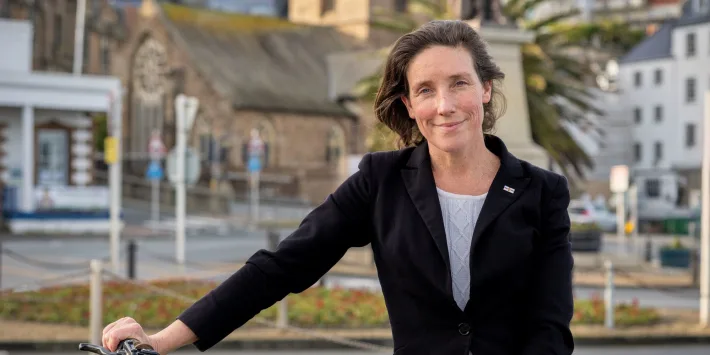
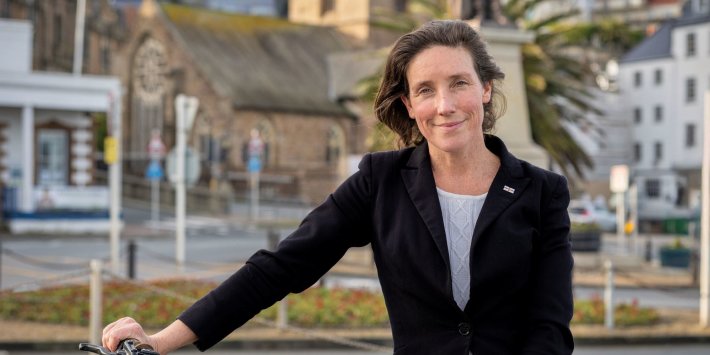
Lindsay de Sausmarez, chief minister of Guernsey (Langlois Photography)

9 min read
Lindsay de Sausmarez is head of Guernsey’s government. She tells Noah Vickers about the island’s demographic challenge, the impact of Brexit and Westminster’s demand for more financial transparency
“This is my personal theory: I like to think it’s down to our exceptional milk,” says Lindsay de Sausmarez, chief minister of Guernsey. “We have very good milk here – the best in the world.”
The island’s people, de Sausmarez explains, are living longer. Life expectancy in Guernsey is 82 for men and 85 for women, respectively three and two years longer than the UK.
With that trend come social and economic challenges to which de Sausmarez has been charged with responding.
The 48-year-old mother of four, who has a background in the creative industries, was elected to the island’s parliament, the States of Guernsey, in 2016. Like most of her colleagues, she is an independent and is reluctant to put a label on her ideology, saying it is “very difficult to overlay Guernsey politics over the UK system”. Online quizzes, however, tend to place her “bang in the middle” of the political spectrum.
In the summer of last year, de Sausmarez made history by becoming Guernsey’s first female chief minister. Officially, her title is President of the Policy and Resources Committee, as Guernsey’s government does not have a cabinet system and instead operates through committees.
“To be completely honest, it wasn’t a role I’d been eyeing up at all,” she tells The House. “I’d been very happy in my previous role, but we have a system where we go where the parliament thinks you can do the most good.”
Her elevation to the top job comes at a critical chapter in Guernsey’s politics, as she and her colleagues grapple with a health system in need of financial reform, a lack of affordable housing and unsustainable tax arrangements.
Guernsey, like Jersey and the Isle of Man, is a Crown Dependency, meaning it is not part of the UK and is almost entirely self-governing, with no MP representing it in Westminster. The UK is responsible only for its defence and international relations.
Guernsey, therefore, is not part of the NHS, and islanders must pay for primary care such as GP visits, prescriptions, A&E treatment and ambulances. Secondary or specialist care is covered by the public purse. According to a BBC analysis, the average cost of seeing a GP in Guernsey is £73.
But with the ageing population, de Sausmarez’s government has warned that “health and care services risk becoming overburdened and financially unsustainable”. The States of Guernsey will agree a new funding model over the current parliament.
Insurance-based systems of the kind used in some EU countries will be examined as part of that work, she says, as will elements of the UK’s system, while acknowledging that Guernsey is “never going to be able to directly replicate” how the NHS works.
“We are very fortunate in that we don’t have many of the problems that are experienced in the UK system,” de Sausmarez points out.
“For example, there was quite a wonderful complaint a month or two ago, where someone complained that they had to wait up to 15 minutes in A&E to be seen. There are many in the UK’s health system who would give their right arm for problems like that.”
Getting more homes built is another priority: “Unlike a town of a similar size in the UK, you can’t just jump on a train to commute in, so we have particularly high housing costs here because space is at an absolute premium.”
The average price of a home in Guernsey is almost £600,000. The island’s government has pledged to commence development at a site it owns called Leale’s Yard, with capacity for more than 300 new properties.
[Brexit] was frustrating for us, because we had no say in the referendum
Brexit has also brought challenges. The Crown Dependencies were never formally part of the EU but were deeply enmeshed in it as they belonged to the bloc’s customs territory. They also enjoyed free movement of goods with Europe, albeit without the single market’s other three freedoms of movement relating to people, services and capital. With the UK’s departure, those arrangements ceased.
“It was frustrating for us, because we had no say in the referendum that led to us [feeling those impacts],” de Sausmarez says. “But it affected us very materially. We’ve had to devote very significant resource to adjusting to a post-Brexit world.”
Should the Crown Dependencies have been given a vote in the referendum, as the British Overseas Territory of Gibraltar was?
“I think many people would have welcomed a vote, because it did affect us so much,” the chief minister replies. “But we didn’t, and there’s no point in dwelling in the past.”
Gibraltar, which was allowed to vote because it was fully part of the EU, plumped for remain by 96 per cent. Would the result have been similar in Guernsey?
De Sausmarez “wouldn’t like to speculate” on that, though from personal conversations she had at the time, she thinks islanders’ views on the issue fell “quite stereotypically along generational lines”.
She adds that Guernsey was “as well-prepared for the result of that vote as we possibly could have been” and points out that Brexit also has brought some benefits.
“We now have control of our territorial waters up to 12 nautical miles. That’s a very helpful thing in terms of our offshore wind and our marine renewable energy aspirations.”
Guernsey has nevertheless taken a “very keen interest” in the UK-EU reset negotiations and has made clear to the UK government that it wants to be included if a youth mobility scheme is agreed.
The island’s tax system, meanwhile, is overdue for reform. Guernsey has no VAT, no inheritance tax and no capital gains tax. Income tax is set at a flat rate of just 20 per cent.
For several years, the island’s government has been spending more than it receives in revenues and has relied on historical reserves to deliver public services. With financial pressures expected to “only intensify”, the States of Guernsey has committed to agree and implement “a final decision” on a future tax regime before the island’s next election.
“There’s long been a recognition, for the most part, that we do need to put our public finances on a stronger and sustainable footing,” de Sausmarez says.
“It’s really a question of how it’s done, and that’s where the political rubber hits the road. It’s a very difficult one. No one, ultimately, wants to pay more tax – that’s just human nature.”
Guernsey remains an attractive location for offshore banking and fund management. Is it fair to call the island a ‘tax haven’, as many in the UK would see it?
“It’s not in any way accurate at all,” de Sausmarez replies. She accepts the island is a “low-tax jurisdiction”, but when it comes to suggestions of financial crime she points to an evaluation last year by Moneyval – the Council of Europe’s anti-money laundering body – which awarded pass ratings to Guernsey in six out of 11 categories.
While the report praised Guernsey for its implementation of targeted sanctions against the financing of terrorism and weapons of mass destruction, it warned the island’s government that “fundamental” work was needed to improve the way it investigates, prosecutes and convicts money laundering offences.
De Sausmarez insists her government is “actively investing” in such improvements and takes the issue “very seriously”, while acknowledging that small jurisdictions like Guernsey will always face an “inherent challenge with the rate of prosecutions”.
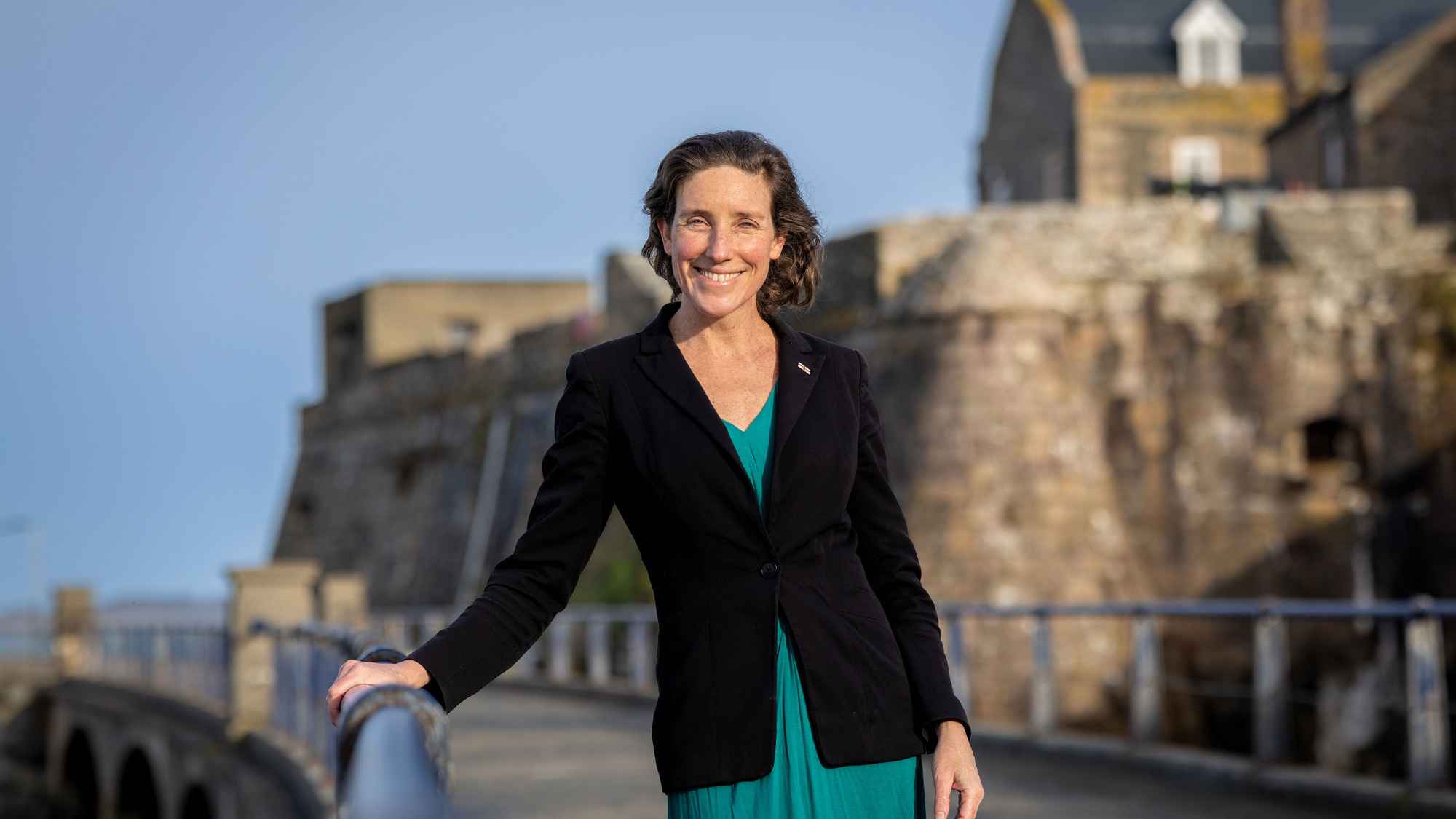
In Westminster, meanwhile, Labour is heaping pressure on the Crown Dependencies to be more transparent about the ownership of companies registered in the islands. None of the dependencies have publicly accessible ‘registers of beneficial ownership’, which has become a growing source of frustration for the UK.
In its 2025 Anti-Corruption Strategy, the UK government said it expects the islands to introduce “broad and inclusive” access to the registers for those who have a “legitimate interest” in viewing them – such as journalists, academics and civil society organisations. The UK says it “anticipates” that the dependencies will have introduced this change by July this year, and that this will merely be an “interim step” towards fully publicly accessible registers.
The States of Guernsey will soon launch a consultation on how that interim change could be implemented.
Is de Sausmarez confident of Guernsey meeting the July deadline? “We can make it happen, but [not] until we’ve carried out the consultation. It’s really important that it’s workable – that’s why we’re undertaking a consultation – but we’re very much hoping to make it happen as quickly as we possibly can.”
She adds that the issue was discussed “in some detail” with Justice Secretary David Lammy at a meeting in December 2025.
According to a briefing note from the island’s government, shared with The House, Guernsey “has repeatedly expressed concern about the UK government’s suggestion that legitimate interest access to beneficial ownership registers should, in its opinion, be fully implemented by July 2026”.
It adds that while Guernsey “shares the objective of the UK… in seeking to fight all forms of financial crime”, the UK government should “continue to respect the constitutional status of the Crown Dependencies and avoid attempting to take unilateral actions which seek to impose UK parliamentary decisions or will upon Guernsey”. Failure to do so “would cause unprecedented constitutional problems”, it warns.
The matter is certain to be discussed at the UK’s Countering Illicit Finance Summit in June this year, just weeks before the July deadline.
As far as full public access to the registers is concerned, meanwhile, a spokesman for neighbouring Jersey tells The House that such a move “would not be compatible with Jersey’s international obligations, including those enshrined in its domestic laws”.
The Crown Dependencies point to a 2022 decision by the European Court of Justice, which found public registers to be incompatible with the rights to privacy and the protection of personal data.
De Sausmarez stresses, too, that Guernsey’s register of beneficial ownership has higher standards of verification and due diligence than the UK’s, and that full public access to it cannot be introduced on a whim.
“We’re not trying to hide anything,” she says. “We’re just trying to make sure that it actually works, because you can’t pick up something from another jurisdiction with a very different system, superimpose it on ours, and expect it to work.”
Responding, a Home Office spokeswoman tells The House: “As responsible international financial centres with close ties to the UK, the Crown Dependencies have an important role in championing high standards globally to reduce illicit finance.
“Our approach is collaborative and focused on practical delivery. The Anti-Corruption Strategy sets expectations, and we are working through them together.”


According to Alzheimer’s Research UK, around 982,000 people are estimated to be living with dementia in the UK.and this number is expected to rise to 1.4 million by 2040
Additionally, one in two of us will be affected by dementia in our lifetime. Either by caring for someone with the condition, developing it ourselves, or both.
Now, a new study published by the American Academy of Neurology has found that a decline in thinking skills and memory can be staved off by regularly reading and writing.
Dementia risk reduced by 40% for those who regularly read and write
Tracking data from 1,939 individuals over the course of 8 years who did not have dementia at the start of the study, the researchers reviewed the participants’ childhoods, looking at factors such as access to encyclopaedias, globes, atlases, and books, whether they were read to, or if they learned a language.
They also looked at later in life factors such as income levels, access to reading materials, library memberships and enriching, educational activities such as museum visits.
What the researchers found was that those with the highest levels of lifetime learning developed Alzheimer’s disease five years later than those with the lowest amount.
Study author Andrea Zammit, PhD, of Rush University Medical Centre in Chicago said: “Our findings are encouraging, suggesting that consistently engaging in a variety of mentally stimulating activities throughout life may make a difference in cognition.
“Public investments that expand access to enriching environments, like libraries and early education programs designed to spark a lifelong love of learning, may help reduce the incidence of dementia.
“Our findings suggest that cognitive health in later life is strongly influenced by lifelong exposure to intellectually stimulating environments.”
What a great reason to get involved with the free learning available to us in the UK! Museums are free throughout the UK and a library membership can bring physical, audio and e-books into your life at no cost.

Jim Ratcliffe is a rank hypocrite who abandoned the UK to stash billions offshore. The co-owner of Manchester United football club moved his tax residence to Monaco during the Covid pandemic to dodge an estimated £4bn in tax. He now lives as a tax exile whilst claiming the UK is ‘colonised’ by immigrants.
A billionaire who moved his tax residence to Monaco during the pandemic so he didn’t have to give his money to hospitals, schools, and public services?
Spare me. https://t.co/gN5KEckEPm
— Ash Sarkar (@AyoCaesar) February 11, 2026
Oi Ratcliffe – you can’t complain about a system you don’t pay into
Complaining about the 9 million people on benefits is a bit rich coming from a guy who enjoys the benefits of the UK system but doesn’t pay into it.
His move to the the French Riviera in September 2020 was heralded by his time screaming about the benefits of Brexit. He possibly moved because we forced him to pay £110m in tax in 2019.
You might be surprised to find out that Jim Ratcliffe was one of them.
Weird that, innit. pic.twitter.com/4hvrIm7yix— Simon Gosden. Esq. #fbpe 3.5% 🇪🇺🐟🇬🇧🏴☠️🦠💙 (@g_gosden) February 12, 2026
By moving his assets and his residency, the slimy knight of the realm ensured that his wealth stays in his pockets. Untold millions remain with one single man, rather than going back into the UK and funding essential services such as schools and hospitals. This didn’t stop Ratcliffe from telling Sky News that the UK is “costing too much money”.
Manchester United fans all over the UK have called out the club’s owner for being an absolute tool:
Millionaire, “I am not a racist BUT, wankers” living in Dubai to avoid tax, defending a billionaire wanker living in Monaco to avoid paying tax, and who is making numbers up to make racist comments
I am sorry @ManUtd but Ratcliffe’s comments shame our club. It’s not who we are pic.twitter.com/REyMKS5BHr
— Cantona & Best (@bestcanton7) February 12, 2026
The club has now distanced itself from Ratcliffe’s position:
BREAKING: Manchester United very politely chucking their owner under a large bus. https://t.co/6QzmFbZjm4
— Piers Morgan (@piersmorgan) February 12, 2026
Ratcliffe also claimed the UK population has surged to from 58 million to 70 million since 2020. This, he said, is due to immigration.
Ratcliffe is presumably better at counting his money than this.
His bizarre claim that the UK population grew by 12m between 2020 and 2025 is a fourfold exaggeration. His starting point, that our population was 58m in 2020 is out by 25 years. His claim that 9 million people are… pic.twitter.com/SYrJkCTvL5
— Dale Vince (@DaleVince) February 12, 2026
This is a blatant and racist lie. The Office for National Statistics confirms the population was 67.1 million in 2020. It had risen to 69.5 million by late 2025.
Pay up or shut up
Ratcliffe needs to concentrate less on immigration into the UK and more about his own shit. This man pays absolutely zero into the UK economy. He’s moved all of his cash offshore, so why is he commenting on the country costing too much?
Until he pays his share, he will continue to consciously deprive UK services such as the NHS of much needed money, driving people further into poverty for the sake of his own personal wealth.
It’s not immigrants that are the problem.
Featured image via The Canary
The political and media establishment are clearly desperate to put a spanner in the Green Party’s massive surge since the election of current leader Zack Polanski. The part’s firm stance against Zionism has become central to this. And the establishment’s latest scramble to smear Greens for opposing Israel’s genocidal settler-colonial project in Palestine seems unlikely to be successful.
Green Party “Zionism is Racism” motion attracts smears
There have historically been different strains of Zionism — the Jewish nationalist movement behind the colonisation of Israel. But the dominant form today is a supremacist extremism that empowers racism, apartheid, and genocide. Zionism is not Judaism, no matter how much Israel’s leaders and cheerleaders want to blur the line.
Now, Green members are campaigning for a spring conference motion that seeks to acknowledge that “Zionism is Racism” and declare the party as “an Anti-Zionist Party.” They also seek a rejection of cynical attempts to “equate anti-Zionism with antisemitism” in order “to silence legitimate criticism” of Israel.
The motion is fundamentally about equality, freedom, and democracy. And if it passes, author Matt Kennard says:
This will be a watershed moment in British politics.
Israel’s genocide in the occupied Palestinian territory of Gaza has fuelled a growing movement to end the apartheid state’s crimes once and for all. And pro-Israel shills know full well that the Greens, under the leadership of a Jewish leader who stands in solidarity with Palestine, are helping to mainstream criticism of Israeli colonialism.
As a result, the smears are intensifying:
Green Party will likely vote to be first major UK political party that is anti-Zionist at its Spring Conference (Motion A105)
This will be a watershed moment in British politics
So the subversion steps up. This absurd article is the beginning
Anti-Zionism is anti-fascism pic.twitter.com/oP9PfM0X0L
— Matt Kennard (@kennardmatt) February 12, 2026
Thanks to strong progressive positions, the Green Party has quickly grown to over 190,000 members in recent months. And it has taken clear positions in support of Palestine under Polanski, like calling for the proscription of Israel’s occupation forces as a terrorist group.
But the party was previously more timid on Palestinian rights. And clearly there are some members still sympathetic to Israeli colonialism. Because one member has now told the historically racist Daily Mail (of all papers) that they reported fellow members to “counter-terrorism police” over the new motion on Zionism.
Green councillor Andrée Frieze, meanwhile, joined with others to criticise the “tone of, and language in, the motion“. But while pro-Israel voices might dislike it, it represents pretty basic progressive positions on Israeli colonialism:
Lubna Speitan—Palestinian Green Party member and a member of the Greens For Palestine Steering Group—has proposed this important motion for the Spring Conference.
I endorse all of it. It should all be Green Party policy. Basic stuff for a progressive party.
Motion A105:…
— Matt Kennard (@kennardmatt) January 26, 2026
Some observers believe this will be a real test for the Greens. But recent positions suggest that the majority of members will indeed lean into even stronger positions that meaningfully challenge Israeli war criminals and their cheerleaders.
Smears feed off timidity
Today, there are still attempts from pro-Israel propagandists to smear anti-genocide campaigners as antisemites. And such voices routinely claim that seeking accountability and consequences for Israel’s genocidal mass extermination of Gaza’s population is somehow “hateful”.
But the widespread pro-Israel smears against the left during Jeremy Corbyn’s leadership of the Labour Party were a learning moment. If you give propagandists an inch, they’ll take a mile. So the best way to challenge them is to call out their bullshit clearly and immediately.
No religious discrimination is ever acceptable. But that’s not what criticism of Israel is about. It’s political, not religious. And the vast majority of Green members have already shown their awareness of that, moving the party to strong positions on the Palestinian people’s right to existence, freedom, and democracy.
The smears will not end. But as long as Greens lean into unapologetic support for human rights and opposition to Zionist racism, the smears will fail. And when the smears fail, the chances of finally holding Israeli war criminals and their cheerleaders to account will increase.
Featured image via the Canary
James Bowes analyses the potential impact of the UK government’s proposed changes to its settlement schemes to both new migrants and migrants already in the UK.
The government’s consultation on its “earned settlement” proposals, which would make it much harder for immigrants resident here for long periods to get Indefinite Leave to Remain (ILR), also known as “settlement”, closed today. As written, and unlike previous immigration restrictions, these new rules won’t just affect new immigrants but will also affect over 2 million immigrants already living in the UK. These changes will force many legal immigrants to leave the country entirely.
What is changing?
Some changes will affect all applicants for ILR. The required English language level will increase from B1 to B2. The applicant will need to earn over £12,570 a year for at least three years. This latter change will make many people on a family visa or work dependant visa ineligible for ILR.
While the baseline period to qualify for ILR has been announced as 10 years, many people will face a wait much longer than this. People with a work visa for a job skilled below a graduate level face a 15-year wait for ILR and refugees face a 20-year wait. People who have entered the country illegally, overstayed their visa or entered on a visitor visa face an even longer 30-year wait. People who have claimed benefits may face an even longer wait.
The qualifying period will remain at 5 years for family of British nationals, BNO visa holders and people working in a graduate level job that either pays over £50,270 or is an eligible public sector job (e.g. doctors, nurses, teachers). It will be shortened to 3 years for people earning over £125,140. Qualifying periods remain unchanged for global talent and innovator founder visa holders.
Who will be affected?
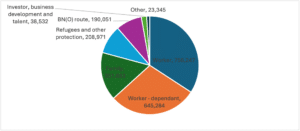
People with a settlement path visa living in the country at the end of 2024 by broad category
Roughly two thirds of people affected by the new rules will be here on a work visa or are the dependant of a work visa holder. Most of the others are on a family visa or are here for humanitarian reasons. Workers, their dependants and refugees will be most affected by the longer qualifying periods. However, everyone will be affected by the tougher language and salary rules.
What will the changes mean for work visa holders?
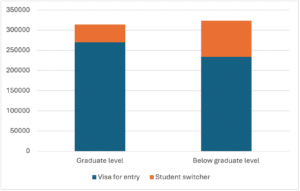
Skilled worker visa grants (including health and care) from 2021 to 2024 split by skill level, visa grants for entry and switchers from a student visa only
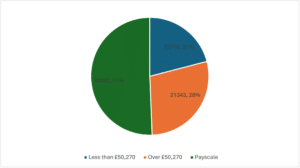
Skilled worker visa grants (including health and care) for graduate-level jobs for entry in 2023. Split by whether the job is on a public sector pay scale or if not, by whether the median salary for the occupation was above £50,270 in Year Ending June 2023.
About half of main applicant work visa holders face a 15-year wait as they are working in a job skilled below graduate level. Most work visa holders working in graduate level jobs will qualify for ILR in 5 years as they are either working in an eligible public sector job or a job paying over £50,270.
However, most dependants of even high-paid workers will face at least a 10-year wait. This is because the dependant themselves will have to earn over £50,270 or work in a public sector job to qualify in 5 years. Most dependants are likely to face a 15-year wait as they are accompanying workers in non-graduate jobs.
Will the changes mean people have to leave the country?
The new rules won’t simply mean a longer wait for ILR. They will mean many people don’t qualify for ILR at all and have to leave the country. Redundancy is much more likely during 15 years on a work visa than it is during 5 years.
Employers may be unwilling to pay the immigration skills charge for 15 years. People on a visa may be unable or unwilling to pay 15 years of visa fees and immigration health surcharge. Many care workers are graduates and so may not want to commit 15 years of their career to working in a care home.
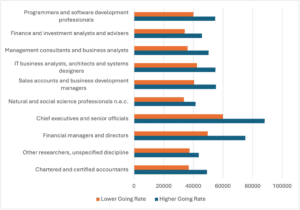
Lower and higher going rates for top 10 non-payscaled high-skilled jobs to illustrate how different the two rates are. NB: Sales accounts and business development managers may be downgraded to medium-skilled.
People who have had a skilled worker visa continuously since before April 2024 currently only have to meet a lower salary threshold and occupational going rate when they renew their visa or apply for ILR. However, these lower rates are currently scheduled to expire in April 2030.
This is a major challenge as both the higher salary threshold (£41,700 compared to £31,300) and the higher occupational going rates are much higher than the lower rates. This means many people, in both graduate and non-graduate jobs, will need a large pay rise to remain in the country, unless the government decide to extend the lower salary threshold and going rates beyond April 2030.
Another challenge for people renewing their visas will be the end of the Immigration Salary List from January 2027 (July 2028 for care workers), that allows a salary discount of 20% for shortage occupations. For visa renewals after this date, the discount to the salary threshold will only apply to visa renewals with the same employer and same occupation.
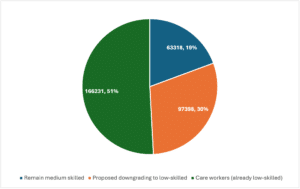
Skilled worker visa (including health and care) grants for entry and to student switchers 2021 to 2024 split by the skill level of the occupation if the proposed changes to skill classification in the Temporary Shortage List review are accepted. Jobs below graduate level only
When a medium-skilled occupation is reclassified as low-skilled, visa renewals are also only possible if they’re with the same employer and the same occupation. Visa renewal for the occupations downgraded to low-skilled in April 2024 will only be possible until April 2030.
Care workers are already considered a low-skilled occupation, only eligible for a visa due to their appearance on the soon to be abolished Immigration Salary List. A further 30 occupations may be reclassified as low-skilled following an updated evaluation of the skill level of jobs; it is unclear what transitional arrangements will exist for visa renewal in these occupations. If the changes are accepted, most people on the 15-year route to settlement would be working in jobs now considered low-skilled.
Unless the proposals are changed to address these challenges, many visa holders will be bound to one specific employer and occupation and only able to renew their visa if that employer is willing to pay a higher salary and visa fees. This will be a particular problem for people employed by exploitative or fraudulent employers. It may not even be possible to renew a visa for some low-skilled occupations.
Conclusion
Over 2 million people will face much tougher requirements to remain in the country than they expected when moving here. The majority are people who came to work. Over half of work visa holders and most dependants face a longer wait to be eligible for Indefinite Leave to Remain. During this time, they will face ongoing visa fees and other charges, and their immigration status will remain insecure. Many will be forced to leave the country entirely. The government claims that this is not the objective – if that is true, then it will need to introduce far-reaching transitional protections.
By James Bowes, Space Management Assistant, Strategic Planning and Analytics, University of Warwick.

A Labour minister humiliated a Reform politician on BBC Question Time by describing the party as a “retirement home for failed Tories”.
Nadine Dorries – a former Conservative MP, ex-culture secretary and strong ally to Boris Johnson – defected to Reform last September, claiming the Tory Party was “dead”.
When discussing a question about climbing house prices in Bristol, Dorries acknowledged that the Conservatives had also failed to reach their housing targets when in office – and predicted Labour will also miss their 1.5 million new homes goal.
Dorries, now a Daily Mail columnist, claimed the problem was the “two main parties cannot lead the country”, adding: “That’s why I went to Reform.
“It’s time for a party that is going to be absolutely radical, that is going to bring forward change, that is going to change this, introduce growth, and change this housing.”
Defence minister Luke Pollard replied: “I don’t think you can have a new party when you’re just a retirement home for failed Tories.”
Amid widespread applause and laughter from the audience, he added: “That’s not a new party Nadine, it’s not.”
Dorries replied: “You can’t make that accusation without me coming back. Reform is the party of hundreds and thousands.
“That’s the difference between me and you. We’re a proper grassroots party of hundreds of thousands!”
Reform currently has eight MPs, with each one – including Nigel Farage – being a member of the Conservative Party at some point.
A total of 27 former Tory MPs have defected to join the rising right-wing party so far, including Dorries, ex-home secretary Suella Braverman and former Tory frontbencher Robert Jenrick.
According to Best for Britain’s tracker, Tory defections to Reform rose by 462% in 2025 compared to 2024 with 81 serving Reform councillors previously holding office for the Tories.
Politics
Bernard Argente: Badenoch needs to ask herself whether her MPs trust her or she distrusts her MPs
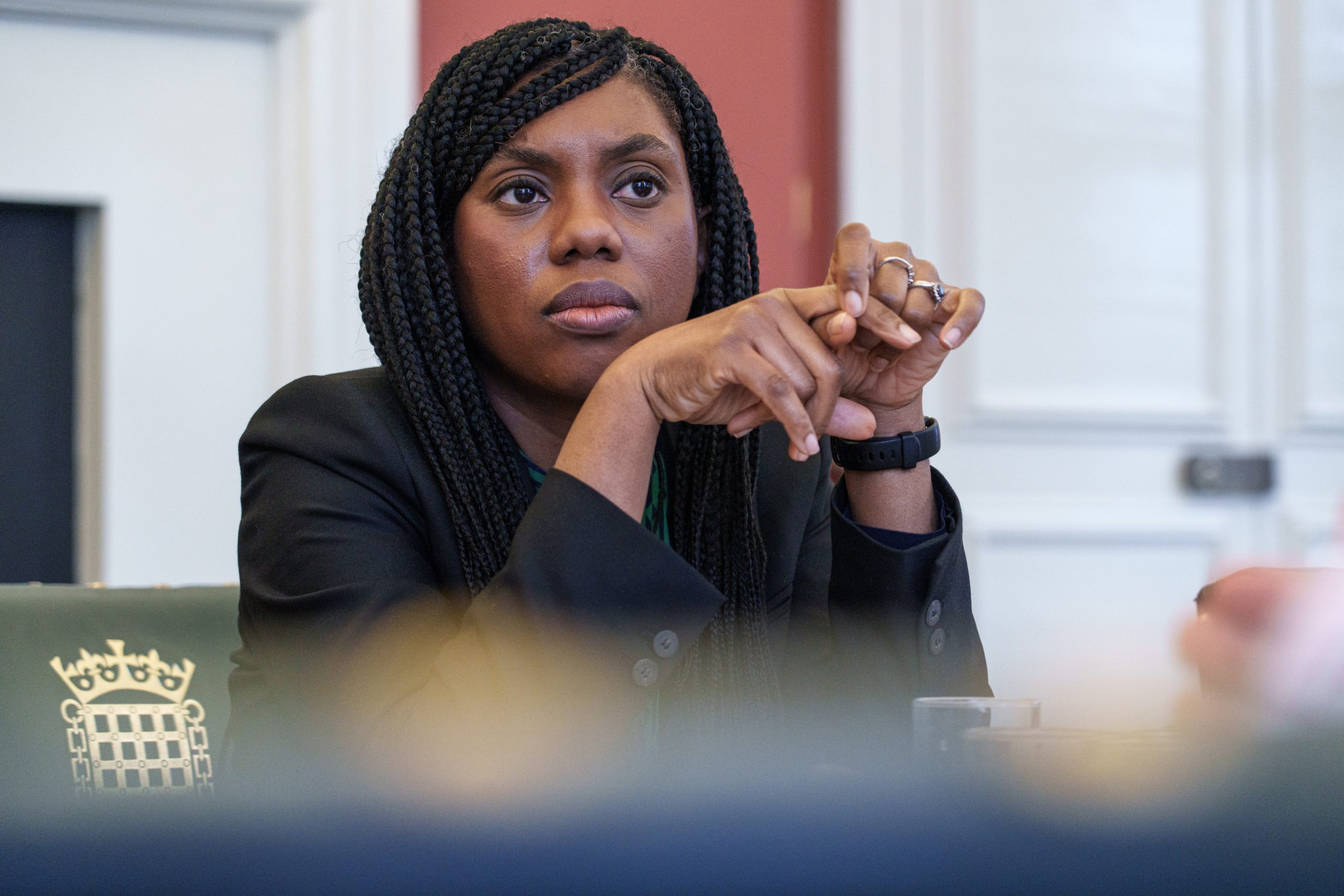
Bernard Argente writer, student, and parliamentary researcher who assisted Richard Tice and his staff.
What happens when a politician defects to another party? Or perhaps a more apt question to ask may be: does such a politician have a choice?
In the case of former Shadow Justice Secretary Robert Jenrick, he may have played the part of the Roman politician Brutus in the veritable play of this Parliament’s debacle.
After being sacked by Conservative leader Kemi Badenoch, Robert Jenrick defected to Reform UK last month, leaving the vast majority of Kemi’s cabinet with the sentiment: Et tu, Jenrick?
But did he orchestrate it, or did the morning sacking entail a predestined chain of events?
Oedipus Rex by Sophocles tells the story of an ill-fated protagonist, Oedipus, who unwittingly fulfils a prophecy, ergo killing his father. In our scenario, our central figure, Robert Jenrick, has rebelled against his leader, which may have been a response to the sacking, which functioned as a catalyst to a series of events which turned to realise Badenoch’s qualms.
Had the Leader of the Opposition not doubted her Secretary, Reform might not have received another heretic in its arsenal. It is imperative for the Conservative Party, with its policy of curtailing turncoats, not to ostracize suspected members as if it were a witch hunt.
The Conservative Party has flourished hitherto Benjamin Disraeli in its conglomerated and immovable community, in which it cannot be compartmentalized. Notwithstanding, the vitality of the Conservatives is indirectly proportional to Reform’s.
Members must not stay neutral, as it would be like when the angels of God who chose to remain neutral were banished to the Antechamber, as Dante’s Vergil put it: “These are individuals who refused to take a stand in life, choosing neither good nor evil.”
The Conservatives will never need Reform, even when it ostensibly seems that way. It is, however, Reform that needs the Conservatives! Just as in George Orwell’s Nineteen Eighty-Four the Ministry of Truth tried to change historical records and newspapers, Reform’s ex-Tory MPs will try to hide their past tweets lambasting Reform leader Nigel Farage, but the truth will remain static and the same.
“Britain is not broken”, wrote Kemi as a riposte to Jenrick’s statements. The leader of the Opposition has made this loss appear to be a victory akin to removing a parasite leeching off a host, but to Farage he has interpreted this as another man’s trash is another man’s treasure!
Whilst Badenoch had indeed been acting reflexively to ‘damning reports’ on Jenrick, it predicted a wave of other prominent Conservative MPs following Jenrick in kind, notably Andrew Rosindell, who defected to Reform UK primarily due to what he believes to be Chagos deal mismanagement and what he describes as the ‘surrender’ of British territory and Suella Braverman, who’d long been on the list of suspects.
The Conservative Party is believed to have identified several other MPs who may potentially defect to the Reform UK Party.
This list consists of several important names, Sir John Hayes, Esther McVey, Mark Francois, and Sir Desmond Swayne, and also entails nascent MPs such as Katie Lam and Bradley Thomas. This begs the question of whether Kemi has rooted out traitors upon traitors or if she has labelled them traitors, which is the role they must fulfil at the end of the play. Chekhov’s gun is a literary device derived from the Russian playwright. The device acts as a gun set in a play, and for it to be introduced, it must be fired. The Tory leader has cast herself a veritable gun in this play, and now that she has shot the villain, it signifies a posthumous warning to other MPs with the notion of treachery to not entertain those feelings.
But the question remains: Did Jenrick appoint himself the villain in Kemi’s story, or was it an unfortunate circumstance in which he had to play the cards he had been dealt? In the fullness of time, we may learn if this will have a domino effect on other MPs. But what is clear to Farage is that even if Kemi regards this situation as “Nigel Farage doing my spring cleaning”, Farage, on the other hand, thanks her for what he believes to be a late Christmas gift.
Badenoch must not follow the same philosophy Labour has with its divided branches, as it weakens the party to an attack from the outside. She must also understand the party’s ordeal to be analogous to a chess game—where her MPs are her pieces, and to sacrifice them blatantly or, worse, hand them to a rival party is blundering the game.
Kemi must ask her party the question: Is it the party not trusting her, or is it her not trusting her party?

Despite the first film picking up a whopping 10 nods last year – including Best Picture and acting nods for its two leads – part two of the Broadway adaptation was completely overlooked by the Academy.
Michelle Yeoh, who plays the treacherous Madame Morrible in both films opposite Cynthia Erivo and Ariana Grande’s Elphaba and Glinda, has now shared her twopence on the snub.
“I am in shock! I really am,” she told Variety before speculating about why Wicked was overlooked this time round.

She offered: “I think sometimes the problem is that people think, ‘Oh, you already got so much with the first one, let other people have a chance’. But then it feels like, ‘No, come on!’
“It’s such a beautiful, well-made movie. Paul [Tazewell] for costume design, hair and makeup. If you compare it [with other contenders at the 2026 Oscars] it should be there.
“For Jon Chu, for [director of photography] Alice Brooks, for the set design. It’s not [a] replica of the first one. It’s more elaborate and there are many more new destinations in Wicked: For Good. So I was truly, truly very disappointed.”
While the first Wicked movie won critics over, the reception was more scattered for 2025’s follow-up, with some questioning whether director John M Chu’s decision to split the adaptation over two movies paid off.
That didn’t stop people from seeing it in their droves though, as Wicked: For Good beat its own box office record and became the biggest international opening for a stage musical adaptation.
Meanwhile, Michelle famously won the Best Actress Oscar back in 2023 for her role in Everything Everywhere All at Once, becoming the first Asian performer to scoop the award.
This year’s nominations fall heavily in favour of Sinners, with Ryan Coogler’s vampire horror making history as the most-nominated film ever thanks to an impressive 16 nods.

The High Court has just ruled that the government’s ban of Palestine Action under terrorism legislation is unlawful.
While the ban remains remains in place for now, it is a major victory to campaigners who have long opposed the decision.
MPs voted to proscribe Palestine Action as a terrorist organisation in July.
The drastic move came after the group targeted an Israeli defence company’s UK base and an RAF centre.
But the move to proscribe Palestine Action has sparked significant backlash from the left, especially amid Israel’s devastating ground offensive in Gaza.
Regional friction spiked when Palestinian militant group Hamas attacked and killed 1,200 people on Israeli soil on October 7, 2023, taking a further 251 hostage.
Israel then launched a military campaign in Gaza. The estimated death toll now exceeds 70,000 Palestinians, according to local health authorities.
While a ceasefire is currently in place, Gaza remains in a humanitarian crisis.
Thousands of people have been arrested since Palestine Action was proscribed last July for showing support for the proscribed group.
Here’s what you need to know.
What Is Palestine Action?
Palestine Action is a pro-Palestine organisation which describes itself as a “direct action movement committed to ending global participation in Israel’s genocidal and apartheid regime”.
It aims to target “corporate enablers of the Israeli military-industrial complex”.
The group’s main target is “Elbit Systems” which is reportedly Israel’s biggest weapons producer.
Its website says: “We do not appeal to politicians or anyone else to create the necessary changes, as we understand the depth of complicity within most global institutions.
“Rather than begging those who are complicit to gain a moral compass, we go straight to the source and shut down the production of Israeli weapons.”
It was set up a few years ago, before decades of tension between Israelis and Palestinians reached fever pitch in autumn 2023.
What Did Palestine Action Do?
The group has been accused of entering an RAF base, Brize Norton in Oxfordshire, on June 20, and spraying two aircrafts with red paint.
The action was condemned by Keir Starmer at the time as “disgraceful”.
Four people were subsequently arrested, and a security review was launched across the “whole defence estate”.
A further two people were arrested on suspicion of criminal damage on Tuesday, July 1, after Palestine Action claimed it had blocked Israeli defence firm’s UK site in Bristol.
Activists said they had covered it in red paint to “symbolise Palestinian bloodshed”.
The government had already put forward its proposals to proscribe Palestine Action by the time of the second incident.
MPs then decided to proscribe the group last summer, by 385 votes to 26.
What Does It Mean To Be Proscribed?
Once the proposal is passed into law, supporting the group will become a criminal offence.
Anyone who is a member or expresses support for the group could face up to 14 years in prison.
Security minister Dan Jarvis told MPs at the time that this will not stop protesters from expressing support for Palestine.
He said: “Palestine Action is not a legitimate protest group.
“People engaged in lawful protest don’t need weapons. People engaged in lawful protest do not throw smoke bombs and fire pyrotechnics around innocent members of the public.
“And people engaged in lawful protest do not cause millions of pounds of damage to national security infrastructure, including submarines and defence equipment for Nato.”
A Palestine Action spokesperson said last summer: “While the government is rushing through parliament absurd legislation to proscribe Palestine Action, the real terrorism is being committed in Gaza.
“Palestine Action affirms that direct action is necessary in the face of Israel’s ongoing crimes against humanity of genocide, apartheid, and occupation, and to end British facilitation of those crimes.”
Why Was There So Much Backlash By The Decision?
There were concerns that the legislation to proscribe Palestine Action was grouped together with two white supremacist groups – Maniacs Murder Cult and Russia Imperial Movement – to help it pass.
Some MPs warned that proscribing the group would undermine basic freedoms.
Ten-Labour MP Zarah Sultana, who is now a Your Party MP, slammed the government’s move, saying: “To equate a spray can of paint with a suicide bomb isn’t just absurd, it is grotesque.
“It is a deliberate distortion of the law to chill dissent, criminalise solidarity and suppress the truth.”
Other MPs pointed out that the vote in the Commons took place on the 97th anniversary of women being granted equal suffrage.
Labour’s Kim Johnson accused parliament for banning Palestine Action “for using tactics once seen in the Suffragette struggle”.
Meanwhile, the head of Human Rights Watch in the UK, Yasmine Ahmed, said proscribing the group was a “grave abuse of state power and a terrifying escalation in this government’s crusade to curtail protest rights”.
She added: “We expect this of authoritarian regimes like Russia or China, not a country like the UK that professes to believe in democratic freedoms.”
What Did The High Court Say?
The High Court ruled the ban of Palestine Action under terrorism legislation is unlawful, although it remains in place for now.
That means taking part in Palestine Action activities is still a serious offence.
Three senior judges said that while the group uses criminality to promote its goals, its activities have not crossed the very high bar to make it a terrorist organisation.
But, the judges decided the ban must stay in place until a further hearing later in February in case of a legal challenge.
What’s The Response To The Ruling?
The government said it will appeal the decision. Home secretary Shabana Mahmood said: “I am disappointed by the Court’s decision and disagree with the notion that banning this terrorist organisation is disproportionate.”
She said the government’s proscription “followed a rigorous and evidence-based decision-making process, endorsed by parliament”.
Palestine Action’s co-founder, Huda Ammori, said the ruling was a “monumental victory for both our fundamental freedoms in Britain and in the struggle for freedom for the Palestinian people”.
She said the ban will be remembered as “one of the most extreme attacks on free speech in recent British history”, adding that it would be “profoundly unjust” for the government to go ahead with its appeal.
Lib Dem Home Affairs spokesperson Max Wilkinson also slammed the government’s move.
The MP said: “The Liberal Democrats have argued all along that the proscription of Palestine Action was a grave misuse of terrorism laws.
“Placing Palestine Action in the same legal category as ISIS was disproportionate and risked undermining public trust and civil liberties.
“This ruling does not place anyone above the law. Any individual members of Palestine Action who are accused of serious offences such as vandalism and violent disorder should be investigated, prosecuted, and, if convicted, sentenced accordingly. But these are potential criminal acts and not comparable to the horrors of terrorism.”

Israel continues to perpetrate war crimes against Palestinians in Gaza while denying access to foreign journalists.
Gaza’s media blackout persists
UN Commissioner‑General for Palestine Refugees (UNRWA), Philippe Lazzarini, condemned the “information blackout” and stressed that its lifting is long overdue. He warned that barring independent media fuels misinformation and obscures the truth. This situation remains critical for Gaza.
His statements thrust the issue of press freedoms into the limelight. The continued ban on foreign reporters is an old tactic the settler‑state has used to evade scrutiny. However, this ban is defective in an age of citizen journalism and social media proliferation.
Palestinian journalists, who continue to risk it all, are filling the void. Under these circumstances, social media has also become a crucial avenue for disseminating news. This includes official statements and announcements from Palestinian factions inside Gaza. It also includes mobile recordings documenting Israeli crimes. Indeed, Gaza remains at the core of global attention.
Citizen-journalists enter the fold
That said, when official sources diminish, information circulated on closed and anonymised social media platforms becomes difficult to verify, especially amidst conflicting narratives. The presence of foreign journalists helps document Israel’s violations, its use of illegal weapons, and casualty counting in Gaza.
More than 250 journalists and media personnel have been killed in Gaza since Israel waged its genocidal war in October 2023, according to press freedom groups. This makes it one of the deadliest conflicts for journalists in modern history. They were slain while on duty — carrying out a public service not only to their people but to the world. Calls for investigations into their deaths from international organisations have been relentless. Yet these calls are frequently ignored.
The price Palestinian journalists have paid is not to be taken lightly. They bear the brunt and risk their lives daily. They navigate dangerous conditions, never knowing if they’ll see their families again after a day in the field. Under international humanitarian law, journalists should be protected as noncombatants. And yet Israel continues to target them with impunity, wantonly…anyone surprised? Reporting from Gaza continues to highlight significant challenges.
Truth survives
Lazzarini’s statement reflects a growing concern that continues to be met with indifference, silence, and inaction from many governments and institutions. Additionally, the situation in Gaza remains alarming on the world stage.
Even so, the blackout Israel is desperate to maintain has not prevented the truth from reaching the world — but it does leave a population that continues to defy Israel’s genocide increasingly isolated. Despite this isolation, Gaza endures.
It is our responsibility at the Canary to pierce through the veil of silence and report what is happening behind the lines of fire. This commitment is especially vital in the context of Gaza’s ongoing genocide.
Featured image via the Canary

One of the most touching moments in Sunday night’s Super Bowl Halftime Show saw Bad Bunny sharing a moment with a young boy, before handing him his recently-won Grammy award.
And the directors behind the show have revealed there was a touching detail in this sequence that you might not have even realised.
During a recent interview with Variety, creative director Harriet Cuddeford explained: “The story behind that was Benito’s idea. He’d grown up watching his idols on TV getting awards. In his life now, he stands on stage and gets given awards by his idols.
“He knew the Grammys were coming up, and he was hoping to win something. And then obviously he won Best Album last weekend. And so, he really wanted to inspire the next generation.”

Cuddeford pointed out that the child actor was intended to represent Bad Bunny’s younger self, which is why he was dressed similarly to an old photo of the Puerto Rican singer and rapper as a boy.
“This is really representing a younger version of himself,” she added.
As for the actual award statuette, Cuddeford admitted that she’s not sure whether or not Bad Bunny bothered to get it back once the performance was over.
“Knowing him, he might have just left it with the kid, honestly,” she quipped.
Meanwhile, a widely-shared theory that the child in question was a five-year-old detained by federal immigration agents was debunked shortly after the Super Bowl.
In their joint Variety interview, Cuddeford and the performance’s director Hamish Hamilton have been taking fans behind the scenes of Bad Bunny’s show-stopping performance, lifting the lid on everything that went into making it happen.
Elsewhere in the interview, the duo admitted that not everything actually went to plan on the night, with a couple of mishaps taking place that – fortunately! – no one appeared to notice.
Speed Skater Claims She Clashed With Snoop Dogg’s Security at Olympics

BREAKING: The US Government Just NUKED XRP!? (Shutdown Confirmed)

Taylor Wimpey to launch Fitzwilliam Place in Redcar

Smart energy pays enters the US market, targeting scalable financial infrastructure

Software stocks enter bear market on AI disruption fear with ServiceNow plunging 10%

Wikipedia volunteers spent years cataloging AI tells. Now there’s a plugin to avoid them.


-

 Politics5 days ago
Why Israel is blocking foreign journalists from entering
-
 Sports6 days ago
JD Vance booed as Team USA enters Winter Olympics opening ceremony
-
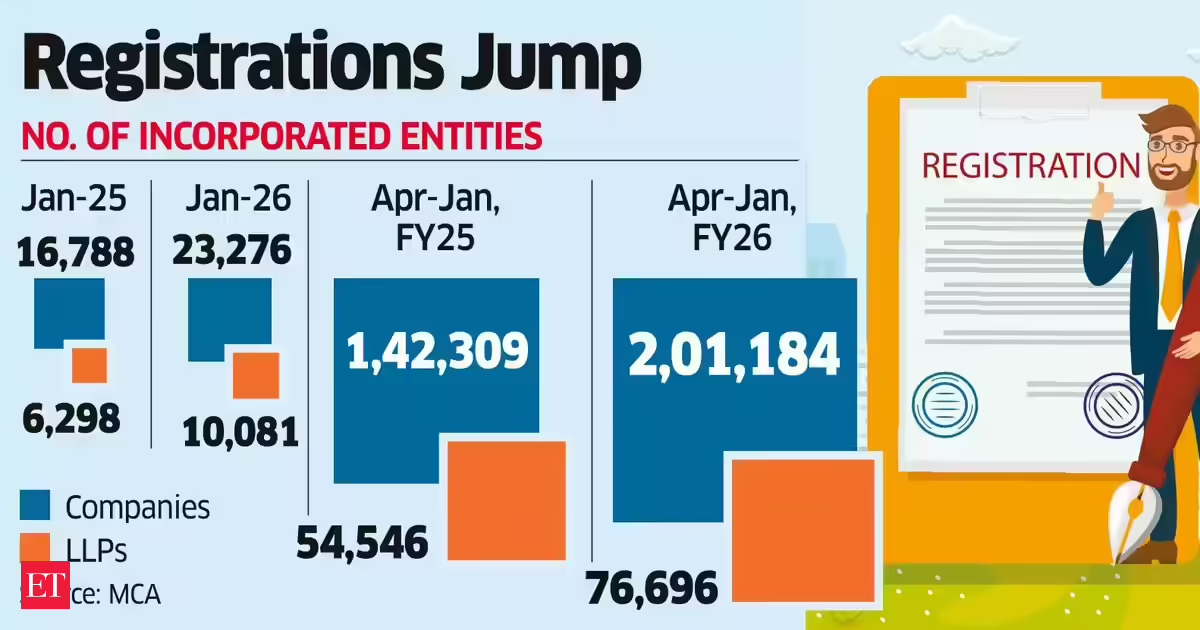 Business5 days ago
LLP registrations cross 10,000 mark for first time in Jan
-

 NewsBeat4 days ago
Mia Brookes misses out on Winter Olympics medal in snowboard big air
-

 Tech7 days ago
First multi-coronavirus vaccine enters human testing, built on UW Medicine technology
-

 Sports2 days ago
Big Tech enters cricket ecosystem as ICC partners Google ahead of T20 WC | T20 World Cup 2026
-

 Business5 days ago
Costco introduces fresh batch of new bakery and frozen foods: report
-

 Tech2 days ago
SpaceX’s mighty Starship rocket enters final testing for 12th flight
-

 NewsBeat5 days ago
Winter Olympics 2026: Team GB’s Mia Brookes through to snowboard big air final, and curling pair beat Italy
-

 Sports4 days ago
Benjamin Karl strips clothes celebrating snowboard gold medal at Olympics
-

 Video2 hours ago
The Final Warning: XRP Is Entering The Chaos Zone
-
Sports6 days ago
Former Viking Enters Hall of Fame
-

 Politics5 days ago
The Health Dangers Of Browning Your Food
-

 Business5 days ago
Julius Baer CEO calls for Swiss public register of rogue bankers to protect reputation
-
 NewsBeat7 days ago
Savannah Guthrie’s mother’s blood was found on porch of home, police confirm as search enters sixth day: Live
-
 Crypto World2 days ago
Pippin (PIPPIN) Enters Crypto’s Top 100 Club After Soaring 30% in a Day: More Room for Growth?
-

 Crypto World3 days ago
U.S. BTC ETFs register back-to-back inflows for first time in a month
-

 Crypto World3 days ago
Blockchain.com wins UK registration nearly four years after abandoning FCA process
-

 Video1 day ago
Prepare: We Are Entering Phase 3 Of The Investing Cycle
-
 NewsBeat4 days ago
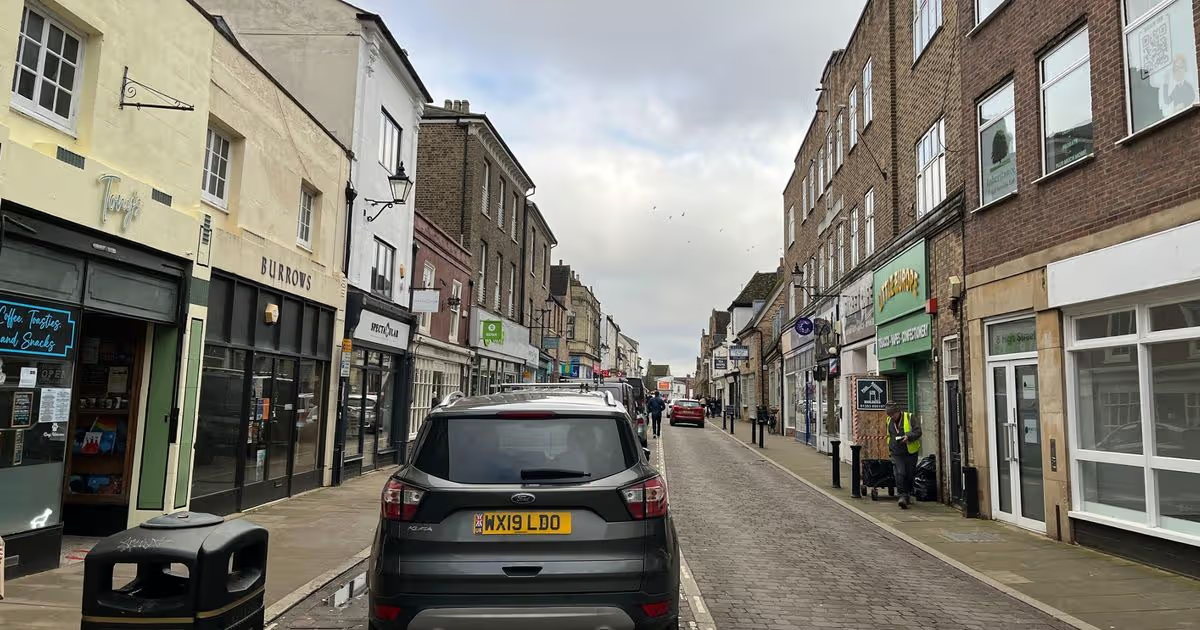
Residents say city high street with ‘boarded up’ shops ‘could be better’