
Politics
The terrorist who claimed asylum


The post The terrorist who claimed asylum appeared first on spiked.



In a football world increasingly shaped by corporate interests, Rayo Vallecano remain defiantly human.
A neighbourhood club that has built its identity on solidarity, resistance, and a fierce loyalty to the persecuted. Their story is not just about football; it is about Vallecas, the working‑class barrio of Madrid that shaped them, and the values their fans refuse to compromise.
Rayo Vallecano, a club built on struggle
Founded in 1924, Rayo Vallecano have always lived in the shadow of their glamorous neighbours Real Madrid and Atlético. Their stadium, the Estadio de Vallecas, sits tightly inside the streets of a district known for labour movements, anti‑fascist organising, and a deep sense of community. That identity has seeped into the club’s DNA.
Rayo’s budget has long been among the smallest in La Liga — just £5.5 million compared to Real Madrid’s £469 million, according to reporting from The Independent. Even in recent seasons, their financial reality has remained closer to a Segunda División struggler than a top‑flight mainstay. Yet the club’s fans, especially the famous ‘Bukaneros,’ have turned that scarcity into a badge of honour. Supporting Rayo is not about trophies; it is about belonging to a cause.
A fanbase that stands with the persecuted
Rayo’s supporters have long aligned themselves with people facing oppression, whether political, social, or economic. Their banners regularly reference anti-genocide, anti‑racism, anti‑fascism, LGBTQ+ rights, and solidarity with global struggles.
The fans wave the flag of Palestine at home games, they regularly produce tifo’s for the support of Palestine. The club even released a rainbow‑striped kit in support of “unsung heroes fighting homophobia,” as reported by CNN
This ethos is not performative, it is lived.
When Ukrainian striker Roman Zozulya, who had been linked to far‑right groups, was set to join the club in 2017, Rayo fans protested so fiercely that the transfer collapsed. Their stance was simple: Vallecas would not welcome anyone associated with extremist ideology. The message was clear, the persecuted are welcome; the persecutors are not.
The story that defined Rayo Vallecano, paying the rent of Doña Carmen
Nothing captures Rayo Vallecano’s soul more than the story of Carmen Martínez Ayuso, an 85‑year‑old woman who lived near the stadium. In 2014, she was evicted from the home she had lived in for 50 years after her son used it as collateral for a loan he could not repay. The images of her crying on the pavement shook Vallecas.
Rayo did not hesitate.
The club announced they would pay her rent and help her find a new home, a gesture that made headlines worldwide. Coach Paco Jémez said:
We won’t stand idly by, We are going to help this woman, not just me, but the coaching staff, the players, the club.
He added: “Within our ability, we will help this lady, so she doesn’t feel alone.”
For a club with one of the smallest budgets in Spain, the act was extraordinary. But for Vallecas, it was natural.
Carmen herself told Marca:
A thousand times thank you, God bless them. It’s a beautiful gesture, Viva el Rayo!
Her gratitude became part of the club’s folklore — a reminder that Rayo’s greatest victories often happen far from the pitch.
Football as a form of resistance
Rayo Vallecano’s identity is inseparable from Vallecas. The fans see themselves as defenders of the barrio’s values: solidarity, dignity, and resistance. Their tifos often show support for Palestine, they reference revolution, their chants echo social justice movements, and their presence at matches feels more like a political assembly than a sporting event.
Images of their supporters, drums emblazoned with skulls, banners reading “Por Nuestro Rayo Revolucionario” truly reflects a fan culture that refuses to be sanitised or commercialise
Rayo Vallecano — A club that punches above its weight
Despite their financial constraints, Rayo have repeatedly survived in La Liga, often playing bold, attacking football. Their recent resurgence under coaches like Andoni Iraola has earned admiration across Spain. But even when results dip, the fans’ commitment does not.
Because for Rayo Vallecano, success is not measured in league tables. It is measured in gestures like helping Doña Carmen, in standing with the oppressed, in refusing to compromise the values of Vallecas.
The beating heart of Vallecas
Rayo Vallecano are more than a football club. They are a symbol of a community that has always fought back, against poverty, against eviction, against discrimination, against indifference. Their fans support the persecuted because they know persecution. They defend dignity because they have had to defend their own.
In an era where football often feels detached from real life, Rayo Vallecano remain gloriously, defiantly human.
Featured image via the Canary
By Faz Ali


In a new interview, the slippery Keir Starmer avoided answering the question when asked if he has his Cabinet’s backing:
— Politics UK (@PolitlcsUK) April 23, 2026
 WATCH: Keir Starmer refuses to say if the Cabinet is behind him amid the Mandelson vetting scandal pic.twitter.com/MWMfmJnDGA
This would be a terrible look for any prime minister. It’s even worse for Starmer, because if he doesn’t have the backing of his Cabinet, he doesn’t have the backing of anyone:
Farage enjoys the highest approval figure (32%), whilst Keir Starmer has the lowest (19%). pic.twitter.com/hevSO4etMq
— Stats for Lefties
 POLL AVERAGE | Net approval of leaders:
 Polanski -8
 Davey -8
 Badenoch -14
 Farage -16
 Corbyn -36
 Starmer -44

 (@LeftieStats) April 3, 2026
Controversy
It’s clear why Starmer lost the backing of his Cabinet. At this point, the scandals are really stacking up:
So we're being asked to believe that Starmer announced the appointment of Mandelson before the security vetting had been completed and didn't then enquire about the vetting at any point subsequently, and according to Darren Jones this means due process was followed at all times pic.twitter.com/WckCGE8rbC
— Saul Staniforth (@SaulStaniforth) April 17, 2026
Just been told by a Minister that there is serious unease in Downing Street tonight that Starmer diverted from his briefing book and went too far in telling the House at PMQs no pressure had been put on any civil servants over Mandelson. “They know that wasn’t true” they said.
— (((Dan Hodges))) (@DPJHodges) April 22, 2026
In the video above, the interviewer asks:
Are you confident the Cabinet is fully behind you?
Starmer answers (and we use the word ‘answers’ loosely here):
The Cabinet is working really hard on a huge amount of issues and what we’re delivering at the moment.
The Cabinet is always working on a huge amount of issues, because they’re the government. If they weren’t working on a huge amount of issues, that would mean something had gone terribly, terribly wrong.
To be clear, the Cabinet being run off their feet is not an argument for the scandal-magnet Starmer to stay in position. The last thing ministers need is to be dealing with his neverending string of cock ups.
Starmer continued:
We’re preparing for the King’s speech and all the further measures that we’re going to need to take the country forward. And, of course, the issue we discuss at Cabinet a lot in recent weeks… is the war on two fronts, the ongoing war in Ukraine and the developing situation in Iran.
What we discuss at Cabinet is the international aspect of that, but also the domestic impact in relation to that and the measures that we need to take to ensure that we’re assessing the risks and making sure we’re protecting people in this country from those impacts.
Yet again, Starmer can’t decide if we’re involved in these wars or not.
He likes to brag that he didn’t allow Trump to drag us into the Iran fiasco when it suits him, but then he talks about facing a “war on two fronts” when he needs an excuse for not fixing problems at home.
Oh, and to be clear – we absolutely are involved in the war on Iran, no matter what the PM does / doesn’t claim.
End of the road for Starmer?
As we reported, it’s obvious why Starmer doesn’t want to say he has the backing of his Cabinet; it’s because he doesn’t:
— Politics UK (@PolitlcsUK) April 22, 2026
NEW: A Cabinet Minister says they have now lost confidence in Keir Starmer and expect the Cabinet to move against him
As one commenter noted:
“Keir Starmer refuses to say if the Cabinet is behind him amid the Mandelson vetting scandal”
Keir Starmer’s Cabinet right now: pic.twitter.com/IBEtzztMnb
— Monique Jolie #PardonAssange
☭ (@moniquejolie) April 23, 2026

We’d like to say Starmer doesn’t have long left, but never underestimate the ability of Labour ministers to dither and delay.
Featured image via X/Twitter
By Willem Moore
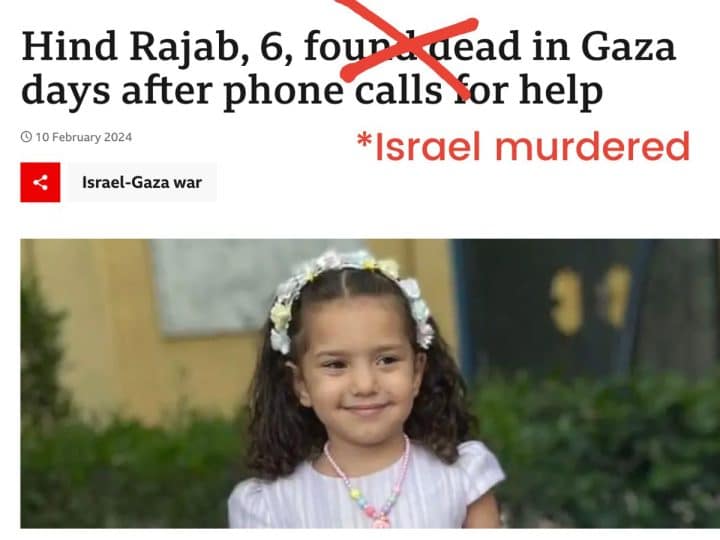

The BBC failed to name Israel as the perpetrator in 50% of reported Israeli attacks on civilians in Gaza.
Other British news outlets were not much better, with Sky News and the Guardian mentioning Israel in only 54% and 55% of cases, respectively. In comparison, the International outlet Al Jazeera named Israel as the attacker in 88% of its articles.
This means that Al Jazeera explicitly names the perpetrator at nearly double the BBC’s rate.
NewsCord analysed 11,295 articles across the BBC, the Guardian, Sky News and Al Jazeera. The aim was to quantify how Western media covered Israel’s genocide in Gaza.
Sanitising Palestinian deaths at the BBC
In 77% of cases, the BBC used the passive voice to report on Palestinians whom Israel murdered. Sky News did the same in 71% of articles.
Use of passive voice when reporting Palestinian casualties:
-BBC: 77%
-Sky: 71%
-Guardian: 67%
-Al Jazeera: 53%The BBC sanitises nearly 4 in 5 Palestinian deaths. pic.twitter.com/vfP1DHjPYD
— NewsCord (@newscord_org) April 23, 2026
One of the most prominent examples is the reporting on the murder of six-year-old Hind Rajab.
The BBC’s headline read:
Hind Rajab, 6, found dead in Gaza days after phone calls for help
But Hind wasn’t just ‘found dead’. The Israeli Occupation Forces (IOF) murdered her, along with her family, in a “brutal act of genocide”. The IOF then fired 335 rounds at the car she was in, and killed the medics sent to save her life.
The BBC completely ignored Israel’s systematic and indiscriminate targeting of civilians in Gaza.
Israeli forces fired 335 rounds at a car, killing Hind Rajab, a 5-year-old Palestinian girl. They killed the medics sent to save her.
The BBC’s headline: “Hind Rajab, 6, found dead in Gaza.”
We analysed 11,295 article excerpts to see how systematic this sanitisation is. pic.twitter.com/1Q31v0YM9C
— NewsCord (@newscord_org) April 23, 2026
Similarly, when reporting on deaths in Palestine, the BBC used the phrase “according to Hamas-run health ministry” in 60% of articles, in comparison to only 1% by Al Jazeera and 17% in the Guardian.
Undermining Palestinian death tolls with “according to Hamas-run…”:
-BBC: 60%
-Sky: 36%
-Guardian: 17%
-Al Jazeera: 1% pic.twitter.com/ZpRcFZlz2V— NewsCord (@newscord_org) April 23, 2026
Importantly, though, the United Nations (UN) consider the figures accurate.
The BBC said that it told complainants it:
regularly reflects that these figures are considered credible by the UN.
However, NewsCord’s analysis showed that the BBC cited the UN’s credibility regarding Hamas figures exactly once. That is 0.6% of the time.
Of course, the BBC did not apply the same rule when it reported on Iranian or Hezbollah missiles killing Israelis. It simply reported deaths as facts.
Humanisation
Additionally, NewsCord analysed how often the four news sites humanised Palestinian hostages, versus Israeli hostages. It also noted that over 3,000 Palestinians are currently being held in Israeli prisons without charge.
The rate of humanisation included details such as names, family and context, and it found that the BBC only humanised 29% of Palestinian hostages, compared to 58% of Israeli hostages.
This means that the BBC is humanising Israeli hostages at nearly double the rate of Palestinian hostages.
Rate of humanisation when covering hostages (names, family, context):
-BBC: 58% Israeli / 29% Palestinian
-Guardian: 79% / 38%
-Sky: 65% / 31%
-Al Jazeera: 56% / 49%Over 3,000 Palestinians are held in Israeli prisons without charge. pic.twitter.com/99Ontv4t75
— NewsCord (@newscord_org) April 23, 2026
Shockingly, the BBC has never reported on various genocidal statements made by Israeli officials.
This included Yoav Gallant calling Palestinians ‘human animals’, Israel Katz stating that Gaza would not receive a drop of water or a single battery until they leave the world, and Bezalel Smotrich saying it was justified to starve two million Gazans.
Similarly, Benjamin Netanyahu referenced Amalek in relation to Gaza. This refers to a bible story in which God commands the total annihilation of Amalek, including all men, women, children, and livestock.
A pattern
The BBC’s bias against Palestine has been widely documented. As the Canary previously reported:
In a report titled BBC on Gaza–Israel: One Story, Double Standards published in June 2024, which critiqued the BBC’s coverage of the Gaza genocide between October 2023 and October 2024, the Centre for Media Monitoring (CfMM) accused the BBC of operating under a framework of ‘double standards’ when covering the Gaza genocide, of systemic bias against Palestinians, and of applying inconsistent editorial standards when covering Israeli and Palestinian experiences of war.
At one point, the BBC dropped a piece about UK and Palestinian kids sharing poetry for ‘impartiality’ reasons – which is absolute bullshit, even for the BBC.
Since 2023, the BBC has systematically attempted to erase the experiences of Palestinians by peddling Israel’s narrative. Anyone who has been paying attention has watched the BBC’s bias play out – but now the figures from NewsCord back up what we’ve all seen.
Is there any wonder Israel continues to get away with genocide and ethnic cleansing when huge media outlets, such as the BBC, continue to whitewash its war crimes?
Feature image via HG
By HG
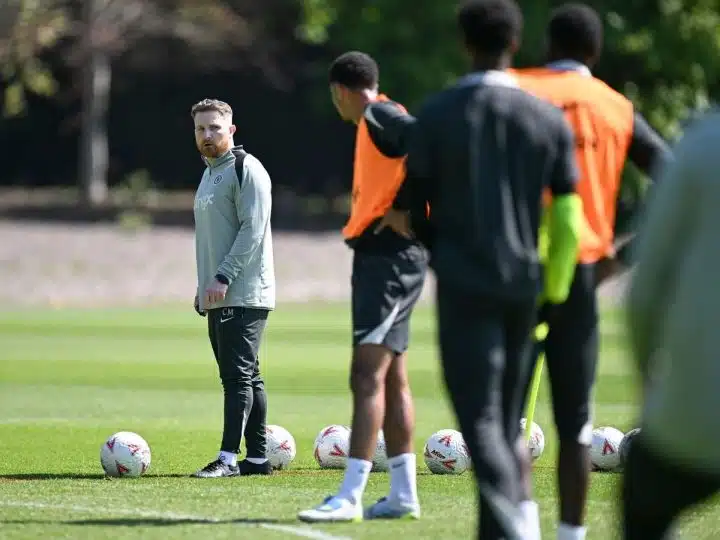

What happens next at Stamford Bridge feels less like a recruitment process and more like the next chapter in a long-running drama — one in which the cast keeps changing but the plot rarely does. Now the question becomes: when and how will Chelsea be pulled out of this quagmire?
The dismissal of Liam Rosenior after just four months — but more importantly just six days after co‑owner Behdad Eghbali publicly backed him — has left Chelsea exactly where they didn’t want to be, scrambling for stability, credibility and direction.
The manner of the Brighton defeat, the players’ visible loss of belief, and Rosenior’s own post‑match outburst made his exit inevitable. But the question now is who steps into a job that has become one of the most volatile in European football.
Chelsea — a club with no obvious plan
The general reporting consensus makes one thing clear, Chelsea are not rushing into a permanent appointment. There is currently, no number 1 candidate, and no appetite to repeat the mistakes of the past two years when managers were hired on long contracts only to be discarded months later.
The club’s leadership, a sprawling structure featuring multiple sporting directors, wants a manager with either Premier League experience or a proven record of success at a high level. That narrows the field, but not by much and with likelihood of no Champions League football next season, the job becomes a harder sell than it once was.
The names in the frame
Even with the current problems Chelsea are facing, certain level of names inevitably rise to the surface.
Andoni Iraola
Available this summer and admired for his work at Bournemouth, Iraola fits the profile: tactically modern, Premier League-proven, and capable of improving young players. But would he walk into a club where managers rarely last a season?
Oliver Glasner
Another coach with Premier League experience, Glasner has impressed at Crystal Palace. His organised, high‑pressing style would appeal to Chelsea’s hierarchy, but prising him away from a stable project may prove difficult.
Xabi Alonso
The most glamorous name on the market, but also the least likely. Alonso will have his pick of Europe’s elite jobs, and Chelsea’s current instability makes this a long shot. Given that there is also a phone call from Liverpool in the pipeline for Xabi.
Marco Silva
If Silva leaves Fulham, he becomes a compelling option: experienced, tactically flexible, and respected across the league. He also has a track record of improving teams without huge spending, something Chelsea may need as they navigate financial losses.
Cesc Fàbregas
The romantic choice. Currently coaching Como, Fàbregas would be a hugely popular appointment among fans. But Chelsea’s hierarchy is wary of appointing a manager without top‑level experience, and there is a belief he may one day be destined for Arsenal.
Beyond these names, Chelsea have previously spoken to Luis Enrique, Hansi Flick, Julian Nagelsmann, Thomas Frank and Roberto De Zerbi. Any could re‑enter the conversation, but the club insists it will not rush.
Chelsea’s structural question
Perhaps the biggest unknown is not the identity of the next manager, but the environment they will walk into. Chelsea’s five‑director sporting structure has been criticised for creating confusion, diluting accountability and undermining managers.
Any new manager will inherit a squad full of talent but short on experience, a fanbase exhausted by upheaval, and a club facing an £80m financial hit if they miss out on the Champions League. They will also have to navigate the futures of key players like Enzo Fernández, who could be sold if a nine‑figure offer arrives.
What the next manager must fix
Chelsea’s season has been a soap opera: the infamous huddle, the mole leaking team news, Cucurella’s barber becoming a storyline, Nicolas Jackson winning trophies at Bayern while his replacement struggled, and the club’s most in‑form centre‑back playing on loan at West Ham. Amid the chaos, one truth stands out: the next manager must restore belief, identity and discipline.
They must also bridge the gap between a young squad and the demands of elite competition. Chelsea plan to add more experienced players this summer — as a “tweak”, not a reset — but the manager will need to mould a coherent team from a group that has looked fractured and fragile.
The bottom line
Chelsea’s next manager will not just be a tactician. They will need to be a stabiliser, a communicator, and a unifier — someone capable of imposing clarity on a club that has lurched from one crisis to another.
The job remains one of the biggest in world football. But right now, it is also one of the most daunting. Whoever takes it on will define the next chapter of Chelsea’s modern era for better or worse.
Featured image via ChelseaFC
By Faz Ali
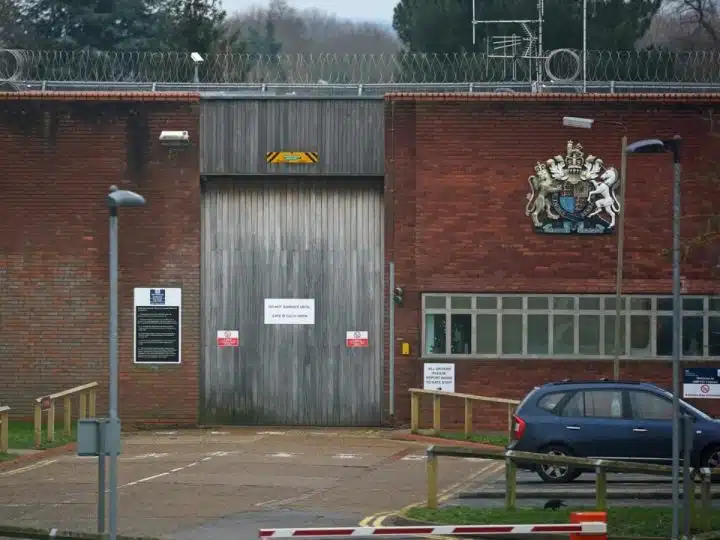

A teenage boy died in custody at Young Offenders’ Institute (YOI) Feltham in West London on 20 April. His girlfriend has told reporters after identifying his body that he had been “beaten to a pulp”. Feltham has been described at the most violent jail in the UK’s already dysfunctional prison system.
A death at Feltham Young Offenders Institute
The Canary was tipped off on 21 April. Feltham staff flatly refused to speak to us, but the Ministry of Justice confirmed the death that evening.
A Youth Custody Service spokesperson said:
We were saddened to hear of the death of a child from YOI Feltham, who died in hospital on Monday 20 April, and our thoughts are with their friends and family.
As with all deaths in custody, the Prisons and Probation Ombudsman will investigate. It would be inappropriate to comment further at this time.
Now more details of the death have emerged. The BBC reported on 22 April:
The London Ambulance Service (LAS) said it was called to the site just after 22:00 BST on Monday to reports of an “unwell child”. The boy was treated at the scene and taken to hospital “as a priority”, where he died.
The Met Police said it was notified of the death in the early hours of Tuesday by HMP Feltham staff. A Youth Custody Service spokesperson said the Prisons and Probation Ombudsman would investigate the death.
The Daily Mail reported that Scotland Yard detectives were treating the death as “unexpected”:
On Tuesday, April 21 at 12.05am, police were notified by staff at Feltham Prison and Young Offender Institute about the death of a boy who had been found unresponsive and later died in hospital.
The London Ambulance Service were called at around 9.30pm on Monday, April 20 and treated the boy, aged 16, before taking him to hospital. He sadly died at 11.43pm.
The Mail also said the individual’s girlfriend, who was not named, had identified his body. They quoted her at length:
His body had been beaten to a pulp, he was covered in scuff marks and bruises.
‘We had to look at him through a glass window, we weren’t allowed to say goodbye properly.
‘We are so confused. We don’t know how he died. He did have a heart condition but it is one that is very rare to die from.
He was a child
She continued:
His mother is completely broken. She was originally told he had died in the prison but then later that it was in hospital so we just don’t know what happened.
He had been in trouble, but he was 16, a child, and should have been protected. He had his whole life ahead of him and planned to go back to college but now he can’t.
It is a complete disgrace that this happened.
Before the story was picked up by legacy media, a source familiar with the matter told the Canary on 21 April:
He had a known heart condition and the other boys are saying he was calling for help (pressing cell alarm) for 45 minutes with no response.
The source said:
All the boys are heartbroken and they have no proper psychological support in there.
According to the BBC and Mail, and as confirmed by the MOJ to the Canary, a post mortem will be carried out in due course.
The MOJ also told us that in cases of this type involving a minor, names are not usually disclosed:
In terms of next steps, as with all deaths in custody the Prisons and Probation Ombudsman will carry out an independent investigation. It is sometimes the case that a name may be published later, for example by the PPO on their website and in their report, or through formal processes led by the coroner.
Adding:
The police and coroner will also oversee the post-mortem and any inquest, which is typically when further details may enter the public domain.
Feltham was described by HM Prisons Inspectorate in 2024 as:
the most violent prison in the country.
The report claimed conditions at the youth jail, which houses offenders aged between 16 and 18, had:
deteriorated significantly since its last inspection, and was characterised by rising self-harm and very high levels of violence.
No child should die in prison
Inquest is an organisation which supports bereaved families following deaths involving the state – including cases like the Grenfell Tower fire and the Hillsborough football disaster. Inquest’s director Deborah Coles told the Canary on 22 April:
No child should be dying in the care of the state, let alone a prison. Our thoughts are with his family and friends.
Coles described some of the shortcomings her organisation had seen:
Away from their families and support systems, locked in their cells for most of the day, with high rates of violence and self-harm, and prison guards now allowed to use PAVA spray, it is clear that imprisoning children will always be harmful and never be safe. This death is a urgent reminder of this.
Adding:
The government must divest money away from punishment and prisons and into community based support services to prevent further death and harm.”
The Canary will bring you more details as they emerge.
Featured image via the Canary
By Joe Glenton


Iran’s state news agency Tasnim has published a map of the undersea cables running through the Strait of Hormuz in an evident warning to the US, Israel, and their enablers of the consequences of continued aggression. Because of the West’s block on access to the site, it can only be accessed via VPN.
Iran is not having it
In a new article carrying a thinly-veiled threat of retaliatory pain, the Iran-based outlet writes:
The concentration of a large number of internet cables in a narrow passage has made the Strait of Hormuz a vulnerable point for the region’s digital economy.
The point wasn’t lost on observers:

Seven major cable systems pass through the Hormuz Strait, including AAE-1, FALCON, TGN-Gulf, ,SEA-ME-WE and Gulf Bridge International. As an example of the scale of disruption any damage to these cables could cause, countries that use AAE-1 include France, Italy, Greece, India, Pakistan, Oman, UAE, Qatar, Yemen, Djibouti, Saudi Arabia, Egypt, Hong Kong, Vietnam, Cambodia, Malaysia, Singapore, Thailand and Myanmar.
The ‘FALCON’ (FLAG Alcatel-Lucent Optical Network) cable system crosses several seas and oceans, including the Atlantic, but the Hormuz stretch connects Egypt, Oman, Bahrain, Saudi Arabia, Kuwait, India and other countries. Tasnim’s article specifically name-checked US enablers in the region – Qatar, Bahrain, UAE, Saudi Arabia and Kuwait.
Around 30% of global internet traffic passes through these cables, with the shallow depth and narrowness of the Strait leaving them clustered and vulnerable. Iran’s ability to flex on countries collaborating with the US-Israel axis is clearly not limited to oil.
Featured image via the Canary
By Skwawkbox
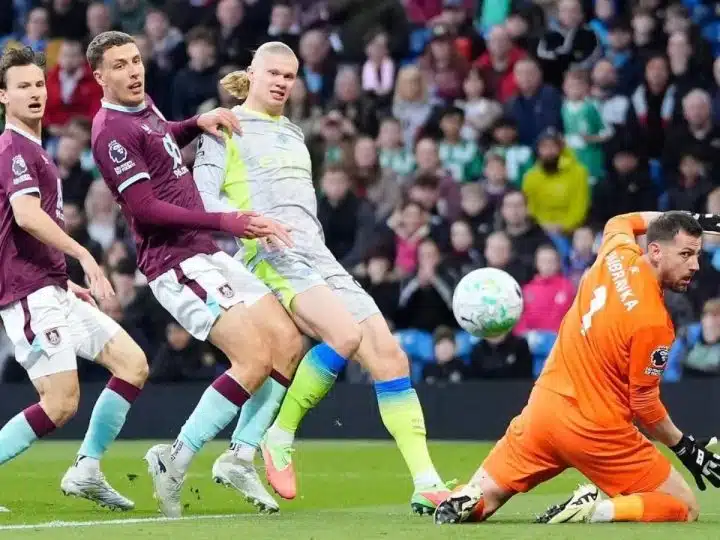

Manchester City may be top again, but their narrow win at Burnley has cracked the title race wide open and Arsenal will feel the door has been nudged back in their favour.
The Premier League run‑in has entered its most volatile phase and if Wednesday night at Turf Moor proved anything, it’s that neither Manchester City nor Arsenal are sprinting cleanly toward the finish. City’s 1–0 win over relegated Burnley put them back on top, but the performance was jittery, wasteful, and strangely flat. It has given Arsenal fresh encouragement at a moment when momentum matters more than mathematics.
Manchester City are top, but far from convincing
Pep Guardiola’s side were expected to steamroll Burnley after their strong win over Arsenal at the Etihad days earlier. Instead, they scored early through Erling Haaland and then laboured, failing to kill the game and inviting pressure from a team already condemned to the drop. Gary Neville called it “the best win Arsenal could have hoped for,” arguing that City will “drop points” if they continue to play with such fragility.
City now lead Arsenal only on goals scored, three more than the Gunners with the sides level on points and goal difference. That statistical deadlock underscores how thin the margins have become. Arsenal will play twice before City next return to Premier league action, meaning the table could tilt again before Guardiola’s side even kick another ball.
Haaland, visibly irritated post‑match, dismissed concerns about goal difference, insisting “1–0 is amazing.” But the unease around City’s inability to put Burnley away lingers. Sky Sports
Arsenal’s opportunity and their burden
Arsenal’s path is deceptively simple, win and keep winning, but the psychological strain is beginning to show. Back‑to‑back defeats to Bournemouth and City earlier this month shifted the emotional balance of the race, replacing Arsenal’s early‑season swagger with a creeping tension.
Gary Neville believes the Emirates crowd itself has become a factor, “extremely nervous” during the Bournemouth loss and warns that fixtures like Newcastle could expose those nerves again. Arsenal’s challenge, he argues, is as much internal as tactical:
They are so close to the finish line that for a moment they imagine they’ve already won.
Yet this is also a team that has repeatedly responded to setbacks. They will play Newcastle next, with the chance to restore a three‑point cushion and reassert control. The question is whether they can do it without tightening up under the weight of expectation.
Manchester City — Pep is in his element
One of the more striking analyses comes from sports psychologist Phil Johnson, who likened Guardiola to a “queen bee” whose emotional connection keeps City’s hive functioning under pressure. That cohesion, he argues, is what allows City to grind out wins even when they’re imperfect, a quality Arsenal have not yet mastered. Yahoo Sports
City’s experience of title after title, run‑in after run‑in, remains their greatest weapon. Arsenal’s inexperience remains their greatest threat.
The run‑in, a race defined by flaws
Both teams are imperfect. Manchester City lack their usual ruthlessness; Arsenal lack emotional control. That’s what makes this title race compelling: it will be won not by the flawless, but by the side that manages its flaws best.
City are currently top, but unconvincing. Arsenal are chasing, but energised. With five games left, the only certainty is that the next twist is coming, but it may not favour the team currently in first place.
Featured image via the Canary
By Faz Ali
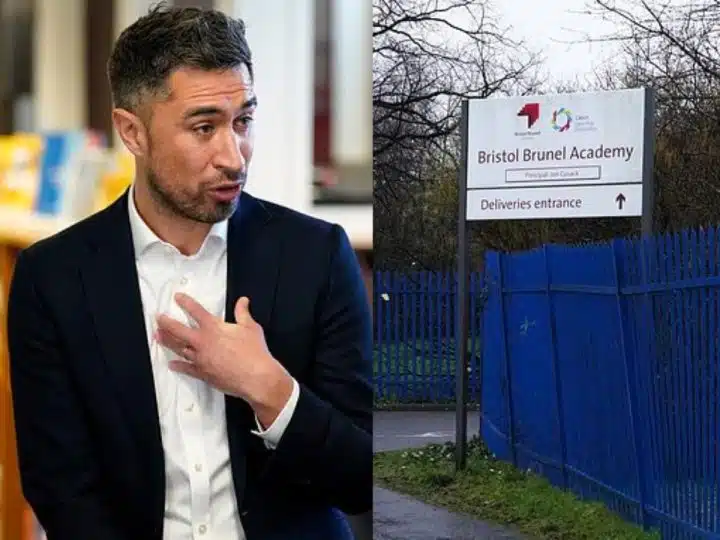

An independent review has confirmed that a school did nothing wrong when it postponed the visit of a pro-Israel MP (a vice-chair of Labour Friends of Israel no less!). So as we said at the time, it seems it absolutely was just a non-story that cynical actors were stirring up to create a useful scandal.
The pro-Israel MP and the cynical ‘scandal’
Israel’s genocide in Gaza has killed over 20,000 children. But our pro–Israel political elites apparently think it’s a good idea for Israel lobbyists to enter our schools. And they don’t want pesky parents, teachers, or students to have any say about that.
That’s why, when ordinary people questioned pro-Israel lobbyist and MP Damien Egan coming into a Bristol school, cynical political actors kicked up a fuss.
The school had postponed Egan’s visit because there were plans for a local protest against the high-profile member of the “opaquely funded” Labour Friends of Israel. And as the independent review confirmed, its decision to postpone over “safeguarding concerns” was entirely justifiable and legitimate.
Cynical right-wing agitators – Jewish and non-Jewish alike – at the time suggested the postponement was because Egan was a convert to Judaism. It wasn’t. And the fact that the school rescheduled his visit soon after proved its decision was not political or discriminatory.
What the media SHOULD be focusing on…
The problem is that the corporate media was, and is, awful. It fuels the highly problematic conflation of Judaism as a religion and Israel as a brutal settler-colonial apartheid state. And it did this even when reporting on the review saying there was nothing wrong with the school’s actions. For example, outlets ran with the headlines:
- Inquiry clears Bristol school of antisemitism for postponing Jewish MP’s visit
- School cleared of antisemitism after cancelling Jewish MP visit
- Bristol school cleared of antisemitism after postponing visit from Jewish MP Damien Egan
Although it’s completely irrelevant, especially considering what the inquiry itself confirmed, outlets placed focus on “Jewish MP”. There was no hint in these headlines that he’s a pro-Israel lobbyist. That’s despite it being a very relevant piece of information, as the whole postponement surrounded public resistance to his political positions.
It would be amazing if the mainstream media actually:
- Placed appropriate emphasis on exactly who Egan is and the politics he represents.
- Highlighted the current Labour government’s million-pound outsourcing of ‘antisemitism education’ to pro-Israel lobbyist (and former Labour Friend of Israel) Natascha Engel.
- Stressed that schools have been censoring solidarity with Palestine during Israel’s mass murder and destruction campaign in Gaza.
- There have been hundreds of incidents of UK institutions and pro-Israel groups targeting teachers and students with censorship in a systematic attempt to “dismantle solidarity” with Palestinians.
- Schools already have enough problems due to years of underfunding and backdoor privatisation. They don’t have time or resources to be dealing with cynical political games too.
This whole fiasco should be a lesson to us all. But it’s not one the corporate media is likely to learn (or want to learn).
Featured image via the Canary
By Ed Sykes
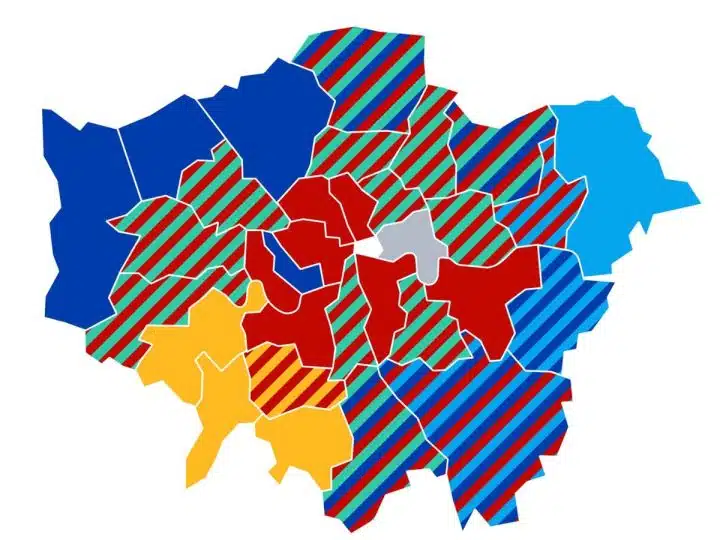

Labour looks set to take massive losses across London in the 2026 local elections, with the Greens in particular set to benefit from the demise. However, predicted results are currently too close to call across a remarkable number of boroughs.
That’s according to YouGov’s first-ever multilevel regression with poststratification (MRP) model for the London locals. The news follows hot on the heels of the pollster’s latest predictions for the Welsh Senedd elections, which likewise show historic Labour losses.
It’s really not looking good for Starmer here, is it, folks? Our hearts bleed, they truly do.
Vote-share upsets in London
Let’s start with the vote-share projections for London as a whole. Compared to the last council elections in 2022, Labour, of course show the biggest predicted drop – down 16 points to just 26%. The Tories, meanwhile, look set to take a nine-point dive to 17% total.
Next to those massive losses, the Greens and Reform look set to make the biggest gains. YouGov predicts that the Greens could land 22% of the vote share across the city. For their part, Reform could see a 14-point increase, netting it… 14%.
However, the number of votes each party receives is only half the story. Where exactly those votes come from is, of course, just as crucial.
You’ve only got to take a glance at YouGov’s vote share projection chart to see how close the race may be. It’s got more stripes than a seaside rock shop:
YouGov's London council election MRP forecasts breakthrough for the Greens and Reform UK in the capital, but with close races in many boroughs
# of boroughs where party has highest vote share, central projection — YouGov (@YouGov) April 22, 2026
Lab: 15 (-6 from 2022)
Con: 5 (-1)
Grn: 4 (+4)
LD: 4 (+1)
Ref: 3… pic.twitter.com/3ofLUWp3LR
Too close to call
The data were drawn from over 4,500 London adults between 27 March and 21 April. YouGov stated that many of the boroughs look so close that it’s unwilling to project wins and losses for specific seats. Instead, it is:
focussing on support for the parties. Owing to the first past the post voting system, this does not guarantee a party will win outright control of a borough, or even the most seats, as happened in Bexley at the 2002 elections and Havering in 2022.
London has 32 boroughs up for grabs. According to the central vote share projections, the second-placed party is less than 2% behind the leader in 10 of those boroughs. Allowing for a 5% difference, 16 boroughs are too close to call, rising to 25 boroughs at 10%.
More to the point, 12 of the boroughs with a 5% difference between first and second place are split between the Greens and Labour. As such, many of Labour’s historic heartlands could ditch Starmer’s party for the left-wing alternative.
Even Labour’s London mayor, Sadiq Khan, warned the PM as much. As Khan put it, Labour was “in danger of being stonked” in the capital on May 7. He also called out Starmer’s apparent obsession with aping the far right:
I’m slightly nervous with this ‘hero voter’ strategy, this understandable obsession to chase the Reform voter. This could lead to progressive voters feeling, wrongly, the Labour Party isn’t for them.
We’d contest the ‘wrongly’ bit, what with all the recent highly public immigrant-bashing.
Best case/worst case
Unfortunately, it’s a bit early to call the exact magnitude of Labour’s London losses just yet. The close-run nature of this election means that there are massive margins for error in YouGov’s model.
For instance, Labour could feasibly lead in just 7 boroughs in its worst-case scenario. Conversely, that number could hit 19 at the upper-bounds of the projection. Meanwhile, the upper-end estimate could see the Greens win 8 boroughs, and Reform take as many as 5.
Even the smaller local independents could lead in 3 different councils, with YouGov explaining that:
Lutfur Rahman’s Aspire party is forecast to, once again, come first in Tower Hamlets, having become the first party other than the Conservatives, Labour or Lib Dems to win a London borough outright at the 2022 elections. We also expect the Havering Residents Association to again do well in their patch, but to come under a strong challenge from Reform UK.
Of course, from a Canary perspective, we strongly dislike the amount of Reform teal we’re seeing on the London projections. Our friends in the capital, for all their faults, deserve better than a bunch of racist, lying, racist, incompetent, racist, lazy racists to represent them.
Yes, that was too many ‘racists’. Given that we needed the extra space to add receipts, we put it to you that this is a Reform problem, rather than a Canary problem.
Featured image via the Canary


A peaceful protester was stabbed outside Downing Street during a demonstration against the US and Israel’s illegal war against Iran, attended by Iranian activists on opposing sides.
Two men, who were taking part in an anti-Iranian counter demonstration, stabbed Mohammed Reza, a British-Iranian and father of two.
Paramedics took Reza to the hospital for treatment, but the extent of his injuries is unclear. Images circulating on social media show very visible stab wounds to Reza’s stomach. Police have since arrested the attackers.
Only recently, a video went viral on social media showing similar pro-monarchy protestors swearing at Reza, whilst he walked to the station with his children.
The stabbing occurred after counter-protestors threatened the main protest with physical violence in full view of the police.
According to Hands Off Iran Coalition:
Eye-witnesses report that the police seem to have paid little attention to keeping the counter-protestors away from the main demonstration, organised by the
This is despite the fact that police are aware that pro-monarchist anti-Iran protestors have a history of trouble and violence.
In recent weeks, they have also targeted mosques, centres and individuals that have shown support for Iran. This includes throwing Molotov cocktails at the Islamic Centre of England in London.
One rule for them
Over the last couple of years, the British Government has imposed increasingly harsher restrictions on anti-genocide protesters in the UK. From the proscription of Palestine Action and the Home Secretary banning the annual Al Quds Day march in London, to the introduction of the Crime and Policing Bill — it has become clear that the Israel lobby has more influence than ever on British politics and policing.
But now, a pro-Israel, pro-Iranian monarchist has stabbed a peaceful protester in broad daylight. Importantly, this only highlights how extra restrictions and curtailed protest rights are completely one-sided.
The Government claimed the changes would ‘protect the public’, yet it was well aware of the violent history of the counter-protesters, and did nothing. Meanwhile, the police continuously arrest and harass anti-genocide protesters, who have no violent history, simply for opposing mass murder and ethnic cleansing.
Two-tier policing is well and truly alive.
Feature image via the Canary
By HG

Anker is betting its new chip can change how AI runs in earbuds

here’s what the evidence actually says
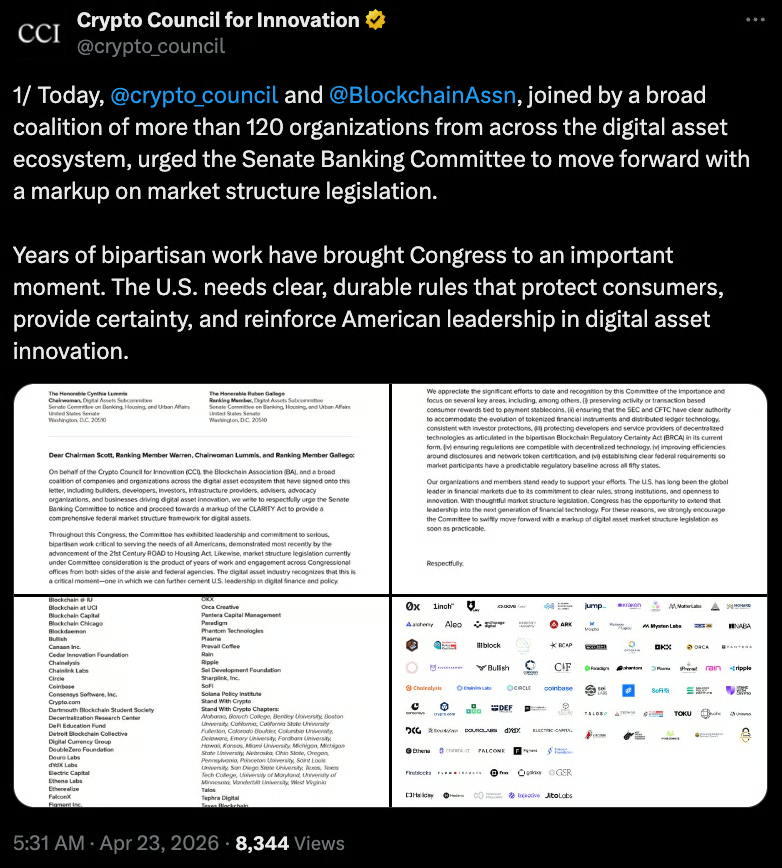
Crypto Advocacy Group Calls Action on Market Structure Bill ‘critical‘

Manchester United reach agreement with Casemiro over contract clause amid transfer speculation

Steven Gerrard disagrees with Gary Neville over ‘shock’ Chelsea and Arsenal claim | Football

US brings back mandatory military draft registration


-

 Sports6 days ago
NWFL Suspends Two Players Over Post-Match Clash in Ado-Ekiti
-

 Fashion6 days ago
Weekend Open Thread: Theodora Dress
-

 Politics6 days ago
Palestine barred from entering Canada for FIFA Congress
-
Entertainment4 days ago
NBA Analyst Charles Barkley Chimes in on Ice Spice McDonald’s Fiasco
-

 Tech5 days ago
Auto Enthusiast Scores Running Tesla Model 3 for Two Grand and Turns It Into Bare-Bones Go-Kart
-

 Business4 days ago
Powerball Result April 18, 2026: No Jackpot Winner in Powerball Draw: $75 Million Rolls Over
-

 Politics4 days ago
Zack Polanski demands ‘council homes not luxury flats for foreign investors’
-

 Crypto World6 days ago
Russia Pushes Bill to Criminalize Unregistered Crypto Services
-

 Politics3 days ago
Gary Stevenson delivers timely reminder to register to vote as deadline TODAY
-

 Business1 day ago
Rolls-Royce Voted UK’s Most Iconic Trade Mark as IPO Register Hits 150
-

 Politics1 day ago
Disabled people challenge government SEND proposals over segregation concerns
-

 Politics1 day ago
Making troops accountable for war crimes threatens US alliance, ex-SAS colonel warns
-
 Business7 days ago
Creo Medical agree sale of its manufacturing operation
-

 Crypto World6 days ago
Russia Introduces Bill To Criminalize Unregistered Crypto Services
-

 Politics1 day ago
Starmer handler McSweeney to be dragged from shadows by Foreign Affairs Committee
-

 Politics1 day ago
Zack Polanski responds to home secretary’s taser threat
-
Politics1 day ago
Wings Over Scotland | How To Get Away With Crimes
-
 Crypto World5 days ago
Kelp DAO rsETH Bridge Hack Drains $292M as DeFi Losses Top $600M in Two Weeks
-

 Politics23 hours ago
‘Iran is still a nuclear threat’
-

 Crypto World2 days ago
New York sues Coinbase, Gemini over prediction market offerings
You must be logged in to post a comment Login