

Politics
What Is The Lamp Theory?


Imagine you have met the love of your life and over time, you get married and have children. You have a long, happy 10 years as a family and everything is as it should be.
Then, you look at your living room lamp and it just looks… weird. Still 3D but somehow inverted.
You can’t look away from this lamp. For days on end, you just stare. Your wife is worried, nobody can distract your from this. Then, you realise, thanks to this lamp’s distortion, that your life isn’t real. Your wife, your kids, your home, none of it is real.
This is apparently what happened to Reddit user u/temptotasssoon, who said: “My last semester at a certain college I was assaulted by a football player for walking where he was trying to drive (note he was 325lbs I was 120lbs), while unconscious on the ground I lived a different life.”
He explained that while he was staring at the lamp, it got ‘wider and deeper’ but still with inverted dimensions before he eventually woke back up.
He said: “I heard voices, screams, all kinds of weird noises and I became aware of pain…. a fucking shit ton of pain… the first words I said were “I’m missing teeth” and opened my eyes.
“I was laying on my back on the sidewalk surrounded by people that I didn’t know, lots were freaking out, I was completely confused.”
Following the accident, he was still haunted by the memories he made when he was unconscious.
He said: “I went through about 3 years of horrid depression, I was grieving the loss of my wife and children and dealing with the knowledge that they never existed, I was scared that I was going insane as I would cry myself to sleep hoping I would see her in my dreams.
“I never have, but sometimes I see my son, usually just a glimpse out of my peripheral vision, he is perpetually 5 years old and I can never hear what he says.”
Now, the story has taken off on TikTok with ‘The Lamp Theory’
Now, TikTok has given the story a new lease of life and users are sharing what their dream lives would be before realising the lamp was weird.
Grandma Droniak, a creator with 14 million followers shared her own, saying: “When my parents tell me how proud of me they are because I wanted to be famous since I was a little girl. They always believed in me but then the lamp starts to look weird.”
Another user, Nalle, said: “When I finally don’t feel excluded, I don’t compare myself to others, I actually feel good about myself and I’m not the angry daughter anymore but then the lamp starts to look weird.”
Is the lamp theory possible?
While the Reddit user’s grief may be enough to believe this really happened to them, any skeptics can rest assured that scientists widely agree that we still don’t fully understand consciousness, meaning that we definitely can’t dispute this.
Help and support:
- Mind, open Monday to Friday, 9am-6pm on 0300 123 3393.
- Samaritans offers a listening service which is open 24 hours a day, on 116 123 (UK and ROI – this number is FREE to call and will not appear on your phone bill).
- CALM (the Campaign Against Living Miserably) offer a helpline open 5pm-midnight, 365 days a year, on 0800 58 58 58, and a webchat service.
- The Mix is a free support service for people under 25. Call 0808 808 4994 or email help@themix.org.uk
- Rethink Mental Illness offers practical help through its advice line which can be reached on 0808 801 0525 (Monday to Friday 10am-4pm). More info can be found on rethink.org.


Americans are fed up with politics invading every aspect of their lives. But many can’t kick the habit.
Roughly 60 percent of Americans say it feels like politics are everywhere these days where it does not make sense for things to be political, according to new results from The POLITICO Poll. It’s a rare point of harmony between Republicans and Democrats, with majorities of both parties also agreeing that it is becoming less important what celebrities say about politics.
Unless they agree with them.
The same people who want politics out of everyday life are still influenced when the celebrities’ or athletes’ opinions align with their own. Nearly 70 percent of voters who backed Vice President Kamala Harris in 2024 would think “more positively” about a movie star if they spoke out against President Donald Trump. The inverse is also true: For nearly 60 percent of the president’s voters, their perception of a star would improve if they expressed support for him.
That picture comes into even sharper relief among the strongest partisans, who are more likely to expect that their favorite celebrities and institutions around them express their political views than those who are more in the middle.
That presents a complicated and often contradictory picture of how voters engage in politics as it bleeds into their daily lives — and the precarious line celebrities and local leaders need to walk as culture and politics become hard to detangle.
Celebrities and athletes have increasingly spoken out about causes like ICE crackdowns and racial equity on the world stage. Key culture podcasts — from the Joe Rogan Experience to Call Her Daddy — have hosted politicians including Trump and Harris. And actors like George Clooney were critical in calling for former President Joe Biden to end his 2024 campaign.
“Everyone should always speak up for what they believe in,” said Jordan C. Brown, a Los Angeles-based Democratic strategist who has worked with campaigns and celebrities alike. “But there is a cost, and I think I would just caution people of the cost.”
The result is an American public that doesn’t quite know what it wants, one that’s tired of their lives being politicized — but are also influenced by partisan statements.
Voters still care about where celebrities and institutions stand
Majorities of both Harris and Trump voters say politics has invaded spaces where it doesn’t belong, but Trump voters are more concerned than Harris voters are.
For example, most Trump voters (52 percent) say there is too much politics in sports, compared to 31 percent of Harris voters who say the same. In some areas of daily life — like sports, movies and on television, and music — pluralities of Harris voters say there’s an acceptable amount of politics present.
But few Americans say they want more.
Some Americans also claim bringing politics into other realms doesn’t affect them. A plurality of Harris voters — 38 percent — say it doesn’t matter to them if athletes, for example, talk about politics.
And yet, the poll finds, Republicans and Democrats alike actually are swayed by statements from businesses and celebrities.
Strong majorities report that celebrities’, athletes’ or even their local grocery store owners’ political statements impact their views of that individual. And roughly one in five people say they have changed their own opinion on a political topic because a celebrity spoke out about it.
The poll results also reveal a clear pattern for when those statements matter most: Americans respond positively to them when they reflect their own world views.
The majority of 2024 Trump voters say they would view an athlete more positively if they made statements aligned with the president’s agenda, like “We need to crack down on the crime running rampant in our cities.” On the other side, over 60 percent of Harris voters say they would think more positively about athletes who make statements like “We need to tax the richest people in this country.” That’s true even for voters on both sides who said there is “too much” politics in sports.

It’s a familiar phenomenon, according to Shaun Harper, a University of Southern California professor who has researched athletes’ political activism. He described the “‘I don’t want politics in my sports unless they’re my politics’” mindset as “anti-democratic.”
“It is unfair to athletes and to our democracy to expect them to only selectively leverage their platforms and their free speech rights,” he said.
The most politically engaged voters are the ones who care most
The strongest partisans are even more curious about what local, religious and cultural leaders have to say compared with those in the center.
More than one-third of Trump voters who self-identify as “MAGA Republicans”, the president’s most loyal base, say religious institutions should make their views clear to their followers, compared to 22 percent of non-MAGA Trump voters.
MAGA Trump voters are also more likely to act on those political differences: Forty-three percent say they would not buy from a business that made clear it held different political views — compared with 27 percent of non-MAGA Trump voters and roughly 30 percent across all adults.
On the other side of the aisle, about one-third of self-identified “strong” Democrats say athletes should make their political views clear, double the 16 percent of those who say they are “not strong” Democrats who agree.
And 36 percent of “strong” Democrats believe schools and universities should make their political views clear to their students, compared to 22 percent of “not strong” Democrats.
Those who voted third party, or who didn’t vote at all, are even less eager to hear about politics in their regular life: Just 12 percent say celebrities should make their political views clear to their fans. And less than 10 percent said they’ve changed their opinion about a political topic because a celebrity spoke about it.
Celebrities are already less willing to engage with partisan politics
The results shed light on an ongoing debate as stars and campaign strategists try to figure out how — or even if — to engage celebrities with politics.
Finding a way to do so that doesn’t damage their own careers, given the complexity of voters’ and fans’ partisan divides, can be difficult, the poll shows. When some voters claim to want neutrality but secretly want their favorite stars’ politics to match their own, but others demand political engagement, it leaves celebrities to decide which group they can upset the least.
Democrats have used celebrity endorsements and surrogates in significant measure since former President Barack Obama’s star-studded 2008 presidential campaign. Harris, two years ago, saw an outpouring of support for her presidential campaign from a host of VIPs: Beyoncé and Kelly Rowland appeared at her rally in Houston, Taylor Swift posted an endorsement for the former vice president to her millions of social media followers, and Lady Gaga performed at her election-eve rally in Philadelphia.

But that backfired for the celebrities when Harris lost, said Todd Hawkins, a Democratic strategist and consultant based in Los Angeles.
“What we saw was the biggest backlash as a result of losing, folks saying celebrities should not tell us what to do, no one cares about what they think,” he said.
Trepidation about the partisan divide is driving many celebrities’ reluctance to get involved in politics in a high-profile way — a dynamic captured by actor Jennifer Lawrence in a 2025 interview with the New York Times, when she was asked about her willingness to speak out against Trump.
“I don’t really know if I should,” she said. “But as we’ve learned, election after election, celebrities do not make a difference whatsoever on who people vote for. So then what am I doing? I’m just sharing my opinion on something that’s going to add fuel to a fire that’s ripping the country apart.”
Last year, actor and entrepreneur Selena Gomez posted — and later deleted — a tearful video responding to immigration crackdowns that drew criticism from the right. And Hunter Hess, an Olympic freestyle skier, drew heat from Trump for saying that representing the U.S. in the Games “brings up mixed emotions” after Alex Pretti and Renée Good were shot and killed by ICE agents in Minneapolis.
“They’re very concerned, they’re scared as hell, but they were scared last year more than anything,” Hawkins said of celebrities. “I still see trepidation on how and what they will do to be engaged.”
The connection between politics and pop culture, however, will hardly dissolve anytime soon, said Brown, the LA-based Democratic strategist: “There’s that phrase: the only thing Hollywood and D.C. love more than themselves are each other.”


Demonstrators donning the logo and insignia of Patriot Front, a white supremacist group, were seen protesting in the Eastern Market neighborhood and on Capitol Hill on the 250th anniversary of U.S. independence.
Sporting white masks, sunglasses and Patriot Front’s signature tan caps, the protesters carried Confederate, Patriot Front and upside-down U.S. flags as they marched through Capitol Hill. The group was also photographed riding public transit on Saturday morning.
Outside Union Station, demonstrators chanted phrases including “Life, liberty, victory!” and “Reclaim America!” — slogans regularly used by the group.
The demonstration unfolded as tourists and Americans alike flocked to the “Salute to America” celebration on the National Mall, which will culminate in a speech by President Donald Trump and a fireworks show expected to last for a record-breaking 40 minutes. The Trump administration has made the nation’s 250th anniversary a top priority over the past few months through high-profile initiatives like the Great American State Fair and restoration work at the Reflecting Pool.
Later, anti-Trump demonstrators were filmed walking toward the White House carrying a large Declaration of Independence banner and chanting “8647,” a slogan calling for Trump’s removal from the presidency.
Patriot Front was founded in 2017 by Thomas Ryan Rousseau, who split from the alt-right organization Vanguard America in the aftermath of the deadly Unite the Right rally in Charlottesville, Virginia. Patriot Front’s website describes the group as a “fraternal, nationalist, activist organization” and writes that “Our people, born to this nation of our European race, must reforge themselves as a new collective capable of asserting our right to cultural independence.”
The D.C. mayor’s office referred POLITICO to the Metropolitan police department for comment.
“The Metropolitan Police Department (MPD) is tracking First Amendment activities that occurred this morning in the Eastern Market neighborhood,” the department said in a statement Saturday. “MPD recognizes the rights of individuals to peacefully express their views and remains committed to maintaining public safety and security for DC residents and visitors.”
Gregory Svirnovskiy contributed to this report.


CALGARY, Alberta — When their national team faces off against Morocco today in its first-ever knockout match in a men’s World Cup, Canada’s political class will be in cowboy hats and boots.
The annual Calgary Stampede extravaganza attracts politicians and lobbyists who fly in for Stampede’s first four days for dealmaking, team building and/or partying — sometimes all three. Ottawa’s fishbowl and Toronto’s power set are drawn west by chuckwagon races and grandstand acts. They fit serious meetings in between carbo-loading pancakes, gawking at the rodeo and schmoozing up and down the nonstop reception circuit.
Once they reach Canada’s largest inland western city, federal pols are under a microscope: Do they look the part? Can they flip a pancake? Does it seem like they really want to be there?
Those who want to latch onto the newest outlet for Canada’s emergent patriotism may struggle to do so today. One of Saturday’s big political events — the Canadian Chamber of Commerce’s Calgary Stampede Mixer — begins at noon, an hour after the Canada-Morocco match kicks off in Houston.
Scheduling would have been more straightforward if the cowboy cosplayers had stayed put in Ottawa. The federal Department of Canadian Heritage — whose mandate is to support “Canadian identity and values, cultural development, and heritage” — is hosting a watch party at LeBreton Flats Park.
“From coast to coast to coast, the country is rallying behind the team as they write an incredible FIFA World Cup story,” Canada’s secretary of state for sport Adam van Koeverden said in a press release promoting the event sponsored by a government that has seen the tournament as an exercise in soft power. “It’s undeniable in moments like these that sport is a great nation-builder, and we can build Canada strong through sport.”
POLITICO’s Canada Playbook will publish special editions from Calgary Stampede this weekend. You can subscribe here.
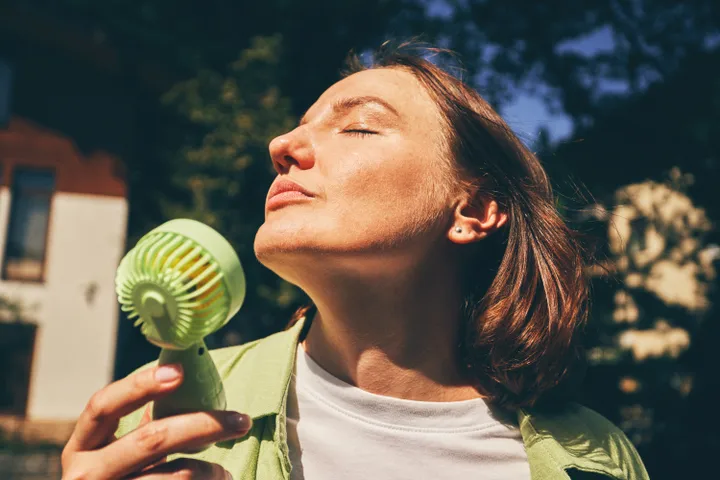
With record-breaking heat sweeping across the country and around the world, people are increasingly seeking ways to stay cool and turning to all kinds of tips, tricks and folk remedies to do it.
But how many of those heat-beating hacks are actually grounded in science?
HuffPost asked experts to weigh in on some of the most common old wives’ tales about surviving the heat, from damp sheets to cabbage leaves to yoghurt on windows.
The verdict? Some have truth to them, others don’t hold up to scrutiny, and a few could actually backfire depending on the conditions.
1. “Sleeping under a damp sheet cools you down.”
“The ‘Egyptian method’ involves sleeping under a damp sheet to cool down,” Dr. Swapnil Patel, vice chair of the department of medicine at Hackensack Meridian Jersey Shore University Medical Center, told HuffPost. “A damp towel can be used as an alternative.”
The cooling effect is the result of a simple evaporation process.
“A lightly damp sheet or cloth can cool through evaporation,” said Dr. Anthony T. Lagina, an associate professor in the department of emergency medicine at Wayne State University, Detroit Medical Center. “As water evaporates from the fabric, it pulls heat away from the skin. This works best in dry, well-ventilated conditions.”
Thus, the effectiveness of sleeping under a damp sheet is limited based on environment. And, the technique can in fact have the opposite effect in the wrong conditions.
“It works poorly in high humidity because water and sweat do not evaporate efficiently,” Lagina explained. “In humid conditions, a damp sheet may feel clammy, disrupt sleep or irritate skin.”
There are other ways to make your sleep environment safe in hot conditions, however.
“To deliver true peace of mind and comfort, I recommend focusing on proven environmental controls such as keeping your bedroom well-ventilated, utilizing lightweight, breathable bedding, taking a cool shower before bed and prioritizing consistent fluid replenishment throughout the day,” said Dr. Scott Braunstein, chief medical officer at Sollis Health.
2. “Smear yoghurt on your windows to keep the heat out.”
The idea behind putting yoghurt on windows – a tip that has circulated in the UK – is that the light-coloured yoghurt forms a thin film on the glass that reflects incoming solar radiation, so less heat passes through the window.
“Putting something reflective on your windows will help keep the sun out and cool your home,” said Anna Bershteyn, an associate professor in the department of population health at NYU Langone Health. “I would suggest a reflective window film, metallic foil or shades rather than yoghurt – that would be more effective and less messy.”
Lagina also advised against putting yoghurt on your windows to keep heat out in favour of more practical options. “It is not a reliable cooling strategy and creates sanitation concerns, including odor, bacterial or mold growth, insects and potential surface damage,” he said.
He also weighed in on a similar hack – putting wet towels or cloths on your windows.
“A wet towel or damp cloth over a window can provide only mild cooling if the air passing through it evaporates,” Lagina explained.
“In humid weather, this may simply add moisture indoors, making sweating less effective. Better home-cooling approaches include blocking direct sunlight with curtains or reflective shades, opening windows only when the outside air is cooler and using fans to move air across the skin.”

Ekaterina Goncharova via Getty Images
3. “Hot beverages cool you faster than cold ones.”
“Some studies have found that hot drinks and spicy foods increase sweating, which could be helpful in dry heat,” Bershteyn said. “Think deserts – where your sweat evaporates so fast that your skin is dry. If your sweat is dripping off of you – as it does in muggy, humid heat – more sweat won’t cool you any faster.”
When sweat evaporates, heat is removed from your body, but in humid conditions, drinking a hot beverage will instead probably just be uncomfortable and add heat initially.
“During heat stress, cool water or an electrolyte-containing drink is usually more practical,” Lagina said. “Moderate caffeine is generally acceptable for many adults, but excessive caffeine and alcohol should be avoided during extreme heat. Alcohol reduces judgment and can worsen dehydration and heat illness risk.”
Indeed, the type of beverage – hot or cold – that you consume makes a big difference.
“Cold water or targeted electrolyte solutions are consistently the better choice because they are refreshing, encourage people to consume a higher volume of fluids, and provide immediate physical relief from the heat,” Braunstein said.
“Also keep in mind that many hot drinks, such as coffee or tea, are caffeinated, and the caffeine both speeds up your metabolism increasing heat production, and acts as a diuretic contributing to fluid losses and dehydration.”
4. “Cooling your pulse points lowers your temperature more quickly.”
“Cooling the neck, armpits, groin, wrists and the backs of the knees can help, as major blood vessels are near the skin surface,” Lagina said. “Cool packs or wet towels can remove heat from blood and skin.”
Basically, you can quickly cool the body by cooling the parts where blood flows close to the skin.
“Applying cold can briefly cool circulating blood locally, which produces a perception of relief,” said dermatologist Dr. Brendan Camp. “However, this effect is modest and does not significantly lower overall core body temperature on its own. It is best understood as a sensory or comfort-based strategy rather than a true systemic cooling method. It works best when combined with airflow or general body cooling.”
Lagina similarly noted that this trick is “not magic,” as some situations require cooling across the fuller surface of the body.
“For serious overheating, broader cooling is better – a cool shower or bath; misting with a fan; cold, wet sheets; or cold-water immersion when safe and appropriate,” he said.
Pay attention to potential heatstroke symptoms, which require urgent medical attention.
“If you begin to experience symptoms such as dizziness, nausea, heavy sweating, muscle cramps or unusual fatigue, it is critically important to immediately seek medical care, most often at an urgent care or ER,” Braunstein said. “Heat-related illness is a spectrum that ranges from very mild to life-threatening, so time is truly of the essence.”
5. “Placing a cold cabbage leaf under your hat or on your body can cool you down.”
“Using cabbage leaves is a real folk remedy, for their cooling properties,” Patel said. “While more commonly studied for reducing pain and swelling in conditions like osteoarthritis, the cooling effect of the leaves, with their water content, is real.”
In the context of heat, cabbage leaves can provide a brief, localised cooling sensation, but experts say don’t get too excited about it.
“My mother has tried to treat quite a few of my childhood illnesses with cabbage leaves,” Bershteyn said. “Sadly, I’m not aware of any special cooling powers of cabbage leaves. But anything cold and wet on your head can feel nice.”
The effect is not long lasting, however. “It warms quickly, does not maintain consistent heat transfer and does not meaningfully affect core temperature,” Camp said. “It is not an effective or reliable cooling strategy from a physiologic standpoint.”
The cabbage leaf trick has historical precedent. Baseball legend Babe Ruth was known to place a cold cabbage leaf under his cap during games to stay cool in the sweltering summer heat.
“A cold cabbage leaf can cool by contact and moisture, just like any cold wet object,” Lagina said. “There is no special heat-related medical property in cabbage. A clean, damp cloth, a cooling towel, a chilled bandana or an ice pack wrapped in cloth is more practical and hygienic. Folk remedies should not delay standard cooling or emergency care.”

Uma Shankar sharma via Getty Images
6. “Placing a bowl of ice in front of a fan works like air conditioning.”
Placing a bowl of ice in front of a fan is a popular TikTok hack for cooling down a room, but experts say the effect is more limited than most people expect.
“This can create a small area of cooler air for someone sitting close by, but it is not an effective way to cool an entire room,” Lagina said. “The ice absorbs heat as it melts, and then the effect stops. It may be useful for short-term personal comfort, especially with good airflow, but it should be paired with hydration, reduced activity, shade and access to air conditioning when possible.”
Bershteyn also noted that a bowl of ice in front of a fan probably won’t meaningfully cool a room.
“In fact, if the ice was made in a freezer in the same room, the heat coming from the back of the freezer would offset the cooling from the ice,” she said. “But if you sit directly in front of the ice, you might get a personal, chilled breeze.”
Here’s what experts actually recommend for staying safe in the heat.
“Many folk cooling methods work only when they improve evaporation, conduction, shade or airflow,” Lagina said. “They are not substitutes for air conditioning, hydration, rest and urgent medical care when heat illness is suspected.”
There are other important facts and precautions to keep in mind as you try to stay safe and cool in extreme heat.
“It takes several weeks for a body to adjust to heat, which is why the U.S. sees more heat-related deaths in the spring than in the summer,” Bershteyn said. “While scientists don’t yet know the exact best way to condition yourself for heat, one thing is clear: Being in good physical shape is a huge benefit.”
She recommended trying to stay physically fit in the springtime and all year-round to make those heatwave days easier to get through. Still, don’t assume that healthy athletes can’t fall victim to heat-related illness.
“Fitness does not eliminate risk,” Lagina said. “Athletes, outdoor workers, children, older adults, pregnant people and people with chronic health conditions are all vulnerable.”
The wrong combination of conditions and exertion can affect even the healthiest people. “We see healthy young adults and children develop heat exhaustion after prolonged sun exposure, strenuous activity or dehydration,” Braunstein said.
He noted that the best prevention is much simpler than those interesting at-home remedies.
“Stay hydrated before you feel thirsty, wear lightweight clothing, seek shade during the hottest part of the day and take breaks in air-conditioned spaces whenever possible,” Braunstein said.
Loose, thin, light-coloured clothing and hats can provide helpful protection, as can periodic cool showers and baths, misting fans, ice packs and damp cloths.
When you reach the peak heat of the day, take advantage of air conditioning and avoid strenuous activity. Drink plenty of water and keep your electrolytes replenished if you’re exercising or otherwise sweating a lot.
“Never leave children, older adults, vulnerable people or pets in parked cars,” Lagina said. “Check on older adults, children, outdoor workers, people living alone and anyone with chronic medical conditions. High humidity, poor airflow, dehydration and prolonged heat exposure all increase risk.”
Knowing how to recognize heat illness and act quickly is also incredibly important. Signs of heat exhaustion include heavy sweating, weakness, dizziness, headache, nausea, muscle cramps, cool or clammy skin and feeling faint.
“If these occur, move to shade or air conditioning, stop activity, loosen clothing, sip cool fluids if alert, and use cool, wet cloths, misting, fanning or a cool shower,” Lagina said.
Heatstroke is a more serious medical emergency with warning signs that include confusion, altered behavior, fainting, seizure, slurred speech, severe weakness, a very hot body or an inability to cool down.
If you suspect heatstroke, immediately call 999 and begin cooling while waiting for help by moving to a cooler place, removing excess clothing and applying cool water, fan mist, ice packs and/or cold, wet towels to your neck, armpits and groin.
“If symptoms like dizziness, vomiting, confusion, fainting or difficulty breathing develop or don’t quickly improve after cooling down and rehydrating, don’t rely on home remedies,” said Braunstein. “Early treatment can prevent progression to the life-threatening conditions that are on the far end of the clinical spectrum.”

The post Why Andy Burnham will crash and burn appeared first on spiked.

We’ve written before at HuffPost UK about how great plums can be for our health.
And as it turns out, another tart treat – gooseberries – may also have brain, heart, and hair benefits.
Though they’re not native to the UK, many species of gooseberry have been grown here since at least 1276. By the 19th century, there was such a craze for the fruit that “gooseberry clubs” formed all over Britain.
I’m not saying we should bring those back, but I am advising you to read the impressive health-boosting benefits of the berry.
Which types of gooseberry are there?
There are many kinds of gooseberry, including:
- The European gooseberry
- The American gooseberry
- The Indian gooseberry, also called amla
- Cape gooseberries, sometimes called physalis.
It’s important to note that American and European gooseberries belong to a different species of plant (the Ribas, or currant, family) than Indian and Cape gooseberries (Phyllanthaceae and the nightshade family Solanaceae, respectively).
Most of these studies involve Indian gooseberry.
What are the health benefits of gooseberries?
1) They may be good for your heart
A supplement extracted from the Indian gooseberry, or amla, has been linked to lower cardiovascular risk factors in adults.
And another study suggested that compounds in the fruit, called ellagitannins and ellagic acid, might help to keep the flow of blood running better.
Additionally, gooseberries are high in copper, which seems to benefit our hearts by protecting them from oxidative stress. They also contain lots of heart-healthy flavanols.
Yet another paper found that a powder made from Indian gooseberry improved LDL (“bad”) cholesterol levels in both participants with an without type 2 diabetes.
2) They could help your cognitive function
The buildup of iron, to which brain cells are more susceptible (especially as we age), damages our brains and nervous systems. But citric acid, which gooseberries have quite a lot of, can help to block that iron accumulation.
In a rat study, extracts made from Indian gooseberry extract led to better memory and learning and appeared to slow the progression of dementia-related damage to the brain.
3) They may have anticancer properties
A review of studies found that Indian gooseberries may have a range of cancer-curtailing effects: it said multiple papers “have demonstrated [the fruit’s] strong suppressive properties against tumour-promoting mechanisms”.
In other words, it might help to slow or even assist in preventing the growth of tumours.
4) They might help to strengthen your hair and prevent hair loss
A mouse study suggested that Indian gooseberry “might influence hair-growth-promoting activity and enhance hair health and can therefore be considered an effective option for treating hair loss”.
5) They may help to control your blood sugar levels
Some studies – again, conducted on animals – have found that Indian gooseberry extract, which is high in a compound called quercetin, might help to control blood sugar.
A 2011 paper, this time conducted on humans, found that people both with and without type 2 diabetes saw more controlled blood sugar levels after consuming Indian gooseberry powder.
6) They could help to manage heartburn
In a randomised double-blind trial, participants with non-erosive reflux disease (NERD) saw fewer cases of heartburn and less severe symptoms after consuming Indian gooseberry-derived tablets.
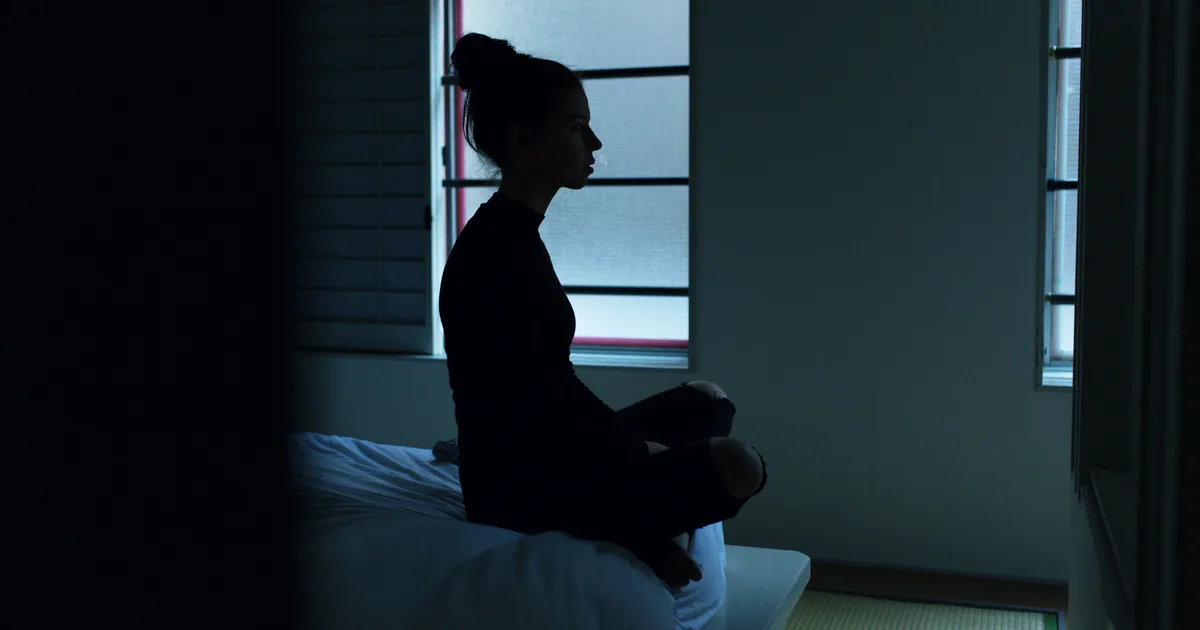
You may already know that how you sleep can affect how you age – getting fewer than six hours a night has been associated with faster ageing and a higher risk of “all-cause mortality”.
Poor sleep, particularly in midlife, is linked to a greater likelihood of developing dementia.
But what does “bad” sleep really mean?
A new paper published in the journal Alzheimer’s and Dementia has used data from over 23,000 middle-aged and older adults to work out “three sleep behaviors distinctly associated with a marker of brain ageing in healthy people”.
These were found from a list of five sleep behaviours measured in the study.
Which sleep habits have been linked to brain ageing?
The researchers used a combination of brain scans and questionnaire responses from participants to work out whether certain sleep behaviours may be linked to brain ageing.
From 2006 to 2010, participants were asked to fill in a baseline questionnaire about the following:
- sleep duration,
- daytime napping,
- sleeplessness,
- unintentional daytime dozing, and
- snoring.
Roughly nine years later, the scientists conducted MRI scans.
They found that all five of these sleep issues were linked to greater white matter lesion volumes, associated with brain ageing.
But after adjusting for other factors that can also create the issue, like smoking, vascular health issues, inactivity, and high blood pressure, only three seemed to be linked to increased brain ageing.
- sleeping less than seven or more than nine hours a night,
- frequent daytime napping, and
- sleeplessness.
More research is needed
In follow-up research, the scientists found that shorter sleep duration might be more harmful than overly long kip.
The study’s senior author, Professor Gene Alexander, said: “Our findings suggest that having too little sleep may lead to greater white matter lesion volumes in the brain as we age.
“We didn’t see greater white matter impacts in people who reported longer sleep durations, but this needs to be followed up in cohorts with more long sleeper.”
Additionally, he noted that the study didn’t capture nap duration, so it could be missing key information about which naps are better or worse for our brains.
“Sleep is one of those potentially modifiable risk factors. If we can improve the quality of our sleep, it may help reduce the impacts of brain ageing and maybe even lower the risk for dementias like Alzheimer’s disease,” Prof Alexander ended.



6 min read
Andy Burnham will put Labour in a stronger position to win back voters it is at risk of losing to Zack Polanski’s Greens, new research for PoliticsHome has found.
The new nationwide survey, carried out late last month by the research organisation Thinks Insight & Strategy, also suggests that the prime minister-in-waiting will help shore up Labour’s right flank against Reform UK.
Ben Shimshon, co-founder and CEO of Thinks Insight & Strategy, said Burnham “definitely opens a window of opportunity” for Labour and “should give the party real hope”.
However, the findings also indicate that the public will expect Burnham to deliver change quickly after he enters Downing Street, which is expected to happen later this month.
The research is based on an online survey of 2,079 people between 24-25 June, alongside four focus groups with people who voted Labour at the 2024 general election but are now considering either the Greens or Nigel Farage’s Reform.
The fieldwork was conducted after both Burnham’s victory in the Makerfield by-election and Prime Minister Keir Starmer’s resignation announcement.
The results, shared exclusively with PoliticsHome, suggest that Burnham is currently well-placed to improve Labour’s electoral prospects as it tries to rebuild support ahead of the next general election.
Burnham will almost certainly replace Starmer in No 10 later this month after securing his return to the House of Commons in emphatic fashion in June.
Among those who voted Labour two years ago, a third (33 per cent) told the survey that a Burnham leadership made them more likely to vote for the party again next time around, while 12 per cent said it made them less likely.
The survey for PoliticsHome found that the former Greater Manchester mayor is particularly popular with 2024 Labour voters now considering the Greens, with 44 per cent of this group saying they were more likely to vote Labour with Burnham as leader.
This is higher than any other group of Labour 2024 voters now considering other parties.
Equal shares of 2024 Labour voters who are considering the Conservatives and Liberal Democrats (both 33 per cent) say they are likelier to vote Labour with Burnham as leader, as did 31 per cent of those now looking at Reform. Thirty-nine per cent of 2024 Labour voters who are currently considering Rupert Lowe’s Restore Britain said they were more likely to stick with Labour under Burnham, though this was based on a small sample.
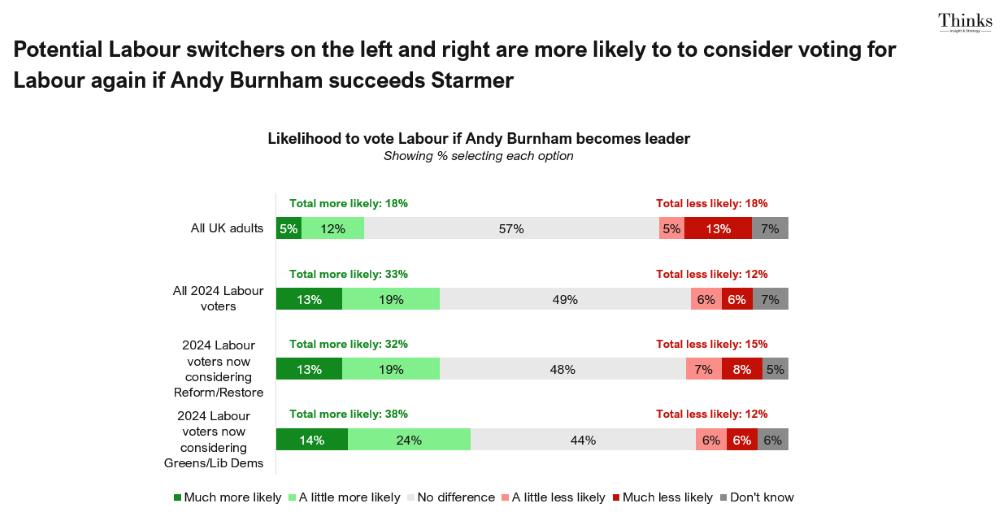
“For Labour, Burnham definitely opens a window of opportunity. Both 2024 Labour voters who are now considering Green, and, to a slightly lesser extent, those who are now considering Reform UK, are more likely than average to say that Keir Starmer’s replacement increases their chance of voting Labour. That should give the party real hope,” said Shimshon.
“But it also speaks to the tightrope Burnham needs to walk, as these voters have very different priorities, and want very different things from their government.”
He added: “Across the survey and in the focus groups, the hope is both low-definition and low-patience: voters don’t know much about ‘Andy’ – they like his vibes, his accent and his manner – but they’re not yet convinced he’s truly different.”
If, as expected, Burnham becomes the UK’s seventh PM in a decade later this month, he will be under pressure to deliver results quickly, the findings suggest.
Over half of respondents (54 per cent) said they would know within six months whether a new prime minister was doing a good job, and only 19 per cent said they would give them longer than that. Twelve per cent said they would know straight away. 2024 Green voters were the most patient, while Reform voters were the least patient.
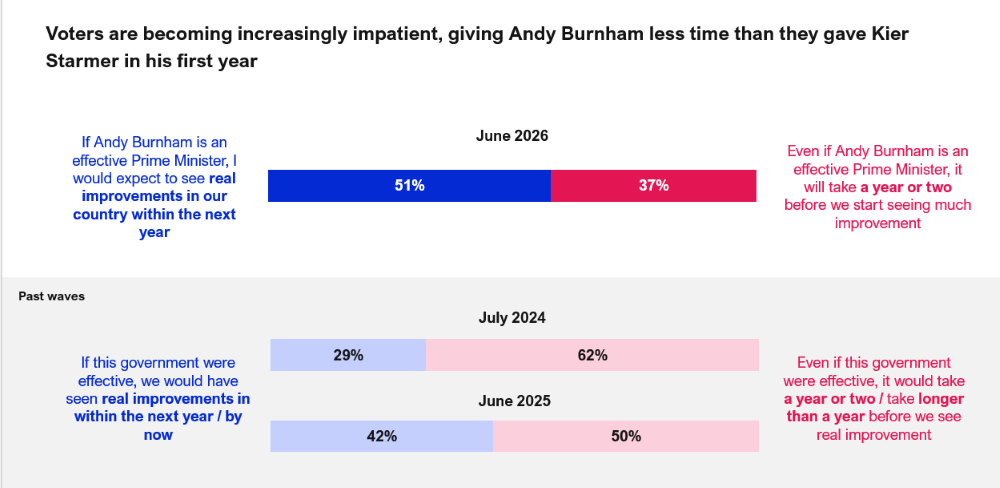
Just over half of respondents (51 per cent) said that if Burnham is effective as PM, they would see real improvements within a year of him entering office, while 37 per cent said it would take at least a year or two.

These results suggest that voters are willing to be less patient with Burnham than they were with Starmer when he first entered No 10 following Labour’s 2024 election victory.
In early July 2024, nearly two-thirds of people (62 per cent) told Thinks Insight & Strategy research for PoliticsHome that even if the Starmer administration was effective, “it will take a year or two before we start seeing improvement.”
On a Burnham premiership, Shimshon added: “The direction of travel needs to be clear within 12 months, and whatever it is, that direction needs to feel like change.”
Farage and Reform have called on Burnham to call a snap election after becoming PM, arguing that he will not have a proper mandate to govern.
Even some on Burnham’s own side have said he should go to the country. Alan Johnson, the former Labour cabinet minister, has said the incoming PM should call a snap election because the mandate he’ll soon inherit was “gifted to him” by Starmer.
On the question of whether Burnham should call a snap election after entering Downing Street, public opinion broadly breaks down along party lines.
Overall, around a third (34 per cent) of people said that a new PM should call a general election as soon as possible after taking office. This was particularly pronounced among 2024 Reform (68 per cent) and Conservative (52 per cent) voters, while just 20 per cent of 2024 Labour voters agreed.
Nearly half of respondents (46 per cent) said the new PM should be bound by the 2024 manifesto, while 35 per cent said they should be free to break from it.
However, the same proportion (46 per cent) told the survey that Burnham must deliver change, even if it means breaking some promises made two years ago.
“In the abstract, voters cleave to the idea that the ‘right and proper’ thing to do is to stick to the manifesto (even though very few among the electorate will ever have familiarised themselves with it),” said Shimshon.
“What this shows is that, when it comes down to it, most voters would trade that off against seeing the change they so badly want actually happen.”
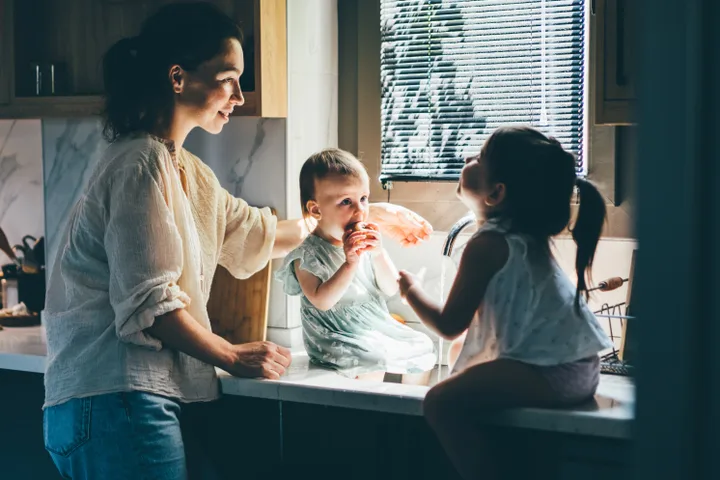
When a nanny steps into a new home for the first time, not only are they entering a new place of employment, but they’re also getting their first look at a family’s personal life, with all of its routines, rules, traditions and eccentricities.
And as many professional nannies can attest, there’s a lot you can tell about a family and how the household functions during that first meeting.
The clues are everywhere: from the level of cleanliness throughout the home to what’s hanging on the refrigerator door (not to mention what’s inside the fridge) and what’s playing on the television, each observation helps paint a picture of the family and what lies ahead.

Maria Korneeva via Getty Images
“One of the first things you learn when you work inside someone’s home is that every family has its own rhythm, systems and quirks. As a nanny, you’re entering into someone’s most personal space, so you start to notice the little things that make each household function,” Shannon Parola, a California-based childcare specialist and longtime professional nanny, told HuffPost.
Noticing these things is not about judgment. Rather, these details help nannies acclimate to a family’s habits and navigate the home respectfully. Wondering what additional details nannies might observe during their initial orientation? Read on for the inside scoop.
Kitchen organisation reveals a lot
Nannies seem to universally agree that a family’s kitchen reveals a great deal about a household’s inner workings and day-to-day operations, making this room, in particular, the source of numerous initial thoughts and insights.
“You can usually tell pretty quickly whether a family is an ‘everything has a place’ household or a ‘we are surviving the week’ household,” said Parola. The clues on this front include everything from the organisation of snack drawers and lunch containers to coffee stations, water bottles and kid cups, all of which reveal what Parola called “the true flow of the home.”
“I always notice this because the kitchen is often the command center for children’s routines,” added Parola.
They’ll pay attention to what’s on the fridge…
Chloe Savage, a part-time nanny from Tennessee, also notices a family’s kitchen area right away, calling it the household’s “centre of gravity.” Her favourite feature to take notice of is the front of the refrigerator.
“It feels like a little personality board for the family,” said Savage. “Kids’ artwork always stands out to me because it’s just so honest and unfiltered. You can tell when kids are really encouraged to be creative because the fridge turns into this full-on rotating gallery. When there’s nothing on it, it also stands out in a different way, almost like the home is more minimal or fast-paced. Neither is good or bad, it just tells you something about the rhythm of the household.”
… and what’s in the fridge
For some nannies, it’s what’s inside the fridge (not what’s on the front of it) that’s especially noteworthy upon first glance. This contingent includes Alie Moya, founder of New York-based Brooklyn Manny & Nanny, who spent more than a decade as a professional nanny and certified doula. During that time, she had plenty of first days in strangers’ homes, observing the contents of refrigerators.
“The funniest, in my opinion, is the ‘Ozempic fridge,’” said Moya. “So many parents are taking weight loss drugs now. Love that. Totally not judging. But you can spot it the second you open the fridge. A couple condiments, some sparkling water, maybe one sad yogurt. Meanwhile the nanny is in there starving.”
The parents aren’t neglecting their children, Moya stressed. There’s always plenty of kid-friendly snacks and raw fruits and veggies on hand. But in such situations, the nanny usually has to start packing a lunch or arrange a DoorDash stipend with the family.
Parola also took careful notice of the contents of the family fridge when acclimating to a new home, describing the food inside as “surprisingly revealing”
“You learn which kids are in a picky eating phase, which parent meal preps, who buys aspirational vegetables and which condiments have somehow become permanent residents,” Parola said. “I noticed this because feeding children is such a big part of caregiving, and the fridge often tells the real story of what actually gets eaten.”

Dishwasher rules can be ‘controversial’
A home’s dishwasher and the rules surrounding exactly how it’s filled with dishes is the source of many nanny ruminations. Moya refers to this subject as “the ever controversial dishwasher saga”.
“There are people that fully rinse off dishes before they load and people that load dishes covered in ketchup and a rogue noodle,” said Moya, who quickly learned that dishwasher rules in a home are nonnegotiable.
Florida-based Niihalani Teare, who spent a decade as both a nanny and household manager, said her initial observations of a family’s dishwasher rules are akin to “a personality test.”
“Every family has strong opinions about where things go and somehow nobody agrees with each other,” Teare, who now works as a domestic recruitment specialist for Household Staffing, said.
“The same goes for toilet paper. Some families are passionate about over, others swear by under and everyone thinks their way is the only correct way. Those little household quirks always made me smile because every family has these tiny debates and routines that become part of their identity.”
Household cleanliness is a factor, too
While it’s completely normal for a busy family’s home to get messy, some nannies say there’s a fine line. And homes that appear too messy at first glance send a clear signal about the type of work experience that may ensue.
“Yes, there are days and even weeks when the house is messier, that’s totally understandable, but the overall care families put into their house says a lot,” said Hailey Boylan, a Massachusetts-based nanny.
“I know I feel valued and respected when I do not have to come in after the weekend to a pile of dirty dishes in the sink, the toy room absolutely destroyed, or the dogs hair and muddy paws all over the furniture. I have been in positions where this was not the case, and I burned out quickly.”
Similarly, Lisa Stenach, an Alaska-based nanny, says the state of the house speaks volumes for her. Overly clean homes, said Stenach, may have strict structure or limits surrounding how things function on a daily basis. If a home is extremely messy, however, (think: food and crumbs everywhere or piles of dirty dishes), then Stenach worries that there’s likely no structure at all.
“My experience says that structure and routine don’t ever happen there, and I should expect to have an ever-changing schedule and duties, and I’ll be lucky to be told about birthday parties, swim lessons and appointments five minutes before they start,” said Stenach.
If, on the other hand, a home simply looks lived in, that’s ideal: “That means it’s balanced, the kids and health and happiness are priorities, and the family can go with the flow,” said Stenach.
They’ll notice if there are toys (and what kind) or if there are designated play areas
When Jamie Wolverton takes her first tour around a new home, the Washington state-based nanny notices the toys on hand and the areas where children are allowed to play.
“Depending on the age, especially between 9 months and 1 1/2 years, I look around for age appropriate toys. That tells me if they are invested in helping their child achieve milestones,” explained Wolverton.
“I also notice if the home is kid-friendly or if the play area is sanctioned to one specific area of the house,” Wolverton continued. “That tells me a lot about their flexibility, adjustability and whether they embrace the chaos of having children.”

Klaus Vedfelt via Getty Images
They’ll get a feel for the atmosphere and attitude – both IRL and the one you are trying to perform
Last but hardly least, the atmosphere throughout a home is a factor nannies take significant notice of. And to be clear, we’re not talking about whether a home is spotless or has nice decor. What nannies notice on this front is whether a home feels warm, welcoming and lived-in.
“Are there books on the couch? Favourite stuffed animals or toys scattered around? Is there the smell of coffee brewing or dinner cooking?” said Teare. “These everyday details often reveal far more about a family than a perfectly organised space ever could.”
Speaking of organisation and atmosphere, families often have their own vision for how they operate and the overall vibe they try to convey to nannies on the first day. But whether the family’s vision aligns with reality is another matter entirely.
“When a family tells me they are ‘super relaxed,’ I smile and I get ready,” said Moya. “After more than a decade of placements, I can tell you this is almost never a description. It’s a wish. It’s how they hope they come across.”
“Meanwhile, the relaxed family has a laminated schedule on the fridge and very real feelings about where the snacks go. I love them for it,” she continued. ”‘Relaxed’ is the vibe board. The house is the reality.”

Few figures in British culture, be they politician, TV personality or sports star, will spark as strong a reaction just from mentioning their name as Katie Price.
Throughout her time in the spotlight, she’s been scrutinised over her career choices, her appearance, her relationships, her parenting and her personal struggles, and been branded a shameless opportunist, a fame-hungry wannabe, a shrewd businesswoman, a good-time girl, an iconic hun, a doting mum, a bad influence and, indeed, a survivor, depending on who you ask.
Her latest venture has seen her following in the footsteps of A-listers like Robbie Williams, Kylie Minogue and both Sir David and Victoria Beckham by bringing us right back to where it all started in the retrospective documentary Katie Price: Nowhere To Hide, a four-part series that takes us through her “rollercoaster” time in the spotlight, offering her side of the headlines that have dominated her life and career.
Early on in the doc, which is a collaboration with Louis Theroux’s production company Mindhouse, Katie explains that she was motivated to offer up her version of events as she feels she’s “always been misunderstood”.
“You all think you know about me,” she tells HuffPost UK weeks before her documentary’s TV debut. “And to a degree, you do. You’ve seen me do reality TV, and I’ve grown up in the public eye since I was 17. But there’s also a lot you don’t know about me.”
“I’m going to take you on a rollercoaster journey,” she teases. “And at the end of it, you will be mentally exhausted.”
“But just imagine, if you’re mentally exhausted, how do you think I feel?” she quips. “It’s my life!”

Nordin Catic via Getty Images for The Cambridge Union
As one of the most iconic pop culture figures of the 21st century, Katie’s story is already very well-documented, between her past fly-on-the-wall reality shows, her whopping eight autobiographies, years’ worth of candid social media posts and, of course, the continuous stream of articles that have been written about her – both fact and fiction – over the last 30 years.
Katie claims that while people will have “seen headlines” and “judged me on them”, her new documentary allows her to put forward not just her version of events and lived experiences, but those of her family, loved ones and other figures from her life who contributed to the series and witnessed it all firsthand.
“When I decided to do the documentary, I literally said, ‘you can interview anyone you like from the past to the present – anybody – and you can ask me any questions you want, no matter how hard or tricky or in-depth it is’,” she recalls.
Clearly, producers took Katie at her word, with the list of subjects interviewed for Nowhere To Hide encompassing family members (including two of her grown-up children, Junior and Princess Andre), close celebrity friends (I’m A Celebrity co-star Kerry Katona and former bridesmaid Michelle Heaton are both featured), famous exes (Gareth Gates and Dane Bowers both lift the lid on their respective relationships with Katie, as does her second husband, Alex Reid) and even her cosmetic surgeons get the opportunity to say their piece.
“People they’ve interviewed, even I have gone ’you’ve interviewed them?’,” the former glamour model and reality star admits with a gasp. “‘What? What did they say about me?’.”
Already renowned for her unfiltered approach to public life, she claims that the Katie we see in Nowhere To Hide is “a proper open book”, and “couldn’t be any more authentic and raw”, as she reflects on the creation of her media “empire”, “marriages”, “relationships” and “every up and down”.

Jeff Spicer via Getty Images
The first two episodes deal mostly with her first decade in the public eye, as she rose from a page 3 favourite to dominating the front pages. Seemingly, no subject is off the table, whether she’s taking accountability for what went wrong in past relationships, reflecting on the public thrashing she received from the tabloid press (and, as a result, the British public) and discussing some of the darkest moments from her personal life.
One such incident discussed early on in the documentary comes when she reflects on being sexually assaulted as a young child by a stranger in a park, something she has previously claimed had a profound effect on her self-image.
In an opening scene of Nowhere To Hide, Katie looks back at childhood pictures of herself, as well as some of the magazine covers she appeared on during her glamour modelling days, describing the latter as “ugly”.
“What’s really sad… there’s a picture I hold up when I’m five, and when I’m seven,” she explains of this scene in the doc. “They’re the only pictures I look at and I think, ‘aw, I was a sweet-looking girl’. But then, something happened to me around then…”
“So I’ve tried to work out, why do I think that I’m so ugly? Because from then, I just think I’m ugly,” she shares. “And that probably explains why I always do surgery.”
“It’s weird, because I’ve been a model all these years, selling out magazines, calendars, being booked for this job and that job, but yet I never look in the mirror and think, ‘phwoar, she’s a sort’,” she adds, with the distinctive laugh viewers of her past reality shows or YouTube series will already know so well.

The most difficult part of making Nowhere To Hide, she says, came when she reflected on a past attempt to take her own life.
“That was the darkest moment. I mean, you can’t get any darker than that,” she notes, saying the documentary allowed her to look back on “the effect it had on my family, the people around me and, obviously, myself”.
Recent years have seen something of a reckoning over the way women in the public eye were treated in the media in the 1990s and 2000s’ tabloid culture, at a time when the private lives of stars including Britney Spears, Paris Hilton and Lindsay Lohan, as well as others who are no longer with us, like Amy Winehouse and Whitney Houston, were treated as a commodity.
Similarly, Nowhere To Hide offers us all a chance to look back at those early years when Katie Price (or Jordan, as he was still known to most of us) became an overnight tabloid fixture.
While she certainly doesn’t shy away from discussing enjoying the highs that came with that time of her life, there’s also no denying there were plenty of lows “and lots of dark moments” that came along with them. If nothing else, the documentary serves as a reminder of just how young Katie was when she first found herself being vilified by the media, as she transitioned from glamour model to media personality.
“When people watch this show, they will realise, I did actually start when I was 17,” Katie points out. “That is so young. I had no media training, and literally, overnight, I’m not joking, I had all the paps following me. Like, carnage.
“I had the media against me. Then the public turned against me – and I’m only a baby, having to deal with all of this.”
She continues: “You go back to your younger self – or even if you are young, the nights you go out, and you’ve gone clubbing with your friends, and got drunk. Imagine if a camera took pictures of your night, of you coming out of a nightclub, then that goes in a newspaper, so the whole UK can see it. And then, they write whatever they think with that picture.
“And it’s not just that day, because then the weekly mags, the following week, write about your night out. This is what I’ve had to deal with constantly – and grown up like. It does affect you. And it’s not normal, really, is it?
“I just became a product for people to just easily target, hate, make fun of, write crap about. And that’s all that I’ve been used to. And, really, that’s quite sad.”
“And it’s been constant, like that, till… the present time!” she adds.

For those tuning in to the doc, she promises equal measures of laughs and tears – “but what’s most important,” she says, “is that anyone from any walk of life will come away and think, ‘I didn’t know that about her’, or you might think ‘I feel really bad for what I thought she was’”. “You will see a different side,” she insists.
One surprising outcome of watching Nowhere To Hide back, Katie says, is the “closure” it’s given her over certain events from her past. Perhaps most notably, in episode two, she and singer Gareth Gates separately reflect on their brief fling in the early 2000s, something Katie observes that “everyone thought was, like, a one-night stand”, but both profess was more serious than many will have realised.
The documentary offers new information about their romance, which took place when Gareth had become an overnight sensation on Pop Idol at the age of 17, and Katie was in her early 20s.
“I’ve had to wait 25 years to get answers for things,” she admits, claiming that watching the documentary back felt like she was “reliving my life, but getting answers I never had at the time”. “It’s quite interesting,” she observes.
Throughout Nowhere To Hide, the constants in Katie’s life – including her beloved mum, Amy – offer their unfiltered opinions on everything from her public falls from grace, her infamous break-ups and the way she’s handled different aspects of her private and professional life.
Both Amy and the glamour photographer Jeany Savage, a mentor to Katie in those early years, profess that they didn’t agree – at least, at the time – with the way she chose to introduce her newborn son Harvey into the spotlight.

Anthony Harvey/Shutterstock for NTA
“They couldn’t understand why I would do photo-shoots and that with Harvey,” Katie says. “And I’m trying to explain to them, ‘if I don’t control it and put pictures out, then a paparazzi will just come and take pictures and make money from it’.”
She adds that while “they couldn’t get their heads around it” in those days, “now it all makes sense to them why I did it”, insisting she was “quite switched on, at a young age”.
Harvey is now 24 years old, with Katie standing by the decisions she made in her younger years.
“He’s my child, he’s an ambassador for Mencap, and I’m glad I did show everyone Harv,” she enthuses. “You know, I’m proud of him, he’s a credit to me. And just because he’s got his disabilities or complex needs, why should he be hidden away?
“He’s a great character, he’s my son, and I love him.”
“And the same with all my other kids,” she adds, referring to sons Junior and Jett and daughters Princess and Bunny. “They were all brought up on TV, and it hasn’t harmed them. They absolutely love it.”
As Katie mentions, tabloid gossip and public scrutiny is something that has gone hand-in-hand with her media career since she was first came onto the scene as Jordan.
“So, it got to a point where it’s like, ‘well, I suppose I’d better play the game, and do it back’,” she remembers of those early days. “But it never got better. It’s never got better.
“It’s literally one scandal after another scandal, and another one, and another one, and another one. Even till this day there is a scandal!”
“Why? Why me?” she ponders. “What did I ask for? I didn’t ask for peace in my life, but come on. A girl needs a break sometimes.”
As for her most recent tabloid scandals – which, this year alone, have included her recent whirlwind marriage to Dubai-based entrepreneur Lee Andrews and the bumps in the road they’ve faced since tying the knot – Katie acknowledges: “Even now, there’s scandal in my life. Yes, I know. But I’m doing no different to anyone else. Everyone else shares their life on social media, so why can’t I?”
“All the speculation about my life and what’s going on now, none of you have any idea,” she adds, teasing: “But if you watch the documentary, there’ll be a lot of things answered to things you always wanted to know.”

Aimee Rose McGhee/Dave Benett/Getty/WireImage
Despite the headlines and drama, the controversy and backlash, the court cases and lapses in judgement, the scandals and still-rampant scrutiny, Katie is adamant that she’d never “walk away from this industry”.
“I love being [in front of] the camera,” she enthuses. “I love doing my photo-shoots. I love filming. I love what I do! I’m a grown-arse woman, I’m 48, and it’s my choice what I do, and my decision.
“And I’m still driven, and it’s not the end of me yet. In fact, I will never give up, until I’m on my deathbed. And that’ll be the last quote. ‘Bye everyone!’.”
Katie Price: Nowhere To Hide arrives on Sky and Now on Wednesday 8 July.
Help and support:
- Mind, open Monday to Friday, 9am-6pm on 0300 123 3393.
- Samaritans offers a listening service which is open 24 hours a day, on 116 123 (UK and ROI – this number is FREE to call and will not appear on your phone bill).
- CALM (the Campaign Against Living Miserably) offer a helpline open 5pm-midnight, 365 days a year, on 0800 58 58 58, and a webchat service.
- The Mix is a free support service for people under 25. Call 0808 808 4994 or email help@themix.org.uk
- Rethink Mental Illness offers practical help through its advice line which can be reached on 0808 801 0525 (Monday to Friday 10am-4pm). More info can be found on rethink.org.
- Rape Crisis services for women and girls who have been raped or have experienced sexual violence – 0808 802 9999
- Survivors UK offers support for men and boys – 0203 598 3898

New Google commercial imagines a Declaration of Independence written with help from AI

How to turbocharge your testosterone HRT: It can give you your life back, but so many women make these mistakes that stop it working. Here are the simple tweaks to boost its effects WITHOUT needing a bigger dose

Broadcom: This Is Just The Start Of A New Leg Up


-

 Fashion1 day ago
Weekend Open Thread: High Hopes
-

 Tech7 days ago
Claude Code turned every engineer into three. Now companies need more product thinkers
-

 Politics2 days ago
The House | “Reframing the debate from a binary discussion of winners and losers”: Yuan Yang reviews ‘We Are Not Machines’
-

 Crypto World5 days ago
Strategy authorizes up to $1.25B in Bitcoin sales under new capital plan
-

 News Videos6 days ago
MAJOR BITCOIN & MARKET UPDATE!!!! (MUST WATCH ASAP!!!)
-

 Tech5 days ago
Anonymous researcher drops 0-day ‘exploitarium’ repo
-

 Business5 days ago
Australia treasurer says alleged access of prime minister’s bank data ’incredibly concerning’
-
 Business5 days ago
The AI boom won’t burst all at once. It will pop in ‘rolling bubbles’: Macquarie
-

 Sports4 days ago
Broncos roster: OL Ben Powers (No. 74) entering final year of contract
-

 NewsBeat4 days ago
Presenter Caroline Flack’s brother Paul Flack dies aged 55
-

 Crypto World3 days ago
Binance stock trading tops $1B in first month after launch
-

 Crypto World3 days ago
Alibaba-affiliate Ant Group enters the humanoid robot market with 12 deals
-
 NewsBeat3 days ago
New exhibition reflects five decades of movement between island of Ireland and GB
-

 News Videos5 days ago
How to Build INSANE Live Financial Dashboards With Claude
-

 Business3 days ago
Meta Platforms Stock Jumps 7% Today as Bloomberg Reports Company Plans to Enter the Cloud Business
-

 Business2 days ago
What a 10 Percent Drop Means for Buyers, Sellers and Renters
-

 Crypto World2 days ago
Binance Re-Enters Philippines As EU MiCA Rules Restrict Access
-

 Tech5 days ago
The attack that hijacked Claude Code came through Sentry. Datadog, PagerDuty, and Jira have the same exposure.
-
 Business5 days ago
PRISM’s IPO filing mentions Zostel case, CCI investigation
-
 Crypto World4 days ago
Airdrop Registration Becomes Key Focus For Remittix As RTX Launch Updates Approach
You must be logged in to post a comment Login