

Politics
World Cup organisation already looks shoddy, thanks to FIFA


The debate surrounding ticket prices for the 2026 World Cup has escalated from a purely sporting discussion to a political issue within US Congress. Dozens of American lawmakers called on FIFA to review its ticket pricing policy.
A letter from US lawmakers warned that the tournament could become an event that excludes a large segment of the fan base.
The letter, coordinated by Representative Sydney Kamlager Duff and signed by 68 other members of Congress, was addressed to FIFA President Gianni Infantino. It urged him to make tickets affordable for American fans as well as international fans attending the tournament, which will be hosted by the United States, Canada, and Mexico from June 11 to July 19, 2026.
FIFA World Cup: rising costs
A global event that impacts the local economy. The primary reason for this intervention relates to the sheer scale of the event itself. Because the World Cup is not just a football competition, but a massive economic project involving cities and public institutions in the host countries.
The American cities hosting the tournament have already spent billions of dollars on infrastructure, security, transportation, and services related to the World Cup. This means that a portion of these costs is covered by public funds and taxpayers, which gives lawmakers the right to question organizers when they feel that local fans might be excluded due to high prices.
Variable pricing
Lawmakers criticized FIFA’s decision to use a variable pricing system for the first time in the tournament’s history, a system that allows ticket prices to change according to factors such as real-time demand and the popularity of a match.
Critics of this policy argue that this model opens the door to significant price increases, especially for matches involving major national teams or crucial stages, potentially turning the tournament into an event exclusively for the wealthy.
In their letter to Infantino, the lawmakers said that high ticket demand “should not be a green light to raise prices at the expense of the people who make the World Cup the most-watched sporting event in the world.”
FIFA under pressure
Although Congress does not have direct authority over FIFA, such letters represent political and media pressure on the international organization, especially when it concerns a tournament held on American soil.
Therefore, in their concluding remarks, the legislators called on FIFA to “review its policies and take immediate corrective action,” warning that continued variable pricing could transform the world’s biggest football event into a profit-driven enterprise that alienates the fans who have made the game so popular.
Amidst the political and economic debate, the issue of tickets appears to have become one of the most contentious topics in the lead-up to the 2026 World Cup, a tournament that will test not only the readiness of the stadiums but also their relationship with the fans, who are the lifeblood of the game.
Astronomical prices
According to FIFA data, nearly two million tickets were sold in the first two phases of sales, with demand exceeding supply by more than 30 times.
Some tickets for the opening match reach prices of around $900, while tickets for the final exceed $8,000, and the cheapest seats for the final start at around $2,000.
But the biggest surprise came on FIFA’s official resale platform, where a third-tier seat for the tournament final scheduled to be held at MetLife Stadium in New Jersey on July 19 was offered for a shocking price of $143,000, more than 40 times its original price.
Featured image via the Canary

A blue wave may already be cresting.
Democrats have flipped 28 Republican-held seats in state legislatures across the country over the past 14 months, a sign that the GOP is indeed at risk of losing control of the House, and maybe even the Senate, in the midterms.
Democratic wins have come even in deep red states, including Texas, Arkansas and Mississippi, and often by margins that make Republican leaders uneasy.
“I’m ringing the alarm bell,” said Brendan Steinhauser, a Texas GOP consultant who has run campaigns for Republicans in the state, including Sen. John Cornyn and Rep. Dan Crenshaw.
The results of these state-level elections reflect the immediate concerns of the electorate, provide a launching pad for the next generation of national leaders and could influence the future makeup of Congress through redistricting. They may also give both Republicans and Democrats a preview of the midterm battles to come.
For Republicans, the results are a sign that they must do more to motivate low-propensity voters who helped carry President Donald Trump back to the White House, said a senior GOP campaign operative, who was granted anonymity because he didn’t have permission from the party to speak freely about the losses.
“We’re the party of low propensity voters now,” said the operative. “How do we turn out these Republican voters in a midterm election?”
One of the first signs that Democrats were building momentum came in August, when an Iowa Senate district swung more than 20 points to elect Democrat Catelin Drey. It was the second seat Democrats flipped in the state last year, and the moment that broke the Republican Senate supermajority in the General Assembly.
Then in November, Democrats did it again: They flipped three of the six Republican-held districts in a Mississippi special election, again breaking a GOP Senate supermajority.
“You are seeing people just vote for change,” said Brian Robinson, a GOP consultant in Georgia, where Republicans lost a seat in December.
Robinson, an outside adviser for the state House GOP caucus, says Republicans are blamed for high prices because they’re in charge.
“If it’s any one thing, it is [the] cost of living.” Robinson said, arguing that Trump will do something to reduce prices before the midterms. In recent weeks, the president has indeed taken steps, including by touting a pledge from tech companies to reduce energy costs associated with data centers and releasing 172 million barrels of oil from the Strategic Petroleum Reserve. The Iran war, which has sent global oil prices skyrocketing, complicates that effort.
After Democrats flipped 13 Virginia seats and five New Jersey seats in November, the Democratic Legislative Campaign Committee went back to reassess state races around the country. They expanded their 2026 target map to 42 chambers and invested $50 million in changing the makeup of state legislatures — the widest map and largest single-year budget DLCC has ever approved.
Legislatures in Arizona and New Hampshire are now on the “flip” list, and the DLCC hopes to break or prevent GOP supermajorities in red states across the South and Midwest. Their success could give Democrats more state power over judicial nominees, protect the veto power of Democratic governors in states with GOP-led legislatures and hand Democrats greater influence over redistricting.
Republicans, meanwhile, are waiting for the funding to hit. As of January, the RNC has just over $100 million and Trump’s MAGA Inc. PAC has $300 million. State Republicans say when that cash flows into midterm races, it will enable them to get low-propensity voters to vote.
Turnout was a major point of discussion at an RNC conference call that Wisconsin GOP Chair Brian Schimming attended Tuesday, and he says Republicans will dedicate a lot of resources to motivate voters in November.
“We’ve met with the White House more than once, and they keep track of the target states pretty closely,” said Schimming, adding he also expects Trump and Vice President JD Vance to stump in key Wisconsin congressional districts closer to the election. “They are big base motivators.”
In the meantime, Democrats keep flipping state seats. The latest came Tuesday night, when Bobbi Boudman beat Republican Rep. Dale Fincher in a New Hampshire Senate seat that Trump won by 9 points.
On March 24, voters will decide in a special election who represents the Florida state House seat that includes Mar-a-Lago. Democrat Emily Gregory, a small business owner who is running against Republican Jon Maples, a businessman, saw her total campaign earnings jump by nearly 75 percent between Jan. 9 and Feb. 12.
In November, a national PAC connected Gregory with Drey, who flipped the Iowa seat in August. Drey advised Gregory to find the affordability issue that matters most to her district — the way energy costs resonate in New Jersey and property insurance does in Florida.
“In this moment, we have all of the issues on our side. We have all of the momentum on our side,” Gregory recalled Drey telling her. “It’s just up to you as a candidate to get in front of every single voter you can and communicate that message.”

The Israeli military has expanded its illegal evacuation order to a large area of Lebanon north of the Litani river, towards the al-Zahrani river as far as Saida. The threat is forcing hundreds of thousands more civilians to flee, adding to the 700,000 forcibly displaced by the earlier expulsion order.
The mass displacement is comparable with demanding the evacuation of England from Birmingham to the south coast.

With its typical arrogance, the occupation is also demanding the evacuation of parts of densely-populated areas of Lebanon’s capital Beirut, with successive orders affecting adjacent areas of the city:

IDF Arabic spokesman Avichay Adraee posted the orders to X, demanding all residents evacuate ‘for their safety’:
#URGENT ‼️ Urgent Warning to Residents of Southern Lebanon
🔸Hezbollah’s terrorist activities are forcing the Defense Army to act against it forcefully, especially in your areas. The Defense Army does not intend to harm you.
🔴Out of concern for your safety, we direct this to all residents south of the Zahrani River – you must evacuate your homes immediately🔴
🔸Anyone near Hezbollah elements, their facilities, or their combat means is endangering their life.
🔸Any building used by Hezbollah for military purposes may become a target.
🔸O residents of southern Lebanon, you must move immediately to north of the Zahrani River.
🔸Attention: Any movement south may put your lives at risk
Following the pattern of its crimes in Gaza, Israel has included among its supposed resistance ‘targets’ the bombing of the Lebanese University in Beirut:
Israel has just bombed the Lebanese University.
They are repeating the Gaza genocide.
— Philip Proudfoot (@PhilipProudfoot) March 12, 2026
Among the victims of the bombing were Dean of Science Dr Hussain Bazzi and Dr Mortada Srour, also member of the school of science faculty.
Was the fact they were leading scientists in their field the reason they’ve been targeted?

Israel, from the tips of its invasive roots to the ends of its poisonous leaves, is a murderous terror state.
Featured image via the Canary
Health minister Zubir Ahmed has said he doesn’t blame Islamophobes for islamophobia.
Why not?
It’s actually the algorithm’s fault.
Labour health minister defends Islamophobes
He said that these right-wing racist cockwombles don’t know any better, and are:
inundated and attacked every minute of the day with algorithmic content.
And? Arguing this is “new” or that they’re impressionable is hogwash. The logic doesn’t add up. Haven’t you ever been told , Ahmed, that you can’t polish a turd? Anti-Muslim hate and general bigotry are exactly what it says on the tin — hate and bigotry.
Racist begets racism
Ahmed, a surgeon by training, shares that he sometimes wears ‘visibly Muslim garb’ when he goes out to gauge the reactions of passersby. Despite his medical accolades, including life-saving surgeries, he himself faces racist comments. For example, people have said, ‘Thanks for the transplant, now go home.’
Ahmed referenced the media’s determined push to drive the “Overton window” of acceptable political discussion ever further right. This process has been underway for decades. As a result, extremist, openly racist right-wing views are now treated as ‘normal’. Moreover, Ahmed warned that it has accelerated over the last year.
Islamophobia? But where?
This is hardly surprising, given that Starmer’s government, committed to Israel, demonises Palestinians. Under Starmer’s leadership, the party has openly been courting the racist right. Furthermore, it has shamelessly demonised Muslims in by-election contests – before and after getting into government.
Starmer also watered down the government’s definition of ‘anti-Muslim hate’, removing the word ‘Islamophobia’ in response to complaints from the hard right and the Israel lobby. The lobby was offended at the definition’s similarity to the so-called ‘IHRA definition’ of antisemitism. Yet, it is still attacked by Islamophobic media. However, Ahmed says that it is still “the right diagnosis for the illness” of Islamophobia.
With its long history of Islamophobia among its ruling right, Labour is of course not the party for Muslims and has haemorrhaged Muslim support since Keir Starmer took over.
Featured image via the Canary

A fire that began in a vape shop has destroyed one of Glasgow’s most recognisable and beloved architectural façades and caused days of disruption to Scotland’s busiest train station. The story behind last Sunday’s blaze is not fully out yet, but what is already known is wearyingly predictable and familiar. A company called Junaid Retail Limited, trading in Glasgow as ‘Scot’s World’, had sold the business two weeks previously, having already accrued a year’s worth of unpaid business rates. Naturally, no license was held by either party for the sale of vapes or tobacco products.
Photographs of the shop prior to the fire suggest that, while mainly trading in vapes, it was also offering a selection of cheap duvets, luggage, hand puppets and soft toys. Even without the benefit of hindsight, the first word that springs to mind, perhaps the only unifying principle in an image otherwise suggestive of post-stroke visual aphasia, is ‘flammable’. The whole scenario could hardly have been more on the nose as a symbol of the decline of British retail, not to mention the vanished prosperity to which the tobacco trade contributed so much in Glasgow in the mid-19th century.
The premises on Union Street were first constructed in 1851 for Orr and Sons, a thriving stationery business. History does not record whether they also offered a range of random knick-knacks, bed linen and other kindling. Images from Union Street’s first hundred years show a street life teeming with energy and purpose, if suggestive of easily recognisable Glaswegian weather. Indeed, despite fears of climate change, that would appear to be the one thing that has remained grimly constant over time. What has changed, or rather vanished, is the kind of formal attire everywhere visible, nowadays associated mainly with funerals and court appearances, if that. One could easily repurpose Philip Larkin’s ‘MCMXIV’ to eulogise the scene.
Vape shops are among the least appealing businesses to have moved into the defenceless hollows that disfigure once-thriving high streets up and down the country. They are perhaps the most familiar icon of the emergent, dominant aesthetic often characterised, after an X account of that name, as ‘Yookay’.
Horrible enough in themselves, vape shops look especially jarring when housed like commercial hermit crabs, behind heritage façades such as that in Union Street. It is unclear whether they and their invariable co-habitees, the Turkish barbers, are even viable in conventional terms or are merely maintained as part of some money-laundering racket. And even when they don’t burst into flames, the suspicion of low-level criminality clings to them like the aroma of sickly steam substrate to a dead-eyed teenager’s synthetic outer shell.
The interiors are generally a combination of the sort of sinister glass apothecary cabinets that Damien Hirst explored in his 1992 installation, Pharmacy, and a sweet shop that turns out to be run by a witch.
Despite, or perhaps because of, the relentless cheerfulness of the packaging and the promised ‘flavours’, the juxtaposition of words like ‘Cherry’ and ‘Mint Julep’ with bold, black sans-serif health warnings, very few people deny that there is something dispiriting about vaping itself or the ambience the product creates in bulk. Which makes it all the more humiliating to have to confess that I did recently experiment with them myself, as a nicotine-delivery system, despite not having smoked since 1992.
I count myself lucky as having been one of those people into whom nicotine does not sink its teeth and claws quite as deeply as some. I started smoking while hitch-hiking in Europe in the summer of 1983, before going to university. I stopped after an epiphany that occurred in a cheap guest house in Spain, while skinning up the first smoke of the day from half-inch butts left in the ashtray from the night before. I suddenly saw myself as a stranger might and thought, correctly, ‘That is disgusting’. And I quit. Simple as that.
Recently, though, I decided to give the vapes a go. Partly to try to punctuate long drives without the need to pay for service-station coffee, both financially and with age-related bladder discomfort. And partly because all my favourite dead authors seem to have been photographed either with a woodbine in the ashtray or ideally, for the really contemplative geniuses like Tolkien and CS Lewis, a pipe stem clamped between their teeth as they savour the completion of another paragraph of archival quality.
Needless to say, it was a failure. On the road, rather than breaking up the monotony, the vape quickly became part of it. There were no measurable breaks between inhalations. Whatever else is wrong with it, traditional smoking does at least introduce a kind of ebb and flow into one’s subjective experience of the world. It gives one a sense of having completed a cycle of some sort, and ready to go again. Vaping doesn’t do this. Instead it becomes part of the autonomic nervous system, as unthinkingly adopted as breathing itself. Instead of being a welcome paragraph or page break, vaping becomes at once as urgent and unsatisfying as an infant failing to get a latch.
All the while, the stylistic aspect, the undeniable cool that still attaches to the Bogarts, Delons and Deans when pictured getting their fix the old-fashioned way, is not only missing when you are seen suckling on one of these plastic teats. The exact opposite is instead suggested: you look like a small boy who is struggling with his first day at school and really wishes someone would come and get him, ideally his mum.
This might all have stayed unaddressed at the back of my mind, had not several valued friends and one valued wife explicitly told me that they think vaping diminishes me and makes me look like an outpatient. And so, the very day before the Glasgow fire, I quit. Thankfully, as before, the nicotine is not really missed. What is, I think, is the sugary tang, the deep breath and the physical twitch. I realise I’m actually addicted to vaporised boiled sweets.
Perhaps none of this really addresses the dire state of the British high street, as exposed by that fire. But somehow, it does seem to echo it, to me at least. Vape shops are to real shops what vaping is to smoking. And lunging at cheap gimmicks that promise to deliver the benefits of an earlier, abandoned practice, without embracing the whole organic truth, might be exactly what is going on in the pestilence that is visibly parasitic on our once thriving hubs of retail activity.
I tried to address some of the issues in an episode of my Radio 4 show, Simon Evans Goes to Market, after the pandemic. And while I’m not generally an advocate for council meddling and command economies, it does seem to me that we need to have a long hard think about what we want our high streets to be, and maybe favour some kinds of business over others – and not only in terms of their likelihood to burn the place down.
Simon Evans is a spiked columnist and stand-up comedian. Tickets for his tour, Staring at the Sun, are on sale here.

Labour MP Neil Duncan-Jordan has called the government out for falsely saying that Motability changes won’t impact disabled people.
Duncan-Jordan has worked with Transport For All and 70 other disabled people’s organisations to prove that this is not true.
Neil Duncan-Jordan holds Labour to account again
The MP for Poole has a history of holding his own party’s government to account. In July 2025, Duncan-Jordan was one of four MPs who lost the whip for being a big catalyst in Labour MPs opposing the horrific benefits cuts.
Ministers said Motability changes wouldn’t impact disabled people.
Transport For All has compiled testimony from disabled people that calls this into question.
I’ve written to the Government with 70 organisations raising concerns.
Ministers must listen to disabled people.
The government announced cuts to Motability in the Autumn 2025 budget. What was abundantly clear from Reeves’ rhetoric around this was that Labour were pandering to Twitter right-wing gobshites.
Letter disproves lies about disabled people
Duncan-Jordan also shared the letter that he and the organisations have sent to the Minister for Disabled People, Stephen Timms. As well as requesting a meeting with the minister, he’s impressing on Timms just how important Motability is.
The letter says:
Motability is a vital scheme, and these cuts will create further barriers for disabled people, including those with long-term and progressive conditions, to access employment, education, medical appointments and to live independently.
The Government and Motability have repeatedly assured deaf and disabled people’s organisations, Parliament and the media that changes to the scheme – including the introduction of VAT on upfront/advanced payments, increased taxation on leases, and a narrowed vehicle selection – would not negatively affect users.
Transport for All has collated responses from disabled people sharing their fears. Duncan Jordan said in the letter that these ‘directly conflict’ with the narrative the government and media are spreading.
The letter said these include those who:
-
Need a higher up car to see safely out of and drive. The removal of a specific model will mean these groups will pay a higher fee for a car that does not meet their access needs.
-
Rely on their Motability cars to work, and who will now face the prospect of being unable to continue employment due to increased costs from VAT and higher insurance premiums.
-
Fear they will be unable to afford the scheme and who cannot get a car that meets their needs due to the reduced vehicle choice.
Labour doesn’t care about working with disabled people
The letter also calls out the fact that there has been no consultation with disabled people or their organisations on these changes. They urge the government to fix that and, if changes must be made, to co-produce new policy alongside disabled people.
But as we’ve seen with the Timms Review, the DWP has a very different view of co-production – and it’s never authentic.
Speaking of the review, the letter also raises the issues that changes to PIP will mean for Motability users. Namely, that if the criteria are narrowed, many will lose their vital vehicles.
The letter ends with a powerful reminder of what the DWP’s aims should be:
Policy must be guided by genuine co-production with disabled people across all impairment groups and their organisations. This should start from the principle of enabling disabled people to live their lives, participate in wider society and for those who can and are able to work, to be supported to work.
Because whilst the Labour government pretend they are doing everything for the benefit of disabled people, their actions always say otherwise.
They might pretend to want to support disabled people into work. But their bullshit schemes, cutting Access to Work, and stopping us from getting to work with accessible vehicles tells us how much they actually care about disabled people.
Featured image via the Canary

As Keir Starmer visited the North of Ireland on 12 March, local politicians laid bare the impact of rising fuel costs. Many in the North use heating oil and this has seen disproportionate price rises following the US / Israeli attacks on Iran.
Sinn Féin leader Mary Lou McDonald T.D led a party delegation to meet with Starmer. She was accompanied by deputy leader Michelle O’Neill MLA, and Pat Cullen MP. McDonald said:
As we approach the thirtieth anniversary of the Good Friday Agreement peace is secure, and our national journey is towards Irish unity which requires political leadership.
Speaking in Belfast, McDonald said:
At today’s meeting between Sinn Féin and the prime minister we raised the growing crisis in relation to rising fuel, home heating, and energy price rises, which is bearing down hard on workers and families.
Given the financial constraints on the Executive budget, there needs significant intervention from the British government and it needs to happen urgently.
We raised the illegal occupation, annexation and continuing genocide in Gaza which remains dire, and the magnitude and scale of the crisis in the Middle East. The international community stands idly by and the British government is arming Israel.
We called on the prime minister to stand on the right side of history. The threat to peace and stability as a result of the wholesale breaching of international rule of law by Israel and the US is deeply worrying.
The human impact is colossal, and we must hold ground to reduce instability and rising militarisation. There must be an immediate ceasefire. Diplomacy and respect for International Law must have primacy.
Commenting on this week’s British Irish Summit she said:
This week’s British Irish summit is another important step in rebuilding relations and East-West co-operation, which was badly damaged under the Tories in pursuit of a hard Brexit.
The challenge for both the taoiseach and British prime minister is to open a new chapter in British-Irish relations, to recognise that as we approach the thirtieth anniversary of the Good Friday Agreement peace is secure, and our national journey is towards Irish unity which requires political leadership.
The long awaited publication of the Terms of Reference for the Pat Finucane Public Inquiry is welcome and which must now proceed without further delay after decades of determined and dignified campaigning by the Finucane family.
The prime minister must now act to establish a public inquiry into the murder of Sean Brown, the Bellaghy Wolfe Tones GAC chairman murdered in 1997. The British government is appealing recent court rulings that found its failure to establish a public inquiry into his murder to be incompatible with its obligations under Article 2 of the European Convention on Human Rights.
Sean Brown’s widow, Bridie, now 87, has waited too long for justice and this continued resistance to an inquiry is totally unacceptable. I put it directly to Keir Starmer that he should meet Bridie Brown, and to drop its appeal to the Supreme Court.
I have also raised this with the Taoiseach who must press the case with the prime minister in Cork and stand with the Brown family in their pursuit of truth and justice.
Gerry Carroll MLA, of the People Before Profit party, also commented on the skyrocketing home fuel costs:
Starmer and Reeves have repeatedly refused to step up and provide a package of financial support for households reeling from spiking oil prices.
Their promises to crack down on profiteering energy companies would be welcome – but for nearly two years, this Labour government has betrayed ordinary people time and time again, in favour of big business.
They’ve refused to fairly tax wealth and rolled out the red carpet for corporate lobbyists. Labour clearly don’t have the interests of working class communities at heart and cannot be trusted.
The Executive’s shambolic handling of this energy crisis is no better, with Sinn Féin and the DUP trading insults about a £81m fund for energy support that looks unlikely to reach the bank accounts of struggling households any time soon.
The fact remains that people in Britain look set to receive a £150 payment next month, with further payments set to follow. It’s completely unacceptable that people in the north will be left behind – especially given our heavy reliance on home heating oil.
Executive parties have a duty to step in where Starmer has failed, and implement price caps on energy costs and deliver meaningful financial support for people across the north, who are facing financial punishment as the result of an illegal and unprovoked war that nobody wants.
Featured image via Sinn Féin

Donald Trump wants the US to dominate Latin America again by weakening the region’s ties with China. And on 7 March, he brought the leaders of “13 like-minded countries” to a Trump resort in Florida for a “Shield of the Americas Summit”. The Chinese embassy in the US, however, mocked the president’s new pet project.
Trump-bootlickers accepting US shackles
Despite a smokescreen promise of using “lethal military force” to rehash drug-war failures of the past, the military alliance of Trump-bootlickers is really a demonstration of US intentions in Latin America. It used brutality in the past to get its way, and it’s willing to do so again now.
The Chinese embassy summed the move up as an attempt to ‘shackle‘ countries throughout the region to US power:
Shield of the Americas, or shackles of the Americas?
📽️ @XHNews #US #America pic.twitter.com/X5kYo09gfq— Chinese Embassy in US (@ChineseEmbinUS) March 12, 2026
After decades of forcing their submission, the US allowed nations in the region a bit more freedom after the Cold War ended. And with some democratic gains, many people in the region sought alternative paths. This saw US economic dominance decrease and cooperation with China increase.
Billionaires have long sought quieter means to get Latin American countries to shackle themselves to the US again. And they’ve got their way in numerous resource-rich nations in the region. But Donald Trump’s tariff pressures, bullying, assassinations, abductions, and blockades have tried to tip the balance even further.
Trump’s regime is desperate to weaken China’s influence in Latin America and, unable to compete economically, it has resorted to militarism again. But for those who lived through the Cold War, the name ‘Shield of the Americas’ may sound all too similar to the notorious ‘School of the Americas’.
School of the Americas / WHINSEC
Most of the countries whose right-wing leaders attended the ‘Shield of the Americas Summit’ also have a dark history with the ‘School of the Americas‘ (SOA), the Pentagon’s “covert warfare” tool that spent decades embedding brutally repressive techniques into militaries throughout Latin America.
Graduates from the military school served elite US interests in Latin America so the US Army didn’t need a repeat of Vietnam closer to home. And some of Latin America’s most notorious dictators passed through SOA’s halls before killing and torturing hundreds of thousands of people back home.
SOA graduates put their lessons into practice from Argentina to El Salvador and Brazil, and from Nicaragua to Venezuela. And despite SOA’s 2001 rebranding as the Western Hemisphere Institute for Security Cooperation (WHINSEC), graduates have been pushing US interests well into the 21st century, from Honduras to Chile and Bolivia.
SOA Watch, a nonviolent grassroots movement campaigning against such training, has faced hostility from the US government for its work. And as its national organiser Hendrik Voss explained:
The purpose of the school is to maintain U.S. hegemony over the Western Hemisphere, and it is also a tool to maintain white supremacy over the non-white populations of this hemisphere.
The training… is among the root causes of migration that force people to flee their countries in Latin America. SOA/WHINSEC-trained soldiers are the military muscle that keeps in place a system guaranteeing profits for the elites—and exploitation for the poor.
The Trump regime has now created the US Army Western Hemisphere Command (USAWHC), to which WHINSEC now reports directly. WHINSEC Commandant Col. Eldridge R. Singleton said the shift would help the school grow its influence. He also explained that:
In Fiscal Year 2025, WHINSEC graduated 781 students from over a dozen countries. Since opening in January 2001, WHINSEC has graduated over 37,000 students from over 30 countries.
The US has trained Latin American forces through other institutions too, but the School of the Americas stands out for its notoriety.
The US return to dominance is not inevitable
The creation of USAWHC seems to be an effort to make the US “preeminent” in the region again. And the ‘Shield of the Americas’ seems to be an extension of this aim. As John Griswold at the Common Reader explained, the Trump regime wants to show Latin America is “a priority theatre” for the US.
Trump’s Republican administration, Griswold said, is shaking off past rhetoric about ‘democracy’ and ‘international law’ (which Democratic support for Israel’s genocide enabled). And it’s openly showing it will use military power to protect US interests and “access to key terrain” in the region, while weakening China’s.
Panama is one country bowing to Trump’s will. While the US regime has pressured Panama to move away from China, it has also reopened a “Jungle Warfare” school there to show both Panama and China that it’s serious.
Trump is bringing “big stick energy” to the region. And fawning far-right governments are bringing big bootlicking energy. But three major Latin American countries — Mexico, Brazil, and Colombia (representing “more than half of the region’s GDP” and currently under left-leaning governments) — aren’t playing along.
Latin America’s relationship with China, meanwhile, won’t end overnight. So China is reacting calmly for now, despite facing an increasingly brash US competitor. And its gentle mocking of US tactics may just prompt people in the region to remember the death and destruction that come with submission to US bullying.
Featured image via Wikimedia
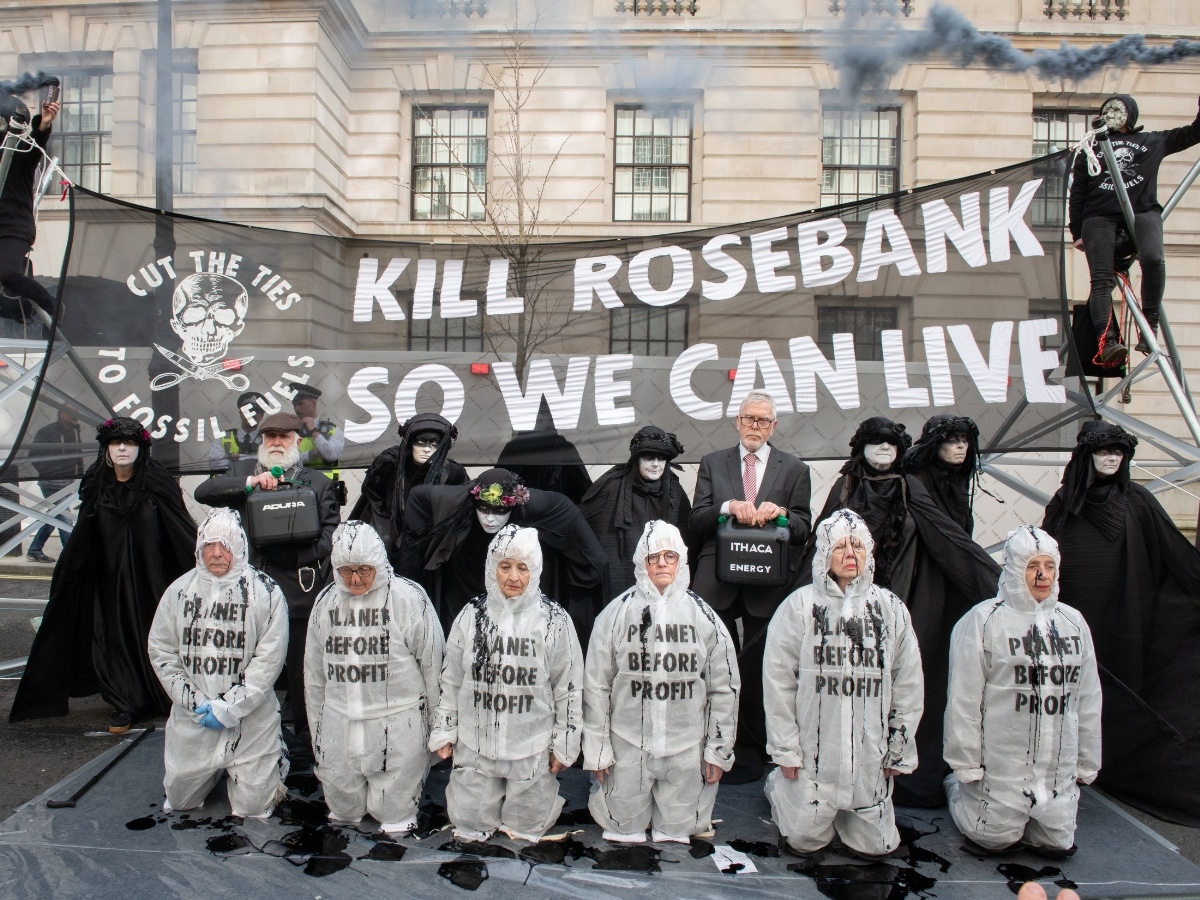
On 12 March dozens of Cut The Ties To Fossil Fuel activists occupied the road outside the Department for Energy Security and Net Zero (DESNZ) in London. They used 4-metre ‘oil rigs’ to stretch out a banner demanding “KILL ROSEBANK SO WE CAN LIVE”.
The street filled with smoke and the sound of drums as a line of activists knelt in front of the DESNZ office. Others poured oil over them from containers labelled Adura and Ithaca. The Oil Slicks performance art group was there too, accompanied by a giant ‘Big Oil’ figure.
Secretary of state Ed Miliband is due to make a decision imminently on whether the controversial Rosebank oil and gas field can go into production. Rosebank is the UK’s largest undeveloped oil field and burning its fossil fuel reserves would emit 254m tonnes of CO2. This makes it incompatible with the UK’s 2050 net zero target.
Ali Fleming, an educator from London who is taking part at the action said:
The decision on Rosebank is a stark choice between reckless profit and survival. We ask Ed Miliband not to lose sight of that, whatever the pressure from lobbyists or other government departments.
Climate change is an existential threat and the science is clear; there can be no new oil and gas developments if we are to avoid the climate tipping into an unrecoverable ‘hothouse earth’ state.
Rosebank won’t lower energy bills
If Rosebank gets the green light, the owners will sell the oil on the international market. Around 80% of all UK oil goes for export. So Rosebank won’t lower our energy bills or add to the UK’s energy security.
However the UK public could carry 91% of the cost of developing Rosebank (£3bn) due to generous tax rebates. NGO Uplift calculates that the gap between the tax breaks and the predicted tax payments from sales profits mean the UK exchequer can expect a net loss of more than £258m over the life of Rosebank. And the recent addition of Shell as co-owner could also potentially cost the exchequer £1.3bn.
Also at the action, Dr Ines Smyth, a retired humanitarian worker from Oxford, said:
Ithaca Energy is owned by the Delek Group, an Israeli fuel conglomerate that is linked to violence and the dispossession of Palestinians as it profits from illegal settlements in the West Bank. Delek literally fuels the ongoing genocide by supplying the Israeli occupation forces as they continue to commit war crimes in Gaza.
Approving Rosebank could mean £200m in profits flowing to Delek. Competition over oil and gas also fuels wider conflicts, so cutting ties to fossil fuel will help bring much needed peace and stability to the world.
Rosebank sits 80 miles north-west off the Shetland Isles. A planned gas pipeline would cut through the Faroe-Shetland Belt Marine Protected Area, threatening its unique ecosystem including endangered species of dolphins, whales and fish. Oil spills, construction drilling and seismic work would all have a negative effect on this fragile ecosystem which is already under pressure from climate change.
Also present, Susan Hampton, a writer from Berkhamsted, said:
We are at the point where we must see emissions peak and begin to fall or the planet will overheat with horrendous consequences.
North Sea oil industry jobs have halved in a decade. Propping up this declining industry is just throwing good money after bad; it would only delay the transition to clean energy which is where the growth in the energy market is anyway.
Killing off Rosebank would be a vital win for the planet, as well as a win for clean jobs. We urge Ed Miliband to do the right thing: cut the ties to fossil fuels and kill Rosebank so we can live.
There were two arrests at the protest. Police charged Jessica Upton from Oxford and Alison Fleming from London with Obstruction of the Highway. This came as they descended from the tripods (‘oil rigs’) they were occupying during the protest.
Featured image via Gareth Morris / Cut the Ties

A second horse, HMS Seahorse died at this year’s Cheltenham Festival after sustaining a fatal injury on 11 March. This has reinforced calls by national animal welfare charity the League Against Cruel Sports for a public boycott and government intervention.
It brings the death toll at the Cheltenham Festival to 80 horses since the turn of the century with Animal Aid figures showing a horse dying at every single festival since the year 2000.
The death of HMS Seahorse follows the death of Hansard earlier in this year’s Cheltenham event.
At last year’s festival two horses also died. Springwell Bay was the first casualty before Corbetts Cross died in the festival’s flagship Gold Cup event.
Emma Slawinski, chief executive at the League Against Cruel Sports, said:
Every year horses are raced to their deaths at the Cheltenham Festival and while the death of HMS Seahorse will sadden all animal lovers, tragically it is not a surprise.
The death toll of 80 horses at Cheltenham festival since the turn of the century is simply staggering.
If this death toll happened in any other sport there would be a huge outcry so why is it any different for horses.
Slawinski added:
We are calling on the public to boycott the Cheltenham Festival by staying away, not betting on the races or watching the ITV coverage and advertising which accompanies it.
The government promised the biggest boost for animal welfare in a generation and now it needs to deliver by tackling the terrible death toll at Cheltenham and introducing tighter safety measures in horse racing and banning the use of the whip.
Featured image
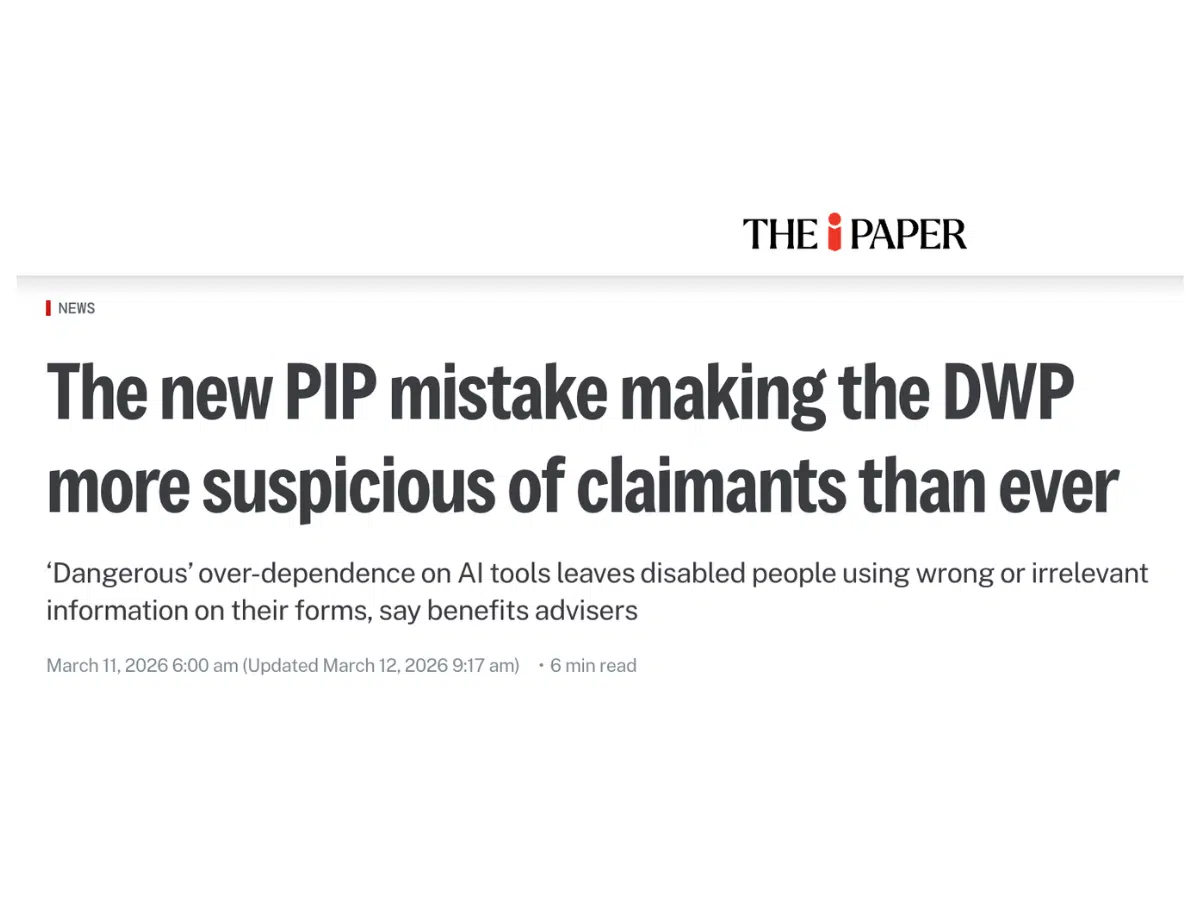
The shitrag corporate media are fueling more lies about disabled people defrauding the Department for Work and Pensions (DWP) benefits system, this time it’s involving AI.
Media doing the DWP’s job for them
The i Paper ran with the story:
The new PIP mistake making the DWP more suspicious of claimants than ever
‘Dangerous’ over-dependence on AI tools leaves disabled people using wrong or irrelevant information on their forms, say benefits advisers
Basically more DWP propaganda about how disabled people are trying to cheat their way to stealing taxpayers money.
If you look deeper into the story this becomes even clearer. And as usual it’s all an exercise to excuse the DWP’s own failures and bullshit.
The i continued:
The DWP is currently engaged in a Freedom of Information (FOI) battle to prevent the release of training manuals that PIP assessors use with “hidden” conditions, such as Chronic Fatigue Syndrome.
According to FOI documents, the Government has argued that people may use them in combination with AI tools to “craft responses or scripts that mirror the exact requirements needed to score highly”.
The real story here is that the DWP thinks people may fake kidney failure using their own guidance. But now that’s being picked up by the mainstream media, they’re seemingly trying to cover their tracks even more. Conveniently they’ve also thrown AI into the mix, which is a hot topic at the minute.
It also needs pointing out that the FOI battle the DWP are locked in is about the severe conditions criteria (SCC) for the Work Capability Assessment, not PIP. But why let that spoil a good “disability fakers are at it again” story.
This is obviously just another iteration of “fraudsters sharing tricks on TikTok”, but of course the disability hating media lapped it up.
Media missing the point, again
Thankfully the i also featured benefits experts who politely called out the media’s bullshit. However they mainly shared the same viewpoint and expressed concern for people doing this. The worries included that people relying too heavily on ChatGPT will accidentally include false information that could either make them commit fraud or stop them getting benefits.
In one absolutely absurd part of the article, Michelle Cardno, founder of Fightback4Justice claims it will hinder assessment because:
Assessors want a complete picture – good days and bad days
This is so laughably, demonstrably untrue that anyone who’s gone through an assessment can tell you the reviews completely lack nuance.
The article, however, never once addressed why people feel that they have to use AI. Mainly that the PIP is such a difficult benefit to qualify for that unless you say the exactly right thing you risk losing support. The system is so stringent that it doesn’t allow for chronic illness fluctuations. There’s also the fact that the form is 40 pages long. For someone with limited energy or conditions affecting their intellectual abilities, it feels deliberate.
AI undoubtedly can be bad news and for someone in a creative industry, it’s terrifying how much it’s being relied on. However, for disabled people it can be an important accessibility tool.
AI can be used to create summaries, make your tired ramblings make sense and translate voice notes to text. Whilst AI is definitely causing harm, we also can’t ignore that when used in circumstances like this, instead of shitty art, it has a place.
And when you’re already up against it in a system which wants to trip you up whilst claiming to support you, any tools that make that easier can’t be disregarded.
DWP are hypocrites
What’s missing from this that once again is that DWP are hypocrites. Because while they don’t want people using AI to fill in the forms, they use AI to make benefits decisions. This is despite findings that AI use is much more likely to target vulnerable claimants.
This is clearly just another in a long line of the media doing the government’s job for them when it comes to turning the public against disabled people. And as usual the media is more than happy to use us for clicks.
Featured image via screenshot

Lucid sees positive cash flow late in decade with affordable model, autonomous offerings

Hester Peirce Calls For Simpler Disclosure Rules, Tokenization Experiments
Dennis Quaid was floored by Lindsay Lohan's “Parent Trap” screen test: 'I thought there was 2 people'


-
Business6 days ago
Form 8K Entergy Mississippi LLC For: 6 March
-

 News Videos3 days ago
10th Algebra | Financial Planning | Question Bank Solution | Board Exam 2026
-

 Fashion6 days ago
Weekend Open Thread: Ann Taylor
-

 Crypto World3 days ago
Paradigm, a16z, Winklevoss Capital, Balaji Srinivasan among investors in ZODL
-
 Tech2 days ago
A 1,300-Pound NASA Spacecraft To Re-Enter Earth’s Atmosphere
-

 Tech2 days ago
ChatGPT will now generate interactive visuals to help you with math and science concepts
-
 Politics7 days ago
Top Mamdani aide takes progressive project to the UK
-

 Business2 days ago
ExxonMobil seeks to move corporate registration from New Jersey to Texas
-

 Sports5 days ago
Three share 2-shot lead entering final round in Hong Kong
-

 Sports5 days ago
Braveheart Lakshya downs Lai in epic battle to enter All England Open final | Other Sports News
-

 NewsBeat1 day ago
Residents reaction as Shildon murder probe enters second day
-

 Entertainment6 days ago
Hailey Bieber Poses For Sexy Selfies In New Luscious Lip Thirst Traps
-

 Business4 days ago
Search for Nancy Guthrie Enters 37th Day as FBI Probes Wi-Fi Jammer Theory
-

 Business2 days ago
Search Enters Sixth Week With New Leads in Tucson Abduction Case
-
 NewsBeat3 days ago
Pagazzi Lighting enters administration as 70 jobs lost and 11 stores close across Scotland
-

 Tech3 days ago
Despite challenges, Ireland sixth in EU for board gender diversity
-

 Business3 days ago
Search Enters 39th Day with FBI Tip Line Developments and No Major Breakthroughs
-

 NewsBeat1 day ago
I Entered The Manosphere. Nothing Could Prepare Me For What I Found.
-

 Business6 days ago
Iran war enters second week as Trump demands ’unconditional surrender’
-

 Sports4 days ago
Skateboarding World Championships: Britain’s Sky Brown wins park gold