TORONTO — A tug-of-war over the pitch clock is the newest element in the Toronto Blue Jays’ rivalry with the New York Yankees, with a strange incident representative of how hard the two teams fight for every inch against one another.
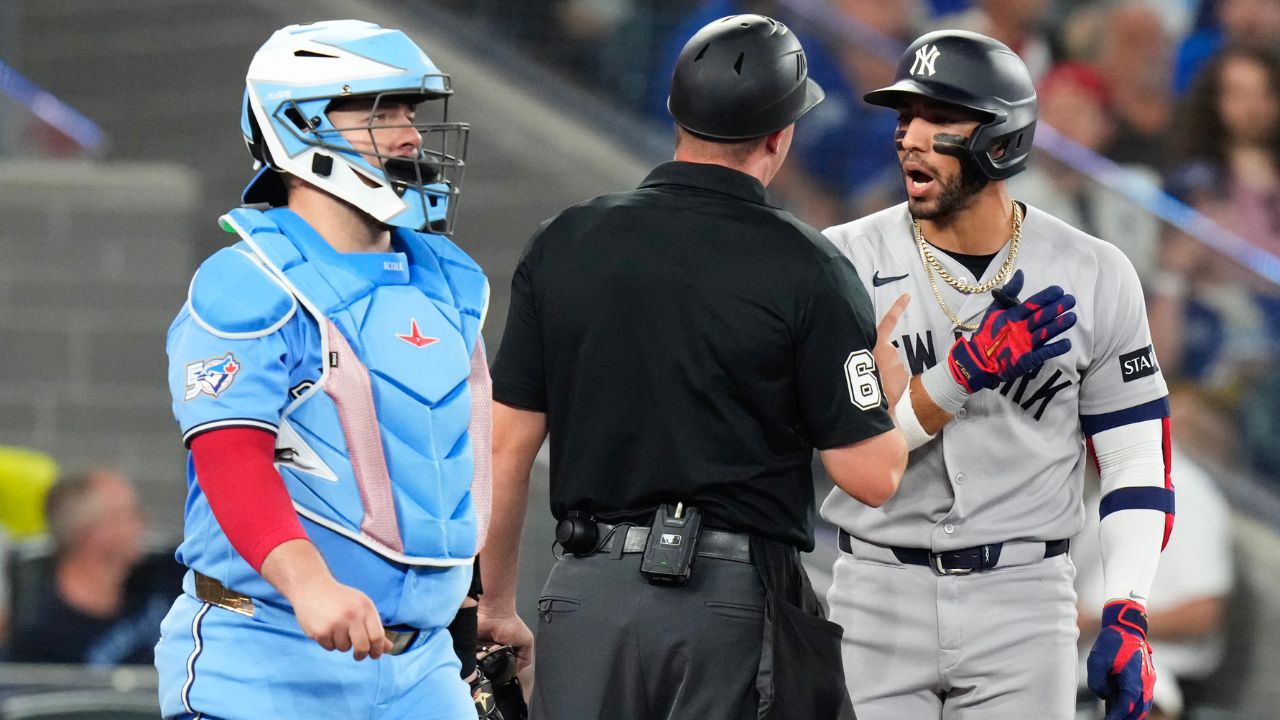
Centre stage was Jose Caballero, who during the sixth inning of New York’s 8-3 win Sunday, stretched the limits of the rule that batters must be alert to the pitcher once the timer hits eight seconds, earning a warning from umpire Steven Jaschinski for “intentionally delaying.”
At issue was the way Caballero stepped into the box against Spencer Miles and positioned his body for the pitch, but took his time raising his head to the pitcher. He twice skirted the line before Jaschinski took action and issued the warning, saying if it happened again, he’d be charged a strike.
The Blue Jays were frustrated that more than two minutes of discussion took place before play could resume, and Miles was left idle, unable to throw a pitch, since Caballero, Jaschinski, Yankees manager Aaron Boone, and eventually crew chief John Tumpane were all standing over home plate.
That’s why when Blue Jays manager John Schneider came out to argue an eighth-inning balk call on Jeff Hoffman with Jaschinski, a native of Burlington, Ont., he had more than just that play on his mind.
“Upset about the balk initially and upset about some other things,” explained Schneider, ejected for the second time this season. “It’s not why we lost, but Hoff has a good inside move. He’s done it quite a bit this year. It’s kind of what I was relaying to them and didn’t think it was a balk. Thought they could have maybe put as much focus and attention on that play as they did the 10-minute conversation with Jose Caballero, who seems to have a problem with the pitch clock. That’s when I got a little bit upset.”
Schneider said he didn’t get any further explanation of the Caballero situation beyond the in-stadium announcement from Jaschinski about the warning, but took issue with the latitude granted to the Yankees infielder.
“There are a lot of major-league players in this league. There seems to be one guy that has an issue with it,” said Schneider. “It sucks that Spencer Miles has to sit out there for as long as he did. Seems like it could have been handled a lot quicker and a lot more efficiently than it was. That’s not why we lost, but it’s major-league baseball and everyone knows the rules.”
Caballero told reporters in the Yankees clubhouse that he was simply doing the same pre-pitch setup he always does and that “it’s not my fault the pitchers rush a little bit.”
Miles said while “it was tough,” he made a point of staying focused mentally throughout the delay, especially since he was unable to throw any warm-up pitches during or after, but added Caballero’s antics didn’t come as a surprise.
“I think everyone in here knows what’s going on. I think it’s pretty common him doing that, and I think the umpire finally caught on,” said Miles. “He did it again there. Like he looked at me and looked back down. So it’s out of habit. But I think everyone in here kind of knows that deal. So just be ready to pitch it when he’s looking at you.”
BUSY BULLPEN: Five of the 22 most frequently used big-league relievers are Blue Jays, with Mason Fluharty’s 38 appearances tops in the majors and Braydon Fisher’s 36 outings tied for second.
Louis Varland and Tyler Rogers are next among the group tied for sixth at 34 outings, while Jeff Hoffman is among the 11 pitchers tied for 12th at 33 games.
The Blue Jays have the most relievers among that top group — the Yankees and Athletics each have three — and it’s demonstrative of how they’re trying to concentrate leverage innings among their most trusted arms. However, some of their blips over the weekend — Varland giving up Paul Goldschmidt’s two-run homer in the ninth Saturday, Fisher coughing up a two-run shot to Ben Rice in the ninth Sunday — might be reflective of the wear from all those outings.
“Yeah, probably,” said John Schneider. “The life of a reliever is really, really hard, and when they’re available, they’re available, and when not, they are not. But over the course of time, it takes its toll on you a little bit, and we’re asking a ton out of those guys.”
That’s the way the relievers like it, of course, and Fisher wasn’t ready to use that as an excuse.
He conceded that heavy workloads can impact performance “sometimes,” but he quickly added that “I don’t think that was the case” against Rice. The slider down and on the inner edge of the zone that the emergent force in the Yankees lineup clubbed over the right-field wall “would have been like the most perfect strike pitch,” he said, “but to strike him out, maybe get it a little lower, a little more in. Preferably a little bit lower, but I’m not trying to be perfect; nobody’s perfect. Maybe looking back, we throw him a different pitch, or maybe I do just throw one 40 feet before I throw it more in the zone.”
Fisher has been invaluable this season, a prime option for Schneider to put out rallies in the middle innings, open in front of a starter, set up in the late innings or even close, with one save to his credit. During busy periods, he throttles down both his catch play and his warmups in the bullpen.
Fluharty, who atypically walked lefty Jazz Chisholm Jr. on four pitches to open the eighth after recording two outs in the seventh, does the same thing. He makes a point of “utilizing all the recovery resources, treadmill pool, all that stuff,” he said. “Making sure I’m on top of arm-care with the trainers. Some days just taking off when I can.”
“Early on in the season, still building up this workload, it was a little tough,” Fluharty continued. “After like the first three weeks, I think, stuff and velo started to trend down a little bit until my body and my arm realized, like, this is where we’ve got to be. Now I feel like my arm and my body are in a spot to where this is my workload and now it’s all balanced out. Everything feels good, so now I’m at a point where I’m used to it.”
Ultimately, Fisher insisted, this is what each of them wants.
“We all love being out there,” he said. “Obviously, we’ve had some struggles with the IL this year and we’re getting our guys back here soon, so the workload will go down a little bit, and we’ll all be happy and sad about that. It’s good for the team as a whole and for each other individually. But we like earning our money.”
GARCIA GETTING CLOSE: Yimi Garcia’s second rehab outing with triple-A Buffalo — an inning of one-run ball in Saturday’s 8-7 win over Syracuse — went much better than his first, with his fastball averaging 95.5 m.p.h. and topping out at 97.1.
Three days earlier, he topped out at only 92.9, an unusually low number for him, so the jump back to normal levels was important.
“Reports were good, velo was better and him after the game reported feeling good,” John Schneider said, although when it comes to his next steps, the Blue Jays are “not quite sure. We’re going to get in touch with him as we get going to Boston to see how he feels, and if he needs another one, we’ll see. But the reports were good and he felt better after that one.”
One factor, and it’s vital for the Blue Jays, is whether Garcia is ready to pitch every other day. Thus far in his rehab from elbow surgery, he’s only pitched once on two days of rest, the others coming with at least three.
He’ll need to be available for a much heavier workload once he’s reinstated, and barring an injury, the Blue Jays will need to create a spot for him in the bullpen that doesn’t have easily optionable bullpen arms.
VLAD AND GIMENEZ: The Blue Jays had several potential lineups Sunday morning and they ended up using the one without Vladimir Guerrero Jr., out a second day due to lower tightness in his back, and Andres Gimenez, a late scratch due to left wrist soreness.
But the news was better by the end of the game, as Guerrero tested himself during the game and was on deck to pinch-hit for Yohendrick Pinango in the ninth had the lineup gotten there.
“Vlad felt better as the game went on,” said John Schneider. “Gimenez was still a little bit sore, but I think the off-day will be good for him and Vlad. … After the off-day, they should both be good.”
Guerrero’s back began tightening up before he played Friday while Gimenez jammed his wrist diving into first base Saturday to beat out an infield single.
He explained that he “hit the bag really hard because of the late slide. It wasn’t in my head (to slide) until I saw (Cam Schlittler) getting closer to me. Then I decided to slide, so it was late.”



























































You must be logged in to post a comment Login