That much was clear. The sequence at Royal Birkdale ended with a birdie that, at the time, moved him to one stroke back of the lead — though it also included a tee shot that led to screamed questions, a driver-off-the-deck choice, a wayward second shot, a wayward provisional and a rules talk.
Advertisement
– From the tee on the 571-yard, par-5 penultimate hole, Scheffler tried to “slice” his ball back into the fairway with a 3-wood. He appeared to do that, only for his ball to kick left and finish in the rough and behind a 30-foot-tall mound. His response went viral. Shouted Scheffler from the tee box:
“Why?
“WHY?
“Why — how does that even happen? That ball’s slicing. One bounce.”
Advertisement
“I was thinking I hit another shot that I felt like was going to be in the fairway,” Scheffler said afterward. “That ball was slicing on the left edge of the fairway, and I hadn’t seen many balls that just have not bounced, especially when they’re curving sideways out here, and it was like, man, I got that break on 13 where I hit it in the rough and I couldn’t advance it more than 10 feet, and then 14, I thought my ball was in the fairway, and then on 17, it’s like, that ball is cutting.
“The shot there for me, if I hit a normal 3-wood, it’s going to get to those three bunkers so I have to put a ton of spin on it, and I did that basically by slicing the ball. So I hit the shot I needed to to get the ball in the fairway, and the ball didn’t react the way I thought it would off the tee. Yeah, you’re thinking, give myself a look for eagle, of course.”
– From behind the mound and 298 yards away, Scheffler tried to go for the green — with a driver off the deck. The Open’s defending champion had started the hole two shots back of the lead and was looking to cut his deficit, only for his ball to hook — and it finished left of the green, left of the rough and left of “Clarets,” a cleverly named, 30-yard-long seating area built for the tournament and overlooking the putting surface.
“This is a mile left,” on-course analyst John Wood said on the NBC broadcast.
Advertisement
“Oh my gosh,” announcer Terry Gannon said.
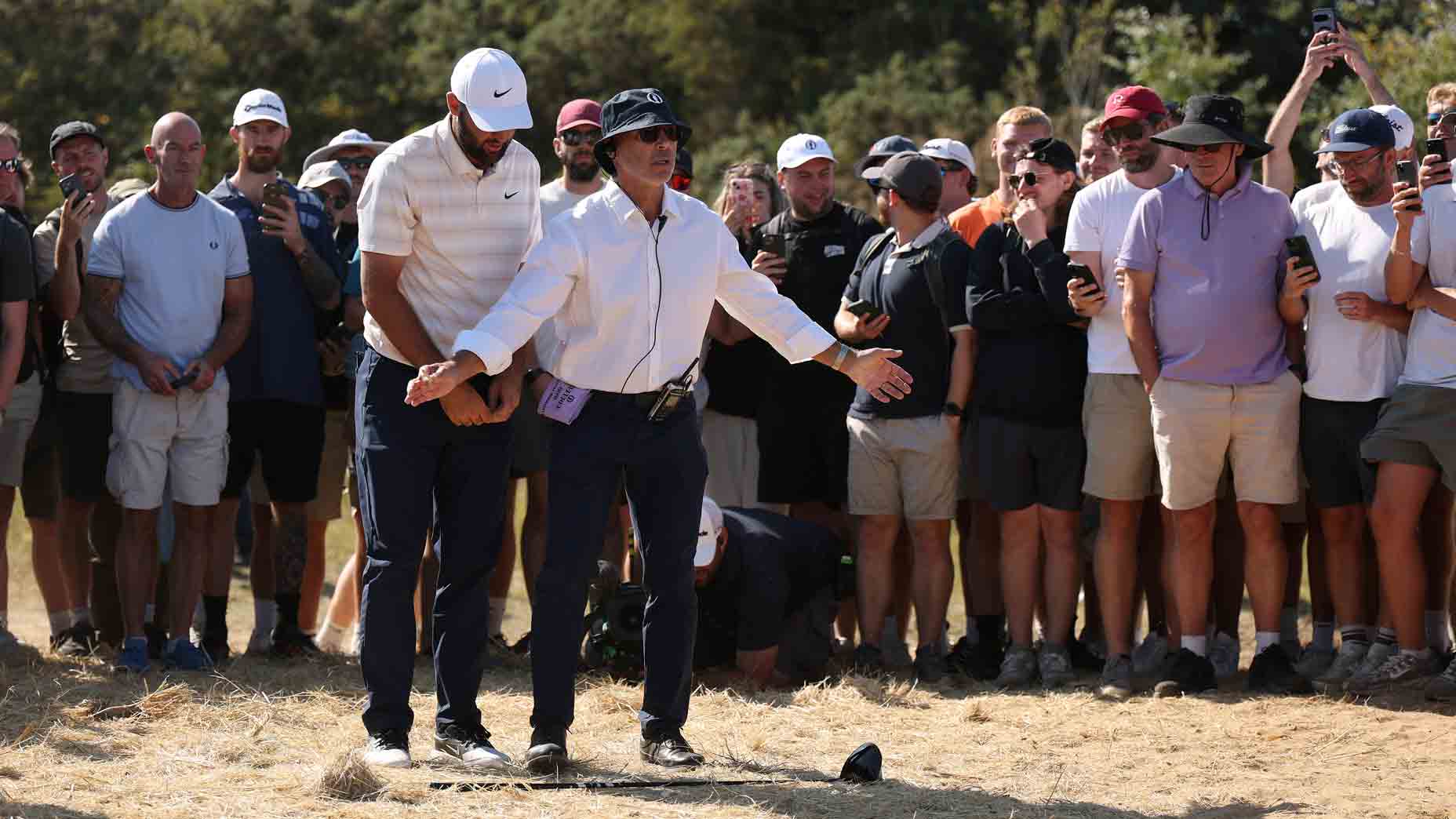
Scheffler tried to see where his ball finished. A rules official also came over. “The rules official said it landed just barely left of the grandstand thing,” Scheffler said. “I don’t know what you call that, like a sponsor area or something. And Teddy [Scheffler’s caddie, Ted Scott] had a bead right on where it was coming down.”
– From the same spot where he hit his second shot, Scheffler took a provisional drop, then hooked a 3-wood, though this ball finished to the right of “Clarets.”
– A rules discussion ensued.
Advertisement
To the left of “Clarets,” Scheffler and Scott talked with a rules official, and Scheffler said he was told that his ball was “past the fence that marks the TIO, so [the official] said anything that’s in there is part of the TIO.” TIO is short for temporary immovable obstructions (think tournament seating, such as “Clarets”), and players can be given relief from them under model local rule F-23 of the Rules of Golf.
But what about the ball itself?
As the talk was going on, observers searched for Scheffler’s ball — then were told to stop. Among them were Wood, or “Woody,” and a security official assigned to Scheffler whom he called “Brucey” in a press conference afterward.
Why not find it? That’s also addressed under model local rule F-23, and that part reads this way: “If the player’s ball has not been found but is known or virtually certain to have come to rest in a TIO, the player may take relief under this local rule by using the estimated point where the ball last crossed the edge of the TIO on the course as the spot of the ball for purposes of finding the nearest point of complete relief.”
Advertisement
In Scheffler’s case, this meant he could drop his ball left and about 100 yards short of the green, in a spot trampled down by fans. If the ball had been recovered, Scheffler was told that he would have to take his drop in what would be considered a less advantageous spot.
“We tried to figure it out,” Scheffler said. “I said, if I find it, does that help me? Can I drop it — since that would be about 50 yards closer to the hole? He said, yes, you can then use that spot, but you might have to go to the other side of the TIO, which I didn’t know exactly where that would be, and that’s not a great angle coming across there.
“So decided to stop the search and go back and drop it doing point-of-entry TIO relief. Actually I did that once this year during the Byron as well [the CJ Cup Byron Nelson event]. Not something I’m proud of, but I was familiar with.”
So Scheffler didn’t find the ball?
Advertisement
“I stopped them,” he said. “They had guys pointing from up there, like it landed right here, and I just kind of hauled up there, and I was like, guys, get out of there, stop, do not find the ball. Fortunately, it was my security guy that I’ve had for a few years here. His name is Brucey. And then Woody was up there as well.
“So both those guys are pretty — I know them quite well, so when I said, please don’t look for the ball, they got out of there.”
Scheffler then dropped about 100 yards from the hole, pitched to 9 feet, and made the ensuing birdie putt, moving him one shot back of the lead. Reactions to the sequence can certainly vary. Did Scheffler follow the rules? Yes. Is the rule funky? Yes, in that Scheffler’s ball went left of left, but he was able to play his next shot in a favorable spot due to temporary seating.
From there, he bogeyed 18, and he finished three back of winner Ryan Fox.
Advertisement
“Yeah, I mean, today was a great effort,” Scheffler said. “I felt like I was doing the right things out there. I gave myself a lot of looks again today. It was just — I guess it just wasn’t my week. I got a good break there on 17, but off the tee, my ball — I don’t know if you watched the shot. It probably should have been in the fairway.
“Yeah, that stuff hurts. My ball on 13 goes into that hole. It wasn’t my best tee shot, but it was a time where I needed to be aggressive, and I saw some good stuff happening with guys that hit the ball over there the last few days, and it didn’t happen for me today.
“Just those little kind of bounces. My ball on 14 I think is in the fairway, I come up there, it’s in the pot bunker. Little stuff like that over the course of the week tends to add up.
“I competed really well this week. I did a good job of staying patient and hit the ball really nice over the course of four days. Maybe yesterday was the only day I didn’t strike it as well as I would have liked to.”
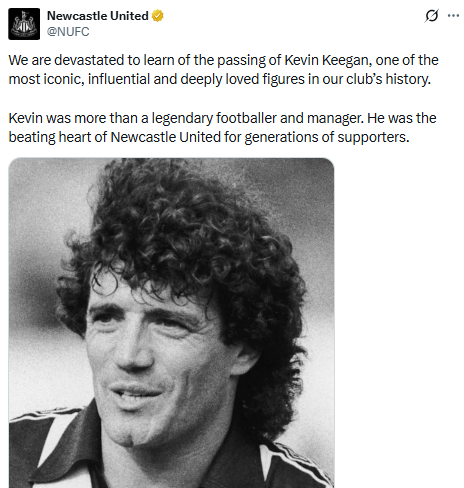
Kevin Keegan, one of English football’s most iconic figures, has died at the age of 75 after battling stage four cancer.The news was confirmed by Newcastle United, the club where Keegan became a legend both as a player and manager. Last month, Keegan had publicly revealed that he had been diagnosed with stage four cancer.“One of the most iconic, influential and deeply loved figures in our club’s history,” Newcastle said in a tribute.
A two-time Ballon d’Or winner, Keegan enjoyed a glittering playing career that saw him captain England, lift the European Cup with Liverpool and become one of only four Englishmen to win football’s most prestigious individual honour.Beyond his achievements on the pitch, Keegan became a cultural icon during the 1970s. His trademark perm hairstyle inspired footballers across Europe, while his celebrity status extended into television, music and advertising. He released the single “Head Over Heels in Love,” appeared in an aftershave commercial alongside heavyweight boxing great Henry Cooper and regularly featured on television shows.Keegan was also among the first high-profile English footballers to move abroad when he left Liverpool for German club Hamburger SV in 1977 after winning the European Cup.“For Hamburg fans he will remain above all a crowd favorite, an exceptional player, and one of the best footballers ever to wear the rhombus (crest) on his chest,” the Bundesliga club said.His move to Germany proved hugely successful. Keegan won the Ballon d’Or in 1978 and 1979 while at Hamburg, helping the club lift the Bundesliga title in 1979 before reaching the 1980 European Cup final, where they were beaten by Nottingham Forest.“Hamburger SV will always cherish the memory of its former championship-winning player and two-time Ballon d’Or winner,” the German club added.Born in Doncaster on February 14, 1951, Keegan began his professional career with Scunthorpe before joining Liverpool in 1971. Under legendary manager Bill Shankly, he formed a prolific strike partnership with John Toshack, helping the Reds secure the league and UEFA Cup double in 1973.During his six-year stay at Anfield, Keegan won three league titles, an FA Cup, two UEFA Cups and the club’s first European Cup in 1977. In that final against Borussia Monchengladbach, he won the penalty that Phil Neal converted in Liverpool’s 3-1 victory.“His legacy at Liverpool will be forever etched in history,” the club said. “He was regarded as a hero wherever he went.”After returning to England from Germany, Keegan joined Southampton, where he finished as the First Division’s leading scorer with 30 goals in the 1981-82 season before moving to Newcastle United, the club he supported through his father.His tireless work rate and infectious personality quickly made him a fan favourite at St James’ Park before he retired in 1984. He briefly returned to action the following year for two guest appearances with Australian side Blacktown.On the international stage, Keegan scored 21 goals in 63 appearances for England. He captained the national team at Euro 1980 and represented his country at the 1982 FIFA World Cup, his only appearance at football’s biggest tournament after England failed to qualify for the 1974 and 1978 editions.Keegan later enjoyed a memorable managerial career that lasted from 1992 to 2008. His greatest achievement on the touchline came at Newcastle, where he guided the club from the second division to the brink of the Premier League title in the 1995-96 season.That campaign became famous for both Newcastle’s attacking football, which earned them the nickname “The Entertainers”, and Keegan’s emotional television outburst directed at Manchester United manager Alex Ferguson.“You can tell him now, we’re still fighting for this title. And he’s got to go to Middlesbrough and get something. And I’ll tell you … honestly … I will love it if we beat them, love it,” Keegan said.Despite leading the table by 12 points in February, Newcastle eventually finished four points behind Ferguson’s Manchester United.Keegan also managed Fulham, England and Manchester City. His spell as England manager lasted from 1999 to 2000 and ended after a 1-0 defeat to Germany in a World Cup qualifier at the old Wembley Stadium. He famously informed Football Association officials of his resignation during an emotional conversation inside a toilet cubicle.He returned for a second spell at Newcastle in 2008 but resigned after nine months following a breakdown in his relationship with club owner Mike Ashley. He never returned to management, instead remaining involved in football through television punditry.Keegan leaves behind an enduring legacy as one of England’s greatest footballers, a pioneering Ballon d’Or winner, an unforgettable manager and one of the sport’s most charismatic personalities.
I watched back England’s miserable defeat by Argentina. Here’s the one thing we didn’t see
England, meanwhile, may still be wondering what might have been after their late collapse against Argentina. Lawrence Ostlere has watched the game back to figure out in greater detail exactly what went wrong.
Harry Latham-Coyle20 July 2026 15:15
Advertisement
Trump’s unflinching quest to ruin the World Cup
It was impossible to escape Donald Trump’s influence on this tournament. Joe Sommerlad explores how the president seemed intent on ruining the World Cup.
Harry Latham-Coyle20 July 2026 15:00
2026 was a World Cup of contradictions – with a tainted legacy
This whole World Cup felt tangled in a web of contradictions, with matters on and off the field colliding to create a drama-filled, but in Miguel Delaney’s opinion, forgettable tournament. After two months in North America, our chief football writer wraps up the event.
Advertisement
Harry Latham-Coyle20 July 2026 14:45
How Luis de la Fuente’s tactical tweaks perfected Spain and created World Cup final masterclass
Spain remain the masters of tiki-taka – though under Luis de la Fuente, their tactics have evolved slightly. Chris Wilson explains.
Harry Latham-Coyle20 July 2026 14:30
Advertisement
Spain to receive hero’s welcome after arriving back in Madrid
Spain’s open-top bus parade will begin at 7pm local time (6pm BST) after the players return to home soil, with their plane due to land at Adolfo Suárez Madrid–Barajas Airport at around 2:30pm on Monday.
The parade will follow a period of downtime for the players, coaching staff and federation officials, who will be taken straight to a secure location for lunch before the celebrations.
(Getty)
(Getty)
(Getty)
Jamie Braidwood20 July 2026 14:23
Advertisement
World Cup 2026 team of the tournament: The Independent’s best XI from historic event
Do any of Thomas Tuchel’s squad make our team of the tournament? As you might expect, it’s a Spain-heavy selection…
Harry Latham-Coyle20 July 2026 14:15
When is Spain’s World Cup trophy parade and what is the route?
Spain, meanwhile, will celebrate their World Cup triumph with a trophy parade later today.
Advertisement
Will Castle20 July 2026 14:00
Spain arrive back in Madrid ahead of World Cup trophy parade
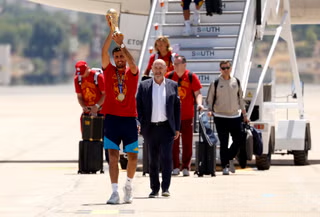
Spain have touched down in Madrid, with captain Rodri proudly holding the World Cup trophy aloft after stepping off the plane with head coach Luis de la Fuente.
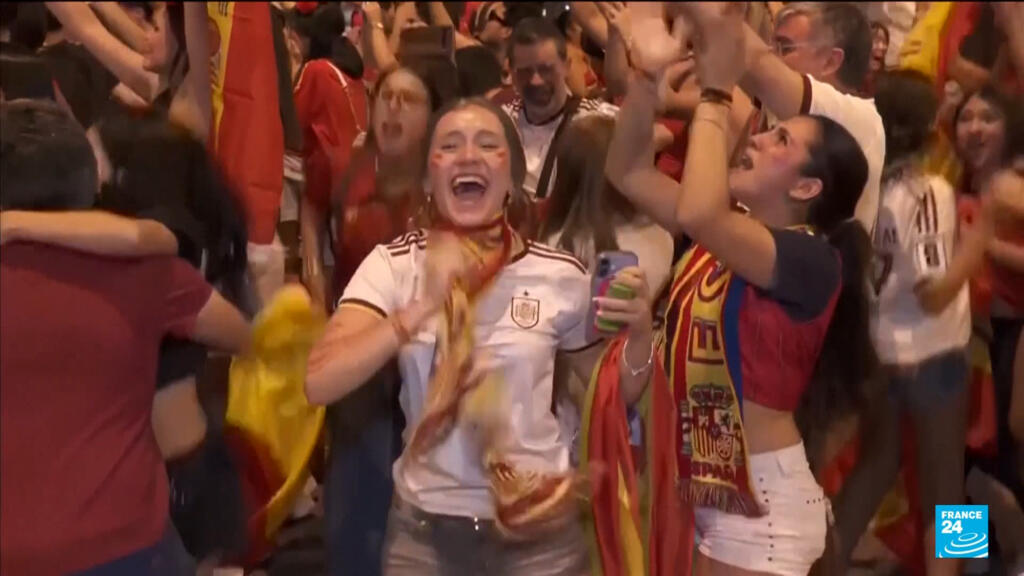
Crowds packed Madrid’s Puerta de Sol and other major squares as they celebrated into the early hours of Monday morning, and that will only continue after the team land back in Spain – with supporters already securing their spots in Cibeles Square for the parade as they brave the baking sun.
Advertisement
(Getty)
Jamie Braidwood20 July 2026 13:56
Spain’s legacy is clear and this is what England must learn from World Cup winners
What can England and the rest of the world’s teams learn from Spain? Miguel Delaney explains the key tenets of their continued footballing success.
Harry Latham-Coyle20 July 2026 13:50
Advertisement
Crowd boos, player snub and failed photobomb: Donald Trump’s big World Cup day out
Argentina weren’t the only ones misbehaving after the match. What was Donald Trump doing? Kieran Jackson recaps the president’s big day out:
Pep Guardiola has reportedly emerged as Italy’s top choice for the national team job after holding talks with football legends Paolo Maldini and Leonardo in Barcelona.
According to Sky Sports Italia, Maldini and Leonardo travelled to Spain to meet the former Manchester City manager and discuss the vacant Italy head coach position. The meeting reportedly lasted longer than expected and may have continued throughout the weekend.
Photos of Maldini and Leonardo in Barcelona circulated on social media, fuelling reports that they were trying to convince Guardiola to take charge of the Azzurri.
Advertisement
However, Guardiola has repeatedly said he is enjoying his break from football and is not ready to return to management.
Speaking recently, the 55-year-old explained that he wanted to step away from the game to focus on his personal life.
“From a mental standpoint, I don’t miss anything at all,” Guardiola said.
Advertisement
He added that he wanted to spend more time with his children and his 95-year-old father while adjusting to life away from football.
Although Italy see Guardiola as their preferred candidate, his decision to remain on sabbatical has made any potential move difficult.
The Italian Football Federation is also considering other options. Former Italy coach Roberto Mancini and Juventus legend Andrea Pirlo have both been linked with the role, while recent reports claim Antonio Conte has already reached an agreement to become the new Italy manager.
Guardiola has also been mentioned as a possible future England coach following the Three Lions’ disappointing World Cup campaign, with several football pundits suggesting he could replace Thomas Tuchel if the role becomes available.
From Madrid to Barcelona, Spanish fans were out in full force to celebrate their team’s win. It took 11 shots to get them the 1-0 victory over Argentina. Meanwhile, in Buenos Aires, fans still celebrated late into the night, despite coming in second place for Lionel Messi’s last World Cup outing.
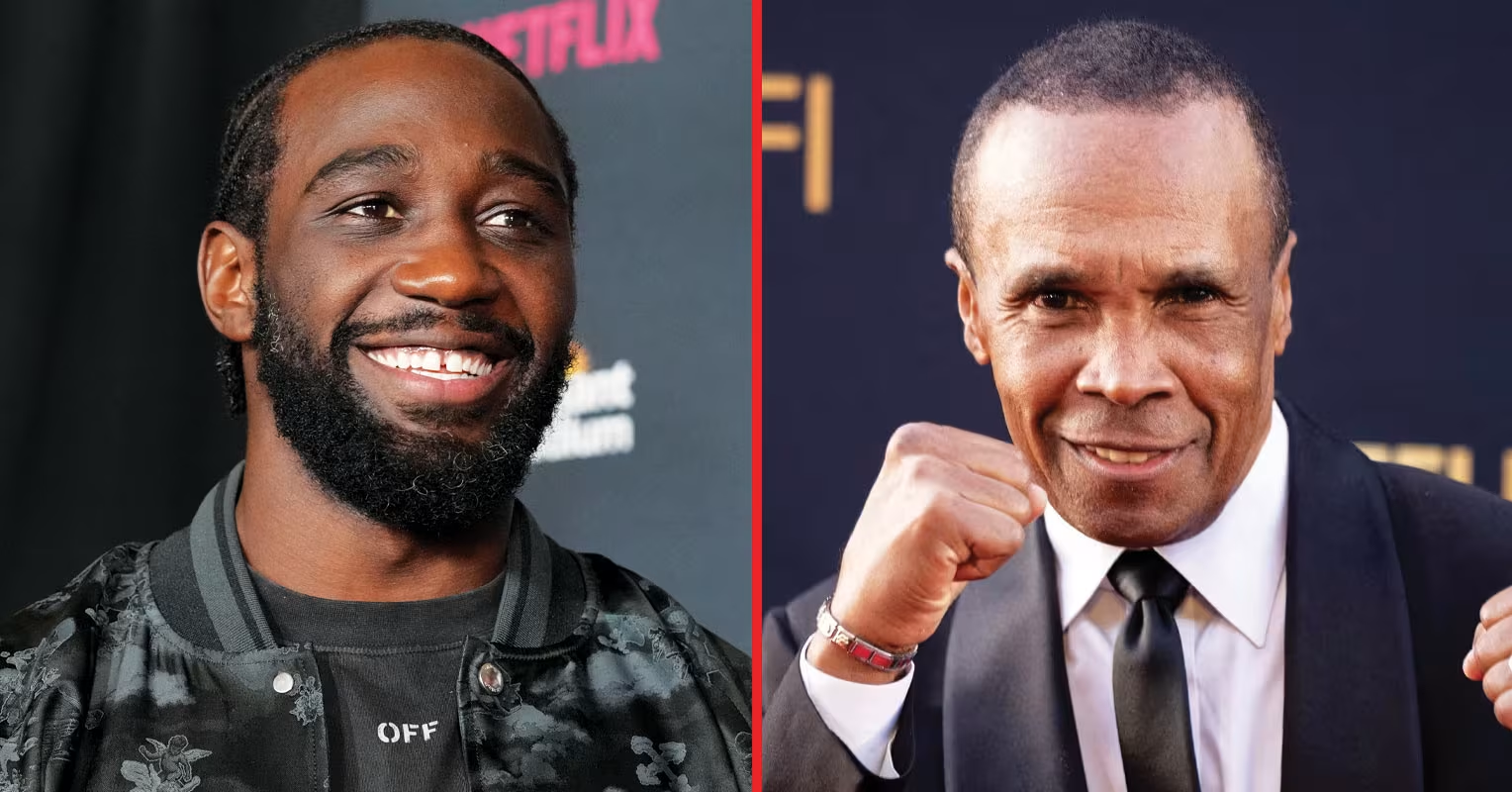
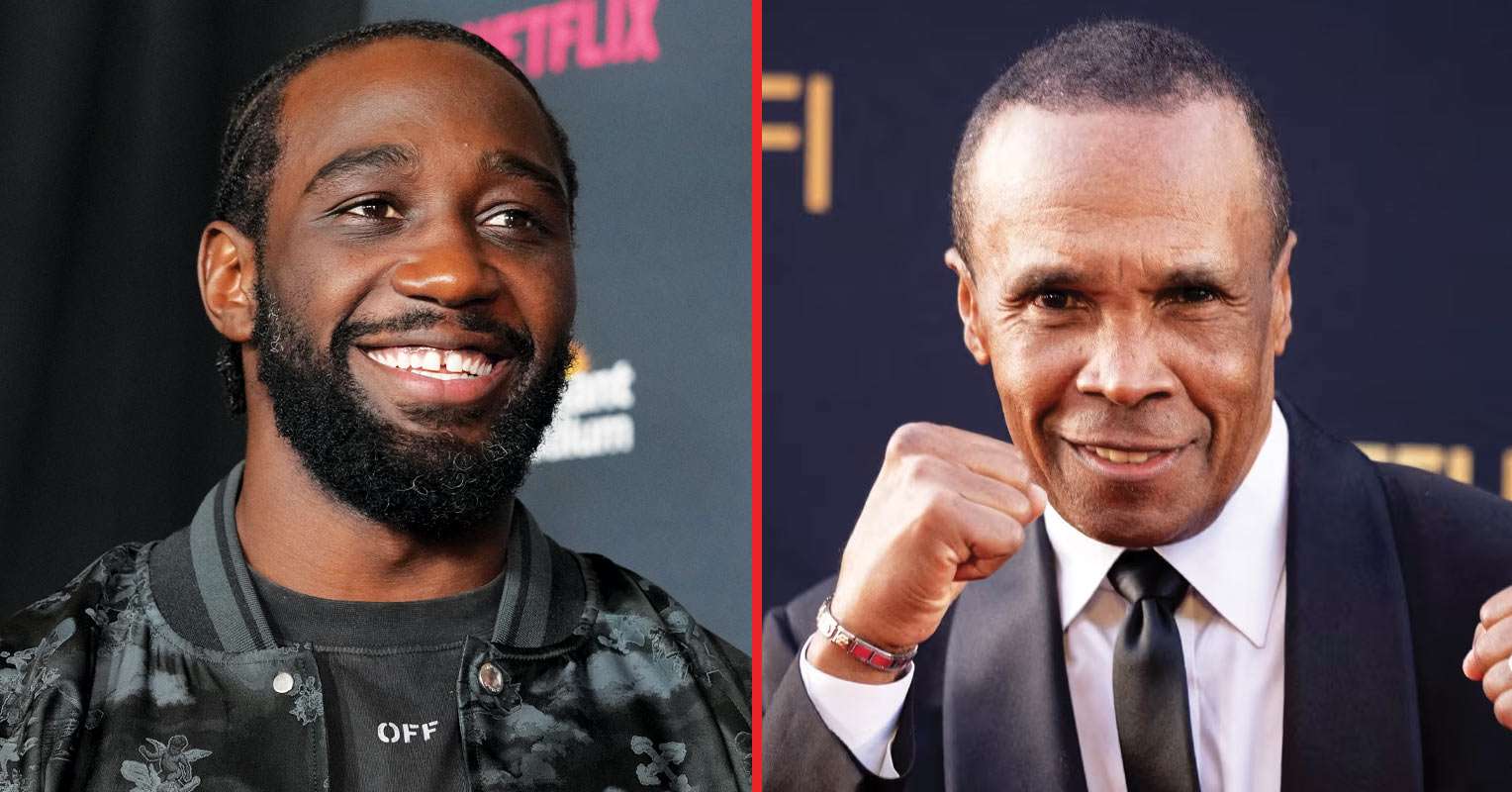
Terence Crawford cemented his place amongst the pound-for-pound greats when he dethroned Canelo Alvarez last year, and now fellow modern boxing legend Oleksandr Usyk has revealed how he believes ‘Bud’ would have fared against the iconic Sugar Ray Leonard.
There, he also became the only post-war fighter to have captured the undisputed crown in three different weight-classes – having already achieved the feat at both super-lightweight and welterweight.
Advertisement
Shortly after that history-making triumph, Crawford made the decision to walk away from the sport with his undefeated record intact, content with a career that finished with a record of 42-0.
After Hearns became boxing’s first five-division champion on November 4, 1988, Leonard joined him as the sport’s second quintuple champion just three days later when Leonard got his hands on both the WBC super-middleweight and WBC light-heavyweight gold in a knockout win over Donny Lalonde.
Yet, despite the skill, will and legacy of Leonard, Usyk told Daily Mail Sport that he thinks Crawford would have got the better of the Wilmington-born sensation if they were to meet in their primes.
Advertisement
Usyk also predicted that Crawford would have overcome Pernell Whitaker, Floyd Mayweather and Sugar Ray Robinson – a testament to the regard in which the Ukrainian holds Crawford, who had been considered as his pound-for-pound rival before his retirement.
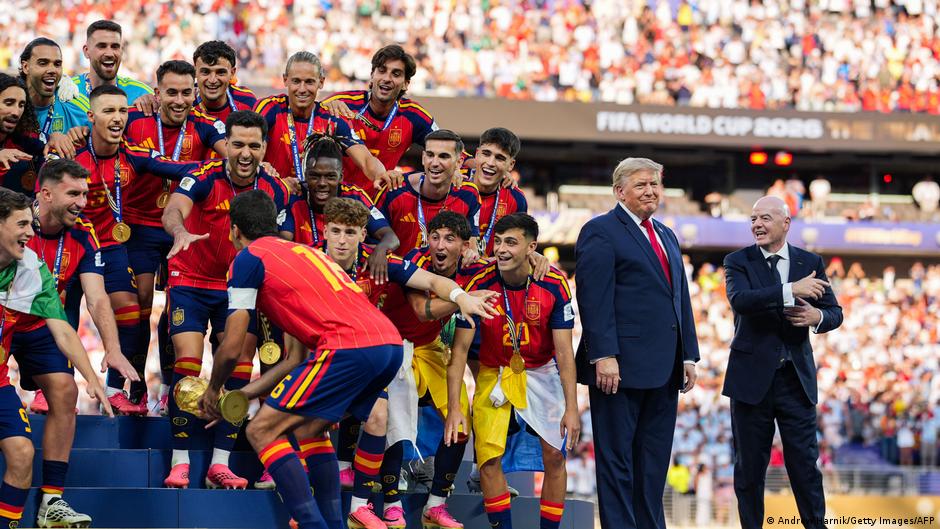
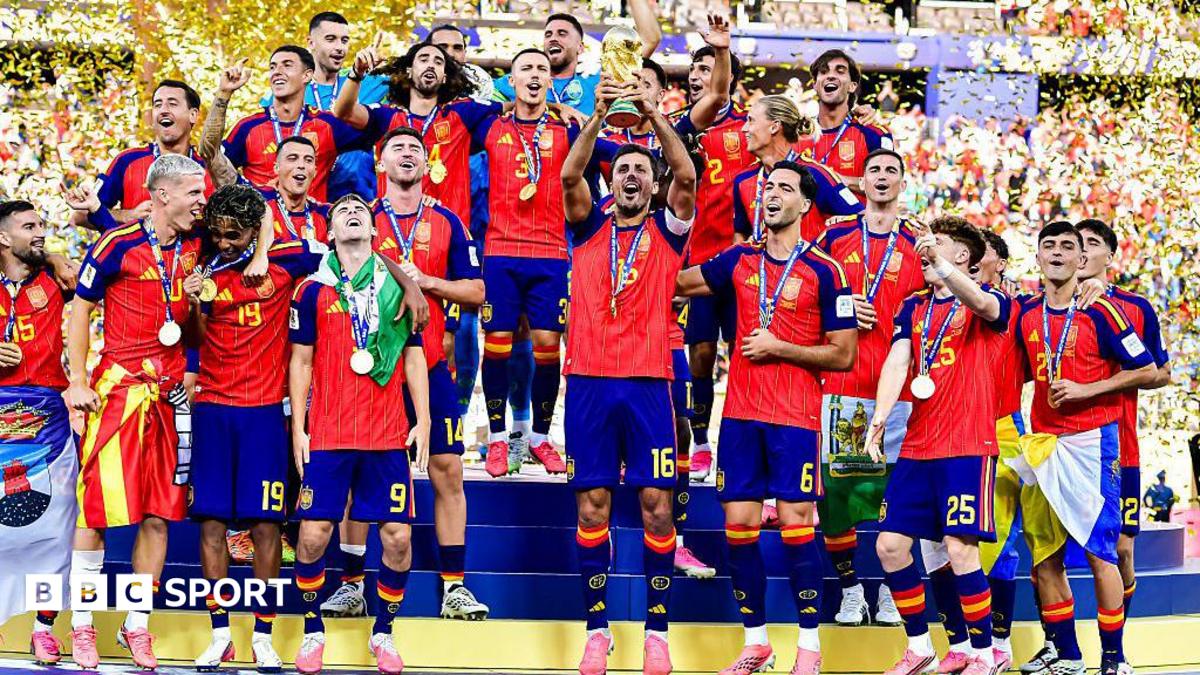
Rodri, like anyone who has ever played football, had dreamed of this moment. The Spain captain held the World Cup in his hands, surrounded by jubilant teammates. But, before he could lift the trophy, he had to find a way to politely usher the world’s most powerful man off the stage.
Though Sunday’s final, in which Spain beat Argentina 1-0, was the first match of the tournament that Trump attended, he declared it “the most successful sporting event maybe in the history of the world” and was a constant presence even in his absence.
“Trump cast a shadow over the entire tournament, weaponizing it for domestic political purposes, regardless of whether he showed up at matches in person,” Jules Boykoff, a professor in the Politics and Government Department at Pacific University in the US state of Oregon, told DW.
Trump’s ‘notorious’ intervention
Trump administration policies denied entry to the United States for a Somali FIFA referee, forced Iran to train in Mexico and travel to games in Los Angeles and Seattle, and barred fans from around the world from attending matches. On top of all that, Boykoff said, Trump’s knockout-stage phone call to FIFA “will most assuredly go down as one of the most notorious political interventions in World Cup history.”
Advertisement
Though Trump’ successfully lobbied to overturn the red card suspension of star striker Folarin Balogun, the strategy backfired on the field, with the US losing its last-16 match against a fired-up Belgium 4-1. “I knew it was going to cause a lot of controversy,” Balogun said. “I could almost see within my teammates a bit of nerves because it was something that’s so unique.”
Boykoff said the sporting implications would not have been at the forefront of Trump’s mind. “Intervening in the red card situation allowed him to deliver the message to his political base that he could get international bodies like FIFA to bend to his will,” said Boykoff, who represented the US at the youth level as a player. “Most of Trump’s actions during the World Cup should be read as efforts to influence a domestic political audience ahead of a key midterm election, not as an attempt to convince an international audience that he’s some great guy.”
2026 World Cup, the tournament that changed football forever
Trump insisted that the tournament has boosted the US’s international reputation. “All over the world, people have come and they love our country,” he told reporters.
Advertisement
Was Balogun call a mistake for Trump?
The US midterm elections are set for November 3 and, with the war in Iran ongoing, Trump’s approval rating is below 40%. Though a “shakedown” of a global organization such as FIFA may have an appeal with a base he’s already won over, Karim Zidan told DW that the Balogun intervention was a political misstep for Trump.
“I think that, in boasting about this when the United States men’s national team gave an opportunity for him to rally behind a team that seemed to be unifying Americans, he managed to find a way to taint it, and those who dislike him hated him just that little bit more,” Zidan, an investigative journalist who has long covered Trump’s use of sports in his politics, said.
Such unprecedented and direct political intervention in a footballing decision drew scorn and fury from most of the rest of the world — with politicians, football federations, fans and coaches all piling on to criticize. But that won’t bother Trump, Boykoff said.
“Based on his actions, Trump does not appear to care much about what the rest of the world thinks of him. His anti-immigration policies stained the World Cup and undercut FIFA’s slogan that ‘Football Unites the World.’ Trump used the tournament to further fracture the world while stoking his base’s worst instincts ahead of the midterm elections,” he said.
Advertisement
Sports-shaping as US strategy
The Balogun incident was Trump’s first real foray into the tournament and came over three weeks after it had begun. Given how present he was in the buildup, that came as a surprise to some. But Zidan said the geopolitical situation had been keeping him busy, while the 250th US independence day also occupied Trump’s time during the tournament.
Trump and Gianni Infantino have become firm friends in recent yearsImage: Dylan Martinez/REUTERS
“All he’s really interested in is making this about himself or reaping any sort of personal prestige from an event,” Zidan said. “So I’m not really surprised at all that he wasn’t very present at standard World Cup games.”
Despite his apparent lack of interest, Trump made a play for future World Cups immediately after the 2026 tournament ended. “I had a great idea for Gianni: You have to do two countries. Announce us again next time and then announce another country after that. It’ll take out some of the anger and the shock,” he told Fox Sports. “Based on the numbers, we will be requesting it again immediately.”
The earliest the US could host the men’s World Cup again is 2038, but Los Angeles will host the Summer Olympics in 2028, with Trump still in power ahead of the presidential election that November. The US is hosting the 2034 Winter Olympics in in Salt Lake City and is likely to win the Women’s World Cup for 2031.
Advertisement
UFC a safe sporting haven for Trump
Zidan thinks that Trump will first retreat to the safety of the mixed-martial-arts Ultimate Fighting Championship (UFC), which he managed to include in the celebrations of the 250th anniversary of the United States.
Trump’s relationship with UFC is a long and fruitful oneImage: Julia Demaree Nikhinson/AP Photo/picture alliance
“Whenever he has shown up at a sports event that is not a UFC event, he’s received resounding boos. It’s not the massive warm welcome he is used to receiving at the UFC,” said Zidan, whose latest book, “The Ultimate Strongmen,” focuses on Trump’s relationship with the UFC.
“That’s why he shows up so often there, why he’s hosted a UFC event at the White House. He understands that is his perfect audience and his safe space, and, no matter how poorly he’s performing and no matter what he’s doing in the world, no matter if there’s a war going on, he will be welcomed.”
Though FIFA and its president rolled out the red carpet for Trump and the 2026 World Cup made more profit than any tournament before, it is the US voters, not the executive bodies of football organizations, whom Trump must impress now. Whichever way the midterms go, it’s unlikely he’ll be ushered off the political stage anytime soon.
As an incredible World Cup comes to an end, everyone here at the BBC wanted to say thank you.
Thank you to the 42.8 million people who tuned in to our live match coverage on television or streamed games on iPlayer, the BBC Sport app and website 237 million times. That’s a lot of football.
Whether you were one of the 24 million who watched England v Argentina in the semi-final, the late-night 9.1 million who stayed up until 4am for England v Mexico, the 2.4 million who saw Scotland beat Haiti in the middle of the night, or part of the hardcore crew of half a million who gave Iran v New Zealand a chance at 2am and were rewarded with a four-goal thriller.
Thank you to those of you who trusted us to not spoil your mornings, coming to iPlayer or the BBC Football YouTube channel every day for our eight-minute highlight packages. There were so many of you that we saw the biggest ever day and week in iPlayer’s history.
Advertisement
Thank you to the 57.2 million unique browsers who used our app and website 1.7 billion times, watching clips of our games, interviews and journalism, following our amazing live pages and reading stories from our journalists covering everything from the Trump-Fifa-Balogun scandal to tactical trends and the US entry denial of Somalian referee Omar Artan.
🏆🇪🇸 After Spain’s World Cup 2026 victory over #Argentina, Donald Trump appeared determined to stay in the spotlight during the trophy presentation, with #FIFA President Gianni #Infantino stepping in so the champions could take centre stage. 🎤
With the World Cup now all over, a clear message has been sent to FIFA by one Manchester City and England star
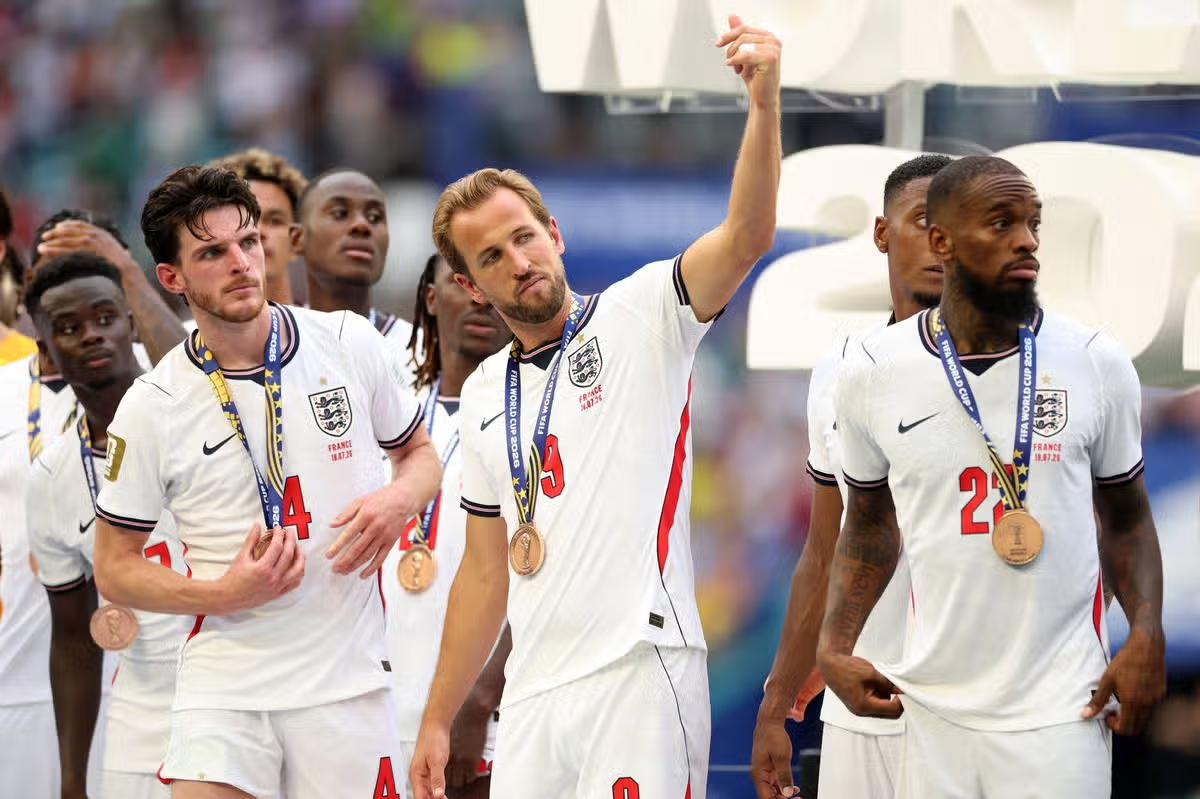
Marc Guehi became the first England player to publicly slate FIFA’s pricing for tickets at the World Cup. Guehi was at the heart of England’s run in the competition, which saw the Three Lions finish third.
The Manchester City defender started all but one match in the competition for the Three Lions. Aside from the opening 4-2 victory over Croatia, where he only played for three minutes, Guehi played every minute in the competition.
Yet, only 64,478 fans made it to the Miami Stadium, which was built to hold 71,000 supporters. As of 10am on Friday, the day before the England versus France clash, 7,000 tickets remained unsold, including 1,246 available on general sale, reports the Express.
This left tickets priced at £657 and £855 on general sale for the third-place play-off fixture. Having played his part in England’s victory over France, Guehi seized the moment to acknowledge the travelling supporters while also taking aim at FIFA over the cost of tickets for the match.
Advertisement
“It’s always hard, especially when you feel like you should have been in the final, so it was down to us to try to do the best that we could,” Guehi told reporters after the victory over Les Bleus.
“We owe it to fans back home for the support. We definitely owe it to everyone who came and watched, especially here in Miami. Because ticket pricing was rubbish. I don’t know what they were thinking, FIFA, to be honest. So at least they could enjoy a fairly entertaining game.”
England’s triumph over France secured them third place at the World Cup, leaving Spain and Argentina to contest the final on Sunday. Spain ultimately came out on top, clinching a 1-0 win against Argentina at MetLife Stadium in New Jersey, courtesy of a goal from ex-City star Ferran Torres during extra time.
Advertisement
Before the final, many ticket prices for the showpiece at New York City’s MetLife Stadium surged to around $2,000 (£1,490). Last minute tickets were even ranging from $10,000 – $60,000 (£7,451 – £44,706), while on FIFA’s official ticket resale site, the cheapest tickets were just over $6,000 (£4,471), according to ESPN.
FIFA boss Gianni Infantino defended the prices before the competition started, insisting they were not unusual compared to other events in the US. He said: “We have to look at the market – we are in the market in which entertainment is the most developed in the world.
“So we have to apply market rates. In the US it is permitted to resell tickets as well. So if you were to sell tickets at the price which is too low, these tickets will be resold at a much higher price.
Advertisement
“And as a matter of fact, even though some people are saying that the ticket prices we have are high, they still end up on the resale market at an even higher price, more than double of our price.”
Upgrade your World Cup TV setup with the Sky Glass ‘designed for football’
This article contains affiliate links, we will receive a commission on any sales we generate from it. Learn more
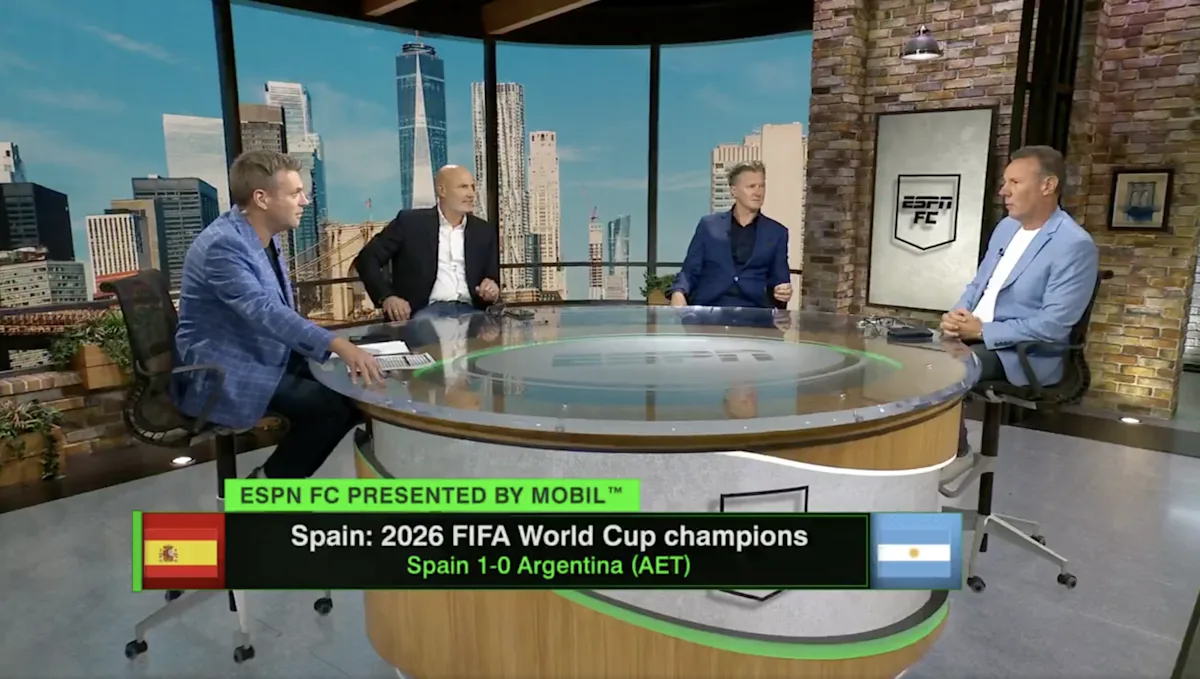
Defending World Cup champions Argentina faced Spain in Sunday’s 2026 FIFA World Cup final. However, in a match the Argentina faithful were hoping would be Lionel Messi’s international swan song, the Argentine squad was completely outclassed. Although the regular time ended in a scoreless draw, Spain outshot Argentina 20-2 en route to its 1-0 win in extra time, dominating with 65% possession. After the match, ESPN’s ESPN FC studio crew was astonished by how poorly Argentina performed with history on the line.
“In one of the worst World Cup finals we have ever seen, Spain in the end deservedly get the victory and defeat Argentina. It was Ferran Torres’ well-taken goal that proved to be the difference between the two sides,” Dan Thomas said to start the segment.
Advertisement
“Two shots from Argentina, none in regular time. Both of those came in extra time. Enzo Fernández sent off. Spain with the victory as they lift the title and get a second star on their shirt.
Advertisement
“We’re supposed to be objective on this show, but I don’t think anyone, unless you’re an Argentina supporter, will be more pleased than what we saw Spain lift in the World Cup, because goodness me, that was embarrassing from the defending champions, wasn’t it?”
Craig Burley was even more scathing in his criticism of La Albiceleste, which finished with 0.22 expected goals (xG).
“I’d go as far as to say Argentina were a complete and utter disgrace today, both with their performance and their antics. We expected the antics, we expected the thuggery, we expected the off-the-ball stuff, but we also expected a lot more on the ball, a lot more purpose, a lot more about their play,” he said.
Advertisement
Advertisement
“They were in utter shambles; they were disgusting, disgraceful. And yeah, I mean, I’m so pleased Spain won, and I could just see a scenario at the end there, but before Spain scored, that it was going to go to penalties, or they were going to get a scruffy goal, Argentina, and win this… to put that kind of performance in a World Cup final, that negative— it was a disgusting performance.”
Frank Lebouef, who won the 1998 World Cup as a centerback for the French National team, felt that Argentina wasn’t playing the right way, calling their performance “completely negative,” “unbearable,” before adding that it was a “bad image of football.”
Steve McManaman joined the other panelists in panning the performance, and let Messi’s teammates hear it for letting the legend down and engaging in antics on the pitch in what was almost certainly his last chance to win a World Cup, saying that “they just want to do anything else apart from win a football match.”
“They’ll kick, they’ll punch, they’ll drag, they’ll dive,” he added of the things they were more interested in, before calling them out for pushing and shoving Spanish players off camera after losing.
Advertisement
Advertisement
Throughout the tournament, some of Argentina’s critics and opponents called out what they deemed to be outside interference or behind-the-scenes decision-making in favor of Argentina affecting the outcome of its matches. But on Sunday, there was no amount of intervention, VAR or otherwise, capable of salvaging a victory from the performance Argentina turned in.



















































You must be logged in to post a comment Login