The Premier League has received pushback in discussions about the rescheduling of two Manchester City fixtures that could prove pivotal to a number of key positions in the table, and the title race with Arsenal.
City’s pursuit of a domestic Treble has also created a fixture headache. After beating Arsenal to the Carabao Cup, Pep Guardiola’s side have once again progressed to the FA Cup final – setting up a clash with Chelsea on Saturday 16 May.
But it now means that City have not one, but two Premier League fixtures that still need to be rearranged – and with just a few weeks of the season remaining. City’s trip to Bournemouth, which fell on FA Cup final weekend, will need to be moved, while the home match against Palace has been without a date for months.
It is up to the Premier League to decide where to schedule both games, and it is a huge decision given how close the title is as City and Arsenal enter the final straight. City could be left with a fixture pile-up that includes four games in 12 days.
Man City’s remaining fixtures
Advertisement
Manchester City have six games left this season, five in the Premier League, plus the FA Cup final. Pep Guardiola’s side currently have a game in hand on leaders Arsenal, due to their progress to both the Carabao Cup and FA Cup finals this season. After City reached the FA Cup semi-finals, where they defeated Southampton on Saturday, their trip to Burnley was rearranged for Wednesday 22 April.
The precedent in the Premier League, however, has generally been for postponed games to be played in the order they were originally scheduled, where possible. That would in this case mean the Palace game happens on Wednesday 13 May and the Bournemouth game on Tuesday 19 May. The latter would be set for that date due to the Europa League final taking place on the Wednesday 20 May, and Uefa disallowing domestic fixtures to be staged when their showpieces fixtures take place.
Monday 4 May: Everton (a)
Saturday 9 May: Brentford (h)
Wednesday 13 May: Crystal Palace (h)*
Saturday 16 May: Chelsea (FA Cup final)
Tuesday 19 May: Bournemouth (a)*
Sunday 24 May: Aston Villa (h)
*TBC
Why Crystal Palace match comes first
Crystal Palace’s participation in the Europa Conference League has complicated rearranging their trip to Manchester City, which was originally scheduled to be played on the weekend of the FA Cup quarter-finals. Palace have reached the semi-finals in Europe and Oliver Glasner’s side will play Shakhtar Donetsk on Thursday 30 April and Thursday 7 May. If the Eagles progress, the final would be after the Premier League season finishes, on Wednesday 27 May, but it means City’s match against them has to be played either immediately after the Brentford match or immediately after the FA Cup final.
Advertisement
The Premier League want the Crystal Palace match to be played before the Bournemouth game, as that was the order of their original calendar. But because the Eagles play their Premier League games following European commitments on a Sunday, that also rules out the prospect of playing on a Tuesday. Therefore, of the two free midweeks, Wednesday 13 May is the leading option, with the Bournemouth match rearranged for the following week, but not on the Wednesday due to the Europa League final. That will involve an English club in either Aston Villa or Nottingham Forest.
City had initially wanted the Crystal Palace match to be rescheduled for Wednesday 22 April, rather than the match against Burnley. It appears this was impossible because Crystal Palace were already scheduled to play West Ham on Monday 20 April, so could not play again that midweek.
‘Tension’ in discussions as Man City face fixture pile-up
The situation could nevertheless leave City playing three games in seven days before the potentially crucial final weekend of the season, with the testing trip to Bournemouth coming a mere three days after the FA Cup final. City have consequently been in dialogue with the Premier League to explore alternative options and swapping the order of the Palace and Bournemouth games, but it is understood that has led to pushback and some tension in discussions. Arsenal are also monitoring developments that could affect the title race.
Advertisement
Any movement could also have repercussions for other positions, as Bournemouth aim for a European place for the first time in their history. If their match against City were to be played on Tuesday 19 May, it would mean nine days’ rest for Andoni Iraola’s side, as they now have a free weekend around the FA Cup final, against a mere three for their opponents. That would also be Iraola’s final home match in charge of Bournemouth, in what is set to be an emotional occasion. Swapping the Bournemouth and Palace games would have allowed City to play on Tuesday 12 May, giving Guardiola’s side an extra day.
Sources with knowledge of the discussions say it has been pointed out that this is just the fairness of how it falls and it is a complication that clubs competing on multiple fronts have to face. City have naturally pointed to the unnecessary pile-up, when alternatives are possible.
This has led to pushback, principally over the idea that individual club situations should not be able to override precedent given how other teams have faced similar in the past. Arsenal sources have pointed to how the 2023-24 title race saw City face a rescheduled away trip at Tottenham Hotspur as their penultimate game, when it could have come earlier, despite an expected media circus around Spurs fans not wanting Arsenal to win the title.
Given their own priorities, Bournemouth currently expect their game against City to be played on Tuesday 19 May, with a likely 7.30pm start. Arsenal are meanwhile set to face Burnley in their own last home game on the night before, a Monday, in a move that is already meeting pushback from fans. The fixtures are anticipated to be announced to over the next 24 hours.
After the news that FIFA is set to allow domestic football leagues to play one game a season abroad, German football faces a familiar battle between tradition and growth.
English newspaper The Guardian exclusively reported that new FIFA proposals will allow domestic leagues to have one game a season hosted in a foreign country. The host country will reportedly be allowed to host a maximum of five games from other countries, with the US the favored target.
“I think the German members would object to that and there would be mass protests in the stadium,” Martin Endemann, head of policy at Football Supporters Europe, who advocate for fans on the continent, told DW. “Any football official who would try to do this would have a very, very hard time with those fans in the stadium as well as the members of the respective clubs.”
The discussion of playing domestic league games abroad is not new. Last October, UEFA gave La Liga (Spain) and Serie A (Italy) permission to play a game abroad, but the games were scrapped after local authorities raised concerns. The fallout was ugly.
Advertisement
Germany’s Dortmund invests in Ghana’s emerging players
The new FIFA protocol for moving a competitive game abroad would require approval from all major stakeholders, and FIFA would still have the right to reject the switch.
“It is the formalization of something that has been economically inevitable for years,” Dominik Schreyer, a professor of sports economics at Germany’s Otto Beisheim School of Management, told DW.
“Football has been shifting from a locally anchored product to a globally monetized media asset, and once that transition happens, geography becomes flexible,” Schreyer added.
Advertisement
“FIFA is not leading here, it is reacting under pressure and trying to regulate a development that was already underway through preseason tours and earlier league attempts to stage games abroad. Framing it as one game per season makes it politically digestible, but economically it starts to normalize the idea that domestic competitions are no longer strictly domestic. You could say, the product has already gone global, now the matches are catching up,” he said.
German football structure different to rest of Europe
While many believe such developments have long been an inevitability for clubs in England, Spain and Italy, German club ownership structure differs to other major European leagues, presenting a more complex conversation.
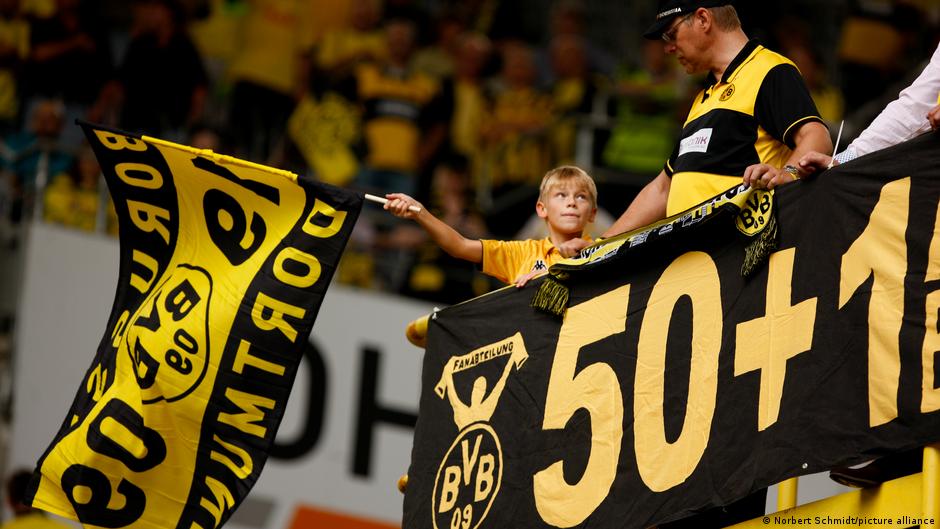
The 50+1 rule essentially guarantees that 50% plus one share of a club’s total shares must be owned by members, ruling out ownership by rich individuals or even nation states. The power of German fans is not to be underestimated, as was recently seen by the failed attempt to secure investment from a private equity partner.
Advertisement
However, if domestic league games abroad become a reality for clubs in Europe, then the Bundesliga will likely return to walking along the familiar tightrope of tradition and growth.
“Financially, the upside exists but should not be overstated,” Schreyer said of playing league games abroad. The example of the National Football League (NFL) in the US playing competitive games abroad is proof of this. Ahead of the first league game in Germany in 2022, the head of NFL Germany said they could have sold over 3 million tickets. Business and finance source BNN Bloomberg explained that when the Jacksonville Jaguars play in London, the team generates roughly $35 to 50 million (€30 to €42.5 million) in revenue each time they play.
“A competitive match abroad carries more commercial weight than a pre-season game because it combines scarcity, sporting relevance and global media attention. As such, a club like Bayern or Dortmund could maybe expect a low double-digit million euro uplift for a match in the US,” Schreyer said, adding that an exact number is hard to come by. Figures released by Sport Bild in late 2025 suggest that Bayern reportedly makes around €5.7 million per home game in revenue.
“This is about positioning, not payday. That becomes even clearer once you factor in compensation for local fans, especially season ticket holders, who would miss out on a high-value fixture at their home stadium.”
Opposed to the idea, but for how long?
Herein lies the major challenge for German football. The tradition that many football clubs are rooted in in Germany, combined with the 50+1 structure, mean that maintaining the local market remains imperative even in the face of football’s global growth.
Advertisement
The DFL (German Football League), the organization that operates the Bundesliga, have publicly spoken out against the idea, and have been as far back as 2018 when Christian Seifert was boss. More recently, Hans-Joachim Watzke, the chairman of the DFL supervisory board and a former Dortmund CEO, couldn’t have been clearer when speaking on the topic.
“As long as I am responsible for this league, there will be no match abroad, when it comes to competitive matches. Full stop,” said Watzke.
Bayern Munich’s CEO Jan-Christian Dreesen is also opposed to the idea, but what if these games become a regular reality for the likes of Manchester City, Paris Saint Germain and Real Madrid?
The NFL has shown how to take a domestic product and not only market it, but play it across the worldImage: Douglas DeFelice/USA TODAY Network/IMAGO
“For German clubs, the real constraint is cultural,” argued Schreyer. “German football still defines itself through local identity, while competitors have fully embraced global market logic. In the short term, Bundesliga clubs will not fall behind simply by abstaining, because media rights still carry the bulk of revenues. But if others consistently monetize international demand through premium events and German clubs opt out, the gap in global relevance will widen, and the money will follow.”
For Germany, this possibility is only really a concern for a handful of clubs.
Advertisement
“Fans are buying a spectacle, not a league fixture. Nobody will fill an arena in the US for Hoffenheim versus Augsburg. So, this will work for a handful of clubs, not for the league as a whole,” Schreyer said, with Bayern Munich and Borussia Dortmund the obvious two candidates.
While Bundesliga games being played abroad remains extremely unlikely, pressure will grow if other major clubs do take the step.
NEW DELHI: South Africa spinner Tabraiz Shamsi sent social media into a frenzy with a hilarious post that perfectly captured cricket’s knack for producing uncanny similarities. Sharing a clip from a local match, possibly played in India, Shamsi highlighted a young boy bowling with a distinctly slingy action, reminiscent of two of Sri Lanka’s most unique pacers.
Watch
Axar Patel shares big update on Mitchell Starc
“We had Malinga.. then we got Pathirana… Meet the final boss now,” Shamsi captioned the video, cheekily extending the comparison to the next generation. The post quickly went viral, with fans amused by how closely the youngster’s action mirrored that of Lasith Malinga and Matheesha Pathirana, both known for their unorthodox, round-arm slinging deliveries.Malinga, a legend of the modern game, built his reputation on a unique low-arm release that made him one of the most feared death bowlers in world cricket. Years later, Pathirana emerged with a strikingly similar action, earning the nickname “Baby Malinga” and carving out his own identity in T20 leagues around the world. The timing of Shamsi’s post coincided with Pathirana’s much-anticipated arrival to join Kolkata Knight Riders in IPL 2026. After days of waiting, the Sri Lankan pacer finally linked up with the squad, offering a ray of hope for a side struggling badly this season. Pathirana’s delayed entry was due to a calf strain he suffered during the ICC Men’s T20 World Cup earlier this year. Following his recovery, he successfully cleared a fitness test conducted by Sri Lanka Cricket and received the necessary clearance to participate in the league. His inclusion had been eagerly anticipated, especially given the hefty Rs 18 crore investment made by the franchise at the IPL auction.While his arrival boosts morale, the team management is expected to take a cautious approach. Pathirana is unlikely to be rushed straight into the playing XI, with the medical staff set to evaluate his readiness over multiple training sessions. The franchise will be keen to ensure he is fully match-fit before exposing him to the rigours of competitive cricket.
Jamie Carragher said the major issue Arsenal have been dealing with recently is fatigue rather than a lack of mental composure
Arsenal defeated Newcastle United 1-0 on Saturday to return to the top of the table. But the Gunners were the second-best in most attacking stats against the Magpies.
Thanks for the submission!
Advertisement
Speaking on Sky Sports’ Monday Night Football, Carragher claimed Mikel Arteta’s men looked leggy against Newcastle and lacked their usual high-pressing intensity. He argued that it was ‘too easy’ for Sandro Tonali and Bruno Guimaraes to dictate the game at the Emirates, which he found ‘worrying’.
Advertisement
“My worry watching Arsenal is not nerves – it hasn’t been for a few weeks – mine is fatigue,” Carragher said. “It was far too easy for Newcastle to make passes and get to the edge of the box. They couldn’t create too much when they got there which is a sign of the Arsenal back four but it looked leggy to me. It was too easy for Tonali and Guimaraes to dictate the game. To see Newcastle play with ease at the Emirates, I thought was a little worrying. It smacked of fatigue for me.”
Meanwhile, the former Liverpool defender insisted that Arsenal are still the best team in the league and attributed their fatigue to fixture congestion, saying they play three games in six days.
Carragher picks game that could cost Arsenal the Premier League title
Speaking further, Carragher said he is worried that the Gunners will throw away their Premier League title hopes when they face Fulham this weekend. For Carragher, the hectic schedule could cost them the title when they face the Cottagers in their next league outing.
“I feel Arsenal have been unfortunate, and I know this playing Champions League semi-finals, when you play Wednesday then Tuesday that’s a big difference between Tuesday then Wednesday,” Carragher continued. “You’re actually playing three games in six days, rather than three games in eight days. It’s a massive difference at this stage of the season.
“That’s why I really worry for Arsenal about this (the Fulham game). You play away and have to travel, Fulham are a good and decent side and then you’ve got to go again on the Tuesday night. They’ve been very unfortunate the way the games have fallen. Three games in six days is really tough.”
Next up for the Gunners is a Champions League clash against Atletico Madrid on Wednesday, April 29.
Louisiana Tech has finalized details to leave C-USA and join the Sun Belt for the 2026 season.
These sorts of moves are not likely to slow down anytime soon.
On today’s episode of Locked On College Football, Spencer McLaughlin discusses the latest public comment from Indiana DC Bryant Haines.
He has since deleted a tweet that talked about the best teams he faced in 2025, and took a shot at Paul Finebaum.
Alabama has landed one of the top quarterbacks in the 2027 class in 5-star Elijah Haven.
He can be an elite QB for HC Kalen DeBoer and the Crimson Tide.
Advertisement
00:00 Conference realignment discussions 04:47 Sun Belt vs. Conference USA 07:00 Future of college football conferences 12:53 Challenges of college football coaching 16:23 Coach’s publicity strategy debate 17:35 Sports team offseason speculation 21:53 Discussing NIL impact on college football
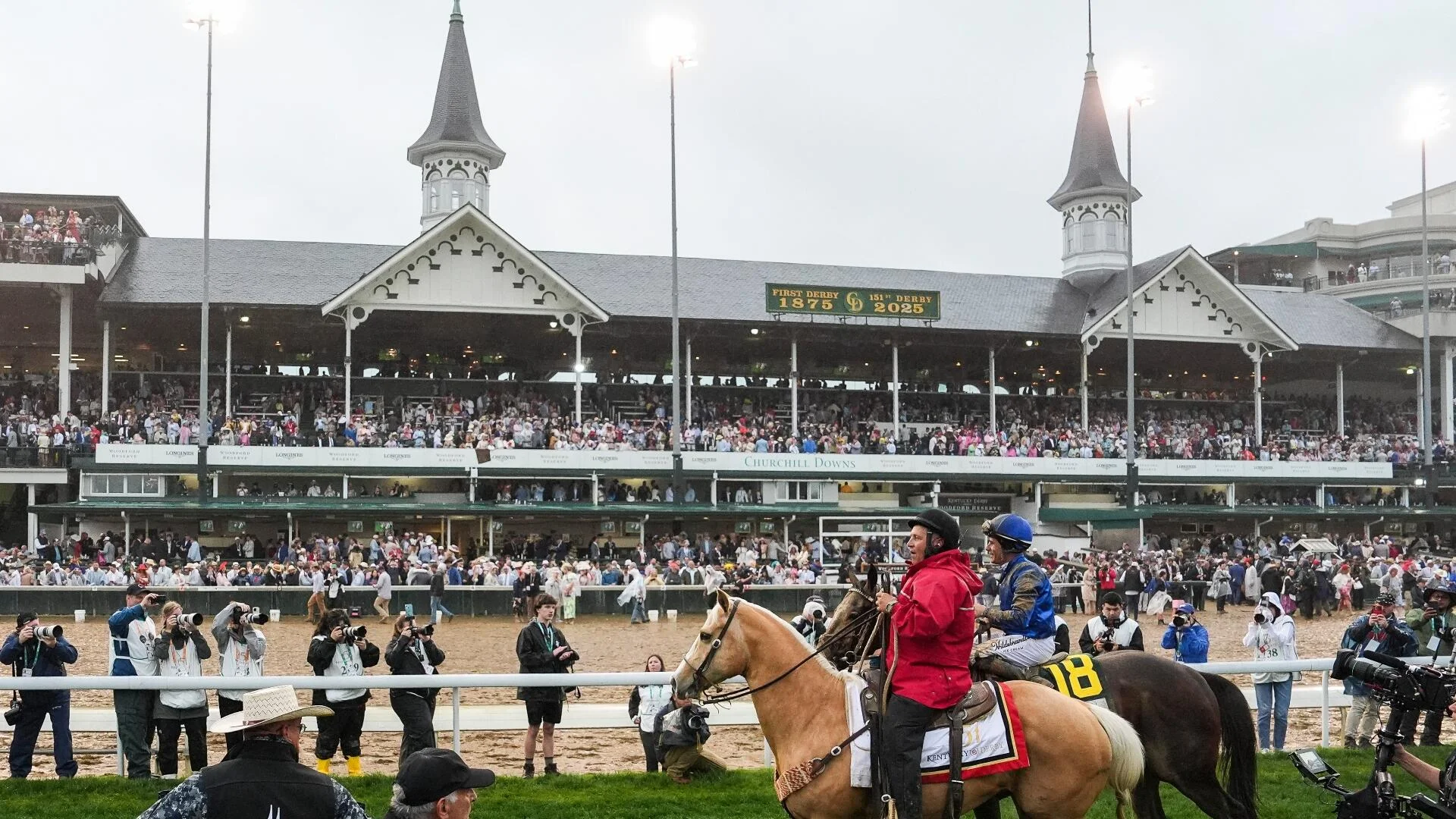
The 2026 Kentucky Derby is wide open with no clear lock. Nearly half the field sits within easy striking distance of the top contenders as the big race draws closer to its Saturday, May 2 showdown at Churchill Downs, which has a 6:57 p.m. ET post time. Following Saturday’s post draw, Renegade, who drew the inside rail, sits atop the 2026 Kentucky Derby odds board as the 4-1 morning-line favorite, but several strong challengers are close behind.
Further Ado is 6-1 and Commandment are 6-1, with Chief Wallabee at 8-1 and The Puma at 10-1. Other 2026 Kentucky Derby contenders include So Happy and Emerging Market, both at 15-1. There are five other horses at 20-1, including Southwest Stakes winner Silent Tactic. Before making any 2026 Kentucky Derby picks, be sure to see the 2026 Kentucky Derby predictions from SportsLine’s elite horse racing expert Jody Demling.
A fixture in the horse racing world who has been writing about, talking about and betting on races for years, Demling has nailed the Kentucky Oaks-Derby double 12 times in the last 17 years. He also predicted the top three 2025 Kentucky Derby finishers in the correct order and called the exacta in last year’s Preakness. Anyone who has followed him on horse racing betting sites could be way up.
Advertisement
Now, with the 2026 Kentucky Derby approaching and horse racing futures odds on the board, Demling is sharing his 2026 Kentucky Derby betting picks and 2026 Kentucky Derby predictions over at SportsLine. Go here to see them.
Top 2026 Kentucky Derby predictions, expert analysis
One of Demling’s surprising 2026 Kentucky Derby picks: He doesn’t have Commandment, one of the favorites at 6-1, on top of the board. In fact, there are several other horses he believes come out above the Brad Cox-trained challenger.
Since taking fourth in his debut last October, Commandment has won four straight races, including the Grade 2 Fountain of Youth over Chief Wallabee, and the Grade 1 Florida Derby over The Puma and Chief Wallabee. However, both races came down to the wire as Commandment is not the horse that catches Demling’s eye. It certainly doesn’t help that the horse drew the No. 6 post, which has the second-lowest win rate of any of the 20 post positions at Churchill Downs. See who to back at SportsLine.
Demling also locked in his 2026 Kentucky Derby prediction for Renegade, who at 4-1 is trying to become the first favorite to win the Kentucky Derby since 2018. While he’s not high on all the contenders, he does believe Renegade deserves serious consideration to be part of all exotics bets, including Kentucky Derby exactas and trifectas.
Advertisement
Renegade took second or third in his first three races. But he’s getting hot at the right time, including a win at the Grade 1 Arkansas Derby on March 28. His best competition at that run was Silent Tactic, a 20-1 longshot at the 2026 Kentucky Derby. So while there is no slam dunk at Churchill Downs on May 2, Renegade is a rightfully one of the top contenders. Bet the Kentucky Derby with the latest TwinSpires promo code CBSSPORTS to claim up to $400 in bonus bets:
Demling has also locked in his 2026 Kentucky Derby picks for Further Ado (6-1), who won at Churchill Downs late in his 2-year-old season. Following his fifth-place finish in his initial dirt-fast MSW race, he has not finished lower than third, that coming in August. Since October, Further Ado has registered three wins and one second-place finish. He is coming off a first-place finish at the 2026 Blue Grass at Keeneland earlier this month.
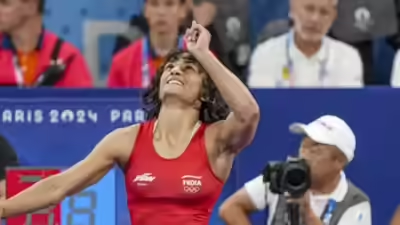
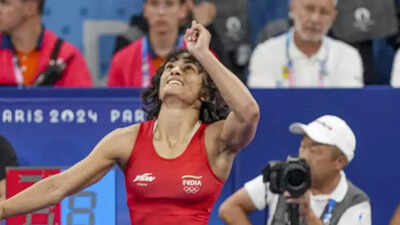
NEW DELHI: The controversy around Vinesh Phogat and her participation in the upcoming wrestling tournament has taken a new turn, with the Wrestling Federation of India (WFI) denying her claims.Speaking to The Indian Express, Vinesh had alleged that she was unable to register for the Senior Open Ranking Tournament, saying the portal showed registrations were closed and officials were not responding. However, WFI president Sanjay Singh rejected this, stating her entry was already done and there was no issue from their side.
Watch
Virat Kohli inaugurates his childhood coach Rajkumar Sharma’s new academy
The WFI chief firmly dismissed the accusations and even shared proof of her registration. “Vinesh Phogat’s registration has already been completed. Why is she creating an unnecessary ruckus? We have not stopped any wrestler from participating; they are all most welcome. Instead of speaking to the media, she should focus on wrestling. So far, 800 wrestlers have registered, and no one has reported any issue,” Singh told IANS.The tournament is scheduled to be held from May 10 to 12 in Gonda, Uttar Pradesh, and registrations are open until April 30. According to WFI, everything is running smoothly, and no other wrestler has faced problems signing up.
Comeback plans and Olympic setback
Vinesh is aiming for a comeback after a long break of nearly 20 months. She had earlier announced retirement following her heartbreaking exit from the Paris Olympics but later changed her mind. Her Olympic journey had grabbed attention as she became the first Indian woman wrestler to reach a final, even defeating world champion Yui Susaki.However, her campaign ended in disappointment after she was disqualified for being overweight before the final. She later appealed to the Court of Arbitration for Sport, asking for a joint silver medal, but her request was rejected.Now, as she prepares to return to competition, this latest disagreement has added fresh tension ahead of the tournament.
Manchester City’s bid to reschedule two Premier League fixtures during the title run-in is set to be rejected by the league, handing Arsenal a boost in the Premier League title race
10:15, 28 Apr 2026Updated 10:18, 28 Apr 2026
Advertisement
The Premier League are poised to turn down Manchester City’s attempts to rearrange two top-flight fixtures. Pep Guardiola’s side sought to switch their meetings with Bournemouth and Crystal Palace to prevent a sequence of three matches in seven days.
The trio of fixtures arrive at the crucial stage of the season with an FA Cup final against Chelsea squeezed in between on May 16. City requested special dispensation from the top-flight governing body to reschedule their home encounter with Palace and the journey to the Vitality Stadium to face Andoni Iraola’s side.
It has been reported that the preference to play Bournemouth first would enable them to spread the matches across eight days rather than seven, thereby reducing the physical and mental strain of the demanding Premier League calendar.
Get MEN Premium now for just £1 HERE – or get involved in our City WhatsApp group by clicking HERE. You can also join our City Facebook page by clicking HERE and don’t miss out on our brilliant selection of newsletters HERE.
Advertisement
According to the Mirror, City are scheduled to play four matches in 12 days, prompting officials to request a change from the league, but it has been suggested that they will maintain their position, forcing a demanding schedule on Arsenal’s title challengers.
Premier League standard protocols stipulate that the Palace home fixture should take priority on May 13, three days before the FA Cup showpiece, while the rearrangement has been further complicated by UEFA owing to Palace’s participation in the Conference League. The European body are understood to be eager to avoid conflicting with Palace’s packed schedule.
Following the collapse of negotiations, City now face a Wednesday-Saturday-Tuesday fixture schedule, meaning they will make the trip to the South Coast just 48 hours after their afternoon at Wembley Stadium.
City, who took part in the Club World Cup last summer, have experienced a surge in injuries of late, with Ruben Dias and Rodri both facing time on the treatment table.
Advertisement
Guardiola had previously voiced his concerns over their participation in the post-season tournament, from which they were eliminated at the quarter-final stage, after it wrapped up just weeks before the resumption of the top-flight season.
Speaking at the end of June, the Catalan said: “I try to relax, enjoy the days here and the good vibes that we have, the competition and we try to win it. The most important thing is to recover and find within ourselves what we were.
“That’s my main target in this tournament. I want them to feel that this is our path again to be competitive like we have been in eight of the last nine years.
“After this, let’s see what happens. Let’s see what happens after the final. We will rest for the time the Premier League allow us. Maybe in November, December or January it will be a disaster, we are exhausted and the World Cup has destroyed us.
Advertisement
“I don’t know, it’s the first time in our lives that this has happened. We will see when we come back.”
City closed the gap on Arsenal with a crucial 2-1 victory over the Gunners last weekend, before climbing to the top of the table on goal difference following a midweek triumph at Burnley.
Their FA Cup semi-final commitment at the weekend, in which they defeated Southampton, afforded Mikel Arteta’s side the opportunity to reclaim top spot as they narrowly overcame Newcastle United.
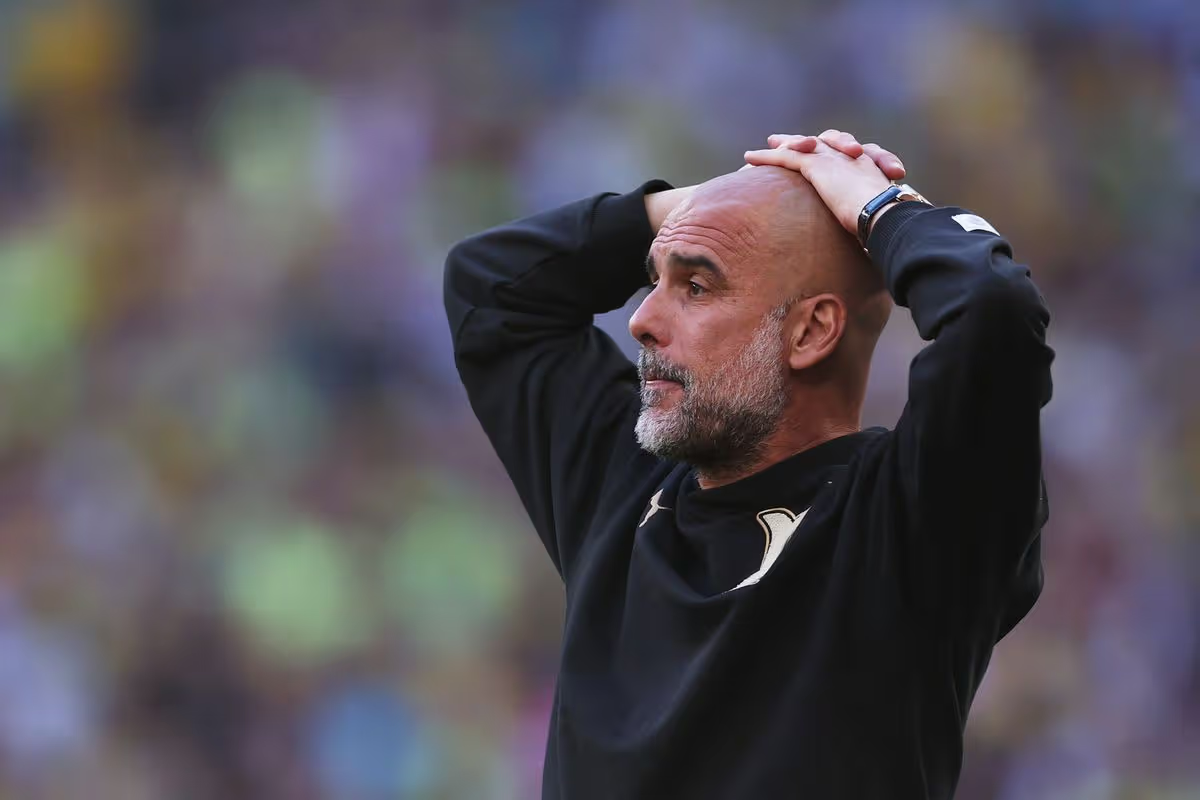
Nevertheless, Guardiola acknowledged that the Premier League title race was taking a heavy toll on his squad. He said: “Arsenal was so demanding emotionally, it’s normal.
Advertisement
“Three days later [Burnley], three days later [Southampton]. Our people were so, so tired. Then take a train, three hours from here to the hotel. Always the grass is thick [at Wembley]. Many thoughts I still have in my mind.”
Head coach Eddie Howe is among those leading figures who will give his perspective, as was always planned.
Howe’s future has come under increased scrutiny following a bruising run of nine defeats in 12 games in the league.
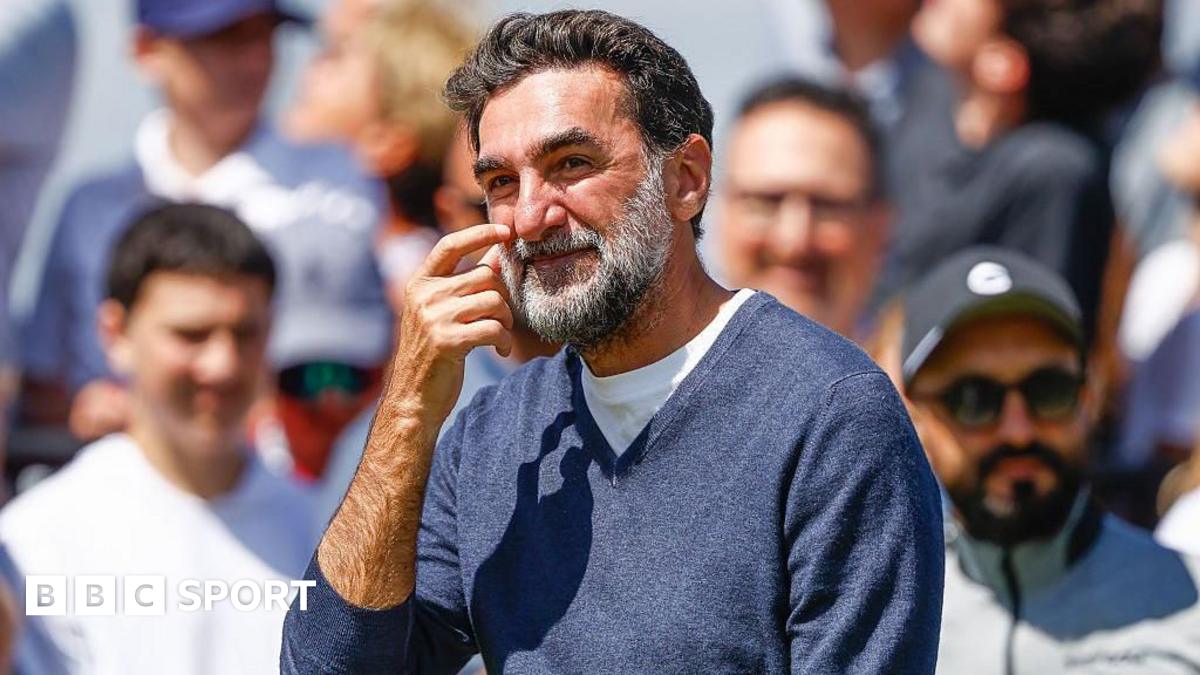
He has said this year’s summit will be “slightly harder”, but stressed he is looking forward to a rare opportunity to address chairman Yasir Al-Rumayyan and minority owner Jamie Reuben in person.
“I’m sure there will be conversations on the team and how we have performed,” he said. “I sort of welcome that to a degree.”
Advertisement
Newcastle‘s owners certainly need no reminding of Howe’s body of work after appointing him in 2021.
Howe took charge of a winless side deep in relegation trouble, but went on to end Newcastle‘s 70-year wait for a major domestic trophy by lifting the Carabao Cup last season. They also qualified for the Champions League in 2023 and 2025.
However, this campaign has been his most testing yet, which is saying something. Only relegated Burnley and Wolves have lost more Premier League games than Newcastle‘s 16.
Newcastle have played 54 matches in all competitions, which is uncharted territory for the group, who reached the last 16 of the Champions League and a third League Cup semi-final in four years.
This drained side have been knocked back by injuries to influential players like captain Bruno Guimaraes at key moments.
Newcastle are also still feeling the effects of a turbulent transfer window last summer.
Advertisement
David Hopkinson and Ross Wilson have since arrived, but the club operated without a chief executive and sporting director during a pivotal trading period.
Newcastle missed out on a host of top transfer targets, including Joao Pedro, Hugo Ekitike, Benjamin Sesko and James Trafford, and have seen little return from a £100m-plus net recruitment drive that Howe was heavily involved in.
Finally, having decided to hold firm for so long, Newcastle ultimately buckled and sold Alexander Isak on deadline day after the striker pushed to join Liverpool for a British record £125m.
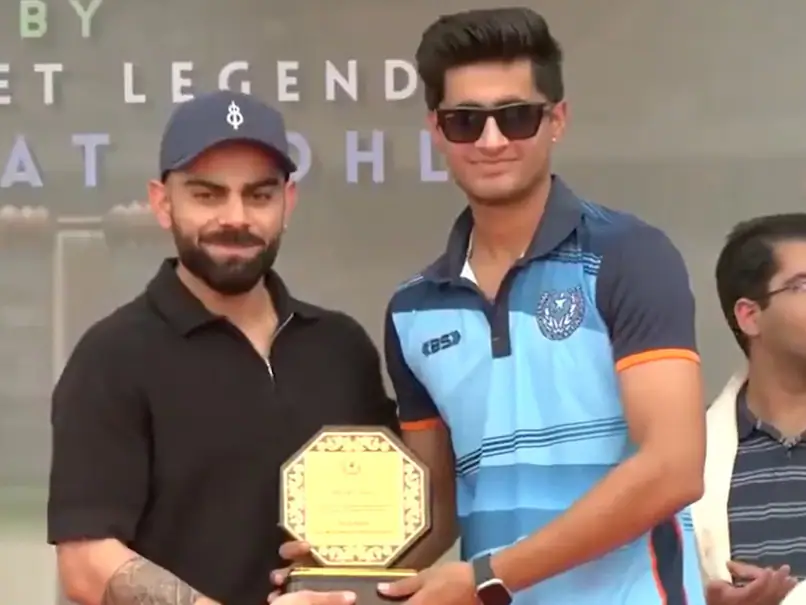
Indian cricket stalwart Virat Kohli delivered an inspirational message at the inauguration ceremony of a cricket academy at DPS (Delhi Public School) RK Puram on Tuesday, urging students to respect their learning environment and pursue their dreams with honesty and commitment. Speaking to students during the event, Kohli said he was not accustomed to addressing school gatherings but connected deeply with the audience, having once been in the same stage of life. Reflecting on his own journey, he highlighted how his priorities shifted early as he chose cricket as his career path.
“Thank you for having me. I’m not used to speaking in schools, so this is going to be a bit awkward for me because I moved away from the school setup long ago for cricket, and that’s what I’m going to talk about. I understand the environment of a school. I’ve been through the same process and stage that all you kids are a part of right now. And I can just share from my own experience how my focus and priority changed very early on in my life,” Kohli said.
The 37-year-old added, “What I want to say is, a school is a place where you come to learn, you come to grow, you become better people.”
Advertisement
#WATCH | Delhi: Cricket star Virat Kohli inaugurated a branch of West Delhi Cricket Academy at DPS RK Puram. His childhood coach, Rajkumar Sharma was also with him. pic.twitter.com/gQumDN5om8
The great cricketer further emphasised the role of educators in shaping character and ability, noting that they dedicate a significant part of their lives to guiding students.
“Have respect and regard for that environment first. For your teachers, for the people who are teaching you. They are giving you a part of their lives. It’s very important to give them that respect and the focus and attention that’s required,” Kohli added.
Advertisement
Sharing insights from his own life decisions, Kohli spoke about his early commitment to cricket and the importance of clarity in one’s goals.
“I chose sport very early on in my life, but that came from a very honest place. I was very sure that I wanted to go ahead and pursue cricket, and I had to be honest with myself, my family, and also my teachers to convey to them that this is the path I want to take,” the former Indian captain said. said.
He advised students to be self-aware and fully committed to their ambitions. “Be honest with your dreams, about what you want to do and follow that dream with absolute commitment. Only you will know whether you are being 100% honest or not.”
Recalling his long association with the academy, Kohli said it remained a significant part of his life and childhood.
Advertisement
“I started practising when I was eight years old, and I still continue to come to the academy whenever I get time. And it’s a big part of my childhood, and I hope all the kids that come to learn cricket here can value it, can learn something from the academy. And I hope it does wonders for the school, the cricket setup here as well. So, I wish everyone all the very best,” the 37-year-old concluded.
Meanwhile, Kohli became the first player to complete 9000 runs in the Indian Premier League (IPL) on Monday. The right-handed batter achieved this milestone during his RCB’s away match against DC at his home stadium of Arun Jaitley Stadium, from where his journey as a cricketer started.
RCB opted to field first, and excellent spells from Josh Hazlewood (4/12) and Bhuvneshwar Kumar (3/5) reduced DC to 75 in 16.3 overs, with Abishek Porel (30) and David Miller (19) offering some resistance. RCB batters came out all guns blazing as Jacob Bethell (20 in 10 balls, with a four and two sixes), Devdutt Padikkal (34* in 13 balls, with three fours and three sixes), and Virat Kohli (25* in 13 balls, with a four and two sixes) sealed the chase in 6.3 overs.
With this win, RCB have registered their sixth win in eight matches, with 12 points to their name. RCB are at number two in the points tally. This fifth defeat for DC, who have won three, keeps them at seventh spot in the points table.
Advertisement
(Except for the headline, this story has not been edited by NDTV staff and is published from a syndicated feed.)
Featured Video Of The Day
Tushar Deshpande’s Brilliant Final Act Ensures Thrilling Win For RR Over Gujarat Titans
Early Monday morning, the R&A announced that the 2028 Open Championship would be hosted at Royal Lytham and St Annes in England. The news comes after many had speculated the 2028 could see Muirfield return to the Open spotlight after a lengthy absence due to controversy.
Here’s what you need to know.
R&A names Royal Lytham & St Annes as 2028 Open Championship venue
The R&A broke the big Open Championship news via press release, with CEO Mark Darbon praising Royal Lytham & St Annes and noting the illustrious champion when the Open was first held at the club in 1926: Bobby Jones.
Advertisement
“Royal Lytham & St Annes is widely renowned as one of the world’s finest links courses and has witnessed many great championship moments since The Open was first played there in 1926 when the legendary Bobby Jones won,” Darbon’s statement said. “This is one of golf’s most cherished and historic venues and The Open’s return to these famous links will spark huge interest among fans to be part of one of the world’s great sporting events and celebrate the rich traditions of golf’s original Championship.”
Royal Lytham & St Annes has a serious Open Championship pedigree, with the 1926 Open won by Jones just one of 11 Opens held at the course located in Lancashire, England.
In addition to Jones, other pros who won the Open at Royal Lytham include Gary Player, Seve Ballesteros and David Duval. When the club last hosted the Open in 2012, Ernie Els hoisted the Claret Jug for his second Open victory.
The 2028 Open Championship at Royal Lytham & St Annes will not be played in mid-July as most Opens are due to the 2028 Olympics. Instead, the 2028 Open will be contested August 3-6.
Muirfield’s absence from Open Championship rota continues
While Royal Lytham is a prestigious course with a storied history, it doesn’t quite live up to the pedigree that Muirfield holds.
The famed Scottish links course has hosted 16 Open Championships, four more than Lytham when you include the 2028 Open.
Advertisement
While Lytham is ranked 68th in our Top 100 Courses list, Muirfield is 11th.
Muirfield’s past Open champions include many of the tournament’s greats, such as Harry Vardon, Walter Hagen, Gary Player, Lee Trevino, Tom Watson and Nick Faldo (twice). Ernie Els’ other Open win came at Muirfield.
And at the 2013 Open Championship at Muirfield, Phil Mickelson shocked the world by capturing his only Open title, a tournament he thought he’d never win.
Advertisement
But the 2013 Open was the last held at Muirfield. The R&A then removed it from its longtime place in the Open rota following a controversial 2016 vote in which Muirfield members elected to continue its policy of barring women from joining the club.
At the time, the R&A said, “The Open is one of the world’s great sporting events and going forward we will not stage the Championship at a venue that does not admit women as members.”
“Muirfield deserves to be back on the Open rota,” McIlroy said in January.
Though now we know the Open will not go to Muirfield in 2028, there are still no future Open venues announced for 2029 and beyond.
Interestingly, Muirfield last hosted the Open in 2013, one year after Lytham hosted its most recent Open. With Lytham now returning in 2028, perhaps 2029 is the year the Open Championship finally returns to Muirfield.









 Alabama has landed one of the top quarterbacks in the 2027 class in 5-star Elijah Haven.
;)
;)




































You must be logged in to post a comment Login