Manchester United have made savings across the board, which led to an operational profit in the second quarter of their financial results, coming as a huge boost to the club’s health off the pitch.
Luke Thrower Trends Writer
17:09, 25 Feb 2026
After plenty of question marks over the club’s financial strength, Manchester United have revealed they have managed to shed £14million from their wage bill, compared to last year, as per their recent second-quarter financial results.
It came after a busy summer transfer window, which has seen some of the squad’s highest earners move on to help stabilise themselves financially.
With a lack of European football after a dismal campaign last time out under Ruben Amorim, there were concerns over investment, due to the lack of broadcasting revenue and prize money that a competition like the Champions League can provide the club.
Advertisement
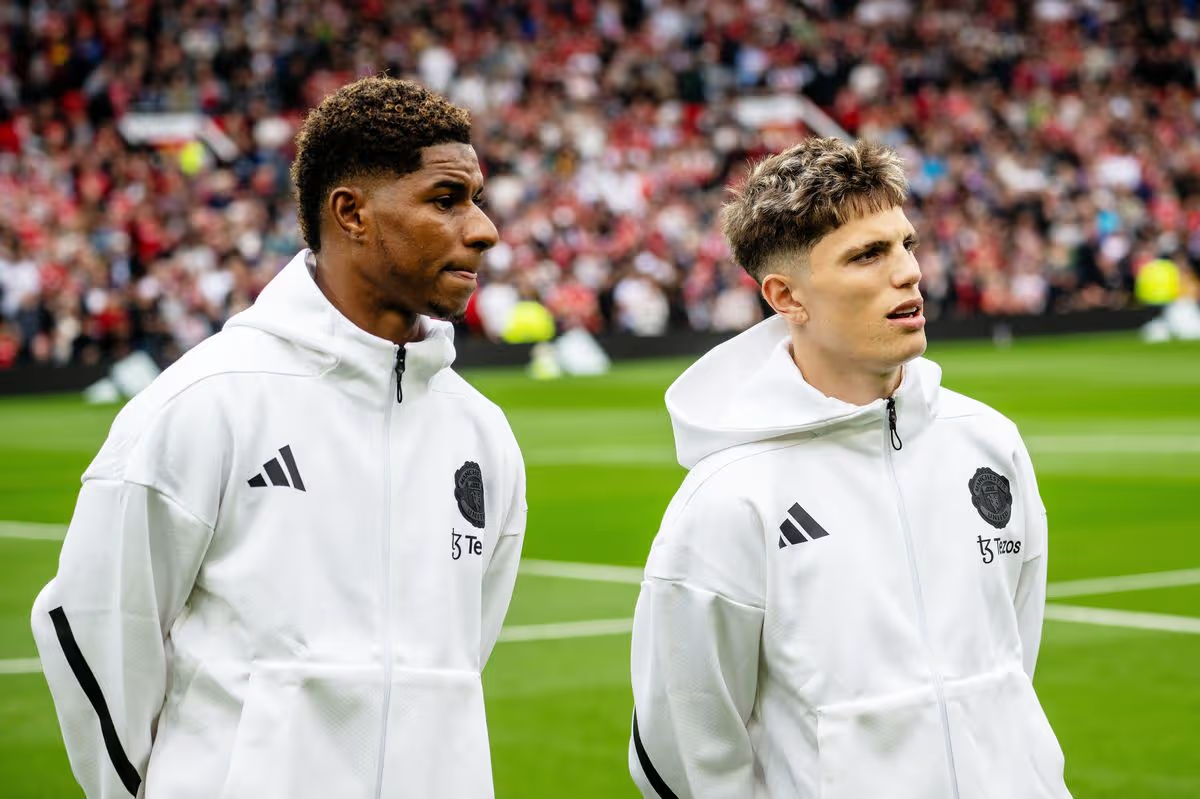
As a result, a clear-out of the squad was underway, as players such as Marcus Rashford, Rasmus Hojlund, and Andre Onana were sent out on loan to help ease the wage bill, while giving them places to play, as they were seemingly deemed surplus to requirements for the head coach at the time.
There were permanent exits for Alejandro Garnacho and Antony, which further helped the bank balance before the club went into the market for options to bolster the squad moving forward.
That represents a nine per cent decrease on the previous year, while the wages to revenue ratio sits at a healthy 45%; for every £1 the club bring in, only 45p is spent on wages, which is one of the lowest in the Premier League.
It has helped to justify moving on the likes of Rashford – who was a huge earner – and Garnacho. The pair fell out of favour under Amorim and seemingly didn’t have a future at United, with the club now able to invest from a stronger position.
It remains to be seen what that means for United in the summer, given their transfer spend in the summer, but that could all depend on the job Michael Carrick can do.
A return to the Champions League would represent a huge potential boost to revenue, with the likes of Chelsea, Arsenal, Liverpool and Manchester City landing roughly upwards of £90million from the league phase alone across all revenue streams – while Tottenham picked up just over £80million, and Newcastle landed in the £50million region.
While that is a possibility, the strategy over those transfers will largely depend on which head coach the hierarchy lands on for the role, and there is a long way to go until that is all made clear.
Ensure our latest sport headlines always appear at the top of your Google Search by making us a Preferred Source. Click here to activateor add us as Preferred Source in your Google search settings.

VANCOUVER — A team that has been tearing at the seams for two seasons is trying to trade a glue guy.
Respected senior defenceman Tyler Myers, part of the Vancouver Canucks’ leadership group and one of the most popular players among teammates, sat out Wednesday’s loss against the Winnipeg Jets after management reportedly presented him with a trade proposal that requires the 36-year-old to waive his no-movement clause.
As an extra skater, Myers participated in Vancouver’s pre-game warmup at Rogers Arena, potentially his final time in a Canucks jersey after he returned to his “home” province as a free agent in 2019.
Canucks general manager Patrik Allvin, who is on a scouting trip, announced about three hours before Wednesday’s game that Myers would not play due to “roster management.” The team made no trade announcements, although players and coach Adam Foote were asked about the situation after Vancouver lost 3-2 in overtime on Cole Perfetti’s goal 1:37 into three-on-three.
Advertisement
Most of them sounded resigned to Myers leaving.
“He’s such a big voice in the room,” winger Brock Boeser, another long-serving Canuck, told Sportsnet. “He’s a big leader and losing him will suck. He’s such a good guy, a great guy for the young guys and everyone around the rink. Personally, I think he deserves the chance to go win a Cup and just hope he chooses the right team.
“We know what’s going to happen; it’s the position we’re in. They’re going to move guys and get what they can. So, yeah, it sucks but it’s part of the business.”
32 Thoughts: The Podcast
Hockey fans already know the name, but this is not the blog. From Sportsnet, 32 Thoughts: The Podcast with NHL Insider Elliotte Friedman and Kyle Bukauskas is a weekly deep dive into the biggest news and interviews from the hockey world.
With the countdown to the National Hockey League’s March 6 trade deadline ticking louder by the day, Canucks populate various media trade boards like Norwegians populate medal podiums at the Winter Olympics.
Advertisement
And yet, Myers’ name has been rare on these trade lists — not because the veteran isn’t a desirable pickup for teams with Stanley Cup ambitions, but because there didn’t seem much chance that the transplanted British Columbian would agree to a move.
The 36-year-old, who was born in Houston but grew up in Calgary, has made Kelowna his home since he won the Calder Trophy with the Buffalo Sabres in 2010. Myers and his wife, Michela, have three children and the eldest, Tristan, has cerebral palsy. Myers has spoken publicly about his family.
The family is settled in B.C. and has support for Tristan.
The fact that Myers didn’t just say no to whatever Canucks management presented him is likely indicative of its potential appeal to a player whose 18-year career in Buffalo, Winnipeg and Vancouver has been played without a Stanley Cup Final appearance.
Advertisement
While Myers’ no-movement clause gives him a veto now, his trade protection diminishes to a 12-team no-go list on July 1 for the final season of his three-year contract. Whether he wants to be traded or not — and Myers has said he’d like to stay — the defenceman is empowered to control his destination now than he will be this summer or next season.
His departure would certainly be a blow to teammates and, especially, the young defencemen on the team he willingly mentors. Myers is frequently the veteran player Tom Willander, Elias Pettersson (Junior) and Zeev Buium approach for advice or support.
“I’m so new to this I don’t know how any of this works, but I love him,” Buium, the 20-year-old rookie, said after the game. “He’s been amazing to me since the first day I got here, texting me, making me feel comfortable. And little things on the ice, systems, getting to know me, speaks volumes to who he is as a person and a player. You can’t just play 1,100 games in this league, so he’s been awesome. Awesome to sit by him (in the locker room) and just pick his brain and hang out with him. Everyone respects him.”
“If he ends up being traded, it will definitely be a missing piece in the locker room, for sure,” Willander, another 20-year-old freshman, said. “It’s not just the knowledge he provides, but he’s also a great person in the locker room, you know? On the ice, he helps with stuff and gives me tips. But I think he’s a great person off the ice, too, and the more people you have like that in the locker room, the better. So it would definitely be a missing piece.”
Advertisement
Of course, other teams appreciate these pieces, too — players who bring value to a dressing room like they bring experience to the ice.
Attrition alone doesn’t explain why Myers, a free-agent signing by former GM Jim Benning, has become the third longest-serving Canuck, surviving one major regime change and four different head coaches.
Without Myers, Vancouver failed twice to hold one-goal leads against the Jets, who have under-achieved this season at least as much as the Canucks have.
Goals by Canucks Drew O’Connor and Evander Kane near the start of the first and second periods were offset by goals from Jets Kyle Connor and Gabe Vilardi.
Advertisement
Goalie Nikita Tolopilo, starting for Vancouver due to Olympic bronze medallist Kevin Lankinen’s late arrival home from Italy, was the main reason the Canucks made it to overtime.
But after making big saves on Connor and Mark Scheifele in OT, Tolopilo couldn’t stop Perfetti’s point-blank shot at the end of a three-on-two rush enabled by Marco Rossi’s poorly-timed change at the end of a long shift.
Myers was replaced in the lineup by Pierre-Olivier Joseph. Willander logged 19:08 of playing time and was on the ice for the overtime winner. In his first game since suffering a facial fracture Jan. 25, Buium finished with 16:30 of ice time while second-year defenceman Pettersson (Junior) logged 19:34. Veteran Canuck blue-liner Filip Hronek led all skaters at 28:53.
Vancouver does not play again until Saturday in Seattle.
Advertisement
“There’s a couple ways to look at it,” coach Adam Foote said of the situation. “Obviously, as a coach, you want to have all the veteran Ds, you want to have all the best players in the world. But this is a different situation where (there is) development and. . . where this organization wants to go. It’ll get a guy like Willander, for example, more reps. Get him prepared in those situations faster to be asked to play in a place that he might not be ready to play in right now. You look at our league, guys are asked to be men before their time starts at 18, 19, 20, right? Just pro hockey, pro sports.”
Foote told reporters he was aware Tuesday night that Myers might not be available to play and was told Wednesday morning that the defenceman had to come out of the lineup. Foote said he asked Myers to take the warmup in case something happened to a teammate.
“He’s a great, great guy, a good human as you all know,” Foote said. “Really enjoyed coaching him, that’s for sure. You know, every year it seems like you lose one you like. It’s part of the game.”
The Canucks traded superstar captain Quinn Hughes to the Minnesota Wild in December, and sent leading goal-scorer Kiefer Sherwood to the San Jose Sharks in January.
Advertisement
Fifteen teams sent pro scouts to Wednesday’s game.
Kevin Na, in talking about a PGA Tour return, says “we’ll see how it goes.”
But he said he won’t be rejoining LIV Golf.
Na’s comments came this week ahead of the Asian Tour’s New Zealand Open, his first event since the longtime pro and LIV parted ways. Na had served as a team captain with the Saudi Arabia-backed circuit since its first event in 2022, but he told Golf Australia Magazine that he wouldn’t be returning in the future.
“I enjoyed it,” Na said of his time on LIV. “I thought it was great. It was a great product. I think it was a part of my life which I gave my all to while I was there.
Advertisement
“I’m happy to move on. Excited about my next chapter.”
Na’s departure from LIV was confirmed in the middle of last month, when the league said that Byeong Hun An would captain Na’s former team, though Na wasn’t named in the press release and the reason for the separation remains unclear. In the last event Na played, the PIF Saudi International event last November, Na wore LIV Golf clothing and he was noted in a LIV Golf press release.
Fourteen days after An was named captain, the PGA Tour said that Na’s PGA Tour membership had been reinstated following his departure in 2022, but it also said that Na was facing “disciplinary action for outstanding violations of the regulations” and that a return date would be given “when appropriate.”
In the Golf Australia Magazine story, Na said that “it’s one step at a time” when looking at a potential Tour return. The 42-year-old had played 458 events on the circuit, earned over $37 million and won five tournaments. With LIV, Na had five top 10 finishes, and last season he finished 44th in the season-long standings.

Advertisement
“Obviously, the PGA Tour is an amazing place,” Na told Golf Australia Magazine.
“I really enjoyed my 19-year season there, and we’ll see how it goes.”
This week, Na accepted an invitation to play in the New Zealand Open, which features a field of 156 players and awards a spot into the Open Championship. In the Golf Australia Magazine story, Na didn’t say where he would play next.
“I want to have some fun,” Na told Golf Australia Magazine. “I think sometimes we get caught up in performance and whatever other things are going on. I want to be that kid again. When you first start playing, and you travel to different parts of the world, you’re excited. Maybe when you do this for a long time, sometimes that fades away. But I know it’s still there.
Advertisement
“I’m really excited this week. I think I want to find that bubbly, exciting feeling again.”
Editor’s note: To read the entire Golf Australia Magazine story, please click here.
Dimitrius Graham was arrested on Sunday, February 22, in Los Angeles on a Metro train. The former American Idol and The Voice contestant reportedly failed to show his ticket, which led to his being in jail for 24 hours.
TMZ reported that the Los Angeles Police Department (LAPD) arrested Dimitrius Graham in a Metro on Sunday. They also shared a video of the incident, where some cops were seen handcuffing the singer. He is also heard telling the cops that he is trying to buy a TAP card, i.e., a train ticket.
Blogger Perez Hilton has reacted to this incident on his website, writing:
“He said his phone died, so when police asked him to show a ticket, he wasn’t able to — which resulted in his arrest and trespassing charge. A big ordeal for a $1.75 card!”
Advertisement
The LAPD told TMZ that Dimitrius Graham allegedly acted erratically and said that he would buy a ticket only when he was detained. The singer, however, has denied these allegations and claimed that he had bought the ticket. He said that his phone battery died, but he could show the date and time of his purchase.
Moreover, Graham uploaded a video on Instagram on Tuesday, claiming he was “racially profiled”. He also said that he’s gone through it multiple times, but expressed gratitude for the support from fans after the video of the incident went viral.
Dimitrius Graham alleges “racial profiling” against LAPD cops, gives advice to young people
In his video on Instagram, Dimitrius Graham opened up about his arrest and the support he’s received from fans. He also shared some advice for young people, especially from the black community. He told the young people to know their rights as Americans and not to carry any “crazy thing” in their bags, like marijuana.
Graham explained that the police didn’t care who he was, despite his appearing on numerous TV shows, saying:
“I told them, I said, yo, I’m a I have a bachelor’s degree. I have been on multiple TV shows. I’m an opera singer. They didn’t care, so if they don’t care about what I’m saying, do you think they care about what you’re saying?”
He also referenced the likes of Emmett Till and George Stinney, who were victims of alleged racial violence and wrongful conviction. He explained that it was a “blessing from God” that he wasn’t “killed”. He added:
“That was a public humiliation on yesterday. Public humiliation, bro. I’ll be Because of what? $1.75? I took a 20 out my pocket. I said, here, y’all can have that. Bro. Like, it’s consequences, bro. Things happen. Know your rights.”
Dimitrius Graham also urged the American authorities to pay their police officers more, saying:
Advertisement
“Last but not least, America, take care of our police officers so they can stop being so damn mad and trying to take out all their anger out on us, ’cause y’all ain’t paying them nothing.”
Dimitrius Graham appeared on Season 17 of American Idol and reached the Top 10 in 2019. He was also on Michael Bublé’s team in Season 27 of The Voice, before being cut in the battle round.
Man Utd announced their financial results for the second quarter on Wednesday afternoon – and something big is at stake.
06:00, 26 Feb 2026
Sir Jim Ratcliffe’s cost-cutting was radical at Manchester United after his acquisition of a minority stake, but club chiefs believe the latest financial numbers vindicate the wide-ranging decisions.
Advertisement
On Wednesday, United announced their second quarter financial results, revealing an operating profit of £32.6million in the first six months of fiscal 2026, compared to £3.9m operating loss in the same period in 2025.
United believe they have effectively managed their structural cost base to increase profitability, along with putting the club in a strong position should they qualify for the Champions League.
Ensure our latest sport headlines always appear at the top of your Google Search by making us a Preferred Source. Click here to activate or add us as a Preferred Source in your Google search settings
Omar Berrada said: “We are now seeing the positive financial impact of our off-pitch transformation materialise both in our costs and profitability. We continue to take a football first approach and invest in both our men’s and women’s first teams.
Advertisement
“On the pitch, our men’s team sits fourth in the Premier League and our women’s team are second in the Women’s Super League, as well as reaching the League Cup final and the quarter-final of the UEFA Women’s Champions League.
“Today’s results demonstrate the underlying strength of our business as we continue to push for the best football results possible for our men’s and women’s teams.”
United are still burdened with more than £1bn worth of debt. Wednesday’s numbers also confirmed that commercial and matchday revenue are both down on the same period last year, but the Ineos hierarchy feel their decisions have put the club on a firm financial footing.
The Reds must return to the Champions League, though. The press release for the second quarter financial numbers highlighted United’s position in the table, and sources privately mentioned the competition.
Advertisement
It looks like fifth place in the Premier League will be enough to secure Champions League qualification this season, and United’s win against Everton meant they are three points clear of Chelsea and Liverpool.
Before United’s visit to the Hill Dickinson Stadium, Carrick discussed the prospect of guiding the club back into Europe’s competition, saying: “It‘s good that everyone’s asking that question. It shows that we’ve put ourselves in a good position to start with.
“I think going back to what I’ve just said before really, we’re not getting too carried away now all of a sudden after a few weeks. We know where we’re at, we’re in a good position.
“I’d still like to be in a better position, mind you, but we’re in a good position. We’re positive, I think we should be. I think there’s a lot of good things to take and look forward to. But then again, it’s up to us and putting it into play really. It’s possible, it’s up to us to take the opportunity.”
Advertisement
When it was put to Carrick that a two-year absence from the Champions League was too long for a club of United’s size, Carrick said: “Yeah, of course, it’s where we want to be. It’s where we want to be. We’ve had success in this competition before, and some great experiences in this competition. For all sorts of different reasons, it’s where we want to be. So it’s definitely what we’re pushing for.”
United need to qualify for the Champions League for commercial and footballing reasons. The best players want to play in the competition, and securing Champions League football will help in the transfer market.
The competition would also provide United with close to £100m from prize money and broadcast revenue. That hefty sum would certainly help to balance the books more kindly.
In the summer, club sources explained a return to Europe was the target for this season. Ruben Amorim refused to outright say Champions League was the target, but Darren Fletcher broke ranks during his stint as caretaker and said United needed to return to Europe’s most lucrative competition.
Advertisement
Carrick has made a remarkable impact, meaning United are now well-placed to return to the Champions League. Ineos have steadily improved the club’s financial position, but their work would be undermined if United fail to qualify for the Champions League again this season.
Have Formula 1’s new rules this year damaged its status as the ultimate challenge for a racing driver?
Listen to the sport’s top drivers, and it would be easy to get that impression.
“Not Formula 1,” says Max Verstappen of the need to manage energy in the new cars. “Ridiculously complex,” says Lewis Hamilton. “The chef could drive the car at that speed,” says Fernando Alonso. “Not the purest form of driving,” says Lando Norris.
Advertisement
Advertisement
When the sport’s four active world champions make comments like that, it would be foolish not to listen.
But before jumping to a conclusion that F1 has been ruined by what amounts to the biggest rule change in the sport’s history, it’s important to establish a frame of reference.
What, in essence, is the job of a racing driver? It is to get a car around a race track in the shortest possible time.
In its purest form, this means braking as late as possible for a corner, driving around it at the highest achievable speed, exiting it as fast as one can and reaching the highest speed on the straight before doing the same again, lap after lap.
Advertisement
Advertisement
But that’s not what a racing driver does all the time. It can’t be. The way they drive on a qualifying lap, for example, is not the same as over a 200-mile grand prix distance.
Tyres and fuel need to be managed, there might be problems with the car to take into account, and so on. That’s still getting the car around the track as fast as possible, but it’s doing so within the constraints presented at the time. Flat out in motorsport is only sometimes.
So when Verstappen, Alonso and co talk about the degree of energy management required with this year’s new hybrid engines, are they saying that they are no longer ever driving on the limit of grip in the corners?
Advertisement
At last week’s pre-season test in Bahrain, I asked that question to all of the above drivers, as well as Mercedes’ George Russell and Kimi Antonelli, and Haas’ Oliver Bearman. They all said they were still on the limit of the grip the vast majority of the time, that skill still mattered, that a faster driver would still beat a slower one.
Advertisement
The new cars have less downforce than last year, so they have less grip, but the drivers are still on the limit of that grip in the corners.
Bearman said: “Some corners on this track, which were last year limitations or places that you have to be aware of, are not really corners any more, they’re more power-limited. Like Turn 12 and Turn Seven.
Advertisement
“So you do change the way that you approach those corners. And where last year Turn 12 you were 40km/h faster this year, it’s not really a corner any more. And that is a bit strange.
“But for the rest, you’re still pushing to the limit even if the limit is a bit lower at the moment. But it’s not feeling out of this world. Once we get used to the differences in some corners, you just adapt your driving style. And then it feels like normal.”
Advertisement
The balance of going flat-out and ‘harvesting’
Max Verstappen in his Red Bull during pre-season testing in Bahrain, where the slower corners allow drivers to recover energy more easily than faster circuits [Getty Images]
McLaren team principal Andrea Stella has an intimate knowledge of what it takes to be a top driver, having worked as a race engineer with Michael Schumacher, Kimi Raikkonen and Alonso. He is also interested in this topic for the good of the sport.
Advertisement
He says: “What we’ve seen in Bahrain definitely confirms that it’s the ultimate challenge.
“Probably this is because Bahrain is a harvest-rich circuit, so you drive in a very normal way. And if anything with these regulations the cars slide quite a lot more and the role of the driver if anything is even more involved in extracting the most out of the car.
Advertisement
“Barcelona was a slightly different situation because, being a relatively harvest-poor circuit, there were some special manoeuvres that needed to be made, like not being flat-out in high-speed (corners) in order to balance the level of harvesting and produce the fastest lap time. That meant that in Barcelona not necessarily you could be at the fastest speed in high-speed corners.”
Advertisement
Stella’s remarks refer to the drivers’ need to perform what McLaren’s Oscar Piastri has described as “counter-intuitive” driving techniques.
The combination of a near 50-50 split between the internal combustion engine (ICE) and electrical components, three times the amount of electrical power compared with last year’s engines and a battery about the same size means the new engines are energy starved.
With the battery emptying itself within about 11 seconds of full power, it is emptying and being recharged constantly around a lap. The engineers have to work out how best to deploy whatever energy they can recover through a lap for the optimum performance.
Advertisement
Advertisement
This has led to unnatural techniques, such as not accelerating at full speed out of a corner before starting a qualifying lap until some way down the straight, choosing not to deploy energy for maximum speed in some high-speed corners, even not deploying on the straight at the end of a qualifying lap because the energy was better used exiting a corner elsewhere on the lap.
Other energy-recovery tasks include:
Lift and coast, a feature for many years, where drivers lift off for a short time before applying the brakes for a corner
Using a lower gear than would be optimum for performance in corners so the turbo can be kept spooling fast to recharge the battery
‘Super clip’, where the electric motor is run against the engine at full speed on the straights to recovery energy
But how much of a difference is this really making?
BBC Sport has seen a telemetry data overlay of a quick lap from Bahrain with last year’s cars compared with one from this year.
Advertisement
There are differences. The slow corners are now taken slightly faster, the quick ones slightly slower. Acceleration is initially much faster, but so is the rate at which it tails off later on the straights. The lap time is a couple of seconds slower overall – as is always intended in the case of an F1 rules reset. But fundamentally, the traces look very similar.
Advertisement
And on track? Well, they still look like F1 cars, is the bottom line. It takes a very well trained eye to notice the differences.
Why overtaking is expected to be difficult
Melbourne’s Albert Park, which stages the season-opening Australian Grand Prix from 6-8 March, is an energy-starved circuit because of its long straights and fewer braking zones [EPA]
Nevertheless, there is an ongoing debate in F1 as to whether the new cars have moved the sport too far away from the purity of the driving challenge, and some think changes could be made to reduce the levels of energy management.
Advertisement
At the moment, the rate of energy recovery with the ‘super clip’ – frankly, jargon that would be better kept away from public consumption because of the potential for confusion – can be a maximum of 250kw.
Advertisement
But the engines are capable of recovering energy at 350kw, and do so when a driver has lifted off the throttle. So why not let them do that when flat out?
Another proposal is to reduce the output of the electrical part of the engine, currently limited to 350kw (470bhp), to about 300kw (402bhp) or even 250kw (335bhp). The idea being to cut overall power but allow it to be applied for longer, to make driving feel more natural.
Advertisement
Going even further, some would wish to increase the amount of fuel the engine is allowed to use, and rebalance the ratio between the ICE and electrical, perhaps to 65:35 or 70:30.
The opposing view is that these last two would require wholesale changes to the engine design and other aspects of the car such as gear ratios. Opponents also argue it would not have the effect required.
Advertisement
A related problem is the new ‘overtake’ button. This replaces the drag reduction system (DRS) overtaking aid, which no longer exists because both front and rear wings open on the straights, part of a series of tweaks made as a consequence of the new engine formula.
Advertisement
‘Overtake’ mode provides the drivers with electrical energy for longer. It does not create more power or, as DRS used to, more speed. As a result, overtaking is expected to be difficult.
Herein lies another argument for reducing the electrical output to 300kw – then, the remaining 50kw could be used for overtake mode.
An added complication is that the circuits all require different levels of energy management.
Advertisement
Advertisement
In Bahrain, the above techniques were not really needed because there are a lot of braking phases into slow corners to recover energy in the standard way.
But Albert Park, which hosts the season-opening Australian Grand Prix on 8 March, is an energy-starved circuit, and lift and coast and super clip are expected to be needed extensively, even in qualifying.
Melbourne joins Saudi Arabia, Austria, Silverstone, Monza, Azerbaijan and Las Vegas among the worst circuits for energy – tracks with long straights but not much facility to recover in braking zones.
The teams are in ongoing discussions about whether to take action, and if so, what form it should take, with governing body the FIA and F1.
Advertisement
Advertisement
Stella says: “Definitely there could still be cases in which the driver needs to approach driving in what is not a common way – (where) we just drive as flat as possible, brake as late as possible, go as fast as possible in every corner.
“When it comes to improving the balance between the regulations in their current format, and some other driving challenges, there is time to fix this.
“For instance, there is a way of changing the way in which we deploy the electrical engine such that this requirement to do these special manoeuvres is reduced.
Advertisement
“So there are things that can be done in the future, but I think we should monitor a little bit more in some other circuits (before deciding what to do).”
Jeff Galloway, a renowned coach, mentor, and innovator whose training methods and programs helped hundreds of thousands of runners reach their racing goals, has died. He was 80.
According to Runner’s World, Galloway died from complications following a stroke and brain bleeding.
Advertisement
A native of Raleigh, North Carolina, Galloway began his competitive running career at Wesleyan University. He gained fame as a long-distance runner after graduating.
Galloway represented the United States in the 10K at the 1972 Olympics. The following year, he finished fifth in the Boston Marathon.
Galloway gained his biggest following as a guru for amateur runners. He shared his running philosophies — namely, the “run-walk-run” method — through books, websites, retreats, and as a training consultant for runDisney, a series of races at Disney-branded resorts.
Advertisement
Advertisement
Galloway believed walking during a run reduced the risk of injury, conserved energy and kept confidence afloat, according to his Associated Press obituary.
“I’ve been using them ever since,” he said, “continuing to fine-tune the ratios of running to walking based upon pace per mile and individual needs.”
A message posted on Galloway’s instagram account Wednesday informed followers of his death.
“Jeff spent his life proving that anyone could cross a finish line,” the message read. “He celebrated every mile, every walk break, and every finish. He coached millions, but found fulfillment in each of your stories of personal accomplishment.
Advertisement
Advertisement
“Jeff had an almost supernatural ability to look at any person, any age, any fitness level… and see not what they were, but what they could become, in fitness and in life.”
Galloway is survived by two sons and six grandchildren, according to the AP.
2 min read Last Updated : Feb 26 2026 | 12:02 PM IST
Real Madrid is hoping Kylian Mbappe will be back in “a matter of days” after he missed its 2-1 victory over Benfica in the second leg of the Champions League playoffs. The result sent Madrid to the round of 16 with a 3-1 aggregate result.
Mbappe was not included in the squad for the game at the Santiago Bernabeu Stadium because of a left knee injury he has been nursing for some time.
“He had to leave training and had been feeling some discomfort,” Madrid coach Alvaro Arbeloa said. “We spoke with the doctors and with him, and we agreed that the best thing was for him to stop for a while. Now we’ll have to wait. Hopefully, it’s just a matter of days.”
The France star, who scored nine goals in his last eight matches for Madrid, was replaced in attack by Gonzalo Garcia. The other forwards in the starting lineup were Arda Guler and Vinicius Junior, who scored the team’s second goal in the 80th minute.
Advertisement
Madrid’s forwards on the bench included included Franco Mastantuono and Brahim Diaz.
Rodrygo and Jude Bellingham also won’t be available because of injuries. In defense, Arbeloa was without Dean Huijsen.
Madrid won the first leg 1-0 last week in Benfica and only needs a draw to advance to the round of 16.
Advertisement
(Only the headline and picture of this report may have been reworked by the Business Standard staff; the rest of the content is auto-generated from a syndicated feed.)
Alejandro Garnacho left Manchester United in bitter circumstances last summer before sparking “concern” with something he did
Alejandro Garnacho was once tipped to spearhead Manchester United’s attack into a new and more fruitful era.
The Argentine joined United in 2020 as a mere 16-year-old from Atletico Madrid. Determined to follow in his idol Cristiano Ronaldo’s footsteps, the youngster broke into the first-team fold, playing alongside the aforementioned veteran and exciting Old Trafford with his wing play.
Advertisement
Garnacho went from strength to strength under Erik ten Hag and helped save the Dutchman’s job, at least temporarily, with a goal against Manchester City in the FA Cup final. Along with Kobbie Mainoo, he was seen as a key player for the club for the next decade, only to end up joining Premier League rivals Chelsea last August for £40million.
The Manchester Evening News now takes a look at how it came to be that such an exceptional talent left United, his current relationship with the team and how he is faring in west London.
Ensure our latest sport headlines always appear at the top of your Google Search by making us a Preferred Source. Click here to activate or add us as Preferred Source in your Google search settings
Bitter exit
The beginning of the end for Garnacho at United was the arrival of Ruben Amorim. Early signs of friction between player and head coach appeared in December 2024 when the Argentina international was dropped, along with Marcus Rashford, for a Manchester Derby after apparently performing poorly in training.
Advertisement
Their relationship soured as the season went on, and he was left out of the starting line-up for last season’s Europa League final, which United lost. He was openly critical of the decision, which all but confirmed he would have no further part to play under the Portuguese boss, as he was relegated to the ‘bomb squad’ over the summer and sold to Chelsea.
Garnacho made 144 appearances for United, netting 26 goals and providing 22 assists. He left United with a farewell message that indicated he held some fondness for his previous club.
Content cannot be displayed without consent
But he also expressed little remorse about departing the red half of Manchester in bitter circumstances. Garnacho even suggested leaving United was an essential move for his development. When asked whether he held any regrets, Garnacho responded: “No.”
Advertisement
Pressed on whether he felt sadness about how his spell at United concluded, he again said: “No.” He added: “Sometimes in life you need to change things to take a step forward or improve as a player,” Garnacho explained. “It was the right moment, and the right club. So it was an easy decision.”
Message to Fernandes
Despite his attitude towards the club, Garnacho seems to still cherish his friendship with several of his former team-mates. He appears to be following United’s matches closely, allegedly giving his views on Mainoo’s own issues with Amorim earlier this season.
And, following United’s shock 3-2 win over Arsenal in January, he shared the players’ enthusiasm on social media. After the game, United skipper Fernandes shared a few pictures from the match, including one with goalscorer Patrick Dorgu, who delivered a strong performance.
Advertisement
He wrote: “Ballon D’orgu,” followed by a lovestruck emoji. That prompted a response from Garnacho, who replied with: “T best.”
Chelsea struggles
Despite leaving United for a hefty fee, Garnacho’s first season at Chelsea has been underwhelming. He has scored six goals and notched three assists in 29 appearances but has only shown flashes of brilliance as opposed to consistently imposing himself on matches.
After a poor display against relegation-threatened West Ham in January, Garnacho was called out by his own manager. Liam Rosenior said: “[He’d] be the first to say that maybe his performance wasn’t to his level in that [West Ham] game, but there were many collective things. I know Garna is an outstanding player, that’s why he’s here…”
Pundit Gary Neville also took a swipe at the forward while partly blaming him for their 2-0 deficit at half-time. The United legend said: “That left side of Chelsea was obliterated. Alejandro Garnacho is a player that divides opinion, I think, at times.
“A lot of people are questioning, is he top-class or where is he? Where is he in the pecking order? What was difficult to watch last night was a young player like that, who’s gone to Chelsea and he looked shot to pieces in terms of his confidence on that left-hand side.”
More recently, Alan Shearer has voiced his concern over how easily Garnacho goes to ground, suggesting that it may show a lack of desire to really affect games.
Speaking on the BBC One live commentary, Shearer wasn’t too impressed with how easily Garnacho went down from a cross in the first half, saying: “I’d love to be wrong, but I think if he shows more desire and strength, he gets on the end of that, rather than looking for a penalty, which it wasn’t.”
Oct 19, 2025; Kansas City, Missouri, USA; Kansas City Chiefs safety Bryan Cook (6) signs autographs during warmups prior to the game against the Las Vegas Raiders at GEHA Field at Arrowhead Stadium. Mandatory Credit: Denny Medley-Imagn Images
Harrison Smith looked set to retire as he left the field on the final game of the 2025 season. There was a planned moment for teammates and fans alike to show their appreciation to the “Hitman”. An official retirement announcement has yet to come, but finding Smith’s successor is a major priority for the Minnesota Vikings.

Whether he decides to go again for another year or the expected retirement finally comes, the Vikings still need to find his long-term successor. Josh Metellus carved out a kind of hybrid role on Vikings defensive coordinator Brian Flores’ defense. He is better suited to that role and should remain in it for the Vikings to get the best out of him.
Bryan Cook’s Skill Set Aligns with Flores’ Defensive Structure
That leaves the Vikings looking for someone to team with Metellus, and there are two obvious places to look. Free agency or the draft, Pro Football Focus thinks they have the perfect answer in Bryan Cook.
Advertisement
[US, Mexico & Canada customers only] Sep 5, 2025; Sao Paulo, BRAZIL; Kansas City Chiefs safety Bryan Cook (6) walks onto the field before a NFL game against the Los Angeles Chargers at Corinthians Arena. Mandatory Credit: Amanda Perobelli/Reuters via Imagn Images
A two-time Super Bowl champion with the Kansas City Chiefs, Cook has played four seasons with the Chiefs since being drafted in the second round of the 2022 draft. His rookie contract is finished, and Cook will be looking to cash in on a good four years in the league.
What Can Cook Bring to Minnesota?
Cook comes from an aggressive, blitz-heavy scheme that also deploys unique blitz packages in Steve Spagnuolo’s Kansas City defense. So he should smoothly transition into the Brian Flores defense in Minnesota. Most importantly, Cook has played particularly well in coverage when the Chiefs’ defense blitzes, something the Vikings have had problems with in their secondary.
Dec 21, 2025; Nashville, Tennessee, USA; Kansas City Chiefs safety Bryan Cook (6) warms up before a game against the Tennessee Titans at Nissan Stadium. Mandatory Credit: Steve Roberts-Imagn Images
Pro Football Focus names Minnesota a top landing spot for Cook, a perfect fit, and a place where he can become the successor to Smith. Here is what PFF had to say in a recent article.
There are nuances to playing solid coverage behind an aggressive defensive front, and Bryan Cook showed he is well-equipped to handle the role this past season, earning an 80.3 PFF coverage grade when the defense blitzes.
Grading out above the 90th percentile as both a safety and in the slot, Cook also possesses the versatility to be a central piece that allows Flores’ scheme to shine. His skill set is in a similar vein to that of the longtime veteran leader of the Vikings’ defense, and impending free agent, Harrison Smith.

Advertisement
Cook is arguably the best safety available in free agency this year — Kamren Curl is the other top safety available — and won’t come cheap. Minnesota has work to do to get its salary cap in a place where this deal could get done. It would be worth doing for a player who should fit seamlessly into the team and improve it.
Jan 4, 2026; Minneapolis, Minnesota, USA; Minnesota Vikings defensive coordinator Brian Flores looks on against the Green Bay Packers during the fourth quarter at U.S. Bank Stadium. Mandatory Credit: Matt Blewett-Imagn Images.
Cook turns 27 as the 2026 season begins, so he has plenty of football ahead of him, making him a long-term investment for the team if the Vikings make this move.
Proud UK Viking. Family Man. Enjoy writing about my team. Away from football an advocate for autism acceptance.
Pictures, as of Wednesday, continue to be unneeded on the scorecard, and for that, you imagine Ryan Gerard is grateful, though it does at least make you wonder:
How exactly would you draw a swing that “looks like Daniel Berger and Jon Rahm had an aneurysm on the downswing?”
Poor Gerard. Talking to Golf Digest’s Luke Kerr-Dineen in 2023, he said he’d heard that about his move. But he doesn’t exactly disagree, either.
In back-to-back-to-back sentences on Wednesday, Gerard offered these assessments:
Advertisement
“Yeah, I don’t really watch my swing on video a lot.”
“I know it’s not the most visually appealing thing in the world.”
So yes, Gerard’s doing fine, thank you very much. As to why, pick your cliche. If it ain’t broke, don’t fix it. Don’t rock the boat. Don’t mess with success. And so on. But all of that can go out the window when Rory McIlroy’s to your left and Adam Scott’s to your right. Gerard knows all of that better than most. On Wednesday, ahead of this week’s Cognizant Classic, he talked about it all, and since his thought, along with his swing, has gotten him where he is, it’s maybe worth a read.
Advertisement
Oh, and below is a down-the-line video of Gerard’s swing.
“I think it’s just one of those things,” Gerard said, “that you get comfortable being yourself and you get comfortable with it working. Growing up, there were people that were like, you’ve got to change, you’ve got to change. I just always did it the way that I felt most comfortable, and I felt like I could hit the ball out of the center of the face. …
“When you’re working your way up the ranks, you’re basically doing whatever you can to find an edge, find a shot here or a shot there. The way my swing works is it’s very consistent for me. It might not be for other people, but for me, I feel like I can repeat the same motion a lot and hit the ball center of the face most of the time. That’s brought me a lot of success growing up.
“There’s no need to reinvent the wheel when you get to the PGA Tour. It’s about fine tuning. It’s about continuing to get better, believing in what got you here, because if you start reinventing the wheel and doing wholesale changes, that can lead down a rabbit hole of lack of confidence and bad results, and then you’re just kind of spiraling, and it’s hard to put it back together.”
Advertisement
Now, should you never adjust? Should you never seek inspiration? No, of course not. And Gerard does speak from a much better place than, say, the 14-handicap who’s writing this article.
But middle of the clubface is all that you want.
That’s easy to draw, too.
To end things here, though, let’s let Gerard keep going. On Wednesday, he had a few other shareable thoughts.
Advertisement
Gerard on the grind
“I think there’s no easy route in this profession. You kind of have to go earn every single step. I kind of feel like that’s something that I was raised on from my parents and kind of put into my DNA through my coaches, college coaches and teammates kind of growing up. It’s not going to be easy. It’s not going to be a walk in the park. You’re going to go earn it, and there’s a lot of really good players who want it really badly. If you want to compete with those guys, you’re going to have to want it just as bad, if not more, and be willing to put in the effort.
“I think kind of going from junior golf, working hard, trying to get my way into college, getting to college, being the smallest fish in a big pond, figuring out how to score on more difficult courses, learning to be a more complete individual on and off the golf course, and then turning pro, starting all over again, lowest rung, working your way up, finding success at each level, gaining experience, and then making it to the pinnacle of golf here on the PGA Tour, it just teaches you resilience. It teaches you a lot of preparation and time management skills.
“But you have to want it because if you don’t want it, there’s a million other guys sitting at home this week not playing that want it just as bad if not more, and they would trade anything to be in the spot that I am right now.
Advertisement
“If I’m not willing to put in the work, someone else will. There’s a limited amount of jobs up here for a reason, and someone will come take mine.”
Gerard on using launch monitors
“I think TrackMan is a great tool. You can use it to fit golf clubs. You can use it to make sure your numbers are going where they should be. Sometimes it’ll even tell you if a club is broken, like if you’ve cracked the face on a driver.
“I’m a very feel-oriented player. I feel like I try and hit shots. I don’t try and play math. TrackMan, obviously I have one, but I use it in a way that’s basically conducive to me hitting a number or hitting a golf shot, and then I would go look at it for the distance or the height or something if I’m looking at something in particular.”
Gerard on his level of self-awareness — at the age of 26
“I think my parents did a really good job of instilling confidence in me but also teaching me that you have to work hard, and it’s not going to be handed to you.
Advertisement
“I played a lot of golf in college at UNC with a lot of really good players, and I kind of came in there my freshman year being almost irrationally confident and got my butt kicked by Ben Griffin for about nine months straight.
“I think that stuff kind of teaches you that there’s a lot of really good players out here, and you’re not going to be able to just waltz in and take over. There are some guys that have that talent and that ability and kind of pop off the page, but I was never one of those guys. I was always kind of that guy that got there, kind of kept getting better, kept getting better, crept up, crept up, and by the time that I was done with high school or I was leaving college, I was one of those guys, but it took me some time to get there.
“I think it comes from having to work hard and having to put in a lot of hours and speaking to a lot of people, trying to figure out how I can get better, talking to college coaches — Coach [Roy] Williams has been great, Carolina basketball coach. Guys like that who have a lot of experience and who I have a lot of respect for have given a lot of good advice and a lot of encouragement but also remember to stay true to yourself.
“Being true to yourself isn’t necessarily just on the golf course. It’s off the golf course, too. Trying to make sure that you understand where you come from and you want to kind of keep on the path that you’re on.
Advertisement
“I think there’s a lot of people that have kind of helped along the way.”