Officially, historically, the craziest NBA Finals game of all time.
In the space of 48 minutes, you had the San Antonio Spurs setting an NBA Finals record for made threes in a half (14) and the largest lead by a road team through the first two quarters (27 points). It seemed like what had already been a remarkable Finals in so many ways was going to get just a little bit weirder: with the veteran New York Knicks and upstart Spurs heading into Game 5 tied at 2-2, neither team having won a game on its home court.
But the craziness was just getting started, with the Knicks eventually making the greatest comebacks in NBA Finals history.
After allowing the Spurs to shoot 59.6 per cent in the first half — including 53.8 per cent from three — and forcing just two turnovers and absolutely killing the atmosphere in Madison Square Garden along the way, the Knicks decided to play some defence in the second half. That, combined with some regression in San Antonio’s shooting, a rising energy in the Garden and the youthful Spurs — for one of the few times in this post-season run — looking like a team that relies heavily on a rookie (Dylan Harper), a second-year player (Stephon Castle) and a third-year superstar (Victor Wembanyama). The possessions got rushed. Too many hasty threes were settled for, and suddenly the Spurs couldn’t hang onto the ball. The Knicks cut what was a 29-point Spurs lead with 9:40 to play in the third quarter to 15 to start the fourth.
But even with that, the Spurs pushed their advantage to 20 with 9:33 left in the gam, when Wembanyama tipped in his own missed lay-up.
But then everything fell apart — for the Spurs at least.
The team that couldn’t miss in the first half made just eight field goals on 39 attempts in the second half, 4-of-19 in the fourth quarter. After setting an NBA record for three-point shooting in the first half, they shot 3-of-17 from deep in the second. After making just two turnovers in the first half, they made five in each of the third and fourth quarters.
It was a total collapse, punctuated in some ways by Wembanyama — an 86 per cent free-throw shooter through these playoffs — missing three free throws in the fourth quarter, including a pair with 1:47 left and the Spurs clinging to a one-point lead. He had 23 points, 13 rebounds and three blocked shots, but was just 9-of-25 from the floor.
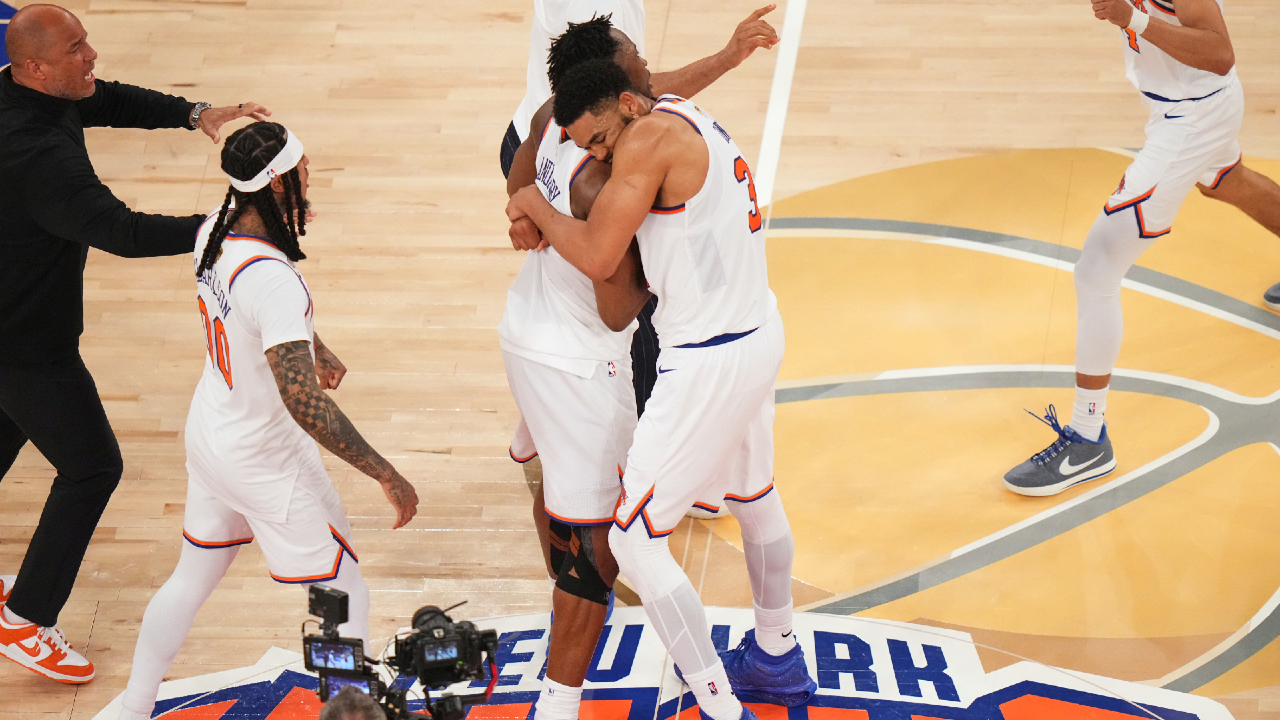
Meanwhile, the Knicks and Knicks fans will long celebrate the greatest single game in the history of one of the NBA’s charter franchises, going back to 1946.
It culminated in a hard-to-believe 107-106 win that gave the Knicks a 3-1 lead as the series shifts back to San Antonio for Game 5 on Saturday, where the Spurs will have to win to avoid elimination.
Most NBA players go their entire careers without making a meaningful play to decide an NBA Finals game. Knicks star OG Anunoby made two legacy-defining plays in the final 11 seconds of Game 4 that will make him the toast of New York for the rest of his life, should the Knicks close out the Spurs and win their first title in 53 years. On the first play, when he tracked down Spurs guard De’Aaron Fox in transition, it appeared that the speedy Fox was going to be able to take a long rebound and sneak by the Knicks’ defence for a lay-up that would have put the Spurs up by three with 11 seconds to play. Nope. Anunoby — as he does so many times on transition plays in the series — was able to turn away the certain seeming score.
That was only to set up the biggest play he’ll likely ever have in his career. With the Knicks down by one and just 4.3 seconds left, it was looking very much like their historic comeback was going to fall just short. Instead, Anunoby ran into the lane following a Jalen Brunson three-point attempt, timed his leap perfectly and managed to tip the long rebound gently back into the rim with his right hand at least one foot above it. Bedlam.
The Knicks were able to defend the Spurs’ last chance off an inbounds pass with 1.2 seconds left.
The block and the tip-in capped as complete an all-around game as is possible to play for a (superstar) ‘role’ player who took just 15 shots but scored 33 points while going 7-of-9 from three. As well, he took turns guarding — to great effect — everyone from Wembanyama at seven-foot-four, fighting him at the rim, to Fox, squaring up the Spurs guard on the perimeter down the stretch in the fourth quarter.
The playoffs are, by definition, full of noisy information that gets overemphasized based on the outcome of each game. The Spurs led the first three games in the final two minutes but won only one of them. Would the information we’ve gleaned to this point in the series mean any less or any more had they won two of them, or all three? The difference splitting the Knicks and Spurs through six halves of the most intense basketball imaginable was seven points.
But what the heck, the games have to mean something, right?
There were at least three data points that seemed correlated to each team’s success heading into Game 4. The first was the ratio of Wembanyama’s shots in the restricted area to shots from the three-point line. In the Spurs’ two losses, it was 4:3. In their Game 3 win, it was more than 2:1. In Game 4? Wembanyama took eight threes (making just two) and 11 shots at the rim, so it would seem that when Wembanyama is more focused on getting shots off around the restricted area, the better off the Spurs are.
Another was turnovers. It’s been a low-turnover series, given how physical the defence has been, but in the first three games, the team that came out ahead in the turnover margin won. That the Spurs turned it over only eight times total — less even than the paltry 13.5 they averaged during the regular season, which was the fourth-best mark in the NBA — was one of the key underlying reasons the Spurs won in Game 3.
In Game 4? Turnovers were arguably the story of the game. When the Spurs jumped out to a 27-point first-half lead, they had a 7-2 advantage in turnovers. When the Knicks beat the Spurs by 28 points in the second half, it was New York that had the turnover advantage, 10-7.
One trend that was constant through the first three games was the Knicks’ advantage on the offensive glass. They came into Game 4 with a 36-20 edge in that category, winning the battle in all three games, with a commensurate edge in second-chance points. That trend reversed itself in Game 4, with the Spurs having a 12-8 advantage in offensive rebounds, but missing 31 shots in the second half probably had a lot to do with that. And then again, the Knicks got the most important offensive rebound of the series on Anunoby’s soaring, game-winning tip-in.
Brunson in a no-win situation, but still wins
Prior to meeting the Spurs, and as the Knicks were layering onto one of the most dominant runs in NBA playoff history, Brunson was just his typical superstar self. In the first three rounds of the playoffs, the Knicks star was averaging 26.9 points over 14 games, along with 6.6 assists and 2.3 turnovers with an effective field goal percentage (capturing the value of two and three-point field goals) of 54.1, all numbers very close to his season averages (26/6.8/2.4 with an eFG of 53.3). As well, his usage rate stayed pretty constant — 30.4 per cent in the regular season compared to 30.7 in the first three playoff rounds. But against the Spurs and the relentless defensive pressure they can put on him, Brunson’s efficiency has cratered.
If the Spurs were able to knock two-time MVP Shai Gilgeous-Alexander off his game, it makes sense that Brunson — about five inches shorter than the Thunder star — would struggle. He came into Game 4 with an effective field goal percentage of 41.4. Among qualified players, the lowest eFG during the regular season was New Orleans Pelicans rookie guard Jeremiah Fears at 48.5. But what has possibly hurt the Knicks more is that his usage rate has skyrocketed, jumping from 30.7 over the first 14 playoff games to 39.6 in three games against the Spurs. The reason is that the Spurs don’t have to trap him and can put pressure on him without automatically sending a second defender. Brunson has to put in more work to put up worse shots.
But Brunson finds a way. He got rolling in Game 4, delivering his best game of the series when the Knicks absolutely needed it, as he finished with a game-high 36 points on 12-of-25 shooting. He scored 19 seemingly inconsequential points in the first half when it seemed like they were just going to be empty calories. To his credit, Brunson kept his foot on the gas. And then — as he does — he delivered clutch score after clutch score down the stretch in the fourth quarter, taking advantage of the Knicks going to a smaller lineup, spreading the floor and dragging Wembanyama from the rim. It was Brunson’s driving floater with 1:22 left that gave the Knicks their first lead and set the Garden on fire.
Wembanyama picked up a flagrant foul in the third quarter for an inadvertent elbow to the jaw of Karl-Anthony Towns. There was no intent and Wembanyama instantly apologized for catching Towns as he tried to break free of the Knicks star’s meaty hands. But the NBA doesn’t allow for a lot of leeway for contact to the head that isn’t a result of a play on the ball. But it was a non-call on a very intentional shot to the head — in this case, Brunson’s head — in Game 3 that could have an outsized role in the series. One of the NBA’s disciplinary measures is that, as flagrant fouls accumulate, they can result in an automatic suspension. A flagrant 1 — like the foul Wembanyama was called for on Game 4 — is worth one point. A flagrant 2 – where a foul is deemed intentional and dangerous — results in an instant ejection and is worth two points. A player who accumulates four total flagrant foul points over the course of the post-season is suspended for the next game.
This is why — some might remember — Draymond Green was suspended for Game 5 of the NBA Finals in 2016. It wasn’t because he kicked LeBron James in the groin; it was because the flagrant foul gave him four flagrant foul points for the playoffs. Since Wembanyama picked up a flagrant 2 for a nasty elbow to the head of Naz Reid of the Minnesota Timberwolves in the second round, his elbow to Towns’ jaw now gives him three flagrant foul points. If he picks up one more flagrant foul in Game 5 or 6, he’ll be suspended for the following game (the suspensions don’t take effect until after the game). The Knicks would argue that he should already have been suspended for his shove on Brunson in Game 3.








 Illinois is resetting at QB following the departure of Luke Altmyer, who Kaytin Houser has replaced.







































You must be logged in to post a comment Login