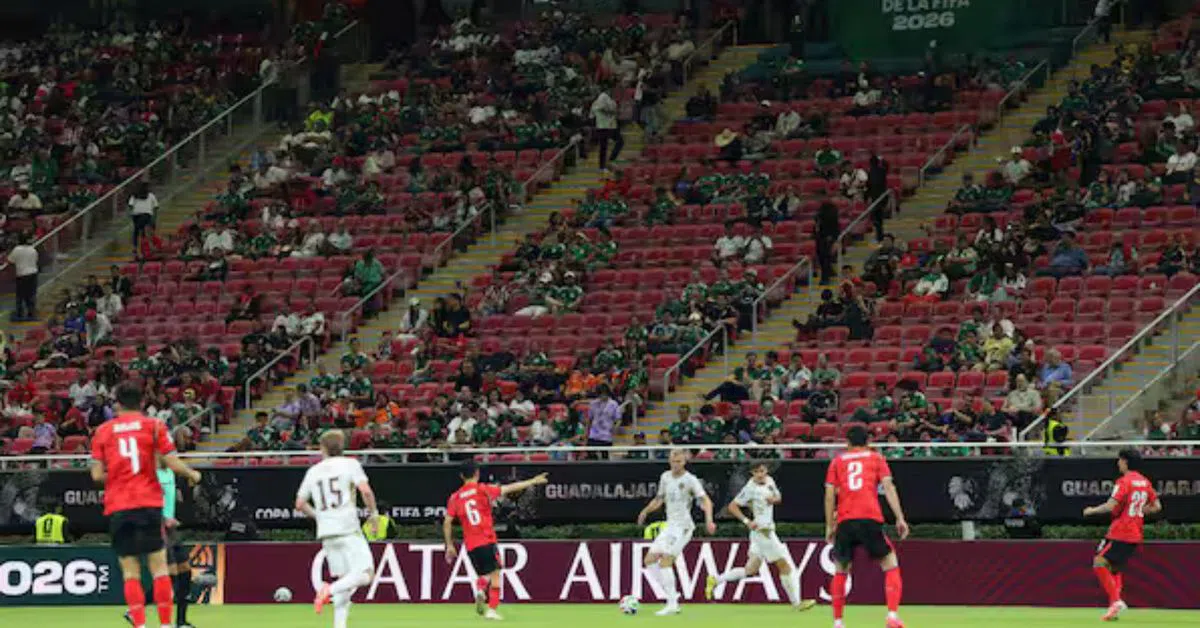
One of the early talking points of the 2026 FIFA World Cup has not been a goal, a controversial decision or a surprise result. Instead, it has been the sight of thousands of empty seats at some matches despite official attendance figures suggesting near-capacity crowds.
The issue came into focus during South Korea’s 2-1 victory over the Czech Republic in Guadalajara, where the announced attendance was 44,985, fewer than 700 short of the stadium’s official World Cup capacity of 45,664. Yet television viewers could clearly spot large clusters of empty seats, particularly in premium sections around the halfway line.
So why does the visual reality often appear different from the numbers released by tournament organisers?
Tickets sold vs fans present
The biggest reason lies in how attendance is measured.
In football, attendance figures often represent tickets that have been sold or allocated rather than the number of spectators physically sitting in their seats when the match kicks off.
This phenomenon is common across major sporting events. A supporter may purchase a ticket but choose not to attend, while some fans may arrive late, spend long periods in concourses or hospitality areas, or leave before the final whistle.
As a result, official attendance numbers can appear significantly higher than what television cameras capture inside the stadium.
The corporate ticket factor
Major tournaments such as the World Cup reserve a substantial allocation of tickets for sponsors, hospitality guests and commercial partners.
These premium seats are often located in the most visible sections of the stadium, particularly around the halfway line. If corporate guests decide not to attend or arrive only for part of the match, the empty seats become highly noticeable on television broadcasts.
This has long been a challenge at global sporting events, from Grand Slam tennis tournaments to Olympic competitions, where premium sections can appear sparsely occupied despite high overall attendance.
Why World Cup stadium capacities change?
Another factor that often creates confusion is stadium capacity.
Many venues hosting World Cup matches are operating below their normal maximum capacity because FIFA requires modifications to meet tournament standards.
Several North American stadiums were originally designed for American football rather than soccer. To accommodate FIFA-approved pitch dimensions, sections of seating have been removed to create additional space around the field.
Los Angeles Stadium, for example, regularly hosts crowds exceeding 73,000 for NFL games but is operating at a reduced capacity of just over 70,000 during the World Cup.
Additional media facilities, advertising zones and operational areas further reduce the number of seats available for supporters.
How attendance figures are calculated?
Unlike some domestic leagues, there is no universal requirement forcing organisers to publish a specific attendance metric.
Tournament organisers can choose whether to report tickets sold, tickets scanned or actual spectators present inside the venue.
FIFA has stated that its attendance figures are based on verified operational data, including ticket scans and spectators within the stadium footprint rather than simple visual estimates from television broadcasts.
Officials also noted that many supporters may spend portions of the match in concourse areas, food courts or hospitality lounges instead of remaining in their assigned seats throughout the game.
Are ticket sales becoming a concern?
The debate has also reignited questions about ticket demand.
Earlier this year, FIFA reported receiving hundreds of millions of ticket requests during the initial application phase and suggested that interest in the tournament was exceptionally strong.
However, not every fixture carries the same level of demand.
High-profile matches involving host nations have generally attracted packed stadiums and vibrant atmospheres. Mexico’s opening victory over South Africa was played before a sold-out crowd in Mexico City, with demand far exceeding supply.
Other group-stage fixtures featuring less commercially attractive matchups have faced a different reality, with thousands of tickets appearing on resale platforms in the days leading up to kick-off.
The Bigger Picture
The contrast between official attendance figures and visible empty seats is not unique to the 2026 World Cup. It is a long-standing feature of major sporting events where ticket allocations, hospitality programmes and spectator behaviour all influence what fans see on television.
While FIFA’s numbers may accurately reflect tickets scanned and spectators within the venue, the visual impression can tell a very different story.
As the tournament progresses, the debate serves as a reminder that a full stadium on paper does not always look full in practice.



























































You must be logged in to post a comment Login