Despite a challenging start to the T20 World Cup with two ducks and a stomach infection, Abhishek Sharma will look to get going in the dead rubber against the Netherlands. The Indian team’s batting coach Sitanshu Kotak remains confident in his aggressive approach, highlighting that opponents’ meticulous planning against him is a testament to his threat.
TimesofIndia.com in Ahmedabad: An hour before the Indian cricket team’s scheduled arrival at the Narendra Modi Stadium, the groundstaff was in overdrive with their preparations. Rolling was underway on the practice square and the makeshift nets were placed around the pitches the Men in Blue would use for their first, and only, session at the venue ahead of the final group game against the Netherlands in the T20 World Cup.The Super Eight berth is already sealed following three convincing wins, but this game will attract significant interest. First, because the same venue will host the Super Eight clash against South Africa on February 22 and second, and more importantly, due to Abhishek Sharma.
Gautam Gambhir works overtime with Tilak Varma in the nets
All the pre-tournament build-up focused on the dashing opener from Punjab. Since breaking into the team, the belligerent southpaw carved a reputation for his consistent destruction at the top of the order, and he was the sole reason opponents burned the midnight oil while planning his downfall.Meticulous planning by the opposition — the USA and Pakistan — means he is yet to score his first run in the World Cup. A severe stomach infection, sandwiched between those two contests, hasn’t helped either. A golden duck in the tournament opener was followed by a four-ball duck against Pakistan in Colombo. Prior to these outings, the 25-year-old, who enjoys a healthy average of 35.05 and a menacing strike-rate of 193.29 in the format, failed to open his account twice in the five-T20I series vs New Zealand at home.
Abhishek Sharma
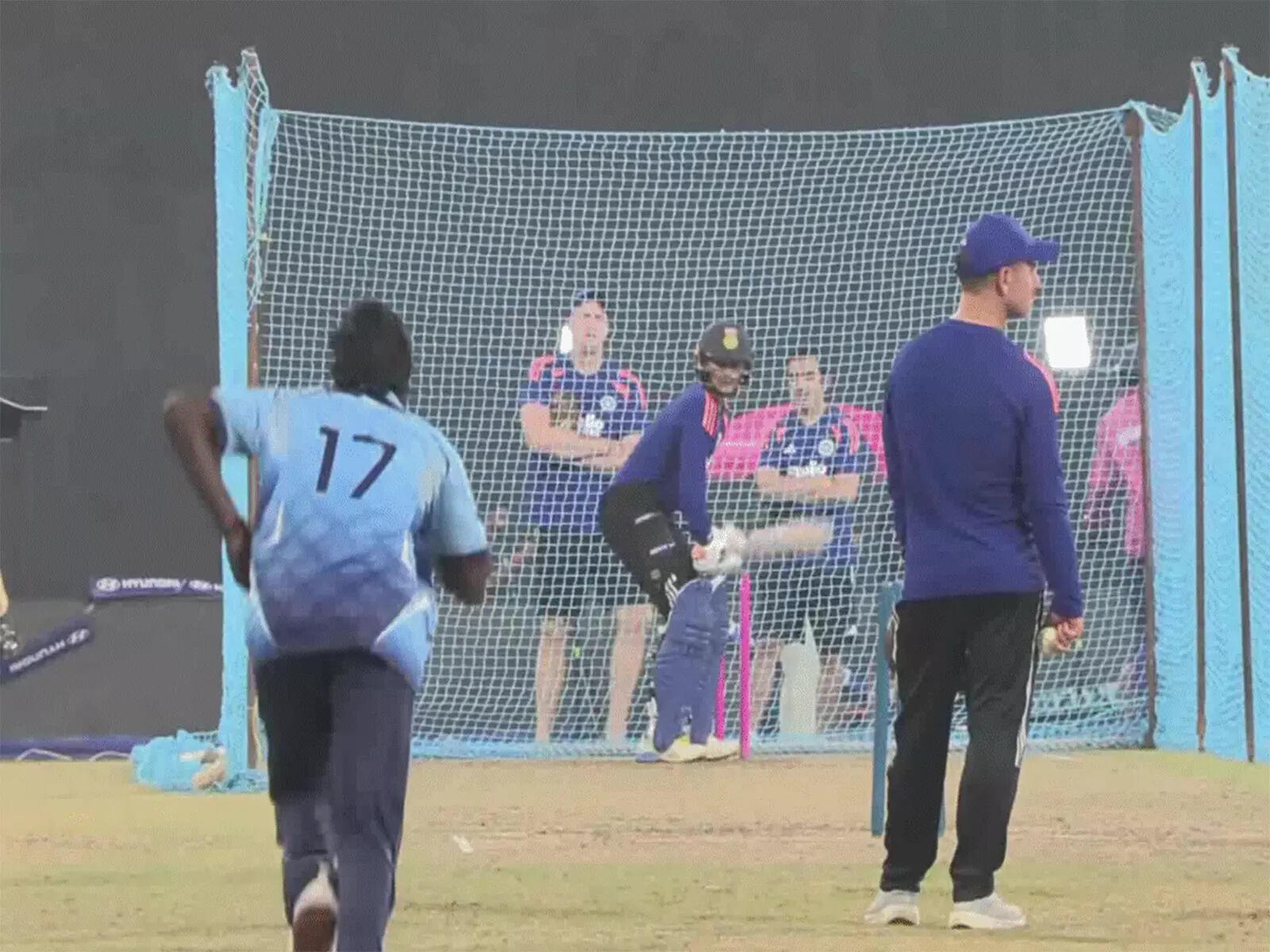
Four ducks in the last seven innings is not the ideal reading for a player who has instilled fear in opponents. On Wednesday he gets another opportunity to regain his form before the T20 World Cup’s business end gets underway. The optional nets session on the eve of the game was a long and lonely grind for the opener who spent significant time working on his range against spinners Varun Chakravarthy and Washington Sundar. The usual big ones were on display but they weren’t the cleanest hits with the sweetest sound off the bat.Rightly so, he was allowed a free hand during the hit as head coach Gautam Gambhir stood behind the net where Tilak Varma and Rinku Singh were batting. The bat flow and swing are such integral parts of his batting that the moment they return to normal, runs flow at the pace everyone is used to seeing from the left-hander. Even when the connection wasn’t ideal, Abhishek achieved a better flow and extended his elbows well while navigating different pockets of the stadium.“Last game he got out in first over. So one thing we definitely do, we unnecessarily don’t over-analyse,” was batting coach Sitanshu Kotak’s response when asked about Abhishek’s failures in two outings.“He is someone who has got his plan sorted and he follows the way he wants to and obviously we discuss about the opposition, their bowling, their bowling strength, whatever they’ve been doing in the last few games they’ve played. All that is normal for everyone, not only for Abhishek,” added the coach.
Advertisement
If we start stressing so much, I think players will be under unnecessary pressure. So he’s in a good form. He’s got clear plans. He’s got a clear mindset. And that is what matters
Sitanshu Kotak
India have followed a high-risk template in T20Is under captain Suryakumar Yadav and coach Gautam Gambhir. Every batter’s primary intent has mostly been to pressure the bowlers from the start. This dominance explains their strong run in the format and why they have been a high-scoring team in the bilaterals preceding the multi-nation tournament.“Abhishek has made runs in the matches before that. Now in the T20 format, sometimes in 10 balls, 30 runs are just as important. Secondly, honestly, we focus on all the batters or all the players. We don’t think that one player didn’t get his runs. Because in T20, there is a high-risk game, somewhere or the other, a player will get out. If we start stressing so much, I think players will be under unnecessary pressure. So he’s in a good form. He’s got clear plans. He’s got a clear mindset. And that is what matters for us,” Kotak explained when asked about the team’s mindset.The coach is instead looking at the brighter side. He is very happy that the teams are worked up about keeping Abhishek quiet. Pakistan head coach Mike Hesson’s admission after the defeat to India was the latest instance of how opponents have identified the fearless batter as the real deal in the Indian line-up.
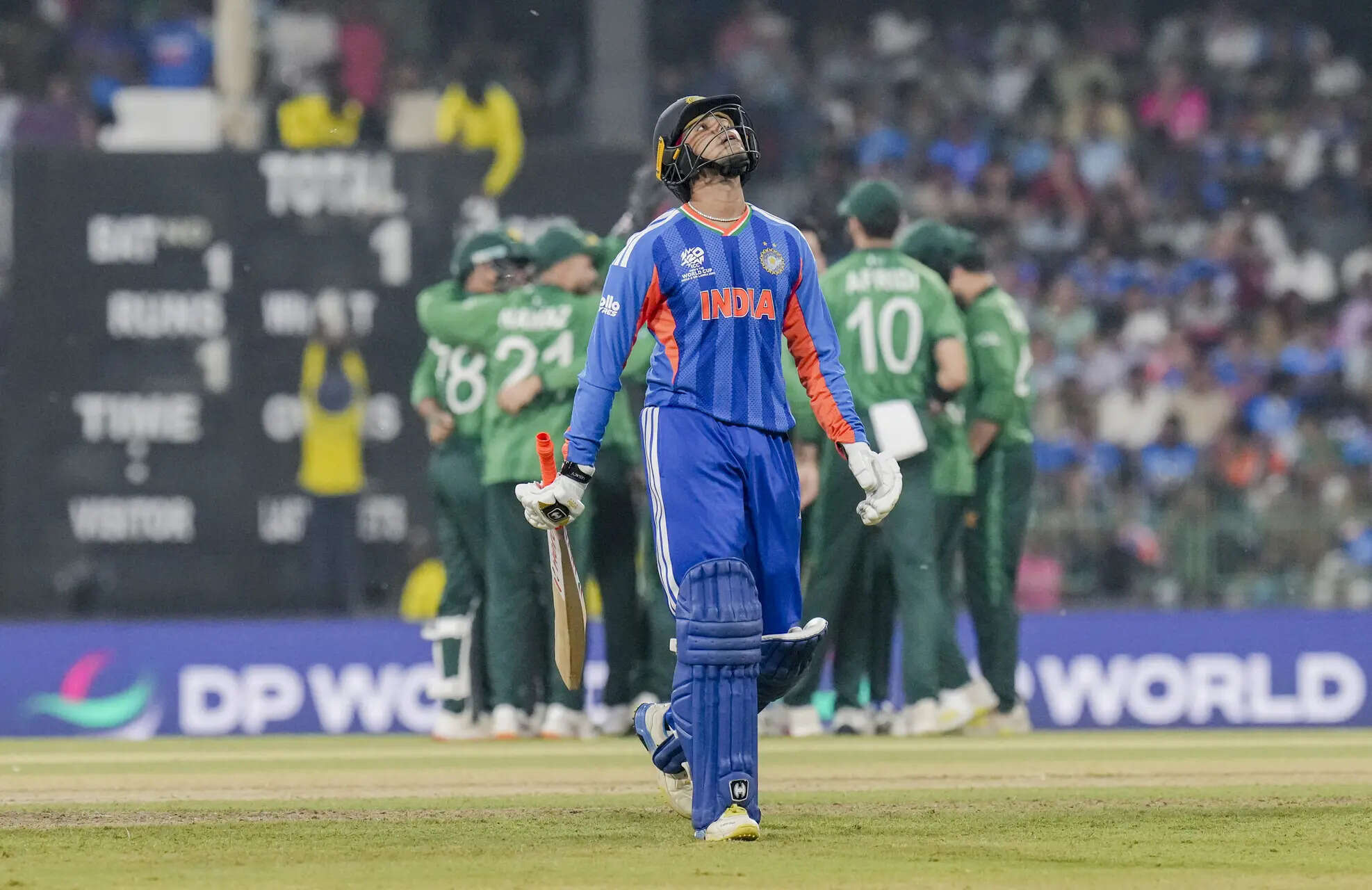
Abhishek Sharma is yet to get off the mark in the ongoing T20 World Cup. (PTI)
Advertisement
“See, first of all, a lot of credit to Abhishek, if they plan and talk about him. Because I am sure he must be doing that well, that they are so concerned about Abhishek. But we plan, he also comes up with his ideas. Even in the last game, I don’t think anyone can plan to get him out at mid-on. He sat up and got out. That’s okay. And if they are so concerned, that’s a great sign for us and it’s great credit to him the way he plays,” said Kotak.For a setup that has successfully embraced the high-risk template, the focus remains on playing the situation and doing what the team demands at that stage. Just as Suryakumar had to dig deep against the USA, and both he and Tilak had to hold their shots when Pakistan applied the spin choke in Colombo.“I think playing aggressive cricket is important but not because of a player’s couple of failure will change. If anything, the plans will change according to situation. So no matter whether somebody has scored runs for two innings or not, or somebody… But it’s more what team needs at that time, in that conditions,” explained Kotak.However, the same rules don’t apply to Abhishek. He doesn’t play by the regular book and has a very straightforward approach. See the ball, whack the ball. While the think-tank isn’t losing sleep over his lack of runs, the entire nation will surely sleep well, and opponents will return to sleepless nights, if Abhishek returns to form and adds significantly to his T20 World Cup tally — which is yet to get off the mark.

Trainer Grant Kluske believes advantages exist in contesting a tougher race with Gold Spirit at Morphettville this Saturday, despite the sprinter’s qualification for milder options.
The progressive four-year-old lines up for start two of the campaign in the $55,000 Sportsbet Same Race Multi BM72 Handicap at 1000 metres on the Parks surface.
Kluske bypassed the post-race 0-62 over 1000m where Gold Spirit qualified, opting for this setup notwithstanding the wide-ish draw from gate nine of 10.
“I decided to go with the higher-class race mainly because the horses in it,” Kluske said.
Advertisement
“He likes it up forward, but I think it’s going to be a bit of a fight up front and will take a sit.
“He doesn’t have to be up there (leading), so I’m more than happy going into it.”
Rather than co-topweight in the lower grade, the Turffontein progeny meets the BM72 at 54kg with 3kg off for jockey Brooke King.
King steered him to a solid fourth on January 31 first-up at Morphettville, going down by little more than one length.
Advertisement
Previously in 0-70 ranks, this BM72 features 68-calibre Been Our Angel, Mintulee and Nextonixs atop the ratings, which Kluske considers not overly deep, aiming to inform subsequent targets.
“This will only be his second start this time in, but he’s got to step up the mark in this one,” Kluske said.
“It’s a benchmark 72, but there’s nothing in it rated 69 (or above), so we’re more than happy.
“He’s a very good horse, very professional in everything he does and I’m feeling really happy with him.”
Advertisement
The racing betting markets offer value for the Sportsbet Same Race Multi BM72 Handicap at racing betting markets.
Sep 19, 2025; Phoenix, Arizona, USA; New York Liberty forward Breanna Stewart (30) dribbles by Phoenix Mercury forward Satou Sabally (0) during the first half of game three of round one for the 2025 WNBA Playoffs at PHX Arena. Mandatory Credit: Joe Camporeale-Imagn Images
WNBA star and Unrivaled co-founder Breanna Stewart will join Turkey’s Fenerbahce Opet for the 2026 EuroLeague Final Six April 15-19 in Zaragoza, Spain.
The team made the announcement on Monday.
Stewart, 31, will join the team upon the completion of Unrivaled’s season on March 4. She’s in her second season playing for the Mist in the startup league, which she launched alongside fellow WNBA standout Napheesa Collier.
The three-time WNBA champion and two-time MVP previously played for Fenerbahçe Opet in the 2022-23 season, leading the team to the EuroLeague championship while being named the Final Four MVP of the event.
Advertisement
That was the last time Stewart played internationally during the WNBA offseason.
Fenerbahçe Opet has won 19 Turkish Basketball Super League titles and won back-to-back EuroLeague and European Super Cup titles in 2023 and 2024.
Stewart is averaging 19.7 points, 9.4 rebounds and 2.7 assists per game for the Mist, which stand third in the Unrivaled standings at 7-4 with three regular-season games left.
Ishan Kishan has emerged as India’s standout performer with the bat in the ongoing T20 World Cup, playing a pivotal role in the team’s smooth progression to the Super 8s. The left-hander has struck consecutive half-centuries, underlining a dramatic resurgence in his career. Just six months ago, he was out of the national reckoning and far from selection discussions. Since making his return, however, Kishan has made every opportunity count.His defining contribution came in the high-pressure clash against Pakistan. On a challenging surface where stroke-making was far from easy, Kishan delivered a commanding 77 off 40 balls, laced with 10 fours and three sixes. His innings proved decisive, allowing India to seize control at a crucial juncture of the tournament.
Suryakumar Yadav press conference: How SKY trolled India-Pakistan rivalry
Former India batting coach Sanjay Bangar attributed the knock to Kishan’s fearless mindset and clearly defined role at the top of the order.“To bat like Ishan Kishan, the way he did against Pakistan, I believe there have to be a couple of factors that have to be your advantage. Number one, he is batting at the top of the order. He has the backing of the team to go out and play by taking a lot of risks, which, at the moment, are coming off,” Bangar said on Star Sports.Bangar emphasised that Kishan’s success is rooted in form and method rather than reckless strokeplay.“Number two, he is the man in form, and T20 cricket is basically for form players. So he is maximising whatever form that he has. There is a method in which he dominated. It isn’t that he was targeting each and every bowler,” Bangar observed.He further analysed the innings, noting how Kishan strategically attacked specific bowlers.“Even till the fourth over, he first attacked Shaheen Shah Afridi in the second over, then gave respect to the off-spinners, and when the leg-spinners came, he took them to the cleaners. So all in all, a very calculative innings. I must say that even though he was getting the majority of the strike, he was farming the strike pretty well and made those 77 possible out of the 88 runs that were there on the scoreboard,” he elaborated.
Home advantage smaller than ever before, but still a factor
Italian women playing a huge role in host’s success
Familiarity with facilities the main reason for Italy’s strong display
History shows negative spillover possible
From Francesca Lollobrigida setting an Olympic record in the women’s 3,000-meter speed skating for Italy’s first gold to alpine skier Federica Brignone winning her second gold medal in three days, this has been Italy’s Winter Olympics in more ways than one. Their haul of 24 medals* is their best ever at the Winter Olympics, with their previous best of 20 coming in Lillehammer over 30 years ago.
But how much of Italy’s success is because they are at home?
Both the US and Canada enjoyed very successful Games when they hosted in 2002 and 2010 respectively. South Korea and China won more medals as hosts than ever before, but historically speaking the concept of home advantage is more complicated.
Carl Singleton is a senior lecturer in economics at the University of Stirling, Scotland, and has written multiple papers analyzing the idea of home advantage at the Olympics. In 2021, he co-authored one looking at the Summer and Winter Olympic Games between 1896 and 2021 and his findings revealed that over the span of the Olympics, home advantage has gradually reduced.
This is logical given the diversity of sports and events has increased, as has competition and participation. There are over 90 countries competing in Italy this month, whereas there were just 16 at the first Winter Olympics back in 1924.
Advertisement
“If you just look at that long history of the Olympic Games, home advantage now is possibly as small as it’s ever been, even though it’s still obviously quite there and substantial,” Singleton told DW.
Women playing a major role
Italy collected 17 medals in total in Beijing, with two of those being gold. In 2026, on home snow and ice, the Games are not even finished and they have already won 24, including eight golds. The most striking part of their success is the major role played by women.
Singleton’s data shows that in the Winter Olympics, the home advantage between 1988 and 2016 was “around 50% larger in men’s events but non-existent in women’s events.”
Advertisement
Italy’s women have changed all that, both this year and last. They have already medaled, either as a single athlete or as part of a team, in 16 events this year (four more than at the last Games).
Federica Brignone is one of the faces and names of the Games after winning two gold medalsImage: Spada/LaPresse/IMAGO
“Women’s sports have become much more competitive, more funding, more access,” Singleton said.
“So now you’re maybe seeing the home advantage amplified through the women’s sports matching the home advantage that you might have always or more commonly seen in men’s sports.”
Facility familiarity the major factor
Singleton’s research points to four major factors that influence home advantage – a supportive home crowd, no travel, familiarity with conditions/tracks and favorable refereeing/umpiring bias. And, in 2026, Italy’s marginal gains have most likely been found in their familiarity with the facilities.
Italy have added just two new venues for these Games, the sliding center and the much discussed Santagiulia ice arena.
Advertisement
“So they’ve got familiarity with everything else, which is great,” said Singleton, highlighting that Italians likely had a chance to practice at the other facilities before any other athletes.
Growing up on this snow combined with being some of the top athletes in the world has been the perfect nudge for these athletes to get onto the podium.
“They’ve maximized the familiarity factor at these Games,” Singleton said.
Support from the home crowd has been a major factor at these Games, helping Italy over the line in some sportsImage: Eric Bolte/Imagn Images/IMAGO
How long-lasting is this success?
While some things are meant to be enjoyed in the moment, there will always be questions asked about the longevity and legacy of such events, especially when such a large amount has been invested. In other words, will there be a spillover performance at the 2030 Winter Olympics in France?
Singleton’s data reveals significant evidence that in the Summer Games, spillovers are real but on average there wasn’t a spillover for the Winter Games.
Advertisement
In fact, looking at recent hosts more than anything, there appears to be a tendency towards a sharp decline. After China won 15 medals at home in 2022, they have won just five in Milan and Cortina. South Korea went from 17 at home in 2018 to nine in 2022, and have just six this time around. While medals are not necessarily a barometer of whether a country’s sporting development pathways are healthy, they clearly matter to hosts.
The hope is, as always with major sporting events, that both the act of hosting and the success of home athletes will inspire the next generation. However, Singleton believes there isn’t a lot of strong evidence that the Olympics lead to long-lasting participation changes. Indeed, the cost is a big problem for many. It can though, make a difference beyond the numbers.
“I’m a macro economist by trade, and I tell my students all the time, there are many things that we can’t quantify in GDP, that don’t show up in national accounts, and I think these things are valuable,” Singleton said.
“Maybe, you can’t say that it was worth the initial money because it’s hard to make that comparison, but the memories, the experiences and the sense of national pride are important things which don’t show up in a country’s balance sheet. And that’s, to some extent, a big factor as to why certain nations bid for these things as well, because there are intangible benefits of hosting these events,” Singleton said.
Advertisement
“I think if every country can lose itself for three weeks and sport can develop a shared memory, then that is what is important.”
Italy’s athletes at these Winter Olympics have shown that even if home advantage is smaller than ever, it can be turned into special and memorable performances.
* As of 16:45 CET on February 17, 2026 Edited by: Chuck Penfold
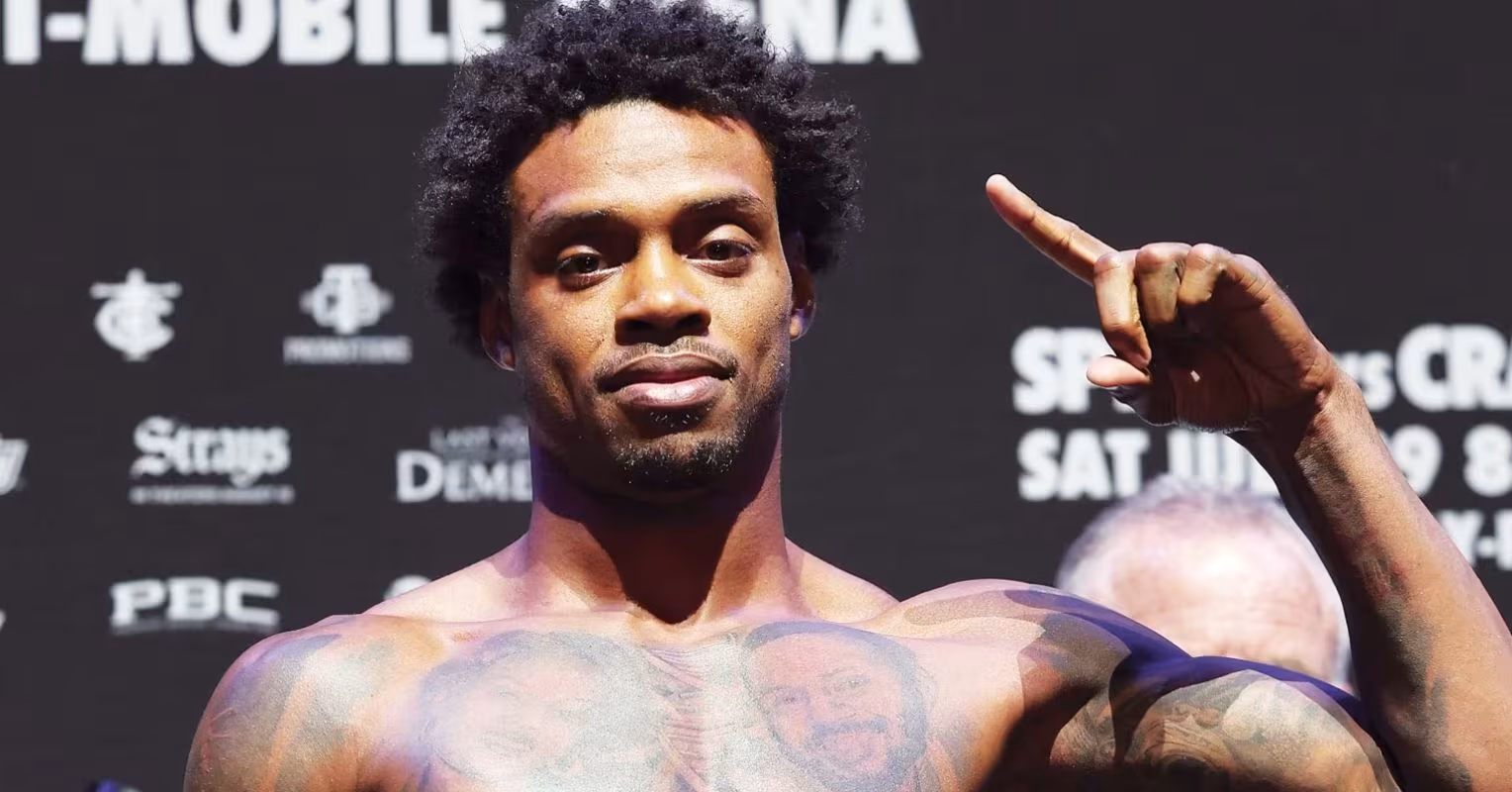
Former four-division world champion Mikey Garcia, who lost to Errol Spence Jr in 2019, has offered his thoughts on the American’s expected comeback fight against Tim Tszyu.
It was reported last week that, following a three-year layoff, Spence is set to return against former world champion Tszyu this summer.
Prior to that, many considered Spence to be the top dog at 147lbs, capable of becoming a two-division world champion at super-welterweight.
And while a lengthy hiatus has now diluted such comments, at least to a certain extent, ‘The Truth’ is nonetheless looking to reignite his career later this year.
Standing in his way of future multi-division glory, it seems, is sturdy contender Tszyu, whose performances have not quite looked the same since his split decision defeat to Sebastian Fundora in 2024.
After that particular night, where he showed tremendous grit to fight through a horrific gash on his forehead, the Australian found himself on the receiving end of a far more punishing third-round stoppage against Bakhram Murtazaliev.
Advertisement
Having since claimed two victories back home, while also losing his rematch with Fundora via a seventh-round finish, many are questioning what Tszyu has left to offer at world level.
But while the same, of course, could be said for Spence, former pound-for-pound star Garcia has effectively told ESNEWS that the Texan should enter their potential showdown as a clear favourite.
“That’s a good fight for Errol if it’s his comeback [fight]. Tim Tszyu is, I don’t think, a huge, huge threat.
“But it’s been a long time since Spence Jr [last fought], so I think it’s a good fight.”
Spence defeated Garcia, the naturally smaller man, with a wide unanimous decision at 147lbs, before defending his titles against the likes of Shawn Porter and Danny Garcia.
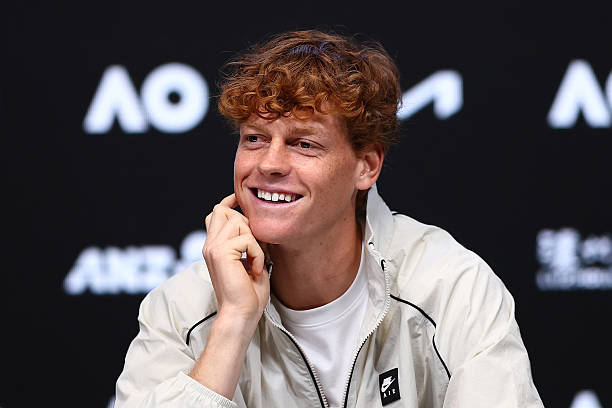
Carlos Alcaraz opened his run at the Qatar Open with a straight sets victory over Arthur Rinderknech, winning 6–4, 7–6.
The match was Alcaraz’s first since completing the Career Grand Slam at the Australian Open, and the Spaniard maintained his perfect start to the 2026 season. He is now 8–0 for the year and has beaten Rinderknech in all five of their meetings.
Alcaraz edged the opening set before being pushed into a tight second set tiebreak, where he stayed composed to close out the contest. The win sends him into the round of 16 in Doha for the second time.
Advertisement
After the match, Alcaraz acknowledged the challenge posed by his opponent.
“It was really difficult. Arthur is always a really dangerous player. Nobody wants to play him in the first round,” he said. “I’m happy with the level and happy I got through. There were difficult moments, but I stayed calm, stayed positive and played good tennis.”
Alcaraz will now look to build on a solid opening performance as he continues his run in Doha.
Consider the sandbagger. You’re familiar with the term and the type. Did you know, though, that neither got its start in golf?
In mid-19th-century England, “sandbagging” was punishable by imprisonment. But it didn’t describe an on-course crime. It referred to the work of common thugs who would knock their victims cold with sandbags and make off with their valuables.
That was a far cry from the word’s original meaning. In the early 1800s, to sandbag was to shore up or stabilize, often as a defense against flooding. But language, like trouble, has a way of spreading.
By the Roaring Twenties, sandbagging had taken metaphorical shape: bullying, coercion, intimidation. Its literal applications expanded, too. In poker, sandbagging became a kind of reverse bluff: playing possum with pocket aces to lure others into the pot.
Advertisement
How and when the term wandered onto the golf course is murkier. But by the 1940s, “sandbagging” had become shorthand in sports for a competitor who downplayed his advantage or deliberately underperformed.
Which brings us, inevitably, to that guy at your club.
By the early 1960s, characters like him were commonplace enough to inspire widespread complaint. The golf press addressed them with pious indignation. In one article from the Pensacola News Journal, the sandbagger was depicted as “an odious character indeed, for he perverts that purpose of the game.” No murkiness there. The sandbagger wasn’t merely gaming the system; he was committing a sin against golf itself.
The tone in those old references is steeped in moral outrage, as though sandbagging belonged alongside slow play, foot wedges and loud trousers as evidence of civilization’s decline. But it’s also telling. That the term was showing up so regularly in golf coverage suggested that it had already been circulating in locker rooms and betting games for some time.
Advertisement
In fact, evidence points to sandbagging gaining real traction in the 1950s, alongside the growing popularity of Calcuttas — handicapped matches with a gambling twist, their name borrowed from the Indian city where British colonists once wagered on horses. The format was tailor-made for the modern sandbagger: keep your handicap comfortably inflated, wait for the right moment, then “discover” your swing when money is on the line.
Today, the word has softened around the edges. “Sandbagger” can still be a harsh accusation, hissed in a stage whisper as the winner of a net event walks up to collect his prize. But it can also be tossed around as friendly ribbing, even a sideways compliment. It’s a golfer’s way of saying: Nice round. Now tell us what you really play to.
The USGA seems allergic to the term. You’d be hard-pressed to find “sandbagging” anywhere in its Rules of Golf or other official writing. Even hard and soft caps — measures that help safeguard against sandbagging — are presented instead in the diplomatic language of fairness, as tools to ensure a Handicap Index accurately reflects a player’s ability.
India will meet South Africa in their Super Eights clash at the Narendra Modi Stadium in Ahmedabad on February 22 (Image credit: Agencies)
When India face South Africa in their Super Eights clash of the 2026 Men’s T20 World Cup at the Narendra Modi Stadium in Ahmedabad on February 22, few supporters will feel more divided than Mariana Morkel.From her home in Pretoria, Mariana will find herself torn. Her elder son, Albie Morkel, represented South Africa in one Test, 58 ODIs and 50 T20Is and is now serving as a consultant coach with the Proteas in the ongoing tournament. Her younger son, Morne Morkel, who played 86 Tests, 117 ODIs and 44 T20Is for South Africa, is India’s bowling coach.
Suryakumar Yadav press conference: How SKY trolled India-Pakistan rivalry
Speaking ahead of South Africa’s Group D match against the UAE at the Arun Jaitley Stadium, Albie was asked if he had exchanged notes with Morne. “No, we don’t talk to each other. I think my mother, she’s more worried than us. She doesn’t know who to support, India or South Africa.”With the Proteas already through to the Super Eights, Albie stressed that the bigger challenge lies ahead.“I think the World Cup really starts now, even though we had a tough group. Now you face India, possibly Australia or Zimbabwe and the West Indies in our group. So it’s really tough. It’s going to be all good games. Yes, there will be more pressure on those games because as you move later towards the playoffs.“But I feel we’ve got a very experienced group of bowlers and batting is better so guys that have been exposed to that whether it’s an IPL or other leagues or in international cricket is a little bit different. But guys that can handle that pressure – they actually will thrive in those circumstances where there’s a bit more pressure on the games – so not too worried,” he added.Cautious about raising expectations after a runners-up finish in 2024, he said, “I don’t like to make statements about it. I think we were in a very tough group. That game against Afghanistan still gives me nightmares and it could have gone anyway.“So now I guess the first box is ticked – getting through to the next stage. To me, the World Cup starts now. Every game will be a tough game, and luckily we’ll be in Ahmedabad again where we sort of are used to the conditions now – so, let’s see.”Brought into the South African setup specifically for this tournament, Albie previously worked as Namibia’s assistant coach and as Bangladesh’s power-hitting coach. Reflecting on his current role, he said, “It’s been an interesting term, a specialist consultant. I had to figure it out myself a little bit. But I guess it’s anything it takes to help the team do well in the World Cup. So do a bit of both, batting, and fielding, mostly focus around the bowling for now and do some work with the lower order batters, around their swing and stuff like that.”Now viewing the game from the sidelines, he also spoke about shaping his coaching philosophy, influenced heavily by Stephen Fleming during his stint with Chennai Super Kings.“Initially when I started my coaching career, you still coach as a player. If you want to make a difference, but you can’t be on the field and you have to accept that fact and work out ways because players are under pressure anyway. If you as a coach want to make a difference in their games all the time, that doesn’t help anyway.“So it’s sort of finding that middle ground where you try to help, but you’re also not, as a coach, put pressure on players as they know what they’re doing. If it’s real technical things, then you can work at it, but not during tournament.“My philosophy is once you hit a World Cup like this and you start to tinker with technical stuff, that’s when you confuse players or players can get confused. So it’s more like how can I actually take pressure off guys, make them believe in themselves, and stuff like that? Stephen has been a big influence on that.“He’s one of the only coaches, or maybe the only coach in the world who’s been at a franchise for 17 years. That’s unheard of and it must mean he does something right. I’ll certainly learn a lot from him, yes,” he concluded.
The Super 8 stage of the ICC T20 World Cup is nearly set, with seven teams confirming qualification and one final berth still to be decided.From Group A, India advanced in dominant fashion, winning all three of their matches.Group B saw Sri Lanka and Zimbabwe progress after Zimbabwe’s final league game against Ireland was washed out in Kandy. The shared points eliminated the 2021 champions Australia, who cannot catch Zimbabwe on the table.
T20 World Cup: India humiliate Pakistan again
From Group C, England and West Indies qualified, while Group D representatives are New Zealand and South Africa.That leaves Pakistan in a must-win situation against Namibia. Victory will send Pakistan through and complete the Super 8 lineup. Any other result will confirm their elimination.However, there are further permutations. If Pakistan lose, United States national cricket team will qualify. The Netherlands national cricket team also remain mathematically in contention — but only if they defeat India by a massive margin. The challenge for the Netherlands is their net run rate of -1.352, compared to USA’s healthy +0.787, making qualification highly improbable unless there is a dramatic swing in results and NRR.
Super 8 Qualified Teams
India (Group A)
Sri Lanka (Group B)
Zimbabwe (Group B)
England (Group C)
West Indies (Group C)
New Zealand (Group D)
South Africa (Group D)
One spot remaining: Pakistan (if they beat Namibia).If Pakistan lose: USA qualify.Netherlands need a huge win over India to stay in contention (NRR factor).
Super 8 Groups
Advertisement
The eight teams will now be split into two further groups in the Super 8 stage:
Super 8 – Group 1 (G1)
India
Zimbabwe
South Africa
West Indies
Super 8 – Group 2 (G2)
Advertisement
TBA (Pakistan/USA/Netherlands)
New Zealand
Sri Lanka
England
The top two teams from each Super 8 group will advance to the semi-finals, setting up the final sprint towards the T20 World Cup 2026 title.
After meeting as students in Belfast, Michaela and John married in on 30 December 2010.
However, tragedy would strike just 12 days later when she visited the couple’s room in a luxury resort in Mauritius on her own after lunch, and she was discovered by John who raised the alarm.
In the aftermath, John, now 41, said there was shock, but there was also “anger” at how the authorities dealt with her death, and the lack of convictions that followed.
“I’ve never asked the question of, ‘why did this happen to me?’, I’ve always just felt so sorry for Michaela,” he said.
Advertisement
“It’s only now that I’m able to talk about it quite logically. There’s still a hell of a lot of pain associated with it, but I accept that it’s always going to be the case.
“I know how intense it is to live with that pain, so I’ve been able to find a way to manage it.”
McAreavey, who featured for Down’s senior football panel and won an All-Ireland Intermediate title with his club Tullylish in 2010, admits that “moving on is a term that has never been comfortable for me”.
“I’ve said before about moving forward, and that just changes the reference around it.
Advertisement
“You’ll never move on from something like that, you can’t just let that be. You have to find a way to move forward.
“I’m still heavily involved for trying to find justice for Michaela so it’s still a very active part of my life.”