Connect with us
DAPA Banner
DAPA Coin
DAPA
COIN PAYMENT ASSET
PRIVACY · BLOCKDAG · HOMOMORPHIC ENCRYPTION · RUST
ElGamal Encrypted MINE DAPA
🚫 GENESIS SOLD OUT
DAPAPAY COMING

Sports

The coach struggling to speak to Germany

Published

on

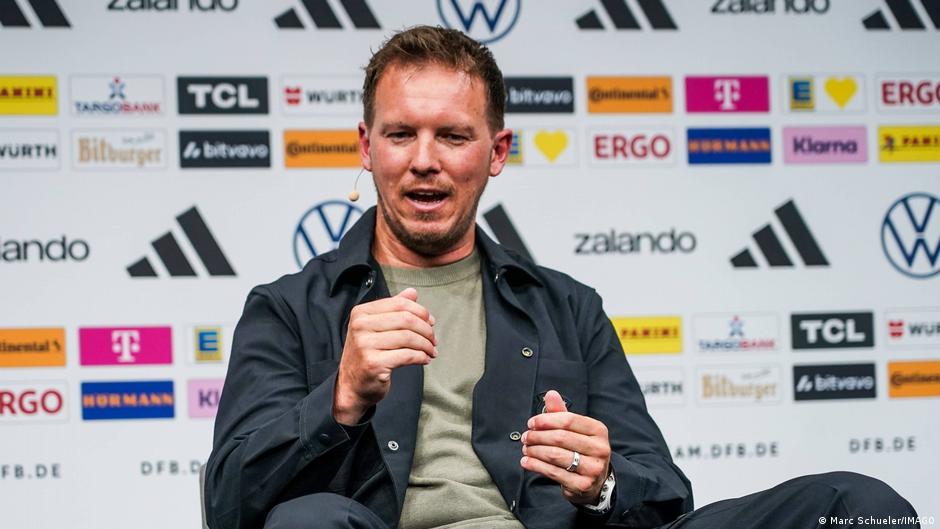
Julian Nagelsmann enters this World Cup in a completely different environment to Germany’s home Euros two years ago. The shine around the 38-year-old head coach has faded somewhat as his communication skills have been called into question.

Most of the concern is focused on his dramatic recalling of retired goalkeeper Manuel Neuer to the Germany squad just weeks before the start of the tournament despite having spent a year reinforcing Oliver Baumann as the number one.

In March, he also delivered very public criticism of striker Deniz Undav, saying the player had played poorly after a game in which Undav had scored the winner. He later, after revealing he had spoken to his wife on the matter, apologized for his comments, saying he had got it wrong. 

For a coach whose early rise was built off of a strong psychological antenna and one who has been keen to develop the strength of the group, the months leading up to the World Cup have been far from ideal.

Advertisement

“Please understand that not every detail of my conversations with the players can be made public,” said Nagelsmann during Germany’s squad announcement last month. “I try to explain things thoroughly and keep people informed. Sometimes I’m not as successful as I’d like to be, and sometimes I am.”

Nagelsmann indecision a reflection of German society?

“Football embodies the essence of social communication. In a highly diverse and fragmented society, it possesses the rare ability to bring together different social circles and groups,” Jürgen Mittag, a professor of sports politics and sociology at the German Sport University Cologne, told DW.

The national team coach thus becomes the focal point of this fragmented public sphere and the broader social discourses associated with it.” 

Perhaps Nagelsmann’s indecision is an extension of the country’s mood. After all, many a famous parallel has been drawn between Germany’s national team head coach and its chancellor, Friedrich Merz. While these parallels shouldn’t take on too much importance, they have become part of the social history of both the national team and the country.

Advertisement

Former Germany coach Joachim Löw and former German Chancellor Angela Merkel are perhaps the most famous example of this. The pair were deeply connected throughout the 15 years the two shared in their respective roles. The pair shared an integrative and cohesive approach, but perhaps lacked the willingness to push through needed reforms. Fittingly, they both left their jobs in 2021.

“Julian Nagelsmann, on the other hand, could — with all due caution — be compared to Friedrich Merz: someone who attempts to push through more far-reaching structural reforms, but in doing so also polarizes more strongly and does not always strike the most skillful tone in his communication,” Mittag said.

Why would a head coach make these decisions?

For many, the question about Neuer makes sense from a sporting perspective, but is it worth the risk given his injuries? And why now? And what does the team think of the decision?

Advertisement

“Out in the public domain, especially with the media, a lot of coaches get themselves into trouble by trying to be too clever,” coaching mentor Cody Royle, who has worked with teams in the NBA, MLB, NHL and the Premier League, told DW.

“It can be easy to try to sound intelligent and over-explain to show you’re deserving of the level. But my approach is the opposite. To paraphrase the American investor Charlie Munger, coaches should spend less time trying to seem smart and more time trying to be less dumb.”

Royle believes Nagelsmann’s comments on Undav were a sign the stress was getting to the head coach, but his decision on Neuer was a sign of a coach in command and connected to his approach.

“I think he has dealt with the goalkeeper situation quite elegantly. He portrayed a calm confidence and was thoughtful and intelligent in his description of why he’d included Neuer. He’s hired to make big decisions like this one, and I’m glad to see he stuck to his guns and didn’t flinch when it became apparent that it would be an unpopular decision,” Royle said.

As for the players, Pascal Gross told Kicker, a German football magazine, that “Nagelsmann’s credibility hasn’t suffered in the slightest.”

Advertisement

Can Nagelsmann bring Germany together again for one summer?

After Euro 2024, Julian Nagelsmann delivered a speech that stretched far beyond his team’s success or the joy of the tournament. Some thought it felt more fitting of a president than a head coach, but most were positively surprised and impressed by his public display of emotion.

“After the tournament, Nagelsmann delivered a remarkably emotional speech in which he emphasized community, solidarity, and a return to shared experiences. He spoke about the connection between fans and the national team as well as social cohesion in a broader sense, highlighting issues of integration in the process. This intervention stood in stark contrast to many current social developments,” Mittag said.

But the view of Nagelsmann then is not the same as now. Not only has Germany changed in the two years since, but so has the feeling around this team and its coach. The good vibes of a home tournament have faded and been replaced by global political turmoil, a bloated World Cup and a head coach who appears, just weeks before the tournament, to still not know his best 11. It also can’t help that so many leaks about the squad came out before the official announcement.

Nevertheless, with legacies and reputations on the line, Nagelsmann remains bullish.

Advertisement

“I don’t think the situation before the home Euros is much different to the one now. We are ready. I don’t know if its my job to create euphoria ahead of the tournament. My job is to create the moments that lead to that joy,” Nagelsmann said.

The summer of 2026 will reveal just how many moments he and this team can create.

Edited by: Chuck Penfold

Source link

Advertisement
Continue Reading
Click to comment

You must be logged in to post a comment Login

Leave a Reply

Sports

Report: Ghana player to miss World Cup game after Canadian denial, says FIFA

Published

on

Ghana will be without a key midfielder for its World Cup opener.

Veteran Thomas Partey, who has been charged with seven counts of rape and one count of sexual assault in England over the last year, was denied entry to Canada, The Athletic reported on Friday.

In a statement to The Athletic, FIFA confirmed that Partey would miss Ghana’s Wednesday match against Panama at Toronto Stadium.

“FIFA can confirm that player Thomas Partey will be unable to travel from Ghana’s team base camp in Boston to Canada for their its match against Panama on Wednesday, June 17, as his visa application has been refused by the Canadian government. FIFA is not involved in the immigration processes of host countries, including the adjudication of visas. As with previous FIFA events, the host government ultimately determines who receives a visa and is admitted into the country,” the statement said.

Advertisement

Partey, who plays for Villareal but formerly suited up for Arsenal, was charged with five counts of rape and one count of sexual assault in London last July.

He was charged with two new counts of rape in September. He has pleaded not guilty on all.

The 32-year-old is still awaiting trial on the charges.

The Canadian government website says “if you have committed or been convicted of a crime, you may not be allowed into Canada.”

Advertisement

However, Immigration, Refugees and Citizenship Canada told The Athletic in a pre-tournament statement that its officers can deny access into the country.

“IRCC officers are trained decision-makers who assess an individual’s eligibility and admissibility in accordance with Canadian immigration laws. If they believe that an individual could pose a security risk, they may decide to deny them entry,” the statement said.

Partey will be able to return for Ghana when it moves to the U.S. for its final two group-stage matches against England and Croatia.

Source link

Advertisement
Continue Reading

Sports

Why NBA Players Earn More Than Footballers — The Truth About Sports Salaries

Published

on

One of the most common debates in sports is surprisingly simple:

Which athletes make more money?

Whether it’s football versus basketball, football versus baseball, or even footballers versus musicians, fans are constantly comparing salaries and wondering why one superstar appears to earn significantly more than another.

  • Aryna Sabalenka reacts emotionally during her French Open quarterfinal defeat after being knocked out of Roland-Garros 2026.Aryna Sabalenka reacts emotionally during her French Open quarterfinal defeat after being knocked out of Roland-Garros 2026.

Advertisement

The latest example involves New York Knicks star Jalen Brunson and Paris Saint-Germain forward Ousmane Dembélé.

On paper, Brunson reportedly earns substantially more in annual salary than Dembélé despite football being the world’s most popular sport and Dembélé being one of the biggest names in the game.

At first glance, it doesn’t seem to make sense.

Advertisement

But the reality is that comparing salaries across different sports often tells only part of the story.

The systems that generate and distribute money in football, basketball and even the music industry are completely different.

The Brunson vs Dembélé debate

The comparison that recently went viral showed that Brunson’s annual NBA salary is significantly higher than Dembélé’s reported fixed salary at Paris Saint-Germain.

That immediately raised questions.

Advertisement

How can an NBA player earn more than a footballer who plays for one of the biggest clubs in the world?

How can a player competing in a sport followed by billions of people earn less than a basketball player whose league is largely concentrated in North America?

The answer lies not in popularity, but in economics.

Why NBA salaries are so high

The NBA operates under a salary-cap system that is directly tied to league revenues.

Advertisement

Players receive a significant share of Basketball Related Income (BRI), meaning the league’s earnings are shared between owners and players.

More importantly, NBA rosters are small.

Each franchise typically carries around 15 players.

That means billions of dollars in league revenue are divided among far fewer athletes.

Advertisement

As a result, elite NBA players regularly sign contracts worth $40 million, $50 million or even $60 million per season.

Jalen Brunson’s contract reflects not only his value as a player but also the financial structure of the NBA itself.


Advertisement

Football clubs spend money differently

Football operates under an entirely different model.

When a club signs a player, the cost goes far beyond wages.

Clubs may have to pay:

  • Transfer fees
  • Agent commissions
  • Signing bonuses
  • Loyalty bonuses
  • Image-rights agreements
  • Performance incentives
  • Salaries

When Paris Saint-Germain signed Neymar from Barcelona, the French club spent a world-record €222 million transfer fee before accounting for wages.

Real Madrid paid over €100 million to acquire Jude Bellingham.

Advertisement

Those costs do not exist in the NBA.

Basketball teams generally spend their money directly on player salaries rather than transfer fees.

That is one of the biggest reasons NBA salaries often appear larger.

Squad sizes matter

Football clubs also carry much larger squads.

Advertisement

A Champions League club may have 25 to 30 senior players, plus academy players regularly training with the first team.

NBA teams typically have only 15 roster spots.

That means football clubs must spread their resources across far more players.

Even when football generates enormous revenue, the money is distributed differently.

Advertisement

Popularity doesn’t equal salary

One mistake many fans make is assuming popularity automatically determines earnings.

Football remains the world’s most popular sport.

Players such as Lionel Messi, Cristiano Ronaldo, Kylian Mbappé and Ousmane Dembélé are recognised across virtually every continent.

Yet popularity alone doesn’t dictate salary levels.

Advertisement

The NBA’s revenues are concentrated within a single league featuring just 30 franchises.

Football’s revenues are spread across hundreds of leagues and thousands of professional clubs worldwide.

The structure of the business matters more than follower counts on social media.

Why some musicians earn more than footballers

The same debate exists outside sports.

Advertisement

Fans often wonder why some musicians appear to earn more than elite footballers.

Again, the answer depends on where the money comes from.

A footballer’s income generally comes from:

  • Club salary
  • Bonuses
  • Sponsorship deals
  • Image rights

A musician can earn through:

  • Touring
  • Streaming royalties
  • Publishing rights
  • Merchandise sales
  • Brand endorsements
  • Ownership of music catalogues
  • Investments

Unlike athletes, musicians are not restricted by salary caps, squad budgets or transfer markets.

A global tour can generate hundreds of millions of dollars.

Advertisement

Artists such as Taylor Swift, Drake, Beyoncé, Burna Boy and Davido have built business empires that extend far beyond music itself.

In many cases, their total earnings can rival or exceed those of elite athletes.

The hidden value footballers create

Another factor often overlooked is the transfer market.

Football clubs treat players as assets.

Advertisement

A club may pay €100 million to sign a player and later sell him for another massive fee.

That transfer value becomes part of the player’s overall economic worth.

In the NBA, most of that value is reflected directly in salaries.

In football, it is split between wages and transfer fees.

Advertisement

That is why a player earning less than an NBA star may still represent a far greater overall financial investment.

The real takeaway

The next time a graphic comparing the salaries of an NBA player, footballer or musician goes viral, remember that salary alone rarely tells the full story.

Jalen Brunson earning more than Ousmane Dembélé does not mean basketball players are more valuable than footballers.

Likewise, a musician earning more than a footballer does not automatically mean the music industry is richer than football.

Advertisement

Each industry distributes money differently.

Different business models create different pay structures.

And while the numbers on the paycheck may grab attention, they are only one piece of a much bigger financial puzzle.

Advertisement

Source link

Continue Reading

Sports

JJ Gabriel, Michael Carrick, World Cup impact – Manchester United’s plan for pre-season

Published

on

JJ Gabriel, Michael Carrick, World Cup impact – Manchester United’s plan for pre-season – Manchester Evening News

reach logo

At Reach and across our entities we and our partners use information collected through cookies and other identifiers from your device to improve experience on our site, analyse how it is used and to show personalised advertising. You can opt out of the sale or sharing of your data, at any time clicking the “Do Not Sell or Share my Data” button at the bottom of the webpage. Please note that your preferences are browser specific. Use of our website and any of our services represents your acceptance of the use of cookies and consent to the practices described in our Privacy Notice and Terms and Conditions.

Source link

Advertisement
Continue Reading

Sports

Can any nation stop Europe’s dominance in the FIFA World Cup 2026? | FIFA World Cup 2026

Published

on


For decades, the FIFA World Cup’s greatest rivalry was not between nations but continents. South America gave the tournament its first champion when Uruguay lifted the trophy in 1930. Brazil would go on to win a record five titles, while Argentina produced some of the sport’s defining moments through Diego Maradona and, more recently, Lionel Messi.


Europe responded with dynasties of its own, from Italy and West Germany to France and Spain. The balance was remarkably even. Between 1930 and 2002, South American nations won nine World Cups and European countries won eight.


Advertisement


Every tournament seemed to reinforce the idea that football’s biggest prize belonged to two continents separated by an ocean but united by excellence. The modern World Cup tells a different story.


Italy won in 2006. Spain followed in 2010. Germany triumphed in 2014 and France in 2018. Argentina interrupted the sequence in Qatar four years ago, but Europe still claimed four of the last five titles and occupied eight of the 10 finalist spots during that period.


Advertisement


As the World Cup returns to North America in 2026, Europe once again enters as the continent everyone else must beat.


From rivalry to European supremacy


Looking at the World Cup’s honours list alone, the contest appears close. Europe has won 12 titles and South America 10. Yet those numbers mask a significant shift.


For much of the tournament’s history, South America often punched above its weight despite having only three traditional contenders in Brazil, Argentina and Uruguay. Europe enjoyed strength in numbers, but the trophy regularly crossed the Atlantic.

Advertisement


That has happened far less frequently in recent decades. Since 2006, European nations have established a level of consistency unmatched by any other confederation.


Three of the last five finals were all-European affairs, while only Argentina and Brazil have prevented Europe from completely monopolising the tournament’s biggest matches.

Advertisement


The semi-final numbers are even more revealing. Of the 20 available semi-final places across the last five World Cups, 15 were occupied by UEFA nations. Only Argentina, Brazil, Uruguay and Morocco managed to break through.


Europe’s dominance becomes even clearer when examining the finalists. Eight of the last 10 places in World Cup finals have been filled by European teams. Argentina are the only non-European nation to reach that stage during this period, doing so in 2014 and 2022.

Advertisement


Those figures showcase the difference between producing an occasional champion and sustaining excellence across an entire continent. Europe has not relied on a single golden generation or one dominant team. Instead, it has continuously produced multiple contenders capable of making deep runs and challenging for the trophy. 


Why Europe keeps producing contenders


The reasons extend well beyond international football. Europe remains home to the world’s strongest domestic leagues, largest clubs and most competitive football environment.


The Premier League, La Liga, Bundesliga, Serie A and Ligue 1 attract elite talent from every corner of the globe, exposing players to the highest standards week after week. That influence can be seen even among Europe’s rivals.

Advertisement


Argentina’s World Cup-winning squad in 2022 featured Europe-based stars such as Lionel Messi, Julián Álvarez, Alexis Mac Allister, Enzo Fernández and Cristian Romero. Brazil’s hopes in 2026 rest heavily on Vinícius Júnior, Rodrygo, Bruno Guimarães and Marquinhos, all of whom compete in Europe.


Morocco’s historic semi-final run in Qatar was driven by Achraf Hakimi, Sofyan Amrabat, Hakim Ziyech and Yassine Bounou, players whose careers were largely shaped within European football.

Advertisement


In many ways, Europe has become the centre of gravity in the modern game. Even nations hoping to end its dominance often rely on players developed within the same ecosystem.


FIFA rankings entering World Cup 2026


The latest FIFA rankings reinforce the argument. Seven of the world’s top 10 teams entering the tournament are European. Spain, France, England, Portugal, the Netherlands, Belgium and Germany all sit among the game’s elite.


Advertisement


Only Argentina, Brazil and Morocco break Europe’s monopoly at the top of the rankings.


That depth is perhaps Europe’s biggest strength. Most continents can point to one or two genuine contenders. Europe can point to half a dozen.


Advertisement


Spain arrive as one of the form teams in international football. France continue to possess a squad overflowing with talent led by Kylian Mbappé. England believe Jude Bellingham, Bukayo Saka and Phil Foden can help end a title drought stretching back to 1966. Portugal have blended experienced stars with a new generation led by players such as Rafael Leão and João Neves.


Even Germany and the Netherlands, often discussed as being a tier below the favourites, possess enough quality to challenge for the trophy.


Advertisement


Top 10 FIFA rankings entering World Cup 2026:


Rank

Team

Rating

1

Argentina

1877.27

2

Spain

1874.71

3

France

1870.7

4

England

1828.02

5

Portugal

1767.85

6

Brazil

1765.86

7

Morocco

1755.1

8

Netherlands

1753.57

9

Belgium

1742.24

10

Germany

1735.77

11

Croatia

1714.87

12

Italy

1704.73

13

Mexico

1700.98

14

Colombia

1698.35

15

Senegal

1684.07

16

Uruguay

1673.07

17

USA

1671.23

18

Japan

1661.58

19

Switzerland

1650.06

20

IR Iran

1619.58


Argentina and Brazil lead the resistance


If history offers one lesson, it is that writing off South America is dangerous.


Advertisement


Argentina arrive as defending champions and remain one of the most complete teams in the tournament. While Messi’s presence inevitably attracts attention, Lionel Scaloni’s side is increasingly defined by the generation that emerged around him. Julián Álvarez, Enzo Fernández, Alexis Mac Allister and Cristian Romero are entering their prime years and provide the foundation for another serious challenge.


Brazil’s pursuit of a sixth title has become one of football’s longest-running stories. More than two decades have passed since their last triumph, yet few nations can match their depth of attacking talent. Vinícius Júnior remains one of the world’s most dangerous forwards, while Rodrygo, Endrick and Bruno Guimarães give Brazil the firepower to compete with any opponent.


Advertisement


Under Carlo Ancelotti, Brazil hope to turn potential into silverware. Together, Argentina and Brazil remain the most realistic non-European challengers to UEFA’s dominance.


Morocco showed another route is possible


For years, conversations about potential World Cup winners rarely extended beyond Europe and South America. Morocco changed that in Qatar.


The Atlas Lions became the first African nation to reach a World Cup semi-final, defeating Belgium, Spain and Portugal along the way. Their success was built not on fortune but on tactical discipline, defensive organisation and a squad capable of competing with elite opposition.

Advertisement


Achraf Hakimi remains the team’s standout figure, but Morocco’s strength lies in the collective quality of a generation that includes Brahim Díaz, Noussair Mazraoui and Youssef En-Nesyri.


Senegal also carry African hopes into the tournament. Led by Sadio Mané, Kalidou Koulibaly, Nicolas Jackson and Pape Matar Sarr, they possess the experience and talent to trouble more established powers.

Advertisement


Neither nation starts among the favourites, but Morocco’s breakthrough proved that barriers once considered permanent can be broken.


Can the rest of the world catch up?


Every World Cup arrives with its own surprises. Croatia reached the final in 2018 despite a population of fewer than four million. Morocco became Africa’s first semi-finalist in 2022. Argentina ended Europe’s run of titles in Qatar when many expected another UEFA champion.


Advertisement


Those examples serve as reminders that football rarely follows a script. Yet when viewed across multiple tournaments rather than a single month, the evidence remains difficult to dispute.


Europe has won four of the last five World Cups. UEFA nations have occupied 15 of the last 20 semi-final spots. Seven of the world’s top 10 teams come from Europe.


Advertisement


The challengers are undoubtedly stronger than they were a decade ago. Argentina are defending champions. Brazil remain Brazil. Morocco have shown Africa can compete with the very best.


But until another continent consistently matches Europe’s success on football’s biggest stage, the burden of proof remains with the challengers.


Advertisement


The World Cup’s history has always moved in cycles. The current one belongs to Europe.

Source link

Continue Reading

Sports

Ivory Coast vs Ecuador Prediction and Betting Tips

Published

on

Group E sees Africa and South America collide in the 2026 FIFA World Cup, as Ivory Coast face Ecuador at Philadelphia Stadium in Pennsylvania on Sunday. The Elephants last featured at a World Cup in 2014.

Ivory Coast have won all three of their friendly matches in the lead-up to the World Cup this year. In March, Ivory Coast thrashed South Korea 4-0 and beat Scotland 1-0.

Coach Emerse Fae’s team only organized one friendly match in June, but it was a big one against World Cup favorites France, with Ivory Coast securing an unexpected 2-1 victory over their more illustrious opponents.

France took the lead in that match on the stroke of halftime thanks to Man City star Rayan Cherki, but Ivory Coast had other ideas, and a second-half fightback produced goals for Guela Doue and Amad Diallo, giving the Elephants an impressive victory.

Meanwhile, Ecuador placed second (29 points) in the CONMEBOL qualification table for the 2026 FIFA World Cup to qualify automatically. Only Argentina, on 38 points, finished above them.

The South Americans played two warm-up games in the last few weeks. La Tri beat Saudi Arabia 2-1 on 30 May. Jackson Porozo and Anthony Valencia scored the goals for Ecuador, with Sultan Mandash providing a late consolation strike for Saudi.

A few days later, on Sunday, 7 June, Ecuador defeated Guatemala 3-0, with Jordy Caicedo’s 19th-minute penalty breaking the deadlock before further goals from Nilson Angulo and Pervis Estupinan gave El Tri a comfortable win.

Advertisement

Four-time world champions Germany and World Cup debutants Curacao complete the Group E quartet.


Ivory Coast vs Ecuador head-to-head stats and key numbers

  • This will be their first-ever meeting on a football pitch at senior level, and they will both be determined to get a positive result to kick off their World Cup journey.
  • Ecuador have qualified for five World Cups, including this one, while this will be Ivory Coast’s fourth World Cup.
  • Ivory Coast topped their qualifying group with an unbeaten record that featured eight wins and two draws.
  • Ecuador striker Enner Valencia is a goal-scoring machine and his country’s all-time leading goal-scorer, having netted 49 goals in 105 caps.

Ivory Coast vs Ecuador prediction

Both these teams have very strong defensive records and prioritize compact backlines designed to blunt their opponents’ attacking edge.

Counterattacks will be key in a match that is expected to be cagey and tactical, with Ivory Coast’s powerful attacking players matched with Ecuador’s disciplined defense in an entertaining battle.

We could see a one-goal margin in favor of either side, but we are predicting a low-scoring draw.

Prediction: Ivory Coast 1-1 Ecuador

Advertisement

Ivory Coast vs Ecuador betting tips

Tip 1: Draw

Tip 2: Both teams to score

Tip 3: Ecuador to score first