Just months after New York golf fans were the subject of controversy for how they behaved at the Ryder Cup at Bethpage Black, they hardly slowed their roll as the PGA Tour returned there.
The U.S. Open took place at Shinnecock Hills Golf Club near the Hamptons this past weekend, and on championship Sunday, Wyndham Clark was public enemy No. 1.
Clark had to go through boos and jeers en route to his second U.S. Open title, which are extremely unusual sounds at golf tournaments. Perhaps one particular reason for facing somewhat of a road-game crowd was the fact that he was paired with Scottie Scheffler, who is a U.S. Open victory away from winning the career Grand Slam.
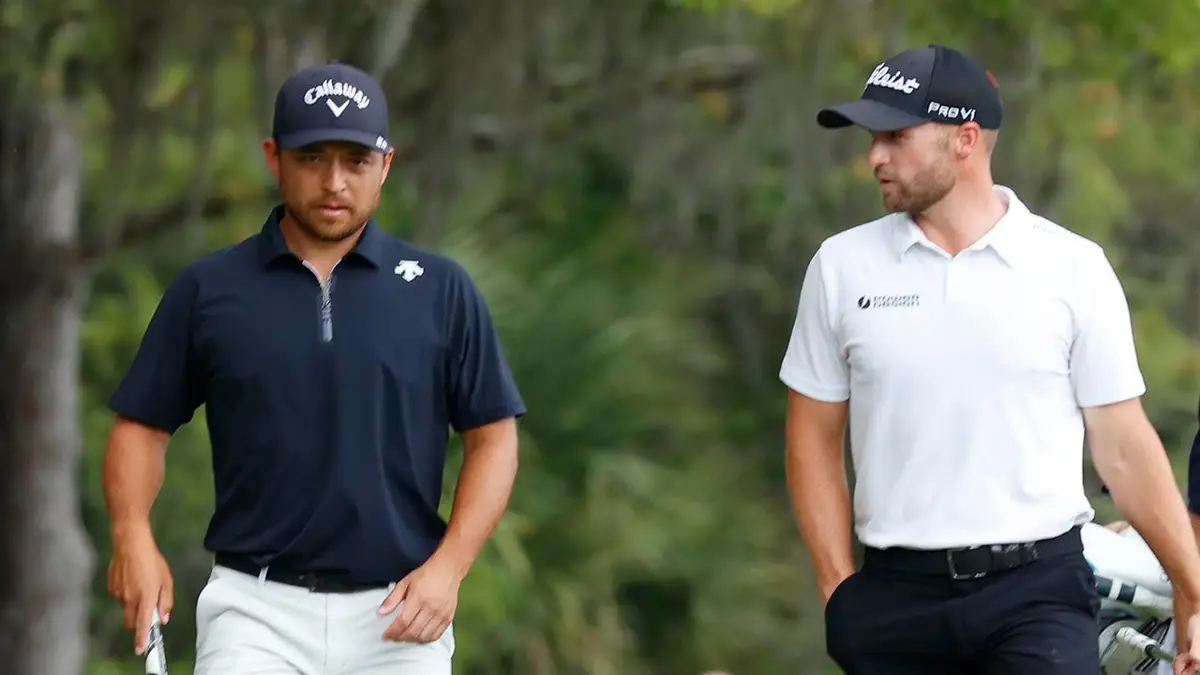
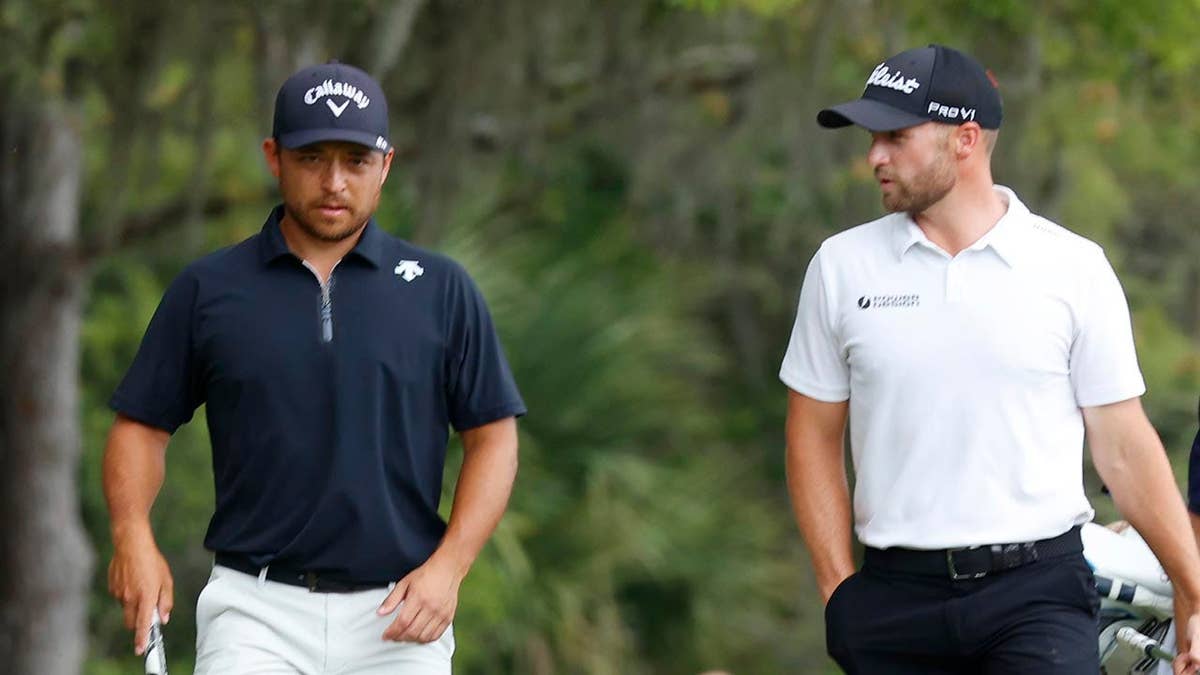
PGA golfers Xander Schauffele and Wyndham Clark walk the third hole during the third round of The Players Championship at TPC Sawgrass in Ponte Vedra Beach, Florida, on March 16, 2024.(Brian Spurlock/Icon Sportswire)
On the other hand, one could argue Clark has brought it upon himself — he was banned from Oakmont Country Club after destroying a locker and has had other on-course outbursts and cheating controversies.
“I sort of heard some things about, I try to turn some golf on. I saw I think I saw his 18th hole, I got back to the house and watched him play come up 18. But yeah, I did hear, you know, he’s getting some flack. It’s a tricky thing,” Xander Schauffele told Fox News Digital in a recent interview.
But Clark was all class after the victory in his post-round media availability and in a heartfelt social media post, and Schauffele took notice.
Advertisement
“I thought he handled it incredibly well and, like he even mentioned in his interview, he kind of used that as fuel to play even better and sort of prove it to himself more than anyone else,” Schauffele said.
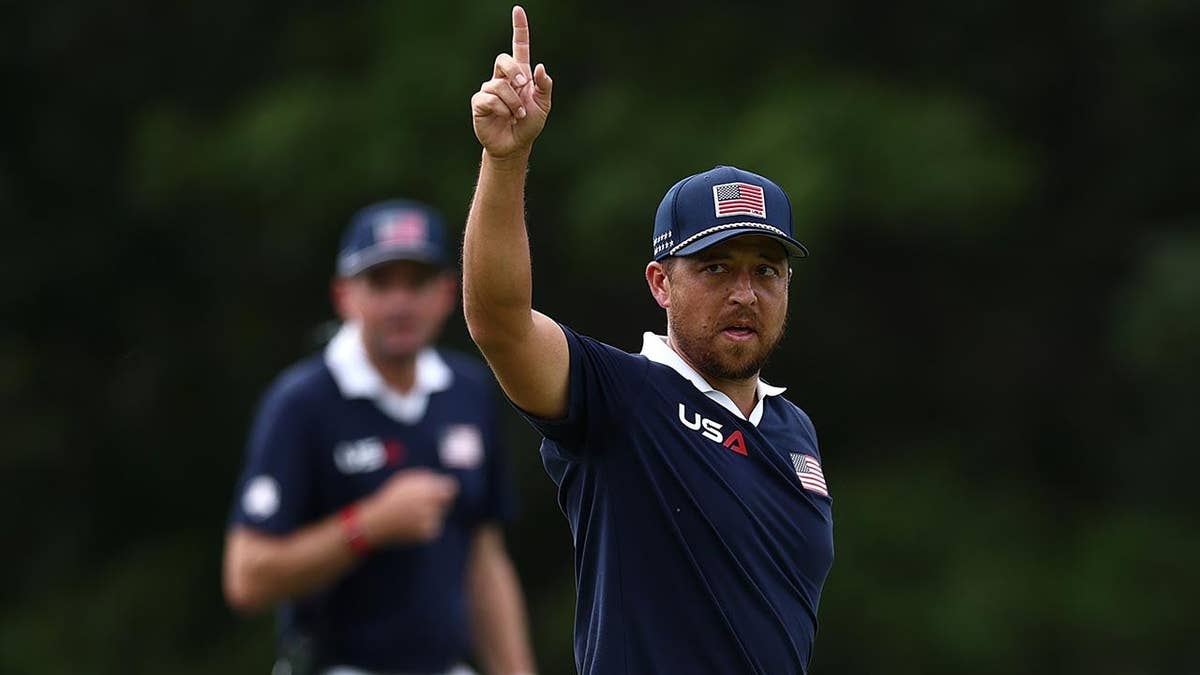
Xander Schauffele of Team United States reacts on the fourth green during the Saturday afternoon four-ball match of the 2025 Ryder Cup at Black Course at Bethpage State Park Golf Course in Farmingdale, New York, on Sept. 27, 2025.(Maddie Meyer/PGA of America)
Schauffele even mentioned that the boos Clark heard in Canada for wearing a Jack Hughes jersey were “more lighthearted than what was happening to him in New York,” which begs the question of whether players want to, and should, still go to the New York area.
The ruckus caused Golf Channel’s Eamon Lynch to call Long Island golf fans a “stain” on the game who “don’t deserve” to have major championships in the area. It doesn’t need repeating what Rory McIlroy and Team Europe went through last September at Bethpage Black.
“I’ve always enjoyed playing anywhere near New York or in the Northeast. My experiences have been good. I mean, I know the Ryder Cup got a little spicy and there’s obviously anticipation that, you know, fans are pretty, I like to call passionate. So, it is what it is.
“I’m sure if you ask 100 different people, you’re going to get different answers. But for the most part, you know, I try to get them on my side as soon as possible.”
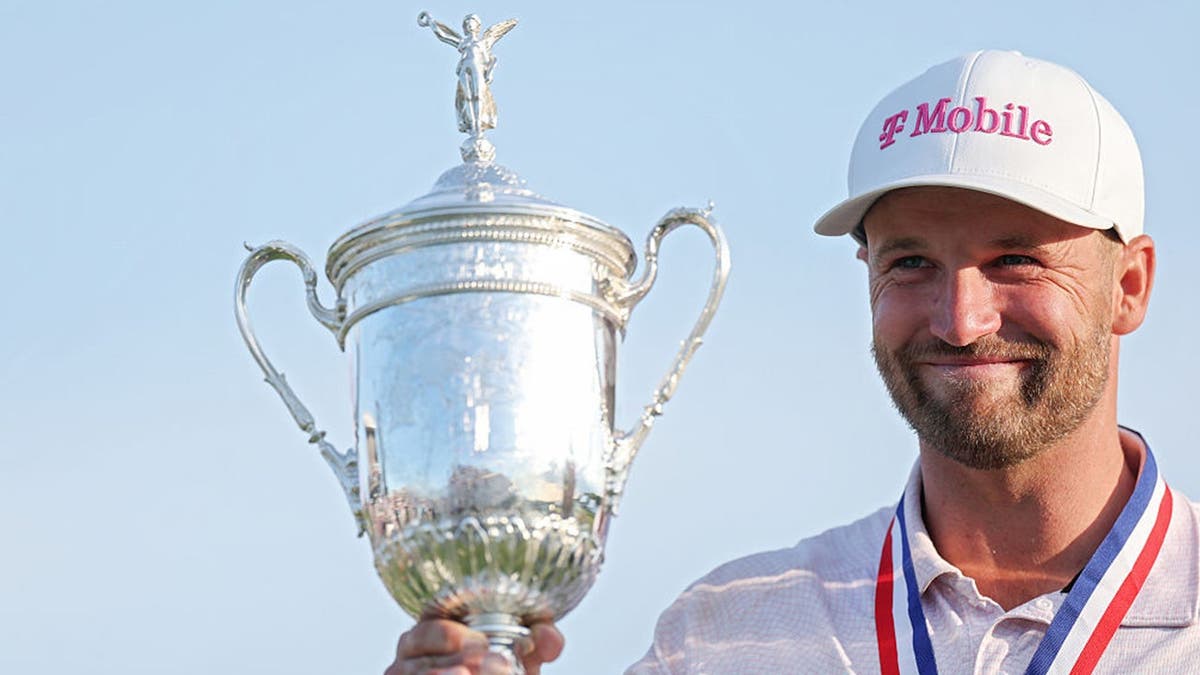
Wyndham Clark of the United States poses with the U.S. Open Championship Trophy after winning the 126th U.S. OPEN at Shinnecock Hills Golf Club on June 21, 2026, in Southampton, New York.(Kate McShane/Getty Images)
The PGA Championship will be at Bethpage Black in 2033, and Shinnecock Hills will again host the U.S. Open in 2036.
Other upcoming PGA events in the New York metro area include next year’s BMW Championship at Liberty National Golf Club in Jersey City, the 2028 U.S. Open at Winged Foot Golf Club in Mamaroneck, and the 2029 PGA Championship at Baltusrol Golf Club in Springfield, New Jersey.
Nigeria’s Super Falcons showed great resilience and defensive discipline to beat Zambia’s Copper Queens 1-0 in their WAFCON group-stage clash in Rabat on Saturday night.
Asisat Oshoala scored the only goal of the game in the eighth minute, calmly finishing inside the box after connecting with a fine pass to give the defending champions an early lead.
Nigeria were reduced to 10 players shortly before half-time when defender Tosin Demehin was sent off following a second challenge involving Zambia forward Barbra Banda.
Advertisement
Demehin had earlier received a yellow card for a challenge on Banda, but the decision was overturned after a VAR review found an offside in the build-up. However, another clash between the pair in the 40th minute saw the Nigerian defender shown a second yellow card and sent off.
Despite being a player down for more than half of the match, the Super Falcons defended resolutely and stayed organised.
Head coach Justin Madugu made a tactical change at the start of the second half, bringing on Shukurat Oladipo for debutant Rofiat Imuran.
Advertisement
Zambia pushed forward in search of an equaliser, but Nigeria’s defence stood firm. Goalkeeper Chiamaka Nnadozie also made important saves to keep the Copper Queens at bay, while Uchenna Kanu and substitute Esther Okoronkwo offered an attacking threat on the counter.
The victory gives the Super Falcons back-to-back wins over Zambia in the competition and keeps their hopes of reaching the knockout stages alive.
Nigeria will play Egypt in their final group match on Wednesday, August 5. Egypt are still searching for their first points after losing their opening two games.
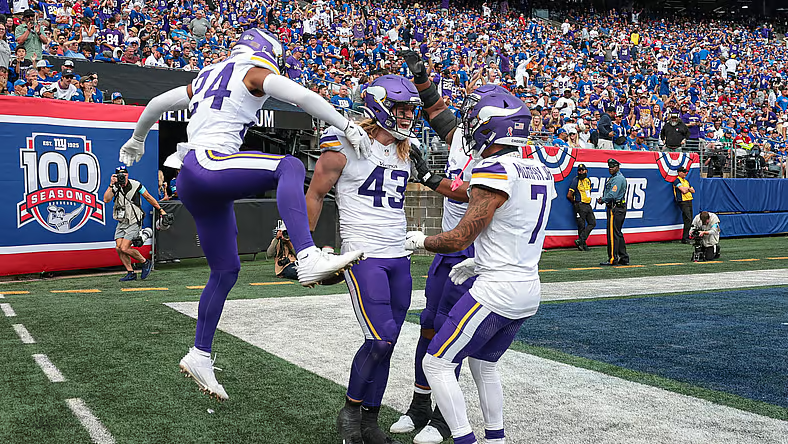
On Sep 8, 2024, at MetLife Stadium in East Rutherford, Minnesota Vikings linebacker Andrew Van Ginkel (43) celebrated after returning an interception for a touchdown against the New York Giants. The defensive score in the second half highlighted his instinctive playmaking and shifted momentum in Minnesota’s favor. Van Ginkel’s moment energized his teammates and underscored the impact of defensive contributions in a critical road contest. Mandatory Credit: Vincent Carchietta-Imagn Images.
Getting Brian O’Neill under contract was good work. The $96 million commitment is an eye-popping number. That being said, there’s an escape hatch beyond the opening pair of seasons, so the Vikings proceeded in a wise manner.
More fascinating, perhaps, is who is next up among the Vikings extension candidates.
GM Nolan Teasley is going to get the final call on contracts. After all, that’s his job. The promise, though, is that he’ll seek input from respected leaders in the Twin Cities, particularly Kevin O’Connell and Brian Flores. Presumably, none of these three would be upset about seeing Andrew Van Ginkel stick around. In fact, it would be surprising if the Vikings opt against extending the terrific pass rushing terror.
Advertisement
Andrew Van Ginkel as the Next Vikings Extension Candidate
The normal thing to do in Minnesota is to criticize Kwesi Adofo-Mensah. The former GM made a pile of mistakes, so he is sometimes a punching bag for online criticism. An important truth: he made a pile of good decisions.
Among the best moves he made was to sign Van Ginkel. The veteran defender was coming off strong football as a Dolphin but hadn’t yet gotten to a point where he was recognized as being elite. Flores is widely credited for Minnesota being able to land the edge rusher, a perspective that’s probably true. In that assumption, don’t lose sight of the contract.
Dec 25, 2025; Minneapolis, Minnesota, USA; Detroit Lions quarterback Jared Goff (16) fumbles the ball defended by Minnesota Vikings linebacker Andrew van Ginkel (43) and linebacker Dallas Turner (15) in the fourth quarter at U.S. Bank Stadium. Mandatory Credit: Jeffrey Becker-Imagn Images
Prying Andrew Van Ginkel away from the Dolphins for a two-year deal sitting at $20 million is an instance of highway robbery. Even the extension that got added on — another year at $23 million — is an instance of the Vikings doing remarkably well.
Tip of the cap to Mr. Adofo-Mensah. Insane value for somebody who would become a second-team All Pro.
Advertisement
At present, the issue is that the leader of the pass rushing department is moving into the final year of his contract. He feels like he just arrived but he’s already going into his third season in Minnesota. He’ll do so with a cap charge sitting at $19,250,000.
If an extension gets sorted out, the Vikings can see $11,352,000 put back into the mix (OTC). Not too bad, right?
Pushing the savings to the max would further free the Vikings to attract new talent. Veteran edge rusher Jadeveon Clowney has stood out for a long time as an attractive name but he’s not alone. So, too, could the Vikings opt to dabble in the trade market if a promising player becomes available.
Minnesota Vikings linebacker Andrew Van Ginkel (43) surveyed the Tennessee backfield Nov 17, 2024, in Nashville, Tennessee, during second-half action against the Titans at Nissan Stadium. Van Ginkel tracked the play from his position as Minnesota’s defense adjusted to Tennessee’s offensive looks in the AFC–NFC matchup, highlighting his awareness and role within the Vikings’ defensive rotation. Mandatory Credit: Steve Roberts-Imagn Images.
And then the other benefit: keeping Andrew Van Ginkel employed. Sounds pretty obvious, but it’s a detail to highlight nevertheless. The Vikings would be wise to work toward Van Ginkel finishing his career in the Twin Cities.
In 2025, Van Ginkel missed some time due to injury. Flores asked him to drop back into coverage a lot, lessening his chances of making splash plays behind the line of scrimmage. He still found a way to pile up 7 sacks to stand alongside 13 quarterback hits and 11 tackles for loss.
Advertisement
Other Vikings extension candidates to watch are WR Jordan Addison, RB Jordan Mason, CB Isaiah Rodgers, LB Blake Cashman, and C Blake Brandel.
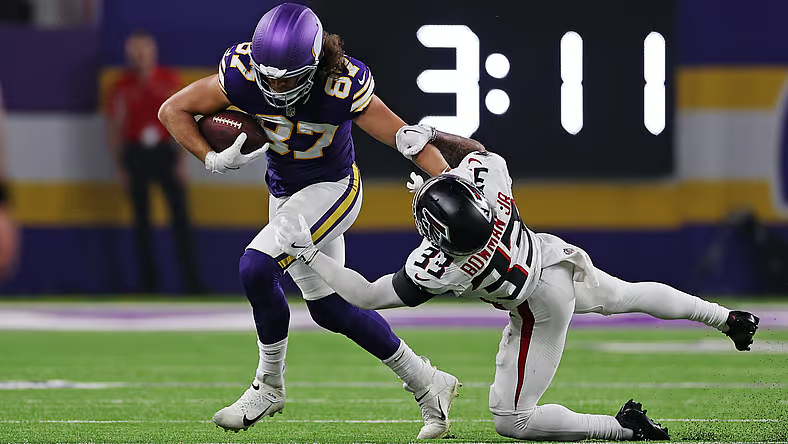
Minnesota Vikings tight end T.J. Hockenson (87) carries the ball after a reception while defended by Atlanta Falcons safety Billy Bowman Jr. (33) during second-half action on September 14, 2025, at U.S. Bank Stadium in Minneapolis. Hockenson’s ability to gain yards after the catch remained central to Minnesota’s passing attack as the Vikings worked to establish offensive rhythm. Mandatory Credit: Matt Krohn-Imagn Images.
Determining the Vikings’ trade candidates isn’t an exact science. Think poetry instead of math.
Still, some guesses can be made.
A trade is an instance of needing two to tango. The Vikings could seek to trade the worst player on the 90-man roster but wouldn’t find any takers. On the other end of things is an unwillingness to trade the team’s best player: Justin Jefferson. The NFL would feature 31 teams willing to make an offer; the Vikings would decline them all short of something absurd.
Advertisement
Check out some options that appear more realistic. They’re listed in no particular order.
The Vikings’ Trade Candidates — A Top 5
1 — Ivan Pace Jr., Linebacler
Minnesota Vikings linebacker Ivan Pace Jr. (0) celebrates after returning a fumble for a touchdown against the Detroit Lions during the fourth quarter at U.S. Bank Stadium in Minneapolis, Minnesota on Oct 20, 2024. Pace raises his arms in celebration following the defensive score during the NFC North matchup late in the game. Mandatory Credit: Matt Krohn-Imagn Images.
Recent years have been disappointing for Mr. Pace. Still, he’s a 25-year-old linebacker who can make plays behind the line of scrimmage. Surely there’s a team out there that is fascinated by his potential.
Minnesota appears happy to roll into 2026 with a deep linebacker spot. Doing so frees Eric Wilson and possibly Jake Golday to help at edge rusher. Pace is part of the mix as an off-ball linebacker who could free those more versatile players.
Determining that a different player could be the LB4 could mean recouping north of $3.5 million, per OTC.
2 — Theo Jackson, Safety
Minnesota Vikings safety Theo Jackson (26) lines up defensively during NFC Wild Card action against the Los Angeles Rams at State Farm Stadium in Glendale, Arizona, on Jan. 13, 2025. Jackson contributed to Minnesota’s secondary rotation during the postseason matchup as the Vikings attempted to slow the Rams’ passing attack on the playoff stage in Arizona. Mandatory Credit: Mark J. Rebilas-Imagn Images.
What happens if Harrison Smith returns?
Josh Metellus is assured of a starting spot. Jay Ward boasts upside as a long, explosive fourth-year player. Rookie newcomer Jakobe Thomas boasts a nice build and some on-field snarl. Trading Jackson wouldn’t result in anything more than a late-round pick, possibly being as modest of swapping a 7th for a 6th.
Advertisement
Moving him out would free $1.67 million.
3 — Tai Felton, Wide Receiver
Minnesota Vikings wide receiver Tai Felton (13) fields the ball and turns upfield during first-quarter action against the Green Bay Packers, Jan. 4, 2026, at U.S. Bank Stadium in Minneapolis. Felton accelerates into space as Minnesota looks to generate early momentum in a key division matchup at home. Mandatory Credit: Jeffrey Becker-Imagn Images.
Tai Felton is a depth receiver who boasts elite wheels. He has proven to be feisty on specials as a fantastic option out at gunner.
His issue is that he got drafted by the past front office. Some struggles in training camp could create problems since gunners generally aren’t super tough to find. He’s a sophomore who got chosen in the 3rd in 2025. There’s a team out there willing to send a 5th or 6th for him.
4 — T.J. Hockenson, Tight End
Advertisement
Dec 7, 2025; Minneapolis, Minnesota, USA; Minnesota Vikings tight end T.J. Hockenson (87) reacts after scoring a touchdown against the Washington Commanders during the second half at U.S. Bank Stadium. Mandatory Credit: Brad Rempel-Imagn Images
Consider an overly negative assessment of Hockenson’s game:
He doesn’t score many touchdowns.
His yards-per-catch average has been modest lately.
He has never been known as a terrific blocker.
Already, Minnesota has lowered his compensation. Shrinking his cap charge came with the trade off of setting him free a year early so he can try to land another beefy deal next March. Does GM Teasley get ahead of the sticks by trading the TE? Minnesota would recoup $10.25 million.
5 — Walter Rouse, Offensive Tackle/Guard
Aug 24, 2024; Philadelphia, Pennsylvania, USA; Minnesota Vikings kicker Will Reichard celebrates with punter Ryan Wright (17) after a field goal against the Philadelphia Eagles during the fourth quarter at Lincoln Financial Field. Mandatory Credit: Caean Couto-USA TODAY Sports
Rouse is a hulking presence who looks large even when he stands beside other NFL linemen. Something to be said for that, folks. Better yet, he’s got some versatility; Minnesota has been experimenting with him inside.
The rationale here is that the Vikings could mirror that Vederian Lowe trade from a few years ago. Adofo-Mensah shipped out the Day 3 OT for a Day 3 pick since the team determined there wasn’t a future for Lowe in the Twin Cities. Something similar could occur, especially since there’s a logjam at OT.
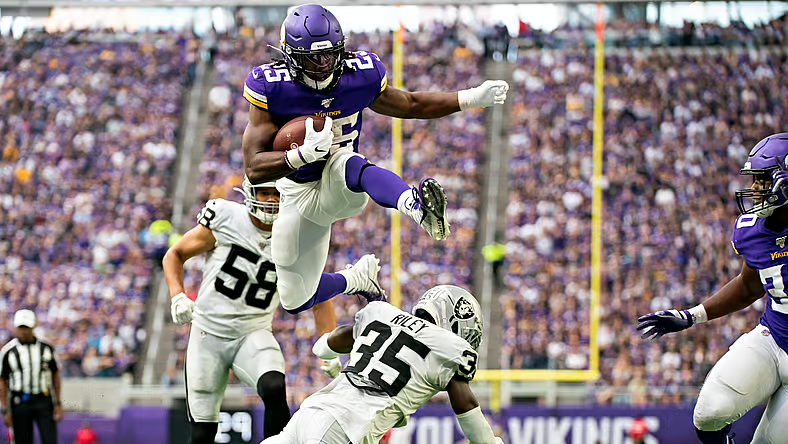
Sep 22, 2019; Minneapolis, MN, USA; Minnesota Vikings running back Alexander Mattison (25) leaps over Oakland Raiders defensive back Curtis Riley (35) for a touchdown in the third quarter at U.S. Bank Stadium. Mandatory Credit: Brad Rempel-USA TODAY Sports.
There was a time not too long ago, folks, when Alexander Mattison was being leaned on to become Minnesota’s next RB1. The plan didn’t work out particularly well.
Currently a free agent, Mr. Mattison is trying to find employment soon. The departed Vikings skill guy could still get a nice merge lane — training camp — to prepare for a bounce back in 2026 if he puts pen to paper soon. Check out the update courtesy of ESPN’s Adam Schefter: “Houston tried out veteran RBs Hassan Haskins and Alexander Mattison.”
Departed Vikings Runner Gets Chance in HOU
At minimum, DeMeco Ryans is a top-ten NFL coach. Quite possibly, Coach Ryans deserves to be included among the top five. Winning a Super Bowl would fully solidify his reputation as one of the foremost leaders in the NFL.
Advertisement
The skipper down in Houston has done terrific work. Most notably, there’s the gruesome twosome coming off the edge in Will Anderson and Danielle Hunter. The NFL doesn’t offer a deadlier duo than those guys. Hunter has aged beautifully and Anderson is only surpassed by Myles Garrett and Micah Parsons in ability. Anderson could prove that he’s as good, or better, than any edge rusher in the upcoming season.
Coach Ryans, a defensive tactician, will be leaning on a ferocious defense to lead the Texans. His ambition can get complemented by a robust ground attack.
Jul 31, 2026; Houston, TX, USA; Houston Texans defensive end Danielle Hunter (55) during training camp at Houston Methodist Training Center. Mandatory Credit: Troy Taormina-Imagn Images – Credit: IMAGN IMAGES via Reuters Connect
Safe to say that Alexander Mattison has had a disappointing second half of his career.
Originally, Mattison arrived in the Twin Cities with some optimism as a 3rd-Round selection. He could function as a rock-solid RB2 behind the elegant, gliding Dalvin Cook. Mattison has never been a terrific athlete but he had good straight line speed and had better mitts than most realize.
Adding all of Mattison’s Vikings stats together involves seeing a runner who finished with 584 carries for 2,370 yards and 11 touchdowns. There were then 100 receptions for 718 yards and 6 scores. The 4.1 yards-per-carry average isn’t particularly inspiring. His normal season featured 132 carries going for 537 yards and 2 or 3 touchdowns. Essentially, a solid RB2, especially since his intangibles (compete, work ethic, etc.) were very high.
Recent seasons have seen him struggle with injury. Alexander Mattison played in fourteen games in Las Vegas in 2024. In 2025, Mattison worked as a Dolphin but didn’t play at all during the season. He’s very unlikely to get anything above the veteran minimum — think something a bit beyond $1 million — since he has produced modestly and is coming off injury.
Advertisement
Sep 10, 2023; Minneapolis, Minnesota, USA; Minnesota Vikings quarterback Kirk Cousins (8) hands the ball off to running back Alexander Mattison (2) against the Tampa Bay Buccaneers in the first quarter at U.S. Bank Stadium. Mandatory Credit: Brad Rempel-USA TODAY Sports
Meanwhile, the Vikings are desperate for improvement in the ground game.
Veterans Aaron Jones and Jordan Mason are competing to work as the RB1. Mr. Jones is a versatile, high-compete player who is respected for his leadership (he’s also just a charming, down-to-earth guy if you ever get the chance to chat, so it’s easy to see why he’s well-liked by essentially everyone). The former Packer has soft hands as a pass catcher and does well in pass pro. He has lost a step, though, as somebody who is on the wrong side of 30.
Mason is young (27) and a physical presence. While he doesn’t get the credit he deserves for his athleticism, Mason is mostly in town due to his hulking size. If you get to camp, take a moment to look at Mason and Jones side-by-side. There’s quite the difference. Plus, Mason is a hammer who treats defenders like nails. Minnesota needs more of that physicality.
Otherwise, the top names to know are Demond Claiborne and Max Bredeson. The rookies got chosen during the 2026 NFL Draft, meaning they’ll be employed by the Vikings for the upcoming season.
Alexander Mattison, 28, will look to secure work sooner rather than later as a strong RB3 who could be elevated to RB2 if health allows.
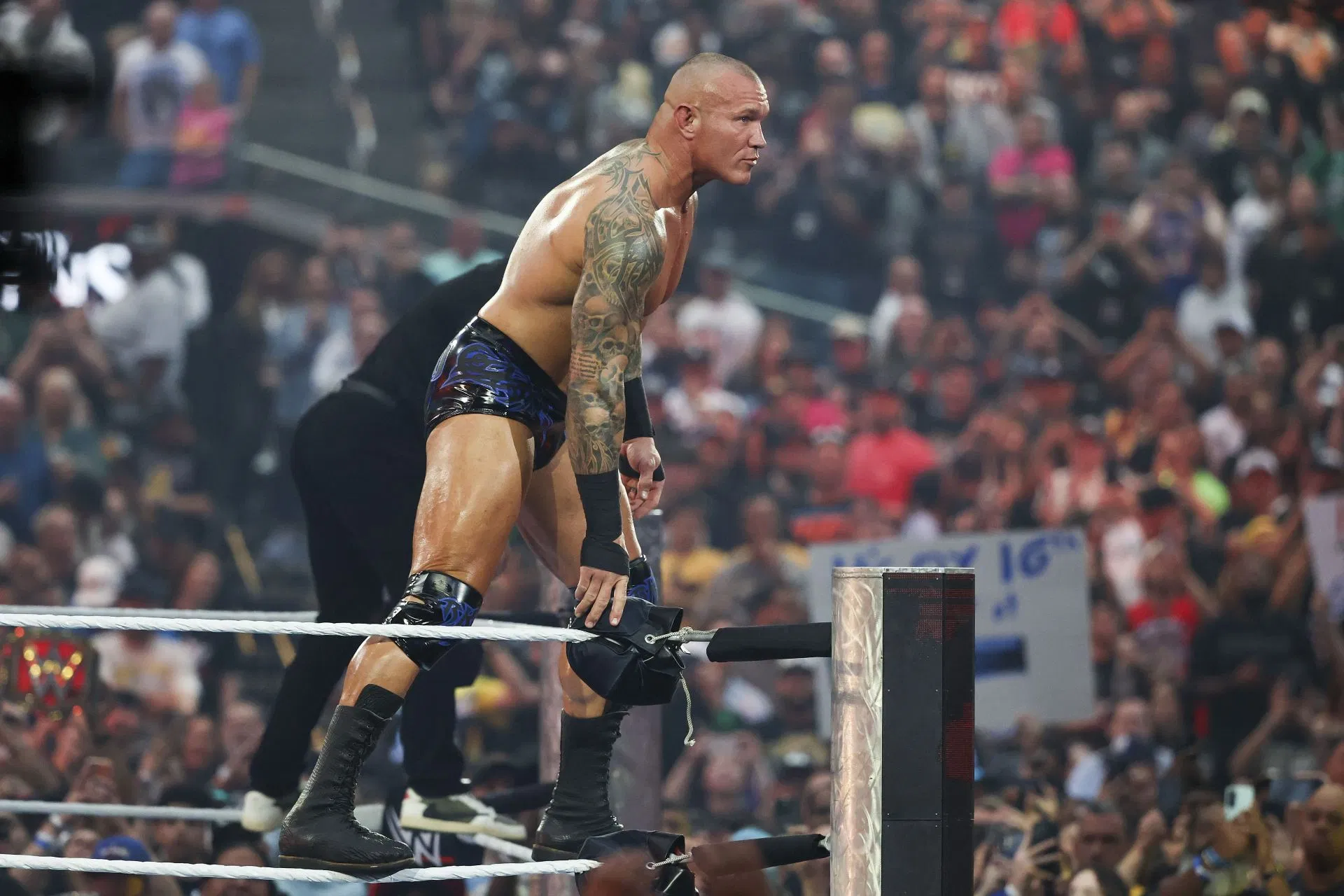
In a rather shocking twist at SummerSlam 2026, WWE legend Randy Orton made a massive return after months to cost his best friend in the co-main event of the night.
CM Punk is still the WWE Champion after the co-main event of SummerSlam. That’s right – Cody Rhodes vs CM Punk didn’t actually headline SummerSlam Night One. That honor went to Oba Femi vs Brock Lesnar and their Hell in a Cell match. Many fans felt that the build-up to Cody vs Punk was underwhelming considering how big they are as superstars. Cody, Punk, and Roman Reigns are the undisputed three top stars of modern WWE. That’s why many thought that the WWE Championship would logically headline SummerSlam Saturday. However, that wasn’t actually the case.
Advertisement
Thanks for the submission!
Either way, the war ended in a bizarre way at SummerSlam. The Viper, Randy Orton, made a shocking return for the first time since WrestleMania 42 in April – three-and-a-half months ago. He hit the RKO on Cody Rhodes while the referee wasn’t looking and CM Punk was outuside the ring. Punk swooped in and hit the GTS, getting a slow three-count from Charles Robinson, but enough to retain his WWE Championship.
Advertisement
Orton was last seen over three months ago, when he lost in the main event of WrestleMania 42 Night One, and turned on Pat McAfee. The Orton-McAfee alliance is something that fans like to actively forget, and from the look of things, McAfee wasn’t feeling the response either, which is why he reportedly pulled out voluntarily, as did Jelly Roll.
Randy Orton ended the night by hitting a punt on Cody Rhodes and lifting the WWE Championship up in the air to signal that he was still in the rivalry, but he had vanished right after that, leaving everyone utterly confused about the storyline.
Why did you not like this content?
Advertisement
Was this article helpful?
Thank You for feedback
Get all the hottest wrestling news FIRST by clicking here
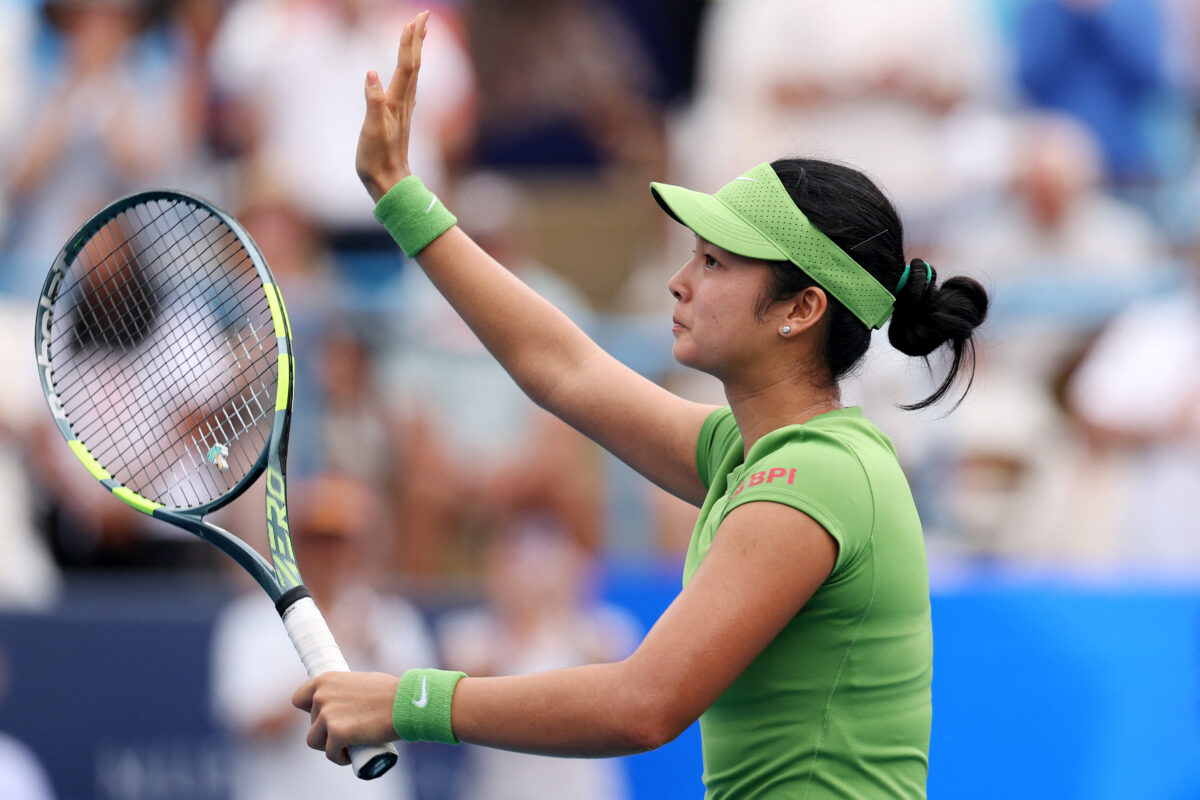
Alexandra Eala of the Philippines celebrates after winning a women’s singles match against Naomi Osaka of Japan on day six of the Mubadala DC Open 2026 at William H.G. FitzGerald Tennis Center on August 01, 2026 in Washington, DC. Emilee Chinn/Getty Images/AFP
MANILA, Philippines — Alex Eala got a first-round bye at the Canadian Open, which starts this week in Toronto.
The Filipino tennis ace, seeded 25th in the WTA 1000 event, will face either Alycia Parks or a qualifier in the second round.
Eala’s first meeting with Parks was in the first round of the Australian Open last January, succumbing to a 6-0, 3-6, 2-6 loss.
If Eala advances, she could face Wimbledon champion Linda Noskova, who has had the upper hand in their head-to-head. The Czech is 2-0 against Eala, whom she swept in the Berlin Open semifinals last June and Indian Wells round of 16 in March.
At the Canadian Open last year, Eala bowed out in the round of 128, losing to Marketa Vondrousova, 6-3, 1-6, 2-6.
The Rafa Nadal Academy graduate is currently competing in the Mubadala DC Open in Washington, where she just dispatched four-time Grand Slam winner Naomi Osaka, 6-4, 6-2 to reach her first career WTA 500 final.
Advertisement
Eala goes for the DC crown against world No. 3 and tournament top seed Jessica Pegula on Monday (Manila time) at 12 a.m.
Your subscription could not be saved. Please try again.
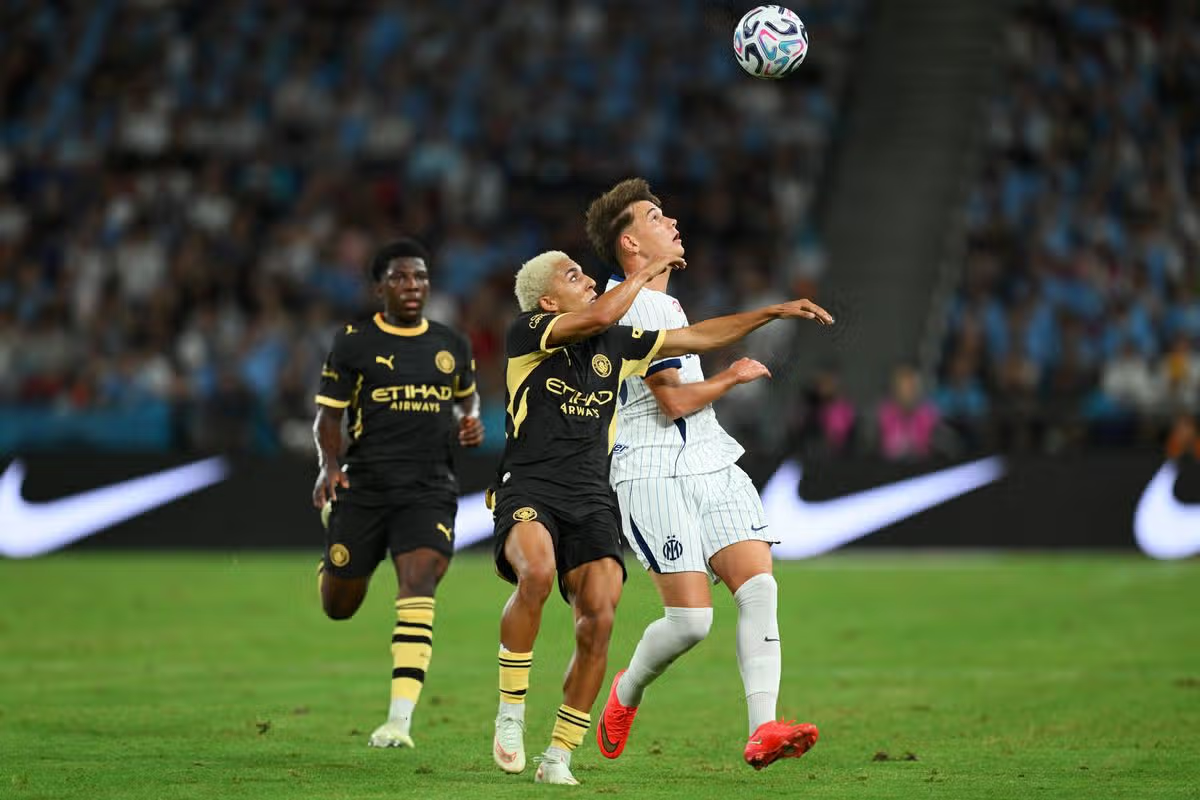
Manchester City manager Enzo Maresca spoke about promising young talent Ryan McAidoo after his performance against Inter
Enzo Maresca says that Ryan McAidoo needs the right path at Manchester City as the club assess whether he is best served stepping up to the first team this season. The 18-year-old winger came on in the second half of City’s first pre-season game against Inter and was one of the standout players, looking sharp and going close to either scoring or assisting a goal on a number of occasions.
City are looking at wide players in the transfer market and could see Savinho move to Spurs in the summer window, but McAidoo took his opportunity under Pep Guardiola last season by scoring on debut and has seriously impressed Maresca in the first few weeks of training. Having done enough to earn his spot on the right wing in the second half against Inter, he then took his opportunity in style.
Advertisement
Maresca said that no decisions have been made on the many youngsters out on tour as they are looked at over the course of the four weeks before pre-season, and the question is whether McAidoo can play his way into the City squad or if he leaves on loan. Several clubs have already expressed an interest in taking him and that list may grow on the back of this latest performance.
Whatever happens, Maresca pointed to his record of giving debuts at Leicester and Chelsea to indicate that the right decision can be made on McAidoo.
“Since day one to be honest with Ryan, we were speaking with the club and since day one he is the kind of winger I love,” he said. “Very aggressive one v one, he always tries, makes the right decisions. But he is very young and he needs the right path.
Advertisement
“At the moment, with most of the young players, the idea was to see them during pre-season and then decide. We started ten days ago and Ryan is working well. We are going to take the right decision. I am always very open with young players. At Leicester, it was a record number of debuts from the academy. And at Chelsea it was also a record number of debuts from the academy.”
India produced its biggest medal haul of the Commonwealth Games 2026 on Saturday, collecting 15 medals across boxing, athletics, para athletics and judo to continue its outstanding campaign in Glasgow.
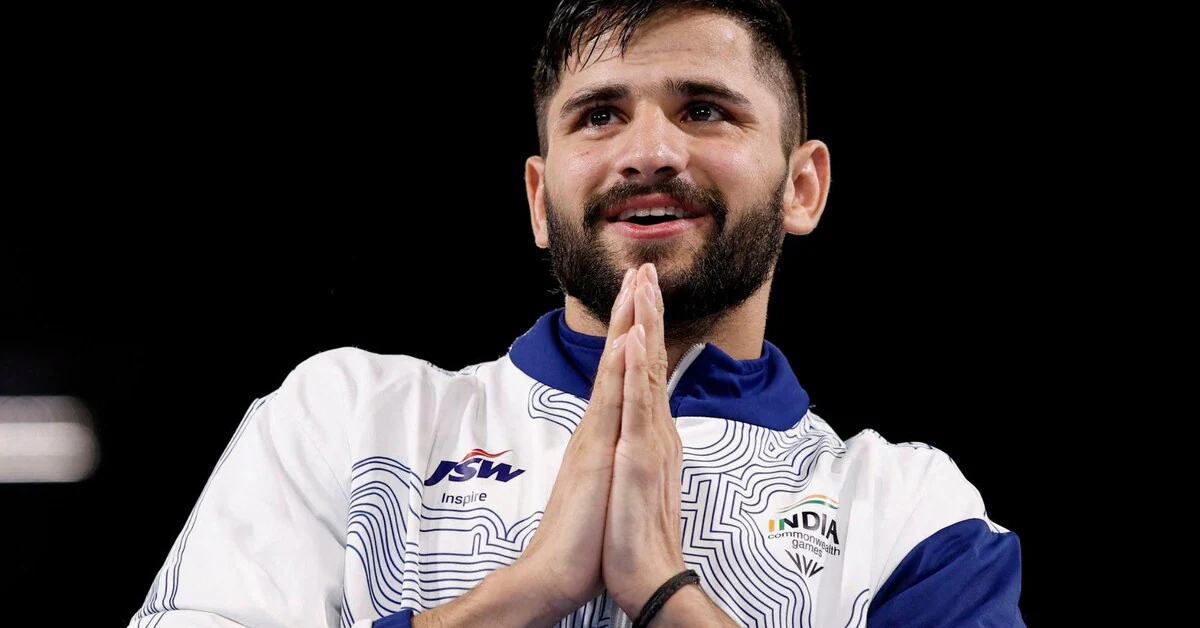
The day belonged to India’s boxers, who delivered a historic performance by winning seven gold medals and three silvers from 10 finals, while the athletics team added three more medals and para athletics contributed a memorable one-two finish in the men’s F57 shot put. Judoka Unnati Sharma also added a bronze to cap another productive day for the Indian contingent.
Advertisement
Indian boxing scripts history with seven gold medals
Indian boxing enjoyed arguably its greatest-ever day at the Commonwealth Games.
Advertisement
The country dominated the finals, winning seven of the 10 gold-medal bouts, an unprecedented achievement in Commonwealth Games history.
Gold medals came through:
Advertisement
Sakshi Chaudhary (Women’s 51kg)
Preeti Pawar (Women’s 54kg)
Jaismine Lamboria (Women’s 57kg)
Priya Ghanghas (Women’s 60kg)
Arundhati Choudhary (Women’s 70kg)
Sachin Siwach (Men’s 60kg)
Ankush Panghal (Men’s 80kg)
India also claimed three silver medals through Lovlina Borgohain (Women’s 75kg), Jadumani Singh (Men’s 55kg) and Narender Berwal (Men’s 90+kg) after all three narrowly missed out in their respective finals.
The remarkable campaign underlined India’s growing status as one of the strongest boxing nations in the Commonwealth.
Advertisement
Para athletics delivers golden one-two
India celebrated a memorable result in the Men’s F57 Shot Put, where Soman Rana produced a gold medal-winning performance.
Advertisement
Adding to the celebrations, Shubham Juyal claimed silver to complete an Indian one-two on the podium.
The result highlighted India’s increasing strength in para athletics, with both athletes delivering under pressure on the biggest stage.
India’s medal winners – August 1
Sport
Athlete(s)
Event
Medal
Boxing
Sakshi Chaudhary
Women’s 51kg
Gold
Boxing
Preeti Pawar
Women’s 54kg
Gold
Boxing
Jaismine Lamboria
Women’s 57kg
Gold
Boxing
Priya Ghanghas
Women’s 60kg
Gold
Boxing
Arundhati Choudhary
Women’s 70kg
Gold
Boxing
Sachin Siwach
Men’s 60kg
Gold
Boxing
Ankush Panghal
Men’s 80kg
Gold
Para Athletics
Soman Rana
Men’s F57 Shot Put
Gold
Boxing
Lovlina Borgohain
Women’s 75kg
Silver
Boxing
Jadumani Singh
Men’s 55kg
Silver
Boxing
Narender Berwal
Men’s 90+kg
Silver
Para Athletics
Shubham Juyal
Men’s F57 Shot Put
Silver
Athletics
Praveen Chithravel
Men’s Triple Jump
Silver
Athletics
Selva Prabhu Thirumaran
Men’s Triple Jump
Bronze
Athletics
Gulveer Singh
Men’s 5000m
Bronze
Judo
Unnati Sharma
Women’s -63kg
Bronze
Advertisement
Athletics continues medal surge
Indian athletics once again featured prominently on the podium.
Advertisement
In the men’s triple jump, Praveen Chithravel secured silver while Selva Prabhu Thirumaran claimed bronze, recreating India’s double podium from Birmingham.
Distance runner Gulveer Singh added another historic chapter to his remarkable campaign by winning bronze in the men’s 5000m.
Advertisement
The medal made him the first Indian to win two track medals at a single Commonwealth Games, having earlier claimed silver in the 10,000m.
Unnati Sharma adds judo bronze
Advertisement
India’s medal tally in judo also received another boost.
Unnati Sharma defeated South Africa’s Skye Knoester with a superb ippon in the women’s -63kg bronze-medal contest, ensuring India continued its best-ever Commonwealth Games campaign in the sport.
Advertisement
Mixed fortunes elsewhere
Not every event brought success for India.
Advertisement
Harsh Tokas narrowly missed out on a medal after losing the men’s -81kg bronze-medal bout, while Karanjit Singh Maan and Inunganbi Takhellambam exited through the repechage rounds.
In athletics, Priyanka Goswami finished fourth in the women’s 10,000m race walk, while Ravina Gayakwad was disqualified.
Advertisement
The cycling team endured a disappointing day as the sprint riders failed to progress and Dinesh Kumar and Harshveer Singh Sekhon did not finish the men’s 10km scratch race qualification.
India’s men’s pairs team in bowls also bowed out after losing to England, while Nayanmoni Saikia ended her singles campaign with a defeat to South Africa’s Bridget Herselman.



















































You must be logged in to post a comment Login