

This story appeared in Today, Explained, a daily newsletter that helps you understand the most compelling news and stories of the day. Subscribe here.
Tech & AI
blink-182’s Enema of the State Vinyl Review: The $100 One-Step Reissue Packs a Punch

Reviewers sometimes have to step outside their comfort zone, listening to artists they’ve either overlooked (for better or for worse) or outright steered clear of for one reason or another. Amidst the onslaught of grunge bands like Nirvana and Pearl Jam, the rich power pop-rock of Weezer, and the emergence of Northern California’s pop-punk heroes Green Day, I admittedly didn’t pay much attention to blink-182. No one I knew was into them, but that doesn’t really matter, as it was clearly music for another generation to enjoy. The band’s 1999 megahit Enema of the State (EOTS) went on to sell 15 million copies globally.
Listening to the new Definitive Sound Series One-Step audiophile edition of EOTS, I hear a well-produced slab of hyperspeed, punk-ish power-pop rock. While it feels familiar, often relying on the same four chords so many bands fall back on, I can’t deny this album’s underlying likability. These guys had something going on, reminding me at times of what a Weezer 33 1/3 RPM LP might sound like played at 45 RPM (sans Chipmunk vocals).
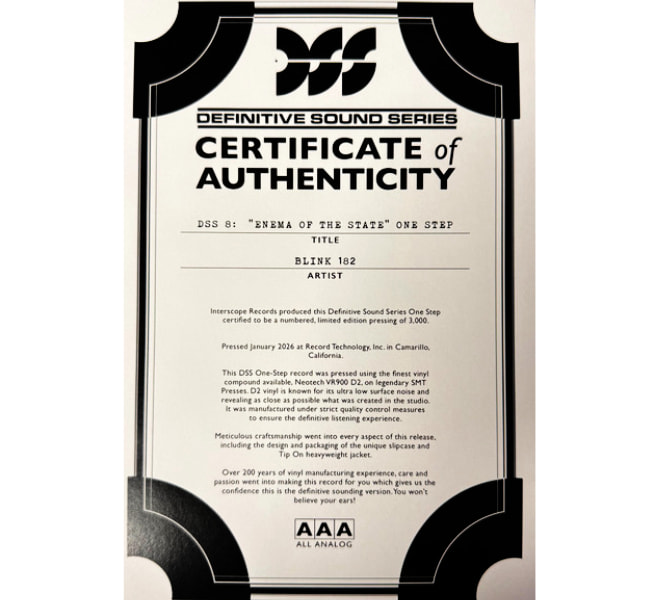
Sonically, EOTS is a surprisingly enjoyable, round-sounding rock record, having been mastered by Chris Bellman at Bernie Grundman Mastering from the original analog tapes. This reissue was pressed on Neotech VR900-D2 180-gram high-definition vinyl using a “one-step” process at one of the best vinyl manufacturing facilities, RTI (Recording Technology, Inc.).
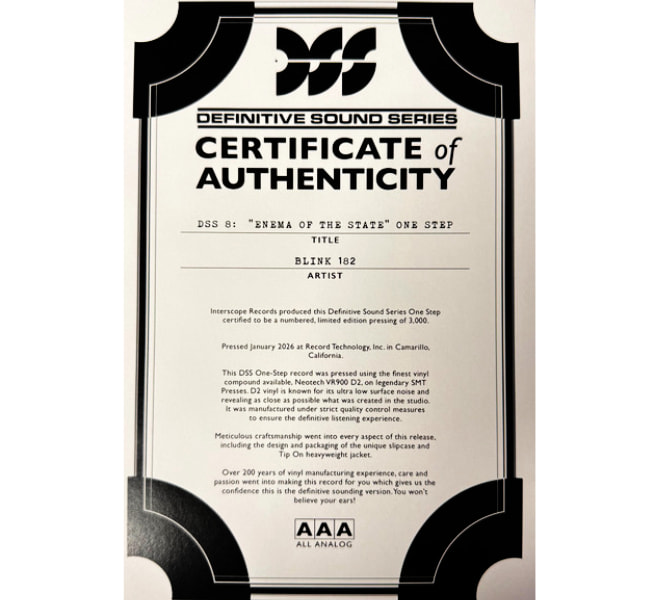
Interscope’s website offers more insights:
“… a specialized manufacturing technique renowned for its superior sound quality. Traditional vinyl pressing involves multiple steps with the potential for quality loss at each stage. The “One Step” process eliminates these steps with the lacquer master being used to create a stamper which is then used to press the records.”
So, you may wonder are there really that many audiophile Blink 182 fans out there to warrant this edition? Clearly there are as this DSS edition is “almost sold out” according to Interscope’s website, which is where you can snag one of these numbered limited edition (of 3,000) copies for $100 (click here). As of this writing, there also seem to be two over at Amazon selling for $129.99.

A very deluxe package inside and out, each Definitive Sound Series (DSS) “One-Step” album is housed in a heavyweight, old-school gatefold “tip-on” style jacket featuring original artwork, which fits into a specially designed hard-shell slipcase. Complete production details are included on the back cover (a transparency I greatly appreciate across the entire DSS series).
If you like blink-182, you should grab one of these before they’re gone. EOTS is a surprisingly strong listen, with great-sounding drums hammering against relentless, overdriven but remarkably warm, densely layered, wall-of-sound electric guitars. Good fun!
Our Ratings
★★★★★★★★★★ Music
★★★★★★★★★★ Sound
★★★★★★★★★★ Packaging
Where to Buy:
Mark Smotroff is a deep music enthusiast / collector who has also worked in entertainment oriented marketing communications for decades supporting the likes of DTS, Sega and many others. He reviews vinyl for Analog Planet and has written for Audiophile Review, Sound+Vision, Mix, EQ, etc. You can learn more about him at LinkedIn.
Related Reading:
Continue Reading
One of America’s foremost thinkers hasn’t done enough thinking. Instead, he’s delivered a handful of thoughtful-sounding stuff that simply doesn’t hold up the minute readers start actually thinking about what he’s saying.
Malcolm Gladwell has a new book about gun violence in the United States. I haven’t read it, so I can’t comment on the entirety of his latest work. I have, however, read a particularly atrocious excerpt — one that was published by The Atlantic because even Slate has moved on from Slatepitches.
In this excerpt, Gladwell argues that the reason US law enforcement officers are so violent is because there just aren’t enough of them. You may think I’m paraphrasing. I assure you: I am not. Here’s the headline and subhead from his Atlantic piece:
America Has a Police Shortage
Many Americans have decided that their country’s problem is that it has too many police officers. In fact, it has too few.
That’s a wild conclusion to reach. It’s especially wild when the only outside support you have to offer for your theory are: one (1) study that agrees with your foregone conclusion, and one (1) police official who agrees with your foregone conclusion.
He starts by comparing US cops per capita with European cops per capita. Most people would think the Los Angeles PD is larger than the Berlin (Germany) police force. They’d be wrong.
Berlin has about 18,000 police officers, making its police department twice the size of Los Angeles’s.
American police departments, compared with their counterparts around the developed world, are tiny. Phoenix has 2,500 police officers. Munich—which has a population of roughly the same size—has nearly two and a half times as many. Dallas has 3,100 officers. The Brussels metro area, comparable to Dallas in population, has 6,700.
But would they actually be wrong? Maybe, but not by much. These comparisons only mean as much as Gladwell is willing to share. He doesn’t look at everything else that factors into this, including police spending as a percentage of national/local budgets.
Despite this objective lack of accountability for policing practice, public levels of trust in police remain among the highest in the EU only behind Scandinavian countries and Switzerland.[179] This allows Germany to maintain one of the lowest levels of public order and safety spending in the EU, at 1.5 percent of gross domestic profit, compared to the EU average of 1.8 percent.[180] As a result, Germany has a police force of only 300 officers per 100,000 of its population.
The US has about 243 officers per 100,000 people. That is a smaller number but it’s not so much smaller that it should immediately raise eyebrows, much less overwhelming support for Gladwell’s preferred narrative.
Here’s where Gladwell decides 2+2 equals whatever number he needs it to be.
In 2020, an African American man in Minneapolis named George Floyd was killed by a rogue police officer, setting off an extraordinary wave of protests around the country. The motto of many of the protesters was “Defund the police.”
If the police were badly behaved, the thinking went, it was because there were too many of them.
[…]
Following the [George Floyd] protests, city after city saw their police force shrink. Of the 15 largest police departments in the United States, 12 had a markedly smaller police force in 2025 than in 2019. Philadelphia lost 23.1 percent of its police force during that period; Washington, D.C., lost 21.4 percent; San Francisco, 17.5 percent; Phoenix, 15 percent; and on and on. The reformers won the day. But what they did not understand is that there is a trade-off between certainty and severity: When criminals think they can get away with crimes, policing and punishments need to be more severe to achieve the same deterrent effect. Severity is not something that comes from lots of police. It’s something that comes from having too few police.
First off, Gladwell refuses to call Floyd’s killing a murder, which is extremely fucking strange since the officer who murdered Floyd (Minneapolis police officer Derek Chauvin) was convicted of murder. Calling Chauvin “rogue” is just plain insulting to everyone’s intelligence, considering a handful of other officers were on the scene and not a single one did anything to stop Chauvin from murdering George Floyd.
Second, the sudden disappearance of cops had nothing to do with any “defunding” efforts. While lots of politicians made loud noises about defunding the police, very few of them actually did anything about it. No defunding of the police has taken place. In a few instances, some police funding has been rerouted to mental health professionals, allowing them to respond to incidents cops are poorly trained (if they’re trained at all) to handle.
The drop-off in police staffing is due to the cops themselves. Lots of cops who got into the business for its high octane blend of maximum power and minimum accountability decided they’d rather exit the force than improve or subject themselves to whatever bare minimum of accountability might be inflicted on them as a result of this widespread (but wholly ineffectual) “defund the police” movement. If cities were spending less on cops, it was due to attrition, rather than any funding restrictions enacted by local legislators.
But the most noxious conclusion Gladwell draws from these stats is that the George Floyd protests and the “defund the police” shouting that accompanied it generated police violence. That statement ignores that fact that decades of police violence (a lot of it racist) led to the nationwide protests that greeted George Floyd’s murder. And this was preceded by several other large protests against police violence that were far more severe and violent than those provoked by Officer Derek Chauvin’s actions.
Gladwell wants to connect the dots between calls for defunding police and the understaffing that now plagues many police departments — something that is wholly due to cops not wanting to be cops if it meant a modicum of accountability might be applied to their actions. But cops have been violent for years, and there’s nothing on the record that even slightly suggests having more cops and bigger budgets makes these officers better than those working for departments with less funding and staffing.
While we’re still on the subject of “more cops = better cops,” let’s go back to Gladwell’s quoting of German police staffing stats as evidence of his theory. I mean, I guess? He just dumps this comparison of Berlin to Los Angeles into the mix and then hustles past it to an interview with a Colorado law enforcement official who claims having more officers would somehow make all of these officers better.
But having more cops hasn’t exactly made German cops better.
As law enforcement is vested solely with the states of Germany, each state’s police force (or “Land” police) follows a different system of law. Accordingly, there is an absence of a federal comprehensive register, compiling and publishing regular, uniform, and comprehensive figures on complaints about police ill-treatment.[170] Even though Germany is bound to obligate its many international treaties and conventions, Amnesty International (2002) highlights the authorities failed to protect a range of human rights as guaranteed by international human rights law and standards.[170] A study conducted in 2019 on police brutality in Germany found that it led to complaints in only 9%, and trials in only 13% of the cases. The study was conducted by the Ruhr-University of Bochum and was the biggest study at the time to be conducted on police brutality in Germany. The study found that the low number of complaints was likely due to a low expectation of success.[174] Furthermore, most German states do not require their police force to carry identification, making it difficult for victims to lodge complaints against individuals.[175][176]
Having more officers doesn’t make policing in German better. In fact, the lack of accountability seems to be on par with the United States. The only reason we don’t hear more about this (and I’m speaking for Gladwell as well) is because we don’t live in Germany. What is different is how we train and arm our cops, which means US law enforcement will almost always kill more people than their counterparts in other parts of the Western world.
And, as if this butchering of logic weren’t damning enough, Gladwell is out there digging his own hole while promoting his book:
Evoking the parable of the blind men and the elephant he promises: “chapters on the trunk and the leg and the tusk, and at the end my hope is that by seeing all the parts in one place you will finally get a sense of the whole elephant – and understand that what seems from the outside like an intractable problem need not be intractable at all”.
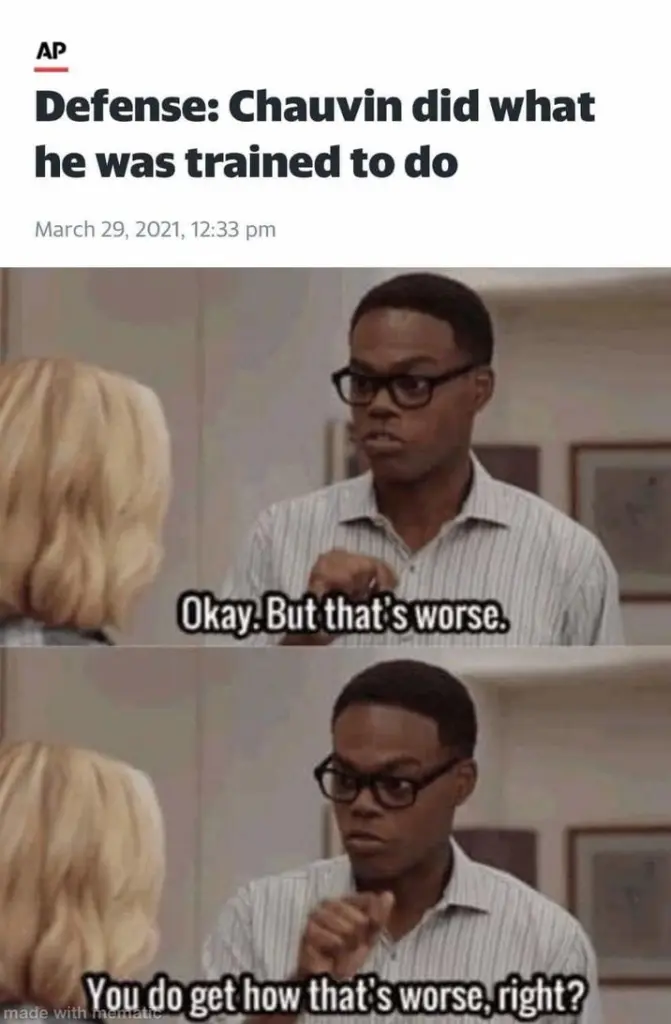
If that’s the defense for his cherry-picking and attempting (and failing) to work backwards from his preconceptions, it’s time for a meme. And not just any meme, but one that hits Gladwell right in his presumptions twice:

The headline — “Defense: Chauvin did what he was trained to do” — points to the origin of a lot of our police violence problems. Adding more cops just means adding more cops trained to treat violence as a first option, no matter how many of them are actually patrolling the streets.
The second part is for Gladwell: you do get how that’s worse, right? Using this parable as a selling point for your book is an incredible self-own. If your best hope is that people will convert your own writing into an Aesopian game of telephone and then still come to the conclusions you want them to draw from this, you’re no longer in the non-fiction game. You’re just telling people what you believe and expecting them to fall in line simply because they might have heard your name somewhere before.
Again, I have not read Gladwell’s book. But if this is the promotional vehicle he’s chosen to drive, I’d rather walk.

Researchers at the National University of Singapore have developed a machine-washable electronic fabric that can turn clothing into an interactive graphical user interface. The prototype reportedly survived 50 gentle machine washes and 1,000 bending cycles, though it still relies on external batteries and controllers. The Register reports: The development could lead – at some point – to a “future in which clothing functions as a pervasive, multimodal human-computer interface,” according to the study published in peer-reviewed science journal Nature this week. The paper shows someone interacting with computing devices using the sleeve of a wool sweater (no jokes about the Windows ugly sweater please, this is serious). The researchers, led by Singapore National University research engineer Fu Heng, claim this is a big leap forward.
“This fiber-centric approach shifts wearable electronics from flexible panels toward truly textile-native architectures, laying the groundwork for fabrics that visualize, sense, communicate and compute as naturally as the garments they inhabit,” the paper says. The researchers claim to have developed a scalable process to make millimeter-thick fibers. Using lasers to strip the insulation from specific spots on the thin copper wires, they attached light-emitting chips to the exposed sections, creating electrical connections to the chips. Thousands of chips were connected to the wires with extreme precision using this process.
The fibers were then fed into a transparent plastic tube, and made pressure-sensitive by adding two strips of a compressible, conductive polymer into a second longitudinal channel in the tube. The paper says they could make fibers 10 meters long using this method, and that they are thin and flexible enough to be woven into or attached to fabrics. The researchers were also able to add “peripherals” such as a microphone, a speaker, a temperature sensor and a light sensor.


Read more of this story at Slashdot.

Disclaimer: Unless otherwise stated, any opinions expressed below belong solely to the author.
Singapore’s economy continues to grow at a record pace, fuelled by the AI boom, which has driven enormous demand across the country’s manufacturing and trade sectors.
But besides making things that are important to AI, Singapore is also one of the best places in the world to study AI at one of the local universities.
According to the prestigious ShanghaiRanking, it is actually no. 1 globally.
In the ranking published last month, NTU has successfully defended the top spot it clinched last year, beating competitors from China and North America. It also climbed up by four positions from 6th to 2nd in the related field of Automation & Control.
At this point, you might be thinking that it’s just one ranking, that odd results do happen quite often and depend on invented methodology, but both Singapore universities are doing rather well in other rankings too.
In QS World University Rankings, NTU ranks 4th, and NUS actually jumped over it to take 3rd in Data Science & Artificial Intelligence, trailing only Stanford and MIT.
Over on the list of top AI universities released by US News, the positions are flipped around again, with NTU coming 2nd, while NUS is 5th.
NTU & NUS in Artificial Intelligence
| University Ranking | NUS | NTU |
|---|---|---|
| ShanghaiRanking | 19th | 1st |
| US News | 5th | 2nd |
| QS World University Rankings | 3rd | 4th |
Both schools are also among the world’s best in other subjects, particularly engineering, where NUS consistently ranks in the Top 3 across multiple fields of study—although NTU does win a few points back in the US News ranking.
NTU & NUS in Engineering subjects
QS World University Rankings
| Subject | NUS | NTU |
|---|---|---|
| Civil & Structural Engineering | 2nd | 6th |
| Materials Science | 2nd | 3rd |
| Chemical Engineering | 3rd | 6th |
| Electrical & Electronic Engineering | 3rd | 4th |
| Mechanical, Aeronautical & Manufacturing Engineering | 3rd | 5th |
U.S. News Best Global Universities 2026–2027
| Subject | NUS | NTU |
|---|---|---|
| Optics | 1st | — |
| Electrical & Electronic Engineering | 8th | 1st |
| Engineering | 8th | 2nd |
| Condensed Matter Physics | — | 3rd |
| Computer Science | 6th | 4th |
| Physical Chemistry | 10th | 4th |
| Materials Science | 5th | 7th |
| Nanoscience & Nanotechnology | — | 6th |
| Chemistry | 3rd | 7th |
| Energy & Fuels | — | 9th |
The importance of knowing how to make things
Artificial Intelligence is threatening jobs in many fields of human activity, outperforming us especially in areas involving mathematical calculations. Ultimately, however, we are the ones building and making things in real life, which we later trade with other countries.

AI is an extremely powerful tool, but it needs qualified people to put it to use.
You can’t blindly rely on everything an AI bot is going to tell you, especially when lives are at stake, as is the case when building anything, testing new materials or developing new medicines.
Neither can AI tell you what to make—future products have to be conceived by and designed with humans in mind. We are still going to need many, many engineers to make them.
This is why it’s very encouraging to see Singapore excelling not only at manufacturing and moving goods around the world, but also educating the future generations of people who are going to keep the economy going, thanks to its world-class universities.
- Read other articles we’ve written on Singapore’s current affairs here.
Featured Image Credit: NTU

Popular M5 MacBook Air deals are back at Amazon, with weekend price drops knocking upgraded 1TB models to as low as $1,399.

Save $200 on 1TB 13-inch MacBook Air models – Image credit: Apple
Amazon’s $200 discount applies to two popular 13-inch MacBook Air configurations with Apple’s 10-core M5 chip.
Buy M5/16GB/1TB for $1,399
Continue Reading on AppleInsider | Discuss on our Forums
In most places in the USA (looking at you, South), you really can’t survive the full year without some sort of air conditioning unit. Sure, it’s every homeowner’s dream to get a traditional HVAC, but not everyone has the budget or willpower to suffer through a full-on duct installation. In that case, a mini split is your best friend. It works similarly to a regular HVAC, where the compressor unit circulates the refrigerant via indoor air handlers through just one hole — no ducts required. It might not give you the capacity of a regular duct system, but the mini split is far superior to window units, which are cheap but can only effectively cool a small studio apartment. Since freon is involved, you may be concerned about how long the refrigerant in a mini split lasts.
Good news. A mini split is a closed-loop system (the refrigerant goes in and out of the compressor to the air handler through two lines), so you can expect the same refrigerant to last as long as your entire air conditioner if everything’s working well. That means you won’t have to worry about topping it off seasonally or stressing about its levels unless you develop a leak. What’s the lifespan of a mini split? Another piece of good news. An HVAC can, on average, last anywhere from 15 to 20 years. Since the design is so similar (sans the ducts, of course), with proper care, it will stay alive and happy for about the same amount of time.
What are the signs that my mini split is leaking refrigerant?
If there’s anything positive about refrigerant leaks, it’s that they fall into the category of issues you’re very likely to notice. Although it could theoretically be a sign of other, more benign ailments, if you find yourself reaching for the thermostat a lot more often as the cooling capacity has decreased, that’s your cue to investigate. The energy bills will also be a giveaway, as a potentially outrageous price tag will catch your attention.
Those two can technically result from a poorly maintained system, a dirty filter or evaporator coil, and so on. However, the moment you hear any new noises, especially whistling or gurgling near the outside unit, chances are that one of the lines has developed a pinhole leak and is actively losing refrigerant. It’s the same thing with frozen evaporator coils inside your air handlers – that should be enough evidence that something serious is going on, at which point you may need professional help. Unfortunately, even a skilled DIY-er can’t do this repair. For starters, you need a license to work with refrigerants, and it takes an expert to find the exact place where the fluid is leaking. Ultimately, it requires knowledge of the exact amount of refrigerant that the system needs – not for the faint of heart.
How often do mini splits need to be serviced?
A good AC can cost thousands of dollars, and if you really want to squeeze the most value out of each one, then it’s a no-brainer to hire a professional for regular maintenance. With mini split refrigerant leaks, the issue is generally preventable (apart from age, which you can’t do much about), as it’s caused by either improper installation, poor repairs, or a lack of maintenance. How often should an air conditioner be serviced? That will depend on how often you use it, but to be on the safe side, schedule an annual inspection where the pro will give your system a thorough scrub, tighten up some parts, and potentially catch any issues early.
Of course, hiring a pro doesn’t mean your job is done. Between these annual sessions, you should also do simple regular maintenance. Cleaning the filters, the outside unit, and replacing the batteries in the thermostat will go a long way to keep the AC working like a champ all year long. It’s just what comes with the territory of air conditioner ownership. Hopefully, yours will be a stint without any refrigerant leaks.
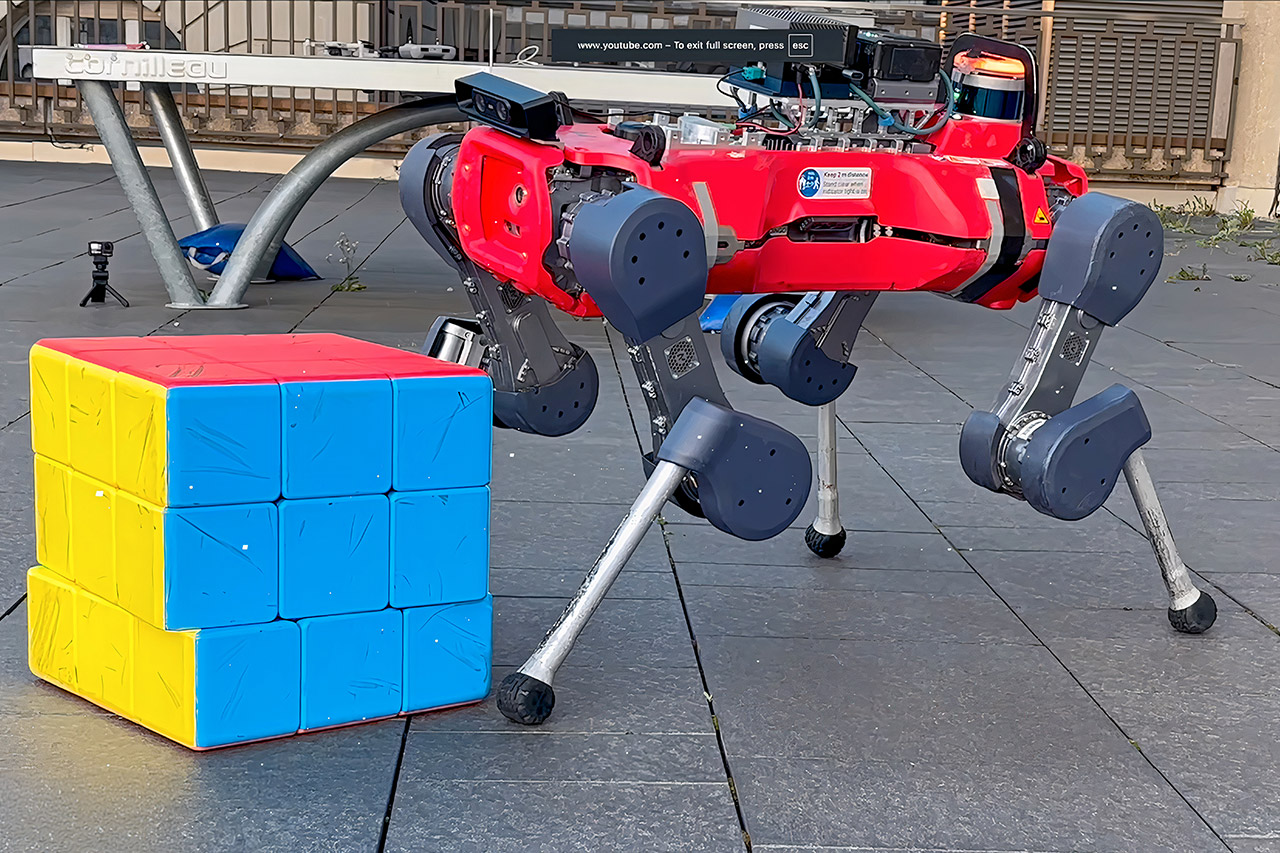
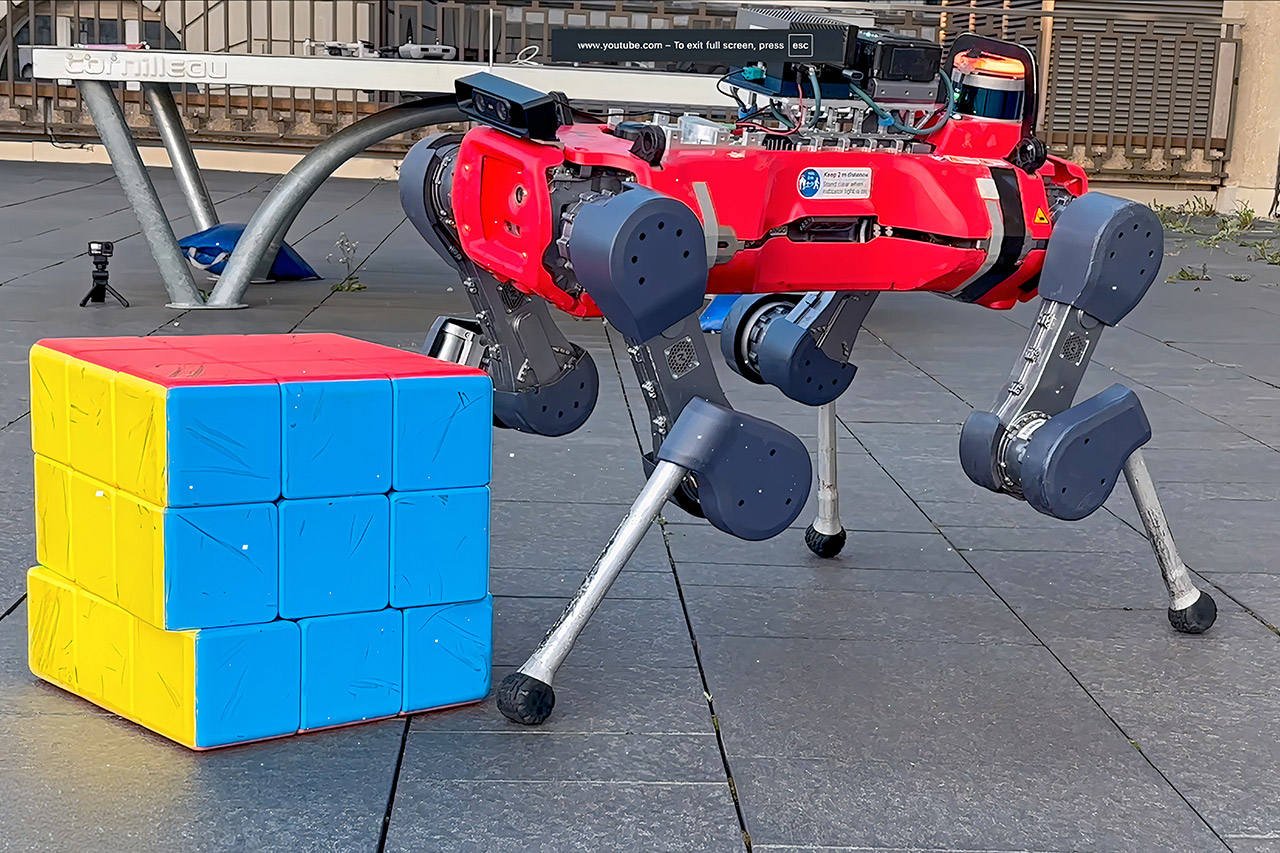
Researchers from ETH Zurich’s Robotic Systems Lab have shown that a standard four-legged inspection robot can fully solve a giant Rubik’s Cube on its own, relying entirely on its feet for every contact with the puzzle. The machine, an ANYmal-D, first walks around the freestanding cube and tips it onto different faces so its onboard depth camera can build a complete picture of the colors. Once it has that map, a planner turns a conventional cube solution into a short list of robot actions, and the machine carries them out without further help from people.
The cube is so heavy that flipping it over and rotating one layer is a completely different ballgame. A single slip-up, such as accidently twisting a layer while tipping, would entirely disrupt the sequence, thus the robot must maintain all of the layers locked in place while reorienting the cube, then consciously release them when it needs to turn a face. To tip the cube 90 degrees forward or backward, simply grasp an edge with one front foot and roll the entire thing onto a new face. To rotate a layer, the right foot firmly plants on the bottom half to keep the cube stable, while the left foot gently pulls the top half through a crisp quarter turn. To turn the layer the opposite direction, simply reverse the motion and repeat.

Unitree Go2 Robot Dog Quadruped Robotics for Adults Embodied AI (Go2 X) Built for Developers
- 【Next-Generation Robotic Companion: Meet the Unitree Go2 Robotic Dog】 The Unitree Go2 X is a powerful and intelligent quadruped robot designed for…
- 【Intelligent Navigation with 3D LiDAR & Obstacle Avoidance】 Featuring ultra-wide 3D LiDAR with 360°x96° perception, the Go2 X detects obstacles…
- 【High-Definition Vision & Seamless App Integration】 A front HD camera streams 1280×720 video to the app. Control the robot, view real-time data…
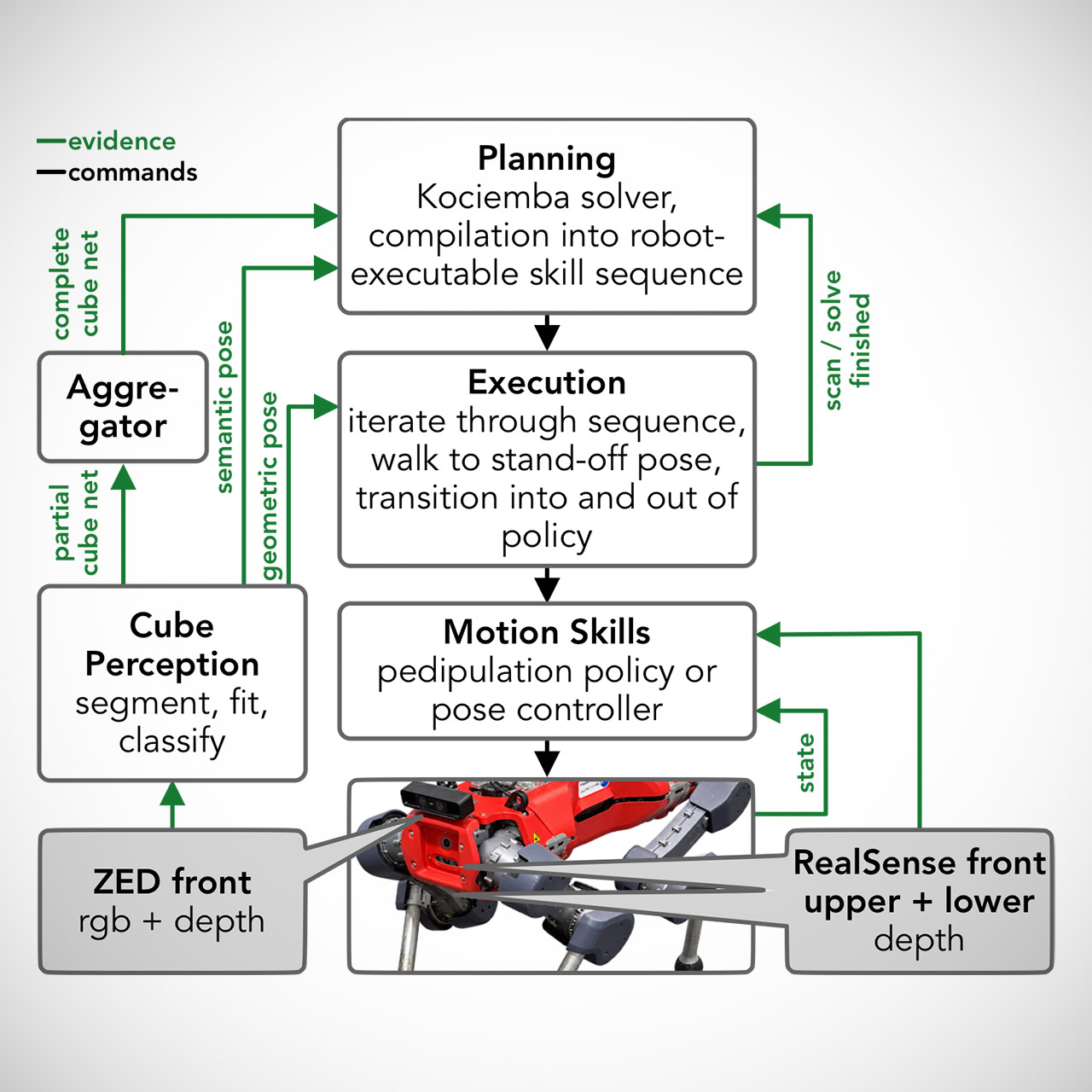
Initially, all of these motions were learned in a virtual setting. A teacher policy that could see every joint and contact point had to practice these abilities for several hours, earning prizes for landing its feet in exactly the right location, shifting the layers cleanly, and keeping its body straight.

The policies were then simplified and made into student controllers that run on the real robot, relying just on the depth images from the two front cameras and the robot’s joint readings. The resulting controls can tolerate minor differences in the cube’s position relative to the robot, recover if it slips or is bumped by an outside force, and continue working on low-friction surfaces, cobblestones, and even mossy surfaces.

On the hardware side, the entire procedure consists of about 30 separate actions and lasts approximately 8-9 minutes. The team tested the autonomous system three times, and the robot solved the cube each time. The perception system adjusts the cube’s pose between each part of the sequence, allowing the robot to step into the correct starting position.
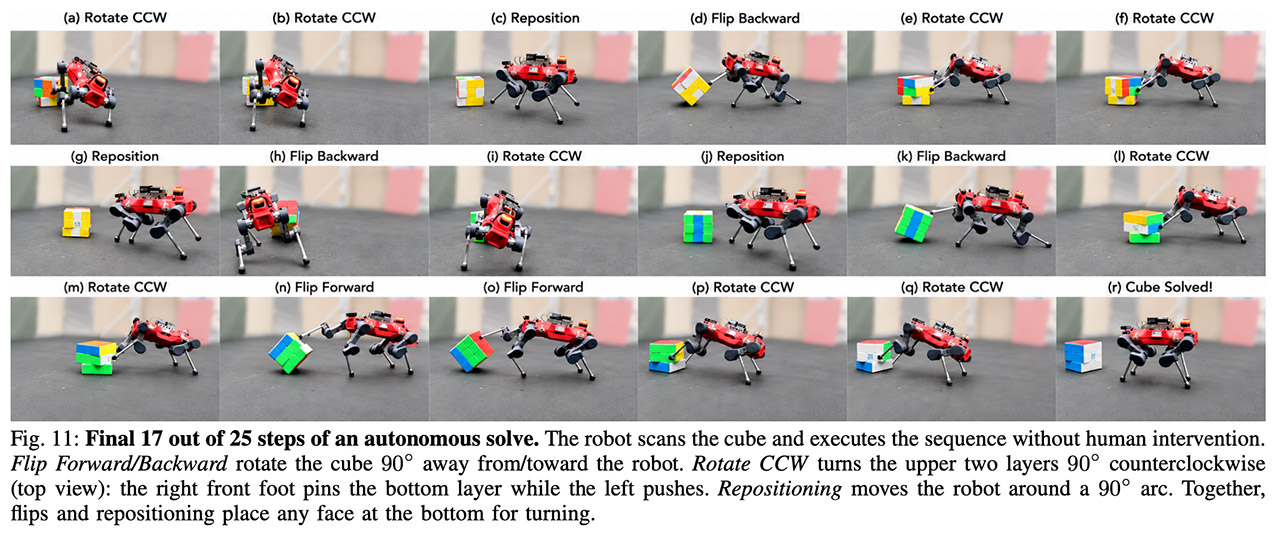
While the sequence is being executed, the learnt policy runs constantly and makes modest tweaks as it goes to rectify faults. The beauty of this is that the robot’s feet can also be the only tools that touch the cube, so this video shows how a machine designed for inspection can be taught to do a long chain of accurate, coordinated interactions without the need for any extra arms or grippers.

Instacart might sell itself to a larger competitor, according to multiple news reports
The Information reported Friday that the grocery delivery company has hired an investment bank to help it evaluate its options, and that it’s held acquisition talks with DoorDash. And Bloomberg reported that the company has also talked to Uber — although Uber reportedly walked away from those discussions.
Instacart currently has a market cap of more than $13 billion, and its stock price is up 25% for the year to date. The company could see this as a good time to sell at a desirable price, before the grocery delivery market gets more competitive — but Bloomberg noted that these are early discussions that might not result in a sale.
TechCrunch has reached out to Instacart for comment. The reports of a potential sale caused the company’s share price to spike more than 9.2% on Friday, while Uber and DoorDash stock declined.
You won’t need expensive equipment or invest much time.
Your car key fob suddenly needs several presses to unlock the door. Your AirTag stops responding when you try to locate it. Before blaming either gadget, it’s worth checking the battery inside. One common type is the CR2032, a 3V lithium coin cell also used in Samsung’s SmartTag2 and some smart home sensors. Depending on the device and how often it’s used, one can last way over a year.
A multimeter can help you check the battery’s voltage, and it’s a good addition to your toolbox if you don’t already own one. There are cheaper ways to check, too, but don’t mistake a voltage reading for a complete picture of battery health.
How to test a CR2032 battery with a multimeter
Begin by checking the battery itself. If you spot crusty residue, rust-colored patches, swelling or leakage, skip the test and replace it. Have a look at the device’s contacts too, since corrosion there can cause trouble even with a good battery.
Remove the CR2032 and set your digital multimeter to DC voltage (V with a solid line over a dashed line). Plug the black lead into COM and the red lead into the V or VΩ port. If your meter doesn’t automatically select a range, set it above 3V, typically 20V.
Hold the battery by its edges over a nonconductive surface. Touch the red probe to the broad face marked with a plus sign (+) and the black probe to the center of the smaller negative face underneath. Keep the probe tips from touching each other or bridging the battery’s terminals. A negative reading simply means you’ve reversed the probes.
A fresh CR2032 typically reads around 3V, while a reading closer to 2.5V is a good reason to bring in a replacement. But don’t give that 3V reading too much credit though. A multimeter draws almost no current, so a battery might look fine on the display but struggle when your key fob or tracker actually needs power. There’s no single pass-or-fail reading for every device. If it keeps acting up, try a fresh CR2032 unit before assuming the device is faulty.
No multimeter? Here’s how to check your AirTag or key fob battery
A dedicated coin-cell tester is another option. Some cost around $10, although certain models only measure voltage rather than how the battery performs under load. Basic multimeters can cost less than $20 and are good for checking other batteries or troubleshooting low-voltage electronics. Still, buying either just to diagnose one suspect $3 battery is a harder sell.
There’s also the LED trick, assuming you have one lying around. A small red or yellow LED is a better choice than a blue or white one because it generally needs less voltage to light up. Touch its longer leg to the CR2032’s positive side and the shorter leg to the negative side. If it lights up, the battery can supply some current. That’s about all it proves. The LED won’t tell you how much life is left, and one that stays dark doesn’t necessarily mean the battery is dead.
AirTag owners can check Find My before opening anything. Select Items inside the app and tap your AirTag. If it says “Low Battery,” or shows a depleted battery icon, skip the testing and replace the CR2032. Some CR2032 batteries have bitterant coatings that may prevent proper contact, even when they’re brand new. Apple recommends packaging marked “Compatible with Apple AirTag” when replacing an AirTag battery, and says an AirTag’s battery lasts more than a year, while Samsung rates the SmartTag2 for up to 500 days in normal mode.
After removing a CR2032, keep it out of children’s reach and tape its terminals before taking them to a battery collection facility. If one is swallowed, seek emergency medical care immediately, as serious internal injuries can occur in as little as two hours.

Are we living through “Black October”? Maybe, according to cybersecurity experts who are raising the alarm about AI’s increasingly sophisticated and far-reaching hacking abilities.
This week alone has seen a string of alarming incidents where AI uncovered previously unknown security flaws deep in the infrastructure of the internet. The most concerning involves something called PHP — a programming language that, according to The Atlantic, is used by “as much as 70 percent of websites.” Cybersecurity researchers used AI to locate a major security breach in the technology.
It’s the kind of thing that, when it’s working, is practically invisible. When it stops, though, you really notice it: Government websites in the UK and Europe briefly went down earlier this week after the PHP vulnerability was discovered, as did some sites in the Wikipedia family, the Internet Archive, and many others.
The outages weren’t actually the result of a hack, but rather preventative action as web engineers took sites down to fix the vulnerability before it was exploited. But not every PHP-like issue will necessarily be uncovered before it can be exploited by someone using AI tools less ethically, and older websites relying on PHP might go unpatched.
The problem doesn’t stop there, either: Concern is also rising around AI cybersecurity risks to ubiquitous conveniences like online banking. As Axios reported on Thursday, banks are detecting more and more “unauthorized third-party AI agents” operating inside of their systems.
Those agents are mostly unauthorized by the banks, Axios explains — the holders of the bank account might have given them permission — but it still creates a security risk that executives described as “horrifying,” in part because banks can’t necessarily tell if an agent doesn’t have permission.
It’s a lot to take in, all of it moving extremely quickly, and it’s hard to tell what any of us can do about it as AI labs continue to forge ahead with ever more competent AI models and agents. Luckily, my colleague Adam Clark Estes has some simple recommendations to shore up your own cybersecurity.
How do I respond right now?
One problem with hackers — even those that happen to be AI agents — is that they can be unpredictable. You won’t know to, say, lock down your Quest Diagnostics records before a breach happens. But whenever you find yourself wondering if your data is safe, that’s a good time to double check that you’ve at least covered your bases.
The National Cybersecurity Alliance, a nonprofit dedicated to the safe use of technology, maintains a list of basic online safety practices that everyone should follow. In no particular order, here’s what to pay attention to now:
- Keep your guard up. AI makes it difficult to know the difference between humans and robots. It’s a fact of life in the year 2026. So be extra careful to avoid engaging in potential phishing scams. Don’t reply to unknown texts, and do due diligence on texts or emails that look like they’re from people you know but just seem off. Don’t click weird links. Don’t give out personal info over the phone, even if it sounds like it’s someone you know. They might be scammers using AI to clone a loved one’s voice.
- Update your software. Yes, it’s annoying to pause your phone or computer use for a few minutes to update your software, but this is one of the best ways to get rid of vulnerabilities. Companies like Apple and Google employ huge teams of security experts to spot these in their software and fix them with software updates. Do the updates.
- Use a password manager or, even better, passkeys. Each of your online accounts should have a unique password that’s at least 16 characters. Yes, it’s impossible to remember that many passwords, so you should also use a password manager like 1Password or the app built into your iPhone or Android device.
- Turn on multifactor authentication. Just in case you don’t already do it, make sure you use multifactor or two-step authentication for all your accounts, including email and social media. It can be annoying to type in a code or check your email while logging in, but hackers, including AI agents, will have a much harder time getting into your accounts if you take this step.
Taking all these measures is not a one-time affair. You have to be vigilant in keeping yourself safe online. Security experts have a term for this that’s almost too specific: cyber hygiene. Like brushing your teeth or taking a shower, take good care of your online life, and do it often.
➨ Is it still possible to ban gerrymandering? The current US Supreme Court is very, very hostile to getting politics out of congressional map-making. But if Democrats win back power, that doesn’t mean they shouldn’t try. My colleague Ian Millhiser gamed out how they could do it in a way that survives the Court — as well as some approaches that almost certainly wouldn’t fly. But, he writes, the real trick will be finding a solution that functions the way Congress wants it to and can’t be exploited by mapmakers.
- Did you know…that the disease multiple sclerosis is misdiagnosed with surprising frequency? As many as 15 percent of diagnoses could be false positives — including that of Christina Applegate, who found out this week that she does not have MS despite a 2021 diagnosis.
- Today’s trivia: Which noble gas is radioactive and has the chemical symbol Rn? (You can find this and other brain puzzles in Vox’s daily crossword. Look for the answer in Monday’s edition.)
- Yesterday’s trivia: We asked what the plural was for multiple Toyota hybrids. That would be Prii, which Toyota officially confirmed in 2011 after holding a vote.
It’s true that money makes the world go around, but it’s oil that lubricates it. We use oil for just about every sort of industry today, from construction to pharmaceuticals, home appliances to travel, and everything in between. There simply is no one-size fits all oil type for all of this stuff despite it all coming from the same source, which is why you can’t use petroleum jelly in place of motor oil. That’d be like comparing a poodle to a grizzly bear because they’re both caniforms.
But that doesn’t apply to every type of oil. Sure, some of them are obviously extremely different, but then you have two with apparently similar functions on paper, like gear oil and hydraulic oil. They’re both lubricants and noncompressible fluids, so they’re interchangeable, right? Not at all, and the reason why is additives and chemical composition.
When you’re creating something for a specific purpose, you want to emphasize traits that are favorable for that purpose. If you know your oil needs to function in high-pressure environments, you use additives that work well for that. If you need to lubricate fast-moving gears, you want something different. The viscosities, protective qualities, tolerances, and operating temperatures of each fluid are vastly different from one another.
Think of it this way: No mechanic would ever recommend pouring brake fluid — no matter what type it is — into a manual transmission or gear oil into your brake system. But why, exactly? It’s because these fluids were designed to move and react to pressure in different ways. What are those ways though, and what’ll happen if you mess them up? Let’s discuss.
The function of gear oil
Gear oil goes by several different names depending on how it’s used, its viscosity, additives, and so on. You have manual transmission fluid (MTF), differential oil (simply diff oil), hypoid gear oil, synchromesh oil, helical, worm, bevel — all common names for specific types of gears or gearboxes. Put simply, different gears have different needs. Some of them build up a lot of friction and heat like hypoid gears, which is why it has its own unique hypoid gear oil typically used in differentials. Others spin really quickly, like those found in manual transmissions.
In general, gear oil is designed to act as a barrier between each set of teeth so that the metal itself isn’t in contact. Metal-on-metal friction creates wear and heat. Moreover, the fluid pulls that heat away from the working area, so it too gets hot, which is why transmission coolers are a thing. However, the gears in a manual transmission are generating a ton of sliding friction, so you need a fluid that’s sticky. Likewise, those gears place tremendous pressure upon the fluid itself. That leads us back to additives — different pressure ratings for gear oil have different designations, and thus different additives to fulfill those purposes.
All that is a long-winded way of saying that gear oil is an umbrella term, the same as hydraulic oil, and the two don’t mix — literally and figuratively. Hydraulic oil lacks the fundamental properties that gear oil possesses, and vice versa. Using hydraulic oil in a gearbox will break teeth faster than chomping down on a lump of granite.
How hydraulic oil differs
The purpose of hydraulic oil is to act as a power transfer medium. You fill a hydraulic line with this fluid, apply pressure, and the incompressible fluid will transfer that pressure from Point A to B. There are numerous benefits to using a fluid as opposed to a solid arm — fluids are flexible, so you don’t need complicated joints; they’re cheap and easily produced, and there are lots of different types that specialize in different applications. Pro-tip: A motor oil substitute isn’t one of those applications.
That said, hydraulic oil’s main benefit is its incompressibility, but it also serves numerous other functions such as lubrication, heat transfer, anti-corrosion and oxidation, and so on. Much like gear oil, it’s about minimizing friction and protecting the working surfaces. However, hydraulic oil operates in a high-speed, high-pressure environment. It’s got a wide operating temperature range, it’s far less viscous than gear oil, and it’s extremely good at transferring energy.
Functionally speaking, gear oil in hydraulic lines is basically what would happen if you put in hydraulic oil that was incredibly thick and offered little of its secondary or tertiary benefits. So what happens if you use hydraulic oil that’s too viscous? You risk damaging the equipment because the pressure isn’t enough to move the fluid as efficiently, so you end up with sluggish performance and horrible lubrication.
It’s like a bicycle gearbox. If you try and pedal in first gear down a hill, your legs won’t be able to keep up — that’s hydraulic fluid in a transmission. If you try and take off uphill in top gear, that’s like using gear oil in hydraulic lines.

Entertainment38 minutes ago
Days of our Lives: EJ BLASTS Rita for Years of LIES!

Tech & AI47 minutes ago
Malcolm Gladwell: Cops Are Violent Because The US Doesn’t Have Enough Cops
Tech & AI53 minutes ago
Singapore Boffins Weave a GUI Into Fabric


-

 Entertainment7 days ago
Britney Spears Praises Janet Jackson In Heartfelt Message
-

 Fashion23 hours ago
Weekend Open Thread: Anine Bing
-

 Tech & AI7 days ago
Turning A Wi-Fi Adapter Into An SDR
-

 Tech & AI7 days ago
Intel Nova Lake processors could ditch three-digit names for Core Ultra 4000 branding
-

 Tech & AI5 days ago
Seattle ag-tech startup Carbon Robotics reduces workforce, citing economic conditions
-
 Tech & AI7 days ago
Amazon’s new Bee AI devices have a bystander problem, says former AWS security engineer
-

 Entertainment6 days ago
David Pollack Reveals ‘Stunning’ Update About Wife’s Brain Cancer
-

 Fashion6 days ago
What I Reach For Every Fall
-

 Tech & AI5 days ago
Amazon challenges Nvidia’s software advantage with new tool for its own AI chips
-

 Fashion4 days ago
Tuesday’s Workwear Report: Margeaux Blazer in Four-Season Stretch
-

 Fashion7 days ago
Hailey Bieber Brings Ballet Style to Adanola
-

 Tech & AI7 days ago
How to watch Fiji vs Cook Islands for FREE: Live stream RLWC 2026
-

 Tech & AI7 days ago
There’s more to headphones than music. Doctors say they can reduce health troubles post-surgery
-

 Tech & AI5 days ago
DeepSeek updates V4.1-Flash model to improve performance
-

 Crypto7 days ago
KOSPI erases an entire year’s worth of South Korean GDP
-

 Tech & AI7 days ago
List of 6 semiconductor chips designed by Malaysia
-

 Fashion6 days ago
Amazon Sundays: Color, in Small Doses
-
Tech & AI6 days ago
Releasing Palm OS Archive, Developer Rediscovers Working Virus After 25 Years
-
 Crypto6 days ago
Software’s new consolidator gets big vote of confidence from Berkshire
-

 Tech & AI6 days ago
Driving On The Moon At A Blistering 11.6 MPH
You must be logged in to post a comment Login