It seems like Netflix’s presence at award shows gets bigger every year, and the 2026 Academy Awards have proven that the streamer is a force to be reckoned with. Six Netflix original films earned 18 nominations this year, taking home seven, including for best animated feature and best original song for KPop Demon Hunters, best documentary short for All the Empty Rooms and best live-action short for The Singers. Guillermo del Toro’s Frankenstein also took home three technical awards for best production design, costume design and makeup and hairstyling.
The streaming giant’s combination of original films and a diverse library from other studios makes it a reliable source of entertainment, although it can sometimes be hard to narrow down what to watch. Films like Jaws and Sofia Coppola’s Priscilla are currently on the platform, but not for long — we suggest a re-watch before they leave Netflix next week. And for something completely irreverent, check out BlackBerry, the true(ish) story of the rise and fall of the once-popular mobile device, which just arrived to Netflix a few weeks ago. The film looks like it could be a parody, but it’s actually a great dramatic comedy about the race to produce a pocket computer. Ahh, remember when there was a time before smartphones?
There once was a time when BlackBerry was the top name in the game when it came to handheld mobile devices, but then the iPhone had to come and ruin it. BlackBerry is a comedy-drama adapted from Jacquie McNish and Sean Silcoff’s book Losing the Signal: The Untold Story Behind the Extraordinary Rise and Spectacular Fall of BlackBerry. The film was directed by Matt Johnson (who also recently directed Nirvanna The Band The Show The Movie) and stars Glenn Howerton and Jay Baruchel as two of the creators of the BlackBerry. It sees them through the development of the product and its rise, and to its downfall after the advent of the iPhone. The film came out around the same time as a few other movies that you could call “corporate biopics,” such as Air and Flamin’ Hot, but It’s definitely the most quirky and fun of the bunch.
Advertisement
Universal Pictures
Steven Spielberg’s Jaws helped define what it meant to be a summer blockbuster. The film about a great white shark terrorizing a coastal community is so much more than a monster movie; it’s truly one of the most iconic films of the 20th century, and it’s leaving Netflix on April 30.
Advertisement
Searchlight Pictures
28 Years Later: The Bone Temple (2025)
Advertisement
28 Years Later and its follow-up, 28 Years Later: The Bone Temple are the newest films in the zombie series about a viral outbreak that has ravaged England and placed it under quarantine with almost no contact with the rest of the world. Right now, you can catch both films on the platform; The Bone Temple just arrived last week. Ralph Fiennes portrayal as Dr. Ian Kelson is not to be missed.
Focus Features
Advertisement
Winston Churchill was not the overwhelmingly popular choice to take over as England’s Prime Minister in 1940, which made his early days in office difficult as he faced adversaries from within his own government who didn’t trust him to lead their country during World War II. As the German threat grew during his first year in power, Churchill was forced to make difficult, often deadly choices (with little help from America who was still not involved in the war), and those moments are captured in Darkest Hour, the 2017 film starring Gary Oldman as Churchill. The film is a great depiction of a dramatic moment in history, but it won’t be sticking around for long, watch it before it leaves on April 30.
Neon
The 2023 film Anatomy of a Fall received the 2023 Oscar for best original screenplay and was nominated for four other Academy Awards. The gripping legal drama follows a French novelist, Sandra Voyter (Sandra Hüller), as a woman whose husband plunges to his death from an upstairs window of their home in the Alps. Was the fall accidental? Did Sandra push him? Or did he kill himself? The mystery and ambiguity of it all will keep you guessing and forming your own opinions, and you’ll never hear 50 Cent quite the same way again. The film just arrived on Netflix this month.
Advertisement
Netflix
Peaky Blinders: The Immortal Man (2026)
Advertisement
Cillian Murphy is back as Tommy Shelby in Peaky Blinders: The Immortal Man. The film picks up a few years after the end of the sixth season of the Peaky Blinders series, in 1940, smack in the middle of World War II. After a self-imposed exile, Tommy Shelby returns to Birmingham and, as you can expect, the past and his family drama have come back to haunt him. The film was directed by Tom Harper and written by Steven Knight, and has a stellar cast with Barry Keoghan, Rebecca Ferguson, Tim Roth and Stephen Graham.
Advertisement
Netflix
All The Empty Rooms (2025)
Advertisement
In the Oscar-winning documentary short, All The Empty Rooms, CBS News reporter Steve Hartman and photographer Lou Bopp embark on a cross-country trip to visit and memorialize the bedrooms of children who were killed in school shootings. It’s a hard watch, to be sure, but a necessary reminder that we can be doing more to prevent future tragedies.
Sony Pictures Classics
Advertisement
Blue Moon was released in theaters in 2025 and received two Oscar nods this year, one for Ethan Hawke’s lead performance as songwriter Lorenz Hart and another for Best Original Screenplay. In the film, a depressed Hart struggles to accept the success of his former songwriting partner Richard Rodgers (played by Andrew Scott). Bobby Cannavale and Margaret Qualley also co-star. The film, directed by Richard Linklater, marks his ninth film collaboration with Hawke.
Netflix
The Singers is a film adaptation of a 19th-century short story written by Ivan Turgenev about a group of pub-goers who turn their depressing night of boozing into an impromptu sing-off. The Oscar-winning short film stars a group of relative unknowns whose singing talents were discovered via social media, and was directed by Sam A. Davis. (In a rare and surprising Oscars moment, The Singers actually tied for their award with another nominee, Two People Exchanging Saliva, which is available to watch on YouTube.)
Advertisement
Netflix
KPop Demon Hunters (2025)
Advertisement
The Netflix original animated film KPop Demon Hunters premiered in June and quickly rose through the ranks to become the platform’s most-watched original film of all time. The film, about a KPop group that performs by day and hunts demons in their downtime, has a soundtrack that’s already been certified Platinum thanks to hits like “Golden” and “Soda Pop.” The film stars Arden Cho, May Hong and Ji Young Yoo as the titular girl group tasked with fighting off a demonic boy band. (Can’t get enough of the movie? Check out the theatrical sing-along version and lyric videos that are also available to stream.) The film was also honored with two Golden Globes this year for Best Original Song and Best Animated Motion Picture and won Oscars in those same categories at this year’s ceremony.
Advertisement
Netflix
Guillermo del Toro’s Frankenstein received nine Oscar nominations this year and took home three. The film, a reimagining of the Mary Shelley classic, is pure del Toro, filled with the dark, fantastical style the director is known for. It stars Oscar Isaac as the mad scientist Victor Frankenstein and Jacob Elordi nabbed an Oscar nomination for his turn as the Monster.
Netflix
Advertisement
Joel Edgerton stars in Train Dreams, an Oscar-nominated drama that has won awards at several film festivals and the Independent Spirit Awards this year. The film takes place roughly a century ago; Edgerton stars as Robert Grainier, a logger in the Pacific Northwest struggling to build a life for himself and his family. The story is adapted from the novella of the same name by Denis Johnson and costars Felicity Jones, Kerry Condon and William H. Macy.
IFC Films
Richard Linklater’s Boyhood was filmed over a span of 12 years, from 2002 until 2013, and chronicles in real time, the adolescence of a young boy named Mason (Ellar Coltrane) as he grows up. Clocking in at nearly three hours, the film feels documentary-like as it shows its characters in real-life settings discussing current events of the time. (It was scripted as filming went along.) The result is refreshingly original and moving. Ethan Hawke, Patricia Arquette and Lorelai Linklater (Richard Linklater’s daughter) co-star.
Advertisement
Lionsgate
Before he created Yellowstone, Taylor Sheridan penned this great crime thriller starring Emily Blunt as an FBI agent trying to bring down the leader of a drug cartel. The film co-stars Benicio del Toro, Josh Brolin, Victor Garber, and Daniel Kaluuya; catch it now before it leaves on April 30.
Advertisement
Netflix
The Perfect Neighbor (2025)
Advertisement
Directed and produced by Geeta Gandbhir, The Perfect Neighbor is a harrowing documentary about the killing of Ajike Owens, a Florida woman who was shot to death on June 2, 2023, by her neighbor, Susan Louise Lorincz. The film’s use of police body camera footage and 911 calls lay out the neighborhood disputes stemming from Lorincz’s erratic and unsettling behavior and the escalating tension that led to the killing.
Sony Pictures Animation
Advertisement
Spider-Man: Into The Spider-Verse (2018)
Advertisement
Spider-Man: Into the Spider-Verse is the first animated Spider-Man feature in the Marvel canon, and the film follows Brooklyn teenager Miles Morales (Shameik Moore) as he becomes the new Spider-Man and teams up with other Spider-People from various parallel universes to save his universe from the Kingpin (voiced by Liev Schreiber). The film’s other Spider-Men are played by Jake Johnson, John Mulaney, Kimiko Glenn and Nicolas Cage. Tthe rest of the cast is top-notch, too.
Next Entertainment World
In the great horror thriller Train to Busan, a father finds himself trapped on a train from Seoul to Busan that’s filled with zombies. As he tries to protect his daughter and escape from the infected, the film delivers pulse-pounding thrills and has been lauded as one of the best zombie movies of the past few years. Check it out now, as it’s set to leave the platform May 1.
Advertisement
A24
Sofia Coppola directed the 2023 biopic Priscilla, which is about the life of a young Priscilla Presley who was just a teen when she met her future husband, Elvis Presley. Cailee Spaeny and Jacob Elordi portray the volatile couple in this Golden Globe-nominated film. If you’re a fan of their performances, they also appear in two other Netflix originals on our list — Spaeny co-stars in Wake Up Dead Man: A Knives Out Mystery, and Elordi plays the creature in Guillermo del Toro’s Frankenstein. Priscilla is scheduled to leave Netflix on April 30.
Advertisement
Netflix
Wake Up Dead Man: A Knives Out Mystery (2025)
Advertisement
Daniel Craig returns for a third time as Benoit Blanc in the newest film in the Knives Out mystery series, Wake Up Dead Man. This time around, the charming detective has been summoned to a small town in New York to investigate the death of a monsignor at a small church, and everyone in the sprawling A-list ensemble is a suspect. The film co-stars Glenn Close, Andrew Scott, Josh O’Connor, Mila Kunis, Kerry Washington and others. Why not make it a double feature and watch 2022’s Glass Onion: A Knives Out Mystery, also on Netflix, while you’re at it?
Toho
Advertisement
Godzilla Minus One (2023)
Advertisement
Godzilla Minus One is an Academy Award-winning Japanese-language movie written and directed by Takashi Yamazaki. Set in 1945, the story centers around Kōichi Shikishima, a young pilot dealing with PTSD in a post-World War II era. After surviving an encounter with Godzilla, he and others realize the kaiju is gearing up to attack Tokyo. A sequel to the Sony film has also just been announced; Godzilla Minus Zero is expected in theaters in late 2026.
The 2015 documentary Amy is a snapshot of a life lost too soon. Amy Winehouse was a singular talent, but her struggles with substance abuse became too overwhelming, and she died from alcohol poisoning in 2011. Amy, directed by Asif Kapadia, uses home movies and rarely seen footage of young Amy as she developed her voice and kicked off a career that would be far too short.
Netflix
Based on the comic book by Greg Rucka, the action-fantasy The Old Guard stars Charlize Theron as one of a group of immortal mercenaries who are able to regenerate even after being killed. When they’re tracked down and hunted by a pharmaceutical company that intends to study them, they fight back in an effort to protect themselves. The first film, released in 2020, was such a success that a sequel, The Old Guard 2, premiered in 2025 with Uma Thurman cast as Theron’s newest adversary.
Advertisement
Sony Pictures
One of Them Days is pure comedy gold. It’s the perfect (R-rated) film when you’re looking for something silly and fun and packed with great jokes and performances. The movie is part of the “desperate best friends embark on a mission with a deadline” genre (see also: Booksmart, Plan B) as best friends Dreux (Kiki Palmer) and Alyssa (SZA in her film debut) try to track down the rent money that was stolen by Alyssa’s boyfriend before the end of the day. When they realize the money is gone, they desperately try to make all the money they need in one day, leading them to sell a pair of stolen Jordans and stage an art show to sell some of Alyssa’s paintings. The film, which arrived on Netflix in March, features hilarious cameos from Katt Williams, Janelle James and Lil Rel Howery. Rumor has it a sequel is in the works.
Advertisement
Yoo Eun Mi/Netflix
Netflix’s K-drama collection has a few hidden gems, including Ballerina, a 2023 revenge story about a former bodyguard seeking justice for her friend. Jang Ok-ju stops at nothing to make the offenders pay in this action-packed thriller. (Just don’t get this Ballerina confused with the recent release of the same name starring Ana de Armas, which is also an action-packed revenge story — that one’s not on Netflix, at least not yet.)
Lewis Jacobs/Netflix
Advertisement
A powerful story about a high school basketball team in New Mexico, Rez Ball takes viewers on a journey with the Chuska Warriors. When a tragic event strikes the team, it faces challenges on and off the court — but still aims for a championship title. Co-written by Sydney Freeland and Sterlin Harjo (co-creator of Reservation Dogs), the movie is based on the novel Canyon Dreams: A Basketball Season on the Navajo Nation.
Netflix
The 2024 action comedy was one of several movies starring Glen Powell that helped cement his leading-man status. The film, co-written by Powell and director Richard Linklater, stars Powell as a nerdy professor drawn into an undercover investigation. Disguising himself as a hitman, he adopts a new persona for each client — until he falls for a woman (Adria Arjona) who hires him to kill her abusive husband.
Advertisement
Netflix
My Octopus Teacher (2020)
Advertisement
2020’s My Octopus Teacher won an Oscar for best documentary feature for telling a personal and poignant story of the friendship between a man and an octopus he meets while diving. Filmed over the course of a year, Craig Foster documented the kinship he formed with the octopus who would repeatedly and playfully approach him. The film explores the often unseen personality of a creature found in the wild who ends up giving Foster insight into nature and his own relationships. If you’re inspired by the natural world, the film’s director Pippa Ehrlich’s follow-up feature, Pangolin: Kulu’s Journey, is on Netflix now, too.
Advertisement
Netflix
The Only Girl In The Orchestra (2024)
Advertisement
The Only Girl in the Orchestra won an Oscar in 2025 for best documentary short and you can catch the 35-minute film exclusively on Netflix. The film is the story of Orin O’Brien, the first woman hired to perform in the New York Philharmonic (by Leonard Bernstein, no less). Often ogled for her looks and singled out for attention because of her gender, she rose above it all, staying true to her creative principles to become one of the orchestra’s most renowned musicians for decades.
The critically lauded Oscar-winning film, 1917, directed by Sam Mendes about World War I, was remarkable for the fact that it was filmed with the intent of making it appear as though the entire movie was shot as two long, continuous takes. The movie stars George MacKay and Dean-Charles Chapman playing British soldiers traveling across a dangerous battle zone rigged by Germans in an effort to deliver a message to their superiors warning them of an impending attack. The film’s stellar supporting cast includes Andrew Scott, Benedict Cumberbatch, Mark Strong and Richard Madden.
Netflix
Advertisement
Ma Rainey’s Black Bottom (2020)
Advertisement
Ma Rainey’s Black Bottom is dedicated to the memory of Chadwick Boseman, who made his final screen appearance in the film before his death in 2020. The film stars Boseman as Levee Green, a member of blues singer Ma Rainey’s band (Viola Davis), and takes place amid one of the band’s conflict-ridden and turbulent recording sessions in 1920s Chicago. Taylour Paige, Colman Domingo and Glynn Turman co-star in the film that was adapted from August Wilson’s 1982 play.
In His Three Daughters, Carrie Coon, Natasha Lyonne and Elizabeth Olsen star as three estranged sisters who come together in their dying father’s small New York apartment to care for him in his last days. Writer-director Azazel Jacobs coaxes some incredible performances out of each actress for this intimate, emotional and often funny study of family dynamics.
Colman Domingo earned an Oscar nomination for his portrayal of civil rights activist Bayard Rustin in this film about a man whose legacy has often been overlooked in civil rights history. Bayard Rustin fought alongside Martin Luther King Jr. and helped organize the 1963 March on Washington and the Freedom Rides, among other major historic events.
Rustin’s outspoken activism and homosexuality made him a target — not just for political adversaries but sometimes even among his allies. The film explores the life of a man whose legacy has long been overlooked.
This biographical film nabbed seven Academy Award nominations, including Best Original Screenplay, Best Cinematography and Best Picture. Maestro tells the story of conductor Leonard Bernstein (Bradley Cooper) and his relationship with actor Felicia Montealegre (Carey Mulligan). In addition to starring in the romance drama, Cooper also directed and co-wrote the film and produced it alongside Hollywood legends Martin Scorsese and Steven Spielberg.
Based on the novel by Elena Ferrante, The Lost Daughter stars Olivia Colman as a woman traveling alone to a seaside resort where she observes a mother and daughter. They send her into a bit of a spiral, recalling her own experiences as a young mother. The screenplay was adapted and directed by Maggie Gyllenhaal in her directorial debut.
The award-winning film, Society of the Snow, is based on true events and adapted from the book of the same name. In 1972, a rugby team from Uruguay boarded a plane to Chile for a game. The plane crashed in the Andes mountains, leaving survivors to contend with injuries, illness, cold temperatures and death. Not everyone makes it and those facing death make agonizing choices to live.
If you weren’t around at the time, it’s hard to explain just how huge We Are the World was. Recorded by a supergroup of popular musicians — assembled on the fly on the night of the 1985 American Music Awards — the charity single benefiting Ethiopian famine victims sold more than 20 million copies and featured the likes of Michael Jackson, Lionel Richie, Bob Dylan, Bruce Springsteen and Diana Ross. (It feels impossible to imagine so many megastars assembling in one room for something like this today.)
Luckily for us, there were cameras rolling the entire time as dozens of the world’s most famous musicians pulled the epic all-night recording session. The recently departed Quincy Jones proves to be the night’s true star, wrangling a studio full of nerves, egos and a little too much wine to produce something genuinely special.
This animated drama, based on the graphic novel of the same name, is set in a futuristic medieval world, in which a knight (Riz Ahmed) is framed for a crime. A shapeshifting teenager named Nimona (Chloë Grace Moretz) — whom he’s been trained to destroy — may be his only hope for proving his innocence.
This biographical film tells the story of two sisters, Yusra (Nathalie Issa) and Sarah Mardini (Manal Issa), who escape war-torn Syria. Amid all the strife and upheaval, Yusra works toward her dream of swimming in the Olympics. It’s a touching narrative of hope and survival.
A World War I drama based on the classic novel of the same name, this epic depicts the horrors of war through the eyes of 17-year-old German soldier Paul Bäumer (Felix Kammerer). At first enthused about joining the army, in spite of his parents’ wishes, Bäumer gets a violent wake-up call. All Quiet on the Western Front was a dominating force at the 95th Annual Academy Awards, as it was nominated for nine Oscars and ultimately walked away with four, including best international feature film.
Alfonso Cuarón’s Roma nabbed him the best director Oscar in 2018 (the film earned two other Oscars that year, too), a first for a foreign-language film. Its inclusion in the award show marked the first time a film distributed by a streaming platform was eligible for major awards. The film, set in the early 1970s, stars Yalitza Aparicio as the live-in housekeeper for a wealthy Mexico City family as she deals with her own pregnancy, the troubles within the family she works for and the escalating political turmoil in the city around her.
Self-driving cars promised a future where you sit back, relax, and glide past the gridlock while the car handles everything. A new study from the University of Texas at Arlington has some bad news for that fantasy. According to research, widespread adoption of autonomous vehicles could actually make traffic significantly worse.
Professors Stephen Mattingly and Farah Naz conducted a meta-analysis on how self-driving cars could affect vehicle miles traveled (VMT). Their findings showed an average 5.95% increase in vehicle miles traveled. Non-shared autonomous vehicles pushed that figure even higher, to nearly 7%.
“The rise of AVs could make commuting more convenient, but it may also lead to more pick-up and drop-off activity, more empty vehicle trips, and new costs.”
The logic is simple. When your car can drop you off and drive itself home, or cruise around looking for rides, roads get busier. As Dr. Mattingly put it, “Where will commuters send their car when they don’t need it?” Will it be sent to a parking lot, sent to try to find other riders, or sent home?”
Are robot taxis already causing chaos on the streets?
To put it succinctly, the research shows that robotaxis are already causing an increase in vehicle miles traveled, and once their adoption becomes universal, it will put extreme pressure on existing infrastructure. But that’s in the future; if current news reports are anything to go by, the robotaxis are already causing havoc on roads.
Waymo
For example, Waymo launched in Nashville on April 7, 2026, and within five days, people were posting viral videos of its robotaxis freezing at intersections and driving into restricted zones. In December 2025, a San Francisco power outage left dozens of Waymo vehicles frozen at intersections city-wide.
Advertisement
It’s not only a US-specific issue. Just a few weeks back, dozens of Baidu robotaxis simultaneously stopped on elevated highways in Wuhan, China, stranding passengers mid-traffic for over an hour.
NEW: Dozens of robotaxis by Baidu stopped on the road in Wuhan, causing crashes on highways and trapping passengers in the cars—some for more than an hour. One passenger told me it took her 30 minutes to even connect to a customer representative.
These are just a few examples. Dozens of similar incidents have occurred over the past few months, where robotaxis have gotten stuck for various reasons and caused traffic jams.
Advertisement
This is happening while robotaxis are still largely in trial mode. Multiply this by a factor of a hundred or even a thousand, and it’s easy to imagine how much worse traffic could become in the future.
So what happens next?
Dr. Naz summed it up well: “AVs are not inherently good or bad. Their impacts will depend heavily on how they are deployed and governed.” Without smart policy ahead of mass adoption, the self-driving dream risks handing us a shinier, more expensive traffic jam.
If we are to pay that price, autonomous vehicles must clearly demonstrate that they are safer and more reliable than human drivers, which they have failed to do till now.
Hyundai is recalling 294,128 Hyundai and Genesis vehicles in the U.S. over a front seatbelt problem that could become dangerous in a crash, even if the belt appears to work normally in day-to-day driving. The recall is listed by the National Highway Traffic Safety Administration (NHTSA) as 26V218, and Hyundai’s internal campaign numbers are 298-032G. This is yet another major Hyundai seatbelt-related recall in less than a year, which involved over half a million Palisade SUVs. This time, the problem seems to be with the snap-on clip at the base of the front seatbelts, which prevents the seatbelts from being fully secured to the seat frame.
Hyundai estimates that only 1% of the recalled population may actually have the defect. However, the concerning part is that this is not necessarily a problem a driver would notice before a crash. The seatbelt may still buckle, retract, and feel normal, but if the lower anchor is not secured correctly, it may not restrain the driver or front passenger as intended during impact.
So far, the Korean automaker claims it is aware of six U.S. reports connected to the condition, with no known crashes, injuries, or fatalities. That last part is good news, but not assuring enough to ignore the recall; a seatbelt only has to fail once for the consequences to become severe.
Advertisement
Which Hyundai vehicles are affected and what Hyundai will do to fix them
The largest population affected by this recall involves Hyundai’s latest Santa Fe lineup. Hyundai says 158,001 gas-powered Santa Fe SUVs from the 2024-2026 model years are included, along with 95,268 Santa Fe Hybrid SUVs from 2024-2026 model years. The recall also includes 35,149 Hyundai Ioniq 6 sedans from 2023-2025 and 5,710 Genesis G90 sedans from 2023-2026.
Advertisement
Owners will need to bring their vehicles to a Hyundai dealer or a Genesis retailer for inspection, where technicians will inspect the front seat belt anchors and add a reinforcement insert on the snap-on lower anchor. If the anchor or seatbelt assembly cannot be repaired with the new insert, the dealers will replace the entire seatbelt assembly itself.
The work will be performed free of charge, even if the vehicle is no longer covered by Hyundai’s new vehicle limited warranty, and Hyundai says it will reimburse owners who already paid out of pocket for repairs related to this recall condition. The official filing does not include a “do not drive” or “park outside” warning, but owners should still check their VINs as soon as possible. To find out if your particular Hyundai is a part of this recall, look up your vehicle’s VIN against Hyundai’s official recall lookup page, or use NHTSA’s VIN search.
alternative_right writes: A new technology has been proposed that could fundamentally solve the issue of smartphones overheating during high-spec gaming or extended video streaming. Researchers at KAIST have discovered the principle of processing signals using the minute vibrations of magnets (spin waves) instead of electrons. This method significantly reduces heat generation and power consumption while enabling instantaneous frequency switching within the several GHz range. This breakthrough is expected to pave the way for smart devices with less heat and longer battery life, as well as ultra-low-power, high-speed computing. Professor Kab-Jin Kim from the Department of Physics said: “This study is a case that proves we can implement and control the nonlinear dynamics of magnons — the principle of information processing using magnetic vibrations — in actual nano-devices, which had previously only been proposed in theory. It will serve as an important foundation for the development of a new information processing paradigm using spin waves instead of electrons.”
NASA’s next eye into the cosmos is due to leave our planet later this year. The agency says it’s targeting an early September launch for the Nancy Grace Roman Space Telescope. Roman (for short) has a field of view 100 times larger than Hubble’s.
The September date is the earliest possible launch for Roman. NASA says it will go up (aboard a SpaceX Falcon Heavy rocket) no later than May 2027.
“Roman will work in tandem with NASA observatories such as the James Webb Space Telescope and Chandra X-ray Observatory, which are designed to zoom in on rare transient objects once they’ve been identified, but seldom if ever discover them,” Julie McEnery, Roman’s senior project scientist, said in 2023. “Roman’s much larger field of view will reveal many such objects that were previously unknown. And since we’ve never had an observatory like this scanning the cosmos before, we could even find entirely new classes of objects and events.”
Advertisement
After leaving our atmosphere, Roman will set course for a vantage point nearly 1 million miles from Earth. There, it will rely on a pair of instruments to study space. The first is a 300.8-megapixel camera that captures light from visible to near-infrared. There’s also a high-contrast coronagraph that will allow it to capture exoplanets that would otherwise be blocked by starlight.
Roman’s mission: “to settle essential questions in the areas of dark energy, exoplanets and astrophysics.” Despite decades of study, astronomers know surprisingly little about dark energy, which makes up about 68 percent of the universe’s contents. And while scientific discoveries are cool and all, you’ll be pleased to know that Roman is also sure to beam back more dazzling pictures of our cosmos.
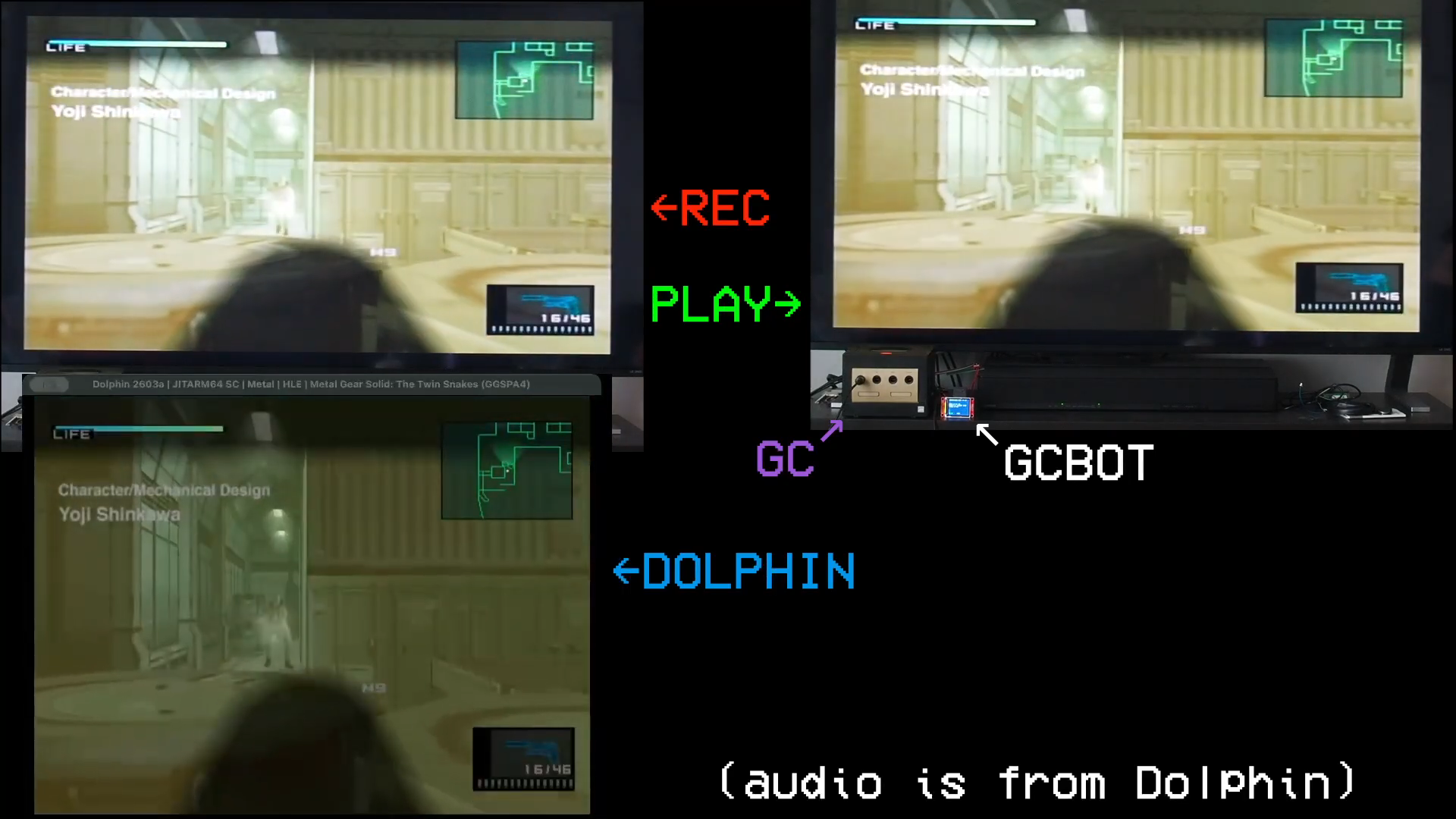
The concept is simple—GameCube bot is a small device that captures controller inputs and records them to an SD card. It can then play them back on command, allowing it to recreate gameplay as it happened the first time right on the console. A Raspberry Pi Pico is the brains of the operation, which is able to intercept signals from a standard GameCube controller. It’s paired with the aforementioned SD storage as well as an ST7735 display for showing status information. The device records in the DTM (Dolphin TAS Movie) format, which can be played back on the device when hooked up to a GameCube console, or in emulators like Dolphin itself.
[jiinurppa] notes that the device isn’t accurate enough to use for tool-assisted speed runs. Most notably, small errors in optical drive reads can lead to desyncs compared to the original machine state that make frame-accurate replays impossible. Still, it’s a neat build that can be useful for capturing game play and later analysis.
A new Mirai-based malware campaign is actively exploiting CVE-2025-29635, a high-severity command-injection vulnerability affecting D-Link DIR-823X routers, to enlist devices into the botnet.
CVE-2025-29635 allows an attacker to execute arbitrary commands on remote devices by sending a POST request to a vulnerable endpoint, triggering remote command execution (RCE).
Akamai’s SIRT, which detected the Mirai campaign in March 2026, reports that, although the flaw was first disclosed 13 months ago by security researchers Wang Jinshuai and Zhao Jiangting, this is the first time in-the-wild active exploitation has been observed.
“The Akamai SIRT discovered active exploitation attempts of the D-Link command injection vulnerability CVE-2025-29635 in our global network of honeypots in early March 2026,” reads Akamai’s report.
“This vulnerability exists in D-Link DIR-823X series routers in firmware versions 240126 and 24082, and allows an authorized attacker to execute arbitrary commands on remote devices by sending a POST request to the /goform/set_prohibiting endpoint via the corresponding function, which can trigger remote command execution.”
Advertisement
The researchers who discovered the flaw briefly published a proof-of-concept (PoC) exploit on GitHub, but later retracted it.
Akamai’s observations show attackers are sending POST requests that change directories across writable paths, download a shell script (dlink.sh) from an external IP, and execute it.
The observed POST requests Source: Akamai
The script installs a Mirai-based malware named “tuxnokill,” which supports multiple architectures.
In terms of capabilities, it features Mirai’s standard distributed denial-of-service (DDoS) attack repertoire, including TCP SYN/ACK/STOMP, UDP floods, and HTTP null.
Akamai has also found that the threat actor behind this campaign also exploits CVE-2023-1389, impacting TP-Link routers, and a separate RCE flaw in ZTE ZXV10 H108L routers. The same attack pattern was observed across all of them, leading to the deployment of a Mirai payload.
Advertisement
The impacted devices reached end of life (EoL) in November 2024, so it’s likely the latest firmware available for the model does not address CVE-2025-29635. D-Link does not make exceptions when active exploitation is detected, so it’s unlikely the vendor will provide a fixing patch now.
BleepingComputer has contacted D-Link with questions about the reported activity and the status of the fix, and we will update this post as soon as we hear back.
Meanwhile, users of routers that have reached EoL are recommended to upgrade to a newer model that enjoys active support with frequent security fixes, disable remote administration portals if not needed, change default admin passwords, and monitor for unexpected configuration changes.
AI chained four zero-days into one exploit that bypassed both renderer and OS sandboxes. A wave of new exploits is coming.
At the Autonomous Validation Summit (May 12 & 14), see how autonomous, context-rich validation finds what’s exploitable, proves controls hold, and closes the remediation loop.
A group of third grade students gather around a board game on a Wednesday afternoon in a Charleston classroom, grabbing game pieces, discussing potential moves and reading out playing cards. The games are not Monopoly, Sorry, or any others of yore – they’re focused on identifying, and boosting, students’ strengths and weaknesses.
It’s part of a shift in school districts’ gifted and talented programs. While many programs focused on a small group of high achieving students, instructors across the nation are now focusing more on inclusion, using data to help them zero in on students’ talents, a method that has the potential of capturing more students for advanced instruction.
For Vanessa Hill, the gifted education coordinator for Amphitheater Public School District in Tucson, Arizona, focusing on strengths and weaknesses helps to solve what she sees as a universal problem with gifted identification.
“Something I’ve been thinking deeply about that tends to be a universal problem is that gifted identification does not match the metrics of your district,” says Vanessa Hill, the gifted education coordinator for Amphitheater Public School District in Tucson, Arizona. “I’m constantly thinking of that, so our demographics can get closer. This new tactic is about exposure to critical thinking and reasoning – what does that look like, how to reason through a problem?”
The gifted and talented programs run the gamut of names and acronyms depending on the district, including advanced learning program, TAG (talented and gifted), LEAP (Learning Enrichment Alternative Program) or REACH (Realizing Excellence through Academic and Creative Help), among others.
Regardless of the name, the program has undergone several major shifts over the last few decades. Schools previously often only selectively tested students, often at the behest of involved parents or by a teacher recommendation. That brought a large amount of inequity in the programs, with many moving to a universal screening practice. Some states, including Washington and Missouri, made it a state mandate to test all students while in elementary school. The screening practice itself evolved from an IQ test to aptitude and ability tests, though how accurate those are is up for debate.
“Society is really unequal along socioeconomic and racial and ethnic lines, and these tests are just reflecting that,” says Scott Peters, director of research consulting at NWEA, a nonprofit education assessment organization. “You can change tests all day long, but at the end of the day, you can’t give some kids three years of $40,000-a-year preschool and also wonder why this kid that’s never been to school until first grade doesn’t do as well.”
Advertisement
Often, schools’ gifted and talented programs do not represent their overall school population and instead skew heavily toward white and Asian students. Zohran Mamdani, the widely-watched mayor of New York City, made it part of his platform to phase out gifted and talented programs because of the inequity.
“Ultimately, my administration would aim to make sure that every child receives a high-quality early education that nurtures their curiosity and learning,” he said in a 2025 statement to the New York Times.
There is no silver bullet test that accounts for inequality and a child’s upbringing, although Peters said when factors such as income, race and other equity gaps are controlled in tests, most inequities disappear.
“This isn’t a factor of, ‘Oh, there are students of color scoring high, but they’re still not getting in,’” he says. “It’s that there’s not enough students of color scoring high because of that larger societal inequality issue.”
Advertisement
Because of the often-skewed gifted and talented population, schools are shifting toward “talent development” with all students, versus focusing on strengthening some students’ already solid skills.
“Because of the baggage of the past, we’re moving toward a new perspective where we’re identifying the strengths of students — whether academic, social or emotional — versus people for a program,” says Kristen Seward, clinical professor in gifted, talented and creative studies at Purdue University. “And I think this twist in how we approach education as gifted researchers is going to benefit everybody.”
Using Data for ‘Talent Development’
Developing talent for gifted programs, much like the name itself, varies depending on the district. Seward says many teachers have enriched curriculums, which enhance things like vocabulary, science and social studies — topics that have been put on the back burner over the years in favor of standardized testing. Teachers are trained to spot students’ strengths and respond to those, which in turn, helps with students’ weaknesses.
For example, if a student has a strong vocabulary but struggles in math, the teacher might focus on math vocabulary during math class to put the lesson on a level the child understands.
Advertisement
Students in the Amphitheater Public School District in Tucson, Arizona, play games that help with quantitative, verbal or non verbal skills.
Photo credit/Vanessa Hill
“I don’t want it to turn into a thing where the teacher is the gate, and if they don’t open the gate, then the students don’t get identified – which has been a problem,” Seward says. “We have to train teachers to be talent scouts, presenting the enriched curriculum. Hopefully it’s not something additional, but something they’d naturally do in their role.”
Elizabeth McLaurin Uptegrove, now the assistant academic director in Charleston County School District, created a “strength or stretch” system that involves the games the students played in the aforementioned classroom. When Uptegrove first arrived in Charleston’s school district, South Carolina used to require all second grade students be tested for the gifted and talented program. But after that year, selection changed to a nomination system.
“Which sounds elitist, and it is,” she says, adding white, affluent children were three times more likely to be in the programs.
Advertisement
She pushed for universal testing again for all fourth grade students, which yielded three times as many students identified as gifted, jumping from 40 fourth graders to 150 across the district. Several schools across the country have adopted similar strength-or-stretch systems.
But Uptegrove’s efforts go beyond identifying candidates for gifted programs through teacher observation: her game-based system uses data. With the aptitude test, there are verbal, quantitative and nonverbal subsections. The tests indicate if a child is low or high achieving in those areas. Then the children are placed in groups with those of similar abilities to play games that can enhance those skills.
The Strength or Stretch games in Uptegrove’s third grade classroom help children grow or reinforce their skills. Photo credit/Elizabeth McLaurin Uptegrove
“Typically a teacher is not very well-equipped to come up with activities or lessons that can actually reach their level of thinking ability and games do that really quickly, in a way that’s not as boring for children as a typical worksheet,” Uptegrove says. “That’s where the magic of the games comes in. We’re making rigorous, hard thinking almost irresistible so students are willing to do the activity for longer.”
Hill, the Arizona-based education coordinator, initially implemented Uptegrove’s game strategy across third grade classrooms in five schools: three Title 1 schools and two non-Title 1. She says the schools that have the strength or stretch program in place have higher passing rates of “proficient” or “highly proficient” scores than those who do not.
“To me, it’s the difference between being a passive learner and active learner; by being able to engage in the games, it’s more active learning,” Hill says. “You raise the exposure to critical thinking and are taught to apply those skills to any situation, whether it’s on an achievement test or on the playground with a friend.”
Advertisement
The Future of the Program
Both researchers and teachers acknowledge the “talent development” approach to gifted and talented programs is far from perfect. It is often costly, whether it is buying the games, instilling teacher training or taking out time from testing. Hill pointed to four schools within her district that are closing this year because of financial constraints.
“Ordering the games is no small cost; I feel so blessed it’s that level of importance that we will find the funds,” she says. “As far as critical thinking games, yes that was missing. It is a hole we were filling. I think that while the core curriculum is doing its best, it can oftentimes be a bit surface level.”
Uptegrove agrees, saying she believes the talent development method is becoming more popular, but “there’s a long way to go in belief and funding for it.”
Peters, who has long studied the best educational methods and practices, believes the shift in gifted and talented is a good step. But he has concerns about the larger moves needed for lasting impact.
Advertisement
“It’s easy to have a 30-minute gifted program; it’s hard to have a second through eighth grade math development pipeline involving everyone in the school,” he says. “And advanced learning isn’t enough of a priority for most schools.”
How powerful is AI? Enough that Anthropic, a leading AI company, announced earlier this month that its latest AI model, Claude Mythos Preview, would be available only to a limited number of businesses due to security concerns — at least for now.
Claude Mythos Preview was designed for general use, Anthropic says, but during testing, the company found it extremely effective at identifying vulnerabilities in the security systems of all types of software, creating potentially massive security concerns.
So far, Anthropic is sharing the Mythos Preview model with a handful of major tech companies and banks through a program called Project Glasswing, intended to give them an opportunity to shore up any existing security vulnerabilities and get ahead of potential hacking attempts that the model could identify.
To get a better sense of what Claude Mythos Preview represents and the potential threat it brings to online security, Today, Explained co-host Sean Rameswaram spoke with Hayden Field, senior AI reporter at The Verge.
Advertisement
Below is an excerpt of their conversation, edited for length and clarity. You can hear the full episode wherever you get podcasts — including Apple Podcasts, Pandora, and Spotify.
Mythos is [Anthropic’s] newest AI model that they designed to be a general-purpose AI model like any other. But what they realized when they were working on it was that it had these special skills that they didn’t really anticipate. It was really good at cybersecurity. It found high-stakes vulnerabilities in virtually every operating system.
That’s pretty bad if you are using that as a hacker. And to have a blueprint for a list of every big gap and insecurity and vulnerability on all these really, really high-profile systems, you’re going to be having a list of everything you could do to take those systems down or exploit data.
They realized that they better not release this to the general public because it could fall into the wrong hands. And they instead handpicked a select few organizations that are responsible for critical infrastructure to release it to so they could plug those gaps in their systems instead.
Advertisement
You’ve heard of many of the companies that currently have and are using Claude Mythos: Nvidia, JP Morgan Chase, Google, apparently a few dozen more that build or maintain critical software infrastructure. How does it actually work?
Since they built it as a general-purpose model, it probably works like any other model in that you’re using it and prompting it to flag all the vulnerabilities in your system.
Maybe you’re Google Chrome, and you’re looking for specific, niche parts of the browser that you think may have some vulnerabilities. You’re basically prompting the model to flag all these really high-profile gaps to you and your security, and then you’re taking that and plugging it up on your own.
A hacker would actually use it in the same way. If it fell into the wrong hands, they’d be like, “Yeah, tell me all the vulnerabilities here.” And then they’re going to take it off the platform and use that for something nefarious. So it’s basically about who is prompting the system and what their motives are.
Advertisement
It’s as easy as saying, “Hey, Claude, tell me how this banking system might be vulnerable.” And then Claude thinks about it for a minute, and it spits out a bunch of answers.
And do we know that the Googles and Nvidias of the world are actually using this technology?
Yes. Part of the reason that Anthropic released this is they wanted these organizations to report back on exactly how Mythos worked and what it did to plug up the vulnerabilities and the gaps in their system. It’s an information-sharing thing.
They’re letting these companies use it to test out how well it does to plug up all these high-profile gaps, and then they have to report back to Anthropic about how it worked.
Advertisement
How is Anthropic choosing who to share this technology with?
I actually asked them that. They’re essentially looking for cyber defenders or companies that a lot of people depend on, and that downstream it would be a huge issue if they got hacked in any way, shape, or form.
JP Morgan Chase is a great example. Anthropic has also offered this technology to the government.
Do Anthropic’s competitors have similar tools? Are they presumably working on similar tools?
Advertisement
OpenAI is apparently working on a similar tool. Anthropic itself has said this isn’t something that they deem they’ll be in the lead on for too long. They think labs anywhere in the world may release this technology in the next three months, six months, 12 months.
It seems like, sometime in the next 12 months, this is going to be out there. And so that’s why they wanted to release Mythos now, so that companies and banks could get ahead of all the hacks that may be coming down the line, when similar types of technology are released to the general public, maybe months from now.
If this is so dangerous and there’s so many potential risks, is anyone having a conversation about just not releasing tools like this and just sort of shutting it down, keeping it internal?
That is a really great question. I’m so glad you asked, because not enough people ask whether an AI system should actually be released or used for certain things. Right now, we’re seeing a lot of one-size-fits-all, throw-it-at-everything type of integration. And a lot of times AI is not the answer for things.
Advertisement
With this, though, people tend to agree that it is something that’s needed right now. AI is already out there helping cyberattackers really step up their attacks. And we’ve been seeing that intensify over the past year. People seem to agree that you need AI to fight AI cyberattacks, essentially.
It’s kind of like medieval fortresses, where you’re adding extra stones and building up the walls at the fortress higher because a war is coming. That’s the sense I get when I talk to these experts about this. They know it’s coming. It’s just, ‘Try to shore up your defenses now so that you’re best prepared.’
Business laptops are a niche that suits only a few, but if there were one laptop you could do every single job with, it’s the ExpertBook Ultra. This laptop debuts Intel’s Panther Lake processors in India, and they pack serious performance not only in the CPU but also in the graphics department, with the Taiwanese laptop maker claiming GPU performance similar to the RTX 4050 on the ExpertBook Ultra, which weighs less than 1kg. Here’s everything you need to know about it.
Flagship All Around
Asus is pitching the ExpertBook Ultra as its most premium business laptop yet, and it’s easy to see why. It features an ultra-light design starting at just 0.99 kg and is built using magnesium-aluminum alloy. We took the Ultra for a spin at the launch event, and it looked beautiful. The finish shimmers in sunlight, making the whole experience even more premium.
Open the lid, and you’re greeted by a beautiful 3K Tandem OLED display that nails the colors and delivers deep blacks. But that’s not actually the highlight. The highlight is the 1400-nit peak brightness in HDR mode, which keeps the display legible even in direct sunlight. The nano coating also keeps the panel smudge-free.
Under the hood lie Intel’s latest Core Ultra Series 3 processors, along with an integrated AI engine (NPU) to handle on-device AI workloads. While we are yet to test the performance of the ExpertBook Ultra, Asus’s demos have set expectations very high, as their benchmarks show the laptop topping the charts among other laptops. The processor can be coupled with up to 64GB of LPDDR5X RAM and 2TB of M.2 2280 NVMe PCIe 5.0 SSD.
Graphics are handled by the Intel Arc B390, which Asus says offers performance comparable to the RTX 4050. The company also ran a series of benchmarks comparing the two in a variety of games. The ExpertBook Ultra is run by a 70WHrs battery with a claimed all-day battery life of up to 26 hours.
Advertisement
ExpertBook P Series Gets an Upgrade
Alongside the Ultra, ASUS has expanded its ExpertBook P series with new models like the P3 and P5, targeting a wider range of business users.
These laptops will deliver scalable performance and AI capabilities for professionals and small- to medium-sized businesses. ASUS says the goal is to provide flexibility across configurations while maintaining strong performance and reliability.
Pricing & Availability
The ASUS ExpertBook Ultra is now available for pre-order on Flipkart, starting at ₹2,39,990. Pre-order offers include extended warranty, accidental damage protection, bank discounts, and bundled subscriptions. Meanwhile, the ExpertBook P3 starts at ₹94,990, while the P5 is expected to launch soon with a starting price of ₹2,14,990
Its expansion comes despite reporting losses here in 2024
Chinese coffee brand Luckin Coffee has been in Singapore for only three years, but it has established a strong foothold in the city-state. It expanded by 30 stores over the past year, bringing its total number of outlets here to 81.
This is despite offering its coffee at heavily discounted prices and reporting losses amounting to RMB¥47 million (S$8.8 million) in Singapore in 2024, all the more notable in the context of Singapore’s notoriously tough F&B landscape.
What, then, goes into the Chinese brand’s playbook for expanding in such a challenging market?
A scale few café operators can match
Image Credit: Luckin Coffee
Luckin’s pricing power comes from a scale few café operators can match.
With over 30,000 stores globally—more than Starbucks—the company benefits from massive purchasing volumes that significantly reduce its cost per cup, enabling retail prices as low as S$4, and even promotional offers such as S$0.99 coffee for first-time users.
CEO Guo Jinyi has also claimed that the company accounted for 40% of China’s total coffee bean imports and 60% of Brazilian coffee bean imports into China in 2024. At this level of purchasing power, Luckin is likely able to secure significantly lower costs compared to most café operators.
Cost efficiencies also extend beyond coffee beans.
In 2025, low-value consumables such as packaging materials and straws cost the company just RMB¥210 million (S$39 million) across its entire 30,000 store network. This translates to roughly S$1,307.64 per store per year, or about S$3.58 per store per day.
Advertisement
Luckin’s newest US$440 million smart roasting centre in Qingdao, Shandong Province, China./ Image Credit: Luckin Coffee
Since 2021, Luckin has also reduced costs by cutting reliance on third-party suppliers and building more of its own production capabilities.
In Aug 2024, Luckin also broke ground on an Innovation and Production Centre in Qingdao with a total investment of approximately RMB¥3 billion and an expected annual roasting capacity of 55,000 tonnes.
This vertical integration allows Luckin to control more of its supply chain in-house, reduce intermediary costs, and ultimately lower overall production expenses across its store network.
Advertisement
An operating model that keeps costs lean
Image Credit: Daniel Food Diary
Ever struggled to find a seat at a Luckin Coffee outlet? That’s by design. Most Luckin stores are intentionally small to keep operating costs low.
Around 99% of its outlets are compact pick-up stores of 20–60 sqm, with limited or no seating. These stores are strategically located in office buildings, commercial districts, residential neighbourhoods, and university campuses, allowing the brand to expand rapidly while keeping rental and renovation costs low.
In fact, store pre-opening expenses accounted for just 0.2% of total operating expenses in 2025.
In Singapore, this format provides a clear advantage: smaller units mean cheaper leases compared to full-format cafés, which is especially crucial in a market where retail rents are notoriously high.
All customers need to do to order a coffee from Luckin Coffee is download the app. With just a few taps, they can place an order for pickup at any outlet, receive real-time status updates within the app, and earn rewards through an integrated loyalty programme./ Image Credit: Luckin Coffee
Beyond its physical footprint, Luckin’s digitalised operating model also enables a leaner cost structure. The company operates on an app-first system where customers order and pay entirely through its own platform.
This reduces reliance on cashier staff, lowers the risk of order errors, and allows for highly targeted in-app promotions and personalised marketing to users.
Advertisement
Besides its own app, Luckin Coffee is also available on third-party delivery platforms. According to its 2025 annual report, delivery orders doubled from 17.1% of total orders in 2024 to 34.7% in 2025 across its whole network, which shows that Luckin is extending its reach beyond its physical store footprint.
Expansion doesn’t cost as much as it looks
Even with lower set-up costs, opening 30 stores in Singapore within a single year might seem aggressive. However, it’s not as capital-intensive as it might appear for the coffee giant under its operating model.
In Singapore, many outlets are run with franchise partners. These partners pay upfront fees and take on much of the setup and operating costs themselves. This means each new store is not fully funded by Luckin, helping the brand scale more quickly with less direct capital outlay.
At the same time, any remaining losses in overseas markets are effectively absorbed by its much larger China business.
However, this is small in the context of the group.
In 2024, Luckin generated over RMB 34.5 billion (S$6.4 billion) in revenue overall, alongside approximately RMB¥3.5–3.9 billion (S$653-S$728 million) in operating profit driven primarily by its China business. Against that scale, Singapore’s losses are effectively marginal.
Singapore is not a profit centre for the group, but part of a longer-term international expansion strategy.
Advertisement
Standing out in Singapore’s competitive coffee scene
Image Credit: Jack Hong via Shutterstock
From America’s Starbucks to China’s Cotti Coffee, and even local coffee houses, the competition for market share amongst coffee brands in Singapore is nothing short of steep, as Singaporeans have so many options to choose from.
So what makes one choose Luckin over other specialty coffee shops and those at our local coffee shops?
While Luckin’s coffee doesn’t start from RMB 10 (S$1.87) per cup as it does in China, at S$4.80 for an Americano, it is still cheaper than many other café operators, including Starbucks, where prices start at around S$6.30.
This also does not account for the personalised discounts Luckin offers to users who order through its mobile app.
Singapore serves as a critical testing ground for building our brand, refining our operational systems, and understanding overseas business models.
The city-state serves as Luckin’s launchpad into Southeast Asian countries, where it shared that it will adopt a franchise model.
While individual 2025 figures for Luckin’s Singapore operations are not available and are grouped with those of Malaysia and the United States after further expansion, the coffee giant shows no signs of slowing down.
In China, the journey from loss-making in 2020 to an explosive market leader took Luckin roughly five years. In Singapore, a city-state of six million people with a coffee shop on nearly every corner, the competition is steep.
But for Luckin, the steep competition is precisely the point—if the model works here, it can work anywhere in Southeast Asia.
Advertisement
Read other articles we’ve written on Singaporean businesses here.































































You must be logged in to post a comment Login