

Tech
5 Classic Electronics & Pieces Of Tech That Instantly Remind Boomers Of Their Childhood

Baby Boomers — or Boomers for short — were born between 1946 and 1964, putting them in their sixties, seventies, and eighties today. Stepping back in time to that era reveals a world of classic and nostalgic tech with a certain charm that most modern-day devices simply don’t have. Wooden finishes on console TV sets, spinning controls to dial a rotary phone — these are things most kids today wouldn’t know about, but instantly take Boomers back to their childhood.
TV sets and rotary phones aside, Baby Boomers were also very familiar with technology that has made a resounding resurgence today: vinyl record players. Boomers will remember hitting The Twist in front of one of these with their parents, or setting the needle down on the latest rock ‘n’ roll hit – a genre that exploded in the 1950s and ’60s.
And if Boomers weren’t listening to music from their record players, they were probably using a transistor radio (which first hit the scene as the Regency TR-1 in 1954) for tunes, sports, and news. Or they may have been writing their own stories and capturing moments with a Polaroid camera. It’s interesting to take a trip down memory lane through the lens of tech, and these classic electronics are a perfectly nostalgic guide.
Console TV sets
If wood-finished Zenith, RCA, or GE console TV sets are nostalgic to you, there’s a good chance you’re a Boomer. Characterized by their furniture-style wooden cabinets, knobs or dials, and captivating center screen, these television sets took the United States by storm in the 1950s, ’60s, and ’70s. It was the centerpiece of the living room and something for the whole family to gather around and enjoy.
Many Baby Boomers will remember the transition from black-and-white to color television — which had actually been around since the 1920s, but wasn’t refined and popularized until the 1940s and into the ’70s — and the ubiquitous impact it had on information and entertainment distribution. 90% of US households had a television set by 1960, whether black-and-white or color. And it wasn’t just to watch “The Flintstones.”
1960 saw the first televised debate between presidential candidates (John F. Kennedy and Richard M. Nixon), and in 1961, Kennedy gave the first live press conference on television. There was no internet or social media to get insights on politics and the goings-on of the world — for Boomers and their parents, these console television sets were crucial to staying informed about the world around them.
Vinyl record players
Vinyl record players were most popular from the 1950s to the ’70s, meaning many Baby Boomers grew up listening to The Beatles and The Beach Boys on a spinning vinyl disc throughout their childhoods. For many teenagers, the vinyl record player was a way to express artistic freedom and build a music collection unique to their tastes. Instead of waiting and hoping for a song to play over the radio, they could easily share certain songs with their friends and have others introduce them to new tunes.
Like console TV sets, vinyl record players of the time were often a bit different than the ones we see in today’s vinyl resurgence. When Boomers were growing up, record players were often housed in wooden consoles and doubled as pieces of furniture. There was also a hands-on aspect that made using vinyl records enjoyable. Choosing a record from your collection, putting it on the turntable, and lowering the needle onto the track was all part of the experience. While records were eventually largely replaced by CDs, that experience is an important part of why vinyl records came back into style.
Transistor radios
While vinyl records brought music into Boomers’ homes, transistor radios let them take it anywhere they wanted. Coming onto the scene in the mid-1950s with the Regency TR-1, these pocket-sized radios quickly changed the way people of the time interacted with music, news, and sports. While the tabletop radios that came before them were big and bulky, transistor radios were small and light enough to carry easily. Because they were battery-powered, they didn’t have to be tied down to an outlet.
For many Baby Boomers, the transistor radio was their first piece of personal tech. Like record players, transistor radios allowed teenagers to listen to the songs and stations they wanted without having to change the channel for anyone else. And the timing couldn’t have been better with rock ‘n’ roll artists like Elvis Presley and bands like Creedence Clearwater Revival becoming popular at the time.
Nowadays, we can simply look up and stream whatever songs we want. But Baby Boomers will remember the feeling of tuning into a station on their transistor radio and hoping for their favorite song to come on — and the joy they were filled with when it finally did.
Rotary telephones
Rotary telephones are one of the most instantly recognizable pieces of tech on this list. Characterized by their circular dial mechanisms and curly cords, you would find rotary phones in many American households between the 1930s all the way into the ’90s. Rather than the physical buttons and touchscreens of today, rotary phones had numbered holes that you would place your finger into and rotate until the circular dial reached the stopper. Their distinct clicking sound and tactile feel became a shared memory across multiple generations.
While our smartphones can be used anywhere, rotary phones were tethered to one specific location. If the phone rang, someone had to get up to answer it. There were no text messages, notifications, or caller ID screens to check first. It was also common for the phone to sit in a busy area of the home, so conversations were rarely private if your family was around.
And for many Boomers growing up, the rotary phone was a method of connecting with their friends. You’d write their phone number down, or do your best to remember it by the time you got home, and then you’d call up your friend after school or on the weekends to hang out. It was a time when phone calls were sometimes planned ahead of time, and communication moved at a slower pace.
Polaroid cameras
Polaroid cameras, which came out in 1948, were one of the most exciting inventions for Baby Boomers because being able to snap a photo without needing a studio and time to develop the picture was revolutionary at the time.
Polaroid pictures became popular at family reunions, parties, and holidays. Instead of using an entire roll of film and waiting days or weeks to see how a picture turned out, you could click the shutter button and hold a physical copy a few moments later (after waving it in the air to help it develop faster). The process became part of the fun — friends and family would gather around to watch an image slowly develop from what initially looked like a blank piece of paper. By 1977, despite Kodak’s best efforts at competition, Polaroid had cornered the majority of the instant camera market.
Long before social media turned every photo into something instant and shareable, Polaroid made it possible to capture a moment and immediately pass it around the room. The distinct white border and vintage look of the photos made taking and collecting pictures a fun, spontaneous activity.



Enterprises deployed AI agents ahead of the controls needed to manage them — and they did it knowingly. That is the central finding across the five parallel surveys VentureBeat Research fielded in June, spanning every layer of the agentic stack. Now those enterprises are retrofitting to catch up with their own standards, and they are budgeting for it: In each of the five control layers we measured, 57 to 68% of enterprises plan to switch vendors or add new ones within 12 months, and roughly a third, depending on the layer, plan to move within the quarter.
VentureBeat Research measured the five controls an enterprise has to build before it can trust an agent: identity, evaluation, cost telemetry, the context layer, and orchestration. Identity governs which agent is allowed to do what, under whose credentials. Evaluation determines whether the agent’s work is any good. Cost telemetry tracks what each agent costs to run. The context layer supplies the business data and definitions agents draw on when they answer. And the orchestration control plane coordinates multi-step agent work. Each of our five reports measures one of those controls.
Most deployed “agents” are chatbots wearing the label. Seventy-one percent of enterprises said a quarter or fewer of their deployed “agents” can complete multi-step work on their own; only 10% said true agents are the majority of what they run. These respondents are positioned to know: 81% recommend or decide AI purchases at their companies. A single-prompt chatbot with a human reading every answer needs none of the controls the other four reports measure. A true multi-step agent needs all of them — and most enterprises can’t say which one they’ve deployed. (Full findings: Agentic Orchestration report.)
Autonomy is outrunning trust in the evaluations that gate it. Two-thirds of enterprises either already allow an agent to push a code or system change to production on automated evaluation results alone, with no human review, or are actively engineering toward that within 12 months. Only 5% fully trust the evaluations that would make that call — and half of enterprises shipped an agent that passed internal evaluations and then caused a customer-facing failure in the past year. Before removing human review from any workflow, test evaluations against production outcomes rather than internal benchmarks. (Full findings: Agent Reliability & Evals report.)
Companies that let agents share credentials get hit more often. Sixty-nine percent of companies let at least some of their agents share credentials — multiple agents operating under one API key or service account. Organizations that allow credential sharing anywhere experienced a security incident or near-miss at a 63.5% rate (47 of 74), against 40.9% (nine of 22) at companies where every agent has its own scoped identity. The fix is scoped identity for every agent, starting with the ones that touch production systems. (Full findings: Agentic Security & Identity report.)
The most expensive hardware in the building runs at half capacity or less. More than eight in 10 enterprises that run their own GPUs reported utilization of 50% or less, and only 44% rigorously track what their AI compute actually costs and returns. The number worth chasing first isn’t more GPUs — it’s the utilization and per-workload cost of the ones already running. (Full findings: AI Infrastructure & Compute report.)
Agents answer confidently from data nobody governs. Fifty-seven percent of enterprises traced a confident, wrong agent answer in the past six months to their own missing or inconsistent business context — wrong metrics, stale definitions, absent documents — and most saw it happen more than once. Governing the definitions agents answer from — metrics and entities first — has to come before scaling the agents that depend on them. (Full findings: Context Layers / RAG report.)
No layer has an entrenched incumbent: The defaults today are the built-in tools that ship with the big AI platforms enterprises already use. Switching intent runs highest in orchestration itself, where 68% plan to adopt, add, or replace platforms within 12 months and 34% within the quarter. Our surveys did not ask which direction that money moves — toward the platforms’ built-in tools or toward the specialists challenging them — and that open question is the next four quarters of this market.
About this research
VentureBeat Research fielded five parallel surveys in June 2026 under its VB Pulse program: Agentic Orchestration (101 respondents), Agent Reliability & Evals (157), Agentic Security & Identity (107), AI Infrastructure & Compute (107), and Context Layers / RAG (101) — 573 qualified respondents in total, all at organizations with 100 or more employees. Samples are self-selected, and some findings should be read directionally; each report carries its full methodology note. What the pattern supports more strongly than any single percentage is the direction: every survey, independently, points the same way. VentureBeat produces both this research and VB Transform, the conference where these reports debuted.


Security
Stop the spread (of online recruiting and propaganda)
Europol and its partners’ investigators flagged 4,340 “horrific” URLs for removal over several weeks in June and July as part of an ongoing crackdown on The Com (short for community), a loosely knit network of online groups whose young members participate in a range of illicit activities. These range from hacking, swatting, and digital extortion to real-life shootings, stabbings, and other physical violence.
Europol’s recent Referral Action Days, aimed at disrupting The Com’s online ecosystem and stopping the spread of its propaganda, is part of the larger Project Compass operation. Project Compass began in 2025, and its partner law-enforcement agencies span the US, UK, and EU member states.
Investigators from Belgium, Finland, Hungary, Ireland, Luxembourg, the Netherlands, Portugal, Spain, and Sweden participated in the Referral Action Days during June and July.
Various groups linked to The Com post content online to recruit members and groom young victims using social media, gaming platforms, and messaging apps.
“The more extreme and harmful the content a user or group can produce or extort, the higher their status within the online community,” according to Europol. “These acts are often livestreamed on social media platforms, where online bystanders cheer them on, and later saved and disseminated.”
The URLs flagged for removal during this latest push to disrupt The Com’s recruiting activities included “violent videos and images depicting self-harm, suicide, child sexual abuse material (CSAM), animal cruelty, and violent attacks,” the international cops said.
This, the European cops say, includes so-called blood walls, which are paintings made with blood that display the extorter’s alias and group affiliation, and cut-signs, where the victims are forced to carve the extorter’s name into their bodies.
It also includes videos of street attacks and arson, plus manuals on how to commit these violent attacks, along with instructions on grooming and extorting vulnerable minors, and conducting doxxing and swatting.
Europol says its European Counter Terrorism Centre has received “hundreds” of requests from member states and others over the past two years to help investigate crimes linked to The Com. It describes the online network as a “global threat, particularly concerning minors as both victims and perpetrators.”
Last year, both the UK and US issued similar warnings about a subset of The Com that recruits children and teens for contract shootings, kidnappings, and other real-life violent crimes. In July 2025, the FBI said that In Real Life (IRL) Com had become increasingly brazen in its swat-for-hire and violence-as-a-service solicitations.
The FBI’s alert followed a similar notice from the UK National Crime Agency about a “deeply concerning” trend of The Com recruiting teenage boys to commit a range of criminal acts, from cyber fraud and ransomware to child sexual abuse.®
Tech
Election Commission Says Musk Likely Broke The Law By Paying Voters. Will Anyone Do Anything About It?

from the the-rule-of-law-unless-you’re-rich dept
Will Elon Musk actually face legal consequences for illegally paying voters in an attempt to interfere in an election? We’re at least one step closer to finding out.
Back during the 2024 Presidential election, he got away with offering $1 million to a “random” (not actually random) voter who would sign his petition in an effort to get out the vote for Donald Trump in Pennsylvania.
He then tried to run back that strategy a few months later during a special election for judges in Wisconsin. It didn’t work out so well for him. It flopped so badly that Musk said he would no longer get so invested in elections any more. Who knows if he’ll keep that promise. Probably not.
And now the Wisconsin Elections Commission has decided that the whole “we’ll pay you to sign this petition” nonsense likely violates the law.
The motion approved by the elections commission said it found probable cause that Musk broke Wisconsin law by making a social media post offering $1 million to people who voted in the Supreme Court election “in order to induce them to vote in that election.”
[….]
Three Wisconsin voters received checks from Musk, including two who got them in person at the Green Bay rally. Two weeks before the election, Musk’s political action committee, America PAC, offered $100 to voters who signed a petition in opposition to “activist judges,” or referred someone to sign it.
And, before you rush out to claim that it was clearly a partisan/biased decision, turns out it really wasn’t. The commission is equally split between Republicans and Democrats:
The Wisconsin Elections Commission, consisting of three Democrats and three Republicans, voted 5-1 in closed session on Thursday to refer the complaints to the district attorney, the commission’s spokesperson, Emilee Miklas, said.
Brown County District Attorney David Lasee, a Republican, did not immediately return a message seeking comment Tuesday.
Of course, it is an open question as to whether or not Lasee will actually do anything about this. Some groups are pushing him to act on the referral. And they called out that Lasee had put a stop to other “get out the vote” campaigns, warning them that their actions (offering food, water, and rides to the polls) could violate election bribery laws. Here’s Kristin Lyerly from the Committee to Protect Healthcare:
“The commission did their job. Now it’s time for District Attorney Lasee to do his,” she added. “This isn’t about political outcomes. It’s about whether the law applies to everyone or just everyone except the richest man in the world.”
Others argued the law should be applied fairly, pointing to an April 2024 incident where Lasee warned local get out the vote organizers that an event they planned risked violating state election bribery law.
The event offered food, water and rides to the polls — as well as cash prizes for social media influencers who got the most people out to vote. The groups canceled the effort after receiving a letter from Lasee questioning its legality.
“When the district attorney’s office believed local organizations may have crossed a legal line, it acted quickly,” said community organizer Christina Thor. “Our community deserves to see that same standard applied today. The same urgency, the same scrutiny, and the same commitment to applying that law fairly.”
So, here we have a very clear opportunity to see whether the law is applied equally to Musk, or whether yet another law enforcement official decides that there can be no consequences for rampant law-breaking.
Should this move forward, I guarantee you that Musk and his hordes of cult-like fans will insist that this prosecution is political. But, again, that seems like bullshit. At some point, those who break the law with impunity have to be held accountable for their actions.
One of the most frustrating things about the last decade has been watching the rich and powerful face zero consequences for doing many, many terrible things — a pattern that breeds exactly the kind of toxic cynicism that lets everyone else assume that the rules don’t apply to themselves either. This is a chance to take a stand and prove that wrong. Those actions should have consequences, and screaming “political prosecution” when it’s clearly not should never be a literal get out of jail free card.
Filed Under: bribery, consequences, david lasee, elections, elon musk, wisconsin
from the ctrl-alt-speech dept
Ctrl-Alt-Speech is a weekly podcast about the latest news in online speech, from Mike Masnick and Everything in Moderation‘s Ben Whitelaw.
Subscribe now on Apple Podcasts, Overcast, Spotify, Pocket Casts, YouTube, or your podcast app of choice — or go straight to the RSS feed. To get extended episodes with additional coverage, support us on Patreon.
Our third annual Live at TrustCon recording of Ctrl-Alt-Speech! Ben was back this year! Mike and Ben were joined live on stage with Kat Duffy, senior fellow for digital and cyberspace policy at the Council on Foreign Relations and Zoe Darme, Director for Trust, Knowledge and Information Products at Google. They cover:
Special thanks to the Trust & Safety Professionals Association (TSPA) and all the work they do each year in putting on TrustCon, and for allowing us to host the live podcast as the closing session again this year.
Filed Under: ai, artificial intelligence, content moderation, france, trust and safety, trustcon
Companies: hugging face, openai, xai


Unlike many budding engineers, K.J. Ray Liu wasn’t inspired to enter the field by tinkering with electronics or following in the footsteps of a family member. Growing up in Taichung, Taiwan, he answered his government’s call for students to become electrical engineers to help manufacture semiconductors in the 1970s, when the country’s economy was struggling.
“Students who were good in math, science, and physics all wanted to be an electrical engineer because that was the top priority of the government,” Liu says. “That’s how I got into engineering. Now Taiwan is a world leader in semiconductors.”
K.J. Ray Liu
Occupation
Retired professor of information technology and a digital signal processing researcher at the University of Maryland in College Park
Member grade
Fellow
Alma maters
National Taiwan University; University of Michigan; UCLA
But by the time he graduated from university in 1983, semiconductor facilities were still under construction, so there were no jobs available.
Instead, he went on to have a successful career as an educator and entrepreneur in the United States.
For 31 years, he was a professor of information technology and a digital signal processing researcher at the University of Maryland in College Park until he retired in 2021.
Liu was the chairman, CEO, and CTO of Origin Wireless, a startup he founded in Rockville, Md. Origin, which was acquired by ADT in February, pioneers artificial intelligence for wireless sensing and indoor tracking.
Liu, an IEEE Fellow, is an active IEEE volunteer who served as the organization’s president in 2022.
IEEE honored him with this year’s Haraden Pratt Award for “transformative and impactful leadership.”
Liu is credited with increasing the diversity of nominees for IEEE’s Fellow program, which is the highest level of membership. He also led the effort to realign the organization’s regions geographically to ensure more equitable global representation on the IEEE Board of Directors.
He received the Pratt honor on 24 April during a ceremony in New York City. The IEEE Foundation sponsored the Board-level award.
“More than anything, I share the honor with the volunteers and staff I had the privilege to work alongside,” he says. “Our hard work is fueled by our shared devotion to this professional home we love and care for so much.”
In the 1970s, Taiwan’s policymakers decided to improve the country’s economy by pivoting from making products such as shoes and umbrellas to manufacturing electronics.
The industry got its start in 1976 when RCA, a major electronics company at the time, agreed to transfer licensed semiconductor processes to Taiwan’s Industrial Technology Research Institute. ITRI spun off several semiconductor-related companies including the Taiwan Semiconductor Manufacturing Co. TSMC, launched in 1987, is the world’s largest dedicated semiconductor foundry.
Liu graduated in 1983 with a bachelor’s degree in electrical engineering from National Taiwan University, in Taipei. At the time, there were no semiconductor companies to work for, he says.
“Nowadays, many of the country’s university graduates go right to TSMC to get a job,” he says. “But back then, there was no real job market.
“Most of my classmates—including me—came to the U.S. for graduate studies. Many of us stayed and, over the last three to four decades, contributed to the development of electronic computer communication technology in the U.S.”
Liu left Taiwan after a two-year mandatory stint in the Republic of China Armed Forces to attend the University of Michigan, in Ann Arbor, where in 1987 he earned a master’s degree in electrical engineering.
“If I can help make IEEE a better professional home for future members, that is something that I can pay back to IEEE.”
He went on to earn a Ph.D. in electrical, electronics, and communications engineering in 1990 from the University of California, Los Angeles. His interest in digital signal processing and very-large-scale integration (VLSI) was sparked while at UCLA. Today VLSI powers all modern electronics.
“When I was a graduate student, there was no wireless communication. Everybody had a landline,” he explains.
VLSI was an important, active research field at the time.
“My research interest was digital signal processing,” he says. “One day I saw a book on VLSI signal processing on my professor’s bookshelf. I immediately thought to myself: That is the field I want to pursue.
“VLSI is one lane, digital signal processing is the other, and there is a bridge linking the two. I was interested in both areas, so I did my Ph.D. thesis on VLSI signal processing.”
After graduating, Liu joined the University of Maryland, where he is credited with establishing its signal processing research program.
In addition to teaching, he conducted research on a broad range of signal processing and communication aspects. The topics include bioinformatics, game theory, signal processing algorithms and architectures, and wireless sensing and communications.
He has authored more than 10 books and 900 papers, and he holds 250 patents. You can find his research papers in the IEEE Xplore Digital Library.
Ambient-sensing trailblazer
Liu is considered to be a pioneer in the field of ambient sensing. The technology gathers environmental data and is used in security systems and health-monitoring devices.
He came up with the idea, he says, while working on a project in 2009 for the U.S. Navy. He was trying to solve a problem the Navy was having with the wireless communication systems used in its submarines. Because submarines are made of metal, radio waves were unable to penetrate the vessels’ compartments and instead bounced around, creating interference, he says.
His solution was to use a relatively unknown concept in physics: time-reversal signal processing. The technique captures waves, such as sound and electromagnetic signals, and sends them back through the same medium in reverse, flipping the signal from last-in to first-out, and re-emits them.
“By using time-reversal feed, we could increase the signal-to-noise ratio by four times,” he says. “That improved performance dramatically.”
He became fascinated by the physics of time-reversal signal processing, he says, and wondered how he could apply the concept to serve society. After three years of research, he came up with the idea of using wireless sensing applications through ambient radio waves from surrounding Wi-Fi networks.
“I learned to turn Wi-Fi networks into sensing networks that decipher our activities,” he says. “We could know everything happening around us—our motions, breathing, heartbeat, even fall detection—without any wearables.”
Through the university’s incubator, which encourages faculty to work on projects with an impact on society, he launched Origin in 2013. The company’s Wi-FI and AI sensing technology enables accurate indoor tracking, motion detection, and health monitoring without the need for wearable devices or cameras. Its products, including its remote patient monitoring, received three innovation awards at the 2020 and 2021 Consumer Electronics shows, including one for best innovation.
Finding his professional home
Liu joined IEEE in 1986 as a graduate student to access its research papers, he says.
“If you didn’t join an IEEE society, you didn’t get its journal—which meant that you couldn’t read the most up-to-date research papers,” he says. “So, I joined the IEEE Signal Processing Society. When I attended my first signal processing conference, I knew I had found a professional home. I met many like-minded people, and together, we built a professional home for our members worldwide.”
He became an active volunteer, holding top leadership positions including 2012–2013 president of the Signal Processing Society and 2016–2017 director of IEEE Division IX, which covers societies focused on signal processing, data transmission, navigation, and transportation. In 2019 he was vice president of the Technical Activities Board.
In 2022 he served as IEEE president and CEO. The three accomplishments during his term he says he is most proud of are increasing the prize money for the IEEE Medal of Honor, overseeing the realignment of IEEE regions, and establishing greater financial transparency.
The reason for increasing the prize for IEEE’s highest award—from US $50,000 to $2 million—in 2025, he says, was to underscore the importance of the technologies the IEEE community develops. Those innovations include semiconductors, the Internet, and the GPU. The money for the Medal of Honor now exceeds that of the Nobel Prize, which carries an award of roughly $1 million.
“We need the whole world to understand the IEEE community has made the most impact on society in the last century,” Liu says. “Nevertheless, we did not receive the attention and respect we deserved, so we needed to help ourselves. We want the whole world to know what our contributions are.”
His next achievement was realigning IEEE’s regions. During the past several years, membership in Region 10, which covers countries in Asia and the Pacific, has grown from 10 percent of total membership to nearly 40 percent, he says. It is the largest and most populous of IEEE’s geographic areas, but its members were not equitably represented on the Board of Directors. Each region had one representative on the Board.
“The region has 40 percent of the members but only makes up 10 percent of the Board,” Liu says. “That didn’t make sense to a lot of us.”
The IEEE Board in 2022 approved region realignment. The total number of regions remains at 10, but their organization is changing. Effective 1 January 2028, the six U.S.-based regions will be consolidated into five, and Region 10 will be split into two. IEEE will no longer use the Region 1 designation. The new Region 2 will represent the Northeastern and Eastern U.S. Region 10 will cover North Asia, and the new Region 11 will represent South Asia and the Pacific.
Liu also succeeded in leading a movement that persuaded the IEEE Board to invest in a better financial reporting system to have a clearer understanding of the organization’s finances. A more modern system now tracks banking transactions, contracts, expense reports, and other spending.
“Now we know exactly where the money comes from and where it is spent,” he says, “so that we can make more informed decisions.
“If I can help make IEEE a better professional home for future members, that is something that I can pay back to IEEE,” he adds. “I truly appreciate what IEEE offered me. From student to professor to an established leader, at every stage, it offered me different opportunities to grow. That is why I worked very hard when I was president to make sure everybody realizes it is a professional home for our entire career.”
From Your Site Articles
Related Articles Around the Web

Nvidia, Microsoft, Meta, Palantir, and more than 20 other tech companies signed an open letter urging policymakers not to impose “premature restrictions” on open-weight AI models, warning that broad limits could “stifle competition or drive innovation overseas.” CNBC reports: They wrote that open-weight models strengthen competition and ensure that the benefits of the technology are “broadly shared rather than concentrated in a few hands.” “Relying solely on closed models is not inherently safe: they can be breached, misused, or fail in ways that outsiders cannot detect,” the letter said. “And concentrating advanced AI capabilities behind a small number of closed models compounds that risk.”
Elon Musk, who runs an AI business under his rocket company SpaceX, also applified the letter on social media, writing that it has his “full support” in a post on X. SpaceX did not officially sign the letter. Greg Brockman, OpenAI’s president, said Thursday that the company believes in broad access, and that he has not been involved in any conversations with the Trump administration about potentially banning Chinese open-weight models in the U.S.
“I think that, that fundamentally, AI and AI usage is something that is actually very important to democratize,” Brockman told reporters during a briefing in New York City. “And so, for me, at a sort of deep level, I think that having more models, more usage, that is a good thing.” OpenAI CEO Sam Altman addressed the letter in a post on X on Friday, writing that he wants the U.S. to win with both open-weight and proprietary models, and that he is “glad to see this.”
[…] In the letter on Friday, the U.S. tech companies said that concerns about unlawful distillation should be addressed through “targeted legal and commercial frameworks” instead of with “sweeping restrictions on techniques that play an important role in AI innovation.” “Our AI leadership will be judged not by one frontier AI model, but by whether the United States builds a strong, open ecosystem that diffuses into every sector,” the letter said. “This is essential for creating opportunities for innovation and prosperity across the country.” The letter follows a separate appeal signed by nearly 200 Silicon Valley companies, including Proton and Y Combinator, warning that restricting U.S. access to Chinese open-weight AI models could cripple the next generation of American startups. “American leadership requires two things: world-leading American open-weight models and continued access for U.S. builders to open models already available worldwide,” the startup founders wrote. Instead of broad prohibitions, they argue the government should adopt targeted safeguards.
Of course, these signees “have an obvious economic stake in seeing open AI models flourish,” notes TechCrunch. “Companies like Nvidia, Microsoft Azure, and other infrastructure providers have a vested interest in pushing for commoditized models: If models are interchangeable, people will buy more GPUs, rent more cloud capacity, and build more applications.”

The U.S. Department of Justice has charged two Volkswagen engineers with securities fraud for an alleged insider-trading scheme connected to the German automaker’s joint venture with Rivian.
The indictment, unsealed Friday by the U.S. District Attorney for the Southern District of New York, alleges that Michael Stamp and Marcus Plank made more than $300,000 by using confidential insider information. Stamp and Plank allegedly bought Rivian stock and options after learning that the EV maker and Volkswagen planned to form a joint venture — internally codenamed “Project Climb” — but before the companies made any public announcements.
Rivian and Volkswagen announced plans for the joint venture on June 25, 2024, which would focus on developing electric vehicle architecture and software. Volkswagen initially committed to invest $5 billion in Rivian, with the capital to be released as the companies achieve certain milestones. The joint venture has since grown to $5.8 billion, and Volkswagen is now Rivian’s largest shareholder.
Rivian’s stock price rose 23% following the initial announcement in June. Stamp and Plank then allegedly sold their Rivian positions, with Stamp realized about $250,000 in profits, Plank realizing about $50,000, and Plank’s close family member realizing about $12,000, as detailed in the indictment.
“Michael Stamp and Marcus Plank’s alleged exploitation of their employer’s confidential information allowed them to make more than $300,000 in illegal profits,” U.S. Attorney Jay Clayton said in a statement Friday. “When people misuse confidential information for their own financial gain, they undermine the principles that allow our markets to function fairly and efficiently. Insider trading is a crime that New Yorkers want pursued with vigor. Its effects ripple through the financial system, harming ordinary investors and eroding public confidence. Today’s charges underscore the commitment of this Office and our law enforcement partners to protecting the integrity of our markets and holding accountable those who choose to violate the law.”
Investigators allege the two engineers understood their actions were illegal. Eight days prior to the joint venture was announced, Stamp searched “statute of limitations insider trading,” and Plank’s close family member searched, in German, “how is insider trading prosecuted?,” according to the indictment.
The pair, who both live in San Jose, were arrested Friday and will appear in the U.S. District Court for the Northern District of California. The case has been assigned to U.S. District Judge Katherine Polk Failla. Stamp and Plank face up to 25 years in prison if convicted of federal securities fraud.
TechCrunch has reached out to Rivian and Volkswagen for comment and will update the article if either company responds.
When you purchase through links in our articles, we may earn a small commission. This doesn’t affect our editorial independence.


Midjourney, the company best known as a maker of AI image and video generation tools, has decided to get into astrology. The company has announced it’s purchasing Co-Star, a popular astrology app, and bringing on its CEO Banu Guler as its new Chief Design Officer. The app will still be under Guler’s “complete control,” according to the company, but now with Midjourney’s resources behind it.
In a post on X, Guler characterizes the acquisition as a natural extension of her friendship with Midjourney founder David Holz and their shared belief that “computers can be tools that reveal our humanity to ourselves. Tools that show you what you mean, how you feel, what you’re imagining, before you can articulate it yourself.”
I moved to New York when I was 17. I waited tables at a vegan restaurant, worked the night shift at Dunkin Donuts on 3rd Ave, and finally found out about bike messengering, which I figured was a great long-term career option if I wanted to focus on feminist zine/book projects and… https://t.co/Bdlu4bKMSz
— Banu Guler (@banu__guler) July 24, 2026
That fits the introspective nature of an astrology app, but seems like a weird match for the kinds of things Midjourney actually makes money selling. Then again, the company has been trying to expand beyond just being a builder and licenser of AI tools. In June, Midjourney announced it was developing a full-body ultrasonic scanner and launching a new division called Midjourney Health to build it.
Guler writes that Co-Star has reached “35 percent of young people in the US with tens of millions of app downloads,” and the app’s younger users may be the hardest audience to sell Co-Star’s acquisition to. According to a Gallup survey from April 2026, people born between 1997 and 2012 (14 to 29 year olds) continue to use generative AI regularly, but have grown increasingly negative towards it. “Gen Zers’ strong agreement or agreement that they feel excited about AI has dropped 14 percentage points to 22 percent,” Gallup says, “while hopefulness has fallen nine points to 18 percent, and anger has increased nine points to 31 percent.”

PARTNER CONTENT: Focusing on 5G deployment, AI integration, and ICT talent development to drive the nation’s digital transformation
ZTE announced that Samdech Moha Borvor Thipadei Hun Manet, Prime Minister of the Kingdom of Cambodia, held a cordial meeting with Mr. Xiao Ming, ZTE’s President of Overseas, Mr. James Zhang, Senior Vice President of ZTE, and other ZTE representatives during the 2026 World Artificial Intelligence Conference (WAIC).
The meeting focused on exploring and deepening bilateral cooperation in digital infrastructure and artificial intelligence, marking a significant step forward in the longstanding partnership between Cambodia and ZTE, while also showcasing the company’s commitment to fostering technological innovation and global collaboration.
During the discussions, Mr. Xiao Ming provided the Prime Minister with a comprehensive overview of ZTE’s development history and its global business footprint. As a global leading provider of integrated information and communication technology solutions, ZTE now operates in more than 160 countries and regions. Mr. Xiao Ming emphasized the company’s two-decade-long commitment to Cambodia, during which it has been instrumental in building the nation’s communications network and actively contributing to its digital transformation and infrastructure development.

Prime Minister Hun Manet acknowledged ZTE’s enduring efforts and significant contributions to the advancement of Cambodia’s telecommunications sector. He reaffirmed that science, technology, and digital transformation remain strategic priorities for the Royal Government, crucial for enhancing national competitiveness and fostering socio-economic development. The Prime Minister expressed Cambodia’s willingness to continue its robust partnership with ZTE and other partners to achieve shared digital goals.
The productive talks have laid a solid foundation for future in-depth collaboration between Cambodia and ZTE, particularly in the areas of 5G network deployment, artificial intelligence applications, and the cultivation of ICT talent.
Contributed by ZTE.
OS PLATFORMS
Git is aptly named: it isn’t easy – but there are alternatives
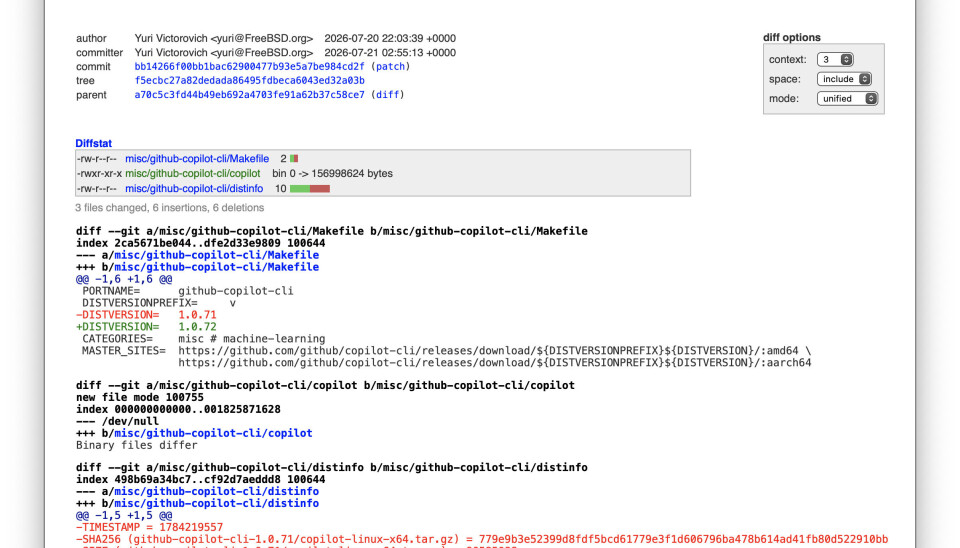
The FreeBSD project froze its ports repository on Wednesday. The reason turns out to be a slightly embarrassing Git-related oopsie where a version of Copilot got uploaded somewhere it should not have been.
The announcement of the 2026 Ports Repository Freeze went out on July 21 and remained in effect the following day, as explained in a message on the freebsd-announce mailing list. The mail delicately skirted around exactly what happened:
« The commit in question severed our ports tree mirroring to github.com due to their filesize hard limit of 100MB, and introduced a blob of questionable licensing into the repository history. »
The offending commit is this one.

It’s not a disaster; the problem is that the Ports repository is automatically mirrored to various places, including a read-only Github mirror – and as Github’s docs say, “GitHub blocks files larger than 100 MiB.”
There is already an official FreeBSD port of Copilot, but FreeBSD terminology is slightly confusing here: the “port” is effectively a sort of package that allows the Linux binary to run inside FreeBSD’s Linux emulation, called the Linuxulator. It isn’t a native FreeBSD version of Copilot, and the package is not meant to include the actual Copilot CLI binary – partly because that is under its own custom license. That’s what FreeBSD’s Kyle Evans meant by “questionable licensing”.
We don’t blame anyone for using any available resources to help with using GitHub. Navigating Linux, FreeBSD, and worst of all Git is hard, especially the last one. Git is aptly named – it’s not an acronym, it’s a real word: someone annoying or unpleasant. It is, however, now more or less the de facto standard version control system of the FOSS world. Despite not being a developer, the Reg FOSS desk worked with Git on a daily basis for over four years – blame the Docs as Code philosophy – and developed a deep and abiding dislike for it.
It’s not just us: it’s in an XKCD comic, so it must be true. (This vulture has directly lived the experience described in that comic.) Personally, we always found Git much harder work than the tar command. It should come as no surprise that multiple teams are working on compatible alternatives.
A Game of Thrones Trees
Just the day before some FreeBSD developer’s regrettably public mishap, a new version of one of those alternatives appeared: Game of Trees version 0.127.
Game of Trees, known as Got for short, is a Git-compatible version control system (VCS) developed by contributors to the OpenBSD Project. It’s been in development since 2019, and we feel that the project has a nice line in self-deprecation – starting with the homepage’s project description: “a version control system which prioritizes ease of use and simplicity over flexibility.”
This is, we suspect, in response to Git’s self-description, which says that it is “designed to handle everything from small to very large projects with speed and efficiency.”
We also like the Got project goals and especially the FAQ, which really does not beat about the bush:
« Does Got aim to replace Git?
No. Got does not aim to replace Git. Got can be used instead of Git (for some tasks), or in addition to Git. If you are already using Git and are happy with it, you don’t need Got. »
And even more succinctly, under the anchor “pointless”:
« What’s the point of all this? Why not just use Git?
If you are wondering why Got even exists, you can just ignore it. »
Got isn’t the only tool that aims to remain compatible with Git, but simplify the experience.
Gitless is another, which describes itself as “a simple version control system built on top of Git,” and says that it’s “easy to learn and use.” Unfortunately, development seems to have gone quiet: the last release appeared the same year that Got appeared.
Another (and even younger) Git-compatible VCS is Jujutsu, often called just “Jj”, and not to be confused with the traditional Japanese martial art Jiu Jitsu. Jujutsu the VCS has lots of documentation, but if it has a weakness, it’s that it rather assumes that you already know your way around VCS use in general and Git in particular. If that’s not the case for you, you might find Jujutsu for Everyone by Remo Senekowitsch more helpful. ®

Bitcoin Miner Poolin Files for Chapter 11 Bankruptcy

Blue Jays’ Addison Barger to have season-ending elbow surgery

VentureBeat Research: Where enterprise AI agent governance hasn’t caught up


-

 Politics6 days ago
The House | The City of London can help the new chancellor deliver growth in every postcode
-

 Crypto World6 days ago
Ripple Payments Joins MiCA With 14 Firms, Does It Mean Anything For XRP?
-

 Politics5 days ago
Democrats look to World Cup watch parties to register thousands of voters
-

 Fashion4 hours ago
Weekend Open Thread: Brooks Brothers
-

 Crypto World7 days ago
Ripple wins EU-wide access as ESMA adds it to MiCA register
-

 Crypto World4 days ago
Grayscale Files For Worldcoin ETF, WLD Registers Sharp Rise
-

 Tech4 days ago
Sail Virtually Aboard The “Itanic” With IA-64 Emulator
-

 NewsBeat4 days ago
Unregistered fitter used Gas Safe logo on business flyers
-
 Tech4 days ago
Turtle Beach Command Series KB7 review: a nifty screen-equipped gaming keyboard
-

 News Videos5 days ago
Big Money Is Entering XRP
-
 Business3 days ago
New Jersey voter registration controversy explained: How 6,600 noncitizens got on the rolls, and what happens next
-

 Crypto World6 days ago
Kaspersky exposes OkoBot’s 20-module crypto wallet attack
-
 Entertainment3 days ago
Johnny Depp’s R-Rated Gothic Cult Classic Gets New Release Ahead of Sydney Sweeney Remake
-

 NewsBeat7 days ago
Durham County Council to send out electoral registration emails
-

 Crypto World2 days ago
Ethics, other provisions in crypto Clarity Act to be further discussed
-

 Crypto World7 days ago
MiCA Licensing Faces Delays as ESMA Adds 14 CASPs to Register
-
 NewsBeat4 days ago
Shanghai science forum photos show China’s AI and robotics advances in rivalry with US
-

 Crypto World6 days ago
Chip Stocks Enter Bear Market After Moonshot Ai Unveils Kimi K3 Model
-

 Tech4 days ago
Watch Flock Safety CEO Garrett Langley discuss the future of surveillance at TechCrunch Disrupt 2026
-

 Tech5 days ago
Subway Sandwich Computers Get a Second Life as Gaming Machines
You must be logged in to post a comment Login