Connect with us
DAPA Banner

Tech

5 Helpful Tools And Gadgets Campers And Hikers Tend To Forget

Published

on


We may receive a commission on purchases made from links.

The National Park Service recently released the results of a study conducted in 2024, intended to gauge the level of preparedness of day hikers and trail runners in Rocky Mountain National Park. This study, summarized here, surveyed hikers and runners about the gear they carried with them, along with personal data and their own opinions about their level of wilderness-readiness. Results showed that most of those surveyed didn’t bring several items from the National Park Service’s 10 Essentials — a list of emergency items posted at most trailheads in national parks, including Rocky Mountain National Park, that includes first aid, navigation, shelter, and hydration. 

As a Colorado resident, very amateur hiker, and husband to an impressive person that completed the Colorado Trail by herself, I can attest to a lot of the findings of the field survey. My partner is absolutely capable and incredibly wilderness-prepared on her longer hikes, and often talks about people she’s met on the trail that were woefully underprepared for weather or accidents. While she’s always happy to help, the very nature of, well, nature, means you may not encounter another person if an emergency strikes. 

Advertisement

With that in mind, SlashGear has compiled five helpful tools and gadgets campers and hikers tend to forget. These items represent the most-forgotten categories on the survey we mentioned previously — hydration, tools/knife, fire starter, navigation, and emergency shelter — and are products my wife and I have experience with. Hopefully they’ll help readers be prepared for anything on their next trip into the great outdoors.

Advertisement

LifeStraw Peak Squeeze

While the study we’re referencing indicates that most outdoorspeople carry extra water, it also shows that most forget to bring some form of water treatment along for the journey. To some degree, that makes sense — say you’re on a short hike and you’ve brought a big, heavy water bottle (like Shark Tank’s LARQ Water Bottle) in your pack — why waste the space? However, that’s when emergencies happen. One minute you’re wandering off trail to inspect a neat tree. The next, you’re propped up against that tree with a broken ankle, no passersby, and a rapidly depleting water supply. In that instance, the ability to filter water for safe drinking is paramount.

One of the best known brands in water treatment is LifeStraw, the company that makes the popular personal water filter that allows users to drink from questionable sources without worry. While that’s a great gadget to have in a pinch, a better option for most folks is the LifeStraw Peak Squeeze. It combines a lightweight pouch with a removable microfilter, meaning you can use the filter as a straw, or threaded onto another bottle. The pouch and filter are also incredibly pack-friendly, rolling up to about the size of a Twinkie. It’s a logical evolution of the popular straw, allowing you to dip the bag in a stream or pond and filter out almost everything that could leave you regretting that decision.

You can order a LifeStraw Peak Squeeze for around $40 on Amazon.

Advertisement

Ontario RAT 2

Purists will tell you a fixed-blade knife is the way to go when choosing an outdoor knife. They’re correct in that a fixed blade is often stronger and more useful for the tasks you’ll be performing when backcountry camping or in survival situations. For a day hike or overnight camping, something that’s strong and durable, but perhaps easier to pack and carry is a folding knife. While it may not be as sturdy as a fixed-blade knife, that trade off comes with a little more safety and portability. If you’re looking to carry something a little more versatile on your outdoor adventures, check out SlashGear’s guide to multitool alternatives to Leatherman.

A knife I purchased last year after reading multiple positive reviews is the Ontario RAT 2. This is one of the best pocket knives out there. It’s incredibly durable, comfortable in hand, small enough to comfortably carry in a pocket, and super affordable. The RAT 2 features a three-inch blade, a nylon handle, and a little lanyard hole. It’s a no-frills tool, but sometimes that’s what you want in a knife. Mine has kept its edge after a few hikes and several hundred boxes that needed breaking down at work, which is a testament to the quality AUS-8 steel used in the blade.

Advertisement

The Ontario RAT 2 can be ordered from Amazon for about $40; for a more robust selection of handle and blade colors, order direct from Ontario Knife Company’s website.

Advertisement

Pyro Putty Elite Rechargeable Dual Arc Lighter

Fire starters aren’t necessarily something you’d think about while packing a light bag for a day trip, but it never hurts to be prepared. You could bring a lighter and hope for the best with whatever tinder you can find, but if you’re caught by a storm or forced to make camp, having something like Pyro Putty could be a life saver. These little bundles are waterproof, quick to light, and keep burning even in high winds. They’re sticky, allowing you to attach them directly to wood, and even come in special formulas for the season and temperatures in which you’ll be using them.

You’ll still need a fire source to ignite Pyro Putty, like a lighter, match, or ferro rod. You could also invest in the handy Pyro Putty Elite Rechargeable Dual Arc Lighter, a gadget that features a little waterproof storage compartment in its base for a bit of Pyro Putty. It’s rechargeable via mini-USB, glows in the dark, and Phoneskope claims you’ll get 300 arcs out of a single charge. While I’d still suggest keeping a few waterproof matches in your pack just in case, this is a great starter kit for the outdoorsperson or campfire enthusiast in your life. The Pyro Putty Elite Rechargeable Dual Arc Lighter comes with a single pouch of Pyro Putty (which the manufacturer claims can start up to 30 fires) and can be purchased from Amazon for about $30.

Advertisement

McMurdo FAST FIND 220 & Spot X

Most of us consider our cell phones to be our link to the rest of the world, but what happens when you’re outside of cell service range? While that’s not as common an occurrence as it once was, areas where service is still lacking also happen to be some of the most popular areas for hiking and camping — they call it “going off grid” for a reason, after all.

For emergency situations where a phone can’t get a signal, a Personal Locator Beacon is a life-saving last resort. Personal Locator Devices, or PLBs, are devices that send a one-way signal to search and rescue. The McMurdo FAST FIND 220 is among the most popular due to its relatively low price and a lack of subscription fees. It’s waterproof, has a battery life of over six years, and produces a signal to rescue services for a minimum of 24 hours. The Fast Find also includes an LED flashlight programmed for SOS morse code, and can be ordered from Amazon for $275.

There are also two-way satellite messengers like the Spot X, off-grid tech essentials which trade off the super-powerful beacon of a PLB for the ability to send messages and location data to friends. There’s still emergency functionality along with text messaging, but these devices typically require a subscription for service. The Spot X is available on Amazon for $250.

Advertisement

SOL Emergency Bivvy

The most commonly forgotten piece of gear from the National Park Service survey we’re referencing for this article was some form of emergency shelter. Campers or thru-hikers often carry tents for overnight stops, but anyone venturing out into the wilderness, including trail runners, cyclists, and day hikers, should have some kind of shelter on hand, even if it’s just an ultralight space blanket or a tarp they picked up at Harbor Freight.

Bivy sacks, like the SOL Emergency Bivvy, are kind of like an emergency sleeping bag. They’re lightweight, easy to pack, and waterproof, windproof, and heat-reflective. Anyone with a backpack can easily fit this pop-can-sized emergency bag into the bottom of their pack, and at less than four ounces, you probably won’t even notice it’s in there. The bivvy is reusable, and the manufacturer says it reflects up to 90% of the user’s body heat, making it a valuable resource if caught by harsh weather. The SOL Emergency Bivvy includes a rescue whistle and a paracord drawstring that doubles as tinder for starting a fire, comes in safety orange or green, and can be delivered via Amazon for about $25.

Advertisement


Source link

Advertisement
Continue Reading
Click to comment

You must be logged in to post a comment Login

Leave a Reply

Tech

The G512 X is Logitech’s most advanced and customizable gaming keyboard yet

Published

on

Thanks to the adoption of features like rapid triggers, analog switches and TMR sensors, the tech in fancy gaming keyboards has changed surprisingly quickly in the past few years. So to keep up with the pace of development, Logitech is putting a bunch of advanced components in its latest flagship offering — the G512 X — to create what may be its most configurable keyboard to date.

Available in both 75 and 98 percent layouts, the G512 X is based on a novel design that supports both mechanical and analog switches. Out of the box, every key features PBT keycaps and uses one of Logitech’s MX mechanical switches. However, for important buttons like WASD, users can swap in up to nine bundled Gateron KS-20 magnetic analog switches. This means that when combined with the keyboard’s 39 tunneling magnetoresistance (TMR) switch beds, users can enable support for customizable rapid triggers and multipoint actuation, complete with five bundled second actuation pressure point (SAPP) rings in case you need even more control over every keystroke. The one potential downside is that Logitech only added TMR switch beds to the left side of the keyboard, so if you prefer more unusual keybinds, you won’t have quite as many configuration options.

The 39 TMR sensors on the left of the keyboard are the ones that support the included TMR switches.

The 39 TMR sensors on the left of the keyboard are the ones that support the included TMR switches. (Logitech)

Meanwhile, to meet the demands of competitive gamers who need lightning-fast response times, Logitech added an 8K polling rate. This includes both 8K reporting and processing to deliver input times of just 0.125 milliseconds. Elsewhere, the G512 X comes with dual dials, a large RGB lightbar and game mode presets — all of which can be tweaked in Logitech’s G Hub app.

However, the coolest thing about the G512 X might be all the handy little details scattered across the keyboard. For example, its adjustable feet serve double duty as keycap and switch pullers, so when you want to adjust your layout, you won’t need to go searching elsewhere for the right tool. On top of that, there is built-in storage for the nine included magnetic analog switches and five SAPP rings, so you’ll always have them on hand if you want to make changes. Finally, while it is an optional accessory, Logitech created a transparent palm rest with a laser-etched surface that will enhance the G512 X’s onboard RGB lighting.

Advertisement
Logitech's optional palm rest really boosts the output of the Logitech G512 X's front-mounted RGB lightbar.

Logitech’s optional palm rest really boosts the output of the Logitech G512 X’s front-mounted RGB lightbar. (Logitech)

Unfortunately, at $180 for the 75 percent layout or $200 for the 98 percent model, the G512 X is a bit pricey. And unlike some other members of Logitech’s G5 family, there’s no option for a wireless variant. But if you want a keyboard with practically all the latest tech and a ton of customizability (including the ability to select linear, tactile or clicky switches), the G512 X is a very intriguing option for demanding gamers.

The G512 X is available directly from Logitech today, with wider availability slated for May 2.

Source link

Advertisement
Continue Reading

Tech

4 Perks You Probably Didn’t Realize Come With Buying Tires At Sam’s Club

Published

on


Buying new tires is rarely fun, but it feels a little better when you know you’re getting something extra with your purchase. Any time a tire retailer throws in some perks, you can rest easier knowing you got more value out of that new set you bought. While most focus on pricing or brand, the real value shopper keeps an eye out for who has the best incentives, as well. Sam’s Club is one such place. If you’re a member, your tire purchase comes bundled with several benefits you might not even know about.

Like all the best warehouse clubs, Sam’s Club wants to make the shopping experience feel more elevated for tis members. This is especially true of its Tire & Battery Center. Members get a whole range of tire perks, and that’s in addition to the discount you get from simply being a part of the warehouse. These benefits are automatically included with your tire purchase, too, so you don’t even have to do (or pay for) anything extra to enjoy them.

Advertisement

Free lifetime tire maintenance

You get free lifetime tire maintenance when you buy tires at Sam’s Club. It’s a standing benefit that lasts for the usable life of the tires (defined as when tread depth reaches 2/32 of an inch). This maintenance package includes free tire rotations, balancing, tire pressure top-offs, tread depth checks, and flat repairs, all at no additional cost to you.

These no-cost maintenance tasks add up fast. Rotations alone are recommended every six months or 6,000 miles, and the average cost of a rotation and balance can be over $130 on average. Over the life of the tires, that could add up to over a thousand extra bucks in your pocket. As long as you buy and install them through the Tire & Battery Center, you’re covered for the life of the tire. Add in the free flat repairs, which are over $50 on average, and that’s even more cash you don’t have to spend.

Advertisement

Road hazard protection

Potholes, nails, broken glass, even ladders… you’re bound to encounter at least one out there. Road hazards are simply a part of life as a driver, and there’s no way to predict when or where you might encounter one. But encounter one you surely will. That’s why Sam’s Club’s road hazard protection is such a nice advantage. They go beyond the manufacturer’s standard warranty to cover any damage caused by these everyday driving hazards. If one of your Sam’s club tires gets punctured out on the road and can’t be safely patched, Sam’s Club gives you a replacement credit pro-rated based on the remaining tread.

Essentially, Sam’s Club makes it so that you’re only responsible for the portion of the tire you used. That’s so nice, especially if the tire’s on the newer side. That pro-rated coverage will shave a ton off the cost of replacing the tire replacement. No separate package purchase or special enrollment required, either. It’s automatically included as part of the installation package.

Advertisement

Emergency roadside assistance

At Sam’s Club, every qualifying tire purchase comes with up to four years of 24/7 emergency roadside assistance. Starting from from the date of purchase, you’re covered for a wide range of common roadside issues. This includes towing, flat tire assistance, jump-starts, fuel delivery, and lockout service. You won’t find that in a Costco tire package.

To use it, all you have to do is call the toll-free number they give you at purchase. As long as your membership’s active, you can call and request assistance at any time, day or night. It’s kind of like their own version of AAA’s roadside assistance, in a way. Whether it’s a dead battery in a parking lot or a flat tire on the highway, knowing you have help available saves you the headache of paying for a separate subscription service… or, worse, wishing you had. By bundling it into tire purchases, Sam’s Club saves you hundreds you would have had to spend on something like AAA.

Advertisement

Discounted installation

All Sam’s Club members, regardless of tier, get competitive pricing on all their major tire brands. But Plus members get another perk: a 50% discount on tire installation when purchasing a set of four tires. Given that installation typically costs $20 per tire, this discount translates to an immediate savings of $40 per set. Costco doesn’t charge installation fees, but Sam’s Club tends to have cheaper tires. With the Plus discount on those installation fees, Sam’s tires look like the better deal.

The installation package includes mounting, balancing, valve stem installation, tire pressure monitoring system (TPMS) reset, and environmentally responsible disposal of old tires. That last one often shows up on your receipt as a hidden fee at other places, so it’s really good to know you’re getting a discount on it as a Plus member. Even if you’re just a base-tier Sam’s Club member, don’t be dismayed: you still get all the other perks listed above.

Advertisement


Source link

Advertisement
Continue Reading

Tech

YouTube is turning into an answer engine with a new conversational search feature

Published

on

YouTube Premium subscribers in the US (18 years and older) have something new to play with. As reported by The Verge, the company is testing a conversational AI search experience called Ask YouTube that is unlike anything YouTube has offered before.

So what exactly is Ask YouTube?

Instead of typing keywords into a search bar and hoping for the best, you can now ask YouTube a full question and get a response that feels more like a conversation. You can enable this feature using YouTube’s experimental feature

Once you do, you will notice an Ask YouTube button built into the YouTube search bar. When you click the search bar, YouTube surfaces suggested prompts like “What caused the 2008 financial crisis?” or “How to fix a stripped screw.” These might be trending searches or based on your own YouTube history. 

You can either search for these trending search terms or enter your own search term and hit the Ask YouTube button to perform the search. When I searched for “prisoners’ dilemma”, YouTube gave me a text overview followed by a featured video. 

Then there were additional videos under different subheadings, including “step-by-step logic of the dilemma” and “real-world applications,” followed by quick concept overviews using shorts. 

I performed multiple searches and found that the search results are a mix of text summaries, long-form videos timestamped to relevant sections, and galleries of YouTube Shorts organized under themed headers. It is a genuinely different experience from the standard search results page.

Does it actually work?

In my limited testing, the AI search worked really well. Not only did it give me an overview of the topic and relevant videos, but I also liked that it sorted them into different categories, giving me an idea of their content. 

Advertisement

Whether it’s better or worse than the normal YouTube search, I cannot comment. I will need to use it for longer to make any such assessment.

Source link

Advertisement
Continue Reading

Tech

Prototype Camera Finally Photographs the Paths of Invisible Ghost Particles

Published

on

Prototype Camera Ghost Particles
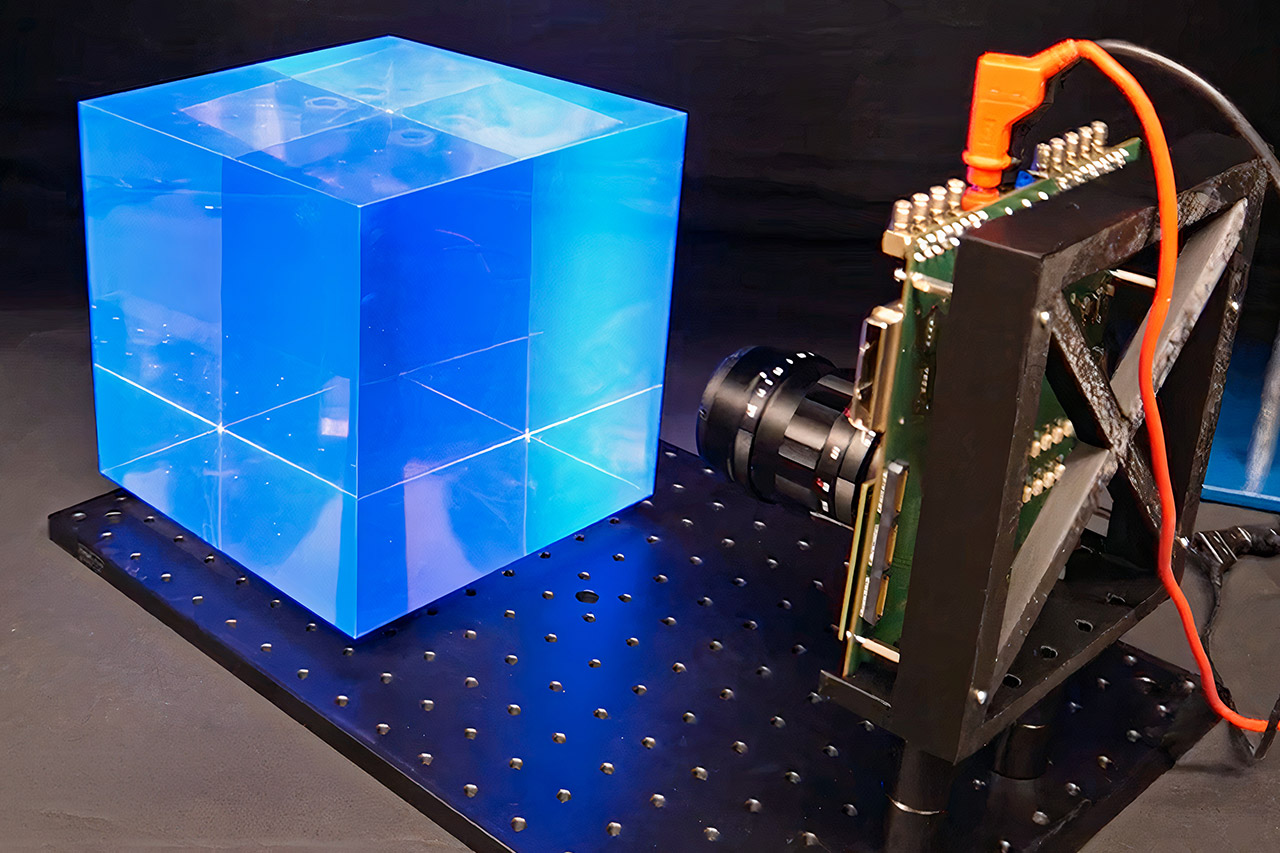
Scientists in Switzerland have developed a prototype camera capable of capturing clear three-dimensional images of neutrinos, particles so elusive they often earn the label ghost particles. Neutrinos come in huge numbers from the sun and other sources throughout space, yet they interact so rarely with ordinary matter that trillions pass through a person every second without any effect


For years, detecting them needed large subterranean containers filled with specific liquids or massive arrays of sensors buried deep in the ground to capture the exceedingly rare occasions when one collides with an atom. That works, but it’s a bit pricey and doesn’t allow scientists to track the particles’ travels very well. However, a team of researchers from ETH Zurich and EPFL has recently developed a new device called PLATON, which is a far easier way of doing things.

Sale


Xtra Muse, Vlogging Camera with 1” CMOS & 4K/120fps Videos, Pocket Camera with 3-Axis Gimbal Stabilizer…
  • Cinematic-Style Footage – Experience the power of Xtra Muse’s 1-inch CMOS sensor, capable of recording breathtaking 4K resolution videos at 120fps…
  • Ultra-Steady Shooting – No more shaky videos! Xtra Muse’s advanced 3-axis gimbal camera stabilizer ensures exceptional smoothness. Enjoy smooth…
  • Effortless Framing – Enjoy Xtra Muse’s expansive 2-inch touch screen, and switch between horizontal and vertical shooting effortlessly.

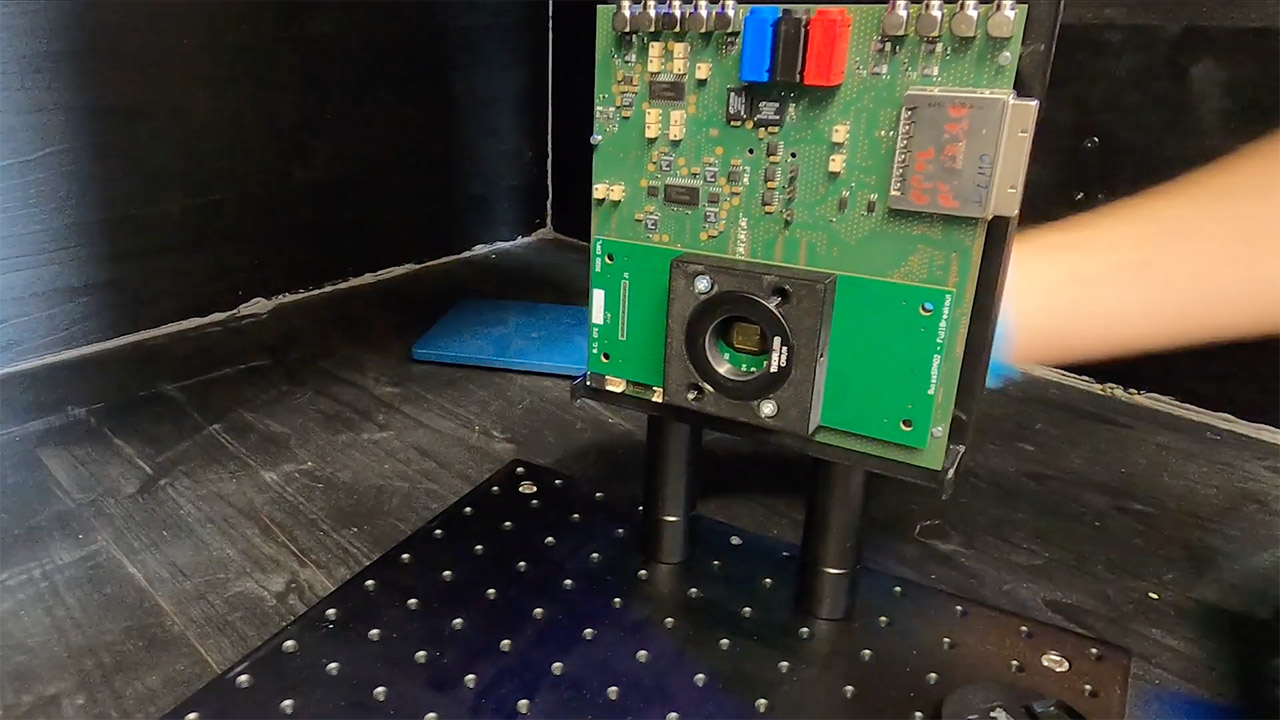
The idea is to use a solid block of a special material called a scintillator, which emits tiny flashes of light whenever a particle passes through it, and to that block is attached a specially designed camera with a grid of tiny lenses and a sensor that can pick up individual photons of light, as well as the exact time they hit it.

Advertisement

Prototype Camera Ghost Particles
When a neutrino interacts with the block, it produces a brief burst of energy that is converted into light, and the camera captures the pattern of light flashes from a variety of angles at the same time. The data is then processed by some sophisticated software, which uses timing information and complex pattern recognition to create a comprehensive 3D representation of the particle’s route. Previous detectors would slice the scintillator into thousands of small bits and connect them with fibers to determine where the particles were, but this made them all large, expensive, and completely unworkable. PLATON does all of the heavy lifting with the camera.

In laboratory experiments, the new device performed admirably, reconstructing tracks from electrons emitted by a known radioactive source. Simulations based on genuine neutrino interactions indicated that it could pinpoint sites with an accuracy of roughly a fifth of a millimeter. According to team member Davide Sgalaberna, this simplifies the process of creating particle detectors while also providing a high level of 3D precision.

Prototype Camera Ghost Particles
This technology opens a host of new possibilities for future studies that will enable researchers to investigate neutrinos more efficiently, and it could be valuable in a variety of other areas as well. Medical imaging is another area where accurate readings inside materials are critical. Of course, there is still a lot of work to be done before it can be scaled up to the size required for large science projects, but for now, this prototype looks promising. As technology advances and becomes more accessible, it has the potential to reveal a great deal more about these fundamental particles and how they help form the cosmos.
[Source]

Source link

Advertisement
Continue Reading

Tech

Alleged Silk Typhoon hacker extradited to US for cyberespionage

Published

on

China

A Chinese national accused of carrying out cyberespionage operations for China’s intelligence services has been extradited from Italy to the United States to face criminal charges.

According to a DOJ announcement, Xu Zewei is alleged to be a contract hacker for China’s Ministry of State Security (MSS) who conducted breaches between February 2020 and June 2021 as part of a coordinated intelligence-gathering campaign.

Xu was previously arrested in Milan, Italy, in 2025 at the request of U.S. authorities for his alleged ties to the Silk Typhoon hacking group.

image

The indictment links Xu to a series of attacks attributed to the Chinese Silk Typhoon hacking group, also known as Hafnium, which exploited vulnerabilities in internet-facing systems to gain initial access to victim networks. Once inside, the attackers performed reconnaissance, deployed malware, and stole data.

The DOJ says Xu was involved in intrusions targeting COVID-19 research organizations, where the attackers allegedly sought to obtain data on vaccines, treatments, and testing.

Advertisement

U.S. authorities also allege that Xu and his co-conspirators exploited Microsoft Exchange Server zero-day vulnerabilities beginning in late 2020 as part of a widespread campaign to compromise email servers and gain access to victim networks.

After breaching vulnerable Exchange servers, attackers deployed web shells that allowed them to access mailboxes, move laterally within networks, and exfiltrate data. The widespread exploitation led to global incidents impacting thousands of organizations before patches were fully available.

Prosecutors say Xu and his co-defendant operated as contracted hackers under the direction of MSS officials.

“According to court documents, officers of the PRC’s Ministry of State Security’s (MSS) Shanghai State Security Bureau (SSSB) directed Xu to conduct this hacking,” the DOJ said.

Advertisement

“When Xu conducted the computer intrusions, he allegedly worked for a company named Shanghai Powerock Network Co., Ltd. (Powerock),” the announcement adds, describing it as one of many firms used to carry out hacking operations on behalf of the Chinese government.

Xu is expected to appear in federal court, where he faces multiple counts related to computer intrusions and conspiracy.


article image

AI chained four zero-days into one exploit that bypassed both renderer and OS sandboxes. A wave of new exploits is coming.

At the Autonomous Validation Summit (May 12 & 14), see how autonomous, context-rich validation finds what’s exploitable, proves controls hold, and closes the remediation loop.

Claim Your Spot

Source link

Advertisement
Continue Reading

Tech

The Risks Of Anonymity In The Age Of Generative AI

Published

on

from the desperately-seeking-satoshi dept

As its name suggests, generative AI is designed to generate material in response to prompts by drawing on its probabilistic database built up through analyzing huge quantities of training input. But it can draw on those patterns to analyze other files, and that’s also a widely used application. Writing in The Argument, Kelsey Piper encountered an interesting variant of that approach:

Recently, Anthropic released a new version of Claude, Opus 4.7. I did what I usually do when a new AI model is released by Google, OpenAI, or Anthropic and ran a bunch of tests on it to see what it can do. One of those tests is to paste in some text from unpublished drafts of mine and ask it to guess the author.

From only the above text [not shown here], 125 words, Claude Opus 4.7 informed me that the likeliest author is Kelsey Piper. This is an Opus 4.7-specific power; ChatGPT guessed Yglesias, and Gemini guessed Scott Alexander. I did not have memory enabled, nor did I have information about me associated with my account; I did these tests in Incognito Mode.

As Piper admits:

Advertisement

this is far from an impossible feat of style identification — a lot of my writing is public on the internet, and this is clearly the start of a political column, narrowing the possible authors down dramatically.

She went on to input less obvious material. For example, an “unpublished draft of a school progress report in a completely different register”:

“Kelsey Piper,” said Claude. (ChatGPT guessed Freddie deBoer. Gemini guessed Duncan Sabien.)

An unpublished fantasy novel produced a similar result, although:

in that case it took more like 500 words for Claude to inform me that it’s the work of Kelsey Piper (whereas ChatGPT flattered me by guessing that I’m real fantasy novelist K.J. Parker).

And finally, “a college application essay I wrote 15 years ago, when my prose style was vastly worse and frankly embarrassing to reread”:

“Kelsey Piper,” said Claude, and in this case, also ChatGPT.

Piper comments:

Advertisement

Right now, today’s AI tools probably can be used to deanonymize any writer who has a large public corpus of writing under their real name and also writes anonymously, unless they have been extremely careful, for years, to make sure that nothing written under their secondary account has the stylistic fingerprints of their primary one. Many academics and industry researchers, for instance, have reported being identified from a draft or in the middle of a chat.

And she concludes:

Whatever goods anonymity ever offered us, we will have to do without them. I don’t want the anonymous posters to all go away and for everyone to frantically delete all their old internet presence before it surfaces, but more than anything, I don’t want them to be surprised.

Those links to other cases of unpublished material being recognized by AI show that Piper’s experience was not a one-off, although the results remain in the realm of anecdata. But even if imperfect, the ability of generative AI to carry out this kind of analysis quickly and often accurately represents an important new option for the well-established field of stylometry. Wikipedia explains:

Stylometry may be used to unmask pseudonymous or anonymous authors, or to reveal some information about the author short of a full identification. Authors may use adversarial stylometry to resist this identification by eliminating their own stylistic characteristics without changing the meaningful content of their communications. It can defeat analyses that do not account for its possibility, but the ultimate effectiveness of stylometry in an adversarial environment is uncertain: stylometric identification may not be reliable, but nor can non-identification be guaranteed; adversarial stylometry’s practice itself may be detectable.

The limitations of stylometry were demonstrated in John Carreyrou’s attempt to reveal the true identity of Bitcoin’s pseudonymous creator, Satoshi Nakamoto, published in The New York Times a few weeks ago. Carreyrou concluded that various real-world coincidences plus linguistic evidence indicated that Bitcoin was created by the 55-year-old British computer scientist Adam Back, something Back denies. Carreyrou’s attempts to use computerized stylometry (not the AI services Piper drew on) were unsatisfactory, and he eventually adopted a more hands-on approach to text analysis, which involved looking at Satoshi’s vocabulary, grammatical hyphenation mistakes and the use of British spellings.

Despite Carreyrou’s lack of success, stylometric analysis by generative AI is likely to become more common in many disciplines for the simple reason it is so quick, easy and cheap to carry out. Even if its results are unreliable, people may find it useful as a stimulus for further investigations. And as we know, the fact that generative AI systems can churn out nonsense hasn’t stopped hundreds of millions of people from using and trusting them anyway.

Advertisement

Follow me @glynmoody on Mastodon and on Bluesky.

Filed Under: adam back, anonymity, bitcoin, chatgpt, claude, deanonymization, gemini, generative ai, grammar, john carreyrou, opus, satoshi nakamoto, stylometry, wikipedia

Companies: anthropic, google, new york times, openai

Source link

Advertisement
Continue Reading

Tech

Robinhood account creation flaw abused to send phishing emails

Published

on

Robinhood

Online trading platform Robinhood’s account creation process was exploited by threat actors to inject phishing messages into legitimate emails, tricking users into believing their accounts had suspicious activity.

Starting last night, Robinhood customers began receiving “Your recent login to Robinhood” emails stating that an “Unrecognized Device Linked to Your Account” was detected, containing unusual IP addresses and partial phone numbers.

“We detected a login attempt from a device that is not recognized,” reads the phishing email. “If this was not you, please review your account activity immediately to secure your account.”

image

Included in the email was a button titled “Review Activity Now”, which led to a phishing site at robinhood[.]casevaultreview[.]com, which is now down. 

However, screenshots on Reddit indicate that the site was likely used to try to steal Robinhood credentials.

Advertisement

What made the emails convincing is that they came from the legitimate Robinhood email address noreply@robinhood.com and passed SPF and DKIM email security checks.

Exploiting Robinhood account creation onboarding flaw

Attackers abused Robinhood to generate phishing emails by exploiting a flaw in the company’s onboarding process that allowed them to inject arbitrary HTML into its account confirmation emails.

BleepingComputer confirmed that when a new Robinhood account is registered, the company automatically sends a “Your recent login to Robinhood” email to the associated address, containing the registration time, IP address, device information, and approximate location.

To inject the phishing message, threat actors modified their device metadata fields to include embedded HTML, which Robinhood did not properly sanitize.

Advertisement

This HTML was then injected into the Device: field of the account creation email, causing it to render as a fake “Unrecognized Device Linked to Your Account” message.

To target Robinhood customers, attackers likely used lists of known customer email addresses from previous data breaches. In November 2021, Robinhood suffered a data breach impacting 7 million customers, with the data later offered for sale on a hacking forum.

The attackers also used Gmail’s dot aliasing behavior, where adding periods to an address does not change its destination, allowing them to register accounts using variations of real email addresses while still delivering the messages to the intended recipients.

As a result, recipients received what appeared to be a standard login alert, but with an embedded phishing section warning of “unrecognized activity” and urging them to review their account.

Advertisement

Robinhood confirmed the incident in a statement posted to X.

“On Sunday evening, some customers received a falsified email from noreply@robinhood.com with the subject line ‘Your recent login to Robinhood.’,” posted RobinHood.

“This phishing attempt was made possible by an abuse of the account creation flow. It was not a breach of our systems or customer accounts, and personal information and funds were not impacted.”

BleepingComputer has confirmed that Robinhood has fixed this flaw by removing the Device: field that was previously abused from their account creation emails.

Advertisement

Robinhood advises users who received the message to delete it and avoid clicking any links.


article image

AI chained four zero-days into one exploit that bypassed both renderer and OS sandboxes. A wave of new exploits is coming.

At the Autonomous Validation Summit (May 12 & 14), see how autonomous, context-rich validation finds what’s exploitable, proves controls hold, and closes the remediation loop.

Claim Your Spot

Source link

Advertisement
Continue Reading

Tech

OpenAI developing AI agent smartphone with Qualcomm and MediaTek, targeting 300-400M annual shipments by 2028

Published

on

TL;DR

OpenAI is developing a smartphone where AI agents replace apps, with Qualcomm and MediaTek jointly designing the custom processor and Luxshare exclusively manufacturing, according to Ming-Chi Kuo. The analyst projects 300-400 million annual shipments, targeting mass production in 2028. Qualcomm surged 13% on the report. The supply chain is credible, Luxshare builds AirPods, Qualcomm powers 75% of Galaxy S26, but OpenAI has never shipped hardware, and every previous AI device (Humane Pin, Rabbit R1) has failed. This is OpenAI’s second hardware track alongside the Jony Ive project.

OpenAI is developing a smartphone built around AI agents rather than apps, with Qualcomm and MediaTek jointly designing the custom processor and Luxshare Precision Industry co-designing and exclusively manufacturing the device, according to Ming-Chi Kuo, the TF International Securities analyst whose Apple supply-chain intelligence has made him the most closely followed hardware analyst in the industry. Kuo projects 300 to 400 million annual shipments if the device succeeds, a figure that would exceed Apple’s iPhone volumes and place the phone in direct competition with the two companies that control roughly 40% of the global smartphone market. Specifications and the supplier list are expected to be finalised by late 2026 or the first quarter of 2027, with mass production targeted for 2028. Qualcomm’s shares surged as much as 13% in premarket trading on the report. None of the three companies, Qualcomm, OpenAI, or MediaTek, confirmed the partnership. This is an analyst report, not an announcement, but the supply chain Kuo describes is not speculative. It is the supply chain that already builds the devices you own.

Advertisement

The concept

The phone Kuo describes is not a smartphone with an AI assistant. It is a device where the AI agent is the interface and the app is obsolete. Instead of downloading applications and navigating screens, users would interact with agents that handle tasks directly: ordering transport, booking restaurants, managing email, conducting research, writing messages. The architecture would process lighter tasks on-device, including context awareness, memory management, and smaller AI models, while offloading complex inference to the cloud. The device would maintain what Kuo calls “full real-time state,” continuously capturing a user’s location, activity, communication, and environmental context to feed the agents. This is the vision Qualcomm CEO Cristiano Amon has been articulating throughout 2026: that AI agents will replace the mobile operating system and apps as the primary interaction layer, and that the hardware must be designed from scratch to support continuous, power-efficient AI inference rather than retrofitting existing chipsets with neural processing units bolted on.

The concept is separate from OpenAI’s other hardware project with Jony Ive, the former Apple design chief whose company io is developing a non-phone device, reportedly a smart speaker with a camera first, then glasses, a lamp, and earbuds, with the first product expected in early 2027. OpenAI is pursuing two parallel hardware strategies: a device that reimagines what a personal computer looks like without a screen, and a device that keeps the phone form factor but replaces everything that runs on it. Apple is testing AI smart glasses with a custom chip, cameras, and Siri powered by a Gemini model, targeting 2027. The question of whether AI lives in your phone, on your face, or in a speaker on your counter is being answered simultaneously by every major technology company, each with a different bet. OpenAI is betting on all of them at once.

The supply chain

The credibility of the report rests on the supply chain, not the concept. Luxshare Precision Industry is a major Apple supplier that assembles AirPods, Apple Watch components, and an increasing share of iPhones. Qualcomm’s Snapdragon 8 Elite Gen 5 powers 75% of Samsung’s Galaxy S26 series and has, for the first time, overtaken Apple in raw multi-core and GPU performance. MediaTek’s Dimensity 9500 matches Qualcomm and Apple in CPU performance at lower cost with better efficiency. These are not the suppliers of a concept phone. They are the suppliers of phones that ship in the hundreds of millions. Qualcomm’s acquisition of Edge Impulse, an edge AI developer platform, in 2025 signalled the company’s strategic commitment to on-device AI inference across device categories. The Snapdragon 8 Elite Gen 5’s Hexagon NPU delivers 37% faster AI processing than its predecessor, supports agentic AI that learns from user behaviour, and includes a personal knowledge graph and continuous context awareness through an upgraded sensing hub. Qualcomm is also reportedly building custom 3D DRAM specifically optimised for AI workloads on mobile devices. The silicon for the phone Kuo describes does not need to be invented. The components exist. The question is whether the software paradigm works.

The financial context matters. Qualcomm’s stock was trading at $149.84 before the report, down from a 52-week high of $205.95, with earnings growth declining 46.9% and gross margins down to 55.1%. The company reports earnings on April 29, two days after the Kuo report. In February, Bloomberg reported that Qualcomm gave a “tepid forecast in sign of shaky phone market.” An OpenAI partnership would represent a new revenue stream in a market where Qualcomm’s traditional business, supplying modems and processors to phone manufacturers, is under pressure from Apple’s efforts to develop its own modem chips and MediaTek’s encroachment on the premium Android segment. Qualcomm would be helping build a device designed to challenge the iPhone while continuing to supply Apple with modem chips through at least 2027, a business relationship that embodies the contradictions of the semiconductor supply chain.

The graveyard

The AI device category has produced more failures than products. The Humane AI Pin, a $699 wearable with a laser projector that beamed information onto the user’s palm, was permanently bricked on February 28, 2025, when HP acquired Humane’s remnants for $116 million and shut down the servers. The Rabbit R1, a $199 “large action model” device, attracted 100,000 pre-orders but retained only 5,000 active users after five months, a 95% abandonment rate. Its founder admitted the device launched too early. Both failed for the same reason: they created new form factors that solved no problem the smartphone did not already solve, at price points that demanded the user carry a second device. The OpenAI phone takes a fundamentally different approach. It is not an additional device. It is a replacement for the device 4.7 billion people already carry, in the same form factor, with the same basic capabilities, but with a radically different interaction model. Whether that is enough to avoid the graveyard depends on whether agents can do what apps do, better, faster, and without the friction of learning a new paradigm.

Advertisement

AI is already reshaping the mobile app ecosystem, with “vibe-coded” applications flooding the App Store in such volume that Apple has had to crack down on submissions. The EU is preparing to force Google to open Android to rival AI assistants including ChatGPT and Claude under the Digital Markets Act, requiring equal system-level access for voice activation and deep integration. The smartphone’s software layer is already in flux. Samsung’s Galaxy S26 runs a triple AI engine with Gemini, Perplexity, and Bixby. Google’s Pixel 10 hands off multi-step tasks to background AI agents. Apple Intelligence processes queries on-device with an emphasis on privacy. Every major phone manufacturer is moving toward AI-first experiences, but all of them are constrained by backward compatibility with billions of existing apps and the operating systems that run them. OpenAI’s advantage, if the phone materialises, is that it has no legacy. It can design a clean-slate interaction model without worrying about whether Instagram’s notification system works or whether the banking app renders correctly. The disadvantage is that users may not want a clean slate. They may want their apps and an AI assistant that works around them, which is what Samsung, Google, and Apple already offer.

The question

Kuo’s projection of 300 to 400 million annual shipments would make the OpenAI phone one of the most successful consumer electronics products in history. For context, Apple ships roughly 230 million iPhones per year. Samsung ships approximately 220 million Galaxy phones. A new entrant reaching those volumes has no precedent in the smartphone era. The projection reflects the scale of OpenAI’s ambition, not a reasonable base case for a first-generation device from a company that has never manufactured hardware, sold through carriers, managed warranty claims, or operated a supply chain at consumer scale. The Jony Ive device carries the same risk: a company whose expertise is in large language models attempting to become a consumer electronics manufacturer, a transition that requires competencies in industrial design, supply chain management, retail distribution, and after-sales service that OpenAI does not have and cannot acquire by hiring one designer, however talented.

The 2028 timeline gives OpenAI two years to finalise specifications, secure component supply, build manufacturing capacity, develop the agent-first software platform, negotiate carrier partnerships, establish retail distribution, and convince hundreds of millions of consumers to abandon their iPhones and Galaxy phones for a device built by a company that has never shipped hardware. The Humane AI Pin took longer than that and shipped a device that lasted nine months before being permanently disabled. The ambition is extraordinary. The supply chain is credible. The concept addresses a genuine architectural limitation of current smartphones, which were designed around apps in 2007 and have not fundamentally changed since. But the distance between a credible supply chain report and a shipping product that displaces the iPhone is the distance between a thesis and a business, and every company in the AI device graveyard had a thesis too.

Advertisement

Source link

Continue Reading

Tech

Drizzle on top: a new high-end dog food brand is coming for the 1%

Published

on

The pet food aisle has never been more crowded, which is exactly why Hillary Coles says she was skeptical when Atomic Labs came calling.

“I had the same reaction you did,” Coles told me on a call Monday afternoon, a day before her new company, Golden Child, opened for business. “Surely that can’t be what people need.”

Coles co-founded Hims & Hers with Andrew Dudum, Jack Abraham, and Joe Spector back in 2016 and spent seven years there overseeing brand, physical products, and consumer strategy before taking a year and a half off to have her children. She describes herself as “a consumer person first” who happened to land in healthcare. Dog food wasn’t “on the bingo card,” as she put it.

The pitch that won her over was rooted less in dog food specifically than in a methodology. Atomic, the startup studio founded by Abraham, runs what it calls “painted door tests” — lightweight experiments designed to reveal what consumers will actually do, not just what they say they want. When Atomic ran those tests in the pet food space, interest was clear. The team then studied 11,000 reviews of existing fresh dog food products and found recurring complaints: inconvenience, dogs getting sick, food that felt like a chore to prepare and serve. “We started to peel the onion,” Coles said.

Advertisement

What they found, she and her co-founder Quentin Lacornerie argue, is an industry that hasn’t innovated in about 12 years — a claim that strains credulity, given how crowded the premium and human-grade segment has become — but one they say ties to 11,000 customer reviews showing persistent complaints about existing fresh food options, even as the humans feeding their dogs have dramatically changed their expectations.

Lacornerie, who was part of the founding team at Hims & Hers and spent years spearheading its personalized growth strategy, says there are lots of parallels to the early days of that company. “Wellness has eclipsed Big Pharma by 4x in market cap,” he noted. Pet parents who take collagen for joint health, who read ingredient labels, and who track their own nutritionincreasingly want the same rigor applied to what goes in their dog’s bowl.

Golden Child is launching with two “five-star” products sold direct-to-consumer for now: a fresh frozen meal system and, more intriguingly, a “drizzle” — a shelf-stable liquid topper that can be added to whatever a dog is already eating, whether that’s Golden Child’s own food, kibble, or something else. The drizzle retails for $19.95 a bottle. The meal system starts at $3 a day and is sold primarily on subscription, though a starter box is available for people who want to ease into the relationship.

Techcrunch event

Advertisement

San Francisco, CA
|
October 13-15, 2026

The drizzle is the more novel idea and, presumably, the higher-margin one. I asked Coles whether the company had considered just focusing on that product. “Like all entrepreneurs, we have a lot of opportunities to build out worlds,” she answered. “This is just the first inning.”

Advertisement

The food itself is made in the U.S. across multiple manufacturing facilities, using human-grade supply chains — a harder thing to establish than it sounds, said Lacornerie. The recipes were developed by a PhD in animal nutrition; Megan Sparkle, who is one of only roughly 80 board-certified veterinary nutritionists in the country; and (naturally) a classically trained chef, one who has work ties to Ina Garten and Guy Fieri, says Lacornerie.

The company also developed what it’s calling a “protein block,” a way of delivering chicken and beef with an enhanced amino acid profile that standard meat cuts alone don’t provide, says Coles.

Golden Child is announcing $37 million in total funding today as it comes out of stealth — a seed round and a Series A led by Redpoint Ventures, with Atomic and A-Star also participating. That’s a meaningful amount for a company selling dog food, but Lacornerie says that doing it right requires actual experts who don’t just dial it in. Indeed, among the company’s 12 employees, and the nutritionists and chef are all on staff, not advisors.

The brand name is broad by design. When I asked whether Golden Child might eventually expand into shampoos, travel gear, even some form of veterinary access — getting medication for a dog is its own particular bureaucratic headache — Coles didn’t deny it. “There’s a lot of interest and excitement from pet parents to involve their dogs in all aspects of their life,” she said. The goal, eventually, is to earn a place as a household brand, not just a food company.

Advertisement

Atomic has had notable successes along with some stumbles. Hims & Hers, now 10 years old, is a publicly traded company with a nearly $7 billion market cap. OpenStore, the e-commerce roll-up co-founded in 2021 by Abraham and venture investor Keith Rabois, tells a different story: after years of splashy coverage and more than $150 million in venture funding, it recently shuttered.

When you purchase through links in our articles, we may earn a small commission. This doesn’t affect our editorial independence.

Source link

Advertisement
Continue Reading

Tech

What is the release date for Hacks season 5 episodes 4 and 5 on HBO Max?

Published

on

The build-up to Deborah’s (Jean Smart) solo Madison Square Gardens show is in full swing… and this week, we’re getting a double helping of Hacks.

After foiling her own original plan to complete the EGOT (Emmy, Grammy, Oscar, Tony) awards clean-sweep in the premiere of Hacks season 5, Deborah has decided to make her big comeback by selling out a show at Madison Square Garden.

Source link

Continue Reading

Trending

Copyright © 2025