




Connect with us
DAPA Banner

Tech

5 New Electronics You Can Buy At Costco In 2026

Published

on


What’s the last thing you bought at Costco? A case of tomato sauce? Enough toilet paper to last the year? A $1.50 hot dog? Perhaps it was a computer or electronic device — after all, the wholesale big-box chain offers plenty of gadgets alongside its more well-known wares. It can be easy to overlook such items when surrounded by towering shelves of bulk food and discount clothing, but many customers have already saved time by doing their tech shopping at the same time they’re buying everything else, rather than visiting a specialty electronics store.

Taking into account the fact that you can also buy many electronics online from Costco’s website, it’s not at all surprising that many people get their gadgets from the retailer. Costco’s offerings include gaming accessories, health and fitness gear, smart home appliances, and more. Plus, it’s always adding more products to its catalog — several new tech items are available in-store, online, or from both.

Advertisement

According to reviews, there are several Costco tech items you should avoid, so you’ll want to do a little research and brand comparisons before buying anything expensive from the store. Newer products tend to have fewer customer reviews than those that have had time to accumulate them, which makes it tougher to tell whether they’re worth paying money for or just additional 21st-century lemons for the next garage sale. The one thing we can say objectively about the following devices is that they’re some of the newest electronics you can buy at Costco in 2026.

Advertisement

1. PowerA Meta Head Strap and Charging Station

One of the new electronics you can buy from Costco this year comes bundled with a non-electronic, though both are accessories for one of the most popular gaming devices on the market. The retailer is selling a head strap for the Meta Quest as part of a twofer with a convenient charging station for the headset and batteries. Those who use their virtual reality headset often may wear out their head strap and need a replacement — the one that comes with the PowerA Meta Head Strap and Charging Station bundle is officially licensed by Meta, as is the charger.

The PowerA Meta Charging Station is a base that Costco says can also be used to display the Quest for those who like to show off their hi-tech toys as part of their home decor. It’s equipped with rubber feet and a weighted base to keep it securely on the surface and prevent your Quest from falling to the floor. The Quest can charge at the station once placed, without requiring any cables. The station includes two rechargeable controller batteries, each providing 30 hours of charge. A 6-foot USB-C charging cable is also included.

The station has a built-in LED charge indicator for the headset, while each controller also displays charging status. Plus, an additional USB-C port is included that allows the station to also charge additional devices. Both the PowerA Meta Head Strap and Charging Station are compatible with the Meta Quest 3 and the Meta Quest 3S, which we called “a worthier heir to the mobile VR throne.” Both are also backed by a 2-year limited warranty.

Advertisement

2. Craftsman myQ Smart Belt-Drive Garage Door Opener

Craftsman is a nearly century-old brand best known for tools, but it also makes other hardware-related products — some of which you won’t find from other tool brands. There are several Craftsman tools not made by DeWalt. For example, Craftsman makes a smart garage door opener that you won’t find on DeWalt. Costco recently added the Craftsman myQ Smart Belt-Drive Garage Door Opener to its shelves, though it is currently available online only and limited to certain regions.

The Craftsman myQ Smart Garage Door Opener has a lift capacity equivalent to around 1 horsepower, and its belt is made of noise-dampening materials. It has built-in Wi-Fi and can be controlled via the myQ smartphone app, allowing you to open and close the garage door at any time, even when you’re not at home. The app can also provide real-time alerts. One useful feature is its battery backup, which allows you to operate the garage door even when your home loses power.

Advertisement

In addition to the smartphone app, the opener can be controlled with a 3-button remote that can be paired with up to three separate garage doors. The remote has a range of up to 1,500 feet, so while it’s not as extensive as smartphone control, it can still be used from a fair distance. The Craftsman myQ Smart Belt-Drive Garage Door Opener also features a dual light lens, separate light and opener controls, a locking vacation mode, safety-reversing sensors, enhanced security measures, and a lifetime warranty on the motor and drive.

Advertisement

3. Taylor Smart Body Composition Scale

Like just about everything else, modern body scales are a lot more advanced than those from a few decades ago. Digital scales have been around for a long time, but smart scales are newer to the market and allow users to track their weight over time via a paired app. Some of the best smart scales now provide metrics beyond body weight, giving people a more comprehensive view of their physiology, which can be useful whether you’re dieting, bulking, or for other health and fitness goals.

Costco recently began selling the Taylor Smart Body Composition Scale (model 5793F), one of several scale products available from the brand. In addition to weight, the device can estimate body fat, muscle mass, body water percentages, and BMI. Users can create a personalized profile that will save to the scale’s memory and take weight, age, height, gender, and activity levels into account. An athlete mode accommodates those with elite-level workout routines, as well. Up to 10 different people can create profiles, so the scale can be used even for very large families. It will automatically identify which user is currently using it.

The Taylor Smart Body Composition Scale works with the brand’s Precision Hub App. Every time you step on it, you’ll see your gains or losses since you last used it. The scale is built from tempered black and transparent glass and includes stainless steel measuring electrodes. A large, bright LCD display is also integrated, so you don’t always need to open the app. The scale has a capacity of up to 400 pounds and delivers weight in 0.2-lb increments. It includes the three AAA batteries required to power the device.

Advertisement

4. Philips ⅚-inch 5CCT Retrofit Downlights

While Philips Hue also makes security cameras and other electronics, lighting remains the brand’s core product. In addition to its Hue smart lights, the company offers other illumination devices that are more advanced than conventional light bulbs. One of Costco’s newest products is the Philips ⅚-inch 5CCT Retrofit Downlight, a flat, round fixture that mounts flush to the ceiling, offering a more elegant look than a naked bulb.

The key selling point of the Philips ⅚-inch 5CCT Retrofit Downlight is its adjustable color temperature, allowing users to customize their lighting setup. Cooler lights may make more sense in the kitchen, while warmer lights can provide a more relaxing vibe in the bedroom, for example. The downlight offers five color-temperature settings from 2,700K to 5,000K and 90% color accuracy. Maxing out at 850 lumens, it also features dimming from 100% down to 5% and is compatible with most standard dimmers. Built to replace 75W bulbs, it can be installed tool-free. Costco is selling the Downlight in an 8-pack, so you can upgrade the lighting throughout your home.

Advertisement

5. Yale Assure Lock 2

Smart security cameras have become popular household items recently, but another way to use IoT to keep your home secure is a smart lock. Smart locks come in various types, each with different features. The Yale Assure Lock 2, which Costco is now selling, is a fairly straightforward option. Unlike tech companies, Yale has been making locks since 1840. With nearly two centuries of experience, it’s no surprise that the company tops our list of the best smart lock brands.

Advertisement

The Yale Assure Lock 2 features a keypad but can also be controlled via voice commands via Apple HomeKit and unlocked with an iPhone or Apple Watch. Just as many commuters now tap their wrist to open a public transit turnstile, you could do the same with your front door using Yale’s device. The Assure Lock 2 also has an auto-lock feature, so you don’t need to remember whether you locked it before heading out.

Unique keypad codes can be created in Yale’s companion app, which can also be used to manage other settings and controls. It’s designed to be glare- and fingerprint-resistant, even under continuous use, and comes in three styles: Black, Satin Nickel, and Oil-Rubbed Bronze. The manufacturer says you won’t need a locksmith to install the device, as you can replace a standard deadbolt with it using only a screwdriver.

Advertisement


Source link

Continue Reading
Click to comment

You must be logged in to post a comment Login

Leave a Reply

Tech

The Always Pan People Made a Rice Cooker, and It’s Totally Adorable

Published

on

Popular kitchen brand Our Place is expanding its lineup with a new rice cooker. The compact kitchen appliance was created with chef and best-selling author J. Kenji López-Alt, and we had a chance to test it firsthand.

The Wonder Oven Pro and the Always Pan 2.0 made millions of fans, including me, so I was excited to test the new appliance to see if it lived up to the company’s innovative reputation and social media hype. 

Like all of Our Place’s products, the rice cooker has a sleek, simple, vaguely retro design with just the right amount of controls. A large button on the front of the appliance pops the device open, while the smaller buttons on the top control the mode and temperature.  

Advertisement
a tan rice cooker on a wooden table

The rice cooker keeps a sleek look by showcasing the digital display only when it’s plugged in.

Corin Cesaric-Epple/CNET

There are four modes: white rice, brown rice, oatmeal and a custom option for additional grains, and it has a six-cup capacity of cooked rice.

It also uses “fuzzy logic technology,” a common feature in high-end rice cookers. Essentially, it means the appliance uses built-in sensors that read the internal temperature and adjust it as needed for perfect cooking.

Advertisement

When the rice cooker is on, the digital display matches that of the Wonder Oven Pro, another element that creates the cohesive look the brand is known for. Using the rice cooker is easy and feels familiar if you’ve used any of Our Place’s other appliances. 

the top of a tan rice cooker sitting on a counter

You can adjust time and temperature.

Corin Cesaric-Epple/CNET

The rice cooker comes with a silicone measuring cup and a small wooden spatula, essentially a mini version of the one included with the Always Pan. Plus, it won’t scratch the nonstick coating.

Advertisement
a tan rice cooker open on sitting on a wooden table

Although the rice maker feels small, it fits six cups of cooked rice.

The Our Place rice cooker is available now for $139 — admittedly a bit pricey for a rice cooker — in five different colors, including blue salt, steam, spice, char and the limited-edition pistachio. 

Advertisement

Source link

Continue Reading

Tech

A first look at Metro 2039 shows how its Ukrainian developer turned the darkness up to 11

Published

on

If the real world isn’t grim enough for you, Ukranian developer 4A Games has your back: Metro 2039 has been announced and is scheduled to arrive this winter. And based on the developer’s first look at the title, Metro 2039 looks to be an even darker affair than previous titles in the series. A tall order, but the real-world turmoil that has enveloped 4A Games since Russia’s invasion of Ukraine sounds like it has turned into a painful inspiration for the developer.

The lengthy cinematic reveal, which also contains a brief bit of gameplay at the end, doesn’t give much of the story away. But it does serve to place you right in the ruined, terrifying world of the Metro series. Metro 2039 arrives about 25 years after a nuclear apocalypse wiped out most life on the planet. The series focuses on survivors who live in Moscow’s ruined metro system. 4A says that this time out, the different underground factions have been united by a group known as “the Novoreich,” complete with a new ruler, the Spartan known as Hunter.

Despite Hunter promising “salvation and a new life” for the survivors left on the surface, things aren’t exactly rosy underground. As you might expect, this supposedly “united” society is still a complete disaster, with propaganda, authoritarian rule and violence the hallmark of the regime.

Screenshot from Metro 2039.

Screenshot from Metro 2039. (4A Games)

The Metro series is based on novels by Dmitry Glukhovsky, a Russian author who has been in exile due to his public denouncement of Russia’s invasion of Ukraine. 4A Studios says that while this new game isn’t based specifically on one of his works, they worked in collaboration with Glukhovsky on the story for Metro 2039 “shaped by shared values of freedom and truth, and informed by the harsh realities of the world today.”

Advertisement

In statements from the studio, 4A directly acknowledges the conditions that Metro 2039 was created under. “Many developers continue to work from multiple locations, facing daily challenges never anticipated,” the studio says. “Through power outages, reliance on generators, and disruptions from missile and drone attacks, development has continued – driven by resilience, shared support, and a commitment to the work.”

It goes on to state that: “The war has directly shaped the development of Metro 2039, with its story focused acutely on choices, actions, consequences, and the cost of securing a future. While told from a distinctly Ukrainian perspective, Metro 2039 remains an authentic Metro story.” While the Metro series has been unfailingly bleak, it’s not hard to imagine how Russia’s invasion could have influenced the storytelling coming out of a Ukranian studio with an exiled Russian being part of the story team. But the limited bit of the game we’ve seen so far doesn’t make anything too explicit.

Screenshot from Metro 2039's reveal trailer.

Screenshot from Metro 2039’s reveal trailer. (4A Games)

The trailer shows off the new player-character known as The Stranger, the first voiced protagonist in the series (though we don’t hear him do anything but scream in the preview). The Stranger has apparently been surviving in the above-ground wasteland but is forced to return to the metro. The little bit of gameplay we saw was the standard first-person shooter view of The Stranger heading underground to be immediately ambushed by a pretty horrific monster that he barely escapes from — he’s then dragged to “safety” by a group of survivors who just get the doors to their shelter shut before being overrun by a larger horde. Creepy stuff.

The rest of the preview largely feels like a dream (or nightmare) sequence — but while it’s hard to put together what is going on, there’s no doubt that the detail in the environments and characters is top-notch. Given that the last metro game, Metro Exodus, was released way back in 2019, it’s fair to say that we’re getting a more graphically impressive rendering of ruined Moscow and the tunnels beneath it.

Advertisement

There’s no exact release date yet, but 4A Games says Metro 2039 will arrive this winter for Xbox Series X/S, PlayStation 5 and PC.

Source link

Continue Reading

Tech

Dan D’Agostino Momentum C2Z Preamplifier Debuts with Z-Circuitry, Optional Streaming Module, and Reference-Level Design

Published

on

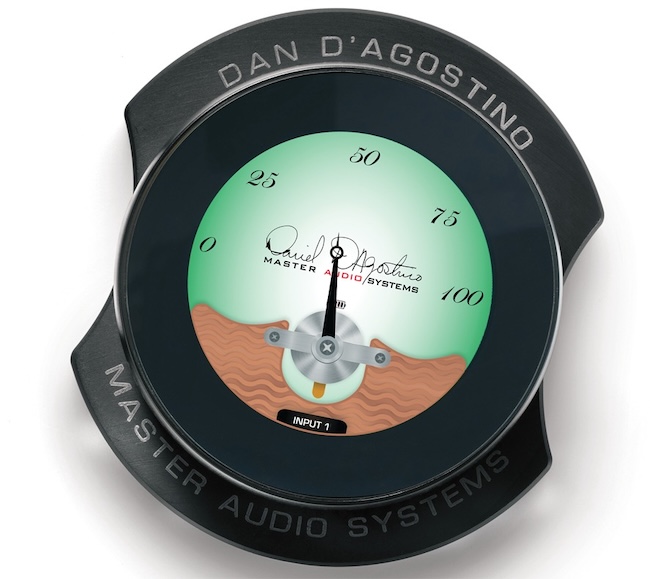
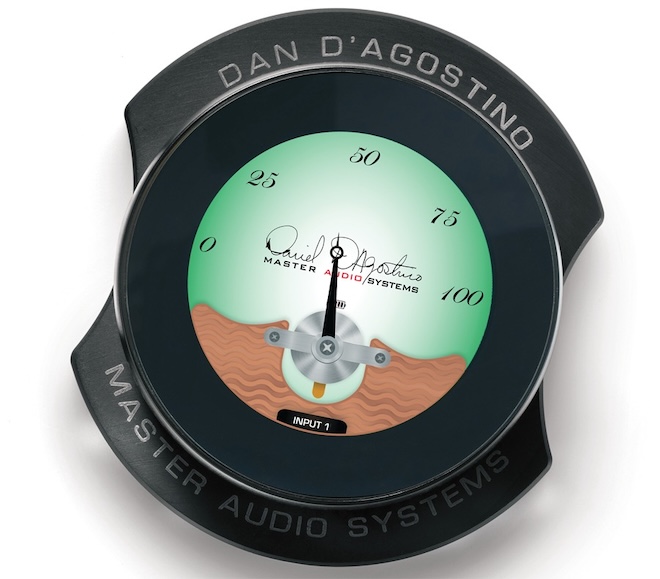
Dan D’Agostino Master Audio Systems has added a new flagship control component to its Momentum lineup with the Momentum C2Z Preamplifier, a two chassis design derived from the earlier Momentum C2 and optimized for use with the company’s Momentum Z Monoblock Power Amplifiers. The visual differences are minimal, limited to the front panel, but the engineering focus is clear: improve system performance within the Momentum ecosystem rather than reinvent the product from scratch.

It also needs to be said plainly that this is ultra high end audio with pricing to match. The Momentum C2Z sits firmly in luxury purchase territory on its own, and building the full matching system with two Momentum Z monoblocks pushes the investment into a range that will make even affluent buyers stop and do the math twice. That does not make it unreasonable in the context of cost no object audio, but it certainly puts the C2Z far outside the reach of anyone shopping for value.

Z-Circuitry

Engineered to take full advantage of the Z circuitry introduced in the Momentum Z monoblock amplifier, the C2Z builds on the established Momentum C2 preamplifier platform with targeted refinements rather than a complete redesign.

It does not replace the original Momentum C2, but instead serves as the more suitable match for the Momentum Z monoblocks. The updated circuitry focuses on improving the electrical interface between preamplifier and power amplifier, with the goal of delivering better system integration, control, and overall sonic accuracy.

Advertisement

With the C2Z upgrade,” said Dan D’Agostino, Founder of Dan D’Agostino Master Audio Systems, “we set out to do more than refine an already exceptional platform—we wanted to fully exploit the performance of the Momentum Z Monoblock circuitry. We have created a more direct and optimized connection between the preamplifier and the amplifier.”

The FET Factor

At the core of the C2Z is a revised output stage for the Momentum preamplifier, built around a current capable Field Effect Transistor architecture. The goal is straightforward: increase current delivery and improve stability, allowing the preamplifier to drive the Momentum Z amplifier’s input stage more effectively and make full use of the Z circuitry across the system.

This implementation integrates FETs directly into the output stage, enabling higher current delivery where it matters most. The result is a more controlled electrical interface between preamplifier and amplifier, with the C2Z providing current with greater precision and the Momentum Z monoblocks designed to receive and respond to it without bottlenecks.

FETs are well suited to high performance audio applications. Their high input impedance reduces loading on source components, helping preserve signal integrity, tonal balance, and dynamic detail. They also offer low noise and strong linearity, which is critical when handling low level signals at the front end of the amplification chain.

Advertisement

Unlike bipolar devices, FETs operate as voltage controlled components and require minimal input current. That behavior contributes to smoother, more linear transfer characteristics, lower distortion, and a more stable connection between components.

The Momentum Z Amplifier Factor

In the Momentum Z amplifier, the Z circuitry takes a different approach by lowering the input impedance typically associated with FET-based designs. This change allows the amplifier to draw more current from the Momentum C2Z preamplifier, strengthening the electrical interface between the two components.

The result is improved transient response, greater dynamic contrast, and more precise retrieval of musical detail. Rather than treating the preamplifier and amplifier as separate stages, the design focuses on how they interact as a system.

Advertisement. Scroll to continue reading.
Advertisement

One of the more audible benefits is in low-frequency performance. Bass reproduction shows better control, texture, and definition, particularly at lower listening levels where detail can often be lost. With the full Z circuitry signal path in place, low-frequency information remains more consistent and better resolved without relying on higher volume levels.

Taken together, the Momentum C2Z preamplifier and Momentum Z monoblock amplifiers are designed to function as a tightly integrated system, with an emphasis on dynamic control, low-level resolution, and stable performance across a wide range of listening conditions.

Other Features

momentum-streaming-control

Control: The Momentum C2 and C2Z preamplifiers include a bi-directional remote housed in precision-machined aluminum and Delrin, with full access to unit functions and settings. The remote features an ergonomic layout and an integrated LCD screen that mirrors the information shown on the preamplifier’s front panel display, allowing for straightforward operation from the listening position. An iOS control app is also available for system management, although there is no Android support.

momentum-streaming-module

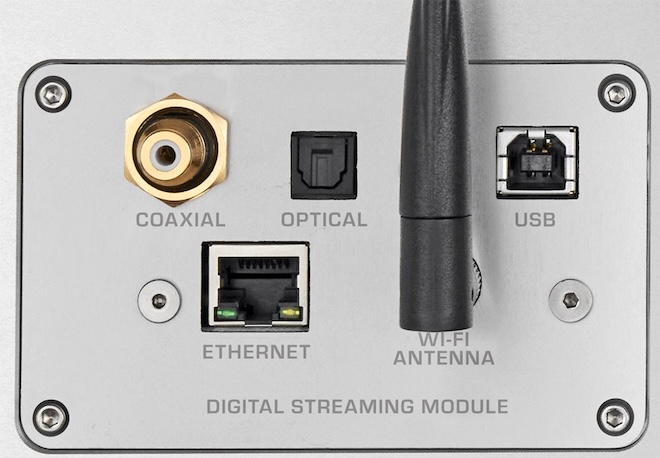
Optional Digital Streaming Module: The optional Digital Streaming Module adds optical, coaxial, and USB digital inputs, along with network connectivity via Ethernet (RJ45) or Wi-Fi 8 using an external antenna. An active internet connection is required to access streaming services such as TIDAL, Qobuz, and Spotify. The module is also Roon Ready, allowing integration into a Roon-based playback system.

Power Supply: The power supply is housed in a separate chassis that connects to the C2 or C2Z preamplifier. It incorporates dedicated custom toroidal transformers for the analog and digital sections, helping to isolate critical circuits. Internal filtering is designed to reduce RF noise and address power line irregularities, supporting more stable overall operation.

Comparison

Dan D’Agostino Momentum Model C2Z (2026) C2 (2024)
Product Type Preamplifier Preamplifier
Price TBD $55,000 to $65,000
Frequency Response 0.1 Hz to 1 MHz, -1 dB
Advertisement

20 Hz to 20 kHz, ±0 dB

0.1 Hz to 1 MHz, -1 dB

 20 Hz to 20 kHz, ±0 dB

Signal-to-Noise Ratio >110 dB, A-weighted 
Advertisement

 >120 dB, unweighted 

>110 dB, A-weighted

 >120 dB, unweighted

Gain 11.5 dB +10 dB
Input Impedance 1 MΩ 1 MΩ
Output Impedance 0.01 Ω  0.05 Ω
Distortion (full output) <0.00066%  <0.002% 
Analog Input 3 pr balanced XLR stereo
Advertisement

1 pr unbalanced RCA stereo

3 pr balanced XLR stereo

1 pr unbalanced RCA stereo

Digital Inputs with Optional Digital Streaming Module (DSM) 1 ea SPDIF coaxial
Advertisement

RJ45 Ethernet

Optical

USB-B

Wi-Fi

Advertisement
1 ea SPDIF coaxial

RJ45 Ethernet

Optical

USB-B

Advertisement

Wi-Fi

Outputs 2 pr balanced XLR stereo
1⁄4-inch headphone
2 pr balanced XLR stereo
1⁄4-inch headphone
Dimensions (WHD) 17.0 x 8.9 x 15.2 in

43.2 x 22.6 x 38.6 cm

17.0 x 8.9 x 15.2 in
Advertisement

43.2 x 22.6 x 38.6 cm

Weight 73.0 lb / 33.1 kg 73.0 lb / 33.1 kg
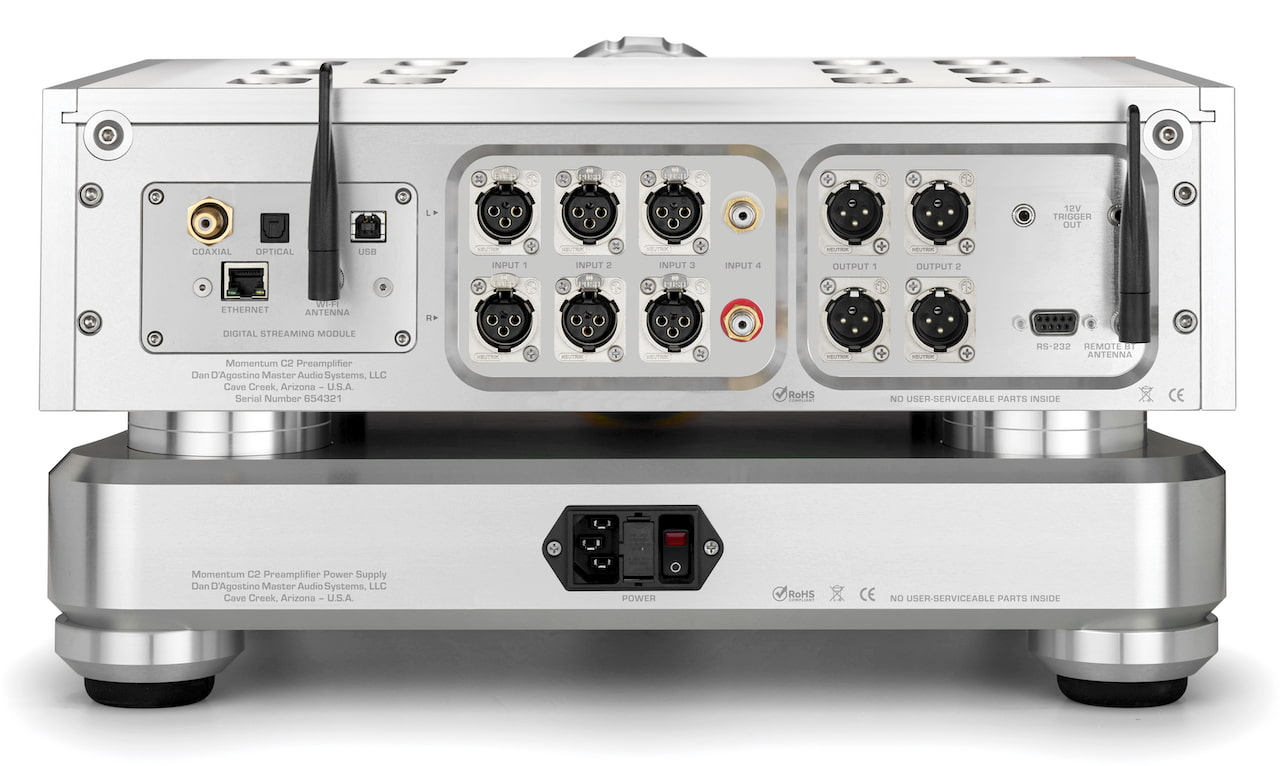
momentum-c2-preamplifier-rear
Momentum C2 (rear)

The Bottom Line 

The Momentum C2Z is not a ground-up redesign, but it does introduce meaningful changes where they matter. The revised output stage with FET-based current delivery is specifically engineered to work with the lower input impedance of the Momentum Z monoblocks, creating a more tightly coupled interface between preamplifier and amplifier. That system-level thinking is the real story here. This is not about adding features for the sake of it, but refining how the components interact to improve control, stability, and low-level detail.

What also stands out is the execution. At 73 pounds and built as a dual-chassis design with a dedicated power supply, the C2Z reflects the same emphasis on materials, isolation, and power management that defines the rest of the Momentum line. It is a physically and electrically substantial preamplifier, designed to anchor a reference-level system.

The reality, however, is the cost. While final pricing has not been confirmed, expectations in the $50,000 to $60,000 range place the C2Z firmly in cost-no-object territory. Building the intended system with two Momentum Z monoblocks at $125,000 each pushes the total investment into a level that requires serious financial commitment, even before speakers and source components enter the equation.

At this level engineering, everything comes separate. An optional Digital Streaming Module leaves nothing to chance, but adds to total cost of ownership. Same deal for adding a phono stage. If you need to ask the price, you can’t afford it.

Advertisement

Price & Availability

The official price of the Dan D’Agostino Momentum C2Z Preamplifier is still forthcoming, but its predecessor, the C2, is priced between $55,000 and $65,000. 

Dan D’Agostino Audio components can be purchased through Authorized Dealers in the US, Canada, Mexico, and internationally.

For more information: dandagostino.com

Advertisement. Scroll to continue reading.
Advertisement

Source link

Continue Reading

Tech

Intel Core Series 3 processors are here and they promise more performance for less money

Published

on

Intel has just launched its new Core Series 3 mobile processors for the next-generation of affordable laptops. The goal of these new chips is to give a more modern foundation to these accessible notebooks without dragging them into premium pricing territory.

The official announcement of the new lineup is aimed at value buyers, schools, small businesses, and essential edge devices. But the highlight is that these chips are still based on the same broader foundation as Intel’s powerful new Core Ultra Series 3 family. So it still uses Intel’s 18A process node, features the hybrid CPU architecture, AI-ready capability, and updated connectivity to more affordable systems.

How Intel is bringing nicer features downmarket

Raise expectations for what everyday computing can deliver with #IntelCore Series 3 mobile processors—designed to transform computing for schools, small businesses, and value buyers while delivering the features people care about at unmatched scale.

Read the press release:… pic.twitter.com/sPHcLNE7jF

— Intel (@intel) April 16, 2026

Advertisement

Intel says Core Series 3 is its first hybrid AI-ready Core Series processor, with support for up to 40 platform TOPS. You even get modern connectivity with up to two Thunderbolt 4 ports, Wi-Fi 7, and Bluetooth 6.

The company is also making big value claims against older PCs, with the Core Series 3 delivering up to 47% better single-thread performance, up to 41% better multi-thread performance, and up to 2.8x better GPU AI performance compared to a typical five-year-old PC. Against the previous-gen Core 7 150U, Intel also claims up to 2.1x faster creation and productivity, 64% lower processor power, and up to 2.7x AI GPU performance.

Why these are still everyday laptop-friendly

Under the hood, Intel’s Core Series 3 platform supports up to 2 Cougar Cove P-cores and 4 Darkmont LP E-cores, plus NPU 5, Xe graphics, support for LPDDR5X-7467 and DDR5-6400, and a design clearly tuned around battery life and lower-cost system builds. Intel also says the platform supports either UFS 3.0 or Gen 4 SSD storage, depending on system design.

In other words, the Intel Core Series 3 is making the next wave of affordable laptops feel less cheap in areas like battery life, responsiveness, video calls, light AI tasks, and basic creative work.

Advertisement

Intel Core Series 3 processor specs

Processor Cores / Threads Max Turbo (GHz) NPU TOPS Xe-cores GPU TOPS Base & Max Power
Intel Core 7 360 6 / 6 4.8 17 2 21 15W-35W
Intel Core 7 350 6 / 6 4.8 17 2 21 15W-35W
Intel Core 5 330 6 / 6 4.6 16 2 20 15W-35W
Intel Core 5 320 6 / 6 4.6 16 2 20 15W-35W
Intel Core 5 315 6 / 6 4.4 15 2 18 15W-35W
Intel Core 3 304 5 / 5 4.3 15 1 9 15W-35W

When do they drop?

Intel says more than 70 designs from OEM partners are on the way, with availability starting April 16, 2026 for consumer and commercial systems, while edge systems will start shipping in Q2 2026. The long list of partners include Acer, Asus, Dell, HP, Lenovo, MSI, Samsung, and others.

The announcement sounds great, on paper, but with the industry-wide price hikes, we’ll have to wait for the upcoming laptop releases to see if they are truly a solid value purchase.

Source link

Advertisement
Continue Reading

Tech

The Kentucky Cave Wars, And Going Viral In 1925

Published

on

Floyd Collins, the unfortunate star of this post. (Public Domain)

Information, it seems, flows at the speed of media. In the old days, information traveled with people on ships or horses, so if, say, a battle was won or lost, it could be months or even years before anyone back home knew what happened. While books and movable type let people store information, they still moved at the speed people moved. Before the telegraph, there were attempts to use things like semaphores to speed the flow of information,  but those were generally limited to line-of-sight operations. Carrier pigeons were handy, but don’t really move much faster than people.

The telegraph helped, but people didn’t have telegraph stations in their homes. At least not ordinary people. But radio was different. It didn’t take long for every home to have a radio, and while the means of broadcasting remained in the hands of a few, the message could go everywhere virtually instantly. This meant news could go from one side of the globe to the other in seconds. It also meant rumors, fads, and what we might think of today as memes could, too.

You might think that things “going viral” is a modern problem, but, in reality, media sensations have always been with us. All that changes is the number of them and their speed.

One of the earliest viral media sensations dealt with William Floyd Collins, an unfortunate man who was exploring caves during the Kentucky Cave Wars.

Background

Mammoth Cave in Kentucky had become a major tourist attraction. The accessible entrance to the cave was located on land owned by the Croghan family. The massive cave system had been made famous in the 19th century, and with the construction of a lock and dam nearby in 1906, Mammoth Cave became accessible to ordinary tourists.

Advertisement
Rescuers weighing options at the entrance to Sand Cave. (Public Domain)

However, the cave wasn’t completely under the Croghan land. There were also other caves that may or may not have been connected with Mammoth Cave. This led to fierce competition. The Croghan family suppressed information about exactly what land was over the cave. Meanwhile, other cave “owners” would intercept people heading for the cave, tell them that Mammoth Cave was closed, and “helpfully” direct them to another location.

By the 1920s, George Morrison blasted new entrances to the cave on non-Croghan land. There was fierce interest in finding new entrances to the cave or nearby caves to capture tourist money.

Back to Floyd

Floyd Collins found an entrance into what would become known as the “Great Crystal Cave” in 1917 and opened it to tourists in 1918. Unfortunately, the cave was hard to access, so it didn’t make much money.

Floyd had started entering caves in 1893 at the age of six. He discovered his first cave in 1910. But Great Crystal Cave was too far off the main road. He entered into a deal with three farmers who owned land closer to the main highway. If Floyd could find a suitable cave or, even better, an entrance to Mammoth Cave, he’d partner with them and create a mutually profitable tourist attraction.

Floyd found a hole in what would become known as Sand Cave. Some of the passages he had to move through were as tight as 9 inches, which, of course, would not be suitable for tourists, but they opened, apparently, into a large grotto. He was determined to expand the entrance to make the cave commercially viable.

Advertisement

In January of 1925, he was working in the cave when his gas lamp started to dim. He tried to leave, but while trying to move through a small passage, he knocked over his light, leaving him in total darkness.

In the dark, he put his foot against a seemingly stable wall and caused a shift that pinned his leg with a rock weighing nearly 30 pounds. He was also buried in gravel. At this point, he was 150 feet from the hole to the surface.

The Media

The next day, people noticed Floyd was missing, but no one would dare to follow him through the narrow passages. His younger brother finally got close enough to determine what happened. He was able to give Floyd food and water as plans for a rescue developed.

After four days in the cave, several people tried to pull Floyd out using a rope and a harness, but they only wound up injuring him. Meanwhile, the media had taken interest in the case, and the publicity drew hundreds of tourists and amateur spelunkers. Campfires and, possibly, the electric light that had been placed to give Floyd some light and warmth, melted ice inside the cave, creating puddles of water around the trapped man.

Advertisement

Two days after the failed rescue attempt, rain and the melting ice caused the cave passage to collapse, and the rescue team determined it was too dangerous to dig it back out after making an attempt to do so. They decided to dig straight down to reach Floyd.

Digging

Unfortunately, the cave drew air in so they decided they could not use mechanical diggers without risking suffocating Floyd. That meant humans would have to dig the 55-foot shaft to reach the victim. The initial estimate that 75 volunteers could dig the shaft in 30 hours proved optimistic, as conditions worsened and the hole grew deeper.

Someone disconnected the wires from the light bulb and connected them to an audio amplifier to detect signs of life from the victim. They believed the repetitive crackling noise meant he was breathing.

The light bulb went open on February 11th, twelve days after the incident started. Five days later, they reached his body. He had died and had been dead for several days.

Advertisement

You can find a well-done documentary from Remix Films in the video below. For a movie inspired by the event, check out the Billy Wilder film Ace in the Hole (1951) starring Kirk Douglas.

Viral

A newspaper reporter, William Miller, was on the scene and, being a small man, was able to actually help remove gravel from Floyd before the cave-in. His interview with the man from inside the cave won a Pulitzer Prize.

Not a circus. A cave rescue.

There was a time when this would have been only a sensational local story, but by the modern year of 1925, reports “went out on the wire” by telegraph and were picked up by newspapers worldwide. The nearest telegraph station was miles away, so two ham radio operators (9BRK and 9CHG) provided a link between the site, the newspaper, and the authorities.

The first broadcast radio station, KDKA, was only five years old, but stations provided news bulletins detailing the progress. Thanks to the media, crowds were reported to number in the tens of thousands. Eventually, the National Guard arrived to help control the crowds.

Advertisement

Vendors popped up to sell hamburgers and memorabilia like a macabre circus. As you can see in the video below, memorabilia about the event and Floyd Collins can be worth a pretty penny to collectors.

The whole thing became one of the three largest media events between World War I and World War II. The other two were Lindbergh’s transatlantic flight (1927) and the kidnapping of Lindbergh’s baby (1932). Oddly, Lindbergh was an acquaintance of Floyd’s and also flew news photos from the scene (although, reportedly, to the wrong newspaper).

While it wasn’t quite as big an event, Canada’s 1936 Moose River Gold Mine collapse was a similar situation and also received worldwide media attention. It has the distinction of being the first 24-hour radio coverage of a breaking news story in Canada.

Advertisement

Today

These days, sensational news stories pop up everywhere. It seems as if they hardly get started when they are displaced by another one. But we submit that “going viral” isn’t a modern phenomenon. Only the speed at which it happens. Even an 1835 newspaper was able to spur a viral hoax.

Featured image: “Mammoth Cave Saltpeter Mine” by [Bpluke01]

Source link

Advertisement
Continue Reading

Tech

The Digital Accessibility Deadline Is Here. Schools Aren’t Ready.

Published

on

A big civil rights deadline that impacts schools and vendors will hit this month.

Federal law has required accessibility for people with disabilities for decades, says Glenda Sims, chief information accessibility officer at Deque Systems, a company that specializes in digital accessibility.

But two years ago, the federal government finally gave schools a way to measure whether their websites, mobile apps and digital content were accessible under law when it released a “final rule.”

In essence, the final rule updated 2024 Title II of the Americans with Disabilities Act, a federal law concerning equal opportunity, setting out standards for public institutions around website and mobile app accessibility. When the deadline was put in place, disability experts told EdSurge that the rules provided clarity for schools and edtech vendors, and also set a ticking clock for when they would have to make changes. The rule set varying deadlines for school districts and state and local governments — in April 2026 or April 2027, based on population size.

Advertisement

On April 24, the first deadline will hit. By then, institutions have to make their web content and mobile apps comply with Level AA of the Web Content Accessibility Guidelines (WCAG) 2.1, a widely recognized accessibility standard that includes accommodations such as a minimum contrast ratio and a requirement for audio descriptions.

But with the well-advertised deadline just days away, schools are well behind schedule.

Some advocates worry that digital accessibility is being swept up in broader political trends. So, what happens when the deadline hits?

Not Ready for Prime Time

Only 14 percent of districts had completed the accessibility updates required by law, according to a survey from the National School Public Relations Association released last December. The survey also found fewer than half of districts prioritized digital accessibility or had procedures for vetting vendor accessibility, which is required by the rule.

Advertisement

It’s not just about course content, but also the apps that a school may use, says Sambhavi Chandrashekar, global accessibility lead at D2L, a company that runs a widely used learning management system. “I doubt if a single K-12 district in the U.S. or anywhere else has an inventory today of all the web apps and forms and content that they have that are not accessible,” Chandrashekar says.

Figuring that out requires performing an audit, which most schools likely haven’t done and which can be expensive, she adds.

At EdSurge’s request, AAAtraq, a company that sells disability-related legal compliance services, surveyed around 20 of the largest schools across a number of states — in California, Colorado, Florida, Illinois, New York, Texas and Washington state. Many school websites and online PDFs failed along “basic accessibility fundamentals,” based on a benchmark the company uses to assess legal exposure. Alt text was missing, there was not enough color contrast and many websites didn’t have an accessibility statement, the company reports. The company found that 88 percent received an “F,” the lowest possible grade.

The company uses AI in its assessments, which do not cover all of the WCAG technical guidelines, and its assessment was meant only as rough barometer. In some cases, the use of AI in accessibility is controversial.

Advertisement

“Title II should have been a wake up call,” said AAAtraq CEO Lawrence Shaw in an emailed comment, referring to the major disability law behind the “final rule.” Yet many schools, including some of the largest in the country, have left themselves open to legal action.

Digital Exhaustion

Schools’ relationship to technology has also changed since two years ago, from rushing to embrace it to trying to limit it.

These days, beset by digital exhaustion and regret over the reach of tech into children’s lives, schools have sought to restrict screens in schools.

But it’s important for schools and lawmakers to distinguish between meaningful tech and doomscrolling on social media, says Luis Pérez, senior director of disability and accessibility for CAST, a digital access advocacy group. Students are under more pressure to manage their own attention, Pérez says, but those with disabilities and multilingual learners rely on certain digital tools, such as text-to-speech and adjustable text sizing to navigate daily learning. When used correctly, digital tools that expand accessibility can foster a sense of belonging, especially for underrepresented groups.

Advertisement

He worries that screen time laws that lump all screens together could make digital accessibility harder.

K-12 schools may be having the toughest time. Universities are usually more prepared for digital accessibility than state or local governments, which run K-12 public schools, says Sims of Deque. That’s partly because students with disabilities represent a more identifiable group in universities and that allows them to advocate for accommodation, she says.

These schools are heavily reliant on vendors for accessibility, Sims says.

It doesn’t help that there’s uncertainty at the moment.

Advertisement

Old Rules, New Rulers

While the accessibility deadline is still in place, the intentions of the federal government have become murky.

Last year, the Department of Justice signaled that it might issue a new “interim final rule” that would impact the deadline. And recently, the Office of Information and Regulatory Affairs — a federal agency that is usually not involved with accessibility — has been holding meetings on the rule, as “credible rumors” have circulated that the rule is in danger of getting delayed or scrapped.

Yet, the federal government has not publicly released information about its intentions, according to Jarret Cummings, senior adviser for policy and public relations at Educause.

The Office of Information and Regulatory Affairs did not immediately respond to a question from EdSurge about whether a delay is expected.

Advertisement

However, some documents related to the meetings are publicly accessible, giving a glimpse into what they are hearing.

A group representing more than 800 Minnesota cities argued in written testimony that none of the Minnesota cities that would be impacted by the rule are fully compliant with the law. The letter states that the cost of compliance would squeeze small government budgets. In a similar argument, testimony from the National Association of Counties estimated that it would cost small counties about $32,000 to fix problems with accessibility on their sites, and large counties as much as $700,000.

Cummings’ organization, Educause, has also argued that two years was not enough time for most higher-ed institutions to make changes. It suggested that the government alter the timeline.

In contrast, Mark Riccobono, president of the National Federation of the Blind, testified that the rulemaking process has been ongoing for decades, with ample time for comment. The bill represents a compromise that clarifies rules, while reducing the burden of those under the law by providing exceptions and generous timelines, Riccobono argued.

Advertisement

Politically, the national mood has changed since the rule was issued a couple of years ago.

The affiliation of accessibility with diversity, equity and inclusion has politically backfired under the Trump administration. The administration has shredded grants it has identified with “radical” DEI ideology, and mass firings have gutted agencies like the Education Department, which the administration is actively trying to dismantle.

For students with disabilities, it means that there’s no guarantee of federal support, even when a federal complaint is filed.

“I would say that so many of the places that were reasonably staffed… have been reduced to almost bare bones, nothing. And so even if there are complaints coming in, there’s no way to truly handle them,” says Sims, of Deque.

Advertisement

Indeed, mass firings have led to 90 percent of all student civil rights complaints, including from students with disabilities, being dismissed by the federal government in the second half of last year, according to a nonpartisan government watchdog report published in January.

In the absence of federal help, people with disabilities have turned to the courts. There were more than 3,000 accessibility lawsuits filed in federal court last year, according to legal analysis of court data.

Long-term Goals

Pérez of CAST maintains that advocates should keep on track, focusing on long-term strategy, no matter what happens at the federal level. Accessibility benefits everyone, regardless of their background or disability status, he says.

Sims, of Deque, has also made a “business case” for considering accessibility during the design of products, suggesting that as schools embrace accessibility, the vendors that can show they build accessibility into their products will be rewarded.

Advertisement

Some hope that artificial intelligence tools will help students with disabilities access information on their own, and point toward tools like Aira, an AI tool that aids in remote video interpretation for people with visual impairment.

But even there, disability law experts insist that the federal rule hasn’t actually changed. “The rule is the rule until it isn’t,” wrote Lainey Feingold in early March.

Source link

Advertisement
Continue Reading

Tech

AI lowered the cost of building software. Enterprise governance hasn’t caught up

Published

on

Presented by Retool


The logic used to be: buying software is cheaper, faster, and safer for most use cases. Building was reserved for companies with large engineering teams, deep pockets, and problems so specific that no vendor could address them. But now, the cost to code a piece of software has dropped to zero.

Anyone can build their own software now, but enterprise and governance models have yet to catch up. Retool’s 2026 Build vs. Buy Shift Report, based on a survey of 817 builders, traces exactly how this shift is playing out.

The cost curve changed; SaaS pricing didn’t

Two years ago, a custom internal tool might have taken an engineering team weeks or months and cost six figures. Today, an operations lead with the right platform can have a working prototype in a day or two. This structural shift is driven by AI-assisted development and the maturation of enterprise app-building platforms.

Advertisement

Meanwhile, SaaS pricing hasn’t adjusted, still charging per-seat for generic software that requires customization and integration costs on top. When the cost of building drops by an order of magnitude but the cost of buying stays flat, the math changes for every company, not just the ones with large engineering teams.

The data reflects this. Retool’s report found that 35% of teams have already replaced at least one SaaS tool with a custom build, and 78% plan to build more custom tooling in 2026.

Workflow automations and admin tools are among SaaS tools at risk

The shift isn’t happening uniformly. The top SaaS tools respondents have replaced or considered replacing include workflow automations (35%) and internal admin tools (33%), followed by BI tools (29%) and CRMs (25%).

A purchased workflow automation tool has to serve thousands of customers, so it optimizes for the average case — and the average case is nobody’s actual case. Every company’s internal workflows are different. They reflect org structure, compliance requirements, data systems, and business logic unique to that organization.

Advertisement

Internal admin tools carry the same problem: they’re inherently company-specific. These categories were always the most awkward fit for off-the-shelf software, and there’s now an affordable, accessible alternative (MIT’s State of AI in Business reported $2-10 million in savings annually for customer service and document processing tasks).

The replacement pattern tends to be additive rather than wholesale (nobody is just ripping out Salesforce). They’re replacing the specific pieces that never quite fit: an approval flow that required three workarounds, the dashboard that couldn’t connect to their actual data … but those narrow replacements add up. Once a team builds one tool that works better than what they bought, the default question shifts from “What should we buy?” to “Can we build this?”

Builders go around IT, signaling broader procurement challenges

The clearest evidence that procurement processes haven’t kept up with building capability is the scale of shadow IT now occurring inside enterprises. Retool’s report found that 60% of builders have created tools, workflows, or automations outside of IT oversight in the past year — and 25% report doing so frequently.

Even experienced, high-judgment people choose speed over process. Two-thirds of total survey respondents (64%) are senior managers and above. Existing procurement cycles weren’t designed for a world where building software takes days rather than months. When people love to quote the 95% generative AI pilot failure rate they’re not accounting for the robust grassroots adoption happening under executives’ noses.

Advertisement

Shadow IT at this scale is a demand signal. The people closest to the problems are telling organizations that the existing process can’t can’t keep up — 31% of those going around IT do so simply because they can build faster than IT can provision tools. So, suppression isn’t a productive response. The challenge is that the tools being built in the shadows are also the ones most likely to stall before they become useful.

A vibe-coded prototype running on sample data is impressive. A production tool connected to your actual Salesforce instance, with role-based access and a security review, is useful. The report found that 51% of builders have shipped production software currently in use by their teams, and among those, about half report saving six or more hours per week.

When building happens in an ungoverned environment, organizations get neither outcome reliably. Someone connects an AI-powered tool to production data with no audit trail, no access controls, and no owner. Multiply that by dozens of builders across an organization, and you have an expanding security surface that IT doesn’t even know exists.[1]

The teams whose homebuilt solutions reach production tend to have three things the others don’t: connectivity to real data sources, a security and permissions model they trust, and a review process for what gets deployed. Channeling builder energy into governed environments, where speed and security aren’t in conflict, is how organizations avoid shadow IT becoming a liability.

Advertisement

Governance will define the next era of SaaS

The build vs. buy shift is already underway. The more important question now is who controls the environment where that building happens.

Ungoverned building invites security risks and makes the ROI case difficult to close. You can’t measure time saved by tools IT doesn’t know exist, or are only run in one individual’s workflow. You can’t enforce access controls on a prototype that someone connected to production data last Tuesday. And those aren’t hypothetical risks: in Deloitte’s 2026 State of AI in the Enterprise survey of 3,200+ leaders, data privacy and security ranked as the top AI concern at 73%, with governance capabilities close behind at 46%. The 35% of organizations with no AI productivity metrics are missing more than just a dashboard. They’re missing the accountability infrastructure that justifies building over buying in the first place.

The organizations that treat governed environments as a prerequisite for building at scale will be the ones that can actually prove it’s working. The ones that don’t will find out when something breaks.

For a closer look at the data, including how enterprises are approaching AI-assisted building, read the full 2026 Build vs. Buy Shift Report.

Advertisement

[1] The cost of which can be steep: IBM’s 2025 Cost of Data Breach Report found that AI-associated cases cost organizations more than $650,000 per breach.


David Hsu is CEO at Retool.


Sponsored articles are content produced by a company that is either paying for the post or has a business relationship with VentureBeat, and they’re always clearly marked. For more information, contact sales@venturebeat.com.

Source link

Advertisement
Continue Reading

Tech

Emergency Bolt-Action Launcher For EpiPens

Published

on

Imagine you and your friend are enjoying a nice sunny day, and BAM — they start to have a severe allergic reaction to who knows what. You have an EpiPen, but your friend is on the other side of a field! The solution? Obviously [Emily The Engineer] has only one option: build an entire EpiPen launcher!

Starting off the life-saving project, [Emily] prototyped with a 3D printed blank and a simple solenoid-controlled glorified potato cannon. This proved effective, as one would expect of such a project after successful tests on a human subject. However, there was one simple problem: what if you missed your initial shot?

To ensure no possible failed missions, a bolt-action magazine was retrofitted onto the device. Additionally, an air compressor placed in a mobile backpack carrier allows for repeated mobile use. Official testing was done on ballistic gel before a “war game” scenario played out involving an anaphylactic friend. As one would assume, this went perfectly, ignoring the time delay of having to wait for the compressor to build up enough pressure…

Advertisement

Anyways, even if you won’t be using this EpiPen launcher anytime soon, there are some actual DIY medical miracles you can look into! Something that’s a tad less insane to hack together than an EpiPen gun would be a splint. That is exactly what you can learn about here!

Advertisement

Source link

Continue Reading

Tech

Intel reveals secret sauce to keep gaming laptops running quieter and cooler

Published

on

If you’ve ever played video games on a laptop that sounded like a small aircraft trying to take off, Intel has heard you (and your laptop). The company’s Chinese division has launched “AI Quiet Plus,” a new certification and optimization program for gaming laptops (via VideoCardz). 

As the name suggests, the feature uses artificial intelligence to dramatically reduce fan noise and surface heat while maintaining performance. 

How does AI Quiet Plus actually work?

It might be a bit confusing at first, since AI Quiet Plus isn’t a chip or a software update that you can download on the go. As mentioned earlier, it’s a certification standard that OEM partners must meet to carry the label.

The program uses the Neural Processing Unit (NPU) built into Intel’s Core Ultra 200HX Plus processors to monitor temperature, workload, power consumption, and fan speed in real-time. 

Rather than running the cooling fan at maximum speed a few minutes into a game (when the motherboard starts to heat up a bit), the system claims to intelligently read gaming conditions and adjust cooling only when it is actually required. 

Advertisement

What does this mean for everyday gamers?

OEMs meeting the new standard must meet more stringent targets across acoustics, keyboard and chassis temperatures, and battery efficiency. The technology builds directly on Intel China’s “AI Quiet Gaming Laptop” initiative. 

For everyday gamers, the AI Quiet Plus should translate to less disturbance and annoyance from the rocket engines on the laptop, less heat for your wrists, should you hop onto an urgent mail trail in the middle of your gaming session, and a longer battery life between charging sessions.

The first laptops certified under this program are expected to reach the market by the end of 2026. These would include laptops from brands like Asus, MSI, Lenovo, and Acer. For now, the program is tied to the Core Ultra 200HX Plus chips, which came out in March 2026. 

Source link

Advertisement
Continue Reading

Tech

5 Car Shows Worth Checking Out In Spring 2026

Published

on


For a certain kind of person, cars are more than transportation; they’re a genuine obsession, culture, and way of life. Regardless if you’re a seasoned collector hunting for your next garage queen, a buyer who wants to see a few new models in person before committing, or someone who simply appreciates the engineering and design that goes into a well-built machine, a car show has something to offer for everyone.

Spring is when the regional calendar fills up across the country, the weather cooperates, and the variety of cars on display gets genuinely impressive. The energy at a well-run show is hard to replicate — you get lifted trucks parked next to vintage Porsches parked next to whatever someone built in their garage over winter, all in the same field. Some people prefer smaller, more informal events, while others want the hustle and bustle of a major car show.

As such, the options in 2026 are plentiful. Whether it’s a Saturday morning cruise-in, a full-blown concours, or a week-long festival with drag racing and swap meets, these events are where car memories are made. For a deeper dive into what makes these events worth the trip, here are five car shows worth checking out in spring 2026.

Advertisement

Goodguys 11th Griot’s Garage North Carolina Nationals | April 17–18 | Raleigh, NC

The Goodguys circuit is one of the most well-established hot rod and custom car show series in the country with more than 70,000 members across the globe. The Goodguys 11th Griot’s Garage North Carolina Nationals presented by Grundy Insurance brings classic cars, custom trucks, hot rods, and family fun to the North Carolina State Fairgrounds on April 17 and 18. The show floor features over 1,500 of the Southeast’s finest 1999-and-older hot rods.

It also includes trucks, customs, muscle cars, and classics, alongside Goodguys AutoCross Racing action, a swap meet, a Cars 4 Sale Corral, vendor midway, and live music. The top awards of the weekend are handed out on Saturday, including the coveted Builder’s Choice Top 10 by Goolsby Customs. Goodguys, which bills itself as the world’s largest hot-rodding association, runs 15 events across the country annually, and the upcoming Raleigh stop is one of the more accessible ones for enthusiasts on the East Coast.

Advertisement

General admission (GA) runs between $10 to $30 while member tickets range from $10 to $24. If that sounds interesting to you and you want to book your tickets, here are 10 common hot rod terms to learn so you don’t sound completely lost when you get there.

Advertisement

Old Town Festival of Speed & Style | May 17 | Alexandria, VA

Alexandria, Virginia plays host to one of the more distinctive car events on the East Coast calendar this spring. The Old Town Festival of Speed & Style is back for its seventh year, and is being held on May 17, 2026. Now, if you are a fan of a famous Italian prancing horse brand, this is the place to be since this year’s edition puts a spotlight on Ferrari, with examples ranging from the 1950s all the way through to current production.

This means that you might even be able to see some of the best-looking Ferraris of all time like the F40 or the 288 GTO up close. Such a sight is not to be missed, which is partly why the attendance is expected to surpass 40,000, with judging across 11 award categories wrapping up at noon. What separates this event from a standard car show is the fashion component — models are styled specifically to complement a selection of the cars on display, merging automotive and haute couture in a way few shows attempt.

If you want to feel fancy and important next to a bunch of classic Ferraris, this year’s event will start on May 16 with the High-Octane Ball gala where visitors are expected to wear formal white, black, and red. As this is a fancy event, the tickets are priced accordingly, between $125 and $250. For those content for just having their cars present, applications cost $125 and are open until April 30th. 

Advertisement

JDM Fest | July 10–11 | Mirabel, Quebec, Canada

Although lusting after hot rods and classic Ferraris is a great way to spend a weekend, what if you are a die-hard Japanese domestic market (JDM) enthusiast who does not care about either? Well, you are in luck. For anyone whose taste runs toward Japanese car culture, JDM Fest at ICAR Route 66 in Mirabel, Quebec on July 10-11 is the event to have on the radar. First held in 2011, the event draws fans of both modified and factory-original Japanese vehicles.

Think Toyota, Honda, Nissan, Mazda, and Subaru. If a long winter without seeing an R34 in the flesh has you down bad, ICAR Route 66 is the perfect antidote, as it’s Canada’s largest Japanese car show. Last year, it pulled in over 13,000 spectators, and the programming goes well beyond a static display. A Show N Shine Top 100 competition awards trophies across several classes, while dedicated zones exist for right-hand-drive JDM exclusives, club gatherings, and exhibition vehicles that don’t compete.

On the track side, drift competition runs across the entire weekend and a Drag Shootout offers prize money in the street class. 12 and under are free to enter, while GA tickets range between $48 and $50 Canadian. Here are 35 affordable JDM cars we recommend, so you can shortlist a few once you arrive and finally make your JDM dream a reality.

Advertisement

Greenwich Concours d’Elegance | May 30–31 | Greenwich, CT

With JDMs out of the way, it’s time to go back to the refined end of the car collector world. If that sounds like something up your alley, the Greenwich Concours d’Elegance in southwestern Connecticut at the end of May is worth marking on the calendar. Now in its 30th anniversary year, the event is backed by Hagerty and has established itself as one of the most important concours events in the Northeast.

According to Greenwich Concours, this year will host Paul Russell, a preservationist and European collector car specialist who spent two years and more than 9,500 hours restoring Ralph Lauren’s 1938 Bugatti Type 57SC Atlantic – the most expensive car in Lauren’s collection. The weekend runs across two distinct events — Saturday’s Concours de Sport centers on high-performance machinery, while Sunday’s Concours d’Elegance is judged on historical importance and design distinction.

Expert panels, live restoration demonstrations, and direct access to car owners and fellow enthusiasts are woven throughout the program. A two day pass is currently priced at $110, but separate events can reach up to $225. If you want to experience the event without paying big bucks, the Concours GA is priced at $60, while the Greenwich Concours de Sport GA is also priced at $60.

Advertisement

Hagerty Cars & Caffeine at Indianapolis Motor Speedway | June 20–21 | Indianapolis, IN

Few car shows can claim a setting as iconic as the one behind this next entry. The Hagerty Cars & Caffeine Car Show arrives at Indianapolis Motor Speedway — nicknamed The Brickyard — on June 20-21, pairing a full show field with live racing on one of the most storied tracks in the world. 

The show welcomes all classic, vintage, collector, muscle, modern, and exotic cars and motorcycles, with car clubs encouraged to attend. On the racing side, the weekend features 850-hp Trans Am cars, classic Porsches, Alfa Romeos, Corvettes, and even historic Formula 1 and Indy cars. Here is a detailed explanation of all of the differences between F1 and Indy racing so you can spot the details in the flesh. 

Advertisement

Show car registrants receive a pair of two-day passes and access to a guided paddock walking tour on Sunday, putting attendees directly alongside the race machinery and the people behind it. Ticket prices are provided upon registration, while discounts are available for Hagerty Drivers Club members, military members, veterans, and first responders.

Advertisement

How we made the list

Although most people reading this article share the love and passion for cars, not everyone likes the same ones. Different generations grew up liking different vehicles, and the idea of this article was to include a wide variety of car shows with multiple separate events in order to satisfy most people. Whether it be fashion and cars, straight-up hot-rodding, exotic track toys, drifting JDMs, muscle cars, historic F1 and Indy cars, drag races, motorcycles, Corvettes, 850 horsepower Trans Ams, or the very top-end of collector Ferrari cars, we listed as many as we could.

To make sure our list provides some of the best venues to visit, we dug through countless event programs, media coverage, past events, important cars, attendance numbers, and distinct legacies to make sure every experience is unique and worth the trip. All events are situated in North America.


Advertisement

Source link

Continue Reading

Trending

Copyright © 2025