
TL;DR
Rivian CEO RJ Scaringe says supervised point-to-point self-driving arrives this year on Gen 2 and R2 vehicles, with eyes-off driving in 2027.



We may receive a commission on purchases made from links.
It’s no secret that Ryobi primarily caters to DIY home repair enthusiasts. There are some tools the pros use and others that are more powerful than those from better-known competitors, but in general, Ryobi sells decent tools at a reasonable price and aims those products directly at people who prefer to do things themselves. Most of Ryobi’s tools are also fairly inexpensive, often costing much less than similar products from bigger competitors, making them an excellent value brand to shop for DIY home repair tools.
When you can get tools for less than competitors, the question is, how low do the prices go, and what tools can you get for that price? Ryobi’s product lineup is mostly cordless power tools, so there is a floor when it comes to cost. However, it turns out that Ryobi has a fairly healthy library of home repair tools under $50 if you know where and how to look. These less expensive tools can easily help bolster an existing library of Ryobi tools and give you more flexibility when tackling a project.
To temper expectations, you’re not going to find a miter saw or something like that on a list like this. Even Ryobi sells those for more than $50. In this range, you’ll find some useful power tools, though, and the list below will get you started on useful home improvement tools you can get from Ryobi for under $50.
The first thing you should consider is a spare battery. Ryobi’s One+ 18V system has hundreds of tools, and they all take the same One+ 18V battery. In many cases, you get a battery when you buy a tool, and if you buy multiple tools, you’ll have multiple batteries. Even so, it’s not a terrible idea to pick up a spare battery in case the occasion calls for it, especially if you have a longer home improvement job planned.
If you shop at Home Depot, the smallest battery you can find there is the One+ 18V 2.0 Ah Ryobi battery, which goes for $90. These are an okay value, and 2.0 Ah lasts a decent while on most of the brand’s power tools. It turns out that Ryobi sells one slightly smaller at almost half the price directly from its website, and that’s the One+ 18V 1.5 Ah battery. This little guy is 75% of the size of the 2.0 Ah battery but comes in at 50% of the price at $45 when not on sale.
This serves quite well as a backup battery, with hundreds of customers agreeing that the battery is worth the price here. It charges on any regular One+ 18V charger, so you don’t need to buy anything else in order to use it if you already have a charger at home. Of course, you can always pick up a spare charger for around $35, allowing you to charge multiple batteries at once.
Ryobi has several cleaning tools in its arsenal, including some niche items like a pool vacuum, a carpet washer, and a patio scrubber. For this list, we think the Ryobi One+ 18V Hand Vacuum is the way to go. When performing home repairs, you’ll almost certainly make a mess. It could be drywalling dust, sawdust, or just general debris from whatever you’re working on. A hand vacuum that takes the same batteries as your power tools keeps your area clean, which matters quite a lot in terms of safety and health.
The vacuum itself is $35 for just the tool (no battery), and according to its numerous positive customer reviews, it does the job well enough. It excels at dry materials and surfaces, and there is a four-piece attachment kit (sold separately) that lets you clean more things more efficiently. This may not compete with the very best hand vacuums designed for cleaning houses but for cleaning up sawdust off your garage floor so you don’t slip on it, it does the job nicely.
There is a second vacuum in this price range that Ryobi calls the 30th Anniversary Performance Edition. The design is different and it appears to be larger overall. It also costs $50 on the nose, so you can decide if the extra $15 is worth it. Both models have excellent reviews overall, and keeping things cleaned up is a valuable part of the home repair process.
Lighting is also important when working on home repair or home improvement. The sun can only do so much, especially if your work is inside the house, so having a good light can make a lot of your tasks easier. Ryobi has several lights to choose from, but for general use, we think the Ryobi One+ 18V LED Area Light is the one to go for. This is a lantern style light that can stand on its own or be hung from a wall and be used like a lamp that disperses light across a wide area.
The specs are pretty good as well. It boasts up to 850 lumens of output across three light settings, which will certainly light up a small room. It also has a 2-amp USB charging port included so you can charge your phone or a USB-powered tool while also providing light. It also doesn’t weigh a lot, which lets you hang it from almost anything without worries about damaging or falls. It takes the same One+ 18V batteries as Ryobi’s other power tools. That means you don’t have to buy extra batteries or, if you do, those batteries will still work with your drill or other tools.
The area light costs $40, which keeps it under that $50 mark. However, nearly all of Ryobi’s lights are under $50, so if this one isn’t doing it for you, this One+ 18V Clamp Light or this light and magnifying glass combo may be more helpful, depending on what you need.
Ryobi doesn’t sell many hand tools, so you won’t find a bunch of wrenches, screwdrivers, or hammers on a list like this. Ryobi does sell electric versions of many of those tools, though, and that includes the Ryobi USB Lithium Screwdriver. This little guy is basically a screwdriver that does the turning for you. It comes with a rechargeable battery that charges over USB-C, so it’s not the same battery system as the One+ 18V collection, but it’s also much smaller and is compatible with Ryobi’s other USB Lithium products.
The tool includes two 1-inch bit holders, dual LEDs so you can see what you’re driving, and a battery indicator to let you see the charge level. In terms of usability, it doesn’t do too much that a regular, everyday screwdriver can’t do. It does carry the same benefits as every other electric screwdriver, in that it saves your wrist from having to manually twist in each screw. You may not see the benefit if you only need to use it on one or two screws, but if you’ve ever put a deck together, you already know how much work a little power tool like this can save you.
Ryobi sells its electric screwdriver for $50, which is a decent value since you get a battery and a charging cable with it. The ability for the screwdriver to twist into multiple shapes also gives it a leg up on some competitors.
Tool bags are nice to have, even if you’re a DIYer. You can pack it up with your most commonly used tools and carry all of them together wherever they need to go instead of carrying armfuls of tools back and forth. As a DIYer myself, I can attest that having a bag is much better than not having a bag. Ryobi sells several tool bags, but the brand’s 18-inch Medium Tool Bag is arguably the best option of the bunch. It costs $50 but is a pretty big step up in terms of storage capacity and quality from its cheaper bags.
This particular tool bag comes with 18 total pockets, a main storage compartment, a carry handle, and a shoulder strap, which should take care of every possible way you would want to use the thing. There are also a tape measure clip and a dedicated level strap, so you don’t have to waste storage space on those two items. It’s one of the few Ryobi products with a limited lifetime warranty, which is always nice to have.
In short, this is a tool bag with few, if any, weaknesses, and customer reviews seem to reflect this, with nearly all of them being positive. People carry regular hand tools, power tools, batteries, and all sorts of other stuff in it. The inner pockets are a bit too small for power tool batteries, but otherwise, it’s about as good as a tool bag gets in this price range.
The power drill is one of the most useful and ubiquitous power tools on the market. It’s often among the first power tools a DIYer purchases, which includes me, and given how many things are held together with screws, you’ll find a use for it whether you know it or not. Ryobi has one of the best power drill deals on the market with its One+ 18V 3/8-inch Drill. For $50, you get a power drill, a battery, and a battery charger, and that price tag is also not on sale. This is the gateway into Ryobi’s tools. The cheap price doesn’t reflect low capability either, since Ryobi’s drills are just as good as many competitors.
I have owned one of these for a few years now. It has done everything I’ve ever needed it to do without much hassle. It struggled a bit drilling holes into solid wood shelving large enough to fit a Philips Hue Lightstrip, but to be fair to Ryobi, the wood was 2 inches thick and would’ve been rough for any drill. In any case, it fits standard 3/8-inch bits, so you can buy those from anywhere, and the variable speed trigger is helpful for not stripping screws or overdoing it when drilling holes.
Ryobi often sells this in combo kits with an impact driver for $100. When you take into account two batteries, a charger, a bag, and two tools, it averages out to $50 per tool and battery, which is a good deal.
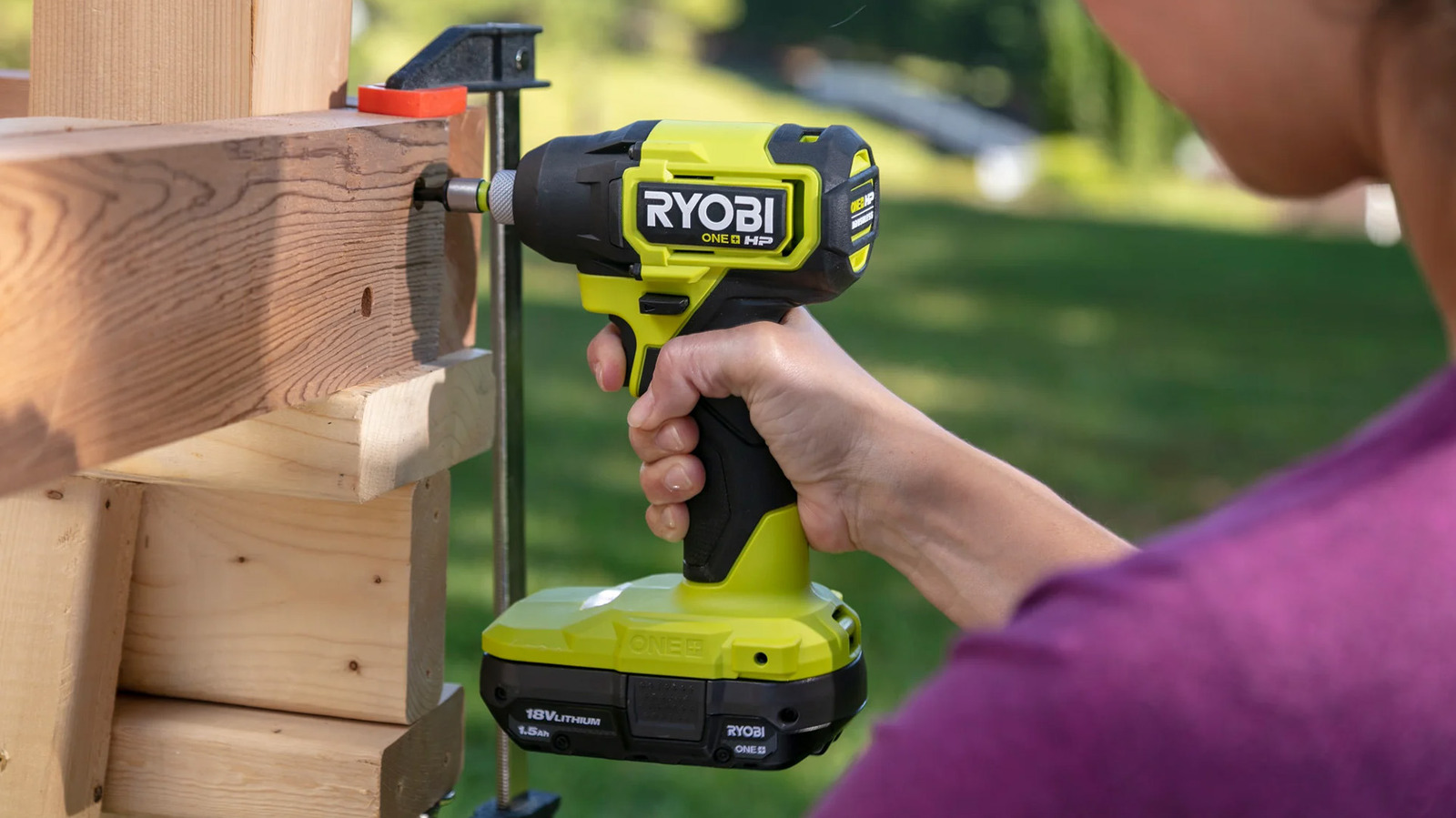
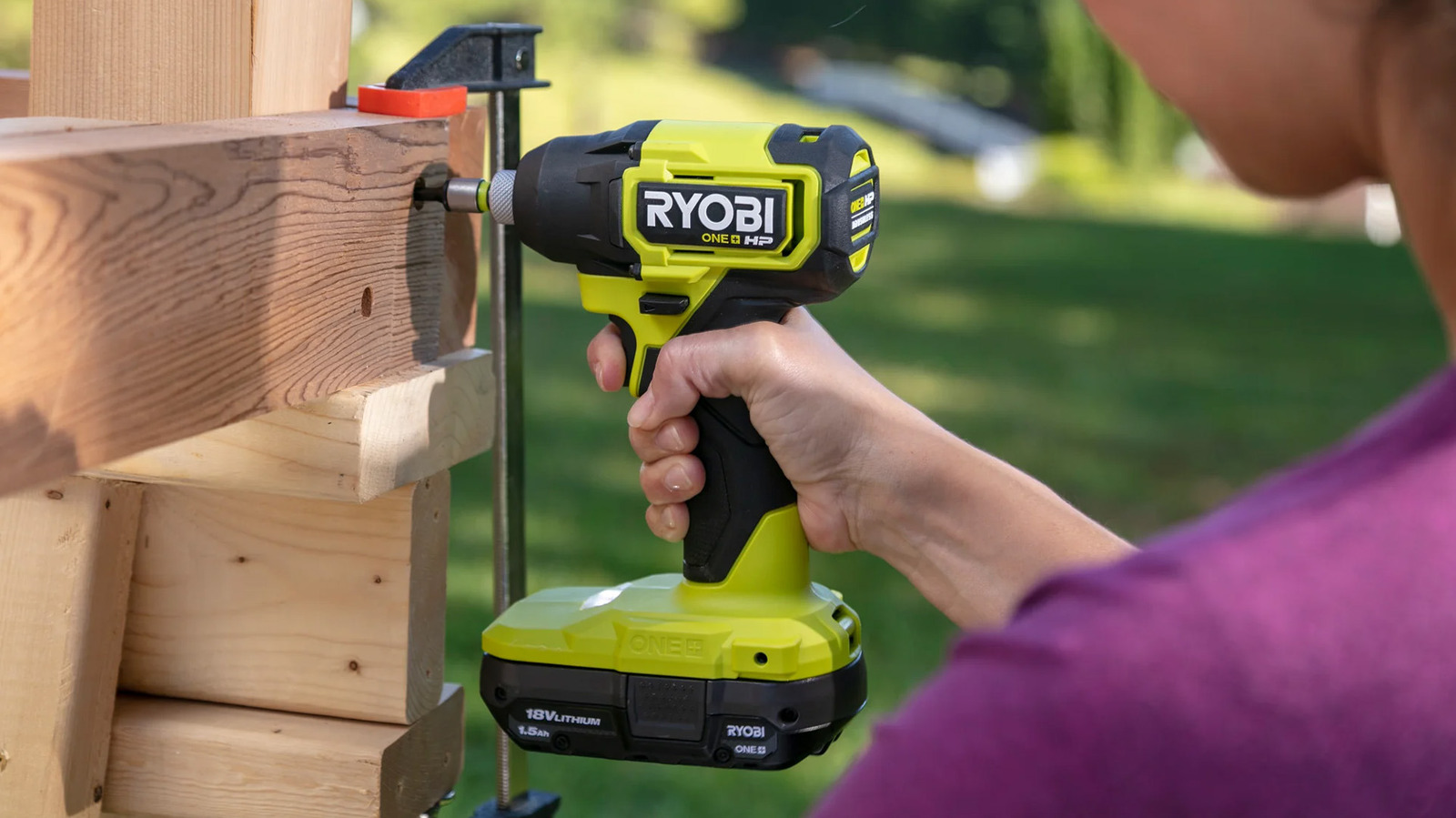
Beginners may get a little confused about the difference between an impact driver and power drill, and for good reason because they are similar. The biggest difference is that impact drivers have more torque and better contact with screw heads, making them superior for longer screws and harder materials like metal or concrete. Ryobi sells such an impact driver for under $50 with the One+ 18V 1/4-inch Impact Driver. It’s $59 at Home Depot, but you can buy it directly from Ryobi for $48.
This little guy provides 1,800 inch-pounds of torque at 2,800 RPM, which is faster than the 600 RPM of Ryobi’s 3/8-inch drill. Just that spec along gives you a pretty good idea what the difference is between a drill and an impact driver. These take 1/4-inch bits, and it is a universal fit, so any 1/4-inch bit set will do the trick here. It comes with a variable speed trigger and Ryobi’s standard three-year power tool warranty.
The only downside is that this is for just the tool, so you’ll need a battery on hand to use it. As mentioned previously, Ryobi likes to package these in combo kits with a drill for under $100, giving you two tools for roughly $50 each along with batteries. That’s a superior deal overall, but if you already have a drill and a battery, you can still get an impact driver for pretty cheap.
Ryobi sells a ton of products for under $50, but the overwhelming majority of them are accessories like drill bit sets and replacement parts for power tools with wear items like saws. So, putting together a list of Ryobi tools for under $50 is pretty simple since you just filter out those accessories and replacement parts, and you’re left with power tools.
From there, we chose tools that are specifically good for DIY home repair and home improvement. You can get a Ryobi tire inflater for under $50, but it doesn’t really help you fix or build anything, so tools like that were left off of the list. We also kept the list to a single light, tool bag, and cleaning product. Those do help you repair or improve your home, but Ryobi has a bunch of those and saturating the list with what is essentially the same item over and over would’ve been low effort.
Finally, all products needed at least a 4.0-star rating across 100 reviews and over. Nearly every product on the list has high ratings and more numerous reviews than that, but there are some questionable Ryobi tools that we made sure to keep off of the list. We also made sure most tools were part of its main One+ 18V lineup, so if you did buy any of these, they’d be compatible with other Ryobi tools you might purchase in the future.

Evolving Rodents: An upcoming crowdfunding campaign aims to introduce a novel approach to mouse interaction. The Rotary Mouse replaces the traditional scroll wheel with a rotating mechanism, which, according to its developers, is designed to feel as natural as possible.
The Rotary Mouse from Airra Labs will debut on Kickstarter at a significant discount and with free shipping to early backers. The company says there is real demand for the product, despite its unconventional design.
The campaign is scheduled to open on June 17. The device replaces the traditional vertical scroll wheel with a built-in rotary mechanism, which it claims delivers up to 2.5x faster scrolling compared to a standard mouse. The company also says the system is smoother and more natural than conventional scrolling wheels.
While the rotary design may appear unfamiliar, it is intended to improve scrolling performance and ergonomics. The wheel includes tactile feedback and supports both traditional vertical scrolling and a counterclockwise rotation mode. Additional features include a range-of-motion function designed to reduce finger strain.
Airra Labs argues that the mouse wheel has remained largely unchanged for the past 30 years. Users still flick small wheels to browse web pages, documents, spreadsheets, source code, and more. In recent years, some mice have adopted “infinite scroll” modes, but the company describes them as slow, repetitive, and difficult to control.
Indeed, using the wheel on my Logitech G502 Hero felt weird and cumbersome at first, but I have since adapted my scrolling habits and I don’t plan on changing anytime soon.
The Rotary Mouse is intended to reduce scrolling strain and make content navigation significantly faster. Airra claims the rotary wheel can outperform infinite scrolling by offering more precise control across different use cases, including video editing, software development, spreadsheets, document work, and long-form web browsing. The wheel can also function as a miniature steering control for driving simulators.
The project appears to be ready for production, but Airra is turning to crowdfunding to cover costs such as injection molding, certification, packaging, and warranty support. The company says mass production is expensive and requires additional operational expertise.
The Rotary Mouse is expected to be priced between $49 and $109. However, early crowdfunding backers will receive a discount of up to 65% off the final retail price. The wireless mouse supports a DPI range of 800 to 1600, suggesting it may have limited appeal among competitive gamers.

A Chinese Zhuque-2E rocket’s upper stage broke apart shortly after last week’s June 9 launch, likely creating 100 to 150 pieces of debris in a busy region of low-Earth orbit crossed by the ISS and lower-altitude Starlink satellites. Most fragments should reenter within months because of atmospheric drag, but experts say the incident adds to a worsening trend as China leaves more large rocket bodies in orbit while expanding its launch rate. Ars Technica reports: The US Space Force confirmed the breakup event in a post on space-track.org, a website used by the military to distribute orbit data to the public. “The tracked pieces are being incorporated into routine conjunction assessment to support spaceflight safety,” the Space Force wrote in an advisory. “There are currently no threats to human spaceflight. Analysis is ongoing.” So far, the Space Force has not added any of the debris fragments to the official catalog of human-made space objects.
[…] The bad news is that the Zhuque-2E’s breakup is the latest chapter in China’s growing contribution to the space junk problem. After decades of leaving spent rocket bodies in orbit, launch operators in most countries now reserve enough fuel to steer their upper stages back to Earth for controlled reentries. Rocket bodies attributed to Russia and the former Soviet Union account for the bulk of the launch-related debris in long-lived orbits, followed by China and the United States. But the Russian and American numbers are declining or holding steady, while the mass of Chinese rocket bodies in these long-lived orbits has grown by more than 150 percent in the past five years, according to a new analysis by Space Domain Awareness expert Jim Shell. The increase comes as China ramps up launches of its own megaconstellations designed to compete with SpaceX’s Starlink.
Rocket bodies are the most concerning sources of space debris because they are typically fairly large in size and mass, often with residual propellant and high-pressure gases that can trigger an explosion. There is no way to maneuver or dispose of them if left abandoned in orbit after releasing their payloads. McKnight characterized the recent breakup of the Zhuque-2E rocket as a “slight space safety issue,” but the trend is not good. China’s Long March 6A rocket has an especially bad track record, including two explosions that littered a higher-altitude low-Earth orbit with more than 1,000 debris fragments, where they will remain for decades or centuries. “Three of the top four breakup events in LEO are of Chinese origin, with two of these events being from Chinese (rocket body) explosions in the last four years,” McKnight said.

Something to look forward to: Competition in the APU market could intensify when Intel and Nvidia reveal the fruits of their announced collaboration against AMD. While no official timeline has been confirmed, reports suggest users could get a first look at Intel-Nvidia chips within the next 18 months.
Tech journalist Erdi Özüağ reports that Intel’s current roadmap targets the first quarter of 2028 for its initial x86 processors with Nvidia RTX graphics, with a possible reveal at CES. The long-anticipated chips are expected to challenge AMD’s high-end mobile APUs and bolster both companies’ broader platform ambitions.
Intel’s plans are likely still in flux this far out, but its current roadmap puts the chips in early 2028 barring delays. Intel and Nvidia officially confirmed they were developing these chips in September 2025, though specific details have been scarce since.
– Erdi Özüağ (@fx57) June 15, 2026
What is known is that the x86 SoCs will combine Intel CPU cores with Nvidia RTX GPU chiplets – likely using a high-bandwidth interconnect – across a range of devices. Reports suggest Serpent Lake will pair Intel’s Titan Lake CPU cores with a GPU based on Nvidia’s next-generation Rubin architecture.
The chip is rumored to be fabricated on TSMC’s N3P process node and is expected to support LPDDR6 memory, providing the bandwidth necessary for both high-end gaming and AI workloads. Its primary target appears to be AMD’s Strix Halo APUs in the high-end laptop segment.
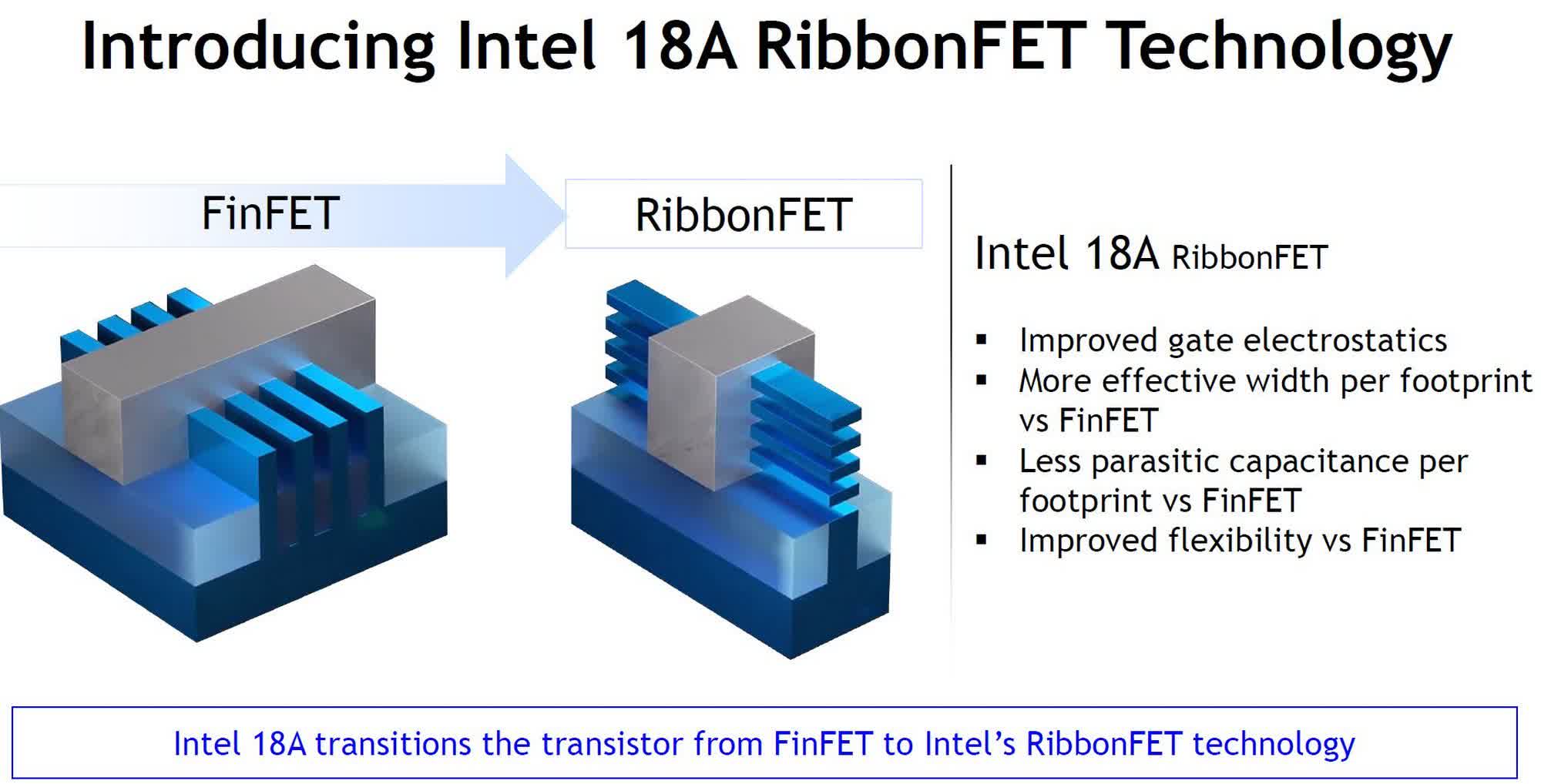
Intel and Nvidia’s partnership could also shake up the mobile gaming market. AMD’s Hawk Point, Strix Point, and Strix Halo chips have powered the category in devices like the Steam Deck, Asus ROG Xbox Ally, and Lenovo Legion Go. More recently, however, MSI’s Claw 8 EX AI+ marked the debut of Intel’s Arc G3 Extreme – a Panther Lake design built on the 18A process node – giving Intel a foothold in the handheld gaming space. The chip also supports Intel’s XeSS upscaling technology.
Özüağ also reports that Apple’s negotiations with Intel over the use of its 18A foundry node are progressing, with the Cupertino company looking to reduce its dependence on TSMC and respond to political pressure to expand domestic manufacturing.
Initial shipments are not expected before the second or third quarter of 2027, and all plans remain subject to Intel’s ability to improve yield, performance, and cost competitiveness on its 18A process.

In 2017, Respond.io set out to solve a simple problem: businesses couldn’t keep up with customers who had moved to messaging apps. Today Respond, with its customer conversation management software, has become one of the tech success stories of Malaysia.
The startup, headquartered in Kuala Lumpur, has raised a $62.5 million Series B round led by Camber Partners, with participation from Endeavor Catalyst and existing investors. It last raised a $7 million Series A in 2022. The company has grown to $35 million in annual recurring revenue (ARR), growing 169% year-over-year, at a 30% profit margin, it tells TechCrunch.
Co-founder and CEO Gerardo Salandra, who worked at IBM and Google before joining Runtastic, a fitness tracking app that was sold to Adidas in 2015, founded Respond in Hong Kong in 2017 alongside Hassan Ahmed (CTO) and laroslav Kudritskiy (COO). The team relocated the business to Malaysia two years later.
The platform helps mid- to large-sized B2C businesses drive revenue from customer conversations across multiple messaging channels including WhatsApp, Instagram, TikTok, Messenger, Line, Telegram, WeChat, voice calls and web chat. It also uses AI agents to automatically handle high volumes of customer inquiries, qualify leads and close sales without human intervention.
Salandra described its core customers as “high-consideration” businesses, where customers need to talk to someone before buying, such as healthcare, automotive, retail, education and travel. “You don’t go to a website, put your credit card, and buy a car; you chat with someone, you ask a lot of questions,” he said. Its sweet spot is companies with 200 to 10,000 employees.
The rise of AI has raised an obvious question for platforms like Respond: Can tools like ChatGPT simply replace what they’ve built?
Salandra thinks his foothold is strong enough to stop such encroachment, should it come. The company is currently processing 2 billion messages per quarter.
“If I just look at the numbers, every day that AI becomes more prominent, we grow faster,” he told TechCrunch. “We are not seeing what the public SaaS markets are seeing.”
Part of that comes down to pricing, he said. Unlike enterprise software competitors that charge per seat, Respond charges based on the volume of customer conversations, meaning it doesn’t matter whether a human or an AI is answering. “When fewer humans use your product, they make less money,” he said. “But we don’t charge like that.”
The incumbent platforms, particularly those dominant in North America and Europe, were built around email and phone calls. “The platforms that exist, they bolted on messaging as a second thought. They’re very email focused, they’re very call focused, but when it comes to messaging, it’s an afterthought,” Salandra said.
That volume of message data creates a feedback loop, according to the CEO. More messages mean better AI. Better AI attracts more customers. More customers generate more messages. “This is what we call the data flywheel,” Salandra said. He added that the head start matters for any upstart AI company, as well. “Because we started so long ago and we have such a strong foundation, we can provide better AI compared to someone who just entered into the messaging space.”
With the new capital, Salandra said the company plans to pursue hiring, organic growth and acquisitions. The CEO has two types of buying targets in mind: bolt-on technology that fits into its existing ecosystem, and established teams with strong customer bases in strategic markets like Europe and North America. “Imagine how many months I can save if I find the right company that maybe already has the clients and the team,” he said. “I can save myself six months to a year through an acquisition.” He confirmed the company is already in talks with a couple of potential targets.
The geographic push makes strategic sense. Respond currently generates roughly 30% of its revenue from APAC, 30% from Latin America, and 20% from the Middle East and Africa, leaving North America and Western Europe at just 20%. But Salandra says those regions are now its fastest-growing. “They took longer to make the change, but now they’re moving very rapidly into messaging channels,” he said, adding that he expects both regions to become the company’s largest segment within two to three years.
Despite the fresh injection of capital, Salandra is cautious about what comes next. “We don’t want to be a growth at all costs company,” he said. “Even with this money, we’re going to be very disciplined.” But Salandra has bigger plans in mind. “My favorite outcome?” he said. “Ringing the bell at Nasdaq.”
When you purchase through links in our articles, we may earn a small commission. This doesn’t affect our editorial independence.

Looking for the most recent Mini Crossword answer? Click here for today’s Mini Crossword hints, as well as our daily answers and hints for The New York Times Wordle, Strands, Connections and Connections: Sports Edition puzzles.
Need some help with today’s Mini Crossword? Read on. And if you could use some hints and guidance for daily solving, check out our Mini Crossword tips.
If you’re looking for today’s Wordle, Connections, Connections: Sports Edition and Strands answers, you can visit CNET’s NYT puzzle hints page.
Read more: Tips and Tricks for Solving The New York Times Mini Crossword
Let’s get to those Mini Crossword clues and answers.
The completed NYT Mini Crossword puzzle for June 16, 2026.
1A clue: Worker who sticks a thick mix on bricks
Answer: MASON
6A clue: Volvos or VWs
Answer: AUTOS
7A clue: “Wow, that’s wild!”
Answer: CRAZY
8A clue: Peaceful place
Answer: HAVEN
9A clue: Key above ~ on a Mac
Answer: ESC
1D clue: ___ 1 (speed of sound)
Answer: MACH
2D clue: Emanating glow
Answer: AURA
3D clue: Fend (off)
Answer: STAVE
4D clue: Seeps slowly
Answer: OOZES
5D clue: Boy band with the 2000 hit “It’s Gonna Be Me”
Answer: NSYNC


offbeat
Worried that an unexpected strike could take out critical orbital systems, Pentagon researchers want to know how fast the industry thinks it could launch replacements
War may never change, but its domains evolve, and DARPA is looking for ideas to ensure space infrastructure destroyed in future orbital skirmishes can be rapidly replaced.
DARPA, on Friday, put out a request for information for an initiative to develop what it’s calling Rapid Reconstitution of Space Capabilities.
“Other nations seek to position themselves as leading space powers while undermining the stability and tranquility that allows space to benefit all nations,” DARPA said, suggesting that the US would never dare deploy space weapons that could destabilize the tranquility of Earth orbit.
“Space is an increasingly contested environment, presenting a multitude of threats to U.S. space assets,” DARPA added. “Therefore, there is a strategic need to be able to quickly respond to disrupted assets and reconstitute degraded space capabilities.”
While we don’t know if the US has any weapons in space – we asked but didn’t get a response – other countries certainly are striking an aggressive posture.
Both Russia and China have reportedly blown up their own defunct satellites in recent years to demonstrate their space warfare capability, and the US Space Force has noticed what appears to be China experimenting with orbital satellite dogfighting maneuvers. The US has also accused Russia of developing anti-satellite weaponry that may or may not involve orbital nukes, leading the US to update its fleet of satellites designed to keep an eye out for potential nuclear launches.
“U.S. competitors are implementing a sustained effort to develop a broad range of offensive counterspace capabilities through a variety of anti-satellite (ASAT) weapons, including direct attacks on satellites, jamming and spoofing of signals, and continued cyberattacks on satellite and ground infrastructure,” DARPA noted in Friday’s announcement.
Pointing to the 2023 Space Force tactically responsive space exercise Victus Nox, which saw the USSF launch a space vehicle into orbit just 27 hours after getting the word, DARPA said it wants more of the same, but hopefully faster.
“DARPA Strategic Technology Office seeks information supporting technical solutions and operational concepts and strategies to enable rapid, responsive, cost-effective reconstitution of any lost or degraded space capabilities resulting from attacks,” DARPA explained, adding that it’s not looking for anything more than ideas at this point, but is willing to entertain anyone in the US with a good idea, be they laboratory or private outfit.
According to the announcement, DARPA wants ideas that would get degraded operations restored in “hours to weeks,” and offer the same turnaround time for cases of surging demand as well as asset loss.
“Possible solutions could be realized with reconfigurable, software-defined, multifunctional, and multi-mission payloads, as well as proliferated/mesh architectures and rapid on-orbit deployment concepts,” the Pentagon research arm said.
“Rapid space capability reconstitution is a complex task,” DARPA added, so don’t expect this research to move anywhere near the speed of DARPA’s eventual rapid reconstitution rockets.
Then again, America just minted the world’s first trillionaire, and he’s a space guy – maybe ask him how to launch rockets quickly? Surely his ideas would be grounded in good sense, right?

alternative_right shares a report from The Hill: The FBI released an urgent security warning to the public about a fast-acting scam targeting Microsoft 365 users on Teams, Outlook and OneDrive. The agency warned that the hacking platform Kali365 seeks out OAuth device codes, allowing scammers to sneak past multi-factor authentication codes, and without the need for a password, to access Microsoft accounts. Scammers will send a phishing email impersonating a trusted document-sharing service with a device code and instructions on how to verify, according to the FBI.
“Kali365 lowers the barrier of entry, providing less-technical attackers access to AI-generated phishing lures, automated campaign templates, real-time targeted individual/entity tracking dashboards, and OAuth token capture capabilities,” the FBI stated. The platform is sold to scammers with a $250 per month subscription. The FBI, which first detected Kali365 in April, described the hacking platform as an “emerging Phishing-as-a-Service platform.” Hackers with limited skills can access advanced phishing tools through the platform, according to NordPass.


Rivian CEO RJ Scaringe says supervised point-to-point self-driving arrives this year on Gen 2 and R2 vehicles, with eyes-off driving in 2027.
Rivian CEO RJ Scaringe said the company will ship supervised point-to-point self-driving on all of its second-generation vehicles and the R2 later this year, describing the capability as “very similar to Tesla’s FSD.” Speaking at the Masters of Scale event in Anaheim on Thursday, Scaringe laid out a three-stage autonomy roadmap: supervised point-to-point driving in 2026, eyes-off unsupervised driving in 2027, and a commercial robotaxi service with Uber beginning in 2028.
The announcement represents a significant jump from Rivian’s current driver-assistance system. Universal Hands-Free, which rolled out in late 2025, handles steering and speed on roughly 3.5 million miles of marked roads in the US and Canada. It does not navigate turns, traffic lights, roundabouts, or parking lots.
Point-to-point driving would extend the system’s capabilities to handle complete journeys from origin to destination, similar to what Tesla’s Full Self-Driving Supervised already attempts. The leap from highway lane-keeping to full urban navigation is the hardest problem in autonomous driving, and no company has solved it without significant constraints.
“Later this year, we’ll have full supervised point-to-point, which will be very similar to Tesla’s FSD,” Scaringe said. “And that’ll roll out to all of our Gen 2 vehicles and, of course, R2.” He did not specify a month or quarter for the rollout, and Rivian has not publicly demonstrated the point-to-point system in an uncontrolled environment.
The comparison to Tesla is deliberate but architecturally inexact. Tesla’s FSD relies exclusively on cameras, while Rivian’s platform integrates 10 external cameras, five radar units, 12 ultrasonic sensors, and a high-precision GPS receiver. Rivian began delivering R2 SUVs earlier this month, and future R2 models will add a roof-mounted LiDAR sensor and the company’s custom RAP1 processor, a 5nm chip delivering up to 1,600 trillion operations per second.
The pricing undercut is sharper than the technology comparison. Rivian’s Autonomy+ package costs $2,500 as a one-time purchase or $49.99 per month, compared with Tesla’s FSD at $8,000 or $99 per month. Whether the lower price reflects a competitive strategy or a difference in capability remains to be seen, given that Rivian’s point-to-point system does not yet exist as a shipping product.
Rivian’s autonomy software is built around what the company calls a Large Driving Model, a foundational AI system trained end-to-end through reinforcement learning. The LDM maps raw sensor input directly to vehicle trajectory, analysing multiple driving paths and selecting the optimal one using a technique called Group-Relative Policy Optimization. The approach mirrors the end-to-end neural network philosophy Tesla adopted with FSD v12, though Rivian’s multi-sensor hardware gives the model a wider range of input data to work with.
The 2027 eyes-off milestone is where the roadmap becomes commercially consequential. Supervised driving, regardless of how capable, still requires a human to watch the road. Tesla has been promising unsupervised FSD for years and has pushed the timeline repeatedly, most recently to Q4 2026 at the earliest. Scaringe has said Rivian targets Level 3 autonomy by 2028 and Level 4 by 2030, timelines that no autonomous driving company has consistently met.
The commercial centrepiece of the roadmap is the $1.25 billion deal with Uber announced in March. Uber committed an initial $300 million investment, with the remainder contingent on Rivian hitting autonomous performance milestones through 2031. The deal calls for Uber or its fleet partners to purchase 10,000 fully autonomous R2 robotaxis, with an option for up to 40,000 more beginning in 2030. Commercial deployment is planned for San Francisco and Miami in 2028, expanding to 25 cities by 2031.
Those targets depend on Rivian achieving something it has not yet demonstrated: a vehicle that can drive itself without human supervision. The company’s Gen 3 autonomy platform, which will power the robotaxi programme, is still undergoing validation. The initial R2 production run launched without the Gen 3 hardware, meaning the robotaxi-grade vehicles are at least one hardware generation away from production.
Scaringe framed the self-driving push as essential to Rivian’s long-term economics. The company posted a net loss of $3.63 billion in 2025 despite achieving its first full-year positive gross profit at $144 million. Autonomy, if it works, transforms the revenue model from selling cars to operating a transportation platform. But the gap between announcing a roadmap at a conference and shipping a reliable autonomous system is where most self-driving timelines have historically broken down.


In case Microsoft Flight Simulator is a little too realistic for your tastes, there’s a new way you can take to the virtual skies. Google Earth has a flight sim mode of its own, and it can now be accessed by anyone globally via their browser. Android Police spotted a social media post from the Google property announcing this update.
Prepare for takeoff. ✈️ Flight simulator is now available globally on web to all users. https://t.co/jV5ZW7BZeW
We’ve recently added many our most powerful professional desktop features to web. Elevation profiles, new import types, but there’s always been one other feature… pic.twitter.com/s11NDaCx60
— Google Earth (@googleearth) June 12, 2026
Google Earth seems to be the area where the massive company remembers that tech can be cool and downright fun. In 2024, it added an option for seeing historical recreations of select times and places. This is the sort of clever curio we love, and Google delivered even more the following year.
Once you have Google Earth open, go to Explore Earth, then the Tools menu to find the Flight Simulator mode. There’s an FAQ for you newbie virtual pilots to help you get acclimated to the Google Earth simulation. Just bear in mind two caveats. For one, this is an experimental feature, so you might have some wonky moments with the flight simulator. And second, Google wants to be very clear that this isn’t enough to put you in the cockpit of an actual 747: “The flight simulator is designed for casual exploration rather than high-fidelity aerodynamic training,” it notes. Happy travels!

Retroid has brought back the 12GB RAM configuration of the internet-famous Pocket 6, returning it to the lineup at the same $279 price point as the discontinued version.
The original 12GB RAM variant was pulled from sale earlier this year after Retroid cited the rising cost of RAM and storage, leaving the Pocket 6 available only in its 8GB RAM configuration.
However, the updated model comes with the catch of reduced internal storage. That storage reduction is the most consequential change in the new configuration, with the returning 12GB model shipping with 128GB of UFS 3.1 storage rather than the 256GB that the discontinued version carried, effectively halving the built-in capacity at an unchanged retail price.
The new variant also arrives with a more limited set of options than the original, restricted to a single control layout with asymmetrical thumbsticks, meaning buyers who prefer the symmetrical D-pad Top arrangement will need to step down to the 8GB RAM version to get that configuration.
Colour availability has narrowed as well, with the 12GB RAM model offered only in Black, 16Bit, and Silver, dropping the Light Purple and Orange options that were available on earlier Pocket 6 configurations sold through the official Retroid store.
Retroid also announced the returning model through its official Discord channel rather than a formal press release, confirming the device is in stock and available to ship immediately, which places it ahead of competing handhelds such as the AYN Thor and Odin 3 that are currently operating on pre-order timelines.
The new 12GB RAM Pocket 6 is priced at $279 and remains exclusive to the official Retroid website, with the device confirmed in stock and ready to ship immediately.




No Jackpot Winner as $257 Million Prize Rolls Over to $269 Million Monday Draw


Oppenheimer backs SpaceX as $70 billion retail frenzy builds


Markets Rally as SpaceX IPO Looms Amid Iran Tensions and Inflation Surge


Weekend Open Thread: Tuckernuck – Corporette.com

Zimbabwe Requires Crypto Businesses to Register Annually Under New FIU Regulations


The Ryan Gosling True Crime Thriller On Netflix That Gets Even Stranger, Stream It Now


NanoClaw integrates JFrog registries to secure AI agent downloads

Bangladesh beat Australia after 20 years in ODIs, register only their second win over six-time world champions | Cricket News


Bitget enters Argentina’s regulated crypto market through PSAV registration


This Week In Security: Microsoft On Microsoft, Register Your Domains, Linux On ARM, And FreeBSD Joins The File Cache Club


El Nino has formed in the Pacific and could set records, forecasters say

Dutton Ranch star claims they ‘didn’t see any disruption’ on set following Chad Feehan’s exit from Yellowstone spinoff fueled by Taylor Sheridan clash rumors


Politics Home | Healey Resignation Is “Colossal Failure Of Government”, Says Former Labour Defence Secretary


‘This is Seattle’s position on AI’: City Council votes unanimously to pause big new data centers


Thailand Ranks Second Worldwide for AI Adoption Growth, Microsoft Reports

Donnie Wahlberg & More Heat Up Las Vegas at Circa’s Barry’s Downtown Prime

Opendoor Ends India Operations, Fueling a Bigger Conversation About AI and Outsourcing


First Time Since 1971: Australia Register Historic Low In ODI Cricket


Belfast burns, while Met chief points finger at Iran and Russia


FBI searches office of Ohio voter registration group


You must be logged in to post a comment Login