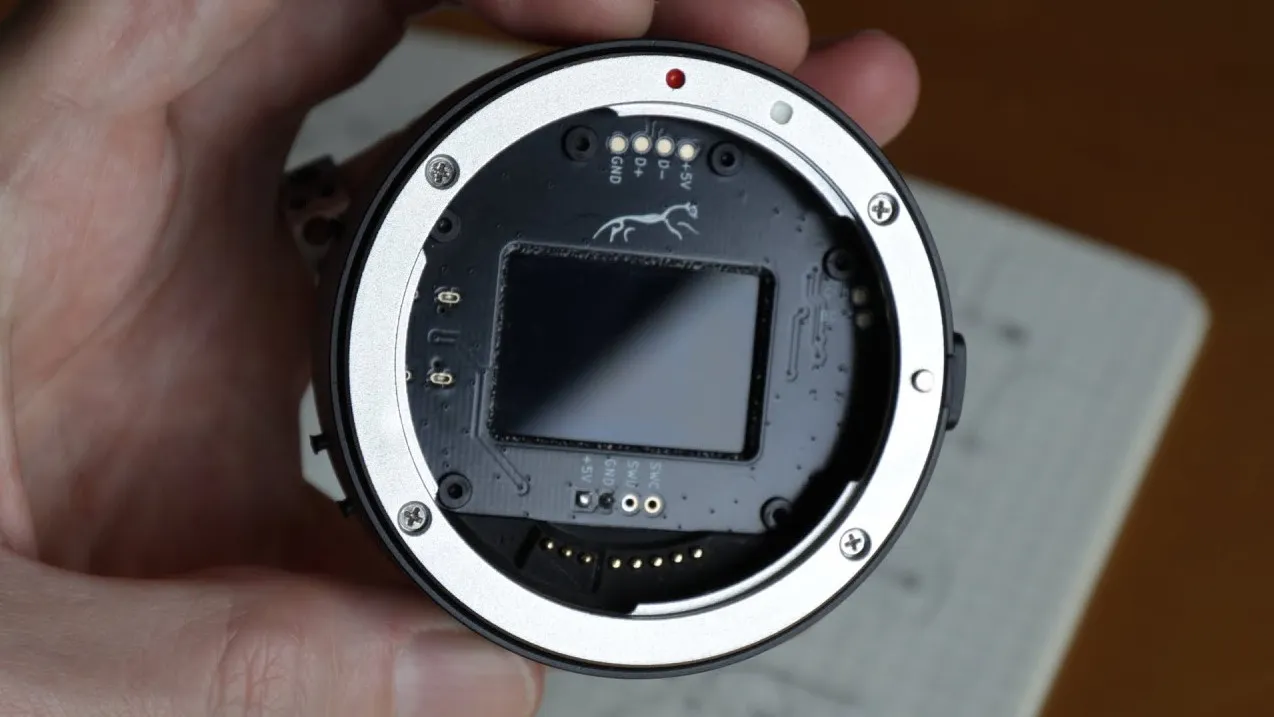
For a long while, digital single-lens reflex (DSLR) cameras were the king of the castle for professional and amateur photography. They brought large sensors, interchangeable lenses, and professional-level viewfinders to the digital world at approachable prices, and then cemented their lead when they started being used to create video as well. They’re experiencing a bit of a decline now, though, as mirrorless cameras start to dominate, and with that comes some unique opportunities. To attach a lens meant for a DSLR to a mirrorless camera, an adapter housing must be used, and [Ancient] found a way to squeeze a computer and a programmable aperture into this tiny space.
The programmable aperture is based on an LCD screen from an old cell phone. LCD screens are generally transparent until their pixels are switched, and in most uses as displays a backer is put in place so someone can make out what is on the screen. [Ancient] is removing this backer, though, allowing the LCD to be completely transparent when switched off. The screen is placed inside this lens adapter housing in the middle of a PCB where a small computer is also placed. The computer controls the LCD via a set of buttons on the outside of the housing, allowing the photographer to use this screen as a programmable aperture.
The LCD-as-aperture has a number of interesting uses that would be impossible with a standard iris aperture. Not only can it function as a standard iris aperture, but it can do things like cycle through different areas of the image in sequence, open up arbitrary parts or close off others, and a number of other unique options. It’s worth checking out the video below, as [Ancient] demonstrates many of these effects towards the end. We’ve seen some of these effects before, although those were in lenses that were mechanically controlled instead.
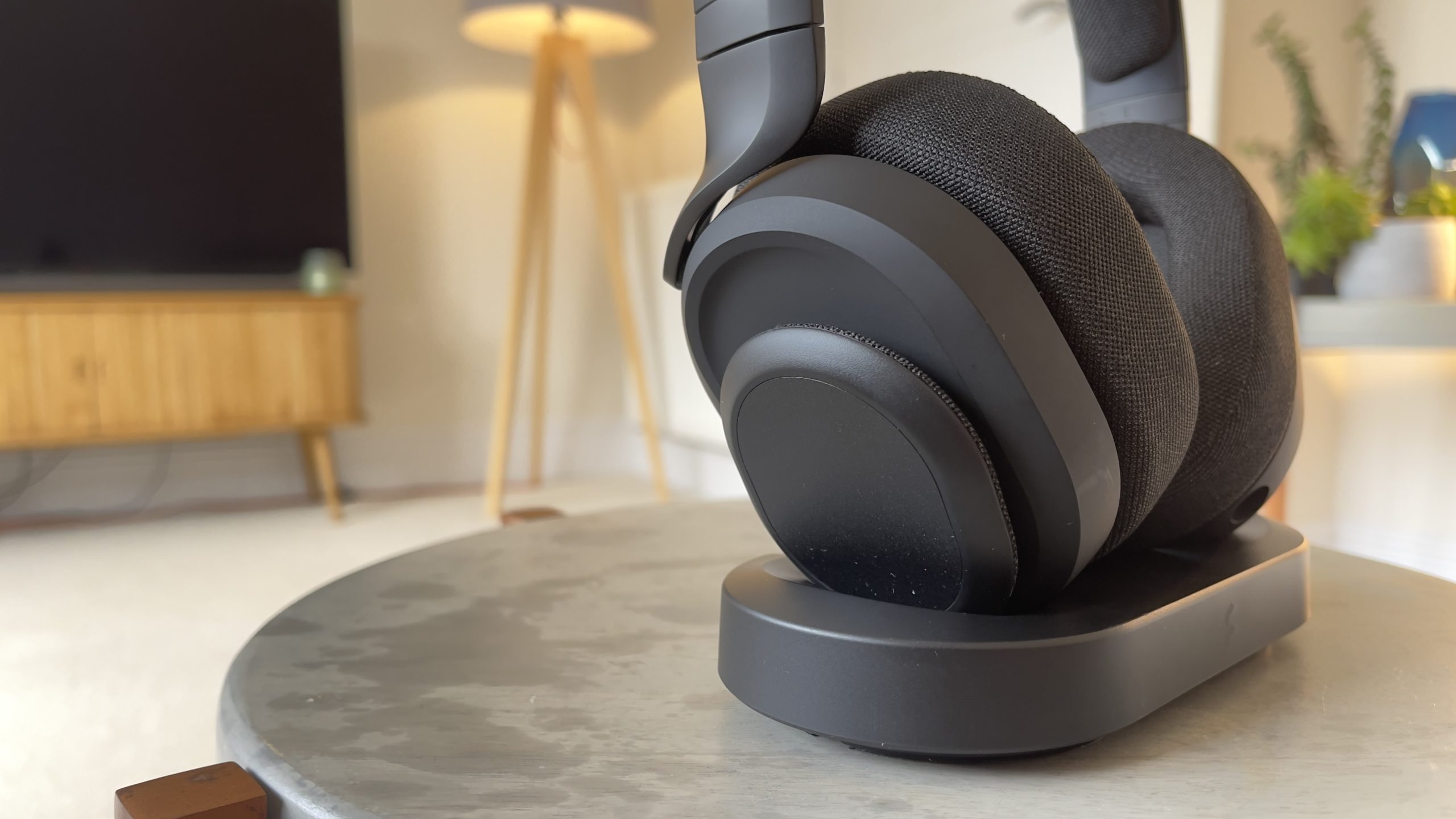
Noise is hard to escape, whether it’s the hum of traffic, the buzz of a busy office or the neighbor’s lawn mower starting up right when you need to focus. That’s where noise-canceling headphones earn their keep. A good pair doesn’t just quiet the world around you, it creates a pocket of calm so you can actually enjoy your music, podcasts or peace and quiet.
Modern noise-canceling headphones have come a long way, combining powerful ANC with clearer sound, longer battery life and smarter features like adaptive modes and multipoint connectivity. Some emphasize comfort for long flights, while others are tuned for audiophiles who want studio-level clarity.
We’ve tested a wide range of options to find the best noise-canceling headphones for every listener. Whether you’re after something lightweight for travel or a premium set for focused work sessions, these picks deliver the sound, silence and comfort you need to tune out the chaos.
Best noise-canceling headphones of 2026
Bose/Engadget
Advertisement
Connectivity: Bluetooth | ANC type: Hybrid Adaptive | Customizable ANC: Yes | Max battery life with ANC: 30 hours | Transparency mode: Yes | Weight: 264 grams | Collapsible: Yes (folds both flat and inward)
The second-gen version of the QuietComfort Ultra Headphones aren’t an entirely new device, but there are impactful upgrades all around. With regard to the ANC specifically, Bose enhanced its ActiveSense tech to smooth any adjustments to sudden spikes in ambient noise levels. This bolsters what was already superb ANC performance, an achievement that gives the company a slight edge over the competition.
The new version also includes significant updates to power management and battery life, with at least five more hours of use in all listening modes. You’ll also get lossless audio over USB-C, putting the QC Ultra Headphones on the same level at Apple’s AirPods Max and others. A comfy fit, reliable controls and folding design round out the spec sheet for this model.
Advertisement
Pros
Industry-leading ANC got even better
Sound and power upgrades are substantial
Cons
Still expensive
Glossy finish isn’t for everyone
Billy Steele for Engadget
Connectivity: Bluetooth | ANC type: Hybrid Adaptive | Customizable ANC: Yes | Max battery life with ANC: 30 hours | Transparency mode: Yes | Weight: 254 grams | Collapsible: No (ear cups swivel flat but do not fold inward)
Sony’s 1000X line has been our top pick for best wireless headphone for a long time now. That’s still true. However, even though the company packs in lots of premium features alongside excellent sound quality, the M6 sits just below Bose in terms of pure ANC abilities. With the WH-1000XM6, Sony subtly redesigned its flagship headphones, making them way more comfortable to wear for long periods of time. This is an important factor to consider when purchasing over-ear headphones. We also noticed in our tests that the company made noticeable improvements to the active noise cancellation, thanks to a new QN3 chip. There are now 12 total ANC mics as well – the previous model only had eight. This all combines to better block background noise at medium and high frequencies, including human voices.
The M6 also has improved sound quality, thanks to new drivers, some help from mastering engineers and spatial audio upmixing. Its battery life remains the same 30 hours as its predecessor, which is more than enough to get you through several days of work or long international flights. Speak-to-Chat still reduces volume and activates ambient sound when you talk and the M6 can automatically change noise settings based on your location or activity. The only real downside is that they’re $50 more than the WH-1000XM5 at full price ($450).
Advertisement
Pros
Improved sound
Better ANC performance
Tons of handy features
Supremely comfy
Cons
Price has increased again
Speak-to-Chat still needs work
Call quality suffers in loud environments
Photo by Billy Steele / Engadget
Connectivity: Bluetooth | ANC type: Hybrid | Customizable ANC: Yes | Max battery life with ANC: 35 hours | Transparency mode: Yes | Weight: 192 grams | Collapsible: No (ear cups swivel flat but do not fold inward)
The WH-CH720N won’t win any design awards with these over-ear headphones, but what you get for the price is well worth some aesthetic sacrifices. Due to their all-plastic construction, the CH720N are super lightweight and comfy, allowing you to wear them for hours at a time. The ANC isn’t as robust in these budget headphones as that in more expensive headphones, but it’s above average for products in this price range. Toss in customizability and a handy transparency mode, and you’ve got a solid device that costs only $150 — and regularly goes for around $100.
In addition to decent noise reduction for a small investment, the CH720N has 35-hour battery life, physical controls, DSEE upscaling and Sony’s 360 Reality Audio. You can also adjust both the EQ and the level of ambient sound. Plus, the company’s ever-present Adaptive Sound Control can automatically switch the sound settings based on your activity or location. Last but not least, the overall sound quality is really impressive for headphones at this price. There’s plenty of detail and subtlety in the audio; you can really hear the gritty texture of distorted guitars and near-pristine acoustic instruments.
Pros
Advertisement
Affordably priced
Lightweight and comfy
Great sound quality
Some handy features
Cons
ANC struggles in certain environments
Lots of plastic
No automatic pausing
Advanced features reserved for pricier models
Billy Steele for Engadget
Connectivity: Bluetooth | ANC type: Adaptive | Customizable ANC: No | Max battery life with ANC: 30 hours | Transparency mode: Yes | Weight: 300 grams | Collapsible: No (ear cups swivel flat but do not fold inward)
If you seek to pair excellent sound quality with capable ANC performance, the Px7 S3 are the best option. Sure, you can find more impressive noise-blocking abilities elsewhere, but if you want pristine audio as well, Bowers & Wilkins is the way to go. An adaptive ANC setup uses eight microphones to capture unwanted noise and automatically adjust to any changes. 40mm dynamic full-range bio cellulose drivers pipe in balanced tuning that provides you with the finest detail of any song.
Advertisement
You’ll also get up to 30 hours of battery life with ANC enabled, although you will probably surpass that figure. Plus, handy tools like transparency mode, multipoint Bluetooth and an adjustable EQ cover the basics on the Px7 S3. You won’t find more advanced features than those, but what Bowers & Wilkins does offer here is finely tuned and carefully polished.
Pros
Excellent sound quality
Comfy fit
Sophisticated design
Cons
Expensive
Awkward button locations
A lack of advanced features
Photo by Billy Steele / Engadget
Advertisement
Connectivity: Bluetooth | ANC type: Hybrid Adaptive | Customizable ANC: Yes | Max battery life with ANC: 60 hours | Transparency mode: Yes | Weight: 292.9 grams | Collapsible: No (ear cups swivel flat but do not fold inward)
Sure, there are headphones that will last longer than Sennheiser’s Momentum 4 Wireless, but they don’t offer the combo of great battery life, ANC and good sound quality you’ll find here. On this model, the company made big improvements to its active noise cancellation, catching up to rivals like Bose and Sony. Specifically, the ANC on the Momentum 4 handles constant distractions more effectively than previous models in the series.
I don’t care for the design Sennheiser introduced on the Momentum 4 as the company ditched what was a quite novel look for something much more generic and plastic. However, the change comes with the bonus of increased comfort. You’ll also get excellent sound quality, in fact, it’s some of the best you’ll find in wireless headphones. There’s noticeable depth to the audio profile with a wide soundstage that complements all genres. You might even discover finer details you previously missed. And, of course, its 60 hours of battery life with ANC on is double what a lot of flagship headphones offer these days.
Advertisement
Pros
Impressive 60-hour battery life
Better ANC performance
Great sound quality
Improved comfort
Cons
Pinch gesture feels unnecessary
Standout design is gone
Auto on/off needs work
How to choose the best noise-canceling headphones for you
Design
When you’re shopping for the best wireless headphones, the first thing you’ll need to decide on is wear style. Do you prefer on-ear or over-ear headphones? For the purposes of this guide, I focus on the over-ear style as that’s what most noise-canceling headphones are nowadays. Sure, you can find on-ear models with ANC, but over-ear, active noise-canceling headphones are much more effective at blocking outside sounds since your ears are completely covered.
For gamers, there are also gaming headsets that feature noise cancellation — some even have detachable microphones, so they can double as over-ear headphones. However, for the purpose of this article, we’re only going to be focusing on noise-canceling headphones rather than headsets. Look for models with a comfortable headband and memory foam ear cups to ensure you can wear them for long periods without discomfort.
Many headphones also come with a range of color options, so if aesthetics matter to you, you’ll find plenty of choices beyond just black or white. Whether you’re looking for something neutral or a bold pop of color, brands now offer a variety of styles to match your personal taste.
Advertisement
Finally, if you’re planning to wear your headphones for long periods of time, it’s important to pick a model with a comfortable fit. Memory foam ear cups, an adjustable headband, and lightweight materials can make all the difference during extended listening sessions. After all, great sound is only part of the equation; comfort matters just as much.
Type of noise cancellation
Next, you’ll want to look at the type of ANC a set of headphones offers. You’ll come across terms like “hybrid active noise cancellation” or “hybrid adaptive active noise cancellation,” and there are key differences between the two. A hybrid ANC setup uses microphones on the inside and on the outside of the device to detect outside noise and cancel it out. By analyzing input from both mics, a hybrid system can combat more sounds than “regular” ANC, but it does so at a constant level that doesn’t change.
Adaptive ANC takes the hybrid configuration a step further by continuously adjusting the noise cancellation for changes in your environment and any leakage around the padding of the ear cups. Adaptive noise-canceling also does a better job with wind noise, which can really kill your vibe while using headphones outdoors. Some high-end headphones also support Dolby Atmos, which enhances spatial audio and makes everything from music to movies sound more immersive. For the purposes of this best headphones list, I’m only considering products with hybrid ANC or adaptive ANC setups because those are the most effective at blocking noise and improving your overall listening experience.
Customization
You’ll also want to check to see if the ANC system on a prospective set of headphones offers adjustable levels of noise cancellation or presets. These can help you dial in the amount of ANC you need for various environments, but it can also help you save battery life. Master & Dynamic, for example, has ANC presets that provide both maximum noise blocking and more efficient cancellation that is more energy efficient. Other companies may include a slider in their companion apps that let you adjust the ANC level to your liking. Some high-end models even allow you to fine-tune the ANC for specific types of environments.
Advertisement
How we test noise-canceling headphones
The primary way we test headphones is to wear them as much as possible. I prefer to do this over a one-to-two-week period, but sometimes deadlines don’t allow it. During this time, I listen to a mix of music and podcasts, while also using the headphones to take both voice and video calls.
Since battery life for headphones can be 30 hours or more, I drain the battery with looping music and the volume set at a comfortable level (usually around 75 percent). Due to the longer battery estimates, I’ll typically power the headphones off several times and leave them that way during a review. This simulates real-world use and keeps me from having to constantly monitor the process for over 24 straight hours.
To test ANC performance specifically, I use headphones in a variety of environments, from noisy coffee shops to quiet home offices. When my schedule allows, I use them during air travel since plane noise is a massive distraction to both work and relaxation. Even if I can’t hop on a flight, I’ll simulate a constant roar with white noise machines, bathroom fans, vacuums and more. I also make note of how well each device blocks human voices, which are a key stumbling block for a lot of ANC headphones.
ANC-related features are something else to consider. Here, I do a thorough review of companion apps, testing each feature as I work through the software. Any holdovers from previous models are double checked for improvements or regression. If the headphones I’m testing are an updated version of a previous model, I’ll spend time getting reacquainted with the older set. Ditto for the closest competition for each new set of headphones that I review.
Advertisement
Other noise-canceling headphones we tested
AirPods Max
Apple’s AirPods Max are premium, well-designed over-ear headphones that incorporate all of the best features you find on standard AirPods: solid noise cancellation, spatial audio and easy Siri access. However, their $550 starting price makes them almost prohibitively expensive, even for Apple users. There are better options available at lower prices, but if you can pick up the AirPods Max at a steep discount, they might be worthwhile for the biggest Apple fans among us.
Dyson On-Trac
The On-Trac headphones have an almost infinitely customizable design, and that’s what’s most unique about them. The sound profile offers some nice detail, but lacks dynamic range overall. ANC is average at best and there aren’t any advanced features that will make your life easier. Well, except for the hearing health monitor, which is actually handy. All told, that’s not a lot for a set of $500 headphones.
Sonos Ace
The Sonos Ace is an excellent debut for the company’s first headphones. The combination of refined design, great sound quality and home theater tricks creates a unique formula. However, ANC performance is just okay and key functionality is still in the works for many users.
Sony ULT Wear
If most headphones don’t have the level of bass you desire, the ULT Wear is an option to consider. The low-end thump isn’t for everyone, but there are also plenty of handy features and a refined look to make the $200 set more compelling than many in this price range.
Advertisement
Beats Studio Pro
The Studio Pro lacks basic features like automatic pausing, and multipoint connectivity is only available on Android. Moreover, they’re not very comfortable for people with larger heads. Overall sound quality is improved, though, and voice performance on calls is well above average.
Master & Dynamic MH40 (2nd gen)
The MH40 are a great set of headphones if you favor crisp, clear and natural sound that isn’t overly tuned. This pair showcases the company’s affinity for leather and metal too, but limited customization and short battery life for non-ANC cans kept this set from making the cut.
Bowers & Wilkins Px8
The company’s trademark pristine sound is on display here, but the Px8 is more expensive and not nearly as comfortable as the Px7 S3.
Noble Audio FoKus Apollo
While this is my top pick for overall sound quality in our main guide to the best wireless headphones, the ANC performance is less impressive than the Px7 S3. Bowers & Wilkins gets the nod here for its improved noise cancellation over the Px7 S2 and Px7 S2e, and its overall excellent audio quality.
Advertisement
Noise-canceling headphones FAQs
Does noise cancellation block all noise?
Noise cancellation doesn’t block out all noise, though it does drastically reduce the volume of most external sounds.
Is there a difference between wired vs wireless noise-canceling headphones?
In terms of sound quality, if you have two headphones — one wired and one wireless — with similar specs, the difference is going to be very minimal. However, wireless headphones offer more convenience, allowing you to move around more freely with your headphones on, which is why they often feature noise cancellation to minimize external sounds.
Does noise cancellation impact sound quality?
ANC does bear some weight on sound quality, but the impact of this often doesn’t outweigh the benefits. Noise cancellation reduces ambient noise, allowing a greater focus on audio detail. For audiophiles, however, there may be a small difference in sound fidelity when ANC is turned on.
A short drive from London, the town of Potters Bar is separated from the village of South Mimms by 85 acres of rolling farmland segmented by a scribble of hedgerows. In one of the fields, a lone oak serves as a rest stop along a public footpath. Lately, the tree has become a site of protest, too. A poster tied to its trunk reads: “NO TO DATA CENTRE.”
In September 2024, a property developer applied for permission to build an industrial-scale data center—one of the largest in Europe—on the farmland. When locals caught wind, they started a Facebook group in hopes of blocking the project. More than 1,000 people signed up.
The local government has so far dismissed the group’s complaints. In January 2025, it granted planning permission. The following October, multinational datacenter operator Equinix acquired the land; it intends to break ground this year.
On a dismal Thursday afternoon in January, I huddled around a gate leading onto the farmland with Ros Naylor—one of the Facebook group’s admins—and six other local residents. They told me that they object to the data center on various grounds, but particularly to the loss of green space, which they see as an invaluable escape route from town to countryside and buffer against the highway and fuel stop visible on the horizon. “The beauty of walking in this area is coming through this space,” says Naylor. “It’s incredibly important for mental health and wellbeing.”
Advertisement
As the UK government races to meet the voracious demand for data centers that can be used to train AI models and run AI applications, similarly large facilities stand to be built acrossthecountry. For the people who live in closest proximity, though, the prospect that AI might buoy the economy or infuse new capabilities into their smartphone is thin consolation for what they consider a disruption to a countryside way of life.
Bonfire of Red Tape
Since the mid-20th century, London has been hemmed in on all sides by a nearly contiguous patchwork of land known as the green belt, made up of farms, forest, meadows, and parks. Under UK law, construction is only permitted on green belt land in “very special circumstances.” The aim is to protect areas of countryside from urban encroachment and stop neighboring towns from melding into an amorphous blob.
After the present government came to power in 2024, however, the UK introduced a new land classification—grey belt—to describe underperforming parcels of green belt on which construction should be more readily permitted. At around the same time, the government announced it would treat data centers as “critical national infrastructure.” Together, those changes have cleared the way for a raft of new data centers to be built across the UK.
When the local planning authority approved the Potters Bar data center, its officers concluded that the farmland met the definition of grey belt. They also said their decision was colored by the government’s support for the data center industry. The benefits from an infrastructure development and economic standpoint, they concluded, outweighed the loss of green space.
“People have this slightly romantic idea that all green belt land comprises pristine, rolling green fields. The reality is that this site, along with many others, is anything but that,” says Jeremy Newmark, leader of Hertsmere Borough Council, the constituency that encompasses Potters Bar. “It’s a patch of very low-performing green belt land.”
Looking for the most recent Mini Crossword answer? Click here for today’s Mini Crossword hints, as well as our daily answers and hints for The New York Times Wordle, Strands, Connections and Connections: Sports Edition puzzles.
Need some help with today’s Mini Crossword? I admit, I thought 8-Across was spelled with another letter at the end, but I guess you can spell it two different ways. Read on for all the answers. And if you could use some hints and guidance for daily solving, check out our Mini Crossword tips.
If you’re looking for today’s Wordle, Connections, Connections: Sports Edition and Strands answers, you can visit CNET’s NYT puzzle hints page.
Claude and Topaz platforms will be integrated to create AI agents for enterprise customers.
Indian conglomerate Infosys will team up with AI giant Anthropic to pool their collective resources for agentic AI enterprise solutions in telecoms, financial services, software development and manufacturing.
The integration of Anthropic’s Claude platform with Infosys’s own AI offering, Topaz, will help customers to automate complex workflows while adhering to high standards of governance and transparency, the company said today (17 February).
In a statement on the partnership, Infosys also said that its goal is to help clients build custom AI agents that can work persistently across long, complex processes rather than one-off interactions, while helping organisations to modernise legacy systems by combining Topaz and Claude.
Advertisement
Salil Parekh, the CEO of Infosys, said: “AI is not just transforming business – it is redefining the way industries operate and innovate. Our collaboration with Anthropic marks a strategic leap toward advancing enterprise AI, enabling organizations to unlock value and become more intelligent, resilient, and responsible.”
India is this week hosting a major AI summit as it attempts to show the world that it can compete with the US and China in the constantly evolving global AI race. World leaders, tech moguls, AI founders and investors will attend the New Delhi conference.
Anthropic CEO and co-founder Dario Amodei said of the new partnership: “There’s a big gap between an AI model that works in a demo and one that works in a regulated industry – and if you want to close that gap, you need domain expertise.
“Infosys has exactly that kind of expertise across important industries: telecom, financial services and manufacturing. Their developers are already using Claude Code to accelerate their work and to create AI agents for industries that demand precision, compliance and deep domain knowledge.”
Advertisement
This week, Anthropic also announced partnerships with Air India and Cognizant around internal deployment of Claude.
Infosys, based in Bengaluru, has operated for more than 40 years and employs more than 300,000 people working with clients in around 60 countries. Anthropic was recently valued at around $380bn after a Series G funding round.
Don’t miss out on the knowledge you need to succeed. Sign up for the Daily Brief, Silicon Republic’s digest of need-to-know sci-tech news.
We spend hours testing every product or service we review, so you can be sure you’re buying the best. Find out more about how we test.
Styx: Blades of Greed isn’t an Assassin’s Creedgame. It’s not a Sniper Elite, aHitman, or part of any of the other popular stealth action franchises that have received new entries in the last couple of years. This is a proper, old-fashioned stealth game – the kind that you really don’t see much of anymore.
Review info
Platform reviewed: PC Available on: PC, PS5, Xbox Series X and Series S Release date: February 19, 2026
Advertisement
The focus is entirely on the act of sneaking, surreptitiously sticking to shadows, and creeping around environments in order to avoid detection entirely, rather than trying to blend in or silently take out enemies from afar.
As the titular green goblin Styx, you’re certainly not a fighter, and detection means an almost certain demise. Sure, you can fend for yourself against one or even two low-level enemies in a pinch, but your health pool is extremely limited, and open combat quickly spirals out of control as more guards are alerted by the sound of the fray.
You can hardly break out of a crouch when you’re moving around maps, as your footsteps alone are enough to trigger a chain reaction that inevitably ends with you getting skewered by an army of heavily armed goons. It sounds frustrating, and believe me, it sometimes is, but I simply wouldn’t have it any other way.
Advertisement
Nothing beats the satisfaction of pulling off the perfect heist, and some smart quality-of-life features stop the experience from ever becoming too exasperating.
Styx and stones
(Image credit: Nacon)
Its big innovation is a clever, quick save system. You might see the phrase ‘save scumming’ (the practice of frequently reloading saves made before your mistakes) tossed around as a derogatory term in discussions about other titles, but in Styx: Blades of Greed, it’s not only necessary for success, but actively encouraged.
It’s instant and bound to pressing down the left thumbstick on your controller, with a successful save signaled by a small on-screen notification that doesn’t break your immersion. Get slashed by a guard, fall off a ledge, or accidentally come into contact with water (goblins dissolve instantly like the Wicked Witch of the West, apparently), and you’re back to your save point after just a brief loading screen.
Advertisement
Sign up for breaking news, reviews, opinion, top tech deals, and more.
It’s a little awkward at first, but after a few hours, saving every time you make any significant progress becomes second nature, and it’s absolutely liberating.
(Image credit: Nacon)
Rather than annoyingly setting you back, deaths become your signal to experiment. “What would happen if I tossed an acid trap on that carpet just as the guard saw me?” “Can I actually take out that worker without his mate seeing me?” “Would that falling chandelier really land on that armored patrol if I timed it just right?”
Best bit
Advertisement
(Image credit: Nacon)
In this instalment Styx is more mobile than ever before, with an incredibly fast default move speed and rapid double jump. It makes scurrying across open rooftops or darting down empty corridors a joy, and really helps you feel like a devious little goblin.
The game’s three main levels are mammoth and filled with multiple avenues of approach that really reward trying new approaches. With endless ledges, chimneys, the undersides of tables, inside barrels or chests, and maintenance passages, you’re never short of places to hide, and making full use of every available spot in order to infiltrate somewhere flawlessly is satisfying.
Don’t be worried about the fact that there are ‘only’ three maps either. Side quests and collectibles incentivize you to scour them thoroughly, and an intelligent metroidvania-esque progression system sees you gradually acquire new traversal tools like grapple hooks or gliders that open up vast new zones in them to explore.
Each story chapter also ends in unique, more linear segments that are a refreshing change of pace after such openness and help you get acquainted with each new mechanic as they come.
Advertisement
Carrot and Styx
(Image credit: Nacon)
Styx is a seasoned master of infiltration, so he has a wealth of abilities to play around with that are unlocked through a modest but impactful upgrade tree. The most interesting of these are tied to your acquisition of Quartz, the sinister new material that Styx and his rag-tag crew of allies are pursuing.
Mind control has you manually piloting adversaries that would otherwise be too powerful to defeat and commanding them to jump to their deaths, while slowing down time helps you escape otherwise impossible situations in a flash.
This is on top of some returning favorites from the past Styx games, like invisibility, throwable clones that latch on to the faces of foes, plus basic tools like throwable bottles, acid mines, and more. It’s perfectly possible to get through the game without using the majority of these, but fully engaging with every tool at your disposal invites exciting gameplay possibilities.
Advertisement
It’s unfortunate that there are plenty of jagged edges here that might trip up those coming over from more casual stealth experiences. I really appreciate the commitment to make Styx: Blades of Greed a faithful sequel to both Master of Shadows and Shards of Darkness (not to mention a prequel to Of Orcs and Men), but it’s almost too faithful at times when the last instalment was almost ten years ago.
Without knowledge of the previous entries, the otherwise surprisingly decent story isn’t going to make a lick of sense, and many of its coolest moments, like returning to the ruins of an old map, simply won’t resonate.
(Image credit: Nacon)
Even true Styx heads like me might struggle to stay fully engaged with it, given the fairly dire voice acting, though. The performance for the protagonist is excellent, especially his many ironically charming one-liners, but the lines for side characters and NPCs are often amateurish. Cutscenes feel cheaply animated, with stilted motion and odd cuts that never seem to flow quite right.
There’s plenty of more general jankiness to get past, too, from frame rate stutters and typos in subtitles to bugs that see you fall through the floor, get seen through solid objects, or have the entire game crash without warning. Thanks to its strong foundations, the experience was never truly spoiled for me, but I do hope there are some patches in the works to make everything more stable.
Advertisement
Should I play Styx: Blades of Greed?
Play it if…
Don’t play it if…
Advertisement
Accessibility features
Styx: Blades of Greed has three difficulty levels, in addition to a modest accessibility menu. Aside from the option to disable controller vibration, all of the settings relate to color blindness.
There are three vision filters: deuteranopia, protanopia, and tritanopia. Subtitles are enabled throughout the game by default.
How I reviewed Styx: Blades of Greed
I went full goblin and played more than 20 hours of Styx: Blades of Greed on PC over the course of a few days. During this time, I completed the entire game, thoroughly explored all of the levels, tested every single ability, and worked my way through many of the side quests.
I reviewed the game at full graphics settings on my system, which is a 5070 Ti-powered model from retailer Scan that features a compact Corsair 2000d RGB Airflow case, Asus ROG Strix B860-I Gaming Wifi motherboard, Intel Core Ultra 7 265K CPU, a 2TB WD Black SN770 SSD, 32GB of DDR5 Corsair Vengeance RAM, and an Nvidia 5070 Ti manufactured by Asus.
We spend hours testing every product or service we review, so you can be sure you’re buying the best. Find out more about how we test.
Fractal Scape review: one-minute review
The bar keeps being raised in gaming peripherals lately, and as such, there’s no room for overpriced or feature-bloated models whose specs don’t translate to a great user experience. Fractal Design clearly knows this very well as it enters the wireless gaming headset market with a $200 model that looks like something Apple would try to sell you for $500, and comes with a charging dock and feature set that you’ll be more accustomed to seeing from pricer Astro headsets.
The looks will be a big selling point for many, as you’d expect from Fractal and its reputation for understated, Scandi-style PC cases. Available in both black and white, it’s got a grown-up look quite apart from the gaming peripherals of yesteryear, and with a detachable mic and Bluetooth connectivity, you can quite comfortably leave the house wearing the Fractal Design Scape as your smartphone’s headset without broadcasting an overstated ‘gamer gear’ look to the world and its judging eyes.
Advertisement
Also included is a wireless charging station, which will juice up the headset with up to 40 hours of use when RGB is disabled, and up to 24 when it’s enabled. Taking the headset out of the magnetic dock automatically powers it on, which feels like an incredibly decadent feature for this price.
While the materials and design generally lend themselves well to comfort – with a particular shout-out due to the high-grade memory foam earcup covers – this definitely favors a smaller head size, and I have concerns about the amount of padding on the headband itself. If you’ve got a larger head, you may start to feel the headband dig in during longer sessions.
It’s not perfect then, but that imperfection is effectively offset by how generous Fractal has been by adding not just a detachable boom mic but a built-in omnidirectional mic too. Not to mention fundamentally crisp and clear sound with some meaty bass response.
Advertisement
(Image credit: Future)
Fractal Scape review: price & availability
List price:$199.99 / £169.99 (around AU$285)
Astro-like features for a far lower price
Priced competitively against Razer Blackshark V2 Pro and PlayStation Pulse Elite
The price point is a big win for Fractal out of the gates. How the manufacturer has managed to bundle a high-quality headset and charging station that look ready to sit in the window of an Apple store is anyone’s guess, but somehow that very thing has been achieved. The choice of two mics and strong construction materials and finish quality are further bonuses that make this a frontrunner in the $150-$200 market.
The competition? Probably still two members of the old guard. PlayStation’s official PS5 Pulse Elite headset features similarly elegant looks and hassle-free wireless operation, while Razer’s older Blackshark V2 is more of an all-rounder that features similar device compatibility to the Scape.
Sign up for breaking news, reviews, opinion, top tech deals, and more.
(Image credit: Future)
Advertisement
Fractal Scape review: Specs
Swipe to scroll horizontally
Row 0 – Cell 0
Fractal Design Scape
Price
$199.99 / £169.99 / around AU$285
Weight
Advertisement
11.8.oz / 338g
Compatibility
PC, Mac, PS5, PS4, Nintendo Switch, iOS/Android
Connection type
Advertisement
2,4 GHz Wireless via USB-A dongle, Bluetooth 5.3, Wired via USB-C to USB-A cable
Fractal’s headset was never going to be an aggressive, overwrought affair. Its cases are recognizable for their elegant minimalism, and the same is very much true of this Scape. It’s reminiscent at first glance of Steelseries’ Arctis range, but has a ‘debadged’ look and the most minimal of RGB zones that carries through the Scandi operation’s less is more philosophy.
The dock features magnetic connections that keep the headset in place and carries through the understated look, guaranteed to bring some culture and sophistication to your desk, no matter how many Funko Pops it’s sharing the real estate with. A USB-A dongle is hidden on the underside of that dock so that you can plug the dongle into the dock and use the USB cable from the dock to your device’s USB port, keeping things nice and clean and giving you a bit more choice over where to position the dock.
In addition to the usual physical controls at the rear of each earcup (power, wireless/Bluetooth connection, and mic mute on the left, RGB on/off on the right), there’s a ‘control crown’ in the upper-left rear which controls volume and provides some multimedia controls for pausing music and skipping tracks. While every other control works well, feels sturdy, and is easy to find without having to take off the headset, I find the control crown a bit fiddly. It’s too small to make precise volume changes easily, and pressing and holding the crown to pause or skip feels awkward.
Advertisement
With that said, it’s extremely impressive that the two mic options have bespoke mute mechanics. The boom arm is flip-to-mute, whereas the built-in omnidirectional is controlled with a button.
(Image credit: Future)
Fractal Scape review: Performance
Strong and precise sound
Great battery performance
Headband comfort can be an issue
Great care has clearly been taken to build a lot of comfort into these cans. That’s most evident when you give the earcup cushions a squeeze and find the most luxuriously squishy memory foam pads you ever squished. This is seriously high-grade material, equivalent to flagship Bose models.
And it’s a vital piece of the comfort puzzle, because the Scape offsets its middleweight heft (11.9oz / 338g is on the lighter side of average for wireless sets now) with a lot of clamping force. The idea is that the tighter the earcups clamp around your ears, the less weight hangs from the headband on top of your head. Plus, you get a nice bit of passive noise cancellation and a tight acoustic chamber for low-end frequencies to resonate in.
(Image credit: Future)
That works on two of three fronts. It’s great at blocking out noise, and the bass response sounds full-bodied. But personally, I still notice the weight of the headband during longer sessions, and when I examine its construction, I find considerably less padding and considerably lower-grade cushion material.
Advertisement
It’s still absolutely possible to adjust the Scape so that it sits comfortably for marathon sessions, by extending the headband as big as possible and thereby placing more emphasis on the horizontal clamping force. But it’s something to keep in mind if your mind is kept within a larger skull.
The sound quality isn’t audiophile stuff, but with a standard-issue 20Hz-20KHz frequency response range, its drivers are more than capable of articulating power, detail, and nuance all at the same time in your game mix. Even with a Discord buddy shouting callouts with their 2011 headset mic.
The battery goes for just as long as the specs suggest, and during my real-world testing, I found more than 40 hours could transpire before I got the beeps. It’s so welcome to have an RGB off button on the headset rather than having to delve into Fractal’s (actually very decent, zero-footprint, web-only) software app, and similarly, I found that enabling the lighting didn’t quite reduce the charge life down to 24 hours. Perhaps I like to play at a lower volume than Fractal does.
Onto the choice of mics. It’s a double-edged sword, this feature, because although it’s incredible value to have two inputs on one headset, the noise cancellation on the unidirectional boom mic isn’t very strong, and external noises can leak into your voice chat. That’s even more true when using the omnidirectional mic, obviously. So: yes to dual mic design, no to the noise cancellation. This is the sort of thing that can be remedied in firmware updates, though, and I really hope it is because otherwise this is an exemplary package, and it’s priced low enough to have established brands like Razer, Logitech G, and Corsair worried.
Advertisement
(Image credit: Future)
Should you buy the Fractal Scape?
Buy it if…
Don’t buy it if…
Advertisement
Also consider…
Does this Fractal leave you in two minds? Consider these premium wireless alternatives.
Swipe to scroll horizontally
Row 0 – Cell 0
Fractal Scape
Razer BlackShark V2 Pro
PlayStation Pulse Elite
Advertisement
Price
$199.99 / £169.99 / around AU$285
$199 / £199 / AU$349
$149.99 / £129.99 / AU$239.95
Advertisement
Weight
11.84oz / 338g
11.2oz / 320g
12.1oz / 347g
Advertisement
Compatibility
PC, Mac, PS4, PS5, Nintendo Switch, iOS/Android
PS5, PC, Nintendo Switch
PS5, PlayStation Portal, PC, Mac
Advertisement
Connection type
2.4 GHz Wireless via USB-A dongle, Bluetooth 5.3, Wired via USB-C to USB-A cable
Bluetooth, 2.4GHz wireless (Hyperspeed dongle)
Wireless (PlayStation Link via dongle), Wired (3.5mm audio jack), Bluetooth
Advertisement
Battery life
40 hours RGB off, 24 hours RGB on
70 hours
30 hours
Advertisement
How I tested the Fractal Scape
Weeks of daily use on PC, PS5 and iPhone
All connection types tested
Tested in online games, Discord comms, and work calls
This being a wireless product with a ton of usability options, including an on/off RGB battery saving setting, it was important to stress-test the Scape’s stated battery capacity and wireless stability.
That meant tracking hours of use without charge, putting in some long mountaineering sessions in Cairn, and plenty of Discord walk-and-talks to test out the wireless range.
The DPC inquiry wants to find out whether X complied with GDPR.
Ireland’s data protection watchdog has launched a “large-scale” inquiry into X after reports found millions of non-consensually generated sexually explicit or suggestive content created using Grok AI. X’s European headquarters is situated in Dublin.
Users on X could prompt Grok to ‘nudify’ people after the platform outfitted the AI bot with the ability to edit images late last December. Prompts asking Grok to undress people generally affected women and children, analysis found.
The Data Protection Commission’s (DPC) inquiry wants to find out whether X Internet Unlimited Company (XIUC) complied with its GDPR obligations. Specifically, the lawfulness of data processing, and the legal requirements to carry out a data protection impact assessment with regard to EU data subjects.
“The DPC has been engaging with XIUC since media reports first emerged a number of weeks ago concerning the alleged ability of X users to prompt the @Grok account on X to generate sexualised images of real people, including children,” said DPC deputy commissioner Graham Doyle.
“The DPC has commenced a large-scale inquiry which will examine XIUC’s compliance with some of their fundamental obligations under the GDPR in relation to the matters at hand”.
Ireland’s inquiry into X comes after the European Commission and the UK government launched a similar investigation into the Elon Musk-owned platform last month.
Advertisement
Meanwhile, a year-long inquiry by French authorities has expanded to probe Grok’s possible role in disseminating Holocaust denials and sexual deepfakes. California also launched a similar investigation into X and Grok’s parent company xAI last month.
Against this backdrop, however, where new legal troubles crop up for X once every while, Musk’s space-tech business SpaceX announced that it acquired xAI to create the world’s largest private company, estimated to be worth around $1.25trn.
Don’t miss out on the knowledge you need to succeed. Sign up for the Daily Brief, Silicon Republic’s digest of need-to-know sci-tech news.
Sales of refurbished PCs are on the up amid shortages of key components, including memory chips, that are making brand new devices more expensive. From a report: Stats compiled by market watcher Context show sales of refurbished PCs via distribution climbed 7 percent in calendar Q4 across five of the biggest European markets — Italy, the UK, Germany, Spain, and France.
Affordability is the primary driver in the secondhand segment, the analyst says, with around 40 percent of sales driven by budget-conscious users shopping in the $235 to $355 price band for laptops. The $355 to $475 tier is also expanding — representing 23 percent of the refurbished market, up from 15 percent a year earlier — indicating some buyers are prepared to spend a bit more for improved specifications.
Photo credit: Volodymyr Lenard via Yanko Design Apple’s March 4th event is reportedly going to be a big one, as the company touts it as a “special Apple experience,” with in-person meetups in New York, London, and Shanghai at 9 a.m. ET, but there will be no keynote event from Cupertino. When the invites arrived, they were just a simple Apple logo broken up into yellow, green, and blue sections, a little detail that hints we should expect some new hardware to emerge from this.
People expect laptops to be the big event, and new MacBook Pros are on the way. They’ll include the M5 Pro and M5 Max CPUs, which offer a significant boost for applications like video editing and software development. You can guarantee that the 14-inch and 16-inch variants will receive an update following last year’s refresh.
WHY IPAD — The 11-inch iPad is now more capable than ever with the superfast A16 chip, a stunning Liquid Retina display, advanced cameras, fast…
PERFORMANCE AND STORAGE — The superfast A16 chip delivers a boost in performance for your favorite activities. And with all-day battery life, iPad…
11-INCH LIQUID RETINA DISPLAY — The gorgeous Liquid Retina display is an amazing way to watch movies or draw your next masterpiece.* True Tone…
The MacBook Air will also be along for the voyage, most likely running the ordinary M5 CPU for everyday use, which should be quite speedy and efficient without the power consumption of the Pro variants. One intriguing speculation suggests that Apple may be producing an entry-level MacBook priced below the Air. This one will use an A-series CPU, possibly an A18 Pro from the current iPhones, and a screen just shy of 13 inches. Its aluminum construction makes it light, and they want to offer it in a variety of colors other than silver and space gray. Pricing appears to be geared squarely at students and novice Mac users, who may be unable to purchase the full amount elsewhere.
Advertisement
Tablets are getting a look too, as the iPad Air is ready for an update and could include the M4 chip for a smoother experience and improved multitasking/creativity capabilities. The base iPad model is reportedly receiving an upgrade, probably up to an A18 processor, which should keep it running smoothly for surfing, streaming, and basic work functions. However, there will be little change in terms of design, as the emphasis will be on increasing power.
In terms of phones, there is one rumor that is looking very solid right now: the iPhone 17e. This one will be attempting to fill a gap in the lineup for a budget choice, with features like MagSafe charging and a decent display to boot, or at least compared to the 16e.
International travel in 2025 is a tricky business. That’s because there’s so much to worry about. Booked your tickets? Now, got to check whether the layover flight you booked requires a transit visa from the connecting country. Applied for the visa for the destination? Need to check if immigration is open 24/7, or you’ll be stuck at the airport at night for hours. The list doesn’t stop. And every time, I forget something, which often means my travel experiences involve running frantically through the airport. Another thing that has caused a lot of headaches is connectivity. Everyone needs a taxi from the airport to the hotel, and for that, you need data. Unfortunately, at most airports, I’ve only seen long queues to get a new SIM, which can sometimes take hours. Beyond that, buying a SIM at the airport is generally more expensive, making the overall experience less than ideal.
Fortunately, there is a solution to this headache, and that’s eSIM. As you may already know, eSIMs are just regular SIMs without the physical card. They function exactly the same and can be used in different countries. With an upcoming Vietnam trip, I decided to finally give eSIMs a go and chose Holafly for this test. These guys offer unlimited data plans in over 200 destinations, with no hidden charges or fuss.
Options
As mentioned, Holafly covers over 200 destinations spanning across North America, South America, Asia, Africa, Europe, Oceania, and even the Caribbean. For all these places, the company provides unlimited data, without a phone number. This means you can browse the web, watch content, and even make calls using apps like WhatsApp and Telegram.
In addition, if you’re planning to visit multiple countries, Holafly also offers regional eSIMs and a global option that provides connectivity in 110+ countries and starts at $9.90 per day. The cost per day decreases with a longer plan. And if you use my code FOSSBYTES, you get a 5% on your eSIM.
Beyond that, if your work requires you to travel to various countries each week, Holafly recently introduced a subscription, called Holafly Plans, with coverage in 160+ destinations. The 25GB plan costs $49.90, the unlimited data plan costs $ 64.90 monthly, and you can cancel the service at any time. It is important to note that this is an introductory price offer, and you can get 10% off for 12 months using the coupon FOSSBYTES.
Advertisement
Holafly’s eSIMs are not transferable, and, like every other eSIM, your phone must be unlocked to use the service. The eSIM does not work with carrier-locked phones, so be sure to check the compatibility before buying. Also, older phones might not have eSIM technology, so check Holafly’s website or app to see if your mobile is compatible. Fortunately, if you do end up purchasing an eSIM and it’s not compatible, Holafly offers a generous 6-month return policy, which also applies if you cancelled your travel plans. Plus, for any help, you can contact the company’s 24/7 multilingual customer support team, with real people, who’d be happy to assist you.
The Setup
To have a pleasant travel experience, I needed to set up the eSIM before the actual flight date. After all, nobody wants to be stuck using the airport wifi to install the eSIM. Fortunately, Holafly’s setup is actually simple. I headed to the Holafly website, searched for Vietnam, and bought a 15-day plan for a total of $50,90. However, you can configure it from 1 to 90 days if you wish.
From there, it was another straightforward journey to install it on my Android device, and there are multiple ways to do so. You can either set up manually, using the QR code or the Holafly app for a one-button install, available for iPhone users with iOS 17.4 or above. I went with the QR code route, and it took just a few minutes.
The Experience
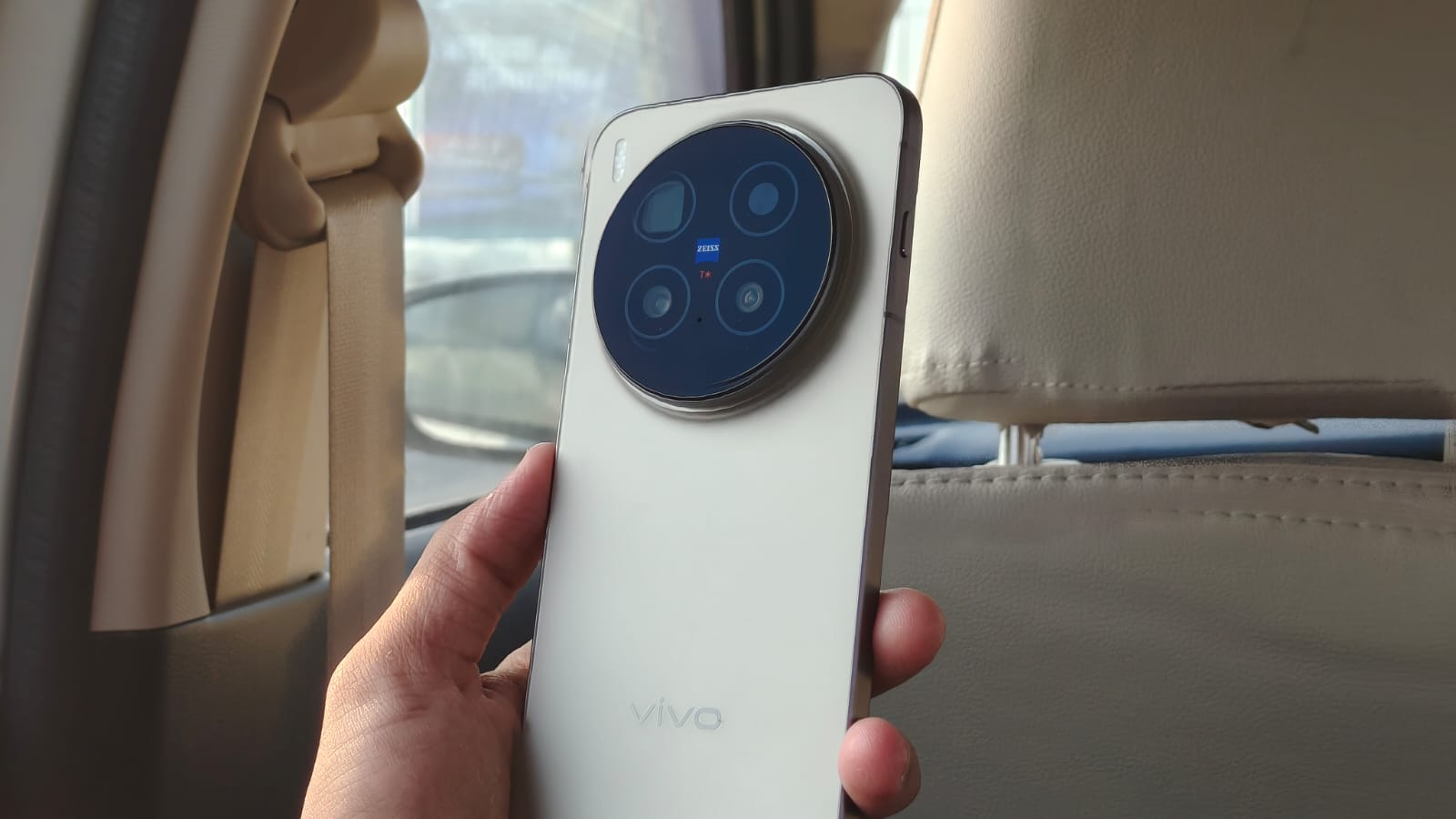
Everything was set up a day before flying, and for the test, I was using my daily driver, the vivo X300 Pro. As soon as my plane touched down at Tan Son Nhat International Airport in HCMC, I was instantly connected to the service, with mobile data running. Naturally, the first order of business was to inform my parents since this was my first solo international trip, and they were obviously worried. I sent them a text, and it went pretty smoothly.
Once I got out of the plane, the next item on the list was immigration. If you aren’t already aware, immigration in Vietnam can take hours. However, there’s a fast-track paid service that helps you get past all this nonsense. Since my Vietnamese speaking skills are basically non-existent, I used ChatGPT as my translator, which, thanks to the connection, worked super fine.
After reaching the hotel, it was time to push Holafly’s connection to the limit. For that, I first started downloading the new episodes of Squid Game Season 3. They were done in just a few minutes, and I was also able to track my data usage using the Holafly app. I then ran a series of speed tests. On average, download speeds ranged from 45.6 Mbps to 56 Mbps, while upload speeds reached 39 Mbps. These speeds are pretty fine for just about anyone, since I could do everything from streaming content to playing PUBG with my friends. However, some streaming services like Netflix did not play well with the eSIM, thanks to the weird “this content is not available at your location” error, which I faced a couple of times. I also faced a couple of errors with the Holafly app, which crashed when tracking my data usage.
Advertisement
After spending a few days in Ho Chi Minh City, the next destination on my travel list was Tuy Hoa. I’m the kind of person who likes to stay away from the touristy places, and it seemed like the best of the bunch. I took a train from Saigon to the region. Since Vietnamese trains don’t have Wi-Fi on board, I was relying on the Holafly connection, which, barring a few desolate forest regions, worked really well. There was decent coverage for about 90% of my journey. Even in the super quiet town of Tuy Hoa, the speeds were the same as in the big city, and I had no problems on my few excursions out of the city and into the wild as well.
Verdict
Holafly’s eSIM service is really good for just about anyone, simply because you get unlimited data. Throughout my Vietnam trip, I never worried about finishing my daily data quota, and that’s a very reassuring feeling. Beyond that, you get really solid coverage across almost the entire globe, a simple setup with various options, a global eSIM for frequent travellers, excellent customer support, and a generous 6-month refund policy. Sure, the app can be a bit buggy at times, and some streaming services can freak out, but Holafly is still a fantastic travel companion. If you have a trip coming up, be sure to give it a try, and don’t forget to save some money using my code FOSSBYTES.