A new wave of Android flagships is on the horizon, and they’re not playing it safe. The biggest shift is that these phones are going all-in on cameras, while eclipsing the apex Android predators (read: Samsung and Google) in a few other ways, too.
Weibo
The specifications of the upcoming Vivo X300 Ultra were revealed on Weibo, and the device is confirmed to feature a 200MP periscope telephoto sensor (likely 1/1.4-inch class), paired with a large 1-inch-type primary sensor and an upgraded ultra-wide lens, along with advanced zoom systems and improved color science. That’s pushing smartphone photography closer to dedicated cameras, something Samsung’s Galaxy S26 Ultra, with its largely iterative camera hardware, hasn’t quite matched this year.
Tom Bedford / Digital Trends
And it’s not just about megapixels anymore. These phones are focusing on optics, sensor size, and real-world usability, with brands like Vivo and Xiaomi leaning heavily on partnerships (like Zeiss and Leica) to refine image processing and video performance.
Why should Samsung be paying attention?
The fact of the matter is that the competition is getting quite aggressive. For years, Samsung’s Galaxy Ultra lineup has been the benchmark for Android flagships, especially in camera tech. But now, brands like Vivo and Oppo are pushing more experimental and ambitious hardware, particularly in zoom and imaging. Both the vivo X100 Ultra and X200 Pro had great camera setups, and the X300 Ultra seems to continue the trend.
Xiaomi
Then there’s Oppo, too. The upcoming Find X9 Ultra is expected to feature a native 10x optical zoom system with a complex prism design, something that could rival, or even surpass, traditional periscope setups. Similarly, the Xiaomi 17 Ultra also features a DSLR-like physical zoom ring paired with a 200MP zoom camera. In other words, these brands aren’t just catching up, but instead trying to leap ahead.
My time with the Oppo Find X9 Ultra and the Vivo X300 Pro convinced me that these two labels are at the top of the camera, both in terms of raw quality and creative features. Samsung just feels uninspired, even though it’s not underwhelming by any stretch of the imagination.
Samsung Galaxy S26 Ultra Privacy Display in actionTom Bedford / Digital Trends
Meanwhile, competitors are pushing much harder, especially in the camera space. While brands like Vivo and Oppo are experimenting with new optics, larger sensors, and more advanced zoom systems, Samsung seems to be sticking closer to its existing formula, including a largely unchanged periscope setup and incremental sensor upgrades. Loyal users will likely stay, and options like Google Pixel still exist. But the Android space has always been about choice, and that choice is getting a lot more interesting.
“Ultra” is starting to mean something else
This shift isn’t just about specs; it’s about direction. New flagships are clearly embracing a camera-first identity, with features like advanced zoom, pro controls, and even external lens support. What’s more, these devices also come with a lot more. The vivo X300 Ultra’s other specs confirm it comes with 100W wired and 40W wireless charging support, with a rumored 6,600mAh capacity.
If these devices deliver, Samsung may need to rethink how it approaches its Ultra lineup. Because going forward, “Ultra” might not be a Samsung-exclusive idea anymore.
The next era of software ‘will be built for agents, by agents’, said Jentic CEO Sean Blanchfield.
Irish AI start-up Jentic is jumping on the OpenClaw frenzy with ‘Jentic Mini’, a free, open source, self-hosted offering for developers building with the product.
Jentic Mini also markets itself to be safer to use in real-world software environments. Jentic said that the API execution layer gives developers a better way to govern how agents access tools, APIs and workflows to help reduce risks that come with broad and unmanaged credential exposure.
Advertisement
Jentic Mini is available on the start-up’s website, as well as on GitHub. It can also be used with other general-purpose agents including NemoClaw.
With more than 10,000 APIs, agents created using Jentic Mini will come with a “machine-usable map” of the tools and workflows that can be used, while enabling a more structured and controlled way to connect agents to real systems, the company said. Jentic’s standard model is available as a verified connector in Claude.
“The next era of software will not be built for humans. It will be built for agents, by agents,” said Sean Blanchfield, the CEO and co-founder of Jentic.
“Jentic Mini gives developers a free, open source foundation for that shift, connecting general-purpose agents to real systems through an AI-curated catalogue of more than 10,000 APIs and workflows. We want to make it dramatically easier to deploy agents that do real work.”
Chill, walking simulator-cross-traveling painter game Eastshade has been in my backlog for a while now. If memory serves, it’s because I found mention of it having wonderful virtual landscapes during a time when I was writing about that aspect of games.
From the Backlog
Every gamer has a backlog — and that’s no different for us at TechRadar Gaming. From the Backlog is a series about overdue first-plays, revisiting classics, returning to online experiences, or rediscovering and appreciating established favorites in new ways. Read the full series here.
Now, years on, I’ve finally made it into the world of EastShade and have fully embraced my role as a visiting painter for hire, intent on fulfilling some last requests by their late mother.
Advertisement
It’s a simple game in a small world, but its gentle chillness has been perfect to discover, seven years after its initial release. After a frantic and action-filled playthrough of Ratchet & Clank: Rift Apart, Eastshade has been a welcome change of pace to relax and soak up a wonderful world while painting its beauty.
Article continues below
An artist in residence
(Image credit: Eastshade Studios)
Playing as an artist who travels to the island country of Eastshade, you set out with an inauspicious beginning, shipwrecked in a cave with only your easel to show for yourself.
Eastshade
(Image credit: Eastshade Studios)
Original release date: February 13, 2019 Released on: PS4, Xbox One, PC Played on: PS5 (via backward compatibility)
Advertisement
However, you have made it to where you wanted to be and soon find yourself in the small settlement of Lyndow having gentle chats with strangers, teaching children to paint, staying in the inn, as well as building up a purse of money through selling feathers, collecting quests, and, importantly, getting your artist’s eye in by painting some vistas.
You’ll travel to a few different areas of the map, each with some small locations to fast travel between, inhabited by the anthropomorphic Eastshadian animal folk, and the gentleness carries on throughout your journey, although you can spice it up with some passive-aggressive or sarcastic answers in conversation if you wish.
Oh, to be a travelling painter
(Image credit: Eastshade Studios)
A small map on the whole, but that soon opens up to something that’s a little larger, but that can still be traversed on foot. And doing so is more than worth it, too, as the land is filled with some of the most pleasing landscapes and use of natural planting and landscape elements that I’ve enjoyed in a long time. So much so that I couldn’t help but take some of my own screenshots of the game.
Advertisement
Sign up for breaking news, reviews, opinion, top tech deals, and more.
And that’s at the core of what Eastshade does well: it makes taking screenshots the main mechanic of the game to progress, but also to capture moments, places, views, people, chickens, hot air balloons, and complete tasks.
What came out of this simple act, though, was a deep level of care in getting the right, or best, and most fabulous painting composition right for my mysterious commissioners. I would spend ages adjusting the on-screen view to make sure a tree was on the third, or that I’d capture some color from some plants, or get the best view of the daily eclipse to ensure the composition was top-notch.
It’s a charming little game, and I’m very pleased indeed to have found the time to get it out of my backlog and now, with a platinum trophy achieved to boot, in my completed library. It’s not perfect by any means, and is a little buggy here and there with environments that won’t load, or soft-locking save screen, but its undeniable chill factor, and slow pace was just what I needed at a time when life can feel loud, busy, and complicated.
And of course, you can also follow TechRadar on YouTube and TikTok for news, reviews, unboxings in video form, and get regular updates from us on WhatsApp too.
The idea came from social media. Catapano posted a short Instagram clip of himself slapping his MacBook, complete with sound effects and a mock groan. When the clip unexpectedly went viral, he decided to turn the gag into an app. Read Entire Article Source link
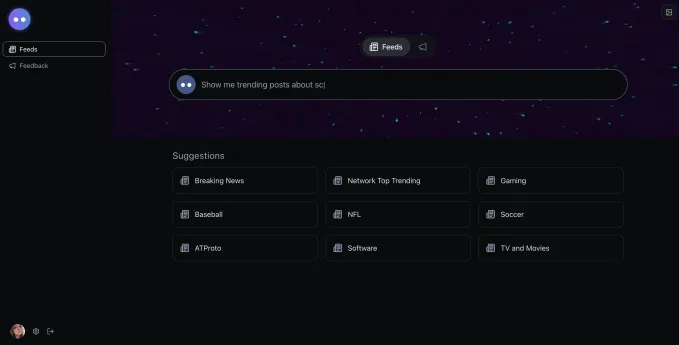
The team from Bluesky has built another app — and this time, it’s not a social network, but an AI assistant that allows you to design your own algorithm, create custom feeds, and, one day, vibe-code your own app.
At the Atmosphere conference over the weekend, Bluesky’s former CEO, Jay Graber, now chief innovation officer, and Bluesky CTO Paul Frazee, presented the AI app, called Attie, for the first time. Conference attendees will become the initial beta testers for the new experience, which leverages Anthropic’s Claude under the hood to create an agentic social app built on Bluesky’s underlying protocol, the AT Protocol (or atproto for short).
“It’s a new product — it’s not a part of the Bluesky app,” explains interim CEO Toni Schneider in an interview. (In addition to his CEO role, Schneider is a partner at Bluesky backer True Ventures.) “We’ve launched a lot of things inside Bluesky — Starter Packs and custom feeds, and all those kinds of things. This is a standalone product, and it’s the first one that’s built by Jay’s new team.”
ScreenshotImage Credits:Attie from Bluesky
With Attie, anyone will be able to build their own custom feed just by typing in commands in natural language, the same as if they’re chatting with any other AI chatbot. To use the app, people will sign in with their Atmosphere login (meaning their login for any app that runs on atproto, which includes Bluesky). Attie will immediately understand what you’ve been talking about, what sort of things you like, and more, because Bluesky and the wider ecosystem are open systems that share data across apps.
You can ask Attie questions, like what posts you might like to see or repost, and you can use the app to curate your own custom feed, personalized to you.
Advertisement
“You control it, you shape it, without having to write code or know how to set up these feeds,” Schneider says. “It’s the beginning of just having a lot more people be able to build on top of the Atmosphere.”
Plus, he adds, “It is an AI product, but it’s an AI product that’s very people-focused … We think AI is a very powerful technology, but we want to make sure that we use it to build things that really benefit people.”
Techcrunch event
San Francisco, CA | October 13-15, 2026
Advertisement
At launch, Attie can be used to build and view these feeds, which will later become available to you within Bluesky or any other atproto app. Over time, the plan is to allow Attie’s users to vibe-code their own social apps as well as build tools for other people.
ScreenshotImage Credits:Attie from Bluesky
Schneider says that Graber and her team began working on the app a few months ago, which was around the same time she decided to return to building, instead of running the company.
“I think she realized that there was so much more that she wanted to build, and just doing the CEO job kept her busy, and she felt like she wanted more time,” Schneider tells TechCrunch. “As she spent more time, [and] got freed up, I think it became clear that this is her happy place. She’s an amazing leader and visionary, and we want her building more things and not worrying about operating the company,” he says.
Advertisement
Graber says today, AI is being used by the major platforms to serve themselves, not their users, by trying to increase people’s time spent in their apps, harvesting data, and controlling their algorithms.
“We think AI should serve people, not platforms,” Graber said in her announcement of Attie. “An open protocol puts this power directly in users’ hands. You can use it to build your own feeds, create software that works the way you want it to, and find signal in the noise.”
Graber’s decision to once again focus on protocol and product was followed by the company’s announcement that it now has $100 million in additional funding from a round that closed last year. The team hopes that news serves as a signal to the wider community that Bluesky will continue to be around.
“It means we have three-plus years of runway, which is great. That means stability and security for the rest of the ecosystem,” Schneider tells TechCrunch. It also means that Bluesky’s team has time to tackle the bigger challenges ahead, which include adding privacy controls to the protocol and finding a way to monetize the social network of 43.4 million users.
Advertisement
One thing that Schneider assures us is not in the works, however, is any crypto integration — despite the financial backing from multiple crypto investors. That’s something that had worried some Bluesky users, who feared the app would be filled with crypto scams or become a payment tool.
“It’s the kind of investors who were attracted to crypto because of its decentralization, and they were investing in things built on the blockchain that were super decentralized,” Schneider says of Bluesky’s backers in the crypto space. “This is decentralized social, so it fits those who are invested to believe in the platform and the ecosystem opportunity.”
Instead, the company may experiment with other means of monetization. The team hasn’t yet decided if Attie will ultimately require a fee, as it’s only a private beta for the time being. Other ideas being batted around include subscriptions and hosting services for those who want to host their own communities on the protocol.
Schneider, the former CEO of Automattic, the home of publishing platform WordPress.com, sees the potential for the Atmosphere as being similar to WordPress in this way.
Advertisement
“At the center of [the Atmosphere] is a completely open system, so anybody can participate,” he says. “You can have all of these independent, decentralized pieces that work together. With WordPress, that turned into a huge ecosystem with billions of dollars — over $10 billion a year, now — flowing through it.”
Schneider continues, “So it’s gotten very big, even though it’s completely decentralized. And this is what we’re hoping for, for the Atmosphere to have that similar ability for lots of these apps and services to coexist and work together and build an ecosystem.”
Looking for the most recent Strands answer? Click here for our daily Strands hints, as well as our daily answers and hints for The New York Times Mini Crossword, Wordle, Connections and Connections: Sports Edition puzzles.
Today’s NYT Strands puzzle is fairly difficult. Some of the answers are difficult to unscramble, so if you need hints and answers, read on.
If that doesn’t help you, here’s a clue: Feathered friends’ food.
Clue words to unlock in-game hints
Your goal is to find hidden words that fit the puzzle’s theme. If you’re stuck, find any words you can. Every time you find three words of four letters or more, Strands will reveal one of the theme words. These are the words I used to get those hints, but any words of four or more letters that you find will work:
These are the answers that tie into the theme. The goal of the puzzle is to find them all, including the spangram, a theme word that reaches from one side of the puzzle to the other. When you have all of them (I originally thought there were always eight, but learned that the number can vary), every letter on the board will be used. Here are the nonspangram answers:
BUGS, SUET, FRUIT, SEEDS, MILLET, NECTAR, BERRIES
Today’s Strands spangram
The completed NYT Strands puzzle for March 29, 2026.
NYT/Screenshot by CNET
Today’s Strands spangram is FORTHEBIRDS. To find it, start with the F that’s the first letter to the left on the top row, and wind over and down.
Australian researchers have pulled off something that quantum theory predicted but nobody had managed to actually observe in matter until now. Working with pairs of helium atoms, they captured the particles existing in two different locations simultaneously, their behavior frozen in a way that has no equivalent in everyday experience. It is the first direct observation of this phenomenon in matter rather than light, and it opens a new window into how the fundamental building blocks of our world actually behave.
The team at Australian National University started with a cloud of helium atoms cooled to just above absolute zero, at which point the atoms slow down enough to behave more like overlapping waves than solid particles. Releasing the cloud from its magnetic trap allowed two groups to collide head on, and that collision created exactly the right conditions for something remarkable. Measure one atom moving in a particular direction and its counterpart will instantly appear moving the opposite way, no matter how far apart the two have traveled.
THREE SCIENCE KITS IN ONE – This kit contains 45 of our most popular Earth science, chemistry, and science magic experiments along with a bonus guide…
EXPLORE EARTH SCIENCES – Kids will build and erupt a volcano, grow a glow in the dark crystal, create water tornadoes, and dig up a real fossil…
DIVE INTO CHEMISTRY – The chemistry set in this kit has everything kids need to make gooey worms and worm eggs, create bubbling reactions, launch a…
To confirm the atoms were genuinely sharing an existence across two locations rather than simply traveling on predictable paths, the team sent the scattered pairs through an apparatus using laser pulses that acted like a half silvered mirror, splitting each atom along two separate routes at the same time. The atoms were then allowed to fall briefly before detectors recorded exactly where each one landed. The interference pattern that emerged left no room for doubt. Each atom had traveled both paths simultaneously right up until the moment it was measured, with one member of a pair appearing on the left side of the detector while its partner showed up on the right, yet the data made clear that both had been exploring both locations all along.
Advertisement
The significance of the result comes down to what the atoms actually are. Previous experiments of this kind used photons, which have no mass and are unaffected by gravity. Helium atoms are a different matter entirely, heavy enough to feel the pull of the Earth, yet they still display this split existence. The connection between the pairs was strong enough to violate Bell’s inequality, a well established test that rules out any classical explanation for the behavior. Measuring one atom instantly determined the state of its partner regardless of the distance between them, exactly as quantum theory has always predicted but nobody had seen demonstrated with matter until now.
Lead researcher Yogesh Sridhar spent years refining the setup because earlier attempts always fell short. “Experimentally, it is extremely hard to demonstrate this,” he said. His colleague Dr. Sean Hodgman put the strangeness into plain words: “It is really weird for us to think that this is how the universe works. You can read about it in a textbook, but it is really weird to think that a particle can be in two places at once.” [Source]
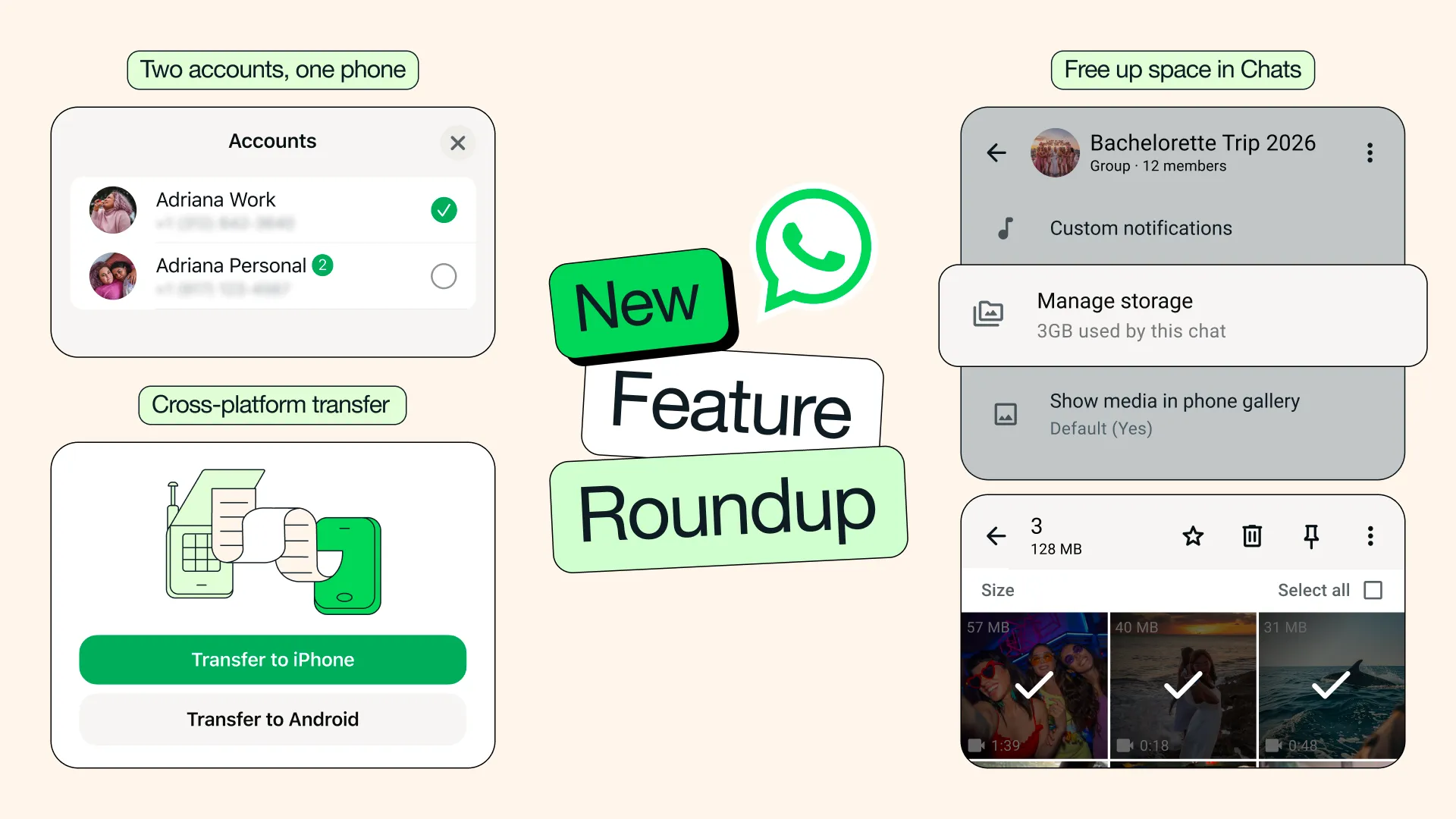
WhatsApp is rolling out multiple features designed to make the app easier to use, including AI-powered message replies and photo retouching, support for two accounts on iOS, and chat history transfer between iOS and Android devices.
Meta said that after the new updates, users will be able to touch up images in the chat before sharing them with contacts or in groups using Meta AI.
The Writing Help feature enables users to quickly draft a response based on the active conversation, with Meta saying it uses Private Processing to ensure messages are completely private.
“Writing Help is built on top of Private Processing technology, which allows you to leverage Meta AI to generate a response without Meta or WhatsApp ever reading your message or the suggested re-writes,” Meta states.
Advertisement
The company says WhatsApp now also helps find large media files in any chat, quickly freeing up space without deleting entire conversations.
Additionally, WhatsApp allows two WhatsApp accounts to be logged in at the same time on iOS (an option that was already available on Android devices), and its chat transfer feature now supports moving message history from iOS to Android (including individual and group chats, call history, channel and community history, and more).
“Now, with just a few taps, your conversations, photos, and videos easily come with you no matter what device you’re using,” Meta said.
New WhatsApp features (Meta)
Earlier this month, WhatsApp also introduced parent-managed accounts for pre-teens, a feature that allows parents to decide who can contact them and which groups they can join.
Meta also introduced new WhatsApp anti-scam protections that warn users when behavioral signals suggest an incoming device-linking request may be fraudulent.
Advertisement
These scam defenses were added soon after the Dutch intelligence agencies warned that Russian state-backed hackers had been targeting Dutch government employees in phishing attacks aimed at their Signal and WhatsApp accounts.
In January, Meta also began rolling out a new WhatsApp lockdown security feature designed to protect journalists, public figures, and other high-risk individuals from sophisticated threats, including, but not limited to, spyware attacks.
Automated pentesting proves the path exists. BAS proves whether your controls stop it. Most teams run one without the other.
This whitepaper maps six validation surfaces, shows where coverage ends, and provides practitioners with three diagnostic questions for any tool evaluation.
External lights are the first thing you see when you get home. It's worth this small investment to get some lights that make your garden feel like home.
We may receive a commission on purchases made from links.
There are a lot of reasons why the Nintendo Switch 2 is a special console, from new features like the GameShare function to the innovative dual-purpose Joy-Con mouse controllers. However, it being special doesn’t mean it can’t be elevated with a few choice accessories. If you know where to look, they don’t need to break the bank, either.
Advertisement
Of course, some Switch 2 accessories are more worthwhile than others. For example, the official Nintendo-branded Switch 2 camera will set you back $54.99 at full price, even though you could save yourself some cash by using any other USB-C camera for a fraction of the cost. As a matter of fact, according to CNET, you can even use some USB-A cameras. It’s important to make sure that whatever Switch 2 accessories or peripherals you buy are actually worthwhile — especially considering the relatively high cost of the console itself.
The right Switch 2 accessories can change the game even for under $30. If you know what to look out for, you can change up how you store your system and peripherals when you aren’t using them, take your handheld on the go, or even extend its lifespan by protecting it properly from any bumps, drops, or scratches. In some cases, select accessories are even officially licensed, meaning they have the Nintendo stamp of approval. Meanwhile, others are completely third-party products with good user ratings.
Advertisement
Kytok Switch 2 RGB Organizer Station
Console clutter can quickly become an eyesore if you leave it around your TV or gaming setup without putting much thought into how you arrange it. One of the Switch 2’s merits is that you can pack it away easily — and take it on the go with you, but if you tend to game from the comfort of your own home, then you still might struggle to know how to make it look good. Kytok’s clever organizer station could be just the thing that elevates your Switch 2 storage, with room for tons of peripherals, games, and bright RGB lighting.
Kytok’s Switch 2 Organizer provides a home for your Switch 2 Charging Dock, which you can then place the Switch 2 tablet in, alongside space for 18 game cards, 16 game boxes, four Joy-Cons, and two hooks for Pro Controllers, headphones, or any other peripherals you might want to throw on there. The four Joy-Con slots pull double duty as charging ports, meaning you don’t need to worry about them dying while you play wirelessly or use their mouse functionality. You can also customize the RGB lighting strips to match any other light-up décor you might have lying around.
At the time of writing, this accessory has a 4.6 average based on almost 5,000 reviews and retails for $28.99 on Amazon. It’s widely praised for the amount of space and storage it offers, as well as how quickly the Joy-Cons charge while docked on it. Despite its high overall rating, it’s worth bearing in mind that some of these positive reviews are for older models, which were designed for the original Nintendo Switch, rather than the Switch 2 specifically. Both versions are fairly similar, though.
Advertisement
FastSnail Charging Dock for Joy-Con 2 with RGB Lights
Keeping your Joy-Cons powered up all the time can prove tricky if you aren’t a big handheld user. That’s because your Joy-Cons charge up while attached to the Switch 2, or when attached to a Charging Grip. So, if you usually game in TV Mode using your Joy-Cons, they just might die on you at the worst possible time. Storing your Joy-Cons on a Charging Dock, like this one by FastSnail, means that you can make sure they’re always ready to go when you are.
Advertisement
FastSnail’s Joy-Con 2 Charging Dock will cost you anywhere from $25.99 to $29.99, and comes in black, white, blue, or red. It’s fitted with a customizable RGB lighting strip, which you can either set to one of seven static colors or to one of two different dynamic lighting speeds. In addition to the dock’s decorative lighting, there are also a couple of light-up charging indicators going through the middle of the dock that tell you whether your Joy-Cons are fully charged or not by switching from red to green. That feature is generally a hit, according to some reviews on the product listing, although it can be a little bright for some. If you aren’t too sure about that feature, you can also turn the lights off altogether.
You have a few options when it comes to powering the charging station. It connects via a USB-C port, which you can plug into a wall socket with a suitable plug adapter, or directly into your Switch 2’s dock. Per the product page, it’ll take around three hours for your Joy-Cons to reach full charge on the dock, and it includes built-in electrical safeguards like overcharge protection.
Advertisement
Jsaux Switch 2 Charging Grip
If you want to charge your Joy-Cons without being forced to forfeit the big screen in favor of playing in handheld mode, you’re going to need to pick up the right accessory. So long as you don’t mind transforming your Joy-Cons into a wired affair, then Jsaux’s $17.99 Charging Grip gives you the option to game with the peace of mind that you won’t run out of power mid-game by allowing you to run a USB-C cable directly to your Switch 2 dock, or any other power outlet that’s convenient for you.
The accessory doubles up as a grip, much like the official Nintendo Joy-Con 2 Charging Grip — but at a lower price. According to some product ratings, the standard, $17.99 version of the Charging Grip isn’t the most comfortable to use. But, if you’re willing to fork out a few more dollars for the case, then it offers a more comfortable and ergonomic design, meaning you can game for longer without worrying so much about your hands. And, of course, you could use it as a Joy-Con Grip even when it isn’t plugged in, if you prefer to keep your controllers closer together without having to rely on a third-party controller.
When using the grip, your Joy-Cons are mostly held in place by magnets. Although that sounds like a good idea, the reviews reveal that their effectiveness is a bit of a mixed bag. On one hand, some users reported that the controller held together well, with a strong connection. Others, meanwhile, mentioned that they could be a bit stronger, with one review mentioning that their Joy-Cons have come out of the grip while gaming sometimes.
Advertisement
R.D.S. Industries Game Traveler Deluxe Licensed System Case for Nintendo Switch 2
R.D.S. Industries offers a wide range of officially licensed products and accessories for different video game consoles, including the Xbox One, the original Switch, and now, the Switch 2. For the most part, their products are carrying cases and protective cases for controllers, systems, and game cards. The Game Traveler Deluxe System Case is among their range designed for the Switch 2, offering protection for your Switch 2 system, peripherals, and game cards on the go.
Advertisement
It provides ample storage for just about everything you might want to keep alongside your Switch 2. That includes your console, 12 game cards, two microSD cards, and room for a couple of peripherals in the padded lower divider. There’s also room for storing your charger and an HDMI cable, so you’re ready to hook your Switch up to a screen whenever the urge strikes. The only real catch with the organizer’s design is that the lower tray can only hold either a Joy-Con grip, a Pro Controller, or the Charging Dock — not all three at once. As a consequence, that means you can’t expect to bring multiple controllers or sets of Joy-Cons with you for multiplayer gaming.
The user reviews show that the case is broadly speaking a hit, though: at the time of writing, it costs $29.96 and has an average rating of 4.9 out of 5 across more than 600 reviews on Amazon. Generally speaking, users seem to be happy with the case’s durability and just how much they can store inside it at once. Its big capacity does, of course, come with a downside. Some reviews mention that it’s a little on the large side.
Advertisement
Mumba Dockable Case for Nintendo Switch 2
Want to future-proof your Switch 2? Considering the high price tag of the successor to the original Switch, that seems sensible. Picking up a shock-absorbing case is a good idea for protecting your console from any bumps, drops, or mishaps, but your options for finding one under $30 are a little limited. Mumba’s protective shell case provides lightweight protection for your console without breaking the bank. And, you don’t have to pop it off each time you dock your console to play it through the TV, minimizing any chances of accidental damage while you get set up.
A nifty feature offered by this case is the hinged grips that accommodate the Switch 2’s Joy-Cons. The foldable hinges mean you can detach or reattach your controllers to the tablet without removing the case. The case also offers coverage for your Joy-Cons while you’re playing in handheld mode, so you can keep them protected too. Plus, they’re textured, so you don’t need to worry about them slipping out of your hands as much as you might have if you were using them without a case at all.
Mumba’s dockable Switch 2 cases, which are available in four different colors, are priced at $24.99 and currently have a 4.4-star average rating across more than 350 reviews on Amazon. Just over 70% of those reviews are 5-stars, with a lot of users praising the case’s fit, ergonomics, and design. Don’t go throwing your Switch 2 around too much, though, as a handful of reviews note that the case can be a little brittle or flimsy in places, sometimes leading to cracks and limited protection from bigger bumps.
Many people have tried AI tools and walked away unimpressed. I get it — many demos promise magic, but in practice, the results can feel underwhelming.
That’s why I want to write this not as a futurist prediction, but from lived experience. Over the past six months, I turned my engineering organization AI-first. I’ve shared before about the system behind that transformation — how we built the workflows, the metrics, and the guardrails. Today, I want to zoom out from the mechanics and talk about what I’ve learned from that experience — about where our profession is heading when software development itself turns inside out.
Before I do, a couple of numbers to illustrate the scale of change. Subjectively, it feels that we are moving twice as fast. Objectively, here’s how the throughput evolved. Our total engineering team headcount floated from 36 at the beginning of the year to 30. So you get ~170% throughput on ~80% headcount, which matches the subjective ~2x.
Zooming in, I picked a couple of our senior engineers who started the year in a more traditional software engineering process and ended it in the AI-first way. [The dips correspond to vacations and off-sites]:
Note that our PRs are tied to JIRA tickets, and the average scope of those tickets didn’t change much through the year, so it’s as good a proxy as the data can give us.
Qualitatively, looking at the business value, I actually see even higher uplift. One reason is that, as we started last year, our quality assurance (QA) team couldn’t keep up with our engineers’ velocity. As the company leader, I wasn’t happy with the quality of some of our early releases. As we progressed through the year, and tooled our AI workflows to include writing unit and end-to-end tests, our coverage improved, the number of bugs dropped, users became fans, and the business value of engineering work multiplied.
Advertisement
From big design to rapid experimentation
Before AI, we spent weeks perfecting user flows before writing code. It made sense when change was expensive. Agile helped, but even then, testing multiple product ideas was too costly.
Once we went AI-first, that trade-off disappeared. The cost of experimentation collapsed. An idea could go from whiteboard to a working prototype in a day: From idea to AI-generated product requirements document (PRD), to AI-generated tech spec, to AI-assisted implementation.
It manifested itself in some amazing transformations. Our website—central to our acquisition and inbound demand—is now a product-scale system with hundreds of custom components, all designed, developed, and maintained directly in code by our creative director.
Now, instead of validating with slides or static prototypes, we validate with working products. We test ideas live, learn faster, and release major updates every other month, a pace I couldn’t imagine three years ago.
Advertisement
For example, Zen CLI was first written in Kotlin, but then we changed our mind and moved it to TypeScript with no release velocity lost.
Instead of mocking the features, our UX designers and project managers vibe code them. And when the release-time crunch hit everyone, they jumped into action and fixed dozens of small details with production-ready PRs to help us ship a great product. This included an overnight UI layout change.
From coding to validation
The next shift came where I least expected it: Validation.
In a traditional org, most people write code and a smaller group tests it. But when AI generates much of the implementation, the leverage point moves. The real value lies in defining what “good” looks like — in making correctness explicit.
Advertisement
We support 70-plus programming languages and countless integrations. Our QA engineers have evolved into system architects. They build AI agents that generate and maintain acceptance tests directly from requirements. And those agents are embedded into the codified AI workflows that allow us to achieve predictable engineering outcomes by using a system.
This is what “shift left” really means. Validation isn’t a stand-alone function, it’s an integral part of the production process. If the agent can’t validate it’s work, it can’t be trusted to generate production code. For QA professionals, this is a moment of reinvention, where, with the right upskilling, their work becomes a critical enabler and accelerator of the AI adoption.
Product managers, tech leads, and data engineers now share this responsibility as well, because defining correctness has become a cross-functional skill, not a role confined to QA.
From diamond to double funnel
For decades, software development followed a “diamond” shape: A small product team handed off to a large engineering team, then narrowed again through QA.
Advertisement
Today, that geometry is flipping. Humans engage more deeply at the beginning — defining intent, exploring options — and again at the end, validating outcomes. The middle, where AI executes, is faster and narrower.
It’s not just a new workflow; it’s a structural inversion.
The model looks less like an assembly line and more like a control tower. Humans set direction and constraints, AI handles execution at speed, and people step back in to validate outcomes before decisions land in production.
Engineering at a higher level of abstraction
Every major leap in software raised our level of abstraction — from punch cards to high-level programming languages, from hardware to cloud. AI is the next step. Our engineers now work at a meta-layer: Orchestrating AI workflows, tuning agentic instructions and skills, and defining guardrails. The machines build; the humans decide what and why.
Advertisement
Teams now routinely decide when AI output is safe to merge without review, how tightly to bound agent autonomy in production systems, and what signals actually indicate correctness at scale, decisions that simply didn’t exist before.
And that’s the paradox of AI-first engineering — it feels less like coding, and more like thinking. Welcome to the new era of human intelligence, powered by AI.
Andrew Filev is founder and CEO of Zencoder
Welcome to the VentureBeat community!
Advertisement
Our guest posting program is where technical experts share insights and provide neutral, non-vested deep dives on AI, data infrastructure, cybersecurity and other cutting-edge technologies shaping the future of enterprise.
Read more from our guest post program — and check out our guidelines if you’re interested in contributing an article of your own!



































































You must be logged in to post a comment Login