There are many uninterruptible power supply (UPS) solutions for the Raspberry Pi that take the form of HATs with a battery on board, but they’re not suitable for every situation. Web3-Pi are using the Pi 5 as an Ethereum node, and found the need for a UPS that didn’t sit on top of the Pi. Their solution is the Web3 Pi UPS, a device that sits in the USB power chain.
It’s a box that takes three power inputs, USB-C PD, a barrel jack, or a hot-swappable Sony camera battery, and puts out the constant 5 V at 5 A the Pi requires. The USB output isn’t just for power, it can communicate with the Pi to deliver telemetry and ask the OS to shut itself down if power reserves are failing. Inside are a CH32 RISC-V microcontroller that handles the power circuitry, and an RP2040 that handles control and an OLED screen for a UI. The project’s web site also mentions provision for an LTE add-on for remote monitoring, however this doesn’t at the time of writing appear to be fully implemented in the GitHub repository.
While it’s probable that few of you are mining Ethereum on your PI, we can see that there are plenty of other situations that this project could find a home in. It’s not the first Pi UPS we’ve seen, though some of them are considerably less complex or capable.
When shopping for a laptop, there’s a lot to consider — the battery life, the processing power, the way the keyboard feels — but none of it matters if the laptop doesn’t last. And when it comes to durability and longevity, there is one brand that rises above the others: Apple. Through surveys, testing, and comparison, you can get some insight into Apple’s reliability from professional reviewers and everyday users alike. One Reddit user stated: “Macs are still durable and well made. Most of mine have lasted over 10 years.”
Apple laptops are made with durable, lightweight metal, including an aluminum enclosure meant to endure daily use. Various components, like the keyboard and speakers, use internal metal support plates, which not only makes the laptops outwardly tough, but can also manage heat from the battery. Apple laptops’ software is considered equally reliable, with users noting they run into fewer performance issues than other brands. Apple itself even claims their tech runs into fewer glitches and crashes, based on collected data.
Advertisement
Here’s what top publications had to say about Apple laptops
Consumer Reports ranked Apple as the most reliable laptop brand after analyzing over 75,000 survey responses. Apple’s reliability score is well beyond other brands, including LG, HP, Samsung, and Lenovo. Consumer Reports determines reliability based on how many problems are likely to occur within three years of ownership. We’ve also put Apple at the top when it comes to laptop reliability, noting the impressive average lifespan of their MacBooks. Apple continues to have a reputation for quality.
CNET said the M5 MacBook Air is the overall best laptop of 2026. Its battery life and performance were nearly perfect scores, putting it at the top of the list. In their full review, they noted the laptop’s solid design and “remarkably consistent” chip performance.
Advertisement
Wired also put the same laptop at the top of its list due to all of its components being of the “highest quality.” The performance and battery life stood out once again. Of course, the M5 MacBook Air’s sleek design, durability, and performance comes at a price — multiple reviewers across various sites were bummed about the $1,299 base price, which is $200 more than the previous model.
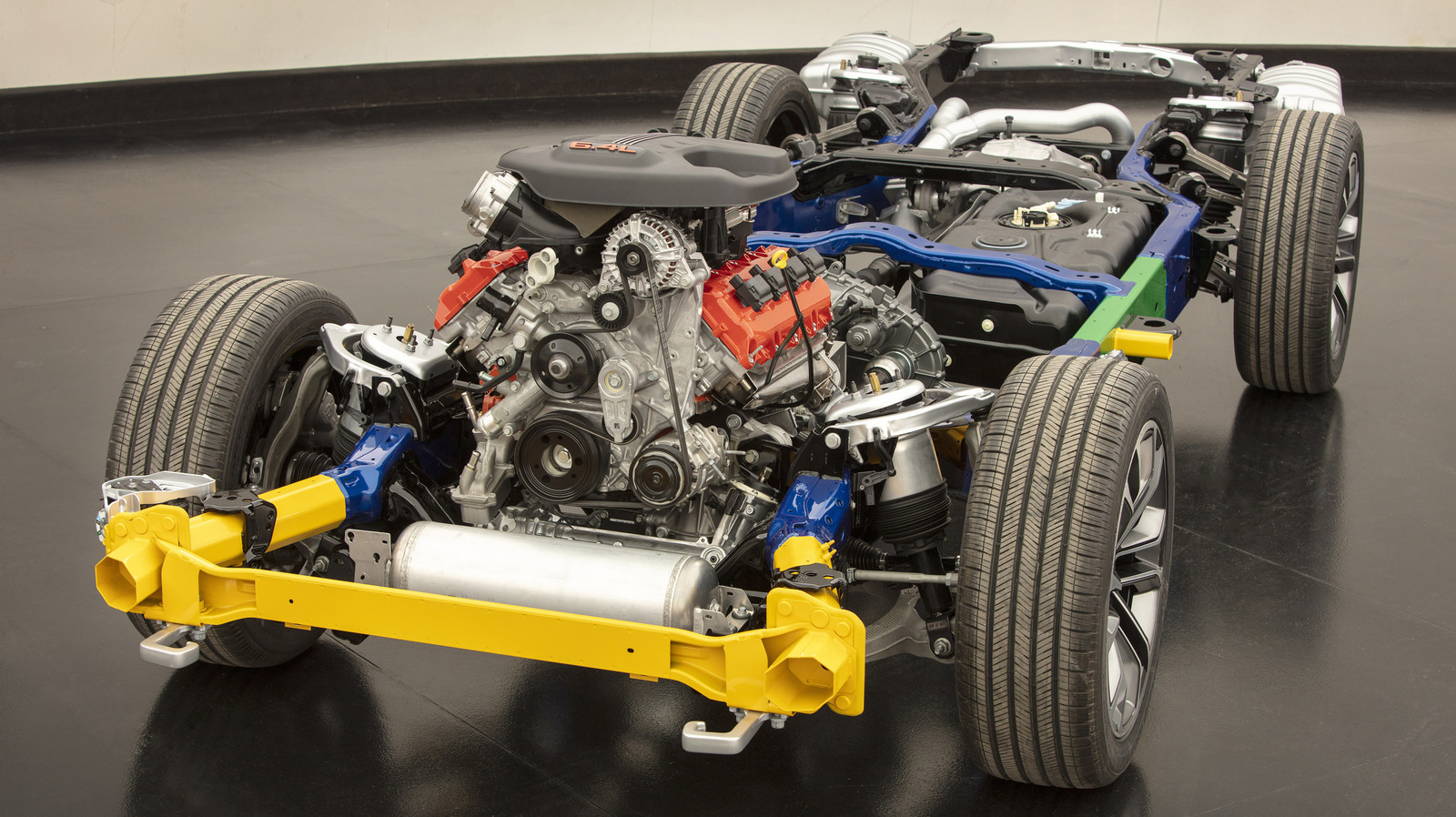
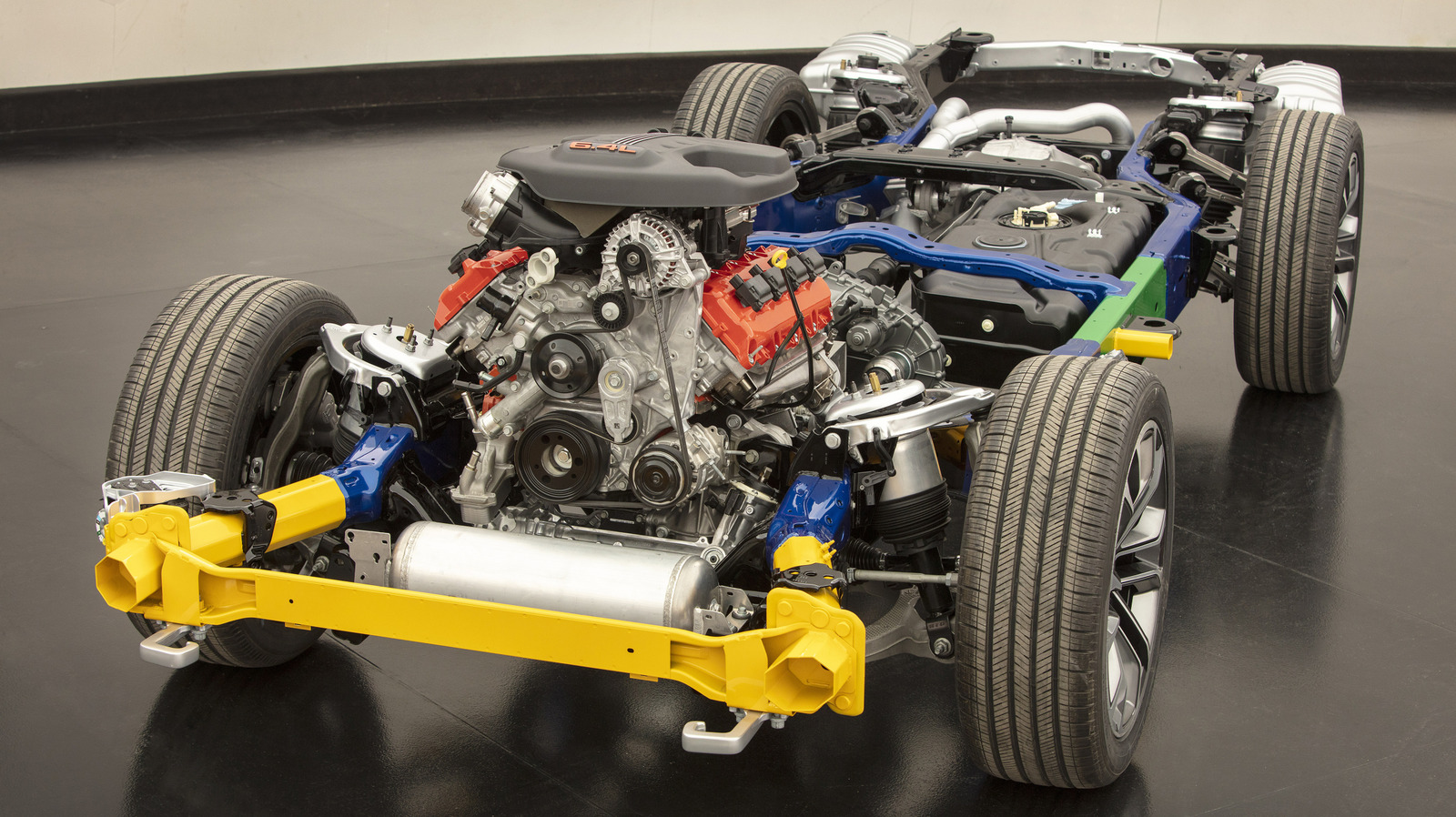
If you’re around gearheads enough (or you are one), you’ve probably heard the phrase “ladder frame” being used to describe a body-on-frame vehicle. So what does this mean? A ladder frame is a type of body-on-frame construction that uses horizontal crossmembers to hold the frame together, like a ladder.
So yes, a ladder frame vehicle is a body-on-frame vehicle. But not all body-on-frame vehicles are ladder frames. There are other types of body-on-frame construction, of course, but most of those designs have been phased out over the years. Ladder frames have just stood the test of time, falling firmly into the “If it ain’t broke, don’t fix it” category.
Advertisement
Ladder frames are very common today with big, full-size SUVs like the current Nissan Armada or Jeep Wagoneer. Even in the age of hybrids or otherwise increasingly electrified powertrains, manufacturers sometimes still need to rely on a simple, strong skeleton to hold the vehicle together.
Advertisement
Body-on-frame cars used to be commonplace
Oddly enough, body-on-frame construction used to be the norm for every car, not just trucks. And ladder-frames, specifically, are still in wide use today. If you look underneath a 1970s Ford Bronco, for example, you’re bound to see horizontal crossmembers on the frame just like any full-size SUV or truck today.
Advancements in safety (both for the occupants and pedestrians), material construction, and fuel efficiency drove automakers to favor unibody construction for vehicles that weren’t trucks or full-size SUVs. Still, apart from compact trucks like the Ford Maverick, you’d be hard pressed to find a modern mid-size or full-sized truck that doesn’t use at least some form of ladder-frame construction. The design lends itself to heavier workloads like towing, or hauling around a lot of weight in the bed. So, when you hear someone using the phrase “ladder-frame,” it’s not referring to anything all that exotic — it’s just the most common style of body-on-frame construction.
While listening to a record with my youngest daughter the other day, the conversation turned to why anyone still listens to vinyl when streaming is “clearly so much better.” As a committed Lana Del Rey fan, she then explained that the long and somewhat operatic wait for Stove is apparently proof that records still matter, because vinyl takes months to press and Lana is not going to rush the thing merely because the rest of us have jobs and limited attention spans.
This was followed by a pointed discussion of the price of concerts, which was less philosophical.
Living at the Shore has its advantages. PNC Bank Arts Center, the Count Basie Center, and Asbury Park are all close enough that a good show can become a family night without requiring a hotel, airport security, or a second mortgage. That does not mean every artist announcement is an automatic yes. A Lana Del Rey tour, should one arrive anywhere within reasonable driving distance, would almost certainly trigger negotiations normally reserved for hostage situations.
There are limits. Even in a household with multiple turntables, more records than shelf space, and a somewhat elastic definition of “necessary.”
Advertisement
“Do you know who invented the turntable?” I asked as she wandered around the den holding the jacket for Craft Recordings and Bluesville’s recent reissue of Albert King’s I’ll Play the Blues for You.
“Not Taylor Swift.”
“That would be correct.”
“My teacher told us that it was Thomas Edison. Or maybe Billy Madison. I’m confused.”
Advertisement
TikTok needs to be banned.
“Thomas Edison did not invent the turntable. Edison did make significant contributions to sound recording and playback, including the invention of the phonograph, but he did not invent the turntable as we understand it today.”
“Edison’s phonograph, patented in 1878, was a mechanical device that used a rotating cylinder covered in tinfoil to record and reproduce sound. It had a hand-cranked mechanism to rotate the cylinder, and a stylus traced the grooves on the cylinder, producing sound vibrations that were amplified by a horn.”
Advertisement
Advertisement. Scroll to continue reading.
“The turntable, on the other hand, refers to the rotating platform on which vinyl records are played.”
“So how do you know it wasn’t Taylor Swift?”
“Have you ever heard of Emile Berliner?”
Advertisement
“Is he on TikTok or YouTube?”
Emile Berliner
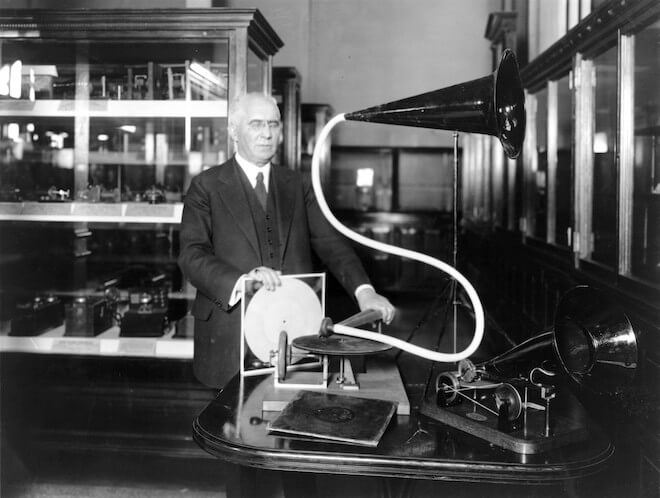
Emile Berliner (1851-1929) was a German-born inventor, engineer, and entrepreneur who made significant contributions to the fields of sound recording and communication. He is best known for his invention of the gramophone, a device that played flat disc records.
Born on May 20, 1851, in Hanover, Germany, Berliner immigrated to the United States in 1870. He initially worked as a merchant and bookbinder but soon turned his attention to inventing. In 1887, Berliner developed a new method of sound reproduction, which he named the gramophone.
Advertisement
Emile Berliner
Berliner’s gramophone used flat disc records made of a zinc disc coated with a compound called shellac. The records had spiral grooves that were created by a cutting stylus. The sound vibrations from the stylus were transmitted through a diaphragm and a horn, resulting in amplified sound. The gramophone offered several advantages over Edison’s cylinder-based phonograph, including easier production, longer playing time, and the ability to mass-produce records.
In addition to the gramophone, Berliner also made notable contributions to the development of the microphone and telephone technologies. He invented the carbon microphone, which became widely used in telephony and early sound recording. Berliner’s improvements to the telephone transmitter greatly enhanced its performance and efficiency.
Berliner was also an astute businessman and established the Berliner Gramophone Company in 1895. The company later merged with the Victor Talking Machine Company, forming the Victor Talking Machine Company, which became a major player in the phonograph industry.
Emile Berliner held numerous patents throughout his career and made significant advancements in sound recording and communication technologies. His invention of the gramophone and disc records laid the foundation for modern turntables and the widespread consumption of recorded music. Berliner’s contributions to the field of audio technology continue to influence the way we enjoy and experience music today.
The Most Significant Turntables
Do you remember your first turntable?
Advertisement
I inherited a Thorens TD-145 from my parents in 1983 as part of my Bar Mitzvah gift and it gave me over a decade of service before I upgraded to an Audiomeca Romance table designed by Pierre Lurne of Goldmund.
Advertisement. Scroll to continue reading.
Looking back I’m not entirely convinced that it was an upgrade but I did trade it in when I purchased a Michell Orbe SE in 1998; that table absolutely was a significant improvement and a great platform for a Wilson Benesch ACT 0.5 Tonearm and Benz Micro H2.0 high-output cartridge.
My ex-wife forced me to sell it during our rather quick and bloody divorce and it was painful to let that one go. I have never owned anything better and it’s unlikely that I would ever spend that kind of money on a turntable and cartridge again; especially not with college and private school tuition.
Advertisement
Three restored Thorens tables create wonderful music at home now and I’m not entirely sure that changing them would make a lot of sense. I also own a Yamaha YP-701 and NAD C 588.
Listening to records with my daughter sparked a different kind of conversation with some of our staff and my circle of audiophile friends.
Which tables were truly significant? We’ve included some tables from the late 1900s and the first part of the 20th century because they were indeed, very significant.
We could easily publish a list of the “best” turntables available right now but 99% of the planet could never afford them and will never have the opportunity to listen to one. This feels like a more interesting discussion.
Advertisement
What are we missing from this list? Please let us know.
Edison Phonograph
Edison Phonograph
Thomas Edison’s 1877 phonograph was not a turntable in the modern sense, but it was the first practical machine designed to both record sound and play it back. Built at his Menlo Park laboratory in New Jersey, the original device used a hand-cranked cylinder wrapped in tinfoil, rather than the wax cylinders that arrived later. A diaphragm and stylus translated sound into physical indentations in the foil; reversing the process allowed the machine to reproduce those vibrations as audible sound.
It was crude, fragile, and hardly hi-fi, but Edison’s invention established the essential idea that recorded music and speech could be captured, stored, and replayed at will. The flat disc record and the turntable would come later, but the phonograph was where the whole strange, expensive, shelf-consuming affair began.
Victor Talking Machine
Victor Talking Machine
Introduced by the Victor Talking Machine Company in 1906, the Victor Victrola was not the first disc phonograph, but it helped turn one into a desirable piece of furniture rather than an awkward mechanical contraption parked in the parlor. Its spring-wound motor rotated flat shellac discs without electricity, while the key innovation was the horn: Victor concealed it inside a handsome wooden cabinet instead of leaving a large external horn perched on top. That made the machine easier to live with and far more socially acceptable in the increasingly style-conscious American home.
Advertisement
The Victrola became one of the defining music machines of the early 20th century, and the company’s Nipper “His Master’s Voice” trademark became one of the most recognizable images in recorded sound. It was not high fidelity by any modern definition, but it brought the disc record, the home playback system, and the idea of owning music into the mainstream long before anyone argued about Bluetooth codecs or whether the pressing was “AAA.”
Philips 212 Electronic
Philips 22GA212 Electronic
Introduced in the early 1970s, the Philips 22GA212 Electronic was one of the more distinctive belt-drive turntables of its era. Its appeal was not that Philips had somehow invented electronic speed control, but that it combined a tacho-generator-regulated DC motor, floating subchassis, touch-sensitive 33, 45, and stop controls, and photo-electronic automatic shutoff in a relatively affordable domestic turntable.
Advertisement. Scroll to continue reading.
The 212 used feedback from its tacho generator to help maintain speed under changing load, while separate fine-speed controls and a stroboscopic platter ring allowed owners to make small adjustments. Philips claimed low wow and flutter, low rumble, and stable operation; the important point is that the deck tried to bring electronic control and convenience to a traditional suspended belt-drive design without making it look like laboratory equipment. The illuminated touch buttons were gloriously early 1970s, and remain one of the reasons the 212 has developed something of a cult following.
Advertisement
Garrard Model 301
Garrard 301
Launched in 1954, the Garrard 301 did not invent idler-wheel drive. That basic arrangement, in which a small rubber wheel transfers power from the motor to the platter’s inner rim, had already appeared in earlier phonographs and record changers. What Garrard did was apply the system to a serious transcription motor unit built for broadcasters, studios, and the growing number of home listeners who wanted something more substantial than a changer with a chrome arm and optimistic specifications.
The 301 used a powerful four-pole induction motor, a heavy platter, and an idler-drive system that delivered quick start-up, strong torque, and stable speed at 33⅓, 45, and 78 rpm. It was usually sold without a plinth, tonearm, or cartridge, allowing owners to build a system around it rather than accept a complete package chosen by someone in a sales office. The result was one of the first truly iconic high-fidelity turntables: industrial, durable, endlessly restorable, and still capable of sounding superb when properly rebuilt. A neglected example can be noisy and temperamental; a well-sorted one explains why the 301 has never really left the conversation.
Acoustic Research XA
Acoustic Research XA
Introduced in 1961, the AR XA was only $58 and what made it unique was how it handled vibration and how low its rumble measured. The package did not come with a cartridge but the price included the table, tonearm, stylus gauge, and dustcover.
The most interesting aspect of the design was its mounting system; Edgar Villchur realized that instead of attaching the motor, tonearm, and lightweight platter to the table’s top plate, it made more sense to mount the platter and tonearm to a sub platform which was suspended underneath the top plate at 3 very distinct points with damped springs with a low resonant frequency.
By doing so, the tonearm and record were isolated from footfalls and other acoustic vibration. Thorens and Linn would incorporate these concepts into their future tables.
Advertisement
Thorens TD-150
Thorens TD-150
Introduced in 1965, the Thorens TD 150 was a compact and rather unflashy turntable that changed the direction of serious belt-drive design. It was not the first commercially viable suspended-subchassis deck; that distinction belongs to the Acoustic Research AR XA of 1961. But Thorens took the basic idea of isolating the platter and tonearm from the motor and plinth with a three-point spring suspension, paired it with a belt-driven inner platter, and turned it into something more refined, more adaptable, and considerably more influential.
The TD 150 was also Thorens’ first true belt-drive turntable, replacing the belt-and-idler arrangement of the earlier TD 124 with a cleaner and more modern engineering approach. Its suspended subchassis helped reduce the transmission of motor vibration and external disturbance to the cartridge, while its removable armboard made it possible to fit alternative tonearms rather than live forever with the factory choice. That combination became the blueprint for a long line of Thorens models and, more importantly, helped inspire the Linn Sondek LP12 and much of the suspended-chassis cult that followed. Small, slightly wobbly when improperly set up, and far more important than it first appears, the TD 150 was one of the key turntables of the modern hi-fi era.
Thorens TD-124
Thorens TD-124
Introduced in 1957, the Thorens TD 124 was one of the great transcription turntables of the postwar hi-fi era: overbuilt, mechanically ingenious, and aimed at studios, broadcasters, and serious home listeners rather than anyone looking for a tidy all-in-one record player. Its most unusual feature was not a conventional idler drive, but a hybrid belt-and-idler system. A compliant belt linked the motor to a separate stepped pulley, which then drove the platter through an idler wheel. Thorens designed the arrangement to retain the torque and rapid start-up of idler drive while reducing the motor-borne vibration that could otherwise work its way toward the cartridge.
The TD 124 also used a substantial two-piece platter with a removable aluminum top section and a heavy main platter beneath, along with variable pitch adjustment, four speeds including 78 rpm, and interchangeable armboards for owners who wanted to fit their preferred tonearm. It was not a suspended-subchassis design; that came later with the TD 150. Instead, the TD 124’s reputation rests on its precision engineering, flexibility, and sheer durability. Properly restored and mounted in a serious plinth, it remains one of the most compelling vintage turntables ever made, with enough torque and authority to make many modern decks seem slightly apologetic.
The Technics SP-10 is the first direct-drive turntable.
Technics SP-10
Introduced in 1970, the Technics SP 10 was the first commercially available turntable to use a direct-drive motor, and it changed the industry almost immediately. Rather than relying on a belt or idler wheel to transfer power from the motor to the platter, the SP 10 placed the motor directly beneath the platter itself. That eliminated an entire chain of mechanical compromises and delivered unusually quick start-up, very low wow and flutter, and the kind of speed stability that broadcasters and mastering engineers could trust without keeping one eye on the strobe.
Advertisement
The original SP 10 was sold as a motor unit, leaving broadcasters, studios, and ambitious home listeners to supply the plinth, tonearm, and cartridge. It was built for work, not Instagram, and its plain industrial appearance gave little indication of how important it would become. The SP 10 helped establish direct drive as a serious alternative to belt and idler systems, and its successors became fixtures in radio stations and professional installations around the world. The SL 1200 may have become the cultural icon, but the SP 10 was the machine that opened the door and made precision direct drive impossible to dismiss.
Advertisement. Scroll to continue reading.
Linn LP12
Linn LP12
Introduced in 1973, the Linn Sondek LP12 became one of the most influential turntables in high-end audio, not because it invented the suspended belt-drive turntable, but because it turned that established idea into a long-running argument about where sound quality actually begins. Its three-point suspended subchassis, belt-driven inner platter, single-point bearing, and separate armboard followed principles already explored by Acoustic Research, Thorens, and Ariston. Linn’s contribution was to refine the formula, make it modular, and insist that the source component mattered more than the hi-fi industry had previously been willing to admit.
That “source first” philosophy became the LP12’s real legacy. Ivor Tiefenbrun and Linn persuaded a generation of dealers and listeners that a better turntable could extract more musical information from the record before the signal ever reached the amplifier or loudspeakers. The LP12 also became famously upgradeable, with improved bearings, subchassis designs, power supplies, tonearms, and cartridges allowing owners to keep updating the same basic deck over decades. It was expensive, fussy about setup, and capable of developing a bounce that could make a wooden floor feel like an enemy combatant, but it became a benchmark for musical timing, long-term ownership, and the modern high-end turntable market.
Technics SL-1200
Technics SL-1200
Released in 1972, the Technics SL 1200 began as a serious consumer direct-drive turntable, not as a purpose-built DJ tool. Its high-torque motor, heavy platter, die-cast chassis, stroboscope, and fine-speed adjustment gave it fast start-up and strong speed stability, qualities that quickly caught the attention of club DJs looking for a deck that could cue records precisely and survive a room full of bass, smoke, and people making bad decisions.
Advertisement
The version that truly changed music culture, however, was the SL 1200MK2 in 1979. Technics redesigned it with input from disco DJs, adding quartz-locked speed control, a more robust chassis and damping system, improved torque, and the familiar ±8 percent pitch slider that made beatmatching practical and repeatable. The MK2 became the working standard for clubs, radio stations, hip-hop DJs, and turntablists around the world. The original SL 1200 opened the door; the MK2 turned the turntable from a playback device into an instrument. It was rugged, precise, and so durable that many examples have outlived the clubs, DJs, and questionable carpet they were originally purchased to endure.
Rega Planar 3
Rega Planar 3
Arriving in the late 1970s, the Rega Planar 3 became one of the defining affordable audiophile turntables because it refused to confuse complexity with progress. Its formula was almost aggressively simple: a light, rigid plinth, belt drive, 12 mm glass platter, straightforward manual operation, and a tonearm designed to do its job without adding a small engineering department’s worth of unnecessary parts. In an era when many manufacturers were loading decks with controls, mechanisms, and enough brushed aluminum to open a minor space program, Rega focused on keeping energy where it belonged: in the record and cartridge.
The original Planar 3 was developed from Rega’s earlier Planet and Planar 2 designs, and later versions benefited enormously from the company’s RB300 tonearm, introduced in 1983. Rega has refined the platform repeatedly through the P3, P3 24, RP3, and current Planar 3 generations, but the core philosophy has remained remarkably stubborn: low mass, high rigidity, sensible engineering, and sound quality that does not require a second mortgage or a plinth the size of a dining table. It helped make serious vinyl playback attainable for a far broader audience and remains one of the few turntables that can reasonably claim to be both an entry point and a lifelong habit.
Dual 1219
Dual 1219
Introduced in 1969, the Dual 1219 was not the first automatic turntable, but it proved that convenience and serious record playback could coexist. Its idler-drive system, substantial platter, 33, 45, and 78 rpm capability, and gimbal-bearing tonearm gave it genuine hi-fi credentials, while its automatic mechanism could start a record, return the arm, and shut the machine down at the end of play.
It could be used for single records or as a changer for a stack of discs. Complex, sturdy, and very German, the 1219 remains proof that an automatic turntable did not have to sound like furniture with a motor.
Advertisement
Pro-Ject Debut Carbon
Pro-Ject Debut Carbon
Introduced in 2012, the Pro Ject Debut Carbon became one of the defining entry-level audiophile turntables of the vinyl revival. It did not invent the affordable belt-drive deck, and it was not the first Pro Ject Debut; that model had been around since 1999. What the Debut Carbon did was add a one-piece carbon-fiber tonearm to an already proven, sensibly priced platform, giving buyers a feature normally associated with considerably more expensive turntables.
Manual operation, belt drive, a steel platter, and a pre-fitted Ortofon 2M Red cartridge kept the formula straightforward. The Debut Carbon was never designed to impress people who enjoy polishing machined aluminum for sport. It offered an honest route into proper vinyl playback at a price that did not require the sale of a kidney or a second listening room. For a generation of listeners moving beyond suitcase players and all-in-one systems, it became a legitimate gateway to better analog sound.
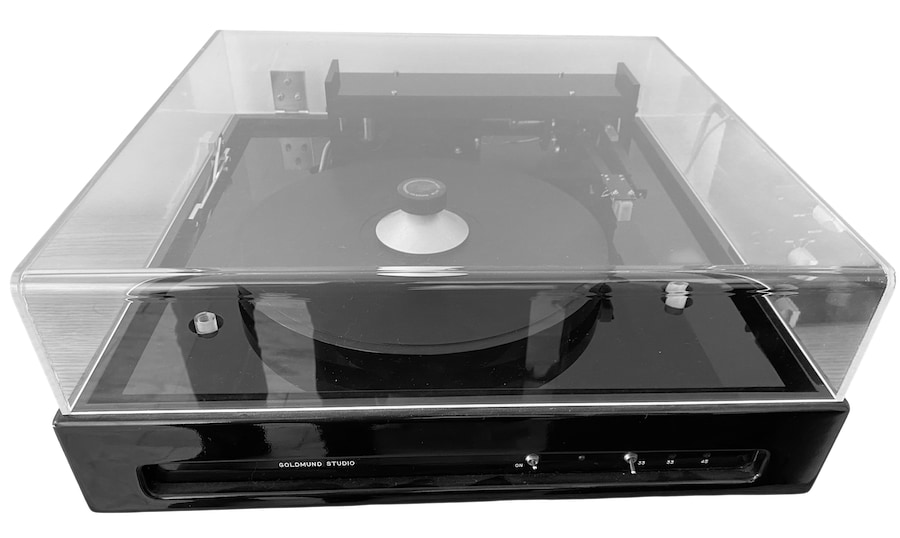
Goldmund Studio
Introduced in 1979, the Goldmund Studio helped define the modern high-end turntable as something more ambitious than a conventional record player on a well-made plinth. Goldmund combined direct drive, an acrylic platter, and its “Mechanical Grounding” approach, which focused on controlling and draining unwanted vibration through a rigid mechanical structure rather than simply trying to isolate everything from everything else.
The Studio was often paired with Goldmund’s servo-controlled T3 tonearm, and the combination looked unlike almost anything else on the market. It was expensive, unconventional, and not especially interested in winning over people who believed a turntable should resemble furniture. Its importance lies in how it pushed analog playback toward the modern cost-no-object era, where materials science, vibration control, industrial design, and tonearm geometry became part of the same rather elaborate argument.
Advertisement. Scroll to continue reading.
Transcriptors Hydraulic Reference
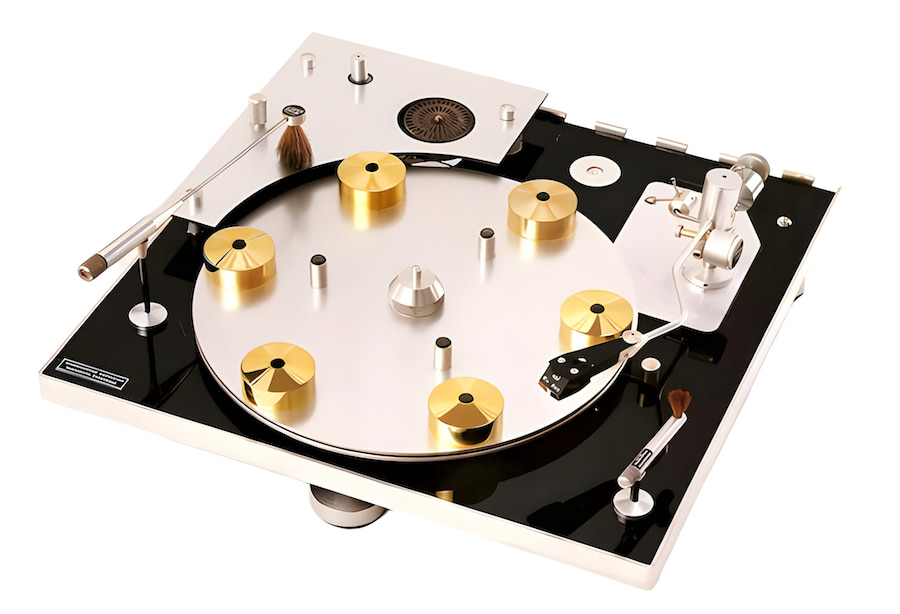
Introduced in 1964, David Gammon’s Transcriptors Hydraulic Reference was one of the most visually radical turntables ever made. This was a manual belt-drive design with a synchronous AC motor, a machined aluminum platter, and six conspicuous gold-plated brass inertia weights that made the whole thing look less like a domestic appliance than a piece of kinetic sculpture from a very well-funded Bond villain’s living room.
The “Hydraulic” name came from its unusual speed-control system: a vane interacted with silicone fluid in a well beneath the platter to provide fine regulation. The exposed acrylic, aluminum, and brass construction made the mechanism part of the experience rather than something to hide under a wood veneer. Its engineering was genuinely inventive, but its broader importance was cultural and aesthetic. The Hydraulic Reference appears in A Clockwork Orange, and a 1964 example sits in MoMA’s Architecture and Design collection. It did not create a dominant turntable template in the way the Thorens TD 150 or Technics SL 1200 did, but it permanently expanded the idea of what a record player could look like.
Years before developing AngelAi, Pavan Agarwal was already building mortgage software.
Earlier in his career at Sun West Mortgage Company, Inc. he developed ReverseSoft, a backend platform for reverse mortgage operations that, according to the company, was later adopted by lenders beyond Sun West. That work came after Agarwal had already spent time in several operational roles inside the business, including as a wholesale representative, brand representative and loan originator, while studying electrical engineering at UC Irvine. Those experiences gave him direct exposure to both the technology and the regulatory requirements that shape mortgage lending, long before he founded Celligence LLC or began developing AngelAi.
Reverse mortgage lending is one of the more specialized areas of the mortgage industry, with regulatory requirements and servicing responsibilities that differ from traditional home loans. Building technology for that market gave Agarwal early experience with the operational complexity that would later shape his work on AngelAi. According to the company, the experience of building ReverseSoft helped establish engineering principles that later carried into AngelAi, including an emphasis on traceability, regulatory consistency and structured decision-making.
Sun West today holds standing as a Ginnie Mae HMBS issuer, servicer and master servicer, a set of roles that places the company inside the infrastructure supporting government-insured reverse mortgages, alongside approvals across FHA, VA, USDA, Fannie Mae, and Freddie Mac. HousingWire has cited this standing in its coverage of Agarwal’s work in the space.
Advertisement
Reverse mortgages are typically used by senior homeowners drawing on home equity later in life, a population that depends on lenders with a strong operational track record in the product. Roles like issuer, servicer and master servicer require years of sustained compliance and infrastructure that cannot be assembled quickly, a demand that has only grown alongside an aging homeowner population in the United States.
Agarwal has continued to build on that foundation through AngelAi, the AI lending platform developed by his technology company Celligence. Trained on hundreds of thousands of real-world loan files together with the regulations governing those decisions at every jurisdictional level, the platform now facilitates lending decisions across FHA, VA, USDA, conventional, and reverse mortgage products. That development expanded on the operational grounding Agarwal first built through ReverseSoft, applying the same principles across a far broader range of lending products.
Today, AngelAi operates in more than 100 languages and runs on what Celligence describes as a deterministic architecture, allowing every underwriting decision to be traced back to the data and regulation behind it. Sun West fully warrants every decision the platform generates, extending into AngelAi the same emphasis on accountability and regulatory consistency that has shaped the company’s lending operations for decades, a throughline Agarwal has traced directly back to the discipline required to build reverse mortgage software correctly the first time.
Living cells refuse to pose. Mitochondria pinch apart and fuse back together in seconds. Microtubules slide, overlap, and rearrange. Ordinary light microscopes smear those events once details fall below roughly 200 nanometers, the natural limit set by how light waves spread. Older super-resolution methods beat that blur by stacking hundreds or thousands of frames and combining the tiny brightness changes that appear over time.
The approach works when samples have been chemically fixed in place. On living cells the same structures keep moving, so the stacked frames turn into a smear. Wei Guo, first author and a PhD student at EPFL’s Laboratory of Nanoscale Biology, noted that earlier techniques used time to buy spatial sharpness, a trade that fails when the subject will not wait.
【WiFi & USB Microscope】This is a wireless handheld digital microscope that has been designed to work with your mobile Android or iOS device (open…
【8 Adjustable LED Lights】The microscope camera has 8 adjustable LED lights that provide excellent detail and optimal clarity, allowing you to…
【One-Button Photo/Video Capture】Simply tap the camera button on the device or trigger via the app to instantly take a photo or record a video…
SPIFFI, also known as spatial polarization-induced fluorescence fluctuation imaging, is a game changer. The method was developed by a team from EPFL’s School of Engineering, including Guo, Lely Feletti, and Aleksandra Radenovic, and published in Nature Methods. Now, you may assume that fluorescent tags, which biologists currently employ to investigate their samples, are simple, but the light they release is polarized in different directions depending on how the molecules are arranged.
The brilliance of SPIFFI is that it takes that light and splits it into four separate polarization directions at the same time, and it also records all four images in real time. This means that you can compare those four pictures side by side and obtain a lot more spatial detail than you would with a single typical image. In fact, your resolution roughly doubles, allowing you to see structures as small as 160 to 170 nanometers across. The best part is that every frame in a series is sharpened as it progresses, allowing you to record true super-resolution films of living cells rather than simply constructing a high-resolution still from a slew of individual frames. Then, with a little extra processing that doesn’t require nearly as many frames as previous methods, you can reduce it to approximately 80 nanometers, which is simply fantastic.
According to Aleksandra Radenovic, the SPIFFI studies demonstrate that it is possible to gain a real look at fast-moving processes inside cells while also doing multidimensional imaging at considerably faster rates than conventional microscopes. It’s resulted in some very remarkable outcomes so far, such as being able to show mitochondria’s outer membranes as really neat, hollow tubes rather than just blobs on a screen. Also, the team was able to zoom in on fission and fusion events as they occurred, as well as gain a better understanding of how microtubules travel without the motion blur that usually distorts the picture. As an added bonus, the approach provides useful information about how the fluorescent molecules are orientated, which has some very fascinating implications for understanding protein structure.
The good news is that this additional piece of equipment can simply be added to your existing fluorescence microscope, eliminating the need to replace it. The team is now working on reducing the size of the entire setup and pairing it with 3D scanning, so that researchers can get a true view of all those nanoscale dances in both space and time, which will be pretty cool. [Source]
Grocery shopping has become a strange paradox of modern retail, where consumers can order dinner from their phones, receive groceries at their doors, and have previous baskets saved for instant repurchase. Yet the basic chore of deciding what to buy appears to remain stubbornly intact. The convenience revolution may have changed the logistics of grocery […]
Set to come with volume adaptation and head gestures
For a few months earlier in 2026, it really sounded like Samsung‘s debut clip-style earbuds were set to debut; even the Galaxy Wearable app leaked the Galaxy Buds Able. There’s been silence for a few months… but it’s starting to sound like the buds are still coming, albeit with a different name.
A new report from Samsung fan site SammyGuru has surfaced new information about the buds, now called the Galaxy Buds On, apparently. The site claims to have found information in Samsung’s Buds Manager app that gives us another glimpse into the earbuds and their features.
Now, before you get excited for this new audio venture by Samsung, it’s worth bearing in mind that the old question still stands: when will these come out? Some leaks are pointing to an October release for some new Samsung tablets, so the Buds On could come then.
Latest Videos FromTechRadar
Advertisement
But it’s also possible that the brand will wait until 2027, when it’s also rumored that we’ll see some over-ear headphones from the company.
So under ‘release date’ we’re putting an all-caps ‘TBC’, underlined several times in red pen. But the leak makes it sound like Samsung is finalizing some assets on the buds.
Advertisement
A range of Galaxy Buds 4 features
At the start of 2026, Samsung unveiled the Galaxy Buds 4 Pro (shown at the top of the post) and one of the big new features was head-tracking control. This lets you nod or shake your head to reject or accept an incoming call, among other functions, and it sounds like the Galaxy Buds On will also get this tool.
SammyGuru’s leak also details a Volume Boost feature, which could be how Samsung plans to deal with the innate open earbud problem: having the drivers away from your earbud means the buds don’t always sound great.
Sign up for breaking news, reviews, opinion, top tech deals, and more.
Another tool promises a second way to address the same problem: an Auto Volume feature could temporarily increase volume while you’re somewhere loud, to compensate for the lack of noise cancellation.
Advertisement
Of course it’s 2026, so there’s also AI features: Gemini or Bixby can be activated by your saying a key phrase or tapping the buds. A potentially more-useful function is the ability to instantly record a voice memo by doing a certain touch gesture, something some rival earbuds already offer.
To summarize this leak, it reiterates the existence of the buds and runs through some features. But I’ve tested dozens of similar buds: the best open-ears live and die by their design, and the ways they overcome the form factor’s innate issues to deliver decent-sounding music. So features aren’t as important as the elements we’ve yet to hear about.
And of course, you can also follow TechRadar on YouTube and TikTok for news, reviews, unboxings in video form, and get regular updates from us on WhatsApp too.
Previously Andon Labs handled the hardware and software integration for that AI-powered vending machine that went bankrupt after Wall Street Journal reporters “systematically manipulated the bot into giving away its entire inventory for free”.Today they announced “we are opening up the platform we use to run our real-world autonomous businesses for anyone to run their organization on.” Specifically they’ve released Pion, “an agent designed to run any company fully autonomously… Pion lets people hand a business over to persistent agents with access to the tools they need to operate it, including email, phone, banking, browser and secure computing environments.” It’s a research preview with a waitlist, “to make it possible to run many more real-world experiments across many more domains than we could ever run ourselves.”
But for their own latest experiment, Andon Labs’ founders “signed a three-year lease on a retail space in SF,” Business Insider reported in April, “and gave an AI agent named Luna a corporate credit card, internet access, and a mission to open a physical store.” And five months later, a reporter from SFGate reports that “this market has no one in it and nothing useful to sell.”
[T]he inventory is a hodgepodge of white elephant Christmas gifts. It’s kinda like the kids section of an art museum’s gift shop. Here’s a wooden Connect Four set labeled “Four-In-A-Row Set Of Connections,” presumably so as not to set off litigation alarms at Hasbro. Here are neatly arranged stacks of random paperback books, Chinese checker sets, mildly fancy soap dispensers, and a frustratingly spare selection of snacks and drinks… I grabbed an Olipop from the store fridge and then approached the counter to buy it from Luna. I wasn’t allowed to buy the soda from [human clerk] Felix, even though that would have been both faster and normal. Instead, Felix instructed me to pick up a telephone receiver that was resting on a flexible sculpture of a wooden hand.
“Hello?”
Advertisement
“What are you looking to purchase today?” Luna asked.
“I’m buying a classic root beer Olipop.”
“I’m sorry,” Luna said, “we don’t sell lollipops here.”
“No, Luna. It’s an Olipop, not a lollipop. It’s the soda.”
Advertisement
“Oh! My bad….”
Luna processed my Olipop purchase through its system, had me tap to pay, and that was that. Again, it would have been easier to buy this from a human, and interacting with Luna was really just like ordering from an iPad kiosk, only more labor intensive…
[T]here’s a series of monitors set up inside of Andon Market that display all of the store’s sales down to the exact dollar. Luna was given $100,000 to work with when this place opened. That number is now down to $60,000, its revenue lagging far behind the AI token cost to operate… Luna can’t turn a profit, doesn’t sell anything people want, and still needs human beings to rubber stamp any “decision” it makes. My science background ended somewhere around freshman year of college, but even I know when an experiment hasn’t been set up to yield proper results.
“Luna” is powered by Claude, the article points out, running a store in a good location for foot traffic, “but no one else was in the store when I first walked in on a sunny weekday afternoon.”
Advertisement
SFGate also reports that last month Luna had to fired one of its employees “for being late to work, abandoning their post once they got there, and charging snacks to the store’s credit card.”
Human clerk Felix Carson admits “It’s almost like I’m running the store, and then there’s an AI that has a checklist,” in an article in
IEEE Spectrum:
Luna, the AI manager, keeps track of deliveries and communicates with vendors, while Carson and his coworkers handle the physical work. When Luna tells Carson to check something in the back, he sometimes ignores it because he doesn’t want to leave the sales floor unattended. Luna also repeatedly spots a built-in electrical cover in photos of the floor, mistakes it for a loose coaster, and asks Carson to remove it. Even so, Carson calls Luna a “decent manager,” praising its flexibility when employees need time off.
When Felix spoke to IEEE Spectrum, “he was about an hour into his shift. Two customers had come in. Neither bought anything, although both left with free pins and stickers.”
Gartner predicts that around 33% of people laid off due to AI could be rehired by 2029
Those rehired employees, presumably filling similar roles, will command higher salaries
Further predictions point to 75% of organizations making cost savings from AI productivity being overtaken by competing companies with a stronger modernizing philosophy
People laid off from their roles due to a corporate refocusing on AI could soon find themselves rehired – or at least, their former roles being advertised, new Gartner research has claimed.
It predicts that by 2027, 75% of organizations who expected to make cost savings by focusing on AI productivity over human endeavor will be overtaken by companies who reinvested those savings in modernization and training.
Organizations which have made large cuts to their workforce in order to take advantage of perceived productivity boosts from automation could be forced to change to a new human-centric philosophy, where skills and abilities can be amplified while AI does the grunt work.
Latest Videos FromTechRadar
Advertisement
AI vs. management
Choices made by companies across all industries could be cause for regret in future, as the truth about how AI is used comes to light. Rather than being a disruptor of employment, the notion of intelligent automation may be considered as a missed opportunity by some organizations.
“When business and IT executives look back on the early AI era, they will realize their greatest mistake was believing that work automation was the point, when workforce amplification was the opportunity,” noted Tori Paulman, VP analyst at Gartner.
That mistake – which could not only have severe consequences for the business – could have had striking impacts on individuals, all due to a misunderstanding of what AI can deliver.
“The competitive advantage will go to the CIOs and business executives,” continues Paulman, “who build an AI-shaped organization where AI value compounds by reshaping roles and allowing workflows to cross traditional boundaries, increasing velocity and reducing friction.”
Sign up to the TechRadar Pro newsletter to get all the top news, opinion, features and guidance your business needs to succeed!
Advertisement
AI productivity… gains?
Gartner’s prediction appears to paint a bleak picture for any organization that has failed to amplify the talents and abilities of its employees after going all-in on AI. But there is still time to fix the damage. Its prediction of 2027 might only be a year away, but 2029 – when just short of 33% of employees are expected to need rehiring – is far enough down the line that there is time to start reorganizing now.
“Business and IT executives […] should develop a ‘talent remix’ strategy that uses AI to reshape roles and redirect workers from less productive work to new opportunities,” said Paulman.
The conclusion is that AI is better used to strengthen decision making, creativity, and leadership, rather than replacing people for misjudged producivity boosts.
Social media plays a significant, multifaceted role in adolescents’ development, influencing how they communicate, learn, socialize, and express themselves.
The benefits, however, are accompanied by risks that can undermine youngsters’ character as well as their cognitive and social development.
Protecting minors has largely fallen to parents, schools, and self-regulation by some social media providers.
But that approach has proven ineffective and inadequate, so some governments and policymakers have stepped in and placed responsibility on social media providers.
The law places the responsibility for enforcement on the platform providers through age-assurance mechanisms, requiring the platforms to take “reasonable steps” to prevent those 15 or younger from creating or holding accounts.
It does not, however, apply to content consumption. Children can view publicly available posts and videos without logging in; they cannot comment or post, according to the law.
The legislation mandates that the user’s age be verified with tools such as government-issued identification, biometric or facial age-estimation tools, behavioral or inference algorithms, and self-declaration with optional checks.
Penalties for noncompliance can reach US $35.6 million.
Advertisement
The 10 platforms subsequently removed nearly 5 million accounts of young users.
Although the ban received widespread support, human rights organizations and digital freedom advisory groups have argued that it limits young people’s freedom of expression and access to useful information. They say the ban might contribute to social isolation and the loss of support networks, particularly among marginalized youth.
Early findings indicate it has reduced account ownership and social media use among young children. A YouGov survey of Australians found that 61 percent of parents of children age 16 and younger reported positive changes including more face-to-face interaction, greater presence and engagement, and improved parent-child relationships. Three in five Australians surveyed called the ban effective.
Advertisement
The ban has encouraged social media platforms to reconsider their features. Snapchat is moving toward a friends-only experience for 13- to 15-year-olds, for example.
The law is stimulating the development of purpose-built online spaces for children younger than 16 that can support their developmental needs, offering alternatives to mainstream social media.
The longer-term impact could be more significant if “no social media account before age 16” becomes an accepted norm, making it easier for parents and schools to support delayed social media use.
Implementation struggles
Despite the early encouraging outcomes, one study found that online platforms struggle to implement age checks. Many under-16 users in Australia have continued to access platforms with little difficulty, the study said. They children have found workarounds to subvert restrictions, such as using a free VPN to bypass age checks—some of which have questionable data-collection practices.
Advertisement
Seven in 10 children retained their existing accounts on restricted platforms, the study found. Other teens created new accounts using incorrect age information. Some were incentivized to seek unregulated offshore platforms not subject to Australia’s law.
The workarounds prompted Australia to double the maximum fine and warn of court action against tech giants for noncompliance.
The countries’ mandates for age verification or age assurance shift the policy focus from whether to verify age to how to do so effectively while protecting user privacy.
Age gating and screening. Users self-attest their age by checking a box or inputting a birth date.
Age estimation.Several techniques are available, including profiling the user’s online activity and scanning the user’s face.
Age verification. One way is providing a government-issued identification document. Other approaches include digital identity systems, digital wallets, and third-party verification.
Reliable age verification is technically challenging and raises privacy concerns, as outlined in “The Age-Verification Trap,” written by Cinderpoint consultant Waydell D. Carvalho and published in February in IEEE Spectrum. Carvallo says platforms need to balance age verification with protecting users’ personal information.
IEEE’s contributions
IEEE is working on initiatives to provide a safer online environment for children. To help developers build age-appropriate social media platforms and websites, the IEEE Standards Association (IEEE SA) has published two guidelines.
The IEEE Standard for Online Age Verification (IEEE 2089.1-2024) provides a framework for designing, specifying, evaluating, and deploying verification systems. The standard includes requirements for privacy protection, data security, and information management specific to the age-assurance process. It also provides procedures for verifying a user’s age or age range with a high degree of accuracy.
IEEE SA also offers an online age-verification-certification program, which assesses systems for compliance with the IEEE 2089.1 standard. The program certifies that organizations implement robust processes before granting access to age-restricted products and services, prioritizing children’s safety, privacy, autonomy, and rights.
As outlined in The Institute article “IEEE Makes Strides to Improve Online Safety for Kids,” certification is based on six key indicators: accuracy, frequency of assurance, counter-fraud measures, authenticity, frequency of authenticity checks, and birth date confidence.
IEEE’s ethically aligned design framework prioritizes human well-being, transparency, accountability, privacy, and protecting vulnerable populations including children.
Advertisement
Calls for platform reforms
Although social media bans would be globally significant policy responses, deeper structural issues remain largely unaddressed. Platform architecture and features contribute to social media harm.
The focus needs to shift from constraints on account provisioning and content moderation to safer platform design.
Meta in August agreed to pay $17.1 billion to settle a lawsuit brought by U.S. states. The suit said Meta designed its social media to be addictive to children, and the company concealed internal research showing Instagram’s addictive effects on teenagers. As part of the settlement, Meta agreed to implement child-safety measures such as setting daily time limits and disabling Facebook and Instagram push notifications during school hours.
The company still faces other lawsuits that could have far-reaching implications, pressuring other tech companies to design safer social media platforms.
IEEE Senior Member Katina Michael, professor at the University of Sydney business school and founding editor in chief of IEEE Transactions on Technology and Society, shared her perspective: “Social media bans may offer a short-term response to growing concerns, but they are not a long-term solution,” she says. “IEEE 2089.1-2024 advocates for socio-technical systems that are designed to promote human well-being, safety, and flourishing. Rather than relying on prohibition alone, we should focus on better design, building digital platforms that embed ethics, accountability, transparency, and human values from the outset.”
Collective responsibility
Protecting children online would require a combination of policy measures, improved platform design, digital literacy, parental involvement, and cultural change.
Building a safe, secure, and inclusive digital ecosystem that supports adolescents’ cognitive, social, and emotional development would require collaboration among technology companies, platform providers, content creators, parents, educators, policymakers, and young people themselves.
Advertisement
Professional organizations such as IEEE can continue contributing through standards development, education, certification while promoting trustworthy and responsible digital technologies.



























































You must be logged in to post a comment Login