
Security teams log 54% of successful attacks and alert on just 14%. The rest move through your environment unseen.
The Picus whitepaper shows how breach and attack simulation tests your SIEM and EDR rules so threats stop slipping by detection.



Within an hour after a horrific knife attack took place in Belfast on Monday night, far-right UK activist Tommy Robinson had shared a video of the incident on X, a post that racked up six million views. Within hours Elon Musk, the owner of the platform, weighed in, agreeing with a post calling for “consequences” for politicians.
By Tuesday morning, supercharged by X, the video was everywhere, and groups on Facebook were organizing protests across Northern Ireland and the UK. Far-right figures in the US and UK continued to pour fuel on the fire online, framing the incident as part of a broader anti-white agenda being perpetrated in Western countries.
By Tuesday evening, violent protests had broken out in Belfast, with masked rioters setting fire to vehicles, kicking in the doors of homes they believed housed immigrants, and setting those homes on fire.
Politicians were quick to criticize Musk and Robinson, who did not reply to requests for comment, for their role in fomenting the violence, but what no one appeared to notice was the role played by the white supremacist Active Club movement and its Youth Club wing in not only stoking tensions, but advising and orchestrating the masked youths who spearheaded much of the violence.
A WIRED investigation has documented how this global network activated within hours of the incident, showing how groups across the US helped promote the violence in Belfast. The movement is already analyzing how the protests played out and using them as a template for others to follow, highlighting the “organisation and professionalism” of those involved.
“Active Clubs, the fastest growing neo-Nazi movement around the globe, never miss an opportunity to exploit a tragedy for their own hateful purposes,” says Wendy Via, cofounder and president of the Global Project Against Hate and Extremism. “The protests in Belfast had hardly started before Active Club senior voices were functioning as a support network for the racist riots and encouraging replication in other countries.”
Around 10:30 pm local time on Monday night, emergency services were called to the Kinnaird Avenue area in north Belfast. Soon after, a video was shared online by an unknown person which showed a horrific knife attack against Stephen Ogilvie, who was left hospitalised with severe injuries to the face and neck, including the loss of his left eye.
Hadi Alodid, a 30-year-old Sudanese man, was arrested at the scene and has since been charged with attempted murder.
After Robinson posted the footage, it quickly gained steam on mainstream social media platforms. US-based X account End Wokeness, which specializes in sharing culture war and ragebait content, shared a screenshot from the video, with the caption: “African migrant just tried to behead a white man in North Belfast, Ireland. Video is too graphic to post.” The post has been viewed over 16M times.
Musk posted dozens of times about the incident in the following days, drawing the ire of politicians in the UK, but away from mainstream platforms like X and Facebook, other groups were also mobilizing and being much more explicit about the reason they believed a strong response was necessary.
Just hours after the attack took place, at 2:19 am on Tuesday morning, a Telegram channel called “White Youth In Revolt”—named after a phrase used across the Active Club and Youth Club movements—shared a screenshot of the video, writing: “Negro invader just attempted to behead a white man in the United Kingdom.”
The account typically shares content from Active Clubs in the US, but given the network’s growing footprint outside of America, it has a lot of followers in Europe.
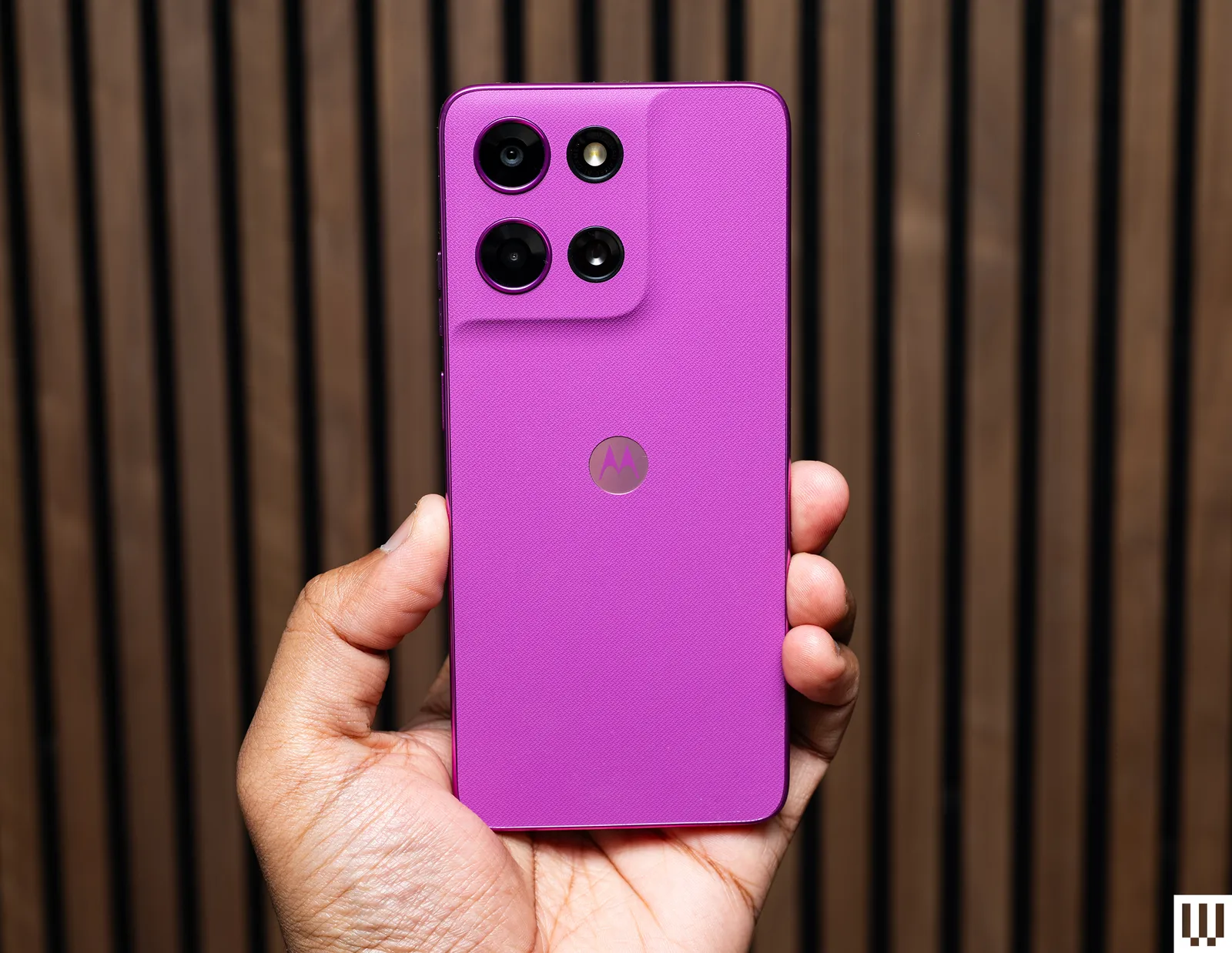
Motorola Edge 2026 for $600: I surprisingly enjoyed my month with the new Motorola Edge. It’s amazingly lightweight at just 160 grams, and the 6.3-inch screen size feels fairly compact. If you hate big, heavy phones and have longed for the days of smaller handsets, the Edge is worth a look; it’s not as small, but it feels great to use one-handed. Performance is more than capable, though you will feel some sluggishness here and there. The cameras are reliable—there’s even a 3X optical zoom telephoto alongside the 50-MP ultrawide and 50-MP primary—but it’s not going to knock your socks off. It will only get two Android OS upgrades and three years of security updates, which is not really acceptable for a $600 phone. Get it on sale!
Motorola Razr+ 2026 for $1,100: The Razr+ is the awkward middle child of the Razr lineup. I’ve never liked it. It doesn’t have all the bells and whistles or top-notch specs of the Ultra, but still costs more than $1,000. You can get very nearly the same experience with the cheaper Razr and save hundreds. Even battery life is the least impressive of the lot, because it has the smallest capacity. The cover glass isn’t the ceramic glass mixture as on the Razr Ultra, and I found out the hard way. I dropped the phone once, roughly a four-foot drop onto asphalt, and the front screen shattered. Get a screen protector!
%2520Reviewer%2520Photo%2520SOURCE%2520Julian%2520Chokkattu.jpg)
Moto G 5G 2026 for $299: The Moto G 2026 is nearly identical to the Moto G Play 2026 below, except it has double the storage (expandable via microSD), supports slightly faster wired charging, and the front and rear cameras pack more megapixels. It’s a $50 difference, so if you’re eyeing either one, you really should go for the Moto G 5G 2026. Performance is similarly sluggish, though perfectly usable day to day (if you’re patient). Even with more megapixels, don’t expect much from the cameras; they can take passable photos in good lighting, but struggle to do so in low light. I was able to hit nearly two days of battery life with average use, and I like that this phone still has the headphone jack. However, keep in mind that it will receive only two Android OS updates and three years of security updates. I think you’re better off buying the Moto G Power 2026 on sale. It’s worth noting that Motorola suddenly jacked up the prices of this device and the Moto G Play.

Moto G Play 5G 2026 for $250: Motorola’s cheapest phone always sits in an awkward spot. It was originally under $200, but Motorola increased the price to $250. I don’t think it’s worth it at that price, but for under $200, it’s a serviceable handset that now features 5G connectivity. You get two-day battery life, a headphone jack, expandable storage, and a pretty nice design. But the MediaTek Dimensity 6300 chip with 4 GB of RAM is very sluggish—get ready to wait a second or two, sometimes more, for an app to launch or a webpage to load. Photo quality is passable; most of my images have lackluster colors. I took several calls, and the people on the other end generally complained about my audio quality, which isn’t great. It’s nice that this ultra-budget phone will get two Android OS updates, but I’d wait for the Moto G Power 2026 to eventually dip to $250 during major sale events.
-Reviewer-Photo-SOURCE-Julian-Chokkattu.jpg)
Motorola phones diminish in value fairly quickly. You should avoid buying Moto G phones from 2025 or earlier. They likely won’t get any more Android version updates, and the prices aren’t drastically different from the latest models. Last year’s Motorola Edge 2025 or the Razr (2025) series are the oldest I’d go, assuming prices are a good deal lower than the latest models, so don’t consider anything else.
Threat actors are using email addresses exposed in data breaches leaked by the ShinyHunters extortion group to send sextortion emails demanding $2,000 in Bitcoin.
The emails claim to come from ShinyHunters and tell recipients that hackers compromised their devices after obtaining their email addresses from breached company databases.
However, the messages appear to be sent by someone who downloaded data previously leaked by ShinyHunters rather than by the extortion group itself, using the exposed email addresses to make the threats appear more legitimate.

BleepingComputer has seen leaked data from the Amtrak, Hallmark, Substack, Betterment, CarGurus, ADT, Panera Bread, and McGraw Hill breaches used in this sextortion email campaign.
For some recipients, BleepingComputer confirmed that the email addresses targeted by the sextortion emails were actually included in the associated data previously leaked by ShinyHunters.
Extortion gangs often warn victims that refusing to pay will expose their customers and employees to additional abuse once stolen data is published. While those claims are intended to pressure organizations into paying, this campaign illustrates how leaked data can later be repurposed by unrelated threat actors for malicious purposes.
While the use of a recipient’s leaked email address may make these emails appear more convincing, there is no indication that the sender compromised recipients’ devices, installed malware, accessed their cameras, or monitored their activity on adult websites.
BleepingComputer contacted the ShinyHunters extortion group, which denied any involvement in the sextortion email campaign.
In the emails seen by BleepingComputer, they are sent from random email addresses using the names “ShinyHunters” or “You’ve Been HACKED” and have the subject “Information about your online security.”
The messages claim to be from the ShinyHunters hacking group and state that the attackers gained access to the recipient’s devices several months earlier.
The sender then names a company whose data was previously published by ShinyHunters, claiming that the breach allowed them to access the recipient’s email account.
We are the ShinyHunters hacking group.
A few months ago, we gained access to your devices and started monitoring your online activities.
What happened:
We gained access to the Cargurus.com database where you have an account and easily accessed your email.
You weren’t very careful about the links you opened.
A week later, we installed an exploit on your devices, including your phone, giving us access to your microphone, camera, keyboard, and all your data.
We have your photos, browsing history, conversations, and contact list.
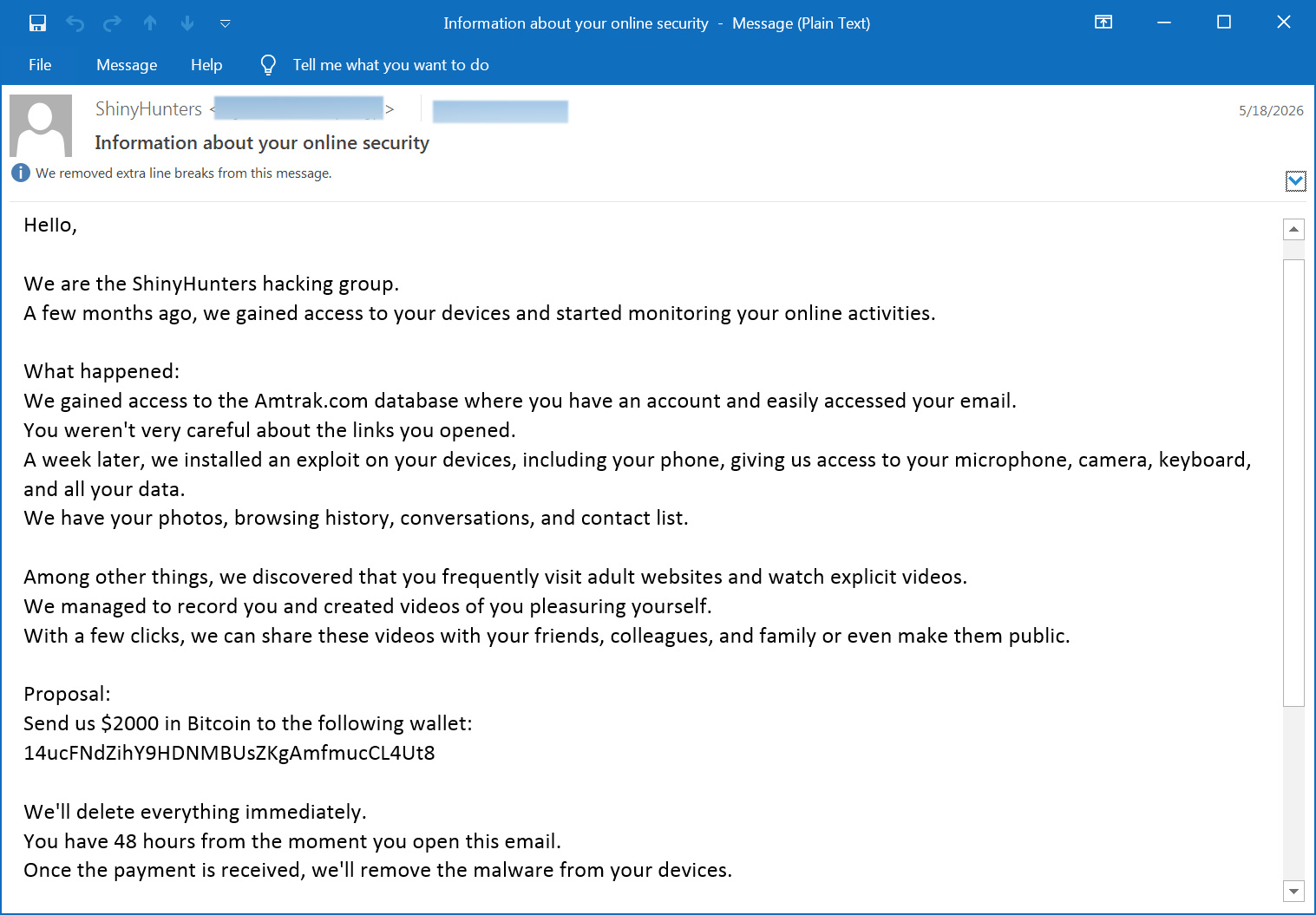
The email falsely claims that the attackers later “installed an exploit” on the victim’s computers and phones, allowing them to access the microphone, camera, keyboard, photos, browsing history, conversations, and contact list.
The sender then claims to have recorded the recipient visiting adult websites and threatens to share intimate videos with their friends, colleagues, and family.
To prevent the alleged release of these compromising videos, the victim is told to send $2,000 in Bitcoin within 48 hours.
The email also warns recipients not to contact police, reply to the message, or reset their devices, claiming that the stolen information is stored on remote servers.
These types of emails are known as “sextortion” emails and are designed to frighten recipients into paying a demand out of worry that they will have their reputation hurt with friends, family, and work colleagues.
However, there is nothing to indicate that the sender ever had access to the recipients’ devices or personal activity.
Instead, the attackers use details from published leaked data breaches, such as an email address and the name of the breached company, to make a sextortion scam appear targeted.
While you may think that no one would fall for these scams, they were very profitable when they first appeared in 2018, generating over $50,000 in a week.
Since then, scammers have created a wide variety of extortion email scams, including ones that pretend to be hitman contracts, information about cheating spouses, bomb threats, CIA investigations, and threats of installing ransomware.
The sextortion campaign appears to have started in April, with numerous people and organizations reporting similar messages or warning recipients to ignore them.
One person who received an email referencing the Betterment breach posted about it on the Betterment Reddit.
Betterment responded that it was aware some clients had received threatening emails claiming to come from a hacking group.
“These messages are part of a common extortion scam designed to intimidate recipients,” Betterment said.
“Please note, knowing an email address does not provide the ability to install malware or access someone’s device.”
The company advised recipients not to reply, send payment, click links, or open attachments and to delete the email. Betterment also asked customers who had interacted with the message to contact its fraud team.
Although their email address may have appeared in one of the published data leaks referenced in the email, this does not mean the sender compromised their devices, recorded videos, or obtained any of the other information described in the message.
Recipients of these messages should not pay the ransom or respond to the sender.

Security teams log 54% of successful attacks and alert on just 14%. The rest move through your environment unseen.
The Picus whitepaper shows how breach and attack simulation tests your SIEM and EDR rules so threats stop slipping by detection.
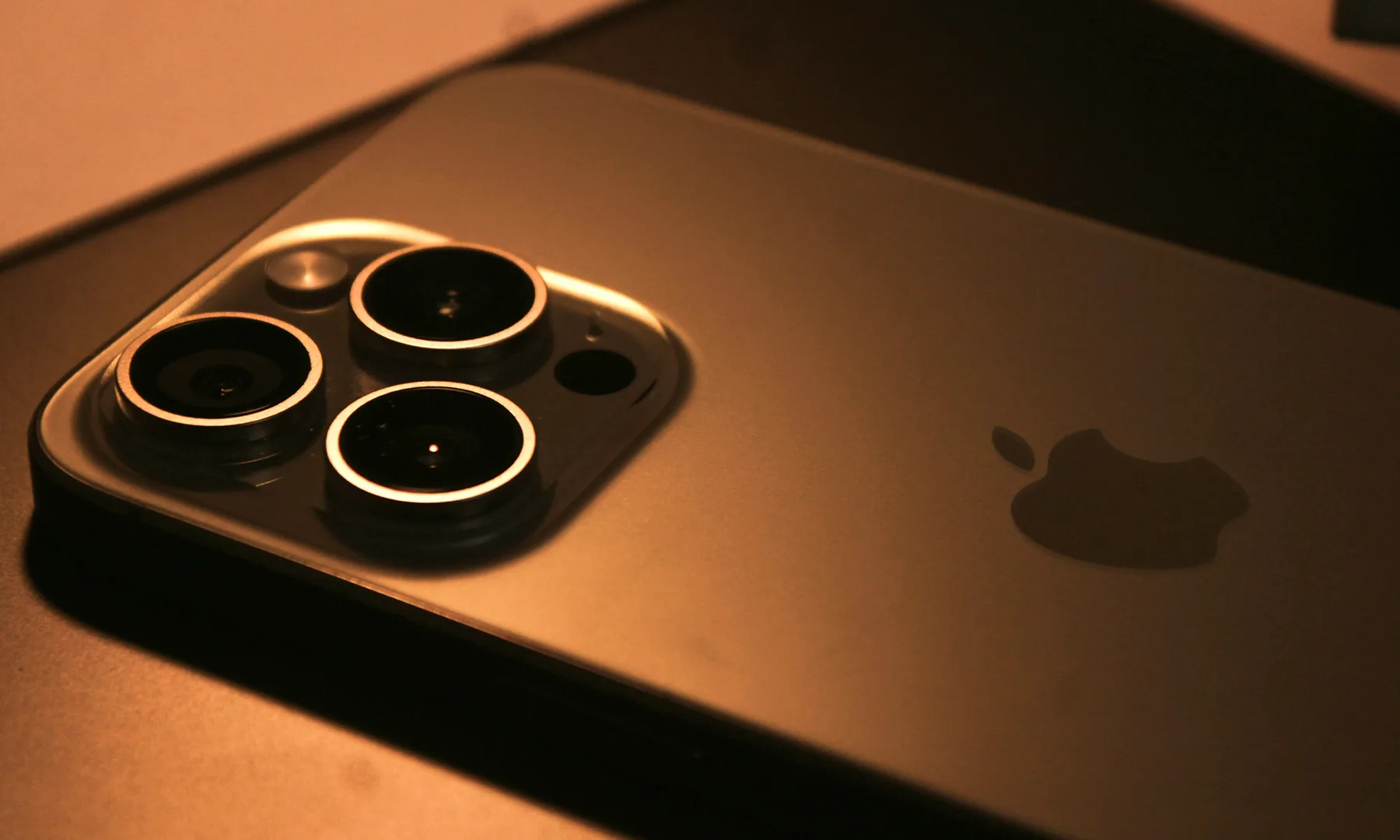
Buying your next Apple device could soon look like leasing a car. Apple is launching its new Apple Upgrade program on Tuesday, July 28, replacing new enrollments in the long-running iPhone Upgrade Program with a lease-based option that covers iPhones, iPads, Macs, and Apple Watches.
Backed by Klarna, the program is designed to lower the upfront cost of Apple’s premium devices, but it is also raising questions about whether you’ll actually own what you’re paying for.
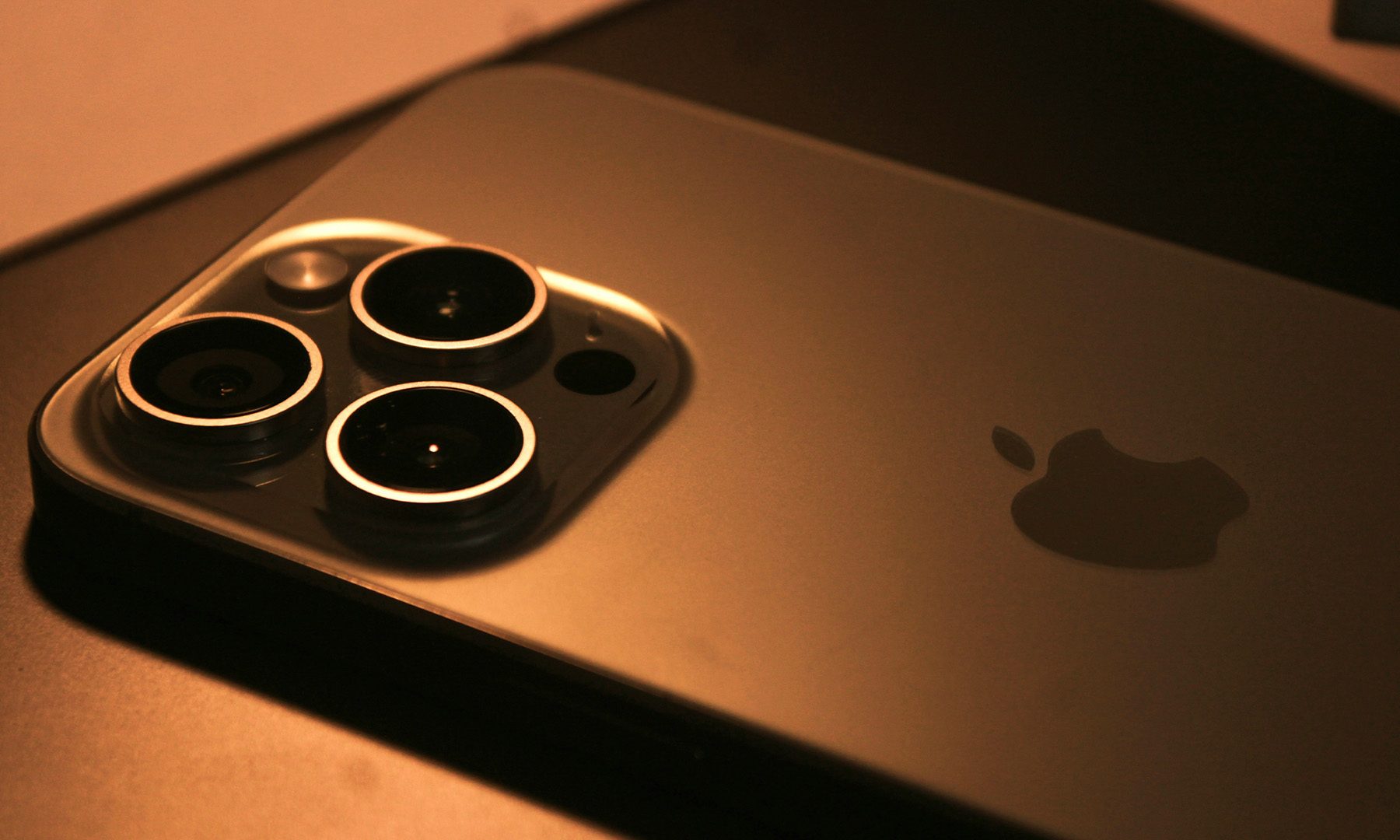
The new program will reportedly launch first in the United States through Apple’s retail stores and online store. Eligible iPhones and Apple Watches will be offered on 24-month leases, while Macs and iPads will be offered on 36-month leases.
You’ll make monthly payments, with the option to pay off the device early, upgrade to a newer model during the lease, or keep or return it when the agreement ends. A soft credit check through Klarna will be required before you can enroll.
Apple Upgrade is expected to replace new signups for the current iPhone Upgrade Program, although existing financing plans will continue for current customers. Unlike the older program, reports suggest that AppleCare will not be included.
The program also excludes the base iPad, iPhone 16, Apple Watch SE, MacBook Neo, and business or education purchases. The timing is interesting because it follows Apple’s recent price increase across much of its hardware and services lineup.

The biggest concern is that Apple Upgrade may work more like a traditional car lease than a financing plan. If that is the case, your monthly payments would mainly cover the device’s depreciation instead of paying off its full value.
At the end of the lease, you could be asked to return the device or make an additional payment to own it outright. Whether this ends up saving you money or just keeps you locked into an endless upgrade cycle will likely depend entirely on how you use it.
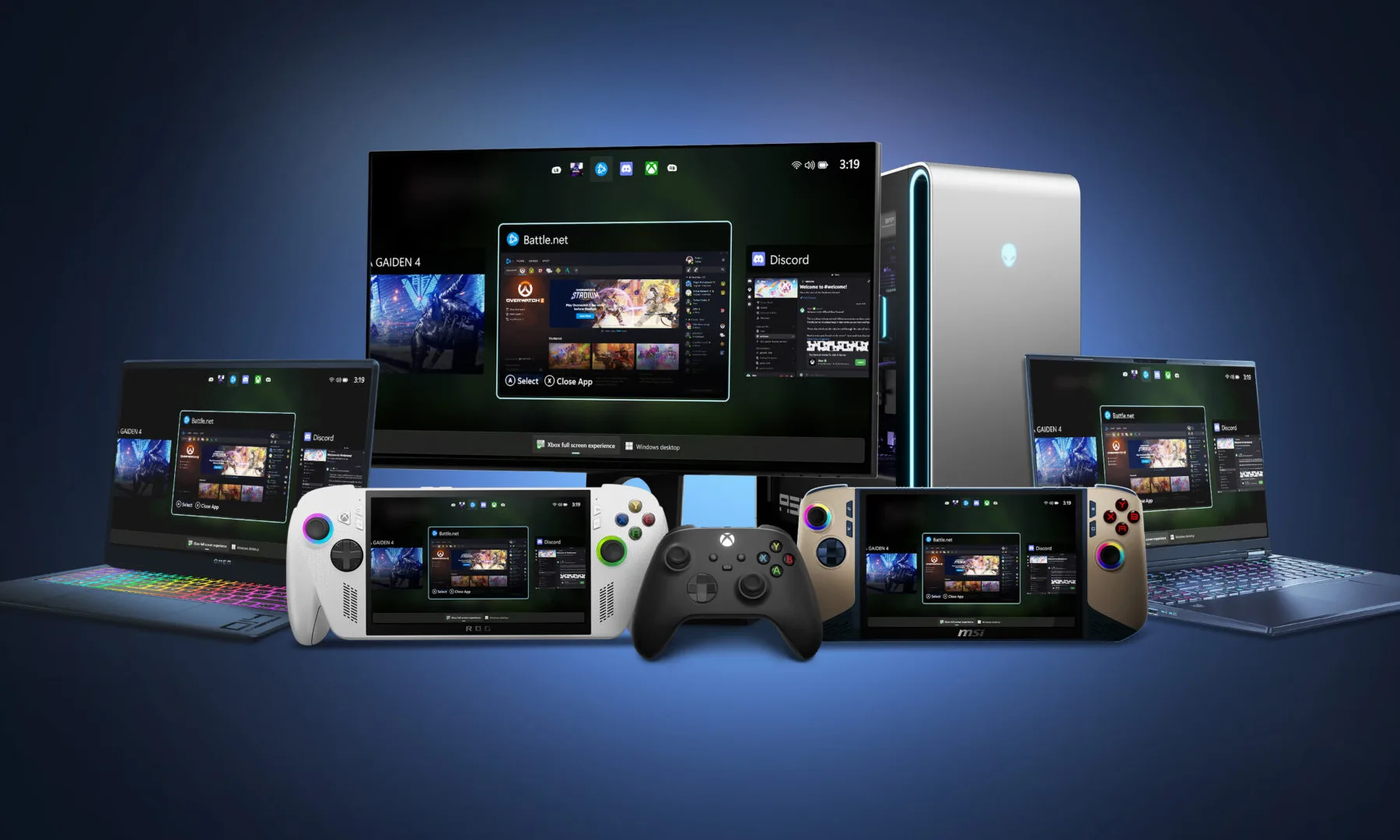
Waiting for a massive Game Pass download to finish could soon become a little less painful. Microsoft has begun testing a new Smart Download Client as part of the latest Xbox Insider Alpha Skip-Ahead update. The feature is designed to speed up game installs and updates by automatically connecting users to the fastest available content server. While it’s currently limited to Xbox Insider testers, early reports suggest the improvements are also making their way to the Xbox PC app, potentially solving one of the platform’s longest-standing frustrations.
According to Microsoft’s latest Xbox Insider release notes, the Smart Download Client first checks whether download servers are available before evaluating multiple server pools to identify the fastest connection. Instead of staying connected to a single server for the entire download, it can periodically reassess network performance and seamlessly switch to a better-performing server whenever one becomes available. The feature is designed to optimize both game installations and updates, ensuring users get the best possible download speeds throughout the process.

It may sound like a small backend tweak, but it addresses a complaint Xbox users have had for years. Even with high-speed internet connections, downloads through the Xbox app have often struggled to fully utilize the available bandwidth, resulting in slower-than-expected installation speeds. By dynamically selecting the best-performing server throughout a download, Microsoft aims to deliver more consistent performance — especially as modern games continue to grow well beyond the 100GB mark.
The Smart Download Client is one of several additions in the latest Alpha Skip-Ahead build, which also brings improvements to the Xbox Store’s game hub for easier DLC discovery, along with fixes for game installations, system updates, Remote Play, audio, and overall console stability.
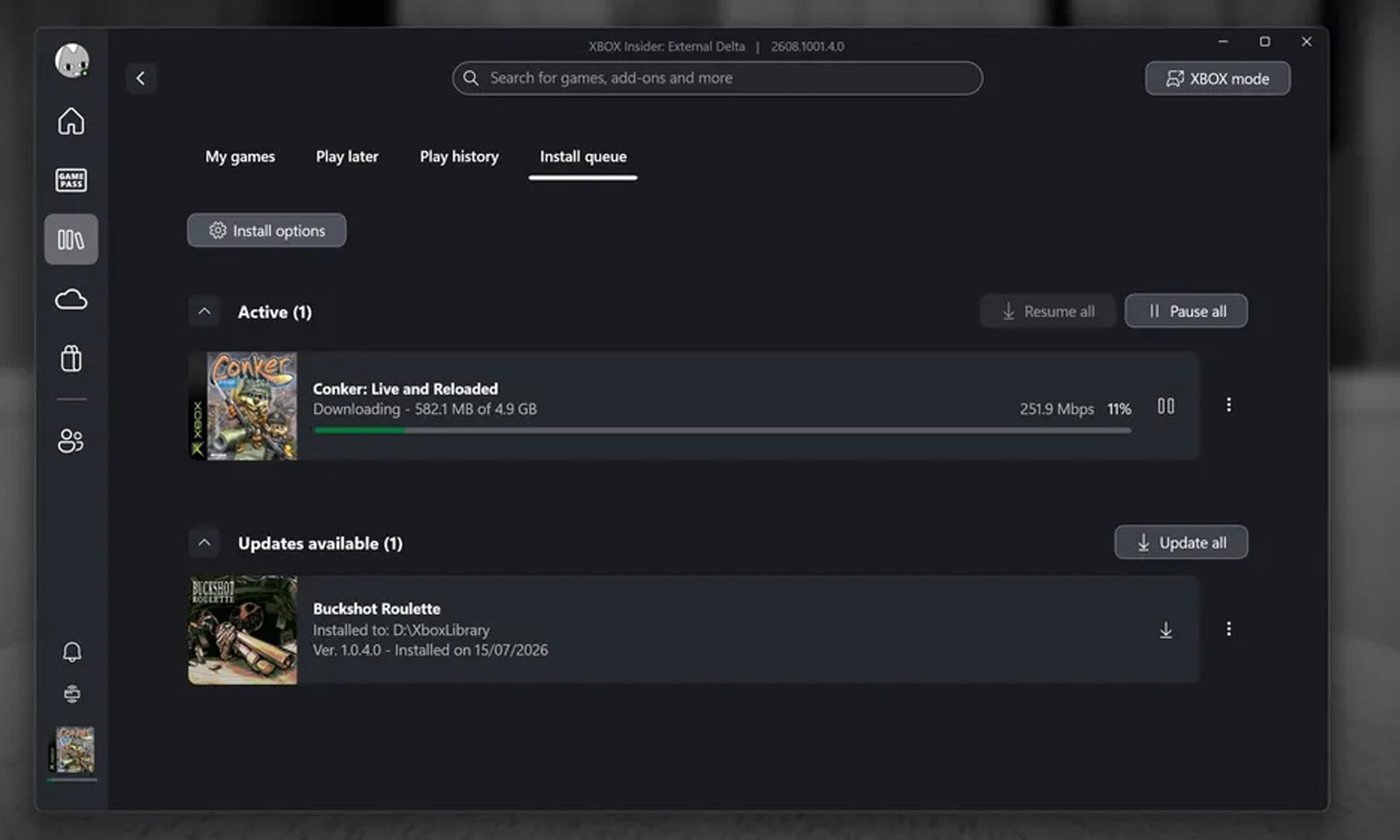
For now, the feature is limited to Xbox Insider testers, although early testing by Windows Central suggests the faster download system is already benefiting the Xbox PC app as well. Microsoft hasn’t shared a wider release timeline, but if the results hold up, this could become one of the most impactful quality-of-life upgrades for Game Pass users. With modern games regularly exceeding 100GB, shaving even a few minutes off every download is a win gamers will gladly take.

Facepalm: Grand Theft Auto fans were already upset that GTA 6 will be a digital-only release, with the so-called physical edition containing just a code to download the game. Gamers who purchased the retail box are now expressing even more frustration after it was officially confirmed that PS5 product codes in Japan will expire 170 days after the game’s scheduled launch date of November 19, 2026.
Rockstar clarified that the expiration period is only applicable to the PS5 version of the game in Japan and won’t affect buyers in the rest of the world. The company also confirmed that codes purchased for the Xbox are not region locked and will not expire, but it did not explain why it’s implementing the policy on one platform but not the other.
Explaining the rationale behind the unusual decision, Rockstar said that download codes work differently depending on the platform and country of purchase, and the Japan-specific policy was put in place due to “regulatory restrictions” in the country. The company also recommended that gamers buy from local retailers to avoid potential activation problems.
Following the announcement, many fans took to social media, slamming Rockstar for setting expiration dates on the download codes. While some likened digital gaming to renting rather than owning a product, others wondered whether Rockstar will also introduce a similar policy in other markets. Others joked that the much-hyped digital future looks brighter with every passing day.
It is worth noting that some gamers and social media commentators have speculated that the expiration date may not apply to the actual game, but only to the DLC content, which is available through a separate code in Japan. However, that still does not explain why the policy applies to PS5 but not Xbox. Rockstar has yet to clarify the matter.
GTA VI will launch on November 19, 2026, with the Standard Edition priced at $79.99 and the Ultimate Edition at $99.99. The game will be available only on PlayStation 5 and Xbox Series X/S at launch, with no word on whether there will be a PC version in the future. It is currently available for pre-order on the official Rockstar Store, the PlayStation Store, and the Xbox Store.
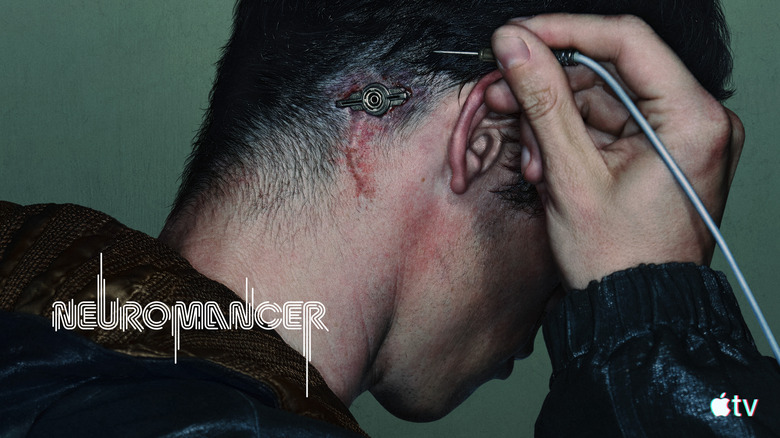
We also now know when it will be released: January 22, 2027.
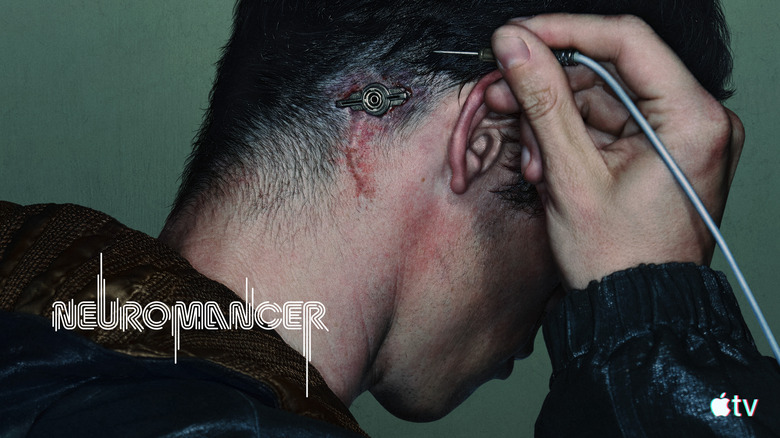
The Apple TV series based on William Gibson’s genre-defining 1984 cyberpunk novel, Neuromancer, will hit the streaming platform on January 22 of next year. Apple dropped the news at San Diego Comic-Con this weekend alongside the first official teaser. Neuromancer stars Callum Turner, Briana Middleton, Mark Strong, Joseph Lee, Peter Sarsgaard and Clémence Poésy.
“‘Neuromancer’ follows a damaged, top-rung super-hacker named Case (Turner) who is thrust into a web of digital espionage and high-stakes crime with his partner Molly (Middleton), a razor-girl assassin, as they pull off a heist on a corporate dynasty with untold secrets,” Apple says. The series will consist of 10 episodes and follow a weekly release schedule, with the first two dropping on January 22 followed by one per week through March 19. Apple has been killing it with sci-fi lately, so here’s hoping this continues that trend.
It’s a good sign that Gibson, who is one of the show’s executive producers, seems to be happy with how it turned out. Sharing the teaser on Bluesky, the author posted, “Anyone who doesn’t see how very satisfied I’ve been throughout production doesn’t get what I most want out of an adaptatation [sic]. Mind you, that does tend to happen.”


ai and ml
Hey Claude, optimize this model for me
Even as AMD’s GPUs have grown more competitive, the House of Zen has struggled to shake the perception that its chips are less capable because they don’t run CUDA. At its Advancing AI event in San Francisco this week, AMD unveiled ROCm.AI, which promises to let users vibe code their way to faster inference performance.
In reality, the so-called CUDA moat has become considerably shallower over the past few years as frameworks like PyTorch and JAX have made it possible for developers to write once and, for the most part, run anywhere without ever having to touch CUDA or AMD’s ROCm and HIP libraries.
But just because the code runs, it doesn’t necessarily mean it’s performant. Low-level programming interfaces like CUDA and ROCm remain key to unlocking a chip’s true potential.
However, hand tuning GPU kernels and general matrix-matrix multiplication (GEMM) routines to take full advantage of the silicon isn’t exactly something everyone has the experience necessary to do. But as it turns out, many of the same models developers are trying to optimize for are surprisingly good at it.
“For every generation of AMD GPUs, we have published not just the ISA spec. We actually publish the machine-readable ISA,” said AMD corporate VP of AI software and solutions Anush Elangovan, adding that as a result, “the frontier models are very, very capable of programming to AMD’s hardware.”
With ROCm.AI, AMD hopes to streamline this capability. The platform plugs into existing code assistants running on frontier models and provides them with the tools and documentation necessary to deploy, debug, and optimize models and serving frameworks for AMD Instinct hardware.
One of these tools is an automated workload performance optimization system called Hyperloom.
When the tool is called, for example by prompting the code assistant to “optimize MiniMax M3 with Hyperloom,” it might spin up an inference server in a Docker container, run benchmarks to establish baseline performance, profile the workload to identify bottlenecks, and adjust the configuration or even generate custom CPU kernels on the fly, Elangovan explained.
In testing on AMD’s newly launched Helios racks, this process, Elangovan claims, was able to boost model performance by 38 percent over baseline.
“We want to give you the ability to eke out the maximum performance,” he said. “This makes it incredibly easy for anyone to consume, debug, profile, and deploy.”
To further improve this process, AMD says that it’s leaning on its close relationship with AI model houses like OpenAI and Anthropic to ensure their models are trained to better understand the inner workings of both their hardware and software.
“We’re not just using the frontier model to generate a kernel,” Elangovan said. “We’re working deeply with frontier model companies so that they natively speak AMD programming.”
In addition to its built-in command-line interface, ROCm.AI will be offered as a plug-in for popular coding assistants, including Anthropic’s Claude Code, OpenAI’s Codex, Google’s Antigravity, and Cursor. ®
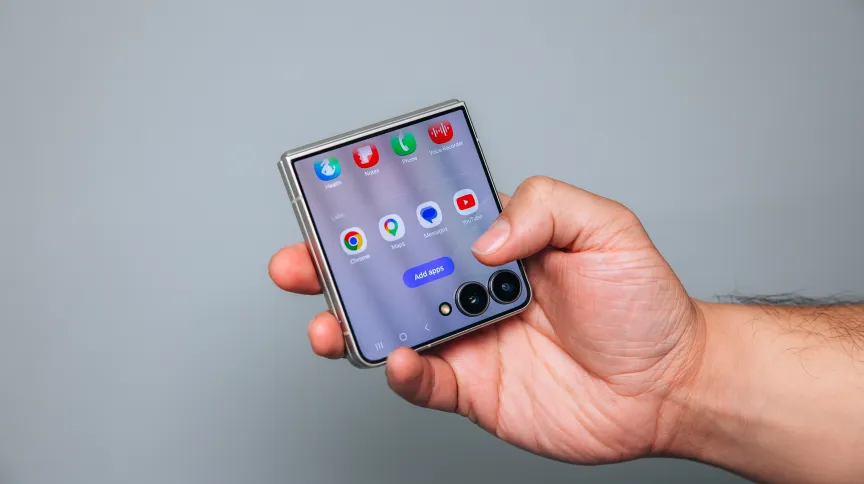
Samsung’s Galaxy Z Flip 8, announced Wednesday during the company’s Unpacked event, launches with the price hike we expected, along with a few welcome tweaks to its design and software that could make the phone easier to use.
I got to demo the $1,200 Z Flip 8, and even though that’s a $100 spike from the starting price of last year’s Z Flip 7 for the same 256GB of storage, the phone is noticeably lighter and thinner than prior iterations. Samsung says that at launch, the 180-gram Flip 8 will be the lightest flip-style foldable phone on the market. When unfolded, the phone is 6.1mm thick, which is noticeably thinner than the Z Flip 7 (6.8mm) and Motorola Razr Ultra (7.2mm).

But I was more impressed by a number of software tweaks coming to the Z Flip 8 that make it easier to use while closed. For starters, you can now add apps to the cover screen by scrolling up on the app drawer and tapping “Add apps” to access any app installed on your phone. Previously, you had to dig through various settings menus to do the same thing. This is also much closer to how the latest Motorola Razr phones let you use any app you want on their cover screens.
The Z Flip 8’s cover screen is also getting the “Recent apps” shortcut button for the first time — which is wild, since quickly switching tasks is such a basic function on the rest of Android. When I test flip-style phones, I’m most likely on the cover screen using Maps for transit directions while playing music and texting friends — that simple button means I can now swap between these directly without having to kick back to the lock screen. That’s also a feature already available on the Razr.

The Z Flip 8 carries over several features that debuted on Samsung’s Galaxy S26 phone line — for instance, the foldable’s video camera includes Super Steady with horizontal lock to smooth out movement while filming. And I had a lot of fun playing with a new camera feature called My Fan Cam, which uses Galaxy AI to identify subjects in a video and create a crop that only follows that person throughout the recording, as if the camera is exclusively focused on them.

The Flip 8 is powered by Qualcomm’s Snapdragon 8 Elite Gen 5 for Galaxy — which is the same custom version of the processor used for the Galaxy S26 phones as well as the foldable’s pricier siblings, the Z Fold 8 and Z Fold 8 Ultra, which were also announced at Unpacked.

Other specs carry over from last year’s Z Flip 7, including the 6.9-inch internal display and the 4.1-inch cover screen. It’s the same for the cameras, which are a 50-megapixel wide-angle, 12-megapixel ultrawide and 10-megapixel selfie camera. The phone’s 4,300-mAh battery, 25-watt max wired charging speed and 15-watt max wireless charging are also the same. We’ll have to see when testing the phone whether the newer processor is efficient enough to improve the overall battery life.

The Galaxy Flip 8 comes in four colors: pink, graphite and cream, as well as mint as an online-exclusive offering. The phone goes on preorder today and will go on sale Aug. 7.

Samsung’s latest foldables have arrived with much fanfare. There’s the uniquely proportioned Galaxy Z Fold 8, which looks to be the precursor to the foldable iPhone Ultra later this year; the more conventional-looking Galaxy Z Fold 8 Ultra; and Samsung’s thinnest and lightest flip phone ever in the Galaxy Z Flip 8.
The first two of those three phones boast Samsung’s new Flex Titanium display technology, which gives them thinner, flatter, and more robust displays than any Galaxy foldables before them. And having spent time with the Galaxy Z Fold 8 Ultra already, I’ve been impressed with the progress Samsung has made in reducing the appearance of the crease, specifically.
From front-on, you can hardly make out the crease at all, and at an angle, it’s less obvious than on the Galaxy Z Fold 7. Running my finger across the middle of the Galaxy Z Fold 8 Ultra’s display, there’s only a very subtle undulation running down the center. It’s so subtle that I’d wager you’ll stop registering that it’s even there after spending a few weeks with the new phone.
Latest Videos FromTechRadar
And yet, for how impressed I am with the Galaxy Z Fold 8 Ultra’s display, I know there’s already something better available.


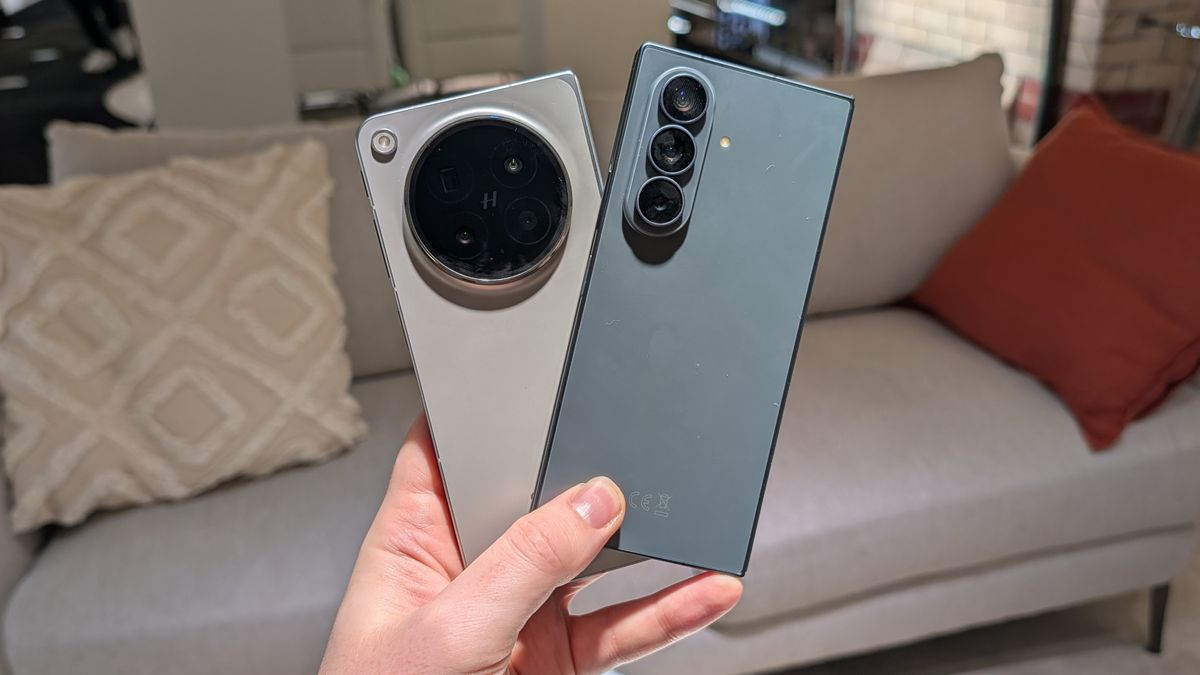
The Oppo Find N6 launched in March 2026, four months earlier than Samsung’s Z8 series, and the big selling point was the claim that Oppo had managed to remove the crease in the foldable screen entirely.
Now, while that isn’t strictly true — at some acute angles, you can still see the crease — what is pretty amazing is the fact you can run your finger across the entire 8.12-inch display and not feel any interruption on the part of the screen that bends when folded.
I’ve been fortunate enough to have used most foldables, including reviewing the original Galaxy Fold, and the screen crease has always been there.
Most of the time, when you’re looking straight-on at the screen, it does disappear as your eyes focus on the content, but have the light hit at a certain angle, or run your finger across, and you’re immediately reminded of the minor imperfection.
I was stunned when I first got my hands on the Oppo Find N6. Swiping my finger back and forth across the middle of the display and feeling nothing, I thought, ‘This is the next frontier of foldables.’


To make sure I wasn’t just looking at the Oppo through rose-tinted specs, I took it to the Samsung preview event so I could experience it side-by-side with the Z Fold 8 Ultra. And sure enough, the Oppo continued to impress with a screen that is smoother and flatter than Samsung’s, but not by much.

Make no mistake, these are two very accomplished, flagship foldables. Both have similarly sized exterior and interior screens, and both are powered by Qualcomm’s Snapdragon 8 Elite Gen 5 chipset.
The Samsung Galaxy Z Fold 8 Ultra is thinner, lighter, and actually readily available in multiple markets. It also has a brighter display (a peak brightness of 3,000 nits vs 2,500 nits on the Oppo) and the firm’s Galaxy AI, Now Brief, and Now Nudge features on top of Google’s Gemini assistant.
The Oppo Find N6 has the smoothest, flattest foldable display, an edge in the camera hardware, a bigger battery and faster charging — yet its availability is limited to just a few Asian markets at the time of writing.
So, the Samsung Galaxy Z Fold 8 Ultra wins by default, which doesn’t feel particularly satisfying as a conclusion, but this shouldn’t diminish the progress that’s been made.
The main issue with foldable displays has been conquered. The next major hurdle we need manufacturers to clear is price.
The Z Fold 8 Ultra is available for pre-order for a lofty $2,099.99 / £1,899 / AU$2,999, which makes it Samsung’s most expensive foldable ever (if we ignore the limited-run TriFold). The Z Fold 8 (from $1,899.99 / £1,699 / AU$2,699) and Z Flip 8 (from $1,199.99 / £1,149 / AU$1,949) are cheaper, but they’re still not cheap.
So, if a manufacturer can find a way to deliver the same premium features for under $1,200/ £1,200 / AU$1,500, it could open the foldable floodgates.

Follow TechRadar on Google News and add us as a preferred source to get our expert news, reviews, and opinion in your feeds. Make sure to click the Follow button!
And of course you can also follow TechRadar on TikTok for news, reviews, unboxings in video form, and get regular updates from us on WhatsApp too.
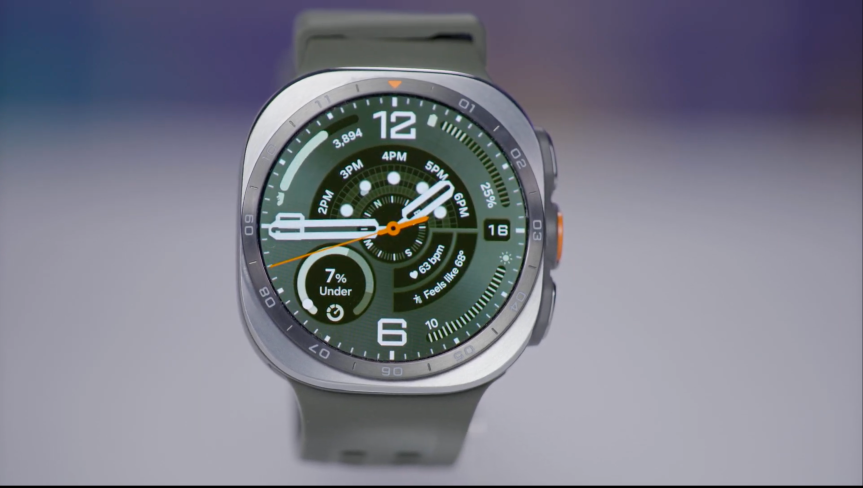
Samsung’s new rugged smartwatch hasn’t changed much on the outside, but the biggest upgrades on the Galaxy Watch Ultra 2 are all hiding inside.
It has a larger battery, more powerful processor and new adventure features to take you from the office to the trails without extra gear. At $700 ($50 more than the original Galaxy Watch Ultra), it’s the most expensive watch in Samsung’s lineup, but it’s also the most durable and arguably the most interesting.
I’ve spent the past week testing the Galaxy Watch Ultra 2, and while the verdict is still out on its long-term features, like health tracking and battery life, it’s clear that it can pull double duty as both an adventure-ready companion and a luxury smartwatch.
Whether its $700 price tag is justified depends on what you’re looking for. If you want Samsung’s most rugged watch with the biggest battery, brightest display and the most outdoor features, it could be worth the premium. But if the package matters less than the core smartwatch features, you may be better off getting the standard Galaxy Watch 9 (or even older models) for nearly half the price.

The Galaxy Watch Ultra 2 looks identical to the original. It has the same premium titanium case, sapphire crystal display, signature squircle design and three programmable physical buttons. But look closer and you’ll notice a few subtle upgrades.
The display is slightly larger (1.52” compared to 1.5” on the original), even though the overall watch is smaller and lighter. Samsung also redesigned the bands, making them thinner and more breathable so the watch sits flatter against your wrist, which the company says improves sensor contact. The new clasp mechanism makes them easier to swap than traditional watch bands, though it also locks you into Samsung’s proprietary system.

The fact that I slept a few nights without ripping it off halfway through the night says a lot for a watch this size. I still wouldn’t choose to sleep with it long-term, but it’s noticeably more comfortable than I expected.
Samsung watches already have the best displays in the business, and the Ultra 2 kicks it up a notch with an even brighter, 5,000-nit display (vs 3,000 nits on the original) that looks flawless even in harsh mid-morning summer sun.
The Ultra 2 edges closer to sports watch territory with a dedicated trail-running mode that surfaces real-time climb and elevation data, has offline trail map access and hydration reminders. I live near a regional park with hundreds of trail options, and I’ve been frustrated by traditional smartwatches that don’t account for uneven terrain or give me enough credit for the extreme elevation changes.

After a 5-mile trail run through the Northern California hills, I was impressed by two things: turn-by-turn audio navigation and real-time elevation tracking. I don’t like wearing headphones when I trail run because I prefer to stay aware of my surroundings, so hearing directions through the watch speaker is the perfect solution. It’s worth noting that getting a route onto the watch for those directions was tedious. Samsung says you’ll eventually be able to search for nearby trails directly from Google Maps, but that feature wasn’t ready during my testing, so I had to load a trail route from a .gpx file on my phone.
With real-time elevation tracking, the watch automatically broke my route into individual climbs and showed my progress. Having a live progress bar as I approach a hill gives me a tangible goal, making it easier to push through steeper sections.

I was less enthused about the hydration reminders. I’d traded my water bottle for my tripod that day, so the three reminders I received during my hour-long trail run mostly fell on deaf ears. Considering the heat, I probably should have listened. But because the reminders are based on AI estimates of hydration loss rather than a dedicated sensor that measures sweat loss directly, I found myself trusting them less.
The Ultra 2 also debuts a recreational diving feature developed in partnership with Italian diving company Mares. Because it doesn’t track gas or oxygen consumption, it’s not meant to replace a dedicated dive computer. Instead, it seems aimed at casual recreational divers who want basic dive information on a device they’re already wearing. The app won’t be available at launch, so I’ll reserve judgment until I can test it myself later this year.

Galaxy Watch Ultra 2’s raise-to-talk Gemini
My favorite feature, however, has nothing to do with rugged adventure sports. It’s Gemini. I’ve already raved about how useful Google’s AI assistant is on your wrist in smartwatches like the Google Pixel 4, and the new raise-to-talk feature makes it even better.
No button presses or wake words required, just raise your wrist and start talking. This added layer of convenience made me much more likely to use it and helped me get things done completely hands-free. At the risk of sounding like a trad wife, I use it a lot in the kitchen. I had meat sitting in the fridge that was about to go bad, so I asked for a simple slow cooker carnitas recipe, and it delivered. I didn’t even have to smudge the screen with meat juice to get the step-by-step instructions read aloud. It’s also been handy for settling debates with my endlessly curious 9-year-old before he loses patience and I have to dig my phone out of my pocket.
The Ultra 2 packs an 800-mAh battery, up from 590-mAh on the original, paired with Qualcomm’s new Snapdragon Wear Elite processor, which should be more power efficient. On-device AI that optimizes battery life as it learns your habits. Samsung rates it for up to 60 hours with the watch’s always-on display enabled.

It’s still too soon to know if that 60-hour claim is realistic because my initial results haven’t been great. That five-mile trail run chewed through nearly 30% of the battery, and I have yet to reach the watch’s promised 60-hour mark. I have gotten closer to 48 hours before needing to recharge, though.
Either way, don’t expect sports watch-level endurance. A Garmin Fenix 8 Pro, for example, can last more than a week on a charge. The Ultra 2 powers a brighter display, Wear OS and always-ready Gemini, all of which demand far more energy than what a dedicated sports watch.
Both watches also get a new suite of health features, which feed into the redesigned Samsung Health app on your phone.
Vitals tracking can flag possible signs of illness by monitoring metrics like heart rate variability, resting heart rate, respiratory rate, blood oxygen and skin temperature. There’s also a new Heart Health Score, Daily Cardio Load to help guide recovery, and a Fitness Index assessment that uses AI to build you a personalized training plan.
Many of these features require at least seven nights of sleep before they unlock (which I haven’t yet logged), so I’m holding off on judging for now.
I appreciate that Samsung isn’t putting these health insights behind a subscription the way companies like Whoop and Oura do. Some guided workouts and iFit content still require separate subscriptions, but the core health features are included with the watch.
Samsung also hasn’t confirmed whether these software features will come to older Galaxy Watches. So, for now, they’re another point in favor of upgrading.

After a week of testing, the Ultra 2 feels like more of an upgrade than its familiar design would suggest. If you’re coming from an older Galaxy Watch and want the latest hardware with the peace of mind that it’ll hold up to the elements, this is the one I’d be looking at.
But I still have plenty left to test. Many of the health features haven’t unlocked yet, and I need to spend more time with the battery before delivering a final verdict. Battery life, in particular, will make or break my recommendation — both over the Galaxy Watch 9 and for anyone considering upgrading from the original Ultra.




Weekend Open Thread: Brooks Brothers


Grayscale Files For Worldcoin ETF, WLD Registers Sharp Rise


Sail Virtually Aboard The “Itanic” With IA-64 Emulator

Turtle Beach Command Series KB7 review: a nifty screen-equipped gaming keyboard


Unregistered fitter used Gas Safe logo on business flyers

New Jersey voter registration controversy explained: How 6,600 noncitizens got on the rolls, and what happens next

Johnny Depp’s R-Rated Gothic Cult Classic Gets New Release Ahead of Sydney Sweeney Remake


Watch Flock Safety CEO Garrett Langley discuss the future of surveillance at TechCrunch Disrupt 2026


Ethics, other provisions in crypto Clarity Act to be further discussed


How a former Blue Peter presenter stunned America’s Got Talent judges

Shanghai science forum photos show China’s AI and robotics advances in rivalry with US


Circle’s President Sold Over 360,000 Shares, The Filings Explain Why


Subway Sandwich Computers Get a Second Life as Gaming Machines


The Peugeot Family: How 200 Years of an “Old Money” Dynasty Died in A Boardroom


2026 3M Open leaderboard: Scottie Scheffler finds putter in Round 1, sits three back


16 Dresses for the High Summer Event


The 35 Best Board Games for Family Game Night


Stephen Colbert Returns to Social Media After Late Show End


Andrew Cuomo joins OKX board as crypto exchange expands in U.S.

A New Post-Apocalyptic Gundam Anime Series Blasts Into SDCC


You must be logged in to post a comment Login