TL;DR
Semiconductor stocks lost 12% in two sessions while the Dow hit a record, as investors rotated from AI chip makers to enterprise software companies. A weak jobs report crushed rate-hike odds.



Semiconductor stocks lost 12% in two sessions while the Dow hit a record, as investors rotated from AI chip makers to enterprise software companies. A weak jobs report crushed rate-hike odds.
TL;DR
The trade that defined the first half of 2026, buying anything with proximity to a GPU, broke apart in the holiday-shortened week before Independence Day. The PHLX Semiconductor Index, which had surged more than 80% in the first half, sank 6.3% on Wednesday and 5.4% on Thursday, a two-session decline of roughly 12%.
While chip stocks cratered, the Dow Jones Industrial Average closed at a record 52,900 on Thursday, lifted by a 5% surge in Apple after Bloomberg reported the company had instructed suppliers to prepare 10 million foldable iPhones for a launch this autumn. All three major indices finished the week higher despite the rotation.
Micron Technology led the decline, falling more than 10% on Wednesday alone. SanDisk, Applied Materials, and Lam Research all dropped roughly 10%, while Intel and Marvell each lost about 9%.

The 💜 of EU tech
The latest rumblings from the EU tech scene, a story from our wise ol’ founder Boris, and some questionable AI art. It’s free, every week, in your inbox. Sign up now!
The selling intensified after reports that SK Hynix was slowing its expansion of high-bandwidth memory production, a signal that the supply side of the AI infrastructure boom may be catching up with demand. Equipment makers ASML, KLA, and Applied Materials all fell between 5% and 6%, suggesting investors are pricing in a slowdown in chip-factory orders.
The damage to chip stocks happened against a backdrop of broader macro uncertainty. June nonfarm payrolls came in at just 57,000, roughly half the 110,000 consensus estimate, and revisions to April and May cut a combined 74,000 jobs from previous tallies.
The unemployment rate dipped to 4.2%, but only because the labour force participation rate fell to 61.5%, its lowest level since March 2021.
The rotation was not a flight from AI but a repricing of where the returns will come from. Enterprise software stocks, led by ServiceNow, Snowflake, and Palantir, have been the primary beneficiaries, with the iShares Expanded Tech-Software ETF up 35% from its April low.
Snowflake surged 36% in late May after reporting strong earnings, adding 616 net new customers and lifting its count of million-dollar accounts to 779. ServiceNow, Oracle, and Palantir each rallied 6% to 8% in the session that followed.
The logic is straightforward. Investors spent two years paying premium multiples for the companies that supply AI infrastructure, and now they want evidence that it is generating revenue for the companies that deploy it.
Palantir’s Q1 revenue hit $1.63 billion, up 85% year over year. ServiceNow has projected $30 billion in subscription revenue by 2030, with roughly a third attributed to its AI product, Now Assist.
The first half left all three major indices in strong shape. The S&P 500 gained 9.6%, the Nasdaq rose more than 12%, and the Dow climbed 8.9%, its best first-half performance since 2021.
But the Shiller CAPE ratio sits at 38 to 40, second only to the dot-com peak of 44, and market concentration in the largest technology stocks has exceeded year-2000 levels. The difference, proponents argue, is that this time the companies are among the most profitable in corporate history, with Nvidia alone reporting net income exceeding $120 billion for fiscal 2026.
The counterargument is that profitability at the top of the supply chain does not guarantee profitability in the middle. Hyperscalers are on track to spend more than $650 billion on AI infrastructure in 2026, and the question that spooked markets in the holiday-shortened week is whether anyone below Nvidia in the stack will earn returns that justify those prices.
The weak jobs report reshaped the interest-rate picture overnight. The probability of a Fed rate hike at the 29 July meeting collapsed to about 22%, with a hold now the overwhelming favourite at 78%.
Fed chairman Kevin Warsh called the jobs picture “steady” and continued to emphasise his commitment to the 2% inflation target, without offering forward guidance on the rate path. A Fed that stays on hold gives equity markets one less reason to sell, but it also removes the catalyst that had been supporting bank stocks and the dollar earlier in the quarter.
The market reopens on Monday with Q2 earnings season approaching. The results that matter most will come from the AI software layer: whether Snowflake’s customer additions accelerate, whether Palantir’s commercial pipeline converts, and whether ServiceNow’s AI attach rate holds at the levels it projected.
If the software companies deliver, the rotation will look prescient. If they disappoint, the AI trade will face a harder question: what happens when the infrastructure is built and the applications do not come.
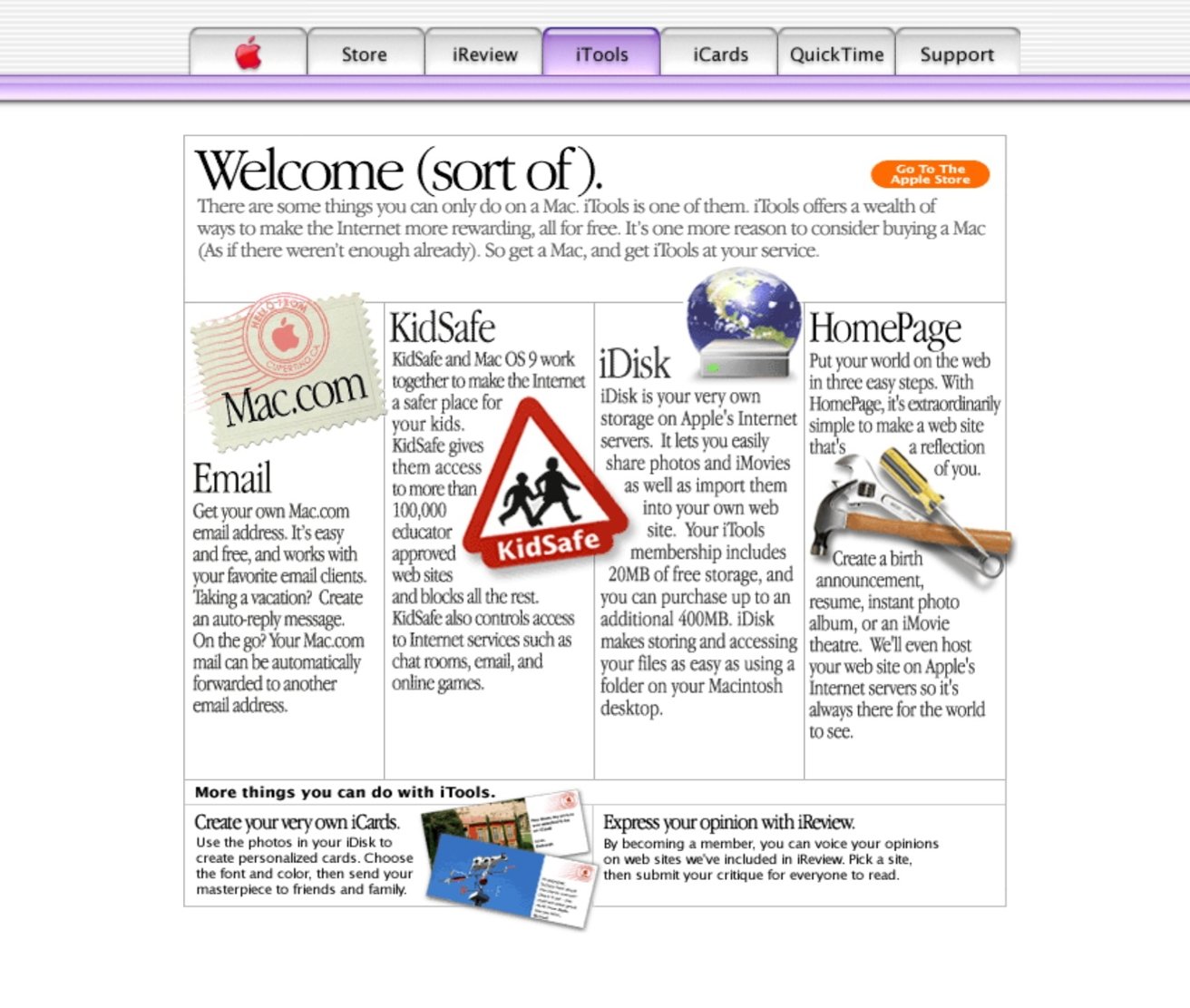
Before iCloud became the backbone of the Apple ecosystem, it spent more than a decade evolving through three distinct services: iTools, .Mac, and MobileMe.
If you’ve got an iPhone, you’ve got an iCloud account. Sure, you might only have the base account, but you’re still signed up for it.
And for most of us, we probably actively engage with iCloud to some degree. After all, iCloud is what Apple uses to store your Messages, Photos, Notes, Contacts, and software backups, and it powers Find My.
But how did Apple get here? While iCloud launched in late 2011, Apple actually began taking its first big steps into subscriptions as a service, or SaaS, eleven years prior.
So here’s the story of how iCloud became iCloud, and the shoulders of the three prior giants it stood upon.
The year was 2000, and Apple was looking for ways to convert Windows users to loyal Mac fanatics. And what is one of the best ways to lure people in?
That’s right: free stuff.
On January 5, Apple launched iTools. It was a collection of services available to those who were using Mac OS 9.
The first was iCards, which was electronic greeting card software. It lets you create greeting cards that you could send via email to friends and family.
It may not sound like it, but this was pretty big. In the early 2000s, sending greeting cards via email was a huge deal.

Image credit: BasicAppleGuy on Threads
It also included iReview, which gave dedicated reviews of internet content. Unfortunately for iReview, it would be the first of the iTools products to go under; it was cancelled in 2001 after failing to attract traffic.
KidSafe was essentially Apple’s take on Bess or Net Nanny, services that would only allow children to visit pre-approved “safe” websites. KidSafe was discontinued in mid-2001, one month after iReview was killed off.
HomePage was another offering, and allowed users to create a personal website without any sort of backend coding. Even more interesting, as Phil Schiller pointed out in 2000, it was available for free.
HomePage gave users templates, free images, and allowed for drag-and-drop customization. It also featured integration with Apple’s iDisk.
And if you’re curious about iDisk, it was yet another iTool. Effectively, iDisk walked so iCloud could run.
Users were granted 20MB of free personal internet storage, but they were able to purchase up to 400MB as part of an annual subscription. If you wanted that whole 400MB of storage, you’d need to fork over $400.
Those with a HomePage could use a file sharing template to publish the contents of an iDisk folder to the web, enabling sharing with anyone who came across your HomePage.
And last but not least, we had mac.com. While it certainly sounds like it was a place to buy a Macintosh computer, it actually was an email hosting account.
Users who utilized mac.com addresses got an @mac.com email address. Not only was it a great way to show your allegiance in the PC-Mac battle, but it worked as free advertising for Apple, too.
iTools existed, more or less, in its initial state, for a little over two years. However, when July 2002 rolled around, Apple rebranded it to .Mac.
This brought a lot of changes, but perhaps the most significant was that it was no longer free. As you could imagine, that didn’t go over particularly well.
The service offered a few new features to make up for its sudden price tag. Notably, Backup launched with the service, allowing users to archive their data to iDisk, CD, or DVD.
Users also got McAfee Vriex, an antivirus program, for free. Well, it was free until 2005, at least.
In 2007, .Mac got a few notable upgrades.
The first was that anyone who had a .Mac account got 10GB of “free” storage that could be split between their email account and iDisk. Users had the option to purchase additional storage up to 30GB.
MobileMe wouldn’t launch until 2008, when Apple acquired me.com. MobileMe would lay the groundwork for the deep ecosystem integration that we know and love about Apple products today.
“Think of MobileMe as ‘Exchange for the rest of us,’” then-CEO Steve Jobs said.
“Now users who are not part of an enterprise that runs Exchange can get the same push email, push calendars and push contacts that the big guys get.”

And then there was MobileMe
At launch, MobileMe allowed users to sync emails, folders, and messages across platforms, the way that iCloud does now. And, it even allowed you to check many of these apps from the web.
Users could still choose to create a @mac.com email address, or if they wanted, one emblazoned with @me.com.
At this point, Apple was still charging for the service. The base MobileMe platform cost $99 per year and came with 20GB of storage. Users could also upgrade to a “Family Pack” for $149 per year, which included one master account with 20GB of storage and four Family Member accounts with 5GB of storage each.
MobileMe also saw the launch of Find My iPhone in 2009. This precursor to Find My allowed users to use the web to locate a missing iPhone on a map, play a sound, change the password, or remotely erase content.
MobileMe survived for four years after launch, eventually being discontinued on June 30, 2012. Apple had announced iCloud in 2011, so it didn’t exactly come as a surprise, but many users were sad to see it go.
As stated above, iCloud was announced in October 2011. Jobs made the announcement at WWDC 11, saying that it would replace MobileMe, which had been considered a failure.
Unlike MobileMe, iCloud would launch as a free service as part of iOS 5 and OS X Lion. No longer would users be expected to fork over at least $100 a year.
“iCloud is the easiest way to manage your content, because iCloud does it all for you and goes far beyond anything available today,” said Eddy Cue, Apple’s senior vice president of Internet Software and Services.

Apple’s Eddy Cue was instrumental in helping to launch iCloud
“You don’t have to think about syncing your devices, because it happens automatically, and it is free.”
This alone ensured that people would use the service. But it also refined features that its predecessors never seemed to get right.
Photo Stream, which would eventually get rolled into Photos, allowed users to take a picture on iPhone and see it on other devices, including Apple TV. Documents in the Cloud gave users an easy way to manage, edit, and save iWork documents across all devices.
iTunes in the Cloud allowed users to download new music purchases to all devices, meaning users could purchase music on their Mac and find it on their iPhone later.
Other features introduced included Find my Friends and improved cross-device management of Contacts, calendar, and Mail.
It may have taken eleven years to get to iCloud, but it’s interesting to see how Apple got there in the end. And, it’s just as impressive that Apple’s managed to expand upon iCloud in the nearly 15 years after its launch.

When they’re not discharging sewage into rivers and the sea, or failing to fix leaks, the water companies seem poised to launch a hosepipe ban. To be fair, it’s been an extremely hot and dry summer for most of the country.
If you’re one of the millions of affected households, then you don’t have to sit back and watch your garden die, as there are some legal ways to keep your plants fresh and watered.
For this article, I’m focusing on established gardens; most water companies allow hosepipe watering of food crops and new plants and lawns under certain conditions. For example, Thames Water has this rule for new lawns and plants: “You can only use a hose or sprinkler if the laying, sowing or planting was completed by a business as a service. In this case, hose use is allowed for the first 28 days from the day of planting, sowing or turf laying. The hosepipe must only be used on the new planting, and not elsewhere.”
Of course, before you do anything, it’s worth checking with your specific water company if an activity is allowed or not.
You can’t spray wildly, but drip irrigation systems, such as those sold by Hozelock, are typically allowed during most hosepipe bans. Rather than spraying water, these systems drip water exactly where it’s needed. Even outside of a hosepipe ban, these systems are more efficient and will save you money.

You’ll need to check compatibility with your water company, but to stay compliant with a hosepipe ban, most systems need to have a pressure-reducing valve and a timer. Be careful of the adaptors that you use: you can’t use ones that use a jet or mist, and the system must drip water directly onto or beneath the surface.
You’ll also need a timer, which can be a smart one, such as the Eve Aqua.
In most hosepipe ban areas, you can still use buckets and watering cans for the garden, but this can be a faff. However, if you have a water butt, then a cordless pressure washer could help make the job easier.
Provided your cordless pressure washer, such as the Stihl RCA 20, can work with alternative water sources, such as water butts, you can use this to draw the water directly out, and spray it where you want.
With the RCA 20, the end of the hose can be dropped into a water butt, with a filter used to prevent any bits of debris being sucked up.

As you haven’t connected the pressure washer to the mains water, you’re not breaking any rules. Just remember, you can’t use mains water to top up your water source, and have to rely on either rain water or grey water harvesting.
Turn down the pressure, so that you’re lightly sprinkling water, rather than jetting it out, and target the roots of your plants to make the most of this method.

Securities firm Rosenblatt is still bearish on Apple’s future, seeing short term supply problems as well as difficulties matching the iPhone 17 range’s success. Just the same, it has raised its price target to a still-underwater $300.
Following Apple’s latest earnings call, the company’s shares took their usual inexplicable dip, but investment and securities firms are looking further ahead. Rosenblatt, which remains amongst the most bearish on Apple, has told investors that it is raising its price target by $24 to $300.
In an note to investors seen by AppleInsider, the company says that it has decided to do this by focusing on how it believes Apple will be faring in a year’s time. Even then, it says the reason for only raising the target by what it calls a modest amount, is down to the volatile financial environment.
That includes economic factors that affect all firms, such as tariffs and inflation. But with Apple, it notes what Tim Cook has said about supply constraints across the company’s product ranges.
Beyond that, Rosenblatt also believes that Apple is going to have difficulty with the iPhone 18 range simply because the iPhone 17 range was such a huge success. Calling it a big test, the company speculates that Apple will have a tough comparison as it tries to continue growing.
As a result of that, the securities firm thinks that iPhone sales will slow substantially. It also says that European Union-drive legislation and regulation could decrease Apple’s value.
All of this means that Rosenblatt has raised its target price but kept a neutral rating for the company. Even as it does so, though, it notes that there is a possibility that the new Apple Intelligence will drive more sales than it expects.
JP Morgan, has been bullish overall, and has the same short term questions. But that investment firm trimmed its Apple price target to $340 after earnings.
They’re above water, at least. Apple stock got hammered after earnings, falling to $307.80 on Thursday, despite record-breaking results again.
AAPL has been on a tear as of late. It’s been above $300 since July 2. It touched the $5 trillion valuation mark on on July 28.
Separately, in April 2026, Rosenblatt was one of the analyst firms praising the appointment of John Ternus as the new Apple CEO. It described that as Apple continuing what already works, but also “leaning into its hardware successes.”

Following price hikes across the rest of Apple’s product lineup, one analyst believes that the upcoming iPhone 18 Pro could be hit with a massive $300 increase, a bump that might not be out of the question considering other recent price changes.
Apple increased the price of its Macs, iPads, and other products in June 2025 as a result of increasing RAM and storage costs. Some Mac models saw four-digit price hikes, although the iPhone lineup was left unscathed.
That has long been rumored to change when the iPhone 18 Pro and iPhone 18 Pro models launch this fall. A report from July 2026 hinted that a price increase of up to 10% was in the cards.
But analyst Jeff Pu has blown that prediction out of the water. According to a post on the X social network, Pu believes iPhone 18 Pro buyers could pay $250 to $300 more than the iPhone 17 Pro price at debut in 2026.
If Pu turns out to be right, the iPhone 18 Pro could start at $1,399. Buyers of the iPhone 18 Pro Max could expect to fork out at least $1,499 for their new handset.
While some will no doubt accuse Apple of increasing prices to boost its balance sheet, Pu doesn’t expect that to be the case. He cites the increased costs of components like RAM and NAND storage as key reasons behind the price increase.
The use of TSMC’s 2nm manufacturing process for the iPhone 18 Pro’s A20-series chip is also thought to be a factor in the price bump.
Pu believes that while recent Apple earnings show the iPhone to still be a key driver of growth, iPhone 18 Pro demand could be hampered by the price increases.
However, it’s also important to remember that Pu’s track record is far from impeccable, with plenty of misses in recent years. While a price increase seems likely, $300 is more than has been previously rumored.
Price hikes on the iPhone 18 Pro versus the iPhone 17 Pro are inevitable. It’s just a question of how much.
Pu isn’t the only one to have dire pricing concerns. Analysts at Counterpoint Research suggested the iPhone 18 Pro Max could cost on average $200 more than its predecessor.
While not quite the same, we can use Apple’s previous price increases as a guide. The 11-inch iPad Pro increased from $999 to $1,099, a $100 bump. But the 13-inch iPad Pro saw a $200 price increase to $1,499.
With that in mind, maybe a $250-$300 iPhone price increase isn’t out of the question after all.
Those hoping for a silver lining should note that the 13-inch iPad Pro saw a 15% price increase. A $300 price hike on the iPhone 18 Pro Max would represent a 25% increase depending on the storage configuration.
There’s even more promising news to be found in a July 2026 report that Apple has sought to lessen the impact of increasing costs. It was reported that Apple had pushed display manufacturers for lower prices in an attempt to offset the higher costs of RAM and storage.
The Apple Upgrade program has been revealed, so it’s time to discuss what leasing your Apple products actually means. Plus, your hosts discuss Apple’s plan to combat the chip shortage on the AppleInsider Podcast.
Apple Upgrade is no longer a rumor and the details match up with what was expected. While Apple won’t be remotely locking iPhones when people miss payments, the lease terms are straightforward about where fees might appear.
AI-driven RAM shortages have pushed Apple to look to Chinese suppliers for China-made products. However, the US government isn’t excited by the prospect and expect it’ll create a slippery slope to more problems in the future.
Your hosts also discuss how Apple might handle smart glasses and privacy. Plus, they share more thoughts on Home Hub, Apple TV, and a new game called Character Limit.
BONUS: Subscribe via Patreon or Apple Podcasts to hear AppleInsider+, the extended edition. This time, it’s the near future and your hosts have been chosen to decide how Apple needs to be broken up to comply with government regulation.
Tune in to our Smart Home Insider podcast covering the latest news, products, apps, and everything HomeKit related. Subscribe in Apple Podcasts, Overcast, or just search for HomeKit Insider wherever you get your podcasts.
Podcast artwork from Basic Apple Guy. Download the free wallpaper pack here.
Those interested in sponsoring the show can reach out to us at: [email protected].
Keep up with everything Apple in the weekly AppleInsider Podcast. Just say, “Hey, Siri,” to your HomePod mini and ask for these podcasts, and our latest HomeKit Insider episode too. If you want an ad-free main AppleInsider Podcast experience, you can support the AppleInsider podcast by subscribing for $5 per month through Apple’s Podcasts app, or via Patreon if you prefer any other podcast player.


The horizontal handheld will be released in navy and orange colorways.
It’s a few weeks after the 25th anniversary of the Game Boy Advance’s US release, but we finally have a modern-day remake, even if it’s not from Nintendo. During its latest product sharing stream, Ayaneo revealed the Konkr Pocket Advance, its take on the iconic horizontal handheld but updated with a better display, extra buttons and two fitting colors.
Drawing inspiration from the original Game Boy Advance, the Konkr Pocket Advance uses a 3.5-inch LCD screen to achieve the same 3:2 aspect ratio, but with a higher resolution of 960 x 640. Ayaneo adds the full range of ABXY buttons, additional menu buttons and some extra shoulder buttons, while also modernizing the handheld with a USB-C port, microSD slot and Wi-Fi/Bluetooth compatibility. There’s even a 3.5mm headphone jack and a volume adjustment wheel for that extra touch of retro.
So far, Ayaneo has only revealed two colors for the Konkr Pocket Advance: a navy blue that’s reminiscent of the classic indigo Game Boy Advance and a coral orange that feels like a callback to the Spice Orange variant. As usual, Ayaneo hasn’t announced a price or release window for its latest handheld. However, we’re hoping that Ayaneo is planning for a larger production run of its Konkr Pocket Advance, unlike its Pocket Micro 2 that sold out in minutes for its very limited production runs.

We’re now well past the point where it’s very difficult, and in some cases impossible, to tell AI-generated photos and videos from the real thing. That means it’s now important to treat everything you see online from untrusted sources with a big dose of skepticism.
A newly rolled out Google Earth feature has apparently made AI-generated misinformation even more of a problem — and it highlights the scary potential of the technology, as well as the need for stronger guardrails to block the efforts of those who will instantly try and find the most subversive and harmful ways to use a new product.
The feature is AI image generation in Google Earth, powered by the Nano Banana 2 model, and after a wave of inappropriate images were created and posted online, it’s now been pulled while Google works on some more robust protections against misinformation.
Latest Videos FromTechRadar

It all started with the usual level of hype that Google builds around any new AI feature: the Nano Banana 2 image generation model that has already wowed us in the Gemini app would be available inside Google Earth on the web.
“Generate custom images to help you visualize history, create real estate plans, and more,” Google said. “For the first time, you can generate custom images using Google Earth’s satellite, aerial, and 3D imagery alongside Nano Banana, which creates concepts grounded in the real world.”
Google had examples of how it could be used too: create an infographic about the Statue of Liberty, visualize your dream home by the lake, see what your neighborhood might look like a hundred years from now, or imagine Pompeii just before it got buried by ash and rock from an erupting Mount Vesuvius.
All it took was a text prompt, and Google Earth would combine existing satellite and 3D data to create the AI image you were asking for. While the AI model wasn’t new, adding it to the accurate and authentic imagery already in Google Earth was.

Perhaps we should’ve seen this coming — and indeed some people did — but combining AI with the 3D data and satellite imagery of Google Earth didn’t work out quite as well as Google hoped. The new upgrade was quickly used to create all manner of deceptive images that were then widely shared online.
I’m reluctant to point you to them directly and give these fakes any more attention, but they’re not hard to find on social media. Think natural disasters, terrorism attacks, giant sinkholes, alien activity, and refugee populations all in places where they never actually were, thanks to AI.
Some of the images are clearly jokes, but many were produced deliberately to spread misinformation and confusion. That they were based on actual images sourced from Google Earth added extra credibility they wouldn’t otherwise have had. And that was enough for Google to remove the feature.
Google says a flood of images “that appear to violate our policies” mean that “we’re rolling back this feature in Google Earth while we work on implementing stronger guardrails”. The company added:.”It’s important to note that generated images didn’t appear in the main Google Earth experience for others to see and were watermarked as AI generated.”

You don’t have to look for long online to find rather strong anti-AI sentiment building up among users, especially when it comes to image and video content. The general sentiment on Reddit is that there’s “zero use” to a feature like this, and that users are fed up with AI being “shoved down our throats”.
There are various obvious lessons to be learned here: firstly not everything needs to have an AI prompt box or an AI element to it, and if some tools are largely AI-free, that’s fine. Microsoft recently rolled back some of the AI it added to Notepad — an app where a big part of the appeal is its simplicity — after user complaints.
Secondly, before companies release any new AI features, they need to consider the worst-case scenarios in terms of how they’re going to be used. The internet as a collective is going to immediately try and stress test them in the most deceptive and unwholesome ways, and there need to be safety measures put in place around that.
Lastly, it’s never been more important to stick to sources of information that you know you can trust: not random social media accounts, but established publications that have policies around AI and its use. That’s one effective way you can tell the difference between what’s trustworthy and what isn’t.

Follow TechRadar on Google News and add us as a preferred source to get our expert news, reviews, and opinion in your feeds.

The best laptops for all budgets

A top seller that’s priced at a 30-day low, Amazon’s M4 Pro Mac mini deal is both on sale and available to ship in 1-2 days.
With increased demand for headless machines to run AI agents, Apple’s M4 Pro Mac mini has been sold out for much of the year. But Amazon has the M4 Pro configuration with 24GB of memory and 512GB of storage back in stock, and it’s $30 off, bringing the price down to $1,569.99.
Buy M4 Pro Mac mini for $1,569.99
Priced at a 30-day low, it appears stock is limited as Amazon states the compact desktop is available to ship in 1-2 days with delivery dates the first week of August to many locations. This puts Amazon’s delivery window a full month ahead of Apple’s, which is Sept. 8-15 at press time.
For the latest pricing and availability, check out our Mac mini Price Guide.


OFFBEAT
Tom Evslin on Bill Gates, the birth of Exchange, and dragging Ma Bell onto the web
Tom Evslin drove the WorldNet project at AT&T and helped develop what became Microsoft Exchange and Outlook. He was at Microsoft when the company was still working out what to do about this newfangled internet thing.
Evslin describes himself as one of Microsoft’s “internet radicals” in the early 1990s, when the company was developing Exchange Server to fend off the threat from Lotus Notes.
“Bill Gates was willing to put lots of effort and money into Exchange because he was very afraid of Lotus Notes,” Evslin says. “He felt that Lotus Notes could become a platform the way that Windows was, which would be an enormous threat to Microsoft. And so he saw Exchange as a Notes killer.”
Evslin saw Exchange differently “because I was an email guy.” He and Microsoft’s other “internet radicals” wanted the upcoming products delayed until they had been made relevant to the internet. Gates disagreed.
“Bill said, with some truth, that we were probably behind schedule anyway, always looking for an excuse to be late. So we go ahead with the next launch of products, including Office, Exchange, and NT, then worry about the internet afterward, which I thought was a mistake.”
Evslin was fascinated by the internet’s potential and disappointed by Gates’ stance. He was responsible for gateways in Exchange, services that connect one mail system to another. Some did things like connecting to CompuServe. Others linked to MCI Mail, one of the first commercial email services in the US, “which I had done a client for,” Evslin says.
“We had one little gateway that we hadn’t put much work into, which was called an SMTP gateway, which connected SMTP mail, which was used on the internet. Which itself wasn’t widely used.”
So, was Gates right? Only briefly. While Microsoft’s corporate clients insisted communication over the internet was “not safe” and “not secure,” Evslin says: “All of a sudden we got a huge number of requests for this SMTP gateway. And when I looked into it, I found that more and more email was going over the internet.”
The official corporate stance might have been one of “nope,” but employees had other ideas. “Their engineers were communicating on the internet, and they never understood that, or didn’t understand that at the time,” Evslin says.
And then there was what would become Outlook. “From the beginning, we wanted the client for Exchange to be able to support graphics, to be able to support fonts, so that you could format an email in the same way that you could format a Word document.
“Where we didn’t go far enough is we still had two separate formatting engines, so the Word and Outlook client never merged as I thought they should have.”
Soon after Gates chose to launch the products before adding deeper internet integration, AT&T invited Evslin “to come and develop their internet strategy.” Back then, Evslin says, AT&T didn’t really have a clear plan for the internet. The company had tinkered with proprietary networks, but Evslin reckoned AT&T should become an ISP. “AT&T always had illusions about being a content provider,” he says.
Evslin also favored all-you-can-eat pricing, which smaller providers had attempted but AT&T had yet to try. “There was a lot of debate internally, people saying ‘you can’t launch a new service in less than seven years.’”
Considering how quickly things were moving – and still are – seven years was a lifetime. “I said, ‘the solution to that is launch it fast and then adapt.’”
WorldNet offered straightforward internet access to customers accustomed to portals, proprietary networks, and some heart-stopping telephone bills. Demand grew so quickly that AT&T had to control sign-ups lest the service earn the “America On Hold” nickname occasionally and unkindly applied to America Online.
With the internet in the ascendant, Evslin became interested in another technology: voice over IP. This, he acknowledges, “was an impossible sale inside AT&T.”
And so, in 1997, Evslin moved on again to found ITXC, a wholesale VoIP carrier. ®

On the first evening of GenCon 2026, in a venerable theater that Wizards of the Coast took over for a weekend’s worth of Dungeons & Dragons activities, the team behind the biggest tabletop roleplaying game in the world revealed its next year of upcoming adventures.
There was plenty of news to look forward to, including the triumphant return of D&D legends to contribute to classic D&D settings like R.A. Salvatore (The Legend of Drizzt), Tracy Hickman and Margaret Weis (Dragonlance) and Luke Gygax (Greyhawk, one of the earliest D&D settings created by his father, Gary Gygax). Among the banquet of table offerings was outreach to other corners of nerd culture — including new sets for World of Warcraft and Star Wars planned for this year and next.
The new series, Universes Beyond, works much like the same-named subset of Magic: The Gathering releases: adapting fan-favorite franchises to the game’s system. In D&D’s case, this means adapting the iconic signature, villains, boss fights and regions for D20 rules. Yes, that means you can fight the Lich King in D&D — that’s the objective of the Warcraft set’s first adventure, plotted out so players can jump in right out of the box.
But the big virtue of Universes Beyond is kicking off custom adventures to explore the corners of these franchises with characters that players can grow at their own pace. With all the information Wizards of the Coast has revealed, CNET’s brain trust of dice-rollers has come together to theorycraft exactly what we want to play first in these exciting new collaborations.
The only problem? The D&D team shared plenty about the World of Warcraft set, which will come out in the fourth quarter of 2026, but shared almost nothing about Star Wars. Still, we let our imaginations run wild for how we’d play to see what happens in Azeroth and a galaxy far, far away.

The D&D team rolled out a small family of products that will debut with the World of Warcraft set toward the end of the year, including a 265-page sourcebook (along with special and hobby store-exclusive editions), the aforementioned adventure called Icecrown Citadel for character levels 16-20, a map pack for said adventure, miniature packs and a dungeon master’s screen adorned with famous characters from the MMORPG. All of those are available for preorder right now with a full release later this year on Nov. 17.
On stage during the D&D keynote, presenters laid out what the set adds to the broader tabletop RPG. You’ll be able to play virtually any species you can in the online game, including 11 that are wholly new to D&D, such as Dracthyr, Earthen and Pandaren. There are nine subclasses in the sourcebook, six of which are new, like the iconic Death Knight, Demon Hunter and Shadow Priest. There are also stat blocks for the MMORPG’s most famous characters, like Arthas Menethil, Jaina Proudmoore, Anduin Lothar, Thrall and Sylvanas.
Here’s what CNET’s editors would play first:
It’s been over 20 years since I last played World of Warcraft – I reluctantly canceled my subscription when I started college. But as soon as I read D&D’s news, my mind immediately cast back to my time roaming the Barrens of Kalimdor as a troll shaman, braving the frontier for the Horde. Before smartphones and doomscrolling and Twitter and all the modern escapes in your pocket, entering the Dark Portal on World of Warcraft’s login screen was how I left my mundane reality behind.
I never got to a high enough level to participate in a raid, the large-group efforts that bundled 10, 25 or even 40 players together to take on the biggest bosses in the game. From Ragnaros to the Lich King himself, the sourcebook has stat blocks for 30 of these classic World of Warcraft baddies, though they’ve been scaled down so that a D&D-friendly three-to-five-person party can take them on. I’d love to tackle the worst of the worst, explore the seven dungeons in the new sourcebook, and more — undertaking the challenges I missed out on to prevent me bungling my college career.

I’ve been WoW-curious for about as long as the game has been around, but I’ve always been a bit too intimidated by the prospect of investing hundreds, if not thousands, of hours into a game when I already feel like I can’t keep up with new releases and my existing library. So World of Warcraft coming to Dungeons & Dragons is exciting because it’s an opportunity for me to interact with the world without tumbling into a seemingly bottomless pit.
I enjoy casting spells and controlling battlefields, so my mind immediately goes to a couple of different builds. If my group wants to go the Alliance route, a Frost Mage Void Elf sounds like a fun time, and fairly straightforward to build with existing D&D Wizard rules. If we’re feeling more Horde, I’d probably check out the new Shadow Priest subclass, maybe as a shifty Vulpera. I’m excited about the high-level Lich King adventure, but I’m hoping the book also gives us options for things like a political intrigue campaign set in the maritime island nation of Kul Tiras, which is the kind of campaign I might brew up if I were in the DM seat.
While the D&D team at Wizards of the Coast had a lot to share about the upcoming World of Warcraft set due out later this year, they were tight-lipped about what’s coming with Star Wars. Despite prodding, the team deigned not to reveal anything just yet — not even whether there will be starship flight and combat systems in the game. And no, they didn’t confirm what challenge rating the Death Star will be (we’re betting it’s in the triple digits).
Without even a hint at what’s to come, we speculated on what we want most from exploring the expansive Star Wars universe, one dice roll at a time.
I’ve been playing Star Wars TTRPGs for an entire decade at this point, and having the franchise officially come to D&D is an exciting proposition. It’s going to be interesting to see how they deal with the more technical aspects of space combat, and I’m looking forward to seeing what era of Star Wars they start in.
I like the concept of a Force User droid. Potentially like General Grievous (a biological/droid mix), but as a Wizard-style class. His familiar could be a mouse droid from the Death Star. I’m not sure if “Droid” will be a race in the new campaign, but D&D already has a Warforged race from Eberron, so it doesn’t feel like a big stretch to add them here. Droids are such a large part of the Star Wars Universe and I would enjoy the roleplay challenges they would bring to the table.
We don’t know what we don’t know yet when it comes to Star Wars played through a D&D lens, but the Star Wars universe is more than big enough to speculate on what would be cool to have. My genuine hope is that the rules being built for this little expansion make it relatively easy to play in any era of Star Wars. As much fun as it would be to roleplay through a big battle with Darth Vader or a space dogfight against a Star Destroyer, I’d love to see some of the flexibility from the High Republic era as well. From repair and hacker focused roles like Mekneks to the greater diversity of Force powers of the era, it’s a bigger sandbox to play in.
This doesn’t mean there needs to be a core book for each era of Star Wars, just a set of rules that encourage adaptation. This is something Wizards of the Coast has demonstrated as a core strength since the release of the 2024 rules. The tools for supporting the creativity of players have been well established, but adapting the massive and decidedly not high-fantasy vibes of Star Wars presents some fun challenges. I genuinely can’t wait to play.

Ahead of the GenCon keynote, I chatted with several game developers from Wizards of the Coast to get the full scope of the World of Warcraft set. From development to new mechanics to how the Universes Beyond sets would play with broader D&D, I plied them with many questions — including what they would do first in their new worlds. While they couldn’t comment on Star Wars, they did have answers for World of Warcraft.
“For me, it’s the Icecrown Citadel adventure,” said Laura Hohman, product architect for D&D. Wrath of the Lich King, World of Warcraft’s second expansion, was what really got her hooked, even though she spent most of the time collecting owls, she admitted with a laugh. But the climactic raid at the end, where players take on the Lich King, holds a special place in memory and nostalgia for her.
“I can’t wait, once this is out there, to play this with my friends [and] recreate those moments again in a new way on tabletop,” Hohman said.
Jeff Turiff, director of product management for D&D Beyond, the online character creator and portal for resources, talked about updates coming to the service as well as to its mobile app version. Fittingly, the self-avowed Horde player is going to “probably start by rolling up some characters.”
“I love character builds. Hop on D&D Beyond, of course, and make some characters to test drive in a setting — maybe in a standard D&D setting would be kind of cool,” Turiff said.

D&D Game Design Director Justice Arman is most excited about the mounts, an iconic element from the MMORPG that enables players to speedily travel (and show off with more exotic beasts of burden).
“I’m from Tennessee originally, so maybe it’s the cowboy in me, but the idea of having a direwolf or gryphon mount is pretty cool,” said Arman.
But as with Hohman, Arman turned to his memories of playing the MMORPG back in the day. It’s less about what race or class he plays, but who he plays tabletop games with, he said.
“Back in undergrad, I had two roommates who were wrestlers and they loved World of Warcraft, and we were playing it so often,” Arman said. “I would love to sit down with them and reconnect.”



Commonwealth Games boxing: Jadumani Singh seals dominant 5-0 win over Pakistan’s Sumama Rehman to enter quarter-finals | Commonwealth Games News


Why Trees Belong on the Risk Register


Weekend Open Thread: Wit & Wisdom


Intel is reversing course and bringing hyper-threading back to its server chips


Meta enters AI-training agreement with far-right ‘propaganda rag’ Newsmax


Luke Littler dismantles Gerwyn Price to retain title in Blackpool


MicroStrategy Post-Earnings CLARITY Act Push Could Add New Catalyst for Its Stock


The Part of the Electric Transition Nobody Wants to Discuss

‘Stargate’ Creator’s New Sci-Fi Series Returns for Season 3 Tomorrow


BITCOIN JUST ENTERED THIS CRITICAL ZONE…


Major shareholder moves on Canyon


Spain sweeps the board at 2026 World Cup with individual awards


Bitcoin Enters the 3rd Stage of the Bear Market


XRP Ledger v3.3.0 brings five institutional features


Kraken Enables Retail Access to Jersey Mike’s IPO via Tokenized Shares


New macOS Sequoia & Sonoma security updates for older Macs


Claude: Build Financial Dashboards in Minutes (2026)


Luke Littler’s dominance sparks GOAT debate


Seema Kaliramna Wins Discus Throw Bronze, Takes India’s CWG Medals Tally To 17


Johnson & Johnson agrees to $5.5B settlement over talc cancer claims



You must be logged in to post a comment Login