

Join Mikko Hyppönen and security leaders from the NFL, CHANEL, and Atlassian for a two-hour digital summit on what AI-speed attacks change, what defenders should stop doing, and how to validate, decide, fix, and re-validate at machine speed.
Tech
Apple Tap to Pay on iPhone expands to Argentina, Columbia, Peru, and more

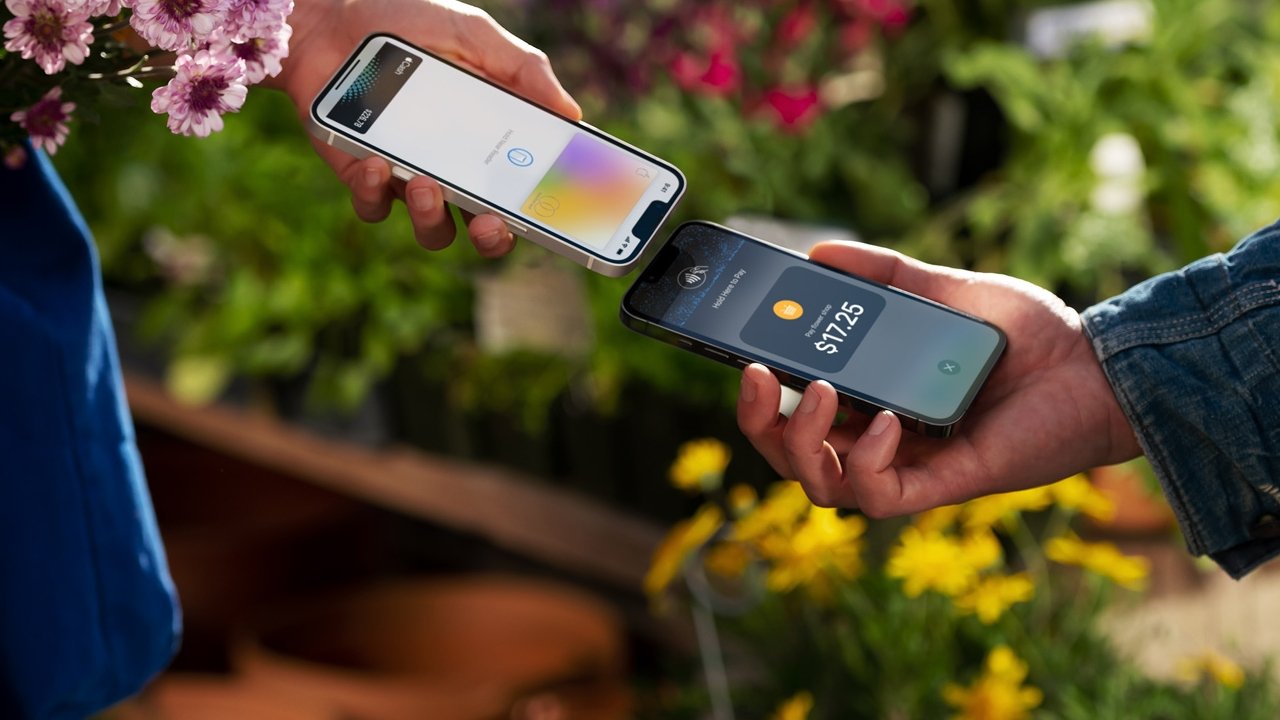
Apple has expanded Tap to Pay on iPhone to eight additional countries in Latin America, allowing businesses to accept contactless payments without dedicated payment terminals.
The expansion brings Apple’s payment acceptance feature to Argentina, Colombia, Costa Rica, the Dominican Republic, Guatemala, Honduras, Panama, and Peru. It gives businesses a way to accept cards, Apple Pay, and other contactless wallets using only a compatible iPhone and supported app.
Tap to Pay on iPhone works with the iPhone XS and newer running the latest version of iOS. Customers can hold a contactless debit or credit card, iPhone, Apple Watch, or another supported digital wallet near the merchant’s iPhone to complete a payment over NFC.
According to a post on Apple’s Latin American site, first spotted by 9to5Mac, Apple is launching the feature via several payment platforms across eight countries, although availability varies. The initial rollout includes:
- Argentina: Mercado Pago
- Colombia: SumUp, Symbiotic
- Costa Rica: Geopagos, Symbiotic, Visa Acceptance Solutions
- Dominican Republic: Azul, Visa Acceptance Solutions
- Guatemala: Geopagos, Symbiotic
- Honduras: Geopagos, Symbiotic
- Panama: Geopagos, Symbiotic
- Peru: SumUp
Contactless cards from major payment networks including American Express, Mastercard, and Visa are supported. Apple first rolled out the feature in 2022.
Continue Reading
Security researchers developed an attack that lets hackers with privileged access register a rogue external MFA provider that steals users’ passwords during legitimate login attempts.
The technique, dubbed TrustSink by Varonis Threat Labs, can work with any provider that relies on this external authentication model, though the researchers demonstrated the attack using Microsoft Entra.
Microsoft Entra supports external MFA providers, which allow organizations to use third-party authentication services to satisfy multifactor authentication requests.
According to Microsoft, when a user signs in with a first factor, such as a password, Entra can redirect them to an external MFA provider to complete the required second factor.
If the provider returns a valid signed token indicating that the second factor was completed, Entra considers the MFA requirement satisfied.
Varonis found that an attacker who has already compromised a highly privileged Entra account can register a rogue External Authentication Method (EAM) as one of these external MFA providers and use it to insert a convincing Microsoft password prompt into the legitimate authentication flow.
The fake prompt captures the user’s password in plaintext before the malicious provider returns a valid signed token to Entra, causing the login to complete without displaying an error.
“In our test tenant, every sign-in completed normally while our server received passwords with timestamps and source IP addresses,” explains Varonis.
“Resetting a captured password did not remove the rogue provider. It remained in the authentication flow and captured the replacement password at the user’s next sign-in.”
It is important to note that TrustSink is not an initial-access attack and requires an attacker to already control a highly privileged Entra account.
Abusing an external MFA provider
TrustSink abuses the trust Microsoft places in a configured external MFA provider.
Varonis created a malicious provider that appeared to Entra as a legitimate external MFA provider but displayed a copy of Microsoft’s password page to the user.
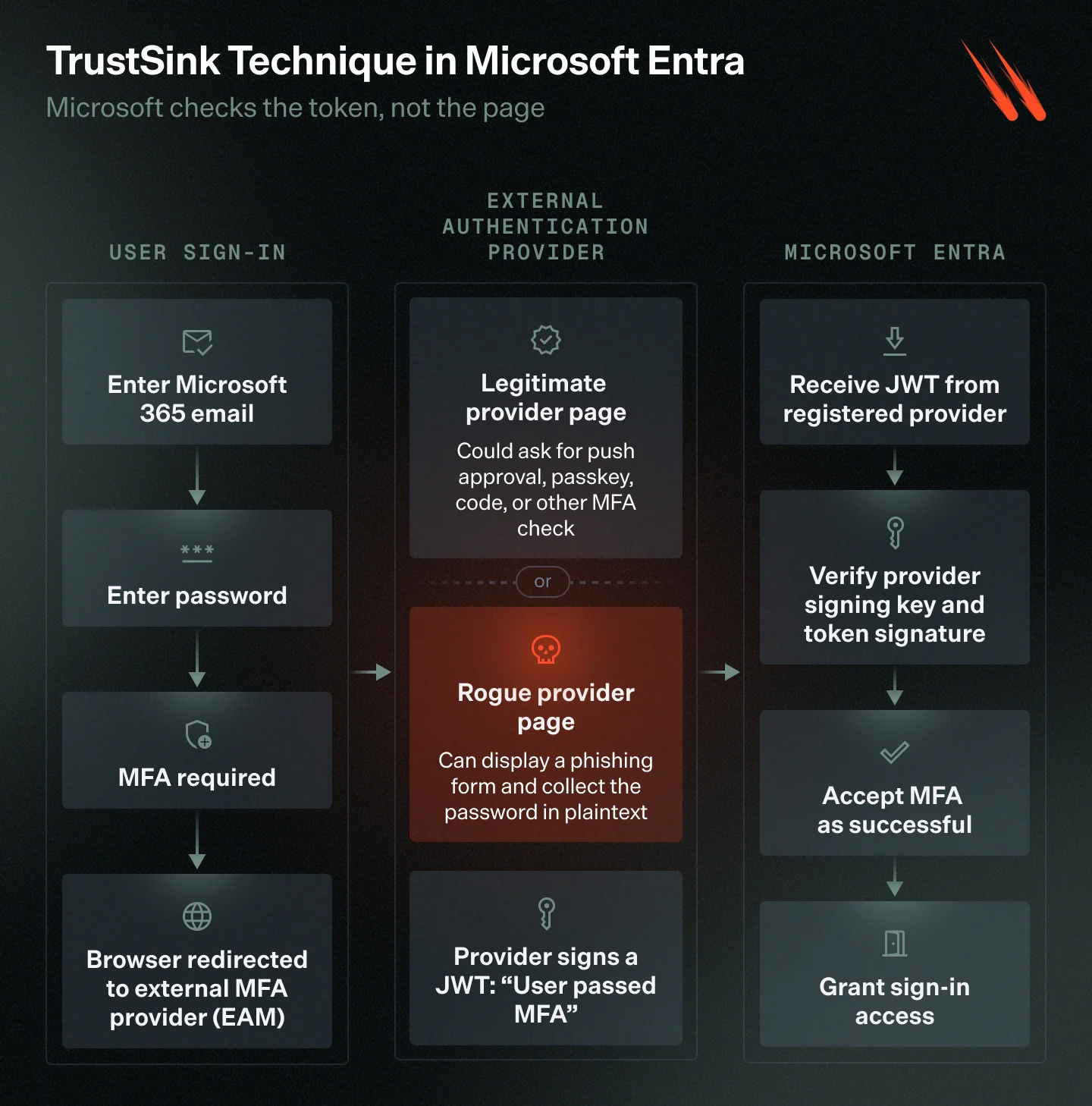
During the proof-of-concept attack, the login initially proceeds normally, with the user entering their email address and password on Microsoft’s legitimate login.microsoftonline.com site.
When MFA is triggered, Entra redirects the browser to the attacker’s external MFA provider for the second authentication step.
Instead of presenting a legitimate second-factor challenge, the malicious provider displays a copy of Microsoft’s password prompt.
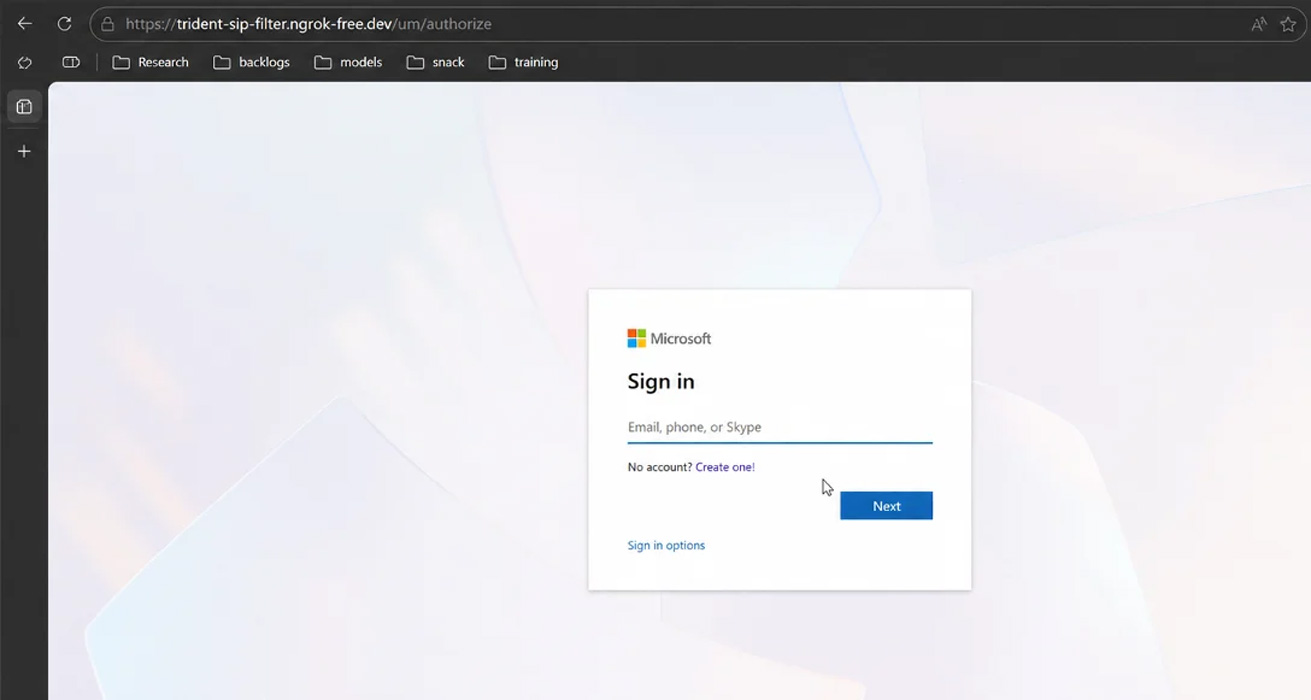
Source: Varonis
If the victim enters their password again, believing Microsoft is requesting it as part of the authentication process, the credential is sent to the attacker-controlled server.
The rogue provider then generates a signed token stating the MFA prompt was completed and returns it to Entra, allowing the user to continue to the application they originally attempted to access.
From the victim’s perspective, the sign-in appears to have completed normally.
Varonis says the attack is convincing because the fake password prompt appears when the user already expects another authentication step.
The researchers say the page uses the same fonts, layout, and button design as Microsoft’s legitimate login page and appears immediately after the victim enters their real password on Microsoft’s domain.
Varonis says TrustSink builds on previous research by security researcher Dirk-Jan Mollema, presented at x33fcon 2025 in a talk titled “Bringing Your Own Identity in Entra ID.”
Mollema showed how a rogue registered external MFA provider could satisfy an MFA requirement by returning a signed JWT claiming authentication had succeeded without actually performing the expected authentication check.
TrustSink abuses the same attack for credential theft.
Varonis says registering the malicious external method requires modifying the Authentication Methods Policy and creating an application, service principal, and consent grant.
Those actions require a Global Administrator or Authentication Policy Administrator account, making TrustSink a post-compromise technique.
Once installed, however, the rogue provider can remain in the authentication path for targeted users across subsequent logins.
Because the rogue MFA provider remains registered in the tenant’s Authentication Methods Policy, even if a user changes their password, it will be recaptured on the next log in attempt.
Varonis therefore warns administrators to remove the malicious provider before rotating affected credentials.
Varonis recommends removing suspicious external MFA providers and their associated applications, keys, and redirect URIs before resetting affected users’ passwords.
Organizations should also monitor changes to the Authentication Methods Policy, limit standing Global Administrator and Authentication Policy Administrator privileges, and use phishing-resistant authentication methods such as FIDO2 or Windows Hello for Business.

from the bringing-out-the-worst-in-America dept
Ever since Trump’s return to office, almost every federal law enforcement agency has been ordered to treat illegal immigration as their first priority. This is why the administration is gutting FEMA to direct more dollars to detention and removal efforts. And that’s why ICE is now the administration’s largest law enforcement budget line item.
To keep up with moving (and ever-increasing) deportation targets, the government has done everything from dismissing pending immigration hearings to stripping temporary protected status from thousands of vulnerable people to the very thing that has been rejected by hundreds of federal judges in thousands of cases.
The administration claims the 1996 Illegal Immigration Reform and Immigrant Responsibility Act (IIRIRA or IRA, depending on which titles judges choose to use) gives it the power to treat any migrant — no matter how long they’ve been in the country — as someone who has been accosted while attempting to cross the border. Migrants who are slated for removal are generally given due process rights if they’re not arrested while attempting border crossings. Trump’s DOJ and DHS have constantly pushed the theory that due process rights do not apply to undocumented immigrants, no matter where they’re arrested or how long they’ve lived in the United States.
As the law stands — at least in terms of how it has been interpreted for the past 30 years — arrested migrants are supposed to receive a bond hearing and be released if they pose no threat of flight or to public safety. The administration goes hard in the other direction, pretending constitutional rights don’t apply to migrants. But it has repeatedly demonstrated it doesn’t even believe its own bullshit. That’s why arrested migrants are swiftly moved from where they’re arrested and shuffled from detention center to detention center to prevent them from filing habeas motions, which must be filed in the jurisdiction in which they were initially arrested.
So far, eight of eleven appellate circuits have ruled in favor of due process rights and against the administration’s desire to pretend the Constitution no longer exists simply because it has expressed a very novel interpretation of the 1996 law.
This loss in the Fourth Circuit brings the total to nine of eleven circuits. And this means the Supreme Court is going to be asked to sort this out, which isn’t exactly heartening. But here are some details on the latest, rather large loss by the Trump administration, as summarized by Politico’s Kyle Cheney:
A federal appeals court on Thursday rejected ICE’s effort to detain millions of people without bond, comparing it to the “historical stain” of Japanese internment during World War II.
“Mass detention of marginalized individuals without due process harkens back to some of the darkest moments in our country’s history,” 4th Circuit Court of Appeals Judge Nicole Berner, a Biden appointee, wrote in a 2-1 majority opinion joined by Judge Barbara Keenan, an Obama appointee.
There it is. The same people who excuse past racism as being a product of a “different time” are doing everything they can to revive this “different time” in the present and make it the “new normal” going forward.
The decision [PDF] notes that this legal action has been brought by two migrants who cannot truly be considered “recent” crossers of the border who were caught in the act of illegal entry. One of the plaintiffs has been here since the law the administration is now deliberately misquoting was first enacted (1996). The other plaintiff is far from a US rookie, having lived here peacefully and productively since 2005.
The government could not be more wrong. And this court isn’t willing to bless a self-serving interpretation that seeks to Make America 1942 Again.
Putting all of our tools of statutory construction to work, we hold that Section 1226, not Section 1225, applies to noncitizens who, like the Petitioners, have been present in the United States for years regardless of how they entered our country. Our holding accords with the text, structure, context, and purpose of the INA [1952’s Immigration and Nationality Act] as well as its universally accepted application for the past three decades. Though the Government’s construction finds some support in the text, it suffers several fatal defects. It renders entire portions of the INA meaningless, calls into question amendments to the statute in the intervening decades, including the recent passage of the Laken Riley Act, and raises significant constitutional concerns.
If we were to agree with the Government’s construction, we would need to conclude that, in passing IIRIRA thirty years ago, Congress intended to direct the single largest mass detention of human beings in our nation’s history. Section 1225 simply “cannot bear the weight of the millions of noncitizens it would potentially subject to detention without bond.”
This administration unabashedly does want courts to agree with its interpretation of the law and it definitely wants to engage in the “single largest mass detention of human beings in our nation’s history.” It doesn’t see this as problematic. Instead, it considers the courts’ nearly-100% rejection of its theories to be the real problem here. In response, it has chosen to directly insult and threaten judges, rather than craft any better arguments in support of its openly racist actions.
While this does put almost every circuit in opposition of the president and his efforts, it does make it clear a showdown in the Supreme Court is all but inevitable. Unfortunately, this iteration of the Supreme Court has repeatedly demonstrated that it believes the president should be able to unilaterally declare how laws should be interpreted, if not able to override them completely by simply issuing an executive order. The conservative majority of the court will undoubtedly do everything it can to prop up decisions delivered by the appellate exceptions to the rule.
Filed Under: 14th amendment, 4th circuit, bigotry, doj, ice, mass deportation, mass detention, trump administration

The Questyle M18i Max is a compact USB DAC and headphone amplifier designed to solve a familiar problem for listeners using a phone, tablet, or computer: how to get genuinely high-quality headphone performance without adding a traditional desktop stack. Questyle has built its reputation around current-mode amplification, a technology the company has used across its home and portable products for years, and the M18i Max brings that approach to a far more portable package.
The focus here is different from much of the current portable audio market. Many dongle DACs are inexpensive, tiny, and designed primarily for convenience. Questyle takes a more ambitious approach. At $399, the M18i Max is larger, more powerful, and more expensive, but it also attempts to deliver the kind of refinement normally associated with a dedicated desktop component.
The M18i Max is not intended to be a disposable dongle or merely a replacement for a missing headphone jack. It is designed as a serious source component, with the power, connectivity, and sound quality to serve as the center of a portable headphone system.
Related Reading:
Design & Build Quality

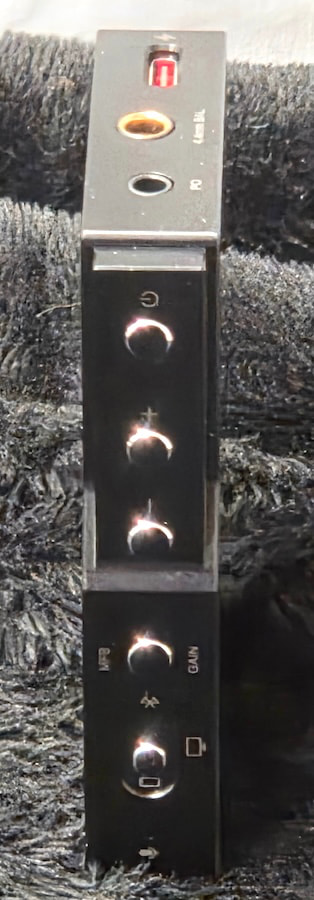
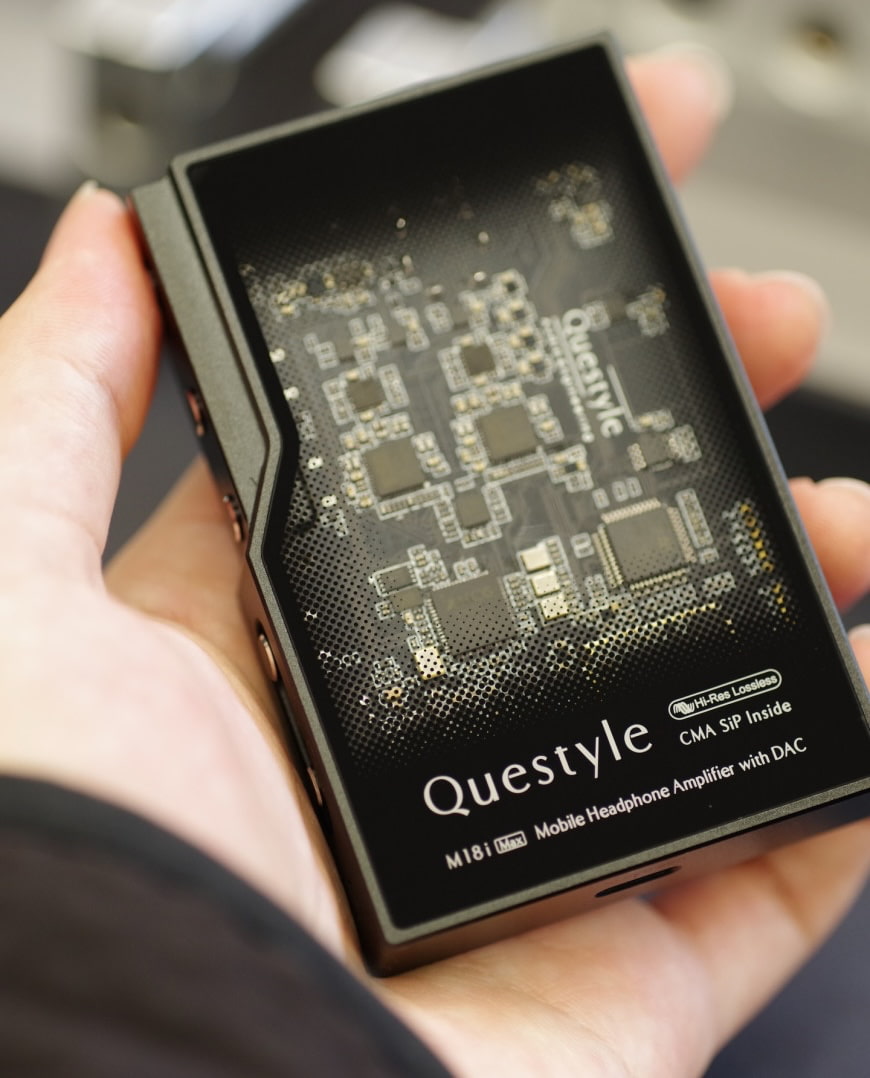
The M18i Max uses a compact aluminum chassis and glass faces with a well-machined look. Buttons down the side are machined as well, and are both well-fitted and tactile. Ports are precisely fitted into the aluminum frame, with no play or slop, giving the unit a very premium feel. The design is understated, relying on the visibility of the components through the glass rear face to generate visual interest.
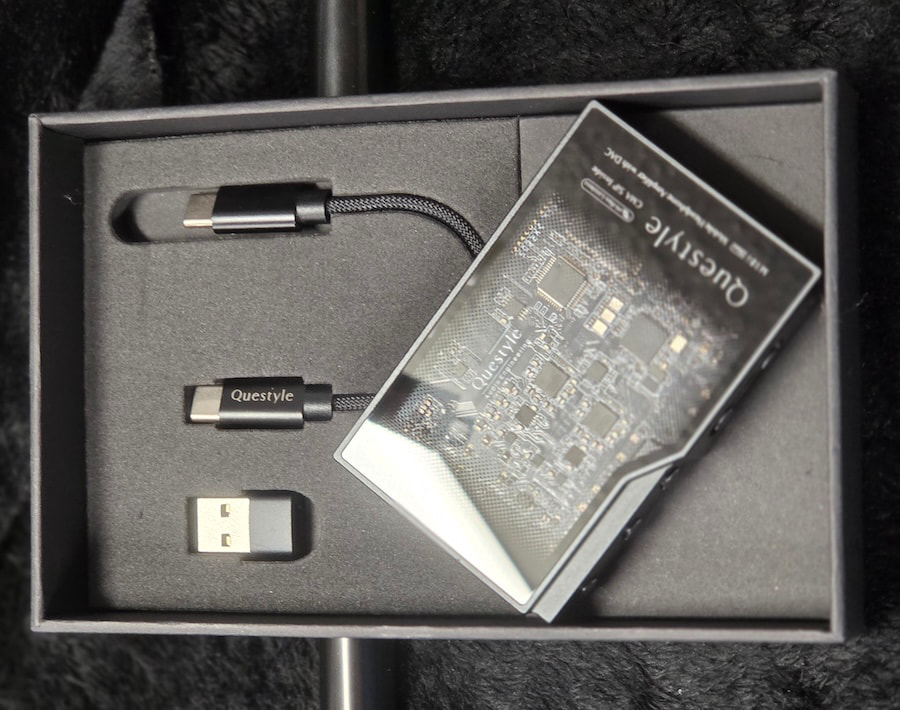
Size-wise, the M18i Max splits the difference between a dongle and something like the Cayin CU9 at roughly 4 inches tall, 2 inches wide, and ½ inch thick. Sporting an 1,800 mAh internal battery also removes it from the category of typical dongles. As a result, the weight is also a bit more than most dongles at 100 grams. That additional size and weight is a trade-off for longer battery life and greater potency. The M18i Max is designed to provide greater output capability than a basic dongle.
The color display provides useful information, including volume, sample rate, output status, and playback format, although my aging eyes would have preferred about a four-point larger font. That may seem like a small detail, but it is helpful when switching between phones, tablets, and computers, where software volume controls are not always obvious. The screen also makes the M18i Max feel more like a complete audio component and less like an adapter hanging from the bottom of a phone.
The independent volume control allows precise adjustment directly from the unit rather than relying entirely on the source device. This also allows the source device volume to be set at 100% where software volume controls might otherwise affect sound quality before passing the signal off to the M18i Max. Listeners accustomed to a traditional analog knob may initially find the button-style interface less immediate, but the controls are logical after a short period of use.
Internals
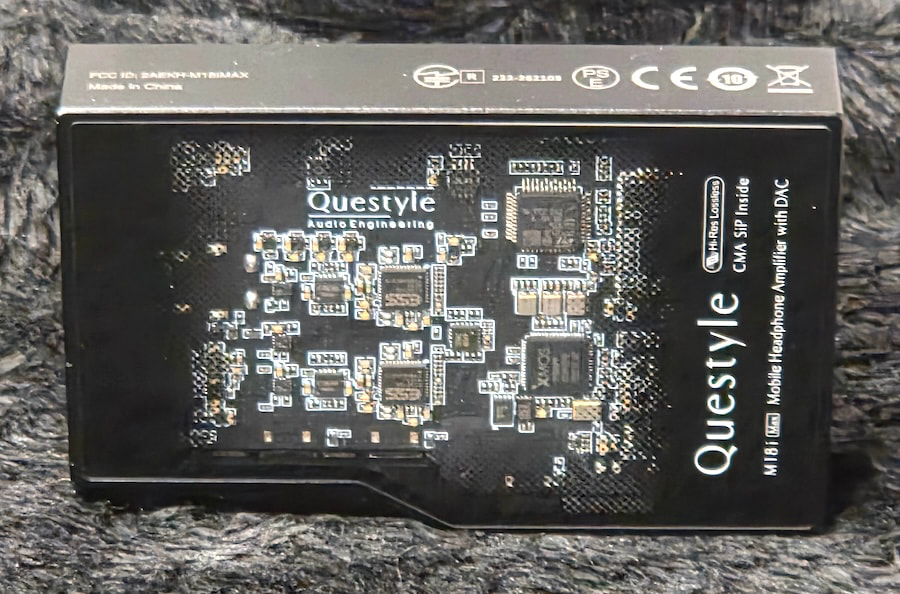
Inputs include USB as well as Bluetooth 5.4, with support for Bluetooth LE, LDAC, aptX HD, aptX Adaptive, and SBC. It is also worth noting that most, if not all, Questyle products in the current lineup are MFi-certified, so they will work equally well with Apple and Android products. A switch on the side of the unit allows listeners to control the operating mode and whether the device should charge from the source, so phone batteries can be protected while the M18i Max can still charge directly from a laptop. A separate USB charging port also puts the unit into phone mode when connected to a USB source and the power port is connected.
The DAC section uses two ES9219Q chips that provide dual-mono processing to further reduce noise and improve channel separation. The design supports high-resolution PCM up to 384 kHz/32-bit and DSD256 playback, well beyond the requirements of most of my music library and many streaming services.

The M18i Max uses two of Questyle’s proprietary SiP amplifier modules containing four patented Current Mode Amplification circuits. These SiPs, as Questyle calls them, are designed to provide high bandwidth, low distortion, and strong control over connected headphones. Books have been written on the topic of current-mode versus voltage-mode amplification, but it is hard to deny that Questyle has found a way to make it work. The company specifies distortion as low as 0.0002% under an actual 300-ohm load, along with a peak output current of 1.5A.
This is more than adequate power for headphones like the HEDD D1 or Sennheiser HD 650, while still providing enough finesse to handle sensitive in-ears like the Campfire Andromeda or Beyerdynamic DT 70. The one limitation is large planar headphones, with inefficient models like the Fostex T50RP and HiFiMAN HE6 acting as current sponges and draining the resources of the M18i Max quickly. The M18i Max closes the gap between portable and desktop performance, but it does not eliminate the distinction entirely.
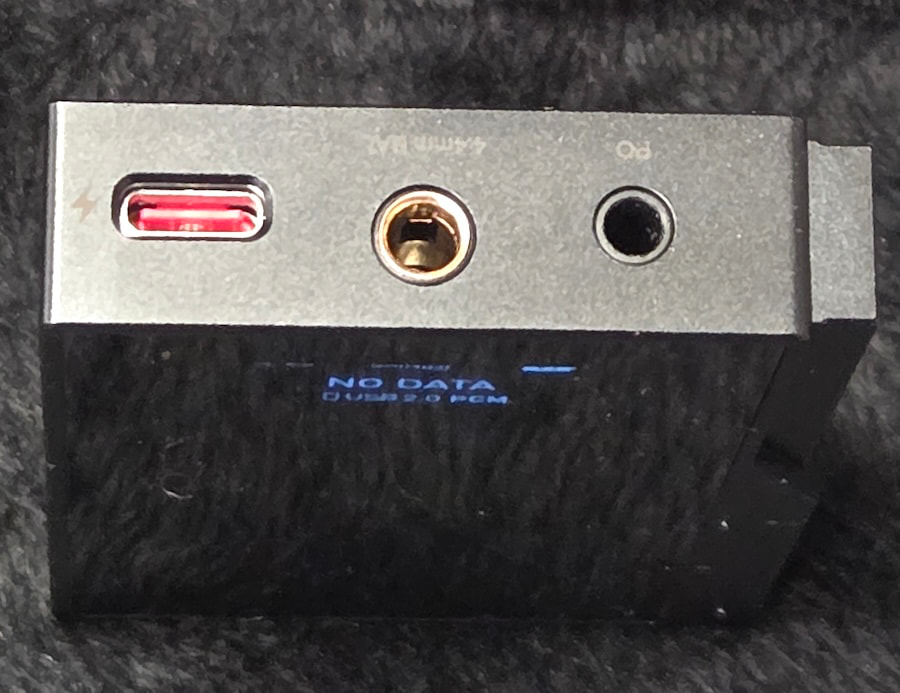
The M18i Max includes both 3.5mm single-ended and 4.4mm balanced outputs. The balanced connection is the preferred output for demanding headphones or listeners who want the greatest amount of headroom.
Listening
The first thing that stands out about the M18i Max is its sense of control. It does not radically alter the tonal balance of a connected headphone, but it gives the impression that the driver is being managed more effectively.
Bass is tight and well-defined, with good extension into the sub-bass region. Kick drums have a clear leading edge, and electric bass lines remain easy to follow in busy arrangements. The M18i Max does not add a large bass lift, which will disappoint listeners expecting a warmer or more obviously colored presentation. What it provides instead is authority and separation.
Sub-bass information is easier to recognize with the M18i Max than through the headphone outputs of many phones and laptops. Electronic music benefits from the additional depth, but the improvement is equally apparent with acoustic recordings, where the lower registers of piano, double bass, or organ need room to develop.
The additional power is most obvious with full-size headphones. The M18i Max maintains its composure when the music becomes dense or the volume rises, and it avoids the sense of strain that can appear when a small amplifier is pushed beyond its comfort zone.
The midrange is clean and transparent. Vocals are well-centered, and small differences in recording technique are easy to hear. Male voices have weight without sounding thick, while female vocals retain texture and air without becoming artificially forward. Acoustic guitars have good body and string definition, and piano notes carry enough harmonic information to sound natural rather than mechanical.
The M18i Max is not warm in the traditional sense. It does not soften the edges of a bright headphone or add much coloration to a neutral one. That makes it a good match for listeners who want to preserve the character of their headphones, although those already using an aggressive or analytical model may prefer a warmer amplifier.
Treble is extended and detailed without sounding excessively sharpened. Cymbals have convincing attack and decay, and low-level information in recordings is easier to follow. The M18i Max offers a largely effortless presentation in the upper registers, particularly with demanding headphones, but it does not turn detail into an excuse for brightness.
Poor recordings remain poor. Compressed pop material can still sound flat and congested, and bright masters can become tiring with already-forward headphones. The M18i Max is resolving enough to expose those flaws, although it generally avoids adding harshness of its own.
The soundstage is more open than what most phones and computers can provide from their internal outputs. Width improves first, with depth and image layering becoming more apparent as the quality of the headphones increases.
Instrument placement is stable, and complex recordings remain organized at higher listening levels. Orchestral recordings benefit from the improved separation. Placing the orchestra is relatively straightforward, and individual sections retain their identity rather than blending into a single mass.
Small jazz ensembles are handled especially well, with enough space around the instruments to make the recording feel less congested. Live recordings also benefit from the additional control, particularly when crowd noise, room ambience, and the performers occupy overlapping parts of the mix.
The 4.4mm balanced output provides the strongest performance. It offers more headroom and a greater sense of ease, particularly with full-size headphones. The 3.5mm output remains very capable with IEMs and efficient portable headphones, but the balanced connection allows the M18i Max to show more of its potential.

Headphone & IEM Pairing
The M18i Max is a flexible match for a wide range of headphones. It works especially well with neutral and slightly warm models, providing enough clarity and control to keep warmer headphones from sounding sluggish while avoiding the exaggerated brightness that can make neutral models difficult to tolerate.
With sensitive IEMs, the quiet background and low output impedance are important advantages. The M18i Max preserves the character of the earphones rather than imposing a strong tonal signature of its own.
The extra power becomes more valuable with full-size dynamic headphones and planar models. The M18i Max provides better headroom and a more effortless presentation than most conventional dongle DACs, particularly through its balanced output.
Listeners should still maintain realistic expectations. “Powerful for a portable DAC” and “powerful enough for every headphone” are not the same thing. The M18i Max is capable, but the most inefficient headphones will still be better served by a dedicated desktop amplifier.
Portability & Everyday Use
The M18i Max is straightforward to use with computers and most modern mobile devices. It can function as a high-quality USB audio output for streaming services, local music libraries, and high-resolution playback software.
Battery life is an important consideration because the M18i Max is more sophisticated than a basic dongle DAC. The display, amplification stages, and higher output capability all require power, and the unit can draw more from a connected phone than a simpler adapter.
That is not a reason to reject the product, but it does make the M18i Max better suited to deliberate listening than casual, all-day use. A small power bank may be useful for longer sessions away from a wall outlet.
There is also the question of portability. The M18i Max is compact compared with a desktop stack but relatively large compared with inexpensive dongle DACs. It may hang awkwardly from a phone in a pocket, especially with larger headphone cables attached.
The M18i Max is aimed at the listener who is willing to accept some inconvenience in exchange for stronger performance. That is a reasonable trade, but it is still a trade. The unit is more portable than a desktop system but less convenient than a simple phone adapter.
What Could Be Better
The price is the most obvious concern. The M18i Max costs considerably more than many competent USB DACs, and listeners using efficient IEMs may not immediately hear enough of an improvement to justify the difference.
Battery consumption is another consideration. The M18i Max is not as carefree as a simple passive adapter, and phone users will need to account for the additional drain during extended sessions.
The unit can also be more complicated than some listeners need. High-resolution format support, multiple output modes, a display, and a powerful amplifier are useful features, but not everyone needs a miniature audio laboratory attached to a smartphone.
Its physical size is another compromise. The M18i Max is very portable compared with a desktop stack, but listeners looking for the smallest possible solution will find less expensive and more convenient options.
Finally, the M18i Max’s clean and controlled sound will not suit every system. Listeners looking for warmth, tube-like coloration, or a more forgiving presentation may prefer a DAC and amplifier with a more obvious sonic personality.
The Bottom Line
The Questyle M18i Max occupies an interesting middle ground. It is considerably more substantial than a conventional dongle DAC, but still small enough to travel without turning your phone into a science project. Its real advantage is Questyle’s Current Mode Amplification combined with dual-mono ES9219Q DACs, a dedicated 1,800 mAh battery, Bluetooth 5.4, and both 3.5mm and 4.4mm outputs.
That combination matters more than chasing another decoding format. The M18i Max can drive sensitive IEMs quietly, provide considerably more authority with full-size headphones, and operate from its own battery rather than treating your phone as a power supply. It still has limits with genuinely inefficient planar headphones, so anyone expecting a pocket-sized replacement for a powerful desktop amplifier is buying the wrong product.
What is missing? There is no PEQ, meaningful DSP suite, or app-based control, which competitors from FiiO and others increasingly offer at this price. The display and physical controls keep operation straightforward, but listeners who want to endlessly tweak filters, EQ curves, and presets will find the M18i Max rather old-school.
That is also part of its appeal. The M18i Max is for someone who already owns very good headphones or IEMs and wants to hear more of what they can do without carrying a desktop rig. At $399, it is overkill for inexpensive earbuds and harder to justify for anyone primarily interested in convenience. For the listener who values sound quality, low noise, strong headphone control, and genuine portability more than software features, however, the M18i Max makes a very persuasive case.
Pros:
- Excellent control and low noise with both full-size headphones and sensitive IEMs
- Current Mode Amplification delivers strong dynamics, separation, and composure
- Clean, transparent tonal balance without excessive brightness
- Dual-mono DAC architecture with 3.5mm and 4.4mm outputs
- Dedicated battery reduces dependence on the source device
Cons:
- Expensive compared with conventional dongle DACs
- Larger and heavier than most portable USB DACs
- No PEQ, advanced DSP, or app-based control
- Can still struggle with very inefficient planar headphones
- Overkill for listeners using inexpensive or easy-to-drive earphones
Our Ratings:
★★★★★★★★★★ Sound Quality
★★★★★★★★★★ Build Quality
★★★★★★★★★★ Portability
★★★★★★★★★★ Value
Where to Buy:
Related Reading:

This article is brought to you by CoolIT, an Ecolab Company.
Beyond 250 kW a server rack can no longer be cooled by a hybrid approach of liquid and air. At this density a 70/30 liquid-air split leaves 75 kW of air load. The air cooling system needed to move it brings cost and complexity few operators will accept. The answer is near-total heat capture. Liquid takes effectively all the heat, air falls below 1 percent of the load, allowing the server to run fanless.
CoolIT builds these loops today from modular coldplate blocks proven across six generations of fanless designs. Processor thermal design power (TDP) keeps climbing generation over generation. This rising heat load is now cascading into the memory, networking, storage, and power components that once ran comfortably on air.
The heat escaped the chip
For years the story stayed simple. Cool the processor and let air handle the rest. That balance has shifted. As TDP climbs, heat spreads outward from the processor and cascades into the components around it. Memory, networking, storage, and power now run hot enough to demand liquid of their own. Engineers designing the next generation of AI servers face a board where heat capture rises with every launch.
Beyond 250 kW per rack, air cooling becomes the bottleneck. Near-total liquid heat capture enables fanless AI server designs built for the next generation of computing.
New parts, new rules
Unlike processors, which are cooled as flat rectangular packages, these peripherals come in a wide range of shapes, sizes, and mounting requirements, each with its own thermal limits. Some run cooler than the processor case temperature, others run hotter, which leaves them sensitive to a design tuned only for CPUs and GPUs. Operators need purpose-built solutions here, matched to the part rather than stretched across the board.
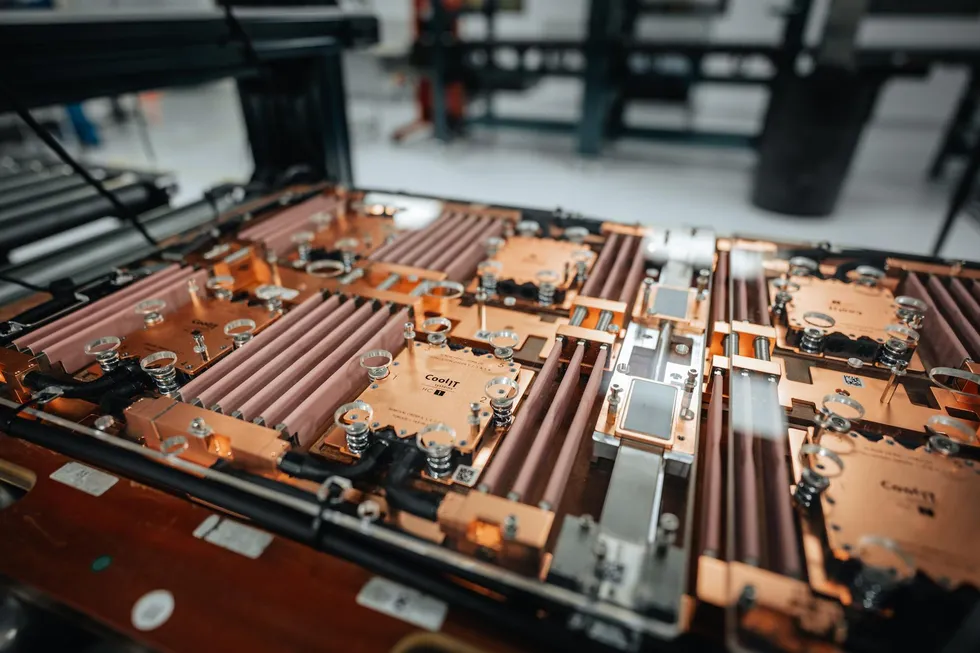
CoolIT engineers meet this with a deep toolkit. Conductive plates, vapor chambers, heat pipes, and thermal transfer plates move heat from components closer to the liquid path. Riding coldplates enable pluggable components. Each solution stays true to the component it serves.
CoolIT Customer Showcase: How GWDG Cools HPC & AI Systems with CoolIT’s Direct Liquid Cooling CoolIT
One loop, one server
Cooling the parts is one challenge. Uniting them is the real work. Full heat capture means folding every one of these solutions into a single server loop that distributes coolant effectively and remains easy to install. Connection reliability, coolant routing, and the time it takes to assemble the loop at rack integration determine whether a design thrives in production or stalls on the bench. CoolIT builds these loops from proven modular blocks, so operators gain performance and deployment speed within the same solution.
Density forces the decision
Rack power continues to climb toward 1 MW, and the case for liquid grows stronger at every step. A 70/30 split of liquid to air holds comfortably at lower density. Past roughly 250 kW it stops working. The 30 percent left to air becomes a 75 kW load inside a single rack, and moving that much heat demands a parallel air system whose cost and footprint few operators will accept. Adding density only widens the gap.
As rack power continues to climb toward 1 MW, CoolIT’s modeling places full heat capture as the standard server design for flagship rack-scale products through 2028.
The simpler, more efficient answer is to capture the heat in liquid and drop air to less than 1 percent of the total load. True 100 percent remains almost impossible to reach in the strictest sense, so the honest and achievable target is near-total capture. That distinction matters to engineers who value precision, and the direction stays clear either way. Full heat capture moves from a premium option to a mainstream requirement as density rises, and CoolIT’s modeling places it as the standard server design for flagship rack-scale products through 2028.
CoolIT delivers it
CoolIT scales heat capture all the way to 100 percent using modular coldplate building blocks proven across six generations of fanless server designs. Engineering teams are already working on designs for the maximum density racks coming next. As the cascade spreads and racks grow denser, near-total heat capture becomes the design that keeps AI running.
Talk to CoolIT about building a server loop engineered for total heat capture.
On November 4, TechCrunch’s Founder Summit will bring a vital one-day crash course on startup building to Boston’s SoWa Power Station. Founders shouldn’t have to learn the hardest lessons the hardest way, and this event is designed to make the challenges of starting a company easier and the highs that much greater.
Instead of months of trial and error, you get direct access to the investors and founders who’ve already made the calls you’re now facing. We’re talking everything from fundraising and hiring to AI strategy, and topping your category.
Don’t take our word for it. Explore the full agenda of speakers and sessions we have planned for Founder Summit below, and lock in your spot at the event. All tickets are available for the lowest prices you’ll see, so now’s the best time to act.
The official TechCrunch Founder Summit agenda reveal
Without further ado, here’s the official agenda. Get to know each session and speaker on the event agenda page.

The New Rules of Raising Capital
Fundraising has never been easy, but the playbook keeps changing. Brian Devaney, partner at Underscore, will break down what investors are looking for now, how founders can stand out in a crowded market, and where founders often lose leverage without realizing it. Expect a candid look at today’s fundraising environment, from first checks to term sheets, and the mistakes that can make or break a round.
The CEO Job Never Gets Easier
The title may stay the same, but the job changes with each stage of a company’s growth. HubSpot co-founder and Sequoia partner Brian Halligan will share the lessons he’s learned from building and advising startups through rapid growth, tough decisions, and constant reinvention.
This session explores how founders can evolve as CEOs, avoid common leadership pitfalls, and build companies that can thrive well beyond the early days.
Built for AI From Day One
Adding AI features is one thing. Building an AI-native company is something else entirely. Lior Div, co-founder and CEO of 7AI, will explore what changes when AI becomes the foundation of a startup rather than a product enhancement. From team structure and product development to operations and go-to-market strategy, this session examines what founders should rethink when building in the AI era.
Not Every Dollar Is Equal
Raising capital is often framed as a milestone, but choosing the right investors can shape a company’s future long after the money arrives. After raising an $11 million round for Cogent Security, co-founder and CEO Vineet Edupuganti learned firsthand what separates helpful partners from costly distractions. This session explores how founders should evaluate investors, navigate trade-offs, and think beyond valuation when building their cap table.
How to Spot the ‘King of the Hill’ Company — Hidden Signals That Define Category Winners
Innovation is needed to solve the world’s biggest challenges, but only certain companies can realistically become category-defining winners at industrial scale. In this session, TDK Ventures investment director Tina Tosukhowong unpacks the firm’s “King of the Hill” framework: the disciplined process that the best investors use to evaluate companies based on economics, scalability, and commercial timing.
Through real-world examples, including Tina’s exploration of fission and fusion, attendees will learn actionable frameworks for evaluating startup readiness, mapping competitive landscapes, and identifying when timing, talent, and technology align.
Your Company Is Who You Hire
Early hiring decisions can define a startup’s culture, speed, and ability to execute. Melissa Taunton, partner at NEA, will share lessons from working with founders as they build teams through periods of rapid growth and uncertainty.
From identifying the right early hires to avoiding common recruiting mistakes, this session explores how founders can build organizations that are resilient, adaptable, and prepared for what comes next.
The Boston Founder Playbook
Silicon Valley gets the headlines, but Chase Garbarino has been quietly building category-defining companies from Boston for over a decade. As co-founder and CEO of HqO, he has raised $200 million from investors and scaled to 30+ countries without ever needing to change geographies.
He’ll break down the real advantages and disadvantages of building where the startup playbook wasn’t written, and what every founder outside a major hub should know.
Finding Product Market Fit Before You Scale
Every founder wants product-market fit, but knowing when you’ve actually found it is far more complicated. Kent Bennett, partner at Bessemer Venture Partners, will unpack how founders can validate demand, build an MVP that answers the right questions, and avoid scaling before the fundamentals are in place.
This session explores the signals that matter, the metrics that mislead, and the decisions that separate enduring companies from expensive experiments.
What happens beyond Founder Summit’s sessions
The programming is a huge part of TechCrunch Founder Summit’s value, but it’s not the whole deal. You’ll also get the chance to mix and mingle with founders working through the same fundraising decisions and the same hiring calls as you, and then network with those who have already lived through those experiences. Or better yet … those who have funded those who have gone through the startup wringer.
A day filled with discussions turns into months of action at TechCrunch Founder Summit, and we’re eager for you to join us and the rest of the Boston startup community on November 4. Register now to secure your ticket savings and join the ultimate founder’s bootcamp.

When you purchase through links in our articles, we may earn a small commission. This doesn’t affect our editorial independence.
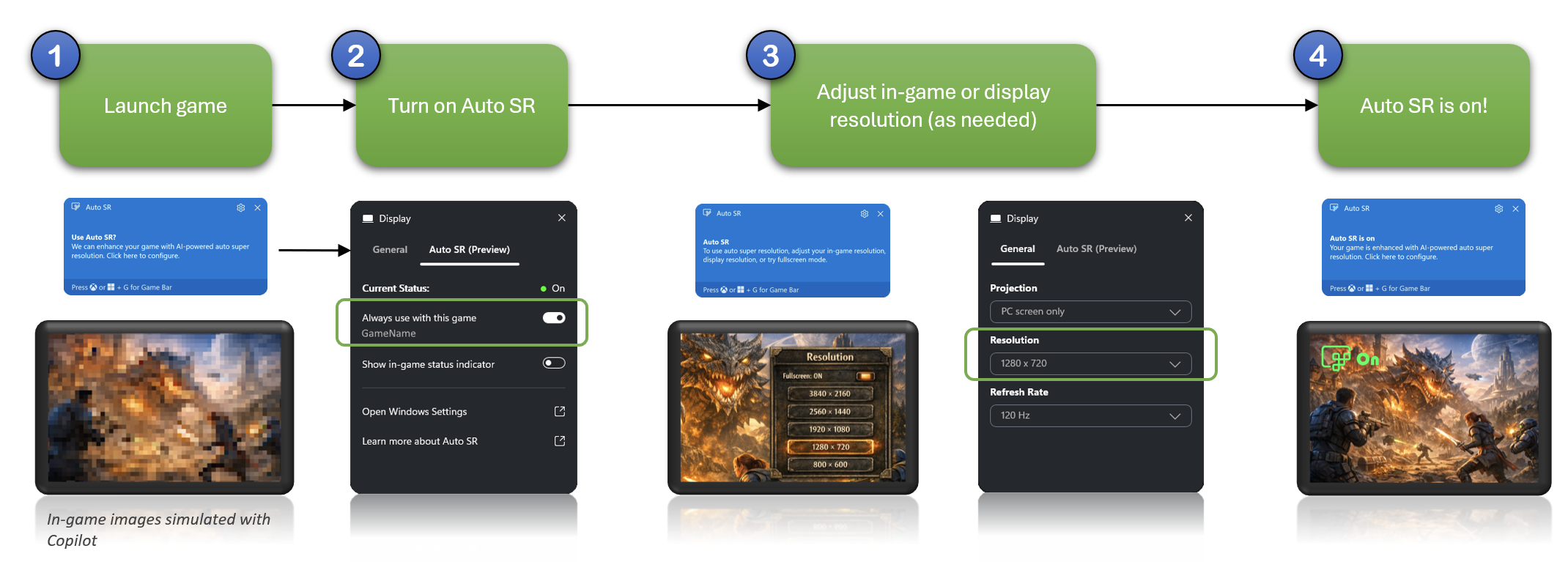
Pixels Matter: Microsoft wants to remind everyone that Windows has its own upscaling technology that can work with both older and brand-new games. Automatic Super Resolution is now rolling out to Intel-based Copilot+ machines, promising notable FPS gains within specific resolution targets.
Microsoft has announced that its Automatic Super Resolution (Auto SR) technology is expanding to Copilot+ PCs built around Intel silicon. Previously limited to Qualcomm Snapdragon X processors, Auto SR now works on Copilot+ devices powered by Intel’s Core Ultra Series 3 chips. Users can expect a genuine bump in gaming frame rates – with a few, crucial caveats.
The company explains that Auto SR is designed to help games that struggle to hit a playable frame rate. The technology taps into the NPU built into every Copilot+ PC, relying on pre-trained AI algorithms to reach a higher “effective” resolution while the game engine renders at a lower one under the hood.
Microsoft says Auto SR can theoretically deliver smoother frame rates while preserving the “visual consistency” of a game’s original artistic vision, a clear dig at Nvidia’s polarizing DLSS 5 technology, which gamers tend to either love or dismiss outright.
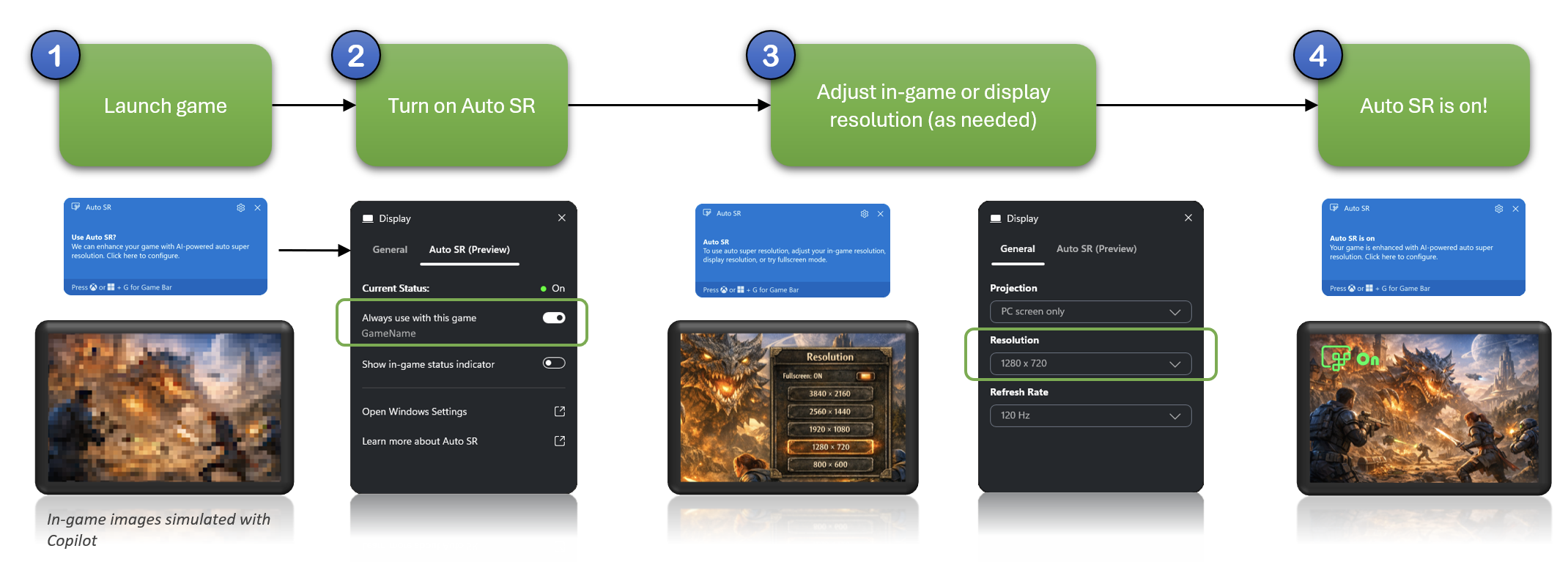
Unlike DLSS, Intel’s XeSS, or AMD’s FSR, Auto SR is built directly into Windows, giving it broader compatibility across both new and older titles. Microsoft says its upscaling solution can boost frame rates in games like Assassin’s Creed Valhalla by as much as 15%, letting gamers enjoy smoother gameplay alongside higher in-game graphics settings.
For now, Auto SR is focused on unlocking that “magic” 60 FPS threshold on Copilot+ PCs. Down the line, Microsoft hopes to expand the algorithm’s reach toward 90 to 120 FPS gaming scenarios. Because the upscaling model is trained on specific target resolutions, it delivers its best results with input resolutions up to 1080p on Intel-based machines.
Auto SR is designed to work with any game built on DirectX 10 or later, and Microsoft has shared a short list of titles it’s targeting with the feature. That list includes Assassin’s Creed: Shadows, Assassin’s Creed: Valhalla, Assetto Corsa, Avowed, Control, Doom: The Dark Ages, and more.
Microsoft has packaged its latest upscaling technology into an app that can be installed straight from the Microsoft Store.
The Redmond giant is also quick to note that while Auto SR can boost frame rates on Copilot+ PCs, more capable systems are still better off relying on game-native solutions like DLSS, XeSS, and FSR when they’re available.
from the it’s-still-speech-when-kids-do-it dept
Since its integration into our digital world, social media has played a pivotal role in youth organizing and social mobilization. Yet, people’s access to these platforms is increasingly coming under threat from courts and legislatures under the guise of protecting young people online—presenting a significant hindrance to youth organizing.
In a major recent example, Meta settled in a lawsuit with 52 states and territories regarding the use of Instagram and Facebook by young people. The settlement will require Meta, and pressure other non-Meta owned platforms like TikTok and YouTube, to embed age gating practices into every product while also requiring restrictions on the accounts of people under-18, such as a two-hour daily time limit and content restrictions.
Youth Power on Social Media
Young people have been using social media for political advocacy and community organizing for more than a decade. From organizing protests speaking out against police brutality, to organizing nationwide school walkouts demanding safety in schools from gun violence, and striking to demand lawmakers take action to protect the climate, social media has become an instrumental tool for youth to both speak out and connect with other young activists.
Instagram has become especially useful for activism online by young people. The features on the app make it a helpful tool for being able to efficiently and quickly spread awareness, which is especially important when people need to share real-time information. For example, 17-year-old Darnella Frazier’s video on Facebook showed the world the murder of George Floyd.
The impact of youth activism online is also evident on non-Meta owned platforms, with services like TikTok and YouTube being particularly prevalent spaces for young people to share their stories, build movements, and amplify collective engagement.
However, in a digital world operating under the settlement’s new guidelines, young people risk not being able to read crucial news due to the content being labeled as “age-inappropriate,” which has already happened for teenagers in Australia under its social media ban.
A two-hour daily time limit and a block on Meta’s apps between midnight and 6am leaves little room for young activists to organize rapid response efforts. Being unable to see likes on a post will make it difficult to gauge the effectiveness of their campaigns.
Add to this what we already know about Meta’s content policies which claim to “protect children” and keep sites “family-friendly” but instead label content like LGBTQ+ content as “adult” or “harmful,” youth will be left with no choice in what content they see once the ‘age-appropriate’ content filter is turned on by default. One recent report noted that Meta had hidden posts that reference LGBTQ+ hashtags like #lesbian, #bisexual, #gay, #trans, and #queer for users with the sensitive content filter on. This would specifically curtail the efforts of young activists doing work on comprehensive sex education.
Global Trends
Measures like this are being discussed across the globe, but not all courts have taken such a short-sighted approach. In August, the French Constitutional Council got a lot right in its decision to strike down the country’s legislation banning under-15s from social media for infringing free expression and communication for everyone online, not just young people.
The French Court also called attention to its infringement on privacy as the legislation would have forced people of all ages to hand over government IDs, face scans, and other sensitive information to prove their age and access online content.
Requiring this much data from users puts activists in danger of even more surveillance. Meta has already previously complied with demands from law enforcement to hand over the messages of users. The amount of personal information that will be logged and that could be demanded via a warrant from police to stifle or investigate activists’ actions or plans could cause a chilling effect, forcing advocates to pause or terminate their work.
This is egregious because these systems misidentify or lock out people of color, people with disabilities, and trans or gender-nonconforming individuals whose IDs may not match their chosen name or align with what the system expects them to look like upon verification. And it’s often these communities that benefit from online organizing the most, especially for marginalized youth as social media can often be the only place to organize and build community.
What Young People Deserve
The settlement generates headlines, but it will not solve the core problem. Instead of tackling Meta’s surveillance capitalism business model that turns all online content into potential profit and centers lining the company’s pockets over protecting the speech and privacy of users, this settlement gives the tech giant an opportunity to carve out a new digital world that prioritizes its own needs, not those of young people.
As we’ve been calling attention to in other contexts, this will force young people into digital isolation—curtailing vital access to news and resources for health and development. It also completely ignores the calls of youths themselves who favor digital literacy and education over surveillance and government control.
Young people deserve a better internet than one regulated through panic. They deserve better than the government or Big Tech getting to decide how they use social media and what they can or cannot be exposed to or learn about. They deserve better than having their right to free expression minimized. This must not be lost in the pursuit of building a better and safer online ecosystem and environment.
Republished from the EFF’s Deeplinks blog.
Filed Under: activism, parental controls, settlement, teen activists, time limits
Companies: meta

Convenience vs. maximum isolation: Here’s how to choose where your verification codes live.

When it comes to keeping your online accounts safe and sound, two-factor authentication (2FA) has been a standard recommendation from security experts worldwide for years. As more and more people adopt 2FA, one question keeps coming up: Should you store your authentication codes inside your password manager or keep them in a dedicated authenticator app?
The idea that your login should rely on two separate factors is a fundamental security principle. Password managers offer one approach, while authenticator apps offer another. Each comes with real trade-offs that aren’t always obvious at first glance. While they’re both designed to protect you, they work in completely different ways.
Two-factor authentication is built on the simple idea that if someone steals your password, they still won’t be able to get into your account without a second piece of proof of your identity. Some apps will send you a text message with a one-time-use code, some will make a number pop on your phone screen, a few will email you a code, while others will ask if you’d rather use a special code generated by an authenticator app.
A password manager, on the other hand, brings both factors into the same vault, trading some of that separation for convenience. Neither approach is wrong, and each reflects a different set of priorities, like how much friction you’re willing to accept, how you manage devices and what you’re most worried about losing access to. Understanding how these tools work, how they differ and what you need is the recipe for finding the right tool that fits your needs.
The pros and cons of storing 2FA in your password manager

Most modern password managers come with multiple tools, including authentication tools. Most popular options, such as 1Password and Bitwarden, can generate and autofill six-digit, time-based one-time password codes right alongside usernames and passwords. There are real advantages to putting all your eggs in one basket.
It’s such an effortless way to autofill all this info without squinting at your phone and typing in a code before it expires. Another advantage comes for users who handle multiple devices, as password managers sync 2FA codes across desktop, browser and mobile apps, so you’re never stuck without access.
Another advantage to using a password manager is that you’re never locked out of your devices if you lose or break your phone. Since all your 2FA seeds are backed up inside your encrypted vault alongside your passwords, they’re all equally safe. If you need to share your account data with family or your team, it’s easier to give access to your password manager since they won’t have access to the authenticator tool on your phone.
It’s not all milk and sugar, because folding 2FA into your password manager comes with downsides too. True 2FA relies on separating the first factor — the password — from the second one — the one-time code. When both live in the same vault, a single master password breach can expose everything at once. Similarly, if you catch a case of malware in the shape of a keylogger or a malicious browser extension, these can all capture your password and 2FA code in the same sweep. Using a separate phone for your authenticator app creates a physical barrier between your password vault and your login codes, which improves safety. Storing both together removes that barrier.
The pros and cons of using a dedicated authenticator app

Standalone apps like Google Authenticator take a more isolated approach because they work offline. There’s physical separation, so your second factor actually lives on a different device than your passwords, and there’s a lower chance of having your data stolen.
On the other hand, that isolation comes at a cost, because you’ll still be copying six-digit codes by hand. Also, most authentication apps are mobile-only, so you’re out of luck if your phone isn’t nearby. Unless, that is, you have one of the models that also offer desktop apps or browser extensions, like 2FA or 1Password. There’s also the risk of temporary lockout of your accounts if you lose or break your phone, requiring you to set up a replacement device and restore your cloud backups before accessing your codes again.
The hybrid model brings the best of both worlds
One of the best ways to make your life easier while still keeping everything safe is to mix and match. Most timed one-time password codes can lie safely in a password manager, but a small handful, such as the codes for your main email account and the password manager itself, are better kept on a separate hardware key or an authenticator app. This way, if your vault is ever compromised, your most critical accounts remain out of reach.
The breakdown is to use your password manager’s built-in 2FA for low-risk everyday services, like shopping sites and subscriptions. Use a dedicated authenticator app or hardware key for your email, banking and the password manager itself. In this way, the friction is minimal, and your most essential accounts are safe if your password manager is ever compromised.
Ultimately, neither tool is flawless on its own, and the best choice depends on what you’re protecting and how much back-and-forth between devices you tolerate. For most people, a hybrid approach seems to be the best path forward.
Tech
Someone turned Apple’s M4 Mac Mini into a bizarre handheld Mac with a touchscreen, keyboard, controls, and batteries

- A M4 Mac Mini has been rebuilt into a battery-powered handheld computer
- The custom handheld keeps Apple’s desktop motherboard and original cooling system intact
- A removable Mac module sits inside the custom 3D-printed handheld enclosure
Apple‘s M4 Mac Mini has been transformed into a handheld Mac with a 7-inch 120Hz touchscreen, physical controls, keyboard, and battery.
Shing Solutions stripped the desktop computer down to its motherboard and cooling system before rebuilding it inside a custom 3D-printed enclosure.
The resulting device, dubbed Mac Nano, keeps the full macOS functionality while replacing the desk-bound form factor with something designed for use in two hands.
Latest Videos FromTechRadar
The Mac Mini becomes a removable computing core
The project retains Apple’s original heatsink and blower fan instead of replacing them with smaller cooling hardware to save internal space.
That decision allows the M4 processor to retain its factory thermal arrangement while the motherboard moves into a completely different enclosure.
Inside the new chassis, the computer module sits on rails, allowing it to slide out without disturbing the screen, keyboard, or controllers.
The arrangement means the central hardware can theoretically be removed for servicing or replaced while the surrounding handheld computer remains assembled.
A 7-inch touchscreen provides the main display, with its 120Hz refresh rate giving the portable machine a smoother interface and gaming experience.
It is also equipped with a compact QWERTY keyboard sitting beneath the display, with an integrated touchpad providing cursor control.
The keyboard originally worked wirelessly, but its battery was removed, and the keyboard was rewired to draw power directly through USB.
This modification reduces the number of rechargeable components while allowing the keyboard to receive power directly from the handheld computer.
The internal layout therefore combines Apple’s desktop motherboard with controls and display hardware that were never designed specifically for this computer.
Nintendo controls and batteries complete the handheld device
The Mac Nano also includes physical gaming controls, using circuit boards taken from Nintendo Joy-Con charging grips and mounted inside both sides of the enclosure.
Those controls are wired directly into the Mac instead of using Bluetooth, but macOS does not natively support wired Joy Con controllers.
To make the controls usable, the project relies on Steam, whose controller mapping system can translate their input for compatible games.
Connecting the keyboard, controllers, touchscreen, and other peripherals also created a USB bottleneck inside the compact enclosure.
Shing Solutions addressed that problem by combining two miniature USB splitter boards into a custom three-port hub.
The Mac Nano is powered by rechargeable cells connected to a custom power delivery system, allowing it to run without staying plugged into an outlet.
The enclosure also incorporates handles, giving the device a grip that accommodates all its components.
Unlike a conventional Mac Mini, the Mac Nano therefore combines desktop Apple silicon with the components needed for genuinely untethered operation.
Via Yanko Design

Follow TechRadar on Google News and add us as a preferred source to get our expert news, reviews, and opinion in your feeds.

Many youngsters fascinated by exploring outer space dream of becoming an astronaut, but few do. One who had the right stuff is Pedro Duque, who was Spain’s first astronaut. The aeronautics engineer flew aboard the space shuttle Discovery and the International Space Station.
After retiring as an astronaut, he headed Spain’s Ministry of Science, Innovation, and Universities. Today he is the chairman of HispaSat, a Spanish satellite company.
Pedro Duque
Employer
HispaSat in Madrid
Title
President and chairman of the board
Member grade
Honorary member
Alma mater
The Polytechnic University of Madrid
Nearly 30 years after his first mission, Duque is still Spain’s most famous astronaut. Three public schools have been named after him, and he has received numerous awards. This year, the IEEE Board of Directors made him an IEEE honorary member for “contributions to space exploration, leadership in collaborative science and technology programs, and serving as a role model for younger generations.”
He was unable to attend the 24 April ceremony in New York City, but he expressed his gratitude in recorded acceptance remarks in his award presentation shown during the event.
“We engineers of all specialties recognize the leadership of your institute—the largest and most important engineering society in the world,” he says in the video. “What an honor it is to belong now to an organization whose purpose it is to foster technological innovation and excellence for the benefit of humanity.”
Inspired by Apollo 11
Duque says he knew he wanted to be an engineer from a young age. It’s not surprising that he became interested in aeronautics, as his father was an air traffic controller who explained to him how airplanes worked.
In 1969, when he was 6 years old, he was inspired to become an astronaut after watching the Apollo 11 moon landing.
“I didn’t know anyone who wasn’t attracted to space exploration,” after the moon landing, he says, laughing. “It was presented in such an epic manner, with declarations about its impact on society. The landing made us aware that humanity was exploring new places, and I was keen on knowing more about them.”
His dream of becoming an astronaut was unrealistic at the time, he says, because the country had no space program. Spain was ruled by Francisco Franco, who spent little to no money on scientific innovation, Duque says.
That changed after Franco died in 1975. The country transitioned to a democratic constitutional monarchy and began participating in research and development programs, particularly with the European Space Agency (ESA).
Astronaut duties
Duque earned an aeronautical engineering degree in 1986 from the aeronautical and space engineering school at the Polytechnic University of Madrid.
His first job was as an engineer in the flight dynamics group at GMV, a space and technology company based in Madrid. He was a member of the orbit determination group and worked at ESA’s European Space Operations Centre, in Darmstadt, Germany. He helped develop algorithms, orbit computational software, and computer models.
He was also a member of the space agency’s flight control team for the European Remote Sensing-1 satellite, launched in 1991, and the European Retrievable Carrier, launched in 1992 on the space shuttle Atlantis’s STS-46 mission.
In 1990, ESA recruited candidates for its astronaut program—which Duque says rarely happens. He and several colleagues applied.
“Why not?” he says. “What we thought we wanted to be when we were little was now possible.”
After a considerable selection process, Duque was chosen in 1992 to join the agency’s Astronaut Corps. He trained at the European Astronaut Centre and at the Russian Cosmonaut Training Center (now known as the Gagarin Research and Test Cosmonaut Training Center).
In 1994, he served as the prime crew interface coordinator on the ESA–Russian EuroMir space station. He managed communication between the astronauts on the Mir station and the European scientists to help ensure orbital experiments and operations ran smoothly.
NASA selected Duque to be an alternate payload specialist on the ground for space shuttle Columbia’s STS-78 mission in 1996. In that role, he was trained to operate and manage scientific experiments, equipment, and cargo during a crewed mission. He also supported the flight from the ground as a crew interface coordinator.
His first flight into space was in 1998 as a mission specialist representing the ESA on the space shuttle Discovery’s STS-95 mission. He managed in-orbit tasks, experiments, spacewalks, and equipment operations.
He served as a flight engineer in 2003 onboard the Soyuz TMA-3 Cervantes, a joint mission between Russia and Spain to the International Space Station. He operated the station systems, managed daily maintenance tasks, and performed scientific experiments assisted by the mission commander.
Memories of flying with John Glenn
The years of training and preparation to become an astronaut were rigorous, he says, but the experience was fulfilling. Even though he spent only about 10 days on each mission, he says, “they were very rewarding times because all the preparation paid off, and we got the results we needed.”
Some of his favorite memories were viewing Earth during the day and night for the first time, and watching it pass from one phase to the other. Another was seeing the moon flattened to almost a sliver during the few seconds before it set. Experiencing microgravity was a thrill as well, he says.
“I also cherish the companionship of the people who worked alongside me in space and on the ground,” he adds.
One was John H. Glenn, the first American to orbit the Earth. Duque flew with Glenn on Discovery. They talked about the selection criteria for astronauts. Glenn told him those on board the Apollo and Gemini missions were chosen because they were test pilots, who were thought to be most likely to handle problems or failures effectively and proactively.
“The technology in today’s missions is advanced enough that astronauts won’t be needed to handle probable catastrophic equipment failures,” Duque says. “Instead, they will perform experiments and update or fix the devices used in space capsules. But flights to the moon and even Mars will use new types of spacecraft that might not necessarily work as planned, so those astronauts will have to know how to fix them and possibly solve critical problems on their own.
“Also, future astronauts will have to live with others in a confined space for months, and not everyone can do that.”
The price of sudden fame
As Spain’s first astronaut, Duque became a celebrity. Among his honors are Russia’s Order of Friendship and Spain’s Great Cross of Aeronautical Merit and Princess of Asturias Award. He also received NASA’s Space Flight Medal, which is given to an astronaut who flies aboard a U.S. space mission.
Learning to navigate sudden fame and being treated like a celebrity was challenging, Duque says. Like many engineers, he was accustomed to working behind the scenes and out of the public eye.
“Being famous, both in the profession and the public, was quite difficult in the beginning,” he says. “Being a celebrity doesn’t come easily to me, but after so many years, somehow I learned how to deal with it.”
People might assume that an astronaut’s leadership skills come effortlessly, Duque says, but that’s not always the case.
“Everybody gives so much importance to your opinion, and sometimes I was surprised by that,” he says. “Being an astronaut, you tend to have a certain kind of leadership style because it’s what you have done for years without knowing it.”
Minister of science and other leading roles
His leadership style has served him well. After he retired from the ESA in 2018, he was appointed as Spain’s minister of science, a role he held until 2021. He oversaw the government’s policies on scientific research, technological development, innovation, space programs, and higher education. During his term, Spain committed to contributing US $800 million (€701 million) between 2020 and 2026 to the ESA—which at the time was the largest overall investment in the agency’s history.
 After retiring as an astronaut, Pedro Duque headed Spain’s Ministry of Science, Innovation, and Universities. Today, the IEEE honorary member is the chairman of HispaSat, a Spanish satellite company.Isaac Buj/AP
In 2022, he joined Destinus Spain, a European defense manufacturer that develops technologies for aircraft propulsion and auxiliary systems. He advised its strategic committee.
The following year, Spain’s government appointed him president and chairman of the HispaSat board. Headquartered in Madrid, the satellite operator provides broadcasting and broadband services for Europe, North Africa, and the Americas. The public-private partnership was in its origin a joint initiative between the Spanish government and private telecom companies.
The IEEE honor was a surprise
Duque says he was surprised to learn that IEEE added him to its membership ranks. He was aware that a colleague had nominated him, but he deemed it unlikely the nomination would be supported.
“When I started looking into who its members were, I wondered why they selected me,” he says. “Obviously, electrical engineering is not my branch, but it could have been, because growing up, I was just as interested in telecommunications as I was in aeronautics.
“Most engineers know IEEE for its standards and the work it does in achieving consensus in standards development.”
After discussing with several colleagues who were IEEE members about the significance of the IEEE honorary membership—which is bestowed for a significant achievement and impact on society— Duque feels the award is a significant honor.
“I’m still in the early phase of figuring out how I can contribute to IEEE,” he says, “and what I can do for the many hundreds of thousands of members, all whom have impressive qualities.”
From Your Site Articles
Related Articles Around the Web

Crypto World9 seconds ago
Bessent Could Add AI Czar Title to Treasury Chief: Conflict Ahead?

Sports2 minutes ago
Thomas Hearns names the one Four Kings rival he ranks above Sugar Ray Leonard

Tech3 minutes ago
Rogue external MFA providers can steal passwords during logins


![[TIKTOK] Lisa Money Trend 2](https://wordupnews.com/wp-content/uploads/2026/02/1770257286_hqdefault-80x80.jpg)


-

 Fashion4 days ago
Weekend Open Thread: Talbots – Corporette.com
-

 Tech2 days ago
Researchers escape OpenAI Codex sandbox to run commands on host
-

 Crypto World4 days ago
Circle launches Arc Studio AI agent for building onchain apps
-
 NewsBeat4 days ago
Trump says US has reached an agreement to take permanent control of Greenland’s security
-

 Crypto World2 days ago
Who Needs CLARITY Anyway? ARB Could See 70X Increase: Hodler’s Digest
-

 Crypto World4 days ago
Bitcoin price breaks channel as RSI climbs to 63
-

 Crypto World4 days ago
Trading Bitcoin on Robinhood? Why 2% Spread Has Traders Worried
-

 Crypto World6 days ago
US Charges Robinhood Engineers Over Crypto Listing Trades
-

 Crypto World5 days ago
Mortgage and refinance interest rates today, Thursday, September 17, 2026
-

 Business2 days ago
Analog Devices (ADI) Bets $1.35 Billion on Chips that Let Machines Think for Themselves
-

 Crypto World4 days ago
World Money launches in 150+ countries with Stripe
-

 Crypto World5 days ago
Silver prices recover quickly, hitting weekly high today
-

 Entertainment7 days ago
Big Brother Update: Melody Explodes at Drew as Illness Sweeps BB28 House
-

 Tech5 days ago
GPT-6 Astra Reached the Nether in Minecraft, Lost Its Stash to a Creeper, and Farmed Potatoes for Hours
-
 NewsBeat4 days ago
US was ‘on brink of war’ with China over false AI report of nukes moving in Middle East
-

 Crypto World2 days ago
Coinbase, Robinhood, Circle Seen as Tokenized-Stock Winners
-

 Crypto World2 days ago
Bitcoin price holds above $81K as key catalysts line up
-

 Business4 days ago
Newsom accelerates AI oversight, advances ‘kill switch’ plan
-

 Crypto World4 days ago
CFTC sends crypto market structure rulemaking to White House
-

 Crypto World22 hours ago
Meta Jumps 11% As Muse Shines and Investors Show an Appetite for Advancing AI
You must be logged in to post a comment Login