

Crypto World
Crypto for Advisors: beneath the crypto surface

In today’s newsletter, Andy Baehr from GSR examines how, beneath the stalled market, advisors are quietly building durable crypto allocations, moving beyond BTC and gaining more comfort in this asset class.
Then, in “Ask an Expert,” Patrick Velleman of Valdora offers commentary on how financial advisors can navigate the growing trend of durable crypto allocations.
Summer is coming. Build your core.
Crypto markets feel low-energy and ambivalent. But, beneath the surface, investors are searching for the right long-term home in crypto. It’s time to position for the next change of the season.
The question finds every crypto person, eventually. A friend, a relative, a client asks: ”I want to add some crypto. What should I actually own?”
Before answering, let’s be honest about the current environment.
Rallies with no booster rocket
The good news: crypto prices are drifting higher. The less-good news: they’re only drifting. Bitcoin has moved from the mid-$60,000s to the high $70,000s, ether (ETH) from around $1,800 toward $2,300, and Solana (SOL) in the mid-$80s. Movement without momentum. Progress without pulse — and more than a few sad-trombone rallies that faded before they could build on themselves.
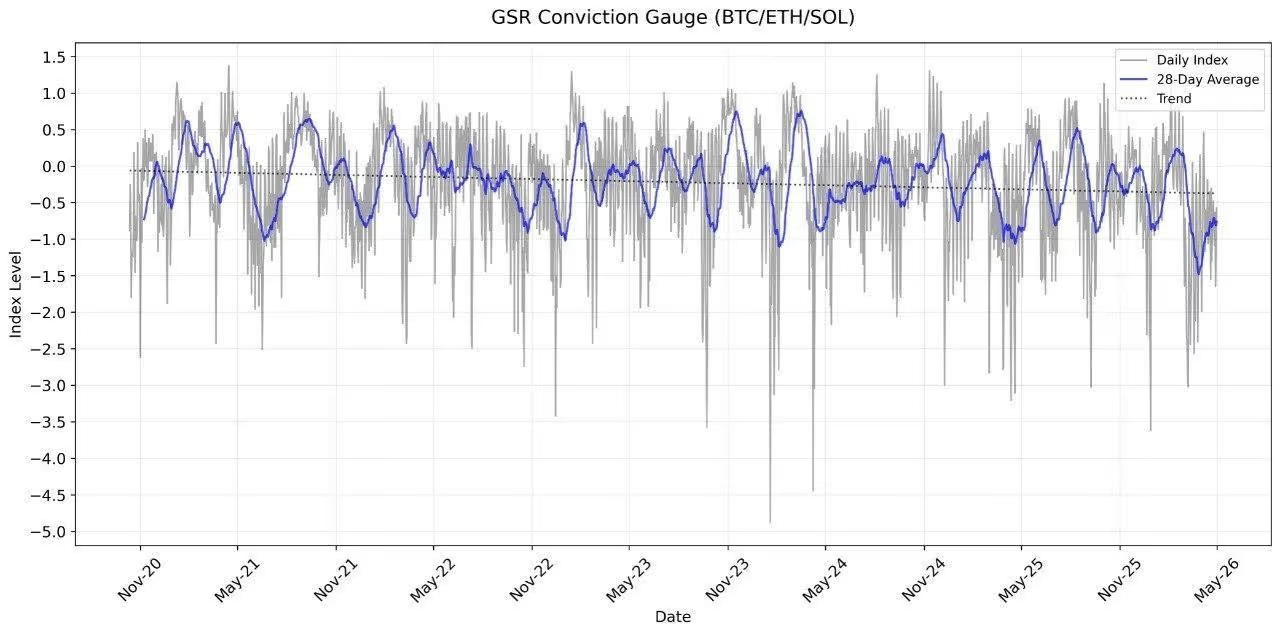
The feeling of … ambivalence ... was so palpable, we developed a Conviction/Ambivalence gauge. In Q1 2026, we hit maximum ambivalence. Other signals point the same way. Funding rates on perpetual futures, a clean read on leveraged appetite, have been persistently low or negative. DeFi borrow rates on Aave drifted toward 3% ahead of a recent exploit, versus 20%+ in the weeks after the 2024 election and 5–7% in more typical conditions. The fast money is elsewhere: oil, equities, prediction markets. Volatility is both a magnet and a product of hot markets, and right now, crypto has a shortage of both.

The Conviction Gauge measures an average ratio of weekly returns to daily returns. Source: GSR
That stands in stark contrast to last year’s Q2 and Q3 rally, which had velocity, power, and breadth. ETH led. SOL pushed hard in August and September. The GENIUS Act added fuel. That was a market with real conviction.
The slower shift that matters more
And yet beneath the surface, something more durable is happening: longer-term investors and their advisors are quietly getting more comfortable allocating to crypto. That shift doesn’t flood X the way a funding rate spike does. Nobody is posting charts about advisors quietly building allocations, but it’s the iceberg that matters. Over time, the effects will be felt, and they will be durable.
And for those allocators, BTC alone is no longer the answer. Its role has been clarified as the macro asset, something that may even behave defensively when markets contract. But advisors are being asked to go further. Clients want exposure to the blockchain growth story: tokenization, stablecoins, the layer-one infrastructure that’s now top-of-fold business news.
So what should the core actually be?
Our answer is straightforward: BTC, ETH and SOL. The power trio. The cycle survivors. Two distinct themes across three assets: BTC as the major macro asset, with ETH and SOL as the layer-ones on which blockchain’s growth story settles. Neck and neck, genuinely competing and we believe, likely to both win.
A solid core holding though, should do more than just sit there. Proof-of-stake assets like ETH and SOL can generate yield through staking, a return stream that passive holders often leave on the table. And you want a product that tilts toward the market: one that reads different environments and adjusts weights to seek excess return, rather than holding fixed weights through every regime.
That’s a lot to ask. So we launched an ETF to make it easy.
The GSR Crypto Core3 ETF (BESO) packages the core BTC, ETH and SOL, with staking rewards on ETH and SOL, and active, research-driven weekly rebalancing. Over time, investors will seek satellite holdings — sectors, themes and factors. But Core3 is designed to do the first job well: core crypto market beta, with staking and active management built in.
– Andy Baehr, managing director, Asset Management at GSR *
Ask an Expert
Q. How is digital asset investing and trading different from traditional assets?
The biggest practical difference is that everything happens on the blockchain. Holdings, transactions, strategies, even the behaviour of a protocol over time, all of it is visible. Anyone with a wallet address and a block explorer can see what you own and what you have done. That is a level of transparency traditional markets simply do not offer. This changes the information environment clients/users are operating in.
The second difference is that price discovery runs 24/7, which means volatility never takes a break either. Then there is self-custody. In traditional finance, custody is someone else’s problem and quite often insured. In digital assets, it’s going to be your problem whether you want it or not. That is empowering, because you genuinely own the asset and no intermediary can gate your access to it. It is also more dangerous because the responsibility for keys, backup and operational security falls on the holder. A lost phrase is a permanent loss and it’s one of the reasons people like CZ (Changpeng Zhao, former CEO of Binance) vouch for storing assets on centralized exchanges.
For advisors this means the conversation with clients is broader than allocation because it also covers custody setup, key management and operational risk in a way it never has before.
Q. How do vaults and onchain finance change the investing vs trading debate?
It is no longer a question of invest versus trade, what I see the market actually debating is which yields are real and which are not. After a few cycles of degen farming, triple-digit APYs and protocols that collapsed, most serious participants have moved on from the question of “how much can I earn” to “how durable is this.”
This is why vaults have been increasing in popularity. A well-designed vault lets capital stay in the market with less manual rotation. So if you deposit into a strategy, and the strategy runs, there is less movement, less clicking, less emotional decision-making. For someone who does not want to trade, that is a clear improvement over what was previously available on-chain, which was mostly either passive holding or active yield farming.
The other important piece is liquidity. A lot of traditional yield products lock your capital up. Private credit funds for example, have redemption windows that run anywhere from a week to a quarter. A vault that issues a liquid token against your deposit gives you something different. Your capital is earning, but you can still move if you need to. That is a real change in how long-term allocations can be structured.
The path this sets up is yield that is perhaps a bit more boring than what crypto has historically offered, but more sustainable. But at least boring doesn’t get you REKT.
Q. As automated vaults handle the technical ‘trading’ (rebalancing, compounding, liquidating), does an advisor’s value-add shift from ‘picking winners’ to ‘curating risk profiles’?
Yes, and a good one at that.
When the mechanics of a strategy are handled by a smart contract, the execution work is no longer where the advisor adds value. Rebalancing happens automatically and compounding happens automatically. Liquidation triggers run on their own logic where none of it needs a human in the loop.
What it does need is a human in the loop as the judgment layer on top. Someone has to look at what is actually available in the market, vet it and decide what is worth putting client capital into. That is more of a due diligence question. Who built this vault? What is the strategy doing underneath? What are the custody arrangements? How has it performed in stress? Is the team credible? Is the audit credible? What happens if a dependency breaks?
You then take the risk appetite of the client and adapt it to the risks the available vaults actually carry. A conservative client might want a tokenized Treasury vault and a stablecoin yield vault. A more adventurous client might accept a DeFi yield vault or an FX strategy vault. Curating risk is human in the loop work.
– Patrick Velleman, chief marketing officer, Valdora CMO
Keep Reading
* Risk Disclosure
Investors should consider the investment objectives, risks, charges and expenses carefully before investing. For a prospectus or summary prospectus with this and other information about the Fund, please call 888-999-5958 or visit our website at gsretps.io/etf/beso. Read the prospectus or summary prospectus carefully before investing.Investments involve risk. Principal loss is possible.
Crypto Currency Risk (Bitcoin (“BTC”), Ether (“ETH”), and Solana (“SOL”) (together, the “Reference Assets”)). The Reference Assets are relatively new innovations and are subject to unique and substantial risks. Crypto currencies are a subset of digital assets, representing blockchain-based tokens that function primarily as mediums of exchange, stores of value, or units of account, whereas digital assets more broadly include any electronically represented asset with economic value, such as tokens, stablecoins, and other distributed-ledger-based instruments.Digital Assets/Cryptocurrency Market Volatility Risk. The prices of the Reference Assets have historically been highly volatile. The value of the Fund’s exposure to the Reference Assets—and therefore the value of an investment in the Fund—could decline significantly and without warning, including to zero.
Market Beta Risk. The Fund seeks to provide core exposure to the cryptocurrency market (‘market beta’) through allocations to BTC, ETH, and SOL. As a result, the Fund’s performance may be significantly influenced by overall digital asset market movements, and the Fund may decline in value when the broader cryptocurrency market declines. The cryptocurrency market is highly volatile and subject to rapid changes.Staking and Validator Risk. When the Fund stakes Reference Assets that utilize proof-of-stake consensus (currently, Ethereum and Solana), the assets are subject to risks attendant to staking generally, such as illiquidity, reliance on third-party service providers, slashing, missed rewards, validator problems, and errors. Staking is the process of putting digital assets to work on a blockchain network to receive rewards and enhance protocol security. By helping the blockchain run more smoothly and securely, rewards are earned in the native blockchain token. Potential staking rewards are earned by the Trust and not issued directly to investors. Liquidity Risk. Unbonding periods for staked Reference Assets may range from several days to several weeks depending on network conditions. Concentration Risk. The Fund’s assets will be concentrated in the sector or sectors or industry or group of industries that are assigned to the Reference Assets, which will subject the Fund to the risk that economic, political or other conditions that have a negative effect on those sectors and/or industries may negatively impact the Fund to a greater extent than if the Fund’s assets were invested in a wider variety of sectors or industries. Foreign Securities Risk. To the extent the Fund invests in foreign securities they may be subject to additional risks not typically associated with investments in domestic securities.Indirect Investment Risk. None of the Reference ETFs or the Reference Assets are affiliated with the Trust, the Adviser, or any affiliates thereof and is not involved with this offering in any way, and has no obligation to consider the Fund in taking any corporate actions that might affect the value of the Fund.New Fund Risk. The Fund is a recently organized management investment company with no operating history. As a result, prospective investors do not have a track record or history on which to base their investment decisions.Non-Diversification Risk. Because the Fund is non-diversified, it may invest a greater percentage of its assets in the securities of a single issuer or a smaller number of issuers than if it was a diversified fund.
Foreside Fund Services, LLC (the “Distributor”)



US lawmakers have introduced legislation to create a federal task force focused on cryptocurrency theft, fraud, and hacking investigations.
Summary
- Bipartisan lawmakers introduced a bill creating a federal crypto crime task force.
- The proposed unit would include the DOJ, FBI, DHS, and Treasury Department.
- The legislation aims to improve investigations, victim reporting, and law enforcement coordination.
The proposal follows a year in which Americans reported more than $11 billion in crypto-related losses. If approved, the measure would establish a coordinated reporting and enforcement framework across multiple federal agencies.
Crypto fraud losses drive call for coordinated enforcement
Bipartisan lawmakers introduced the Federal Cryptocurrency Theft Enforcement and Coordination Act in Congress. The proposal would create a task force led by the attorney general. Officials from the Department of Justice, FBI, Department of Homeland Security, and Treasury would participate.
The bill arrives after a sharp rise in crypto-related complaints across the United States. According to the FBI’s 2025 Internet Crime Report, Americans filed 181,565 cryptocurrency complaints. Those reports resulted in more than $11.3 billion in recorded losses. Investment fraud generated the largest share of those losses. FBI data showed investment scams accounted for approximately $7.2 billion. Complaint volume also increased 21% compared with the previous year.
Older Americans reported the highest losses among all age groups. People over 60 filed 44,555 complaints during 2025. The FBI said those victims lost roughly $4.43 billion through crypto-related schemes. Meanwhile, blockchain analytics firm TRM Labs reported rising criminal activity involving digital assets. According to the firm, wallets linked to illicit activity received $158 billion in cryptocurrency during 2025. The figure stood at $64.5 billion in 2024.
Bill seeks single reporting channel for victims
Representative Lance Gooden and Representative Josh Gottheimer introduced the legislation. The lawmakers said victims currently lack a central place to report crypto-related crimes. The proposal aims to establish a more coordinated response structure.
Gooden said Americans need a unified strategy against cryptocurrency criminals. He argued that fragmented enforcement leaves victims without clear support options. The bill seeks to improve communication between agencies handling crypto investigations.
Under the proposal, the task force would coordinate investigations across participating agencies. It would also develop standardized guidance for local law enforcement departments. Officials would create procedures for handling cryptocurrency theft and fraud cases. The legislation also focuses on victim assistance. Lawmakers said the framework would provide a clearer reporting process. Support services would operate through a centralized federal structure.
Proposal follows changes in federal crypto enforcement
The bill arrives after the Department of Justice disbanded the National Cryptocurrency Enforcement Team in 2025. Officials said the previous unit relied heavily on enforcement actions against industry participants. The current proposal instead focuses on criminal investigations and victim support. Federal agencies already operate several programs targeting digital asset crime.
The FBI’s Operation Level Up identifies scam victims before losses escalate. According to the bureau, the initiative saved more than $225.8 million during 2025. Other agencies also continue crypto enforcement efforts. The Treasury Department’s Scam Center Strike Force has targeted overseas fraud networks. Authorities said the program seized more than $700 million linked to scam operations.
Industry groups have expressed support for the proposal. The Digital Chamber said law enforcement agencies need stronger tools and training. Satoshi Action Fund CEO Dennis Porter said the legislation would provide a coordinated federal response for victims and investigators. The measure must still advance through congressional committees before becoming law. Lawmakers could also attach the proposal to a broader legislative package during the current session.
Archax has introduced real-time yield payments on Hedera, enabling interest generated by tokenized securities to be distributed continuously in USDC.
The system allows interest payments to update automatically as tokenized securities move between wallets. According to Archax, cash flows are transferred alongside the underlying asset, allowing yield to follow ownership in real time.
Most tokenized securities continue to distribute interest through periodic payments, similar to traditional financial products. Archax said its system allows cash flows to accrue and settle continuously, supporting applications such as real-time coupon payments and revenue-sharing arrangements.
The launch builds on Archax’s earlier work on tokenized investment products. In September, the company introduced Pool Tokens on Hedera, allowing multiple tokenized assets to be bundled into a single onchain instrument, including a product backed by money market funds from several major asset managers.
Graham Rodford, CEO and co-founder of Archax, said tokenization was “the first step,” while real-time cash flows could allow tokenized assets to support yield streams and reduce market inefficiencies.
Archax is a UK-regulated digital asset exchange and custodian, while Hedera is a public distributed ledger network used by financial institutions developing tokenized asset products. According to Hedera, Archax’s platform hosts more than $300 million in tokenized assets from six asset managers.
Related: Franklin Templeton, BNP Paribas see tokenization boosting EU’s capital efficiency
Yield-bearing tokenized assets gain traction
Financial institutions are increasingly bringing yield-bearing assets onto blockchain networks, with tokenized money market funds becoming a growing segment of the real-world asset market.
In April, OKX added BlackRock’s BUIDL tokenized Treasury fund to a collateral framework with Standard Chartered, allowing institutional clients to use the yield-bearing asset as trading margin while it remains in regulated custody.
Weeks later, JPMorgan filed to launch a tokenized money market fund on Ethereum designed for stablecoin issuers. The fund will invest in Treasury bills and overnight repurchase agreements, allowing issuers to earn yield on reserves backing their stablecoins.
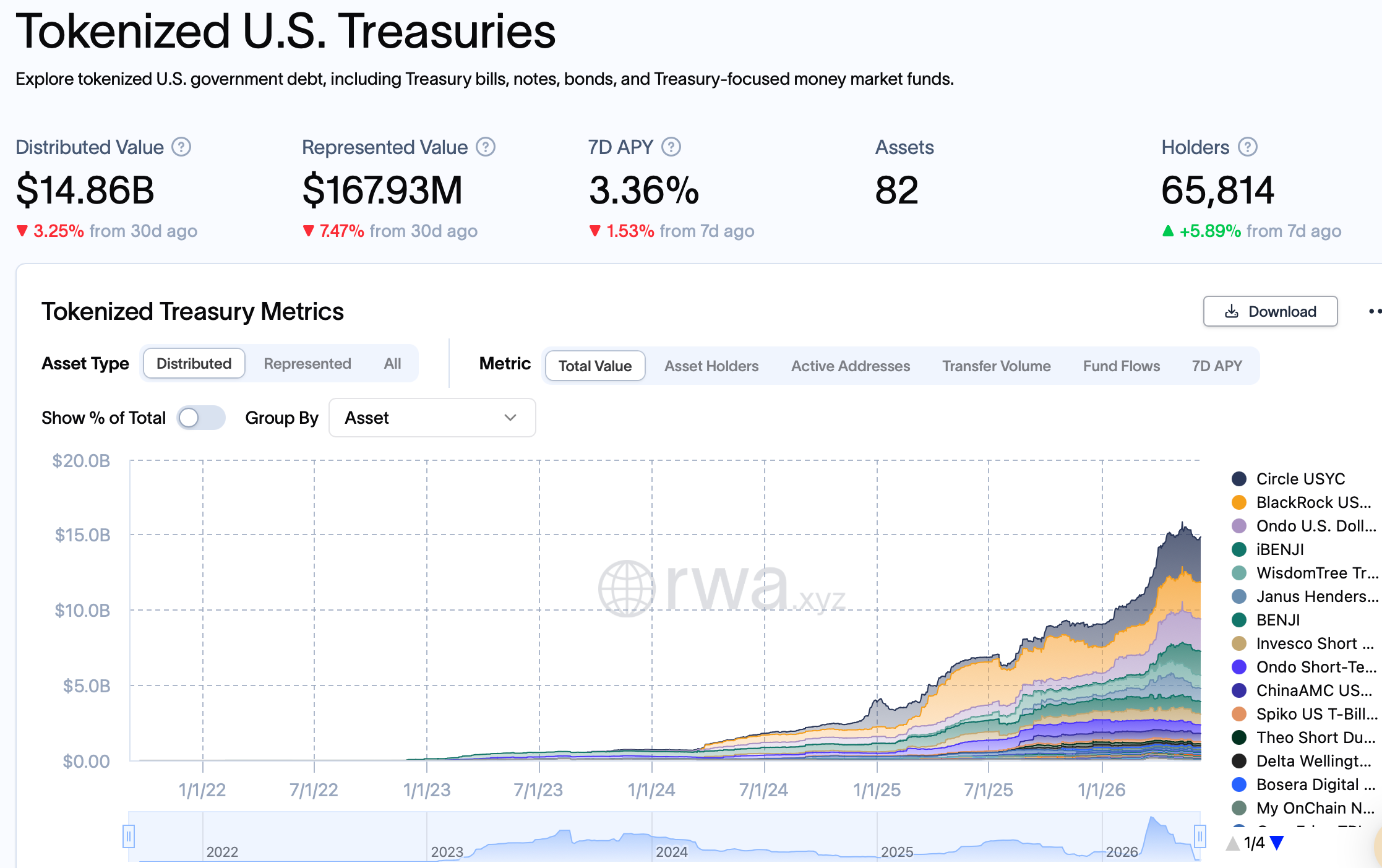
The push comes as tokenized real-world assets continue to expand, bucking broader weakness in the crypto market. According to Binance Research, the value of active tokenized RWAs has increased 589% since early 2025, with tokenized bonds and money market funds adding roughly $6.5 billion in value over the period.
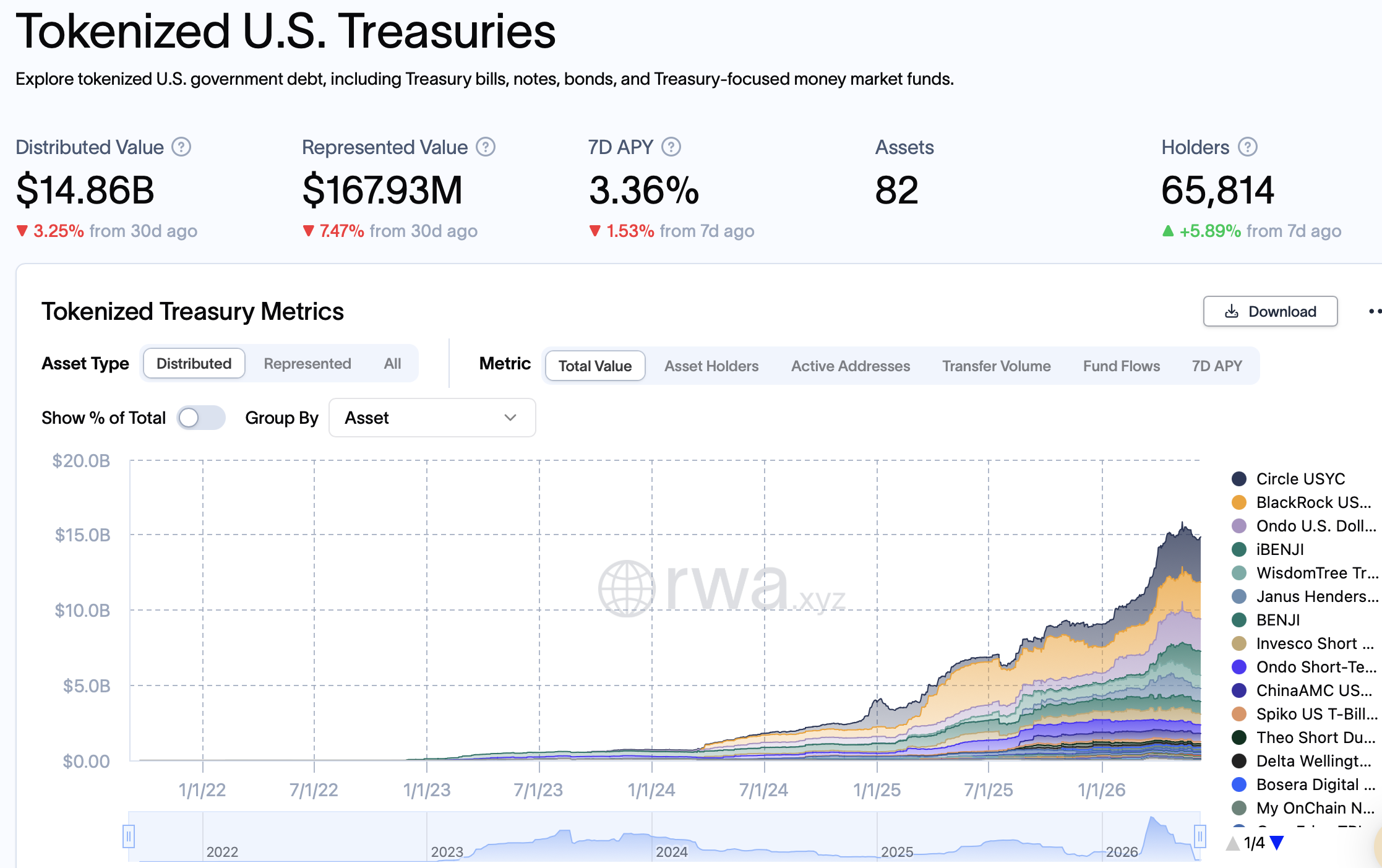
Growth in tokenized US Treasurys began climbing in early 2025. Source: RWA.xyz
Magazine: Does ‘Paper Bitcoin’ mean there’s an unlimited supply of BTC?
New artificial intelligence (AI) models have shifted the cybersecurity playing field in favor of attackers, causing a “vulnerability apocalypse” that led to the resurgence in decentralized finance (DeFi) hacks, according to Mitchell Amador, the CEO of bug bounty platform Immunefi.
The proliferation of new AI models, such as Claude Opus 4.8 and ChatGPT 5.5, is the main reason that led to the resurgence in crypto hacks in 2026, Amador told Cointelegraph at the recent WAIB Summit in Monaco.
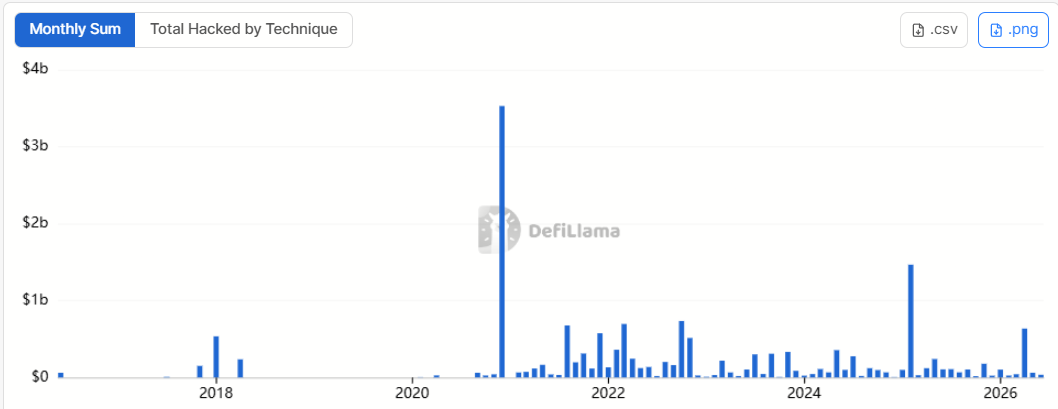
Hacking activity across the industry surged in April 2026, with illicit actors stealing more than $634 million from cryptocurrency platforms, the highest monthly total since the Bybit hack helped drive losses to roughly $1.4 billion in February 2025, according to DefiLlama data.
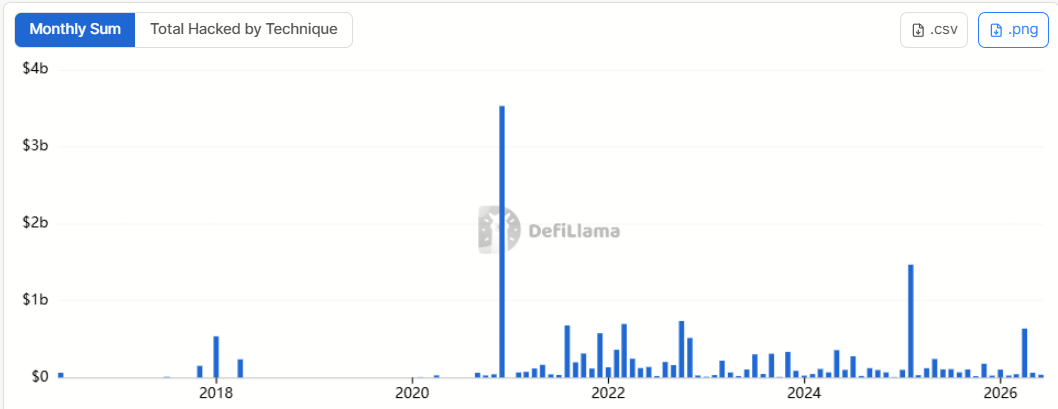
Total crypto hacks by monthly sum, all-time chart. Source: DefiLlama
Crypto needs to survive the next three to four years
The next three to four years will be a crucial survival period for the crypto industry, until cybersecurity teams harness the defensive capabilities of these same AI models to build “impregnable” codebases that attackers won’t be able to breach, said Amador.
This timeline could shrink to less than two years if the industry adopted more “crowdsourced security solutions” until cybersecurity researchers turn these AI models to their advantage, he added.
Amador’s comments followed the release of Anthropic’s latest Claude Mythos model, Fable 5, which sparked industry concerns over its potential ability to accelerate cryptocurrency exploits.
Anthropic said on Tuesday that Fable 5 has safeguards that reroute topics such as cybersecurity to a different model, Claude Opus 4.8.
Related: Recovery hopes fade as Kelp DAO hacker launders nearly all $220M in stolen funds
The industry has become increasingly sensitive to security risks after a string of major DeFi exploits renewed concerns about protocol vulnerabilities.
On April 19, an attacker drained about 116,500 restaked Ether (rsETH), worth roughly $290 million to $293 million at the time, from Kelp DAO’s LayerZero-powered rsETH bridge.
LayerZero said Kelp DAO’s 1/1 decentralized verifier network (DVN) setup created a single point of failure by relying on a single verifier path for cross-chain messages. LayerZero said it had previously advised against that configuration.
Magazine: The legal battle over who can claim DeFi’s stolen millions


The US government has transferred nearly $984,000 in cryptocurrency linked to Alameda Research and FTX.
- The US transferred nearly $984K in seized FTX and Alameda-linked crypto.
- About $768K of the funds moved to Coinbase Prime, according to Arkham data.
- Arkham data shows US government crypto holdings total about $20.93B.
Blockchain data shows that most of the funds moved to Coinbase Prime as authorities continue managing seized assets. The transfers form part of ongoing efforts tied to the recovery and distribution process following the FTX collapse.
Coinbase Prime receives portion of seized FTX funds
Arkham Intelligence data showed movement from wallets connected to seized Alameda and FTX assets. The transfers totaled approximately $984,000 in cryptocurrency. Of that amount, about $768,000 moved to Coinbase Prime.
The transactions occurred as authorities continue overseeing digital assets recovered from the bankrupt exchange. The funds remain linked to broader bankruptcy and recovery proceedings. Current records point to the FTX Estate as the eventual destination of recovered assets.
Government agencies have gradually managed seized cryptocurrency through transfers and liquidation activity. These actions support efforts to return value to affected creditors. The latest movement represents a small portion of assets held under government control.
FTX recovery process continues through asset management
Authorities seized multiple cryptocurrency holdings connected to Alameda Research and FTX after the exchange collapsed. Since then, officials have managed those assets through established recovery procedures. The process includes custody, transfers, and liquidation when required.
The FTX Estate continues working to recover and distribute value to creditors. Recovered assets form a key part of that effort. Government-managed transfers help move seized holdings through the recovery framework.
Blockchain monitoring platforms continue tracking wallet activity connected to seized assets. Arkham Intelligence reported the latest transactions through publicly visible blockchain records. The transfers added another step in the long-running FTX recovery process.
Bitcoin remains the largest asset in government crypto holdings
According to Arkham data, the US government currently controls a cryptocurrency portfolio worth about $20.93 billion. Bitcoin accounts for the majority of those holdings. Government wallets hold approximately 328,354 BTC valued at around $20.57 billion.
The portfolio also includes roughly 62,437 ETH worth more than $103 million. Other holdings include USDT, WBNB, BNB, WBTC, and additional digital assets. These assets originate from separate enforcement actions and seizures.
Although the recent $984,000 transfer represents a small fraction of total holdings, it remains part of active asset management. Government agencies continue processing seized cryptocurrency tied to major enforcement cases. The latest movement highlights ongoing efforts connected to the FTX and Alameda recovery proceedings.

TLDR
- Federal prosecutors charged two suspects in a $389M crypto money laundering case.
- Authorities linked the operation to AudiA6, a bitcoin mixing and cybercrime forum network.
- The group allegedly processed over 10,000 BTC and earned millions in fees.
- Investigators traced funds connected to darknet markets and ransomware activity.
- International agencies conducted coordinated arrests and seized digital infrastructure.
Federal prosecutors in Philadelphia charged two men in a $389 million crypto laundering case. Authorities linked the operation to a global network using bitcoin mixing services and darknet platforms. Officials said arrests occurred in Georgia after a coordinated multinational enforcement action.
Crypto Money Laundering Charges Linked to AudiA6 Network
Ruslan Tkachuk and Alexander Ledenev face conspiracy charges tied to a crypto money laundering scheme. They allegedly operated a service processing large bitcoin flows across multiple wallets globally coordinated.
Prosecutors said AudiA6 handled about 10,333 Bitcoin worth $389.7 million. The group earned over $10 million through transaction fees up to 5% and the platform network-wide.
Authorities traced about 393 Bitcoin linked to darknet markets and ransomware groups, investigators confirmed. They said additional funds entered indirectly through criminal networks.
Officials said undercover agents conducted six operations between 2022 and 2026. Agents posed as criminals seeking laundering services for illicit proceeds operations.
In one exchange, operators accepted stolen bitcoin without restrictions, prosecutors said. In another, they instructed that all funds must pass through mixers transactions.
Prosecutors said blockchain analysis exposed traceable flows through exchange records systems. They said marketing claims of full anonymity did not match transaction trail activity.
Charges include conspiracy to launder monetary instruments and money laundering offenses charges filed. Each count carries a maximum sentence of 20 years in prison.
Dark2Web Forum and International Arrest Operation
AudiA6 operated Dark2Web, a forum used for cybercrime coordination and payments in an online marketplace. Users negotiated illicit services, including scams and narcotics-related transactions.
Authorities said the platform functioned alongside a bitcoin mixing infrastructure framework layer. It supported transactions designed to obscure fund origins across wallets.
FBI and Secret Service agents conducted undercover exchanges over several months. They engaged operators posing as criminals seeking laundering services investigations period.
Operators responded with statements supporting unrestricted laundering of illegal funds for illicit activity. One operator said “don’t care” when asked about stolen Bitcoin sources.
A coordinated operation involved Europol and multiple international law enforcement agencies across the operation. Searches targeted properties, digital devices, and cryptocurrency-linked accounts.
Authorities froze assets, seized devices, and replaced websites with seizure banners. They also blocked Telegram channels linked to the AudiA6 network channels.
U.S. officials plan extradition proceedings for both suspects from Georgia. The Eastern District of Pennsylvania continues prosecution led by federal attorneys.



Digital Asset, the company behind the Canton Network institutional blockchain, has closed a $355 million funding round led by a16z crypto, with participation from HSBC, Apollo, CME, BNP Paribas, ABN Amro, ADIA, S&P Global, Tradeweb, and more than 20 other institutional names. The round, announced… Read the full story at The Defiant
Coinbase launched a standalone account product for AI agents, letting assistants including ChatGPT and Claude execute trades, manage portfolios, and pay for data autonomously under user-defined guardrails. Coinbase for Agents went live Thursday as a separate account from the main Coinbase app…. Read the full story at The Defiant
XRP has entered a crucial support region after suffering an aggressive selloff over the past two weeks. While buyers have managed to prevent a deeper breakdown for now, the asset remains trapped within a broader downtrend, leaving the current rebound vulnerable unless key resistance levels are reclaimed.
Ripple Price Analysis: The Daily Chart
The daily chart shows XRP trading inside a long-term descending channel, with the price recently breaking below the lower boundary of a multi-month consolidation range.
The recent selloff pushed XRP into the highlighted support region around $1.08-$1.20, where buyers managed to generate a reaction. However, the recovery has been relatively weak so far, indicating that demand remains limited. As long as the asset stays beneath the former support zone around $1.70-$1.85, any upside movement is likely to be viewed as a corrective bounce rather than a trend reversal.
On the upside, the first significant resistance sits near the descending channel boundary and the 100-day MA around $1.35-$1.40. A successful reclaim of that area would be needed to improve the technical outlook. Beyond that, the $1.70-$1.85 supply zone represents the next major obstacle. Failure to hold the current demand area could expose the lows around $1.05 and potentially open the door for a deeper decline.
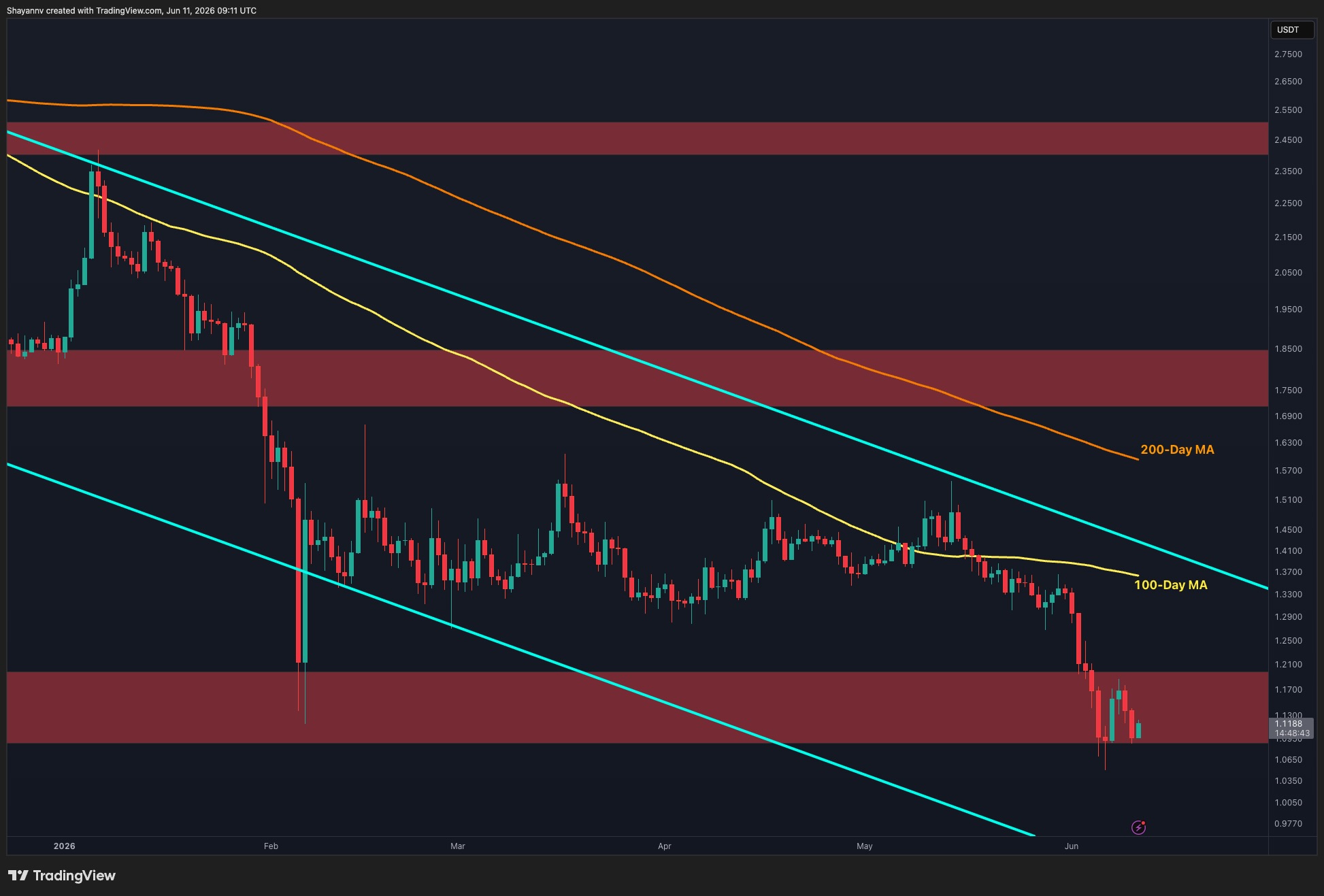
XRP/USDT 4-Hour Chart
The 4-hour chart provides a clearer view of the recent breakdown. The recent sharp drop eventually found support near the red demand zone around $1.08-$1.10, which coincides with the measured move target from the breakdown. Since then, XRP has staged a modest recovery, but the bounce has so far produced only a lower high structure, keeping the short-term trend bearish.
For bulls, reclaiming the $1.21 level would be the first sign that momentum is stabilizing. Above that, the $1.25-$1.30 region remains the most important resistance cluster, as it combines previous support turned resistance with multiple Fibonacci levels. A breakout above this zone could trigger a stronger relief rally toward $1.36.
On the downside, the $1.08-$1.10 support area remains critical. A decisive breakdown below this zone would invalidate the current rebound attempt and increase the probability of a retest of the $1.05 swing low shown on the chart.
Overall, the higher timeframe trend remains bearish, while the 4-hour chart suggests XRP is attempting to build a short-term base above support. The next directional move will likely depend on whether buyers can reclaim the $1.21-$1.30 resistance cluster or whether sellers force a breakdown below $1.08.

The post Ripple Price Analysis: XRP’s Weak Recovery Points to More Downside Ahead appeared first on CryptoPotato.

Bitcoin’s slide toward a key on-chain support level has sparked debate after market analyst Shanaka Anslem Perera argued that the behavior usually seen at major market bottoms is still missing.
According to him, BTC came within 9% of the price level that has historically ended bear markets, but investors didn’t sell in the numbers usually associated with capitulation.
Bitcoin Nears Realized Price, But Selling Pressure Looks Different
The metric in question is Bitcoin’s realized price, which is currently around $53,600, and represents the average cost basis across every BTC in circulation.
In a June 11 post on X, Perera stated that in 2018 and 2022, the OG cryptocurrency fell to that level and bounced. Those rebounds, according to him, weren’t coincidences but were because of what happens after Bitcoin comes close to its realized price. Holders often break, selling at a loss in large enough numbers that the supply gets flushed, weak hands leave, and the market finds solid ground again.
But that flush hasn’t happened this time around. In the 2022 capitulation, Perera says holders sold 1.2 million BTC at a loss, but in last week’s drop, the number was only 187,000 units.
Essentially, Bitcoin approached the same price floor without the same behavior, which, per the analyst, is precisely what made that moment ambiguous rather than confirming.
“Bitcoin reached the bottom’s address without the bottom’s behavior,” he wrote. “The flush that clears weak hands and ends bear markets has not happened.”
In his opinion, the dip was driven by disappearing demand rather than panic selling. He pointed to a drop of 652,000 BTC in demand last week, which he described as the worst decline since January 2022, and also noted that spot Bitcoin ETF flows had been hugely negative.
Bitcoin’s cause has not been helped by escalating geopolitical tensions after Iran once again closed the Strait of Hormuz following US strikes on its military infrastructure, sending the price of crude oil jumping by more than 2.5%.
Furthermore, the US Consumer Price Index came in at a higher-than-expected 4.2%, effectively ruling out Fed rate cuts and raising the possibility of hikes under the new Federal Reserve Chair, which added to concerns about reduced market liquidity.
Long-Term Holders Still Steady Despite Market Pressure
One other thing that Perera pointed out in his assessment was that the lack of selling can also be interpreted as a bullish signal.
“The realized price has marked four of the last four major bottoms, and long-term holders are sitting still rather than selling. That is the bull case,” he explained.
That view echoes comments from another market observer, Sykodelic, who noted that long-term holders collectively control a record 16.5 million BTC despite many positions sitting below the prices they were bought for.
Other firms have reached similar conclusions while stopping short of calling a bottom. For instance, Grayscale has said that Bitcoin currently looks undervalued, even though it warned that the conditions right now are not as extreme as past bear market lows.
The post Bitcoin Nears Realized Price But Capitulation Signals Are Missing: Analyst appeared first on CryptoPotato.
Crypto World
Silver Price is Down Nearly 50% from Record High, and This Trendline is the Last Defense
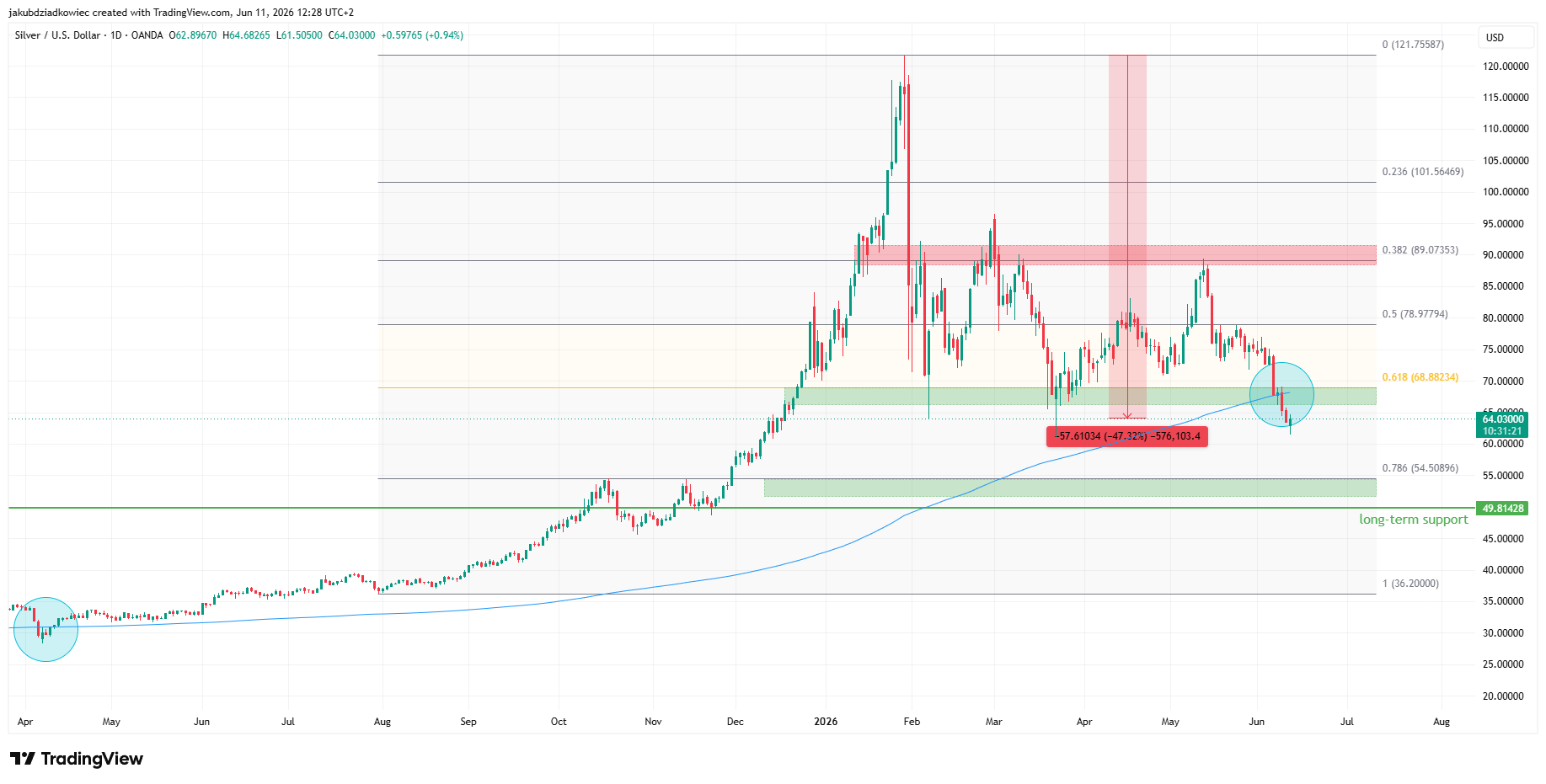
Silver (XAG) closed below its 200-day moving average on June 9 for the first time since April 2025. Silver price now trades near $64 after falling about 47% from its January all-time high (ATH) of $121.75.
The breakdown removes a trend support that held through the entire bull cycle. However, a four-year trendline in the daily Relative Strength Index (RSI) is approaching its fifth test.
Silver Loses the 200-Day Moving Average for the First Time Since April 2025
Silver closed below the 200-day moving average on June 9 and extended the decline a day later. The price printed a low at $61.50 on June 11 before a modest bounce to around $64.
The previous close below this average came on April 4, 2025. Back then, silver spent only three days under the line before reclaiming it. The current breakdown looks different because it follows a 47% drawdown rather than a brief pause in an uptrend.

Sellers also took out the support near $69, which aligned with the 0.618 Fibonacci retracement of the rally from $36.20 to $121.75. An earlier BeInCrypto analysis had already flagged the risk of a slide to $63.
The next major support sits near $54.50, at the 0.786 Fibonacci level. Below that, the $50 area marks strong long-term support and the previous record high. Meanwhile, the 0.382 Fibonacci level near $89 remains the key resistance.
A 4-Year RSI Trendline Faces Its Fifth Test
The bearish price structure has one important counterweight. The daily RSI has been trading above an ascending trendline since May 2022.
The line has already produced four bounces (blue circles) in May 2022, March 2023, October 2023, and April 2025. Notably, the April 2025 touch coincided with silver’s quick recovery above the 200-day moving average.

The indicator now reads near 30 and approaches the trendline for the fifth time. A bounce here could reset momentum and fuel a counter-trend rally. In contrast, a clean break would end the four-year pattern and confirm that bearish momentum dominates.
The signal carries extra weight because a May prediction from BeInCrypto already warned of further losses once key supports failed.
Silver Price Prediction as Precious Metals Sentiment Turns Capitulatory
The drawdown extends across precious metals. Trader BullTheoryio estimated the combined damage in a post on X.
“BREAKING: Over $12.95 trillion has been wiped out from gold and silver in just 132 days. Gold has crashed -26.50% from its January peak… Silver is down -47.69%, wiping out $3.2 TRILLION.”
According to the same post, the selloff happened while the Iran conflict stayed active, oil traded near $90, and inflation remained elevated. These are conditions that have historically favored metals, which makes the decline more striking.
Mockery from Bitcoin circles adds a final signal of sentiment. On-chain analyst Checkmatey ridiculed the crash with a satirical post about Jane Street using a quantum computer to mine asteroids and inflate the supply of metal to infinity.
Such open derision of an asset class often clusters near capitulation phases, though it offers no timing guarantee.
If the RSI trendline holds, the silver price could attempt a recovery to the broken $69 area. A reclaim of that zone would open the way to the 0.5 Fibonacci level near $79. Only a move above the $89 resistance would invalidate the broader bearish structure, a scenario explored in a recent outlook on physical market tightness.
If the trendline breaks, the path opens to $54.50, then to $50. Silver’s fate now rests on a single momentum line that has not failed in four years.
The post Silver Price is Down Nearly 50% from Record High, and This Trendline is the Last Defense appeared first on BeInCrypto.

World Cup starts in Mexico City

Euro-Office 1.0 Arrives To Open-Source Infighting: ‘Compatibility Is Not Sovereignty’

Trump says deal to end Iran war is close after calling off strikes



-

 Fashion6 days ago
Weekend Open Thread: Evereve – Corporette.com
-
 Crypto World7 days ago
Jensen Huang Approves Samsung, SK Hynix, and Micron for NVIDIA (NVDA) HBM4 Memory Supply
-

 Crypto World4 days ago
Anatomy of the June crypto crash: Fed, Iran, Saylor
-
 Entertainment5 days ago
The Best Mystery Series of All Time Is Surging on Streaming 30 Years After It Ended
-

 NewsBeat4 days ago
Alexander Zverev wins the French Open to finally earn a 1st Grand Slam title
-

 Tech6 days ago
Suspicious Polyfill login prompts pop up on Toshiba, Muji websites
-
Crypto World5 days ago
Senator Cynthia Lummis Calls CLARITY Act the Most Consequential Financial Legislation of This Generation
-

 Tech7 days ago
Microsoft launches MXC, an OS-level sandbox for AI agents, with OpenAI and Nvidia already on board
-

 Tech5 days ago
Microsoft unveils seven homegrown AI models in new bid for ‘long term self-sufficiency’
-

 Business7 days ago
(VIDEO) Justin Bieber Delivers Surprise Happy Birthday Serenade to Diners at Los Angeles Mexican Restaurant
-
 NewsBeat4 days ago
Alexander Zverev conquers demons and outlasts Flavio Cobolli to win French Open for first major title
-
 Business5 days ago
The Pain Points Taking a Fragile Tech Rally Down a Notch
-

 Business4 days ago
High Stakes for Wembanyama as New York Pushes for 3-0 Lead
-
 Crypto World4 days ago
Eli Lilly (LLY) Stock Surges 4% Following Breakthrough Sleep Apnea Trial Results
-

 Tech6 days ago
Von der Leyen’s AI envoy pick draws conflict-of-interest fire
-

 Tech7 days ago
Meta steals a tactic from Tesla and builds data centers in tents
-
Crypto World7 days ago
LBank Surpasses 25 Million Users Worldwide as AFA Partnership Continues to Drive Global Growth
-

 Tech6 days ago
Hackers now exploit SolarWinds Serv-U flaw to crash servers
-

 Crypto World5 days ago
Trump’s AI Ownership Plan Could Benefit Anthropic at OpenAI’s Expense
-
 Sports2 days ago
Bangladesh beat Australia after 20 years in ODIs, register only their second win over six-time world champions | Cricket News
You must be logged in to post a comment Login