That rumored foldable iPhone didn’t come from nowhere. Experts from CNET, PCMag, Mashable, Popular Science, ZDNET and Lifehacker examine Apple’s most important tech reveals.
Back in my college days, I remember recording lectures on a budget Android phone, hoping to save all the important information right before exams. Yes, it wasn’t a perfect solution. My phone’s microphone wasn’t the best, and sorting through an hour-long lecture just to find something was like looking for a needle in a haystack. The same problems still apply in my professional life. I like to record in-person meetings because of my goldfish memory, but it’s a bit of a faff. And I’m not alone. Many professionals suffer from this exact problem, which is the reason the iFlyTek P1 and P1 Pro exist.
In essence, they are AI voice-recording devices that help you record meetings, transcribe them, and provide detailed summaries of what needs to be done and when. You can also translate meetings into different languages. They also work as conventional voice recorders for taking interviews and such, but the real appeal is with the Deepting app. But should you spend $119 on the P1 or $159 on the P1 Pro? To find out, I’ve been testing both for the better part of two weeks, recording meetings and sorting through all the information and its legitimacy.
iFlyTek P1 & P1 Pro Review
Hisan Kidwai
Advertisement
Summary
The iFlyTek P1 and P1 Pro solve the genuine problem of recording and sorting through meetings, turning it into an automated experience that requires little oversight. The recording quality, even for larger conferences, was excellent, and iFlyTek’s AI does a really solid job of transcribing the content. This, coupled with the fact that you can ask questions about the meeting directly, makes both genuinely useful tools.
Advertisement
Design & Hardware
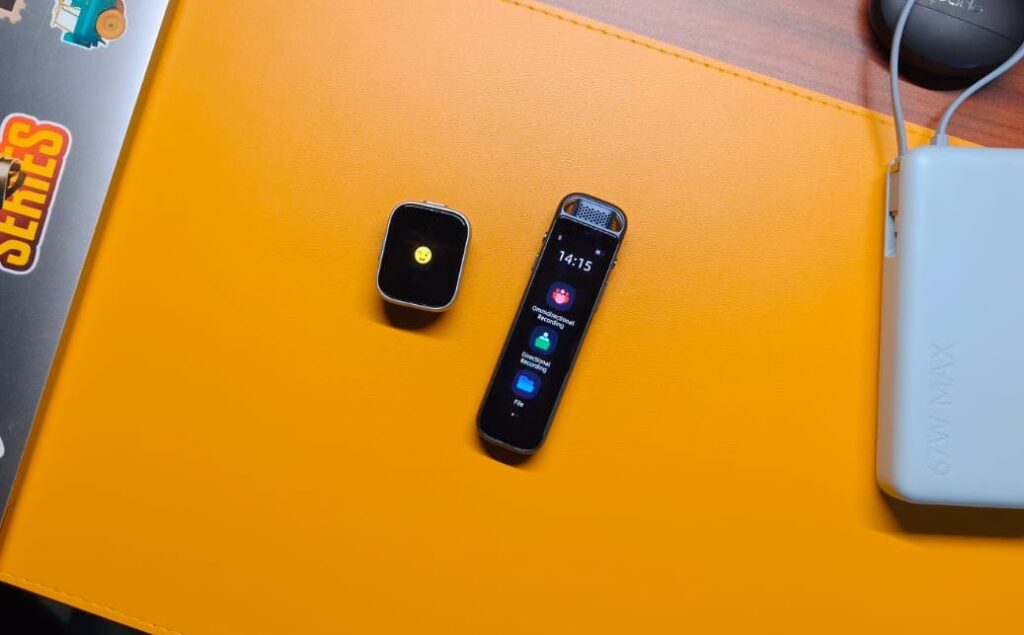
The iFlyTek P1 and P1 Pro are fundamentally different devices. Yes, both record meetings, but that’s where the similarities end. Starting with the P1, it looks like a smartwatch. A small rectangular device with a display on the front and buttons on the top and left side. The first time I unboxed it, I mistook it for an Apple Watch, and I wasn’t the only one who thought that. The second thing I noticed was the weight, or lack thereof. The P1 is extremely light because you actually have to wear it. It comes with a magnetic accessory, which sticks to the back. You can either hook the magnet onto your shirt, like those fancy microphones, or use the clips. The latter are spring-loaded so they won’t fall off whenever you move.
The build is plastic, but I don’t mind since the P1 is extremely well made, with no moving parts or loose ends. There are two buttons on the device, each serving a different purpose. You power it on by holding the button on the left side for two seconds. Now, press the top button for two seconds to start/stop recording. So what does the display actually do? Well, that’s a great question you may have asked. The display on the P1 is very small. Possibly the smallest display I’ve ever seen to date. And it’s not that useful. All it does is show a winking emoji when the device powers on and a microphone emoji when it’s recording. Nope, you can’t change any settings or listen back to what you just recorded. For all that, you’ll need to rely on the Deepting app.
If not having a screen or speakers to play back what you just recorded is a problem for you, then the P1 Pro is what you need. It ditches the smartwatch form factor for a more elongated design, with a 3.2-inch OLED display nestled in between. It runs on custom software, allowing you to toggle between omnidirectional and directional recording, check the stored files, and adjust settings. The screen is plenty responsive, and iFlyTek has designed the UI quite thoughtfully. You also get a more premium metal-and-glass build, along with an extra flagging button to mark important moments of a meeting. Sadly, you can’t hook the P1 Pro to your clothing, so it’s more of a hands-on tool you might see people using during interviews.
Microphones & Recording Quality
As with the design, the microphones on the iFlyTek P1 and P1 Pro are different. The smaller one has two mics that can record either omnidirectional or directional audio. iFlyTek says it can record someone speaking clearly up to 5 meters, but I found the reality to be different. With some background noise, you should always aim to be around 3-4 meters max from the subject, after which the AI will have a hard time transcribing all the information. Speaking of the quality, I like it. The mics pick up conversation effectively without letting background noise interfere much. You will hear the playback clearly and not have to guess what the subject was saying.
The P1 Pro adds an extra mic, bringing the total to three. This increases the effective range of the P1 Pro to 10 m, which should be sufficient for recording conference room meetings. There is also support for 96 kHz/24-bit hi-res audio, which I put to the test when doing an interview with an eSports player at a PUBG Mobile tournament. Despite the abysmally loud background music, the P1 Pro picked up both of our voices surprisingly well, and the details were on point. I also put it in a conference room, and it effectively picked up voices from about 8 m away. Though after that, picking up quieter words became a problem. Both devices come with 64GB of onboard storage, which should be sufficient for years to come.
App Experience
So far, I’ve been impressed by the iFlyTek P1 and P1 Pro, but the app experience is the real deciding factor. Both devices pair with the Deepting app, available on both the Google Play Store and the App Store. Once paired, the app gives you unlimited cloud storage and 300 minutes of transcription every month. That was enough for a casual user like me, but if you’d be using it every day, I can see this being limiting. If that’s the case for you, there’s a Deepting Pro subscription. I’m not the biggest fan of subscriptions, but it does give you 1800 minutes of transcription, so you can be the judge.
All that aside, the recordings are synced from the device pretty fast. Each recording is stored separately, and you can play them at different speeds. There is a transcribe button front and center, which uploads your conversations to a remote server for processing. As for the quality itself, I found no problems. The transcription was accurate over 95% of the time, with clear separation between speakers, sentences, and pauses. It can sometimes mess up specific names, but that wasn’t a big problem and happened only 1 out of 10 times. You can also translate these transcriptions into 11 different languages.
Advertisement
On the top right, there’s the AI button, which itself has three sections: Overview, Notes, and Ask AI. The first gives you a concise summary of the meeting. If you want more detail, then the Notes section is where you need to be. It formats the content into headings, points, and other elements, which was great for digging up important information from an hour-long corporate jargon meeting. There’s also this ChatGPT-powered Ask AI feature. With it, you can ask questions about the meeting directly, instead of having to find everything yourself.
Verdict
After extensive testing, I can say both the iFlyTek P1 and P1 Pro deserve a place in the market. They solve the genuine problem of recording and sorting through meetings, turning it into an automated experience that requires little oversight. The recording quality, even for larger conferences, was excellent, and iFlyTek’s AI does a really solid job of transcribing the content. This, coupled with the fact that you can ask questions about the meeting directly, makes both genuinely useful tools. Yes, they do have a few flaws, namely the subscription, but if you have a use case, you should consider them.
As data center developers compete for a cut of the hundreds of billions of dollars flowing into the artificial intelligence industry, the queue to join the UK’s power grid has become jammed with projects that will likely never get built. The snarl is exacerbating already years-long wait times for viable projects, and it’s messing with attempts to forecast energy demand and plan grid expansions.
In July, the UK’s energy regulator, Ofgem, laid out a proposal meant to force phantom data centers out of the swollen queue. Under the plans, set to be finalized after an industry feedback process that ends in September, developers would be required to put down a steep, nonrefundable deposit that could balloon to hundreds of millions of dollars for the very largest data centers. Developers would also be required to line up customers in advance and prove they have the funding to complete their builds.
However, Ofgem faces a Goldilocks conundrum: The reforms must be burdensome enough to deter speculators but not so much that they drive legitimate data center projects to other shores, undermining the UK’s ambitions to meet the voracious demand for the compute required to run sophisticated AI models.
Data center developers face delays almost everywhere; similar grid congestion issues afflict the US and countries across Europe. But whereas the US is a highly desirable market, Ofgem’s reforms risk making the UK—already unattractive for the high cost of energy and dearth of land—one of the world’s most expensive places to build a data center, industry experts believe.
Advertisement
The frenzied data center buildout “is bringing a huge amount of capital investment into the UK,” says Alex Burgoyne, head of data centers at real estate consultancy Knight Frank. “We don’t want to shoot the golden goose.”
Ofgem says that it will take into account industry concerns before settling on a fee, but that differences between international energy markets make like-for-like comparison difficult. “We recognize data centers are a key part of the UK’s AI ambitions and future economic growth. Enabling viable data centers to connect more quickly is an enabler of this,” Nathan Macwhinnie, deputy director of strategic planning and connections at Ofgem, tells WIRED in a statement.
The queue to join the UK grid began to balloon toward the end of 2024, around the time the government designated data centers “critical national infrastructure.” Between November 2024 and June 2025, the total energy demand of the projects in the connection queue increased from 41 gigawatts to 125 gigawatts, according to Ofgem. New data centers make up 73 gigawatts of that—equivalent to one and a half times the peak demand for the entire UK last year—and counting.
The government has said it believes much of that demand is a mirage. “It’s absolutely insane,” says Taco Engelaar, managing director at grid optimization company Neara. “No one really understands … what the real grid demand will be because of these phantom projects.”
Advertisement
The crowded queue is largely the product of an incentives problem. Because developers face a years-long wait for grid access, and it has previously cost only a few thousand dollars to join the queue, they might as well apply for power, even if they do not have a watertight plan to develop a site. It’s a no-downside bet that allows developers to hedge for a future in which demand for compute remains sky-high.
However, because grid operators have to account for the combined effect of large infrastructure proposals on network stability before granting individual connections, phantom data centers can exacerbate already-lengthy delays for viable projects. “They have to treat every project as serious when they try to study whether the system can handle them,” says Olivier Darmouni, associate professor of finance at HEC Paris Business School, who has published research on the impact of AI on power grids. “The more speculative projects are especially damaging because they make these studies more complex, more expensive, longer.”
Star Wars Zero Company is earning strong reviews for bringing XCOM-style turn-based tactics to the Star Wars universe. Critics are praising its cinematic presentation, characters, and grittier story, while pointing to some occasional performance issues.
By now you’ve almost certainly heard the news that Meta has settled with 52 state and local Attorneys General who had sued the company in some form or another over child safety on Meta’s platforms. The headlines are all covering the basics: the years-long case these states filed against Meta ends, and Meta pays somewhere between $12.7 billion and $18 billion, depending on which document you read (the consent judgment itself caps the total at $16,680,647,753.21; Meta’s press release rounds it up to “approximately $18 billion”). Also Meta will implement a bunch of changes to its platforms with the aim of improving child safety on those platforms. It will also “encourage” YouTube and TikTok to enable the same safety features even though (bizarrely), if YouTube and TikTok follow suit, then Meta will have to pay more.
Notably, the whole point of doing this as a “settlement” is that everyone involved knows full well that no government could mandate these feature changes without violating the First Amendment. But now that it’s in a “settlement” the courts may need to explore if these choices — which Meta could make freely on its own — suddenly have become a “state action,” implicating the First Amendment.
As with the various rulings against Meta over the last few months, people are cheering this on, without realizing the damage it will do. We’ll explore why this is problematic in a moment, but just to highlight that I’m not alone in thinking so, both EFF and Fight for the Future are warning how bad this settlement is. Here’s EFF:
Advertisement
Underthis settlement, young users will now have less access to Meta products, and a lesser ability to exercise their rights to speak, access information and art and culture, associate and form communities, and play. The settlement also embeds age assurance into every product, mandating the collection of even more personal information from users of all ages; this enshrines Meta’s harmful surveillance into law, and it will compromise users’ privacy and anonymity while increasing their exposure to data breaches and government data requests. And the data minimization and security measures don’t keep states from using data collected under the agreement for other law enforcement purposes – which could include things like criminal investigations of abortions or gender-affirming care.
And here’s Fight’s emailed statement:
Big Tech does pose harm to our kids through its business practices and exploitation, but pushing for more censorship, age-gating, and surveillance of young people at the hands of the same Big Tech companies that have already harmed young people is not the answer. Online ID checks when implemented put vital information behind age-gates, stamp down teenagers’ right to speak, and expose all of us to even more of our data being collected, hacked, and leaked. Meta knows that managing this amount of personal information and enforcing these agegates will be messy and that’s why they are seeking to offload the burden to anyone but themselves, while being seen to comply by the public and lawmakers. Instead of actually damaging their exploitative business model, this result allows Meta to bring everyone else down with them, from app stores to other social media companies. We feared that these lawsuits would manufacture consent for invasive age verification and content controls and our fears have been proven correct. We will continue to oppose online ID checks everywhere and be on the watch for more censorship creeping into Meta’s platform.
We’ll get into the specifics of why this settlement is so bad, but first some important background. For a few decades now, when basically all Attorneys General would get together to threaten and/or sue tech companies, it was almost always over bullshit headline grabbing claims where the AGs either had no jurisdiction or ability to legally do anything. Sixteen years ago, we wrote one story about an account written by a CEO of a company who faced down dozens of state AGs who were way more concerned about the headlines they generated than actually making platforms safe.
It was similar to other stories that we’d heard, where no matter what companies did to explain to the AGs what steps they were taking to keep a platform safe the AGs would simply turn around and misrepresent what they were told, out of context, to make the platforms look worse and worse until they agreed to some sort of settlement. It happened with Craigslist. It happened with ISPs being forced to kick their users off at the behest of the recording industry. Even John Oliver has covered how grandstanding state Attorneys General will target just about anyone they want to shake down in some form or another.
That’s not to say that there aren’t righteous cases brought by Attorneys General, but there are so many examples of them being much more about getting headlines than actually making people safer. And the simple fact is that these efforts are so resource intensive, so expensive, and so draining that it’s no surprise that most companies end up “settling” by agreeing to do things that the government simply cannot force a company to do. But because it’s a “settlement” people act like it’s not the government doing it.
Advertisement
In this case, given some of the recent court decisions, it’s no surprise that Meta would strike some sort of settlement. As these cases continued, the headlines would only get worse for the company. And Meta deserves some bad headlines, but as I’ve discussed, many of the bad headlines in these cases involved lawyers and the media taking things way out of context. The classic case with Meta is that many of its efforts to study how to make its platforms safer were used against the company as proof that “they knew!” their platforms were unsafe!
The lesson for the rest of the tech industry is grim and unambiguous: never study whether your own platform is causing harm. The mere existence of the research will be turned into Exhibit A that “they knew,” both in the court of public opinion and in actual courts.
The other bit of background worth understanding here is that Meta has been desperately seeking a path to regulatory capture for quite some time now. It’s been practically begging for Congress to pass child safety legislation that only the largest companies (like itself) could comply with. Indeed, Meta has done this before. It went against the rest of the internet industry in embracing FOSTA, again to try to create a regulatory moat. So this shouldn’t be surprising.
Meta’s failed forays into the “metaverse” and AI have shown that it’s been pretty consistently losing the innovation race, and the government granting it a regulatory moat that smaller competitors can’t cross would be a godsend.
Advertisement
And it’s even better when it can be done in a way that looks like Meta “losing” a lawsuit.
So that’s what Meta gets here. They “settle” the lawsuit so the AGs and Meta haters can all claim that they’ve “protected the children.” Meta pays out over a decade — enough that it’s taking a $10 billion legal charge in Q3, which stings for a bit but will mostly be forgotten by next year. Meta can easily eat the cost. And then Meta agrees to implement a bunch of kid safety features, most of which we have no idea whether they actually protect any kids. Notably, a legislature could not have mandated most of these features without running straight into the First Amendment — but coming out of a settlement, they carry the imprimatur of law anyway (more on that in a moment), and the structure of the agreement makes it so that Meta has to actively encourage Google and TikTok to take identical steps, thereby setting in concrete what steps any platform will have to take to be considered following “best practices” and therefore acceptable to most of the country’s Attorneys General.
The specific features don’t even matter that much, but for the record:
Time Limit:A default two-hour daily time limit that teens can only turn off with a parent’s permission. This limit is cumulative across Facebook and Instagram, and time spent scrolling on both apps counts toward the total, including if we detect that someone has multiple accounts.
Night Mode:A default block from our apps between midnight and 6am. This means teens will not be able to post or view their Feed, Stories, Explore, or Reels, for example.
School Mode:Notifications will be muted by default between 8 AM and 3 PM. During those hours, teens will no longer receive push notifications, except for direct messages and alerts about their account security or safety.
Regular Prompts:Teens will receive prompts after every 15 minutes of continuous screen time on Facebook or Instagram. They’ll also receive prompts when their total daily usage hits 60 minutes and 90 minutes. These prompts are designed to encourage intentional use.
Algorithmic Feed Control:Teens will be able to choose a non-algorithmic feed — one that isn’t personalized by our recommendation systems — as their default. We will periodically remind them of this option, and parents can choose to adjust their teen’s default experience to require this setting.
Autoplay Control:Teens will be able to turn off autoplay, so that content no longer automatically plays. Instead, they’ll need to take a deliberate action, like a tap or swipe, to see more. Parents can choose to adjust their teen’s default experience to require this setting.
Hidden Likes:Teens won’t see the number of likes and reactions on posts — both their own and those from others — by default.
Disabling cosmetic surgery and extreme makeup filters:In addition to our existing policy to block teens from using cosmetic surgery filters, we’ll now block teens from using extreme makeup filters.
Age Assurance:We work hard to find and remove underage accounts from our apps and, as part of our agreement, we’re investing in even stronger technology to proactively catch accounts that may belong to under-13s. We’re also strengthening the technology we use to identify accounts that may be between the ages of 13 and 17, so we can ensure those accounts are placed in experiences designed for teens, even if they give us an adult birthday. However, to ensure teens are consistently protected across the many apps they use, app stores must provide developers with verified age information. This will allow platforms to put age-appropriate protections in place for as many teens as possible. That’s why we’ll continue toadvocate for legislationthat empowers parents by requiring app stores to verify age and obtain parental approval before a teen downloads an app.
Age-appropriate content restrictions:We will maintain our current content standards so that, by default, teens are placed into 13+ content settings, inspired by movie ratings criteria and parent feedback. We will also continue to prevent teens from following or interacting with accounts we consider age-inappropriate. We will work to continually improve these systems to ensure age-appropriate content experiences for teens.
Unwanted contact from strangers:We will maintain our current practices of defaulting teens into private accounts on Instagram and private default settings on Facebook, and we’ll continue to restrict potentially suspicious adults from contacting them. We will also strengthen our efforts to make it harder for those adults to find, follow, or interact with teens.
Reporting and ongoing protection from harmful content:We will continue to give teens easy ways to report content that concerns them, and we’ll work to improve our response times. We will also continue our work to protect teens from potentially harmful experiences by regularly evaluating how often teens are exposed to them. We’ll draw on research and expert input to improve our work.
Strengthening our parental controls:We will encourage parents to set up our supervision tools and give them new controls and insights. This includes notifying parents when a teen links a secondary account, alerting them to interactions with potentially suspicious accounts, and providing periodic updates on their teen’s usage and any changes their teen attempts to make to their protective settings.
Some of those might be good features. Some of them might not be. Some of them might be good for some kids, but very bad for other kids.
Part of the problem is we really don’t know.
Advertisement
There is something of an accountability structure here too. Meta and the states will appoint an “independent” auditor for five years, and the age assurance system gets tested annually to meet certain thresholds. But it’s important to look at what’s actually being audited here. It’s whether or not Meta is implementing the things it’s promised to do, not whether any of those things actually work.
But now these are, effectively, mandated by law. Even though if Congress or the states had passed a law requiring these, it would almost certainly be thrown out as unconstitutional under the First Amendment.
The weirdest part of the agreement is that Meta has to try to convince Google (YouTube) and TikTok to implement some (but not all?) of these same features. Indeed, Meta has already put up a settlement-mandated open letter to those two companies asking them to implement those features.
What’s so weird is that if YouTube and TikTok agree to do this and to voluntarily throw billions of dollars at the states, then Meta also needs to pay more. The breakdown of the money Meta owes is partially dependent on them arm-twisting those two companies to do the same things:
Advertisement
The agreement includes a payment of approximately $18 billion, which can be used to fund youth online safety initiatives, among other state priorities. The payment will be distributed in annual installments over a 10-year period. Participating states will receive approximately 70% (approximately $12.7 billion) of the allocated payment over the decade. The remaining 30% (approximately $5.3 billion) will be released only after two specific conditions are met.
YouTube and TikTok implement a one-hour Daily Limit, Night Mode, and age assurance measures.
YouTube and TikTok each pay an amount matching the 30% figure, with half of the remaining funds tied to YouTube’s payment and half tied to TikTok’s.
You can argue that Meta might not actually want YouTube and TikTok to do this, so they won’t have to pay that extra $5.3 billion, but from a competitive standpoint, you have to think that Meta absolutely needs to have YouTube and TikTok implement these features or its already somewhat dwindling market share will dwindle faster.
It’s quite possible that YouTube and TikTok will go along with this, rather than get bogged down in a similarly costly legal fight. But, again, that would create many problems. First, we still don’t know if those feature changes are actually helpful or effective. But now they’re effectively government mandated.
In theory, this could open up room for other platforms to come in and sweep up the youth market by not implementing these same features. But the nature of this agreement is that if the state AGs suddenly feel like any platform is becoming too popular with the kids, it can point to this agreement and call it “industry standard” or “industry best practices” to insinuate that other companies not doing the same are deliberately choosing to keep kids unsafe.
Indeed, within the agreement there’s a bit of weirdness, in which Meta has to push for “industry wide adoption” which is currently defined as YouTube and TikTok, but which the agreement makes clear could include any new social media platform if such a new platform meets the thresholds. In other words, Meta is basically being forced into guaranteeing this settlement creates an industry-wide standard.
And that’s a real problem when we still don’t know how to actually help keep kids safer online. So if a web service comes up with a unique or innovative or different idea that works differently than what Meta has agreed to do, then that may be too risky to even try. Better to just follow what the AGs have “blessed” in this settlement.
Advertisement
As noted, we already know that some of these things are directly harmful. Age assurance is a privacy nightmare. Enshrining it as the industry standard means the end of meaningful online anonymity, and it “forces” Meta to collect more data about all of us — including adults — while handing the states a pipeline to that data for whatever else they decide it’s useful for.
That’s bad.
Also, there are some oddly specific requirements:
Meta SMPs will disable Teen Users from applying Cosmetic Procedure Filters to their content.
The agreement clarifies that this means:
Advertisement
… any digital filter or augmented reality (AR) effect that distorts, sculpts, redefines, or idealizes a user’s face in a way that cannot be achieved without cosmetic surgery or extreme makeup techniques.
And, sure, I can understand why such content might be unhealthy for teens. But it is, in fact, Constitutionally-protected speech. Meta could decide internally to block that speech specifically on its own platform (that’s its own editorial right). But now that it’s being done at the behest of government pressure, it almost certainly violates the First Amendment.
Also, somewhat oddly, some of the rules appear to only apply to content in English or Spanish:
With respect to Potentially Harmful Reported Content submitted in English or Spanish, Meta SMPs shall maintain processes designed to permit Teen Users to receive a response indicating Meta’s decision on the report within 6 hours in at least 90% of cases.
The implication is obvious: those are the languages most reports come in, and Meta is expected to staff up enough to clear them fast. But it also means the government has just negotiated a moderation service level that varies by the language you happen to speak — English and Spanish speakers get a six-hour guarantee, Tagalog and Mandarin speakers get whatever Meta feels like. That’s a strange thing for a state to be dictating at all.
This is also a perfect example of the kind of standard that only a giant can meet. A six-hour turnaround on 90% of reports is achievable when you have thousands of trust & safety staff and a decade of tooling. For a startup with four employees and a Discord server, it’s a fantasy — and now it’s the benchmark against which every AG will measure them.
Advertisement
So what happens now? The judge will need to review the settlement, but I’m actually wondering if some teenage users would have standing to challenge this. Meta is clearly restricting First Amendment protected speech under this agreement. It is free to do so on its own if it chooses to do so, but this is different. Here it’s doing so because it’s being forced to by various state AGs, making it a state action.
Under the Supreme Court’s recent (unanimous) Vullo decision, that seems pretty clearly unconstitutional. In that case,the justices said, quite clearly:
[A] government official cannot do indirectly what she is barred from doing directly: A government official cannot coerce a private party to punish or suppress disfavored speech on her behalf.
That seems like it should be the whole ballgame, because that’s what’s happening here.
One other point on all of this. Here’s the list of 52 Attorneys General that have agreed to this settlement:
Advertisement
Alabama, Alaska, American Samoa, Arizona, Arkansas, California, Colorado, Connecticut, Delaware, District of Columbia, Georgia, Hawaii, Idaho, Illinois, Indiana, Iowa, Kansas, Kentucky, Louisiana, Maine, Maryland, Massachusetts, Michigan, Minnesota, Mississippi, Missouri, Montana, N. Mariana Islands, Nebraska, Nevada, New Hampshire, New Jersey, New York, North Carolina, North Dakota, Ohio, Oklahoma, Oregon, Pennsylvania, Puerto Rico, Rhode Island, South Carolina, South Dakota, Tennessee, Texas, Utah, Vermont, Virginia, Washington, West Virginia, Wisconsin, and Wyoming.
Notice anyone missing? Yup. There’s no New Mexico. Remember, New Mexico won its initial case against Meta recently, enabling the judge to force a different set of feature changes on the company. So… now Meta may have certain features for New Mexico, and different features for everywhere else?
None of this is to say that Meta shouldn’t do a better job trying to protect kids on its platform. Obviously, it can certainly do more. But this settlement seems much more like Meta using this case as a way to force the industry into a set of required steps (which might not help much, and may do real harm in some cases), making it difficult for smaller competitors to enter the market, and giving them a bit of regulatory capture through mass lawsuit settlement.
As law professor Jess Miers wrote, this settlement is about Meta selling out the entire social media industry, forcing them to embrace impractical and unhelpful features that serve only to lock in giants and lock out upstarts:
Meta sold out the entire social media industry today by signing all UGC services up for standards that are neither practical nor something the government actually has the right to mandate. This is precisely why I am not confident in them defending 230 at SCOTUS either in the Nevada case.
But for all the people “celebrating” this as a win “against” Meta, you’ve been fooled. Meta just cut a deal to put itself in charge of how social media works going forward. As Justin Maurer wrote on Bluesky, this is Meta taking a “please regulate me Daddy” approach to the government, and getting exactly what it really has been asking for.
We still don’t have any actual evidence that this will help anyone, let alone every kid. The state AGs didn’t have to prove how this would help kids. Meta didn’t have to prove it. The judge won’t be asked to. It’s just taken on faith. Meta offered this up, the AGs okayed it… and it all becomes a grand experiment on kids.
You can argue that these feature changes sound like they should help kids. Limiting access to two hours a day (unless parents grant more, which many will), lights out at midnight, disappearing like counts — these all sound like they’ll help some kids. But if it turns out that locking kids out of these systems actually pushes the most vulnerable ones to darker places with no trust & safety team at all, you won’t hear about that from Meta or the AGs.
We just spent three years teaching the entire industry that if you do research on child safety, you’ll have it held against you. Do we really think that all of this is going to actually enable anyone to figure out what works to help actual kids?
Advertisement
Meta bought itself a moat. The AGs bought themselves headlines that will be useful next election season. And every teenager in the country was just automatically enrolled in an untested experiment. There’s a five year independent auditor requirement to confirm that Meta follows the rules. But not to see if the rules work.
Last year, as decades of work by RFK Jr. to undermine vaccines with false links to deaths and autism culminated in his appointment to lead HHS, America saw the largest resurgence of measles cases in something like three decades. Three people died, including two children, all unvaccinated. Kennedy mostly ignored the outbreak from the beginning and has since only mustered the ability to say that people should get the MMR vaccine out of one side of his mouth while reminding everyone that he thinks vaccines are bad out of the other. Measles continued to roar into 2026, with Kennedy and HHS officials attempting to downplay case counts and deaths the entire time. We’ve already eclipsed 2025’s record-breaking case count here in 2026 and we still have months to add to that total.
And now we have our first two deaths from measles in 2026, as well. Both occurred in Pennsylvania and, while health officials aren’t releasing many details due to privacy concerns, it was noted that both of the deceased were unvaccinated for measles.
Citing privacy, health officials in Pennsylvania are not providing information on the people who died beyond that they were unvaccinated and were residents of Lancaster County. Officials noted that the deaths are among 393 confirmed cases reported this year across 28 counties in the state.
As we talked about recently, due directly to the decades of work Kennedy has taken to undermine vaccines, vaccination rates for school children have and are continuing to fall. These deaths, and the vast majority of the case counts, are completely needless. We have the solution to preventing them. The MMR vaccine is safe and effective for those that are not immunocompromised. There is no scientific reason to believe it causes autism. And, importantly, if 95% of us get vaccinated against measles, we achieve herd immunity which protects those that can’t get vaccinated, as well as very young children who haven’t been vaccinated yet.
Advertisement
And that last category is one that is likely to grow, thanks to the Trump administration’s blatantly stupid executive order attempting to curtail how childhood vaccines are delivered and when. Not to mention the constant muddy waters Kennedy himself creates as to whether vaccines are good or bad, when they are so, what risks they carry, and so on. It is not an overreach to say that this administration, and Kennedy’s decades of bullshit in particular, got these people killed.
Still, anti-vaccine rhetoric, misinformation, and disinformation have shaken confidence in the vaccine, driving down vaccination rates. Some of that damaging discourse has come from Trump administration officials, most notably ardent anti-vaccine activist Robert F. Kennedy Jr., who is currently the US health secretary. But President Trump has also contributed, falsely claiming in a White House press event two weeks ago that the MMR vaccine can be “quite lethal.” The MMR vaccine has never been linked to a death in a person with a competent immune system (it’s not recommended in those who are immunocompromised).
One hundred percent correct. People look to their leaders for guidance on things like public health. Or they used to, at least. For some non-insignificant percentage of the country, they really do think Trump and Kennedy know what they’re talking about when it comes to matters of medicine. They don’t, of course. Not even close. But enough people are listening to them that it puts all of us in danger.
This has to end. Outbreaks of infectious diseases at the level of the measles tend to grow exponentially if not addressed. That’s why we’re already past last year’s case count. The project for getting back to herd immunity and proper vaccination rates will not be a short one. It will take years.
And I very much doubt that we won’t pass the death count here before the end of the year as well.
Meta has agreed to pay up to $18 billion and to make changes to Facebook and other online services, all to settle a federal lawsuit alleging teenagers are being harmed by social media.
Mark Zuckerberg’s Meta has been dealing with a trial concerning the mental and social effects of social media for a while, but it’s seemingly no longer a problem. The social giant has managed to hammer out a settlement with some functional concessions as well as a hefty fine.
The settlement is with 48 state attorneys general across the entire United States, including four jurisdictions, reports theWall Street Journal. The exceptions are New Mexico, which won in a similar trial in the spring, and Florida, which didn’t take part in the settlement.
Under the settlement’s terms, Meta will pay a maximum of $18 billion, but only if TikTok and YouTube also play nice. Otherwise, Meta will only have to pay 70% of the figure.
Advertisement
TikTok and YouTube would each have to pay a combined $5.3 billion between the two companies and abide by the same service changes as Meta. In exchange, Meta would also have to pay the remaining 30%, which is also $5.3 billion.
The settlement funds will be provided to the states in annual payments over ten years, with per-state amounts varying by population.
The deal has Meta agreeing to set a default one-hour time limit per day for underage users. It also agreed to introduce a “night mode” to block apps between midnight and 6 A.M., and a “school mode” to disable push notifications between 8 A.M. and 3 P.M.
The case still needs to be approved by a federal judge before it is finalized.
Advertisement
As a byproduct, the settlement stops an ongoing trial involving the state attorneys general of California, Colorado, Kentucky, and New Jersey. The quartet alleged that Meta had violated state consumer protection laws as well as the Children’s Online Privacy Protection Act of 1998 (COPPA).
More to come
When it comes to the actual amount of cash Meta will have to pay for the settlement, it will be viewed as the company avoiding a much bigger penalty.
The state AGs collectively wanted around $200 billion in damages for the lawsuit. The resulting settlement is less than 10% of that figure, if Meta has to pay the full amount.
In the New Mexico trial that Meta lost, it was ordered to pay $375 million in civil penalties and create a $567 million abatement fund to rectify harms toward New Mexico youth, as well as app changes.
Advertisement
This may not be the entire end of the matter for Meta, either. It still has to deal with lawsuits from school districts and individuals claiming to have been wronged by the design and utility of social media apps.
All but a few of our very youngest readers are surely familiar with music formats that rely on optical disks. When we say [RobDevBuilds] made a MOD tracker that uses an optical disk, then, you might be forgiven for thinking he stuck a bunch of MOD files onto a CD– MOD files being a format of electronic music that was conceived of on the Commodore Amiga that is still used to this day. A dedicated MOD-CD player might be a fun project, but it’s not what [Rob] did; his project is far more impressive and impractical, as he’s come up with a way to encode the MOD files on paper for optical playback. This way the Amiga’s legacy can be preserved longer than the paltry thousand years promised by the optical M-disk format.
Zooming way, way in on the disk reveals that he’s actually printing the patterns of the MOD file row by row, just like you’d see playing it in a ‘tracker’ program. A MOD file, you see, does not encode music like a WAV or MP3; rather, like with MIDI, it lists the notes the software reading the file– traditionally called a tracker–is to recreate. Unlike a MIDI file, though, you don’t have to store the same notes more than once: repeating sections are stored in patterns. So most of the disk is just a long list of hexadecimal numbers: several columns worth, one for each ‘voice’ or instrument playing in the song. Another difference with MIDI is that MOD files are self-contained in that they are supposed to contain the samples, which isn’t in evidence until you flip over the disk.
There’s no B-side to [Rob]’s album; instead a QR-code like series of barcodes is used to encode the samples used in each track on the disk, as well as other information needed to recreate the MOD file, including metadata like title and artist, and the sequencing of the patterns on the front. Of course this means he needs two cameras on his physical mod player, one on each side, and steppers to slide them across the disk like a linear tracking turntable. The front is read via OCR of his modified Amiga “Topaz” font, while the rear holds the first 1084 bytes of the MOD file in a QR-inspired format [Rob] produced specifically for this project.
Unlike the last time we saw someone store music in QR codes, the more modest size requirements of modfiles– something that led to their use in keygens— means this player can store the music’s 8-bit sound samples without the OPUS compression [Rob] is using affecting fidelity. He’s working on another video to give the details of the player– as he works out the bugs, right now it can’t jump betwixt patterns on the disk as fast as some modfiles need–but we’re willing to hazard a guess he’s got a Raspberry Pi in there, and that it’s probably not running the Amiga-inspired AROS operating system.
A critical vulnerability chain in the popular Avada theme for WordPress can be exploited by an unauthenticated attacker to execute arbitrary PHP code on the server.
The exploit chains six security issues into a zero-click attack. The flaws are collectively tracked as CVE-2026-18431 and received a 9.8 critical severity score.
The attack comprises exploits for authorization, input-validation, trust-boundary, and file-handling weaknesses, which must be executed in a specific order to enable arbitrary PHP code execution on a target server.
Hackers who successfully exploit these vulnerabilities could fully compromise websites for malicious activities ranging from planting malware and accessing databases to redirecting visitors to malicious sites or adding rogue admin accounts.
CVE-2026-18431 affects Avada versions up to 7.16 and Fusion Builder plugin versions up to 3.16, researchers at Defiant’s Wordfence team say in a report on Tuesday.
Advertisement
While ThemeFusion, the developer behind Avada and Fusion Builder, fixed the vulnerability, Wordfence is not sharing complete technical details to give administrators sufficient time to install the latest updates and has only provided the following attack chain overview:
Exposing attacker-controlled input through a public request
Passing that input to functionality restricted from anonymous users
Invoking a privileged component outside its intended context
Using request data to influence trusted state
Accessing an insufficiently protected administrative operation
Bypassing file-handling restrictions on what could be written and where
Exploitation requires a vulnerable version of both the Avada theme and the Fusion Builder plugin to be active on the target website.
The Avada theme is quite popular, with more than 1 million sales, so CVE-2026-18431 threatens a sizable pool of sites.
“Fusion Builder is a required plugin for the Avada theme. Therefore all sites running the Avada theme will also be running the Fusion Builder plugin,” Wordfence told BleepingComputer.
“[That being said…] the prerequisites don’t narrow the pool of potential targets. Any site that has the Avada theme installed is going to be exploitable.”
Advertisement
Wordfence discovered the six-step vulnerability chain using an internal agentic framework called Argus, which also developed proof-of-concept exploit code, all in about two hours.
Argus found and successfully reproduced the flaw on July 30, and the researchers shared the full details to the vendor on August 5. ThemeFusion acknowledged the report on August 10 and released fixes in Avada 7.16.1 and Fusion Builder 3.16.1 yesterday.
Update 27/08 – Removed wrongful claim that the exploitable pool of sites is smaller than the total of Avada installations after receiving clarifications from the Wordfence team that the two plugins are automatically installed together.
Overall prevention scores can hide what happens after initial access. Once attackers are using valid credentials, prevention drops sharply.
The Blue Report 2026 measures defenses technique by technique across 338 million simulations run in customer production environments.
A week ago, a mystery model called Ox Alpha showed up on OpenRouter — one more entrant among more than 400 models, with roughly 10 new ones launching every week. What made it stand out wasn’t just the free price tag; it was quietly good. Hobbyists and indie developers noticed fast, pushing several trillion tokens through it daily, with community estimates for the week ranging from single digits to over 20 trillion.
AI enthusiasts spent the next six days doing forensics and speculating who could have built it, and who could have the infrastructure to serve that many tokens for free. First the guess was a U.S. lab: the long-awaited Gemini, or Anthropic shipping a good-enough middle tier, or Elon sitting on so much capacity he dropped Ox Alpha (note the naming). People ran tokenizer traces and networking analysis. A real Sherlock Holmes mystery week.
On August 26, Z.ai put its name on it. Ox Alpha was GLM-5.3-Flash. They’d been running it on public traffic on purpose, but the real surprise was not how good the model was (it’s really good). It was served entirely on Chinese chips and infrastructure. List price is 15 cents / 50 cents per million tokens. OpenRouter’s launch promo is 50% off that, 7.5 cents / 25 cents, through September 9. The weights are open (MIT), and inference is hosted by Z.ai as well as GMI Cloud, Cloudflare, and other US-based inference providers.
Artificial Analysis put the model on their intelligence-versus-cost chart the same day. GLM-5.3-Flash lands at 57 on the index for about nine cents a task. A US mid-tier like GPT-5.6 Sol (max) sits around 59 at 67 cents, meaning for two points of intelligence you are paying about 7.4x more. Take it further and Grok 4.6 is at 61 at 94 cents a task, or about 10x for a four-point gain. At this point the token economics heavily influences the consumption calculus. At the top end the curve has flattened. If we take this open-weight bait, what happens to the heavy infrastructure circular investments we made that never accounted for a strong Chinese inference contender?
Advertisement
American enterprises are already feeling the cost pressure. Take Uber. CTO Praveen Neppalli Naga told The Information in April he was going “back to the drawing board because the budget I thought I would need is blown away already”: the company’s full-year 2026 coding budget gone in four months, with Naga personally burning $1,200 in a single two-hour demo. By June, Uber had put a $1,500-per-person-per-tool cap in place. The tools were useful — but usefulness and value aren’t the same thing. Uber’s COO, Andrew Macdonald, still couldn’t draw a line from those dashboards to “25% more useful consumer features.”
McKinsey’s 2026 State of AI survey says 80% of people say they’re faster, 37% of companies see some EBIT, and 32% skipped at least one software purchase because they could build that feature in-house with coding agents. Organizations want to cut the bill. They cannot afford to abandon AI. The task now is to optimize usage across the org.
We cannot avoid Chinese model makers like Zhipu, Qwen, DeepSeek, and the rest. Time and again they have brought their own ingenuity to challenge SOTA labs and cut costs. On OpenRouter, Chinese models passed US token share in early June, and the top of that board is still mostly Chinese labs. The indie developer world already looks like GLM Flash, DeepSeek Flash, MiniMax, Kimi, and sometimes Grok or Claude if they already paid for a heavy subscription. If you are already subscribed to Grok or OpenAI through your company, that is now a sunk cost. Finance will start asking whether those seats still make sense if pay-as-you-go gets this cheap.
So what choices remain? Consider your coding and agentic work in three buckets, split by share of tasks and tokens run through each tier — not dollars, since GLM-5.3-Flash’s much lower per-token price means an even dollar split would already send most of your volume there. At the very top you have Fable and Opus. If you need to analyze a complex strategy or write a detailed execution plan, the extra points of intelligence matter and you should spend top dollar, but only for those rare tasks you cannot skimp on — probably 5% of the task volume. The mid tier is Kimi K3, Gemini 3.7 Flash, GPT-5.6 Sol, and Grok 4.6, all sitting around 60 on the intelligence index. Kimi is a heavy hitter for coding and a fan favorite; then Grok 4.6 is a close second, though its smaller context window holds it back. Put about 50% of the volume here. For the last 45%, strongly consider GLM-5.3-Flash as the volume workhorse. Your harness, your mix (coding vs content vs marketing), and your evals will draw your own frontier. Chinese open-weight models will save you money — and they need to be in your cost calculus.
Advertisement
September is shaping up to be a deluge of new models — Google, xAI, Anthropic, OpenAI, and DeepSeek all have releases expected. The Pareto frontier might move again. But the direction is set: more intelligence for less money. Labs that can’t get their serving costs down will lose the volume — and with it, the audience that volume creates.
Before September, some homework:
Count your tokens. Can you attribute spend to a top-line metric like customer or revenue growth? If not, at least development velocity or productivity? Without clear goals, it is going to be hard to defend the spend.
Build your AI budget again. Org by org, what is planned AI spend? Can those leaders come up with a proposal and defend it?
Define your model strategy by team. Write the three tiers. High for irreversible decisions and strategies. Mid for the paid seat and everyday coding. Low (GLM-5.3-Flash) for volume.
Next month the models get cheaper again. Your teams get hungrier. The companies that come out of this will place their bets intentionally, and they won’t let those agents think on Opus or Fable unless the task is really worth it.
Parvez Syed Mohamed is a product executive who has built API integration and agent platforms at Salesforce (MuleSoft), Oracle and at AgentPaaS.ai. He works on production agentic systems. Some of his thoughts on building software with Agents is here: https://github.com/parvezsyed
Advertisement
Welcome to the VentureBeat community!
Our guest posting program is where technical experts share insights and provide neutral, non-vested deep dives on AI, data infrastructure, cybersecurity and other cutting-edge technologies shaping the future of enterprise.
Read more from our guest post program — and check out our guidelines if you’re interested in contributing an article of your own!
Apple’s next event, which it’s calling “Surprise and shine,” is set for Sept. 9. Historically, Apple has used its September event to announce new hardware, particularly the newest models of iPhones. That means we only have a few weeks left to see if Apple will release the rumored foldable iPhone.
You can catch the Apple event on Apple’s website, Apple TV, the Apple Developer app and the company’s YouTube channel on Wednesday, Sept. 9, at 10 a.m. PT (1 p.m. ET, 6 p.m. BST). We expect to hear from Apple’s incoming CEO, John Ternus, for the first time in his role after he takes up the mantle on Sept. 1.
Here’s what Apple could announce at the event.
A foldable iPhone
Whether Apple calls it the iPhone Fold, iPhone Ultra or the iPhone Flip, the company could show off a foldable iPhone at its September event. Leaks and supply chain reports suggest the foldable iPhone will be a squat, book-style foldable, similar to the Samsung Galaxy Fold 8.
This is a mock-up of what a possible iPhone Fold might look like, according to CNET designer Jeffrey Hazelwood.
Jeffrey Hazelwood/CNET
Those same leaks also suggest the price of the iPhone foldable could be between $2,000 and $2,500, which could price many people out. According to a CNET survey, US adults are only willing to spend an average of $781 on a foldable iPhone, which is less than the price of the base model iPhone 17 ($799).
Patrick Holland, CNET’s director of content, said that foldable phones remain a niche interest among most shoppers, but that Apple is likely to price the device to reflect its expensive manufacturing costs.
Advertisement
New iPhone 18 Pro models
CNET’s Jeffrey Hazelwood created these custom renders of what an iPhone 18 Pro might look like.
Jeffrey Hazelwood/CNET
According to Bloomberg, Apple could unveil the iPhone 18 Pro and Pro Max at its September event, too. Those iPhones could also see a price hike, with prices starting at $1,200, up from the iPhone 17 Pro‘s starting price of $1,100.
You might notice that entry-level iPhone 18 models are missing from that lineup. That’s because Bloomberg suspects Apple will split the iPhone launch this year. That means we could see the iPhone 18 Pro and Pro Max in September before Apple rolls out the iPhone 18, iPhone 18E and potentially a refreshed iPhone Air in the spring.
New Apple Watches
The (from left to right) Apple Watch Ultra 3, Apple Watch Series 11 and Apple Watch SE 3. Apple could show new Apple Watches at its event in September.Carly Marsh/CNET
Apple is also reportedly preparing to announce an Apple Watch Series 12 and Apple Watch Ultra 4 at its September event. According to Bloomberg, the new watches could include faster chips and new health and fitness features. However, the new watches likely won’t receive a design change.
There’s no solid information about how much these watches will cost. However, Apple has raised a lot of hardware prices this year, so while the starting price of the Apple Watch 11 is $399, the Apple Watch 12 could cost more at launch.
The AirPods 5
The AirPods 4 (pictured) are a few years old now, so Apple could show AirPods 5 at the company’s September event.Apple/CNET
Bloomberg also reports that Apple could debut the AirPods 5 at the September event, releasing an updated version of the company’s entry-level headphones. Apple released the AirPods 4 almost two years ago, in 2024. Apple isn’t expected to show the rumored camera-equipped AirPods at the September event. We could see those later this year, or in 2027.
The AirPods 4 had a starting price of $129 at launch, but given Apple’s other price increases, the AirPods 5 could also see a higher starting price.
Advertisement
Apple did not immediately respond to CNET’s request to comment.
Zach began writing for CNET in November, 2021 after writing for a broadcast news station in his hometown, Cincinnati, for five years. You can usually find him hanging out with his wife, son and dog. You can reach him at zmcauliffe@cnet.com.
See full bio

































































You must be logged in to post a comment Login