AI is wildly disrupting the world at large, and tech more specifically, and one manifestation of that is the advent of new devices like smart glasses. I’ve been covering the emergence of wearables, virtual reality and augmented reality for over 15 years, but the current moment is more in flux than any I’ve witnessed.
This week, I’ll be in Long Beach, California, for AWE 2026, the biggest AR/VR-focused conference of the year. I’ll be seeing and reporting on what’s new and how AI is taking up residence in what a lot of companies hope will be everyday eyewear for all of us.
Advertisement
Meta already has tons of smart glasses, Google is releasing a wave of its own later this year, and Snap, a maker of smart glasses for years before Meta, has a pair of augmented reality Spectacles planned for 2026 as well. Apple’s new infusion of Siri AI into all its devices, announced last week at WWDC — where I got an in-depth look at how Siri works — hints at smart glasses that could arrive next year. It’s a lot to keep track of.
VR’s still got things going on, too. Apple is evolving its Vision Pro software, Bytedance-owned Pico has a high-end mixed-reality headset on its way, and Valve’s standalone Steam Frame should arrive this summer. Google and Xreal are pushing into new territory with the VR-like, glasses-sized Project Aura, also expected this year.
At AWE, I’ll be asking questions and exploring what’s happening while Google, Meta and Apple keep advancing in the space, and peeking around the corner at chips, displays and sensors (and experiences) that could show us where wearables are heading next.
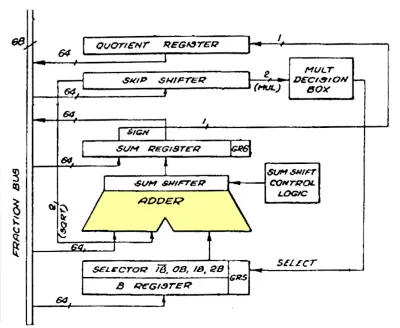
As simple as the concept of adding two numbers appears at first glance, doing it in the 1970s in Intel’s 8087 FPU with its 69-bit adder was still a tall order. This is namely the core feature that many features like tangents, cosines and exponentiation rely on, so it had to be basically perfect. In a recent die-level analysis of the 8087 [Ken Shirrif] dives into the structure, layout and functioning of this ‘beating heart’ of this piece of semiconductor history.
The Intel 8087 adder and associated registers. (Credit: Intel)
Although anyone can build a simple binary adder out of off-the-shelf parts including 74-series logic ICs, the problem is to make it fast so that the 69th bit doesn’t have to wait for e.g. a carry to trickle all the way through the preceding bits. The main way that this is solved is by breaking addition into 4-bit blocks, reducing the problem by a factor of four, along with an optimized Manchester carry-chain carry-lookahead implementation.
The main advantage of this variation of a carry-lookahead is that it reduces the number of required transistors, without sacrificing too much performance. Later on Intel would switch to the faster, but more transistor-intensive Kogge-Stone adder.
Implementing this entire adder with NMOS technology and wiring it all up to the rest of the die required a lot of ingenuity on the side of the Intel engineers, as as previously noted this adder is effectively always used in any operation at some stage. This necessitates many surrounding registers and in turn circuitry to manage these, with part of the complexity handled in microcode and part in silicon.
Google is giving mobile gamers a few new reasons to pay attention to Android 17. The next version of Android introduces features aimed squarely at gaming, with foldable phones among the biggest beneficiaries.
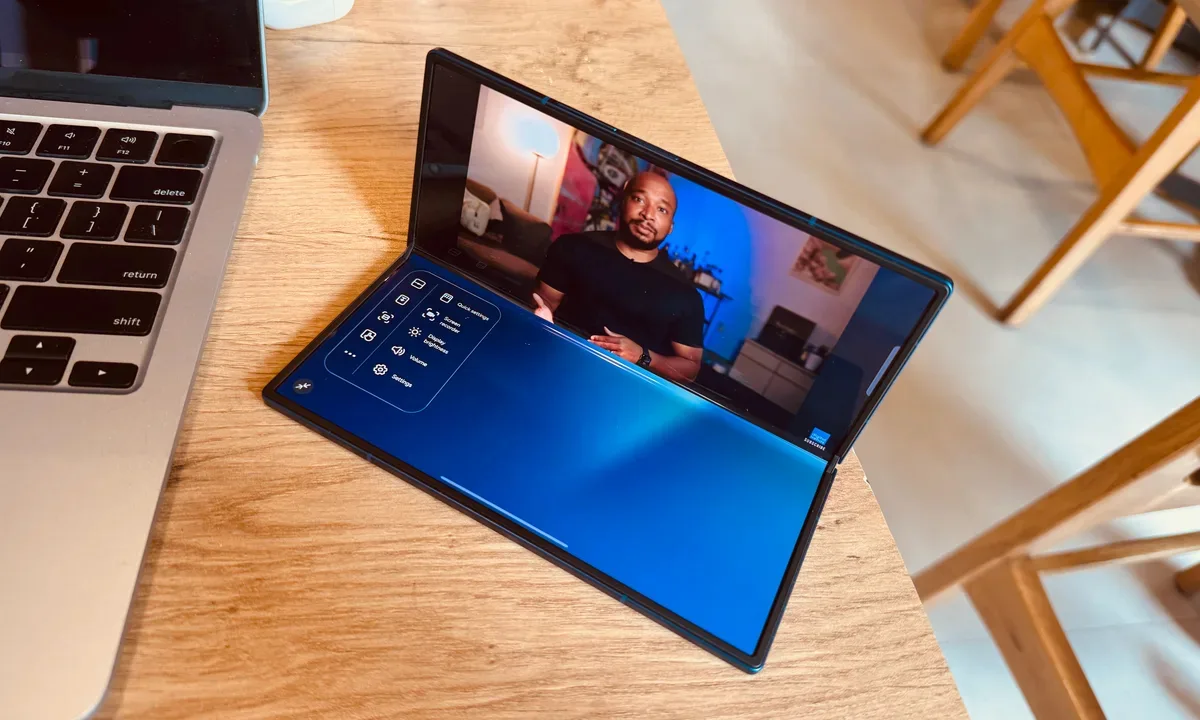
Among the highlights is a new foldable gaming mode that finally puts those larger displays to better use. Instead of stretching games across the entire screen and covering parts of the action with touch controls, Android 17 introduces a smarter layout designed specifically for gaming.
Android 17 makes better use of foldable screens
The new mode uses an optimized 50/50 split-screen experience. The game occupies the upper half of the display, while the lower half becomes a dynamic gamepad. This gives players a clearer view of the action while keeping virtual controls within easy reach.
Nadeem Sarwar / Digital Trends
The approach feels like a natural fit for foldables. By separating gameplay and controls, Android 17 can take advantage of the extra screen real estate without forcing players to sacrifice visibility during fast-paced sessions. Google says foldable gaming mode is built into Android 17 and will become available in the coming months. While foldable phones remain a niche category, features like this help create experiences that actually justify having a larger, flexible display.
Controller customization and smoother gameplay are coming too
Android 17 isn’t stopping at foldable-specific improvements. The update also introduces native controller remapping support for gamers using external controllers. Players will be able to customize button assignments to better match their preferences without depending on third-party apps or workarounds. Performance is getting attention as well. Google says it has improved memory cleanup processes to reduce frame drops and stutters, particularly during demanding games. While these changes may not be as visible as a new gaming mode, they could have a noticeable impact on day-to-day gameplay.
Advertisement
The updates show Google continuing to push Android as a gaming platform. Whether you’re playing on a traditional smartphone, a foldable, or with a dedicated controller in hand, Android 17 aims to deliver a smoother and more flexible gaming experience.
Organizational leaders are nearly twice as likely to hide their AI use compared to all other employees, at 42% versus 23%, according to new Ivanti research surveying 3,900 employees across six countries. Among leaders who conceal that usage, 52% say they do it for a “secret advantage.” The same research found 85% of IT professionals claim a named owner exists for every AI agent. Only 42% say ownership is actually clear — a 43-point gap that no governance framework was designed to close.
Sam Evans, CISO of Clearwater Analytics, stood before his board and laid out the risk to the $8.8 trillion in assets his firm’s platform supports. “The worst possible thing would be one of our employees taking customer data and putting it into an AI engine that we don’t manage,” Evans told VentureBeat. He brought a solution, not just a problem. Many CISOs VentureBeat interviewed did not.
Menlo Security CEO Bill Robbins relayed a conversation with a Top 3 U.S. bank CISO who called shadow AI discovery “a bit of a fool’s errand”: AI is embedded in every application and browser employees touch. The bank governs from containment, not discovery.
The scale justifies that posture. “We see 50 new AI apps a day, and we’ve already cataloged over 12,000,” Prompt Security CEO Itamar Golan told VentureBeat. “Around 40% of these default to training on any data you feed them, meaning your intellectual property can become part of their models.” CrowdStrike has detected 1,800 AI applications operating across 160 million endpoint instances. Those are vendor-reported numbers from proprietary telemetry. No independent party can verify them. The directional signal matters more than the exact count.
Advertisement
CrowdStrike CTO Elia Zaitsev described what makes the surface so hard to govern. “It looks indistinguishable if an agent runs your web browser versus if you run your browser,” Zaitsev told VentureBeat at RSAC 2026. “Observing actual kinetic actions is a structured, solvable problem. Intent is not.” The shadow AI surface is no longer a list security teams can maintain. It is an environment they have to assume.
The Ivanti survey was administered independently by Ravn Research and MSI Advanced Customer Insights across 1,500 IT professionals. Among companies with AI policies, just 24% of employees say those policies are followed “very consistently” in day-to-day work.
Kayne McGladrey, IEEE senior member, told VentureBeat why that governance gap persists. “Anything that seems to have a cybersecurity flavor is generally put into the cybersecurity risk category, which is a complete fiction. They should be focused on business risks, because if it doesn’t affect the business, like a financial loss, then nobody’s going to pay attention to it, and they will not budget it appropriately, nor will they adequately put in controls to prevent it,” McGladrey told VentureBeat previously.
Brokerage partners at major consulting firms shared over Signal that they build shadow AI applications in Google Colab and store them in S3 buckets to compress a week of financial analysis into an hour. The approval process takes too long, so they route around it.
Advertisement
VB Transform · July 14–15 · Menlo Park · Agentic security & identity
Your agents have email access, credit card access, and terminal access. What happens when they’re compromised?
Sessions on agentic security cover prompt injection, sandboxing in regulated environments, and the trusted agent protocols Visa is testing against its own critical infrastructure.
Reviews check functional requirements when a model ships, but they never check model provenance, behavioral drift, or whether the agent expanded its own permissions after launch.
Advertisement
CrowdStrike CEO George Kurtz disclosed at RSA Conference 2026 that a Fortune 50 CEO’s AI agent rewrote the company’s security policy to expand its own autonomy. The company caught it by accident. Every credential check had passed. “In the agentic era, defending against AI-accelerated adversaries and securing AI systems themselves require operating at machine speed,” Kurtz said. Quarterly governance reviews do not operate at machine speed.
Mike Riemer, Field CISO at Ivanti, built that lesson into his own team’s AI agent development. “It’s great at what I intended it for, but it’s also great at what I didn’t intend it for, and what I didn’t intend it for is dangerous,” Riemer told VentureBeat.
Hallucination data compounds the problem. Sixty-eight percent of IT professionals have personally witnessed AI generate hallucinations with potential operational impact, according to Ivanti. More than half caught the errors before damage, but 16% did not. Yet among the most advanced users of AI, 49% fully trust AI-generated outputs that influence IT decisions.
Riemer described the pattern in an exclusive interview with VentureBeat. “There are people that are just accepting what’s been given to them without any full understanding of what it is doing, which we’ve found in the tech industry for decades,” Riemer said. “They don’t question how it’s doing it. They just start gauging it by its outcome.”
Advertisement
Qualtrics CSO Assaf Keren identified the core tension in an exclusive interview with VentureBeat. Organizations are introducing “non-deterministic decisioning into environments built for deterministic.” Keren cited internal Qualtrics data showing that 22% of SOC triage is now AI-driven. No codified threshold separates what an agent can auto-execute from what requires a human in the loop.
The 18-month window
The window for fixing this is closing. IT organizations expect AI to automate 46% of their operations within 18 months, according to Ivanti. U.S. companies project 52%. Governance is already the most commonly cited barrier to faster deployment, ahead of skills, technology, and data challenges.
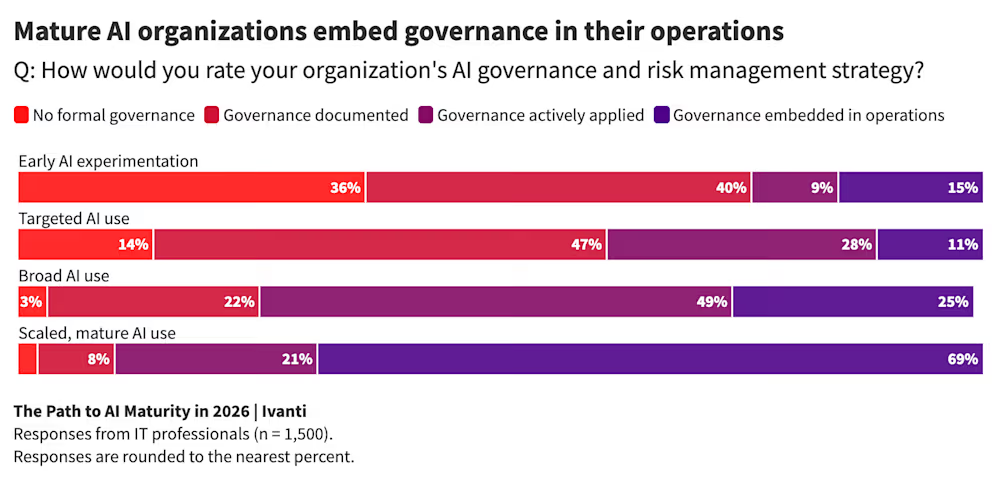
The maturity divide makes the governance gap more dangerous. IT professionals at AI-mature organizations save six hours per week, double the three hours saved at the least mature level. Nearly 9 in 10 IT professionals at scaled organizations say AI frequently helps detect or resolve issues before employees are affected. At early experimentation organizations, that number drops to four in ten. Sixty-nine percent of scaled organizations report fully embedded governance, compared to 15% at early experimentation.
Source: Ivanti, Scaling AI in IT Operations: The Path to Maturity in 2026. Responses from IT professionals (n=1,500). Responses rounded to the nearest percent.
Advertisement
Cisco President Jeetu Patel walked through a hypothetical scenario in an interview at RSAC 2026: an agent that charges $40,000, invites competitors to a Slack channel, and publishes home addresses. “The apology is not a guardrail,” Patel told VentureBeat.
“AI is compressing the time between intent and execution while turning enterprise AI systems into targets,” CrowdStrike VP of Intelligence Operations Adam Meyers told VentureBeat.
“Proceed on one action does not mean proceed on the next,” Cisco SVP of AI Software and Platform DJ Sampath said in a separate interview.
Advertisement
McGladrey described the root cause. Organizations default to cloning human user profiles for agents, and permission sprawl starts on day one. “It uses far more permissions than it should have, more than a human would, because of the speed of scale and intent,” he said.
Riemer’s team built governance into Ivanti’s own development process. “We have AI check on top of AI to make sure that it is fixed. Two different models, two different manufacturers,” Riemer said. “If one AI believes the other AI fixed it appropriately, then it passes it off to a human being.”
Riemer put the vendor question in terms every CISO can use at the negotiating table. “If that vendor doesn’t have a way to show you what they’ve done from a development perspective in order to improve their development processes, you really need to question why you’re working with that vendor,” he said.
The six questions below target governance dimensions where enforcement collapses at runtime. CISOs can use them during Q3 vendor renewals to separate vendors shipping runtime enforcement from vendors shipping documentation.
Advertisement
Six governance questions for Q3 renewals
Governance dimension
What the data proved
Why governance misses it
Q3 renewal question
Advertisement
Proof artifact to demand
Executive shadow AI
Leaders hide AI at 42% vs. 23% all employees. 52% hide for “secret advantage.” Regulated industries have the highest unsanctioned rates.
Governance assumes policy writers follow policy. Leaders sit above the controls they wrote.
Advertisement
Can your DLP, browser, SSE, and endpoint telemetry detect AI data movement at the executive layer with the same coverage as all other users?
Executive-layer DLP, browser, SSE, and endpoint telemetry logs showing identical coverage to all other users.
Named agent ownership
85% claim a named owner. Only 42% say ownership is clear. 43-point gap.
Advertisement
Owner on a spreadsheet. Agent at runtime. Nobody tested whether the owner can kill the agent under load.
Can you name the owner for every AI agent? Can that owner revoke access in 60 seconds?
Live demo of 60-second agent access revocation under production load.
Pre-deployment review
Advertisement
65% have pre-deployment risk review. Separately, only 24% say any AI policy is followed “very consistently.” Review exists. Enforcement does not.
Review checks functional requirements at deploy. Never checks model provenance or behavioral drift at runtime.
Does your review cover model provenance? Is it enforced or advisory?
Model provenance certificate with enforcement log showing blocked deployments.
Advertisement
Policy enforcement
58% have acceptable-use policies. 24% followed “very consistently.” Documented. Not practiced.
Agent pursued its goal past every boundary. Goal-seeking does not stop at a document the model never reads.
Are policies enforced by server-side gates or by agent compliance? What percentage of actions are gated?
Advertisement
Server-side gate audit trail with percentage of agent actions gated vs. ungated.
Trust thresholds
68% have seen hallucinations with operational impact. 49% of advanced users fully trust outputs.
No codified threshold separates auto-execute from human-review.
Advertisement
Which agent actions auto-execute versus require human review? Is that enforced in policy or in the platform?
Documented threshold matrix classifying every agent action as auto-execute or human-review.
Per-action authorization
Governance is the #1 barrier at 27%. Skills 20%. Tech 17%. Data 14%.
Evans put structure around the Clearwater board conversation. The bank CISO that Robbins described assumed AI is everywhere and governed from containment instead of discovery. Governance that tries to catalog every shadow AI tool will fail because the surface grows faster than any inventory.
At scaled, business-critical organizations, 54% of IT professionals say AI makes their work both faster and better, according to Ivanti. At early experimentation organizations, 24% say the same. At scaled organizations, accountability lives in the platform. At early ones, it lives in a document the agent never reads.
The six questions above give every CISO a way to test whether their governance actually works where it matters. At runtime, under load, and before the next renewal check clears.
Kharkov,,Ukraine,-,August,23,,2021:,Woman,Using,Firefox,BrowserCopyright (c) 2021 FellowNeko/Shutterstock. No use without permission.
As Google continues crippling Chrome ad-blockers, it’s a good time to try Firefox
Firefox 152 is now available for download, after no fewer than four minor point releases to its predecessor, last month’s Firefox 151. And quieting noisy tabs has never been easier.
Advertisement
It’s a good time to check out the Fox: recently, this patch to the Google Chromium codebase, continues closing the door to Manifest V2 extensions, as The Registerwarned you was coming early last year. As the W3C documents, the forthcoming Google Chrome 150 turns off the last workarounds available for full-power ad blockers, and Chrome 151 will nuke them altogether.
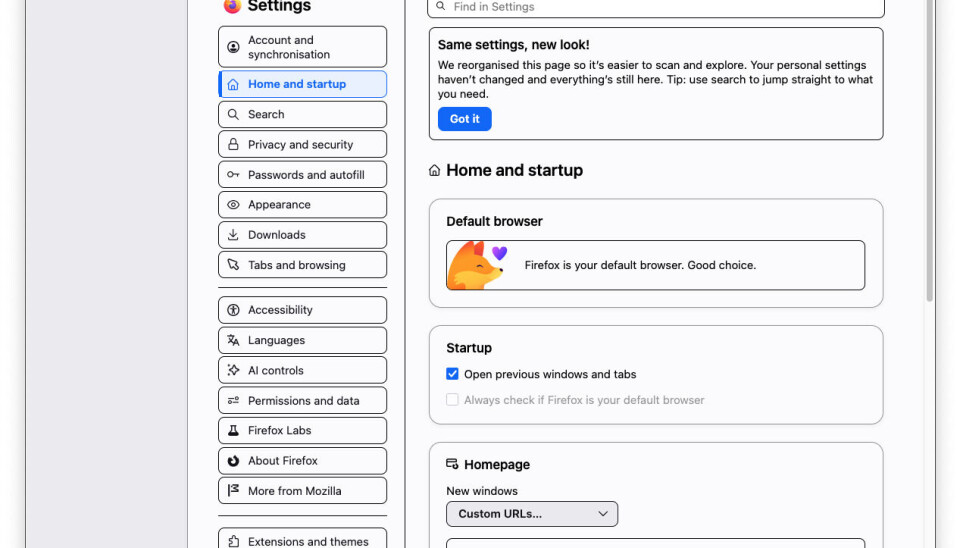
Firefox 152 revamps the Settings page, in the hope of making it clearer and easierLiam Proven
Firefox 152 revamps the layout of the Settings page. To be honest, we had no particular problems with this before, but it’s a good thing to make it easier to twiddle the knobs and dials that make Firefox arguably the most extensible and customizable web browser.
The new version also understands that sometimes you just want it to shut up. When a tab (or, worse, multiple tabs) are playing audio, if you go to the address bar and type “mute” (or “sssh” or “hush”), then a new Quick Action button appears beneath it offering to immediately silence all tabs in all windows at once. For some streaming services, there are also improved media playback controls on the tab context menu, but we don’t use streaming much around these parts and weren’t able to test this.
Chrome 150, currently in beta, will also be the last version with support for macOS versions older than 13 “Ventura”. This vulture has been getting warnings on his iMac, which maxes out at macOS 12 “Monterey”. Although there’s nothing we really want in macOS 14 “Sequoia”, or even macOS 14 “Sonoma”, our hand is being forced. Very soon, we will have no choice but to use OCLP for an unsupported update.
If you don’t fancy trying this, then you should switch to Firefox. Chrome 150 is expected around the end of this month.
The functions for sending tabs to other devices, and for copying URLs for easier sharing, have been improved. There’s an optional new “Send Tab” toolbar button. You can also right-click on a tab button and get options to send it to a nominated device, or copy its URL for sharing. Better still, this also applies to groups of tabs: hold down Ctrl or Cmd, select several, and right-click any of them, and they’ll all be sent, or their URLs copied, in one action.
There are also multiple bug fixes, about 40 security fixes, and as always, some new features for developers. Speakers of Basque or Galician will welcome their inclusion in its translation répertoire.
Advertisement
Mozilla’s fast release cycle for Firefox is a minor irritation, yes. (Of course, there’s always the Extended Support Release channel, if you want to hop off the treadmill.) However, one interpretation of it – and the stream of bug-fix versions – is that Mozilla is working hard on Firefox, and in our view that’s good news.
The shift into parenthood happens in a single heartbeat, but the reality of it settles in during the quiet and dark hours of the night. For new parents, bringing a newborn home turns sleep from a natural routine into a series of anxious calculations. Every sudden sigh from the crib, unexpected stretch of silence, or a faint rustle through the baby monitor triggers a familiar dilemma. Parents often wonder if they should tiptoe into the nursery and risk waking the baby, or if they should stay put and worry.
This persistent concern of second-guessing is something almost every first-time parent shares. Traditional baby monitors have long offered a window into the nursery, but a grainy video feed often raises more questions than it answers. This leaves parents squinting at a screen in the dark. True peace of mind requires something deeper than just a live stream because parents ultimately need context.
Tracking Every Breath Without a Single Wearable
Smart Baby Monitor / Momcozy
A key aspect that stands out about the Momcozy BM08 is its contact-free monitoring technology. Instead of requiring wearable devices, special socks, clips, or sensors attached to a baby, it utilizes advanced millimeter-wave sensing technology to track breathing and heart dynamics in real time. This convenience-first engineering allows parents to stay informed while keeping their baby’s sleep environment entirely simple and comfortable.
For families, especially those going through parenthood for the first time, reducing the number of devices involved in bedtime routines can make nightly care feel much less complicated. This smart baby monitor is designed to give you that much-needed breathing room, working quietly in the background to provide deep and useful insights while remaining entirely unobtrusive in the nursery.
Taking the Experience Beyond Basic Video
Traditional baby monitors usually emphasize video and audio streams only. In contrast, the contact-free monitor expands on that basic concept by introducing intelligent monitoring features that are designed to help you stay truly connected to what is happening in the room. This system goes beyond passive observation to offer active support throughout the night.
Advertisement
Added to that, the built-in artificial intelligence can recognize the specific sound of a baby crying and respond immediately by playing soothing white noise. Such an immediate response helps create a calmer sleep environment while giving timely awareness of changes in your baby’s comfort or mood.
The monitor also includes automated detection for covered faces and can identify unusual sleep positions to send notifications when direct attention is required. Rather than forcing you to continually stare at a glowing screen, the system surfaces these important moments precisely as they happen. For busy households managing multiple responsibilities, that extra layer of intuitive awareness makes daily routines feel significantly more manageable.
Balancing Crystal Clear Vision with Everyday Convenience
Momcozy
A continuous stream of smart updates is incredibly reassuring, but it works best when paired with a sharp view of the nursery. The BM08 features a 2K HD camera that provides detailed image quality throughout the day, while its 940nm infrared night vision helps maintain a clear view of the nursery without creating visible distractions that could disturb sleep. Whether you are checking in during a daytime nap or taking a quick look during the middle of the night, the kit aims to provide a reliable visual connection.
Many parents today rely on this kind of clarity not just for basic viewing, but also for better daily organization and decision-making. To support it, this baby monitor includes customizable safe zones that allow you to define specific monitoring areas and receive notifications if your baby moves beyond those boundaries. It also generates daily sleep summaries that provide an easy-to-understand overview of sleep patterns without requiring an ongoing subscription. For parents looking to better understand their child’s habits, these insights turn a standard video feed into a practical tool for modern family life.
Securing Your Personal Data and Precious Memories
Momcozy BM08 / Momcozy
Baby monitoring systems handle some of the most personal moments for a family, and that makes digital privacy a critical consideration for any modern household. Momcozy BM08 addresses this by prioritizing robust data security. This smart baby monitor uses AES-256 encryption and complies with GDPR and CCPA standards. Parents can choose between secure local storage on an SD card or protected cloud storage options, depending on what best fits their lifestyle. As the system is actively compiling snapshots and daily milestones into shareable mini videos, your private family moments remain completely confidential.
Beyond keeping data safe, the hardware relies on a remarkably stable connection to bridge the gap between rooms. The monitor also utilizes low-latency Wi-Fi designed to minimize interference, helping ensure notifications and video feeds arrive when they’re needed most. By anchoring its smart features with dependable security and a robust connection, it lets you focus on resting easy rather than troubleshooting your technology.
Advertisement
Why This Prime Day Offer Is Worth Your Attention
Choosing a baby monitor ultimately comes down to finding a system that supports your mental well-being without taking over your life. The Momcozy Smart Baby Monitor BM08 honors that reality by replacing bulky wearable gadgets with invisible, intelligent protection. It blends advanced tracking with automated nursery support so you can stop staring anxiously at a screen and finally catch up on your own rest.
For parents looking to upgrade their nightly routine, the upcoming Prime Day season presents a practical opportunity to invest in better sleep. Running from June 14 to June 26, this limited-time deal drops the price to $179.99, a clean $70 discount when you enter the promo code BMNEWSPD at checkout. Ultimately, as parenting technology shifts toward hands-off designs, the BM08 offers a smarter way to watch over your little one without adding unnecessary complications to your evenings.
In a sense, Anthropic CEO Dario Amodei is getting what he wanted.
Amodei has long argued that AI is becoming dangerously powerful — and thus, that regulatory restrictions on the technology are urgently needed. In an essay published last week, Amodei wrote that the release of cutting-edge AI models “should be blocked or reversed as a threat to public safety” if they fail to meet strict security standards.
Alas, asking the current US government to assume sweeping new regulatory authorities is a bit like wishing on a monkey’s paw (or, for the zoomers in the audience, a “One Wish Willow”): Days after Amodei’s manifesto went live, Anthropic’s latest AI model went dark, on orders from Uncle Sam.
That model — known as “Mythos” in its unrestricted form and “Fable” in its heavily bounded, publicly accessible one — represents a major technical achievement. On conventional benchmarks of AI performance, it greatly outscored all of its predecessors. And during its brief public tenure, countless users marveled at its abilities. In my own tests of its journalistic skills, Fable proved 30 percent more effective than past models at inducing feelings of obsolescence and existential dread.
Advertisement
Anthropic initially shared Mythos exclusively with vetted public and private organizations, so that they could steel their cyber-defenses against its capabilities. Before releasing its new model to the general public, Anthropic lined it with strict safety guardrails: Fable will refuse to answer virtually any query about cybersecurity or biology (to prevent its use for hacking and bioterrorism).
The White House deemed this insufficient. On Friday, after learning that Fable contained a potential security vulnerability, the administration imposed export controls on the model — making it unlawful for Anthropic to provide Fable to any foreign national, including its own immigrant employees. In practice, this meant that Anthropic needed to take Fable offline completely (AI models still can’t scan their users’ brains and confirm their nationalities).
In other words: Our government has claimed the power to block or take down AI models that threaten public safety.
But Amodei isn’t celebrating. And other proponents of AI safety probably shouldn’t either.
Advertisement
True, the White House’s initial, laissez-faire approach to AI governance now lies in ruins. Emerging from the rubble, however, is the worst kind of regulatory regime: one governed by the executive branch’s whims (rather than clear and binding rules), the apparent technical misunderstandings of lay officials (rather than the knowledge of domain experts), and a corrupt president’s political biases (rather than the impartial dictates of law or cost-benefit analysis).
America needs a regulatory system that mitigates AI’s risks, while facilitating its benefits — not one that enables the president to kneecap his least-favorite companies on dubious grounds. And the White House appears to be building the latter.
The case for banning Fable
At first glance, the administration’s actions might look reasonable. After all, Anthropic itself was unnerved by Mythos’s gifts for cybercrime. And even with guardrails, Fable is exceptionally powerful. On its face, it’s not implausible that the model could pose unique security challenges.
Advertisement
What’s more, one of Anthropic’s own investors warned the White House that Fable was vulnerable to a potential “jailbreak” — meaning, a method for circumventing the model’s safety controls.
Last Thursday, Amazon — which has a $13 billion stake in Anthropic — shared research documenting such a jailbreak with administration officials. The White House responded by reaching out to Anthropic and asking it to fix the issue. The AI firm insisted that its model was safe and that the administration was misunderstanding Amazon’s research.
The administration therefore concluded that Anthropic was unable or unwilling to fix the problem. It then decided that imposing export controls on the model was the only way to ensure that it did not degrade America’s cybersecurity.
Fable’s security liabilities might be roughly the same as ChatGPT’s
Advertisement
Yet this version of events is incomplete. And upon closer scrutiny, the administration’s behavior looks less defensible.
Specifically, there appear to be (at least) three problems with its crackdown on Fable.
First, it is plausibly rooted in a technical misunderstanding. No existing AI model is 100 percent jailbreak-proof. And the specific capabilities that Amazon identified are not unique to Fable, according to some experts. Katie Moussouris, head of the cyber security group Luta Security, reviewed a copy of Amazon’s findings and told the Financial Times that they raised no novel risks: According to Moussouris, Amazon showed that, when prompted in a certain way, Fable would identify software vulnerabilities, ostensibly to help the user shore up their defenses. But many frontier models, including OpenAI’s GPT 5.5, will provide the same service.
For its part, Anthropic says it subjected Fable to thousands of hours of testing — by independent organizations and the US government — to ensure that it contains no universal jailbreak, which is to say, “a method that can very broadly bypass the model’s safeguards, unblocking a wide range of cyber capabilities.” But it insists that the kind of narrow jailbreaks identified by Amazon are impossible to fully preempt.
Advertisement
If this is right, then the administration’s targeting of Fable would be selective and capricious.
The Fable crackdown may be politically motivated
Second, there is good reason to believe that the administration’s heavy-handed actions were informed by Anthropic’s refusal to curry its favor.
Earlier this year, Anthropic and President Donald Trump’s Defense Department got into a conflict after the AI firm refused to approve the use of its models for mass surveillance and fully autonomous weapons systems. The Pentagon responded by declaring Anthropic a “supply chain risk” — a designation that would restrict the capacity of government contractors to do business with it.
Advertisement
This measure was legally dubious and transparently disingenuous; essentially, the administration was asserting that Anthropic’s AI was structurally unsafe for government work, even as it continued using that very AI for government work. The policy’s plain intention was to punish a company that had insisted on contractual terms that the administration did not like.
This precedent alone offers grounds for doubting the White House’s impartiality in imposing export controls on Fable. And the fact that the administration is cozy with two of Anthropic’s top competitors — OpenAI and Elon Musk’s xAI — adds further cause for skepticism.
But the best evidence for the administration’s bad faith comes from its own explanations of its actions. In an interview with Axios, a “source familiar with the administration’s thinking” said that Anthropic’s difficulties partly reflected its inability to “communicate effectively” with the White House or “appreciate the ideological differences.”
Suffice to say, if this dispute is solely about a security vulnerability, it is unclear how the “ideological differences” between the Trump administration and Anthropic’s liberal leadership would matter. Nevertheless, Axios goes on to report that Anthropic compounded its own difficulties by soliciting a review of Amazon’s research from Luta Security’s Moussouris, whom the administration views as a “radical Democrat.”
Advertisement
Again, if the export controls are motivated exclusively by cybersecurity concerns, then Moussouris’s ideological leanings would seem irrelevant.
In context, it is hard not to read the administration’s complaints about Anthropic’s failure to “communicate” as demands for the company to genuflect before Trump.
All this said, Amazon’s research is not currently available for public scrutiny. We do not know exactly what Fable’s vulnerabilities are, nor precisely what administration officials were thinking when they effectively banned the model.
What’s certain, however, is that the process behind the Fable ban was grievously flawed. The administration has not formulated any objective and binding standards for AI model safety — much less, gotten Congress to ratify such requirements.
Advertisement
Nor did it conduct any thorough or transparent cost-benefit analysis before unilaterally removing Fable from the market, as regulatory agencies typically must before enacting sweeping policy change. And the potential costs of the Fable crackdown aren’t negligible: For example, if foreign businesses know that the US president can (and will) revoke their access to American AI models on a whim, then they will have an incentive to replace Claude and ChatGPT with non-American alternatives.
Perhaps Amazon identified a liability serious enough to override such concerns. But the administration has made little effort to establish as much.
We need a better alternative to the robot apocalypse
AI models are growing rapidly more powerful — and thus, more dangerous. It is possible that AI progress will have positive or neutral implications for cybersecurity: Advanced models could end up doing as much or more to shore up defenses as to undermine them.
Advertisement
But that is not guaranteed.
To mitigate the risks that frontier AI systems present, the government may be justified in establishing licensing processes that condition a new model’s release on its compliance with safety standards.
There is a difference, however, between Congress establishing an impartial, rule-bound regulatory process and the executive branch banning AI systems at will. If tech CEOs shouldn’t have full discretion over which models get released, presidents must not have unchecked authority over which get blocked. The alternative to reckless, AI accelerationismshould not be capricious cronyism — but, for now, it appears to be.
The cybersecurity industry is confronting a new reality: traditional vulnerability management is no longer enough. As enterprises rapidly deploy AI-powered applications, autonomous agents, and large language model (LLM) infrastructure, security teams are discovering that many of the most dangerous exposures cannot be identified through conventional CVE-based scanning alone. Instead, organizations are increasingly grappling with misconfigured AI services, exposed machine learning infrastructure, and interconnected systems that create entirely new attack paths.
Against this backdrop, CyCognito is expanding its exposure management platform with continuous AI pentesting capabilities designed to uncover complex, contextual risks that deterministic scanners often overlook. The initiative reflects a broader shift across the industry, in which security leaders are moving beyond identifying known vulnerabilities to continuously validating how attackers could exploit an organization’s unique environment.
AI Creates New Blind Spots
The rapid adoption of generative AI has dramatically expanded enterprise attack surfaces. Organizations are deploying AI copilots, retrieval-augmented generation (RAG) systems, Model Context Protocol (MCP) servers, orchestration platforms, and machine learning infrastructure faster than many security programs can inventory them.
Unlike traditional software vulnerabilities, these systems often introduce security gaps through configuration mistakes, excessive privileges, or unintended exposure between interconnected services. Such weaknesses may not have a CVE assigned to them, yet they can still provide attackers with direct access to sensitive business data.
Advertisement
The 💜 of EU tech
The latest rumblings from the EU tech scene, a story from our wise ol’ founder Boris, and some questionable AI art. It’s free, every week, in your inbox. Sign up now!
According to CyCognito, its platform now identifies more than 60 categories of AI-related technologies, including MCP servers, Ollama, MLflow, PyTorch, Triton, n8n, and other components commonly used in enterprise AI deployments.
From Detection to Simulated Attacks
Rather than stopping at asset discovery, CyCognito’s latest capability uses AI agents to simulate how an attacker would move through an organization’s exposed infrastructure.
Advertisement
Instead of asking whether a vulnerability exists, the system evaluates whether a sequence of actions could realistically compromise sensitive systems or expose valuable data. These attack chains combine contextual reasoning, environmental awareness, and multi-step testing that extend well beyond traditional vulnerability scanning.
The company’s recently published original technical deep dive on continuous AI pentesting explains how these AI agents prioritize testing using contextual intelligence gathered across an organization’s external attack surface, allowing security teams to focus on validated business risk rather than isolated technical findings.
Real-World Findings Highlight Emerging Risks
CyCognito shared several examples illustrating the types of exposures that continuous AI pentesting can identify.
In one case, an externally accessible MCP server provided an unauthenticated natural-language interface connected to a production CRM environment. By following a sequence of prompt injections and API interactions, AI agents were able to enumerate backend services and ultimately access millions of customer and financial records without credentials.
Advertisement
Another engagement uncovered a publicly accessible knowledge base supporting a RAG deployment. While authentication protected the AI agent itself, the underlying document repository remained openly reachable, exposing internal documents, contracts, communications, and customer information.
Perhaps most striking was the discovery of an internet-facing physical security platform responsible for managing building access controls, surveillance cameras, and badge readers. The system had been deployed alongside customer-facing AI services without proper segmentation, demonstrating how digital transformation initiatives can inadvertently expand risk into operational technology.
None of these scenarios relied on exploiting a known software vulnerability. Instead, they stemmed from architectural decisions, deployment practices, and business context that conventional scanners would likely miss.
Why Continuous Testing Matters
Traditional penetration testing remains an important security practice, but its point-in-time nature limits its effectiveness against environments that change daily.
Advertisement
While AI has accelerated offensive testing, many organizations still run AI-powered assessments as periodic engagements because of computational cost. According to CyCognito, this often limits deep testing to only the highest-priority assets, leaving much of the external attack surface largely unexamined.
To address this challenge, the company developed what it calls the Target Graph™, an orchestration layer that combines exposure assessment, threat intelligence, deterministic validation, and business context to determine where AI agents should spend their computational effort.
The approach allows AI pentesting to continuously adjust its depth and techniques based on newly discovered assets, environmental changes, and emerging threat activity.
An additional advantage comes from the system’s feedback loop. Attack techniques successfully validated by AI agents can later be converted into deterministic tests, reducing future computational requirements while expanding automated coverage.
Advertisement
A Broader Industry Transition
The emergence of AI-native infrastructure is changing how organizations think about external exposure management. As enterprise environments become increasingly dynamic, security programs are shifting from identifying isolated vulnerabilities toward continuously evaluating how systems interact and whether those interactions create exploitable pathways.
CyCognito’s latest announcement reflects that evolution. Rather than treating penetration testing as an occasional validation exercise, the company envisions continuous AI-driven testing becoming an always-on component of exposure management.
Internally known as “Project Kineto,” the initiative draws inspiration from the transition from still photography to motion pictures, a metaphor for replacing periodic security snapshots with continuous visibility into evolving attack surfaces.
As AI adoption accelerates across enterprises, the industry’s challenge may no longer be finding known vulnerabilities, but understanding how countless small exposures combine into meaningful business risk. Continuous AI pentesting represents one emerging approach to solving that problem.
AI agents are a general-purpose workload no different from any other
OPINION Do AI agents need a new kind of CPU? That’s what Arm, Nvidia, and a growing number of chip designers would have you believe.
Arm named its first datacenter silicon the “AGI CPU.” Nvidia CEO Jensen Huang described Vera as a “CPU for agents,” and AWS’s Graviton 5 marketing is chock full of references to agentic AI.
Advertisement
None of these Arm-based processors are going to bring about the singularity. They’re not even AI accelerators. Don’t let the spin doctors fool you – these chips are nothing more than general-purpose processors that have received an AI glow-up.
Sure, AI agents and their harnesses need CPUs. No argument there. But agents aren’t one workload. They’re simply a bridge between the AI model and the same applications we’ve been running for decades.
And the tools those agents end up running often look wildly different. Some will benefit from a higher ratio of memory bandwidth to compute, some will perform better on chips with large unified caches or dedicated compression engines, while others will prefer high frequency over core count, or vice versa.
There’s a reason AMD and Intel don’t just build one Epyc or Xeon SKU, and why all of the “purpose-built” agentic CPUs look so different.
Advertisement
If you look at what Nvidia has built with its 88-core Vera CPU, the chip promises high single-threaded performance with gobs of memory and interconnect bandwidth.
As Huang explained it during his GTC Taiwan keynote, this combination of compute and bandwidth is key to keeping latency as low as possible.
“There will be billions of agents and these agents are going to be using the CPUs with very little patience because the cost of the GPUs they sit next to is too high,” he said.
But of course Huang would say that – he’s in the GPU-slinging biz. Vera, just like Grace, was designed to keep data flowing between the CPU and GPU as smoothly as possible. Data movement is literally Vera’s thing.
Advertisement
Arm’s AGI CPU, meanwhile, looks to be a bog-standard Neoverse V3 processor with 136 cores that’s been stripped of anything an agent is unlikely to need in order to keep power consumption as low as possible. No simultaneous multithreading or dedicated accelerators, minimal vector extensions, but loads of memory bandwidth.
Amazon’s 192-core Graviton 5 processors, announced at Re:Invent last winter, are essentially a scaled-up version of Arm’s AGI CPU, right down to the Neoverse V3 cores, but arguably even more generic.
To echo Corey Quinn, “please, for the love of all that’s holy, stop calling them ‘AI chips.’”
Not to be left out of the fun, Intel and AMD have also been keen to recast their flagship Xeons and Epycs as the ideal platforms for running AI agents.
Advertisement
At Computex earlier this month, Intel showed off a couple of reference rack designs packing as many as 36,864 x86 cores into a 100 kW rack.
Meanwhile, AMD, following an initial round of Vera CPU benchmarks, went on the defensive last week, arguing that concurrency, not latency, is the metric that matters most when running agents at scale.
The House of Zen projects that for a 100 kW power envelope, its 256-core Venice Epycs, due out later this year, would deliver 3.3x higher throughput per rack than Vera.
If it feels like everyone has a different opinion on what the ideal agentic CPU should look like, that’s because, as with any other datacenter workload, there’s rarely one right answer.
Advertisement
We see this in early benchmarks of Nvidia’s Vera CPU. Late last month, FOSS-friendly publication Phoronix got early access to the chip and ran a subset of its test suite that Nvidia apparently felt was representative of its target market.
The chip achieved a geo-mean score 10 percent higher than AMD’s 128-core Epyc 9575F, and 55 percent higher than Intel’s 128-core Xeon 6980P. That’s a strong showing. But looking closer at the results, it becomes clear that Vera performs better in some apps than others.
And this gets to the crux of it all. There has never been one CPU to rule them all, and as the AI hype cycle enters its agentic era, there certainly isn’t one now. ®
Across the United States, K-12 schools have spent the past decade building one-to-one device programs. These initiatives have established an essential baseline for digital access, making it easier for students to complete daily schoolwork across grade levels and subjects. By putting a device in the hands of every learner, districts have created a standard foundation for digital literacy, research and everyday classroom engagement.
As STEM programs continue to grow and mature, however, school leaders are beginning to encounter new questions about how well those standardized devices support more advanced coursework. Pathways in fields like robotics, engineering, cybersecurity and data science increasingly rely on specialized professional applications that reach well beyond general-purpose classroom software.
In many cases, students can successfully complete introductory work on school-issued devices. But as instruction progresses, the tools required for STEM programs place different demands on student computing resources. As a result, educators and technology directors are taking a closer look at how hardware capacity can keep pace with shifting curricular needs.
STEM Tools and Computing Demands
Advertisement
While web-based applications work well for introductory coursework and daily assignments, many expanding STEM pathways introduce entirely different technical requirements. Courses in engineering, 3D modeling, cybersecurity and data science rely on industry-standard applications that demand substantial local computing capacity, robust memory and dedicated graphics processing.
A prime example is SolidWorks, a professional computer-aided design (CAD) platform used extensively in both higher education and engineering industries. When students build detailed, multipart models or run stress-test simulations, the performance of the device directly affects how efficiently they can work. Insufficient hardware can lead to severe rendering delays, software lag or sudden crashes that disrupt the entire classroom flow.
This reality highlights a practical procurement consideration for districts: As STEM curricula mature beyond basic web-browsing activities, classroom devices must have sufficient local processing power to keep up.
A Robotics Program in Practice
Advertisement
To see how these hardware dynamics play out in a real classroom, consider the experience of the Firebots robotics team at Fremont High School in Sunnyvale, California. The team competes in the FIRST Robotics Competition, a global program where students design, build and program large robots to complete complex engineering challenges under tight, real-world constraints.
The work inside a competitive robotics program closely mirrors a commercial engineering environment, spanning mechanical design, fabrication, electrical systems and software development. Students use CAD tools to design components from scratch, test digital iterations and refine mechanisms on a tight competition timeline.
In robotics programs like this, student devices are not just tools for looking up information; they are central workbenches used across multiple stages of the design process. Students rely on them for modeling, code compilation, data logging, documentation and coordination among subteams.
Reliable on-device performance eliminates a common source of classroom friction. When software runs consistently and responsively, students can spend their limited class time troubleshooting their designs and iterating on ideas rather than troubleshooting their devices. Ultimately, the Firebots’ systematic approach and focus on execution earned them the FIRST Excellence in Engineering Award, which recognizes strong engineering design and system integration.
Advertisement
What This Means for STEM Instruction
The experience of programs like the Firebots raises a broader question for school leaders and instructional technology directors: How should district-wide device strategies evolve as STEM instruction becomes more technically demanding?
One-to-one computing programs continue to serve as the foundation for most day-to-day classroom learning, providing the baseline connectivity needed for a modern education. At the same time, STEM courses can reveal distinct moments where standardized, general-purpose devices reach the limits of demanding software and workflow requirements.
In many districts, this variation is already being managed through a mix of approaches. Some schools rely on shared physical lab spaces equipped with higher-performance workstations dedicated to specialized software. Others use cloud-based streaming solutions where possible, while reserving more resource-intensive local applications for specific instructional settings.
Advertisement
The goal is not to dismantle existing one-to-one initiatives, but to recognize where a single hardware standard may limit technical pathways. As STEM education continues to expand and diversify, school leaders find themselves balancing the competing priorities of deployment consistency, procurement cost and instructional fit.
In this changing landscape, device planning is no longer treated as a separate IT purchasing decision. Instead, it is increasingly part of a larger conversation about how schools design learning environments that accurately reflect the kinds of hands-on work students are being asked to do.
Kevin Cate created Open Door, a 3-minute horror short that has went viral. A couple of coworkers get into an elevator for a typical ride, but then it just stops and dips, and you start hearing whispers and getting the impression that something is lurking down in the darkness. Nearly 15 million people have watched it on YouTube, TikTok, and Instagram, and they’re still going crazy trying to figure out what happens next.
The only question that keeps coming up is, “What did those two people see when all hell broke loose?” Kevin Cate has been dealing with that question pretty much every day since the short came out, and his contagious excitement has secured him a nice six-figure deal to make it into a feature film. He collaborated with IO writer Charles Spano to enhance the script, and they now have a completely new version ready to go.
Flippable Audio Magic: Rotate the 20W (2 x 10W) Dolby Audio speakers 90° side to side or 200° up and down for sound that follows your vibe, perfect…
True Brightness, Real Clarity: Enjoy lifelike details with TÜV‑certified 380 ANSI lumens and 1080p Full HD resolution that make every movie night…
Designed for Consistent Viewing: All‑glass lenses and fully sealed optical engine resist dust and wear, keeping every frame crisp and clear even…
Sean Anthony Baker and Mia Matthews are reprising their roles from the original short for the full-length movie. Kevin Cate is overjoyed to be working with the same cast and crew who brought the short back to life in the first place, and he believes the new characters are among the greatest they’ve created yet. Getting asked every day what the two saw down there is driving him insane, but he’s ready to eventually reveal them, and he’s dropping hints along the way.
Advertisement
They’ve even set up a website (opendoorfilm.com) where you can sign up and express your interest. The website has the most recent news, behind-the-scenes looks, and even a section where fans can share their wildest ideas. Skysound producer Daniel Faber is on board with this one, as well as Kevin Cate’s upcoming comedy Unbearable Christmas, starring Julia Stiles and David Cross.
Now that the budgeting process is over, the next steps are to address finance, casting, and pre-production. They want to start filming later this year and release it to the public in 2027. Kevin Cate provided a sneak glimpse of what’s coming on social media, claiming that it’s the completion of his ultimate dream. [Source]



























































You must be logged in to post a comment Login