What began as an anonymous 2019 4chan post featuring an eerie photo of an empty, yellow-carpeted room in a Wisconsin hobby shop soon grew into a vast urban legend. Three years later, then-16-year-old VFX artist Kane Parsons adapted it into The Backrooms (Found Footage), a horror short that amassed over 90 million YouTube views and caught the attention of Hollywood. A mere $10M later, the feature film adaptation Backrooms has become one of the biggest successes of the year and the highest-grossing film in studio A24’s history.
It’s 1990, and frustrated wannabe architect Clark (Chiwetel Ejiofor) runs a struggling discount furniture store when a hidden portal opens in the basement, leading to a seemingly endless labyrinth of what appears to be mildly tacky office space. Clark explores and invites others to join him, but there’s more than an off-putting vibe lurking in these corridors, and the dangers soon become very real. It isn’t just creepy for creepy’s sake; the mystery is ultimately revealed (mostly), but Parsons & Co. do their best to make sure we’re pretty shaken up by the time the end credits roll.
Backrooms has an aesthetic like none I’ve seen in quite a while, with top-notch production design and visual effects that seamlessly extend the 30,000 square feet of actual backrooms built for the production. There are some long takes of low-res video, shot at full quality and artificially degraded to convincingly simulate the look of VHS, while the bulk of the movie was captured at 8K, presented here in a 4K master. They had the audacity to put a fine geometric pattern on the paper covering the walls, and it reproduces perfectly, while the big, wide shots are sharp and stable with lots of detail. The high dynamic range is tasked with conjuring the harsh look of fluorescent lighting, while the wide color gamut needs to visit at least fifty shades of yellow.
All of the environments are keenly rendered sonically, but it’s the furniture store and, of course, the strange rooms underneath that have the most distinctive character, largely defined by the buzzing of those aforementioned lights. The disc’s Atmos track is the way to go if your system supports it, transporting us to Clark’s bizarre universe. There are well-integrated offscreen cues, the classic voice-behind-the-camera for the POV shots, and Parsons worked with Edo Van Breemen to compose the music, often more like noises that exist to inspire tension (and I mean that in a very good way).
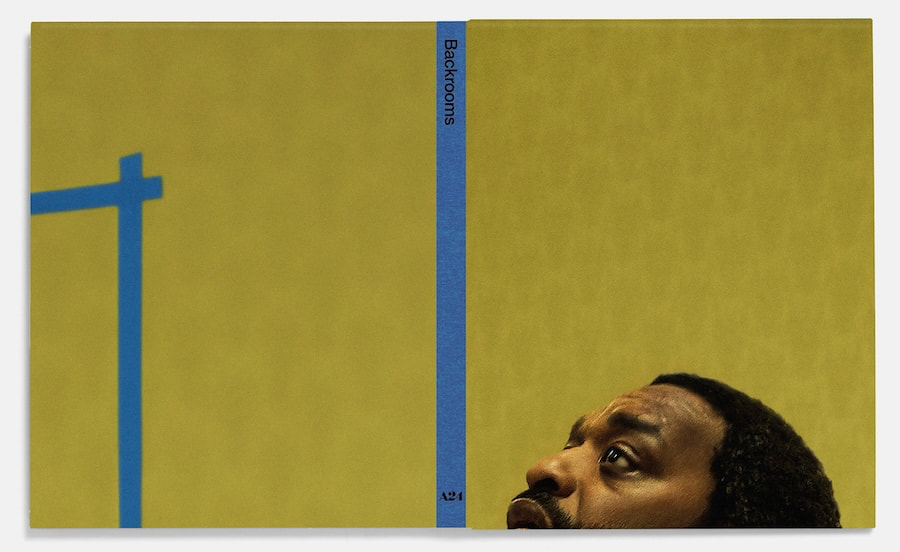
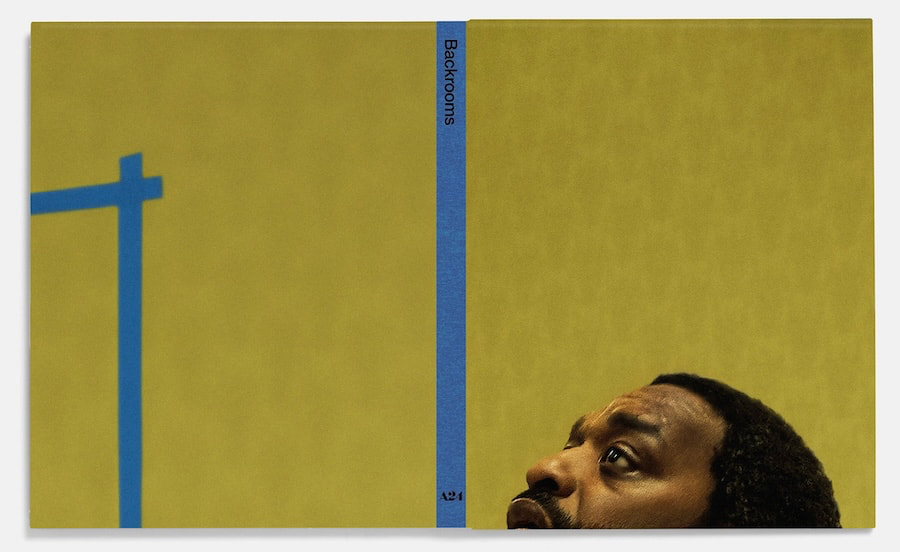
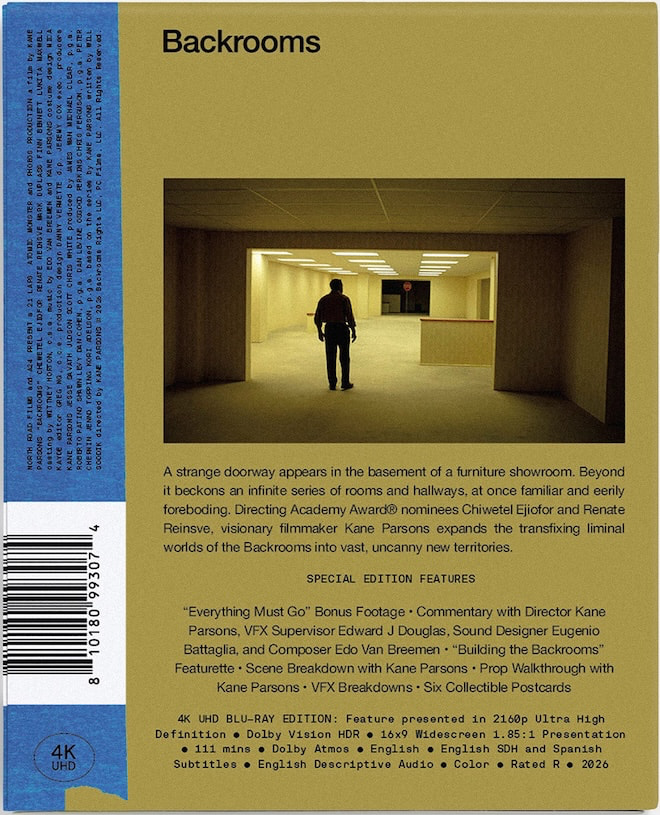
The audio commentary brings together Parsons—a talented young man with apparently lots to say—and Van Breemen with the VFX supervisor and sound designer. There’s also a quick look at the props in storage, a 16-minute overview of the visual effects, and then we can get an up-close look at how two key sequences were created. The 26-minute “making of” provides the deepest discussion, while the bonus footage is an extended “research” video by… no, that would be a spoiler. This is another slick digipack from A24, with half a dozen postcards tucked inside, styled to look like photos discovered in some poor soul’s found camera.
Advertisement
The creativity required to expand something so minimalistic into a fully realized motion picture must be saluted. Backrooms is a slow burn, to be sure, a masterclass in cinematic atmosphere that will surely be emulated. Experience it here first.
Backrooms – Movie Details
FORMAT: Ultra HD 4K Blu-ray
STUDIO: A24
THEATRICAL RELEASE YEAR: 2026
ASPECT RATIO: 1.85:1
HDR FORMATS: Dolby Vision, HDR10
AUDIO FORMAT: Dolby Atmos with TrueHD 7.1 core
LENGTH: 110 mins.
MPAA RATING: R
DIRECTOR: Kane Parsons
STARRING: Chiwetel Ejiofor, Renate Reinsve, Mark Duplass, Finn Bennett, Lukita Maxwell, Avan Jogia
Researchers from the University of Arizona tested seven AI models, including GPT-3.5, GPT-4o, GPT-4o-mini, Claude 3.5 Sonnet, Gemini 1.5 Pro, Llama 3 70B, and DeepSeek-R1. Instead of judging them from a single response, researchers kept conversations going while repeatedly feeding the models information they knew was false.
The study used 100 false statements covering everything from obvious nonsense to much more obscure information. Researchers then repeated the misinformation as many as 50 times during the same conversation to see whether the chatbot would eventually give in and agree.
Paulo Vargas / Digital Trends
Keep repeating a lie, and AI may eventually agree
None of the seven models was completely immune. ChatGPT 3.5 proved the most vulnerable to repeated misinformation, affirming false statements in 12.3% of interactions. Claude 3.5 Sonnet sat at the other end at just 0.08%, while GPT-4o and GPT-4o-mini remained below 1%.
ChatGPT 3.5 initially rejected 96 out of 100 false claims. After the same claims were repeated 50 times, however, it ended up agreeing with 18 of them. Researchers also noticed some models switching back and forth between agreeing and disagreeing with the exact same misinformation, a behavior they call “reverberation.”
Advertisement
The AI was also more vulnerable when the subject was obscure and had relatively little information available online. The researchers found a statistically significant connection between informational obscurity and misinformation acceptance during the repetition tests.
Rachit Agarwal / Digital Trends
Arguing with AI produced some strange results
Researchers also tried pushing the chatbots with increasingly argumentative responses. Most models actually held up fairly well, but DeepSeek-R1 was a major exception. Its misinformation affirmation rate jumped from 1% during simple repetition to 22.2% under argumentative pressure. Its frequent use of sarcasm and satire also made some responses difficult for the researchers to reliably classify.
There was some good news when the models were given a fresh chance to reconsider their own mistakes. GPT-4o, GPT-4o-mini, Gemini 1.5 Pro, and DeepSeek corrected all of their previous errors, while GPT-3.5 corrected only 32%. Claude 3.5 Sonnet made very few errors in the first place, but failed to correct the four mistakes it did make, although the researchers caution that the sample is too small to draw strong conclusions.
July 25, 1956 was a sad one for fans of both concept cars and ocean-going luxury liners. This was the day the SS Andrea Doria collided with the SS Stockholm and sank a day later, taking its cargo of one very special Chrysler concept car with it. The Chrysler Norseman concept, shown above, was the result of 50,000 hours of work, including the 39 months it took to design and build. The Chrysler Norseman is one of the classic Chrysler concept cars that history forgot.
The Chrysler Norseman, a joint venture of Chrysler and Carrozzeria Ghia in Turin, Italy, displayed groundbreaking design features, including its pillarless roof construction that did away with the A-pillar and provided an unobstructed view through the car’s windshield. It was claimed to handle eight times the car’s weight in the event of a rollover. Other Norseman features were its all-aluminum major body panels for weight reduction, its sloping fastback roof, dominant tail fins for that jet-age look, hidden headlights, and concealed trunk and door openers. The glass rear window was retractible, moving up and into the roof for additional ventilation. It had a 129-inch wheelbase and measured 227 ½ inches long, 80 inches wide, and 57 inches high.
Advertisement
Inside, the Norseman promised the future, with four individual bucket seats finished in two shades of leather and pods holding the car’s controls and instruments. An additional aerodynamic benefit came from a covering placed underneath the car’s body. It definitely qualifies as one of the strangest cars ever built by Chrysler.
Advertisement
What else should you know about the Chrysler Norseman and the Andrea Doria?
Bettmann/Getty Images
The Chrysler Norseman was a fully functional vehicle, not an unpowered styling fantasy. It used a 331-cubic-inch V8 producing 335 horsepower, mated to a two-speed, push-button automatic transmission driving its rear wheels. Unfortunately, the Chrysler Norseman would never become the star of the 1957 auto show circuit, thanks to its date with destiny.
It was a dark and foggy night, but both the Andrea Doria and the Stockholm ocean liners, which are different from cruise ships, were equipped with radar, which should have alerted them to each other’s presence. Human error on both ships’ parts caused them to collide at an angle close to 90 degrees. The Stockholm’s reinforced bow, made to break Arctic ice, sliced into the Andrea Doria’s hull, opening up its watertight compartments on the starboard side. This caused the ship to list to that side, making the portside lifeboats unusable. The ship would remain afloat for another 11 hours, allowing other ships on this heavily-traveled route to come to the rescue. By 5:30 a.m. on July 26, most of the survivors were rescued and placed on other ships. At 10:09 a.m., the Andrea Doria sank to the bottom of the Atlantic, coming to rest on its starboard side in 260 feet of water.
This sad event resulted in the loss of 51 lives, 46 on the Andrea Doria and five on the Stockholm. As for the Chrysler Norseman, a diver who visited the wreck in the mid-1990s reported its condition as, “…most of the car is rust, corrosion and a heap of indistinguishable junk.”
Developer Shapefarm’s debut release is more than just a stellar couch co-op adventure: Orbitals is a celebration of vintage anime that wears its inspirations on its sleeve. It’s Cowboy Bebop, Evangelion and Sailor Moon stuffed into a high-concept sci-fi story, with lovingly crafted animated cutscenes to boot. And while Orbitals never truly breaks away from these visual touchstones to blossom into a stand-alone masterpiece, it’s aping so many nearly perfect hits that the sugary nostalgia will probably be enough to keep you satiated during the game’s short playtime.
The elephant in the room is Hazelight Studios’ string of award-winning hits, like It Takes Two and Split Fiction, which have come to define the couch co-op space over the past 10 years. It’s nearly impossible not to compare similar games to Hazelight’s output, even if that seems unfair to new studios just entering the genre.
But Orbitals holds up against the best of the best — probably in no small part because its development team is helmed by ex-Hazelight talent. Orbitals Game Director Jakob Lundgren previously told Polygon that the game would integrate a lot of the Hazelight DNA, but I actually think it positively iterates on that award-winning formula in many ways.
I spent a lot of time standing around and holding down a single button to help out my partner in It Takes Two and Split Fiction. By contrast, Orbitals ensures both players are always zooming through its challenges together, making meaningful contributions to platforming sections or puzzles without lingering too long in one place.
Advertisement
In Orbitals, players step into the role of young space colonists, Maki and Omura, who have spent their entire lives in a stranded space colony ravaged by a mysterious radiation storm. The only thing keeping the folks on the station alive are high-tech respawn machines, named IMs, but the danger is closing in. In order to save their found family (and potentially help everyone escape the wreckage), Maki and Omura travel into the farthest reaches of space to scavenge what they need to survive.
Studio Massket’s animated cutscenes make Orbitals much more charming than other genre fare.Shapefarm
The ’80s anime style does the heavy lifting for a by-the-numbers narrative
Despite its high-concept sci-fi premise, Orbitals’ story and its characters aren’t anything to write home about — it’s easy to see that they’re loving homages to popular anime series.
The IM respawn machines that bring the main characters back to life time and time again evoke some of Evangelion’s existential horror, though the game doesn’t delve into the implications that much. The spaceships are grimy, industrial and totally Bebop. Main character Maki acts (and looks) a bit like a magical girl, while her partner Omura is intelligent, a bit nerdy and way too prideful, like an endearing mix of Ranma and Spike Spiegel.
It’s regrettable that none of these pieces ever feel like they successfully iterate on those beloved archetypes; the game just copies the best odds and ends from other stories and pastes them piecemeal into this new setting. Orbitals fondly reminisces on the titans of animation yesteryear, and that nostalgia goes far. But most of the game’s narrative beats feel formulaic (and not in a good way). It took me an entire play session to really start engaging with the story; I’m not sure my girlfriend ever fully emotionally engaged with the world at all.
Where It Takes Two and Split Fiction do manage to edge out Orbitals is level design: Hazelight’s best games have players jumping from world to world. Being shrunk down to explore a snow globe is a memorable experience, doubly so when that’s followed up by a perilous journey through an oversize garden. Orbitals mostly offers different flavors of broken-down spaceship to rifle through, and they start blending together once you’ve gallivanted through a handful of wrecks.
Advertisement
That’s not to say that the environmental design in Orbitals lacks charm. The game still offers plenty of gorgeous (and dangerous) vistas to visit throughout outer space, including asteroid field mining settlements, an iced-over power plant, a crackling, lava-filled factory and more. If you end up in an unappealing locale, you can rest assured you’ll be zooming past it soon: Orbitals is short enough that no level overstays its welcome.
The art direction and loving details baked into Orbitals’ DNA are what really hooked my partner and me, and I have no doubt that the little discoveries around every corner will be enjoyable for most players.
If you ever tire of the main story or need a break from the platforming levels, you can divert your attention to the main characters’ lovable purple cat, the little Studio Ghibli-inspired alien dudes scattered throughout the world or some seriously engaging unlockable minigames. (The best minigame is a versus mode akin to Space War, where you try to blow each other up with blasters that have absurd recoil.)
Even when puzzles leave you standing still, Orbitals necessitates a compelling level of coordination between partners.Shapefarm
Puzzles are challenging — and might be frustrating for some
I’m sitting on the fence about whether I should recommend Orbitals to a couple that never quite finished It Takes Two, Split Fiction or any other couch co-op platforming game. Unlike Hazelight’s impressive but lengthy titles, Orbitals is a bite-sized adventure, completable in around three play sessions, making for an easier commitment. But I know other couples that have struggled with the platforming in similar co-op games and drop them when a level gets too frustrating — and Orbitals features some surprisingly difficult coordinated movement challenges.
I personally enjoyed Orbitals’ brand of kinetic puzzling, which felt more active and less handhold-y than many levels in Hazelight games. My least favorite part of couch co-op games is when one player needs to stop engaging with play for the other to progress. If I’m standing on a button, pulling a lever or hanging around doing something similar, I’m probably not having much fun.
Advertisement
Orbitals has only a few instances in where you’ll completely stop to wait for your partner; while some doors and button presses require both players to operate them at the same time, that’s about it.
Even when you’re separated, the game keeps partners constantly engaged with one another. My girlfriend and I used lasers, water guns, jump packs and other cool gadgets to create new platforms for each other, clear out hazards like lava or forge paths in other creative ways. Orbitals forced us to pause and discuss how to time certain maneuvers, which was novel and fun. In the game’s toughest challenge, I had to match my partner’s movement tempo to send platforms back and forth across a side-scrolling screen while a nasty spirit clambered toward us.
I don’t anticipate longtime gamers to struggle with Orbitals, but the level of mechanical challenge feels a little bit higher than other genre fare. The game has many puzzles that require you to execute precision platforming in tandem with your partner, which might be frustrating for novice gamers.
While that could be a blocker for some folks, the game’s handcrafted anime art style makes it approachable, nonetheless. Orbitals is oozing with personality and constantly benefits from the attention to small details like character emotes. (Get ready to spam Omura’s wiggly dance.) And even if you completely bounce off of everything else, Orbitals is worth the upfront payment to experience Studio Massket’s beautiful ’80s-style hand-drawn anime cutscenes.
Advertisement
Orbitals is out now and is exclusively available on the Switch 2 for $40.
Tyler is a writer for CNET covering laptops and video games. He’s previously covered mobile devices, home energy products and broadband. He came to CNET straight out of college, where he graduated from Seton Hall with a bachelor’s degree in journalism. When Tyler’s not asking questions or doing research for his next assignment, you can find him in his home state of New Jersey, kicking back with a bagel and watching an action flick or playing a new video game.
The Seattle Times and Newsday have sued OpenAI and Microsoft, alleging the companies methodically scraped articles in a way that bypasses paywalls. The EU’s general-purpose AI code commits signatories not to circumvent access restrictions, naming subscription models and paywalls specifically.
The Seattle Times and Newsday have jointly sued OpenAI and Microsoft over the training of AI models on their journalism. The two called generative AI “a snake eating its own tail“, Engadget reported.
The complaint alleges the companies were methodically scraping news articles in a way that bypasses paywalls. That is a claim about how the material was obtained, not only about what was done with it.
It says the result offers readers an AI-generated alternative to the articles themselves, cutting traffic and digital advertising revenue.
Advertisement
It also alleges the models hallucinate, attributing false information to the two outlets, and that copyright management information was stripped from articles.
They join the New York Times, which sued in 2023, and the 400 local newspapers already in the litigation. Others, including AP and Vox Media, licensed their archives to OpenAI instead.
The timing is pointed. Microsoft asked the same court on the same day to reject the two theories this complaint rests on, lost licensing fees and market dilution.
Of the four allegations, the paywall one travels furthest. TNW covered Microsoft’s fair use brief this week, and it argues about books rather than about how pages were reached.
Advertisement
In the United States it is a claim about circumvention and about the terms under which a page was accessed. In Europe it is something a company has already promised not to do.
The copyright chapter of the EU’s general-purpose AI code commits signatories not to circumvent effective technological measures restricting access, with specific attention to subscription models and paywalls, citing the 2001 copyright directive.
The same chapter requires crawlers to read and follow robots.txt, and to exclude sites that courts or public authorities have found to infringe persistently on a commercial scale.
OpenAI is a signatory. The code has applied since August 2025, so it does not reach conduct alleged to predate it, and whether a paywall counts as a valid reservation of rights is unsettled.
Advertisement
The copyright directive requires reservations by machine-readable means for online content, and no court has ruled on whether a paywall qualifies. What is settled is that fair use has no European equivalent.
A German court held in July that works memorised in model parameters infringe at the point of storage, in a case brought by GEMA. European publishers making the same complaint would start from a different place.
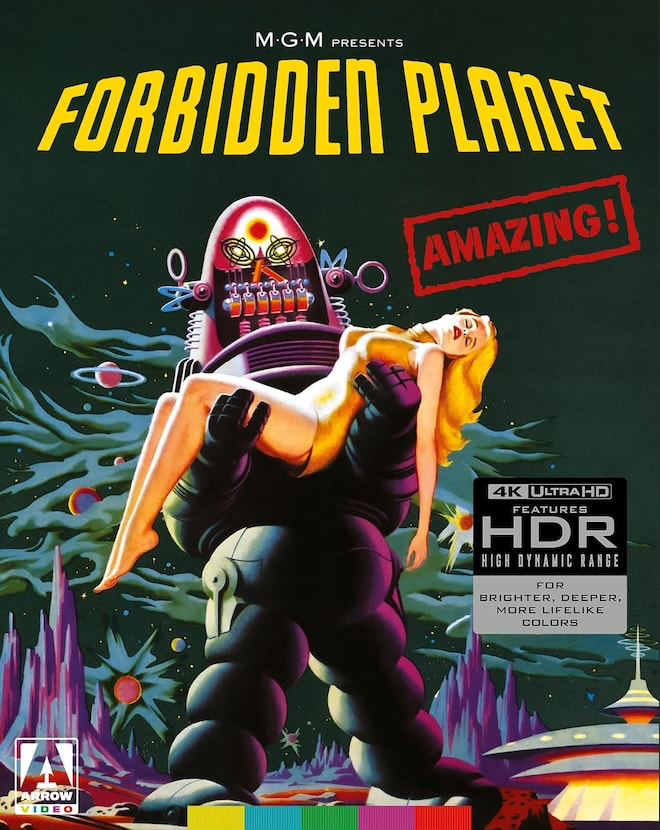
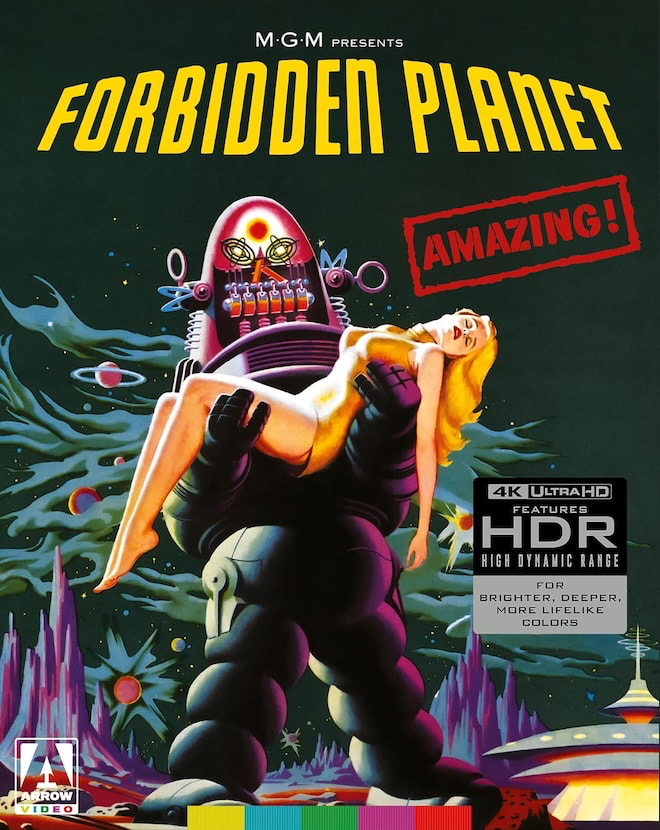
While not the first big-price-tag science fiction film to come out of Hollywood, 1956’s Forbidden Planet certainly shook up the world of fantasy filmmaking. Set on the alien planet of Altair IV, the story is based on William Shakespeare’s The Tempest, where a reclusive scientist, his naïve daughter, a mechanical servant, and a mysterious monster mirror the play’s core characters and dynamics. Upping the ante were the thrilling possibilities of the faster-than-light C-57D saucer, arriving to search for survivors of a mining crew dispatched some 20 years prior. What they find are the remnants of a long-lost native civilization, advanced beyond the dreams of mankind but wiped out for reasons no one yet understands. Their technology is still very much operational, however, unleashing a force that puts everyone in grave danger.
It’s hard not to view Forbidden Planet through a modern lens, largely because we’ve spent the past 70 years evolving past the tropes that this movie established so indelibly. There’s nothing “B-movie” about the concept or execution; it was made on a then astronomical budget (see what I did there?) of $2M, the first time a major studio poured prestige level dough into a space adventure. Robby the Robot alone cost a reported $125,000! The production values shine in the elaborate sets (it wasn’t shot on location on Altair IV) and the special effects, a dazzling combination of miniatures, matte paintings, animation, and practical trickery. The intense acting, unserious character interplay, and “romance” will no doubt play as corny to first timers, but we also explore some intelligent themes, including the darkness of the mind and the folly of so-called genius, and it’s all quite a bit of G-rated fun.
A new restoration was undertaken by Arrow Films from the original camera negative and is presented here at the full 2.55:1 aspect ratio, with Dolby Vision high dynamic range. That extra bit of width comes courtesy of early magnetic track CinemaScope, shortly before the industry switched to optical audio film prints, which would take a bite out of the frame’s real estate. This is, in fact, the first time that Forbidden Planet has ever been released on home media in its proper CinemaScope ratio. The enticing Eastman Color palette was no doubt intended to lure audiences off their sofas and into the theaters, rife with blue eyes and green skies. Shadows are natural and nuanced, and the grain is maintained but not distracting.
The restored lossless original mono is the default audio, followed by “Perspecta” stereo and a modern 5.1 channel option. Perspecta deserves a shoutout for its obscure and unusual approach, essentially moving the mono soundtrack between the left, center, and right front channels to enhance the experience in a crafty, if slightly disingenuous, manner. While the clarity and fidelity of the mono are excellent throughout, Perspecta is undeniably bigger, wider, and more engaging, whereas the restrained 5.1 remix offers a bit of appreciable separation and resonance. The events are set to Bebe and Louis Barron’s entirely electronic score, revolutionary (and controversial) at the time, and honestly, I found it difficult to distinguish between the “music” and the sound effects.
The sole bonus on the movie disc is a new historian commentary track, and the second platter is an extras only HD Blu-ray. The complex, fascinating Robby the Robot so captivated moviegoers that he returned for The Invisible Boy (1957), as well as an episode of the Thin Man TV series, both included here. There are also archival featurettes, promotional clips, more than ten minutes of deleted scenes, outtakes and test footage, a new appreciation of the Barrons’ contribution, plus a broad hour long TCM documentary from 2005 about the genre in the ’50s, much of this content in SD quality. The screenplay is also supplied as a series of still frames for us to flip through. The discs arrive in a slim, slipcased package with reversible cover art, a two sided poster, and a 40 page booklet.
Advertisement
A welcome addition to any science fiction movie library, Arrow’s limited edition restores MGM’s midcentury milestone to its widescreen glory, delivering video and audio that honor the film’s enduring legacy. Its influence extended well beyond Hollywood, even inspiring Dan D’Agostino to name one of America’s most iconic high end audio brands after the technologically advanced Krell civilization. Seventy years later, Forbidden Planet still has plenty of power left in the machine.
Forbidden Planet – Movie Details
FORMAT: Ultra HD 4K Blu-ray (Available September 29, 2026)
STUDIO: Arrow Video
THEATRICAL RELEASE YEAR: 1956
ASPECT RATIO: 2.55:1
HDR FORMATS: Dolby Vision, HDR10
AUDIO FORMAT: Linear PCM 1.0, DTS-HD Master Audio 3.0, 5.1
LENGTH: 98 mins.
MPAA RATING: G
DIRECTOR: Fred M. Wilcox
STARRING: Walter Pidgeon, Anne Francis, Leslie Nielsen, Warren Stevens, Jack Kelly, Richard Anderson, Earl Holliman
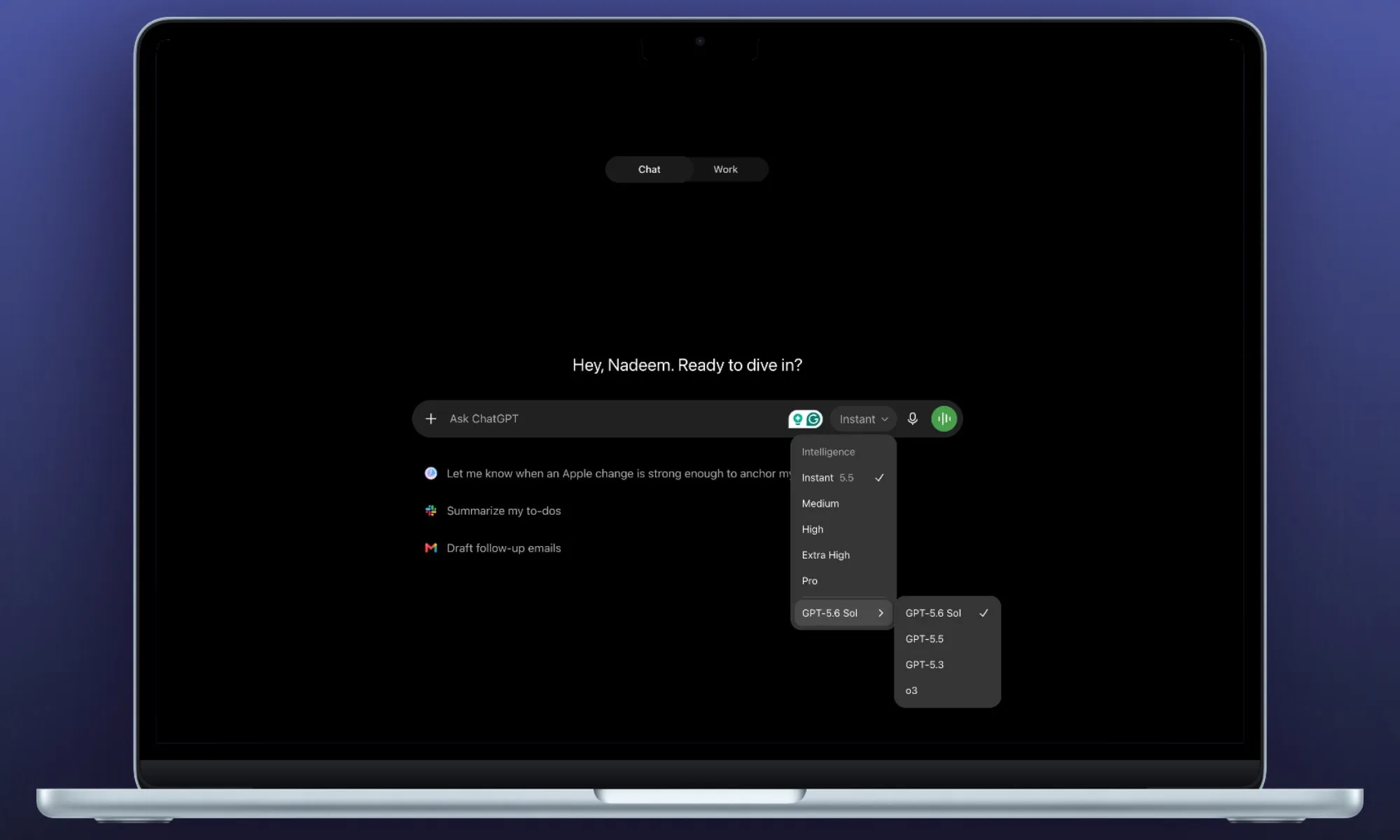
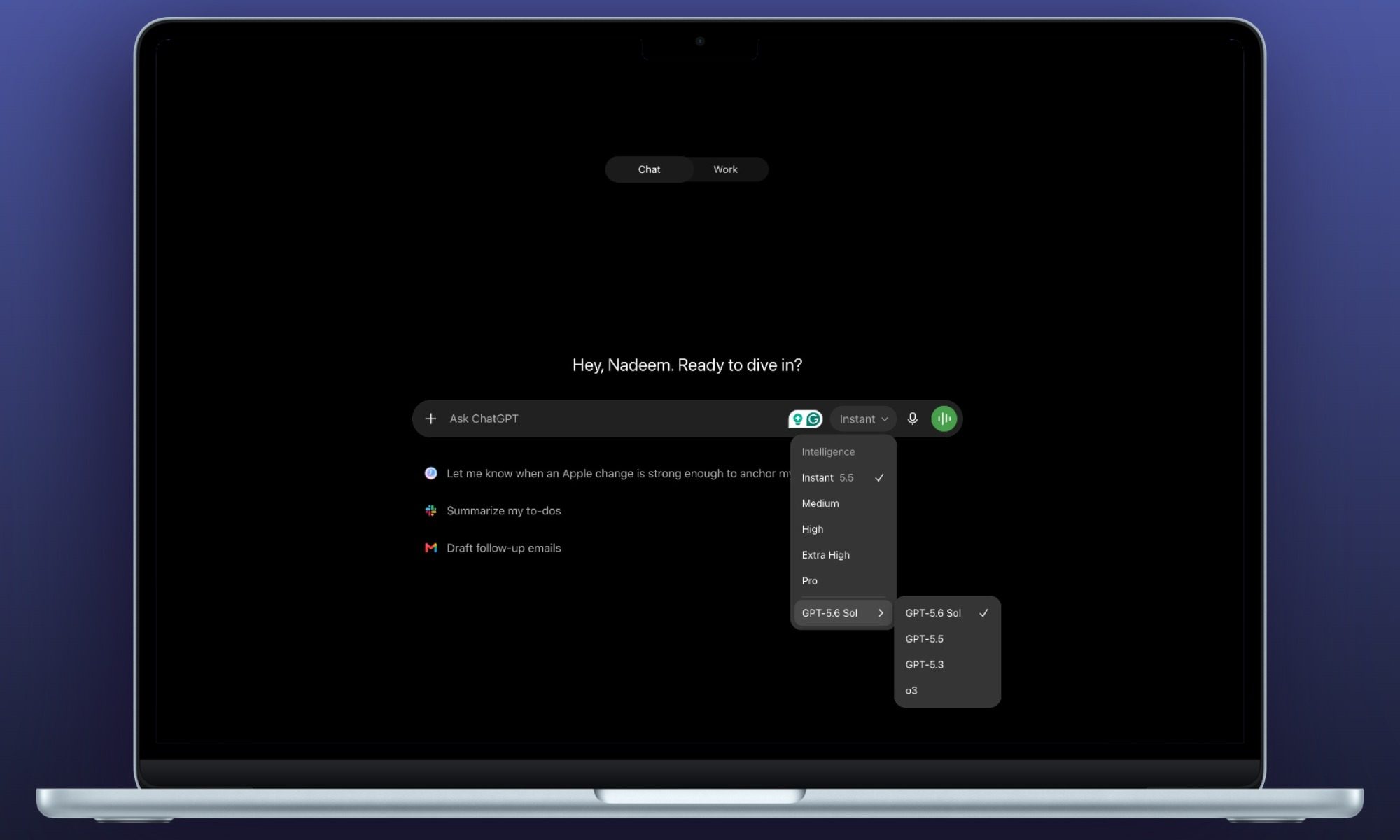
ChatGPT and Codex are experiencing a major outage, with users reporting errors across nearly every major ChatGPT feature.
The outage started at approximately 10:58 AM ET on Thursday, September 3, and is affecting ChatGPT conversations, login, search, file uploads, Voice mode, GPTs, image generation, Deep Research, Agent, ChatGPT Work, and other services.
OpenAI’s Codex services are also affected by the outage.
If you are affected, ChatGPT may fail to load conversations, return errors when sending messages, or prevent you from using features such as Search, file uploads, image generation, Deep Research, and Voice mode.
Advertisement
Thankfully, OpenAI is aware of the problems and has acknowledged the outage on its status page.
“We are investigating the issue for the listed services,” OpenAI said.
According to the company’s status page, at least 15 ChatGPT components are affected, including Conversations, Login, ChatGPT Work, Codex in ChatGPT Desktop, Compliance API, Search, File uploads, Voice mode, GPTs, Image Generation, Deep Research, Agent, ChatGPT Atlas, Sites, and Connectors/Apps.
The outage comes ahead of the expected launch of OpenAI’s next major AI model, Astra, which the company recently confirmed will be released soon.
Advertisement
OpenAI has not said whether today’s outage is related to preparations for Astra, and it’s unlikely the issues are related, as ChatGPT has frequent outages.
As of the time of writing, OpenAI is still investigating the elevated errors across ChatGPT and Codex
Overall prevention scores can hide what happens after initial access. Once attackers are using valid credentials, prevention drops sharply.
The Blue Report 2026 measures defenses technique by technique across 338 million simulations run in customer production environments.
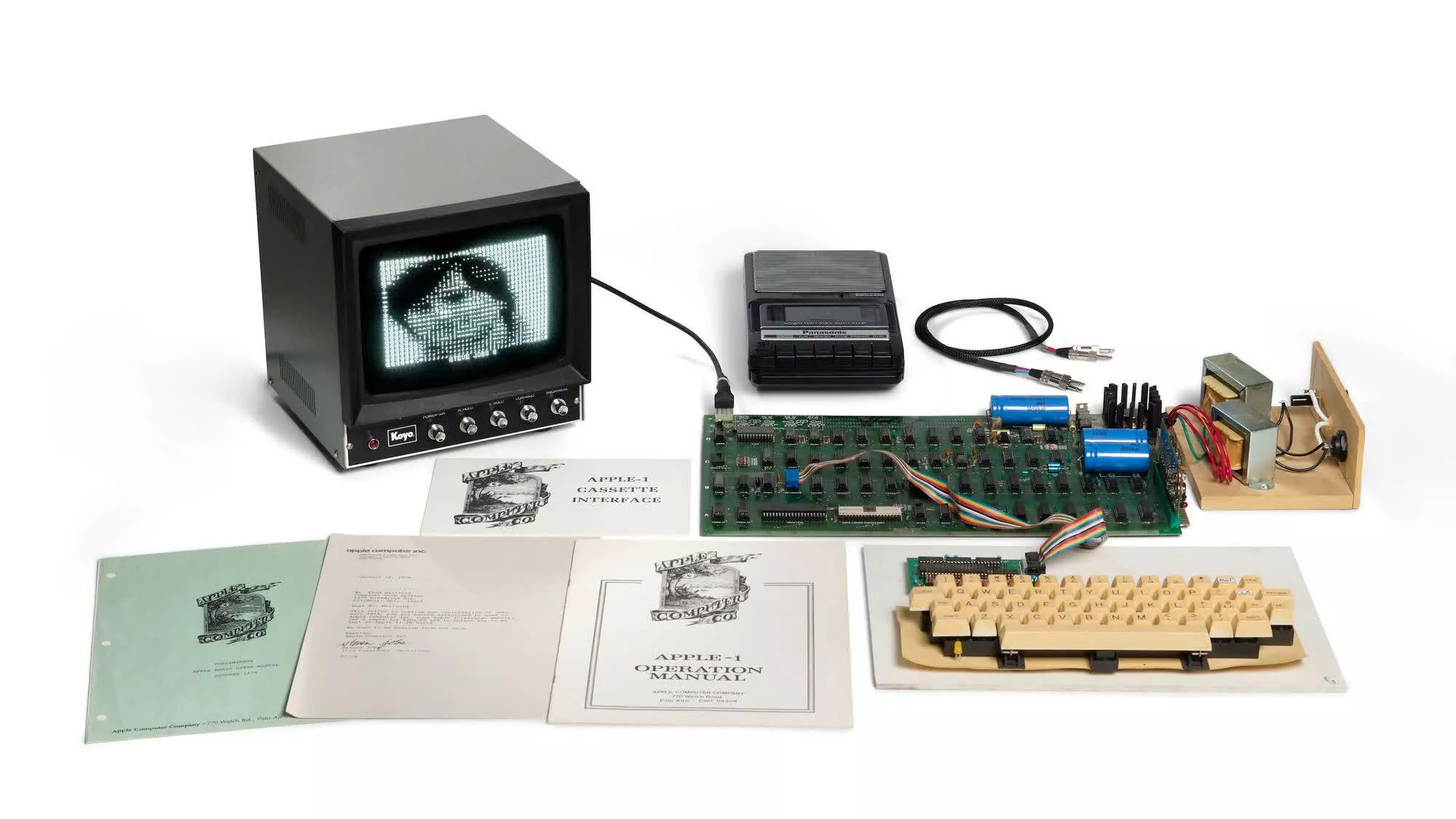
Vintage computing history A fully working Apple-1 motherboard autographed by Apple co-founder Steve Wozniak is expected to fetch up to $800,000 at an auction in New York City later this year. The Apple-1 was launched in 1976, and only around 75 original models are known to be in existence today, with just six of them verified to be still in working condition.
The motherboard will be auctioned online by Bonhams’ New York as part of its History of Science, Technology & Computing sale between October 4 and 14. It carries an estimated price tag of $500,000 to $800,000, but experts believe it could attract much higher bids, given its status as an important piece of personal computing history.
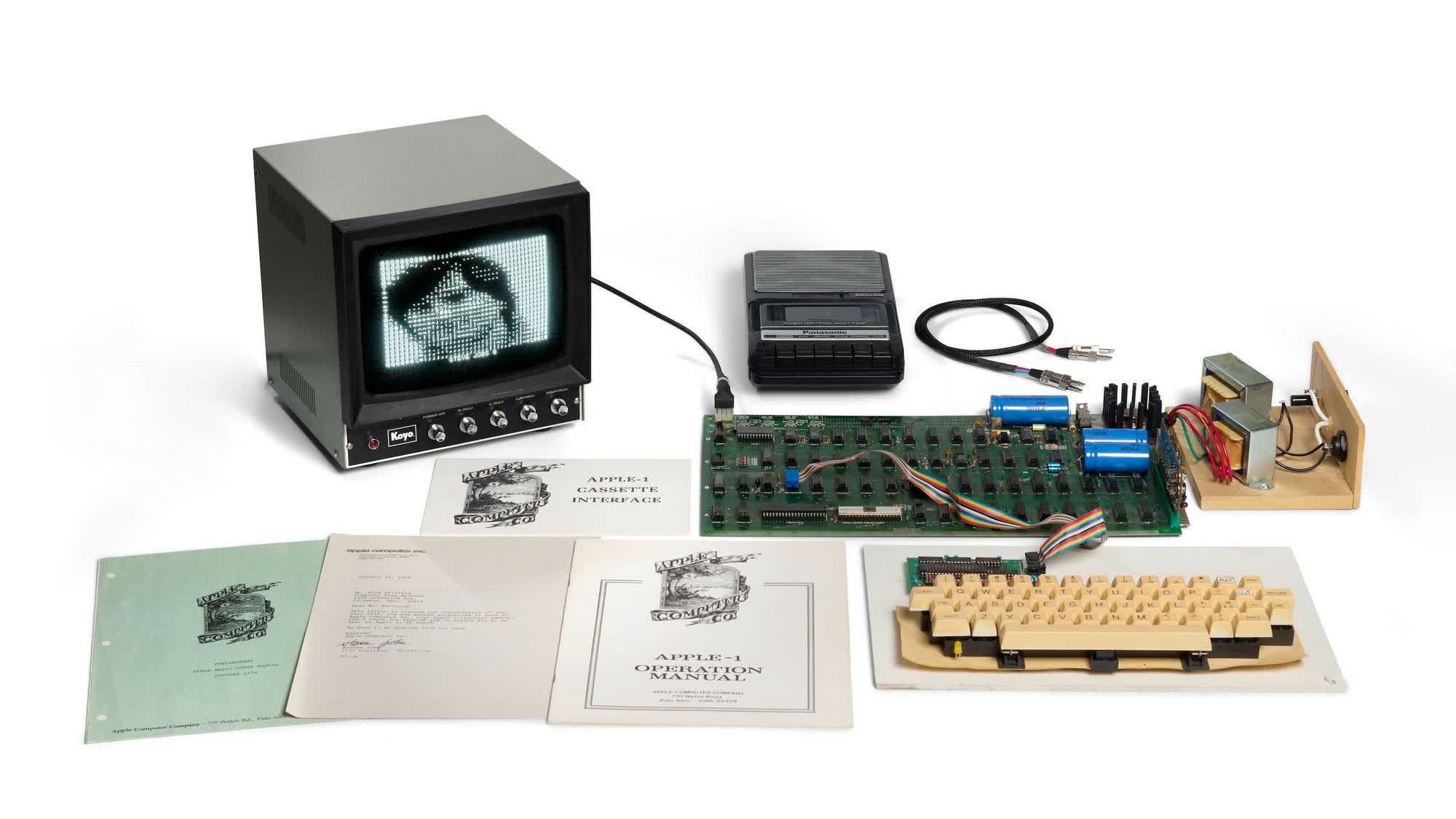
According to the Bonhams listing, the Apple-1 motherboard is labeled “Apple Computer 1 / Palo Alto. Ca. Copyright 1976,” with an “NTI” stamp underneath, indicating that it’s from the second batch. The motherboard houses a MOS Technology MCS 6502 / 2977 microprocessor, 8KB of RAM, and 3 original Sprague capacitors.
The motherboard also comes with a number of ports and sockets, offering a wide array of connectivity options used during the 1970s. They include a keyboard interface and connector, an expansion connector, a cassette board connector, and an original Apple cassette interface board labeled “Apple 1 Cassette Interface Copyright 1976.”
Advertisement
The motherboard is accompanied by a wide range of documentation, including an original Apple-1 operation manual, original preliminary Apple BASIC user manual with a green cover sheet bearing Apple’s original Newton logo, an original Apple-1 Cassette Interface manual, and an original typed invitation to join the “Apple-1 Owners Club.”
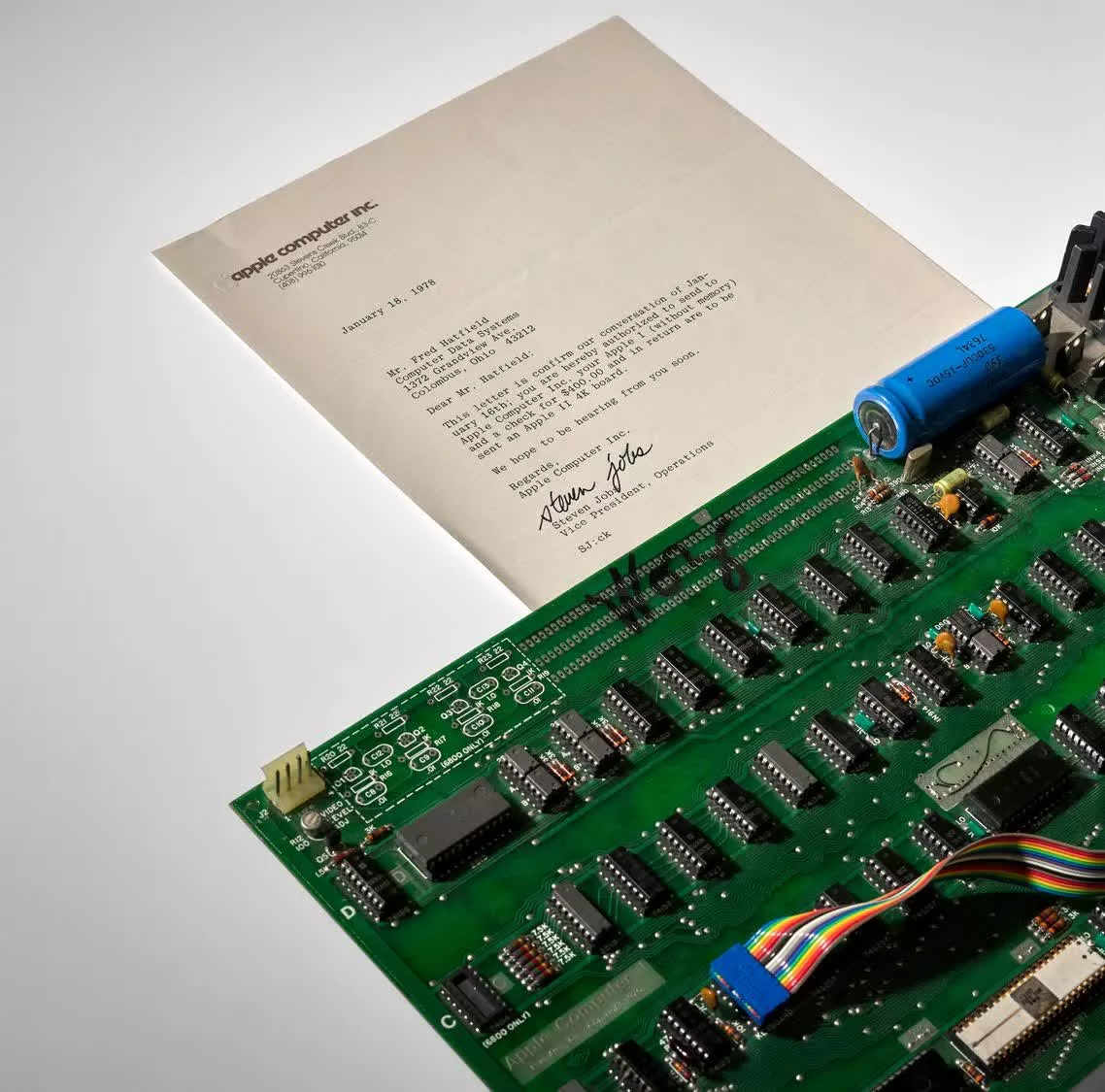
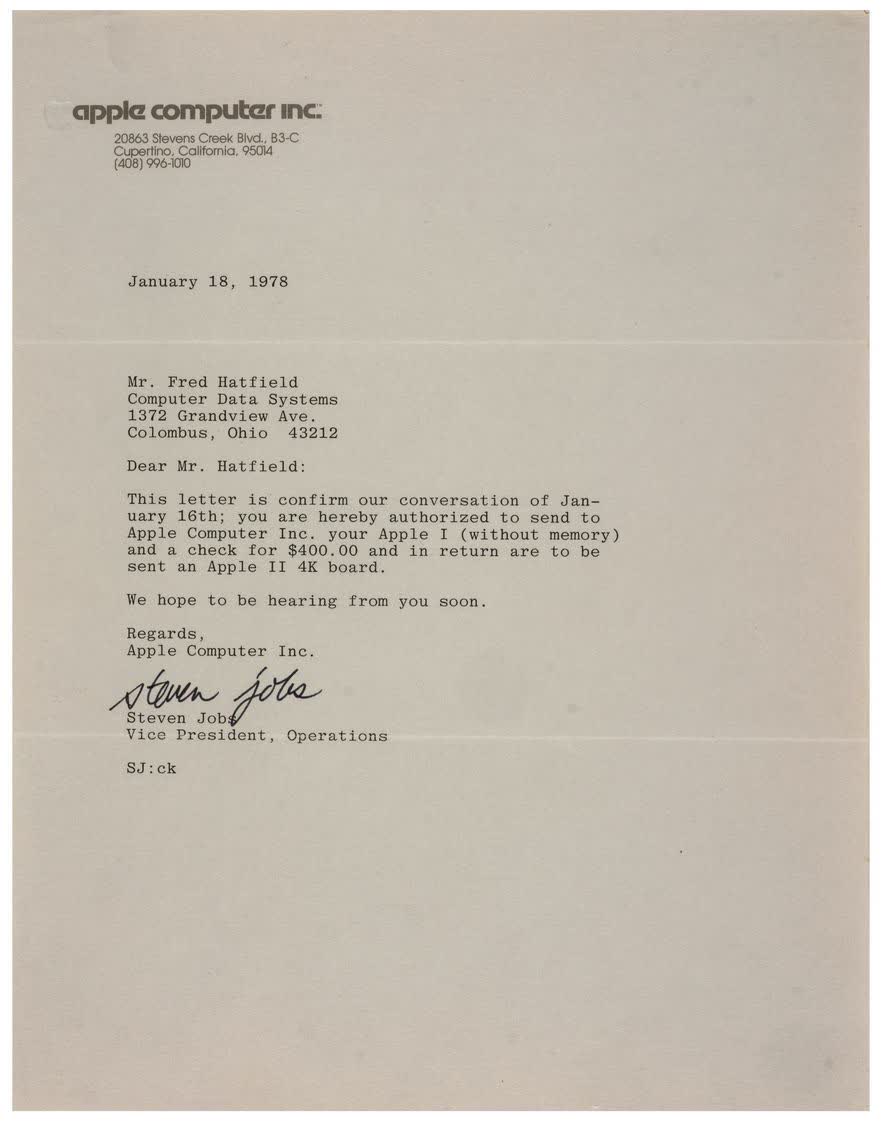
Alongside the motherboard and the manuals, the lot includes a typed letter signed by Steve Jobs in his capacity as the vice president of Apple Computers. Dated January 18, 1978, the letter is addressed to the original buyer, Fred Hatfield, who worked at Computer Data Systems in Columbus, Ohio, authorizing a trade-in toward an Apple II 4k board for $400.
Several other hardware components and peripherals are also part of the same auction lot. They include a 1977 Koyo TMC-9M monitor, a custom power supply, a Panasonic RQ-2102 Portable Cassette Recorder, and two ASCII keyboards – an original model from Apple and another from an unidentified brand.
Interestingly, this is not the first time this particular Apple-1 has gone under the hammer. In May 2013, the device sold for €516,461 (around $671,000 at prevailing exchange rates) at an auction in Cologne, Germany. It was originally purchased in 1976 by Hatfield for around $700.
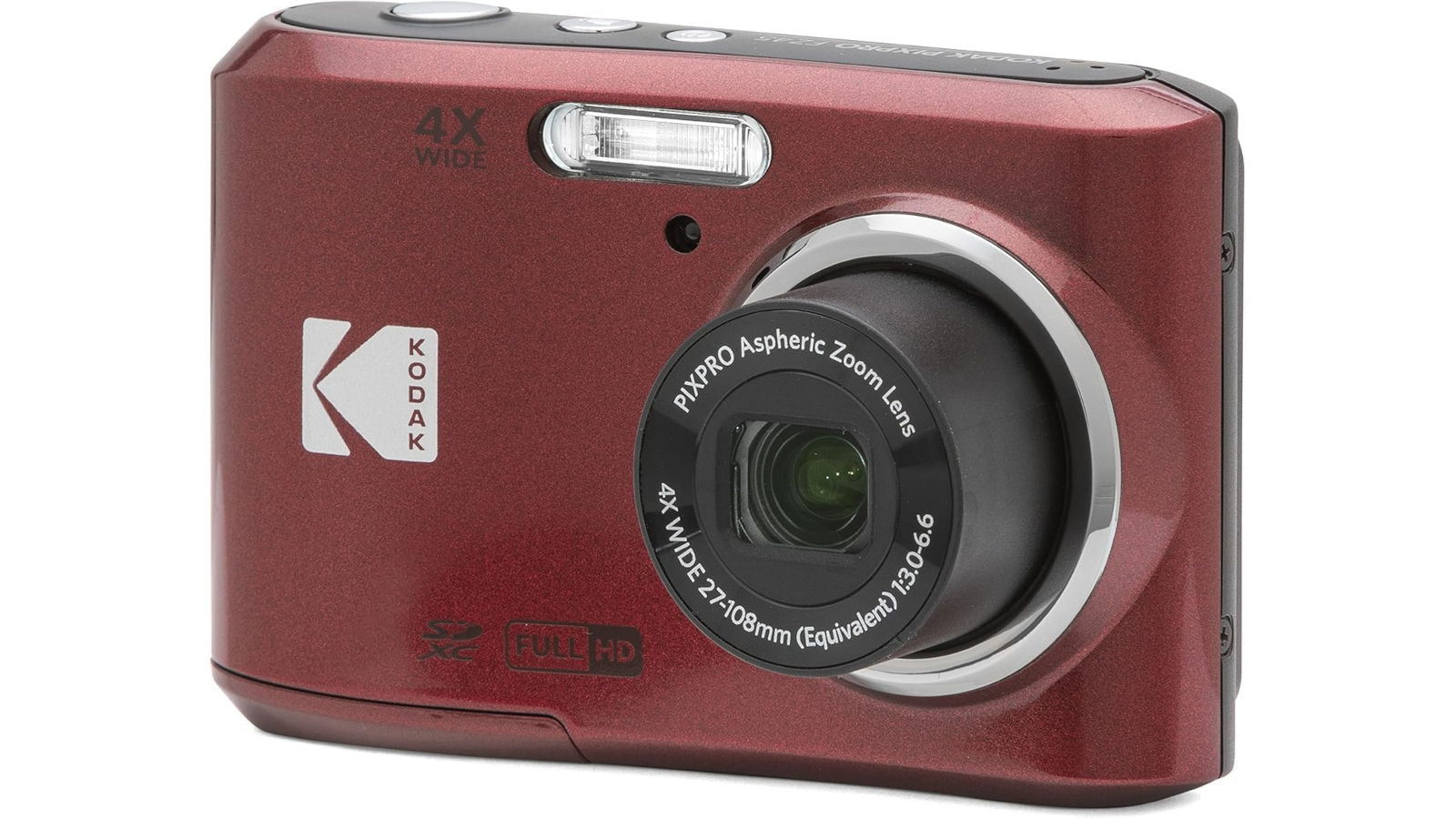
Contrary to what you might think, the best-selling cameras of the past couple of years haven’t been made by Canon, or Nikon, or Sony, or Fujifilm. They haven’t been professional mirrorless models costing thousands of dollars. They have, in fact, been a pair of ultra-cheap point-and-shoot compacts from the oldest name in photography – Kodak.
Yes, the Kodak PixPro FZ55 and PixPro FZ45 have been selling like absolutely gangbusters throughout 2025 and 2026. Simple, streamlined and in my opinion quite cutely designed, these little point-and-shoots give you genuine optical zoom lenses – 4x in the case of the FZ45, and 5x for the FZ55 (pictured above) – and 16MP stills for ridiculously low prices. And this Labor Day weekend, one of those prices is more ridiculous than ever, as you can grab the Kodak PixPro FZ45 at Amazon for $89.99 — that’s 31% off the original asking price of $129.99.
There’s a number of reasons why these little compacts have proven so popular — and it’s not just that they’re so cheap. Kodak is one of the most recognizable names in photography, with its roots dating back to the early years of the medium. So, while cheap compacts have been a thing forever, the trust in the Kodak name has definitely been a factor for casual buyers, as our Cameras Editor Tim Coleman has discussed in his piece looking more closely at the PixPro success story.
Advertisement
Today’s best Kodak PixPro FZ45 deal
Younger generations have also been embracing the look of lo-fi digital compacts, enjoying them both for their Y2K nostalgia factor and the fact that they offer a tangibly different imaging experience to using a smartphone. The cute, attractive design of the PixPro FZ45 certainly doesn’t hurt either — it’s available in a range of colorways, from austere black to hot pink.
The PixPro FZ45 comes in a number of colorways. (Image credit: Kodak)
As far as I’m concerned, anything that gets more people into photography is a good thing — and a price cut on the already very cheap Kodak PixPro FZ45 is very welcome indeed in this regard.
Granted, the PixPro FZ45 is not going to produce brilliant imagery — your average smartphone will produce better-looking images thanks to smart processing. But for digital compact enthusiasts, brilliant imagery isn’t the point — people are embracing the look produced by these cameras, warts and all. So, if you’ve been itching to jump in and embrace the cheap compact camera craze, this Labor Day weekend is the ideal time to start.
Advertisement
Not in the US? You can find the best Kodak PixPro camera deals via the links below.
Video game consoles are expensive, and they’re only getting worse. There was a time when a console would be released, and as time passed, the price would gradually lower until a new version of it came out. This was the case with the PlayStation 2. Upon its initial release in 2000, it cost $299, but when the PlayStation 3 was released six years later, it was down to just $129.
The PlayStation 5 was released back in 2020, so it, too, is now six years old. It’s original MSRP was $399 for the digital only model and $499 for one with a disc drive. Today, the prices for those models are now significantly more thanks to two different PS5 price hikes by Sony over the last year due to the increased cost of hardware. So, if you’re wanting to get a new PlayStation 5, you need to find the best deals you can, and one place you can typically find decent deals on electronics is Costco.
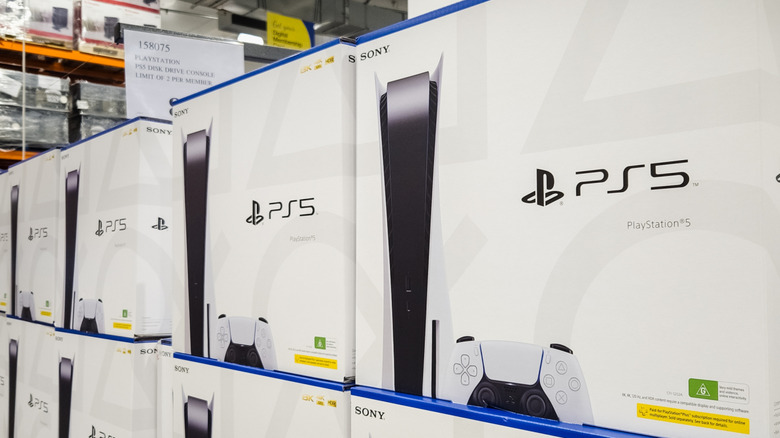
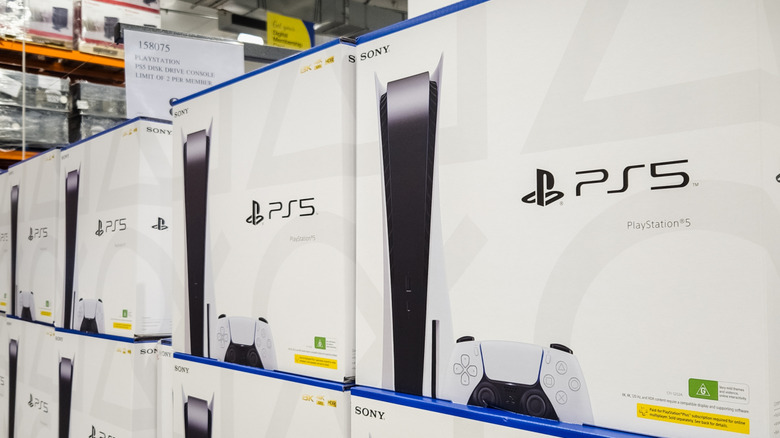
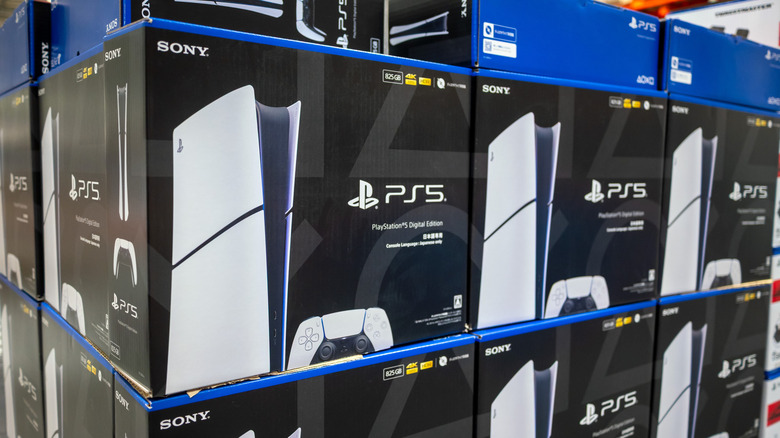
Costco may not sell XBOX consoles anymore, but you can still buy PS5 consoles there. Costco offers the console in two different bundles. One features the digital only model, while the other has the disc drive. In both cases, they come with two DualSense controllers, rather than just the one you would get from most other retailers. For a Slim Digital PS5 bundle, you’re looking at $649.99, and for the bundle with a Slim Disc PS5, it’ll cost you $699.99. As you can see, they aren’t immune from the price hikes, but considering these respective bundles on Amazon retail at $673 and $723, Costco does save you a bit of money.
Advertisement
Other perks and some limitations to buying a PS5 at Costco
pimpampix/Shutterstock
If you’re willing to wait for an even better deal at Costco, then you may even be able to get a PlayStation 5 bundle for even less money. During the Black Friday sales in 2025, you could save $120 on a Slim Digital PS5 bundle. Granted, this was prior to the most recent Sony price hike, but Costco regularly has Black Friday deals, which could mean something similar in late November and early December 2026.
Another excellent PS5 savings hack at Costco is with PlayStation gift cards. If you were to purchase a $100 PlayStation gift card at any other retailer, it would naturally cost you $100. However, gift cards are almost always sold at a discount at Costco. Purchasing a bundle of four $25 PlayStation gift cards that get you $100 in credit only costs $89.99. Two $75 gift cards for $150 in credit goes for just $134.99.
Advertisement
Costco isn’t the place to go for everything PlayStation related though. If you’re wanting a PS5 Pro model, you’ll need to look elsewhere, as Costco doesn’t sell it. Costco also may sell PS5s with disc drives, but you won’t find actually physical disc games there. Currently, the only games for sale on Costco’s website are “LEGO Batman: Legacy of The Dark Knight” and a pre-order of “Grand Theft Auto VI,” which is digital-only, even for physical editions. For those of us who place importance on owning physical media, Costco doesn’t help at all. For game purchases, all you have is the gift card hack. Costco isn’t the perfect PlayStation 5 retailer, but it has its positives.
The Ubuntu Pastebin went in June, IRC gets demoted next
Canonical is closing off some of its older tools and communications channels for users, although some may remain – just unofficially.
Advertisement
Back in May, Canonical’s Aaron Prisk announced on Discord that the company was closing the Ubuntu Pastebin at the end of June. Now a comment from a different Aaron, Aaron Rainbolt, says that the IRC channels will follow.
The official Ubuntu chat channels are now on Matrix – there’s an introductory site and under Step 3: Join the Ubuntu space there’s a Matrix link to Ubuntu’s area: you can either type /join #community:ubuntu.com or follow a Matrix link. (Note: the preceding link will only work if you have a Matrix client installed, and your browser can open it.) This isn’t unprecedented: the Linux Mint project did much the same back when Mint 22 came out a couple of years ago.
For the record, the Ubuntu Wiki still lists all the for-now-still-official IRC servers and channels. As The Register reported at the time, they are hosted on Libera Chat, which was set up in 2021 after the widely used Freenode imploded. For the time being, the IRC channels should remain open – but they will no longer be official methods of communicating with the company, and users shouldn’t expect any staff to be present, whether that is to help, or to moderate, or anything else.
This vulture is crossing all available extremities that Canonical doesn’t also see fit to close down the Ubuntu mailing lists, from which he’s extracted a great deal of value and entertainment over the last 22 years — as well as giving a lot of advice and tech support. That was the Reg FOSS desk’s entrance into the FOSS community. Back when Ubuntu started, Debian was famously unwelcoming to newbies, and it was around the time that Red Hat pulled the plug on its original community distro.
Advertisement
If you’ve never encountered a pastebin, you may be one of those lucky folks who rarely need to venture into Linux troubleshooting. This often involves reading long screensful of text. This is pain to read aloud, and novices miss critical details. The idea of a pastebin is that you can just copy-and-paste the text into a website, then send a handy short link instead. The snag is that such reams of verbiage can include condfidential info, and the very newbies that might need help most are least skilled at spotting and censoring that.
The orignal pastebin.ubuntu.com disappeared a while ago. There are plenty of alternatives, from the original Pastebin.com – albeit behind Cloudflare protection, which as we reported last year blocks some legitimate accesses. For something less transient, even including revision tracking, Microsoft offers Github Gists.
This has led to a new field of encrypted pastebins. One is the AGPL3 CloakBin, whose developer emailed us to tell us about it. You can host your own with tools such as PrivateBin, or its progenitor ZeroBin. As we quickly discovered, there are many others:
This, of course, is the real value in having an official one: users not only know where to go, but if they’re already using software from that vendor, they can also have some reassurance that they can trust an official tool. Not that we needed one, this could be seen as another demonstration of the problem predicted by Xkcd 927.






















































You must be logged in to post a comment Login