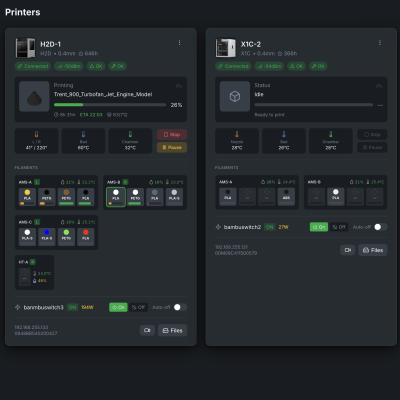
If you have a Bambu Labs printer and aren’t keen to send your files to Bambu’s servers with each print job, then check out Bambuddy, an open-source, self-hosted, cloud-free central command that offers a local alternative for managing Bambu Labs printers. It acts as a replacement for the official cloud services, allowing you to slice, print, and monitor with full local control and zero reliance on Bambu Labs’ servers.
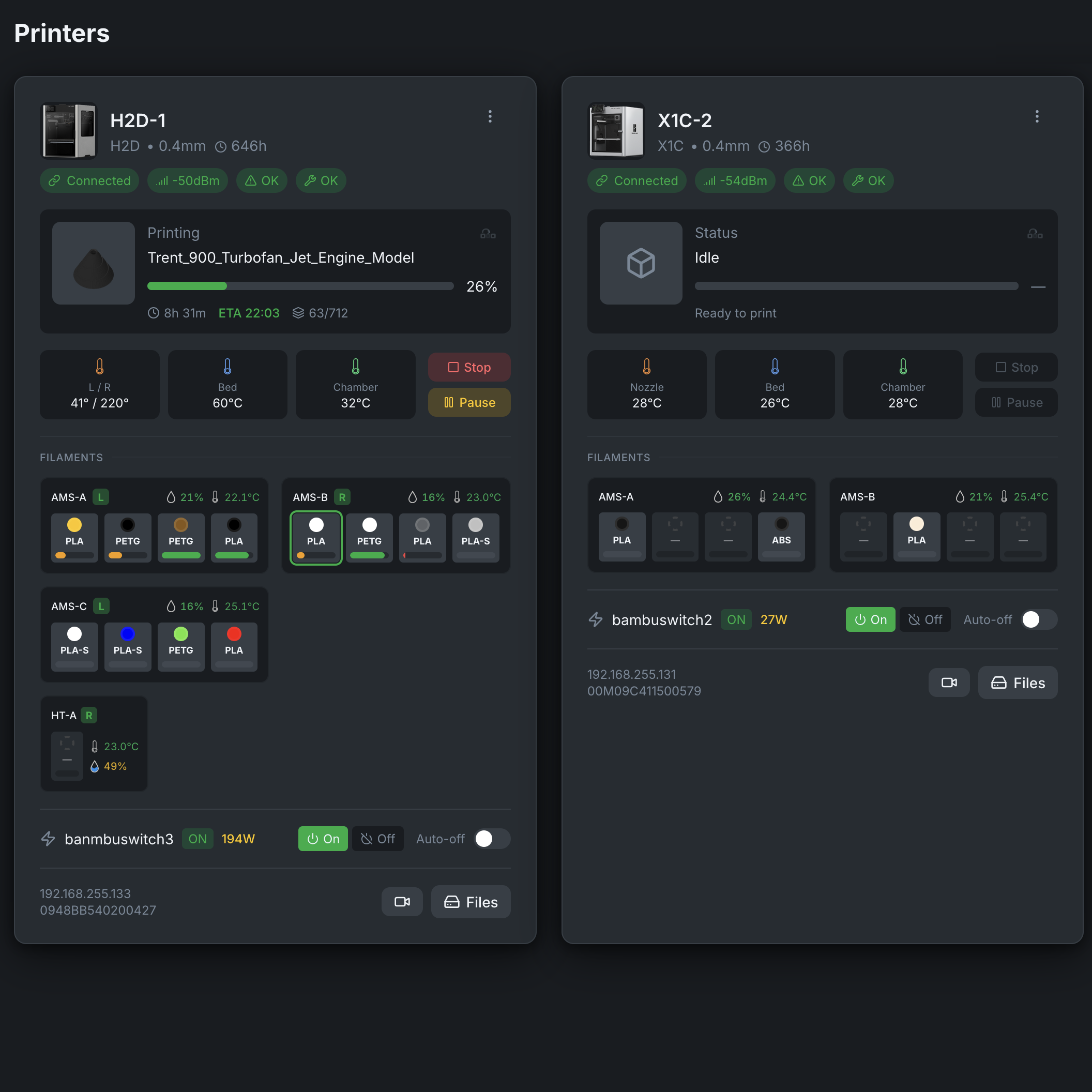
Bambuddy offers full control over one to forty printers.
To use it, one installs Bambuddy, then puts their printer(s) into LAN-only mode. Doing this disables cloud functionality, including remote access. Then one enables Developer Mode, which allows external software to control printer functions via a machine API. Once that’s done, the printers can be added to Bambuddy.
Bambuddy then acts as a full-featured control panel and management center for anywhere from one to forty printers. It runs on Linux, macOS, or Windows, and a Raspberry Pi is a common install target.
Bambu Labs makes indisputably high-quality printers, and using their software and official app is certainly convenient. But the fact that every print job goes through Bambu’s servers, and a software architecture that frustrates home-grown solutions? Not so much. Add AGPLv3 violations and some heavy-handed legal behavior to the mix, and it’s easy to understand the motivation for an alternative to the factory software.
Bambuddy has a huge number of features — including an integrated slicer and proxy mode for remote access — and it may look a little intimidating at first. Fortunately, the project’s website offers a live sandbox demo with simulated printers, which should be right up the alley of those who prefer to learn by clicking around in a consequence-free environment.
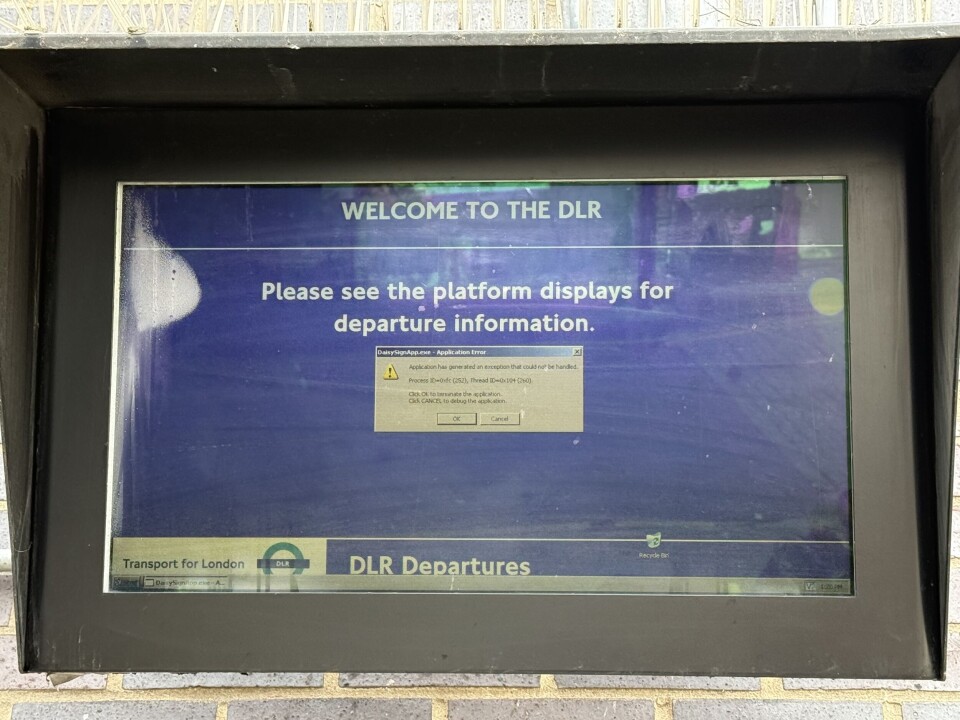
BORK!BORK!BORK!We’re big fans of retro computing here at Vulture Central, and so it is with a certain delight that we can report XP-era Windows has been spotted disgracing itself on London’s Docklands Light Railway.
A London Docklands Light Railway information screen displays a Windows application errorTim Haywood
Spotted by Register reader Tim Hayward, the wonderfully named DaisySignApp.exe has thrown up an application error. While the Windows shell might be shorn of all of XP’s fripperies, the Recycle Bin icon hints at the operating system’s origins. Hayward reckoned that XP was stalking the DLR, but it could also be Windows Server 2003.
Advertisement
Support for Windows Server 2003 finally ended in 2015. XP was sunset in 2014, so the DLR display is rather out of date. Then again, as any IT administrator would admit, if something isn’t broken, there’s no point fixing it, no matter how much Microsoft would encourage them to.
In this case, it is unlikely that the operating system is at fault (although one could argue that it should handle a misbehaving application more discreetly), and DaisySignApp.exe should be dealing with its own dirty laundry rather than throwing an exception in commuters’ faces at Limehouse station.
Limehouse connects London’s Docklands Light Railway (DLR) to the UK’s National Rail services. It was one of the first DLR stations and predates the borked operating system by more than a decade.
Indeed, at the time of the DLR’s opening in 1987, Microsoft was preparing to inflict Windows 2.0 upon the world – the delights of later versions and the company’s GUI dominance were still a few years in the future.
Advertisement
The DLR also seemed like a glimpse into the future back in the 1980s. However, a fair chunk of its underpinnings, such as formerly disused railway viaducts, hark back to an earlier era.
Anyone looking at today’s iteration of Windows might wonder how much of it dates back to what’s on display at Limehouse. ®
A coalition of state attorneys general has opened an investigation into OpenAI.
The company was served with a subpoena from New York’s attorney general on Friday, according to The Wall Street Journal. That subpoena sought documents related to a broad range of topics including the company’s advertising, user engagement and retention, model sycophancy, handling of consumer data and health data, and treatment of minors and seniors.
“AI is a new and powerful technology, and we work every day to safely bring its benefits to people in a responsible way,” an OpenAI spokesperson said in a statement. “We take the concerns raised by state attorneys general seriously and intend to engage constructively with their offices.”
The spokesperson also said, “Today’s ChatGPT includes a more protective experience for minors and people experiencing difficult situations, with safeguards that direct them to real-world resources and trusted human contacts. We believe kids should be treated like kids, which is why we built age prediction, released parental tools to guide their children’s use of AI, and disallowed advertising that targets kids.”
Advertisement
The company did not specify which states are involved in the investigation or share more details about what information was requested. TechCrunch has also reached out to New York attorney general’s office for confirmation.
OpenAI recently defeated its co-founder Elon Musk in a high-profile trial, after Musk accused the company of violating its founding agreement. (Musk’s lead attorney said he will appeal the decision.)
Altman recently apologized to the community of Tumbler Ridge, Canada after a mass shooting; he acknowledged that OpenAI failed to alert law enforcement after the company flagged and banned the suspected shooter’s ChatGPT account.
On a recent evening in suburban Chicago, a group of parents, teachers and administrators gathered to talk about something that, until recently, rarely drew this level of public scrutiny: the role of technology in their schools.
The meeting was part of a three-session tech and learning focus group organized by Mary Jane (MJ) Warden, chief technology officer of Community Consolidated School District 15, in conjunction with the Teaching, Learning and Assessments Department.
The district, which serves 11,000 preK-8 students, spent the past several years — like so many others — adding digital tools. Now, with budgets tightening and concerns about screen time rising, it was time to take stock.
A re-examination of digital tools was already happening with curriculum reviews and tightening budgets after the pandemic. And then the screen time concerns arose.
Advertisement
Participants discussed everything from screen time to what district technology use looks like at home. Out of those conversations came something new: a “Portrait of a Digital Learner,” derived from the district’s Portrait of a Graduate, meant to develop clear expectations around what skills students need and, by extension, which technologies are worth keeping and how technology would be used by students toward positive learning outcomes.
“We’re trying to get much [clearer] about what this is going to address,” says Warden. “What do we need students to learn, and which tools will help us understand where they are?”
Across the country, district leaders are asking similar questions. After years of rapid expansion, many are now engaged in a quieter but more consequential phase: reassessing what stays, what goes and how to decide.
From Buying Tools To Proving Value
For much of the past decade, edtech decisions often began with the product. A new platform promised to boost engagement or personalize learning; districts piloted it, added it to an already crowded ecosystem and moved on.
Advertisement
That approach is no longer sustainable, says Erin Mote, CEO of InnovateEDU, a nonprofit focused on systems change in special education, talent development and data modernization in schools.
“We’re seeing a shift from ‘Does this look cool?’ to ‘Does this work?’” she says. “Districts have less money now; they have to be smarter.”
The end of pandemic-era federal funding has intensified that pressure. Technology leaders are now expected not only to manage infrastructure and compliance, but also to demonstrate what Mote calls a return on instructional impact.
Advertisement
In practice, that is changing how districts approach procurement. Instead of starting with vendor demos, many are beginning with specific learning needs.
“If you need to improve third-grade reading comprehension, you start there,” Mote says. “Then you ask: Which tool can move that needle?”
New Playbook For Evaluation
As districts rethink their approach, a more structured and more skeptical evaluation process is emerging.
One major shift is toward tracking actual usage. Platforms like ClassLink and Clever now give districts detailed analytics on which tools students and teachers are accessing, how often they’re used and, in some cases, how much time is spent in each application. That data has helped uncover what some leaders call “zombie licenses,” products that continue to be renewed despite minimal use.
Advertisement
At Joliet Public Schools in Illinois, technology leaders review usage data each spring alongside feedback from a districtwide technology committee.
“If we’re not getting usage or we have another product that does it better, we start asking hard questions,” says John Armstrong, chief officer for technology and innovation.
But usage alone is not enough. Districts are also weighing cost, redundancy and alignment with instructional goals.
During the pandemic, many schools layered new tools on top of existing ones. Now, leaders are working to simplify.
Advertisement
“We had so many products that teachers were going to four different places to run a lesson,” says Kelly Ronnebeck, associate superintendent for student achievement in East Moline School District 37 in Illinois. “We’re trying to get back to a slower, more intentional process.”
That often means replacing several standalone tools with a single platform that can do multiple jobs — even if it means giving up some features teachers value. In some cases, a newer system can replace several standalone tools at a lower cost but may not match each one’s individual strengths.
“It’s not always a perfect swap,” admits Armstrong. “Someone gives up something.”
At the same time, districts are placing greater emphasis on interoperability and data privacy. Tools must integrate with existing systems like learning management platforms and single sign-on tools, and vendors have to be willing to sign increasingly stringent data privacy agreements.
Advertisement
“If a company can’t meet those requirements, that’s a red flag right away,” says Phil Hintz, CTO of Niles Township District 219 in Illinois.
The Challenge Of Proving What Works
Even as districts adopt more rigorous processes, it remains stubbornly difficult to determine whether edtech tools actually improve learning.
“It’s such a huge challenge,” says Naomi Hupert, director of the Center for Children & Technology at the Education Development Center. “We see so much that doesn’t seem to make a difference but costs a lot of money.”
Part of the difficulty lies in the sheer breadth of what “edtech” encompasses, everything from learning management systems to specialized math platforms to communication tools. Each category has different goals, users and measures of success.
Advertisement
“It’s like asking whether ‘books’ work,” says Hupert. “It depends on the book, the context and how it’s used.”
District leaders have to piece together evidence from multiple sources: vendor-provided analytics, small pilot studies, teacher feedback and, occasionally, external research. But those data points don’t always align.
Jason Schmidt, director of technology in Oshkosh Area School District in Wisconsin, describes his approach as “trust but verify.”
“I know vendors are collecting tons of data, and they have to, but I still need to talk to teachers and understand how the tool is actually being used,” he says.
Advertisement
Even then, results can be uneven. A platform might show strong engagement overall but fail to support certain groups of students — or vice versa.
In Alexandria City Public Schools in Virginia, leaders are developing a formal framework to evaluate both edtech and nontech programs. But defining “value” has proven complex.
“It’s not just usage and cost,” says CIO Emily Dillard. In a district with a high number of English learners, some tools play a critical role for students who need targeted or specialized support.
“You might have a tool that isn’t working for most students — or takes time to show results — but for a small group, it’s the best thing we have. We have to think about what’s best for them, too,” says Dillard.
Advertisement
Building Systems for Quality
Recognizing these challenges, a growing coalition of organizations is working to create clearer signals of quality in the edtech marketplace.
Through the Edtech Quality Collaborative, 1EdTech, CAST, CoSN, Digital Promise, InnovateEDU, ISTE, and SETDA are developing a shared framework built around five indicators: safety, evidence, inclusivity, interoperability and usability.
The goal, says Korah Wiley, senior director of edtech R&D at Digital Promise, is to reduce the noise.
“Right now, there are a lot of certifications and labels, and it’s hard for districts to know what to trust,” says Wiley. “We want to brighten the signal of what quality looks like.”
Advertisement
The initiative includes a planned directory of vetted validators, an implementation guide for districts and a central hub to connect educators with high-quality tools. Leaders hope it will help districts make decisions more confidently and push developers to meet clearer standards.
“This is the cost of doing business in education,” says Mote. “If you want to be in classrooms, you need to be building evidence and demonstrating impact.”
What Happens When Tools Are Cut
For all the talk of frameworks and data, the hardest part of reassessment often comes when districts decide to let a tool go.
Those decisions can affect classroom routines, teacher preferences and even student outcomes. And they are rarely straightforward.
Advertisement
In some cases, tools are phased out because of cost or low usage. In others, they are replaced by more comprehensive platforms. Sometimes, they no longer align with district priorities.
But even when the rationale is clear, the transition can be difficult.
“Teachers build practices around these tools,” says Warden. “We have to be thoughtful about how we support them through change.”
Districts are increasingly pairing those decisions with professional development, clearer communication and, in some cases, community engagement. In Warden’s district, the focus groups that helped define the “Portrait of a Digital Learner” are also shaping how the district explains its choices to families.
Advertisement
“We want to be transparent about what we’re using and why,” she says.
A More Intentional Future
As districts move into this new phase, many leaders describe it as a reset that is forcing them to be more deliberate about how technology fits into teaching and learning.
That includes pushing back on broader narratives that treat all screen time as equal.
“There’s a big difference between passive consumption and purposeful edtech and we need to be clear about this,” says Mote.
Advertisement
It also requires clearer alignment between technology decisions and instructional goals. Without that, even the best tools can fall short.
“If you don’t know what you want teaching and learning to look like, it’s very hard to decide what tools you need,” says Keith Krueger, CEO of CoSN.
Back in District 15, Warden and her colleagues are trying to build that alignment. The conversations sparked by their focus groups are informing not just which tools they keep, but how they define success.
“We’re still digging out from COVID, when we had to move fast and add a lot. Now we have an opportunity to be more strategic.”
Advertisement
For district leaders across the country, that shift may be the most important change of all. The future of edtech, they suggest, will not be defined by the number of tools schools use, but by how thoughtfully they choose them.
A criminal investigation has begun after a police officer allegedly used AI to create evidential material in a “number of cases”. Derbyshire Constabulary said an officer was being investigated over an allegation of suspected perverting the course of justice. The Crown Prosecution Service (CPS) confirmed it was engaging with defence lawyers and the courts over potentially affected cases…
It is the first known allegation of AI misuse by police in a criminal case in the UK, but it follows an incident last year in which West Midlands police relied on AI-generated material that fabricated a match involving Maccabi Tel Aviv. The material was used in intelligence supporting a proposed ban on away fans at the club’s match against Aston Villa.
Anthropic’s sudden move to suspend access to its newest AI models following a U.S. government directive has raised fresh questions across the global technology industry. In India, the decision has reignited a long-running debate over whether one of the world’s largest AI markets can afford to rely on technologies built and controlled elsewhere.
The announcement came late Friday, when Anthropic said it had received the U.S. government directive requiring it to suspend access to its recently launched Fable 5 and Mythos 5 models for all foreign nationals, including its own foreign national employees. The move came shortly after the company announced a partnership with Indian IT services giant Tata Consultancy Services to expand enterprise AI adoption in India, underlining how closely the country’s AI ambitions have become tied to technologies developed and governed in the U.S.
While the broader implications remain unclear, some reports said the initial security concerns were first reported to the government by Amazon CEO Andy Jassy. And The Information said the White House is unlikely to extend similar restrictions to other AI companies and is privately blaming Anthropic’s handling of alleged jailbreak vulnerabilities. Anthropic has disputed the government’s characterization and argued the action should not have been taken.
Regardless, the development has triggered debate among Indian founders, investors, and policy experts over whether the country should accelerate efforts to build domestic AI capabilities, deepen investment in open-source alternatives, or continue relying on a handful of U.S. frontier model providers. For some, the episode is a wake-up call on technological dependence. For others, it is a reminder that access to increasingly critical AI systems can be shaped by geopolitical decisions beyond India’s control.
Advertisement
India has become one of the most important markets for frontier AI companies. Anthropic and OpenAI have both described the South Asian nation as their second-largest market after the U.S., reflecting its growing importance in the global AI race. The companies have already set up their offices in India, expanded local hiring, partnerships, and enterprise initiatives in recent months, betting on India’s vast base of developers, startups, and businesses to accelerate adoption of their latest technologies.
For many in India’s technology sector, Anthropic’s Friday announcement was about more than just one AI company. It reopened questions about the country’s long-term AI strategy and whether India could afford to remain dependent on a small number of foreign frontier AI providers.
“It completely changes things,” said Aakrit Vaish, founder of Indian AI venture platform Activate, referring to Anthropic’s decision. “I think this materially changes the way all of us should be thinking about sovereign AI in India.”
Vaish told TechCrunch that he woke up on Saturday morning “shocked and confused” by the announcement and said it strengthened the case for developing domestic AI capabilities. He expects startups to increasingly turn to open-source models and plans to encourage companies in his portfolio to reduce their dependence on a small number of frontier AI providers.
Advertisement
For some founders, the bigger concern was what restrictions on frontier AI access could mean for competitiveness. Vijay Rayapati, co-founder and CEO of Atomicwork, told TechCrunch that the episode highlighted the risks facing startups whose teams span multiple countries if access to advanced AI systems increasingly becomes subject to geopolitical restrictions.
Atomicwork has around 25 employees in the U.S., though much of its product engineering team is based in Bengaluru, India.
“If your AI team is not made up entirely of U.S. citizens, you are at a competitive disadvantage,” Rayapati said, arguing that unequal access to frontier AI models could give some companies a significant edge over rivals.
The concern comes as parts of India’s tech sector are already grappling with questions about how AI could reshape the economics of global talent. This week, U.S. real estate technology company Opendoor shut its India office less than two years after expanding in the country, with CEO Kaz Nejatian citing a push to bring operational work closer to customers in the U.S. and a shift toward smaller AI-native teams.
Advertisement
While Opendoor did not specify how much of the decision was driven by AI-related efficiencies, the move added to a broader debate about how advances in AI could affect the future of global technology work and what that might mean for India’s position as an engineering talent hub.
Beyond Anthropic
In addition to startups and AI builders, the Anthropic episode also prompted a broader debate among India’s technology leaders about dependence on foreign AI infrastructure.
Sridhar Vembu, founder of Indian SaaS company Zoho, said the move showed that “technology is the ultimate weapon” and urged Indian organizations to increasingly embrace smaller and open-source models.
“What can our government do right now? Ensure that orgs in India embrace smaller models, both Indian and Chinese open source ones,” Vembu wrote on X.
Advertisement
Investor and former Infosys executive Mohandas Pai responded to Vembu on X, arguing that the development highlighted the need for a far more ambitious national AI strategy and calling on the government to substantially increase investments in AI, computing infrastructure, and deep technology.
“We are way behind and need a national mission to get going quickly,” Pai wrote, urging the government to create an annual ₹500 billion (about $5 billion) fund for AI and deep tech, alongside a ₹2 trillion (around $21 billion) credit guarantee program to support cloud infrastructure, hardware, and semiconductor development.
Pai’s proposal would dwarf India’s existing AI efforts. In 2024, New Delhi approved the IndiaAI Mission with an outlay of ₹103.72 billion (about $1.2 billion) over five years, aimed at expanding compute infrastructure, supporting startups, and developing indigenous AI capabilities.
Despite growing interest in AI and New Delhi’s push to develop domestic capabilities, India remains a relatively small player in frontier model development. Only a handful of startups are pursuing foundational AI models, including Sarvam, which released open-source models earlier this year. However, another high-profile AI startup, Krutrim, pivoted toward cloud and AI infrastructure services after initially positioning itself around foundational model development.
Advertisement
Much of India’s AI ecosystem has instead concentrated on applications and specialized models built on top of existing foundation models. Recent examples include Avataar AI, which launched a video-generation model earlier this week aimed at providing a lower-cost alternative to offerings from rivals including Google’s Veo, Kling, Luma, and Runway.
Not everyone agrees that the primary challenge is a lack of capital. Responding to Pai’s comments, Lightspeed partner Hemant Mohapatra argued that the biggest constraints to building globally competitive AI companies are talent, access to computing resources, and execution, rather than simply the size of investment commitments.
Mohapatra estimated that training a frontier AI model could cost anywhere from hundreds of millions to several billion dollars, depending on the approach, but said successful AI companies have historically scaled their capital requirements over time as adoption grew.
Yet for some policy observers, the implications extend well beyond AI startups or model providers.
Advertisement
Prasanto Roy, a New Delhi-based technology policy expert who advises multinational companies, said the episode would likely reinforce concerns within the Indian government about strategic autonomy, comparing it to the lesson many countries drew from Russia’s loss of access to SWIFT and other parts of the global financial system following its invasion of Ukraine.
He told TechCrunch that the move was likely to provoke a significant nationalist backlash in India and described it as a poorly considered decision by Washington, with consequences extending far beyond Anthropic itself.
“Even if this is corrected or reversed, the Anthropic episode shows there’s no such thing as a geopolitically neutral foreign LLM,” Roy said. “American AI models are bound to American geopolitics.”
When you purchase through links in our articles, we may earn a small commission. This doesn’t affect our editorial independence.
Australia and Turkey will face off in a pivotal World Cup 2026 Group D clash at BC Place in Vancouver, Canada, with both sides eyeing a strong start in one of the tournament’s most open groups. Alongside the United States and Paraguay, both teams will believe qualification is a possibility, and so we can expect high intensity from the opening whistle.
Turkey head into the match as slight favourites thanks to their wealth of European talent. Vincenzo Montella’s side boasts exciting stars such as Arda Güler, Kenan Yildiz, and Kerem Aktürkoğlu, and arrives on the back of a five-match winning streak in competitive qualifiers.
Standing in their way are Tony Popovic’s Socceroos, who reached the Round of 16 at the 2022 World Cup and will be eager to make another deep run. While Turkey are making their first World Cup appearance since their memorable third-place finish in 2002, Australia will rely on the experience of captain Jackson Irvine and goalkeeper Mathew Ryan, as well as the emerging talent of Nestor Irankunda, to spring an upset.
Advertisement
So, read on as we show you exactly how to watch Australia vs Turkey for free from anywhere in the FIFA World Cup 2026.
Australia vs Turkey is available to watch for free in multiple countries, including the UK, Australia, Brazil, Belgium, Ireland, Netherlands, Switzerland and Turkey.
Abroad? Can’t access your free stream? Unblock your free World Cup stream with Norton VPN — more on that below.
Advertisement
Use a VPN to watch Australia vs Turkey live streams
It’s the World Cup, and if you’re traveling, you might discover your usual Australia vs Turkey stream is suddenly unavailable due to geo-restrictions.
Don’t worry, that’s exactly where a VPN can help. A virtual private network lets you connect to servers around the world so you can securely access your usual World Cup coverage as if you were back home.
Those looking for a streaming service instead can watch Australia vs Turkey on Fox One (3-day free trial).
If you are looking for a stream in Spanish you can watch on Telemundo which is available via Peacock.
Advertisement
Visiting the US from the UK? You can still watch your World Cup stream for free thanks to Norton VPN (try for 60 days).
How to watch Australia vs Turkey in the UK
UK customers are in luck as they can stream Australia vs Turkey for free on ITV. Live coverage is available on ITV1 and ITVX.
You require a TV license and a valid UK postcode for an account (e.g. SE1 7PB).
Advertisement
Norton VPN can unlock your stream if you’re abroad today.
How to watch Australia vs Turkey in Australia
(Image credit: free)
Australia vs Turkey will be shown for free in Australia on SBS On Demand.
The streaming platform has every game of the tournament for free, making it the perfect place for your World Cup viewing.
Advertisement
Traveling for work or on holiday? A VPN like Norton VPN can help unlock your free stream.
How to watch Australia vs Turkey in Canada
(Image credit: Other)
In Canada, TSN and free-to-air channel CTV will be broadcasting Australia vs Turkey.
You can live stream via the TSN+ streaming platform, which costs CA$8 per month or CA$80 per year.
Advertisement
CTV will require TV provider login details for you to watch for free online.
Outside of Canada? Use Norton VPN whilst you’re traveling away from home to unlock your stream.
Australia vs Turkey: Match Information
What time does Australia vs Turkey start?
Australia vs Turkey kicks-off at 5am BST / 12am ET / 2pm AEST on Sunday, June 14 at BC Place in Vancouver, Canada.
Advertisement
What are the squads for Australia vs Turkey?
Australia
Goalkeepers: Mathew Ryan (Levante), Paul Izzo (Randers), Patrick Beach (Melbourne City)
Defenders: Jordan Bos (Feyenoord), Aziz Behich (Melbourne City), Harry Souttar (Leicester), Alessandro Circati (Parma), Lucas Herrington (Colorado Rapids), Cameron Burgess (Swansea), Kai Trewin (New York City FC), Milos Degenek (Apoel Nicosia), Jason Geria (Albirex Niigata), Jacob Italiano (Grazer AK)
Midfielders: Jackson Irvine (St. Pauli), Aiden O’Neill (New York City FC), Paul Okon Jr (Sydney FC), Cameron Devlin (Heart of Midlothian)
Midfielders: Salih Özcan (Borussia Dortmund), Orkun Kökçü (Beşiktaş), Hakan Çalhanoğlu (Inter Milan), İsmail Yüksek (Fenerbahçe), Kaan Ayhan (Galatasaray)
Forwards: Kerem Aktürkoğlu (Fenerbahçe), Arda Güler (Real Madrid), Deniz Gül (Porto), Kenan Yıldız (Juventus), İrfan Can Kahveci (Kasımpaşa), Yunus Akgün (Galatasaray), Barış Alper Yılmaz (Galatasaray), Oğuz Aydın (Fenerbahçe), Can Uzun (Eintracht Frankfurt)
Swipe to scroll horizontally
Group D Table
Position
Team
Advertisement
GD
Points
1
USA
Advertisement
0
0
2
Paraguay
Advertisement
0
0
3
Australia
Advertisement
0
0
4
Turkey
Advertisement
0
0
Can I watch Australia vs Turkey on my mobile?
Of course, most broadcasters have streaming services that you can access through mobile apps or via your phone’s browser.
You can also stay up-to-date with all of the key World Cup moments on the official social media channels on X/Twitter (@FIFAWorldCup), Instagram (@FIFAWorldCup), TikTok (@FIFAWorldCup) and YouTube (@FIFA).
Advertisement
We test and review VPN services in the context of legal recreational uses. For example: 1. Accessing a service from another country (subject to the terms and conditions of that service). 2. Protecting your online security and strengthening your online privacy when abroad. We do not support or condone the illegal or malicious use of VPN services. Consuming pirated content that is paid-for is neither endorsed nor approved by Future Publishing.
Looking for the most recent Strands answer? Click here for our daily Strands hints, as well as our daily answers and hints for The New York Times Mini Crossword, Wordle, Connections and Connections: Sports Edition puzzles.
If you have a British royal family obsession, like me, today’s NYT Strands puzzle will be a royal breeze. Some of the answers are difficult to unscramble, so if you need hints and answers, read on.
Your goal is to find hidden words that fit the puzzle’s theme. If you’re stuck, find any words you can. Every time you find three words of four letters or more, Strands will reveal one of the theme words. These are the words I used to get those hints but any words of four or more letters that you find will work:
SOUR, MARE, RANT, RANTS, DIRT, DIRTS, LEAR, COUNT, QUID, QUIDS
Answers for today’s Strands puzzle
These are the answers that tie into the theme. The goal of the puzzle is to find them all, including the spangram, a theme word that reaches from one side of the puzzle to the other. When you have all of them (I originally thought there were always eight but learned that the number can vary), every letter on the board will be used. Here are the nonspangram answers:
Amazon has developed a new networking topology that’s up to a third faster and up to 40 percent more energy efficient than traditional hierarchical network designs.
The novel architecture, called Resilient Network Graphs (RNG), is based on random graph theory.
Advertisement
“Traditional networks have always been hierarchical,” explained Matt Rehder, VP of global network engineering at AWS, in a recent interview. “They’re sort of like an org chart where one network device will talk to the boss network device which will talk to the next boss network device and you gotta go up the chain of command in order to talk to someone else in another department.”
There are reasons for that, Rehder said. Hierarchy creates structure and makes data routing rules simpler. “You don’t have to know how to talk to everyone in the organization, you just talk to the person above you,” he said.
But that creates inefficiencies. The tree-like structure creates points of contention where data flow bottlenecks can occur. At the same time, other parts of the network may be underutilized.
Rehder said that academics in 2012 proposed a random graph topology for networks.
Advertisement
But that design, as detailed [PDF] by Amazon researchers, had issues. The reimagined network structure, dubbed Jellyfish, relied on truly random graphs and called for removing routers from server racks and locating them centrally to simplify cabling. But that approach ended up increasing latency between servers within a rack.
Rehder said no one has been able to put that design into production.
“It requires much more complicated routing rules to figure out how to program every device – you can’t just program every device to know who everyone is, they have limited memory space,” he said. “And then the other [issue] is that the cabling actually is very complicated. Part of that hierarchy is about simplifying how you build the network in the datacenter and with a random graph it’s literally random and you can’t just have cable spaghetti all over a datacenter. So you could build it in a lab but you could never really do it at scale.”
Nonetheless, said Rehder, AWS has been solving these problems over the past few years.
Advertisement
“The only reason we were able to even think about tackling them is that 15-year history of iteratively improving our hardware development and software ownership of our network,” he said.
Less random
Inspired by other academic networkingresearch, AWS managed to succeed with random network topology by making it not entirely random. RNG relies on a flat graph where routers interconnect through a mix of deterministic and randomized cabling.
RNG began taking shape three years ago when Seshadhri Comandur, an Amazon Scholar and professor at the University of California, Santa Cruz, answered an internal Slack message from Ratul Mahajan, a fellow Amazon Scholar, datacenter networking expert, and professor at the University of Washington, who was looking for an expert on graph theory and routing.
With help from AWS principal applied scientist Giacomo Bernardi and other colleagues, AWS has become the first company to deploy a flat datacenter network at scale. AWS expects the technology will offer better performance and reliability for Amazon customers while also saving billions of dollars in hardware and reducing CO2 emissions.
Advertisement
The reimagined network structure was referred to as Penrose internally because the original design involved Penrose tiles. But as the project evolved, AWS settled on Resilient Network Graphs “to reflect the customer benefit and that primarily is a more resilient and performant network,” as a company spokesperson put it.
RNG relies on a routing algorithm called Spraypoint to identify node paths and an optical device called a Shufflebox for mixing connections between routers.
Rehder said the Shufflebox is one of the pieces of magic that makes RNG work.
“In a random graph network you don’t have that hierarchical structure where you can have all the cables neatly aligned,” he explained. “So how do you do that? How do you basically make a random network feel more structured? Well, you have the Shufflebox and the idea is that you plug fiber in here and inside of this it will randomize or basically scramble the fiber. So the ports you plug in get scrambled around and come out on some random port around the other side.”
Advertisement
RNG is AWS’s new network for its core database servers. Machine learning hardware uses the company’s UltraServer network, because the machine learning workloads need full bandwidth.
“The core server networks can be oversubscribed more efficiently,” said Rehder. “Everyone’s not talking to each other at the same time.”
RNG has been rolled out in Ireland, Germany, and Spain, and the plan is to deploy it in the majority of company datacenters by the end of the year. ®
This month saw the release of Vim Classic 8.3, the first stable version of a new long-term support fork of Vim maintained without generative AI tools. Linuxiac reports:
The release is based on Vim 8.2.0148 and includes selected bug fixes and patches backported from later upstream Vim releases. Vim Classic was first announced by [SourceHut’s CEO/founder] Drew DeVault in March 2026 after he objected to LLM-assisted development in Vim and Neovim. In his announcement, DeVault said he no longer wanted to use software developed with LLM assistance and introduced Vim Classic as a fork for users who want to continue using Vim without that involvement… Vim Classic follows Vim’s charityware model and continues to direct users toward Bram Moolenaar’s long-running support for children in Uganda. The release is distributed as a signed source tarball from SourceHut, while future important announcements are expected through the project’s mailing list.
“Vim is important to me…” DeVault wrote in March. (DeVault even tattooed “hjkl” on his right arm.) “[A]lmost every word I have ever committed to posterity, through this blog, in my code, all of the docs I’ve written, emails I’ve sent, and more, almost all of it has passed through Vim.”
But DeVault wrote that he also cares about AI’s impact on air pollution, fresh water supplies, global supply chains, and the working conditions of miners in African companies: And at a moment when the climate demands immediate action to reduce our footprint on this planet, the AI boom is driving data centers to consume a full 1.5% of the world’s total energy production in order to eliminate jobs and replace them with a robot that lies… All this to enrich the few, centralize power, reduce competition, and underwrite an enormous bubble that, once it bursts, will ruin the lives of millions of the world’s poor and marginalized classes.
Advertisement
I don’t think it’s cute that someone vibe coded “battleship” in VimScript. I think it’s more important that we stop collectively pretending that we don’t understand how awful all of this is. I don’t want to use software which has slop in it. I do what I can to avoid it, and sadly even Vim now comes under scrutiny in that effort as both Vim and NeoVim are relying on LLMs to develop the software… To keep my conscience clear, and continue to enjoy the relationship I have with this amazing piece of software, I have forked Vim…
Since forking from this base, I have backported a handful of patches, most of which address CVEs discovered after this release, but others which address minor bug fixes. I also penned a handful of original patches which bring the codebase from this time up to snuff for building it on newer toolchains…
I invite you to use Vim Classic, if you feel the same way as me, and to maintain it with me, contributing the patches you need to support your own use cases.
A roundup of recent reviews published by Engadget.
Sam Rutherford for Engadget
It’s as hot as the surface of the sun here in the southeast US, and we’ve got another batch of freshly baked reviews for you to catch up on. If you’ve missed any of our team’s in-depth testing over the last two weeks, read on for a full rundown of all of our latest impressions on foldable phones, an affordable GPU, headphones and more.
Advertisement
Motorola Razr Ultra
In case you’ve been living under a rock, Motorola turned its iconic Razr phone into a set of foldables. Now on the second iteration of the Razr Ultra, the company hasn’t done enough to justify a pricier follow-up. “With Samsung expected to announce a new Z Flip before the end of the summer, buying a Razr Ultra right now at full price feels like a bit of a trap,” writer Sam Rutherford said. “It’s a good phone, I just wish it cost less.”
AMD Radeon RX 9070 GRE
Devindra Hardawar for Engadget
It’s not a great time to buy a GPU, but AMD has a unique solution for the budget crunch. With the RX 9070 GRE, the company offers older tech for less money, but you’ll have to make some sacrifices along the way. “Given the times we’re in, I can’t easily recommend that you run out and buy the Radeon RX 9070 GRE,” writer Devindra Hardawar said. “But if you’re in desperate need of an upgrade, and you can’t wait until next year, it’s a solid choice for midrange 1440p gaming.”
Advertisement
Honor Magic V6
Daniel Cooper for Engadget
Honor just launched the Magic V5 last August, but it announced the Magic V6 in March. Editor Daniel Cooper argues the company rushed out a successor to maintain its claim of the world’s thinnest foldable. “The tragedy of this device is that you can throw a rock and hit an issue with the UI design or software that you would expect to have been caught during the QA period,” he said. “Some of these would be forgivable in a cheaper handset, but not in an ultra-premium flagship of this caliber.”
Marshall Milton ANC
James Trew for Engadget
Although over-ear ANC headphones are aplenty, noise-canceling on-ear headphones are much more rare. Marshall has a new take on the on-ear formula, balancing its product lines with a dash of distraction blocking on the Milton ANC. “The heritage of the popular Major line clearly has been put to good use here to make an on-ear headphone for the more discerning listener,” writer James Trew said. “The ANC capabilities are strong for the form-factor, even if they might be considered more mid-pack if they were over ears.”
Advertisement
Logitech Mobi Fold
Sam Rutherford for Engadget
Is a folding mouse the ultimate travel accessory? For a certain set of people, Logitech’s Mobi Fold may prove that answer to be a resounding “yes.”
“I’m faster and more productive when using a physical mouse and I’m more than willing to carry one with me, just as long as it doesn’t weigh things down too much,” Sam said. “And with the Mobi Fold, Logitech has created one of the most travel-friendly pointers on the market.”
Advertisement
2027 Rivian R2 first drive
Tim Stevens for Engadget
While we await an opportunity for extended testing, you can read some initial impressions from behind the wheel of Rivian’s R2 SUV. “[The] R2 is very much a standard SUV, but one that proved both capable and comfortable in all conditions,” writer Tim Stevens said. “After a day of driving, I found myself liking it a lot more than the R1S. In other words, there’s no sophomore slump here, and now I’m even more excited about the R3X.”
























































You must be logged in to post a comment Login