Connect with us

Tech

Beats up to $190 Off, Nomad iPhone Cases From $19

Published

on

Amazon’s Beats discounts knock up to 54% off the earbuds and over-ear headphones, while Nomad launches an aggressive overstock sale dropping iPhone and Apple Watch accessories to as low as $19.

If you’re in the market for a new pair of headphones or want to breathe new life into your iPhone with a fresh case, there are deals in effect from just $19.

Save up to $190 on Beats

Apple deals continue to roll in at Amazon, with a price cut on the M5 MacBook Air that we covered earlier today, but now Beats are on sale to pair with your Mac, iPad, or iPhone.

Save up to 51% across the headphones range, with a standout deal being the $159.95 price on Beats Studio Pro for the exclusive Sand Gray color. Other color options are priced at $169.95, still a $180 discount off retail, with Amazon stating the limited-time offers are selling fast.

Advertisement

Save up to $190 on Beats

On the earbuds side, Beats Studio Buds Plus are marked down to $99.95, which is a 30-day low.

Today’s best Beats deals

Nomad iPhone & Apple Watch accessories from $19

Discounts of up to 74% off are in effect as Nomad clears out iPhone 16 and 17 accessories. You can also grab an Apple Watch band at 49% off during the overstock sale.

Grab Nomad deals from $19

Advertisement

Nomad iPhone accessory deals

Nomad Apple Watch accessory deals

Source link

Continue Reading
Click to comment

You must be logged in to post a comment Login

Leave a Reply

Tech

The 2026 Box Office Is Booming. Are IMAX and Dolby Cinema Bringing Movie Theaters Back?

Published

on

The movie theater business is doing something rather inconvenient for everyone who spent the past five years writing its obituary: making a lot more money.

Through August 10, the 2026 domestic box office has generated $6.54 billion, according to Box Office Mojo. That is 19.1% ahead of the same period in 2025 and 28.8% ahead of 2024. It is even running 6.9% ahead of 2023, the year of Barbie and Oppenheimer. For some perspective, the entire domestic box office finished 2025 at $8.66 billion and 2024 at $8.57 billion.

That does not mean everything is back to 2019 levels, and we’ll get to that rather important detail. But the 2026 rebound is no statistical rounding error.

I’ve already seen The Odyssey and Spider-Man: Brand New Day twice. Aside from raising legitimate questions about whether I should be trusted with a movie ticketing app, all four screenings shared something important: I deliberately chose a premium theatrical experience because I wanted something my television and home theater system could not completely reproduce.

Advertisement

Increasingly, I don’t appear to be alone.

2026 Has More Than One Hero

Spider-Man: Brand New Day has become the monster of the year, reaching $655.1 million domestically and $1.67 billion worldwide in only 10 days. But blaming the entire recovery on Peter Parker would be convenient and wrong.

Toy Story 5 has earned more than $470 million domestically, The Odyssey has crossed $461 million, The Super Mario Galaxy Movie is approaching $430 million, Michael has exceeded $372 million, and Project Hail Mary has generated $344 million. Even Obsession, which didn’t arrive with decades of franchise baggage attached, has surpassed $263 million domestically.

mario-michael-toy-story-5

Five 2026 releases have already crossed $1 billion worldwideSpider-Man: Brand New DayThe OdysseyToy Story 5Michael and The Super Mario Galaxy Movie. That’s more billion-dollar releases than any year since 2019, with plenty of calendar still remaining.

Advertisement

Not everything with a familiar logo has worked. Star Wars: The Mandalorian and Grogu limped to just $177.7 million domestically and $345.2 million worldwide. For comparison, Solo: A Star Wars Story — the film Disney has spent eight years pretending it left in a jacket pocket at Mos Eisley, managed $213.8 million domestically and $392.9 million worldwide back in 2018. Somewhere on Corellia, the Solo crew is high-fiving one another and ordering another round.

But 2026 still has two enormous theatrical wild cards waiting in December. Marvel’s Avengers: Doomsday and Denis Villeneuve’s Dune: Part Three are both scheduled for December 18, and both are being positioned for premium presentation. Dolby currently lists each with Dolby Vision and Dolby Atmos, while Dune: Part Three is already selling advance IMAX 70mm tickets. IMAX also includes Avengers: Doomsday in its 2026 release slate.

That creates a fascinating Christmas problem for theater owners: two films designed to dominate the very IMAX and Dolby Cinema screens that are becoming increasingly valuable. Doomsday looks like the safer bet commercially, even if the footage so far has left me wondering whether Earth’s Mightiest Heroes misplaced the fun somewhere between multiverses; while Villeneuve has turned Dune into exactly the kind of large-scale cinematic event that premium theaters were built to showcase.

Advertisement. Scroll to continue reading.
Advertisement

The takeaway isn’t that audiences will watch anything Hollywood throws at them again. They clearly won’t. The stronger 2026 slate is giving consumers more reasons to go out, and when the movie feels like an event, they are showing up.

Here’s the Problem: Attendance Hasn’t Really Come Back

This is where the numbers become much more interesting.

U.S. theaters sold an estimated 470.9 million tickets during the first 30 weeks of 2026, compared with 747.3 million over the same stretch of 2019. Placer.ai estimates theater attendance through July was up 8.1% compared with 2025, but remained 27% below 2019.

So how can the box office be booming while substantially fewer people are going to the movies?

Advertisement

Part of the answer is price. EntTelligence puts the average 2026 adult ticket at $13.46, while premium-format admissions such as IMAX average $18.22. More importantly, audiences increasingly appear willing to pay that premium when the experience justifies leaving the house.

And that is where IMAX and Dolby Cinema enter the story.

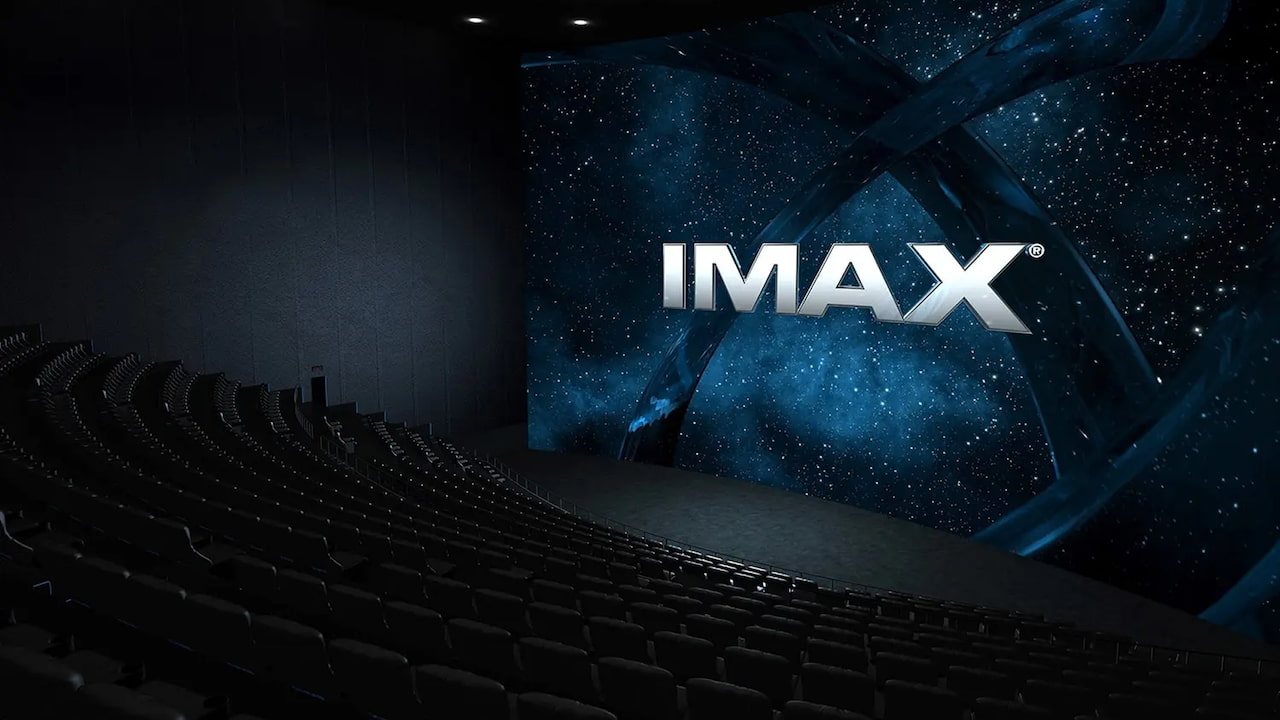
IMAX Theater

IMAX Is Having a Ridiculous 2026

Christopher Nolan didn’t merely make The Odyssey for IMAX; he made the first theatrical feature shot entirely with IMAX film cameras. Audiences have responded accordingly.

The Odyssey has now generated $289 million in IMAX box office, making it the format’s highest-grossing release ever. Its $147.3 million domestic IMAX haul is also an all-time company record. July produced $257 million for IMAX worldwide, the highest-grossing month in the company’s more than 50-year history.

Advertisement

This didn’t come out of nowhere. IMAX generated a record $1.28 billion worldwide in 2025, while its domestic box-office share reached 5.2% despite IMAX representing only about 1% of domestic screens. Premium presentation was already growing before Odysseus started sailing around the Mediterranean.

dolby-cinema-theater

Dolby Cinema Is Seeing the Same Shift

Dolby Cinema generated a record $203 million domestically in 2025. From January 1 through April 6, 2026, revenue had already reached $46 million, 62% higher than the same period a year earlier.

Then Spider-Man showed up.

Brand New Day delivered roughly $10 million from just 177 U.S. Dolby Cinema locations during its opening weekend, the format’s biggest weekend ever. Premium large-format screenings overall accounted for about 24% of Spider-Man’s extraordinary $360 million domestic opening.

Advertisement
Advertisement. Scroll to continue reading.
spider-man-brand-new-day-movie-poster

That is not a niche audience carrying around calibration meters and arguing about black levels on Reddit. That’s meaningful box-office revenue.

Your Living Room Got Better. Movie Theaters Had To As Well.

The uncomfortable reality for exhibitors is that the average living room became a formidable competitor.

An excellent OLED or Mini-LED television, competent surround system or Atmos soundbar, comfortable sofa and instant access to streaming make the mediocre multiplex experience increasingly difficult to defend. Throw in parking, concessions and the gentleman six seats away illuminating half the auditorium with his phone, and “wait for streaming” starts sounding perfectly reasonable.

But a genuinely great IMAX auditorium or Dolby Cinema changes that equation.

Advertisement

Reuters reports that theater chains are expanding premium large-format screens specifically as audiences become more selective about theatrical trips. AMC said premium-screen demand recently helped produce the highest single-weekend revenue in its 106-year history, with more than 10.2 million customers visiting AMC and Odeon locations.

Streaming didn’t kill movie theaters. Better home entertainment may simply have forced theaters to offer something better.

The 2026 numbers suggest audiences still love going to the movies. They are just becoming far less interested in paying for an ordinary experience they can increasingly duplicate at home.

The movie theater isn’t dying. The ordinary movie theater might be.

Advertisement

Source link

Continue Reading

Tech

I Used AI to Build AI-Resistant Assignments

Published

on

Artificial intelligence has wreaked havoc across secondary and higher education classrooms, leaving educators struggling to figure out how to create cheat-resistant assignments and assessments. While everyone is good at diagnosing the problem, no one seems to have a workable solution. So I designed a free tool to help teachers create uncheatable assessments and avoid the headaches of AI and academic dishonesty.

The Cheat Vulnerability Index

Based on the concepts from my book, course and workshops, I built the Cheat Vulnerability Index, a web app that lets teachers analyze their existing assignments to pinpoint strengths and weaknesses when it comes to vulnerability to cheating. Users upload an assignment, then get a custom report and suggestions for how to make improvements.

I came up with the idea when I noticed that educators struggled to take the ideas from my conference sessions and workshops and implement them in their unique learning contexts. Since I can’t always sit with everyone as they plan lessons or write a syllabus, I wondered how I might scale the concepts and strategies from my content leveraging the power of AI.

I needed to create a brand-new tool that didn’t exist before and to do so with no budget. So I learned to “vibe code,” the method of using natural language in an AI model to create computer code. I hadn’t done coding since I used BASIC in high school, and it took me a while to figure out how it worked, and how to turn the code into an interface on my website. 

Advertisement

I trained the index on concepts from my book Storytelling With Purpose: Digital Projects to Ignite Student Curiosity and a variety of other workshops and articles I’ve published as the pedagogical framework for the assignment analysis. The concepts, processes and strategies it produces are unique to my published work, and create suggestions through that research-based, classroom-tested lens. 

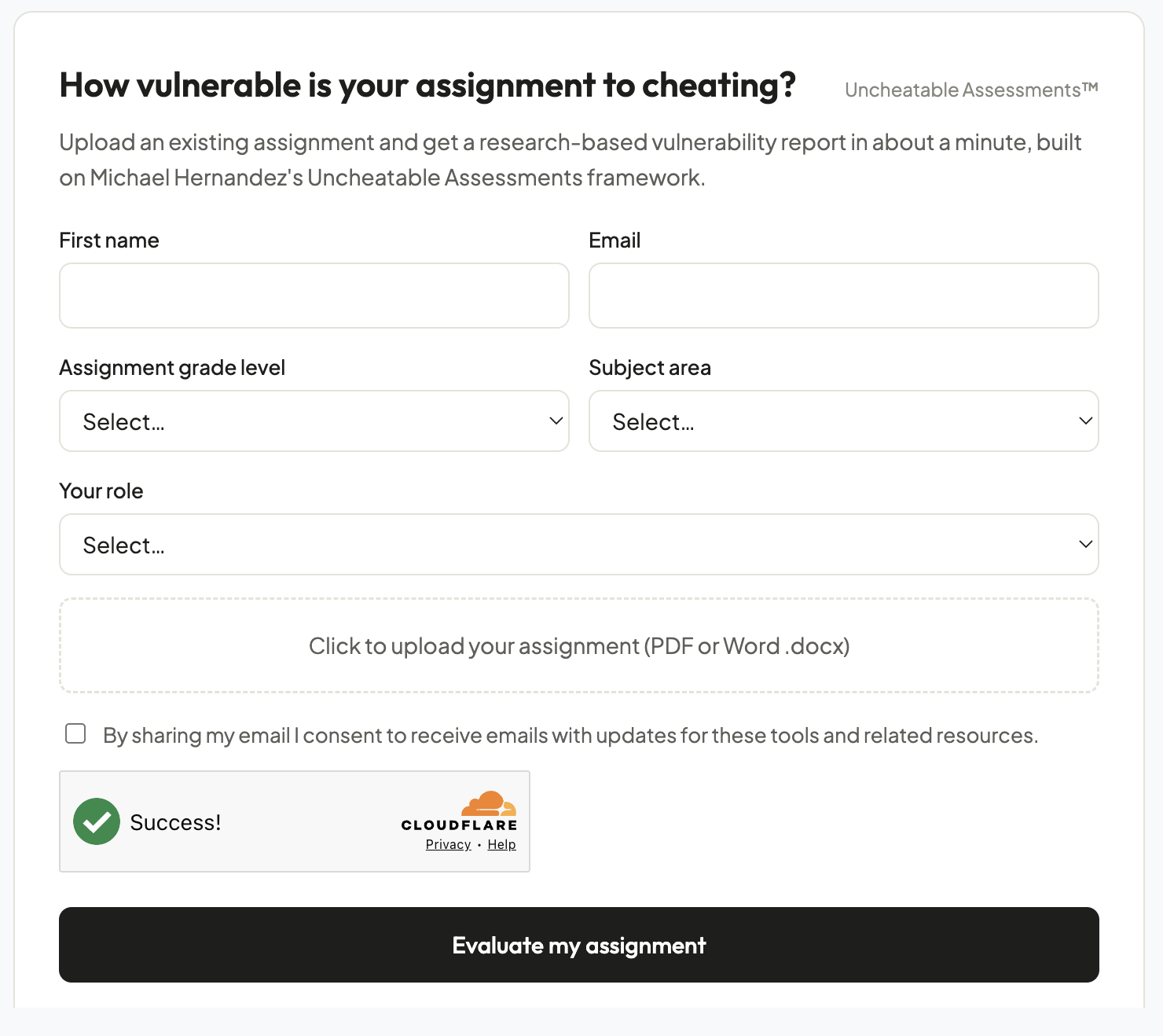
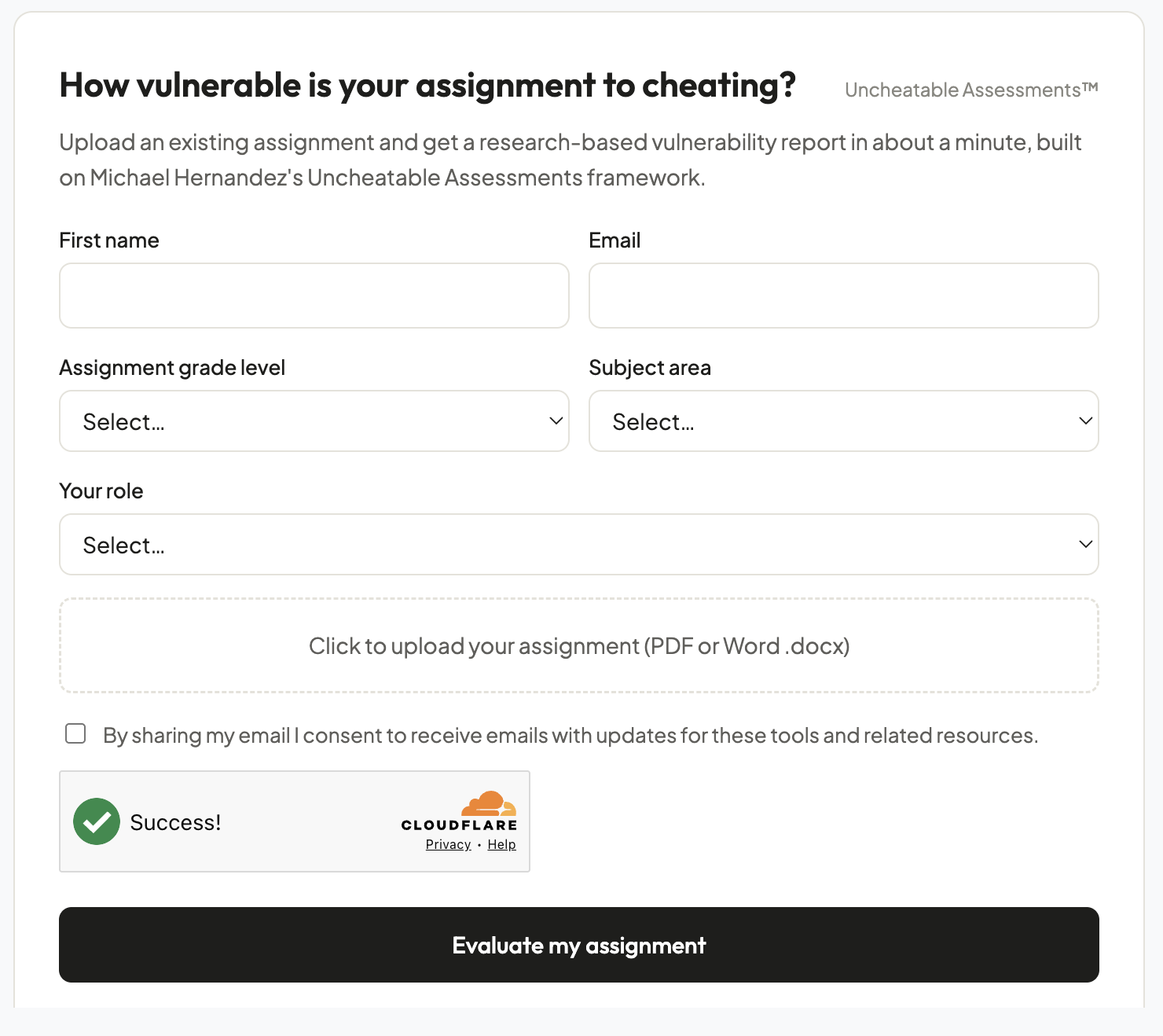
Uncheatable Intake Form

The intake form for The Cheat Vulnerability Index

Turns out, vibe coding is a lot like teaching: you begin with deep subject-area expertise (in this case, authentic learning and assessment), create a complex set of detailed instructions and processes for the AI agent to follow (a lesson or unit plan), define what “good” looks like (learning outcomes, standards and rubrics), and how to describe the concepts clearly to an audience (a learning artifact). I was stunned by how well the app turned out, and teachers who have tried it find it useful.

But the biggest takeaway for me is how this experiment revealed the ability of AI tools to remove barriers to learning and how they can facilitate deeper learning through the application of knowledge. 

Despite what they say, not everyone can code — including me. So why should coding (or the cost to hire a team of coders) get in the way of my ideas and creating a useful tool to help others? In the same way, how does a student’s writing ability, processing speed or facility as a public speaker affect their grades if our assessments are in-class essays, timed tests or presentations and debates?  It got me thinking about the obstacles students face expressing their knowledge and how traditional assessments can get in the way of assessing them.

Advertisement

Students may cheat or cut corners for a lot of reasons, not all of which have to do with moral depravity. Designing uncheatable assessments requires more than adjustments to a single assignment — it requires us to expand our definition of success and to rethink what counts as achievement and how we measure it.

Creating Uncheatable Assessments

The Cheat Vulnerability Index is a quick diagnostic that gives teachers and faculty feedback on a single assignment. But to have meaningful, sustained resilience while maintaining rigor and high standards across an entire school year, teachers need to rethink what and how they assess, and foster cultures of integrity that go beyond any one test or unit.

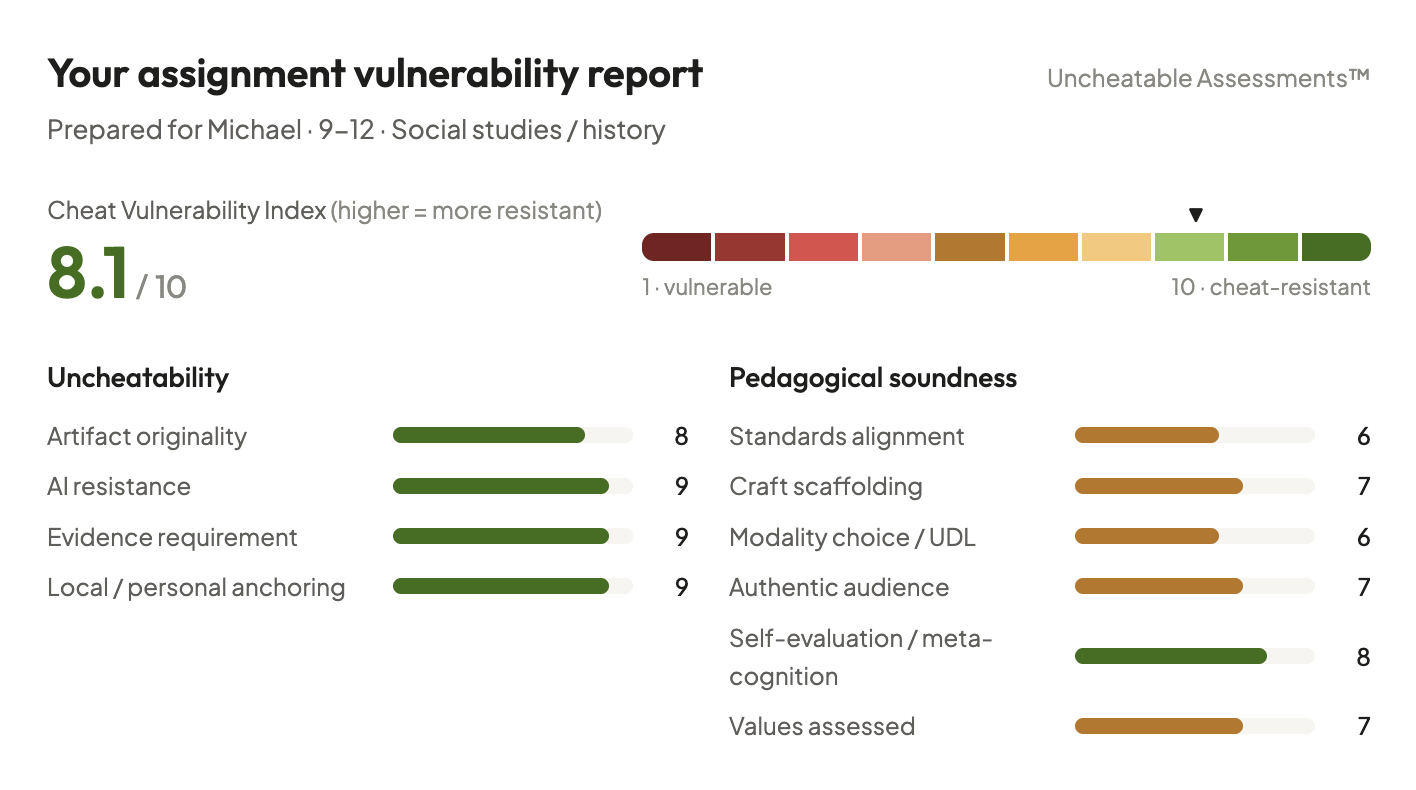
Cheating Vulnerability Index Diagnostic

The diagnostic evaluation for The Cheat Vulnerability Index

Cheating happens when two conditions are met: when an assignment is cheatable by design and when students have the incentive to cheat. 

Assignments like tests, worksheets or essays are all vulnerable to academic dishonesty simply by their design. AI can write essays, and students can share answers, for example. How can the format of an assignment minimize opportunities for cheating or rely on a combination of multiple metrics that make it less possible?

Advertisement

No matter how well an assignment is designed, if a student really wants to cheat, they will. So instead of trying to surveil students and make our job as educators about policing them, we can create assignments that disincentivize cheating before it becomes a problem in the first place.

There are three ways to do this.

Three Uncheatable Assessment Traits

1. Originality. When we expect students to create the same answers at the same time, we’ve set ourselves up for cheating (with or without AI). Authentic learning experiences result in one-of-a-kind learning artifacts that no other student could copy or use AI to complete entirely.

2. Personal connection. To be truly invested in learning, everyone wants to know “why this matters.” Allowing ways for students to connect curriculum to their lives or community helps them personalize an abstract concept and disincentivizes cheating because they care about the outcome and know it will help them or people in their community. Students should also have multiple opportunities for agency throughout the process.

Advertisement

3. Purpose. What’s the point of students’ hard work? If an assignment ends up in the trash, it sends a powerful message about the value of their effort and your curriculum. Instead, have students create learning artifacts that are designed for users or audiences beyond the classroom. Give students a good reason to complete an assignment with integrity and accuracy. Real stakes beat clever rules.

What’s Next

The problem of academic integrity is more fundamental than preventing students from cheating. AI has forced us to recognize that the old proxies we used to assess students are no longer reliable as evidence of learning (if they ever were), and requires us to redefine what counts as evidence of understanding. Like the Cheat Vulnerability Index I designed that didn’t require me to know the vocabulary or grammar of coding, my learning artifact still required me to build subject-area expertise, identify goals and limits, interrogate what good learning means and take responsibility for the outcome of my work. 

As mathematician Terence Tao says about AI disrupting mathematics research, it’s like we’ve been trying to drive a car on outdated roads made for horses and pedestrians, and it’s revealed potholes and bumps and cracks. AI is now giving us faster cars that lead to big traffic jams and accidents. 

The destination hasn’t changed, just how we get there. What we need isn’t better ways to catch students cheating, but a new pedagogical road forward.

Advertisement

Source link

Continue Reading

Tech

DeepSeek Harness launches as open source rival to Claude Code, alongside V4-Pro on API with higher prices

Published

on

DeepSeek is expanding beyond the model layer and deeper into the software developers use to put AI agents to work.

The Chinese AI lab on Thursday launched the official version of DeepSeek-V4-Pro, an updated flagship model focused heavily on agentic workloads, alongside DeepSeek Harness v0.1, a new open-source agent harness that gives developers an alternative to integrated coding-agent environments such as Anthropic’s Claude Code.

Together, the releases amount to a broader developer push from DeepSeek. V4-Pro is now available across DeepSeek’s web interface, mobile app and API, with native support for the OpenAI Responses API and integration with Codex.

DeepSeek Harness, meanwhile, is entering developer preview under the MIT license and the code is available now for download and use on GitHub. It’s built around an unusually modular premise: practically every part of the agent runtime can be swapped out as a plugin.

Advertisement

But developers accessing V4 through DeepSeek’s API will soon pay considerably more for it. DeepSeek is simultaneously abandoning its existing flat API pricing in favor of peak and off-peak rates beginning at 16:00 UTC on Sunday, Aug. 16 (2 am ET).

Even the discounted off-peak cache-miss and output prices will be substantially higher than the prices available today.

The combination is significant because DeepSeek is no longer competing solely over model intelligence and token prices. With Harness, it is moving into the layer that determines how models use tools, manipulate files, maintain sessions and execute long-running agent workflows — territory where Anthropic’s Claude Code and other coding agents have become increasingly important developer products.

DeepSeek builds its own agent harness

DeepSeek describes Harness, or dsh, as an open-source agent harness built on Cordis, a framework designed around composable plugins.

Advertisement

Its guiding principle is simple: “Everything is a plugin.”

That extends to models, tools, skills, sessions, sandboxes, filesystems, loops, orchestration and user interfaces, according to DeepSeek. Rather than making those components fixed pieces of a single coding agent, Harness is designed to let developers mix, replace and extend them.

The project is available under the MIT license and can currently be launched from npm with npx @deepseek-ai/dsh web. DeepSeek also provides instructions for building it directly from source. The repository describes the software explicitly as a developer preview and warns that “THERE WILL BE COMPATIBILITY-BREAKING CHANGES.”

That caveat matters for enterprise developers. Harness is not yet being presented as a stable drop-in production platform. But its architecture points toward a potentially important strategy: DeepSeek can now offer developers not only models but an open framework for assembling the systems that surround them.

Advertisement

That makes Anthropic’s Claude Code and OpenAI’s Codex useful competitive references, although the products should not be treated as functionally identical.

DeepSeek Harness is an open-source, model-agnostic alternative to the agent infrastructure underlying Claude Code and Codex—not yet a full replacement for either product’s broader developer experience.

It can already inspect repositories, edit files, execute shell commands, search files and the web, maintain plans, invoke skills, delegate work to subagents and enforce approval policies. Those are the essential capabilities that make Claude Code and Codex agentic coding tools rather than autocomplete systems.

DeepSeek explicitly describes Standard mode as a full coding agent with file editing, shell access, search, planning, subagents and workflows. Its local web interface lets users select a workspace and approve sensitive operations.

Advertisement

But Claude Code and Codex now extend well beyond that agent loop. Here’s a quick comparison:

Dimension

DeepSeek Harness

Claude Code

Advertisement

OpenAI Codex

Read, edit and test a repository

Yes

Yes

Advertisement

Yes

Shell and development tools

Yes

Yes

Advertisement

Yes

Planning and subagents

Yes

Yes

Advertisement

Yes

Permission controls and sandboxing

Yes, configurable through plugins

Yes, mature built-in permission and sandbox system

Advertisement

Yes, granular sandbox and approval controls

Primary interfaces

Local web UI; headless command; Python SDK

Terminal, VS Code, JetBrains, desktop, browser, mobile and Slack

Advertisement

CLI, IDE extension, desktop app, web/cloud and integrations

Hosted background agents

Not documented as a DeepSeek-managed service

Yes

Advertisement

Yes

GitHub-native PR workflow

Not documented as a finished integration

GitHub Actions, automatic reviews, issue-to-PR workflows

Advertisement

Cloud tasks, automatic reviews, PR fixes and GitHub Action

Model choice

DeepSeek, Anthropic, OpenAI and custom compatible endpoints

Primarily Claude, including Bedrock, Google Cloud and Microsoft hosting

Advertisement

Primarily OpenAI models, with configurable providers in the open-source CLI

Extensibility

Exceptional: virtually every component is replaceable

Strong: skills, hooks, MCP, plugins and agent teams

Advertisement

Strong: skills, MCP, custom agents, SDK and app server

Product maturity

Developer preview; breaking changes expected

Established commercial product

Advertisement

Established commercial product plus open-source CLI

License

MIT

Commercial product with extensibility interfaces

Advertisement

Codex CLI is open source; cloud and app services are managed products

DeepSeek Harness instead emphasizes modularity and replacement: the model itself is another plugin rather than necessarily the center of a vertically integrated stack.

DeepSeek’s repository was already attracting significant developer attention on launch day, showing roughly 27,500 GitHub stars and 2,000 forks as of Aug. 13, although those rapidly changing figures are best viewed as a snapshot rather than an adoption metric.

V4-Pro gets an agent-focused upgrade

Harness arrives alongside the general-availability release of DeepSeek-V4-Pro-0813.

Advertisement

DeepSeek originally introduced the V4 family in preview in April. The lineup consists of the 1.6-trillion-parameter V4-Pro, with 49 billion parameters activated per token, and the smaller 284-billion-parameter V4-Flash, with 13 billion activated. Both support context windows of up to one million tokens.

The company’s Aug. 13 release therefore is not the first appearance of V4-Pro. It is the transition from the earlier preview into an updated official version, with DeepSeek emphasizing agent performance.

“The official version of DeepSeek-V4-Pro has been released, featuring significantly enhanced agent capabilities and support for the Responses API and Codex integration,” DeepSeek says on its API website. “It is now fully available across the web, mobile app, and API; we welcome your testing and feedback.”

DeepSeek’s changelog similarly says the general-availability model has “significantly enhanced Agent capabilities,” particularly in production environments. Developers using the API do not have to change model identifiers: deepseek-v4-pro now resolves to the latest V4-Pro version.

Advertisement

The company has also added native OpenAI Responses API support, lowering the amount of integration work required for applications already built around that interface.

DeepSeek says V4-Pro is optimized for OpenAI’s own open source harness, Codex, with one-click setup. Its current API documentation lists Responses API, tool calling, JSON output and an Anthropic-format API among the supported interfaces for both V4-Pro and V4-Flash.

For developers using DeepSeek directly rather than through an API, V4-Pro is now accessible through “Expert Mode” on the company’s app and website.

Reasoning effort becomes another deployment knob

DeepSeek is also making reasoning effort an explicit control across V4-Pro and V4-Flash.

Advertisement

The V4 model documentation describes three levels: Non-think, designed for fast routine tasks; Think High, intended for more complex problem-solving and planning; and Think Max, which allocates substantially more reasoning to difficult problems.

That distinction can be operationally important for agent systems because maximum reasoning on every step can consume unnecessary time and tokens. A coding agent might use relatively little reasoning to inspect a file or execute a routine tool call, then increase effort when diagnosing a difficult bug or planning a multi-stage code change.

DeepSeek’s latest benchmark table suggests the 0813 model improves substantially on agent-oriented tests, although the figures are company-reported and some results depend on the harness configuration.

DeepSeek reports V4-Pro-0813 scores of 87.9 on Terminal Bench 2.1, 74.1 on Toolathlon-Verified, 71.1 on DSBench-FullStack and 67.2 on DSBench-Hard. It does not lead every comparison in DeepSeek’s own table: Fable 5, for example, scores 77.9 on Toolathlon-Verified and 77.2 on DSBench-FullStack.

Advertisement

There is an especially important qualification buried beneath the benchmark table. For public Code Agent tasks, DeepSeek says V4-Pro-0813 was tested using its upcoming DeepSeek Harness in “minimal mode.”

In other words, some of the agent results arriving alongside Harness are not purely model benchmarks. They measure the model operating inside an agent execution environment — precisely the software layer DeepSeek is now releasing to developers.

A sharp reversal in DeepSeek’s API price trajectory

The bigger immediate change for teams already running DeepSeek in production may be pricing.

DeepSeek’s current API documentation lists V4-Flash at $0.14 per million cache-miss input tokens and $0.28 per million output tokens, while V4-Pro costs $0.435 for cache-miss input and $0.87 for output. Cache hits are dramatically cheaper at $0.0028 for Flash and $0.003625 for Pro.

Advertisement

Those prices themselves represented a major reduction from V4’s original April launch economics. When V4 arrived in April, V4-Pro was priced at $1.74 per million cache-miss input tokens and $3.48 per million output tokens. By late May, DeepSeek had made a 75% reduction permanent, intensifying its position as an unusually inexpensive option for high-volume agent workloads. Now the pendulum is moving in the other direction.

Beginning Aug. 16 at 16:00 UTC, DeepSeek will charge different rates depending on when API calls occur. Peak hours are 01:00–04:00 UTC and 06:00–10:00 UTC (9:00 PM – 12:00 AM ET and 2:00 AM – 6:00 AM ET, respectively) with all other hours classified as off-peak. Off-peak rates are half the corresponding peak prices.

For V4-Flash, off-peak cache-miss input rises from $0.14 to $0.22 per million tokens, while output rises from $0.28 to $0.66. During peak hours those rates reach $0.44 input and $1.32 output.

V4-Pro moves from $0.435 per million cache-miss input tokens and $0.87 output today to $0.66 and $1.98 off-peak, respectively. Peak rates rise to $1.32 input and $3.96 output.

Advertisement

The increases are even more pronounced for cached input. V4-Pro cache hits rise from $0.003625 per million tokens today to $0.022 off-peak and $0.044 at peak. Flash moves from $0.0028 to $0.007 off-peak and $0.014 peak.

Model

Old input (per 1M token)

Old output (per 1M tok)

Advertisement

Old total (1M in/1M out)

deepseek-v4-flash

$0.14

$0.28

Advertisement

$0.42

deepseek-v4-pro

$0.435

$0.87

Advertisement

$1.305

The new prices still position DeepSeek as an affordable alternative via API to Western proprietary labs, but Reuters reported Thursday that, depending on model, token category and time of use, the changes represent increases ranging from 50% to more than 1,100% over existing rates.

Model

Input ($/1M)

Advertisement

Output ($/1M)

Total ($/1M)

Source

Muse Spark 1.2 Contributor

Advertisement

$0.10

$0.20

$0.30

Meta

Advertisement

MiMo-V2.5 Flash

$0.10

$0.30

$0.40

Advertisement

Xiaomi

DeepSeek-V4-Flash — off-peak

$0.22

$0.66

Advertisement

$0.88

DeepSeek

GPT-5.6 Luna

$0.20

Advertisement

$1.20

$1.40

OpenAI

MiniMax-M3

Advertisement

$0.30

$1.20

$1.50

MiniMax

Advertisement

LongCat-2.0 — limited-time promo

$0.30

$1.20

$1.50

Advertisement

LongCat

DeepSeek-V4-Flash — peak hours

$0.44

$1.32

Advertisement

$1.76

DeepSeek

MiMo-V2.5

$0.40

Advertisement

$2.00

$2.40

Xiaomi

DeepSeek-V4-Pro — off-peak

Advertisement

$0.66

$1.98

$2.64

DeepSeek

Advertisement

LongCat-2.0 — standard

$0.75

$2.95

$3.70

Advertisement

LongCat

MiMo-V2.5 Pro (≤256K)

$1.00

$3.00

Advertisement

$4.00

Xiaomi

DeepSeek-V4-Pro — peak hours

$1.32

Advertisement

$3.96

$5.28

DeepSeek

Muse Spark 1.1 / 1.2

Advertisement

$1.25

$4.25

$5.50

Meta

Advertisement

GLM-5.2

$1.40

$4.40

$5.80

Advertisement

Z.ai

Grok 4.6 — <200K prompt tokens

$2.00

$6.00

Advertisement

$8.00

xAI

MiMo-V2.5 Pro (>256K)

$2.00

Advertisement

$6.00

$8.00

Xiaomi

Qwen3.8-Max

Advertisement

$2.00

$6.00

$8.00

QwenCloud

Advertisement

Gemini 3.6 Flash

$1.50

$7.50

$9.00

Advertisement

Google

GPT-5.6 Terra

$2.00

$12.00

Advertisement

$14.00

OpenAI

Grok 4.6 — ≥200K prompt tokens

$4.00

Advertisement

$12.00

$16.00

xAI

GPT-5.4

Advertisement

$2.50

$15.00

$17.50

OpenAI

Advertisement

Kimi K3

$3.00

$15.00

$18.00

Advertisement

Moonshot AI

Claude Opus 5

$5.00

$25.00

Advertisement

$30.00

Anthropic

Sakana Fugu Ultra (≤272K)

$5.00

Advertisement

$30.00

$35.00

Sakana AI

GPT-5.6 Sol — Standard mode

Advertisement

$5.00

$30.00

$35.00

OpenAI

Advertisement

Claude Fable 5 / Claude Mythos 5

$10.00

$50.00

$60.00

Advertisement

Anthropic

GPT-5.6 Sol — Fast mode

$10.00

$60.00

Advertisement

$70.00

OpenAI

That makes the “50% lower” off-peak framing potentially misleading without context. Off-peak is 50% cheaper than DeepSeek’s new peak rate; it is not a 50% discount from the API prices developers are paying today.

For a simple workload consisting of one million cache-miss input tokens plus one million output tokens, V4-Pro currently costs $1.305. The same token mix will cost $2.64 off-peak, roughly twice as much, or $5.28 during peak hours, more than four times the current price.

Advertisement

V4-Flash moves from $0.42 under the same simple calculation to $0.88 off-peak and $1.76 peak.

Actual application costs will vary considerably depending on the ratio of cached input, uncached input and generated output, making those combined figures illustrative rather than universal total-cost estimates.

DeepSeek is moving up the agent stack

The timing makes the strategic direction difficult to miss.

When DeepSeek released the V4 preview on April 24, the major story was how much frontier-class capability the company could deliver with an unusually efficient architecture.

Advertisement

V4-Pro uses a hybrid attention design combining Compressed Sparse Attention and Heavily Compressed Attention; at a one-million-token context, DeepSeek says it requires only 27% of the single-token inference FLOPs and 10% of the KV cache required by V3.2.

By late May, the discussion had shifted toward what those efficiencies meant economically for high-volume agents, whose repeated context reads can make caching a major component of inference costs. DeepSeek’s steep V4 price cuts amplified that advantage.

The Aug. 13 releases move the competition another layer upward.

DeepSeek now has an updated V4-Pro tuned around agent workloads, standardized interfaces designed to make it easier to connect with existing developer tooling, configurable reasoning effort, and an MIT-licensed harness for controlling the models, tools, sandboxes, filesystems and orchestration surrounding an agent.

Advertisement

At the same time, DeepSeek is demonstrating that developers cannot assume its aggressively low API rates are permanent. For organizations considering the platform, workload scheduling, caching behavior and the option to run open weights on their own infrastructure now become more important parts of the total-cost calculation.

That leaves DeepSeek pursuing two potentially conflicting advantages at once: making its agent stack more accessible and open while making its own hosted API considerably more expensive.

For enterprise developers, Harness may ultimately be the more consequential part of Thursday’s announcement. Models can increasingly be swapped behind standardized interfaces. The harness that controls how an agent reasons, invokes tools, edits software and persists across a workflow can be much harder to replace.

DeepSeek is now competing for that layer, too.

Advertisement

Source link

Continue Reading

Tech

Flock Tries To Make Its Cameras Harder For Cops To Misuse

Published

on

Flock cameras have quickly become some of the most hated things on the planet. One of the primary reasons is the perception that cops abuse the tools for nefarious ends. There have been plenty of reports that allege that officers have used Flock cameras to spy on people or even stalk ex-partners.

The company is finally addressing some of these issues and rolling out updates to make abuse by law enforcement and other entities more difficult. The pre-existing Audit Assistance feature will now be required to use, after being introduced as an optional tool. This flags “abnormal search behavior” and locks out suspicious users until an administrator reviews their activity.

Police officers will now be required to enter case codes to run searches, which is intended to limit personal queries. This can, however, be overridden by an administrator in certain scenarios.

“This is such an obvious way to curb abuse,” CEO Garrett Langley told The Verge. “And I said, ‘Fine. You know what? I think that’s right, and we got this one wrong. We should make it a requirement.’” It is worth noting that we’ve been seeing Flock-related stalking incidents from police officers since 2021.

The company is also shortening the Automated License Plate Reader (ALPR) data retention period from 30 days to a week. Again, there will be exceptions for “cases that take longer,” like “an active investigation in cold storage.” However, this looks to only apply to new customers. The company is carving out another exception for existing customers, in which they can “keep their current, democratically approved retention periods.”

CEO Langley has long been combative when it comes to critics of Flock, even calling a website that tracks the cameras “terroristic”. He has since apologized for that language and seems to have taken a softer approach, likely due to severe public backlash.

Advertisement

“All I guess I’m asking for is for a fair shot,” he told The Verge. “It took me maybe longer than it should have to realize the sheer impact of the company.” Again, it must be noted that these officer-related offenses have been ongoing for at least five years and the company itself turns 10 next year.

These are largely positive moves that could curb some police misuse, but that’s only one aspect of why people dislike Flock cameras so much. Groups like the ACLU and the Electronic Frontier Foundation have accused the company of misleading the public regarding the capabilities of these cameras, suggesting that they are actually much more than simple license plate readers.

To that end, there are allegations that the cameras have been used to track a woman seeking an abortion. Police have also been using Flock cameras to track people traveling from one state to another for the purpose of purchasing marijuana in a state where it’s legal.

Advertisement

There are multiple reports that Flock data has been shared with ICE, to which Langley has said that “if the state of Texas wants to enforce immigration, they might use Flock, but they’re gonna go enforce immigration no matter what Flock does.” As of this writing, at least 24 people have reportedly died in ICE custody in 2026.

All of this combined has led to serious backlash. Some law enforcement agencies have severed ties with the company, like in Los Angeles. Communities have also begun taking matters into their own hands. Flock cameras have been vandalized, destroyed or straight-up stolen in numerous incidents throughout the country. One Minnesota town found that its entire stock of Flock cameras had disappeared overnight. The city’s police department has announced it will not be replacing the cameras.

Advertisement

Source link

Continue Reading

Tech

Acura’s New Concept Car Has The Coolest Doors Since The McLaren F1

Published

on


Acura is largely known for its reliable models and simple SUVs, but the automaker recently unveiled a shocking concept car that is cool enough to rival any supercar. The Acura NEXERA Vision is debuting at The Quail on August 14th, right in the middle of Monterey Car Week, and will then be showcased at the Pebble Beach Concours d’Elegance on the Concept Lawn on August 16th. Its butterfly doors may very well steal the show.

Acura Creative Director and Vice President of Auto Design, Yasutake Tsuchida, said Acura’s 40th anniversary has sparked the brand to experiment with the design language for future models, including the upcoming fourth-generation RDX Hybrid that’s releasing in the next few years. “Our goal with this new design direction is to define Acura performance through disciplined proportions, sculpted form and the seamless integration of advanced technology, creating an expression that is both progressive and authentic to the brand,” he said in a press release. 

The NEXERA Vision concept was designed under Tsuchida’s guidance at the Acura Design California studio in Los Angeles. The Matte Titanium finish gives it a sleek, futuristic appearance, which is paired with a wide stance for extra drama. The butterfly doors elevate that striking profile even further, as you can see in the coolest cars with butterfly doors. But its aggressive appearance is matched by a promise of performance, thanks to an active rear spoiler, high-performance carbon-ceramic Brembo brakes on its 22-inch wheels, and forged carbon accents.

Advertisement

The Acura NEXERA Vision’s leveled up details

The Acura NEXERA Vision concept car features intricate details that make it more dynamic than just its butterfly doors. Upon a closer look, you can see a new lighting signature Acura is calling “phantom lighting” behind the bodywork. It’s revealed when the vehicle is illuminated, creating a layered look that makes the NEXERA Vision come alive. 

The thin headlights and taillights are also part of a new lighting signature for Acura, forming an “A” that artistically wraps around the front and back of the vehicle. This will become part of Acura’s identity and will be seen on future production cars. (Although we’d love to see the NEXERA Vision become more than just a concept as well.)

Inside the NEXERA Vision, there is also plenty of detail that may not be seen at first glance. Meant to be a driver-focused cabin, the fixed front seats are integrated into the floor to make them lower, allowing the pedals and steering wheel to “meet” the driver. There are premium materials and forged carbon finishes throughout, giving a luxury feel. 

These include many sustainable materials, like recycled aluminum and polyester. Said Tsuchida: “Sustainability is playing an increasingly important role in how premium quality and performance are defined, and the Acura brand is embracing innovative material technologies that bring fresh possibilities to the customer experience while supporting broader environmental ambitions.” 


Advertisement

Source link

Continue Reading

Tech

Apple Turns to Publishers For Help With Siri AI

Published

on

Apple is reportedly negotiating multi-year deals with news publishers to give its redesigned Siri access to current news and other information, with payments potentially tied to how often publishers’ content is used. The talks come as Apple prepares to launch its long-delayed Siri AI later this year, after partnering with Google to use distilled Gemini models. Engadget reports: [The Wall Street Journal] did not reveal the specific publishers Apple reached out to, but did note the company has proposed structuring payments around a variable compensation plan, which would see it pay those organizations when their content is used. By contrast, most large AI labs like OpenAI have typically offered guaranteed fees in exchange for broad access. According to the The Journal, Apple has paid publishers for access to their content in the past as part of earlier agreements that saw the company secure AI training rights.

Read more of this story at Slashdot.

Source link

Advertisement
Continue Reading

Tech

‘Trump Said A Thing’ Journalism Must Stop

Published

on

from the feature-not-a-bug dept

One obvious byproduct of letting what’s left of U.S. journalism consolidate in the hands of a bunch of giant corporations is the end result winds up being a feckless mess. Generally corporations don’t want to upset advertisers, ownership (usually Conservative, white, and male), event sponsors, or potential advertising targets, so their journalism winds up being hollow, performative, and toothless.

One end result of this is something I affectionately call “CEO said a thing!” journalism, which kind of looks like journalism, but generally involves mindlessly parroting whatever a wealthy executive (or politician) says without context, correction, or even third-party objective analysis.

You’ll endlessly see this in corporate press coverage of corporations and tech. But it’s more generally reflected in their coverage of all rich men. Especially guys like Elon Musk or Donald Trump, who have found it incredibly easy to manipulate what’s left of our press into parroting every brain fart they have, regardless of whether there’s any useful new information or meaningful tether to factual reality.

This has been on particularly proud display when it comes to Trump and his unpopular and pointless war in Iran, with each week bringing a new headline of a plan that doesn’t exist, a pivot that never happened, or a strategy that isn’t coherent — or even real. The U.S. press, with occasional refreshing exception, endlessly just repeats whatever Trump says, regardless of whether what he’s saying is useful, real, or true.

Advertisement

Media critic Dan Froomkin has it right when he calls for a moratorium on “Trump says” headlines where every statement by our mad idiot king is mindlessly repeated without context or correction:

“It’s simple: Newsroom leaders should ban headlines based on what Trump says if there is legitimate reason to suspect that he may not be relating truthful, accurate, and durable information.

I’m only a tiny bit more tolerant of the Trump “claims”, “maintains”, “blames”, and “insists” headlines, but at least those impart an iota of doubt.”

The problem is this has been going on for generations. We’re more than ten years into Trump authoritarianism and propaganda. There’s no more room for giving meaningful credence to the idea that newsrooms and top editors are doing this simply because they don’t know any better.

They do this because corporate consolidated media isn’t interested in truth-telling journalism, they’re interesting in journalistic simulacrum and infotainment kayfabe that props up the interests and values of the extraction class. The public interest, hard-nosed journalism, and a properly informed electorate is the last thing on these gentlemen’s minds.

Advertisement

This isn’t some funny accident and it’s not subtle. Republicans and most rich white men are treated with kid gloves by 75% of the U.S. press because the corporations that own what’s left of these companies don’t want to rock the boat. They want their latest giant shitty merger approved. Their ownership likes tax cuts. Journalism that tells the truth isn’t what they’re here for.

Froomkin remains hopeful all the same:

“Surely our top newsroom leaders don’t see themselves as being in the business of spreading disinformation. But that’s what happens when they use the headlines and the tops of their articles to tell us what “Trump says” without caveats or pushback — when their headlines and leads should instead be devoted primarily to those caveats and pushbacks.”

Froomkin is right, though I’d argue this isn’t something that a compelling letter to the editor can fix. This sort of abject cowardice is systemic and by design. And while there’s still great journalism that can occur at many modern media companies, it’s increasingly becoming the exception, not the rule. We’re not debating our way out of this. The fix is massive structural reform.

The fixes are obvious and have always been there, and they involve things large media company owners don’t like: like reforged media consolidation limits, real antitrust enforcement, media ownership diversity requirements, improved media literacy and education standards (an informed audience that demands more of our journalistic institutions can shape coverage), a restoration of U.S. public media, and creative new funding models for real independent, worker-owned (and inevitably unionized) journalism.

Advertisement

We’re way past the point where we can assume this isn’t intentional, or can believe that simply asking better of these companies will result in the outcomes we’re all looking for.

Filed Under: ceo said a thing, consolidation, dan froomkin, donald trump, journalism, media, reporting

Source link

Advertisement
Continue Reading

Tech

Fans believe they’ve solved the secret name of The Elder Scrolls 6, and the clue might have been hidden in Starfield the whole time

Published

on

  • Fans think they’ve uncovered The Elder Scrolls 6‘s eight-letter subtitle
  • Redditor ‘starfieldnovember’ suggests the subtitle is “Sentinel”
  • The clue comes from Starfield‘s character creator and employee number, which, translated via the alphabet, spells “Sentinel”

The Elder Scrolls 6 fans believe they’ve uncovered the game’s secret subtitle, and it may have been under our noses the entire time.

Earlier this week, Xbox CEO Asha Sharma shared an X post that blew up, which read, “Live playthrough of The Elder Scrolls 6: ******** this morning. The scale and grandeur are incredible. The story is even greater.”

Source link

Advertisement
Continue Reading

Tech

Ways to Reduce Downtime in Industrial Boiler Systems

Published

on

Reducing downtime in industrial boiler systems requires combining ASME- and NBIC-compliant pressure vessel inspections, automated water chemistry control, precise feed pump sizing, and continuous oxygen-trim combustion tuning to eliminate root causes of unscheduled outages. Implementing a proactive spare parts buffer and structured operator warning protocols further prevents minor mechanical deviations from escalating into plant-wide shutdowns.

When an industrial steam or hot water boiler fails unexpectedly, loss of thermal energy halts production lines, compromises product quality, and imposes expensive emergency repair bills. Facilities that achieve high operational availability do not rely on reactive fixes; they manage their boilers through rigorous condition monitoring, proactive component replacement, and precise fluid dynamics.

Evaluation Criteria for Boiler Downtime Reduction

To eliminate unscheduled outages, boiler maintenance strategies must address the primary mechanisms of mechanical, chemical, and operational degradation. A robust reliability framework prioritizes interventions based on three main criteria:

  • Structural Safety & Code Compliance: Interventions that prevent catastrophic pressure shell or tube failure, adhering to jurisdictional standards.
  • Thermodynamic Efficiency & Fuel Stability: Measures that stop heat exchanger degradation, soot accumulation, and burner instability.
  • Operational Continuity & Fluid Delivery: Protections that maintain uninterrupted feedwater flow, correct steam header pressure, and proper chemical balance.

Quick Take: Core Downtime Reduction Strategies

Preventing industrial boiler downtime relies on eliminating scale accumulation, mechanical wear, and fluid imbalances before they force a safety trip. Maintaining strict water chemistry controls and executing periodic combustion tuning prevents up to 80% of premature tube failures and burner outages. Pairing these daily operational habits with strategic spare parts management and calibrated pressure vessel inspections ensures continuous thermal delivery even under heavy production loads.

7 Proven Ways to Reduce Industrial Boiler Downtime

1. Schedule Regular Inspections of Pressure Vessels

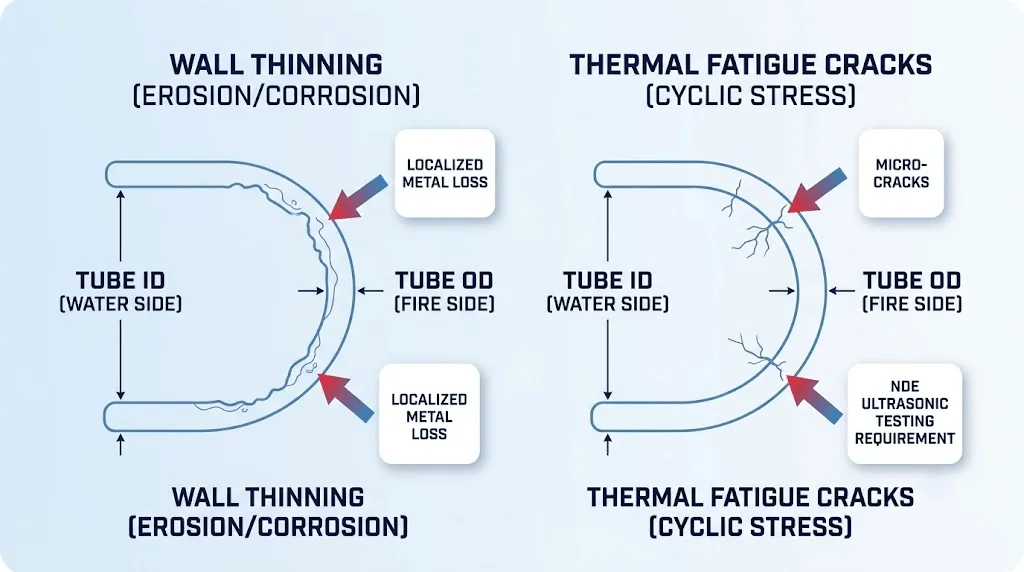
Because pressure vessels degrade over time from cyclic thermal stress, chemical corrosion, and mechanical fatigue, undetected micro-cracks or localized wall thinning can trigger emergency shutdowns or catastrophic pressure boundary breaches. Operating under constant pressure expansion and contraction weakens shell welds, steam drum nozzles, and firetube sheet turnarounds.

Advertisement

Cross-section diagram showing boiler tube wall thinning from corrosion/erosion and cracks from thermal fatigue, highlighting areas requiring NDE ultrasonic testing.

Relying solely on annual jurisdictional pass/fail inspections is insufficient for high-demand facilities. Plant engineers should establish a supplementary internal non-destructive examination (NDE) schedule—utilizing ultrasonic wall thickness testing, magnetic particle testing on high-stress welds, and dye penetrant inspection on tube sheets. Documenting these measurements in an ongoing log allows maintenance teams to plot metal loss rates over time rather than treating each inspection as an isolated event. When repairs or alterations become necessary, perform all welding in accordance with National Board Inspection Code (NBIC) Part RC standards using an R-stamp certified contractor to maintain structural integrity and regulatory compliance.

2. Calculate Boiler Feed Pump Duty and NPSH Margins

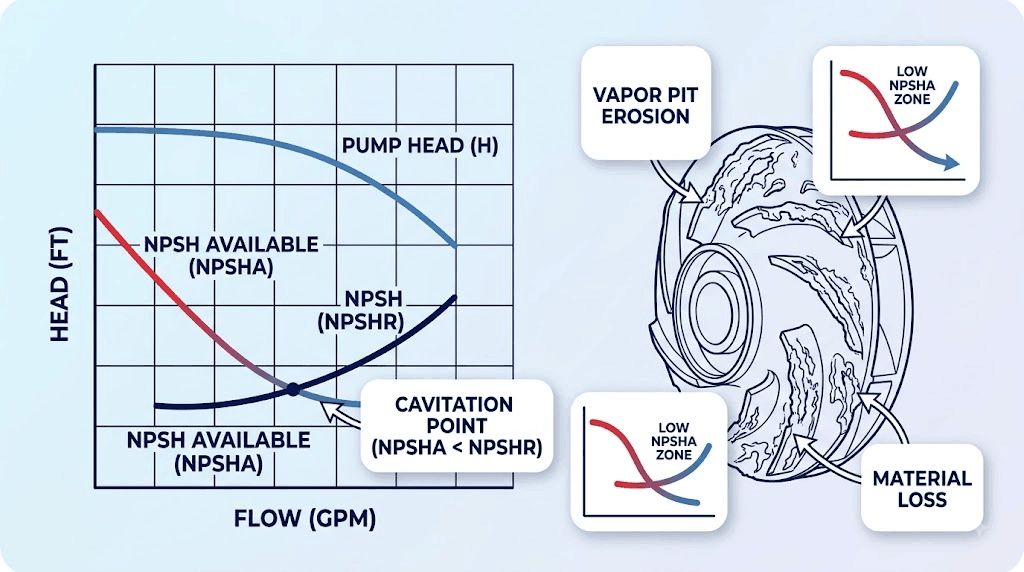
A boiler feedwater pump running outside its designed operating curve creates continuous mechanical stress that leads to seal failure, bearing destruction, and low-water boiler trips. Undersized feed pumps fail to deliver sufficient water volume against peak steam drum pressure, triggering low-water safety cutoffs. Conversely, oversized pumps force feed valves to operate near fully closed positions, causing excessive throttling wear and pump recirculation overheating.

NPSH curves graphing the cavitation point (NPSHA < NPSHR) alongside a diagram of a pitted, damaged centrifugal pump impeller.

Executing an accurate boiler feed pump calculation ensures the pump is matched to actual system hydraulics. The sizing calculation must account for maximum steam generation capacity, required operating pressure, piping friction head loss, static elevation, and an additional 5% to 10% flow allowance for blowdown losses. Furthermore, engineers must verify that the Net Positive Suction Head Available (NPSHA) from the deaerator or condensate tank exceeds the Net Positive Suction Head (NPSH) required by the pump under peak temperature conditions. Insufficient NPSH causes hot condensate to flash into steam at the impeller inlet, creating destructive cavitation that can destroy a feed pump impeller in weeks.

3. Control Water Chemistry and Enforce Consistent Blowdown Protocols

Improper boiler feedwater treatment is the single largest cause of unscheduled tube failures, scale accumulation, and dissolved gas corrosion. Dissolved calcium, magnesium, and silica precipitate out of solution under high heat, forming an insulating scale layer on heat transfer surfaces. A scale deposit as thin as 1/16th of an inch insulates boiler tubes, reducing thermal efficiency and forcing metal temperatures to rise until the tube wall softens, bulges, and ruptures.

Advertisement

Maintaining water quality requires a dual approach: operating external pretreatment equipment such as water softeners and deaerators, alongside dosing internal chemical treatments (phosphate treatment, oxygen scavengers, and alkalinity builders). To prevent dissolved solids from reaching critical concentration thresholds, operators must follow blowdown procedures systematically. Implementing automated continuous surface blowdown controls total dissolved solids (TDS) and conductivity levels at the water surface, while periodic manual bottom blowdown removes accumulated sludge from the lower drum or shell legs. Combining these controls with a external water treatment equipment testing routine prevents carryover, foaming, and scale-induced overheating.
Comparison side-by-side photo of severe scale build-up inside a firetube boiler versus a clean tube bundle - Visualizes the thermal barrier effect caused by untreated mineral deposits.

4. Implement Predictive Replacement for Critical Control and Safety Valves

Control valves, blowdown valves, feed check valves, and safety relief valves operate under extreme pressure drops, high temperatures, and erosive fluid conditions. A sticking feedwater control valve can trigger a low-water shutdown within seconds, while a leaking blowdown valve steadily drains boiler water and thermal energy. Waiting for a critical valve to fail completely mid-production turns a simple maintenance task into an emergency outage.

Establish a predictive replacement program based on valve duty cycles, seat material wear rates, and operational history. Inspect control valve stems for packing leaks, actuator diaphragm cracking, and seat scoring during scheduled outages. Test safety relief valves in compliance with safety valve testing standards, performing manual lift tests or bench testing to confirm set pressures and re-seating capability. Replacing internal packing, trim, or entire valve assemblies during planned maintenance prevents minor internal leakage from escalating into total valve seizure during heavy plant operation.

5. Optimize Combustion Efficiency via Continuous O2-Trim Tuning

Inconsistent combustion forced by improper air-to-fuel ratios wastes fuel and accelerates mechanical wear on burner components, combustion chambers, and heat transfer surfaces. Running with too little air results in incomplete combustion, generating toxic carbon monoxide and heavy soot deposits that coat firetubes and act as an insulating blanket. Running with excess air pulls heat out of the combustion zone and sends unburned energy up the stack, overworking the forced draft fan and burner linkage.

While performing a routine flue gas combustion analysis with a portable analyzer calibrates seasonal burner response, ambient air temperature and barometric pressure fluctuate constantly. Installing an automated oxygen trim system continuously measures flue gas oxygen content and adjusts the air damper or variable speed fan in real time. Maintaining optimal excess air levels (typically 15% excess air or roughly 3% O2 in flue gas for natural gas) stabilizes combustion temperatures, reduces thermal fatigue on burner cones, and prevents unburned fuel accumulation.

Advertisement

6. Train Operators on Early Mechanical Deviation and Acoustic Warning Signs

Boiler operators on the plant floor are the primary line of defense against compounding mechanical failures. Minor mechanical deviations—such as a subtle change in feed pump vibration, a high-pitched hiss from a packing gland, or small pressure swings on the steam header—precede complete system failures. Without structured training, operators may overlook early indicators until automated safety limit controls trip the boiler offline.

Formalize daily shift routines around a standardized checklist rather than relying on informal walk-throughs. Operators should record daily logbook entries capturing flue gas temperatures, steam drum pressure, feedwater temperature, chemical dosing rates, and stack draft pressure. Establish clear escalation thresholds: if stack gas temperature rises 20°F above baseline at a given firing rate, operators should immediately flag potential tube soot accumulation or fireside baffle bypass to the maintenance team for investigation before efficiency drops further.

7. Maintain a Strategic On-Site Critical Spare Parts Buffer

Extended boiler downtime often stems not from the complexity of a repair, but from waiting for long-lead replacement components to arrive. High-spec items—such as flame safeguard control modules, flame scanners, high-pressure feed pump seals, level control probes, and boiler-specific valve rebuild kits—frequently carry multi-week lead times from original equipment manufacturers (OEMs).

Conduct a spare parts criticality audit by analyzing past maintenance logs and component lead times. Maintain an organized, climate-controlled on-site inventory containing high-wear components, including replacement gaskets, sight glass sets, igniters, safety valve spares, and burner nozzles. Pair this physical inventory with a formal agreement for a emergency temporary steam header piping connections setup to ensure rapid deployment if an unexpected pressure vessel failure occurs.

Advertisement

Decision Framework: Customizing Your Maintenance Priority Matrix

Not all industrial boilers face identical failure modes. Operating profile, feedwater source, fuel type, and system design dictate which downtime prevention measures yield the highest return on effort. Use the matrix below to prioritize maintenance resources based on your facility’s operational reality:

Operational Condition Primary Downtime Risk Highest-Priority Preventive Focus Secondary Mitigation Measure
High Makeup Water Ratio (>50%) Scale build-up, dissolved gas pitting, tube burnout Automated water chemistry control & continuous blowdown Deaerator tray inspections & oxygen scavenger monitoring
Rapid Cyclic Loading / Frequent On-Off Thermal fatigue, pressure vessel cracking, seam leaks ASME/NBIC ultrasonic wall thickness & NDE weld testing Modulating burner upgrades & turndown optimization
Heavy Fuel / Alternate Gas Sources Sooting, burner nozzle fouling, stack fire risk Continuous O2 trim combustion control & stack monitoring Automated soot blowers & daily combustion logging
Continuous 24/7 Operations Feed pump failure, valve seizure, unexpected trips Precision feed pump NPSH sizing & valve rebuild cycles On-site spare parts buffer & temporary rental contingency plan

Key Takeaways

  • Combine Code Inspections with NDE: Supplementary ultrasonic wall testing and NBIC Part RC compliant repairs catch pressure vessel thinning long before mandatory inspections force an emergency shutdown.
  • Solve Feed Pump Hydraulic Deficits: Accurate boiler feed pump sizing must account for drum pressure, head losses, blowdown margins, and strict NPSH requirements to prevent pump cavitation.
  • Automate Chemistry and Blowdown Controls: Scale accumulation insulates tubes and causes rapid thermal failure; daily testing and automated blowdown maintain optimal heat transfer.
  • Implement Continuous Combustion Tuning: Installing automated O2 trim systems prevents thermal fatigue, reduces soot buildup, and stabilizes burner output across fluctuating ambient conditions.
  • Bridge Hardware Gaps with Inventory and Planning: Stocking long-lead control modules and maintaining a temporary rental boiler plan eliminates logistics delays when repairs are required.

Frequently Asked Questions

How often should industrial boiler water chemistry be tested to prevent downtime?

Industrial boiler water chemistry should be tested at least once per shift for manual parameter checks (such as hardness, pH, sulfite, and phosphate levels), while conductivity and Total Dissolved Solids (TDS) should be monitored continuously via inline sensors. Continuous monitoring combined with daily laboratory verification prevents sudden scale precipitation and acidic corrosion. Following a comprehensive preventative maintenance schedule ensures chemical dosing pumps and blowdown controllers remain calibrated.

What is the most common cause of premature boiler tube failure?

The most common cause of premature boiler tube failure is thermal overheating caused by internal scale buildup or oxygen pitting corrosion on the waterside. When mineral scale accumulates on heat transfer surfaces, it acts as an thermal insulator, preventing water from cooling the metal. The tube metal temperature escalates rapidly until the wall weakens, swells, and ruptures under operating pressure.

How does improper feed pump sizing cause boiler shutdown?

An undersized boiler feed pump cannot maintain sufficient flow against peak steam drum pressure, causing the water level to drop until the low-water fuel cutoff trips the burner offline to prevent dry firing. An oversized pump causes severe control valve throttling, leading to high flow turbulence, pump overheating, premature seal failure, and frequent pressure swings across the steam system.

What emergency contingency measures should be in place for unexpected boiler outages?

Facilities should maintain an active rental boiler contingency plan that documents physical connection points for steam lines, feedwater supply, fuel lines, electrical connections, and stack clearances. Pre-wiring electrical hookups and pre-flanging steam header tie-ins allows a temporary rental unit to be piped and commissioned within hours of a severe primary boiler outage, maintaining plant operations while repairs take place.

Advertisement

Source link

Continue Reading

Tech

Microsoft’s nemesis returns: Nightmare Eclipse is back with a new zero day which could be bad news for Windows users

Published

on


  • Nightmare Eclipse discloses ShieldBreak, a new Windows privilege‑escalation zero‑day
  • Flaw bypasses a recent patch and works on fully updated Windows 11 systems
  • Researcher’s ongoing exploit spree leaves multiple Windows vulnerabilities still unpatched

Nightmare Eclipse has struck again! The notorious zero-day researcher with a Microsoft grudge disclosed its latest vulnerability, and just as in previous instances, they picked their timing and released their research hours after Microsoft published its August Patch Tuesday cumulative update in order to maximize the hurt.

The newest flaw is called ShieldBreak, and is described as a local escalation of privilege vulnerability that allows threat actors to gain SYSTEM-level privileges on vulnerable systems. Speaking of vulnerable systems, the list is rather long because it includes all versions of Windows 11, including those with the latest security patches.

Source link

Continue Reading

Trending

Copyright © 2025