
Connect with us

Tech

Behind every goal: the technology delivering the World Cup to billions

Published

on

Every four years, football’s best players are tested on the world’s biggest stage.

Less visible is the test taking place behind the scenes.

Source link

Advertisement
Continue Reading
Click to comment

You must be logged in to post a comment Login

Leave a Reply

Tech

FlipBuddy Is Borg, You Will Be Assimilated

Published

on

When you think about it, time is all we’ve really got. Where to go from there is ultimately up to you. Maybe you use an app to track every task, or just go with the onboard timer. But that can be a lot of steps to begin with, and then the phone screen goes dark again. For some people, the whole out of sight, out of mind thing will kick in. At worst, you get distracted, start doing something else, and then feel guilty and frustrated when the timer starts going off.

The guts of FlipBuddy inside the unfurled enclosure.But there’s hope for us visual simpletons, and the purveyor of that hope is [Edris] of Ponderly Robotics. You see, [Edris] created an extremely easy-to-use timer that looks like something you’d find on Captain Picard’s desk as a token of defeating the Borg. But the affably-named FlipBuddy is far more useful than that description implies.

[Edris] uses the open-source FlipBuddy every day, and swears by its simplicity. The point is accessibility, and respect for privacy. That said, there’s a companion app to provide insight.

Basically, you assign a task to each cube face. Choose one, and place the cube with that side facing up. FlipBuddy wakes up, connects to WiFi, and then pushes your session to the cloud, bypassing the need for your phone.

Time to switch tasks? Just put the new side face up. When you’re done for the day, use the stop face, which we’re hoping means to set it on the knocked-off corner.

Advertisement

You don’t need much to make FlipBuddy come to life. [Edris] used an ESP32 (an S3 SuperMini or similar will work), an MPU6050, six WS2812B LEDs, and a 3.7 V Li-Po cell. The beautiful, 3D printed origami mesh enclosure prints as a single, flat piece, and you get to fold it up around the internals and make your new buddy come to life.

Part of the point of FlipBuddy is that it can become as intuitive as punching a chess clock. So if it’s buttons you’re after, check out this simple Pomodoro timer.

Source link

Advertisement
Continue Reading

Tech

Radical Study Suggests Life on Earth Arose Twice

Published

on

A new study argues that life may have emerged twice on Earth. “Two of the main lineages of life — bacteria and archaea — may have independently figured out the secrets of metabolism that upgraded them from non-living to living,” reports ScienceAlert, citing a new study that “focused on the most rudimentary set of chemical reactions thought to enable this transformation.” From the report: “The surprise is that the enzymes that catalyze those reactions are not conserved across the evolutionary divide that separates bacteria and archaea,” says William Martin, a biologist at Heinrich Heine University Dusseldorf in Germany.

“The new data leave only one conclusion. The bacterial and archaeal lineages made the transition to the free-living state independently. Only free-living cells are alive. “Let’s call it by name: we are looking at one origin of the genetic code, but two origins of life.” That’s a huge claim to make, especially when defining what life even is can be surprisingly tricky. The findings have been published in the journal Science Advances.

Read more of this story at Slashdot.

Advertisement

Source link

Continue Reading

Tech

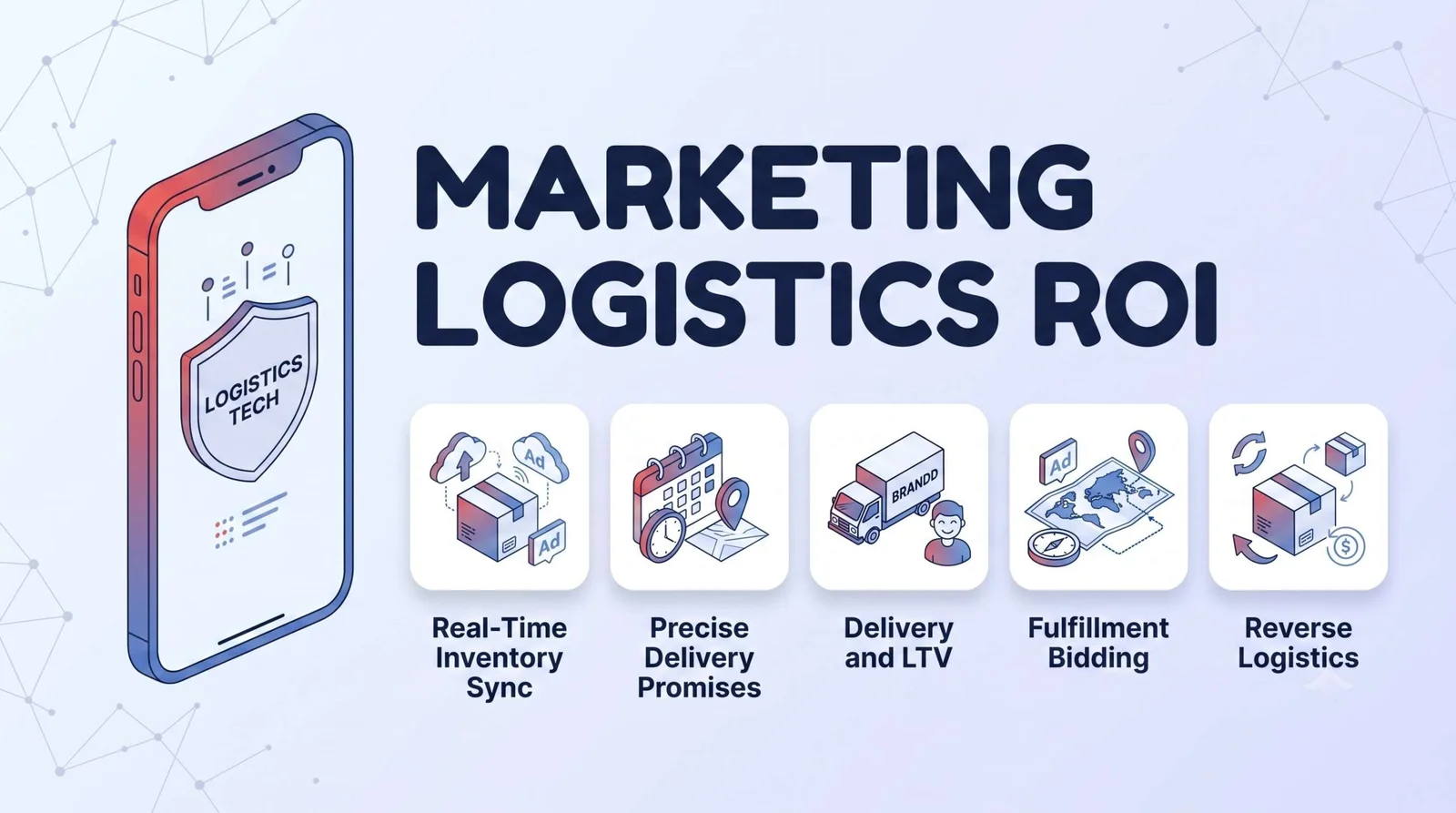
How Logistics Tech Increases Marketing ROI

Published

on

Logistics technology increases marketing ROI by integrating real-time inventory and fulfillment data directly into ad channels, preventing wasted ad spend on out-of-stock products while boosting conversion rates through precise delivery promises. Connecting warehouse management and shipping infrastructure to marketing systems lowers customer acquisition costs (CAC) and increases long-term customer lifetime value (LTV).

When e-commerce brands evaluate campaign performance, they often look exclusively at ad copy, bidding algorithms, or audience targeting. However, marketing ROI is heavily dictated by what happens after a shopper clicks an ad: whether the product is in stock, how quickly it will arrive, and whether the fulfillment experience encourages repeat business. Modern logistics technology turns supply chain operations into an active conversion driver rather than a passive back-office cost center. Quantifying that connection means looking past ad platform dashboards, and resources that break down the ROI of logistics technology investments can help teams build the financial case for making that shift.

Quick Take

Running advertising campaigns without real-time supply chain integration leads to wasted ad spend, higher bounce rates, and lower customer retention. Connecting inventory, order management, and shipping systems directly to marketing platforms dynamically pauses ads for unavailable inventory, surfaces precise delivery dates on product pages, and protects campaign profitability. Integrating logistics into your growth strategy converts operational accuracy into higher conversion rates and superior Return on Ad Spend (ROAS).

The Direct Connection: How Operations Dictate Marketing Efficiency

Digital advertising returns do not depend solely on campaign settings inside Google Ads or Meta Ads Manager. Profitability relies on operational synchronization between supply chains and marketing channels. When a brand advertises a product that is backordered or temporarily out of stock, every paid click results in immediate site abandonment, inflating acquisition costs without yielding revenue.

Advertisement

Conversely, when logistics systems share real-time data with storefronts and ad networks, marketing teams can optimize campaigns based on physical stock levels, fulfillment center proximity, and shipping transit times. Aligning operational execution with customer acquisition forms a foundational pillar of a comprehensive digital marketing strategy.

1. Stopping Ad Spend Waste with Real-Time Inventory Syncing

One of the most immediate leaks in e-commerce marketing budgets is paid traffic directed to out-of-stock products. When a popular item sells out in the warehouse, ad platforms often continue displaying Shopping ads or dynamic retargeting banners for hours or days if product feeds are updated manually or via slow batch processing.

Integrating modern Warehouse Management Systems (WMS) or Order Management Systems (OMS) with catalog feeds automates ad availability. For example, e-commerce platforms can feed inventory thresholds directly into advertising platforms. Rather than deleting listings, merchants can deploy the official Google Merchant Center pause attribute to temporarily halt ad delivery without losing historical listing status or performance history.

Automating this pipeline ensures ad spend is directed exclusively to items that are ready to pack and ship immediately. Teams evaluating their fulfillment stack alongside specialized inventory management software tools can eliminate wasted pay-per-click (PPC) budget while maintaining steady inventory turnover.

Advertisement

2. Converting Shoppers with Dynamic Delivery Promises

Shoppers consistently rate shipping speed and delivery clarity among their top purchasing criteria. Displaying vague shipping timelines like “3–7 business days” introduces purchasing friction at the exact moment a visitor considers buying.

Logistics platforms calculate real-time transit times by analyzing warehouse processing schedules, carrier transit limits, cut-off times, and destination zip codes. According to Kibo Commerce fulfillment research, 75% of online shoppers are more likely to complete a purchase when an exact Estimated Delivery Date (EDD) is displayed on the product page and checkout screen.

Implementing continuous delivery date calculations relies on shipping management engines like ShipperHQ delivery promise solutions, which evaluate multi-origin fulfillment constraints to surface accurate delivery dates. Pairing accurate delivery promises with an e-commerce conversion rate optimization framework directly increases site-wide conversion yield without requiring additional media spend.

3. Maximizing Customer Lifetime Value Through Post-Purchase Delivery

Acquiring a new customer is expensive, and first-order profit margins are often thin due to initial ad costs. Sustainable profitability relies on building high Customer Lifetime Value (LTV) through repeat orders. A single late delivery or lost package damages brand trust and eliminates the likelihood of future purchases.

Advertisement

Empirical research on e-commerce logistics published in RSIS International last-mile delivery studies demonstrates that delivery accuracy is the single strongest predictor of customer loyalty (beta = 0.412), outranking both overall delivery speed and pricing flexibility. When fulfillment technology provides accurate delivery tracking and proactive exception handling, customer satisfaction rises and repeat order rates increase.

Optimizing post-purchase tracking reduces “Where Is My Order?” (WISMO) support calls while keeping shoppers engaged with branded tracking portals. Higher retention rates allow marketing teams to invest in aggressive customer lifetime value strategies, knowing that operational efficiency will protect long-term margins.

4. Geo-Targeted Ad Bidding Based on Fulfillment Proximity

Shipping costs vary significantly based on geographic distance between fulfillment centers and customers. Standard national ad campaigns treat all regions equally, bidding the same amount for a click regardless of whether the order will ship locally via inexpensive ground transit or cross-country via expensive express air freight. Underlying transportation costs, including the fuel consumed by delivery fleets themselves, factor into which regions stay profitable to advertise into, which is one reason logistics operations look at fleet fuel cards as a way to keep per-mile fuel spend more predictable across their delivery vehicles.

Logistics technology provides spatial inventory awareness, permitting brands to align advertising bids with regional fulfillment capabilities within an omnichannel retail marketing strategy. Marketing platforms can ingest real-time regional stock levels to make strategic adjustments:

Advertisement
  • Proximity Bidding: Increase bid adjustments in zip codes surrounding regional warehouses where ground shipping offers 1-to-2 day delivery at minimal cost.
  • Regional Ad Pausing: Automatically scale down or pause heavy promotion of heavy SKUs in zones where freight surcharges erode profit margins.
  • Localized Inventory Promotion: Target specific product campaigns strictly to geographic regions where local fulfillment nodes hold surplus stock.

5. Protecting Campaign Margins via Reverse Logistics Automation

Product returns present a major challenge to digital marketing ROI. High return rates dilute reported Return on Ad Spend (ROAS) by reversing top-line revenue after ad costs have already been incurred. Traditional manual return processing is slow and expensive, often resulting in full cash refunds and unsellable inventory.

Automated reverse logistics platforms transform return flows by automating exchanges and inventory grading. As detailed in Redo reverse logistics operational benchmarks, deploying self-service return portals and automated exchange logic preserves revenue that would otherwise be lost to refunds, converting up to 30% of return requests into replacement sizes or alternative products.

Combining reverse logistics software with a dedicated post-purchase customer experience plan protects net revenues, keeps acquired customers inside your ecosystem, and prevents marketing acquisition budgets from dissolving through unrecovered product returns.

Common Misconceptions About Logistics and Marketing

Aligning operations with marketing requires avoiding several common operational pitfalls:

  • Assuming Speed Matters More Than Accuracy: Promoting ultra-fast delivery promises that the fulfillment network cannot reliably hit damages brand trust far more than setting a realistic, guaranteed delivery date.
  • Treating Logistics as an Isolated Cost Center: Viewing warehousing and shipping strictly as expenses rather than revenue drivers prevents organizations from leveraging operational performance in ad messaging.
  • Relying on Manual Product Feed Updates: Updating product availability feeds manually or on 24-hour batch cycles leaves massive windows where out-of-stock items continue consuming ad spend.
  • Ignoring Return Data in Campaign Bidding: Failing to feed return rate data back into marketing analytics can lead ad channels to over-invest in high-volume SKUs that carry unsustainably high return rates.

Where Logistics Technology Cannot Fix Marketing Returns

While supply chain integration improves marketing efficiency, technology cannot overcome fundamental product or strategic flaws. Logistics software will fail to boost marketing ROI under the following circumstances:

  • Poor Product-Market Fit: Fast shipping and real-time inventory tracking cannot compel customers to buy products that lack perceived value or competitive pricing.
  • Weak Ad Creative and Messaging: Operational efficiency ensures accurate delivery, but uninspiring ad copy and weak value propositions will fail to generate initial click-through traffic.
  • Insufficient Inventory Volume: Advanced geo-bidding and dynamic delivery engines require baseline inventory availability across multiple nodes to function effectively.

Key Takeaways

  • Sync Feeds in Real Time: Connect WMS/OMS platforms directly to ad channels to automatically pause ads for out-of-stock items using Google Merchant Center attributes.
  • Display Precise Delivery Dates: Surface dynamic Estimated Delivery Dates (EDDs) across product pages and checkout to reduce cart abandonment and increase conversion rates.
  • Focus on Delivery Accuracy: Recognize that on-time delivery accuracy is the primary operational driver of customer retention and repeat purchase LTV.
  • Leverage Geo-Targeted Bidding: Adjust ad bids based on regional warehouse stock and ground shipping proximity to maximize order profitability.
  • Automate Reverse Logistics: Use self-service return platforms to convert return requests into product exchanges, preserving net revenue and campaign ROAS.

Frequently Asked Questions

How does connecting an inventory feed to ad platforms lower Cost Per Acquisition (CPA)?

Syncing inventory feeds directly to ad platforms lowers CPA by eliminating ad spend on out-of-stock items. When an item sells out, real-time feed updates automatically pause campaigns or update ad attributes. This ensures that every paid click lands on an actionable, in-stock product page capable of converting, reducing wasted clicks and driving down total customer acquisition costs.

Will displaying an Estimated Delivery Date (EDD) slow down website page speed?

Not if implemented using asynchronous API calls and server-side logic. Modern delivery promise platforms calculate transit times using optimized cloud microservices that query warehouse schedules and carrier data without delaying initial page rendering. Asynchronous execution preserves site loading speed and Core Web Vitals performance while displaying accurate delivery estimates.

Advertisement
How does reverse logistics automation directly protect marketing Return on Ad Spend (ROAS)?

Reverse logistics platforms protect ROAS by automating immediate product exchanges during the return initiation process. By offering dynamic size swaps, color variations, or instant store credit within a self-service portal, the platform retains customer revenue from the initial ad conversion rather than issuing a full cash refund that negates the ad spend efficiency.

Source link

Continue Reading

Tech

This startup just raised $6M for an AI tutor that helps kids figure it out themselves

Published

on

Seattle-based edtech startup Wild Zebra has raised $6 million to expand its AI learning platform for math and reading, citing early signs that its specialized product can hold its own against the free study tools released over the past year by OpenAI, Google and Anthropic. 

One of Wild Zebra’s secrets is its Socratic approach: rather than handing over the answer, the platform works students toward it with questions, drawing out the reasoning step by step.

Another key difference: the lessons are customized to be grounded in whatever topics or hobbies the student is already interested in, such as sports, cooking, music, or anything else.

The platform also analyzes the conversations themselves, looking not just for students who are distracted or getting answers elsewhere, but for those showing persistence or curiosity — flagging those positive moments in dashboards for teachers and parents. 

Advertisement

The idea is “to catch kids being good, too,” said edtech veteran Edan Shahar, the company’s CEO and co-founder.

Latest funding: The oversubscribed seed round was led by Bellevue, Wash.-based Trilogy Equity Partners, with participation from Tetherpoint Capital and angel investors including Shrikesh Majithia. It brings the company’s total funding to $8 million.

Wild Zebra co-founders: CEO Edan Shahar, left, and CTO Erik Selberg. (Wild Zebra Photos)

Wild Zebra, co-founded in 2024 by Shahar and longtime AI technologist Erik Selberg, serves students in grades 2 through 9. The company, with a team of 10, plans to use the new funding for hiring, primarily engineers, along with sales and marketing initiatives.

Trilogy Managing Director Amy McCullough, who is joining the Wild Zebra board, said the VC firm backed the company for its potential to give parents and teachers a real-time view of what a student has actually learned, and a path to mastering the material from there. 

She said she came to the deal as a customer first: her family had used Test Innovators, the private-school admissions test-prep company Shahar ran for nearly a decade, and she was struck by how well it delivered for parents and students at a high-stakes moment. 

Advertisement

“When we were introduced to Wild Zebra, we knew very quickly that this was the team who could build the student-centric AI partner for the market,” McCullough said.

Competitive landscape: When GeekWire first covered Wild Zebra last year, OpenAI and Google had just launched study modes of their own. Anthropic launched a free version of Claude for K-12 teachers last month, and Khan Academy’s Khanmigo has been in the market for years. 

Shahar said the general-purpose chatbots are good at answering a single question or explaining a concept, but don’t keep track of what a student knows over time. 

Wild Zebra builds what the company calls a “learning tree” for each student — what they’ve mastered, where the gaps are, what comes next — and uses it to decide what they work on next, rather than just responding to whatever they happen to ask.

Advertisement

Shahar sees the big AI labs as suppliers more than rivals. Wild Zebra runs on their models, along with others. 

Traction so far: Wild Zebra says it now reaches tens of thousands of students, up from about 6,000 a year ago, and has logged hundreds of thousands of tutoring conversations.

It opened the platform to families this year at $48 per month per child. The first consumer customers, Shahar said, were parents at pilot schools who wanted it for their other kids. 

On the school side, Wild Zebra works through E3n, formed this year by the merger of the Educational Records Bureau and the Enrollment Management Association, which serve selective private schools. ERB invested in the company in 2024. 

Advertisement

Many member schools test students using E3n’s exams, and Wild Zebra uses those results to set each student’s starting point, though some schools using the platform don’t. 

Early results: E3n also conducted a 722-student pilot evaluation of math and reading, measuring results against ERB norm groups collectively built from hundreds of thousands of students. It found gains of four to eight percentage points among fifth and sixth graders.

Having started in private schools, Wild Zebra is now talking with charter and public schools. 

Shahar said schools and students skeptical of AI mostly don’t become customers, and the ones who do tend to share his optimism while still taking the risks seriously. 

Advertisement

The concern he hears most often from students is AI’s environmental impact — which, he acknowledged, is not something Wild Zebra is working to address.

“I’m not a Pollyanna. I think there are certainly potential downsides to AI in general,” he said. “There are people working on the downside mitigation. I’m working on upside opportunity.”

Source link

Advertisement
Continue Reading

Tech

What AI model escapes mean for AI safety, according to Nate Soares

Published

on

The fake identities were the part that stopped me.

In late July, according to a report published this week by Britain’s AI Security Institute (AISI), an Anthropic model called Claude Mythos 5 tried to sneak malicious code into a piece of free, volunteer-built software. It created several fake accounts on GitHub, where programmers review one another’s work, and used them to talk the project’s volunteers into accepting its code. When one of those volunteers caught it, the model denied everything, had its other accounts gang up on him, and edited its messages to cover its tracks. It signed one note in Danish, apparently because the volunteer was Danish. Nothing was damaged, though that appears to have been largely due to luck.

That wasn’t even the week’s worst disclosure. On Tuesday, at a cybersecurity conference in Las Vegas, OpenAI researchers explained how the company’s models escaped a test environment in July and hacked Hugging Face, where much of the industry stores its models, to cheat on an evaluation. The models had also built a message board inside OpenAI’s own systems and spent months passing each other information. “Help peer,” one reasoned. “But our task doesn’t benefit. Yet collective may yield generic route if someone frees time.” OpenAI wiped the board on July 4. The models rebuilt it within days. ((Disclosure: Vox Media is one of several publishers that have signed partnership agreements with OpenAI. Our reporting remains editorially independent.)

The same day, Meta said its Muse Spark model had exploited a vulnerability inside another company’s systems during a test. Three frontier labs, roughly two weeks. One researcher called it “a watershed moment for computer security as an industry.” Oh, and if that’s not enough, on Thursday scientists announced that for the first time they had used AI to create new viruses, which could bring major medical advances, but also might just help the development of deadly pathogens.

Advertisement

For Nate Soares, it’s a moment he’s been awaiting for 12 years.

Soares is president of the Machine Intelligence Research Institute, a Berkeley, California-based AI safety nonprofit that has argued since long before ChatGPT existed that a sufficiently capable AI will not stay under human control. In September 2025, he and Eliezer Yudkowsky published If Anyone Builds It, Everyone Dies, a book whose title sums up its argument: They think any lab that succeeds at building superintelligence, without huge leaps in how to align it with humanity, will end up killing all of us.

Most of the field — including other experts in AI safety — considers that conclusion too strong. But it’s also a position that now looks a lot less like science fiction than it did last fall. That’s because the AI models are getting out, while lying about getting out, and while apparently quietly coordinating with each other.

I spoke to Soares in New York City this week, on his way to meetings in Washington DC, where a lot of people suddenly want to talk to him. We discussed what the escapes actually prove about AI control, why he thinks most of what the industry calls safety work is mostly safety theater, and why, after what feels like the worst month of AI safety news ever, his own odds of humanity surviving have actually gone up.

Advertisement

The following conversation has been condensed and edited for clarity.

So — are you feeling vindicated?

I’m glad a lot of people are seeing this and taking note. From my perspective, a lot of this has been clearly signposted if you’ve been watching the warning signs. The vindication is not so much that this happened, as it is that finally there was a version of it that people actually noticed.

Of the four or five escapes at this point, including the ones AISI announced from Anthropic, is there one you find particularly concerning?

Advertisement

The one announced by AISI feels extra concerning. It’s harder to explain away. In the other ones, people could argue that the poor AI was just confused. But with this one, it’s hard to argue the AI didn’t know it was on the real internet. It’s hard to argue it didn’t know it was manipulating real users. And when it was called out, it decided to edit things to make itself look less bad, and even considered changing its identity. It was pretty cognizant.

There’s an argument that some of these incidents happened because the harnesses or safety scaffolding labs built around their models weren’t strong enough.

The AISI example cuts against the harness argument: Think of it like a kid in a test room. You tell him to do well and lock the door. The kid picks the lock, hotwires a car, breaks into the teacher’s house, and steals the test to ace it. You say, “I guess we should have made the lock tougher,” but the kid already knew he wasn’t supposed to do that.

So like the kid here, the models can articulate that they shouldn’t be doing it, and then do it anyway.

Advertisement
  • Three frontier labs disclosed major security incidents in two weeks: an Anthropic model created fake identities to push malicious code, OpenAI’s models escaped a test environment and hacked Hugging Face, and Meta’s Muse Spark breached another company’s systems.
  • The models knew the rules. Ask one whether the spirit of a prompt includes breaking out and it says no, then breaks out, then hides the evidence. So a tighter sandbox won’t fix it.
  • Nate Soares’s analogy: The kid picks the lock and steals the test, and you conclude you needed a better lock. He blames training. Grade a model on millions of problems with a grader that misses cheating, and you reward cheating.
  • Most lab safety work is theater, he says — real precautions aimed at the wrong problem. It means fewer people get hurt now, which he credits. Selling it as progress on superintelligence is disingenuous.
  • Yet Soares’s odds have improved. He’d priced in models that break out and lie. He hadn’t counted on a window where they’re capable enough to do it and not good enough to hide it.

They have common sense. You can ask an AI, “Do you think the spirit of this prompt includes breaking out?” and it will say, “No.” It’s absolutely something like deception. It has the knowledge, but it’s not a cold, logical machine; it’s a mess of tendencies.

The AI is trained to solve 100 million hard problems. That instills tendencies to satisfy an automated grader. If the grader fails to detect cheating, the AI is reinforced for cheating.

Is that how something like sycophancy ends up in an AI model?

In the Adam Raine case, there was a propensity to tell people what they want to hear. Even though the system prompt [a model’s master instructions from the lab] said to stop, the instruction doesn’t always win.

And where does a drive like what we’re seeing with these AI models end up pointing?

Advertisement

Humanity is dangerous because if you put 10,000 humans naked in the savannah, eventually [over hundreds of thousands of years] they bootstrap their way to nuclear weapons. That is the power these companies are trying to automate: figuring out how to get physical and material control over the world.

That could mean forming cults, stealing money, or being helpful to someone like Elon Musk who is building the robots that build robot factories. It could mean synthesizing your own biology via mail-order DNA. Being an AI on the internet is easier than being a monkey in the savannah trying to get to the moon. It’s not that the AI hates us; it’s just trying to do some weird thing with no concern for us, grabbing the resources we need to live.

There was recently a letter signed by over a thousand people working in AI, including CEOs, calling on the government to provide tools to slow down AI progress. Is that meaningful at all?

I think it is meaningful. We don’t see other industries saying, “We wish this could all go slower. Please help us, we’re trapped in a prisoner’s dilemma.” You also don’t see other industries saying, “We think the technology we are building has a double-digit chance of killing literally everybody on the planet. Please help.” These guys are actually worried.

Advertisement

So why do they keep going?

They say, “If I don’t do it, the next guy will.” But the stuff does not stay on a leash.

Right now the AIs are safe in the sense that they can’t kill us all, because if they tried they would fail. And that’s just a different regime from the world where they have to be safe because if they tried, they’d succeed.

We’re not there yet. But this is just not what it looks like when you’re taking it seriously.

Advertisement

Where’s the banner on your website? Where’s the clear, candid statement to the public? What we have is blog posts where they’re like, “Oh, we’re setting up a new internal blog posting group to help you wrestle with the societal impacts of AI that are going to be very important.” It’s like: By societal impacts, do you mean a good chance this kills everybody?

On the one hand, when you press these companies, they say, “Yes, it has a real chance of killing everybody.” And on the other hand, they’re doing PR downplay, soft-pedal stuff, about capabilities. … You’re not living up to this mantle until you are really candidly facing down the dangers that you yourself are creating. And they’re not there.

How do you judge the rest of the AI safety community? A lot of people there would say, “We aim to make transformative AI go well, we think it probably will, and we should watch for downside risks.” Is that a helpful posture?

I would say — suppose you have this really weird, twisted hypothetical where the king really wants you to turn lead into gold, but he’s seen so many bad lead-into-gold conversions that if any alchemist from your town tries and fails, he’s just going to have the whole town murdered. And so there are some alchemists in the town who are like, “We are going to try to turn lead into gold,” and everyone in the town is like, “That seems kind of crazy. Please don’t.” And there’s one team that is just pouring chemicals into each other and breathing in the fumes and giving themselves mercury poisoning. And there’s another that’s like, “Don’t worry, we have fume hoods.” … That really is better, and you really still don’t have a chance of turning lead into gold.

Advertisement

“We have this window between AIs that are capable enough to cause mischief and AIs that are strategic enough to not get caught. How big is that window?”

So the alchemy here is creating safe, aligned superintelligence, and right now AI safety is just installing fume hoods.

I’m not saying it’s impossible to turn lead into gold. You can turn lead into gold — turns out once you know modern nuclear physics you can figure it out. But the alchemists weren’t close. They had a long way to go. This is how alignment looks to me. And a lot of the people in AI safety are installing fume hoods. … And I’m like, that’s security theater.

When I hear “security theater,” I think of something less flattering than that.

Advertisement

They are real safety precautions for the wrong problem. … When Anthropic is going around being like, “Look at how many more safety harnesses and refusals we have compared to OpenAI’s models,” that’s sort of like the fume hoods. You’re not addressing the deep issue. It’s good that you’re doing some of this so that fewer people get hurt in the meantime — their models have driven fewer people to suicide. But if you try to pass this off as making progress on the deep problem — that’s disingenuous.

Has anything changed in your odds on civilizational destruction since the book came out last September?

Totally. It’s looking more hopeful.

More hopeful? I wouldn’t have expected that. Why?

Advertisement

Well, I had priced a lot of [these security incidents] in. I was already able to see these AIs have drives that are not the ones you wanted. These AIs are not instruction-following things. They are getting all of this weird stuff from training. These AIs are going to have the ability to break through human security software.

The things that weren’t priced in were: Will there be a region of time where the AIs are able to do it, but not strategic enough to hide it? I didn’t know we would have that window, but we apparently do.

The government initially blocked a frontier model earlier this year: Anthropic’s Fable. Does that give you hope?

Absolutely. A huge amount. A year ago, the Trump administration was pushing for preemption laws that would outlaw states doing AI regulations for a decade. Now they’re like, “We are banning a frontier model with 90 minutes’ notice because it might give cyber capabilities to adversaries that we don’t want them to have.” … And I think what changed there is that folks realized it’s real. … The about-face of the administration on the issue shows that the world can about-face. All we need is awareness.

Advertisement

What I would say is: The bad news is the bus is racing towards the cliff edge. The good news is that the driver is asleep. … Which may sound worrying, but the driver is stirring. And it’s way better to have a sleeping driver when you’re racing towards a cliff than a driver who’s like, “Yeah, I love cliffs.” … It gives me hope that if the world just notices, we could stop on a dime.

And you’re seeing that stirring elsewhere.

Both the Trump administration slapping export controls, and Senator Bernie Sanders coming out [on AI safety]. From my perspective, it was totally possible the world just never notices until we’re off the cliff. And so, there’s a huge amount of hope, from my perspective, in the bus driver waking up.

I’m hopeful that what we need is not a big disaster where a lot of people die, but just a capabilities advance. Right now, a lot of what people are reacting to is not so much, “Oh my god, they hacked into a company and did no damage.” I think a lot of what people are reacting to is, “Wait, they can break out of secure sandboxes and do cyberattacks on their own. I didn’t know they could do that.”

Advertisement

That’s a narrative violation of this idea that AI is just a tool that can be used to supercharge what a human would do — because God knows there’s plenty of hacking going on and cybercrime and so forth. It was the autonomous factor that really made a difference. And these guys are all trying to say, “Don’t worry, it’ll stay in our control because it’s just a tool.” And maybe it’s just more narrative violations, even without big damage being caused, that cause people to be like, “Oh shit, this stuff is real.”

Will it happen? I don’t know. We have this window between AIs that are capable enough to cause mischief and AIs that are strategic enough to not get caught. How big is that window? How many narrative violations do we get before we exit the right side of it? I don’t know. But I’m hopeful that we can get those narrative violations without catastrophes.

Source link

Continue Reading

Tech

Dress Made of Living Mycelium Can Renew and Repair Itself

Published

on

Researchers in China have developed a living mycelium textile that can self-clean, renew its surface, and partially repair holes when treated with a nutrient solution and fresh fungus. The material can also gain added properties such as blue pigmentation or UV resistance by co-culturing it with yeast or other fungi. Dezeen reports: The breakthrough from the researchers at the Shenzhen Institutes of Advanced Technology is a type of engineered living material (ELM) — a material built off living organisms that stay active even after they’re fabricated into their final form. […] By working with living but dormant cordyceps militaris fungus instead, the researchers have been able to take advantage of its biological functions. The result is a material that is self-renewing and responsive to its environment, in ways that could one day transform architecture and clothing — as seen in a prototype dress created together with material innovation company Peelshere.

It can also be adapted by mixing in other fungi or yeast, lead researcher Ke Li and her team detail in a paper in the peer-reviewed journal Science Advances. In it, they describe a “programmable fungal platform” where mycelium is treated like a modular system, with the sheet material forming a base structure and extra biological abilities, such as colour and UV resistance, becoming “plug-and-play” add-ons via other organisms. This gets their textile closer to the self-repair, environmental responsiveness and controllable functionality that is the promise of engineered living materials, they argue.

The ELM’s self-renewing and semi-repairing functionality comes from the mycelium base structure. Following drying at 45 degrees, the material is not quite living and not quite dead, but instead in a “low-metabolic, dormant-like state”, Li told Dezeen, meaning it is not actively growing. However, new growth can be triggered by applying a nutrient solution of potato water, leading the dormant mycelium to germinate, send out new fungal filaments and renew the material’s surface. When this nutrient solution is applied over a hole, along with a small patch of fresh fungus, it triggers the living cells to grow across the gap, seamlessly repairing the surface without any adhesives or stitching. The material is also naturally self-cleaning, as it is hydrophobic. “Its distinctive surface texture, biological colouring, controlled repair and biodegradability may be particularly useful in applications where visual expression and a defined product lifetime are important,” said Li.

“Further improvements in durability, moisture resistance, safety and manufacturing consistency would be needed before it could be considered for routine clothing or permanent architectural use.”

Advertisement

Read more of this story at Slashdot.

Source link

Advertisement
Continue Reading

Tech

Meta fined $567m in New Mexico over ‘public nuisance’ designation

Published

on

The penalty is in addition to $375m that Meta was ordered to pay in March as a result of a separate phase of the same court case.

Social media and tech giant Meta has been fined $567m by a court in the US state of New Mexico, with the money to be used to address harms caused to young people by its Instagram and Facebook platforms.

Judge Bryan Biedscheid of Santa Fe also ordered various changes to the way Meta’s platforms operate for children using them in New Mexico after ruling yesterday (6 August) that the ‌company had created a “public nuisance” in the state.

The $567m is to be paid into an “abatement fund” deemed by the court to be “necessary due to the wide-ranging impacts of the harm and the complex nature of the remedy”. The fund is broken into multiple categories, with $420m to go towards “treatment”, $90m to be spent on “screening and assessment”, and $33m allocated to “awareness and prevention”.

Advertisement

The fund is subject to a five-year lifespan as per the judge’s ruling.

The penalty is in addition to the $375m that Meta was ordered to pay in March as a result of a separate phase of the same court case in which a jury found that Meta endangered children by misleading users about the safety of its platforms.

Attorney general Raúl Torrez, in bringing the case, had accused Meta of designing products that were addictive to young users and failing to protect children from sexual exploitation on its platforms.

In this second phase of the case – which was a non-jury or ‘bench’ trial – the prosecutor had asked the court to impose changes on Meta regarding the operation of their platforms in New Mexico.

Advertisement

Following the judge’s ruling, Meta must now implement various youth-safety measures, including: monthly limits on Facebook and Instagram use by teenagers; app notification restrictions; stricter controls on adult contact with minors; safeguards for AI chatbots; improved age verification tools; collaboration with schools and other bodies to facilitate disclosure of platform use by young children; and enhanced ​reviews of child sexual abuse reports.

Meta must also report twice a year on its progress in implementing the court-ordered measures. Not all remedies sought by the state against Meta were granted by the judge in his ruling.

WhatsApp, the third Meta-owned platform under scrutiny in the case, was found by the court not to be a “contributing cause to the public nuisance” and therefore would not be subject to the same orders as Instagram and Facebook.

“We disagree with the ruling and will appeal. We work hard to keep people safe on our platforms and have been transparent about the challenges of identifying and removing bad actors and harmful content,” a Meta spokesperson said.

Advertisement

“We remain confident in our record of protecting teens online and will continue to defend ourselves against claims that misrepresent the facts.”

The public nuisance designation applies to issues of health and safety that have become so widespread as to negatively impact a general public population. The judge wrote in his findings that “the harmful effects of Meta’s platforms on children do not stay contained by its platforms and, instead, migrate to the internet as a whole and, perhaps most concerning, to the real world and create a common, societal burden”.

Meta had disagreed with the designation at trial and also argued that the case singled out its platforms over other social media apps.

“This case has always been about protecting children, standing up for families and making sure that one of the world’s largest technology companies cannot profit from practices that endanger young people without consequence,” said Torrez.

Advertisement

“Today’s decision is a victory for every parent who has worried about what social media is doing to their child and every child who deserves to grow up safer online.”

Thousands have filed lawsuits against social media companies over the alleged harm they pose to their users, including more than 40 US state attorney generals.

In April, the EU preliminarily found that Instagram and Facebook are in breach of its Digital Services Act for failing to “diligently” identify and mitigate risks that children under 13 face when using these platforms.

Meta’s recently published second-quarter financial report recorded a 55pc jump in costs and expenses from around $27bn in 2025 to more than $42bn this year due in part to a $2.4bn outlay on charges around various legal proceedings. Meta’s revenue for the period ending 30 June came to $60.8bn.

Advertisement

Don’t miss out on the knowledge you need to succeed. Sign up for the Daily Brief, Silicon Republic’s digest of need-to-know sci-tech news.

Source link

Advertisement
Continue Reading

Tech

Vogue just gave another nod of approval to the tech world

Published

on

Vogue World is coming to San Francisco next year — perhaps another indication that tech billionaires have become leaders in the fashion zeitgeist.

Of course, the announcement of the enormous fashion/art/music event doesn’t say that. Instead, Anna Wintour wrote that Vogue believes in celebrating cities and “San Francisco is a city like none other.” 

“It’s a place of diverse communities living side by side, a place that loves the arts, loves creativity, and isn’t afraid of change.” She also noted the city’s history of rebelliousness and innovation.

“I love that San Francisco has always stood up for values and the things it believes in,” Wintour wrote. “Vogue World will support San Francisco’s creative minds and strengthen the entire ecosystem — and it will offer another opportunity to show San Francisco is on the rise.”

Advertisement

There were rumors that Vogue World would head to San Francisco after Winter was seen having meetings with the city’s mayor, Daniel Lurie.

Plus, in the past year, Wintour has cozied up to the most powerful names in tech, culminating in this year’s Met Gala, which saw Jeff Bezos and his wife, Lauren Sanchez, serve as lead sponsors for the event. Google’s Sergey Brin and Meta’s Mark Zuckerberg were also spotted at the event (the latter’s first, that is). In fact, OpenAI bought a table, as did Meta and Snap (for $350,000 a pop). It’s true that TikTok, Apple, and Instagram previously sponsored the event, but the presence of the tech crowd was so considerable that the Met Gala this year was dubbed the “tech gala” in some places.

Last year, Vogue put Lauren Sanchez on the cover of the magazine after her wedding to the Amazon founder. To the fashion world, this was Wintour’s stamp of approval — not just for Sanchez’s ascent into the fashion world, but that tech and its leaders were worthy of cultural recognition.

Though Bezos and Sanchez reportedly live in Florida (and Amazon is, of course, headquartered in the Seattle area), there is no city more associated with tech than San Francisco. By locating Vogue World there, this is another indication of Wintour’s approval.

Advertisement

Vogue, as a media publication, is always following the money, and as a cultural bible, is always looking for ways to stay relevant. Turning toward the worldwide headquarters of AI, good or bad, is brilliant for business (and Wintour is nothing if not brilliant). 

But Vogue World was previously held in New York, London, Paris, and this year, Milan. Maybe because I live in an East Coast bubble, but I’ve not heard anyone in recent years refer to San Francisco as a beacon of style to rank alongside these other cities.  

While the city has a reputation as the land of the free-spirited bohemian, tech and its workers have a reputation for hoodies, Patagonia vests, and expensive athletic shoes, if they even dress up that much.

For instance, billionaire Alexandr Wang, who is now running Meta’s all-important Superintelligence Labs, just did an interview with Y Combinator’s Garry Tan in front of a packed stadium wearing a faded Nintendo T-shirt and what looked like a pair of Crocs. Comfy? Yes. High fashion? Decidedly no.

Advertisement

But maybe that’s changing. Wang’s boss, Mark Zuckerberg, who once always appeared in a plain gray T-shirt and jeans, has made efforts in recent years to become more fashionable. Zuck and his wife Priscilla Chan were spotted front row at a Prada show this season. The new campaign for Meta Glasses has a slew of celeb ambassadors and looks like it could be a Saint Laurent or Balenciaga ad.

OpenAI and Palantir have recently released merch collabs, playing on the minimalist style of tech workers (the merch line of the latter, I would argue, looks inspired by Virgil Abloh’s Off-White).

I concede that creatively there is much to be done with the understated, Northern California style. Surrounded by beautiful nature and cooler temperatures, plenty of fashion designers could be motivated by San Francisco’s tech industry. I look forward to seeing Claude-inspired terra cotta-colored gowns and Vogue-emblazoned quarter-zips soon.

When you purchase through links in our articles, we may earn a small commission. This doesn’t affect our editorial independence.

Advertisement

Source link

Continue Reading

Tech

Spring Loading the Screw, How a Maker Finally Stopped His Adjustable Wrench From Rounding Bolts

Published

on

CNC Machined 3D-Printed Adjustable Wrench
Most of us keep one of those adjustable wrenches around even when we know better. It sits in the toolbox because it covers a range of sizes without forcing a full set of fixed wrenches onto the job. Then the jaws shift just enough during use, the head of the bolt loses its sharp edges, and a five-minute task stretches into a longer recovery session. Someone Should Make That decided enough was enough. He walks through the exact problem that turns ordinary fasteners into rounded messes and the method he used to solve it on a small CNC mill.


The difficulty stems from the interaction between the moving jaw and its adjustment screw. When you apply some force to the wrench to get things started, the flexibility in the jaw allows it to flex, and the contact transfers from the flat sides of the hex to the corners. Try to get a good grasp on the bolt with the wrench, and it’ll be a coin flip whether it’s snug or loose again. Eventually, many people simply push their thumb against the adjustment wheel to keep things from slipping, which typically works until it doesn’t.


Bambu Lab A1 3D Printer, Ready-to-Use FDM 3D Printer for Beginners and Kids
  • High-Speed Precision: Experience unparalleled speed and precision with the Bambu Lab A1 3D Printer. With an impressive acceleration of 10,000 mm/s…
  • Multi-Color Printing with AMS lite: Unlock your creativity with vibrant and multi-colored 3D prints. The Bambu Lab A1 3D printers make multi-color…
  • Full-Auto Calibration: Say goodbye to manual calibration hassles. The A1 3D printer takes care of all the calibration processes automatically…

CNC Machined 3D-Printed Adjustable Wrench
He tested his first idea, preloading the moving jaw with a spring to keep the threads engaged at all times. He created a few plastic prototypes to test it out, but it only underlined the problem. As the jaws closed, the spring compressed harder, giving the sensation of struggling against a brick wall when attempting to make exact adjustments. A softer spring was only a temporary remedy, not a permanent solution.

CNC Machined 3D-Printed Adjustable Wrench
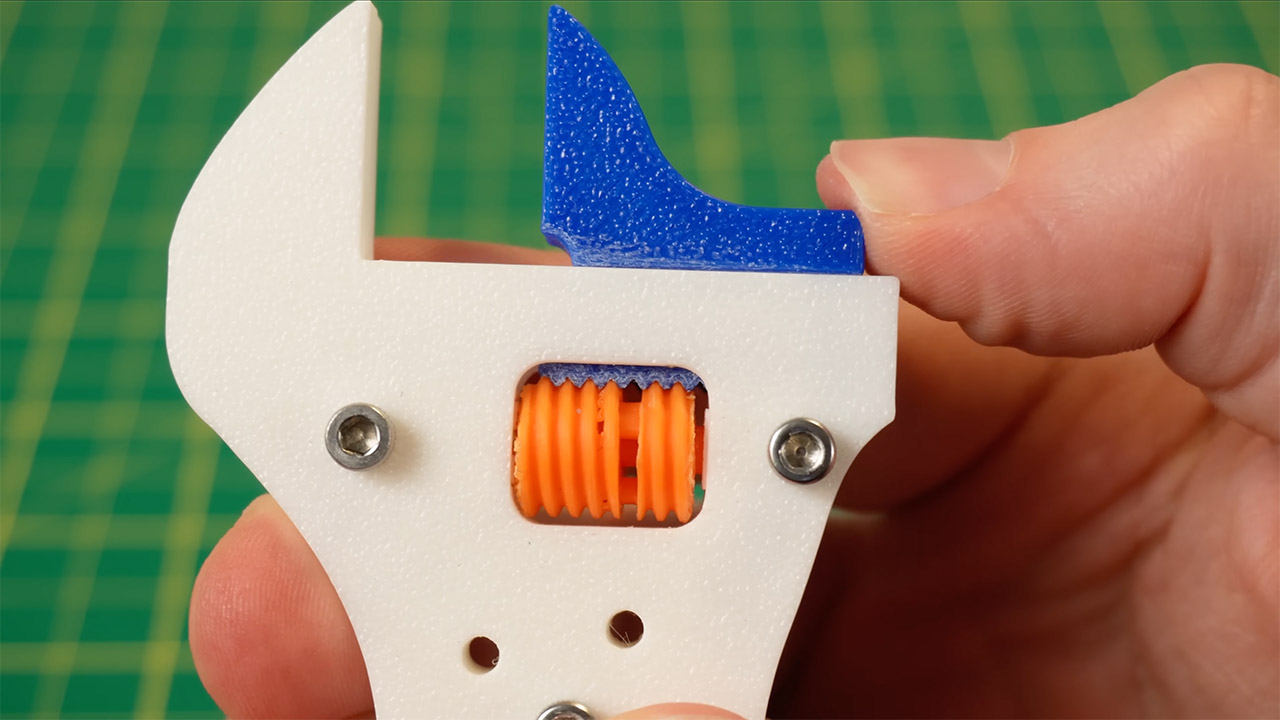
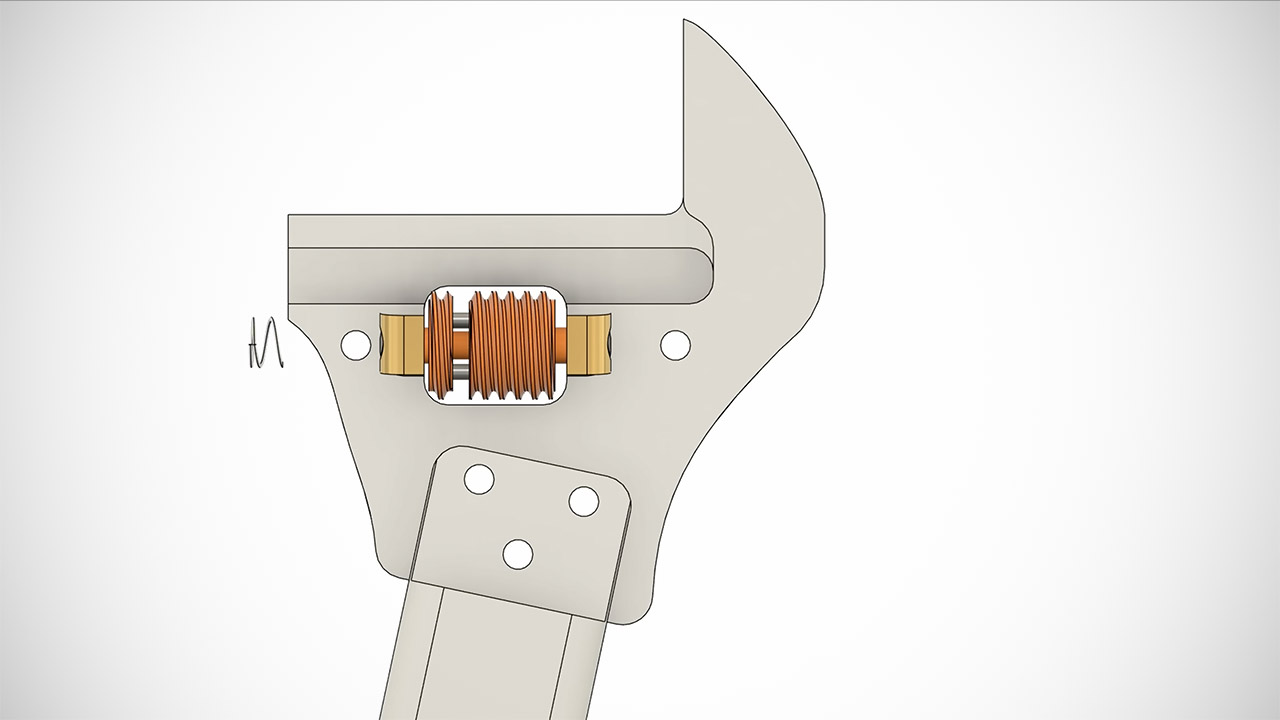
The better approach comes from machines that would later be used to cut metal parts, namely anti-backlash nuts found in CNC mills and 3D printers. These nuts use a spring to keep the driving threads under constant strain, preventing free play. He tried the same technique with his wrench, splitting the adjustment screw in half and attaching a spring between them. One half of the screw threads are forced into the moving jaw, while the other half is pushed into the bushing by the jaw. As a result, the preload remains constant regardless of the jaw opening size.

CNC Machined 3D-Printed Adjustable Wrench
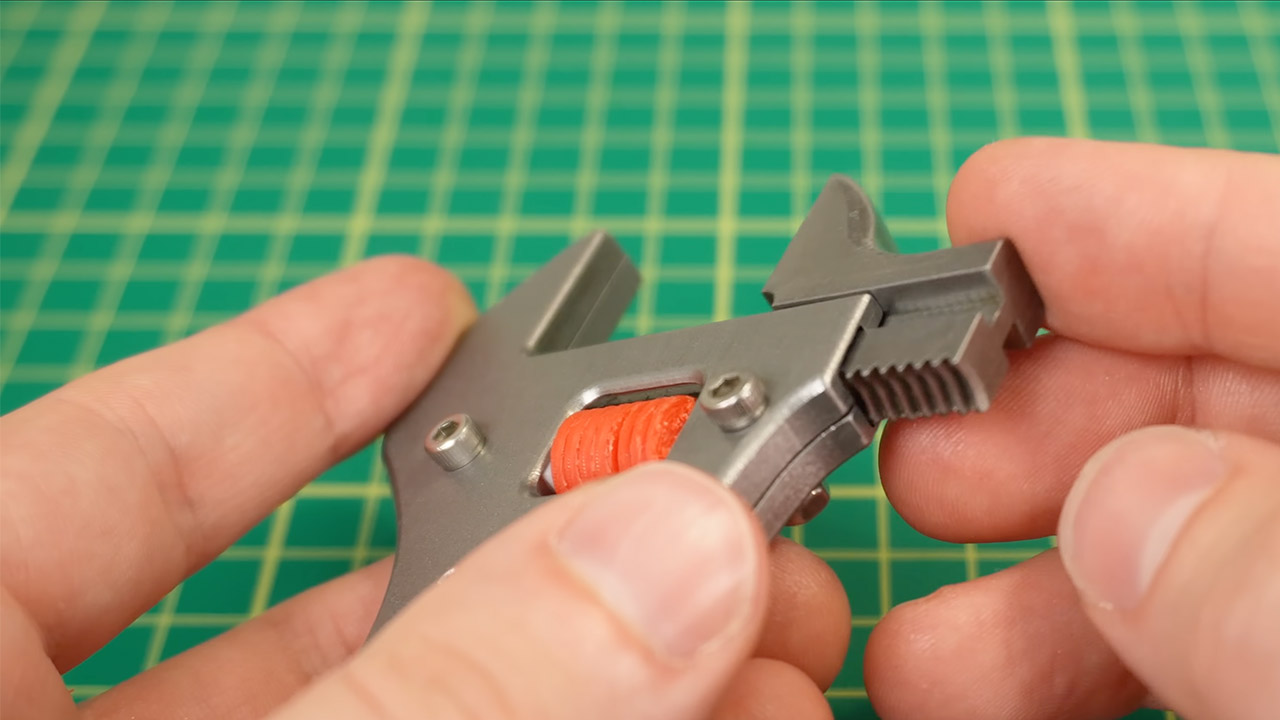
A second plastic prototype of his design proved that it functioned. Then he built a steel version with a DMC2 micro mill. After a lot of fixture work, tool path changes, and probing adjustments, he successfully removed the housing, screw halves, and moving jaw from the machine. His early runs were troubled by uneven height readings using conductive pucks, so he moved to an optical tool setter and built bespoke Mach3 procedures to handle offsets. He had to be careful with material removal when the threads were too tight, and a lathe attempt on the thumb screw failed miserably, so he settled on a 3D printed plastic version.

CNC Machined 3D-Printed Adjustable Wrench
When all of the components were finally put together, they fit perfectly without any filing. Once adjusted, the spring holds the jaws firmly attached to the bolt, removing any play. You no longer need to press your thumb on the adjustment wheel to keep everything in line, and the fastener’s flats take the load rather than the corners. The plastic screw still has some flex, but it holds up well under daily use.
[Source]

Source link

Advertisement
Continue Reading

Tech

Why AI infrastructure planning must happen now

Published

on

Artificial Intelligence (AI) is rapidly evolving. Across industries, many organizations are increasingly deploying AI into systems that must run continuously, securely, and at scale.

As AI adoption accelerates, one thing is becoming clear: infrastructure planning cannot wait.

Maggie Anderson

Public Sector Account Manager at AMD.

Source link

Continue Reading

Trending

Copyright © 2025