

Connect with us
DAPA Banner

Tech

Bluesky leans into AI with Attie, an app for building custom feeds

Published

on

The team from Bluesky has built another app — and this time, it’s not a social network, but an AI assistant that allows you to design your own algorithm, create custom feeds, and, one day, vibe-code your own app.

At the Atmosphere conference over the weekend, Bluesky’s former CEO, Jay Graber, now chief innovation officer, and Bluesky CTO Paul Frazee, presented the AI app, called Attie, for the first time. Conference attendees will become the initial beta testers for the new experience, which leverages Anthropic’s Claude under the hood to create an agentic social app built on Bluesky’s underlying protocol, the AT Protocol (or atproto for short).

“It’s a new product — it’s not a part of the Bluesky app,” explains interim CEO Toni Schneider in an interview. (In addition to his CEO role, Schneider is a partner at Bluesky backer True Ventures.) “We’ve launched a lot of things inside Bluesky — Starter Packs and custom feeds, and all those kinds of things. This is a standalone product, and it’s the first one that’s built by Jay’s new team.”

ScreenshotImage Credits:Attie from Bluesky

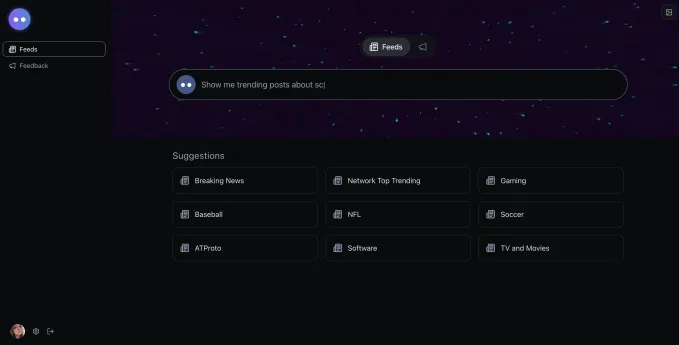
With Attie, anyone will be able to build their own custom feed just by typing in commands in natural language, the same as if they’re chatting with any other AI chatbot. To use the app, people will sign in with their Atmosphere login (meaning their login for any app that runs on atproto, which includes Bluesky). Attie will immediately understand what you’ve been talking about, what sort of things you like, and more, because Bluesky and the wider ecosystem are open systems that share data across apps.

You can ask Attie questions, like what posts you might like to see or repost, and you can use the app to curate your own custom feed, personalized to you.

Advertisement

“You control it, you shape it, without having to write code or know how to set up these feeds,” Schneider says. “It’s the beginning of just having a lot more people be able to build on top of the Atmosphere.”

Plus, he adds, “It is an AI product, but it’s an AI product that’s very people-focused … We think AI is a very powerful technology, but we want to make sure that we use it to build things that really benefit people.”

Techcrunch event

San Francisco, CA
|
October 13-15, 2026

Advertisement

At launch, Attie can be used to build and view these feeds, which will later become available to you within Bluesky or any other atproto app. Over time, the plan is to allow Attie’s users to vibe-code their own social apps as well as build tools for other people.

ScreenshotImage Credits:Attie from Bluesky

Schneider says that Graber and her team began working on the app a few months ago, which was around the same time she decided to return to building, instead of running the company.

“I think she realized that there was so much more that she wanted to build, and just doing the CEO job kept her busy, and she felt like she wanted more time,” Schneider tells TechCrunch. “As she spent more time, [and] got freed up, I think it became clear that this is her happy place. She’s an amazing leader and visionary, and we want her building more things and not worrying about operating the company,” he says.

Advertisement

Graber says today, AI is being used by the major platforms to serve themselves, not their users, by trying to increase people’s time spent in their apps, harvesting data, and controlling their algorithms.

“We think AI should serve people, not platforms,” Graber said in her announcement of Attie. “An open protocol puts this power directly in users’ hands. You can use it to build your own feeds, create software that works the way you want it to, and find signal in the noise.”

Graber’s decision to once again focus on protocol and product was followed by the company’s announcement that it now has $100 million in additional funding from a round that closed last year. The team hopes that news serves as a signal to the wider community that Bluesky will continue to be around.

“It means we have three-plus years of runway, which is great. That means stability and security for the rest of the ecosystem,” Schneider tells TechCrunch. It also means that Bluesky’s team has time to tackle the bigger challenges ahead, which include adding privacy controls to the protocol and finding a way to monetize the social network of 43.4 million users.

Advertisement

One thing that Schneider assures us is not in the works, however, is any crypto integration — despite the financial backing from multiple crypto investors. That’s something that had worried some Bluesky users, who feared the app would be filled with crypto scams or become a payment tool.

“It’s the kind of investors who were attracted to crypto because of its decentralization, and they were investing in things built on the blockchain that were super decentralized,” Schneider says of Bluesky’s backers in the crypto space. “This is decentralized social, so it fits those who are invested to believe in the platform and the ecosystem opportunity.”

Instead, the company may experiment with other means of monetization. The team hasn’t yet decided if Attie will ultimately require a fee, as it’s only a private beta for the time being. Other ideas being batted around include subscriptions and hosting services for those who want to host their own communities on the protocol.

Schneider, the former CEO of Automattic, the home of publishing platform WordPress.com, sees the potential for the Atmosphere as being similar to WordPress in this way.

Advertisement

“At the center of [the Atmosphere] is a completely open system, so anybody can participate,” he says. “You can have all of these independent, decentralized pieces that work together. With WordPress, that turned into a huge ecosystem with billions of dollars — over $10 billion a year, now — flowing through it.”

Schneider continues, “So it’s gotten very big, even though it’s completely decentralized. And this is what we’re hoping for, for the Atmosphere to have that similar ability for lots of these apps and services to coexist and work together and build an ecosystem.”

Source link

Advertisement
Continue Reading
Click to comment

You must be logged in to post a comment Login

Leave a Reply

Tech

I took a ride in an Nvidia-powered autonomous Mercedes at GTC 2026 – and it’s convinced me this is the future

Published

on

As AI and robotics become an ever-more important presence in everyday life, the use cases are quickly going from science fiction to real life.

One of the most popular areas of interest is autonomous vehicles, self-driving cars able to navigate the roads and get us to our destination without needing to touch the wheel.

Source link

Advertisement
Continue Reading

Tech

From Bot Signups to Account Takeovers

Published

on

A bot conducting fraud

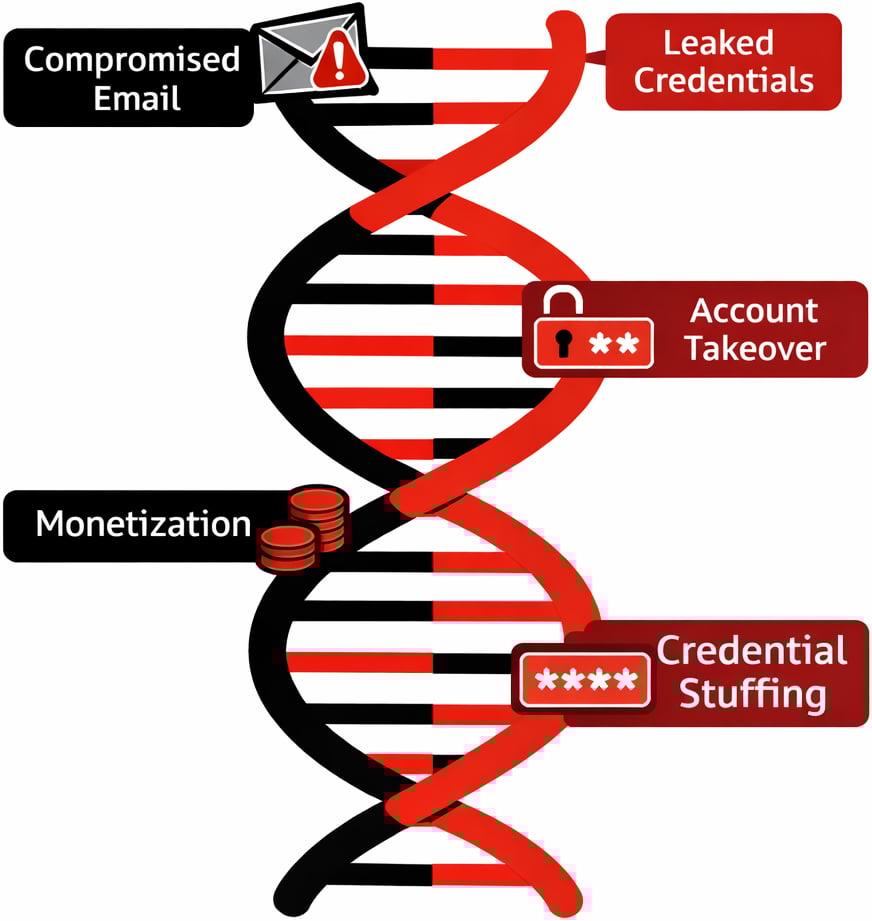
Modern fraud attacks look like a relay race where different tools and actors handle each stage of the journey from signup to cash-out.

When you only inspect one signal at a time, such as IP or email, attackers simply shift to a different part of the chain and still succeed.

Bot characteristics

Anatomy of a Modern Fraud Chain

A typical attack chain starts with automation to create scale. Attackers use bots and scripts to open large numbers of accounts with minimal human effort, often rotating infrastructure to avoid rate limits and simple bot rules.

Those bots are usually powered by “aged” or compromised emails and leaked credentials so that every account looks like it belongs to a long standing user instead of something created yesterday.

Advertisement

Residential proxies then mask traffic behind real consumer IP ranges, making traffic appear like normal home users rather than data centers or known VPN services.

Once those accounts are established, they shift tactics from automation to slower, human driven sessions to blend into normal usage.

At this point the chain reaches account takeover and monetization, using malware links, phishing, and credential stuffing outputs to log in, change details, and push through high value transactions.

Throughout this lifecycle, the tools are mixed and matched. A single actor may move from a headless browser and proxy at signup to a mobile device emulator and different proxy provider at login, then hand off access to another party who specializes in draining funds or exploiting promo campaigns.

Advertisement

This is exactly why a point in time, single signal check rarely tells the full story

Bot DNA

False Positives from Siloed Checks

When teams lean on one dominant signal, such as IP reputation, false positives become a daily problem. Legitimate users on shared Wi Fi, mobile carrier NATs, or corporate VPNs can inherit the poor reputation of a small number of bad actors on the same ranges, even though their intent is clean.

Blocking by email alone has similar issues, since free webmail domains are used by both sophisticated attackers and completely normal customers.

Identity centric controls on their own also hit a wall. Static data checks, like simple name and document matches, are easy to spoof for synthetic identities built from real data fragments.

Advertisement

Device centric controls that only look for rooted phones or emulators can miss fraudsters operating on seemingly normal devices that have been compromised earlier in the chain. Even bot specific solutions can create blind spots when they work alone.

Once a credential stuffing campaign ends and attackers pivot to manual logins with the same stolen credentials, pure bot tools see only “human” traffic and approve it. The result is a pattern where high risk users are blocked while determined adversaries adapt and slip through.

Multi-Signal Correlation in Practice

Effective fraud defense comes from correlating IP, identity, device, and behavioral signals at every step of the journey instead of evaluating each one in isolation.

An IP that looks slightly suspicious on its own becomes clearly abusive when tied to dozens of new accounts on the same device fingerprint and similar behavioral patterns during the first session.

Advertisement

Likewise, a user with an apparently normal device and clean email reputation can still be high-risk if login behavior reflects credential stuffing patterns or access follows known malware distribution campaigns.

Modern decision engines improve accuracy by weighing hundreds or thousands of data points together rather than enforcing rigid rules on a single attribute.

For organizations, that means unifying what were once separate views. IP intelligence, device fingerprinting, identity verification, and behavioral analytics should feed the same risk model so that each event is scored in context, not as a disconnected log line.

This multi signal approach is the most reliable way to raise the bar for attackers while reducing friction for genuine customers.

Advertisement

Prevent chargebacks. Stop account takeover. Recover revenue. 

Leading enterprises use IPQS data to power their fraud prevention strategies, don’t leave yourself vulnerable. Seamlessly integrate with our APIs to reduce friction, prevent more fraud, and secure your business.

Free Sign Up

Case Study: Stopping Coordinated Signup Abuse

Consider a self service SaaS platform that offers a generous free tier and trials. As the product grows, abuse appears in the form of thousands of signups used to scrape data, test stolen cards, or resell access under the radar.

Early countermeasures rely on blocking certain IP ranges and obvious disposable email domains, but this only dents the problem and begins to impact small teams and freelancers on shared networks.

Advertisement

By shifting to a multi-signal model, the platform starts scoring signups across IP, device, identity, and behavior together.

New accounts that reuse the same device fingerprint with different emails, come from IPs recently seen in automated traffic, or immediately exhibit scripted behavior are grouped into coordinated abuse clusters instead of being evaluated one by one.

This lets the team apply precise responses, such as challenging only high risk clusters with additional verification or silently limiting their capabilities while letting low risk signups proceed without friction.

Over time, feedback from confirmed abuse and confirmed good users trains the scoring model, driving down false positives while pushing organized attackers to spend more effort for less return.

Advertisement

Outpacing Fraud Trends

Attackers are no longer tied to a single tool or weak point in your stack. They combine proxies, bots, synthetic identities, leaked credentials, and malware infrastructure across multiple stages, which means that single signal defenses will always lag behind.

Multi layered approach

To keep pace, fraud teams need correlation across IP, identity, device, and behavior in one coherent risk view rather than a collection of disconnected checks.

From here, the conversation shifts to how to operationalize that unified model, integrate it into existing workflows, and measure its impact on both loss reduction and customer experience.

Book a free consultation with a fraud expert today!

Advertisement

About IPQS

IPQS is a founder-led, self-funded company built on a simple principle: fraud prevention should be driven by real intelligence and a multi-layered approach. From day one, we’ve focused on owning the full lifecycle of our technology—developing and maintaining our own global data network, honeypots, and fraud intelligence specialists. This approach gives our customers a distinct advantage: faster insights, greater accuracy, and complete transparency into how decisions are made. By staying independent, we prioritize long-term innovation over short-term gains, continuously evolving our platform to stop fraud before it starts.

Sponsored and written by IPQS.

Source link

Advertisement
Continue Reading

Tech

Watch Electricity Slosh: Visualizing Impedance Matching

Published

on

It’s one thing to learn about transmission lines in theory, and quite another to watch a voltage pulse bounce off an open connector. [Alpha Phoenix] bridges the gap between knowledge and understanding in the excellent videos after the break. With a simple circuit, he uses an oscilloscope to visualize the propagation of electricity, showing us exactly how signals travel, reflect, and interfere.

The experiment relies on a twisted-pair Y-harness, where one leg is left open and the other is terminated by a resistor. By stitching together oscilloscope traces captured at regular intervals along the wire, [Alpha Phoenix] constructs a visualization of the voltage pulse propagating. To make this intuitive, [Alpha Phoenix] built a water model of the same circuit with acrylic channels, and the visual result is almost identical to the electrical traces.

For those who dabble in the dark art of RF and radio, the real payoff is the demonstration of impedance matching in the second video. He swaps resistors on the terminated leg to show how energy “sloshes” back when the resistance is too high or too low. However, when the resistor matches the line’s characteristic impedance, the reflection vanishes entirely—the energy is perfectly dissipated. It really makes it click how a well-matched, low SWR antenna is crucial for performance and protecting your radio.

Advertisement

[Alpha Phoenix] is a genius at making physics visible. He even managed “film” a laser beam traveling at light speed.

Advertisement

Source link

Continue Reading

Tech

Irish AI start-up Jentic joins OpenClaw push with Jentic Mini

Published

on

The next era of software ‘will be built for agents, by agents’, said Jentic CEO Sean Blanchfield.

Irish AI start-up Jentic is jumping on the OpenClaw frenzy with ‘Jentic Mini’, a free, open source, self-hosted offering for developers building with the product.

The months-old OpenClaw project has taken the developer world by storm, but security issues associated with letting personal agents access computers has already led to a number of different iterations from big-name brands such as Nvidia, with its open source stack NemoClaw, and Anthropic, which recently integrated OpenClaw’s text features into Claude.

Jentic Mini also markets itself to be safer to use in real-world software environments. Jentic said that the API execution layer gives developers a better way to govern how agents access tools, APIs and workflows to help reduce risks that come with broad and unmanaged credential exposure.

Advertisement

Jentic Mini is available on the start-up’s website, as well as on GitHub. It can also be used with other general-purpose agents including NemoClaw.

With more than 10,000 APIs, agents created using Jentic Mini will come with a “machine-usable map” of the tools and workflows that can be used, while enabling a more structured and controlled way to connect agents to real systems, the company said. Jentic’s standard model is available as a verified connector in Claude.

“The next era of software will not be built for humans. It will be built for agents, by agents,” said Sean Blanchfield, the CEO and co-founder of Jentic.

“Jentic Mini gives developers a free, open source foundation for that shift, connecting general-purpose agents to real systems through an AI-curated catalogue of more than 10,000 APIs and workflows. We want to make it dramatically easier to deploy agents that do real work.”

Advertisement

Jentic became the first Irish company to be selected for the AWS generative AI accelerator last year. The selection followed a €4m pre-seed raise in 2024, one of the largest in Ireland that year.

Don’t miss out on the knowledge you need to succeed. Sign up for the Daily Brief, Silicon Republic’s digest of need-to-know sci-tech news.

Source link

Advertisement
Continue Reading

Tech

I’m finally playing Eastshade, and it’s turned me into a travelling painter who really cares about artistic composition

Published

on

Chill, walking simulator-cross-traveling painter game Eastshade has been in my backlog for a while now. If memory serves, it’s because I found mention of it having wonderful virtual landscapes during a time when I was writing about that aspect of games.

From the Backlog

Every gamer has a backlog — and that’s no different for us at TechRadar Gaming. From the Backlog is a series about overdue first-plays, revisiting classics, returning to online experiences, or rediscovering and appreciating established favorites in new ways. Read the full series here.

Now, years on, I’ve finally made it into the world of EastShade and have fully embraced my role as a visiting painter for hire, intent on fulfilling some last requests by their late mother.

Advertisement

Source link

Advertisement
Continue Reading

Tech

This app makes your MacBook moan when you slap it, and it's going viral

Published

on


The idea came from social media. Catapano posted a short Instagram clip of himself slapping his MacBook, complete with sound effects and a mock groan. When the clip unexpectedly went viral, he decided to turn the gag into an app.
Read Entire Article
Source link

Continue Reading

Tech

Today’s NYT Strands Hints, Answer and Help for March 29 #756

Published

on

Looking for the most recent Strands answer? Click here for our daily Strands hints, as well as our daily answers and hints for The New York Times Mini Crossword, Wordle, Connections and Connections: Sports Edition puzzles.


Today’s NYT Strands puzzle is fairly difficult. Some of the answers are difficult to unscramble, so if you need hints and answers, read on.

I go into depth about the rules for Strands in this story

Advertisement

If you’re looking for today’s Wordle, Connections and Mini Crossword answers, you can visit CNET’s NYT puzzle hints page.

Read more: NYT Connections Turns 1: These Are the 5 Toughest Puzzles So Far

Hint for today’s Strands puzzle

Today’s Strands theme is: A bit peckish?

Advertisement

If that doesn’t help you, here’s a clue: Feathered friends’ food.

Clue words to unlock in-game hints

Your goal is to find hidden words that fit the puzzle’s theme. If you’re stuck, find any words you can. Every time you find three words of four letters or more, Strands will reveal one of the theme words. These are the words I used to get those hints, but any words of four or more letters that you find will work:

  • FORT, FORTS, SEEN, STORE, BATE, RATE, FILE, LIFE, LIFER, TIES, FORTH, SILL

Answers for today’s Strands puzzle

These are the answers that tie into the theme. The goal of the puzzle is to find them all, including the spangram, a theme word that reaches from one side of the puzzle to the other. When you have all of them (I originally thought there were always eight, but learned that the number can vary), every letter on the board will be used. Here are the nonspangram answers:

  • BUGS, SUET, FRUIT, SEEDS, MILLET, NECTAR, BERRIES

Today’s Strands spangram

completed NYT Strands puzzle for March 29, 2026 #756

The completed NYT Strands puzzle for March 29, 2026.

NYT/Screenshot by CNET

Today’s Strands spangram is FORTHEBIRDS. To find it, start with the F that’s the first letter to the left on the top row, and wind over and down.

Advertisement

Source link

Continue Reading

Tech

Scientists Observe Atoms Existing in Two Places at Once

Published

on

Australia ANU Scientists Two Atoms Exist Different Locations
Australian researchers have pulled off something that quantum theory predicted but nobody had managed to actually observe in matter until now. Working with pairs of helium atoms, they captured the particles existing in two different locations simultaneously, their behavior frozen in a way that has no equivalent in everyday experience. It is the first direct observation of this phenomenon in matter rather than light, and it opens a new window into how the fundamental building blocks of our world actually behave.


The team at Australian National University started with a cloud of helium atoms cooled to just above absolute zero, at which point the atoms slow down enough to behave more like overlapping waves than solid particles. Releasing the cloud from its magnetic trap allowed two groups to collide head on, and that collision created exactly the right conditions for something remarkable. Measure one atom moving in a particular direction and its counterpart will instantly appear moving the opposite way, no matter how far apart the two have traveled.

Sale


National Geographic Mega Science Lab – Kit for Kids with 75 Easy Experiments, Featuring Earth Science…
  • THREE SCIENCE KITS IN ONE – This kit contains 45 of our most popular Earth science, chemistry, and science magic experiments along with a bonus guide…
  • EXPLORE EARTH SCIENCES – Kids will build and erupt a volcano, grow a glow in the dark crystal, create water tornadoes, and dig up a real fossil…
  • DIVE INTO CHEMISTRY – The chemistry set in this kit has everything kids need to make gooey worms and worm eggs, create bubbling reactions, launch a…

To confirm the atoms were genuinely sharing an existence across two locations rather than simply traveling on predictable paths, the team sent the scattered pairs through an apparatus using laser pulses that acted like a half silvered mirror, splitting each atom along two separate routes at the same time. The atoms were then allowed to fall briefly before detectors recorded exactly where each one landed. The interference pattern that emerged left no room for doubt. Each atom had traveled both paths simultaneously right up until the moment it was measured, with one member of a pair appearing on the left side of the detector while its partner showed up on the right, yet the data made clear that both had been exploring both locations all along.

Advertisement

Australia ANU Scientists Two Atoms Exist Same Time Different Location
The significance of the result comes down to what the atoms actually are. Previous experiments of this kind used photons, which have no mass and are unaffected by gravity. Helium atoms are a different matter entirely, heavy enough to feel the pull of the Earth, yet they still display this split existence. The connection between the pairs was strong enough to violate Bell’s inequality, a well established test that rules out any classical explanation for the behavior. Measuring one atom instantly determined the state of its partner regardless of the distance between them, exactly as quantum theory has always predicted but nobody had seen demonstrated with matter until now.

Australia ANU Scientists Two Atoms Exist Same Time Different Location
Lead researcher Yogesh Sridhar spent years refining the setup because earlier attempts always fell short. “Experimentally, it is extremely hard to demonstrate this,” he said. His colleague Dr. Sean Hodgman put the strangeness into plain words: “It is really weird for us to think that this is how the universe works. You can read about it in a textbook, but it is really weird to think that a particle can be in two places at once.”
[Source]

Source link

Continue Reading

Tech

WhatsApp rolls out more AI features, iOS multi-account support

Published

on

WhatsApp

WhatsApp is rolling out multiple features designed to make the app easier to use, including AI-powered message replies and photo retouching, support for two accounts on iOS, and chat history transfer between iOS and Android devices.

Meta said that after the new updates, users will be able to touch up images in the chat before sharing them with contacts or in groups using Meta AI.

The Writing Help feature enables users to quickly draft a response based on the active conversation, with Meta saying it uses Private Processing to ensure messages are completely private.

“Writing Help is built on top of Private Processing technology, which allows you to leverage Meta AI to generate a response without Meta or WhatsApp ever reading your message or the suggested re-writes,” Meta states.

Advertisement

The company says WhatsApp now also helps find large media files in any chat, quickly freeing up space without deleting entire conversations.

Additionally, WhatsApp allows two WhatsApp accounts to be logged in at the same time on iOS (an option that was already available on Android devices), and its chat transfer feature now supports moving message history from iOS to Android (including individual and group chats, call history, channel and community history, and more).

“Now, with just a few taps, your conversations, photos, and videos easily come with you no matter what device you’re using,” Meta said.

New WhatsApp features
New WhatsApp features (Meta)

​Earlier this month, WhatsApp also introduced parent-managed accounts for pre-teens, a feature that allows parents to decide who can contact them and which groups they can join.

Meta also introduced new WhatsApp anti-scam protections that warn users when behavioral signals suggest an incoming device-linking request may be fraudulent.

Advertisement

These scam defenses were added soon after the Dutch intelligence agencies warned that Russian state-backed hackers had been targeting Dutch government employees in phishing attacks aimed at their Signal and WhatsApp accounts.

In January, Meta also began rolling out a new WhatsApp lockdown security feature designed to protect journalists, public figures, and other high-risk individuals from sophisticated threats, including, but not limited to, spyware attacks.

Automated pentesting proves the path exists. BAS proves whether your controls stop it. Most teams run one without the other.

This whitepaper maps six validation surfaces, shows where coverage ends, and provides practitioners with three diagnostic questions for any tool evaluation.

Source link

Advertisement
Continue Reading

Tech

'Great Design, Easy Setup': Home Depot Has Highly-Rated Solar Lights For $8

Published

on

External lights are the first thing you see when you get home. It's worth this small investment to get some lights that make your garden feel like home.

Source link

Continue Reading

Trending

Copyright © 2025