The new Bluesound PULSE FLEX P130 is the 2025 version of Bluesound’s compact BluOS wireless speaker, replacing the long running PULSE FLEX 2i. Compact wireless speakers are no longer background noise for kitchens, bedrooms, home offices, cottages, second homes, and the one shelf in the living room that somehow becomes everyone’s audio system. People buy a lot of these things, and the category has gotten a lot more serious than it used to be.
The new Bluesound PULSE FLEX arrives at $379 with BluOS streaming, hi-res and lossless audio support, Apple AirPlay 2, Bluetooth, USB-C audio, and the ability to work as a standalone speaker, part of a multi-room system, or as wireless surround channels with compatible Bluesound home theater products. That puts it directly in the path of the Sonos Era 100, WiiM Sound, and the Bose Lifestyle Ultra Speaker, which starts at $299 and rises to $349 depending on finish. We previewed the Bose last week, and our full review lands on May 15 when the embargo lifts. So yes, this fight is getting crowded. Good.
Bluesound also has something Sonos and WiiM cannot copy overnight: the Lenbrook ecosystem behind it. NAD Electronics, PSB Speakers, and BluOS give the PULSE FLEX a stronger hi-fi foundation than most compact wireless speakers chasing the same shelf space. That matters because this is not a throwaway category anymore. Build quality is improving. Sonic performance is improving. Connectivity is improving. And consumers are no longer just looking for a small speaker that makes noise while they burn toast.
The real question is whether the new PULSE FLEX actually lives up to the name. At $379, does Bluesound’s compact BluOS speaker play hard in the corners against Sonos, WiiM, and Bose, or does it merely have a pulse?
Advertisement
Design: Not Every Speaker Needs to Look Like Vader
PULSE FLEX (white)
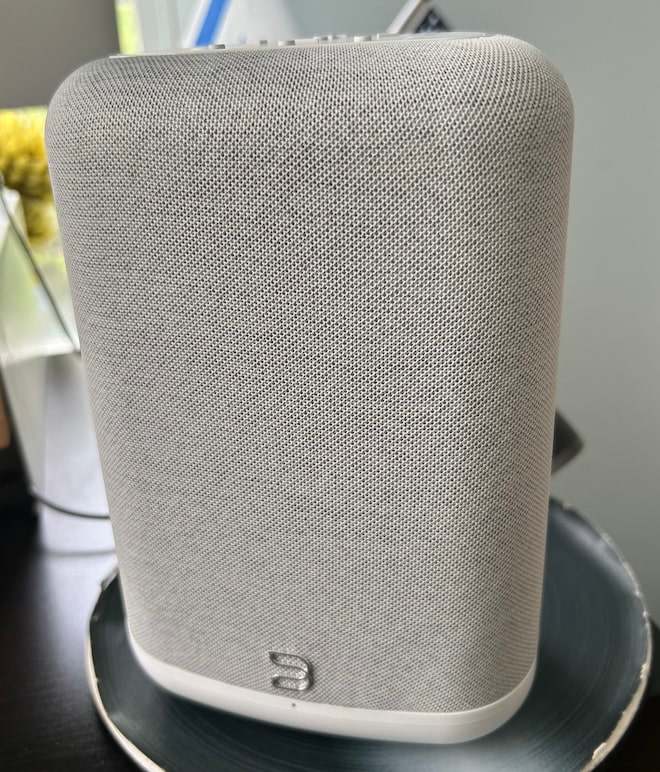
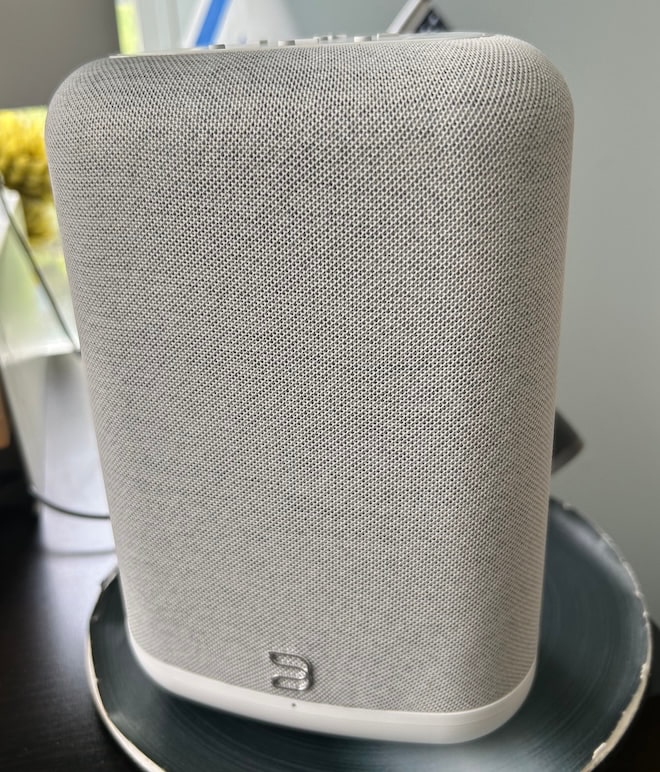
The PULSE FLEX has the kind of compact footprint that makes sense on a desk, nightstand, bookshelf, kitchen counter, or side table without announcing itself like a piece of networking gear from 2009. The rounded edges and cleaner cabinet design are a step in the right direction, and the finish options give Bluesound some needed visual flexibility.
Bluesound sent me the White Pebble Grey version, which is probably the safest choice for most homes. It is neutral enough to disappear into a lot of rooms without looking sterile, and that matters when these speakers end up in public spaces where spouses, partners, kids, guests, and people with actual taste get a vote.
The PULSE FLEX 2025 works as a standalone mono speaker, which is how many buyers will likely use it: on a desk, nightstand, bookshelf, kitchen counter, or in a home office. Add a second unit and it can run as a stereo pair, or serve as rear surrounds with compatible Bluesound home theater products.
At 5.15 x 7.73 x 4.37 inches and 3.55 pounds, it is compact enough to fit into real rooms without becoming the room. Bluesound includes 120V and 230V AC power cords, a Toslink mini adapter, safety and warranty documentation, and a quick setup guide. Not glamorous, but useful.
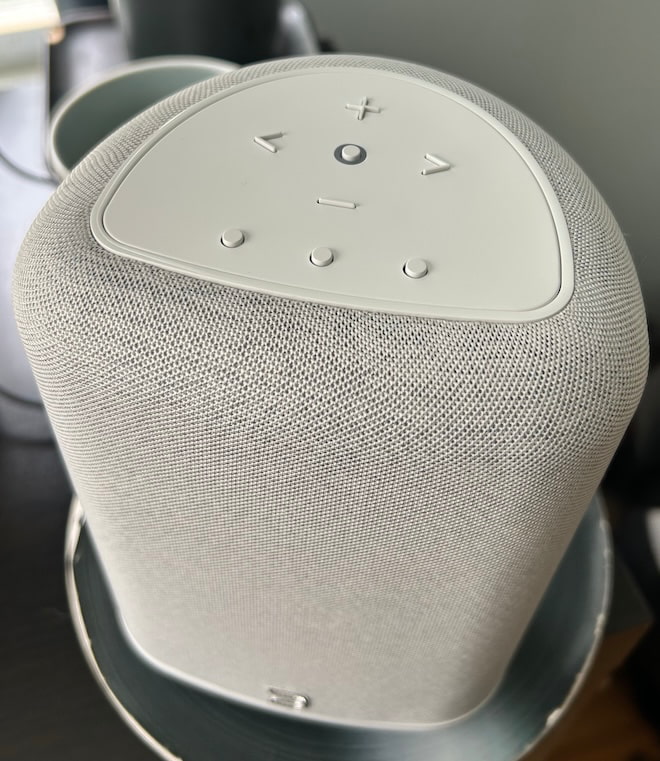
The top panel includes physical controls for play/pause, volume up/down, and track forward/back. There are also three preset buttons that can be assigned in the BluOS app to favorite radio stations, playlists, podcasts, or other commonly used sources. It is a small but useful touch, especially if the speaker ends up in a kitchen, office, or bedroom where reaching for the phone every time gets old fast.
Unlike the WiiM Sound, the PULSE FLEX does not include a touchscreen or display. Bluesound clearly expects you to control the speaker through the BluOS Controller app on your phone, tablet, or computer, with the top panel buttons handling basic playback and presets. That is not necessarily a problem, but it does make the PULSE FLEX feel more like a serious BluOS endpoint than a smart speaker trying to run the room from its own front panel.
Advertisement
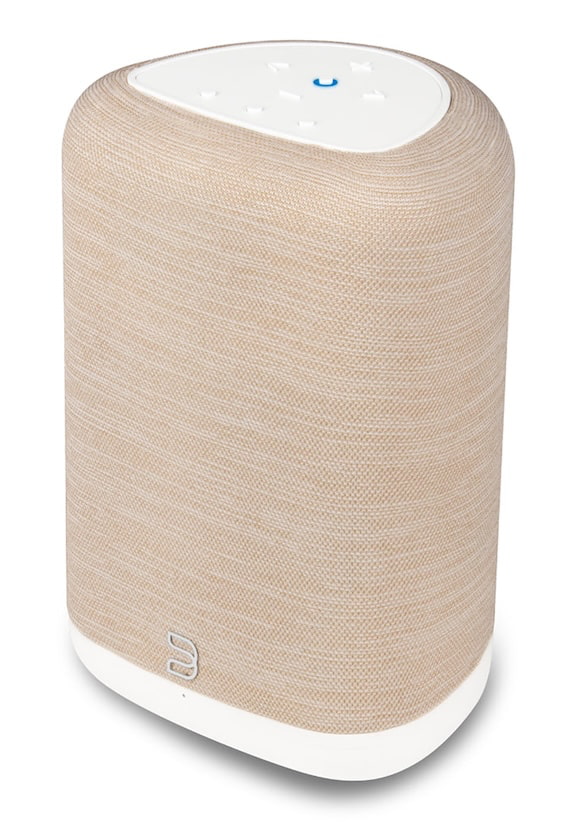
The PULSE FLEX is also available in White, Tan and Black Charcoal, with interchangeable fabric grilles in tonal weaves for those who want the speaker to blend in rather than become the room’s main character. Bluesound also offers the WM100 Wall Mount for cleaner wall installations and the FS230 Adjustable Stand for floor placement, which makes sense if you are using a pair as surrounds or trying to keep them off furniture already losing the war against charging cables.
Advertisement. Scroll to continue reading.
Inside the PULSE FLEX
The Bluesound PULSE FLEX is built around a Smart DSP amplifier delivering 50 watts total system power, split between a 4-inch woofer and 0.75-inch tweeter. That makes it a compact mono wireless speaker, not a stereo miracle box pretending physics had the day off. Add a second unit and you can create a proper stereo pair, or use two as rear surrounds with compatible Bluesound home theater products.
The new FLEX supports hi-res audio up to 24-bit/192 kHz, along with FLAC, MQA, ALAC, WAV, AIFF, MPEG-4 SLS, MP3, AAC, WMA, WMA-L, OGG, and OPUS. It also supports DSD256, which gives it a stronger file support story than a lot of compact wireless speakers in this category. MQA and DSD “support” require a more detailed explanation, so let’s break down what those formats actually mean on the PULSE FLEX.
Advertisement
PULSE FLEX (tan)
DSD256 and MQA?
DSD256 is not something most people will stream from TIDAL, Qobuz, Spotify, AirPlay 2, Bluetooth, or their phone. That is not how this works. On the PULSE FLEX, DSD support is mainly for people who already own downloaded high resolution music files and keep them on a USB drive, NAS, or computer-based music library.
Bluesound lists the USB Type-A port as being for external storage in Local Server Mode, which means you can connect a compatible USB drive with music files directly to the speaker. BluOS can also index music stored on a NAS or computer, making those files available through the BluOS Controller app. That is where DSD256 support actually matters.
The USB-C port is listed as a PC input, but Bluesound’s available information does not clearly state that it supports DSD256 playback from a computer over USB-C. Until Bluesound confirms that, it is safer not to make that claim or expect it to work. We will update if that question ever gets answered.
For most buyers, the more important formats and services will be FLAC, ALAC, WAV, Qobuz Connect, TIDAL Connect, Spotify Connect, Apple AirPlay 2, Bluetooth aptX HD, and Roon Ready.
MQA is more complicated. Lenbrook acquired MQA’s assets in 2023 and later created Lenbrook Media Group to commercialize BluOS, MQA, and SCL6 across the hi-res audio chain. But TIDAL officially removed MQA from its apps and integrations on July 24, 2024, replacing MQA content with FLAC where available.
Advertisement
For 99% of users, neither format will ever be part of the buying decision. But there is always one guy with a NAS, six versions of Kind of Blue, and the emotional stability of a Leafs fan in overtime, so we might as well be thorough.
Connectivity: More Reliable Than Rogers on a Friday Morning
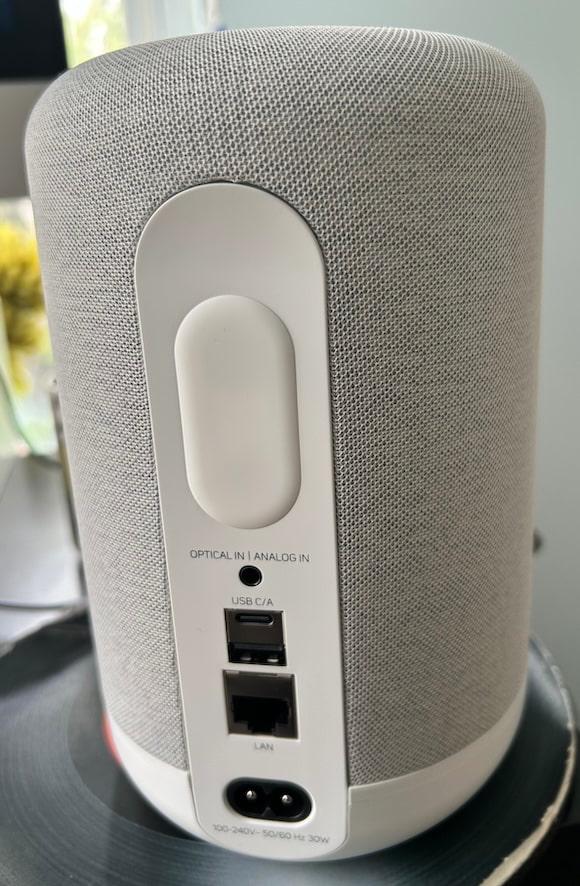
Connectivity is solid for a speaker this size. The PULSE FLEX includes Wi-Fi 5 dual band, Gigabit Ethernet, Bluetooth 5.3 with aptX HD, a 3.5mm optical/analog combo input, USB Type-A for external storage in Local Server Mode, and USB-C for PC input. It also offers IR learning, three onboard preset buttons, physical playback controls, and integration support for Crestron, Control4, RTI, Nice, URC, and Lutron.
The one spec that feels a step behind is Wi-Fi 5. It should be fine for most users, especially with hi-res streaming and BluOS multiroom playback, but plenty of homes have already moved to Wi-Fi 6E or Wi-Fi 7. At $379, Wi-Fi 6 would have been a welcome update.
That said, the PULSE FLEX offers more than the basics. It has useful wired and wireless options, practical control features, and enough integration support to work beyond a simple desktop or bedroom setup.
The BluOS Controller app remains one of Bluesound’s strongest advantages. It is detailed, mature, and gives users access to EQ adjustment, input level control, stereo pairing, multi-room setup, presets, music services, and system management without making the process feel like a firmware negotiation.
Advertisement
Advertisement. Scroll to continue reading.
That matters. BluOS has had almost a decade of real world development, updates, and use across Bluesound, NAD, and other Lenbrook products. It is one of the better multiroom platforms out there, especially for listeners who care about hi-res audio, local libraries, and more serious system integration.
There are limits. EQ adjustment is fairly basic, and the PULSE FLEX does not offer room correction, which is something WiiM includes with the WiiM Sound. Voice control is available through Amazon Alexa Skills, but you will need the patience to set that up properly. Nobody said the smart home was actually smart.
I also ran the PULSE FLEX with multiple iPhones. The iPhone 14 and iPhone 17 worked without issue, but the older iPhone 11 was less consistent with BluOS. That tracks with my own experience using earlier PULSE FLEX models and other Bluesound speakers over the years: BluOS is very good, but not completely free of quirks, especially with older phones.
Advertisement
Listening
I came into the new PULSE FLEX with some preconceptions, mostly because I have owned and used other Bluesound speakers in the lineup. That prior experience led me to expect a somewhat bold presentation, which is not automatically a bad thing. But it can be.
Bold can work very well outside on the deck while eating char dogs with the kids and watching the dog get the zoomies across the lawn like he just stole something from a federal evidence locker.
At 5 a.m., it can be a different story.
I am a very early riser because sleep and I have a complicated arrangement, and some of my listening happens in the kitchen while I am making a pot of rooibos tea and staring into the backyard. That is usually when the fox and deer are sizing each other up like two extras in a Kurosawa film, while Tyrion the Westie scratches at the windowsill, furious that I will not let him outside to start a war he has absolutely no chance of winning.
Advertisement
That kind of listening tells you something useful about a compact wireless speaker. It is not just about how loud it can play, or whether it can sound impressive for 90 seconds in a demo. It is whether the tonal balance still works when the house is quiet, nobody else is awake, and you need music that has presence without behaving like it drank three espressos.
Right out of the box, after the mildly annoying LED light show that tells you whether the speaker is pairing, connecting, updating, or silently judging your Wi-Fi, it was obvious that the new PULSE FLEX does not sound like the older models.
The older Bluesound speakers I have owned leaned more bold and bass forward, with a presentation that could feel somewhat V-shaped. That is not what I heard here. The new PULSE FLEX sounds cleaner, more open, and more balanced through the midrange and treble. The tradeoff is that the lowest bass does not hit with the same weight. The sub bass has not left the building, but it definitely took the morning off.
That showed up across Nick Cave, The Orb, deadmau5, and Talking Heads. The presentation felt more spacious and better sorted, with less bass bloom getting in the way, but also less physical impact than I expected based on earlier Bluesound models.
Advertisement
Think less Vladdy Jr. sending one into the upper deck, and more Ernie Clement sneaking one just over the wall in left. It still counts. It just does not make the pitcher stare into the middle distance and reconsider his decision to leave Toledo.
Advertisement. Scroll to continue reading.
Another positive change is that the new PULSE FLEX sounds more spacious than previous models I have used. That matters because this is still a mono speaker, and Bluesound, unlike Bose, did not send a stereo pair for evaluation. So no, it is not going to overwhelm a room with a huge wall of sound or create the kind of left/right separation you get from two properly placed speakers. Physics remains undefeated, even in Jersey.
What it does manage rather well is a sense of openness and placement within reasonable limits. The PULSE FLEX does a better job than I expected keeping vocals, percussion, and electronic textures from stacking up in one congested lump. Imaging from a single mono speaker is always going to come with an asterisk, but this version feels less boxed in than earlier Bluesound compact models. That is a meaningful improvement.
Advertisement
Another positive change is pacing. With less low end thickness, the PULSE FLEX sounds quicker, cleaner, and more open. There is more detail, better organization, and a little extra snap on rhythm driven tracks. It gives up some bass weight, but gains speed and clarity.
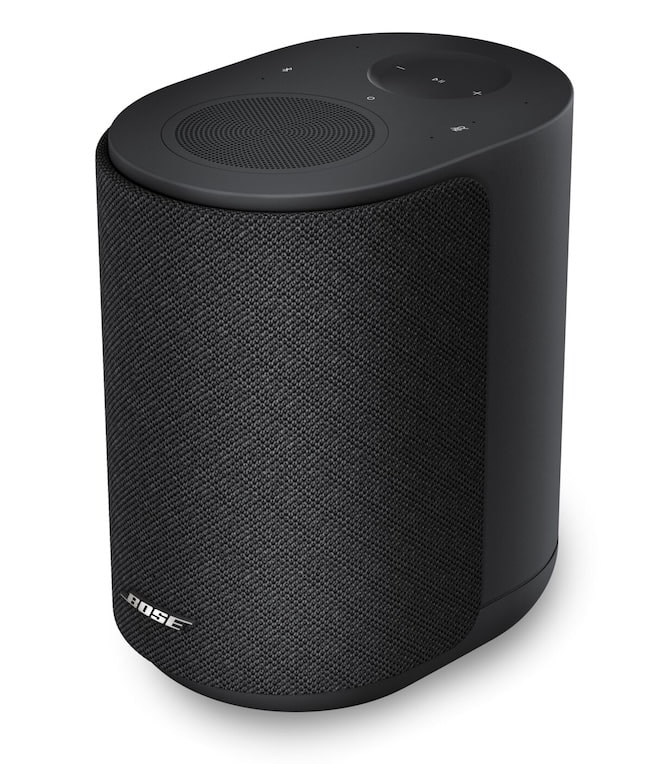
PULSE FLEX vs. Bose Lifestyle Ultra
Bose Lifestyle Ultra Speaker in Nueblack
I am slightly limited in what I can say about the new Bose Lifestyle Ultra Speaker until my review publishes on May 15 under embargo, but there are too many similarities here to ignore.
Where the PULSE FLEX has the immediate advantage is software. BluOS gives Bluesound easy access to multiple streaming platforms, local libraries, multiroom playback, and system control from one app. The Bose app is more focused on setup, configuration, and system management. That is not a criticism, but it is a different approach.
The Bluesound also supports Spotify Connect, TIDAL Connect, and Qobuz Connect natively. Bose supports Spotify Connect, while TIDAL and Qobuz playback run through Apple AirPlay or Google Cast. For listeners already using Qobuz or TIDAL every day, that matters. Fewer steps. Less friction. Fewer reasons to mutter at your phone like it owes you money.
The real difference is how each speaker handles control and streaming access. Bluesound puts more of the music experience inside BluOS, especially for Qobuz Connect, TIDAL Connect, Spotify Connect, local libraries, and multiroom playback. That is a major advantage if you already use BluOS or want one app to manage everything.
Advertisement
PULSE FLEX (black)
But there is a counterargument. Some users do not want to live inside another control app, even a good one. They would rather open their preferred streaming app and cast directly from there. Bose leans more in that direction with Spotify Connect, Apple AirPlay, and Google Cast handling broader streaming access, while the Bose app focuses more on setup and system control.
So the PULSE FLEX has the stronger platform for serious BluOS users and local library playback. Bose may feel more natural for listeners who prefer to stay inside the apps they already use. Pick your poison: one deeper ecosystem, or fewer reasons to open another app before coffee.
The Bottom Line
The Bluesound PULSE FLEX P130 is not trying to be the loudest compact wireless speaker in the room, and that is probably a good thing. Compared to older PULSE FLEX models, the new version sounds cleaner, more open, and better paced, with improved detail and less of the bass heavy thickness that defined some previous Bluesound compact speakers. The tradeoff is impact. If you want deeper bass and more room filling weight from one small speaker, this is not the obvious first pick.
What makes the PULSE FLEX unique is the combination of BluOS, strong file support, native Spotify Connect, TIDAL Connect, Qobuz Connect, AirPlay 2, Bluetooth aptX HD, Roon Ready, real wired inputs, and the ability to work as a standalone speaker, stereo pair, multiroom endpoint, or surround channel with compatible Bluesound home theater products. That is a lot of flexibility in a speaker this small. It also helps that the build quality and finish options finally feel more appropriate for public rooms, not just a shelf in the basement next to the router.
Advertisement
What is missing? Room correction, deeper EQ control, Wi-Fi 6, a touchscreen or display, and true stereo playback from a single unit. The WiiM Sound has a stronger feature story in some of those areas, and the Bose Lifestyle Ultra Speaker offers a different kind of integration for users already inside that ecosystem. Bluesound’s answer is BluOS, and for the right listener, that still matters.
Advertisement. Scroll to continue reading.
The PULSE FLEX is best for someone who wants a compact wireless speaker for a desk, nightstand, bookshelf, kitchen, home office, cottage, or second home, but does not want to give up real streaming flexibility or local library support. It is also a smart buy for existing Bluesound, NAD, or BluOS users who want to expand into another room without starting over. Just know what you are buying: this is a refined compact BluOS speaker with better clarity and pacing, not a tiny subwoofer with fabric on it.
Pros:
Cleaner, more open tuning than previous PULSE FLEX models
Better pacing, detail, and snap with less low end thickness
BluOS remains one of the strongest multiroom platforms
Native support for Spotify Connect, TIDAL Connect, Qobuz Connect, Apple AirPlay 2, Bluetooth aptX HD, and Roon Ready
Strong connectivity for the size, including Gigabit Ethernet, optical/analog input, USB Type-A, and USB-C
Compact enough for a desk, nightstand, bookshelf, kitchen counter, or home office
More spacious presentation than earlier models, within mono speaker limits
Can be paired with a second PULSE FLEX for stereo playback
Can be used as surround channels with compatible Bluesound home theater products
Strong build quality and attractive finish options, especially White Pebble Grey
Cons:
Less bass impact than previous Bluesound compact speakers
Still mono unless you buy a second speaker
No room correction, unlike the WiiM Sound
EQ controls are limited
Wi-Fi 5 feels slightly behind the times at $379
No touchscreen or display, unlike the WiiM Sound
BluOS can still be quirky with older phones
Alexa is supported through Alexa Skills, but not built-in
Some users may not want to rely on another control app
Photo credit: WSJ Colin Angle, the co-founder who transformed the humble vacuum into a household staple, left iRobot in 2024 to pursue a new business, Familiar Machines & Magic. His most recent creation, Familiar, a four-legged companion, adds a unique element to living rooms. The prototypes, Daphne and Winston, are about the size of a bulldog. They have soft artificial fur to give them a cuddly appearance, and a touch sensitive layer underneath to detect how people interact with them. Their huge, round bear-cub ears and doe eyes draw them up for a conversation.
These things move using 23 separate joints, allowing them to bob their heads, tilt those little ears, adjust their gaze, and wag a small tail. They travel through the house at a slow pace, following you from room to room and plopping down when they think you’re close. People can touch them on the head or take them up for a squeeze, and the object will respond in a way that makes them feel alive, even if they do not say anything. They simply kind of… sound like they’re purring or emitting small chirps that change on the spot.
🌟V28 update 🚀 new features are now available! In response to Loona’s charging problem, we’ve upgraded the automatic recharge 2.0.The upgrade is…
🤖 Smart and Interactive Robot Pet🧠Loona is like no other pet you’ve seen. With a high-definition RGB camera, Loona sees and understands your…
🗣️ Voice Command Enabled AI robot 🎤Loona is not just a good listener; also a great conversationalist! Powered by Amazon Lex & ChatGPT, Loona…
All of this is thanks to onboard cameras and microphones that detect tone of voice, posture, and everyday routine. It everything happens on the device, thanks to a small AI that has been trained to understand social cues. They remember what you do every day, notice when you appear off, and change their behavior over time to maintain everything feeling natural and seamless. They’re doing all of this without sending any video or audio clips, unless you choose to provide a small clip or two to help the developers figure out what to fix.
Angle and his team drew on their extensive experience at Disney, Boston Dynamics, and MIT. They blended some of the low-cost strategies they discovered while working on the original Roomba with fresh motion and sound design ideas that have emerged since then. So, what do we get? A robot that does not attempt to walk like a person or do anything other than be a good pet. Familiar keeps low to the earth and simply existing.
In terms of money, expect to spend between $50 and $100 each month for the luxury of having one of these things around. When you consider the cost of food and vet visits for the real thing, it’s not much different than what you’d pay in pet expenditures. Sales aren’t expected to begin until 2027, so don’t get too excited just yet. For now the prototypes serve as proof that everyday homes can welcome a machine built first for company instead of chores.
Between 2000 and 2002 the Fisher Price Pixter was sold to children as an educational handheld toy with a touch screen that enabled drawing and listening to music in addition to cartridge-based games and more. It was followed up by multiple new iterations of the system, but as an ecosystem didn’t last beyond 2007. This has left much of the system in obscurity, with people like [Dmitry] doing their best to reverse-engineer, dump and document what they can, such as recently for the entire range of Pixter devices and most of the games.
One of the reasons why [Dmitri] got interested in the second-generation Pixter Color originally was as a potential PalmOS porting target, which gives somewhat of an idea of how these devices were meant to be used.
With absolutely no remaining known official documentation on how to develop software for the hardware reverse-engineering posed somewhat of a challenge. Fortunately this was made somewhat easier by the Pixter Color using the ARM-based LH7541, but worse by just how much of a minimal ARM7 implementation the SoC is. This was meant to go into a cheap-ish kid’s toy after all.
Where things got wild was that the firmware implements a 16-bit stack-based virtual machine, possibly due to initially having selected a completely different SoC. From here things get even crazier with how audio output is implemented, with [Dmitry] descending into a long-winded rant on this and all the weird things encountered during reverse-engineering.
After the Color Pixter its Multimedia sibling with slightly better SoC was also reverse-engineered, as well as the Classic device that started it all. This particular device uses an 8-bit VM, but a black-blob 6502 processor, which is rather astounding for a 2000-era device, but then again it was meant to be a toy.
Advertisement
In addition to getting a lot of reverse-engineering woes off his chest, [Dmitri] also details how he reverse-engineered and dumped the cartridges, as well as writing emulators to ensure that the Pixter legacy will endure, for better or worse.
Top image: Pixter with opened case. (Credit: Raimond Spekking, Wikimedia)
We spend hours testing every product or service we review, so you can be sure you’re buying the best. Find out more about how we test.
This past week or so, I haven’t been able to stop thinking about Saros. Housemarque’s intense roguelite third-person shooter is a tremendous refinement of its previous work, Returnal(a game I feel is one of this console generation’s best). Yet its harrowing, cosmic horror-influenced narrative elevates it to something especially memorable.
Review info
Platform reviewed: PS5 Available on: PS5 Release date: April 30, 2026
Advertisement
If you’re familiar with Returnal, it probably doesn’t come as a surprise that Housemarque has once again deployed the Torment Nexus for Saros’s doomed spacefarers, and the concept of its protagonist being forced into a seemingly eternal cyclical hell is very much present here. That said, Saros is decidedly more manageable than its predecessor, featuring gameplay and progression systems that allow for a more forgiving experience overall.
Don’t get me wrong, though; Saros is still a tough PS5 game. Strip away all its new systems, and I’d say it’s about on par with Returnal in terms of difficulty. Enemies hit hard, and bosses demand keen focus when it comes to learning and dodging their bullet patterns. You’re going to die a lot in Saros, but given I reached the true ending in a tidy 20 hours, it’s a good bit friendlier to the average player.
Advertisement
Latest Videos From
A skill tree packed with permanent upgrades — alongside a very clever modifier system unlocked early on — ensures that protagonist Arjun grows steelier with each run. Furthermore, checkpoints placed at the start of each biome mean that, unlike Returnal, you don’t have to play through the whole thing in one flawless run. That alone condenses runs from Returnal’s 2-3 hours to a far more manageable 30 or so minutes, depending on what you’re looking to achieve on each run.
And like its predecessor, Saros is polished to a mirror sheen. Arjun’s movements are fast and snappily responsive. Color-coded bullet patterns instantly communicate the approach you need for each enemy. Weapons are varied and often creative in design and their sub-weapon functionality. And those haptics and adaptive triggers? Simply the best I’ve ever experienced and reminded me that, for all its faults, the DualSense is still capable of wowing me after all these years.
All in all, Saros is very much another slam dunk from a studio that has mastered the art of blending arcade-like trappings with AAA production values. It’s not quite perfect; I wish there were more post-game activities (and no daily challenge system yet, a la Returnal), and there are very (and I do mean very) occasional performance dips on base PS5 hardware. But there’s nothing that puts a serious dent in what I’m sure will be a game of the year frontrunner for many who seek Saros’s yellow shores.
Hail to the King
(Image credit: PlayStation / Housemarque)
Saros puts you in the role of Arjun Devraj, portrayed by actor Rahul Kohli. Arjun is a member of Echelon IV, a team sent by megacorporation Soltari to the planet Carcosa. Their purpose is twofold: to continue the extraction of a valuable resource called Lucenite, as well as to uncover what happened to the previous three Echelon teams that have made no contact with Soltari since planetfall months ago.
Advertisement
Sign up for breaking news, reviews, opinion, top tech deals, and more.
It’s not long before the truths of Carcosa are laid bare. In a phenomenon unique to the planet, it undergoes regular eclipse phases that rapidly advance time. Oh, and people who look directly at the eclipse are driven mad. This is all spelled out pretty early on through collectable audio and text logs left behind by prior Echelon expedition teams. From there, the madness only increases at a rate of knots.
If you’re familiar with Returnal, then you’ll know that there was more to its protagonist, Selene, than met the eye. It’s a similar case with Arjun in Saros. I won’t spoil the finer details here, but there’s still an element of his trauma seemingly manifesting itself in the form of Carcosa’s horrors.
That said, I find Carcosa to be a tremendously compelling setting. Housemarque certainly isn’t shy about its horror inspirations here. Namely, the stunning H.R. Giger-esque architecture left behind by the planet’s former inhabitants, and The King in Yellow, a collection of short stories that revolve around a stage play of the same name, which causes all of its readers to go inexplicably mad. It’s rather on the nose with the latter, actually, but it all serves to create an aggressive brand of horror here that pairs beautifully with Saros’s fast-paced third-person shooting.
Advertisement
I’m Blue
(Image credit: Sony / Housemarque)
Saros, at its heart, is a third-person shooter with roguelite elements. There’s no trudging movement speed or ducking behind cover here, though. Arjun’s default run speed would be enough to set off a highway speed camera, and he can dodge, jump, and air dash on a dime to quickly reposition or blink through incoming projectiles.
It’s a game with myriad arcade sensibilities. Enemies’ primary method of attack is intricate bullet patterns reminiscent of danmaku shoot-em-ups like DoDonpachi Resurrection or Ikaruga. Okay, Saros never gets as intimidatingly screen-filling as that, but I think it does take some inspiration, especially from that latter title.
Best bit
Advertisement
(Image credit: PlayStation / Housemarque)
I love Saros for many of the same reasons I did Returnal, but the new Carcosan Modifier system is brilliant to play around with. This is where you can add a bit (or a lot) of extra bite to the game’s difficulty, or give yourself a bit more favor depending on your preferences.
A new addition to Saros is Arjun’s Soltari Shield. Bound to R1 by default, holding the button down produces a protective globe around Arjun that absorbs projectiles, converting them into ammunition for his currently equipped power weapon. As a result, Saros directly encourages you to get stuck into the line of fire. You’ll need to watch out here, though; only blue projectiles can be absorbed without penalty. You can absorb yellow projectiles, but they’ll cause corruption, eating into your maximum health until cleansed with power weapon usage. Red projectiles, meanwhile, cannot be absorbed or even dodged through.
There’s plenty of weapon variety in Saros. From powerful revolvers and close-range shotguns to energy crossbows and auto-targeting smart rifles. You’ll need to use power weapons in tandem with these to deal devastating damage and effectively turn dire situations in your favor. Some are great for immediate single-target damage, while others excel at crowd control, spreading damage-over-time projectiles around the room.
One thing I adore about Saros’s weapons is that they all come fitted with an alternate fire module. By holding down L2 about halfway, your weapon’s behaviour changes. These typically consume more energy, but can do things like turn your shotgun into a grenade launcher, or your energy crossbow beams into a single concentrated blast. My favorite weapon comes a bit later in the game, though; a chakram launcher that embeds blades into enemies, spinning inside them to deal damage when you activate its alt fire. It’s so awesome.
Advertisement
Helping hands
(Image credit: PlayStation / Housemarque)
As I said at the top, Saros has a similar difficulty curve to Returnal, but it’s much less mean. Early on, you’ll unlock the ‘Armor Matrix’, a massive skill tree that improves stats and offers various perks (such as a ‘second chance’, allowing you to get back up once when you die) when you pump collectible Lucenite currency into it. A secondary resource, Halcyon, can also be gathered to unlock particularly potent enhancements.
You’ll typically be faced with a boss at the end of a biome. Levels can take around 20-30 minutes per run, depending on how much optional exploration you undertake, and beating a boss will unlock a checkpoint for you to return to upon death. These checkpoints can be teleported to from your home base of the Passage, letting you begin a run from your most recent one, or for returning to older areas for side collectibles like audio logs and Halcyon.
This is probably the main thing that makes Saros a much more manageable beast compared to its predecessor. Returnal (outside of its split halfway through the game) demanded a full run every time. Dying to a late-game boss there often meant 2-3 hours of lost progress. Saros is far more forgiving in this regard, making it a far more accessible game for those who were put off by Returnal’s difficulty and the time investment it demanded.
Advertisement
Fear not if you’re after a meatier challenge in Saros, though. After a few early biomes, you’ll unlock Carcosan Modifiers at your base. This system presents you with a range of modifiers to make your life on Carcosa both easier and more difficult. You can give yourself stronger firepower and better defenses, but you’ll have to balance that out with detrimental modifiers, like the loss of your second chance or more aggressive enemies.
Easy modifiers decrease the number on the scale, while hard ones increase it. There is no upper limit to this, either; you’re free to pack on as many modifiers as you choose, so long as the scale doesn’t dip too far in the easier direction. In short, if you want to bring all the modifiers that make your life easier, you are required to pile up the ones that increase the game’s challenge. It’s a really smart way of increasing difficulty and adds tons of flavor to runs once you have a good grasp on the game.
Bathed in yellow
(Image credit: PlayStation / Housemarque)
I found Saros to be a deeply enjoyable game, then, and I didn’t find its additional safeguards and progression systems made it any less when compared to Returnal. But one area where I think Saros surpasses its prequel is in presentation.
Advertisement
It’s one of the most visually stunning games put out by a PlayStation Studios team to date. Biomes are vast and varied, ranging from chalk-like canyons and underground mines to dilapidated docks and swampy marshlands. Draw distance is also remarkable, and you can often see entire levels span out when you look out over a vista. You can even spot landmarks from areas further in the game off in the distance. It’s awe-inspiring stuff.
I would also strongly, strongly recommend bolstering your experience with a pair of headphones. Sound design in Saros feels tailor-made for the PS5’s Tempest 3D audio. Roaring winds and distant alien screams fill the soundstage, while gunshots and explosions all sound satisfyingly chunky. The soundtrack is also a massive highlight for me, blending chaotic synths with wailing electric guitars.
Once again, Housemarque has really put the DualSense Wireless Controller through its paces. The novelty of its haptic feedback and adaptive triggers has long worn off for me, but Saros really surprised me with its usage of these. Things like the pattering of rain and feedback from power weapons echo through the controller’s vibrations accurately and immersively. And the usage of those adaptive triggers to open up secondary fire options is a brilliant touch, as it was in Returnal, too.
To close out, I really have very few complaints from my time with Saros. The game largely holds an impressive 60fps (frames per second) on base PS5, but there was the very occasional slight chug in busier, enemy-filled rooms. It’s never anything game-breaking, though.
Advertisement
Beyond that, I’d really like to see more postgame activities come to Saros. Returning to older areas for collectibles is fun, but it’s currently lacking anything like leaderboards or Returnal’s daily challenge runs. That game did eventually receive a chunky free expansion with new story elements, so I’d love to see the same thing happen again in Saros. Right now, I’ve just been left wanting more, which is hardly a bad thing.
Should you play Saros?
(Image credit: PlayStation / Housemarque)
Play it if…
Advertisement
Don’t play it if…
Accessibility features
Like most contemporary PlayStation Studios titles, Saros has plenty of accommodating options for gamers of all stripes. Up front, you can disable the Carcosan Modifier limiter if you desire an easier experience, and there’s no penalty or trophy-gating for doing so. Full button remapping is also supported.
There are plenty of colorblind options, too, to the point where you can even change the default color of different projectile types. Meanwhile, subtitle options are robust. You can change their size, color, and background opacity.
Audio options are especially broad. A dialogue priority slider ensures spoken lines aren’t drowned out by other audio sources, and you can fine-tune bass, treble, and the lower and higher ends of dynamic range. There’s even an average loudness setting if you’re hard of hearing or don’t have access to speakers or a surround sound system.
Advertisement
How I reviewed Saros
I reached Saros’s true ending in 20 hours of play. In addition to the main campaign, I spent plenty of time gathering optional collectibles and collecting currencies to build up the Armor Matrix skill tree.
I played with a DualSense Wireless Controller on a base PS5, often pairing my play time with the RIG R5 Spear Pro HS gaming headset for more immersive audio. My display of choice is the LG CX OLED TV.
I went into this review with extensive playtime in Housemarque’s previous games, most notably Returnal. It was one of my favorite games in the year it came out, so I was excited and plenty prepared to take on the horrors of Saros using Returnal as one of my frames of reference.
Wise began trading on Nasdaq under ticker WSE after moving its primary listing from London. The fintech processed 243 billion dollars in cross-border volume last year and is applying for a US banking charter and Federal Reserve master account as London’s stock market continues to lose its biggest tech companies.
Advertisement
Wise began trading on Nasdaq on Monday under the ticker WSE. Shares opened at 15.96 dollars. The London-founded fintech, which went public on the London Stock Exchange in July 2021 via a direct listing that valued it at 11 billion dollars, has moved its primary listing to New York while keeping a secondary listing in London. Nearly 91 per cent of class A shareholders voted in favour of the move. The company will now report in US dollars under US GAAP. It is not just changing exchanges. It is changing countries.
The Nasdaq listing is the most visible part of a broader American migration. Wise has applied for a national trust bank charter from the Office of the Comptroller of the Currency, with the proposed entity, Wise National Trust, based in Austin, Texas. If approved, the company intends to seek a master account at the Federal Reserve Bank of Dallas, which would let Wise clear and settle US dollar payments directly through the Fed’s rails, including FedNow. A fintech that began by making international bank transfers cheaper is rebuilding itself as an American financial institution.
The numbers
For the fiscal year ended 31 March 2026, Wise processed 243 billion dollars in cross-border volume, an increase of 31 per cent year over year. Net revenue was 2.5 billion dollars, up 19 per cent. Transaction revenue grew 22 per cent to 1.9 billion dollars, split between 1.3 billion in cross-border revenue and 600 million in card and other revenue. Card revenue grew 34 per cent, the fastest-growing segment.
Active customers reached 18.9 million, up 21 per cent. Customer holdings in Wise accounts climbed 40 per cent to 39 billion dollars. Seventy-five per cent of payments are now delivered instantly, up from 65 per cent a year ago. The company guided its income before tax margin toward the top of its 13 to 16 per cent target range, including the costs of the Nasdaq listing itself. Wise saved its customers more than 3.3 billion dollars in fees during the year, a figure the company uses to illustrate the pricing gap between its service and traditional bank transfers.
The market capitalisation is approximately 14 billion dollars. That is a premium to its 2021 direct listing price but below the levels implied by comparable US-listed fintechs. The move to Nasdaq is, in part, a bet that American investors will pay more for a company growing revenue at 19 per cent, processing a quarter of a trillion dollars annually, and expanding into banking.
Advertisement
The migration
CEO and co-founder Kristo Kaarmann was blunt about why Wise left London. “We have current shareholders who would like to own more, but they can’t, because there is not enough trading volume for them in our shares,” he said.
Major investors including Peter Thiel, Andreessen Horowitz, and Baillie Gifford had shown interest since the 2021 listing but were constrained by London’s liquidity. The US has the world’s deepest and most liquid capital markets. London does not.
The national trust bank charter application, filed in June 2025, is the more consequential move. A charter gives Wise a single federal regulator and federal legitimacy.
A Fed master account would give it direct access to the payment rails through which money actually moves in the American financial system, eliminating the need to route transactions through intermediary banks. Fed Governor Chris Waller has said publicly that he is exploring a streamlined account structure for newly chartered entities, but no formal framework exists. The charter is not guaranteed. The master account is even less so.
Advertisement
If both are approved, Wise would become one of the few fintechs with direct Fed access, a position that would fundamentally alter its cost structure for US dollar transactions and position it as a competitor not just to other fintechs but to the correspondent banking network that currently intermediates cross-border payments. The Austin hub is not a regional office. It is the foundation of a US banking operation.
The exodus
Tech companies have been snubbing the London Stock Exchange for years, but the pace has accelerated. Arm opted for a New York IPO in 2023. CRH, the building materials group, delisted from London entirely after switching its primary listing to New York. Flutter moved its primary listing to New York in 2024 and is now considering dropping London altogether. Darktrace left the London market after a 4.3 billion pound sale to Thoma Bravo. Just Eat quit for Amsterdam. Tui moved to Frankfurt. Ashtead and Indivior are gone or going.
More than 100 billion dollars in market capitalisation has migrated away from the LSE in the past five years. The pattern is consistent: companies list in London, grow, discover that London cannot provide the liquidity, analyst coverage, or valuation multiples they need, and leave. Wise is the latest. It will not be the last. Revolut, valued at 75 billion dollars after a 2025 secondary share sale, has confirmed that its IPO will be on Nasdaq, targeting a valuation of 150 to 200 billion dollars. Klarna listed on the NYSE last year.
McKinsey has warned that Europe’s software sector is at a critical inflection point, with the continent producing more than 280 software companies generating over 100 million euros in annual recurring revenue but struggling to retain them as public companies. The talent, the capital, and the customers are in the United States. The companies follow.
Advertisement
The counterargument
Monzo quit the US to focus on Europe ahead of a London IPO, a decision that suggests not every fintech concludes the American market is worth the cost of entry. Monzo’s board calculated that European expansion offered better unit economics than competing in a US market where customer acquisition costs are higher and regulatory complexity is deeper. The company is preparing to list in London, not New York, betting that a home-market focus is what investors will reward.
Wise is making the opposite bet. Its US business is its largest growth opportunity. The American cross-border payments market is the biggest in the world by volume. A banking charter and Fed access would give Wise structural advantages that no amount of London liquidity could replicate. The question is whether the regulatory path is as clear as the commercial one. Eleven companies filed for or received OCC national trust bank charter approvals in 83 days earlier this year, a wave that includes Circle and Ripple alongside Wise. The Fed’s master account process is slower, more discretionary, and less predictable.
The position
The argument that European startups need their own Nasdaq has been made for years. It has not happened. Instead, the companies that would anchor such an exchange keep leaving for the real one. Wise is now a Nasdaq-listed, Austin-headquartered, US GAAP-reporting company that happens to have been founded in London by two Estonians who were frustrated by the cost of sending money between the UK and Estonia.
The company processes a quarter of a trillion dollars a year. It has 18.9 million active customers. It is applying for a US banking charter. Its co-founder told investors that London could not provide enough liquidity for the shareholders who wanted to buy more. The Nasdaq listing is not the story. The banking charter is not the story. The story is that London built a fintech ecosystem, celebrated it, and is now watching it leave, one listing at a time, for markets that can price it properly.
A Georgia data center developed by QTS used nearly 30 million gallons of water through two unaccounted-for connections before residents complained about low water pressure and the county utility discovered the issue. “All told, the developer, Quality Technology Services, owed nearly $150,000 for using more than 29 million gallons of unaccounted-for water,” reports Politico. “That is equivalent to 44 Olympic-size swimming pools and far exceeds the peak limit agreed to during the data center planning process.” From the report: The details were revealed in a May 15, 2025 letter from the Fayette County water system to Quality Technology Services, which outlined the retroactive charge of $147,474. The letter did not specify how many months the unpaid bill covered, but when asked about it Wednesday, Vanessa Tigert, the Fayette County water system director, said it was likely about four months. A QTS spokesperson said the timeframe was 9-15 months. Once the data center was notified, it paid all retroactive charges, a QTS spokesperson said in an email, noting the unmetered water consumption occurred while the county converted its system to smart meters.
The Fayette County water system confirmed the data center’s meters are now fully integrated and tracked. Tigert, the water system director, blamed the issue on a procedural mix-up. “Fayette County is a suburb, it’s mostly residential, and we don’t have much commercial meters in our system anyway,” she said. “And so we didn’t realize our connection point wasn’t working.” The incident became public last week when a county resident obtained the 2025 letter to QTS through a public records request and posted it on Facebook, prompting outrage from residents concerned about the data center’s water consumption. […]
Tigert, who sent the 2025 letter to QTS, said the utility didn’t know about the water hookups because the connection process “got mixed up” as the county transitioned to a cloud-based system while also trying to accommodate an industrial customer. Tigert also said her staff is small and at capacity. “Just like any water system, we don’t have enough staff. We can’t keep staff,” she said. “I’ve got one person that’s doing inspections and plan review, and so he’s spread pretty thin.” She said it’s possible her staff did know about hookups but that she hadn’t been able to locate the inspection report. “I may have hit ‘send’ too soon,” she said about the 2025 letter to QTS. While the utility charged the data center a higher construction rate for the unapproved water consumption, Tigert confirmed the utility did not penalize or fine the data center.
For what it’s worth, the Blackstone-owned company says its data centers use a closed-loop cooling system that does not consume water for cooling. The reason for last year’s high water use, according to QTS, was the temporary construction work such as concrete, dust control, and site preparation.
Once the campus is fully operational, it should only use a small amount of water for things like bathrooms and kitchens. But that point could still be years away, as construction and expansion in Fayetteville may continue for another three to five years.
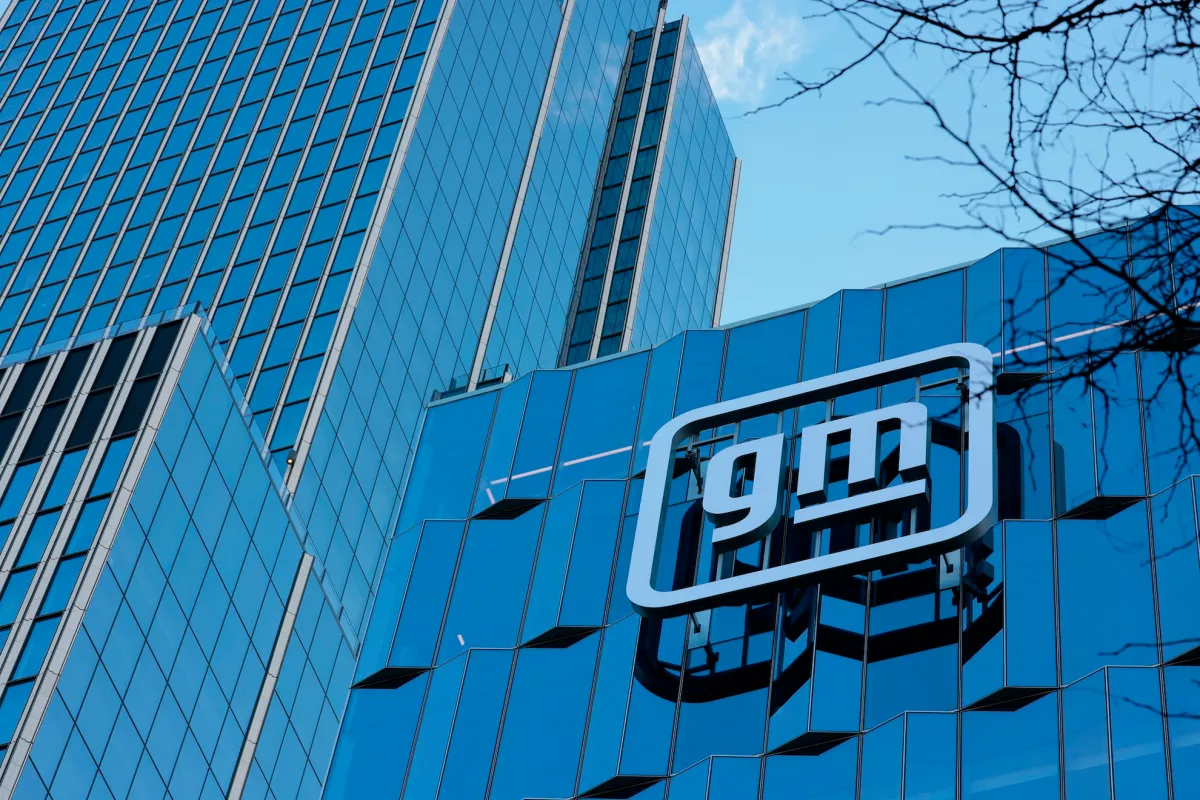
General Motors has laid off more than 10% of its IT department, or about 600 salaried employees — in a deliberate skills swap: clearing out workers whose expertise no longer fits and making room for some with AI-focused backgrounds.
GM confirmed to TechCrunch that it had conducted layoffs; they were first reported by Bloomberg News.
In an emailed statement, the automaker framed the layoffs as a means to prepare it for the future, without providing specifics. “GM is transforming its Information Technology organization to better position the company for the future,” the company said.
These layoffs are not all permanent headcount reductions. A person familiar with the layoffs told TechCrunch that the company is still hiring people for roles in its IT department, but for different skills. The most sought-after capabilities are AI-native development, data engineering and analytics, cloud-based engineering, and agent and model development, prompt engineering, and new AI workflows. In practical terms, GM is looking for people who know how to build with AI from the ground up — designing the systems, training the models, and engineering the pipelines — not just use AI as a productivity tool.
Advertisement
GM has laid off white-collar employees in several departments over the past 18 months, as it focuses its resources on high-priority initiatives, including AI. In August 2024, for example, the company cut about 1,000 software workers.
The software workforce has undergone significant change since Sterling Anderson — co-founder of the autonomous trucking startup Aurora and a veteran of the autonomous vehicle industry — was hired in May 2025 as chief product officer. Last November, three top executives left the company’s software team as Anderson pushed to consolidate GM’s disparate technology businesses into one organization: Baris Cetinok, senior vice president of software and services product management; Dave Richardson, senior vice president of software and services engineering; and Barak Turovsky, a former VP at Cisco who spent just nine months as GM’s chief AI officer.
GM has since moved to fill the gap with new AI-focused hires. It hired Behrad Toghi, who previously worked at Apple, in October as AI lead. The company also brought on Rashed Haq as its vice president of autonomous vehicles. Haq spent five years at Cruise — the self-driving vehicle company acquired and later shuttered by GM — as its head of AI and robotics.
For the industry, GM’s restructuring is a signal of what enterprise AI adoption actually looks like in practice — not just adding AI tools on top of existing teams, but deliberately rebuilding the workforce from the ground up. The specific capabilities it’s hiring for — agent development, model engineering, AI-native workflows — point directly at where large-enterprise demand is heading.
Advertisement
When you purchase through links in our articles, we may earn a small commission. This doesn’t affect our editorial independence.
GitLab announced a restructuring that will flatten management, cut its country footprint by 30 per cent, and reorganise R&D into 60 autonomous teams. CEO Bill Staples called it an investment in the “agentic era,” not a cost cut, but the scope of job losses will not be known until 2 June earnings.
Advertisement
GitLab is cutting jobs to invest in AI agents. The company announced on Monday that it will flatten management layers, reorganise its research and development teams into roughly 60 smaller autonomous units, reduce its country footprint by approximately 30 per cent, and use AI agents to automate internal reviews, approvals, and handoffs. CEO Bill Staples said the restructuring is “not an AI optimization or cost cutting exercise” and that the company intends to “reinvest the vast majority of savings back into the business to accelerate our unique opportunity in the agentic era.”
The stock fell more than eight per cent in after-hours trading. GitLab reaffirmed its guidance for the first quarter and full fiscal year 2027. Staples does not yet know how many roles the process will eliminate. The scope and financial impact will be disclosed on 2 June, when the company reports quarterly earnings.
The framing is now familiar. A software company announces layoffs. It says the cuts are about investment, not austerity. It promises to redirect savings into AI. The stock drops anyway. The question, as it is every time, is whether the restructuring represents a genuine strategic pivot or whether AI has become the vocabulary companies use to describe cost cuts they would be making regardless.
The company
GitLab makes a DevSecOps platform that manages the entire software development lifecycle, from planning and coding through testing, security scanning, and deployment. The company went public on Nasdaq in October 2021 at 77 dollars per share, closed its first day of trading at 103.89 dollars, and reached an all-time high of 137 dollars the following month. It now trades at approximately 25 dollars. The market capitalisation has fallen from roughly 15 billion dollars at its peak to 4.1 billion.
For fiscal year 2026, which ended in January, GitLab reported 955 million dollars in revenue, up 26 per cent year over year. Annual recurring revenue surpassed one billion dollars. Free cash flow was 220 million dollars, up more than 80 per cent. The company authorised a 400 million dollar share buyback. Fiscal year 2027 revenue guidance is 1.099 to 1.118 billion dollars, implying 15 to 17 per cent growth. The deceleration from 26 per cent to 16 per cent is the context for the restructuring.
Advertisement
GitLab operates as one of the world’s largest all-remote companies, with approximately 2,500 employees across more than 65 countries. The 30 per cent reduction in country footprint will consolidate that presence. Staples, who became CEO in December 2024 after co-founder Sid Sijbrandij stepped down for health reasons, previously ran New Relic and held executive roles at Microsoft Azure and Adobe Experience Cloud, where he oversaw three billion dollars in annual revenue.
The product shift
GitLab’s AI strategy centres on Duo, an agent platform that adds usage-based pricing alongside traditional per-seat subscriptions. The company introduced GitLab Credits, a virtual currency priced at one dollar per credit, to meter AI agent usage. Premium tier customers receive 12 credits per user per month. Ultimate tier customers receive 24. Automated code reviews cost 25 cents each, a flat rate that GitLab says undercuts competitors charging 15 to 25 dollars per review using token-based models.
The shift from pure per-seat pricing to a hybrid model that includes usage-based AI credits is an acknowledgment that the economics of developer tools are changing. When an AI agent can review code, set up pipelines, and remediate security vulnerabilities autonomously, the value of the platform shifts from enabling human collaboration to orchestrating machine workflows. The seat is no longer the natural unit of value. The task is.
GitHub froze new Copilot sign-ups after agentic AI broke the economics of its unlimited-use pricing. Agent-driven coding sessions run for hours, spawn parallel threads, and generate token volumes that dwarf traditional autocomplete interactions. The cost structures built for lightweight AI assistance no longer hold. GitHub’s response, pausing new individual subscriptions and tightening usage caps, signals that the era of unlimited AI coding assistance at fixed prices is ending. GitLab’s credit-based model is an attempt to get ahead of the same problem.
Advertisement
The competition
The AI coding tools market reached an estimated 12.8 billion dollars in 2026, up from 5.1 billion in 2024. GitHub Copilot holds approximately 37 per cent market share. Cursor has become the most widely adopted AI coding tool among individual developers. Amazon Q Developer, Google Gemini Code Assist, and JetBrains’ Junie agent are all competing for enterprise adoption.
GitLab’s position is different from most of these competitors. It is not primarily an AI coding assistant. It is a platform that manages the entire development lifecycle, and it is adding AI capabilities across that lifecycle rather than building a standalone AI product. The risk is that the platform becomes the substrate on top of which AI agents operate, essential but invisible, while the agent layer captures the margin. The opportunity is that enterprises want a single platform that governs the full workflow, including the AI agents running inside it, and GitLab is one of the few companies positioned to offer that.
Atlassian cut 1,600 jobs in March, approximately 10 per cent of its workforce, framed as an adaptation to the AI era. One month later, Atlassian launched AI visual tools and partner agents in Confluence. The pattern is identical to GitLab’s: cut staff, announce AI investment, ship AI features. The developer tools sector is restructuring around a thesis that fewer humans and more agents will produce better software faster. Whether that thesis is correct is an empirical question that the companies are answering with headcount reductions before the evidence is in.
The pattern
Meta and Microsoft announced 23,000 combined job reductions in the same week, with the same underlying logic: the companies are not cutting because they cannot afford their workforces but because they have decided to redirect that capital to AI infrastructure. Meta’s 135 billion dollar AI spending programme and Microsoft’s first-ever buyout offers represent the extreme end of a spectrum on which GitLab’s restructuring sits. The common thread is companies converting payroll into AI capital expenditure.
Advertisement
OpenAI CEO Sam Altman has called the practice of using AI as justification for cuts made for other reasons “AI washing.” Fewer than one per cent of 2025 job losses could be directly attributed to artificial intelligence, he said in February. The label matters because it determines whether investors should treat AI-justified restructurings as forward-looking investments or backward-looking cost cuts dressed in new language.
The human cost of tech layoffs is not captured in restructuring charges. The tech industry has shed more than 95,000 jobs across 247 layoff events in 2026, an average of 882 per day. GitLab’s contribution to that number will not be known until June. Staples wrote that “in some cases AI can augment and accelerate what team members have been doing, in other places we need to expand certain roles to go faster.” The sentence contains both a euphemism for job elimination and a promise of job creation. The ratio between the two is the number that matters, and it has not been disclosed.
The question
The argument that AI is not coming for your job but for your justification captures the dynamic playing out at GitLab and across the industry. The company is not replacing developers with AI agents. It is restructuring the organisation around a world in which AI agents handle an increasing share of the development workflow, and the humans who remain are expected to be more productive, faster, and focused on the work that agents cannot yet do.
GitLab’s revenue is growing at 16 per cent. Its free cash flow is 220 million dollars. It is not in distress. It is a profitable, growing company that has decided its current structure is built for an era that is ending. The company that pioneered all-remote work, that built a platform on the assumption that geographically distributed human developers need tools to collaborate, is now rebuilding around the assumption that many of those developers will be replaced by agents that do not need collaboration tools at all. The restructuring will be detailed on 2 June. The thesis, that the agentic era demands fewer people and more credits, is already priced in.
UPDATED: Sorry, kids, everything’s back up so get to work on your new assignment – An essay on the ethics of paying ransoms, because it looks like that’s what happened here
Ed-tech giant Instructure confirmed two rounds of unauthorized activity affecting its online learning platform Canvas within two weeks as data-theft-and-extortion crew ShinyHunters threatened to leak data it claims belongs to more than 275 million students, teachers, and staff tied to nearly 9,000 schools worldwide.
In a security incident update, Instructure apologized for the disruption when Canvas went offline last Thursday, leaving thousands of colleges, universities, and K-12 schools without access to course materials, grades, and due dates during final exams and Advanced Placement testing for many.
Advertisement
As of Saturday, the parent company claimed, “Canvas is fully back online and available for use.”
And it finally broke its silence on Monday about what happened, admitting not one but two intrusions after criminals exploited a security vulnerability in its Free-for-Teacher learning system, and saying the data thieves stole information including usernames, email addresses, course names, enrollment information, and messages.
“Core learning data (course content, submissions, credentials) was not compromised,” the Monday disclosure said. “We’re still validating all findings, but we want to be clear about what we understand was and wasn’t affected.”
On April 29, the online education firm “detected unauthorized activity in Canvas,” immediately revoked the intruder’s access, and initiated a probe into the breach, according to Instructure’s notice posted on its website.
Advertisement
On May 7, the company “identified additional unauthorized activity tied to the same incident.” ShinyHunters defaced about 330 Canvas school login portals, also exploiting the same Free-for-Teacher vulnerability, and that caused the ed-tech firm to take Canvas offline and “into maintenance mode to contain the activity.”
ShinyHunters claims it stole 3.65 TB of data, including about 275 million records from about 8,800 schools including Harvard, Columbia, Rutgers, Georgetown, and Stanford universities. After moving the pay-or-leak deadline multiple times, ShinyHunters set a final deadline of end-of-day May 12 for individual institutions to contact them directly to negotiate payment – or the group will publish the full dataset.
In response, Instructure said it temporarily shut down its Free-for-Teacher accounts. It also revoked privileged credentials and access tokens tied to compromised systems, rotated internal keys, restricted token creation pathways, and added monitoring across all platforms.
The education platform hired CrowdStrike to assist with its forensic analysis and incident response, and said it also notified the FBI – which published its own alert on social media – and the US Cybersecurity and Infrastructure Security Agency.
Advertisement
This is Instructure’s second breach in less than a year. ShinyHunters claimed to have breached Instructure’s Salesforce environment in September 2025, and while Instructure didn’t name the crew in its latest disclosure, it did address the intrusion. “The prior Salesforce-related incident and this Canvas security incident are distinct events involving different systems and circumstances,” the company said. ®
UPDATED AT 01:10 UTC MAY 12 Instructure At 10:21 UTC on May 11, Instructure updated its incident report to state “All Canvas environments are available.”
The company also admitted it “reached an agreement with the unauthorized actor involved in this incident” and secured stolen data.“
“We received digital confirmation of data destruction (shred logs),” the company said, adding “We have been informed that no Instructure customers will be extorted as a result of this incident, publicly or otherwise.”
Advertisement
Further: “This agreement covers all impacted Instructure customers, and there is no need for individual customers to attempt to engage with the unauthorized actor.”
The statement makes it hard not to conclude that Instructure took the controversial decision to pay a ransom.
“While there is never complete certainty when dealing with cyber criminals, we believe it was important to take every step within our control to give customers additional peace of mind, to the extent possible,” the statement adds.
You normally think of fiber optic as something used in network cables. However, scientists employ dedicated fibers to detect earthquakes. In simple terms, they fire a laser down the fiber and watch reflections caused by imperfections. When vibrations hit the cable, it changes the defects, which show up in the return pattern. However, with the right techniques, those vibrations could just as easily be from people speaking near the cable.
If you are alarmed, there’s good news and bad news. The good news is that the technique seems to be limited to coils of fiber that are not buried, and you have to be within about 5 meters of the fiber. The bad news is that there is plenty of dark cable all over the place. Besides, if researchers can do this successfully, you would imagine three-letter agencies around the world could do it even better.
Looking for the most recent Mini Crossword answer? Click here for today’s Mini Crossword hints, as well as our daily answers and hints for The New York Times Wordle, Strands, Connections and Connections: Sports Edition puzzles.
Need some help with today’s Mini Crossword? There’s a fun little twist involving how many times a certain letter is used. (The 1-Down clue explains it further.) Read on for all the answers. And if you could use some hints and guidance for daily solving, check out our Mini Crossword tips.
If you’re looking for today’s Wordle, Connections, Connections: Sports Edition and Strands answers, you can visit CNET’s NYT puzzle hints page.











 Between 2000 and 2002 the Fisher Price Pixter was sold to children as an educational handheld toy with a touch screen that enabled drawing and listening to music in addition to cartridge-based games and more. It was followed up by multiple new iterations of the system, but as an ecosystem didn’t last beyond 2007. This has left much of the system in obscurity, with people like [Dmitry] doing their best to reverse-engineer, dump and document what they can, such as recently for the entire range of Pixter devices and most of the games.























































You must be logged in to post a comment Login