
TL;DR
Apple’s design team has been hollowed out since Jony Ive left. Incoming CEO John Ternus says a major shake-up is coming before he takes over in September.




Day 2 of the BMPS Grand Finals was truly the day of comebacks, with teams like GDR and Victoris Summus making the largest leap, and occupying the second and third place in the rankings, respectively. While there was plenty of action from the bottom dwellers, Divine held their 30-point lead, thanks to clever strategies that put them in the top five of almost every match consistently. Here’s what the schedule will look like for day 3 of the BMPS Grand Finals.
The live broadcast will begin at 2:45 PM IST. Fans can catch the games like on Krafton’s YouTube channel in Hindi, English, and a few other regional languages. Or, if you want to support your team live, head over to the Jaipur Convention Center. Tickets are available on the District app. Maps for today will include:
A total of 18 matches will be played over the course of this weekend. And the format is pretty simple. Points are awarded for each finish, and also for how long a team survives. In the end, the team with the most total points (position + finish) will be the winners.
| Rank | Team | WWCD | Finish Points | Position Points | Total Points |
|---|---|---|---|---|---|
| 1 | DIVINE | 2 | 83 | 47 | 130 |
| 2 | GDR | 1 | 65 | 28 | 93 |
| 3 | VS | 2 | 55 | 36 | 91 |
| 4 | GODL | 1 | 58 | 32 | 90 |
| 5 | GENS | 0 | 63 | 27 | 90 |
| 6 | iQOOORGE | 2 | 40 | 38 | 78 |
| 7 | NBE | 1 | 52 | 25 | 77 |
| 8 | VASISTA | 1 | 52 | 24 | 76 |
| 9 | iQOOSOUL | 1 | 46 | 23 | 69 |
| 10 | iQOO8BIT | 0 | 45 | 24 | 69 |
| 11 | iQOOxTT | 0 | 49 | 19 | 68 |
| 12 | iQOORNTX | 0 | 47 | 15 | 62 |
| 13 | 7GODS | 1 | 35 | 20 | 55 |
| 14 | iQOOxOG | 0 | 37 | 17 | 54 |
| 15 | TAG | 0 | 45 | 2 | 47 |
| 16 | MYTH | 0 | 33 | 7 | 40 |


NETWORKS
Members aren’t RIPE for a new charging scheme, though
Europe’s internet registry is abandoning its cloud migration plans over geopolitical risk, but reversing course now means rebuilding the resilient, secure infrastructure it needs.
The RIPE Network Coordination Centre – which oversees the regional internet registry (RIR) for Europe, the Middle East, and parts of Asia – had, like many organizations, adopted a “cloud-first” strategy that involved moving move core services and databases to cloud providers.
But, as with many European organizations, the arrival of the Trump administration delivered a wake-up call, prompting it to reassess the risks of relying on US-based hyperscalers for parts of its infrastructure.
In a blog post, RIPE Managing Director Hans Petter Holen says returning to the previous status quo is no longer an option – stakeholder expectations about the security, stability, and resilience of services have risen, among other things.
In a presentation at last month’s RIPE NCC General Meeting, Holen said much of the organization’s infrastructure needs an overhaul, requiring a jump in capital expenditure (capex) to levels not seen in years, before the cloud-first strategy was adopted.
“To start with, we will need to replace hardware that has reached, or in some cases passed, the end of its lifecycle. This is the result of trade-offs between capex and opex over the period in which we were focused on cloud deployments, as well as various assumptions and decisions about how this balance would evolve over the long term,” he said.
RIPE needs to consider its datacenter footprint – the number and location of facilities – while minimizing interdependencies between them to allow for expansion into additional sites as needed.
Geographically redundant storage and backups are also needed, Holen said, along with a decision on future virtualization platforms that limit vendor lock-in risks.
Despite these challenges, the organization expects to complete a migration to a greenfield deployment by 2028 at an additional cost of €5 million, effectively returning capital spending to levels last seen before 2020.
To fund this, RIPE will need to balance internal cost savings against membership fees. Holen said he is aware that some members are concerned about the fees they’ve paid in recent years and don’t want to see further rises.
Yet despite this, a vote on the membership charging scheme at the General Meeting went the opposite way from what was expected: rather than switching to a sliding scale – under which 74 percent of members would have paid less – members opted to keep the existing flat fee.
Clearly discombobulated by this turn of affairs, RIPE dedicated a blog to picking over the reasons why the membership voted the way it did.
It’s worth noting that of 19,415 eligible members, only 3,421 registered to vote and 3,049 actually cast ballots, resulting in a 15.7 percent turnout. Yet this was described as one of the highest turnouts on record, falling only slightly short of the May 2020 peak.
The result was close, with 51.1 percent voting for the status quo and 48.9 percent voting for the alternate sliding-scale charging scheme. RIPE claims a swing of just 35 votes would have delivered a different outcome.
Both schemes generate the same total income, but the new one would have shifted the burden so that members with more internet number resources pay more.
In the end, RIPE wonders if mixed messages may have contributed to the result. The organization says it communicated repeatedly with members through various channels to encourage participation.
But during the lengthy process of preparing the charging scheme options, RIPE published consultations on different ideas for the base fee and various additional fees – some of which were later abandoned following member input, though not everyone may have realized it.
Misconceptions also persisted, including the belief that paying more would mean greater voting rights – an idea that was strongly opposed.
“Perhaps our initial assumption that many of you would prefer a tiered model was inflated. It is true there was a long-standing demand for it,” the blog concludes. “But we also hear from people who believe in equality over equity when it comes to financial contribution. To them, the varying amounts of resources members hold shouldn’t be a reason for them to pay accordingly.” ®


The Last Salvage Squad
Developer: Sunfish Kumano
Publisher: Waku Waku Games
Platform: Steam (Windows; Steam Deck verified; demo available), Nintendo Switch, Switch 2
Price: usually $10, with a 10 percent discount on Steam until July 1
It feels right that The Last Salvage Squad is landing on Switch and Switch 2 as well as Steam, since the striking red and black visuals seem very much inspired by the Virtual Boy. This is a 2.5D shooter in which you’ll use an array of firearms and swords to defeat enemies, some of which look like the Martian Tripods from The War of the Worlds.
I’m tempted to check this out, perhaps on Switch 2 since that version supports Joy-Con 2 mouse controls and runs at up to 120fps. I’ve never used a Virtual Boy and this might be about as close as I’ll ever get, largely because I don’t particularly feel like paying $100 for the Switch 2 accessory.
Copa City
Developer and publisher: Triple Espresso S.A.
Platforms: Steam (Windows; playable on Steam Deck), PS5, Xbox Series X/S
Price: usually $40, with 10 percent off on Steam until June 30
Copa City is a soccer game that doesn’t really have much to do with controlling or managing the action on the pitch in the style of EA Sports FC or Football Manager. This is all about the other side of the beautiful game, which is ensuring matches go off without a hitch. You’re in charge of managing the entire matchday experience across a city. Among other things, you’ll recruit volunteers, cater to different groups of supporters by setting up fan zones for both teams and place players in hotels.
I’ve played around an hour of Copa City and haven’t really found it engaging. It’s very rough around the edges and feels like it was rushed out to capitalize on World Cup hype. The interface is clunky, the game doesn’t explain its systems very well and, as others have noted, essential items are sometimes gated behind a nonsensical progression system. Worst of all was something I noticed about 15 minutes into the tutorial: Loren Ipsum placeholder text on a menu screen. Yikes.
To their credit, the developers say they’re listening to players’ concerns and working to fix the issues. I like to give developers the benefit of the doubt as much as possible. We’re all aware of games that have been completely turned around after a poor initial reaction. But with there being far more games to play than I have time for, I can’t see myself returning to Copa City. This one’s going on the transfer list, sadly.
Thank You For Your Application
Developer: IceLemonTea Studio
Publishers: IceLemonTea Studio, No More Robots
Platform: Steam (Windows and Mac; playable on Steam Deck; demo available)
Price: usually $20, with a 15 percent discount until July 3
In Thank You For Your Application, you review candidates for jobs and decide whether to bring them on board depending how well they fit a company’s requirements. You’ll check their resumes and other documents, such as internship reports and even emotional evaluations. In addition, you’ll manage your own life by paying bills and managing your mental health.
This game — which echoes both No More Robots’s own Not Tonight series and Papers, Please — seems like a timely commentary on late-stage capitalism, particularly given how tough many people are finding it to land work right now. It even seems like your character is trapped in a company town, as they can only spend their earnings from the company within Aeropolis.
The Quiet Things
Developer and publisher: Silver Script Games
Platform: Steam (Windows; demo available)
Price: Usually $25, with a 10 percent discount until June 25
The Quiet Things was in the news recently as BAFTA pulled a trailer for the game from its game awards ceremony at the last minute. The organization claimed it was “not in a position to sufficiently warn” attendees about “themes that may be a trigger for some.” BAFTA added in a statement to Kotaku that it fully supports “games that engage with difficult subjects.”
Indeed, the Steam page for The Quiet Things warns that it “contains discussion of self-harm, suicide, sexual assault/non-consensual sex and childhood abuse.” It’s an autobiographical game that’s based on the developer’s own story and explores important issues from the perspective of a survivor. That makes it more than worthy of attention.
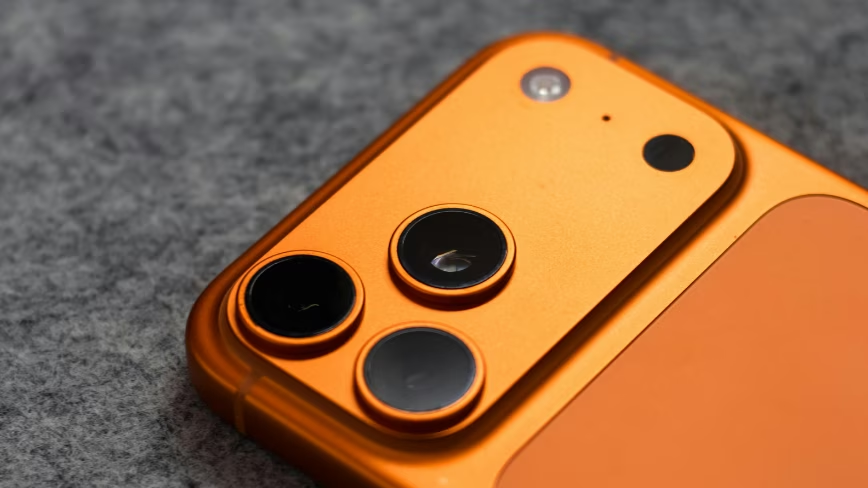
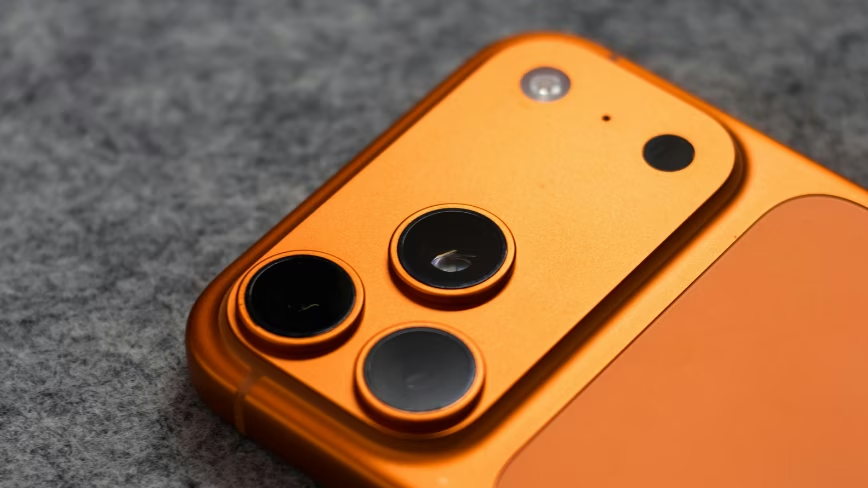
Apple’s design team has been hollowed out since Jony Ive left. Incoming CEO John Ternus says a major shake-up is coming before he takes over in September.
Apple’s industrial design studio, once the most influential product design operation in the technology industry, has been gutted. Bloomberg’s Mark Gurman reports that the team no longer has a true seat at the executive table, has less influence and credibility than at any point in decades, and has become a service bureau where other teams come to get what they need and get out.
Incoming CEO John Ternus, who takes over from Tim Cook on September 1, knows the problem. He is preparing a major shake-up of the design organisation and is getting ready to put his firm imprint on the team, according to Gurman’s reporting.
The decline started roughly a decade ago. In 2015, Jony Ive stepped back from day-to-day management to become chief design officer, a move Apple framed as a promotion but which began a slow erosion of the design-first culture that had defined the company since Steve Jobs’s return. Ive left Apple entirely in 2019 to form LoveFrom, a design firm that today works with OpenAI.
For a few years, Apple managed to hold things together. Evans Hankey, who had managed the studio under Ive, took over as head of industrial design. But Apple chose not to give Hankey a seat on the executive team, signalling that design’s role within the company had diminished.
Instead, Hankey reported to Jeff Williams, the chief operating officer, who had no design background.
The arrangement meant Apple had replaced one of the most influential designers in history with its top supply chain executive. That decision, according to Gurman, spoke volumes about how priorities had evolved under Cook.
When Ive’s consulting deal ended in 2022, Hankey left too, triggering a wave of departures that saw nearly every designer from the Ive era defect to LoveFrom, start their own firms, or retire. Bart Andre, Apple’s longest-serving designer who had been with the company since 1992, retired in February 2024. Colin Burns, Peter Russell-Clarke, and Shota Aoyagi all left around the same time.
Hankey went on to cofound io, an AI hardware startup with Ive that OpenAI acquired for $6.5 billion in 2025.
Williams, tasked with stopping the bleeding after Hankey left, chose not to hire a new design leader. He took direct control of the group instead, fearing that elevating one designer over another could trigger even more departures. The exits continued anyway, and at an even faster pace.
The situation became what Gurman describes as a full-blown crisis: morale declining, the studio’s influence shrinking, the historic innovation hub becoming less relevant and powerful. When Williams retired in November 2025, Apple had to confront a question it had long avoided.
The answer was Molly Anderson, an industrial designer known for her work on Apple Watch and her relationship with Hankey. Apple added Anderson to its leadership page as vice president of industrial design in March 2026. The problem, according to Bloomberg, is that Anderson had never managed a team before taking the role, and Apple prioritised continuity over searching for the most accomplished design leader available.
The bench has weakened in parallel. The team is now filled with more junior staffers from school or smaller companies, lacking the depth of globally recognised design leaders it once possessed.
Then came arguably the biggest blow: Alan Dye, who had run user interface design since 2015, left for Meta in December 2025 to become its chief design officer. Several software designers followed him.
The consequences are visible in the products. While Apple has continued updating devices on schedule, the pace of new designs and major form factor changes has slowed. Until last year, the iPhone looked largely the same for about half a decade.
The Apple Watch, AirPods, and Mac have retained essentially the same industrial designs for roughly a decade, with only occasional exceptions like the Watch Ultra and MacBook Neo.
In the Jobs and Ive era, going that long without a significant redesign would have been unthinkable.
Ternus, who comes from Apple’s product engineering and design ranks, has already spent considerable time with the industrial design group since taking oversight of the team in late 2025. He told employees in a recent internal meeting that the company is “going to keep focusing on design, because design is core to what we do at Apple.”
Gurman’s reporting is clear about what needs to happen next: Apple must find a leader capable of restoring the design studio’s prowess, give that person a genuine seat at the executive table, and empower them to rebuild the organisation and deliver breakthrough designs. Getting the right cultural fit will be difficult, but that should not be an excuse to avoid recruiting the best person available.
The challenge for Ternus is that design leadership is just one item on a very long list. Apple trails its competitors in AI, faces enforcement actions under the EU’s Digital Markets Act, and must deliver a foldable iPhone this September alongside the regular lineup. Rebuilding a design culture takes years, and Ternus has weeks before he takes the CEO title.
Whether he can restore design to its former position at Apple while managing everything else will be the defining question of his early tenure. The company has the money, the brand, and the distribution to attract the best designers in the world. What it lacks, for the first time in its modern history, is the internal culture that made those designers want to stay.


A previously undocumented malware botnet named AryStinger has compromised more than 4,000 outdated routers to turn them into proxies for malicious traffic.
Researchers at Qianxin’s XLab threat intelligence team say that the malware converts infected devices into remotely controlled “executors” that can perform scanning, proxying, tunneling, command execution, and other activities on behalf of the attacker.
“The attacker can split a massive scanning task into multiple small chunks and distribute them to different Executors for parallel execution,” XLab researchers note.

“With this distributed-like design, the attacker can efficiently complete the early “footprinting” activities, thereby providing strong assurance for the smoothness and success rate of subsequent intrusion operations.”
Apart from using compromised routers as a springboard for malicious operations, XLab warns that the malware can also tamper with DNS settings, hijacking the user’s browsing, and silently monitor and potentially steal all inbound and outbound network traffic.
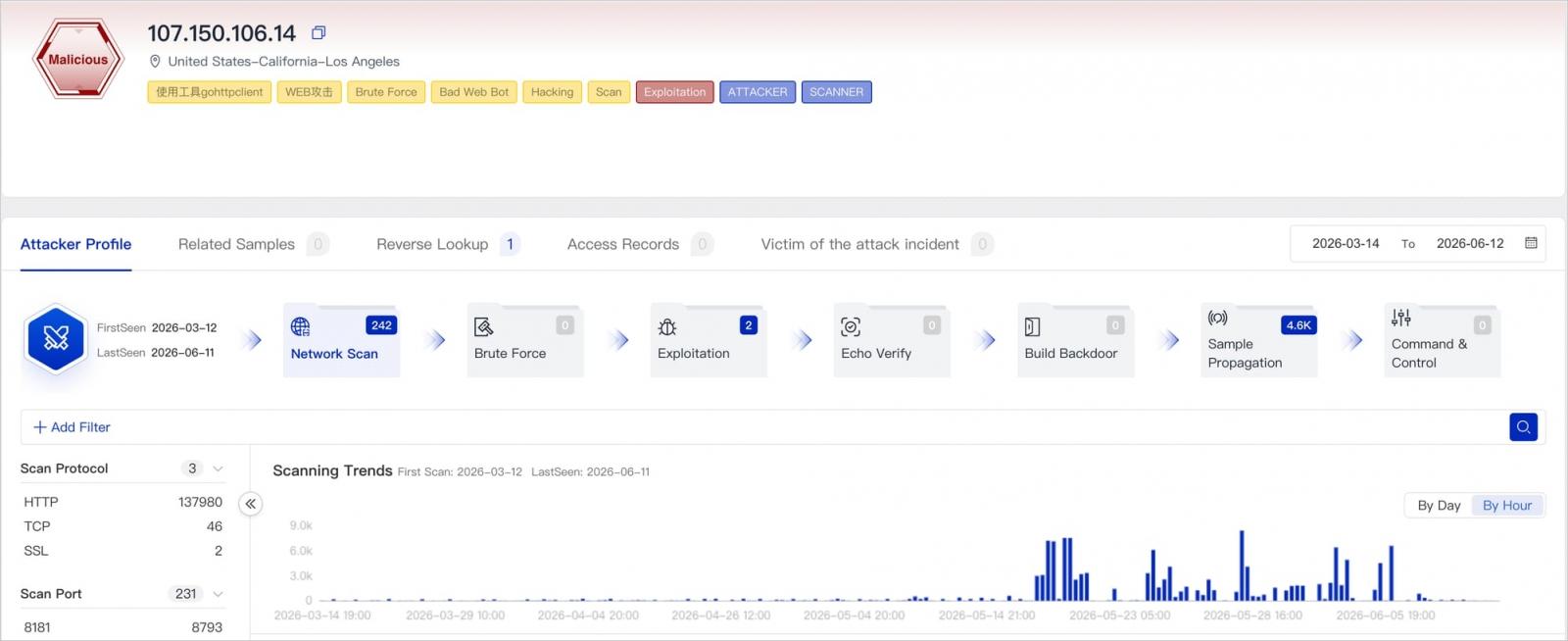
AryStinger exploits older flaws such as CVE-2013-3307, CVE-2016-5681, and CVE-2025-11837, targeting primarily D-Link DIR-850L, D-Link DIR-818LW routers.
The two router models were previously targeted by the AVrecon malware botnet that Lumen communications services provider Lumen disrupted in 2023.
Qianxin’s telemetry data shows that almost half of all infections are located in South Korea (48.5%), followed by China (31.8%), Sweden (6.4%), Malaysia (3.5%), and Singapore (2.5%).
XLab researchers found two variants of the AryStinger malware: a C-based version targeting mostly outdated routers, and a Go-based one that focuses on NAS systems, but currently with a far more limited reach.
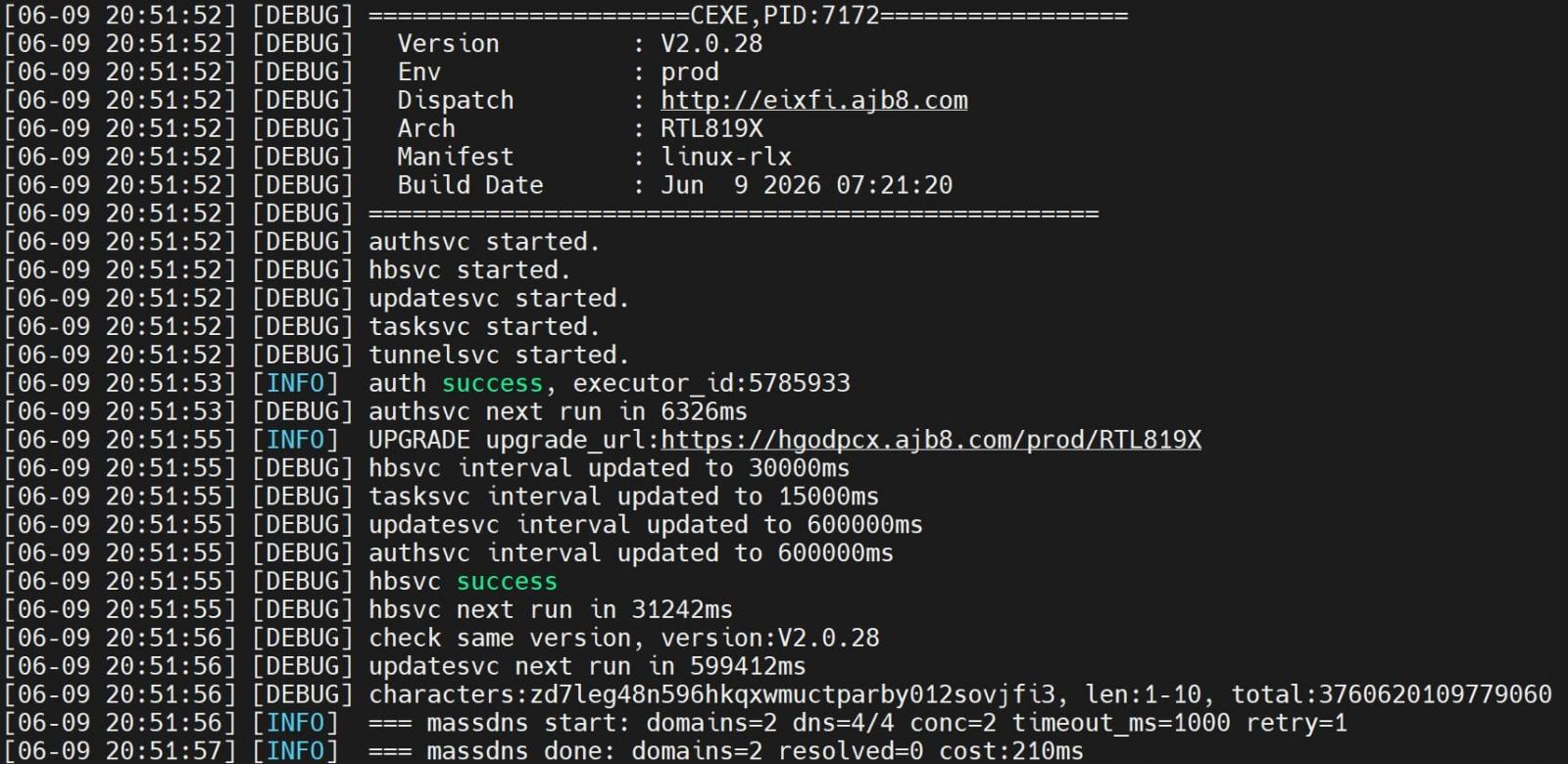
The NAS version is the most advanced of the two, featuring additional capabilities such as IP and DNS scanning, command execution, payload execution, and internal network reconnaissance through the integration of open-source penetration testing tools.
The researchers noted that AryStinger’s distributed DNS-scanning infrastructure could potentially be repurposed to generate large volumes of DNS queries against resolvers, although they did not observe any such attacks.
Regarding the NAS version’s code execution capabilities, XLab says there’s support for Shell commands, as well as Go, Java, and Python source code.
However, there are some limitations to using source code instead of compiled binaries, as compilation requires language runtimes on the host, and the process as a whole introduces noise that can break stealth.
The researchers did not attribute AryStinger to any known activity cluster, stating that “many mysteries surrounding AryStinger remain to be solved.”
Owners of end-of-life (EoL) routers should replace them with new, actively supported models, apply the latest available firmware updates, change the default administrator account password, and disable remote management panels.

Security teams log 54% of successful attacks and alert on just 14%. The rest move through your environment unseen.
The Picus whitepaper shows how breach and attack simulation tests your SIEM and EDR rules so threats stop slipping by detection.
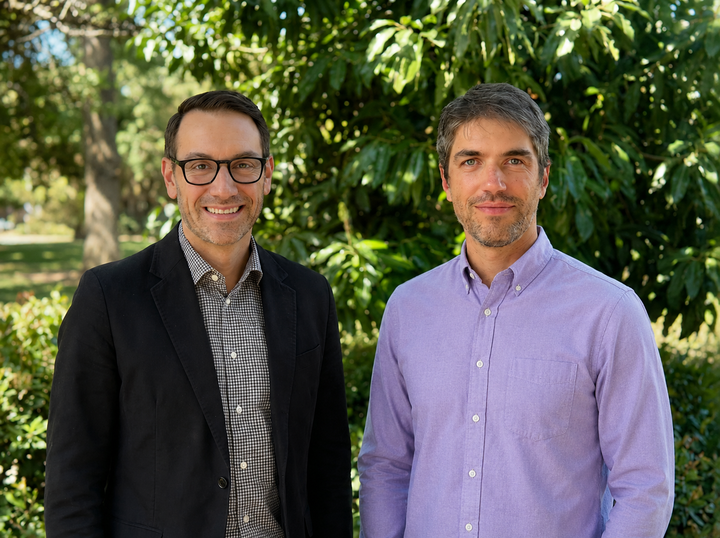

Devplan, a Seattle startup trying to automate away the meetings and status reports that eat up a product team’s week, is coming out of stealth Thursday with $2.5 million in seed funding.
The company, founded by two industry veterans with experience at companies such as Uber, Amazon, Snap and Meta, is also expanding availability of its software for coordinating work across product and engineering teams, after testing it quietly with a small group of customers.
Devplan traces its roots to a youth soccer pitch, of all places, where co-founder Anton Safonov coached the daughter of his future business partner, Chris Bee. They had kids at the same school, and discovered they shared a frustration from running engineering teams: too much of the work didn’t have anything to do with building the product.
Bee calls it an invisible tax.
“With AI fundamentally changing the way we do software development, we’ve seen this huge acceleration in coding and in engineering work,” he said in an interview. “But the rest of the coordination work, the rest of that tax — that ‘work about work’ — hasn’t changed very much, frankly.”
They co-founded Devplan in 2025, with Bee as CEO and Safonov CTO.
How it works: Devplan’s core product, Weaver, connects to commonly used tools including GitHub, Jira, Slack and meeting note-takers. A user can query Weaver through a built-in chat function, a Slack bot, or through a direct link into AI coding tools like Claude Code, asking about product status, features, or who’s responsible for which aspects of the project, for example.
Weaver also works in the background, generating a daily digest for each person and tracking projects on its own, flagging risks and progress without anyone filing an update.
The idea is to avoid scheduling a meeting or creating a status report.
Bee said queries run faster and cheaper through Weaver than pointing an AI tool at the raw data each time, because Devplan processes the information in advance and stores it in a knowledge graph rather than scanning code and documents on every request. He said queries run roughly twice as fast and more than three times cheaper on token costs in internal testing.
Funding: The company’s $2.5 million seed round was led by AI2 Incubator, with participation from Acequia Capital, Mighty Capital, Grand Ventures and eLab Ventures.
Based at AI House on Seattle’s Pier 70, Devplan employs six people, with a seventh hire in the works. The seed money is going toward engineering hires and deeper integrations, Bee said.
Founder backgrounds: Bee was previously CTO of Lessen, where he helped grow the property-services company from a $20 million startup to a $2 billion valuation, and earlier led product and engineering teams at Zillow, Uber and Amazon.
Safonov spent seven years as a principal software engineer at Snap, where he was a lead engineer on the company’s infrastructure team, and earlier worked on systems at Meta that handled realtime traffic for Messenger, Facebook and Instagram. He also built systems at LinkedIn.
“Chris and Anton have lived this problem at scale, and they have the technical depth to solve it,” said Yifan Zhang, managing director at AI2 Incubator, in a statement.
Competitive landscape: Devplan’s bet is that a tool built specifically for product and engineering teams will outperform the general-purpose AI assistants.
Glean, the enterprise AI search company, may be the closest comparison, Bee said, but it works more broadly across all of a company’s information while Devplan goes deeper on software development specifically. Devplan integrates with Linear, the project-management tool, making it more of a partner than a rival, he said.
Increasingly, given the capabilities of AI coding assistants, the competition also includes companies deciding to build a coordination tool in-house rather than buy one.
Current status: Devplan has dozens of paying business customers on annual contracts, plus hundreds of users who have tried it so far. Pricing is consumption-based, with companies quoted a flat rate based on team size and expected usage.
What’s next: The company is focusing on enterprise customers for now, with plans to eventually open the product to individuals on a pay-as-you-go basis.
Let’s be honest: few iOS design changes have sparked as much debate as Liquid Glass. When Apple first introduced it with iOS 26, the internet immediately split into two camps. Some people loved the fresh, translucent look, while others couldn’t stand it and felt it made parts of the interface harder to read. I happened to be firmly in the first camp. At the time, I was using an iPhone 14 Pro Max, and installing the update was one of the first things I did. I loved how the new design made iOS feel more modern and dynamic. The transparency effects gave the interface a sense of depth, making the entire experience feel fresh again.
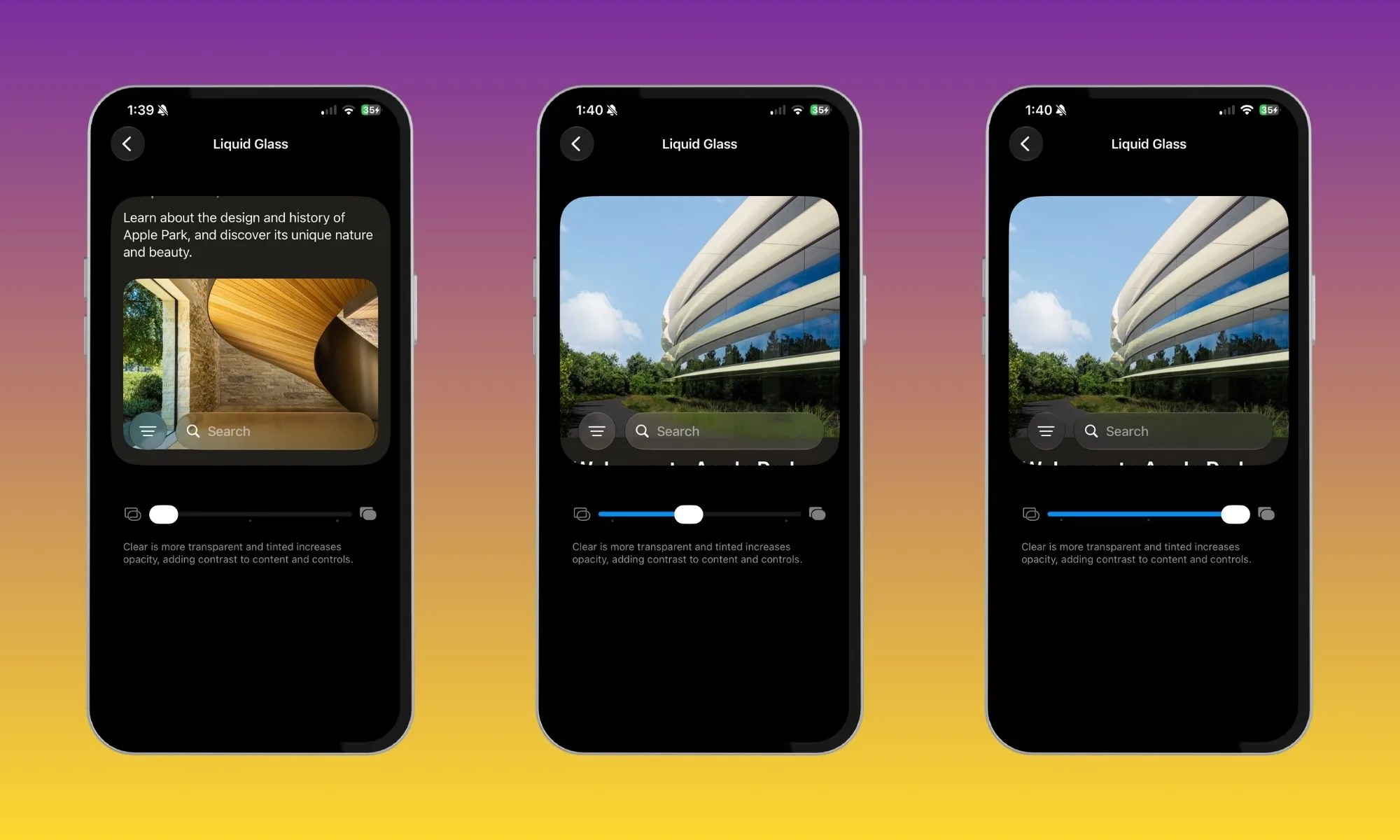
That said, it’s easy to understand why not everyone felt the same way. After months of feedback, screenshots, hot takes, and endless debates online, Apple eventually responded by giving users more control. Instead of forcing everyone into the same look, it introduced options that let people choose between a clearer glass effect and a more tinted appearance. With iOS 27, Apple is putting the Liquid Glass debate completely in your hands. A new slider lets you customize the effect exactly the way you want it, whether you prefer a crystal-clear look or something easier on the eyes. Here’s what it does and how to make the most of it on your iPhone.
The Liquid Glass slider is essentially Apple’s way of letting you decide how much of the new design language you actually want to see. In everyday use, that means you can customize the experience to match your preferences. If you’re like me and enjoy the full Liquid Glass aesthetic, you can keep things more transparent and let your wallpaper shine through menus, widgets, and system panels. It gives iOS a lighter, more layered feel that really shows off the design Apple has been building toward.

On the other hand, if you find all that transparency distracting or simply prefer a cleaner look, you can dial up the tint. Doing so makes interface elements more robust and improves contrast, making text and buttons easier to read at a glance. What I like most is that Apple is no longer treating customization as an all-or-nothing choice. You don’t have to love Liquid Glass exactly as Apple designed it, nor do you have to turn it off entirely. The new slider lets you find a middle ground that works for your eyes and your style, making iOS feel a little more personal.
Before you start tweaking the Liquid Glass slider, you’ll need access to iOS 27. I’ve been testing the feature on my iPhone 16e through Apple’s developer beta, which is currently the only way to try it out. If you’re comfortable running beta software, getting started is fairly straightforward. Anyone can enroll in Apple’s developer program for free and gain access to the latest developer builds. Once you’ve signed up, simply open the Settings app, go to General, tap Software Update, and select Beta Updates. Choose the iOS 27 Developer Beta from the list, and the update should appear on your iPhone within a few moments.

That said, beta software isn’t for everyone. Early builds can occasionally be buggy, and some apps may not work exactly as expected. If your iPhone is your primary device and you’d rather avoid the risks of pre-release software, there’s nothing wrong with sitting this one out. The good news is that the wait shouldn’t be too long. Apple will eventually bring the feature to everyone through the public release of iOS 27, so if you’d rather have a more stable experience, it may be worth holding off for a little while longer.
Actually changing the Liquid Glass effect is surprisingly simple. Once your iPhone is running iOS 27, open the Settings app and look for the Appearance section. From there, tap Liquid Glass to access the new customization controls. This is where you’ll find Apple’s new Liquid Glass slider. Unlike the older setup, which limited you to a couple of preset looks, the slider gives you much finer control over the effect. The best part is that you don’t have to guess what each setting does because the interface changes instantly as you adjust it.

I spent a few minutes moving the slider back and forth just to see how different parts of iOS reacted. Sliding it toward one end makes menus, panels, and interface elements appear more transparent, allowing more of your wallpaper and background content to shine through. Moving it in the opposite direction adds more tint and contrast, giving the interface a cleaner and more solid appearance. There’s no right or wrong setting here, which is what makes the feature so useful. You can leave it at either extreme or settle somewhere in the middle if you want a balance between style and readability. As you move the slider, iOS previews the changes in real time, making it easy to find a look that feels right without constantly jumping between menus. My advice to you would be not to rush it. Spend a minute experimenting with different levels of transparency and tint. You might be surprised by how much a small adjustment can change the overall feel of your iPhone.
One thing I’ve always appreciated about iPhone is having the ability to make the experience feel a little more personal, and the new Liquid Glass slider fits perfectly into that idea. I’ve been running iOS 27 on my iPhone 16e for over a week now, and while this might seem like a relatively small addition on paper, it’s one of those features that makes a difference every time you pick up your phone. More importantly, it feels like a sign of where Apple is heading with iOS: giving users more flexibility without making the software feel complicated. And from everything I’ve seen so far, that’s a direction I’m happy to see the company take.
There’s still plenty for me to explore in iOS 27, and I’m sure more surprises will reveal themselves over the coming weeks. But if you’re eager to try the new design for yourself, my advice is simple: be patient. The stable release will almost certainly offer a smoother experience than the early beta builds, letting you enjoy all these new features without the usual beta headaches. When that update finally arrives, the Liquid Glass slider is one of the first settings I’d recommend checking out. You might be surprised by how much a small adjustment can change the way your iPhone feels.

AI inference company Baseten is close to finalizing a stunning $1.5 billion funding round at a $13 billion valuation, the Wall Street Journal reports. Just five months ago, the startup announced that it had raised a $300 million Series E at a $5 billion valuation. And that round was just nine months after raising a $150 million Series D.
If finalized, this latest round would represent a 160% increase in valuation in less than half a year. However, the WSJ reports that this is a split-priced round, a tactic startups are using to boost their headline valuation and make lead investors look good on paper. Some investors in this latest funding round are reportedly coming in at a $13 billion valuation, while others at $11 billion, sources told the Journal. This deal is said to be co-led by Spark Capital, Sands Capital, Altimeter Capital, and Wellington Management.
Launched in 2019, Baseten is a startup benefiting from what The Next Wave hailed the “inference gold rush,” in which VCs are pouring enormous amounts of money into companies building the inference layer. Inference is what the model does after a user submits a prompt. Baseten promises to handle inference quickly while controlling costs by routing requests to the best-for-task model, especially to competent, less-expensive open source alternatives.

Tournament favorites Spain will look to put things right against Saudi Arabia, after both sides opened their respective FIFA World Cup 2026 campaigns with a point. Lamine Yamal hopes to start for La Roja.
Spain play in Atlanta for the second game in a row but the 75,000-capacity stadium will already hold bad memories after La Roja’s goalless draw with World Cup debutants Cape Verde on Monday. Head coach Luis de la Fuente even chucked on star wingers Yamal and Nico Williams in a desperate bid to find a goal, as both players continue their convalescence from recent injuries. The main talking point is now whether the duo will start what feels a must-win game for European champions.
Saudi Arabia warmed up for their toughest test of the group stage by drawing 1-1 with Uruguay in Miami, as Abdulelah Al Amri’s first-half goal was canceled out by Maxi Araujo’s equalizer 10 minutes from time. The prospect of being heavy underdogs against Spain will not faze the Saudis, whose shock 2-1 victory over eventual champions Argentina in their opening game of the 2022 World Cup will give them belief that they can repeat the trick here. Skipper Salem Al Dawsari scored the winning goal that day and will lead his country against Spain.
So, read on as we show you exactly how to watch Spain vs Saudi Arabia for free from anywhere in the FIFA World Cup 2026.
Spain vs Saudi Arabia is available to watch for free in multiple countries, including the UK, Australia, Brazil, Belgium, Ireland, Netherlands, Switzerland and Turkey.
Abroad? Can’t access your free stream? Unblock your free World Cup stream with Norton VPN — more on that below.
It’s the World Cup, and if you’re traveling, you might discover your usual Spain vs Saudi Arabia stream is suddenly unavailable due to geo-restrictions.
Don’t worry, that’s exactly where a VPN can help. A virtual private network lets you connect to servers around the world so you can securely access your usual World Cup coverage as if you were back home.
We recommend Norton VPN. Here’s why:

US viewers can watch Spain vs Saudi Arabia on Fox and Telemundo (Spanish comms).
You can watch every World Cup game on Fox, FS1 and Telemundo, which are available on cord-cutters like YouTube TV (free trial), Hulu+Live TV, Sling (select markets), Fubo or DirecTV.
Those looking for a streaming service instead can watch Spain vs Saudi Arabia on Fox One (3-day free trial). Telemundo is available via Peacock as well.
Visiting the US from the UK? You can still watch your World Cup stream for free thanks to Norton VPN (try for 60 days).

UK customers are in luck as they can stream Spain vs Saudi Arabia for free on BBC. Live coverage is on BBC One and BBC iPlayer.
You require a TV license and a valid UK postcode for an account (e.g. SE1 7PB).
Norton VPN can unlock your stream if you’re abroad today.

Spain vs Saudi Arabia will be shown for free in Australia on SBS On Demand.
The streaming platform has every game of the tournament for free, making it the perfect place for your World Cup viewing.
Traveling for work or on holiday? A VPN like Norton VPN can help unlock your free stream.

In Canada, TSN and free-to-air channel CTV will be broadcasting Spain vs Saudi Arabia.
You can live stream via the TSN+ streaming platform, which costs CA$8 per month or CA$80 per year.
CTV will require TV provider login details for you to watch for free online.
Outside of Canada? Use Norton VPN whilst you’re traveling away from home to unlock your stream.
Spain vs Saudi Arabia kicks-off at 5pm BST / 12pm ET on Sunday, June 21. That’s 2am AEST on Monday, June 22 in Australia.
Spain
Goalkeepers: Unai Simon (Athletic Bilbao), David Raya (Arsenal), Joan Garcia (Barcelona).
Defenders: Marcos Llorente (Atletico Madrid), Marc Pubill (Atletico Madrid), Pedro Porro (Tottenham), Aymeric Laporte (Athletic Bilbao), Eric Garcia (Barcelona), Pau Cubarsi (Barcelona), Marc Cucurella (Real Madrid), Alejandro Grimaldo (Bayer Leverkusen).
Midfielders: Rodri (Manchester City), Martin Zubimendi (Arsenal), Mikel Merino (Arsenal), Pedri (Barcelona), Gavi (Barcelona), Fabian Ruiz (Paris St-Germain), Alex Baena (Atletico Madrid).
Forwards: Yeremy Pino (Crystal Palace), Victor Munoz (Osasuna), Mikel Oyarzabal (Real Sociedad), Ferran Torres (Barcelona), Lamine Yamal (Barcelona), Dani Olmo (Barcelona), Nico Williams (Athletic Bilbao), Borja Iglesias (Celta Vigo).
Saudi Arabia
Goalkeepers: Mohammed Al-Owais (Al-Ula), Nawaf Al-Aqidi (Al-Nassr), Ahmed Al-Kassar (Al-Qadsiah).
Defenders: Abdulelah Al Amri (Al Nassr), Hassan Tambakti (Al Hilal), Jehad Thikri (Al Qadsiah), Ali Lajami (Al Hilal), Hassan Kadesh (Al Ittihad), Saud Abdulhamid (Lens), Mohammed Abu Al Shamat (Al Qadsiah), Ali Majrashi (Al Ahli), Moteb Al Harbi (Al Hilal), Nawaf Boushal (Al Nassr), Sultan Al-Ghannam (Al Nassr).
Midfielders: Mohammed Kanno (Al Hilal), Abdullah Al Khaibari (Al Nassr), Ziyad Al Johani (Al Ahli), Nasser Al Dawsari (Al Hilal), Musab Al Juwayr (Al Qadsiah), Alaa Al Hajji (Neom), Salem Al Dawsari (Al Hilal), Khalid Al Ghannam (Al Ettifaq), Ayman Yahya (Al Nassr).
Forwards: Firas Al Buraikan (Al Ahli), Saleh Al Shehri (Al Ittihad), Abdullah Al Hamdan (Al Nassr).
|
Position |
Team |
GD |
Points |
|---|---|---|---|
|
1 |
Uruguay |
0 |
1 |
|
2 |
Saudi Arabia |
0 |
1 |
|
3 |
Spain |
0 |
1 |
|
4 |
Cape Verde |
0 |
1 |
Of course, most broadcasters have streaming services that you can access through mobile apps or via your phone’s browser.
You can also stay up-to-date with all of the key World Cup moments on the official social media channels on X/Twitter (@FIFAWorldCup), Instagram (@FIFAWorldCup), TikTok (@FIFAWorldCup) and YouTube (@FIFA).
We test and review VPN services in the context of legal recreational uses. For example: 1. Accessing a service from another country (subject to the terms and conditions of that service). 2. Protecting your online security and strengthening your online privacy when abroad. We do not support or condone the illegal or malicious use of VPN services. Consuming pirated content that is paid-for is neither endorsed nor approved by Future Publishing.

As I watched Graham Sykes climb onto his rocket bike, I was worried for a moment that I was about to film a man as he died. But as he hurtled past me at hundreds of miles per hour and engulfed me in a cloud of steam, I realised I needn’t have worried — this is just a normal day for Sykes.
I was at the Santa Pod raceway in Bedfordshire, England, meeting Sykes and his team as they prepped his entirely steam-powered bike — dubbed Force of Nature — for a potentially record-breaking speed attempt during a drag-racing festival. After battling through the crowds flooding into the venue, I eventually found Sykes and his team among cars and bikes of all shapes and sizes, diligently preparing Force of Nature for its one scheduled run that day.
Watch this: World’s Fastest Steam-Powered Rocketbike
Sykes, who seemed far calmer than I expected, offered me a marshmallow as I got my first glimpse of the bike, “I tend to not eat a great deal before a run, except for sugary sweets — we’ve all got our vices!” he said.
Sykes (in his racing leathers) and the team make some adjustments to the bike.
The bike looked like nothing I’d ever seen before. Long and sleek with enormous funnel-shaped exhausts on the back, the only thing that marked it out as a motorcycle was the fact it was a vehicle on two wheels. A mechanical engineer by trade, Sykes has made almost every component himself from his workshop in his back garden.
Not that you’d guess. Peering close up at various components, I felt I was looking at something crafted in a NASA lab rather than in someone’s garden shed. At the heart of the bike’s steam propulsion system is a 120-liter boiler, heated by a burner to around 260 degrees Celsius (around 500 Fahrenheit). That boiling process creates an immense amount of pressure inside the tank, which is released when the starting lights go green in about 3 seconds, propelling the bike to speeds of over 200 miles per hour.
The boiler is the only component not built by Sykes He instead sourced it from a company that manufactures pressurized vessels for the nuclear and oil and gas industries. The reason simply comes down to safety. “If it exploded, it wouldn’t just be myself that would be injured or killed,” said Sykes. “It would be everyone else around me too.”
The Santa Pod Raceway plays host to all kinds of drag races, including this one involving what I’m pretty sure is a Mustang. It wasn’t easy to capture, especially when shooting on Kodak Gold film.
Despite the very real risks involved, Sykes struck me as very calm and relaxed on the day. He was clearly enjoying himself as he helped the team do the pre-run checks and chatted with excited fans who came to the team’s base to meet Sykes and get his autograph. He was clearly in his element.
“I always wanted to ride a rocket bike,” he said “But no one was going to ask me ‘Hey Graham, do you fancy riding my rocket bike?’ so the only way to do it was to build one. In the 1970s Evel Knievel tried to jump over Snake River Canyon and that was a super-heated water rocket, so that’s what inspired me.”
The race day drew tens of thousands of fans, all eager to see cars and bikes move faster than they really have any right to.
But nerves do still set in, even for Sykes. “Every time you get on the bike, you have trepidation,” he said “You have that adrenaline and you’ve got that little bit of reservation in your head that says ‘when I press this button, my life is gonna change. Hopefully for the better.”
I positioned myself next to the track, with a clear view of the starting line. I could see Sykes and the team preparing, and had a nice bit of space that would allow me to see him zoom past. I was there to film the spectacle too, but when each run lasts a matter of seconds, it’s not an easy task to capture. Aside from the camera in my hand and the three cameras I had on tripods, I’d also attached a number of GoPro cameras to his bike (using industrial clamps to ensure they didn’t fly off with the force of the acceleration).
Even so, I was nervous about missing the one opportunity I had to capture Sykes in action. And I was right to be: Before his run, I practiced on other drag races, from tuned-up road cars to hot-rods powered by literal rockets pulled out of fighter jets. The speeds these vehicles achieved were astonishing to me, and the noise was like nothing I’d ever heard.
The rocket-powered drag cars were fast and probably the loudest things I’ve ever heard.
But the practice helped me prepare to get the shot, and as I got the thumbs up that the run was soon to begin, I braced myself. As, I imagine, did Sykes. “When we get the bike to the starting line, Diane, my wife, takes the safety pin out, shows me the pin to say that it’s out and the bike is live, taps me on the head which is as good as a kiss, and… off we go,” he told me.
“Nothing can prepare you for what you’re going to experience. It’s like being kicked from behind — the G-Force pulls your body backwards.”
The lights counted down, turned green and Sykes went off like a bullet. A huge plume of steam erupted from the bike’s exhaust, knocking back one of my cameras, positioned nearby, and sending it hurtling 30 feet into a barrier. I panned my camera quickly as he shot past me, before the wall of steam swept over me.
When most races last only a few seconds, it’s really a case of “blink and you miss it.”
It was astonishing to watch and I can’t begin to imagine what it must feel like for Sykes on the bike. I’ve driven some speedy cars in my time at CNET but the fastest acceleration I’ve experienced is 0 to 60 miles per hour in about 2.8 seconds. That felt insanely fast to me — fast enough that I didn’t like it. I felt the edges of my vision blurring and I didn’t want to do it again.
Sykes does 0 to 60 mph in under half a second.
The Force of Nature bike didn’t break its own records that day. But the run, at least, was a safe one. “Once I see that parachute come out at the end, I know everything’s all right,” said Diane.
Every run is also a great performance that shows the amassed crowds the true power of what steam can do. “People think that steam is an old-fashioned, out-of-date power source, said Sykes. “But every power station that generates power from fuel is really powered by steam.”
Sykes shares a kiss with his wife Diane following the speed attempt.
“When we first started building [the bike] we wanted to run a 5-second quarter mile, with a 200 mph pass — neither had been done before using steam,” he added “We’ve since achieved both of those goals.”
Sykes and the team hope to achieve a 4-second run in the future. From what I saw of their precision, dedication and passion, I don’t think it’ll be long before they get there.
Blender is one of the poster children for Open Source Software– proof that something hacked together by enthusiasts could grow to rival the big boys in 3D modeling, animation and rendering after it was abandoned by its original corporate owners. Once you climb that initial learning curve, which can indeed feel cliff-like, you can do almost anything in Blender you can in paid competitors– almost.
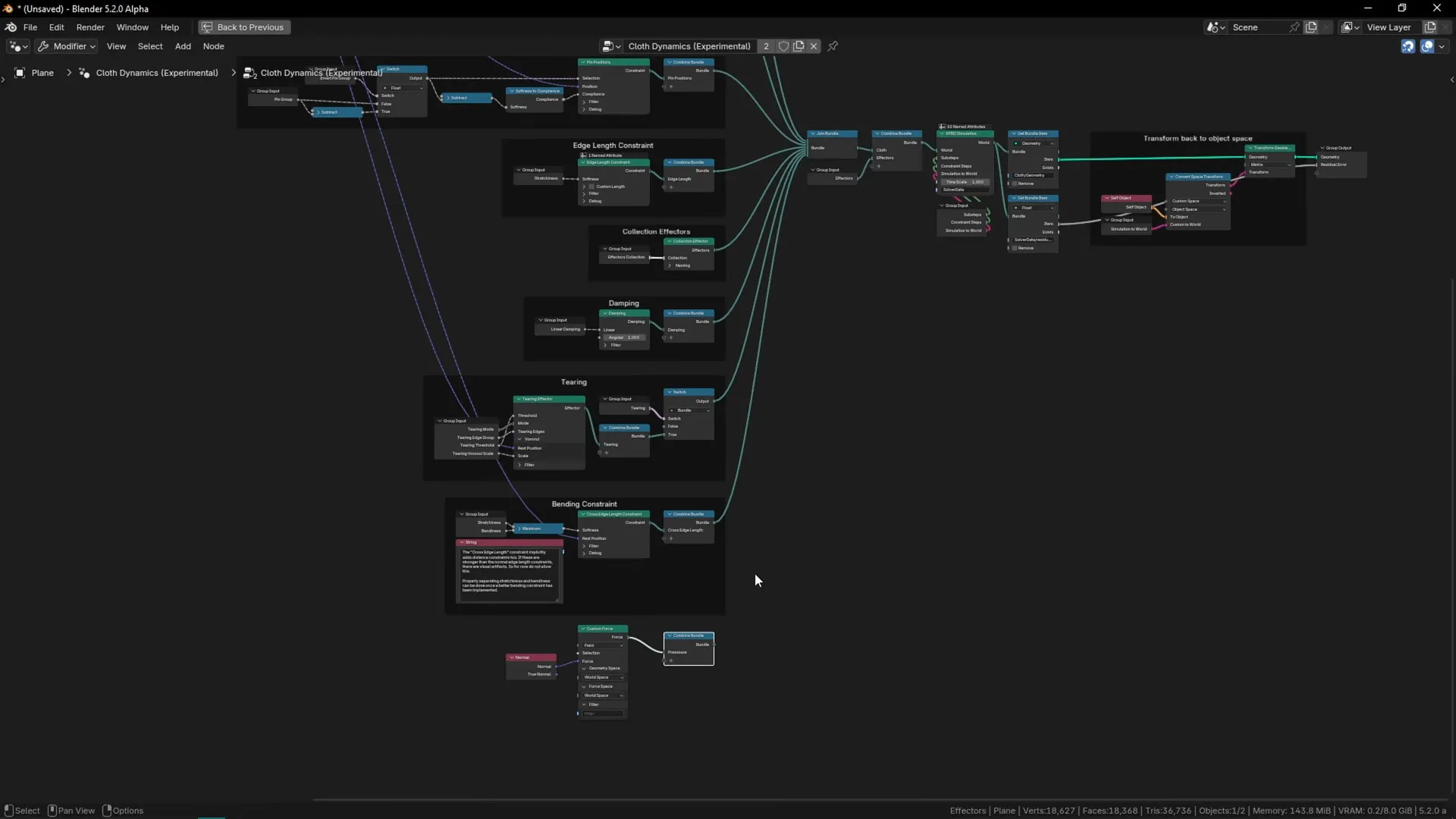
Traditionally, one of the weak points has been simulations, with even those working in Blender professionally offloading simulation to programs like Houdini. According to [3Dan], once version 5.2 is out of beta in July, that may become a thing of the past.
Simulations aren’t a necessary part of a 3D animation software, but they are very, very nice to have. If you want realistic-looking fluids, hair, or cloth, it’s incredibly difficult to animate it by hand. One, because there are so many degrees of freedom in, say, flapping cloth, keyframing is a major pain, but also figuring out how to make the model move and deform realistically is by no means trivial. It’s easier to offload all that on a physics simulation; then, as long as the physics is realistic, the animations will be as well.
That’s not easy, computationally speaking, and one thing that’s clear is there’s been work behind the scenes to optimize the simulation algorithms, not just improve the workflow, as the basic “drop cloth on a monkey head” demo now runs twice as fast. The new workflow itself bring simulations more into line with how Blender has been going– it’s part of geometry nodes now. So there’s simulation nodes you bring in, but that means things like tearing cloth become quite straightforward compared to the occasionally byzantine workarounds required before. This node-based workflow also brings Blender more into line with how paid software works these days.
[Dan] demonstrates the power of it by adding air pressure to a cloth simulation with some custom nodes, inflating and popping a fabric sphere. He also demonstrates how cloth simulation can be applied to animate realistic foliage. This update probably doesn’t have Houdini developer SideFX shaking in their boots, but it might allow some animators to stop paying that license and go fully-open source, which is great to hear.
While the work on the simulations engine is raising the bar on what was, traditionally, one of the weak points of the software, v5.2 brings oodles of improvements across the whole gamut of what blender can do– which is a lot. See them all on the official release notes. Even if you’re not into digital sculpting or animating, you may find yourself downloading a copy of Blender at some point to add texture to 3D prints, or make fancy resin-print miniature models FEM-friendly. The right addon can even let Blender do parametric CAD, if you want open-sorce and can’t stand FreeCAD. Though FreeCAD is getting better all the time, too.




No Jackpot Winner as $257 Million Prize Rolls Over to $269 Million Monday Draw


Weekend Open Thread: Miami – Corporette.com

Zimbabwe Requires Crypto Businesses to Register Annually Under New FIU Regulations

Wall Street Week Ahead: Investors see Micron earnings as pulse check of AI rally momentum

Matt Damon’s Viral Sci-Fi Thriller Has Taken Over HBO Max


HIVE shares jump as $220M AI deal speeds Bitcoin mining pivot


As AI companies race to go public, who else is along for the ride?


Anthropic staff to meet White House officials next week, Axios reports

Bitcoin could crash to $48,000, if this historical pattern is triggered

what doctors are seeing in ebike crashes

Tributes to former deputy head teacher at Cambridge school among death and funeral notices

Warning of disruption as Cardiff Crossrail works to start

Kate Middleton Glare Goes Viral After Kids Booed At Royal Event


“Israel’s” ban on ICRC visits ruled illegal, but Knesset moves to stop them permanently


XRP ETFs Outperform As Bitcoin And Ethereum Funds Extend Outflow Trend


Over 400 Arch Linux packages compromised to push rootkit, infostealer


Financial Accounting | Last Day Revision Strategy and Booster | CMA Inter – June 2026


Dick Advocaat’s Curacao scores first-ever World Cup goal against Germany


Invesco Quality Income Fund Q1 2026 Commentary


Singer Oliver Tree dies aged 32 in helicopter crash in Brazil


You must be logged in to post a comment Login