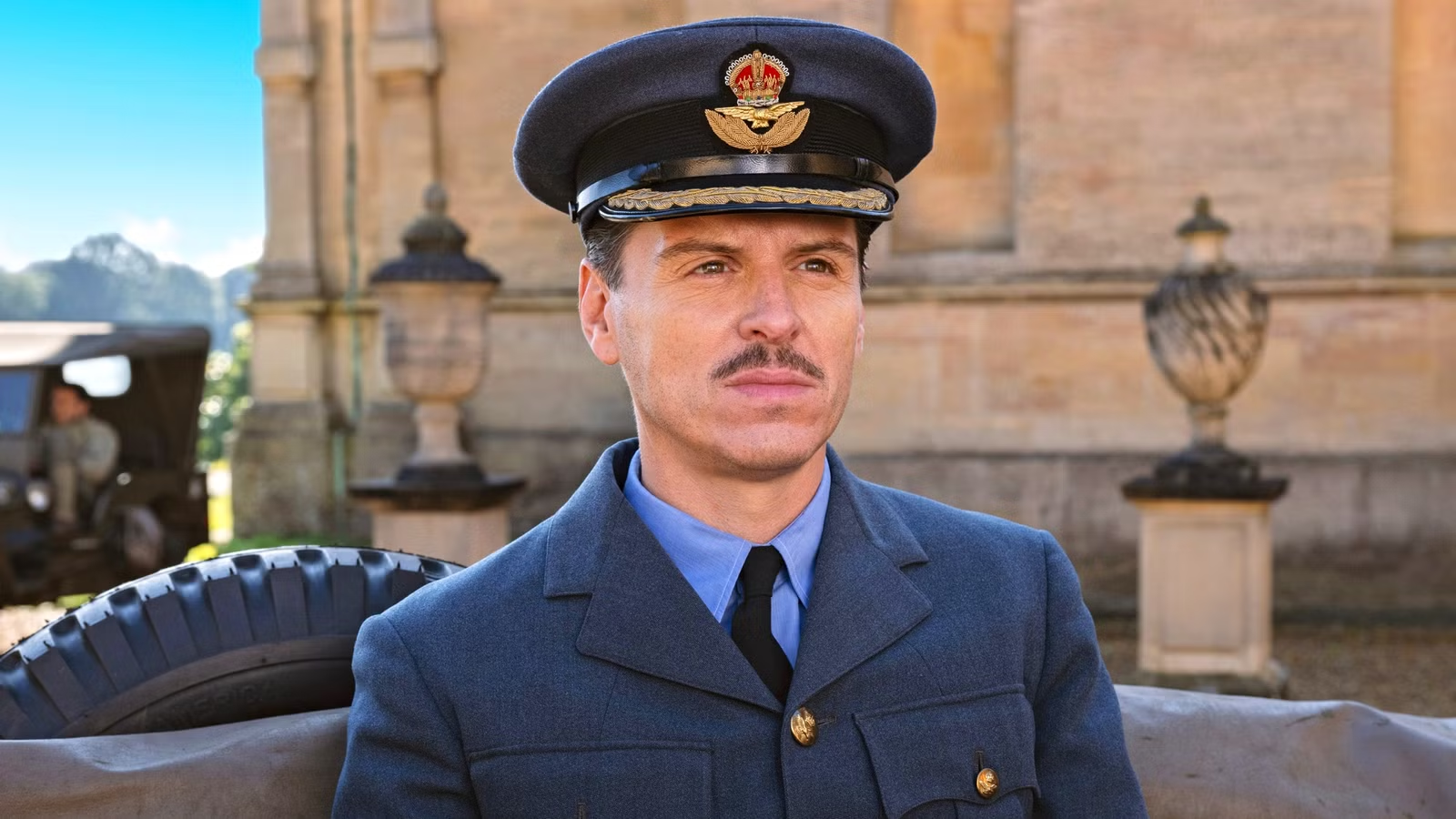
Andrew Scott in PressureImage via Focus Features/StudioCanal
After a strong theatrical run where it overtook a handful of older WWII movies, and more importantly, generated valuable awareness, the sleeper hit of 2026 has landed on the PVOD market. Unsurprisingly, it emerged as one of the most popular titles on home video almost immediately after its release. The movie never quite managed to earn the sort of nationwide theater count that movies such as The Mandalorian and Grogu and Disclosure Day have enjoyed, but it made the most of its limited theatrical run. It grossed around $15 million, exceeding the grosses of older WWII movies such as Nuremberg and Letters from Iwo Jima made during their domestic box-office runs.
According to FlixPatrol, the new movie is currently among the top five most popular titles on the domestic iTunes and Amazon charts, in the company of massive hits such as Michael and Project Hail Mary. The one metric that unites these three films, and most home video hits, is their terrific audience scores on Rotten Tomatoes. While Michael holds a “Verified Hot” 97% audience score on the aggregator website, Project Hail Mary and the WWII hit in question are both sitting at 95% scores. This practically guarantees a hugely successful home video run for the new film, which was aimed at the exact demographic — older male viewers — who prefer watching movies at home.
Advertisement
Advertisement
Collider Exclusive · Oscar Best Picture Quiz Which Oscar Best Picture Is Your Perfect Movie? Parasite · Everything Everywhere · Oppenheimer · Birdman · No Country
Five Oscar Best Picture winners. Five completely different visions of what cinema can be — and what it can do to you. One of them is the film that was made for the way your mind works. Ten questions will figure out which one.
🪜Parasite
🌀Everything Everywhere
☢️Oppenheimer
Advertisement
🐦Birdman
🪙No Country for Old Men
Advertisement
01
What kind of film experience do you actually want? The best movies don’t just entertain — they leave something behind.
Advertisement
02
Which idea grabs you most in a film? Great films are driven by a central obsession. What’s yours?
Advertisement
03
How do you like your story told? Form is content. The way a story is shaped changes what it means.
Advertisement
04
What makes a truly great antagonist? The opposition defines the protagonist. What kind of opposition fascinates you?
Advertisement
05
What do you want from a film’s ending? The final note is the one that lingers. What do you want it to sound like?
Advertisement
06
Which setting pulls you in most? Where a film takes place shapes everything — mood, stakes, what’s even possible.
Advertisement
07
What cinematic craft impresses you most? Every great film has a signature — a technical or artistic element that makes it unmistakable.
Advertisement
08
What kind of main character do you root for? The protagonist is the lens. Who you choose to follow says something about you.
Advertisement
09
How do you feel about a film that takes its time? Pace is a choice. Some films sprint; others let tension accumulate slowly, deliberately.
Advertisement
10
What do you want to feel walking out of the cinema? The best films leave a mark. What kind of mark do you want?
Advertisement
The Academy Has Decided Your Perfect Film Is…
Your answers have pointed to one Oscar Best Picture winner above all others. This is the film that was made for the way your mind works.
Advertisement
Parasite
You are drawn to films that operate on multiple levels simultaneously — that begin in one genre and quietly, brilliantly migrate into another. Bong Joon-ho’s Parasite is a film about class, desire, and the architecture of inequality that manages to be darkly funny, deeply suspenseful, and genuinely shocking across a single extraordinary running time. Your instinct is for cinema that hides its true intentions until the moment it’s ready to reveal them. Parasite is exactly that — a film that rewards close attention and punishes assumptions, right up to its devastating final image.
Advertisement
Everything Everywhere All at Once
You want it all — and this film gives you all of it. The Daniels’ Everything Everywhere All at Once is one of the most maximalist films ever made: action comedy, multiverse sci-fi, family drama, existential crisis, and a genuinely earned emotional core that sneaks up on you amid the chaos. You are someone who responds to ambition, who doesn’t want cinema to choose between being entertaining and being meaningful. This film refuses that choice entirely. It is overwhelming by design, and its overwhelming nature is precisely the point — because the feeling of being crushed by infinite possibility is exactly what it’s about.
Advertisement
Oppenheimer
You are drawn to cinema on a grand scale — films that understand history not as a backdrop but as a force, and that place their characters inside that force and watch what happens. Christopher Nolan’s Oppenheimer is a film about the terrifying gap between what we can do and what we should do, told with the full weight of one of the most consequential moments in human history behind it. You want your films to feel important without feeling self-important — to earn their ambition through sheer craft and the gravity of their subject. Oppenheimer does exactly that. It is enormous, complicated, and refuses easy comfort.
Advertisement
Birdman
You are drawn to films that foreground their own construction — that make the how of the filmmaking part of the what it’s about. Alejandro González Iñárritu’s Birdman, shot to appear as a single continuous take, is cinema examining itself through the cracked mirror of a fading actor’s ego. You respond to formal daring, to the feeling that a film is doing something that probably shouldn’t be possible. Michael Keaton’s performance and Emmanuel Lubezki’s restless camera create something genuinely unlike anything else — a film that is simultaneously about creativity, relevance, self-destruction, and the impossibility of ever truly knowing if your work means anything at all.
Advertisement
No Country for Old Men
You are drawn to cinema that trusts silence, that refuses to explain itself, and that treats dread as a form of meaning. The Coen Brothers’ No Country for Old Men is a film about the arrival of a new kind of evil — implacable, arbitrary, and utterly indifferent to the moral frameworks we use to make sense of the world. It is one of the most formally controlled films ever made, and its controlled restraint is what makes it so terrifying. You want your films to haunt you, not comfort you. You are not interested in resolution if resolution would be dishonest. No Country for Old Men is honest in a way that most cinema never dares to be.
Advertisement
Advertisement
The WWII Movie Is Competing with Box-Office Behemoths on PVOD
We’re talking, of course, about Pressure. The WWII drama-thriller stars Brendan Fraser and Andrew Scott in the lead roles, and unfolds in the tense 72 hours before D-Day. In addition to its excellent audience score, the film also holds a “Certified Fresh” 87% critics’ score on Rotten Tomatoes. The aggregator website’s consensus reads, “Finding a fresh angle on one of the most dramatized days in military history, Pressure is a brainy war film that derives most of its thrills from Andrew Scott’s simmering performance.” Fans of WWII storytelling can also tune into World War II with Tom Hanks, the epic 20-episode documentary series hosted by the Oscar-winner that’s airing on the History Channel. Hanks is also working on a sequel to his Apple TV blockbuster film, Greyhound. Stay tuned to Collider for more updates.
After a nearly five-year wait, Tom Holland‘s Spider-Man has finally returned to the big screen. Spider-Man: Brand New Day has been making a splash all week, with overwhelmingly positive reviews for the Marvel Studios and Sony collaboration getting fans even more excited in the days leading up to the theatrical debut. Now, at long last, Spider-Man: Brand New Day is playing in theaters everywhere, and fans are not only getting the chance to experience one of Marvel’s best movies in years, but they’re also getting a glimpse into what could become a bright future for at least a corner of the Marvel Cinematic Universe.
The closing act of Spider-Man: Brand New Day beautifully brings the story of the film to a close, but it also plants a few seeds for what’s coming next. Unlike many other MCU movies, Brand New Day doesn’t sacrifice its own plot and ending in favor of the grander universe. That said, there are some natural moments that use the closing of one door to subtly open another. There’s a lot to unpack with the ending of Brand New Day, and we’re going to dive deep into all of it here. It should go without saying that the rest of this article will have major spoilers for Spider-Man: Brand New Day. So, if you haven’t seen the movie yet, now is the time to bookmark this page and come back once you leave the theater.
Advertisement
What Happens to Spider-Man at the end of ‘Brand New Day’
Throughout Spider-Man: Brand New Day, Peter Parker (Holland) is at odds with his own evolution and inner psyche. He’s challenged by a terrifying threat that can seemingly control the minds of others at will, and the governmental agency known as Damage Control tasks him with eliminating said enemy. As many fans expected, that mind-controlling mastermind is none other than Jean Grey (Sadie Sink), who you probably know as one of the most prominent members of the X-Men.
Of course, Jean isn’t really the villain she’s made out to be, as she was only attacking Damage Control to save her sister, who had the same kind of dangerous powers and was ultimately killed by the organization during their rigorous experimentation. Peter, upon realizing he got it wrong, opts to try and save Jean — though she has the saving part handled. Her powers evolve, and she is on the verge of some catastrophic destruction that she could never take back, when Peter finally lets her into his mind, and she gets the classic power and responsibility talk from the late Aunt May (Marisa Tomei).
Spider-Man ultimately takes a bullet to the back to save Jean, but she returns the favor, hopping into his mind and keeping him alive until he can receive care. He recovers and resumes business as Spider-Man, now with MJ (Zendaya) and Ned (Jacob Batalon) once again at his side. Peter and MJ aren’t romantically involved at this point, because she doesn’t remember their history. The final moment ahead of the credits, however, does hint that Ned gets his memories of Peter back after the two share their signature secret handshake.
Jean Grey and the X-Men in ‘Spider-Man: Brand New Day’
Advertisement
Image via Marvel Comics
The arrival of Sink’s Jean Grey marks the MCU’s first real foray into its own version of the X-Men — the only X-Men appearances to this point have been legacy cast from the Fox franchise. She is given an alternative origin story and an evolving set of powers, but she’s still very young, and acting entirely on her own.
At this point, as far as we know, Jean hasn’t met any of the other X-Men characters yet. Some flashback scenes with her sister reveal that their mother “sent them away” after learning about their powers, but there isn’t any indication that they were shipped off to Xavier’s School for Gifted Youngsters. It just seems like the two of them are on their own and on the run.
After saving Spider-Man, Jean disappears from New York City. In her final scene in the movie, Jean is riding a bus away from the city, potentially to Upstate New York, or another less populated area in the Northeast. She doesn’t say where she’s going, but it’s safe to assume she’s going to wind up crossing paths with Charles Xavier.
Advertisement
‘Spider-Man: Brand New Day’ Post-Credits Scene Sets Up the Avengers
The MCU has made post-credits scenes a tradition and, during several minutes of credits, it feels as though Spider-Man: Brand New Day is going to actually buck the trend. When the Sony logo appears after the credits, it does feel as though there isn’t going to be anything else.
That changes when Ned’s Spider-Man tracking app reappears on the screen. There aren’t any characters or any dialogue, but the tracker program shows another Spider-Man sighting, and begins zooming out from New York. The screen takes viewers away from our planet entirely before announcing the presence of a Spider-Man somewhere out in space.
This is, of course, teasing the upcoming Avengers: Secret Wars. Based off the Secret Wars comic books, timelines and alternate universes are going to converge in the film, resulting in multiple versions of the same character appearing together. The place known as Battleworld in the comics is ultimately where a lot of these variants duke it out in order to become the lone version of their character. The post-credits scene in Brand New Day is definitely hinting at Secret Wars, and potentially teasing some sort of Spider-Man gathering on a Battleworld. Unlike most MCU characters, though, several Spider-Man variants already know one another and have a solid friendship. There probably won’t be a lot of battling if Peter 1, Peter 2, and Peter 3 get together again.
Advertisement
Following that little animation is the all-important Marvel message: “Spider-Man Will Return.” Not that there was any doubt Spider-Man would appear in Avengers: Secret Wars but this essentially confirms it.
Advertisement
Release Date
Advertisement
July 31, 2026
Runtime
145 Minutes
Advertisement
Director
Destin Daniel Cretton
Writers
Advertisement
Chris McKenna, Erik Sommers, Steve Ditko, Stan Lee
Producers
Amy Pascal, Kevin Feige, Rachel O’Connor, Avi Arad
Utah beauty queen Brynn Carneseccadied by suicide at age 21 mere weeks before she was scheduled to compete in her next pageant.
“She took her own precious life, but she is more than what happened to her,” Brynn’s mother, Michele Carnesecca, told mourners at a candlelight vigil on Tuesday, July 28, per KSL News. “We would like to celebrate the amazing life she lived.”
Many of Brynn’s friends and family gathered at the vigil in American Fork, Utah, to celebrate the life and immense legacy of the pageant competitor.
“Oh, how she loved to laugh,” Michele told the local outlet. “What sets Brynn apart is that her life was all about service.”
Former Miss Universe Jamaica contestant Tyra Spaulding has died after expressing struggles with her mental health. She was 26. Spaulding’s body was reportedly found at her apartment by her family on Tuesday, September 23, according to Caribbean National Weekly. Police are investigating her death as a possible suicide, the outlet reported. The Miss Universe Jamaica […]
She added, “Brynn loved her family and friends fiercely and was always there when you needed her. She was so loved.”
Advertisement
Brynn was crowned Miss American Fork in 2024 and later received the Miss Congeniality Award from her fellow competitors at Miss Utah in 2025. She was scheduled to compete next at Miss Provo on August 22, according to her Instagram bio.
Aside from her pageant success, Brynn was an accomplished journalist and activist. She founded Envelopes of Hope in 2024 to foster penpal relationships between her local community and its incarcerated population.
“I’ve seen so many lives change and how much empathy and connection can be built through these letters,” she told KSTU about Envelopes of Hope in September 2025. “As we reach out through this program, our worldview expands, and I’ve seen some amazing friendships take shape.”
Following her death, the Miss American Fork organization highlighted the “impact” Brynn made on her local pageant scene.
“Our forever Miss American Fork 2024, Brynn Carnesecca has passed away,” the organization wrote via Instagram on Monday, July 27. “She made a great impact on our community and beyond and are grateful for her memory and impression on the Miss American Fork organization. We are deeply touched from her loss.”
Advertisement
Brynn was also associated with Utah Miss Amazing, an organization that promotes self-esteem for young women and girls with disabilities.
“Brynn’s kindness, compassion, and genuine heart made a lasting impact on everyone she met. She had a beautiful way of making our queens feel seen, supported, and loved. Whether she was cheering someone on, sharing a smile, or simply being present, Brynn embodied what Miss Amazing is all about,” a Utah Miss Amazing statement read. “We are so grateful for the time she spent with our Utah Miss Amazing family. Her light will continue to shine through the lives she touched and the memories we will forever cherish.”
Wualys Aquino, who competed to be Miss Universe Tegucigalpa pageant in Honduras, has died. She was 23. “The Miss Universe Tegucigalpa organization deeply mourns the passing of our runner-up, Wualys Aquino,” the organization wrote via Instagram on Tuesday, July 21, originally in Spanish and translated in English by Us. “We wish to express our condolences to […]
Brynn’s cousin, Kassidy Jackman Murdoch, recently set up a GoFundMe page to help the Carnesecca family navigate this difficult time. As of publication, the fundraising appeal has raised more than $28,000.
Thank You!
You have successfully subscribed.
Advertisement
“Our family is heartbroken by Brynn’s unexpected passing. We want to honor her memory in a way that reflects her spirit and the love she gave to so many. Brynn touched countless lives through her work and her generosity, and we hope to celebrate her legacy with a meaningful memorial,” Jackman Murdoch wrote on the fundraising page.
Her statement went on, “Your support will help the family cover funeral expenses, create a memorial that truly honors Brynn, and provide comfort to her loved ones as we navigate this difficult time. We are grateful for any help you can offer. Please consider donating or sharing this fundraiser to help us honor Brynn and support our family.”
If you or someone you know is struggling or in crisis, help is available. Call or text 988 or chat at 988lifeline.org.
Whew! India Royale has social media sounding off after sharing her latest thoughts on relationships and commitment. Her post quickly sparked a debate over what matters most in a relationship, with many users also weighing in on her longtime relationship to rapper Lil Durk.
India Royale Says “Everything But A Ring” Is Better Than “Nothing But A Ring”
On Wednesday, July 29, India Royale shared a statement on X without any additional context. While the post was only a few words long, it quickly caught the attention of social media users and sparked a conversation about marriage and commitment.
She wrote, “Everything but a ring > Nothing but a ring.”
As the discussion continued, one user replied, “How about everything & the ring? No settling.” India later responded with a simple, “Absolutely.”
Advertisement
Social Media Reacts
As the debate continued, users flooded The Shade Room Teens’ comment section with their own opinions on India Royale’s perspective.
Instagram user @key_babyyy wrote, “Nah it makes sense yall stay tryna force marriage on ppl because yall hate to see ppl have kids and have material things. yall dont got lmfao but ppl in marriages hate each other, cheat on each other, with each other for the wrong reasons just mind, yall business!!!”
Another Instagram user @ihrtlae wrote, “She trynna reverse psychology us 😂”
While Instagram user @tyniaa.sha_ wrote, “Everything w/ a ring is an option ladies don’t forget that!”
Advertisement
Instagram user @_she_said_so_1 wrote, “Am I the only one who thinks she just saying she missed Durk”
Another Instagram user @oh.dats_amiracle wrote, “I think it’s subjective honestly don’t marry someone who isn’t fulfilling u and don’t stay with someone who doesn’t want to commit to u simple/
While Instagram user @feliceladylovepink wrote, “She had everything before she married durk & now she has the ring & he’s in jail, that’s probably what she saying… Nothing without the one u love”
Instagram user @ivydiariess wrote, “Yeah that’s how much social media has brainwashed yall lol”
Advertisement
Another Instagram user @kadeemcvisions wrote, “The girls getting mad, she’s right. F*** that ring, dont make up for nothing. If you beleive in innder deep love within two spirits”
While Instagram user @cinyeaa wrote, “Truee but coming from a person with a ring is crazy 😂”
India Royale Previously Shut Down Rumors About Her Relationship With Lil Durk
Earlier this year, India Royale addressed speculation surrounding her relationship with Lil Durk after social media users claimed she was distancing herself from the rapper while he remains behind bars. The rumors gained traction after a post on X alleged that she skipped one of his court hearings and pointed to photos of India posing with another man.
India pushed back on the claims. In a series of posts on X, she referred to Lil Durk as her “husband” before telling critics to “stop with the false narrative.” She also responded to another post by writing, “Can’t believe so many people lack common sense.”
There’s no single definition of a great thriller. However, what most of them have in common is a sense of tension. Now, the way this tension is created can vary dramatically from film to film. Some thrillers build suspense through psychological mind games, while others rely on shocking twists that completely reframe the narrative in a single moment. A memorable thriller doesn’t just surprise the audience, though — it traps them, makes them question everything, and refuses to play by any rules.
When a film leaves the viewers desperate to know what happens next, that’s when it’s doing something right. Over the years, filmmakers have approached countless ways to build this tension, but only a few have truly mastered it. This is a list of eight such suspenseful thrillers that know exactly when to tighten the noose.
Advertisement
8
‘Anatomy of a Fall’ (2023)
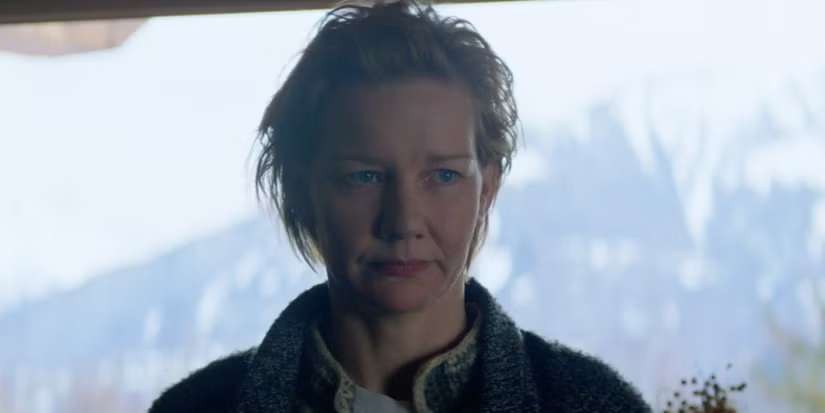
Close up shot of Sandra Hüller in ‘Anatomy of a Fall’Image via NEON
Anatomy of a Fallis an intense, entertaining take on the courtroom drama. The film, directed by Justine Triet, opens with a man being found dead outside his remote chalet in the French Alps. His wife, Sandra Voyter (Sandra Hüller), insists it was an accident or possibly suicide. However, as the investigation unfolds, small inconsistencies lead to the case escalating into a courtroom trial where every detail of the couple’s marriage is called into question. Their visually impaired son, Daniel (Milo Machado-Graner),is the only real witness to the events surrounding his father’s death, which complicates things even more. Anatomy of a Fall is structured like an intricate puzzle where every new piece of information complicates the situation.
However, the procedural format never takes away from the gravity of Sandra and her husband’s fractured relationship. Hüller delivers an extraordinary performance, and her character’s emotional ambiguity is what fuels the narrative. This results in a story that isn’t merely about solving a crime. Instead, Anatomy of a Fall dissects the fragile dynamics of marriage, resentment, and grief. By the time the trial concludes, the audience is left with a lingering sense of doubt. The film builds suspense through uncertainty instead of relying on traditional twists or grand reveals. This layered, human approach is what makes it such a compelling thriller.
Advertisement
7
‘The Game’ (1997)
Image via PolyGram Films
David Fincher’s The Gameis the perfect example of a well-executed thriller. The film stars Michael Douglasas a wealthy but emotionally detached investment banker, Nicholas Van Orton, living in San Francisco, who receives an unusual gift from his estranged brother Conrad (Sean Penn) on his 48th birthday. The gift in question is an invitation to participate in an elaborate entertainment experience, known as a “game,” run by a mysterious company called Consumer Recreation Services. At first, Nicholas assumes it’s just a harmless distraction. However, things take a turn when strange things start happening in his everyday life. As the game intensifies, Nicholas finds TV broadcasts speaking directly to him, people start following him, his business reputation is threatened, and his money starts vanishing.
The film then becomes a masterclass in paranoia and unpredictability, where the protagonist stops trusting anyone and is constantly questioning his reality. What’s genuinely heartbreaking is when he learns that his alliance with a waitress named Christine (Deborah Kara Unger) might also be a part of the game. However, this kind of shock is exactly why The Game is such an effective thriller. Fincher creates a destabilizing experience for both Nicholas and the audience, which makes every twist feel unsettling but plausible at the same time. This growing sense of tension makes the final reveal land with absolute perfection, solidifying The Game as one of the most suspenseful thrillers of all time.
Advertisement
Advertisement
Collider Exclusive · Action Hero Quiz Which Action Hero Would Be Your Perfect Partner? Rambo · James Bond · Indiana Jones · John McClane · Ethan Hunt
Five legends. Five completely different ways of getting out alive — with style, with muscle, with charm, with luck, or with a plan so intricate it probably shouldn’t work. Ten questions will reveal which action hero was built to have your back.
🎖️Rambo
🍸James Bond
🏺Indiana Jones
Advertisement
🔧John McClane
🎭Ethan Hunt
Advertisement
01
You’re dropped into a dangerous situation with no warning. What do you need most from a partner? The first few seconds tell you everything about who belongs beside you.
Advertisement
02
You have to get somewhere dangerous, fast. How do you travel? How you get there is half the mission.
Advertisement
03
You’re pinned down and outnumbered. What does your ideal partner do? This is when you find out what someone is really made of.
Advertisement
04
The mission is paused. You have one evening to decompress. What does your partner suggest? Who someone is when the pressure drops is who they actually are.
Advertisement
05
How do you prefer your partner to communicate mid-mission? Good communication is the difference between partners and a liability.
Advertisement
06
Your enemy is powerful, well-resourced, and has the upper hand. How should your partner approach them? The approach to the enemy defines the partnership.
Advertisement
07
Things go badly wrong and you’re captured. What do you trust your partner to do? Who someone is when you need them most is the only thing that matters.
Advertisement
08
What does your ideal partner bring to the table that you couldn’t replace? A great partner fills the gap you didn’t know you had.
Advertisement
09
Every partnership has a cost. Which of these can you live with? No one comes without baggage. The question is whether you can carry it together.
Advertisement
10
It’s the final moment. Everything is on the line. What do you need from your partner right now? The last question is the most honest one.
Advertisement
Your Partner Has Been Assigned Your Perfect Partner Is…
Your answers have pointed to one action hero above all others. This is the person built to have your back — for better or considerably, spectacularly worse.
Advertisement
Rambo
Your partner doesn’t talk much, doesn’t need to, and will have assessed every threat in your immediate environment before you’ve finished your first sentence. John Rambo is not a man of plans or politics — he is a force of nature shaped by survival, loyalty, and a capacity for endurance that goes beyond anything training can produce. He will not leave you behind. He has never left anyone behind who deserved to come home. What you get with Rambo is the most capable, most quietly ferocious partner imaginable — one who has been through things that would have broken anyone else, and who chose to keep going anyway. You’ll never need to ask if he has your back. You’ll just know.
James Bond
Advertisement
Your partner will arrive perfectly dressed, perfectly briefed, and with a cover story so convincing it’ll take you a moment to remember what’s actually true. James Bond is the most professionally dangerous person in any room he enters — and the most disarmingly charming, which is the point. He operates in a world of layers, where nothing is what it appears and every advantage is used without apology. You’ll never be bored. You’ll occasionally be furious. But when it matters — when the mission is genuinely on the line and the margin for error has collapsed to nothing — Bond is exactly the partner you want. He has survived things that have no business being survivable. He does it with style. That is not nothing.
Indiana Jones
Your partner will know the history, the language, the cultural context, and exactly why the thing everyone else is ignoring is actually the most important thing in the room. Indiana Jones is brilliant, reckless, and occasionally impossible — but he is also one of the most resourceful, most genuinely knowledgeable partners you could find yourself beside. He approaches every situation with a scholar’s eye and a brawler’s instinct, which is an unusual combination and a remarkably effective one. He hates snakes and gets personally attached to objects of historical significance, both of which will slow you down at least once. It doesn’t matter. What Indy brings is irreplaceable — and the adventures you’ll have together will be the kind people write books about. Assuming you survive them.
Advertisement
John McClane
Your partner was not supposed to be here. He does not have the right equipment, the right information, or anything approaching the right odds. He has a sarcastic remark and an absolute refusal to accept that the situation is as bad as it looks. John McClane is the greatest accidental hero in the history of action cinema — a man whose superpower is stubbornness, whose contingency plan is improvisation, and whose capacity to absorb punishment and keep moving would be alarming if it weren’t so useful. He will complain the entire time. He will make it significantly more chaotic than it needed to be. And he will absolutely, unconditionally, without question come through when it counts. Yippee-ki-yay.
Advertisement
Ethan Hunt
Your partner has already run seventeen scenarios by the time you’ve finished reading the briefing, and the plan he’s settled on involves at least two things that should be physically impossible. Ethan Hunt operates at the absolute edge of human capability — technically, physically, and intellectually — and he brings the same relentless precision to protecting his partners that he brings to dismantling organisations that shouldn’t exist. He is not easy to know and he will never fully tell you everything. But he will carry the weight of the mission so completely, so absolutely, that your job is simply to trust him — and the remarkable thing is that trusting him always turns out to be the right call. The mission will be impossible. He will complete it anyway.
Advertisement
6
‘Rear Window’ (1954)
Image via Paramount Pictures
Advertisement
No list of suspense thrillers would ever be complete without this Alfred Hitchcockmasterpiece. Rear Windowhas to be one of the director’s most influential works and proves just why he was known as the “Master of Suspense.” The film follows photojournalist L.B. “Jeff” Jefferies (James Stewart), who is stuck in his Greenwich Village apartment with a broken leg after a dangerous assignment. To kill time, Jeff begins watching his neighbors across the courtyard through his rear window. However, his harmless curiosity turns into something far more dangerous when one of them begins to stand out for all the wrong reasons. Lars Thorwald (Raymond Burr) is a traveling salesman who lives with his wife, who is often sick. Jeff notices him making several late-night trips carrying a suitcase, soon after which his wife mysteriously disappears.
The more Jeff watches, the more convinced he is that Thornwald has murdered her with the help of his girlfriend Lisa Fremont (Grace Kelly)and nurse Stella (Thelma Ritter).That kicks off an investigation based entirely on observation. Jeff can’t leave his wheelchair, so he relies on binoculars and instincts to piece together what really happened. Hitchcock places the audience in the same position as Jeff and restricts them to his confined perspective. This brilliant setup heightens every little movement and conversation and makes the viewers feel like active participants in this baffling mystery. Rear Window remains just as gripping decades later and proves that a great thriller doesn’t need to rely on spectacle to leave an impact.
5
‘Zodiac’ (2007)
Jake Gyllenhaal as Robert Graysmith in Zodiac.Image via Paramount Pictures
Advertisement
Zodiacis another Fincher thriller that remains the benchmark for the genre. The film turns one of America’s most infamous unsolved crimes into a cinematic experience that stays with the audience long after the credits roll. The story follows the real-life manhunt for the Zodiac Killer, who terrorized the San Francisco Bay Area in the late 1960s and early 1970s. The film unfolds through the perspectives of three men whose lives become consumed by the case: political cartoonist Robert Graysmith (Jake Gyllenhaal), crime reporter Paul Avery (Robert Downey Jr.), and homicide inspector Dave Toschi (Mark Ruffalo).Graysmith, in particular, becomes increasingly fascinated by the killer’s cryptic letters to the police and newspapers and begins an investigation of his own to decode them.
However, this curiosity slowly turns into an obsession and pushes Graysmith into a web of complicated clues that seem to lead nowhere. The film explores how the case takes a toll on everyone involved and attempts to center the story on the painful process of investigation itself. Zodiac isn’t really interested in finding who the killer is and deliberately avoids the usual beats a crime thriller would typically follow. The tension here comes from watching these people chase lead after lead, only to end up with nothing. That lingering uncertainty makes the climax all the more shocking. Zodiac mirrors the frustration that defined the real mystery of the killer and perfectly captures the psychological toll of it all.
Hitchcock’s Psychois just one of those films that never get old. In fact, it remains a defining moment in the evolution of modern horror and thriller storytelling. The story begins with Marion Crane (Janet Leigh) impulsively stealing $40,000 from her employer and going on the run in hopes of starting a new life with her boyfriend. During her drive, she runs into a terrible storm and decides to pull over at the quiet roadside Bates Motel. The establishment is run by the polite but socially awkward Norman Bates (Anthony Perkins), who lives in a giant Victorian house overlooking the property with his overbearing mother. The story plays out like a traditional crime drama centered on Marion before Hitchcock subverts all expectations, and the audience witnesses her shocking murder in the now-iconic shower scene.
As Marion’s sister Lila(Vera Miles) and boyfriend Sam Loomis (John Gavin) begin searching for her, the investigation slowly leads them back to the eerie motel and the secrets hidden inside Norman’s house. The narrative unfolds slowly, and the audience gradually uncovers that the motel owner is far more complicated and terrifying than he initially seems. Perkins’s performance definitely deserves a mention here because his portrayal of Norman is the heart of the film. That’s exactly what makes the final reveal and Norman’s eventual descent into madness land so perfectly. Looking back, the brilliance of Psycho lies in how carefully the director builds up to that one moment, and it is the reason why the film has stood the test of time.
3
‘The Silence of the Lambs’ (1991)
Clarice Starling staring at Hannibal Lecter as his reflection looms in the glass in The Silence of the LambsImage via Orion Pictures
Advertisement
The Silence of the Lambsis undisputedly one of the greatest psychological thrillers ever made. The film follows FBI trainee Clarice Starling (Jodie Foster), who is tasked with helping track down a brutal serial killer known as Buffalo Bill(Ted Levine). Now, to understand the mind of a killer, Clarice is sent to interview imprisoned psychiatrist and cannibalistic murderer Dr. Hannibal Lecter (Anthony Hopkins). The catch is that Lecter only agrees to offer clues about Buffalo Bill if Clarice reveals deeply personal details about her own past to him. This uneasy dynamic is the center of the story as Clarice pieces together fragments of information about Buffalo Bill’s disturbing motives while navigating her strange relationship with Lecter.
Their conversations feel like a cat-and-mouse game where Lecter is constantly trying to manipulate and analyze Clarice’s fears. On the other hand, Buffalo Bill continues abducting women, which raises the stakes of the investigation and pushes the FBI trainee to rely on Lecter’s transactional guidance. The film builds suspense by focusing on its characters and their psychology. The horror is rooted in the conversations between Clarice and Lecter rather than momentary shocks. The Silence of the Lambs is a must-watch for anyone who appreciates the art of a slow burn.
2
‘Shutter Island’ (2010)
Mark Ruffalo as a US Marshal sitting at a table in Martin Scorsese’s ‘Shutter Island’Image via Paramount Pictures
Advertisement
Shutter Islandmarked a turning point for modern era psychological thrillers. The film, adapted from Dennis Lehane’s 2003 novel of the same name, is set on an eerie, remote island that houses a psychiatric hospital for the criminally insane. The story follows U.S. Marshal Teddy Daniels (Leonardo DiCaprio) and his partner Chuck Aule (Mark Ruffalo) as they arrive on the island to investigate the disappearance of Rachel Solando, a patient who drowned her three children and somehow vanished from her locked hospital ward. Things only get stranger from there; when Teddy begins questioning doctors and patients, he realizes that everyone at the hospital is hiding something. Meanwhile, Teddy starts experiencing disturbing migraines, flashbacks, and extremely vivid dreams about his late wife, who died in a tragic fire.
All of this leads him to believe that something sinister is happening on the island, and he is entangled in rumors of secret experiments and impossible conspiracies. However, every conversation and clue pushes him further into a state of confusion. After a while, both Teddy and the audience begin to question what is real and what might just be an illusion. The film slowly builds up to what is easily one of the most memorable plot twists Hollywood has ever seen — one that completely recontextualizes the entire story. Ultimately, Shutter Island revolves around a man who is gradually confronting the darkest corners of his own mind. It’s a psychological puzzle that gets better with every rewatch and never loses its thrill.
1
‘Seven’ (1995)
close up of Detective Mills (Brad Pitt) aiming a gun in Seven.Image via New Line Cinema
Advertisement
Sevenmight just be one of the darkest thrillers Fincher has ever delivered. The film is unsettling from the get-go, and it refuses to offer the audience or its characters any respite. The story follows veteran detective William Somerset(Morgan Freeman) and his new partner David Mills (Brad Pitt) as they chase a serial killer whose crimes are inspired by the seven deadly sins. Things kick off with a disturbing murder scene where an obese man has been forced to eat until he dies, a crime that represents gluttony. When another victim is discovered with the words “greed” marked at the crime scene, Somerset realizes this is the work of an extremely methodical killer operating with a twisted moral compass.
What makes Seven such a compelling movie is the interesting dynamic between the thoughtful and patient Somerset and the younger, much more impulsive Mills, who grows increasingly frustrated as the killer keeps getting away. The film’s final act is what cements Seven as an unforgettable experience as the antagonist (Kevin Spacey) reveals that he committed the sin of envy and delivers that now-infamous Box to Mills. Seven ends on a devastating note that leaves everyone shaken because, despite everything, the killer’s plan works exactly as he intended. This bleak storytelling and relentless sense of dread make Seven a masterclass in suspense.
The world heard from Nolan Wells‘ self-proclaimed best friend, Warren Hudson, last week. In a three-part interview, Hudson explained how July 4 allegedly unfolded, from boarding the boat to returning Nolan’s phone. Now, his father is offering $50,000 for information surrounding the death.
According to TMZ, Dr. Benjamin Hudson is the latest to put up a reward for information about the death of Nolan Wells. Dr. Hudson is reportedly offering the money that “leads to the arrest and conviction of the person responsible for Nolan’s death.”
“We don’t know that anyone had any involvement, but we care about Nolan and want to find out what happened,” Dr. Hudson told TMZ.
Benjamin made it clear that he doesn’t think the teenagers who were on three boats on July 4 had anything to do with the death. He told TMZ again, “We still don’t know what happened.” Dr. Hudson said he’s hoping the $50,000 reward will encourage someone to come forward with credible information. He believes potential witnesses aren’t speaking because of the public pressure surrounding the case. “We feel people aren’t talking because of the pressure of the case,” Dr. Hudson said.
Meanwhile, local law enforcement has suggested Nolan Wells’ death was an accidental drowning. Additionally, the Jackson County District Attorney’s Office has moved to seal the official autopsy report until a grand jury reviews it. A toxicology report is still pending. Meanwhile, an independent autopsy conducted in Washington, D.C., could not rule out foul play and listed “undetermined” for cause of death.
Advertisement
Dr. Benjamin Hudson Claims His Family Is Receiving Death Threats
Speaking to TMZ, Dr. Hudson also alleged that his family has been “living through a nightmare” since Nolan’s case went viral. He claims his family has received thousands of death threats. Hudson adds that he believes that’s also an obstacle for investigators gathering information.
Another man who was present on Horn Island on July 4 has also claimed he’s receiving death threats. Bart Edmiston Jr. secured a lawyer, who released a statement saying so and threatened to go after online creators and anyone else spreading unfounded misinformation in the case. So far, at least one cease-and-desist has been issued to creator Kymbra Li.
“Officer” Brandon Tatum Reacts To Backlash Over Warren Hudson Interview
Following the release of part two of his interview with Warren Hudson, Brandon Tatum clapped back at internet users calling him out for giving Hudson a platform. He took aim at “ignorant melanated people” and claimed they want him to “hate white people.”
“I have said from the very beginning that I support finding out what happened to Nolan Wells. Everybody want to know what happened to Nolan Wells, when I talked to the young boys, they want to know what happened to Nolan Wells cause they weren’t there when he apparently died. But you want me to go out on a limb and hate these young boys because they white. You want me to hate white people. I’m not doing it. I’m not going to hate people because of the color of their skin,” Tatum said on Threads.
Still, the backlash has persisted. Most recently, Pastor Jamal Bryant took to the same platform to allege that Tatum is allegedly related to someone who snitched about the Denmark Vesey uprising in South Carolina back in 1822. The intercepted slave rebellion led to the arrests and hanging of at least 35 people.
Below Deck: Sailing Yacht alum Alli Dore revealed the results of her recent rib contouring procedure.
“Just under halfway at 5.5 weeks out of 12 and already convinced this is the best thing I’ve done,” Alli, 38, wrote via Instagram on Tuesday, July 28. “Thank you to the @_snatchedwaist team for making this such a positive experience!”
Alli’s post, which was marked as a paid partnership Snatched Waist, included a side by side comparison of her midsection. Prior to the treatment, Alli donned a yellow bikini and she showed off her figure. For the end results, she wore black strapless bikini and flaunted her slimmed down waist.
The former reality star also teased that she will be sharing her “best recovery tips” later.
Remi Bader showed off her bikini body. Bader, 30, took to Instagram on Monday, July 7, to show off her figure after undergoing weight loss surgery in December 2023. In the snap, she rocked a gingham bikini by For Love and Lemons while promoting her mini fan, which launched on Tuesday, July 8. Her blue-and-white […]
Alli’s procedure reveal had mixed reactions amongst fans. Several expressed their concerns in the comments section.
Advertisement
“I’m so sorry u felt u needed to do this to yourself, I admired u from the first time I saw u on BD but this looks painful and so unnecessary for such a beautiful woman. 🤗 Not hating on u just concerned xo,” one user wrote while another replied, “I just want to say your body was so beautiful before and I feel so sad that you felt the need to do this. 💔.”
Multiple users reminded others to be mindful of what they’re saying and avoid spreading negativity.
“As women, let’s celebrate whatever makes another woman happy ❤️,” one person wrote while another shared, “This looks similar to my starting shape 😍 love it.”
Last month, Alli flew to Sanur, Bali with a group of influencers and former reality stars as they all underwent Snatched Waist’s procedure. According to the Snatched Waist website, the treatment does not remove a person’s ribs. Instead it is a “rib recontouring” process that uses liposuction to remove fat and then reshapes the lower ribs via an ultrasound. Following the ultrasound, the patient wears a fitted corset for 12 weeks.
Love Is Blind’s Alexa Lemieux revealed that she underwent a breast augmentation and now is on the road to recovery. “My girls got a little ✨makeover✨ @Solomon Plastic Surgery,” the Netflix personality, 31, shared alongside a TikTok video on Tuesday, January 13, detailing what she had done in the clip captioned, “Get unready with me […]
Alli explained that the surgery was “minimally invasive” and she was inspired to get the procedure done after welcoming son River George in 2021.
“After having a baby I had rib flare and I’ve always wanted an hourglass waist so I was excited for this procedure,” she wrote via Instagram in June. “I’ll continue to share my recovery journey and I’ll post some before and after photos when my shape starts to show ✨.”
Alli appeared on Below Deck: Sailing Yacht season 3, which aired in 2022. The Australia native served as the ship’s third stewardess.
The idea of a “Glee curse” has lingered for years, fueled by the tragic deaths of three cast members. While some continue to point to those heartbreaking losses as evidence the show is “cursed,” Kevin McHale is pushing back against the narrative, arguing that it unfairly overshadows the lives of those involved.
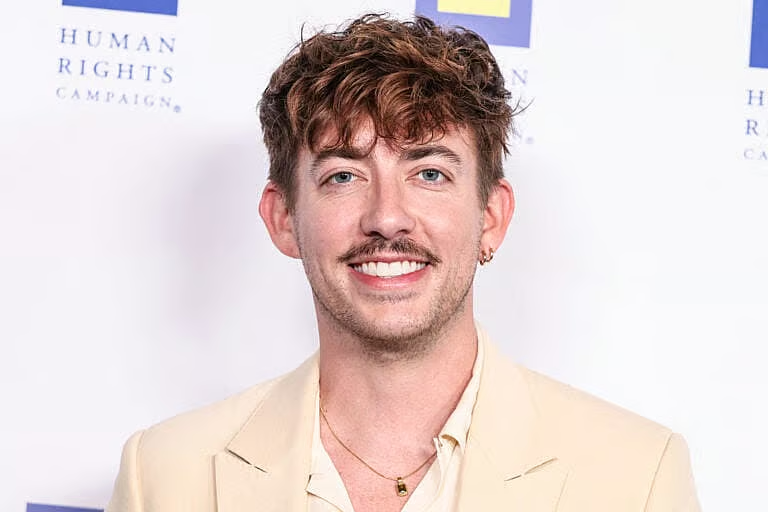
Xavier Collin/Image Press Agency/MEGA
The “Glee” curse narrative emerged following the deaths of some cast members. It gained traction following the release of the three-part miniseries, “The Price of Glee,” in which the tragic passing of Cory Monteith, Mark Salling, and Naya Rivera were explored.
Kevin McHale, who played Artie Abrams in the musical TV series, took to X on July 29 to share his thoughts about the so-called curse surrounding the show.
“Let me log off today because the way too many of you talk about real people who have passed as a ‘sacrifice’ or a ‘curse’ in regards to a tv show is f-cking diabolical and untethered from any sort of humanity or reality. get f-cked,” McHale wrote.
Advertisement
Many agreed with the actor’s sentiment. One user noted, “It’s so f-cking disrespectful to their memory and to their families and friends.” “When entertainment starts making people forget they’re talking about actual human beings, it’s time to step away from the screen,” another added.
The Actor Previously Talked About The ‘Curse’
In an interview on “Elvis Duran and the Morning Show” in 2024, McHale discussed the so-called curse, admitting that they make jokes about it.
“The amount of times we’ve said some things that everyone gets really quiet, we’re like, ‘No no. Understand, if we don’t laugh about this, we will all just be sad, cause it’s insane. It really is crazy,” McHale said.
The actor added he wasn’t superstitious and didn’t believe in curses. As for what happened to his “Glee” co-stars, he said they were just coincidental. “I just think a lot of unfortunate, really horrible accidents do happen,” he stressed. Later, he said there’s nothing to be gained by believing “Glee” is cursed.
Three ‘Glee’ Main Cast Members Passed Away Tragically
Is the curse of Glee real?
Cory Monteith died at age 31 from an accidental drug and alcohol overdose.
Cory Monteith (Finn Hudson) passed away in 2013 due to an accidental overdose. The loss was a big blow to the cast and crew, and it was written into the fifth season of “Glee.” The show intentionally left out his character’s cause of death, and the cast sang emotional tributes to honor his memory.
Advertisement
Mark Salling (Noah “Puck” Puckerman) faced legal troubles in the years before his death. In late 2015, he was arrested for possessing thousands of images and videos of child sexual abuse materials. Salling agreed to a plea agreement and pleaded guilty in 2017. He died by suicide in January 2018, a few months before his sentencing hearing.
Naya Rivera (Santana Lopez) died of an accidental drowning in 2020. She went out boating on a lake with her then-4-year-old son, who was later found alone in the boat. Authorities concluded that the actress helped her son back into the boat before she drowned.
Several Of The Show’s Crew Members Also Died
“The Price of Glee” also mentioned the deaths of some other people associated with the show. An assistant director and a props crew member both died of a heart attack. A rigger and production assistant died by suicide, and a stand-in for actor Matthew Morrison died in a vehicular accident.
Many fans heavily criticized the docu-series for leaning into the “curse,” saying it exploited real-life tragedies for the sake of entertainment. Amid the backlash, a writer for the documentary claimed some “Glee” cast and crew were involved in the project, which was refuted by McHale, Chord Overstreet, and Jenna Ushkowitz.
“I think that’s all bullsh-t. I think anybody that knows anything about that show and experienced it doesn’t have anything to do with that from what I know,” Overstreet said.
Advertisement
Is Ryan Murphy Rebooting ‘Glee’?
MEGA
It has been more than a decade since “Glee” aired its final episode, and co-creator and showrunner Ryan Murphy teased it may be time to reboot the series.
“That show is interesting because it’s come back around. So many young people now watch it. And I’m like, ‘Maybe we should revisit that show’,” Murphy told PEOPLE.
While he didn’t confirm that a reboot is in the works, Murphy seems keen on the idea of creating “a new incarnation” of the Emmy-winning musical series.
Chile! Damson Idris is making it clear that sometimes the easiest way to protect your peace is with the tap of a button. The actor recently shared his thoughts on one social media feature that has become a favorite for anyone looking to cut out unwanted energy online.
In an Instagram Story shared this week, Damson Idris showed his appreciation for the block button, writing, “Blocking people is so 🔥 Poof. Now you don’t exist lol.” While the ‘Snowfall’ and ‘F1’ actor didn’t reveal who inspired the post or whether he recently used the feature himself, he appeared to be embracing the idea of removing negativity from his digital space.
Damson Has Roomies Confessing Their Blocks
Fans quickly made their way to The Shade Room’s Instagram comment section and brought all the energy after Damson Idris shared his thoughts on blocking people. Some Roomies admitted they go on blocking sprees all the time, while others started guessing who the actor may have been referring to when he shared the message. A few even revealed who they recently blocked, and chile, the comments had everyone entertained.
One Instagram user @ayojugg said, “He blocked Coogler and Michael B. Jordan 😂 That marvel money bussin’”
Advertisement
This Instagram user @iamjuju_ commented, “My favorite thing to do .. very satisfying”
And, Instagram user @comedian_nodross added, “Until they text u from another number lmao”
Meanwhile, Instagram user @preeconsuelaa joked, “I have 1,400+ people in my block party 😂”
While Instagram user @maleya82 shared, “I LOVE a good block party. I provide the sodas and chairs too 🥳”
Advertisement
Instagram user @quair_ramik said, “Block lori Harvey so I can have my turn bro”
Lastly, Instagram user @couture.lol wrote, “Yup i just blocked keyshia Cole”
Damson Idris Has Been On A “Protect Your Peace” Wave
This isn’t the first time Damson has encouraged people to be mindful of their online presence. Last October, the British-Nigerian star advised his followers—especially younger social media users—to think carefully before posting negative comments, warning that words shared online can impact future opportunities. “The negative things you say online today can burn bridges you haven’t arrived at yet,” he wrote, adding that people should “walk with class and focus on your dream.”



















:max_bytes(150000):strip_icc():format(jpeg)/Drive-DJ-Kavinsky-072926-bcc6f16686c04f66b028d52730b6ad87.jpg)

:max_bytes(150000):strip_icc():format(jpeg)/Usher-072926-2-752fbbcbdc0b4c66a948b50378f63c0b.jpg)













































You must be logged in to post a comment Login