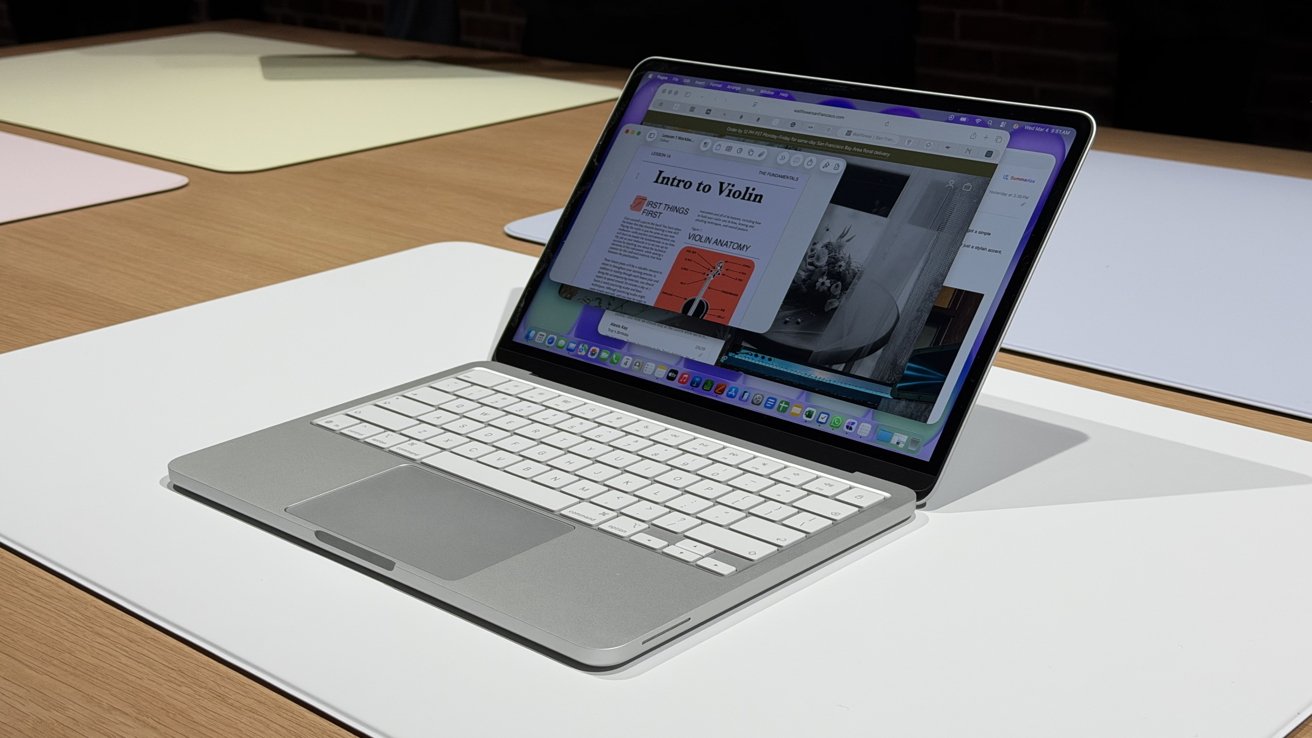
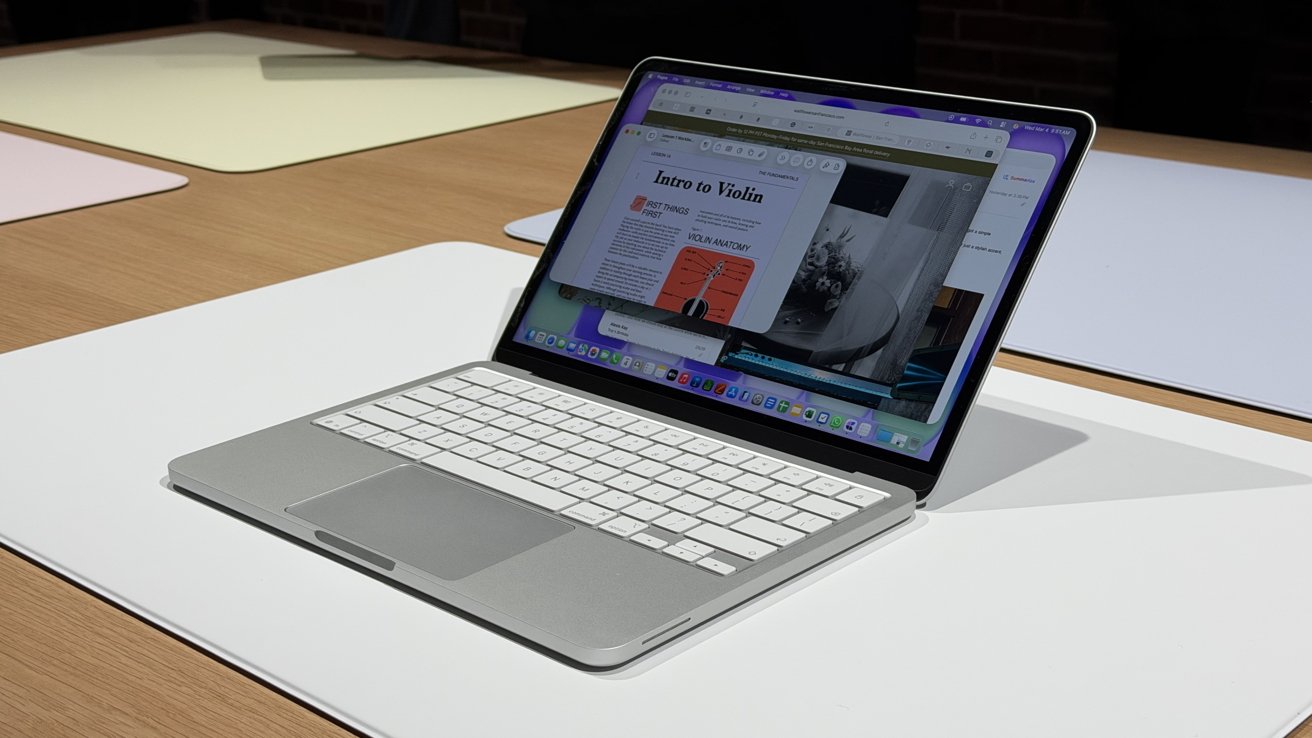
Apple’s budget-focused MacBook Neo borrows the A18 Pro chip from an iPhone 16 Pro. Here’s how the chip compares against other Apple Silicon Macs, and why it’s actually a pretty smart thing for Apple to do.
MacBook Neo has an A18 Pro chip borrowed from the iPhone 16 Pro Max
Apple’s launch of the new MacBook Neo is a fresh salvo into the value computer market, normally dominated by Windows notebooks and Chromebooks. The value end of the market meant Apple had to cut production costs. One of those cuts was the CPU. Continue Reading on AppleInsider | Discuss on our Forums
Live Science spoke with physicist David Gross, who today received the $3 million “Special Breakthrough Prize in Fundamental Physics”. He was part of a trio that won the 2004 physics Nobel prize for research that helped complete the Standard Model of particle physics. But when asked if physics will reach a unified theory of the fundamental forces of nature within 50 years, Gross has a surprising answer. “Currently, I spend part of my time trying to tell people… that the chances of you living 50 [more] years are very small.”
Cold War estimates for a 1% chance of nuclear war each year seem low, Gross says. “The chances are more likely 2%. So that’s a 1-in-50 chance every year.”
David Gross: The expected lifetime, in the case of 2% [per year], is about 35 years. [The expected lifetime is the average time it would take to have had a nuclear war by then. It is calculated using similar equations as those used to determine the “half-life” of a radioactive material.]
Live Science: So what do you suggest as remedies to lower that risk?
Advertisement
Gross: We had something called the Nobel Laureate Assembly for reducing the risk of nuclear war in Chicago last year. There are steps, which are easy to take — for nations, I mean. For example, talk to each other. In the last 10 years, there are no treaties anymore. We’re entering an incredible arms race.
We have three super nuclear powers. People are talking about using nuclear weapons; there’s a major war going on in the middle of Europe; we’re bombing Iran; India and Pakistan almost went to war. OK, so that’s increased the chance [of nuclear war]. I would really like to have a solid estimate — it might be more, and I think I’m being conservative — but a 2% estimate [of nuclear war] in today’s crazy world.
Live Science: Do you think we’ll ever get to a place where we get rid of nuclear weapons?
Gross: We’re not recommending that. That’s idealistic, but yes, I hope so. Because if you don’t, there’s always some risk an AI 100 years from now [could launch nuclear weapons], but chances of [humanity] living, with this estimate, 100 years, is very small, and living 200 years is infinitesimal. So [the answer to] Fermi’s question of “Where are the civilizations, all the intelligent organisms around the galaxy, and why don’t they talk to us?” is that they’ve killed themselves…
Advertisement
There are now nine nuclear powers. Even three is infinitely more complicated than two. The agreements, the norms between countries, are all falling apart. Weapons are getting crazier. Automation, and perhaps even AI, will be in control of those instruments pretty soon… It’s going to be very hard to resist making AI make decisions because it acts so fast. He points out that with the threat of climate change, “people have done something,” even though “It’s a much harder argument to make than about nuclear weapons.
“We made them; we can stop them.”
Thanks to hwstar (Slashdot reader #35,834) for sharing the article.
There’s something to be said about brand recognition — being able to tell what one car is from another at a glance. Companies have their trademark “looks” befitting certain models, sure — Jeep Wranglers are always boxy 4x4s with the seven-slotted grille and Ford Mustangs have the triple-taillight and a fastback coupe body shape. And these trends generally carry on from one generation to the next — a modern Wrangler still bears a superficial resemblance to the old TJ Wrangler from the 1990s, for instance. But every now and then, you get manufacturers trying something new. Whether it’s reusing a name on a brand-new platform or just a total ground-up redesign, sometimes you’re simply baffled to see the same logo on two seemingly completely different cars.
This is actually way more common than one might think. Take the Dodge Challenger, for instance, which went from a pony car in the early 1970s to a rebadged Mitsubishi Galant of all things. There are a few instances of this practice rearing its head, generally when automakers are chasing trends or undergoing large platform changes. An example of the latter is the Dodge Ram, which went from a Spartan, functional pickup in the 1980s to arguably the first modern production pickup truck in 1994.
Advertisement
We don’t see it as often today, with designs focusing more on minimalism and safety. But there are a few newer cars out there that will make you go, “Wait, it looked like that just one generation ago?” Let’s dive in and have a look.
Advertisement
Chrysler 300
What’s the first thought that comes to your mind when you think of the name “Chrysler 300?” Because the answer is generally all over the place; these cars (sadly now discontinued) once began life as midsize 1950s luxury sedans. Then they evolved into 1960s luxury sedans, then 1970s luxury sedans, and so on — the trend ran right up to their ultimate demise. But while these cars never changed their intended purpose, they most certainly changed their looks. Because the modern 2005-2023 Chrysler 300’s father is actually just a fancier Sebring — identical body shape and all, to the point where you’d be forgiven for mistaking the two without the presence of the badge.
Okay, granted, that badge reads “300M,” but it’s a Chrysler 300 — a car which, like its predecessors, prides itself on being refined and luxurious. Although you won’t find a Hemi anywhere near this car (unless you’re a lunatic who swapped in a remarkably inexpensive Hemi crate engine). Instead, you’ll find that classic Pentastar V6 in 3.5L form married to a front-wheel drive setup, all housed underneath a remarkably well-rounded body shell. It was Chrysler’s thing at the time; we all know that look from the Town and Country minivans.
The mid-2000s marked a pivotal period for Chrysler (and Mopar as a whole), with the entire range undergoing massive redesigns. These included the debuts of the new Jeep Wrangler JK in 2007, the Dodge Magnum in 2005, and many others. For the 300, it meant going from FWD budget luxury to intimidating, Hemi-powered RWD aspiration piece, a move that became so iconic that the car remained nearly unchanged right up until it was discontinued.
Advertisement
Chevrolet Corvette
Jonathan Weiss/Shutterstock
This one is also fairly obvious when you look at it, especially considering this was the first time we’ve ever seen a mid-engine Corvette in dealerships. It’s a car that has arguably marred a silhouette that was well over 50 years old, with the classic front-engine, rear-drive grand tourer coupe layout solidifying in 1963 with the Stingray fastback. Those classic lines of the long hood and sweeping rear end met their demise with Chevrolet’s modern rendition, for better or worse, marking a shift in design philosophy never before seen in the lineup — going from a grand touring sports car to supercar.
Typically the Corvette filled the niche of the former: a sports car. It was less money, less hassle, more practical, and generally more common than a lot of other high-performance vehicles of its era. Even today, you’re more likely to see a Corvette cruising down the highway than, for instance, a Lamborghini that’s more than double the cost (depending on where you live). But modern “fast cars” have a new image attached to them; think of modern Ferraris, the Audi R8, and so on. These are cars which typically command six-figure sums and hit 60 in three seconds or less. But not the Corvette (at least the base model).
The original design was revolutionary for the time, being marketed as “America’s First Sports Car.” And it’s a classic template, one which could easily continue into the future. But GM chose to depart from the “sports car” label, leaving us with what is ostensibly America’s budget supercar. Recognizable in name and performance, but hardly a trace when it comes to aesthetic presentation.
Advertisement
Dodge Charger
This was probably one of the most startling and controversial redesigns of the past couple years, with the Charger going from a pure-bred modern muscle car to a two-door EV (with the Hurricane turbocharged straight six available in model year 2026 onwards). Some might call it blasphemous to release a muscle car with no V8 option available for the masses, but whatever you think about the powertrain, it still wears the Charger badge — and looks almost nothing like its predecessor, with only a passing resemblance in four-door form.
Advertisement
Granted, the Charger was never exactly a svelte sports car in terms of its looks (as you can see in each generation). It was more of a brick on wheels than anything. The original Charger was a full-size sleeper coupe, looking more like a salesman’s car from the outside but potentially hiding a massive engine under the hood. The second-gen is what we generally think of when we hear of a classic Charger, but they both share certain key traits like that iconic, stone-faced grille and fastback roof. The modern Charger takes these elements and reimagines them in a 2020s context, returning the two-door configuration, flat nose, and vintage roof line. It’s a retro-flavored design, for sure, arguably returning the Charger name to a more traditional aesthetic.
Redesigns rarely hit without backlash, as we see fairly often in website facelifts for instance. And the new Charger was met with tons of it, though that generally revolved around its powertrain, not its aesthetics. The actual look of the car is, in fact, far more in-line with vintage Charger design philosophy, which may not be to everyone’s taste. But it’s certainly more faithful than the 2000s-era four-door sedan look, which is arguably its own unique thing.
Advertisement
Toyota Supra
We have yet another sports car entering the chat, this time a Japanese-German chimera born from a BMW — and yes, the Supra has a BMW engine. The B58, to be specific, the same engine as the BMW Z4. Of course, the body is quite different from the Z4, though that doesn’t stop people from calling the MK5 Toyota Supra a BMW. It’s yet another controversial car in this regard, but aside from the question of whether or not it’s a “real” Toyota, one fact still remains consistent: This thing looks nothing like the MK4 A80 Supra, from just about any angle.
One might suggest that such a design departure is obvious enough. After all, the A80 itself looks almost nothing like its predecessor either, trading the boxy pop-up headlights look for that timeless rounded shape. Regardless of what you think about the car (it’s arguably seriously overrated for what it provides), that body shape is instantly recognizable and looks correct even in modern traffic. By contrast, the MK5 is certainly not a bad-looking car in its own right, with exceptionally sporty design language. That said, good luck finding commonality, aside from the 2-door fastback styling.
By contrast, the MK5 Supra is a car with a contemporary aggressive fascia, plenty of vents, a svelte body with bold accents, and a long nose hiding that straight six. The FT-1 concept it was based on was well-received for its looks, with the production Supra basically being a watered-down version. Is it bad? Absolutely not — neither it nor its ancestor were. But you really have to stretch the definition of “similar” to marry this car’s aesthetic language to the MK4’s.
Advertisement
Chevrolet Blazer
Typically when a car totally jumps from one segment to another, you get some sort of differentiation in the name — Ford Mustang Mach-E or Mitsubishi Eclipse Cross, for example. Other times it’s a revival of a far older nameplate banking on recognition, such as the Ford Capri or Maverick. And then there’s this thing. The Chevrolet Blazer at a glance looks like it fills a similar role to the previous S-10 Blazer. That car was produced until the mid-2000s in North America, supplanted by the TrailBlazer in the midsize segment. Neither model bear even a passing resemblance to the modern crossover, however, either in form or function.
Advertisement
The S-10 and TrailBlazer alike were both unquestionably SUVs, with the S-10 in particular being more off-road oriented with its traditional high ground clearance, optional full-time 4WD, and features on-par with competitors like the Jeep Grand Cherokee. Additionally, Chevrolet even offered it in performance truck trim, with street-oriented option packages like the Blazer Xtreme. Its versatile SUV platform suited many roles well for its day, but its design is certainly dated on modern roads.
Chevrolet’s answer wasn’t to remake it as an SUV but rather as a crossover, debuting in 2019 to mixed reception (putting it mildly). The design proved controversial with the Blazer crowd, expecting a plucky, utilitarian 4×4 to rival the Bronco and getting a decidedly road-oriented unibody instead. It is almost nothing like the Blazers of old, only sharing the rough physical footprint they take up on the road. The Blazer is essentially the reverse of the Chrysler 300, going from a RWD or 4×4 truck to a FWD or AWD midsize that blazes rental fleets nationwide.
To make up for an incredibly laughable inaugural event, Beijing is running back its humanoid robot half-marathon. Fortunately, the event that pits humanoid robots made by Chinese companies against each other across 13 miles went a lot smoother this year.
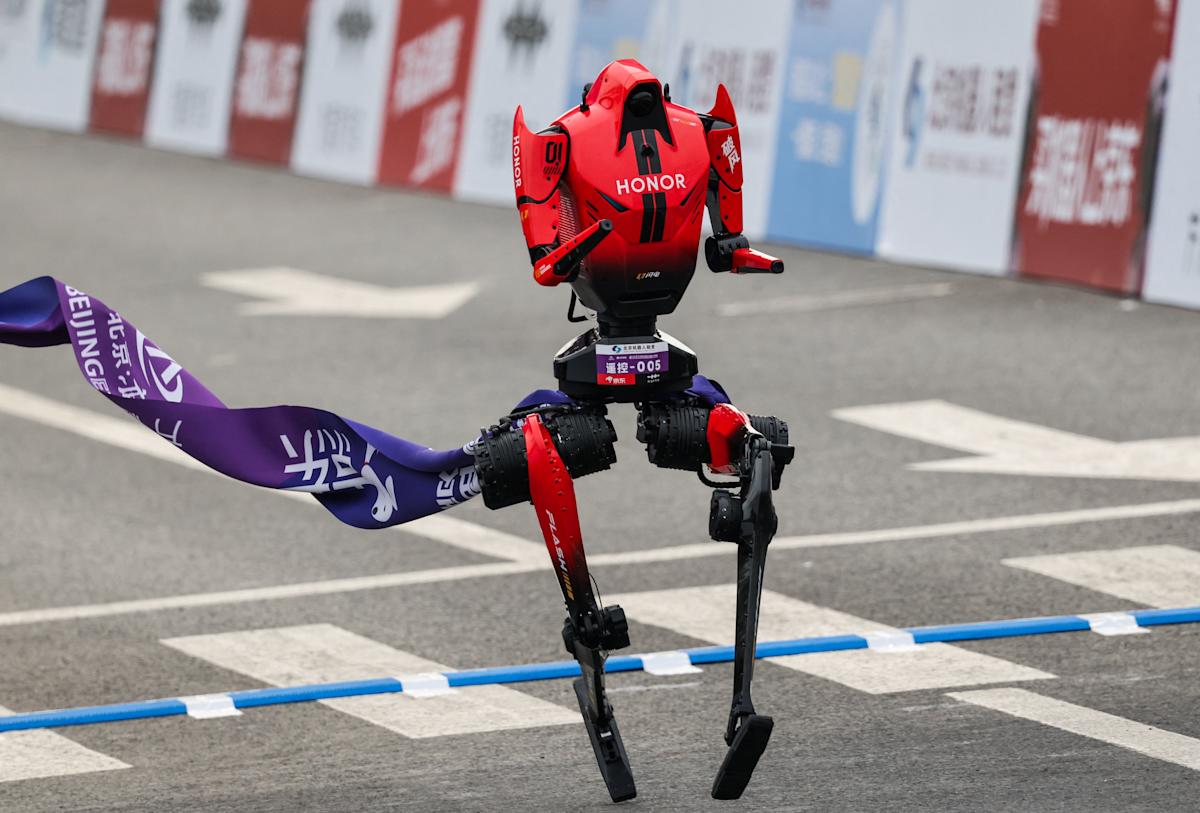
This year’s half-marathon hosted more than 100 competitors, with first place going to Honor, better known for its smartphones, and its red-clad robot named Lightning. Living up to the name, the gold medalist finished the race in 50 minutes and 26 seconds. That’s several minutes faster than the human record that was recently set by Uganda’s Jacob Kiplimo last month.
Honor swept the other podium spots, with the important caveat that they all navigated the course autonomously, according to the state-sponsored television news agency CCTV. That’s a massive improvement over last year, where the fastest time among 21 robots was achieved by Tiangong Ultra with a record of two hours and 40 minutes. Last year’s event saw many of the bipedal robots receiving assistance from human operators who ran alongside them, as well as some comical mishaps, like falling at the starting line.
However, the BBC reported that around 40 percent of the robots competed autonomously this year, while the rest were remote-controlled. Despite the rapid improvements, this year’s event still had its fair share of crashes, even from Honor’s robots.
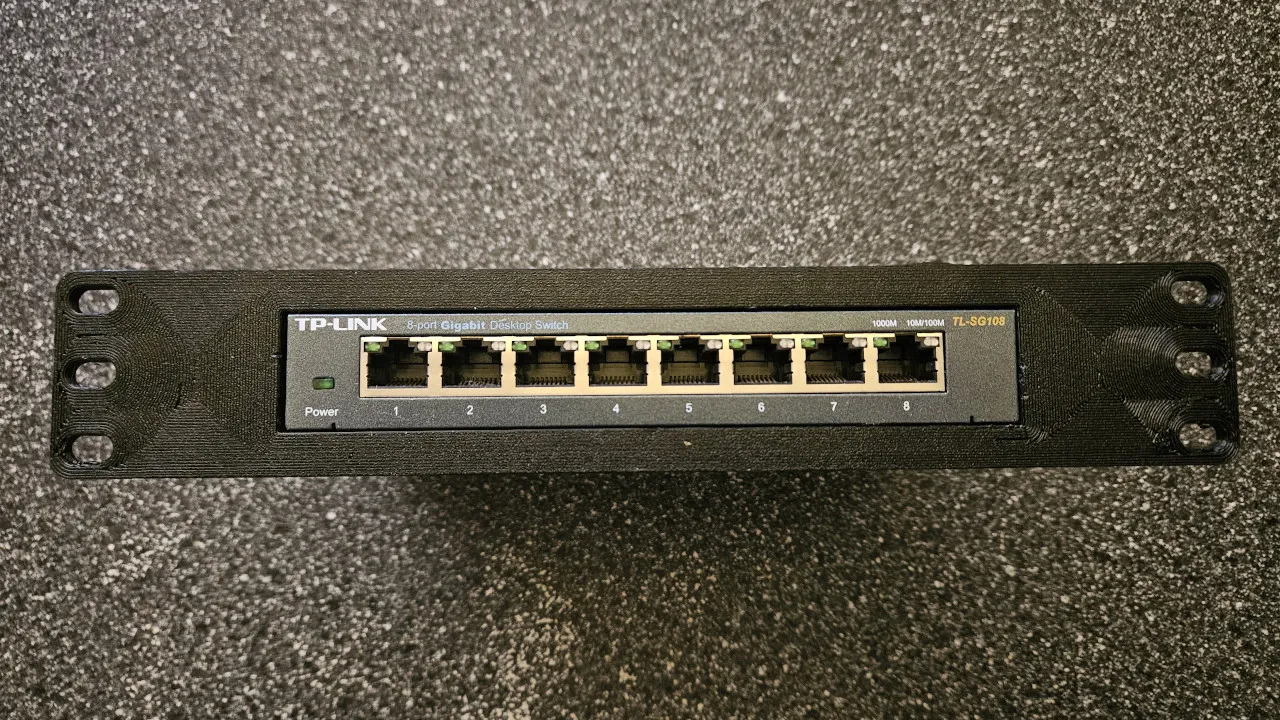
Sometimes, as hackers and makers, we can end up with messy lashed-together gear that is neither reliable nor tidy. Rackmounting your stuff can be a great way to improve the robustness and liveability of your setup. If you find this appealing, you might like CageMaker by [WebMaka].
This parametric OpenSCAD script can generate mounts for all kinds of stuff. Maybe you have a little network switch that’s just a tangle of wires on your desk, or a few pieces of audio gear that are loosely stacked on top of each other and looking rather unkempt. It would be trivial with this tool to create some 3D printed adapters to get all that stuff laced up nice and neat in a rack instead.
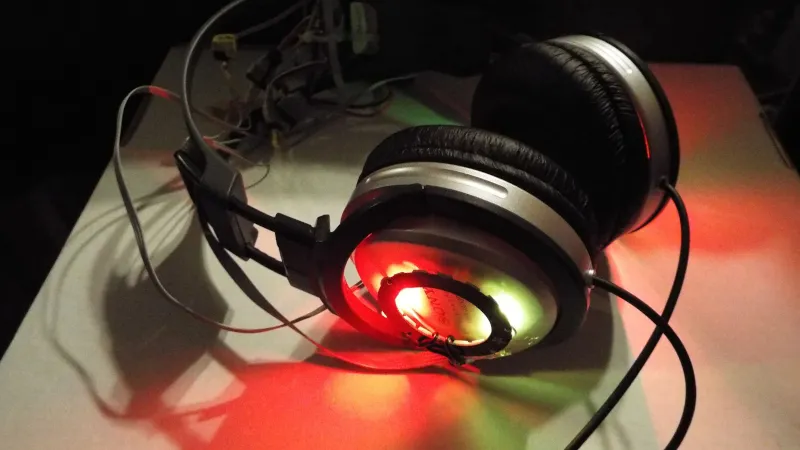
Noise cancelling headphones are a great way to insulate yourself from the bustle of the city, but due to their power requirements, continuous use means frequent recharging. [Alessandro Sgarzi] has an elegant and unique solution — powering the noise cancelling electronics by harvesting energy from the ambient noise of the city via a sheet of piezoelectric film.
This impressive feat is achieved using a LTC3588-1 power harvesting IC and a pair of supercapacitors, while an STM32L011K4T6 microcontroller processes the input from a MEMS microphone and feeds a low-power class D amplifier. This circuit consumes an astounding 1.7 nW, a power that a noisy city is amply able to supply. Audio meanwhile comes via a traditional 3.5 mm connector, which we are told is the cool kids’ choice nowadays anyway.
We like this project, and since it’s part of our 2026 Green Powered Challenge, it’s very much in the spirit of the thing. You’ve just got time to get your own entry in, so get a move on!
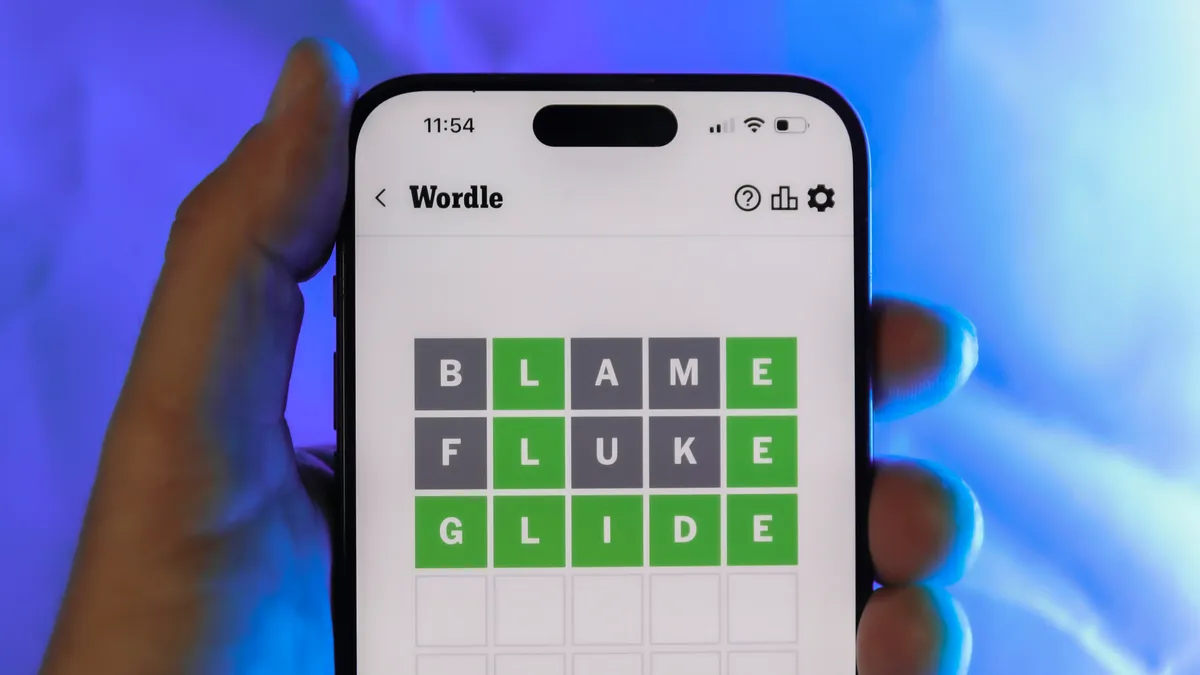
Looking for the most recent Wordle answer? Click here for today’s Wordle hints, as well as our daily answers and hints for The New York Times Mini Crossword, Connections, Connections: Sports Edition and Strands puzzles.
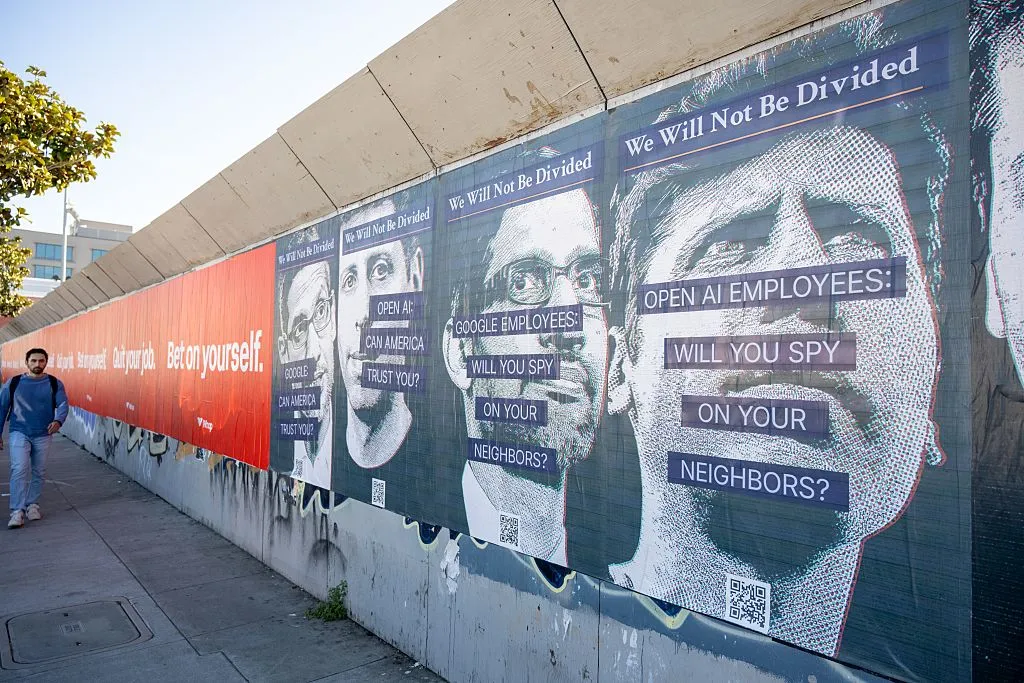
On the latest episode of TechCrunch’s Equity podcast, Kirsten Korosec, Sean O’Kane, and I did our best to round up all the latest OpenAI news. While the company’s latest acquisitions seem to be classic acqui-hires, Sean suggested they also address “two big existential problems that OpenAI is trying to solve right now.”
First, with the team behind personal finance startup Hiro, the company may be hoping to come up with a product that has “more hooks than just a chatbot, and maybe something worth paying more for.” And with new media startup TBPN, OpenAI could be looking to “better shape its image in the public eye, which lately has not been great.”
Read a preview of our conversation, edited for length and clarity below.
Advertisement
Anthony: [We have] two deals that are worth mentioning, one is that OpenAI acquired this personal finance startup called Hiro. And that comes after another deal that was literally announced when we were recording our last episode of Equity, so we didn’t get to talk about it: OpenAI had also acquired TBPN — a business talk show, like a new media company.
And I think both of these deals are pretty small compared to the scale of OpenAI. These are not things that people expect to really change the course of their business or anything like that, but they’re interesting because it suggests that there’s still this [attitude of,] “Let’s try out different things.”
Especially [with] the TBPN deal […] particularly at this time when it feels like OpenAI, from all the reporting we’re reading, is also trying to really refocus on making ChatGPT and its GPT models really competitive in an enterprise context with programmers.
Techcrunch event
Advertisement
San Francisco, CA | October 13-15, 2026
Is running a tech talk show, should that really be on the to-do list?
Advertisement
Kirsten: No, this should not be on the to-do list. That’s it.
I do want to mention Hiro because to me, that’s an interesting one, because Julie Bort, our venture editor, super talented, she wrote about this and was I think the first to write about it. She dug in a little bit and basically this looks like an acqui-hire. The company is folding. They basically said, “By this date, you won’t be able to access this anymore.”
This is a personal finance startup. And they only launched two years ago. So this absolutely is about getting talent on board. So I’m very curious to see if OpenAI is going to be just absorbing them into the ether at OpenAI, or if they’re actually interested in some sort of personal finance product that they want to work on. To me, it’s not really clear.
Sean: I think you look at both of these as acqui-hires to a certain extent. I mean, the TBPN acquisition, allegedly they are going to retain their editorial independence on the show that they make every day. And all respect to those guys who’ve put that out there and gotten it off the ground so quickly and grown it into what it has become.
Advertisement
I think any person who follows the media should have a healthy dose of skepticism that when you acquire something like that and you put the people who make the show under the org of the public policy people and comms or marketing adjacent people higher up at the company making the acquisition, that you could have good questions about whether or not saying “editorial independence” is enough. It’s not an incantation that just works.
But you know, what’s interesting to me about these two, while they are similar in their acqui-hire-ness, I think they both represent two major problems that OpenAI is facing.
One is Hiro. OpenAI has a very successful product in ChatGPT. As far as whether or not that will actually ever make them enough money to become a sustainable business that’s not raising the largest private rounds in the world, ever, to keep things going, is a big question. And they also seem to be struggling to keep up on the enterprise side of things where the real money seems to be, so bringing in a team like this seems like taking a shot at, “What else can we do?”
The guy who founded Hiro seems to have a serial entrepreneur streak of creating consumer apps, and so this seems to me like a bet on them being able to come up with something else that may have more hooks than just a chatbot, and maybe something worth paying more for.
Advertisement
And then TBPN is an acquisition made to help better represent what the company does and better shape its image in the public eye, which lately has not been great and certainly is under more questions now than just a few weeks ago, because Ronan Farrow just led a report at The New Yorker that dropped suspiciously right around the time that this and a couple other announcements from OpenAI came out last week.
I think those are two big existential problems that OpenAI is trying to solve right now.
Kirsten: So the thing that you didn’t say is, there’s Anthropic kind of looming in — not in the shadows, I mean, they’re very much taking up a lot of space here — but they’re having a lot of success on the enterprise side of things.
It feels like these guys are competitors and they also feel like very different companies in a lot of ways. Anthony, I’m wondering if you see them as direct competition to OpenAI? Or [are they] just finding their stride in enterprise and in a way, these two companies are clearly going to coexist and they’re really not directly competing with each other — maybe on talent, but not necessarily as we initially thought of them?
Advertisement
Anthony: I think they’re directly competing with each other. There’s definitely a scenario where if AI as an industry, as a technology, is as successful as its proponents hope for, they could both be very successful companies, they could just be the one and two. And the success of one does not necessarily mean that the other will just fade into obscurity.
And again, none of this is official, but there’s just been a lot of reporting around how it seems like OpenAI, more than anyone, is obsessed with and upset about Anthropic’s rise.
Our reporter Lucas [Ropek], he did a great piece over the weekend about the HumanX conference, where he was talking to everyone there and they’re sort of like, “Yeah, ChatGPT is fine, too,” but like they were all about Claude Code. And I think that is exactly what OpenAI is worried about.
Because again, in theory, there could be many other opportunities for generative AI, but it feels like the big growth area, the area where the most money is and where they could at least see a path to having a sustainable business in the future, is in these enterprise and coding tools.
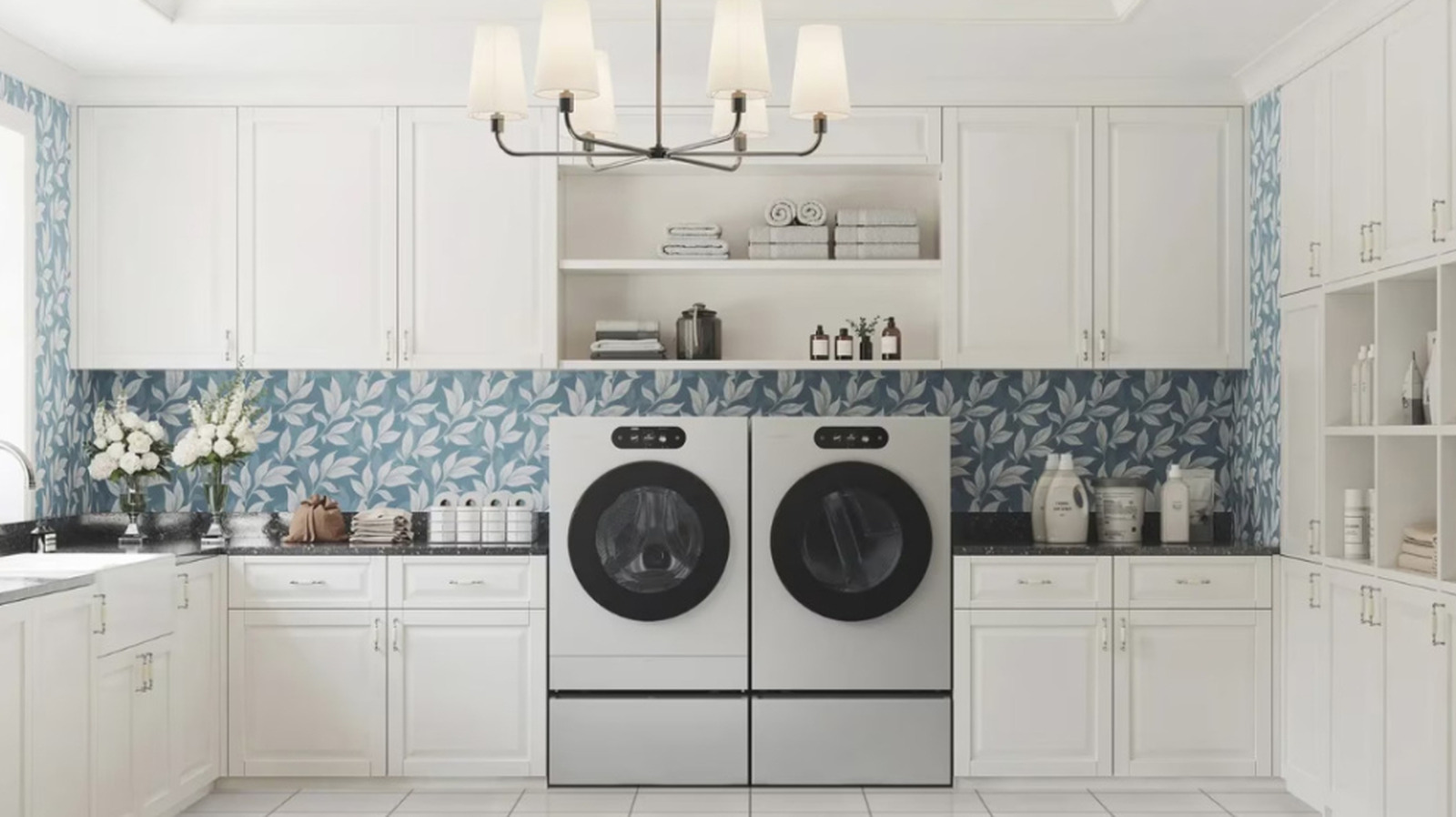
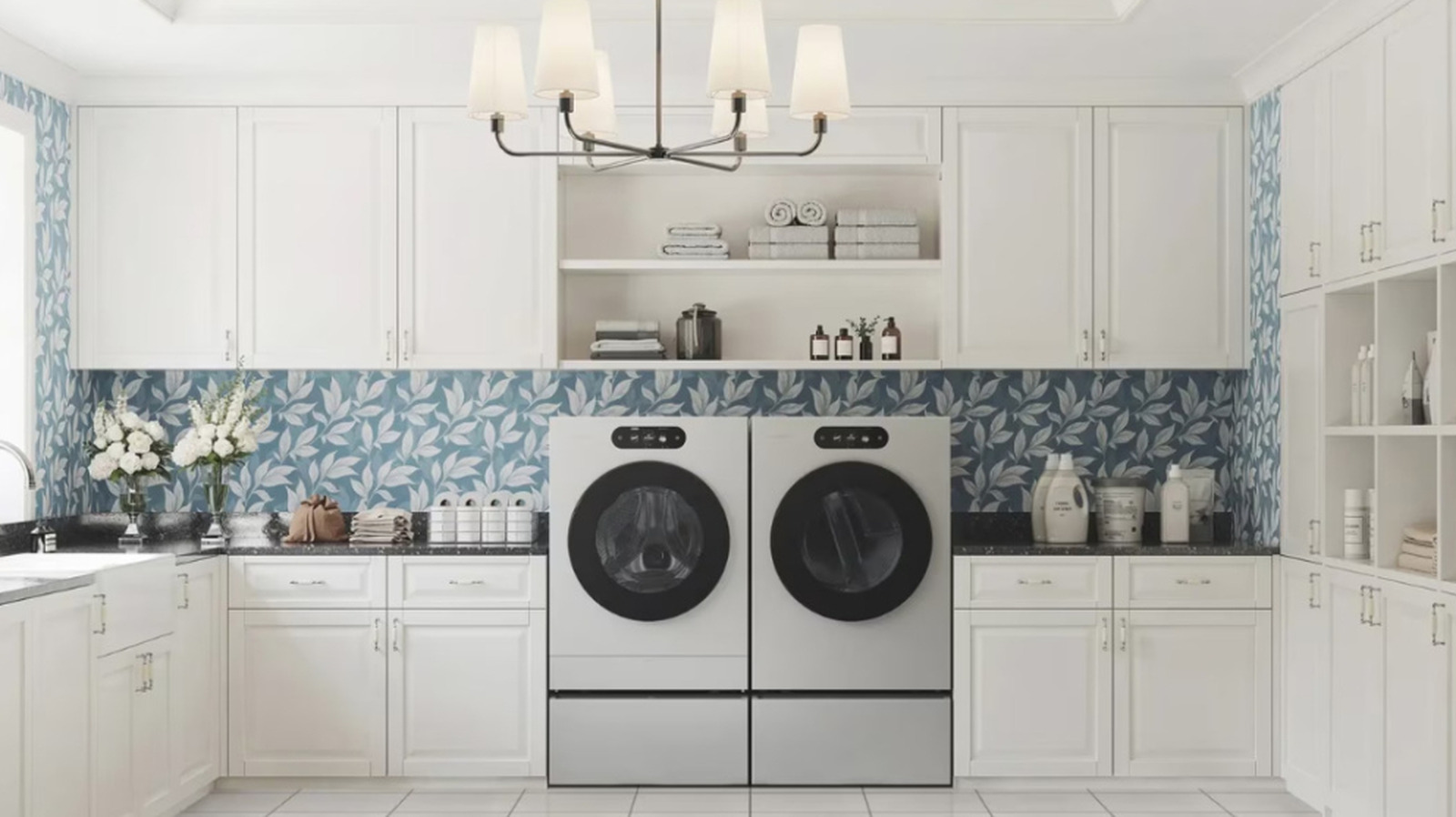
Very few of us actually like doing the laundry. Nevertheless, it has to be done. It doesn’t help that there’s now a big debate about front-load efficiency vs. top-load machines. If you’re on the side of the front-loaders and are in the market for a new one, Consumer Reports has a model you might want to consider. Its testing ranks the LG Signature WM9900HSA as the best option money can buy. The machine pairs a 5.8-cubic-foot mega capacity with advanced automation features to help make everybody’s least-favorite chore a little less time-consuming.
Its AI Wash 2.0 system uses built-in sensors to automatically select the best wash settings based on fabric texture and load size. The washer’s TurboWash 360° technology uses five high-pressure jets to handle large loads in less than half an hour, as well. Beyond marketing hype, Consumer Reports has real first-hand experience to back it up. Their testing methodology looks at washer performance using stained fabric swatches and repeated cycle analysis. And in Consumer Reports’ experiments on the WM9900HSA, the LG front-load washer consistently outperformed other top washing machine brands.
Advertisement
Why not everybody loves the LG Signature front-load machine
Beyond its speed and intelligence, the LG Signature front-load washer model WM9900HSA also uses an “ezDispense” automatic detergent system. All you have to do is fill up the reservoirs, and you can enjoy up to 20 to 36 cycles before you need to refill again. The machine is smart enough to know the correct amount of detergent and softener to dispense for each load. It’ll even send you an alert to your phone when you’re running low. Like plenty of other LG smart appliances, you also get an LCD touchscreen.
Advertisement
But looking beyond what Consumer Reports says, real-world customer feedback isn’t exactly overwhelming in its praise. It’s currently at a 3.8 out of 5 on LG’s website based on 57 reviews, many of which are incentivized. Users do have nice things to say about the washer’s large capacity and reliable cleaning, but others say the “ezDispense” feature is a headache. Clearly, even though LG ranks as the best front-load washer brand based on Consumer Reports’ survey data, individual customer experiences are going to vary.
Get caught up on the latest technology and startup news from the past week. Here are the most popular stories on GeekWire for the week of April 12, 2026.
Amazon paid about $1.8 billion last year to Blue Origin, the aerospace company owned by its founder and board chair Jeff Bezos — nearly triple the amount the year before — as shareholders weigh a proposal citing his business interests outside Amazon as potential conflicts of interest. … Read More
The students in a computer science class at the Global Idea School, an independent, non-profit elementary school in Redmond, Wash., learned vibe coding through GitHub Spark and built a Braille 3D Generator, a tool that turns text into printable, tactile 3D Braille models in seconds. Read More… Read More
OpenAI’s chief revenue officer touted the AWS alliance as a key enterprise growth driver, saying that the Microsoft relationship has constrained the company’s reach into big business. … Read More
Amazon’s deal for satellite operator Globalstar doesn’t just bulk up Amazon Leo — it brings Apple along for the ride, with a long-term agreement to power iPhone and Apple Watch satellite features. … Read More
Anoop Gupta is stepping down as CEO of SeekOut, the Bellevue-based recruiting startup he co-founded in 2017, handing the reins to enterprise software veteran Sean Thompson. … Read More
Seattle customer engagement startup Ambassador has acquired the operating assets of Tacoma-based programmatic ad platform Humming, part of a roll-up strategy that anticipates a larger shakeout among startups as major AI platforms expand their capabilities. … Read More
Seattle Mayor Katie Wilson raised the possibility of a moratorium on new data centers in the city, following a report that four companies have approached Seattle City Light about building five large-scale facilities. … Read More
As someone who has worked from home for the last 15 years, there aren’t many things more frustrating than my internet connection going down in the middle of a workday. Sure, my kids act like it’s the end of the world when it happens after school, when they’re trying to unlock some forbidden fruit on Roblox or whatever, but that’s nothing compared to the internal rage I feel when I see my camera feed stuttering on a video call.
My current Internet Service Provider (ISP) has gotten more reliable, but there was a period of time when I’d complained about them so much on Twitter that I had four technicians and their boss randomly show up at my house, asking if they could run a brand new service line in a bid to fix my issues.
Those improvements aside, it’s not perfect. My connection still drops from time to time.
Advertisement
Article continues below
I’ve tinkered with backup internet solutions over the years, and even considered signing up for Starlink as a secondary provider at one point.
But most of the backup internet solutions offered by firewalls or Wi-Fi systems aren’t seamless, requiring you to connect your router to your phone’s hotspot, which then broadcasts mobile data throughout your home’s network.
Advertisement
That’s not an ideal solution when I’m on a video call, for example. My home office is nowhere near my router, so I’d have extended downtime while I move closer, connect my router to the hotspot, and by then, the call was either over or my regular connection had returned.
Then I found Eero Signal
I currently use one of Eero’s mesh Wi-Fi systems, so when Eero announced its latest product, the $99 Eero Signal, my interest was piqued.
Sign up for breaking news, reviews, opinion, top tech deals, and more.
Advertisement
The small device that looks like a wireless charging stand for your phone connects to a compatible Eero router. When your main internet connection drops, your Eero system automatically switches to the LTE connection that Signal provides. (There’s a 5G model coming later this year that I’d instantly upgrade to.)
I’ve had Signal set up and running in my house for several weeks now, and I have to admit — I’m smitten. It’s perfectly picked up where my service provider has let me down.
Setup was easy, and it has deep controls
(Image credit: Future/Jason Cipriani)
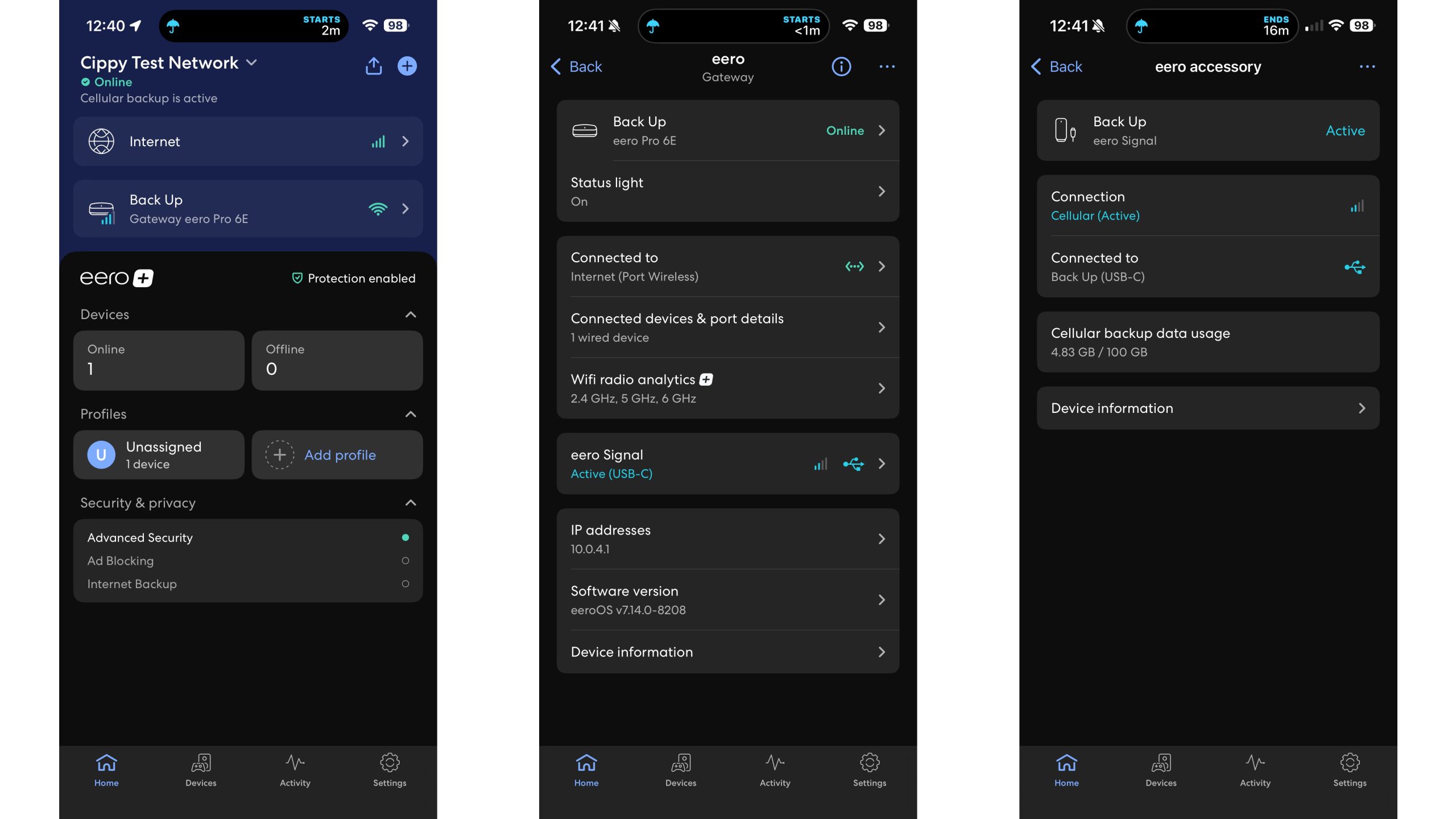
After unboxing the Signal and a 45W power adapter, I immediately connected it to my Eero system and the included power supply. The rest of the process required a few taps on my phone, adding the device to my home system, ensuring I was on an Eero Plus plan for the cellar portion, and I was up and running.
Advertisement
Eero offers two plans. You can pay $99.99 a year for 10 GB of data per month, while $199.99 gets you 100 GB of data per month through Signal’s connection.
To test Signal, all I had to do was temporarily disconnect the wired internet connection going to my Eero system, and it switched over to Signal almost immediately.
Seamless backup internet achieved.
Advertisement
The last step to complete setup was to go through the list of devices in the Eero app, approving or forbidding access to data when Signal is active. It’s a quick and easy way to ensure that your work laptop or home alarm system and cameras stay connected to the internet during an outage, but stopping your streaming devices from eating into your data allotment.
Recent maintenance put Eero Signal to the test
(Image credit: Future/Jason Cipriani)
My home network setup is complex, and beyond the previously mentioned video calls for work being a priority, so too is all of the self-hosted websites and services I have running, including personal and business websites from my basement. When my sites go down, I get sad. I don’t like being sad.
But since installing Eero Signal, my sites have had virtually zero downtime due to a lack of internet.
Advertisement
The reliability and speed of Signal was put to the test a couple of weeks ago when my internet service provider announced routine maintenance in my area that’d take my connection offline all day.
Bring it on, I said to myself as I read the email.
The morning of the scheduled downtime, while I was out of town and away from the house, I received an alert that my connection had dropped and my network switched over to Signal and then… nothing. I didn’t get an alert that any of my sites were down, and I could pull up a live stream of my Ring security cameras.
Several hours later, I received another alert that the work was done for the day, but they were unable to finish everything, and expected a prolonged outage the next day.
Advertisement
The second day came and went much like the first — Signal kicked in and took over, providing data to my home’s network and self-hosted services, all the while I was able to call into a Teams meeting. The Signal’s LTE connection is averaging 50 Mbps down and 10 Mbps up for me, which isn’t super fast compared to my standard connection, but it’s enough for short periods..
(Image credit: Future/Jason Cipriani)
Internet outages are a thing of the past
(Image credit: Future/Jason Cipriani)
I’d become so accustomed to dealing with sporadic internet outages that I didn’t realize how much time I spent worrying about it. Then again, being connected to the internet during the day is how I do my job, and without it, I’m not very productive, so it makes sense.
It also makes sense that after setting up Signal and realizing it delivers on its promise, I’ve felt relieved. A couple of months ago, those messages alerting me of upcoming maintenance would have stressed me out for days.
Advertisement
Instead, all I did was get excited because it was going to be a stress test for Signal — and it passed, easily.
That relief alone is worth the cost. Now I can spend that energy on something productive.









































You must be logged in to post a comment Login