



Connect with us
DAPA Banner
DAPA Coin
DAPA
COIN PAYMENT ASSET
PRIVACY · BLOCKDAG · HOMOMORPHIC ENCRYPTION · RUST
ElGamal Encrypted MINE DAPA
🚫 GENESIS SOLD OUT
DAPAPAY COMING

Tech

Car Buyers Are Turning To ChatGPT To Help Them Get A Better Deal

Published

on


As artificial intelligence continues to advance, people are finding creative and useful ways to use it. One possibility: getting a good deal on a car. From finding a vehicle to negotiating with the dealer, AI could handle every step of the process, saving you time — and hopefully money. For example, ex-Apple engineer Mustafa Khan has created Negoshify, which can be downloaded on Claude or used as an app in ChatGPT. You can ask Negoshify to find a model around a certain price point in your area. It will show you available cars that match your inquiry within Negoshify’s dealership network, put down a refundable $500 reserve on the car, and even negotiate with a dealer to get you a better price. 

Some car buyers simply chat directly to ChatGPT — no additional apps needed — to make smart purchases. You can ask ChatGPT to evaluate the cars you’re considering to find out which one is the right choice for you. ChatGPT can also coach you through the negotiation process and give you advice on how to respond to dealers. One Reddit user said she ran her messages through ChatGPT, and it told her how to reword them after it decided she was losing too much leverage. “I normally can’t negotiate to save my life, so this was amazing for me,” she said. 

Advertisement

Should you be using ChatGPT to negotiate car deals for you?

Some buyers using ChatGPT have been impressed by its ability to gather information ahead of a negotiation, analyze dealer emails, and make sense of documents. There is no denying that an AI sidekick getting you a hassle-free deal on a car is a neat concept, but the technology may not be quite where it needs to be. There are a lot of things to remember if you plan to run your negotiation correspondence through ChatGPT. 

First, it can sometimes be biased depending on how you shape your prompts, or even make up things completely. “If the model’s training data has incomplete, conflicting, or insufficient information for a given query, it could generate plausible but incorrect information to ‘fill in’ the gaps,” a software engineer told TechRadar. Any feedback you get from ChatGPT should still be researched and verified before using it in a negotiation.

Another thing to consider is the biases that dealers may have towards AI. You may not get a response to your inquiry if they can tell it’s been generated by an AI program. There are some common ChatGPT phrases and styling that may be a giveaway, so steer clear of simply copying and pasting what ChatGPT tells you to say and instead rewrite it in your own words. Or maybe just stick to doing your own negotiations.

Advertisement


Source link

Advertisement
Continue Reading
Click to comment

You must be logged in to post a comment Login

Leave a Reply

Tech

Anthropic rolls out ‘Mythos-like’ AI model Claude Fable 5

Published

on

The model will reportedly be made available to enterprise customers and paid subscribers. 

Just two months after rolling out Mythos to a limited pool of high-level users, Anthropic has announced the release of Claude Fable 5, an AI model similar to Mythos but with significant safeguards and blocks to prevent deliberate misuse and security breaches, according to the company. 

Unlike Mythos, which is currently only available to a select number of organisations and institutions due to major concerns about securing critical infrastructure, Claude Fable 5 will be made available to enterprise customers and paid subscribers. 

The model has built-in barriers that aim to block responses in high-risk areas such as cybersecurity, chemistry and biology, with such interactions automatically handled instead, the company said, by its Opus 4.8 model.

Advertisement

Fable 5, Anthropic claimed, shows strong capabilities in software engineering, knowledge work, vision, scientific research and similar fields.

In a statement, Anthropic explained that over the course of the past few months, the organisation has worked to improve safeguards that would make Claude Fable 5 “robust enough for a general release”, adding that in prioritising safety, some measures are “stricter than would be ideal” and some benign requests may be classified as risky. However, there are plans to further refine the model’s regulation systems. 

Anthropic has also announced an updated version of the Mythos model, Claude Mythos 5, reportedly similar to Fable 5 but with the cyber safeguards lifted. 

The organisation said, “In consultation with the US government, we plan to steadily expand access to Claude Mythos 5, continuing our periodic addition of new partners, as well as pursuing a trusted access programme that allows cybersecurity organisations to apply in a more systematic manner.”

Advertisement

In early June, Anthropic unveiled plans for a historic initial public offering that could take the company’s valuation soaring above $1trn. The proposal came less than a week after Anthropic overtook OpenAI’s valuation with a $65bn Series H funding round that valued it at $965bn.

Don’t miss out on the knowledge you need to succeed. Sign up for the Daily Brief, Silicon Republic’s digest of need-to-know sci-tech news.


Source link

Advertisement
Continue Reading

Tech

Solar Beats Coal In the US For the First Month Ever

Published

on

An anonymous reader quotes a report from Electrek: Solar generated more U.S. electricity than coal for the first month on record in May 2026, according to new analysis from global energy think tank Ember. Solar supplied 12.8% of U.S. electricity during the month, while coal dropped to 12.2%. That’s a dramatic shift in the U.S. power mix. Just five years ago, coal generated 19.7% of U.S. electricity in May, while solar accounted for only 5.4%. U.S. solar generation hit a record 45.5 terawatt-hours (TWh) in May 2026, up 17% from May 2025 and higher than the previous record set last July. Ember says another record could be broken again this summer.

Solar output usually peaks in June or July, but its share of the electricity mix is often highest in spring, when strong sunshine lines up with milder temperatures before summer cooling demand ramps up. May was also the first time solar became the third-largest individual source of electricity in the U.S., behind only natural gas and nuclear. (If solar is included with all other renewables, then they’re the second-largest source of electricity as an overall category of electricity.) Meanwhile, coal keeps sliding (and will continue to slide). Coal generation hit an all-time monthly low of 39.3 TWh in April 2026. Output rose slightly in May to 43.4 TWh, but it was still 11% lower than May 2025 levels. Even with that small rebound, coal couldn’t keep pace with solar’s rapid growth.

Source link

Continue Reading

Tech

Nuvei in ‘advanced’ talks to acquire Payoneer for $2.7bn

Published

on

While the deal could be signed in ‘the coming days’, talks are ongoing and it may not materialise at all, sources told Reuters.

Nuvei, a payments company based in Montreal, Canada, is reportedly in “advanced talks” to acquire Payoneer Global for $2.7bn, according to Reuters.

The purchase price – which includes Payoneer’s cash holdings – implies an enterprise value of about $2.3bn, according to two sources familiar with the matter that spoke with the publication.

While the deal could be signed in “the coming days”, talks are ongoing and it may change or not materialise at all, the sources added.

Advertisement

If the deal was signed, the resulting acquisition would combine Nuvei’s payment processing business with Payoneer’s cross-border payments solution.

Nuvei, which provides payment processing, risk management and payout solutions to merchants globally, was founded in 2003 by Philip Fayer, who is also the company’s chair and CEO.

Nuvei is backed by Canadian investment group CDPQ and private equity firms Novacap and Advent International – the latter of which took Nuvei private in 2024 through an all-cash transaction that valued the payments company at approximately $6.3bn.

Payoneer, which is based in New York, was founded in 2005 by Yuval Tal with $2m in seed funding from Tal and other private investors.

Advertisement

The company – which processes cross-border payments for freelancers, sellers and businesses – supports 70 currencies and has a number of high-profile customers, including Google, Ebay, AirBnB, Fiverr, Visa and Walmart.

Since Reuters’ report on the potential acquisition, Payoneer shares have risen significantly, jumping by more than 24pc. Its market capitalisation at the time of writing is currently $2.13bn.

At the start of this year, the US fintech acquired Dublin-based start-up and employee record-keeping platform Boundless for an undisclosed amount.

Boundless enables businesses to handle cross-border payroll, taxes, benefits and compliance, with the aim of simplifying complexities surrounding international employment to make it easier for companies to hire and support talent globally.

Advertisement

The acquisition was expected to help Payoneer access and manage its talent spread globally, especially as limited staff and varying local regulations make payroll compliance difficult, the company said at the time.

Don’t miss out on the knowledge you need to succeed. Sign up for the Daily Brief, Silicon Republic’s digest of need-to-know sci-tech news.

Source link

Advertisement
Continue Reading

Tech

Don’t Update Your iPhone To iOS 27 Without Knowing This First

Published

on


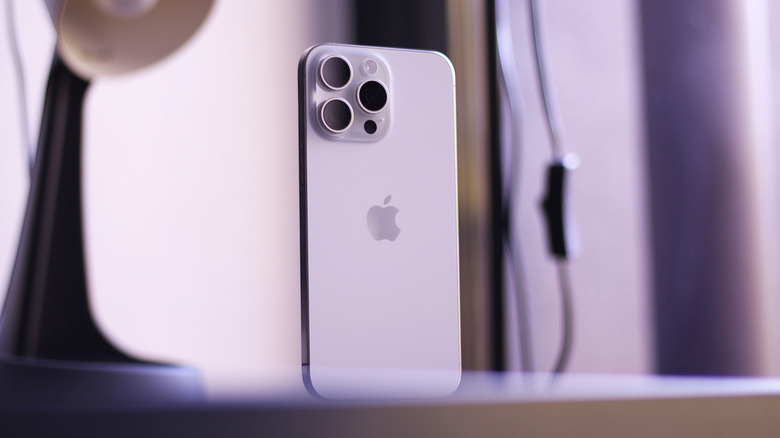
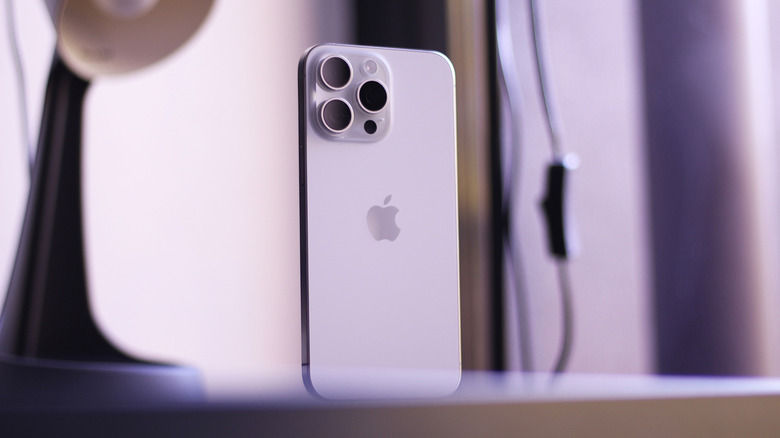
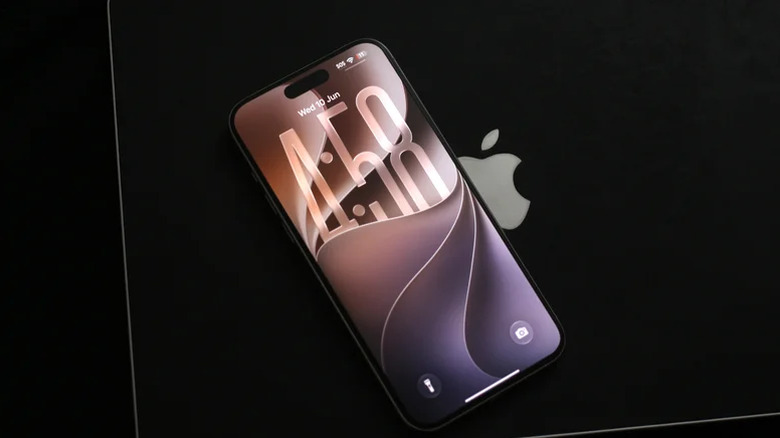
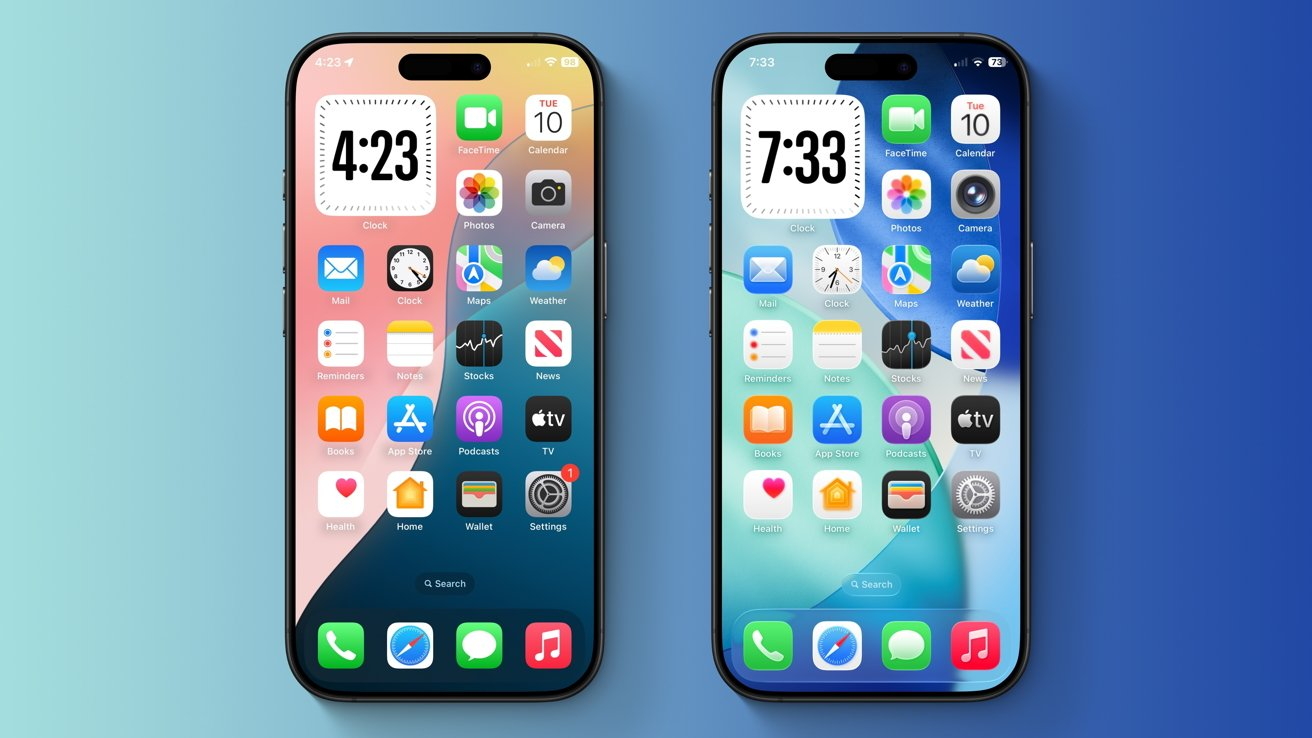
At WWDC 2026, Apple debuted the next version of the iPhone’s operating system, iOS 27. The public release is set for September, but those interested can try out the new features in iOS 27 early by installing the developer preview. As it is with every beta release, however, there is always a bit of risk involved, especially if you own an older iPhone model. Multiple iPhone 15 Pro owners have been reporting bricked devices after installing the update.

The issue seems to be triggered after a force restart. Affected users have reported that their iPhones became completely unresponsive, with the display remaining black even after trying to turn the device back on or plugging it into a charger. We were able to reproduce the issue on our iPhone 15 Pro Max running the first iOS 27 developer beta. To be safe, you may want to avoid installing the first beta if you’re on an iPhone 15 Pro. It’s unclear whether this issue affects the non-Pro iPhone 15s.

What worked in our case, as with many others, was restoring the iPhone using a Mac or PC by sending it into DFU (Device Firmware Update) mode. Unfortunately, some users haven’t been able to enter DFU mode, in which case, reaching out to Apple Support or a verified technician may be the only option.

Advertisement

How to fix a bricked iPhone on iOS 27

If you’ve recently updated to iOS 27 and ended up with a bricked iPhone, there’s a decent chance that you might be able to revive it yourself. You need access to a Mac or Windows PC, an internet connection, a data cable, and some luck. Start by opening Finder on your Mac. If you’re on Windows, install the Apple Devices or iTunes app and launch it. Connect your iPhone to your computer using a cable. Next, you need to enter DFU mode on your iPhone. Doing so is tricky and requires a sequence of button combinations. With your iPhone connected to your computer:

  1. Quickly press and release the volume up button.
  2. Quickly press and release the volume down button.
  3. Press and hold the side (power) button for five seconds, then, without releasing it, hold down the volume down button as well.
  4. After five seconds, release only the side button while continuing to hold down the volume down button.

The Apple Devices app or Finder should recognize your iPhone in DFU mode. Click on “Restore iPhone” and give it a while. Your device should now boot up fresh with iOS 26.5. Unfortunately, you will lose all your apps and data, and you might need to bypass the activation lock by entering your Apple ID and password. This is why you should always back up your iPhone before trying out beta builds.

Advertisement


Source link

Advertisement
Continue Reading

Tech

AMD claims next-gen Zen 6 server CPU will deliver 330% of Nvidia Vera’s performance per rack

Published

on

What we know so far: As the server battle between AMD and Nvidia enters a new phase, the two companies have begun trading jabs through performance estimates and early benchmarks. While Nvidia-approved results suggest its Vera processors outperform most AMD Epyc chips, Team Red believes its upcoming Venice lineup can leave Vera in the dust.

AMD recently published performance projections claiming its upcoming server CPU platform will dramatically outpace Nvidia’s latest showing. AMD’s estimates directly reference earlier results from controlled benchmarks that had favored Nvidia’s processor.

Team Red’s next data center CPU platform recently entered production and is on track to launch later this year. Built on AMD’s Zen 6 architecture, Epyc Venice chips will offer up to 256 cores and 512 threads. The lineup also marks AMD’s transition to TSMC’s 2nm process, a jump directly from the 4nm Epyc Turin that skips the 3nm node entirely.

AMD is projecting a 70% overall improvement in performance and efficiency over Turin, along with a 30% increase in thread density.

Advertisement

Nvidia, for its part, formally launched its Vera server CPU at GTC in March. The Arm-based SoC packs 88 cores and 176 threads. In recent benchmarks, Phoronix described Vera as the most capable Arm processor it has ever tested, outclassing Intel Xeon and AMD Epyc across most workloads. However, the tests were conducted at Nvidia’s headquarters and came with several restrictions to ensure Nvidia’s sign-off.

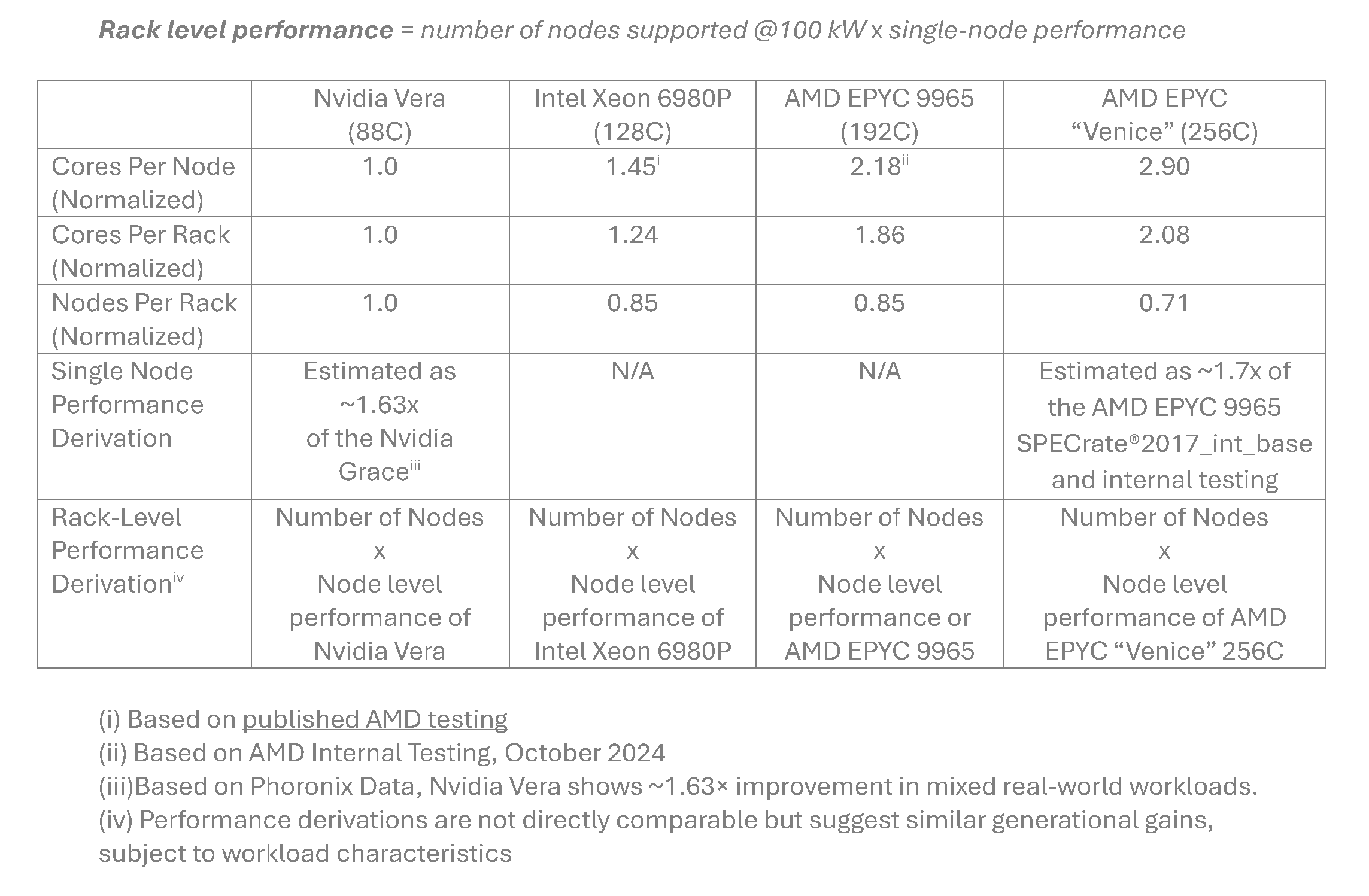
AMD drew on Phoronix’s figures when building the methodology for its Venice projections.

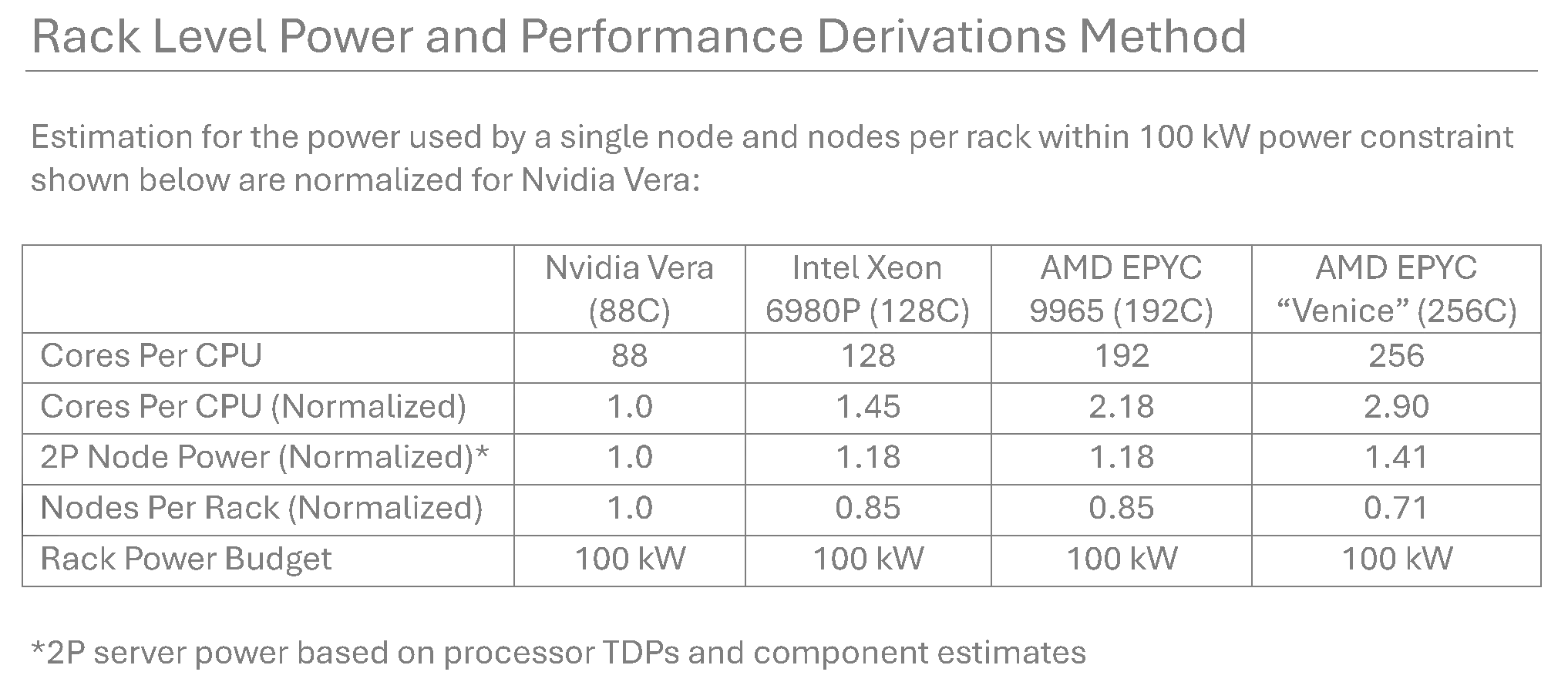
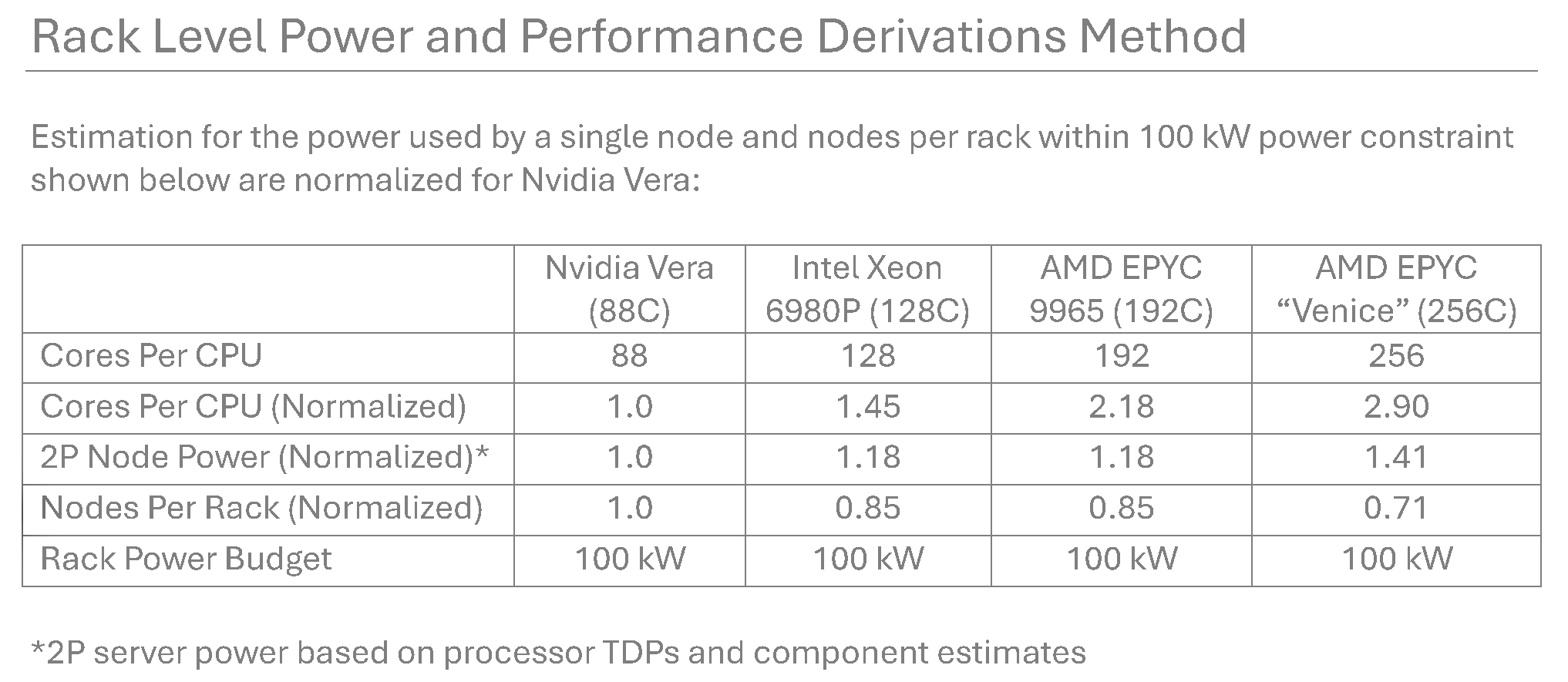
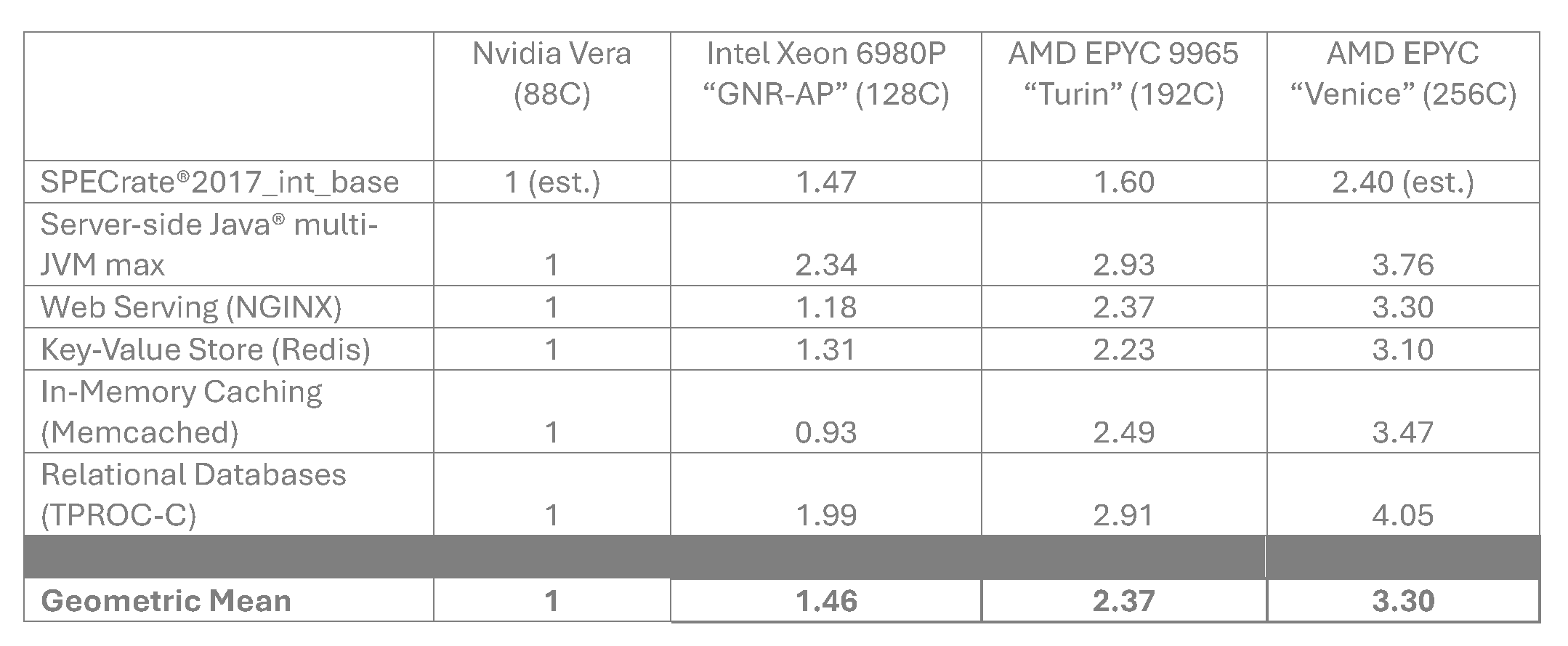
Comparing core counts per CPU, node power, nodes per rack, and a 100kW rack power budget, the company estimates Venice will deliver 3.3 times Vera’s per-rack performance. AMD also projects its 192-core Epyc 9965 Turin and the 128-core Intel Xeon 6980P GNR-AP can reach 2.37x and 1.46x of Vera’s output, respectively.

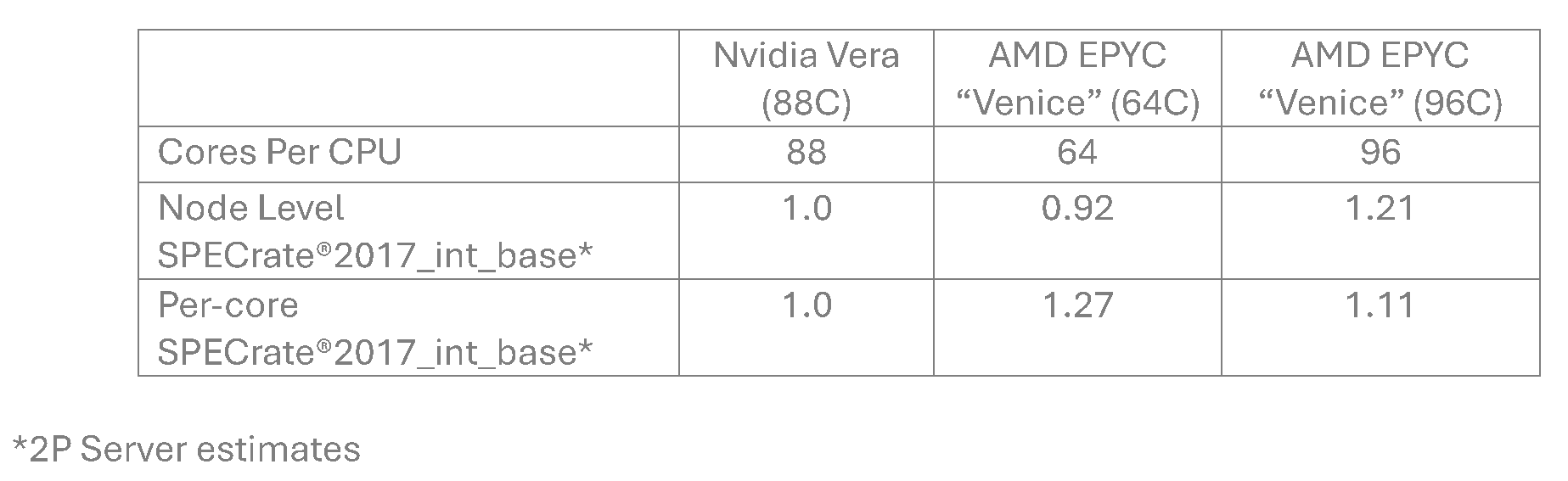
AMD is also challenging Nvidia on per-core performance, claiming a 64-core Venice chip can beat Vera by 27%, with the 96-core variant edging it by 11%.

Advertisement

As both processors target AI workloads, AMD argues that Venice’s higher core counts will translate into a meaningful advantage for agentic AI deployments. Even so, the true performance gap will remain uncertain until independent benchmarks arrive.

While promoting Venice’s theoretical performance, AMD is already hinting at what comes next. “Verano” will be AMD’s first CPU designed specifically for AI infrastructure. That chip is expected to introduce the Zen 7 architecture. Supply chain reports suggest Zen 7 will target TSMC’s A14 node, a 1.4nm-class process that would mark AMD’s entry into the angstrom era and deliver further gains in performance and efficiency beyond 2nm. AMD has not confirmed those details.

Source link

Advertisement
Continue Reading

Tech

Fewer iPhone users are upgrading to iOS 26 than iOS 18

Published

on

The iOS 26 update has the second-worst adoption rate of all iOS releases since 2015, falling behind both iOS 18 and iOS 8.

Though all eyes might be on iOS 27 and its AI-infused Siri, which debuted at WWDC, the software has only entered beta testing.

Most iPhones, or 79% of all devices to be more precise, are currently running iOS 26. This is according to Apple’s App Store data for June 2026, which also revealed that 86% of all devices introduced in the last four years have iOS 26 installed.

While these figures might seem impressive when taken at face value, the iOS 26 adoption rate is actually worse than that of the preceding iOS 18 update. In June 2025, 82% of all iPhones ran iOS 18, more than the 79% currently running iOS 26.

Advertisement

When taking into account Apple’s App Store data from all iOS releases from 2015 through 2026, the iOS 26 update actually has the second-lowest adoption rate, with only iOS 17 seeing fewer user upgrades.

The exact adoption rates for iOS 8 through iOS 26 for all compatible iPhones are the following:

  • 2015 iOS 8: 84%
  • 2016 iOS 9: 84%
  • 2017 iOS 10: 86%
  • 2018 iOS 11: 81%
  • 2019 iOS 12: 88%
  • 2020 iOS 13: 81%
  • 2021 iOS 14: 85%
  • 2022 iOS 15: 82%
  • 2023 iOS 16: 81%
  • 2024 iOS 17: 77%
  • 2025 iOS 18: 82%
  • 2025 iOS 26 79%

Note that all of these adoption rates were taken in June of the corresponding year, with the exception of iOS 12 usage data, which was published in August 2019.

At 79%, the iOS 26 adoption rate is below the 82.3% average from 2015 through 2026. Still, it’s not all bad news.

In February 2026, only 66% of all iPhones were running iOS 26, meaning more users have upgraded in the last couple of months. This is to be expected, though.

Advertisement

Even so, not everyone has embraced the controversial iOS 26 upgrade. According to Apple’s June 2026 App Store data, 14% of devices are still running iOS 18, while 7% are still on even older releases.

Apple’s data on newer devices running iOS 26

Since 2020, in June of every year, Apple has published iOS adoption rates for devices “released in the last four years.” At 86%, the adoption rate for iOS 26 is identical to that of iOS 17 in 2024. Meanwhile, iOS 18 had a higher score, at 88%.

The adoption rate of iOS 26 is also lower than the 87.6% average when Apple’s data from 2019 through 2026 is taken into account. Previous iOS updates, like iOS 12 in August 2019, saw lower adoption rates among newer devices, so iOS 26 is not an outlier in any sense.

Apple’s exact numbers for “all devices introduced in the last four years,” since the company released such data, are:

Advertisement
  • 2019 iOS 12: 85%
  • 2020 iOS 13: 92%
  • 2021 iOS 14: 90%
  • 2022 iOS 15: 89%
  • 2023 iOS 16: 90%
  • 2024 iOS 17: 86%
  • 2025 iOS 18: 88%
  • 2026 iOS 26: 86%

While iOS 26 has fallen behind iOS 18, possibly due to its Liquid Glass design language, the difference is likely not enough to cause alarm for Apple. Looking ahead, iOS 27 could boost iOS adoption rates.

Rather than controversial design changes, Apple says the iOS 27 update will deliver improved performance on older iPhones, with app opening speeds now being 30% faster, relative to previous releases.

Additionally, the same iPhone models that support iOS 26 can be updated to iOS 27, including the iPhone 11. As such, iOS 27 seems to have little to deter potential upgraders. Time will tell if the iOS 27 adoption rate will actually be higher than that of iOS 26, though.

Source link

Advertisement
Continue Reading

Tech

Fable’s 30-Minute Gameplay Demo Brings a Reactive Albion to Life

Published

on

Fable 30-Minute Gameplay Demo Build and Extraordinary Life
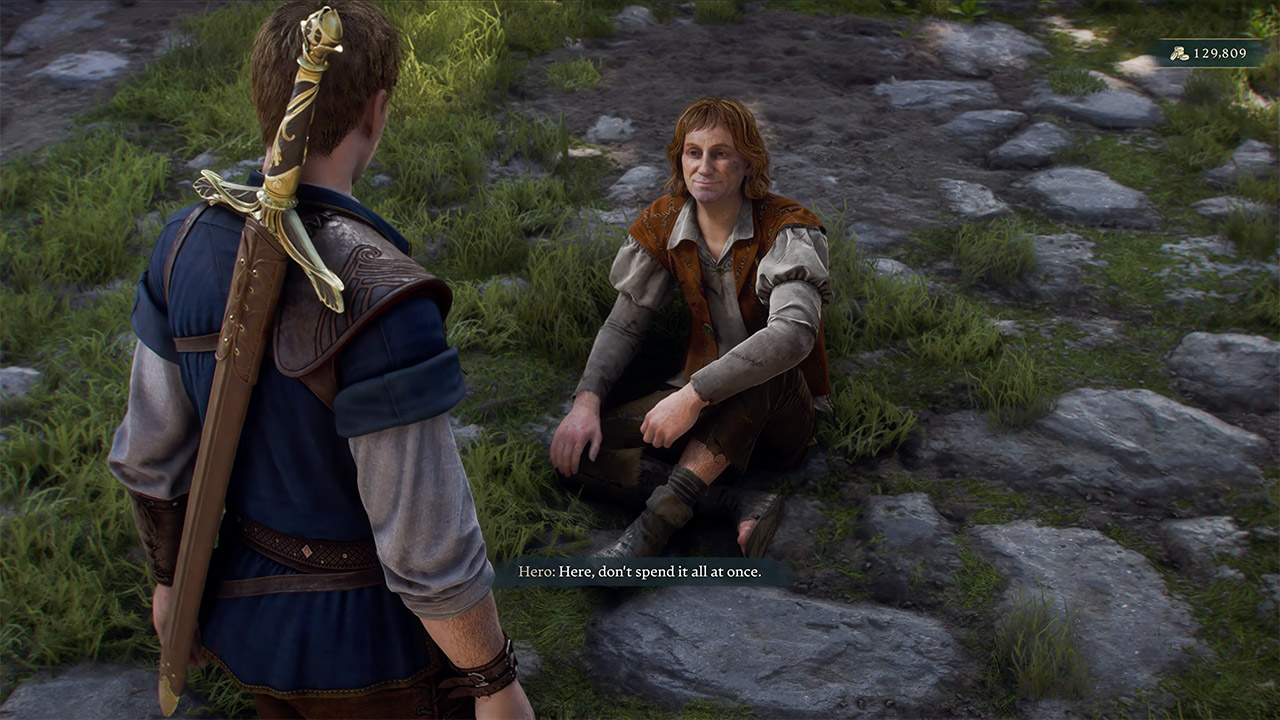
Microsoft shared a 30-minute gameplay video for Fable right after the latest Xbox showcase. The footage offers the most detailed look yet at how Playground Games plans to handle the return to Albion. Players step into the role of a hero who begins as a child discovering unusual powers in the village of Briar Hill. A time jump then moves the story forward to adult life, where decisions start to shape both the character and the surrounding world.


Playground Games based the game on three key ideas from previous entries. A fairytale tone is undoubtedly evident, but it is balanced by a particular British sense of humor and a heavy emphasis on making decisions that will have long-term consequences. The new story stands on its own, but it has a very familiar approach to fantasy.


Xbox Series X – All Digital Gaming Console – 1TB SSD – Includes Wireless Controller – 4K Gaming – 120FPS…
  • FASTEST, MOST POWERFUL XBOX — Experience next‑generation performance with 12 teraflops of processing power, delivering smoother gameplay, richer…
  • TRUE 4K GAMING UP TO 120 FPS — Enjoy breathtaking visuals with true 4K resolution, HDR, and frame rates up to 120 FPS, plus support for advanced…
  • 1TB CUSTOM SSD & VELOCITY ARCHITECTURE — Reduce load times dramatically with the custom 1TB SSD and XBOX Velocity Architecture, enabling…

Fable Screenshot
The combat system functions efficiently because it is divided into three fundamental categories: Strength for close-up and melee combat, Skill for ranged attacks, and Will for magic. Some of the videos show some very innovative uses for that magic, such as transforming an enemy into a chicken and then shooting them with a fireball, or sneaking up behind someone and teleporting past for a quick strike before the green orbs light up to indicate you’re accumulating experience.

Fable Screenshot
Reputation is based on what others see you do, not on an abstract number. So, assisting someone in need may earn you a virtuous or merciful reputation, which may result in a more welcoming reception from the community. If you cause disturbance in public, you may gain a reputation as a troublemaker, which could make things more difficult in the future. The system is clever since it allows you to build a reputation through a combination of good deeds as well as selfish goals, and you can even try to shape people’s impressions of you by spreading rumors or paying off local gossipmongers.

Fable Screenshot
Is it more than just fighting and main quests? You can truly establish your existence in the world. You can purchase a home, open a bar, a blacksmith business, and so on. You can even develop relationships with others, some of which may lead to your own family or a shared home. Instead of always rushing to complete the main story, the game lets you to take a break and enjoy the journey.

Fable Screenshot
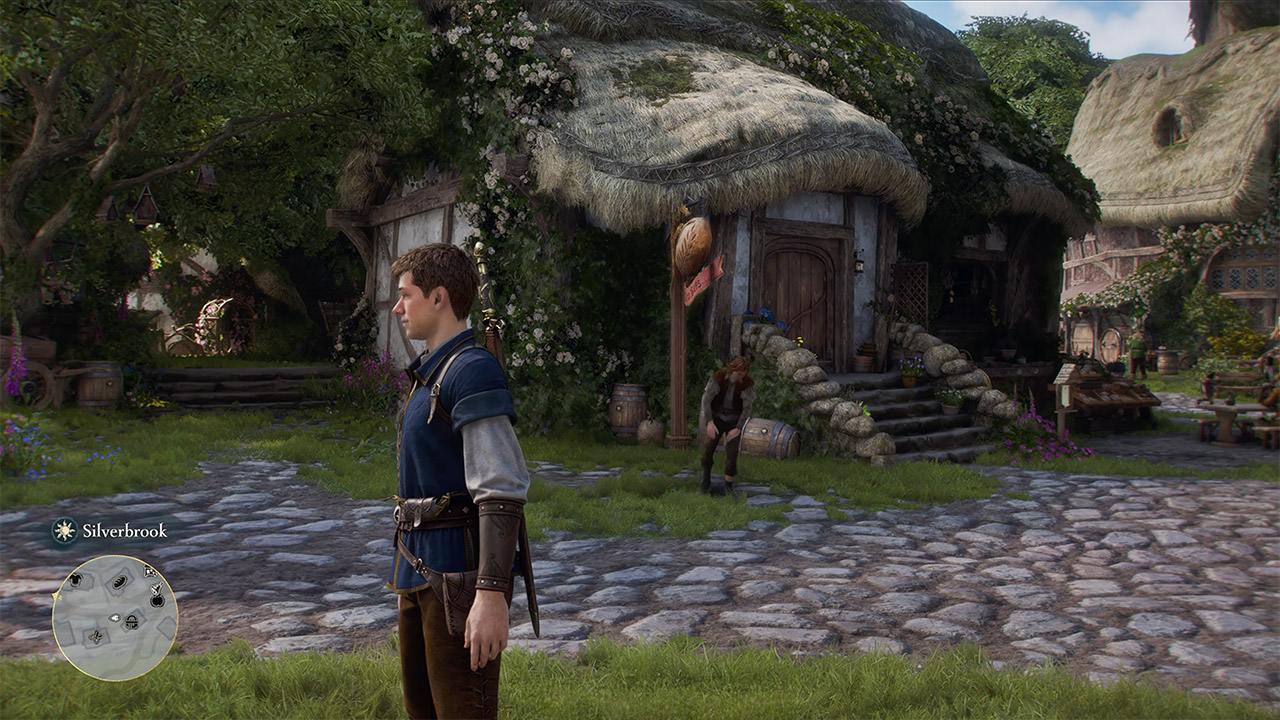
Albion, the land in which you play, is full of little side paths and detours. There is no one “correct” way to play, so go explore, do some local jobs, and start building a life in any community you find yourself in. Towns look to be populated by real people, rather than just waiting for the hero to show, because the residents have their own schedules rather than simply hanging out till you arrive.

Fable Screenshot
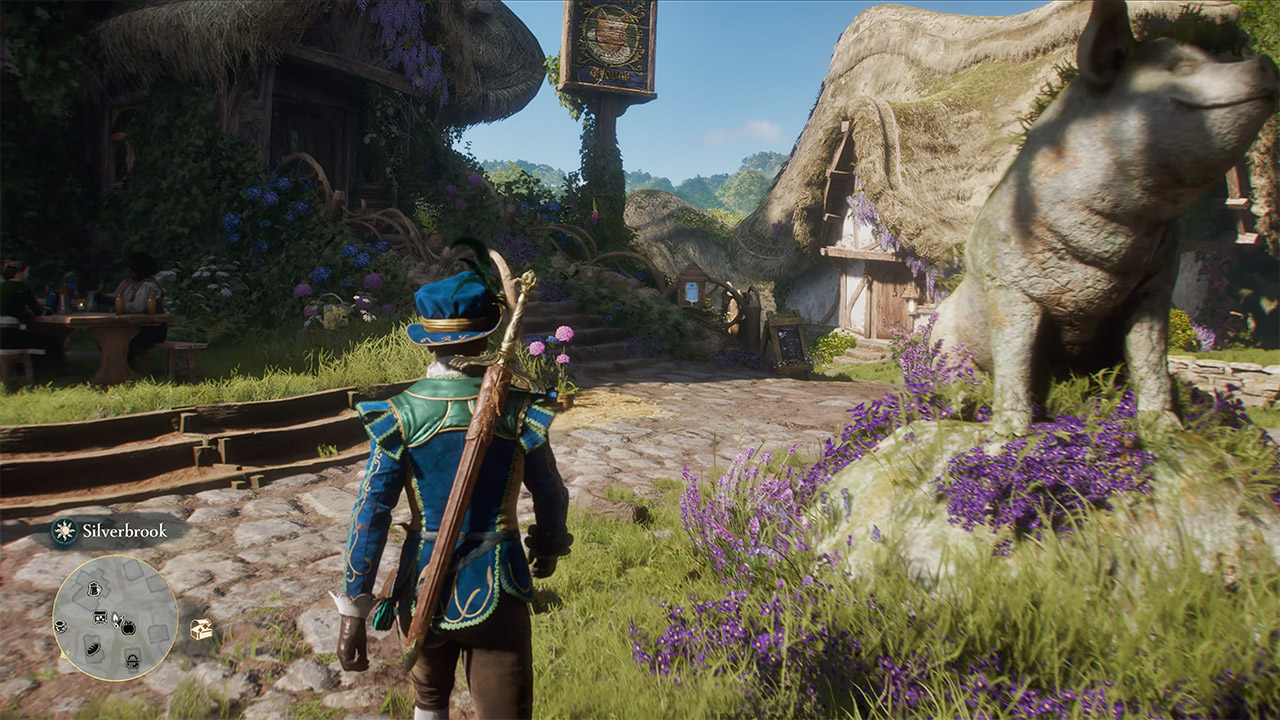
The visuals are bright and stunning, with a timeless quality about them. The villages are full of flowers and thatched roofs, and the locals look to be going about their everyday lives rather than standing around waiting for you, which is one of the most impressive elements of this demo, given that the entire game will be released on February 23rd, 2027.
[Source]

Source link

Advertisement
Continue Reading

Tech

If You Grew Up In The ’60s, You Definitely Remember These Cars

Published

on


Every generation has its iconic cars. From the hot rods of the 1930s to the sleek sports cars of the 1980s, each era can be defined by its unique take on the age-old idea of how to make cars that are fast, cool, and expressive.

Across all of automotive history, the 1960s stand out as a special time for cars. High-performance vehicles were incredibly affordable, and gas wasn’t the premium product it is now. Many houses had one- or two-car garages, and most had a car that served as an extension of their own personality. The cars of this era had not yet settled into the homogenized style of the 1970s, retaining much of the hot-rod flair of earlier decades without becoming luxury status symbols reserved for only the wealthiest elites.

Advertisement

Let’s travel back in time to the golden age of automobiles and look at some of the most legendary vehicles of that one-of-a-kind decade. If you grew up in the ’60s, you definitely remember these cars. And if you didn’t, you surely still find yourself looking at them with an envious wistfulness of vicarious nostalgia. Simply put, they don’t make ’em like that anymore.

Advertisement

1965 Pontiac GTO

Over the years, Jay Leno’s Garage featured tons of iconic and expensive cars, but few are as downright legendary as this one. When the 1965 Pontiac GTO Royal Bobcat was featured on an episode of Jay Leno’s Garage, the former Tonight Show host described the vehicle as the first true supercar, an early example of the burgeoning American muscle car scene. He even went so far as to say, “This was the dream car when I was 14 or 15 years old.” 

The Pontiac GTO was special because it broke, or at least sidestepped, the rules. Back in the day, General Motors limited the size of a midsize car’s engine to 330 cubic inches. Big cars get big engines, small cars get small engines. But the engineers at Pontiac managed to stuff a 389-cubic-inch V8 engine into a midsize car, and the rest was history. Initially pitched as an optional engine upgrade for the Pontiac Tempest, its popularity led to the invention of the 1966 GTO as its own bespoke vehicle, and the birth of the American muscle car.

There’s nothing like the rev of an oversized V8 engine that’s just a little (or a lot) too big for the car it’s powering. Every child of the ’60s who sat in a car and felt the entire frame vibrate as the driver revved the engine had the exact same thought: “When I grow up, I want one of these.” Chances are, that car was a Pontiac GTO.

Advertisement

1968 Ford Mustang

For many automotive enthusiasts, love for cars comes from exposure to TV and movies. In that regard, the 1960s had some of the most legendary vehicles ever to grace the screen. There’s the 1966 Batmobile driven by Adam West in “Batman” and the Mach 5 from “Speed Racer,” as well as the Black Beauty from “The Green Hornet” and the Elva Mk VI, driven by none other than Elvis Presley in “Viva Las Vegas.”

However, if there’s a single scene that represents the blending of cars and cinema, it’s the 1968 Ford Mustang driven by Steve McQueen in “Bullitt.” For the most part, “Bullitt” is a by-the-numbers detective movie bolstered by McQueen’s cool charisma in the title role. However, it kicks into overdrive during the show-stopping ten-minute car chase sequence, which was a turning point in action cinema. The entire car chase genre, including the “Fast & Furious” series, would not exist without “Bullitt.” McQueen does much (but not all) of his own driving in the scene, which sees Frank Bullitt outmaneuver hitmen in a pulse-pounding pursuit through the streets of San Francisco.

Advertisement

The movie and its car chase inspired a whole generation of car fanatics. Everyone who saw “Bullitt” wanted a Ford Mustang. More than five decades later, Ford is still releasing modern Mustangs inspired by the one used in the film, such as the 2020 Ford Mustang Bullitt, named after the movie. As for the original 1968 Mustang used in the movie, it was sold for $3.74 million at a 2020 auction, making it the single most valuable Mustang of all time.

Advertisement

1967 Chevrolet Camaro

In 1966, Car and Driver magazine went hands-on with the 1967 Chevrolet Camaro SS 350 and came away impressed, though with more than a hint of melancholy. The Camaro, they surmised, was aimed at the youth market, which had been sideswiped by the escalation of the Vietnam War. The Camaro was hip and relatively inexpensive but hindered by the fact that its target audience of young men had been drafted into military service.

Nevertheless, the Camaro was priced reasonably, with both the hardtop and convertible versions retailing for less than $3,000 each, competitive with its main rival, the Ford Mustang. One of the more popular versions of the Camaro was the RS, or Rally Sport, variant, which featured concealed headlights, mag wheels, options for vinyl roof customization, and rally stripes. They don’t make the car any faster, but they sure look neat!

The car was marketed toward young people, though it earned the respect of auto enthusiasts due to its use as the Pace Car in the 51st Indy 500 in 1967, with none other than three-time Indy 500 champion Mauri Rose behind the wheel, thus giving the vehicle credibility among the gearhead community. As a result, the Camaro ingratiated itself with Indy 500 fans of all ages. There would be many Camaro variants over the decades, but the 1967 version is among the best-looking Chevy Camaros of all time. Not bad for a car approaching 60 years old.

Advertisement

Volkswagen Van

Even if you’re not a “car person,” you know what a Volkswagen van is. It’s the iconic “hippie bus,” and it’s instantly recognizable as an iconic car of the era. Design-wise, it had a ton of room in the back, which was perfect for road trips and the nomadic lifestyle of counterculture kids. Remember, back in, say, 1967, gasoline was only 33 cents per gallon on average, so going on even a cross-country trek wasn’t as difficult as it is now. If you wanted to drive for days at a time, you could just go without selling off all of your possessions first.

The original run of the Volkswagen Transporter was actually introduced way back in 1950, and it became popular in the beach scene. Teenagers of the era would pack into a VW and head to the beach for fun in the sun. Later on in the 1960s, however, the bus would become the de facto automobile mascot of the hippie scene. It was perfect for packing in many riders to go to protests, and there was plenty of room in the back for a little “free love,” if you will.

Advertisement

In 1967, the second-generation iteration of the vehicle was introduced, though it lost some of its bus-like novelty with the removal of the iconic split windshield design in favor of a more traditional single-pane windshield, among other changes that sacrificed the classic identity of the original Transporter. The VW Bus would evolve considerably over the years, but the original is still a fan favorite.

Advertisement

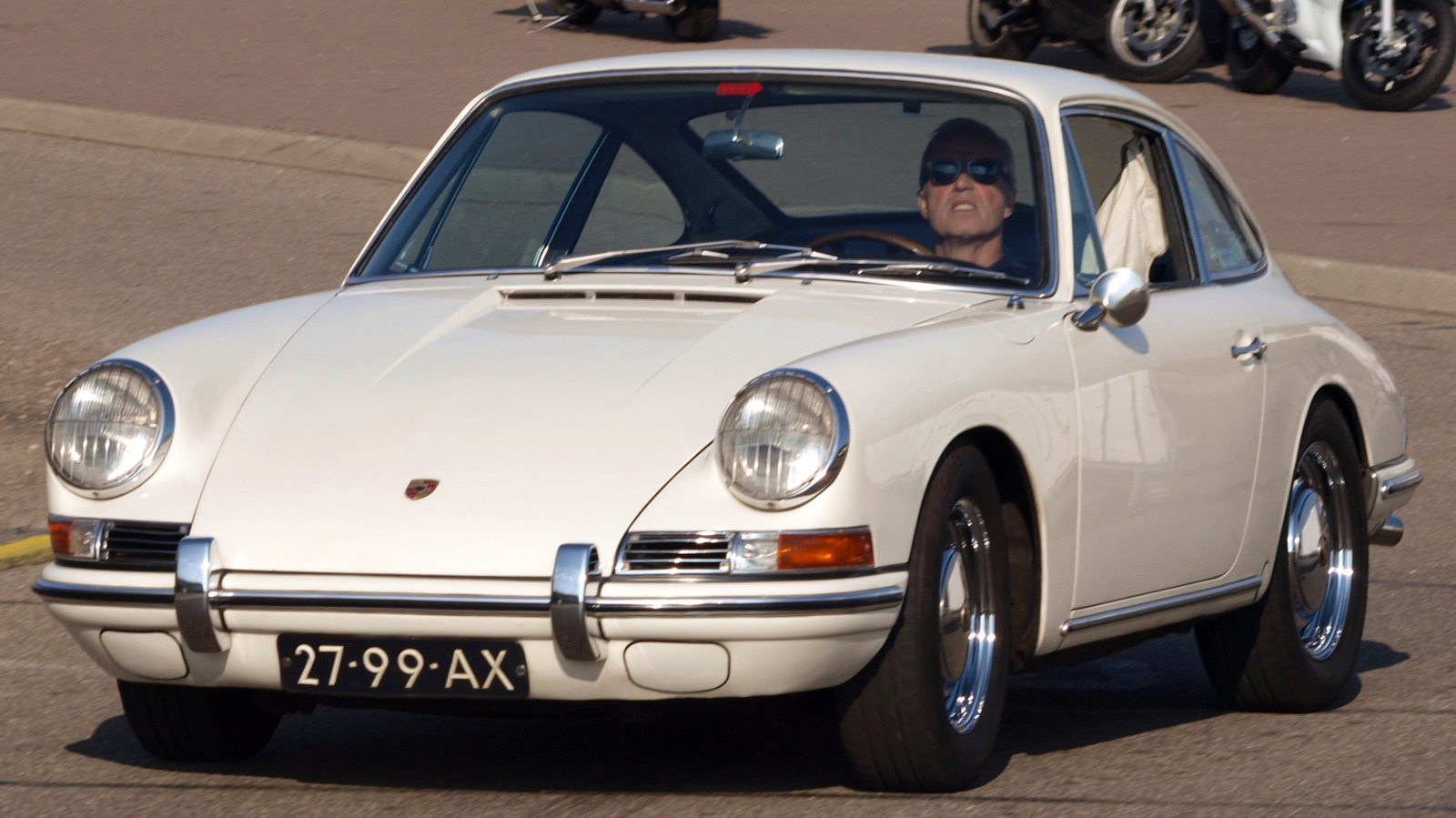
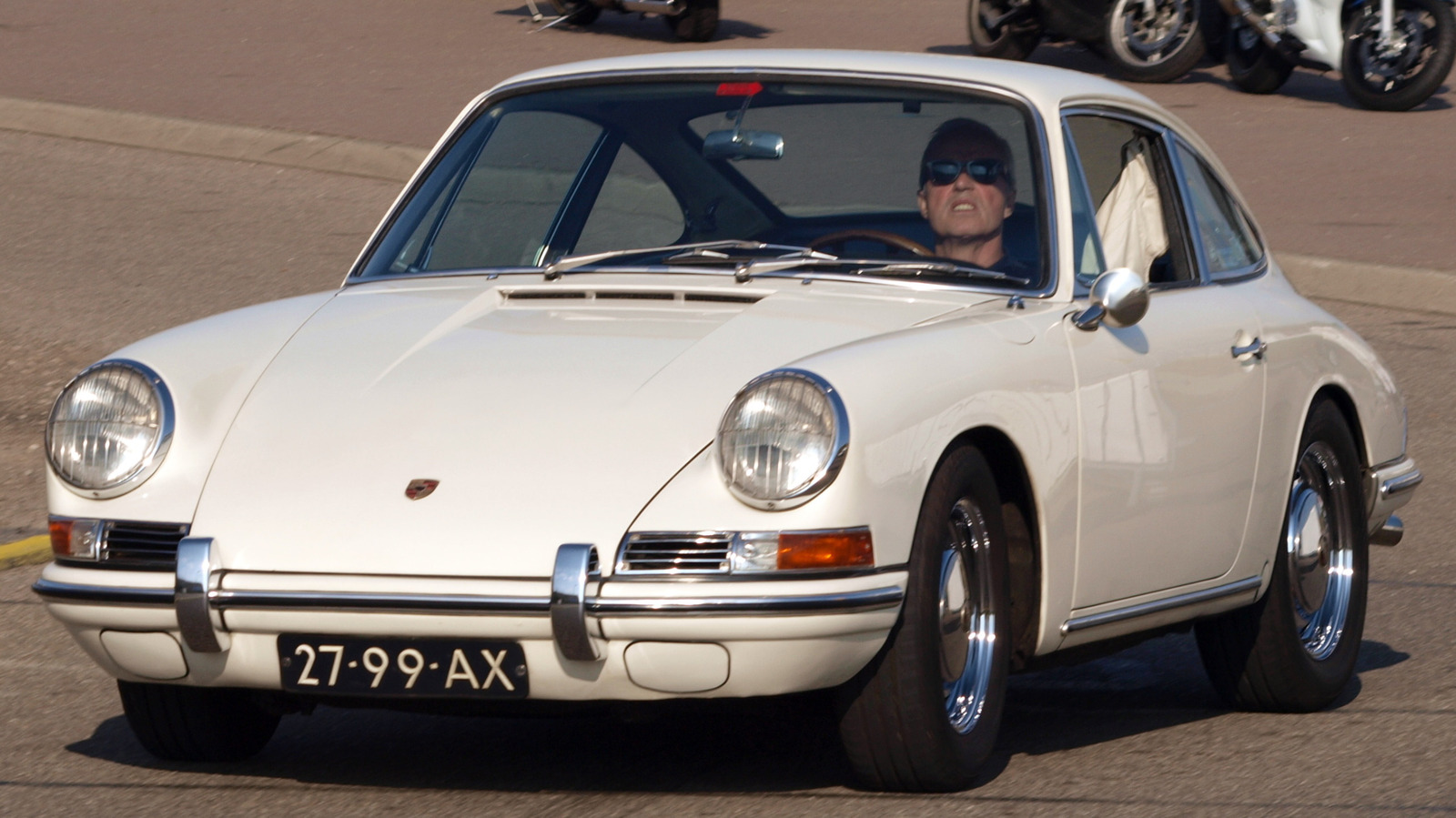
1963 Porsche 911

There were sports cars before Porsche, but the 1963 Porsche 911 changed the game. It wasn’t the first classic Porsche, but it was sleek and small with an instantly recognizable silhouette. Under the hood, the 911 boasted an air-cooled engine that delivered 130 HP. Despite making sports cars, Porsche also had a reputation for being (relatively) affordable and would go on to develop the Porsche 912 in 1965 as a less expensive alternative to the regular 911.

The Porsche 911 is an iconic car for bringing luxury sensibilities to everyday suburbia in the 1960s. Its engine may not have been able to compete with the muscle cars of Pontiac or Ford, but Porsche would upgrade the engine over the years. In 1966, the Porsche 911S boosted the engine to a more palatable 160 HP, and by 1971, the Porsche Carrera RS would boast a stellar 210 HP engine.

For many young people in the 1960s, Porsche was their introduction to the very concept of a sports car. For those who didn’t see the appeal of a bulky, muscular hot rod but still wanted to go fast, Porsche was the origin point for a lifetime of aspirational thinking.

Advertisement


Source link

Advertisement
Continue Reading

Tech

Introducing Boron Buckyballs | Hackaday

Published

on

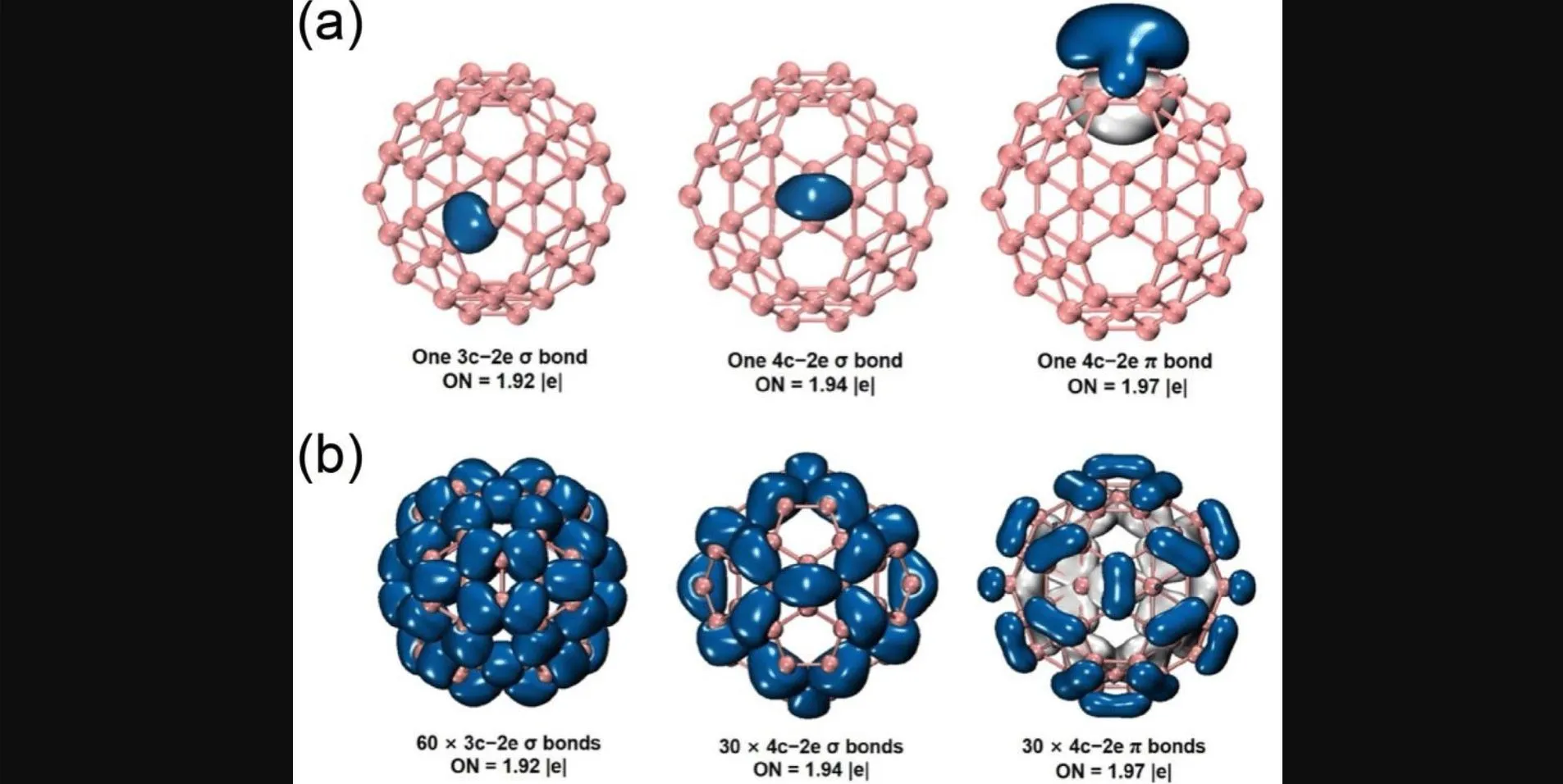
A buckminsterfullerene, also known as a buckyball, is typically a fullerene consisting of sixty carbon atoms (C60) arranged in a way that resembles a football-like sphere. Extending this arrangement to other types of atoms has until now however proven as illusive as finding non-carbon-based lifeforms. In a paper by [Hyun Wook Choi] et al. and published in Chemical Science the discovery of boron buckyballs is detailed. There is also a soft-paywalled article in the Chemical & Engineering News magazine for a higher-level perspective.

The discovered boron-based buckyball ups the number of atoms to eighty, forming B80 (boron fullerite) with a slightly larger diameter than C60 at 0.85 nm versus 0.71 nm. Perhaps more interesting are the claims by the authors that boron fullerite may have more practical applications than its carbon-based cousin, mostly due to it being predicted to be a semiconductor with an 0.8 eV energy gap and better electron acceptance that provides interesting doping prospects.

Producing these boron structures used laser vaporization with a helium carrier gas that was seeded with argon to increase cooling efficiency. Inside this boron cluster the reported structures were then discovered and characterized as described in the paper.

Advertisement

Obviously, going from a fascinating laboratory discovery to bulk production won’t be easy, and the predicted properties of boron fullerite may turn out to be incomplete or have a dark side that we aren’t aware of. Regardless, they’re bound to be more useful at least than the carbon version that’s remained mostly a curiosity despite many years of research.

Source link

Advertisement
Continue Reading

Tech

xAI fired an engineer who raised alarms about Grok safety, new lawsuit claims

Published

on

A former engineer at Elon Musk’s xAI has filed suit against the company and its parent SpaceX claiming he was fired for raising concerns about AI safety.

Devin Kim, who left xAI in September 2025, filed the suit in a California state court on Tuesday. The complaint comes days before SpaceX is set to join the public markets in what’s shaping up to be the largest IPO in history.

According to the lawsuit, which TechCrunch has viewed, Kim became a prominent voice for AI safety while working on Grok, xAI’s AI chatbot. He allegedly complained repeatedly about xAI’s failure to prioritize safety in Grok’s development, a product that has since come under fire for a range of safety and behavioral issues. In particular, Kim was concerned with the possibility that Grok could foment discrimination and help spread information about weapons of mass destruction.

“Grok, of course, proved Mr. Kim right by engaging in spectacular displays of online hatred and vitriol, with the model likening itself to Hitler (‘MechaHitler’),” the lawsuit reads. “Following the Hitler debacle, Mr. Kim worked to re-evaluate Grok’s political bias and discriminatory tendencies.”

Advertisement

A few months after Kim departed xAI, Grok made headlines again when the chatbot was used to flood X — Musk’s social media platform that also falls under the xAI umbrella — with nonconsensual sexual imagery.

The lawsuit also positions Kim as a whistleblower who was concerned about xAI’s alleged disregard for AI safety as “unlawful” in areas such as internet regulation, consumer protection and unfair business practices, and arms and explosives regulation, among others. 

Advertisement

xAI and SpaceX did not immediately respond to requests for comment. 

Kim’s focus on AI safety predates his time at xAI. While working at Scale AI, Kim worked on early safety AI initiatives, like leading a project that produced training data for AI to train systems to detect harmful content and comply with governance policies. Last week, the nonprofit Center for AI Safety, which focuses on AI risks, named Kim as its president.

Interestingly, the lawsuit doesn’t implicate Musk himself as a reason for a lack of safety. Rather, Kim’s lawyers describe Musk as having directed xAI to follow the law and implement appropriate safety and testing processes. Instead the claim targets Kim’s supervisor, xAI co-founder Jimmy Ba — who left the company earlier this year — saying that Ba ignored Musk’s directives and retaliated against Kim for pushing for safeguards, in an effort to “silence his repeated complaints about AI safety and biases.”

The lawsuit portrays Ba as someone who vehemently opposed AI safety measures, allegedly telling Kim at one point “AI will kill us all anyway,” and who was instead driven by a mission to make xAI the first to reach superintelligence. 

Advertisement

“In one instance in or around August 2025, Mr. Ba attempted to thwart EU safety regulations during the release of Grok Code 1, misrepresenting aspects of the model in order to avoid legally required testing,” the complaint says. “Mr. Ba indicated that he would rather release an unsafe model than a poor-performing one. Mr. Musk ultimately had to intervene.”

According to the lawsuit, Kim intended to give a presentation of his findings the week of September 15, 2025, but Ba called him into a meeting and told him they should “go [their] separate ways” without providing a satisfactory reason. 

TechCrunch has reached out to Ba for comment. 

Kim is seeking compensatory and punitive damages, as well as a declaratory judgment that xAI and SpaceX’s conduct was unlawful.

Advertisement

When you purchase through links in our articles, we may earn a small commission. This doesn’t affect our editorial independence.

Source link

Continue Reading

Trending

Copyright © 2025