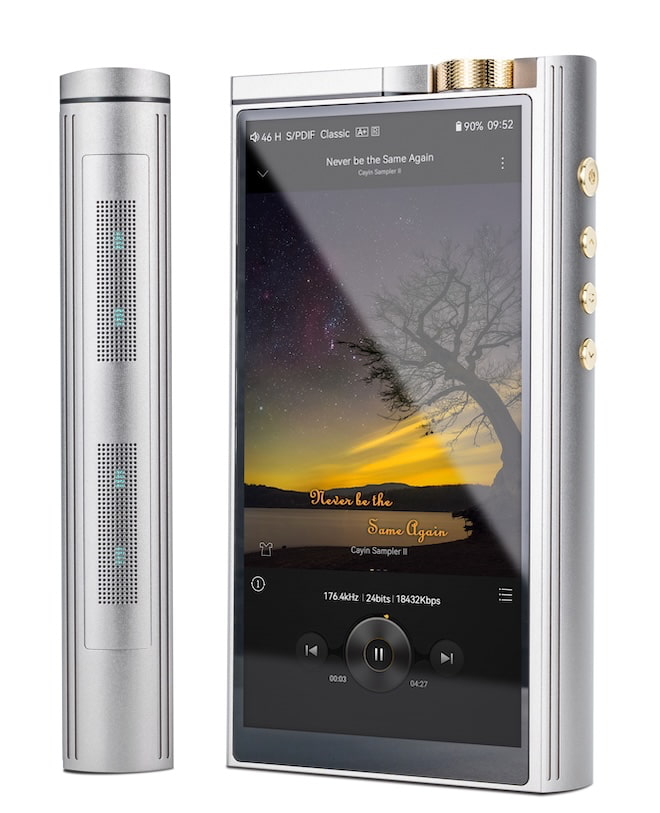
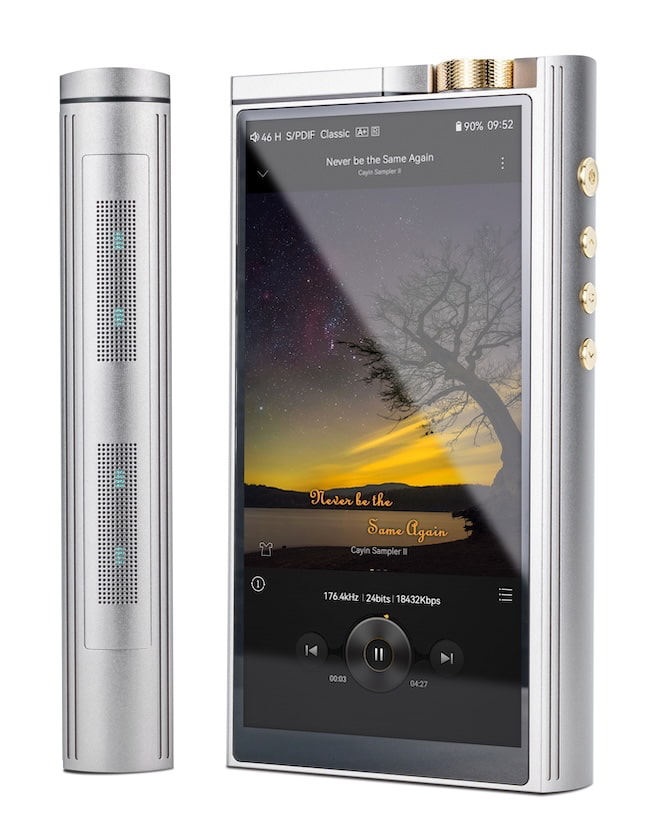
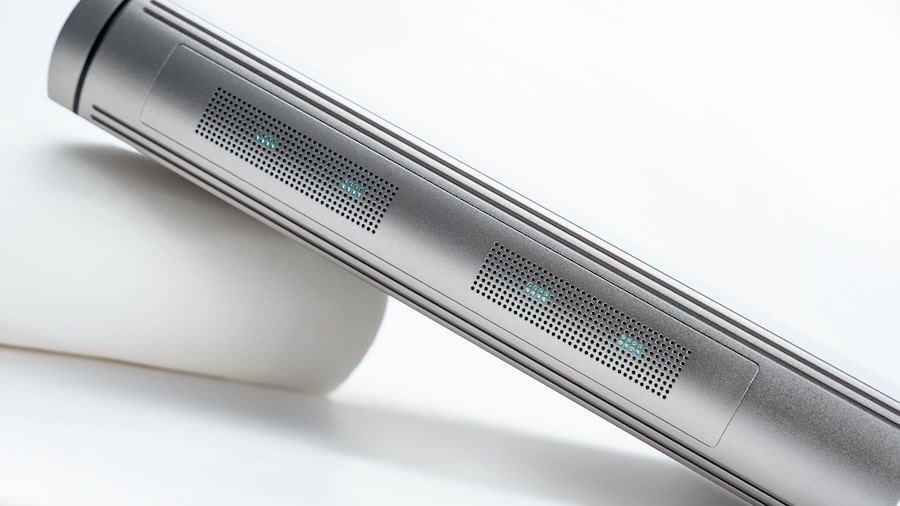
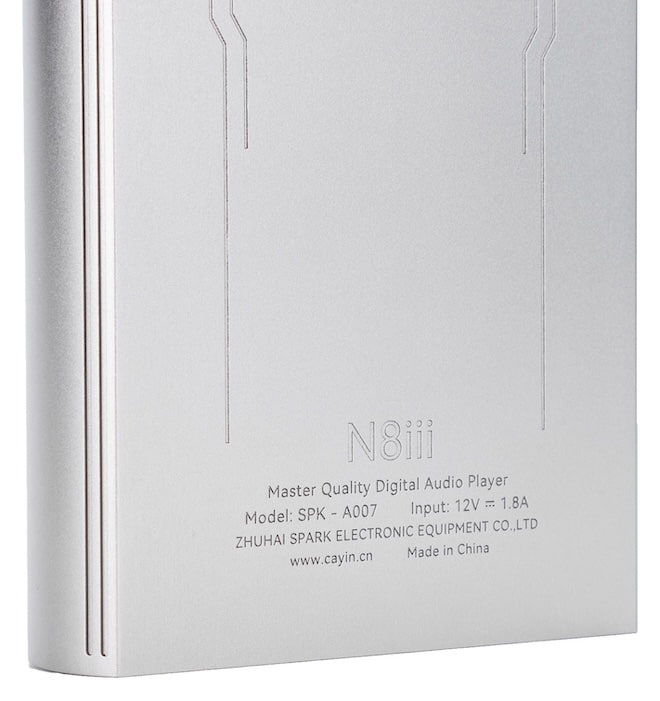
Cayin has officially taken the wraps off the N8iii, its next generation flagship digital audio player (DAP), and this time there is enough real information to move past speculation. The timing matters. Astell&Kern continues to dominate the premium tier with refined hardware and software, FiiO has become far more aggressive at the top end, and iBasso keeps pushing output and modular flexibility. Cayin is no longer competing in a niche it helped create. It is now part of a very crowded field where execution matters more than ambition.
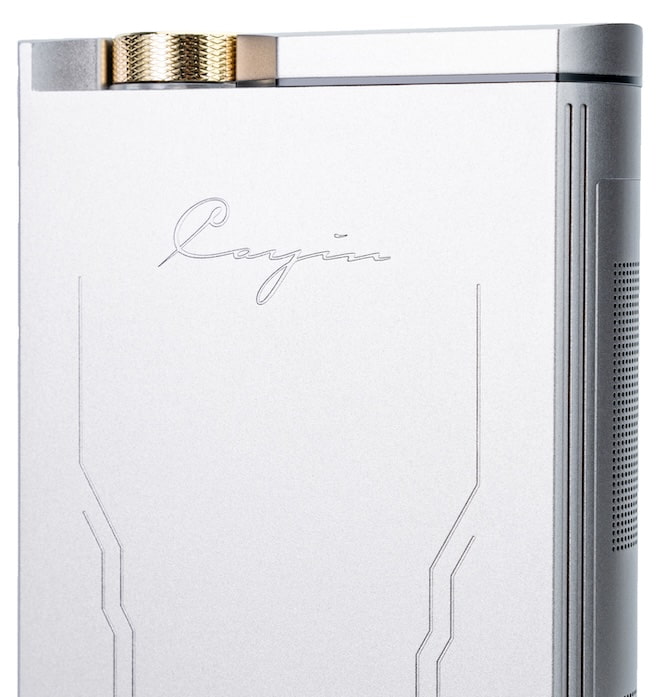
Cayin is positioning the N8iii as a limited release with just 500 units worldwide and a suggested retail price of $3,999, placing it squarely in the upper tier of the DAP market and making it clear this is not intended for a broad audience.
A Flagship That Sticks With Tubes
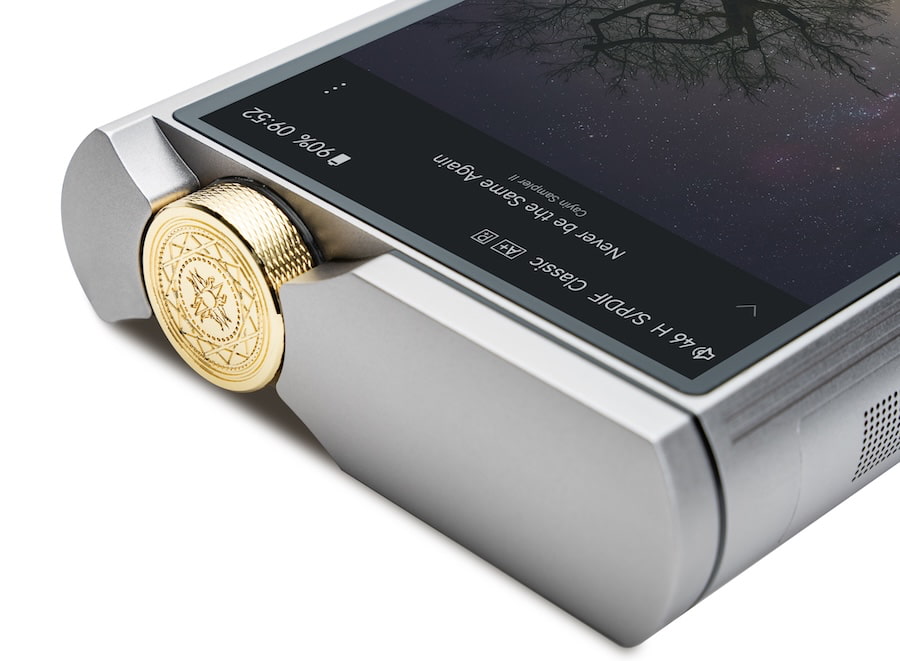
Cayin is continuing with its hybrid tube and solid state approach. The N8iii introduces a Triple Timbre system with Tube Classic, Tube Modern, and Solid State modes. This is less about novelty and more about giving users different tonal options depending on the headphone and music. Cayin has been consistent here. It is one of the few brands willing to deal with the complexity of tube integration in a portable device, even if that comes with tradeoffs in size, heat, and battery life.
Power Output and Amplifier Design
The N8iii offers up to 900 milliwatts single ended and 1285 milliwatts balanced output, which translates to roughly 0.9 watts and 1.285 watts respectively. That is enough power for a wide range of headphones, including many planar magnetics and most dynamic designs in the portable category. It should not have any issue with efficient or moderately demanding full size headphones.
Where things get less certain is with high impedance dynamic headphones. Models in the 300 to 600 ohm range often require voltage swing as much as current, and Cayin has not provided enough detail yet to determine how the N8iii handles that. It is likely usable, but whether it offers full control and headroom is still an open question.
Advertisement
It is also worth stating the obvious. This is not designed for electrostatic headphones. That requires a completely different amplification approach, and Cayin is not trying to solve that problem here.
Cayin includes triple amplifier modes and dual output modes, which gives users some flexibility in how the player behaves, but it also adds complexity that will need to be justified in real world use.
DAC & Platform
Cayin is moving forward with a new flagship AKM DAC architecture, although full details have not been confirmed. That will appeal to listeners who prefer the AKM presentation, especially after several years where ESS dominated the category.
The N8iii runs on a Snapdragon 665 platform with 8GB of RAM and 256GB of internal storage. That is not cutting edge by smartphone standards, but it is in line with what most high end DAPs are using and should be sufficient for streaming and local playback without performance issues.
Advertisement
Software & Battery
The player uses a customized Android audio system with DTA, allowing SRC bypass for bit perfect playback across supported apps. This is expected at this level and Cayin is in line with the rest of the market here.
Battery capacity is listed at 13,500mAh with PD2.0 fast charging. That is a large battery, which makes sense given the use of tubes and relatively high output power. Actual runtime will depend on how those features are used, and Cayin has not provided estimates yet.
Advertisement. Scroll to continue reading.
The Competition
At this price and level, Cayin is up against established competition. Astell&Kern offers more polished industrial design and a mature user experience. FiiO is delivering strong performance with competitive pricing. iBasso continues to push output power and modular flexibility. These are complete products that balance sound quality with usability.
Cayin’s approach remains more specialized. The N8iii focuses on offering a different listening experience rather than trying to be the most practical option.
Advertisement
Cayin N8ii vs N8iii: What’s Actually Changed
Looking at the available data, the jump from the N8ii to the N8iii is not about reinventing the concept. Cayin is refining it, adding flexibility, and pushing output a bit further while trying to clean up some of the practical limitations that came with the earlier design.
The N8ii already established the blueprint. Snapdragon 660 platform, 6GB of RAM, 128GB storage, Android 9, ROHM DACs, and dual Nutube implementation. It was powerful for its time, but it also felt like a device that prioritized experimentation over usability. Battery life hovered around 8 to 11 hours depending on mode, the chassis was thick and heavy at around 442 grams, and while the output was respectable, it was not class leading.
On the output side, the N8ii delivered up to 420mW at 16 ohms from the single ended output in standard mode, and up to 720mW in its higher power setting. Balanced output pushed that further to 760mW standard and up to 1200mW in its higher power mode. That translates to roughly 0.76W to 1.2W balanced depending on how hard you push it. In practical terms, it could handle most headphones reasonably well, but it was not the last word in authority, especially with higher impedance dynamics where voltage swing matters more than raw wattage.
The N8iii moves that forward, but not dramatically. Cayin is now quoting up to 900 milliwatts single ended and 1285 milliwatts balanced output, which translates to roughly 0.9 watts and 1.285 watts respectively. That is enough power for a wide range of headphones, including many planar magnetics and most dynamic designs in the portable category. It should not have any issue with efficient or moderately demanding full size headphones.
Advertisement
Where things remain uncertain is with high impedance dynamic headphones. The increase in output is incremental, not transformative, and Cayin has not provided detailed voltage specs yet. That means headphones in the 300 to 600 ohm range may still be usable, but not necessarily driven to their full potential. And just to be clear, neither the N8ii nor the N8iii is designed for electrostatic headphones, so that remains outside the scope entirely.
The more meaningful change is in flexibility. The N8ii gave you tube or solid state. The N8iii expands that into Triple Timbre with Tube Classic, Tube Modern, and Solid State. That suggests Cayin is focusing more on user tuning and adaptability rather than just raw performance gains. It is a shift toward giving listeners more control over presentation depending on the headphone pairing.
Internally, there is also a shift in direction. The N8ii relied on dual ROHM BD34301 DACs, which offered a certain tonal character that some preferred over ESS implementations. The N8iii is moving to a new flagship AKM architecture, which likely signals a different tuning approach. That is not inherently better or worse, but it does indicate Cayin is responding to market preferences and the return of AKM supply.
Platform and usability are also getting a modest update. The N8iii moves to 8GB of RAM and 256GB of storage, along with a Snapdragon 665. That is not cutting edge, but it is an improvement and should make the device feel less constrained with modern streaming apps. The inclusion of a customized Android audio system with SRC bypass brings it in line with what competitors have already been doing, rather than pushing ahead.
Battery is another area where Cayin appears to be compensating for its design choices. The N8ii used a 10,000mAh battery rated at 38Wh and delivered between roughly 8 to 11 hours depending on mode. The N8iii increases that to 13,500mAh and adds PD fast charging. That suggests Cayin is trying to offset the power demands of tubes and higher output rather than fundamentally improving efficiency.
Advertisement
The rest of the design philosophy remains consistent. Both devices are heavy, complex, and not particularly concerned with being pocket friendly. Both are built around the idea that a portable device can approximate a desktop listening experience if you are willing to accept the tradeoffs.
Advertisement. Scroll to continue reading.
The Bottom Line
The Cayin N8iii builds on what the company has been doing with its flagship line. It keeps the tube hybrid concept, adds more flexibility in tuning, and delivers enough power for most headphones people are likely to use with a portable device. It is not intended to cover every use case. High impedance dynamics may still require more careful matching, and electrostatic headphones are not part of the equation.
At nearly $4,000 USD and with only 500 units available, this is a focused product for a specific audience. The competition is strong and more well rounded than it used to be. Cayin is relying on differentiation and sound tuning to justify its place at the top. Whether that is enough will depend on how it performs outside of the spec sheet.
What the charts from the previous model make clear is how much detail still has not been confirmed for the N8iii. The N8ii offered a very complete set of physical connections including both 3.5mm single ended and 4.4mm balanced headphone outputs, along with matching line outputs on both connections. It also included digital outputs over USB and I2S via a mini HDMI connection, plus coaxial S PDIF. That made it more than just a portable player. It could function as a transport or DAC in a larger system. With the N8iii, Cayin has not yet clarified whether all of those outputs carry over unchanged, or if anything has been added or removed. Given how important that flexibility is to this category, that is not a small omission.
Advertisement
Bluetooth is another area where details matter. The N8ii supported a wide range of codecs including LDAC, UAT, AAC, and SBC, with both transmit and receive capability. That placed it ahead of many competitors at the time, especially with UAT support for higher bandwidth wireless audio. So far, Cayin has not confirmed the codec support for the N8iii. If it remains unchanged, it is still competitive. If it has been updated, that could be a meaningful improvement. If it has been simplified, that would be a step backward. Right now, we simply do not know.
The digital section is where the lack of detail becomes harder to ignore. The N8ii supported PCM up to 32-bit/768kHz and DSD512 over USB and I2S, along with DoP support over coaxial. It could function as a USB DAC across multiple platforms and offered asynchronous USB audio with broad compatibility. Those are not niche features. They are part of what makes a flagship DAP viable as a hub in a desktop or transport based system. Cayin has confirmed a new DAC architecture for the N8iii, but has not yet outlined the full range of supported formats, digital input and output capabilities, or whether its USB DAC functionality has been expanded or refined.
MSRP: $3,999 (launch date not confirmed at en.cayin.cn).
Looking for the most recent Mini Crossword answer? Click here for today’s Mini Crossword hints, as well as our daily answers and hints for The New York Times Wordle, Strands, Connections and Connections: Sports Edition puzzles.
I thought today’s Mini Crossword was pretty tricky. I jumped from the Across clues to the Down and back to Across, slowly adding answers and making several mistakes as I went. Read on for all the answers. And if you could use some hints and guidance for daily solving, check out our Mini Crossword tips.
If you’re looking for today’s Wordle, Connections, Connections: Sports Edition and Strands answers, you can visit CNET’s NYT puzzle hints page.
Last summer, a group of officials from the Department of Energy gathered at the Idaho National Laboratory, a sprawling 890-square-mile complex in the eastern desert of Idaho where the U.S. government built its first rudimentary nuclear power plant in 1951 and continues to test cutting-edge technology.
On the agenda that day: the future of nuclear energy in the Trump era. The meeting was convened by 31-year-old lawyer Seth Cohen. Just five years out of law school, Cohen brought no significant experience in nuclear law or policy; he had just entered government through Elon Musk’s Department of Government Efficiency team.
Advertisement
As Cohen led the group through a technical conversation about licensing nuclear reactor designs, he repeatedly downplayed health and safety concerns. When staff brought up the topic of radiation exposure from nuclear test sites, Cohen broke in.
“They are testing in Utah. … I don’t know, like 70 people live there,” he said.
“But … there’s lots of babies,” one staffer pushed back. Babies, pregnant women and other vulnerable groups are thought to be potentially more susceptible to cancers brought on by low-level radiation exposure, and they are usually afforded greater protections.
“They’ve been downwind before,” another staffer joked.
Advertisement
“This is why we don’t use AI transcription in meetings,” another added.
ProPublica reviewed records of that meeting, providing a rare look at a dramatic shift underway in one of the most sensitive domains of public policy. The Trump administration is upending the way nuclear energy is regulated, driven by a desire to dramatically increase the amount of energy available to power artificial intelligence.
Career experts have been forced out and thousands of pages of regulations are being rewritten at a sprint. A new generation of nuclear energy companies — flush with Silicon Valley cash and boasting strong political connections — wield increasing influence over policy. Figures like Cohen are forcing a “move fast and break things” Silicon Valley ethos on one of the country’s most important regulators.
The Trump administration has been particularly aggressive in its attacks on the Nuclear Regulatory Commission, the bipartisan independent regulator that approves commercial nuclear power plants and monitors their safety. The agency is not a household name. But it’s considered the international gold standard, often influencing safety rules around the world.
Advertisement
The NRC has critics, especially in Silicon Valley, where the often-cautious commission is portrayed as an impediment to innovation. In an early salvo, President Donald Trump fired NRC Commissioner Christopher Hanson last June after Hanson spoke out about the importance of agency independence. It was the first time an NRC commissioner had been fired.
During that Idaho meeting, Cohen shot down any notion of NRC independence in the new era.
“Assume the NRC is going to do whatever we tell the NRC to do,” he said, records reviewed by ProPublica show. In November, Cohen was made chief counsel for nuclear policy at the Department of Energy, where he oversees a broad nuclear portfolio.
The aggressive moves have sent shock waves through the nuclear energy world. Many longtime promoters of the industry say they worry recklessness from the Trump administration could discredit responsible nuclear energy initiatives.
Advertisement
“The regulator is no longer an independent regulator — we do not know whose interests it is serving,” warned Allison Macfarlane, who served as NRC chair during the Obama administration. “The safety culture is under threat.”
A ProPublica analysis of staffing data from the NRC and the Office of Personnel Management shows a rush to the exits: Over 400 people have left the agency since Trump took office. The losses are particularly pronounced in the teams that handle reactor and nuclear materials safety and among veteran staffers with 10 or more years of experience. Meanwhile, hiring of new staff has proceeded at a snail’s pace, with nearly 60 new arrivals in the first year of the Trump administration compared with nearly 350 in the last year of the Biden administration.
Some nuclear power supporters say the administration is providing a needed level of urgency given the energy demands of AI. They also contend the sweeping changes underway aren’t as dangerous or dire as some experts suggest.
“I think the NRC has been frozen in time,” said Brett Rampal, the senior director of nuclear and power strategy at the investment and strategy consultancy Veriten. “It’s a great time to get unfrozen and aim to work quickly.”
Advertisement
The White House referred most of ProPublica’s questions to the Department of Energy, where spokesperson Olivia Tinari said the agency is committed to helping build more safe, high-quality nuclear energy facilities.
“Thanks to President Trump’s leadership, America’s nuclear industry is entering a new era that will provide reliable, abundant power for generations to come,” she wrote. The DOE is “committed to the highest standards of safety for American workers and communities.”
Cohen did not respond to multiple requests for comment. The NRC declined to comment.
Blindsided by DOGE
The U.S. has not had a serious nuclear incident since the Three Mile Island partial meltdown in 1979, a track record many experts attribute to a rigorous regulatory environment and an intense safety culture.
Advertisement
Major nuclear incidents around the world have only strengthened the resolve of past regulators to stay independent from industry and from political winds. A chief cause of Japan’s Fukushima accident, investigators found, was the cozy relationship between the country’s industry and oversight body, which opened the door for thin safety assessments and inaccurate projections overlooking the possible impact of a major tsunami.
“We knew regulatory capture led directly to Fukushima and to Chernobyl,” said Kathryn Huff, who was assistant secretary for the Office of Nuclear Energy during the Biden administration.
The U.S. has barely built any nuclear power plants in recent decades. Only three new reactors have been completed in the last 25 years, and since 1990 the U.S has barely added any net new nuclear electricity to its grid. Though about 20% of U.S. energy is supplied by nuclear power plants, the fleet is aging. Some experts blame the slow build-out on the challenging economics of financing a multibillion-dollar project and the uncertainty of accessing and disposing of nuclear fuels.
But an increasingly vocal group of industry voices and deregulation advocates have blamed the slow build-out on overly cautious and inefficient regulators. Among the most powerful exponents of this view are billionaires Peter Thiel and Marc Andreessen; both venture capitalists have their own investments in the nuclear energy sector and are influential Trump supporters.
Advertisement
Andreessen camped out at Mar-a-Lago, Trump’s private club in Florida, after Trump won the 2024 election, helping pick staff for the new administration. In late 2024, Thiel personally vetted at least one candidate for the Office of Nuclear Energy, according to people familiar with the conversations. Neither responded to requests for comment.
Four months into his second term, Trump signed a series of executive orders designed to supercharge nuclear power build-out. “It’s a hot industry, it’s a brilliant industry,” said Trump, flanked by nuclear energy CEOs in the Oval Office. He added: “And it’s become very safe.”
Under those orders, the NRC was directed to reduce its workforce, speed up the timeline for approving nuclear reactors and rewrite many of its safety rules. The DOE — which has a vast nuclear portfolio, including waste cleanup sites and government research labs — was tasked with creating a pathway for so-called advanced nuclear companies to test their designs.
The goal, Trump said, was to quadruple nuclear energy output and provide new power to the data centers behind the AI boom.
Advertisement
As DOGE gutted agencies, departures mounted in the nuclear sector. Career experts in nuclear regulations and safety departed or were forced out. When Trump fired Hanson, a Democratic NRC commissioner, the president’s team explained the move by saying, “All organizations are more effective when leaders are rowing in the same direction.”
In an unsigned email to ProPublica, the White House press office wrote: “All commissioners are presidential appointees and can be fired just like any other appointee.”
In August, the NRC’s top attorney resigned and was replaced by oil and gas lawyer David Taggart, who had been working on DOGE cuts at the DOE. In all, the nuclear office at the DOE had lost about a third of its staff, according to a January 2026 count by the Federation of American Scientists, a nonprofit focused on science and technology policy.
That summer, Cohen and a team of DOGE operatives touched down at the NRC offices, a series of nondescript towers across from a Dunkin’ in suburban Maryland. He was joined by Adam Blake, an investor who had recently founded an AI medical startup and has a background in real estate and solar energy, and Ankur Bansal, president of a company that created software for real estate agents. Neither would comment for this story.
Advertisement
Many career officials who spoke with ProPublica were blindsided: The new Trump officials at the NRC seemed to have no experience with the intricacies of nuclear energy policy or law, they said. One NRC lawyer who briefed some of the new arrivals decided to resign. “They were talking about quickly approving all these new reactors, and they didn’t seem to care that much about the rules — they wanted to carry out the wishes of the White House,” the official said.
At one point, Cohen began passing out hats from nuclear energy startup Valar Atomics, one of the companies vying to build a new reactor, according to sources familiar with the matter and records seen by ProPublica. NRC staffers balked; they were supposed to monitor companies like Valar for safety violations, not wear its swag.
NRC ethics officials warned Cohen that the hat handout was a likely violation of conflict rules. It betrayed a misunderstanding of the safety regulator’s role, said a former official familiar with the exchange. “Imagine you live near a nuclear power plant, and you find out a supposedly independent safety regulator — the watchdog — is going around wearing the power plant’s branded hats,” the official said. “Would that make you feel safe?” The NRC and Cohen did not respond to requests for comment about the hat incident.
Valar counts Trump’s Silicon Valley allies as angel investors. They include Palmer Luckey, a technology executive and founder of the defense contractor Anduril, and Shyam Sankar, chief technology officer of Palantir, the software company helping power Immigration and Customs Enforcement’s deportation raids.
Advertisement
It was among three nuclear reactor companies that sued the NRC last year in an attempt to strip it of its authority to regulate its reactors and replace it with a state-level regulator. Before the Trump administration came into office, lawyers watching the case were confident the courts would quickly dismiss the suit, as the NRC’s authority to regulate reactors is widely acknowledged. But new Trump appointees pushed for a compromise settlement — which is still being negotiated. The career NRC lawyer working on the case quietly left the agency.
Valar and its executives did not reply to requests for comment.
“Going So Fast”
The deregulatory push is the culmination of mounting pressure — both political and economic — to make it easier to build nuclear power in the U.S. Over the years, a bipartisan coalition supporting nuclear expansion brought together environmentalists who favor zero-carbon power and defense hawks focused on abundant domestic energy production.
Anti-nuclear activists still argue that renewable energy like wind and solar are safer and more economical. But streamlining the NRC has been a bipartisan priority as well. The latest major reform came in 2024, when President Joe Biden signed into law the ADVANCE Act, which went as far as changing the mission statement of the NRC to ensure it “does not unnecessarily limit” nuclear energy development.
Advertisement
Some nuclear power supporters say the Trump administration is merely accelerating these changes. They cite instances in which the current regulations appear out of sync with the times. The NRC’s byzantine rules are designed for so-called large light-water reactors — massive facilities that can power entire cities — and not the increasingly in vogue smaller advanced reactor designs popular among Silicon Valley-backed firms.
Rules that require fences of certain heights might make little sense for new reactors buried in the earth; and rules that require a certain number of operators per reactor could be a bad fit for a cluster of smaller reactors with modern controls. Advances in sensors, modeling and safety technologies, they say, should be taken into account across the board.
The NRC has said it expects over two dozen new license requests from small modular and advanced reactor companies in coming years. Many of those requests are likely to come from new, Silicon Valley-based nuclear firms.
“There was a missing link in the innovation cycle, and it was very difficult to build something and test it in the U.S. because of mostly licensing and site availability constraints in the past,” said Adam Stein of the pro-nuclear nonprofit Breakthrough Institute.
Advertisement
The regulatory changes are in flux: This spring, the NRC is starting to release thousands of pages of new rules governing everything from the safety and emergency preparedness plans reactor companies are required to submit to the procedures for objecting to a reactor license.
“It’s hard to know if they are getting rid of unnecessary processes or if it’s actually reducing public safety,” said one official working on reactor licensing, who, like others, spoke on the condition of anonymity for fear of retaliation from the Trump administration. “And that’s just the problem with going so fast — everything just kind of gets lost in a mush.”
Lawyers from the Executive Office of the President have been sent to the NRC to keep an eye on the new rules, a move that further raised alarms about the agency’s independence.
Nicholas Gallagher — a relatively recent New York University law school graduate and conservative writer whom ProPublica previously identified as a DOGE operative at the General Services Administration — has been involved in conversations about overhauling environmental rules.
Advertisement
He’s working alongside Sydney Volanski, a 30-year-old recent law school graduate who rose to national attention while she was in high school for her campaign against the Girl Scouts of America, which she accused of promoting “Marxists, socialists and advocates of same-sex lifestyle.”
NRC lawyers working on the rules were told last October that Gallagher and Volanski would be joining them, and they both appear on the regular NRC rulemaking calendar invite.
The White House maintains, however, that “zero lawyers from the Executive Office of the President have been dispatched to work on rulemaking.” Neither Gallagher nor Volanski replied to requests for comment.
The administration is routing the new rules through an office overseen by Trump’s cost-cutting guru Russell Vought, a move that was previously unheard of for an independent regulator like the NRC. The White House spokesperson noted that, under a recent executive order, this process is now required for all agencies.
Advertisement
Political operatives have been “inserted into the senior leadership team to the point where they could significantly influence decision-making,” said Scott Morris, who worked at the NRC for more than 32 years, most recently as the No. 2 career operations official. “I just think that would be a dangerous proposition.”
Morris voted for Trump twice and broadly supports the goals of deregulating and expanding nuclear energy, but he has begun speaking out against the administration’s interference at the NRC. He retired in May 2025 as part of a wave of retirements and firings.
At a recent hearing before the Atomic Safety and Licensing Board — an independent body that helps adjudicate nuclear licensing — NRC lawyers withdrew from the proceedings, citing “limited resources.” The judge remarked that it was the first time in over 20 years the NRC had done so.
Meanwhile, some staff members, other career officials say, are afraid to voice dissenting views for fear of being fired. “It feels like being a lobster in a slowly boiling pot,” one NRC official who has been working on the rule changes told ProPublica, describing the erosion of independence.
Advertisement
The official was one of three who compared their recent experience at NRC to being in a pot of slowly boiling water. “If somebody is raising something that they think that the industry or the White House would have a problem with, they think twice,” the official said.
Inside the NRC, the steering committee overseeing the changes includes Cohen, Taggart and Mike King, a career NRC official who is the newly installed executive director for operations. The former director, Mirela Gavrilas, a 21-year veteran of the agency, retired after getting boxed out of decision-making, according to a person familiar with her departure. Gavrilas did not respond to a request for comment.
Any final changes will be approved by the NRC’s five commissioners, three of whom are Republicans. In September, the two Democratic commissioners told a Senate committee they might be fired at any time if they get crosswise with Trump — including over revisions to safety rules.
Draft rules being circulated inside the NRC propose drastic rollbacks of security and safety inspections at nuclear facilities. Those include a proposed 56% cut in emergency preparedness inspection time, CNN reported in March.
Advertisement
Even some pro-nuclear groups are troubled by the emerging order. Some have tried to backchannel to their contacts in the Trump administration to explain the importance of an independent regulator to help maintain public support for nuclear power. Without it, they risk losing credibility.
“You have to make sure you don’t throw out the baby with the bathwater,” said Judi Greenwald, president and CEO of the Nuclear Innovation Alliance, a nonprofit that promotes nuclear energy and supports many of the regulatory changes being proposed by the Trump administration.
Greenwald’s group favors faster timelines for approving nuclear reactors, but she worries that the agency’s fundamental independence has been undermined. “We would prefer that they yield back more of NRC independence,” she said.
“Nuke Bros” in Silicon Valley
One Trump administration priority has been making it easier for so-called advanced reactor companies to navigate the regulatory process. These firms, mostly backed by Silicon Valley tech and venture money, are often working on designs for much smaller reactors that they hope to mass produce in factories.
Advertisement
“There are two nuclear industries,” said Macfarlane, the former NRC chair. “There are the actual people who use nuclear reactors to produce power and put it on the grid … and then there are the ‘nuke bros’” in Silicon Valley.
Trump’s Silicon Valley allies have loomed large over his nuclear policy. One prospective political appointee for a top DOE nuclear job got a Christmas Eve call from Thiel, the rare Silicon Valley leader to back Trump in 2016. Thiel, whose Founders Fund invested in a nuclear fuel startup and an advanced reactor company, quizzed the would-be official about deregulation and how to rapidly build more nuclear energy capacity, said sources familiar with the conversation.
Nuclear energy startups jockeyed to spend time at Mar-a-Lago in the months before the start of Trump’s second term. Balerion Space Ventures, a venture capital firm that has invested in multiple companies, convened an investor summit there in January 2025, according to an invitation viewed by ProPublica. Balerion did not reply to a request for comment.
A few months later, when Trump was drawing up the executive orders, leaders at many of those nuclear companies were given advanced access to drafts of the text — and the opportunity to provide suggested edits, documents viewed by ProPublica show.
Advertisement
Those orders created a new program to test out experimental reactor designs, addressing a common complaint that companies are not given opportunities to experiment. There are currently about a dozen advanced reactor companies planning to participate. Each has a concierge team within the DOE to help navigate bureaucracy. As NPR reported in January, the DOE quietly overhauled a series of safety rules that would apply to these new reactors and shared the new regulations with these companies before making them public.
Secretary of Energy Chris Wright — who served on the board of one of those companies, Oklo — has said fast nuclear build-out is a priority: “We are moving as quickly as we can to permit, build and enable the rapid construction of as much nuke capacity as possible,” he told CNBC last fall. Oklo noted that Wright stepped down from the board when he was confirmed.
The Trump administration hopes some of the companies would have their reactors “go critical” — a key first step on the way to building a functioning power plant — by July 2026. Then the NRC, which signs off on the safety designs of commercial nuclear power plants, could be expected to quickly OK these new reactors to get to market.
According to people familiar with the conversations, at least one nuclear energy startup CEO personally recruited potential members of the DOGE nuclear team, though it’s not clear if Cohen was brought aboard this way. Cohen has told colleagues and industry contacts that he reports to Emily Underwood, one of Trump adviser Stephen Miller’s top aides for economic policy. He is perceived inside government as a key avatar of the White House’s nuclear agenda.
Advertisement
In its email to ProPublica, the White House said, “Seth Cohen is a Department of Energy employee and does not report to Emily Underwood or Stephen Miller in any capacity.”
The DOE spokesperson added, “Seth’s role at the Department of Energy is to support the Trump administration’s mission to unleash American Energy Dominance.”
Cohen has been pushing to raise the legal limit of radiation that nuclear energy companies are allowed to emit from their facilities. One nuclear industry insider, who spoke on the condition of anonymity, said many firms are fixating on changing these radiation rules: Their business model requires moving nuclear reactors around the country, often near workers or the general public.
Building thick, expensive shielding walls can be prohibitively expensive, they said.
Advertisement
Valar CEO Isaiah Taylor has called limits on exposure to radiation a top barrier to industry growth. A recent DOE memo seen by ProPublica cites cost savings on shielding for Valar’s reactor to justify changing those limits. “Shielding-related cost reductions,” the memo said, “could range from $1-2 million per reactor.” The debate over the precise rule change is ongoing.
The DOE has been considering a fivefold increase to the limit for public exposure to radiation, which will allow some nuclear reactor companies to cut costs on these expensive safety shields, internal DOE documents seen by ProPublica show.
A presentation prepared by DOE staffers in their Idaho offices that has circulated inside the department makes the “business case” for changing the radiation dose rules: It could cut the cost of some new reactors by as much as 5%. These more relaxed standards are likely to be adopted by the NRC and apply to reactors nationwide, documents show.
In February, Wright accompanied Valar’s executive team on a first-of-its-kind flight, as a U.S. military plane was conscripted to fly the company’s reactor from Los Angeles to Utah. Valar does not yet have a working nuclear reactor, and a number of industry sources told ProPublica they viewed the airlift as a PR exercise. Internal government memos justified the airlift by designating it as “critical” to the U.S. “national security interests.”
Advertisement
Cohen posted smiling pictures of himself from the cargo bay of the military plane.
Cohen told an audience at the American Nuclear Society that the rapid build-out was essential to powering Silicon Valley’s AI data centers. He framed the policy in existential terms: “I can’t emphasize this strongly enough that losing the AI war is an outcome akin to the Nazis developing the bomb before the United States.”
As it deliberated rule changes, the DOE has cut out its internal team of health experts who work on radiation safety at the Office of Environment, Health, Safety and Security, said sources familiar with the decision. The advice of outside experts on radiation protection has been largely cast aside.
The DOE spokesperson said its radiation standards “are aligned with Gold Standard Science … with a focus on protecting people and the environment while avoiding unnecessary bureaucracy.”
Advertisement
The department has already decided to abandon the long-standing radiation protection principle known as “ALARA” — the “As Low As Reasonably Achievable” standard — which directs anyone dealing with radioactive materials to minimize exposure.
It often pushes exposure well below legal thresholds. Many experts agreed that the ALARA principle was sometimes applied too strictly, but the move to entirely throw it out was opposed by many prominent radiation health experts.
Whether the agencies will actually change the legal thresholds for radiation exposure is an open question, said sources familiar with the deliberations.
Internal DOE documents arguing for changing dose rules cite a report produced at the Idaho National Laboratory, which was compiled with the help of the AI assistant Claude. “It’s really strange,” said Kathryn Higley, president of the National Council on Radiation Protection and Measurements, a congressionally chartered group studying radiation safety. “They fundamentally mistake the science.”
Advertisement
John Wagner, the head of the Idaho National Laboratory and the report’s lead author, acknowledged to ProPublica that the science over changing radiation exposure rules is hotly contested. “We recognize that respected experts interpret aspects of this literature differently,” he wrote. His analysis was not meant to be the final word, he said, but was “intended to inform debate.”
The impact of radiation levels at very low doses is hard to measure, so the U.S. has historically struck a cautious note. Raising dose limits could put the U.S. out of step with international standards.
For his part, Cohen has told the nuclear industry that he sees his job as making sure the government “is no longer a barrier” to them.
In June, he shot down the notion of companies putting money into a fund for workplace accidents. “Put yourself in the shoes of one of these startups,” he said. “They’re raising hundreds of millions of dollars to do this. And then they would have to go to their VCs and their board and say, listen, guys, we actually need a few hundred million dollars more to put into a trust fund?”
Advertisement
He also suggested that regulators should not fret about preparing for so-called 100-year events — disasters that have roughly a 1% chance of taking place but can be catastrophic for nuclear facilities.
“When SpaceX started building rockets, they sort of expected the first ones to blow up,” he said.
Renewables made up nearly half of global installed electricity capacity by the end of 2025, “accounting for 85.6% of global capacity expansion,” reports the Register, citing the International Renewable Energy Agency’s (IRENA) 2026 Renewable Capacity Statistics report. “Per IRENA’s data, that aforementioned 85.6 percent share of new power capacity additions was actually a decrease from 2024, when renewables were about 92 percent of global capacity additions. Yes, the share of total installed power capacity in 2025 rose again, but non-renewable capacity additions also rebounded sharply last year.” From the report: Solar, in turn, was the dominant renewable technology, accounting for nearly three-quarters of last year’s renewable capacity additions. Those additions totaled 692 GW in 2025, lifting installed renewable capacity by a record 15.5 percent year over year, IRENA noted. By the end of last year, renewables accounted for 49.4 percent of global installed electricity capacity, while variable renewable sources such as solar and wind represented roughly 35 percent of total capacity. For reference, it was only in 2023 that renewable energy sources crossed the threshold of generating 30 percent of the world’s electricity.
A clip from NASA’s livestream quickly circulated on social media, capturing the moment astronauts flagged the problem. The glitch added an unexpectedly relatable note to an otherwise historic launch. Read Entire Article Source link
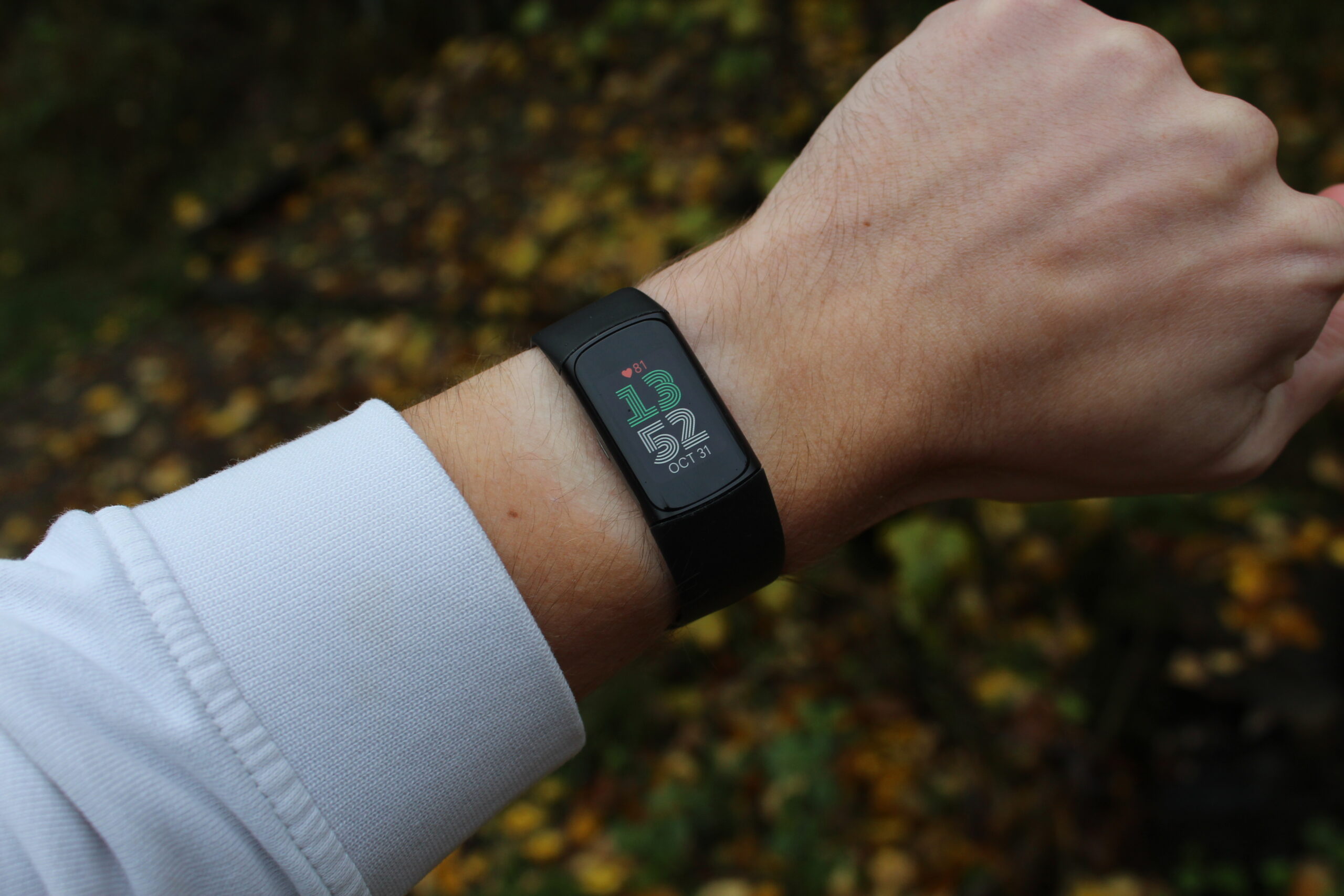
Fitbit is expanding its Gemini-powered health coach with a wave of new features, including nutrition tracking, cycle health tools, and mental wellbeing insights.
The update builds on the AI-driven coach launched earlier this year. It adds more ways for users to track and understand their overall health in one place.
One of the biggest additions is cycle tracking, which lets users log periods and symptoms directly within the app. While basic tracking appears to be available to free users, Fitbit notes that more personalised insights remain part of its Premium offering.
The coach is also gaining nutrition and hydration tracking. Users can log meals, monitor calorie intake, and keep track of daily water consumption. In addition, Fitbit says it will provide personalised macronutrient ranges. This will give users clearer guidance on how to balance their diet based on their goals.
Advertisement
Mental wellbeing is another new focus. Users can now log their mood, track mindfulness sessions, and get a better sense of how their body handles stress through an updated resilience score. This builds on Fitbit’s existing stress management tools.
Advertisement
Alongside these additions, Fitbit is loosening access to its Public Preview programme. Users no longer need a Fitbit Premium subscription to try the redesigned app. However, features like the AI coach itself, “Ask Coach” functionality, and custom fitness plans will still sit behind a paywall.
The update follows a steady stream of improvements to the health coach, including recent support for continuous glucose monitors. This lets users ask how certain foods might impact their glucose levels. Google has also been expanding availability. The company has been bringing the feature to markets including the UK, Canada, Australia, New Zealand, and Singapore in recent months.
Armoire’s “Outfit Inspiration” feature allows shoppers to cycle through a number of options for pieces to create the right outfit. (Armoire Image)
Seattle-based online clothing rental company Armoire is leaning into the AI in fashion with a new feature called “Outfit Inspiration” that allows customers to create desired looks in an instant from dozens of available style and size choices.
Ambika Singh, CEO and founder of the 10-year-old startup, said she hadn’t seen anything from retail and fashion competitors that looks quite like it and enables such “builder” interactivity. The company was inspired by old paper dolls, where pants, shirts, jackets and other items can be moved around. In this case, clicking on images creates instant digital paper dolls.
Armoire CEO Ambika Singh.
“It is fun, but it’s also useful,” Singh said of the feature, which shows up for now when a member is logged in.
The tech relies on a series of pre-made outfits, suitable for a variety of occasions, created by Armoire’s stylists and head buyer.
“If you click into one of them, you can see all of the backup options, and these are actually all AI generated with visual similarity,” said Morgan Cundiff, who recently joined Armoire as head of product and machine learning.
AI makes it possible to track a huge amount of inventory across a range of styles while knowing if those items make sense for the given outfit — and if the right sizes are currently available for rent.
Advertisement
“AI has really allowed us to unlock and dynamically be grabbing those items [in real time], so we know exactly what’s available when we’re grabbing them for you,” Cundiff said. “Without the AI assist, creating this number of permutations felt impossible.”
Armoire, which Singh has previously referred to as “a very human-powered business,” made its first big AI splash last November with the launch of a virtual stylist to help clothing renters find the perfect items.
Outfit Inspiration builds on that use of AI while adhering to Armoire’s core principle of personalization. And it will continue to grow beyond the launch offering of outfits, as different customers will see different main outfits as well as the many clickable options inside each.
“It’s not AI for AI’s sake,” Singh said. “It’s some old problem that you have been trying to solve, that you now have an opportunity to actually go get.”
Advertisement
Armoire, which works out of a 60,000-square-foot warehouse space in Seattle’s SoDo neighborhood, employs 100 people.
The startup has raised $12 million from investors, including a $3.5 million round in 2021 that included backing from Microsoft CEO Satya Nadella, GoDaddy CEO Aman Bhutani and others. Armoire reached break-even near the end of 2025, a first for the business.
Advertisement
The company is ranked No. 40 on the GeekWire 200 index of the Pacific Northwest’s top startups and won Workplace of the Year last April at the annual GeekWire Awards.
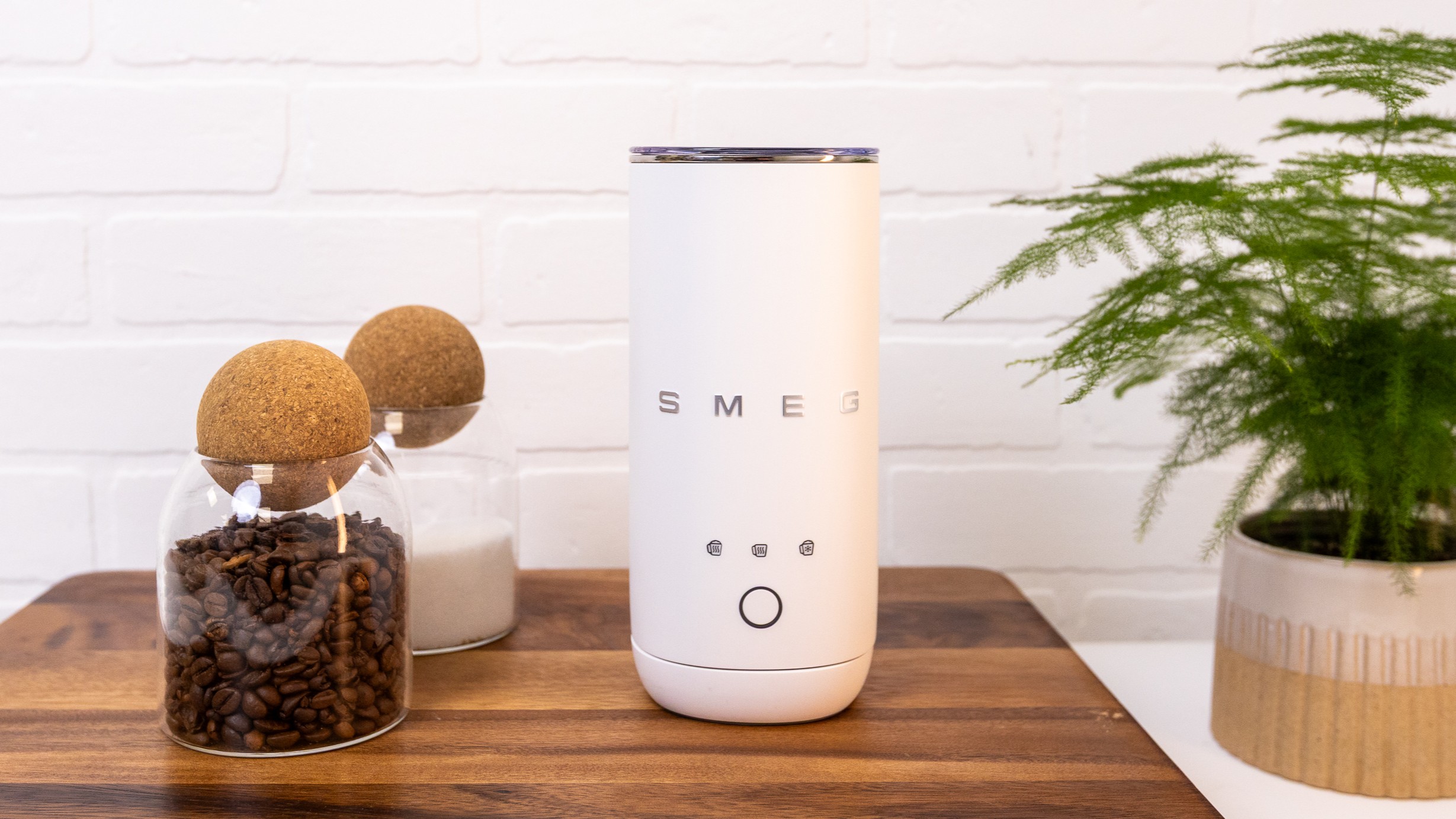
Smeg’s Mini Milk Frother is now available with a smart matte finish
It froths hot and cold, and works with both dairy and plant-based milk
It’s on sale now for £129.95 (about $170 / AUS$250) direct from Smeg
If you enjoy a shot of espresso, but long for a luxurious latte in the morning, you’ll be pleased to know that Smeg has given its compact Mini Milk Frother a fresh new look for 2026. The tiny appliance, which was originally available with a glossy black or white finish, is now also available with a satiny matte finish that looks smarter and is less prone to attracting fingerprints.
Manual espresso machines usually have a steam wand for frothing your milk, compact bean-to-cup machines (like the excellent Philips Baristina I reviewed recently) may not, leaving you with a perfectly brewed espresso but no means of turning it into a latte or cappuccino. It’s the same story with even the best Nespresso machines; without anything extra, foam is out of the question.
That’s where a standalone milk frother comes in. I’ve tested quite a few of these little gadgets as TechRadar’s Homes Editor, and the Smeg Mini Milk Frother remains my favorite. It’s particularly easy to use.
Article continues below
(Image credit: Smeg)
This little frother can be used with dairy or plant-based milk, which it heats to a consistent temperature of 140F / 60C while whisking it into a creamy foam. This is an ideal temperature for drinking, and means your coffee never tastes scalded or ‘custardy’.
The Mini Milk Frother gives you the option to foam milk cold as well, which is excellent considering how many espresso machines now give you the option to brew with cold water rather than hot. Just add cold foam and a couple of ice cubes, and you’ve got an iced cappuccino in no time, at a fraction of the price of coffee shop drinks.
It’s also a lot easier to use than a steam wand, making it a great option for anyone with limited mobility in their hands. Just pour in your milk, hit the large button, and away you go. When you’re done, its non-stick coating makes it easy to clean; a quick rinse and wipe, and it’s ready to use again.
Advertisement
My only complaints were that the fill level markings inside can be difficult to see, depending on the lighting in your kitchen, and unlike the more advanced (but also more expensive) Dreo Baristamaker, you can’t choose the texture of your finished foam.
Sign up for breaking news, reviews, opinion, top tech deals, and more.
The new-look Mini Milk Frother is available now direct from Smeg for £129.95 (about $170 / AU$250. If you’d rather stick with the original glossy finish, there’s a choice of colors, including red, cream, and pastel green for $200 / £99.95 / AU$169.
And of course, you can also follow TechRadar on YouTube and TikTok for news, reviews, unboxings in video form, and get regular updates from us on WhatsApp too
Samsung makes everything from smartphones and gaming monitors, to smart TVs and dishwashers. I’m always looking for a sale (I’m assuming you are, too), and I’ve found the best Samsung promo codes and special offers to help you save big on your most important tech purchases. At WIRED, we often review the South Korean company’s products, especially Samsung’s vast lineup of Galaxy smartphones, and I’ve rounded up a bunch of Samsung coupons for (virtually) every type of shopper.
Get $100 Off With Samsung Promo Codes and $1,000 Off Galaxy Phones
Right now, Samsung has some of the best deals I’ve ever seen on their best-selling tech with more exclusive discounts to ring in the new year. On top of today’s sale deals, there are also limited-time promo codes, flash discounts, and trade-in offers. Beyond the coupons above, you can get up to $100 in Samsung credit when you sign up for The First Look now. You’ll not only be able to see the newest cutting-edge tech, but you’ll get savings towards the latest Samsung innovations like select 2026 TVs, monitors, and home appliances.
And when you buy products together that you already need, you can save a ton. This includes 30% off Galaxy Buds, watches and tablets when you order the Galaxy S25 Ultra. If you’re in the market for a new Samsung phone, you can get a new Galaxy Z Fold7 for $1,000 less with a trade-in. Feeling nostalgic? The new spin on an old classic, the Galaxy Z Flip7 is up to $600 off. Or maybe you want one of the Galaxy S25 Ultra models. Get $350 off a Galaxy S25 Ultra, you’ll get up to $700 off with instant trade-in credits, and a storage upgrade for a limited time.
Unlock a 30% Off Samsung Coupon Code With These 2026 Offer Programs
One of the hottest Samsung coupons is a whopping 30% discount for government employees, first responders, military personnel, and educators. Customers enrolled in the Offer Program can stack promo code discounts with most other promotions, and even get access to exclusive coupons. Some of the best deals we’ve seen in the Offer Program right now include an extra 15% off Galaxy Watch8 (read our review here), plus up to $200 off with trade-in, and an extra 10% off the Frame Pro Neo QLED 4K TV, Galaxy XR (read our review here), and Galaxy Tab S11 series tablets (read our full review here).
Advertisement
Get up to $250 Off Your First Order With Samsung Referral Code
Get a pal involved for more savings—when a friend uses your referral code to make a purchase at Samsung.com, they’ll get 5% off their purchase (up to $250 off) and you’ll get up to $100 off per order (with the potential to save $1,000 per calendar year). My insider tip is to sign up for a Samsung Rewards account and download the mobile app for even more perks, including app-only coupons, and updates on the newest products, like the QLED 8K, select refrigerators, and other home appliances.
Score a $1,000 Samsung Mastercard on 2 or More TVs, Monitors & More Tech
Along with other great tech, Samsung has some seriously nice TVs. The Samsung Frame TV has been trending this year for its stylish ability to blend into your home’s decor. Plus it just feels more elevated than a regular ol’ TV and mount. Some other trending TVs have been the Q60D, S90C, and the S95D models–not only do they have instant discounts of over up to 35% ($2,100 off).
Samsung is starting out the new year with a new season of sales with the Samsung Buy More Save More savings event. When you purchase two or more Samsung products, you’ll receive a $100 Samsung Prepaid Mastercard, continuing like that with three, four, etc. to up to eight or more products for a $1,000 Prepaid Mastercard. This is a great way to make the most (and save big) on products you already purchase, including a myriad of Samsung’s bestselling gadgets like TVs, soundbars, monitors, refrigerators, dishwashers, vacuums, and so, so much more. This deal ends March 31, so make sure you buy and register your product on Samsung’s site to qualify for the Mastercard deal.
Plus, there are tons of TV and home theater deals at Samsung, including a bundle offer for $7500 off when you buy a Neo QLED 4K TV with a Dolby ATMOS soundbar.
Advertisement
Take advantage of their Trade-In Recycling Program for up to $200 off when you trade in your old TV—any brand, any size. When your new one is delivered, Samsung will handle recycling the old one, so you can enjoy your upgrade.
Get a Free Cookware Set with Samsung Promo Code
Although here at WIRED we mostly cover Samsung’s traditional AV tech, they also make top-of-the-line kitchen and home appliances. Although here at WIRED we mostly cover Samsung’s traditional AV tech, they also make top-of-the-line kitchen and home appliances. Right now, you can even get a free induction cookware set of a five-piece Circulon Premier Professional with any Samsung induction cooktop or range. Better yet, this offer is valid even if you didn’t purchase it directly from Samsung! To redeem, visit Samsung’s promotions tab, and select “Website” to access the online offer claim form. Then you’ll receive an email from Samsung with the unique promo code, and you’ll need to enter it on Circulon’s website to redeem the offer.
Save $480 on New S26+
We on the WIRED Reviews team love the newly released Samsung Galaxy S26 series, especially the Samsung Galaxy S26+ because of its new built-in privacy display. Plus, it has excellent performance and great battery life. And right now, when you buy a Samsung Galaxy S26+, you’ll get up to $480 in instant trade-in credit or $150 off for add-ons without a trade-in.
15% Off Samsung Galaxy Buds4 Pro
The rewards just don’t stop! We especially loved the newly released Galaxy S26 Ultra. We rated it a high 8/10 because of its built-in privacy display. We also loved the horizon lock to capture super steady video footage. Plus, it has excellent performance, great battery life, and a reliable quad-camera system. And right now, when you buy one of these excellent phones you can get 15% off Buds4 Pro when you purchase a Galaxy S26 Ultra. We rated the Buds4 Pro a 8/10 for their bold and detailed sound across frequencies, excellent call quality, and polished design. Plus, we loved the loads of extra features, especially for Galaxy phones and ability to auto-switch between Samsung devices.
Advertisement
Stay up to Date on all Things Samsung at WIRED
Us nerds here at WIRED have a lot of opinions about Samsung’s foldable Galaxy Z Flip6 and Z Fold6 phones But we also have guides to help determine which Galaxy S24 phone is best for you and how to set up your Samsung Galaxy S25 to ensure you’re getting the most out of its features, as well as advice on which Galaxy S24 series accessories are worth the money.
We spend hours testing every product or service we review, so you can be sure you’re buying the best. Find out more about how we test.
Oscal Pilot 5: 30-second review
The Pilot 5 sits in the lower-mid tier of the Oscal rugged lineup, slotting beneath the Pilot 6 and the more premium Marine 3. Its headline features are a 15,000mAh battery with 33W fast charging, a 6.67-inch 120Hz IPS display, and the UNISOC T8100 chipset built on a 6nm process. Importantly, it ships with Android 16 via Oscal’s DokeOS 5.0 skin, which is ahead of most of the competition at this low price point.
At 570g and 25.3mm thick, this is unquestionably a chunky handset. It is heavier than many flagship consumer phones and will not easily fit into pockets. The trade-off is a device that carries IP68 and IP69K waterproofing alongside MIL-STD-810H durability. It can survive immersion to a depth of two metres and withstand high-pressure water jets, which should cover most outdoor working environments. It certainly feels built to withstand significant abuse.
Advertisement
Performance from the UNISOC T8100 is modest by flagship standards, being roughly in line with what you would expect from a mid-range chip at this price bracket. Day-to-day tasks, navigation, and messaging are handled without fuss, though the processor is not intended for demanding 3D gaming. The 8GB of LPDDR4X RAM is extendable to 24GB via virtual memory, though by current standards, the memory type and capacity aren’t the best.
Even greater cost-cutting was evident in the camera choices, with a 16MP rear sensor and a 13MP front camera, making this less than ideal for photography.
The genuine strength of this device is its battery and power efficiency. At 15,000 mAh with 33W fast charging, endurance over several days of moderate use is realistic.
Advertisement
Connectivity is broad, covering 5G across a solid band selection that includes the key UK and European frequencies. Wi-Fi reaches 802.11ac (Wi-Fi 5) but stops short of Wi-Fi 6, which may disappoint those who want the fastest possible local network speeds. Bluetooth 5.0 and NFC are both present.
The built-in 5W speaker is rated at 140dB if you want to damage your hearing, and the 410-lumen camping torch is a practical inclusion for outdoor users. Oscal’s Doke AI 2.0 platform integrates DeepSeek-R1, ChatGPT-4o mini, and Gemini 2.0, giving the device a broad AI toolkit that goes well beyond what most competitors at this price offer.
Sign up to the TechRadar Pro newsletter to get all the top news, opinion, features and guidance your business needs to succeed!
Overall, the Oscal Pilot 5 is a mixed bag with a few good points and undeniable weaknesses. It’s affordable, but it won’t be included in our best rugged smartphone collection.
Advertisement
(Image credit: Mark Pickavance)
Oscal Pilot 5: price and availability
How much does it cost? $390/£232/€277
When is it out? Available now
Where can you get it? You can get it directly from Blackview or via many online retailers.
The phone is available directly from the makers, Blackview, where the price is £232 in the UK and €266.95 across Europe. Oddly, and this might be tariff-related issues, the US price is $389.99 direct from Blackview, but it can be found on AliExpress for only $269.98, a much better deal.
However, I can’t confirm if there might be extra duty to pay using that source. For Europeans, the best place to buy this phone is directly from the brand, since prices are better than on popular Chinese importers like AliExpress.
There are only two SKUs of the Oscal Pilot 5, and those are the two colours on offer: Yellow and Black. All have 8GB of RAM and 256GB of storage.
Advertisement
What’s slightly curious is that one of the strongest competitors, the Pilot 5, also comes from the same stable, the Blackview Rock 2 Pro. It offers the same 15,000mAh battery with a dual 400-lumen camping light, 32GB RAM (8GB physical plus 24GB virtual), 256GB storage and a similar camera arrangement. And at $363.99, it is cheaper than the Pilot 5.
A better choice than either of those is the Oukitel WP56, since it has a 108MP camera sensor, 16000mAh battery and 45W charging, all for around $260.
If I wanted a cheap, rugged phone, I’d also look at the Doogee S200 and Ulefone Armour 29 Ultra, both of which have better specs and lower prices.
Overall, the Pilot 5 is an inexpensive phone, but that doesn’t make it a great value for money.
Advertisement
(Image credit: Mark Pickavance)
Oscal Pilot 5: Specs
Swipe to scroll horizontally
Item
Spec
CPU:
Advertisement
UNISOC T8100 (UMS9620), Octa-core, 6nm, 4 x A76 @ 2.2GHz + 4 x A55 @ 2.0GHz
GPU:
ARM Mali-G57
NPU:
Advertisement
Unknown
RAM:
8GB LPDDR4X
Storage:
Advertisement
256GB UFS2.2 (expandable via MicroSD)
Screen:
6.78-inch IPS Screen protected with Panda Glass
Resolution:
Advertisement
720 x 1604
SIM:
2x Nano SIM + TF (one shared position)
Connectivity
Advertisement
Wi-Fi 802.11a/b/g/n/ac (2.4GHz / 5GHz), Bluetooth 5.0, NFC, GPS
The physical form of the Pilot 5 will be familiar to anyone who has handled a Blackview design in the past five or so years. It sports the solid feeling metal-sided that gives way to reinforced plastic corners, and a bevelled edge makes it easier to hold.
At 570g, this isn’t the heaviest rugged phone by any degree, but it’s not lightweight either, and fitting it in a pocket might prove a challenge.
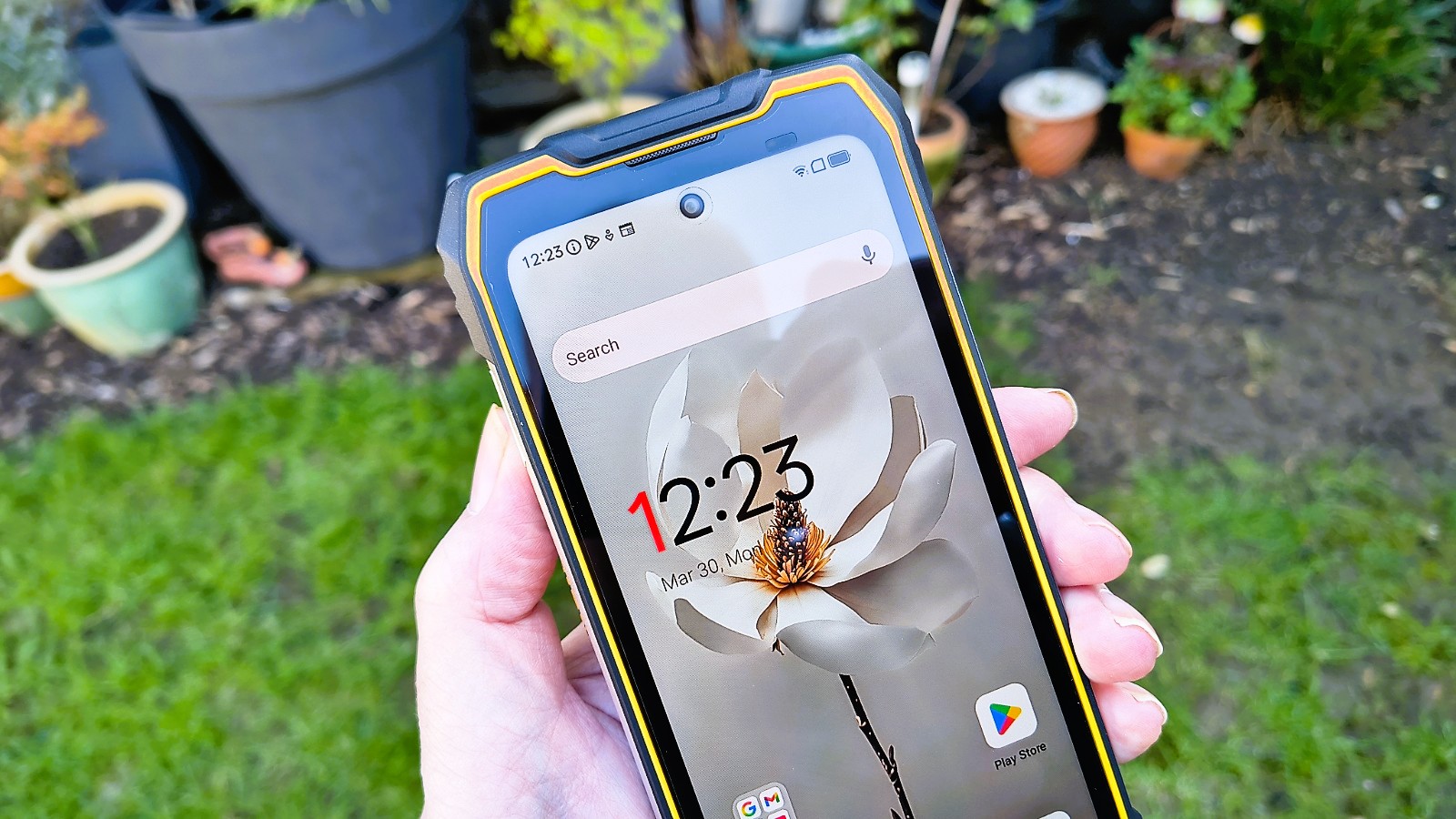
The Pilot 5 is available in Black and Yellow, with the latter being a popular choice in outdoor and worksite environments where high visibility matters. The yellow model that I received for review has a highlight line on the front, and that’s almost all the yellow on it.
That border also serves to highlight how much smaller the display is than the front of the phone. According to Blackview, this phone measures 188.6 x 89.7 x 25.3mm, but I measured the display width at around 70mm and the length at 155mm, resulting in substantial borders on all sides.
The panel is an odd 720 x 1604 resolution, which doesn’t achieve the level of FHD, never mind FHD+.
Advertisement
(Image credit: Mark Pickavance)
The buttons are less of a diversion, with the classic placement of power and volume on the right, with a custom button and SIM tray to the left. The USB-C port is on the bottom edge, and there is no 3.5mm audio jack for those who prefer that headphone option.
On the back, the camera cluster is forced onto the left to make room for a 5W speaker, and below that is a curious isometric camping LED that the makers helpfully obscured a portion of with the critical manufacturing label. Not sure why phone makers do this rubbish with the label, but it’s certainly annoying. The placement and angle of the camping LED guarantee that there is no room for wireless charging coils, sadly.
The Pilot 5 ships with DokeOS 5.0 built on Android 16, making it one of the first rugged phones at this price point to launch with the latest Android release. Oscal’s skin adds a range of customisation options, including wallpaper hubs, colour schemes, and theme styles, alongside a deep-cleaning memory management tool.
Doke AI 2.0 is the platform’s AI layer, integrating three third-party models: DeepSeek-R1, ChatGPT-4o mini, and Gemini 2.0. The Hi Doki assistant handles document parsing, online search, and creative generation. The AI Global Smart Control feature is described as allowing voice or text commands to operate across the entire phone, including switching between apps.
Advertisement
None of these things is free, and a subscription is required for those who wish to chat on their phone on a regular basis. Since nobody has made a compelling argument for paying for AI right now, I suspect these tools will have quietly disappeared by the time the 2027 models come along.
Doke 5.0 is heavily encrusted with bloatware, so be prepared for that.
(Image credit: Mark Pickavance)
Design score: 3.5/5
Advertisement
Oscal Pilot 5: hardware
UNISOC T8100 (UMS9620)
15000 mAh battery
This is the third phone I’ve covered that uses the MediaTek Dimensity 7025, and I haven’t changed my opinion of it.
The UNISOC T8100 is a 6nm octa-core chip comprising four Cortex-A76 cores running at 2.2GHz and four Cortex-A55 cores at 2.0GHz. This is a step up from the older T7300 found in many budget rugged phones. However, even mid-priced phones are using 4nm SoC these days, although at least the accompanying GPU is an ARM Mali-G57.
A wide selection of benchmarks places the Pilot 5 in the mid-range bracket, comfortably ahead of budget MediaTek Helio G-series chips but well below the Dimensity 8300 used in Blackview’s more expensive Xplore 2. For the intended workload of rugged mobile users, this is generally adequate.
The 8GB of physical LPDDR4X RAM can be supplemented by up to 16GB of virtual memory drawn from the UFS2.2 storage, bringing the addressable total to 24GB. This virtual expansion is useful for keeping more apps resident in memory, but does not replicate the sustained throughput of physical RAM.
(Image credit: Mark Pickavance)
The 15,000mAh battery is the Pilot 5’s most prominent specification. Oscal claims the device can cope with heavy use across multiple days, and with the phone in standby, the capacity should sustain the handset for weeks. For users whose daily routine involves long periods in the field with limited access to charging infrastructure, this is a meaningful advantage over a standard consumer smartphone.
Advertisement
My only reservation is that the 33W ‘fast charge’ that is highlighted in the phones promotional material isn’t all that special these days. Some phones charge at 45W and others at 66W, so 33W isn’t the fastest to refill the 15000mAh capacity.
While it can recover 20% from exhaustion in 30 minutes, the slower rate at which batteries charge as they reach full capacity would suggest that a complete recharge takes over three hours, and maybe closer to four.
I’m unsure if the 5W OTG support is useful, but it means the Pilot 5 can also act as a power bank to charge other devices. However, it’s worth noting that each power transfer costs capacity to achieve.
With the exception of the battery capacity, there isn’t much to write home about under the hood of the Pilot 5.
Advertisement
Oscal Pilot 5: cameras
16MP, 2MP on the rear
13MP on the front
Three cameras in total
(Image credit: Mark Pickavance)
The Oscal Pilot 5 has three cameras:
Rear camera: 16MP + 2MP Macro Front camera: 13MP
Normally, it’s not hard to work out what the camera sensors on phones are, mostly because the makers document that in the specifications.
Advertisement
In the Oscal Pilot 5 specifications, the selfie camera is listed first as a SC820CS by SmarSens Technology. I don’t believe this for good reasons, one of which is that the SC820CS sensor is only 8MP. It’s more likely that it’s a SC1320CS, but that’s a wild guess.
Another issue is the primary sensor, which is listed as an Omnivision OV13B10, a 13MP sensor, but it doesn’t meet the 16MP spec. Let’s assume that’s also wrong.
And, the 2MP macro sensor isn’t mentioned by Oscal, though a hardware analysis of the phone sees it. It could be an Omnivision or a GalaxyCore sensor, but I’m not sure which one.
Part of the issue here is that, normally, you can make educated guesses about the sensors used because those binaries were added to the platform when the OS was compiled. But in this case, no less than 82 camera sensors were compiled with Doke 5.0, including ones for 108MP Samsung sensors. Depending on how generous you feel, that’s either overkill, untidy or intended to obscure what is actually used.
Advertisement
But irrespective of the specific details of these sensors, the primary rear sensor is a 16MP unit with autofocus and a rear LED flash. The front-facing selfie camera is 13MP. There is no telephoto or ultra-wide lens and no dedicated night-vision sensor, which sets the Pilot 5 apart from the alternative Pilot 3 and Pilot 6 designs.
I’m not sure when the last time was I covered a phone that had a 16MP sensor as the best it could offer, but this one barely captures still images that are higher resolution than 4K video.
They are a suitable resolution for social media posts, but you wouldn’t want to try to print them.
Unsurprisingly, the top video resolution is 1080p, but you also get the same video resolution on the front. I could go into painful detail about how these sensors disappoint, but it would be easier if we just accepted that this isn’t the phone for photographers and moved swiftly on.
Advertisement
(Image credit: Mark Pickavance)
Oscal Pilot 5 Camera samples
Image 1 of 9
(Image credit: Mark Pickavance)
(Image credit: Mark Pickavance)
(Image credit: Mark Pickavance)
(Image credit: Mark Pickavance)
(Image credit: Mark Pickavance)
(Image credit: Mark Pickavance)
(Image credit: Mark Pickavance)
(Image credit: Mark Pickavance)
(Image credit: Mark Pickavance)
Oscal Pilot 5: performance
Older 6nm SoC
Great battery life
Swipe to scroll horizontally
Phone
Oscal Pilot 5
Blackview Oscal Tank 1
Advertisement
SoC
UNISOC T8100
MediaTek Dimensity 7050
GPU
Advertisement
ARM Mali-G57
Mali‑G68 MC4
NPU
Unknown (3.2 TOPS)
Advertisement
MediaTek NPU 550
Memory
8GB/256GB
12GB/256GB
Advertisement
Weight
570g
640g
Battery
Advertisement
15000
20000
Geekbench
Single
Advertisement
755
920
Multi
2399
Advertisement
2466
OpenCL
2041
2471
Advertisement
Vulkan
2101
3036
PCMark
Advertisement
3.0 Score
11235
11684
Battery
Advertisement
33h 49m
33h 57m
Charge 30
%
Advertisement
20
13
3DMark
Slingshot OGL
Advertisement
4282
5293
Slingshot Ex. OGL
3208
Advertisement
4150
Slingshot Ex. Vulkan
3220
3940
Advertisement
Wildlife
1684
2232
Row 17 – Cell 0
Nomad Lite
Advertisement
191
266
Since both the Oscal Pilot 5 and Oscal Tank 1 both come from the same source, it just seemed right to see what each offered.
The first obvious thing to say is that the Dimensity 7025 in the Tank 1, which is a rebranded SoC from the 1000 series, has more punch than the UNISOC T8100 in the Pilot 5. And, the Mali G68 MC4 is an improvement, if modest, over the ARM Mali-G57.
Advertisement
So, where does the Pilot 5 win? Well, offering less performance, it manages to last almost as long with 75% of the battery capacity in the Tank 1. And, it also recharges more rapidly.
It should also be noted that when the Pilot 5 shut down, the PCMark battery test still had 24% capacity left, suggesting that 40 hours isn’t unrealistic.
I’m glad the Pilot 5 has this one thing that’s good about it, because almost everything else isn’t remarkable or special.
(Image credit: Mark Pickavance)
Advertisement
Oscal Pilot 5: Final verdict
My experience with the Pilot 5 wasn’t the best; it started badly because, for some inexplicable reason, Blackview sent me a phone intended for the Russian market.
I eventually worked out how to get English as the language, but the phone ignored that change and salted the Doke 5.0 with Russian applications. Presumably, everything about my testing was relayed to Comrade Putin before breakfast the next day.
To start on a positive note, this phone has a decent amount of battery capacity, and because the SoC isn’t a massive power drain, it can run for at least four working days, or even longer with some curation.
However, this is far from a gaming platform, and its curious resolution screen isn’t ideal for watching streamed content. But where it truly falls down is the cameras, which reminds me that the first smartphone with a 16MP sensor was the Nokia Lumia 1020 in 2013, if I’m not mistaken. That said, Apple only introduced better than 12MP in 2022, so it’s possible to take good pictures with relatively few pixels. But in this case, the pictures aren’t wonderful.
Advertisement
That aspect, coupled with a 5W speaker that the maker claims can output 140dB, enough to permanently damage hearing if true, makes the Pilot 5 something of an acquired taste.
What I think undermines this design somewhat is that it’s not especially cheap, and it’s relatively easy to find a 2024 phone design with more of everything for less money.
Should I buy a Oscal Pilot 5?
Swipe to scroll horizontally
Oukitel WP61 Plus Score Card
Attributes
Advertisement
Notes
Rating
Value
Not expensive, but hardly cheap.
Advertisement
3.5/5
Design
Standard Blackview design playbook
3.5/5
Advertisement
Hardware
6nm SoC and only 8GB of RAM, but 15000mAh of battery
3.5/5
Camera
Advertisement
16MP sensor that underachieves, only 1080p video
2/5
Performance
Great battery life, but little else that’s impressive
OpenAI has acquired popular tech industry talk show TBPN — Technology Business Programming Network — making this the AI giant’s first acquisition of a media company. The show will report to OpenAI’s chief political operative, Chris Lehane.
TBPN, hosted by former tech founders John Coogan and Jordi Hays, is a daily live show that airs on YouTube and X for three hours, focusing on tech, business, AI, and defense.
The show has gained a cult following in Silicon Valley, a safe space where industry power players can speak candidly and be questioned by fellow insiders. The show has a reputation for being something of a Sports Center for the tech industry — a place where top tech CEOs like Mark Zuckerberg, Satya Nadella, Marc Benioff, and, yes, Sam Altman, come to chop it up, react to the news of the day, and occasionally make some of their own.
TBPN will continue to live on as its own brand, which OpenAI will help scale. Not that it necessarily needed help on that front; TBPN has grown into an empire that’s on track to pull in more than $30 million this year, according to The Wall Street Journal.
Advertisement
OpenAI already has its own podcast for long-form conversations with the people building tech at the company.
OpenAI will also tap the founders’ “amazing comms and marketing instincts” outside the show, according to OpenAI’s head of AGI deployment, Fidji Simo, who said TBPN will “bring AI to the world in a way that helps people understand the full impact of this technology on their daily lives.”
Simo went even further, noting that TBPN’s prowess is necessary for an atypical company like OpenAI where “the standard communications playbook just doesn’t apply.”
Techcrunch event
Advertisement
San Francisco, CA | October 13-15, 2026
She said TBPN will have editorial independence and continue to “run their programming, choose their guests, and make their own editorial decisions.”
Advertisement
Still, the acquisition might give some pause. After all, OpenAI is a valuable AI lab on the brink of an IPO buying a buzzy talk show that often discusses the company and its competitors. And once the deal closes, TBPN will operate under OpenAI’s strategy team and report to Chris Lehane, the man who invented the phrase “vast right-wing conspiracy” as a tool to deflect press scrutiny of the Clinton White House.
Lehane, who has been described as a master of the “political dark arts,” is also behind the crypto industry super PAC Fairshake, which spent hundreds of millions to kneecap anti-crypto candidates in the 2024 election. He joined OpenAI that same year and has been in President Trump’s ear ever since, whispering recommendations for sweeping and controversial policies like preventing states from regulating AI and easing environmental restrictions that might slow data center construction.
OpenAI CEO Sam Altman, who said in a social media post that TBPN is his favorite tech show, seems to believe the acquisition won’t change TBPN’s commentary and even criticism of the company.
“I don’t expect them to go any easier on us, am sure I’ll do my part to help enable that with occasional stupid decisions,” he wrote.
Advertisement
TBPN, meanwhile, sees the acquisition as a means to do more than just commentary.
“While we’ve been critical of the industry at times, after getting to know Sam and the OpenAI team, what stood out most was their openness to feedback and commitment to getting this right,” Hays said in a statement. “Moving from commentary to real impact in how this technology is distributed and understood globally is incredibly important to us.”
Got a tip or documents about the AI industry? From a non-work device, contact Rebecca Bellan confidentially at rebecca.bellan@techcrunch.com or Signal: rebeccabellan.491.






























































You must be logged in to post a comment Login