Not so long ago, most computer users didn’t own their own machines. Instead, they shared time on mainframes or servers, interacting with this new technology through remote terminals. While the rise of cloud computing and AI might feel like a modern, more dystopian echo of that era, some look back on those early days with genuine fondness. If you agree, check out this 70s-era terminal replica from [David Green].
The inspiration for this build was a Lear Siegler ADM-3A terminal seen at a local computer festival. These machines had no local computing resources and were only connected to their host computer via a serial connection. The new enclosure, modeled on this design, was 3D-printed and then assembled and finished for the classic 70s look. There are a few deviations from a 70s terminal, though: notably, a flat LCD panel and a Raspberry Pi 3, which, despite being a bit limited by today’s standards, still offers orders of magnitude more computing power than the average user in the 70s would have had access to.
On the software side, there are a few modifications to allow the Pi 3 to emulate a CRT-style display. It also runs the i3 windows manager, which was the easiest way to replicate the feel of an old terminal without going command-line-only. With the Pi’s computing power available, though, it’s easier to run emulators for older computer systems, and there’s perhaps no better way to get a sense of how these systems behaved than to use a replica from the era. Another excellent way is to completely reimagine what these computers could have been like in an alternate past.
Even if you’ve never subscribed to a VPN service, there’s a good chance that you’ve already heard about its importance. Constantly advertised on podcasts and around the web, VPNs have taken off in the last few years and while it’s easy enough to get caught up in the noise of it all, just know that they are worth the hype, and we should know – we’ve tested the best of them.
For anyone who’s completely out of the loop, virtual private networks are able to mask the location of the device you’re using to browse the web, which means that bad actors aren’t able to track your whereabouts, nor are they able to access your device if you’re connected to a public Wi-Fi network.
Although masking your IP address and keeping your online activity safe is the core appeal of having a VPN, there’s a lot more to it. For instance, if you’re travelling abroad and want to read the news in your mother tongue, then you can use a VPN to have your browser believe that you’re back in your home country.
When it comes to signing up for a VPN, there’s almost always a ton of deals available for first-time customers, so it helps to shop around to get the best price. As with most bits of tech however, you’ll always find the best deals for VPNs if you shop around Black Friday in November.
Advertisement
Regardless of when you sign up, this guide can pair you with the best VPN for your needs as we’ve highlighted the areas that each service excels in. Keep on reading to see which VPNs most impressed our tech experts, but if you’re completely strapped for cash and want to keep your devices free of malware then our guide to the best free antivirus may serve you better.
Which is the best VPN?
Advertisement
Learn more about how we test VPNs
We carry out speed tests to get a general feel for how each service performs. We test all services using their clients’ default settings.
We run tests from a London-based connection that typically sees speeds between 500Mbps and 700Mbps, which means that we’re able to get a good idea of what each VPN’s maximum speeds currently are. We test multiple endpoints from each provider in three locations: the UK, the Netherlands and the US.
Advertisement
Pros
Fast HTTPS transfer speeds
Wide range of endpoint countries
No price increase on renewal
Cons
More expensive than many rivals
Pros
Blisteringly fast
Good for streaming
Unlimited devices
Great value subscriptions
Cons
Subscriptions renew at a higher rate
You have to interact with a human being if you wish to cancel your subscription
Pros
Large number of servers
Wide range of security features and endpoints
Clear, audited no-logging policy
Great for streaming
Cons
Relatively expensive
Subscriptions renew at a higher rate
Pros
Unlimited-bandwidth free tier
Wide range of endpoint countries
Paid version is great for streaming
Quick download speeds
Cons
Subscriptions renew at a higher rate
Pros
Fast speeds
Low, consistent price of €5 a month
Great range of cross-platform clients
Cons
Not reliable for streaming
Fast HTTPS transfer speeds
Wide range of endpoint countries
No price increase on renewal
More expensive than many rivals
If you don’t want to spend any time diving into the details and would rather get straight to enjoying the benefits of having a VPN, then ExpressVPN is where your search ends. This is by far the best VPN that we’ve tested, with incredible speeds and a variety of countries to connect to.
Advertisement
During our testing we picked up on unbelievable download speeds across the board, including 278.4Mbps in the UK and 195.2Mbps in the United States. For productivity users who don’t want to be caught out by web pages that take an age to load, this is the service to go for.
It’s not just the speed of ExpressVPN that’s impressive though, as the service boasts one of the most expansive suites of extras that we’ve come across. There’s ExpressKeys which can be used to safely store and access all of your passwords, and can be handy if you’re constantly forgetting them, alongside ExpressMailGuard which can stop phishing emails from ending up in your inbox.
One of the most recent additions to the company’s toolbox is ExpressAI. This service lets you converse with an AI chatbot for help with any queries or issues that you might typically use AI for, except that unlike those other options, ExpressAI doesn’t log your conversation so it’s all private.
It should be said that ExpressVPN isn’t the cheapest VPN service available, but for all that you get here, it’s well worth the expense as you certainly won’t be wanting for anything. The company also lets you connect with no less than 105 countries so you have plenty of options available to you when hiding your IP address.
Advertisement
Blisteringly fast
Good for streaming
Unlimited devices
Great value subscriptions
Subscriptions renew at a higher rate
You have to interact with a human being if you wish to cancel your subscription
Advertisement
Although ExpressVPN, for our money, provides the best overall VPN package that you can buy right now, if you’re someone who is solely focused on speed and wants to make sure that they can access the fastest possible internet connection whilst masking their IP address then Surfshark VPN is the option for you.
When putting the service to the test, we picked up on 264.8 Mbps download speeds in the UK, 297.6 Mbps in the Netherlands and 228 Mbps in the US, which averaged out to around 263.47 Mbps. That average comes in only ever so slightly behind NordVPN in our tests, but consistency is the name of the game with Surfshark – helpful for when you’re working for a long period of time and need to keep a connection going without interruption.
In terms of security, Surfshark is one of the best companies out there for transparency so you can surf the web with peace of mind in knowing that your data and browsing history isn’t logged. The company also publishes a Transparency Report to let you know if it’s been contacted by government agencies over access to information.
Going one step further, Surfshark also makes use of independent audits to make sure that everything’s in check and that there’s nothing for customers to be worried about. It’s gestures like these that go a long way towards consumer confidence in a VPN service, and we would love to see them adopted industry-wide.
Advertisement
With regards to the connections on offer, Surfshark currently uses more than 4500 servers across 100 countries. Although that’s slightly less than the 105 countries connected to ExpressVPN, it’s still a significant amount and won’t leave you wanting. Just bear in mind that Surfshark’s renewal prices can be higher than what you initially paid to sign up, so double-check the rate ahead of renewal to make sure you’re happy with the cost.
Large number of servers
Wide range of security features and endpoints
Clear, audited no-logging policy
Great for streaming
Advertisement
Relatively expensive
Subscriptions renew at a higher rate
Out of all the VPN services we’ve tested, it’s NordVPN that provides the best alternative package to ExpressVPN. Although the latter can be more affordable in the long run, you may appreciate NordVPN’s more robust approach to online security, so it’s best to compare the features that these two services have before deciding on which to sign up to.
For starters, NordVPN can connect up to six devices simultaneously, so if you live in a large household and you want to protect everyone as they browse the web then this is the option for you. Plus, with dedicated apps for iOS, Android, Windows, MacOS, Linux and Google TV, NordVPN has put in the work to meet you where you’re at and make the process of getting connected a simple one.
Once you are connected to the service, you have a ton of features at your fingertips. Anyone who uses the Tor browser can enable Onion over VPN so that Nord and Tor can work hand in hand for a highly secure session. Regardless of your chosen browser, Nord’s Threat Protection Pro goes one step further than an average VPN by ensuring that phishing scams and malware can’t access your device, so you have an extra layer of security as you search.
Advertisement
In terms of your own data and how it’s stored by NordVPN, the company presents a clear no-logging policy so your internet history isn’t tracked, and the brand has built up a solid degree of trust in this area thanks to regular audits to ensure that everything is still working to the company’s vision.
NordVPN now provides access to servers in 211 locations which isn’t quite as varied as what we’ve seen on some of the other services we’ve tested, but what you do get from those locations is an impressively stable connection. In fact, NordVPN came out on top with regards to the average speed recorded when all of our test locations were taken into account.
Advertisement
Unlimited-bandwidth free tier
Wide range of endpoint countries
Paid version is great for streaming
Quick download speeds
Subscriptions renew at a higher rate
As much as we recommend opting for a paid VPN service as you’ll get so much more in return, especially with features like malware protection and an onboard password manager which feel more essential than ever in the modern age, there are options available to you if you have no cash to spend. While quite a few free VPNs have popped up in the last few years, the only one you need to concern yourself with is ProtonVPN.
What’s most surprising about ProtonVPN is that unlike a lot of free VPNs which throttle the available bandwidth as a means of enticing you towards a paid version of the same service, ProtonVPN lets you surf the web with unlimited bandwidth. This is great if you have a particularly speedy router at home as you won’t feel capped by going down the freebie route.
Advertisement
ProtonVPN has also made privacy a core tenet of its business practices. The company has a regularly updated transparency report to let users know of any changes they should be aware of, but the company does currently employ a strict no-logging rule so your data isn’t stored. However, the Swiss Government does have the right to order the collection of data in the event of a criminal case.
There’s also a kill switch feature built into the brand’s free VPN service so you don’t have to worry about any gaps in your internet connection that bad actors could exploit. Although there’s a decent number of countries included with the free tier, it’s worth upgrading to the paid version of ProtonVPN if you want a wider variety of locations to choose from.
Still, if speed is your main concern then we reckon that you’ll be quite pleased with what ProtonVPN is able to offer. Across our testing of speeds in the UK, the Netherlands and the US, we noted an average speed of 164.27Mbps which is more than enough for the average user and excellent value when you consider that it’s available at no cost whatsoever.
Advertisement
Fast speeds
Low, consistent price of €5 a month
Great range of cross-platform clients
Not reliable for streaming
If there’s one complaint that can be thrown at most VPN services, it’s that things can get a bit out of control when it comes to renewing your subscription. Oftentimes you’ll see very tempting introductory prices which get you through the door, but once your subscription runs out you can be presented with a nasty bill if you’re not careful. For those who would rather avoid that scenario entirely, Mullvad VPN is our go-to pick.
Advertisement
Mullvad VPN costs just €5 (roughly £4.35/$5.84) a month, and in the face of rising costs for pretty much every aspect of the tech industry, that monthly rate has stayed the same. It’s brilliant value for money, and a much better option for anyone who doesn’t want to get tied into a long-term contract or who only needs a VPN for a few months.
What’s even more impressive is what you get for that low monthly cost. Mullvad has a strict no-logging policy, and that was put to the test in 2023 when authorities carried out a search warrant at the company’s office in Gothenburg and came away with no customer data. The brand also uses RAMdisk servers which are far more secure than the standard servers typically used by VPN companies.
Beyond that, a Mullvad subscription comes with a ton of extra security features including a kill switch (ensuring that you’re never connected to the internet unless there’s a VPN protocol to go with it), split tunnelling and an ad blocker that can stop you from accidentally clicking on junk ads as you surf the web.
It’s not a perfect service however as we did notice some irregularities when trying to access streaming websites, although the general speeds that we noted were fairly solid. Across our three test countries, we noted an average download speed of 229.87 Mbps which is very respectable. Unless you want a wider suite of features, the likes of which ExpressVPN and Nord VPN can provide, Mullvad is a great option to go with.
Older iPad tablets often remain in daily use years after purchase, making long-term maintenance increasingly important as hardware ages. Here’s how to restore their usefulness and keep them running safely.
The iPad rehab guide
Many iPads become obsolete before they cease functioning due to the evolution of demanding workflows. Consequently, they are often repurposed for lighter tasks such as smart home control, media playback, or casual browsing. Despite steady pressure to upgrade, most iPads can remain useful for years with basic maintenance and realistic expectations. This guide covers how to clean and protect aging hardware, manage safety risks, and find new roles once performance starts to taper. Continue Reading on AppleInsider | Discuss on our Forums
We may receive a commission on purchases made from links.
Managing a home with multiple people can feel like a thankless and never-ending project management exercise. From making sure the plants get watered, the pets are fed, the bathrooms are clean, and the kitchen is stocked up, it’s a logistical feat just to get to the end of the week.
Advertisement
This challenge only gets harder when there are multiple people of different ages in your home that need to be on the same page, which is why you might want to invest in a digital calendar. These days, one of the most popular options is the Skylight Digital Calendar, which starts at just under $160. Although there are several digital calendar alternatives, it can be hard to find one that doesn’t cost an arm and a leg up front and may include subscription fees.
If you’re looking for a cheaper way to keep everyone in your home aligned, you could use an old iPad to be a smart home hub that doubles as a calendar. But if you don’t have one lying around your house, there are plenty of budget-friendly options that might work for you instead. To help you know what’s out there, we’ve rounded up some highly rated digital calendar options that are under $100. For more details on why we think they might be great for you, we’ve elaborated more on our methodology at the end. But, if you’re in desperate need to make sure no one feeds the dog twice, keep reading.
Advertisement
YPI 10.1-inch Digital Calendar
Available in seven sizes, budget conscious customers can opt for YPI’s cheapest offer, the 10.1-inch Digital Calendar that retails for $89.99. Measuring 10.5 inches by 7.3 inches, it has a 10.1-inch HD touch screen that can be used in both portrait or landscape with its included stand. You can sync with all kinds of calendar providers, such as Google Calendar, Microsoft’s Outlook, and Apple’s iCloud. With its own eCalendar app, you can also color code schedules of up to 20 users. Apart from a calendar, it lets you display tasks, meals, photos, and more.
On Amazon, the YPI Digital Calendar has an average rating of 4.3 stars from 450+ customers. Among the 74% of users who rated it a perfect rating, an iPhone owner mentioned that it takes less than a minute to set up. Some of the recurring positive feedback also mentions its screen for its automatic brightness adjustment, visibility from multiple angles, and responsive screen. That said, there were about 10% of people who rated it a single star that said that they had issues with connecting to the Wi-Fi, the app crashing, and poor customer service.
Advertisement
DXMART 10.1-inch Digital Calendar
Priced at $99.99, the DXMART 10.1-inch Digital Calendar sets itself apart with its LED reminder light border, plus a built-in speaker that you can use for audible reminders. Apart from auto sync features with major calendar apps, it has interactive tasks and rewards systems, meal planning, and custom lists.
With its dashboard, you can switch between day, week, and month views. It’s made to be wall-mounted or standing in either portrait or landscape mode. It also doubles as a digital photo frame, and you don’t need a subscription to display screensavers. For people who are particular about their privacy, the European-owned brand also boasts both GDPR and CCPA-compliance.
Advertisement
DXMART also has a larger model, and together, both models have an average rating of 4.3 stars from 200+ Amazon users, wherein 71% of people gave it a perfect 5 stars. While it markets itself as a calendar, there are a lot of people who mentioned how they thought it was great value for displaying photos. One person even noted how their kids would drop photos while they’re on holiday, which they could view from their home. But take note, there were also a few dissatisfied customers, such as the 7% who rated it a single star. They lamented how there were issues with durability and not being able to connect to the internet.
Advertisement
Roxicosly Large Digital Display Calendar
The Roxicosly Digital Calendar is designed specifically with the elderly in mind. Measuring 7.2 inches by 4.65 inches, it’s one of the most compact options in this list. With a dozen different theme options, it also comes with 18 ring times for alarms with a 9-level volume, which you can use for everything from wake up to medication reminders. Aside from the calendar function, wherein it lets you see the date, time, and what period of the day it is; it lets you share photos via microSD and USB flash drive.
Available in two colors (black and white), you also have the option to get a plugged AC-powered model ($29.99) or one with a rechargeable battery ($37.99). An Amazon’s Choice product, the Roxicosly Digital Display Calendars have a 4.6-star average from more than 1,400 customers. In addition, 81% of users have rated the elderly-friendly calendar an impressive 5 stars, while only 4% have it a single star.
It’s not a perfect product, since multiple people complained that it can be difficult to set up, there were more users who were satisfied with it. In fact, several people shared that their elderly loved ones who had bad eyesight liked how it was easy to read. Apart from seniors, some customers mentioned that it also worked well for students and for their home school set up.
Advertisement
Canupdog 10.1-inch Digital Calendar
For fans of the mid-century interior design look, the $89.99 Canupdog 10.1-inch Digital Calendar can mesh well with your vintage, hardwood furniture. Compatible with major calendar apps, like Google, iCloud, Microsoft, and Yahoo, you can also see the integrated calendar across multiple accounts via its app. It also has streamline lists, for things like to-dos or groceries. It also has a chore chart and a reward system once tasks are accomplished.
Canupdog also sells larger sizes as well. All together, more than 700 Amazon users have rated them 4.2 stars on average, wherein 71% thought they were worth 5 stars. In particular, a lot of people mentioned that they thought it looked stylish, were impressed with the high storage capacity, and that it didn’t need a subscription to work. In fact, one reviewer even called it one of the best purchases they had made.
Advertisement
That said, there were also a significant number of customers who thought it didn’t deliver its promises. With 12% of people rating it a single star, one of the most common negative feedback items is that it tends to freeze, experience calendar sync glitches, and shut down for no reason. Not to mention, multiple people lamented the poor tech support whenever they encountered any problems.
Advertisement
Dragon Touch Digital Calendar
For people who want to integrate rewards and meal prep, the Dragon Touch Digital Calendar has features that do both. Apart from the standard multi-view calendar features and 32GB capacity photo display, it has both sleep more and alarm functions for wake up times and reminders. Not to mention, you can create rewards for yourself (or your kids) whenever you check off things from your lists. If sustainability matters to you, this particular digital calendar has been certified by Global Recycled Standard on Amazon for being made of recycled materials, safer chemicals, and manufactured with worker well-being in mind.
Available in two colors, you can opt to get the 10-inch white ($89.99) or black ($97.99) model. Dragon Touch also lists 21-inch models and collectively, they have been rated 4.5 stars on average by 350+ Amazon customers. In general, it holds a pretty positive ratio of satisfied customers — 79% of buyers thought it was perfect rating material.
Among 5-star reviewers, people have mentioned how they liked the screen quality and enjoyed the breadth of features without a subscription fee, such as the automatic grocery list maker. On the other hand, the 7% of people who didn’t like it so much and rated it a single star mentioned that their unit arrived broken and with cracks, struggled to connect to Wi-Fi, or stopped working within months.
Advertisement
Methodology
To make this list of budget-friendly digital calendars, we’ve rounded up different models that range from $29.99 to just under $100. For people with higher budgets, we’ve also listed similar items from the same manufacturers that offer larger screen sizes.
Next, we narrowed down to products that have a general average rating of 4 stars from more than 200 customers. Then, we selected digital calendars that at least 70% of users have rated a perfect rating, as well as 15% or less rating 1-star. When possible, we also noted if it was listed as an Amazon’s Choice product to highlight how it stands out in its category.
Advertisement
To help you differentiate the options, we noted any special features that the digital calendar might have, as well as who we think might benefit from it, such as if it’s designed for the elderly, children, or particular aesthetics. While it didn’t affect their inclusion in our list, we also mentioned unique aspects, such as LED lighting, speakers, notable sustainability certifications, or privacy features.
A new NYT Connections puzzle appears at midnight each day for your time zone – which means that some people are always playing ‘today’s game’ while others are playing ‘yesterday’s’. If you’re looking for Sunday’s puzzle instead then click here: NYT Connections hints and answers for Sunday, April 12 (game #1036).
Good morning! Let’s play Connections, the NYT’s clever word game that challenges you to group answers in various categories. It can be tough, so read on if you need Connections hints.
What should you do once you’ve finished? Why, play some more word games of course. I’ve also got daily Strands hints and answers and Quordle hints and answers articles if you need help for those too, while Marc’s Wordle today page covers the original viral word game.
Advertisement
SPOILER WARNING: Information about NYT Connections today is below, so don’t read on if you don’t want to know the answers.
Article continues below
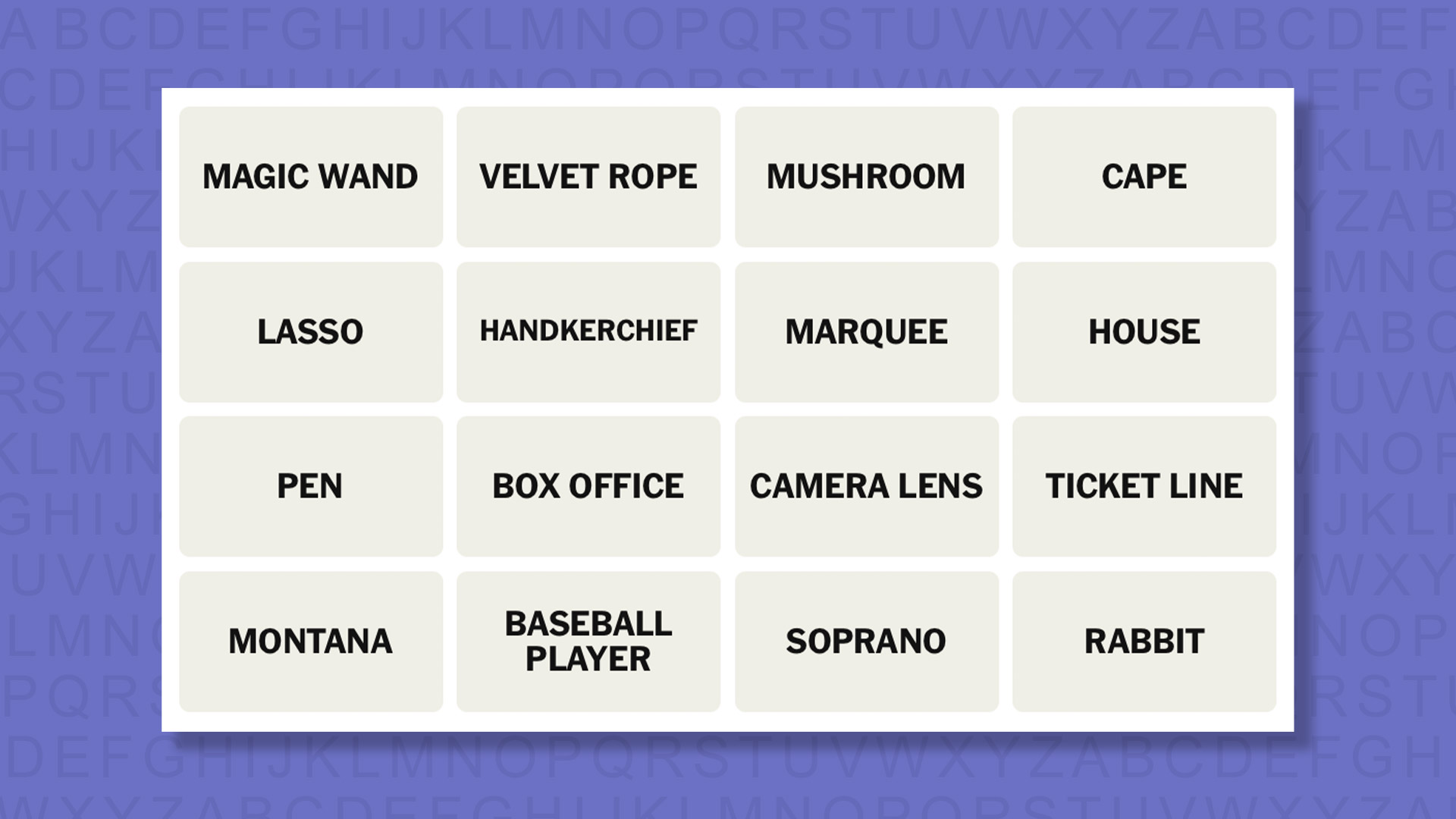
NYT Connections today (game #1037) – today’s words
(Image credit: New York Times)
Today’s NYT Connections words are…
MAGIC WAND
VELVET ROPE
MUSHROOM
САРЕ
LASSO
HANDKERCHIEF
MARQUEE
HOUSE
PEN
BOX OFFICE
CAMERA LENS
TICKET LINE
MONTANA
BASEBALL PLAYER
SOPRANO
RABBIT
NYT Connections today (game #1037) – hint #1 – group hints
What are some clues for today’s NYT Connections groups?
YELLOW: Spotted at the cinema
GREEN: Things a trickster has
BLUE: Small screen characters
PURPLE: Think:a type of hat
Need more clues?
We’re firmly in spoiler territory now, but read on if you want to know what the four theme answers are for today’s NYT Connections puzzles…
Advertisement
Sign up for breaking news, reviews, opinion, top tech deals, and more.
NYT Connections today (game #1037) – hint #2 – group answers
What are the answers for today’s NYT Connections groups?
YELLOW: SEEN OUTSIDE A THEATER
GREEN: ACCESSORIES FOR A MAGICIAN
BLUE: TV SHOW TITLE SURNAMES
PURPLE: THEY HAVE CAPS
Right, the answers are below, so DO NOT SCROLL ANY FURTHER IF YOU DON’T WANT TO SEE THEM.
Advertisement
NYT Connections today (game #1037) – the answers
(Image credit: New York Times)
The answers to today’s Connections, game #1037, are…
YELLOW: SEEN OUTSIDE A THEATER BOX OFFICE, MARQUEE, TICKET LINE, VELVET ROPE
GREEN: ACCESSORIES FOR A MAGICIAN CAPE, HANDKERCHIEF, MAGIC WAND, RABBIT
BLUE: TV SHOW TITLE SURNAMES HOUSE, LASSO, MONTANA, SOPRANO
PURPLE: THEY HAVE CAPS BASEBALL PLAYER, CAMERA LENS, MUSHROOM, PEN
My rating: Easy
My score: Perfect
After seeing SOPRANO and LASSO on the grid I was pretty certain that there had to be a group about TV SHOW TITLE SURNAMES, but MONTANA made me hesitate and check to see if there were any more Tonys in the game after Tony SOPRANO and Tony MONTANA. In the end I stuck with my hunch and threw in HOUSE.
I used to love The Sopranos and used to buy any merchandise connected to the show I could — I’ve got a cookbook, T-shirts, scripts, a Satriale’s meat market sign and, in the style of those Baby on Board stickers, one that says Body on Board with the chalk outline of a dead body. I had that on my car for five minutes before I thought better of it.
Advertisement
Anyway, we digress. The other two groups were pretty straightforward, but I lacked the lateral thinking to be able to connect MUSHROOM and BASEBALL PLAYER — kudos if you saw it.
Yesterday’s NYT Connections answers (Sunday, April 12, game #1036)
YELLOW: PANTS FEATURES BELT LOOP, CUFF, FLY, POCKET
GREEN: PERSPECTIVE ANGLE, POSITION, STANCE, TAKE
BLUE: EMIT CAST, PROJECT, RADIATE, SHED
PURPLE: _____DOLL PAPER, RAG, RUSSIAN, TROLL
What is NYT Connections?
NYT Connections is one of several increasingly popular word games made by the New York Times. It challenges you to find groups of four items that share something in common, and each group has a different difficulty level: green is easy, yellow a little harder, blue often quite tough and purple usually very difficult.
On the plus side, you don’t technically need to solve the final one, as you’ll be able to answer that one by a process of elimination. What’s more, you can make up to four mistakes, which gives you a little bit of breathing room.
Advertisement
It’s a little more involved than something like Wordle, however, and there are plenty of opportunities for the game to trip you up with tricks. For instance, watch out for homophones and other word games that could disguise the answers.
It’s playable for free via the NYT Games site on desktop or mobile.
Apple’s upcoming smart glasses could sidestep one of the biggest issues facing the category – privacy concerns – by rethinking something as simple as the camera indicator light. According to a recent report by Bloomberg, the company is working on display-free smart glasses that focus on everyday functionality, but with a design approach that may make them feel less intrusive than current offerings.
The device, internally codenamed N50, is expected to arrive around 2026 or 2027 and will function more like a companion to the iPhone than a standalone augmented reality system. Instead of a display, the glasses will rely on features like photo and video capture, voice interactions via Siri, notifications, and media playback.
A Subtle Hardware Shift With Big Implications
What sets Apple’s approach apart is how it plans to handle recording visibility. Unlike existing smart glasses that use small LED indicators, Apple is reportedly experimenting with a more prominent lighting system integrated directly into the camera module.
The design includes vertically oriented lenses surrounded by visible lighting elements, making it harder to hide when recording is active.
Advertisement
This could address a key concern that has plagued smart glasses since their inception: the fear of being recorded without consent.
The Privacy Problem Others Are Still Facing
The issue isn’t theoretical. A report by WIRED highlights how users of Meta’s Ray-Ban smart glasses have attempted to bypass privacy safeguards. Third-party sellers have even promoted accessories like “ghost dots,” designed to dim or block the recording indicator light.
Meta
These attempts, while often ineffective due to built-in protections, reveal a broader problem. If users actively try to hide recording signals, the trust required for widespread adoption breaks down.
Even unsuccessful workarounds contribute to the perception that smart glasses can be misused, reinforcing the “creepy” reputation that has limited their acceptance.
Apple’s Strategy: Solve Trust Through Design
Rather than relying solely on software restrictions, Apple appears to be addressing the issue at the hardware level.
Advertisement
By making the recording indicator more visible and integrated into the design, the company is attempting to remove ambiguity. If successful, this could make it significantly harder to use the glasses in a way that feels covert or deceptive.
This aligns with Apple’s broader approach to new product categories. As seen with devices like the iPhone and Apple Watch, the company often enters markets later but focuses on refining user experience and addressing key pain points.
Part Of A Larger AI Wearables Push
The smart glasses are not being developed in isolation. Bloomberg notes that they are part of a broader strategy that includes AI-powered AirPods and other wearable devices designed to interpret the user’s surroundings.
Best Buy
These products will rely on computer vision and Apple Intelligence to provide contextual information, from navigation assistance to real-time reminders.
This suggests that Apple’s goal is not just to build smart glasses, but to create an ecosystem of devices that make AI more ambient and seamlessly integrated into daily life.
Advertisement
What This Means For Users
For consumers, the success of smart glasses will depend as much on perception as on functionality.
If Apple can make its glasses feel transparent and trustworthy, it could overcome one of the biggest barriers to adoption. At the same time, tight integration with the iPhone and Apple’s ecosystem may make the device more useful in everyday scenarios.
What Comes Next
Apple’s smart glasses are still in development, with a launch expected no earlier than 2026 or 2027. Fully featured augmented reality glasses remain further out, likely toward the end of the decade.
Until then, Apple’s focus appears to be on getting the basics right – functionality, usability, and most importantly, trust.
At some point in 2025, Windows stopped feeling like an operating system and started feeling like a demo for AI. Open Notepad to jot something down, and there it was, nudging you to summarize. Fire up Edge, and Copilot would politely wave from the sidebar. Even apps like Microsoft Paint began to feel different, not because they got simpler, but because they suddenly wanted to generate, edit, and enhance images for you.
That’s roughly when the internet did what it does best. It coined a name: Microslop. Crude, catchy, and brutally effective. Borrowing from the broader idea of “AI slop,” which refers to low-quality, mass-produced AI output, the term quickly became shorthand for something more specific.
Not just bad AI, but unwanted AI.
The kind that shows up uninvited, sits too close, and insists on helping when you really just wanted to type a grocery list. It captured a growing frustration that Microsoft’s software was becoming noisier, heavier, and a little less predictable.
Advertisement
Microsoft says it won’t automatically install the Microsoft 365 Copilot app on Windows 11 PCs, at least for now.
This comes as the company faces growing backlash online, with users increasingly mocking it as “Microslop” over its aggressive Copilot push.
The backlash got loud enough that even CEO Satya Nadella publicly pushed back on the idea of AI being dismissed as “slop.” Ironically, that only made the term spread faster. By early 2026, it had become a full-blown cultural shorthand for dissatisfaction with Microsoft’s AI push, even getting banned in some official communities. At that point, this wasn’t just a meme anymore. It was feedback.
Advertisement
The Moment Microsoft Blinked
For a while, it felt like Microsoft would just keep pushing forward. But then, in March 2026, in a surprisingly candid blog post titled “Our commitment to Windows quality,” Microsoft acknowledged what users had been saying for months. The company talked about improving reliability, reducing friction, and making Windows feel smoother and more dependable again. Among other things, Microsoft said that it’d also be cutting down on Copilot’s presence across Windows.
Microsoft
And those weren’t just hollow promises. Across multiple apps, the company has reduced the number of entry points where AI showed up. Features that had been announced earlier, like deeper Copilot integrations in notifications, have quietly been shelved. What’s more, is that apps like Notepad, Photos, and Snipping Tool no longer have visible Copilot hooks.
Microsoft
On paper, it looks like exactly what users had been asking for. Less AI clutter. More focus. Naturally, the narrative became simple. Microsoft had heard the backlash and was scaling things back. But like most simple narratives, this one doesn’t quite hold up.
Why Microsoft Can’t Just “Turn Off” AI
Here’s the thing. Microsoft can’t actually walk away from AI, even if it wants to. This isn’t a feature toggle. It’s the foundation of everything the company is building right now. From Azure infrastructure to Microsoft 365 to Windows itself, AI is deeply baked into the strategy. Billions have already been invested. Entire product lines are being reshaped around it.
boliviainteligente / Unsplash
Microsoft was an early backer (read: billions of dollars) of OpenAI, heavily integrated ChatGPT in its products, and then borrowed rival Anthropic’s Claude AI to boost Copilot — all while developing its own AI models. The AI push even birthed a whole new breed of laptops with a Copilot+ branding and a dedicated Copilot button on the keyboard deck.
Yeah, “preposterous,” you might say.
Even now, while scaling back visible integrations, Microsoft is still pushing Copilot into enterprise tools, workflows, and services. So what you’re seeing isn’t a retreat. It’s a recalibration. AI isn’t going away. It’s just being repositioned by making it less visible, but silently seeping into the foundations.
Stealth Mode Activated?
You can see this most clearly in the small details. Take, for example, Notepad. A year ago, it had a bright Copilot button sitting right there in the interface. It was obvious, almost eager. In newer builds, that button is gone. In its place is a far more neutral “Writing Tools” icon. The features are still there. Rewrite, summarize, tweak tone. But the branding is gone. The loudness is gone.
Advertisement
Breaking: Microsoft quietly removes Copilot branding from Notepad and Snipping Tool on Windows 11.
Microsoft appears to be doing exactly what it promised after the Windows quality reset.
Notepad has now removed Copilot branding and replaced it with a simpler “Writing tools”… pic.twitter.com/eEmxoIZ2Wm
And this isn’t an isolated case. Across Windows, Microsoft is reducing how often Copilot shows up as a named feature while still keeping the underlying capabilities intact, from AI Features to Advanced Features, and whatnot. This is what some are calling “Stealth-Slop.” AI that hasn’t disappeared, but has learned to stay out of your way. Fewer announcements, more availability.
Advertisement
What’s fascinating is that Microsoft’s core belief hasn’t changed at all. The company still sees AI as the future of computing. If anything, it’s doubling down behind the scenes. What has changed is the delivery. The first phase was about visibility. Ship AI everywhere. Make sure users see it, notice it, and ultimately, try it. That worked, but it also backfired.
People didn’t just notice AI. They felt overwhelmed by it.
Now we’re in phase two. Integration. Microsoft is being more selective about where AI shows up and how it behaves. Executives have even said they want to focus on AI experiences that are “genuinely useful,” rather than just widely available. It’s a shift from proving capability to proving value.
The Real Shift
Microsoft hasn’t exactly “fixed” the problem, but that might not even be the right way to look at it. The backlash wasn’t about AI being bad; it was about it being everywhere in ways that felt unnecessary and intrusive. That distinction is important. Even now, criticism around forced integrations and limited user control hasn’t fully gone away, but at the same time, Microsoft is clearly trying to clean things up with a more focused, less cluttered Windows experience.
Microsoft
What’s really changing is not the presence of AI, but how it feels. Instead of being a loud, in-your-face feature, AI is being reshaped into something quieter and more natural. The goal now seems to be simple. Make it helpful without making it obvious. Because for AI to actually work at scale, it cannot feel like an add-on. It has to feel like it was always meant to be there.
Microsoft
That’s the lesson Microsoft seems to have learned the hard way. It didn’t remove AI from Windows. It just made sure you wouldn’t notice it quite as much anymore. Microsoft isn’t a slouch in the AI game. Earlier this month, Microsoft announced not one, but three foundation AI models. Its Phi series of open-source small language models is fairly popular and capable.
By next year, Microsoft wants to release its own frontier models that compete with the likes of ChatGPT, Claude, and Gemini. “We must deliver the absolute frontier,” Mustafa Suleyman, chief of Microsoft’s AI efforts, said in an interview. As I said, the AI push is here to stay. I just hope it evolves without muddying up everything that Microsoft offers to hundreds of millions of users across the world — including lifelong die-hards like me!
Looking for the most recent Wordle answer? Click here for today’s Wordle hints, as well as our daily answers and hints for The New York Times Mini Crossword, Connections, Connections: Sports Edition and Strands puzzles.
“Robotic bird decoys are being deployed at Grand Teton National Park,” reports Interesting Engineering, “to influence the behavior of real sage grouse and help restore a declining population.”. Robotics mentor Gary Duquette describes the machines as “kind of a Frankenbird.” (SFGate shows one of the robot birds charging up with a solar panel… “Recorded breeding calls are played at the scene, with clucking and cooing beginning at 5 a.m. each day.”)
Duquette builds the birds with a team of high school students, telling WyoFile that at school they “don’t really get to experience real-world problems” where failures lurk. So while their robot birds may cost $150 in parts, the practical experience the students get “is priceless.”
Spikes in the electric currents burned out servo motors as the season of sagebrush serenades loomed, Duquette said. “The kids had to learn the difference between voltage and amperage….” To resolve the problem, the team wired a voltage converter in line with the Arduino controller and other elements on an electronic breadboard. “We pulled through and got it done in time,” he said…
A noggin fabricated by a 3D printer tops the robo-grouse. Wyoming Game and Fish staffers in Pinedale supplied grouse wings from hunter surveys, and body feathers came from fly-tying supplies at an angling store. Packaging foam from a Hello Fresh meal kit replicates white breast feathers, accented by yellow air sacs… The Independent wonders if more national parks would be visited by robot birds… During this year’s breeding season, which runs through mid-May, researchers are using trail cameras to track whether real sage grouse respond to the robotic displays and return to the restored lek sites. If successful, officials say similar robotic systems could eventually be used in other national parks facing wildlife management challenges.
The Super Mario Galaxy Movie “is officially the year’s highest-grossing film to date with $629 million at the global box office,” reports Variety — and it will likely earn over $1 billion. Project Hail Mary now becomes the year’s second highest-grossing movie, with four-week ticket sales over $510, notes The Hollywood Reporter:
The two films have helped propel year-to-date revenue to $2.113 billion — the best showing for the first part of the year since before the pandemic in 2019 ($2.619 billion), according to Comscore. And revenue is running 25% ahead of the same corridor last year.
Some context from ScreenRant:
Even though The Super Mario Galaxy Movie reviews were largely negative, earning it a disappointing 43% score from critics on Rotten Tomatoes, audiences gave it a far superior score of 89% from audiences, making it Verified Hot on the platform’s Popcornmeter. This indicates that the movie should continue to climb up the global box office chart thanks to strong word of mouth, even as it trails consistently behind the original 2023 movie in terms of commercial performance.
Canadian astronaut Jeremy Hansen called Project Hail Mary “an inspirational example.. We all thought that movie was really uplifting and inspiring.” Before the Artemis astronauts launched their mission, Space.com points out “they were treated to a viewing of Amazon MGM Studios’ Project Hail Maryto bolster their spirits ahead of their monumental 10-day lunar voyage. ” Marking the occasion and providing encouraging words to the three American astronauts and one Canadian astronaut, Ryan Gosling recorded a brief encouraging video for the moon-bound foursome.
Advertisement
Today NPR took a spoiler-filled look at the science in the film, asking: Would it be possible for humans to travel to a place as far away as the Tau Ceti star system? It’s not possible right now, says Lisa Carnell, division director for NASA’S Biological and Physical Sciences Division. “I don’t think we are fully prepared to send humans to Mars, let alone light years away,” she says. Given the leaps in technology that humanity has made in just the past century, however, she didn’t want to rule it out…. “I believe it’s possible [one day]”…
The hypothetical study of how humans and extraterrestrials might communicate is a real scientific field, called xenolinguistics, that includes researchers from linguistics, animal communication, and anthropology. Martin Hilpert, a professor of linguistics at the University of Neuchâtel in Switzerland, says the film “gets a lot of things right” for how such an encounter might occur, though it also employs a lot of “happy coincidences” too.
Microsoft has done a massive amount of work to improve compatibility and has also convinced developers to embrace Windows 11 on Arm. Users of Windows 11 on Arm PCs spend 90% of their time on Arm-based apps that run natively. Additionally, apps that do not run natively can often run through Prism emulation, which has improved dramatically since launch…
[A]pp compatibility issues are overblown by many, and unfortunately those sharing false information are the same folks people rely on to make purchases… Works on Windows on Arm maintains a list of compatible apps and games for the platform. There, you’ll see well-known apps like Google Chrome, the Adobe Creative Suite, and Spotify. We also have a collection of the best Windows on Arm apps to help you out. Snapdragon X PCs aren’t gaming PCs, but there is a growing library of games that can run on the chips.

























































You must be logged in to post a comment Login