The four potential collaborators initially formed an equal-partnership ad-tech joint venture in 2023.
Four of Europe’s largest telecom operators are said to be in talks to create a consortium that will bid on satellite spectrums and offer direct-to-mobile service in Europe, Bloomberg reported earlier this week.
The mooted partners – Germany’s Deutsche Telekom, France’s Orange, Spain’s Telefonica and the UK-headquartered Vodafone – are expected to make a joint bid for a share of airwaves that the EU has planned to reserve for local operators in order to strengthen home-grown European sovereign satellite communication capabilities, according to Bloomberg.
The sector is currently dominated by Elon Musk’s SpaceX.
Advertisement
The talks are in early stages, sources told Bloomberg. The four potential co-bidders initially formed an equal-partnership ad-tech joint venture in 2023.
Earlier this year, the EU adopted a proposal to select mobile satellite services providers who will be authorised to use the 2GHz frequency band beyond 2027, when the current licences expire. These licences were first handed out in 2008.
Under new rules, one-third of the band will be dedicated to government use, while the remaining two-thirds will be used commercially to provide direct-to-device services for mobile users.
SpaceX – which currently provides its satellite broadband to much of Europe with Starlink – has pushed back on the European Commission’s plans to boost satellite sovereignty in the region.
Advertisement
In June, the company said that the proposal creates a “significant likelihood that Europeans will be left without direct-to-device satellite services or that new European operations will create global interference problems, including to emergency services like those in Ukraine”.
SpaceX already has a partnership with Deutsche Telekom to provide direct-to-device services in the EU – something it cannot do independently.
Last year, Vodafone and AST SpaceMobile, a US company building a space-based cellular broadband network, announced a joint venture called SatCo with the aim of providing exclusive direct-to-device satellite broadband services to European mobile network operators.
Don’t miss out on the knowledge you need to succeed. Sign up for the Daily Brief, Silicon Republic’s digest of need-to-know sci-tech news.
Even if regulators did somehow unwind the $20B deal, there’s a growing list of alternatives ready to take Groq’s place, no merger required
Nvidia spent a whopping $20 billion late last year to license Groq’s AI accelerator tech and hire away key members of its engineering team in an everything-but-the-kitchen-sink deal.
Advertisement
The acquihire technically left Groq’s core inference-as-a-service business intact, but was clearly architected in such a way as to fly under regulators’ radar.
Only it didn’t.
This week, The New York Times reported that the US Department of Justice had launched an antitrust probe into the deal.
It’s hard to argue that Nvidia didn’t strip the startup for parts. It may not have been a merger in the traditional sense, but without its engineering staff, Groq may as well be Nvidia’s puppet at this point.
Advertisement
Despite this, Nvidia contends the deal is a great American success story.
“The Groq story is a prime example of the American system working as designed to promote innovation, reward entrepreneurs, and benefit consumers. The law is designed to encourage America’s startup ecosystem and promote the fundamental rights of inventors and workers to pursue their dreams,” an Nvidia statement provided to El Reg and other media reads.
Whether the acquihire of Groq actually harmed competition is another matter entirely. But, even if the Justice Department did force Nvidia to unwind the team, it’s probably too late.
What exactly did Nvidia buy?
Nvidia’s Groq acquihire bought it two key assets: mature silicon and the talent necessary to continue its development.
Advertisement
Groq – which, by the way, is completely unrelated to Elon Musk’s Grok model series – made a name for itself using SRAM-heavy dataflow accelerators to speed up LLM inference to hundreds and now thousands of tokens a second, something that GPU-based systems from Nvidia had struggled to do on their own.
But while faster than GPUs, the accelerators couldn’t achieve rapid throughput. Think of it this way: If Groq’s LPUs were the F1 cars, Nvidia’s GPUs were more like a city bus. But combine the two and you get something more akin to a sport pickup.
At GTC in March, Nvidia unveiled its LPX racks, which are powered by 256 Groq-3 accelerators. As we understand it, they are really lightly modified versions of the startup’s existing Groq-2 chip designs, which makes sense, because three months is absurdly fast to tape out new silicon.
Nvidia CEO Jensen Huang promised Groq-3 combined with its Vera Rubin GPU racks would deliver optimal performance across the entire spectrum of inference workloads.
Advertisement
But, as we’ve discussed at length now, disaggregated compute architectures are not unique to Groq. Nvidia rival Cerebras is building similar systems with AWS and AMD, SambaNova is working with Intel, and d-Matrix and its partners are combining its in-memory compute platform with Nvidia GPUs to the same end as Nvidia’s Vera Rubin-LPX rack combo.
The damage, if any, has been done
Deals of this sort that are engineered to avoid regulatory scrutiny should get it anyway, several US senators have argued. While Nvidia didn’t outright buy Groq on paper, it may as well have.
However, the real question for the DOJ is whether the deal was harmful to competition, and given the competitive landscape, proving harm may be easier said than done.
But even if the DOJ found reason to litigate and was successful in unwinding the deal — it certainly wouldn’t be the first time regulators had torpedoed an Nvidia deal — it probably wouldn’t change much.
Advertisement
Before Nvidia and Groq announced their licensing deal, the GPU giant was already laying the foundations for an ecosystem with its networking business at its center.
In late 2024, the company contributed its MGX rack designs to the Open Compute Project (OCP) making it possible for any chipmaker to put their chips in racks originally designed for Nvidia GPUs.
Then in mid-2025, GPUzilla opened its high-speed interconnect tech — the secret sauce that makes six dozen GPUs behave as one — to the broader industry through a licensing scheme called NVLink Fusion.
As we recently discussed, the combination of open racks and Nvidia networking effectively meant that any chipmaker licensing the tech could slot their designs directly into Nvidia’s racks.
Advertisement
If the DOJ blocked the acquihire and unwound the deal, Nvidia might lose direct control of LPU development and any revenues from the sale of the chips, but it wouldn’t necessarily be the end of its Groq LPX racks.
Groq would just join the growing number of Nvidia hardware partners designing around the company’s AI factory ecosystem. In fact, if anything, the acquihire ensures that even if regulators eventually derail the deal, there will be plenty of alternatives lined up and ready to fill the void. ®
For U.S. consumers, a credit card is generally safer than a debit card for online shopping when the main concern is unauthorized transactions, covered merchant disputes, or keeping checking-account funds available while a problem is investigated. Debit cards still have important protections, but their direct connection to a deposit account and their timing-sensitive federal liability rules can make fraud more disruptive.
That does not make a credit card the best financial choice in every situation. If using credit leads you to carry an unaffordable balance and pay interest, avoiding debt may be the more important risk. The useful comparison is what happens when an online transaction goes wrong.
The first difference is where the purchase is funded. A debit card normally uses money already held in the linked checking account. A credit card uses credit provided by the card issuer. The Federal Trade Commission’s comparison of payment cards explains both this funding difference and the different legal protections that apply.
Suppose an unauthorized $800 online purchase appears on each type of card. With a debit card, that transaction can reduce the money available in the linked account while the matter is investigated. With a credit card, the disputed transaction normally affects the credit account rather than directly removing $800 from checking.
Advertisement
That difference matters even when the consumer ultimately has no financial loss. A temporarily reduced checking balance can interfere with rent, utilities, scheduled transfers, or other payments. Final fraud liability and short-term access to cash are separate risks.
Credit cards also have a relatively simple federal limit for qualifying unauthorized use. Under Regulation Z’s credit-card provisions, a cardholder’s liability generally cannot exceed the lesser of $50 or the amount obtained through unauthorized use before the issuer is notified, provided the regulation’s conditions for imposing liability are met.
Credit Card vs Debit Card: Safety Comparison at a Glance
The most useful comparison is not whether both cards advertise fraud protection. It is how federal liability, access to checking-account funds, merchant-dispute rights, network policies, and debt risk differ.
Credit Card vs Debit Card for Online Purchases
Comparison of credit-card and debit-card protections and practical risks for U.S. online shoppers
Feature
Debit Card
Credit Card
Purchase funding
Usually draws from money in a linked checking account.
Uses a credit line rather than directly withdrawing checking-account funds.
Federal unauthorized-use liability
Can vary based on the circumstances and how quickly the consumer reports the problem.
For qualifying unauthorized use, liability generally cannot exceed $50 and may be lower.
Stolen account number
Regulation E protections apply to unauthorized electronic fund transfers, with reporting rules affecting potential liability.
If the physical card was not lost but the account number was stolen and used, CFPB guidance says the consumer generally has no liability.
Effect on checking-account cash
An unauthorized transfer can reduce available account funds before the matter is resolved.
A disputed purchase normally does not directly remove funds from the checking account.
Federal merchant-dispute framework
Regulation E provides error-resolution rights for electronic fund transfer errors, but it does not mirror Regulation Z’s billing-error category for goods or services not delivered as agreed.
Regulation Z covers several billing errors, including certain transactions involving goods or services not accepted or not delivered as agreed.
Additional network protection
Some networks and issuers provide protections beyond federal minimums.
Networks and issuers may also provide protections beyond federal minimums.
Debt and interest risk
Usually uses money already held in the account and does not create ordinary revolving credit-card debt.
Can create interest charges and revolving debt when balances are carried, depending on the account terms.
For online-payment protection, credit generally has the advantage. That does not mean it wins every financial criterion. A shopper who is likely to carry expensive credit-card debt may reasonably give greater weight to borrowing risk.
Advertisement
What Happens If Someone Uses Your Card Without Permission?
Credit-card unauthorized use
Federal credit-card rules provide a relatively straightforward liability ceiling. Regulation Z states that qualifying liability for unauthorized credit-card use cannot exceed the lesser of $50 or the value obtained before the issuer is notified.
The protection can be stronger when the physical card remains in your possession. According to the Consumer Financial Protection Bureau’s guidance on unauthorized credit-card charges, if someone steals and uses only the account number and you have not lost the card itself, you generally have no liability for that unauthorized use.
“Unauthorized use” has a specific legal meaning. Regulation Z defines it as use by someone other than the cardholder who lacks actual, implied, or apparent authority and from which the cardholder receives no benefit. A disagreement involving a family member, employee, or another person who was previously allowed to use the card can therefore be more complicated than a straightforward stolen-number case.
Debit-card unauthorized transfers
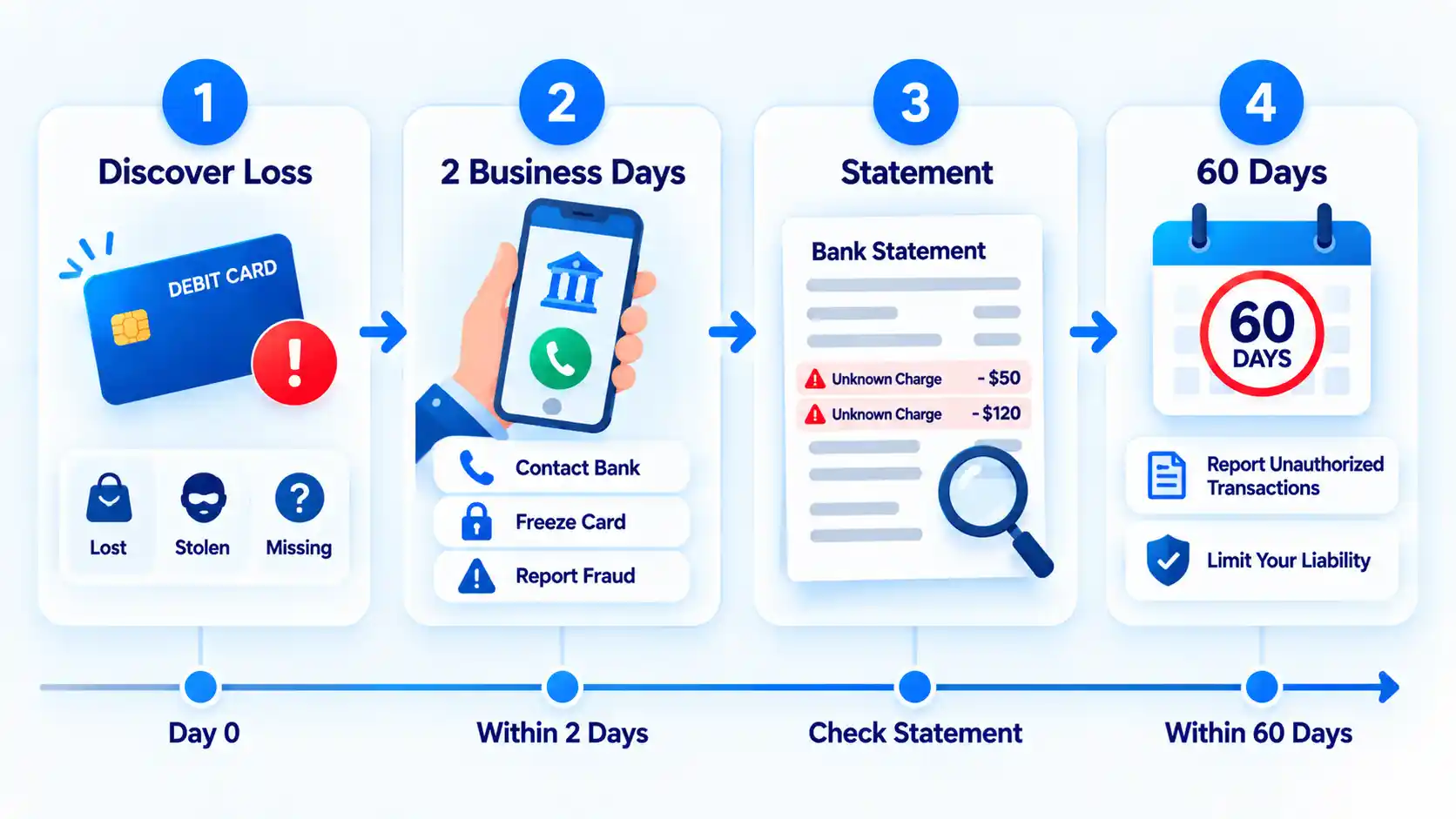
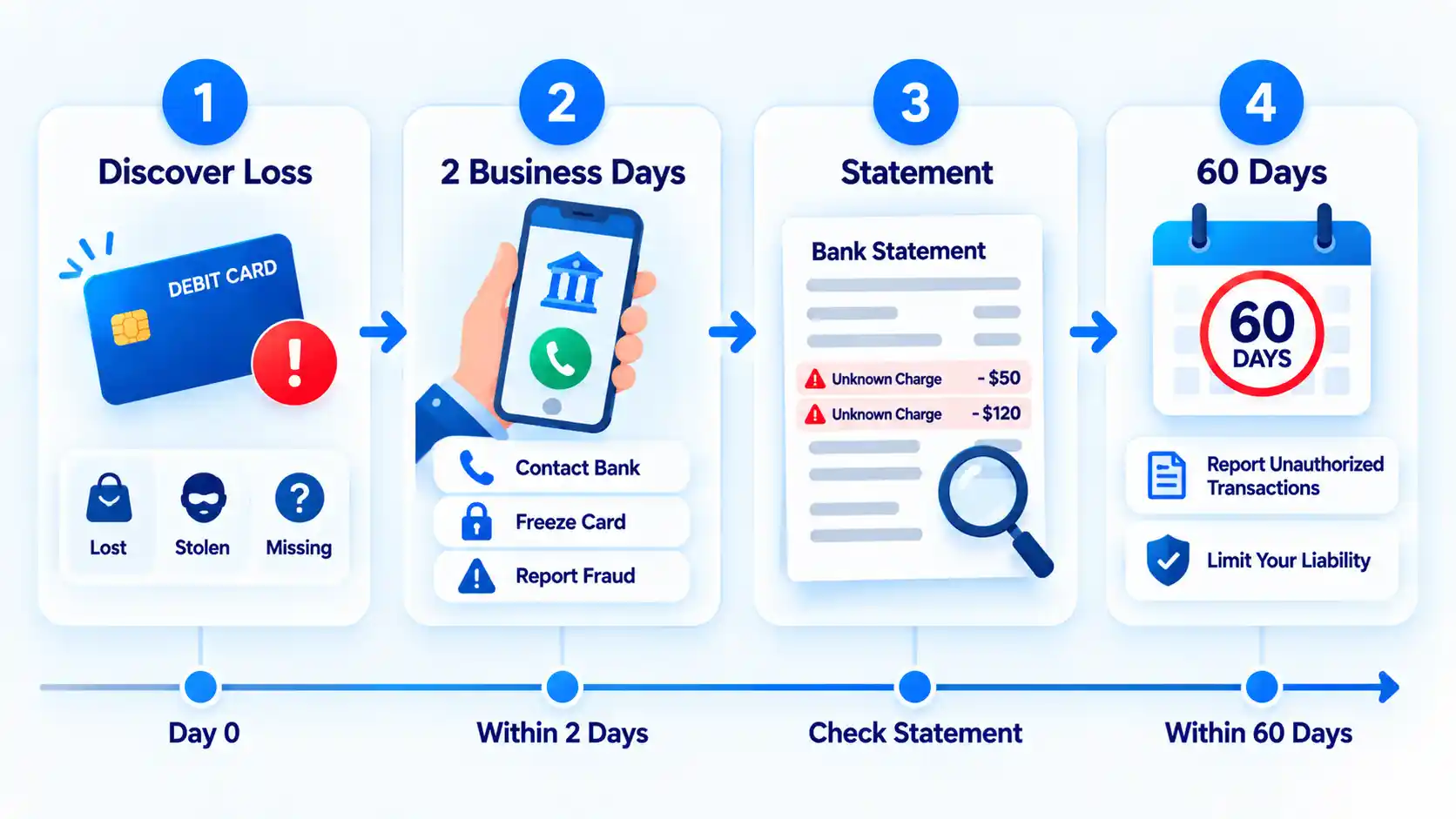
Debit cards also have federal protections, but reporting timing can materially affect potential liability. Under Regulation E’s unauthorized-transfer rules, a consumer who notifies the financial institution within two business days after learning that an access device was lost or stolen generally faces liability of no more than the lesser of $50 or the unauthorized transfers that occurred before notice.
Advertisement
If the consumer waits longer than two business days, potential liability can rise. Regulation E describes circumstances in which the applicable ceiling can reach $500, although the actual amount depends on when the transfers occurred and whether the institution establishes that later transfers could have been prevented by timely notice.
The often-repeated “60-day rule” also needs precision. If an unauthorized electronic fund transfer appears on a periodic statement, the consumer generally must report it within 60 days after the institution transmits that statement to avoid potential liability for later unauthorized transfers that timely notice could have prevented. It is misleading to say that every unauthorized dollar automatically becomes the consumer’s responsibility on day 61.
Because reporting time can affect the outcome, responding to an unauthorized online card purchase should include prompt notice to the issuer or financial institution and preservation of the relevant transaction records.
A consumer can ultimately have little or no liability and still experience temporary disruption. That distinction is particularly important with debit cards because the disputed transfer can affect money already sitting in the linked account.
Advertisement
Under Regulation E’s error-resolution procedures, a financial institution generally must investigate promptly and determine whether an error occurred within 10 business days after receiving a qualifying notice of error.
If the institution cannot complete the investigation within that period, it can generally take up to 45 days if it provisionally credits the consumer’s account within the required period and satisfies the other conditions in the rule. Regulation E provides longer investigation periods for specified categories, including certain point-of-sale debit-card transactions, transfers initiated outside a state, and qualifying new-account cases.
Provisional credit is a temporary credit placed in the account while the investigation continues. It is not necessarily a final determination that the consumer’s claim is valid.
Consider the $800 fraud example again. If an unauthorized debit transaction reduces the checking balance shortly before rent is due, the consumer may face a cash-flow problem before the investigation or provisional-credit process restores access to those funds. An unauthorized credit-card transaction ordinarily does not remove that $800 from checking in the first place.
Advertisement
Credit Cards Have Federal Billing-Error Rights for Some Merchant Problems
Online-shopping problems are not limited to card theft. A merchant might bill twice, charge the wrong amount, fail to deliver an order, send the wrong quantity, or deliver an order somewhere other than the location agreed upon.
Regulation Z’s billing-error rules cover several categories of problems with open-end credit accounts. One category includes charges for property or services that the consumer did not accept or that were not delivered as agreed. The CFPB’s official interpretation gives examples including different property than agreed, the wrong quantity, late delivery, and delivery to the wrong location.
For the formal billing-error process, the consumer’s written notice generally must reach the creditor no later than 60 days after the creditor transmitted the first periodic statement reflecting the alleged error. The notice must also contain enough information for the creditor to identify the account and understand the alleged problem.
Once a qualifying notice is received, the creditor generally must acknowledge it in writing within 30 days unless the matter has already been resolved, and complete the applicable resolution procedures within two complete billing cycles, but no later than 90 days.
Advertisement
There is an important limit. Regulation Z expressly says this billing-error category does not cover a dispute merely about the quality of property or services that the consumer accepted. Whether the consumer legally accepted the goods can depend on state or other applicable law.
For example, a laptop that never arrives can fit the non-delivery framework more readily than a laptop that arrives as ordered but feels less premium than the buyer expected.
Credit cards also have a separate federal claims-and-defenses provision. Under Regulation Z’s claims-and-defenses rules, a cardholder can in qualifying circumstances assert certain merchant-related claims or defenses against the card issuer after the merchant fails to resolve the dispute satisfactorily.
That right has conditions and should not be presented as a universal guarantee. The regulation generally requires a good-faith effort to resolve the dispute with the merchant and includes transaction-value and geographic requirements. Its official interpretation also notes that internet orders can qualify as credit-card purchases, while the location of an internet or telephone transaction for the geographic condition can depend on state or other applicable law.
Advertisement
For that reason, “you can always charge it back” is too broad. The applicable right depends on the type of dispute, the facts, the account, and the governing rules.
What About Debit Cards With Zero-Liability Policies?
Network and issuer policies can improve the protection available to debit-card users beyond the federal statutory minimum. They do not make Regulation E and Regulation Z identical.
For example, Visa’s current Zero Liability Policy says qualifying Visa credit and debit cardholders are not held responsible for unauthorized charges made with the account or account information. Visa states that the policy covers most credit and debit cards but excludes certain commercial-card and anonymous prepaid-card transactions and transactions not processed by Visa.
Visa also instructs cardholders to notify their issuing financial institution immediately and tells consumers to check with the issuer about coverage for a specific card.
Advertisement
This creates two distinct layers. Federal law sets statutory rights and liability rules. A network or issuer can then provide contractual protections that are more favorable to the cardholder. A network policy should therefore be described as an additional protection, not as evidence that every debit card has identical rights or that statutory debit and credit protections are the same.
When Using a Debit Card Online Can Still Make Sense
A debit card can still be a reasonable choice when avoiding revolving debt is the higher financial priority. Debit purchases normally use money already held in the linked account rather than creating an ordinary credit-card balance.
The FTC notes that credit cards can charge interest when balances are carried from month to month. It also explains that on most cards, paying the whole bill by the due date can avoid purchase interest, although the exact account terms control.
Debit may therefore make sense for someone who does not have a credit card, prefers not to borrow, or knows that available credit tends to lead to balances that are difficult to repay. In that situation, it is particularly important to understand the bank’s reporting procedures, review account activity regularly, use available transaction alerts, and report suspicious transfers promptly.
Choosing credit instead of debit does not make an untrustworthy merchant safe. Payment protections matter after something goes wrong, while merchant checks can reduce the chance of entering the transaction in the first place.
Check an unfamiliar seller before paying. Look for independent information about the business and search its name with terms such as “complaint” or “scam.”
Do not treat HTTPS as proof that a seller is legitimate. The FTC explains that HTTPS means the connection is encrypted, but fraudulent sites can use encryption too.
Keep transaction records. Save the order confirmation, price, promised delivery information, return or refund terms, and important communications with the seller.
Review account activity regularly. Detecting an unauthorized transaction sooner can make it easier to report within applicable deadlines.
Use transaction alerts when your issuer offers them. They can make unexpected activity easier to notice.
Report suspicious activity promptly. Follow the card issuer’s or financial institution’s stated reporting process rather than waiting to see whether another transaction appears.
The FTC’s online-shopping guidance specifically recommends paying by credit card when possible because of the protections available when a scam or covered purchase problem occurs. The FTC also recommends keeping purchase records and warns that an encrypted website is not necessarily legitimate.
How the card credentials themselves are exposed is a separate security question. Virtual card vs physical card for online shopping can be evaluated separately from the legal differences between debit and credit accounts.
Which option should you choose?
Credit Card
Choose this if: you want stronger federal protections for several online-purchase problems, want a disputed purchase separated from your checking-account balance, or are making a purchase where temporary loss of cash would create a serious inconvenience.
Advertisement
Avoid this if: using available credit is likely to leave you carrying debt that you cannot comfortably repay.
Main trade-off: stronger payment protections come with the possibility of interest and revolving debt if the balance is carried.
Debit Card
Choose this if: avoiding borrowing is the higher priority, you understand your bank and network’s fraud policies, and you actively monitor the linked account.
Avoid this if: temporary loss of checking-account funds could interfere with essential bills or you are unlikely to notice and report unauthorized activity promptly.
Advertisement
Main trade-off: you avoid ordinary revolving credit-card debt, but unauthorized transactions can directly affect available account funds while a dispute is being investigated.
For most U.S. shoppers who can use a credit card without carrying unaffordable debt, credit is the safer default for online purchases. Its advantage comes from federal unauthorized-use limits, specific billing-error protections for several merchant problems, and the practical separation between a disputed purchase and money held in checking.
Debit is not inherently unsafe. It simply makes rapid detection and reporting more consequential and exposes the linked account more directly when fraud occurs. Whichever card you use, verify unfamiliar sellers, keep transaction records, review account activity, and report suspicious transactions promptly.
Many electronics users have felt the wave of panic that comes with trying to wipe away a mark on their screen, only to realize it’s actually an issue with the screen itself. Sometimes, this can be caused by factors like source or cable issues, and isn’t cause for alarm. Other times, however, it’s a pixel problem, which can be much more dread-inducing due to varying levels of repairability.
Even the best monitors aren’t safe from a potential pixel issue, of which there are two main types: stuck pixels and dead pixels. Both are dots — or, even worse, clusters of dots — that no screen user wants to see. However, though both screen annoyances look a lot alike shape-wise, there are some distinct differences between them, namely in their exact appearance and if they can be fixed.
Advertisement
Spotting the difference
One of the biggest differences between a stuck and dead pixel is the presence of light. A stuck pixel is permanently on, displaying a constant blue, red, green or bright point, while a dead pixel is, as the name suggests, no longer functioning and is always black. This visual difference can help you determine which particular problem you’re facing.
The other main defining factor between the two is how fixable they are. A stuck pixel has a myriad of troubleshooting routes that can be taken, and can often be returned to normal. A dead pixel, on the other hand, cannot be salvaged. If you’ve got a dead pixel, you’ll unfortunately either have to get a replacement or learn to tolerate it. On the bright side, it’s a generally less obtrusive visual issue than something like screen burn-in.
Advertisement
How to test for dead and stuck pixels
Loner Nguyen/Shutterstock
Stuck and dead pixels are so small it can sometimes be tricky to identify if they’re even the issue at hand, and, if they are, which instance in particular you’re dealing with. First, it’s best to rule out all other display issues that could be going on. Clean your display thoroughly, see if the problem persists across different applications and, if you can, try both a new cable and input device.
Once you’ve ruled out other problems, conduct a final test designed to concretely pinpoint the issue. There are several sites and apps that can be used to sniff out pixel problems, like Dead Pixel Buddy, and even some that purport the potential to solve the issue as well, like JScreenFix or Dead Pixels Test and Fix. It should be noted that stuck pixels can sometimes be harder to diagnose, as those with power or heat problems as the underlying cause may only appear intermittently. If that’s the case, try to pull up one of these tests as soon as you notice the issue’s returned.
Samsung’s first Android XR glasses with a colour display could arrive towards the end of 2027, according to a new report. The company is already working on the tiny microdisplays needed for the glasses, although some key decisions around the design and cost still appear to be up in the air.
The Elec reports that Samsung has asked Samsung Display to develop new colour microdisplays for future smart glasses. The panels are expected to be around 0.2 inches or smaller, with Samsung still weighing up performance and price as it works out the final form factor.
Exactly how those displays will be used isn’t settled yet, either. Samsung is reportedly considering both monocular and binocular designs. The early prototypes shown by Samsung and Google have generally used a monocular setup, with a display positioned over one eye. A binocular design would put displays over both eyes and could offer an advantage for showing 3D content.
That would make these glasses quite different from Samsung’s first Android XR glasses, which aren’t expected to have a display at all. Those glasses are instead being developed more like the Meta Ray-Ban smart glasses, combining a camera with open-ear audio.
Advertisement
Samsung has already shown designs created with eyewear brands Warby Parker and Gentle Monster, but it hasn’t confirmed when those first display-free glasses will actually launch.
Advertisement
The colour-display version appears to be further down the road, with the latest report pointing towards late 2027. There are still plenty of details to work out before then, particularly whether Samsung settles on one or two displays and how it balances the performance of those tiny panels against their cost.
Still, the move would mark a more ambitious step for Samsung’s Android XR push. Rather than simply adding cameras and speakers to a familiar pair of glasses, a colour-display model could put actual visual information in front of the wearer while keeping the glasses themselves far more compact than a traditional headset.
Or, in the case of cool new hardware, it’s the software that can make or break the experience. Apple forcefully made both points with the launch of its new foldable smartphone, the highly anticipated iPhone Duo, which is expected to ship on October 23 at a starting price of $1,999.
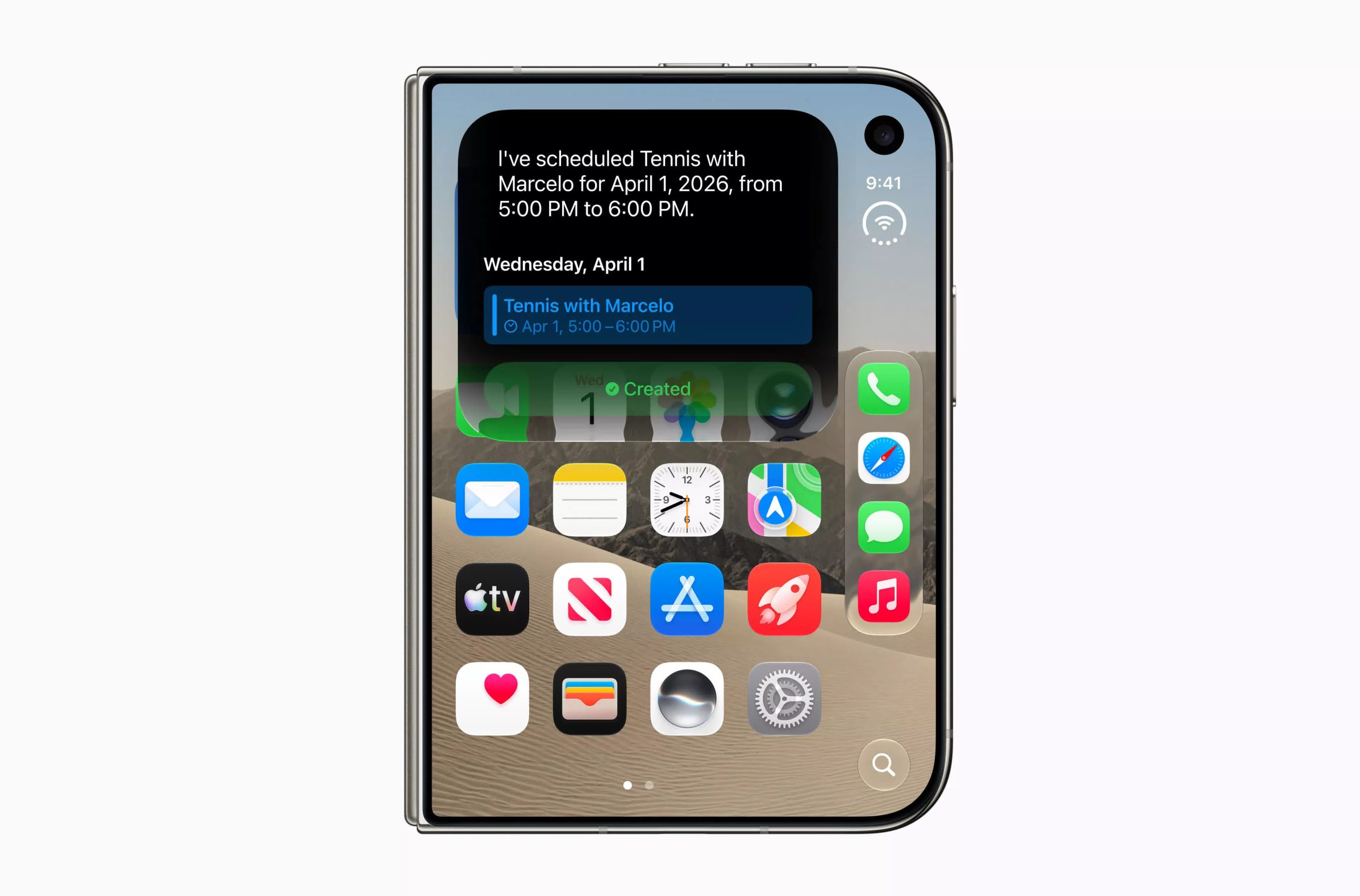
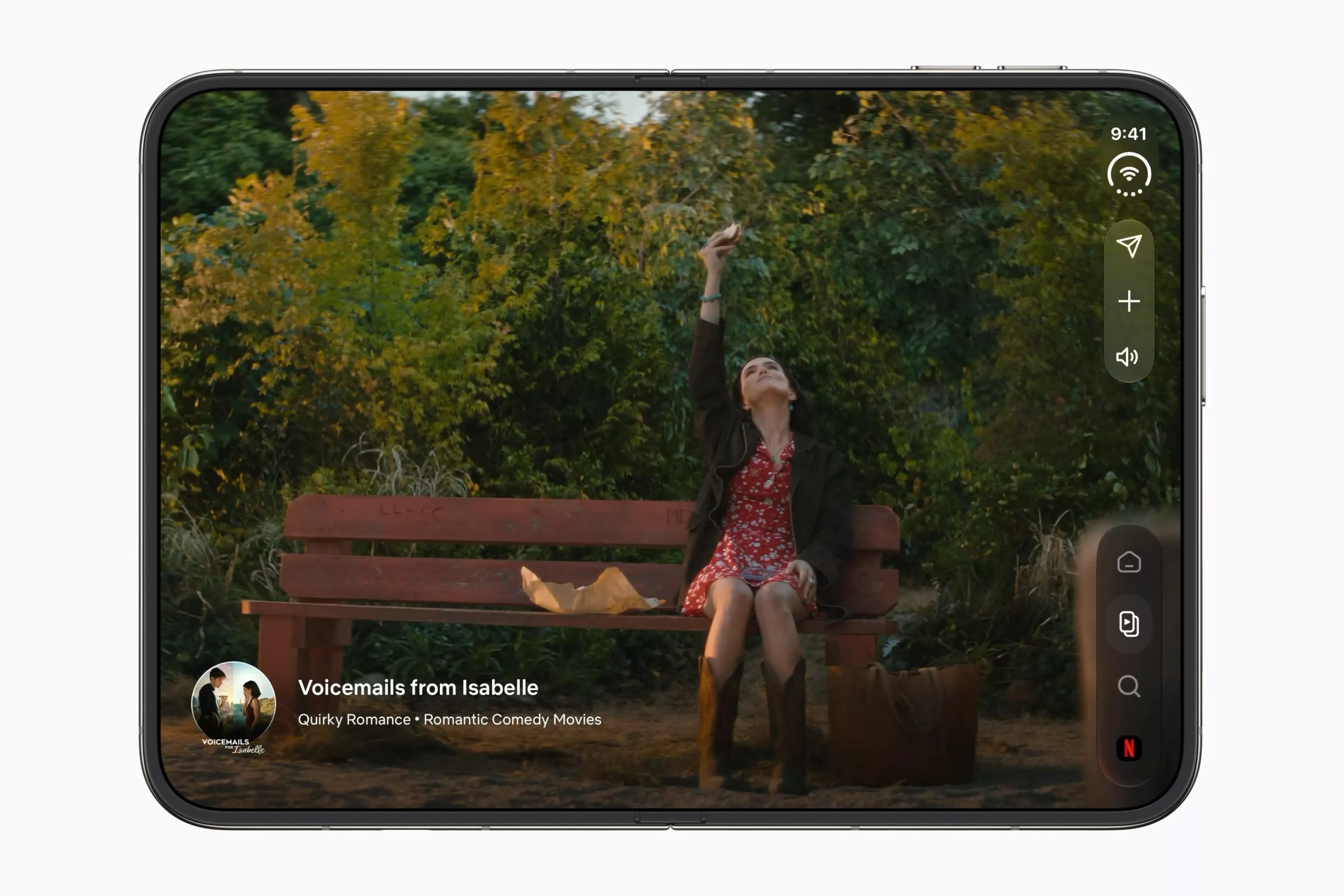
The Duo features a very nice, if arguably derivative, hardware design that at first glance looks similar to other recent passport-style phones, such as Samsung’s Z Fold 8. But the phone distinguishes itself with a new version of iOS and multiple applications that have been clearly and cleanly optimized for the foldable form factor.
It’s these software refinements that make the iPhone Duo stand out among other foldable competitors. In fact, even with very limited hands-on time with the phone, I’d argue that Apple has redefined the foldable category and experience with the launch of the Duo. From simple adjustments, like moving app icons from the bottom of the screen to the side, to more elaborate touches, such as the visual transition from the front display to the larger inner screen, Apple has created a range of enhancements that make foldables feel brand new.
Advertisement
Given that Samsung first introduced the world to foldable phones back in 2019, that’s quite an accomplishment. As a vocal and avid supporter of the category since those early days, I’ve used every single foldable Samsung has created as my daily driver, so I was very curious to see if Apple could use its very delayed entrance into the category to its advantage.
Clearly, it has.
Admittedly, some of the capabilities Apple showed off on the Duo are similar to features we’ve seen from companies like Samsung, Motorola, and Google over the years. However, the level of refinement and the collective experience Apple demonstrated at the launch event showed how thoroughly the company has thought through the details to create a true foldable experience, rather than simply putting the same software into a different physical package.
I expect the iPhone Duo will end up becoming the hot new tech status symbol in the near term.
Advertisement
Speaking of hardware, on closer inspection the iPhone Duo does have some important differences compared with other foldable designs. Compared with Samsung’s Z Fold 8, for example, the Duo is slightly shorter and wider, both when folded and unfolded, giving it a form factor that’s a bit easier to hold. However, the Z Fold 8 is a noticeable 1.87 ounces lighter and about 0.7mm thinner, likely reflecting the many years of experience Samsung has had refining and shrinking its foldable designs.
The hinge designs are different as well, which could partially explain the weight difference, with Apple’s design feeling a bit firmer, though the distinction is relatively subtle. The iPhone Duo also has a more robust IP68 water and dust resistance rating versus the Z Fold 8’s IP48.
In addition to the iPhone Duo’s slightly higher-resolution displays, the biggest difference is that, thanks to a new nano-texture finish layer on top of the screen, there’s virtually no visible crease. As a very long-time user of foldable phones, I can say with certainty that creases on most modern foldables aren’t really noticeable when you’re actually using the device. However, for first-time users considering a move to a foldable, it’s an important issue to address.
One of the biggest surprises with the iPhone Duo is the price. It starts at $1,999 for a 256GB configuration, which is $100 more than the similarly configured Z Fold 8. Early rumors suggested pricing would begin well above $2,000.
Advertisement
By staying below the psychological $2,000 barrier, Apple managed to keep the Duo within reasonable consideration for people who are now accustomed to paying around $1,500 for well-configured “regular” iPhone Pro and Pro Max models. Of course, at the high end, a 2TB configuration of the iPhone Duo is expected to hit an eye-watering $3,199.
Despite the better-than-expected pricing for the base configuration, the iPhone Duo and foldables in general clearly aren’t for everyone. Right now, the category makes up only about 2% of the total smartphone market, although it is one of the few sub-segments that continues to grow.
My expectation is that the introduction of the iPhone Duo will raise interest in the entire category and could eventually help push foldables closer to 10% of the market over the next few years. Apple will undoubtedly be the primary beneficiary of that growth, but companies like Samsung, Motorola, and Google will likely benefit as well.
Advertisement
In the meantime, I expect the iPhone Duo will become the hot new tech status symbol. Initial manufacturing volumes are rumored to be low, and combined with the higher price point, that means it’s likely going to be difficult to get one.
Eventually, that will pass, but along the way, I’m hoping a much wider audience will be exposed to the benefits that I think foldables bring to the smartphone category. Combining a large screen with a pocketable form factor is something that, once you’ve gotten used to it, is very hard to give up.
Bob O’Donnell is the founder and chief analyst of TECHnalysis Research, LLC a technology consulting firm that provides strategic consulting and market research services to the technology industry and professional financial community. You can follow him on Twitter @bobodtech
Instagram is making it easier to show off the posts you’ve been tagged in, with a new option to add them directly to your main profile grid.
The Tagged tab isn’t going anywhere. It will still house the posts other people have tagged you in, but you can now pick specific ones to feature alongside your own posts. Instagram suggests the feature could be useful for favourite group photos, creator collaborations and memories, although there’s nothing stopping you from adding any tagged post you want to your grid.
There are a few ways to do it. If you’ve just been tagged, you can select “Add to grid” directly from the DM notification. You can also open the three-dot menu in the top-right corner of the tagged post, or press and hold a post from your Tagged tab to bring up the same option.
There is one privacy detail worth knowing. Adding someone else’s post to your profile doesn’t automatically make it visible to everyone. Instagram notes that who can see the post will still depend on the privacy settings of both your account and the account of the person who tagged you.
Advertisement
If you change your mind later, you can remove the tagged post from your profile grid without deleting the original post. That makes the feature a little more flexible than simply reposting something you’ve been tagged in.
Advertisement
By default, posts added to your grid will appear in reverse-chronological order. You don’t have to leave them there, though. Instagram also lets you rearrange posts on your profile, so you can move the tagged photos around and fit them into whatever layout you’re going for.
That profile-reordering feature arrived in June, about a year after Instagram first announced it. Combined with the new tagged-post option, it gives users considerably more control over what appears on their main profile, even when they didn’t create the original post themselves.
The all-LEGO version barely cuts paper. (Credit: Jamie’s Brick Jams, YouTube)
Although building a table saw out of LEGO is probably not the first thing that comes to mind when you look at those colorful bits of plastic, [Jamie] has been on a bit of a search for more applications of his LEGO-based air-powered motors. Naturally this led to the idea of doing something useful with it, like making a table saw you can actually use for real wood.
Starting off with a basic prototype using only regular LEGO pieces to get the mechanism figured out, [Jamie] then builds this up into said air-powered table saw featuring an actual metal blade. Suffice it to say that this isn’t something that you want your children to do with their LEGO while unsupervised.
The star of the show is of course the air-powered turbine that spins the blade. This is something that [Jamie] has been working on for a while, going through a number of prototypes to figure out a 3D printed geometry for the turbine blade that helps to convert as much of the high-pressure air into rotation.
Along the way it was also discovered that 3D printing saw blades is pretty hard, probably due to the lack of a sharp edge. This is definitely an area where it’s hard to beat a real table saw blade, with the added caveat that anything that’s good at cutting up boards of wood and sausages will just as happy slice through careless primate fingers.
In terms of safety features, the air supply is cut automatically with a sort of dead-man switch that requires you to keep one hand on it while using the final table saw design. There also an auto-feeding system added that tries to guide the board into the saw, but this turned out to be finicky. Suffice it to say that an air compressor and a handful of non-LEGO-approved components created a pretty convincing table saw.
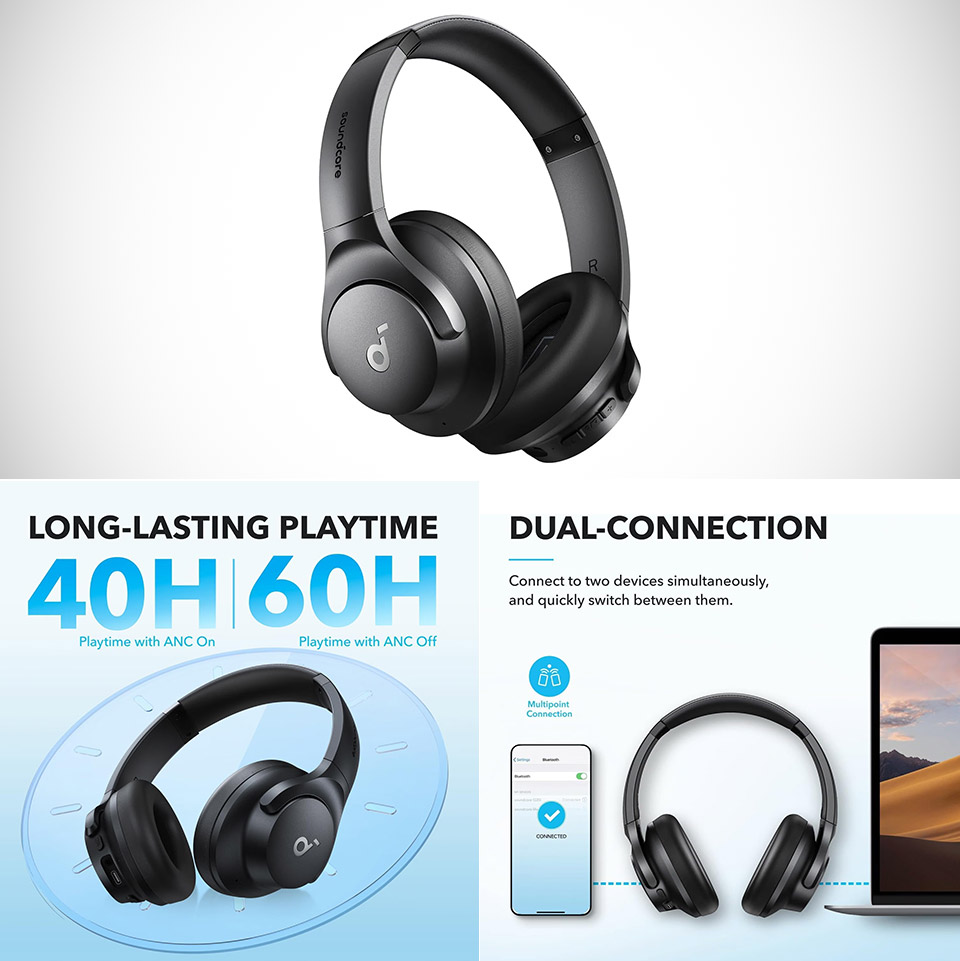
Anker still sells the Soundcore Q20i as a $70 pair that regularly lands closer to $40, and that number explains why these over-ears keep showing up in carry-ons years after their original launch. Hybrid cancellation, a 40-hour ANC claim, memory-foam cups, and a fold-flat frame sit in a package light enough that you forget them until the cabin drone disappears. For commuters and travelers who want silence more than a flagship badge, that combination has been hard to ignore.
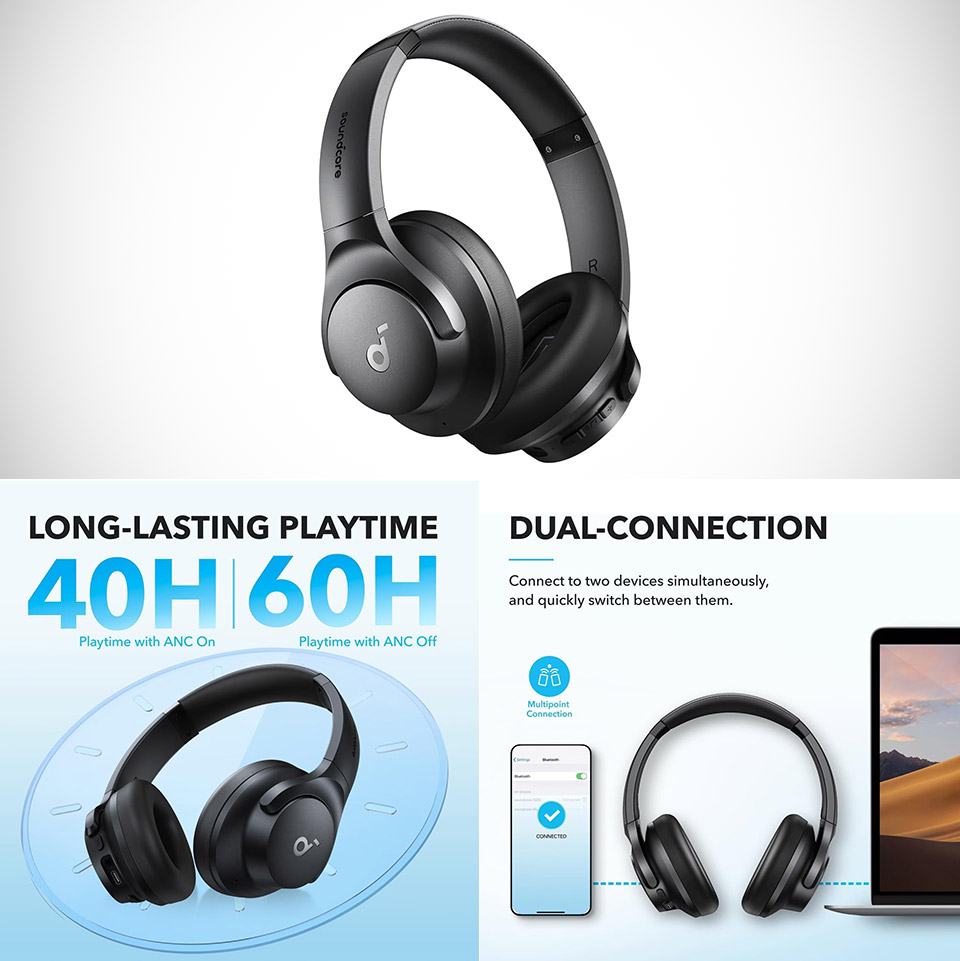
Anker’s headphones excel in hybrid cancelation, which uses four microphones, two pointing out and two pointing in, to eliminate rumble before it reaches your ear. The technology appears to be able to reduce low-frequency noise by 90 percent, including airline engines, bus motors, and workplace air conditioning. That is sufficient to effectively eliminate noisy cabins, subway chatter, and workplace fans without making you feel as if your ears are shut off in a more expensive set, although some loud speech and sudden noises still pass through.
Hybrid Active Noise Cancelling: 2 internal and 2 external mics work in tandem to detect external noise and effectively reduce up to 90% of it, no…
Immerse Yourself in Detailed Audio: The noise cancelling headphones have oversized 40mm dynamic drivers that produce detailed sound and thumping beats…
40-Hour Long Battery Life and Fast Charging: With 40 hours of battery life with ANC on and 60 hours in normal mode, you can commute in peace with your…
Memory foam pads and soft leather on the outside make wearing these for long periods of time much easier than you may expect, especially for the price. The weight of 246 grams allows you to wear them for up to eight hours without developing hot spots. However, if you have large ears, the ear apertures are a little narrow, and the cup’s light hold means it can fall off if you gaze down too quickly. However, the cups fold up flat, making them ideal for storing in a backpack or the supplied case. The plastic headband and hinge are quite fragile, but they should be durable enough to withstand daily use.
Advertisement
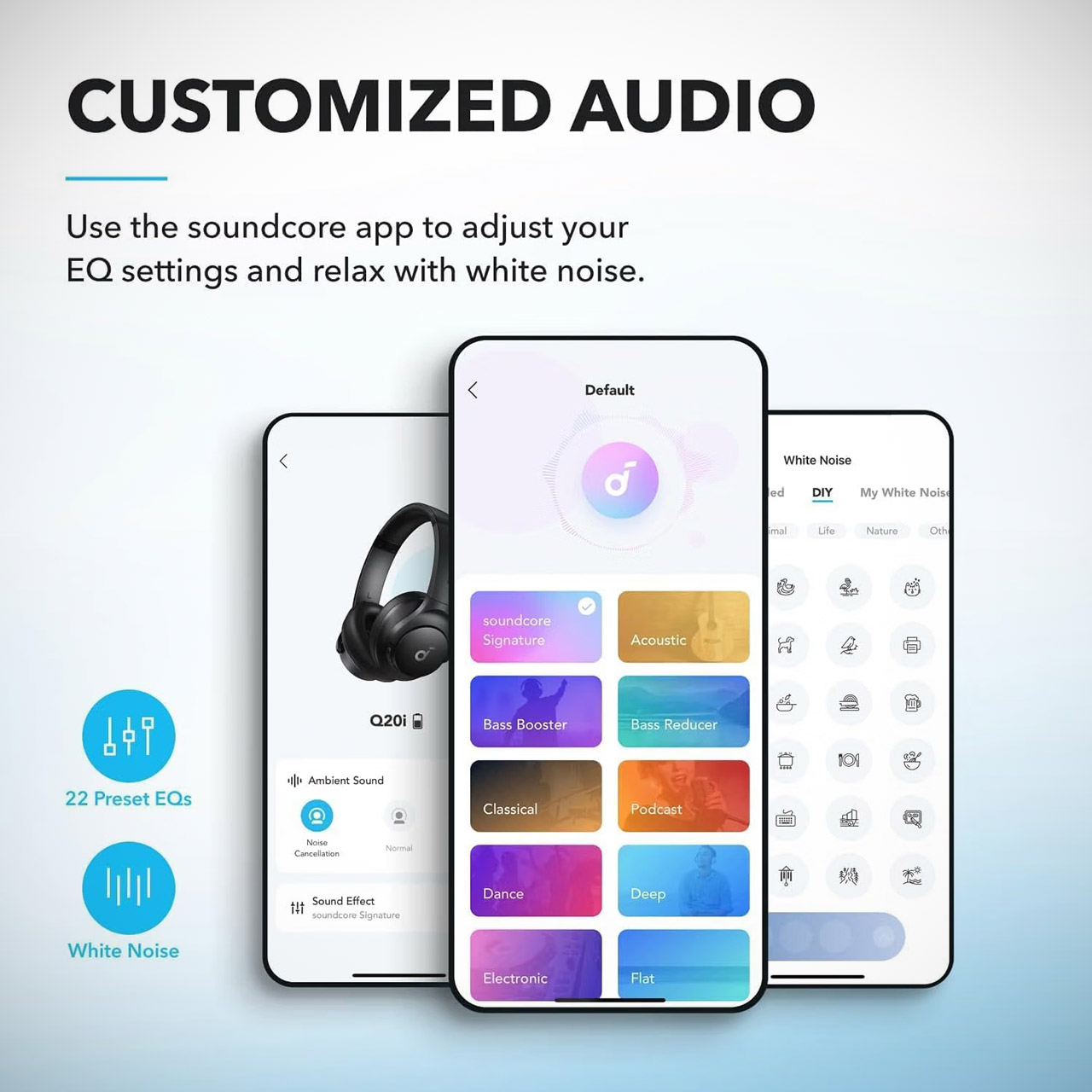
The 40mm drivers and BassUp tech give the default sound a pretty heavy low end, which is great for hip hop, EDM, and modern pop, as the bass thumps along nicely and goes deep, but the mids get lost in the mix, so vocals and instruments can sound muddled, and the treble can get a little too sharp at times. Soundcore’s app has 22 pre-sets to choose from, as well as a custom equalizer, which can help to draw some of that bass back, even if the underlying V-shape in the sound remains. Wireless audio is via Bluetooth 5.0, although it only supports SBC and AAC; nevertheless, when you plug in the provided 3.5mm connection, it begins to refer to itself as Hi-Res. It also supports multipoint pairing, allowing you to connect it to both your phone and laptop at the same time, and it will instantly switch to the new device when it begins playing.
The battery life is what everyone is talking about, since Anker claims 40 hours with cancelation on and 60 with it off, but most users tend to get about the mid-to-high 30s with ANC on and around 49 hours in mixed use, which is still enough for a long weekend. A 5-minute top-up provides around four hours of playing, while a full charge takes an hour and a half to two hours. One thing to keep in mind if you’re using a wire: plugging in the 3.5mm cable usually turns off active noise cancelation, so you’re back to just music without the quiet.
Call quality is rather straightforward: its single microphone performs admirably in calmer areas but struggles in busy cafés or on public transportation, where background noise is amplified. All app functionality, including firmware updates, white noise tracks, and mode switching, is available via the Soundcore app for iOS and Android.
Seattle’s foundation as a hub of technology, science and innovation runs deep. Its confidence should, too. (GeekWire Photo / Kevin Lisota)
[Editor’s Note: Jacob Colker is co-founder and co-managing director of AI House.]
Seattle is one of the most talented, creative and inventive places in the world. But if we want the rest of the country to see us that way, we have to start acting like we believe it ourselves.
First, we need more pride around here.
Let’s talk about what it means to be proud.
My mother grew up in Tarnów, Poland. She escaped communism and came to the United States in 1978 looking for a better life. She found one, built a family, and has lived in America for nearly 50 years.
But my mom is still very, very Polish.
Advertisement
Several times a year, I get a message: “Jakub. Did you see this?”
I already know what’s coming.
Some Polish person did something. A Polish athlete won something. A Polish scientist discovered something. Some guy with a Polish grandmother finished third in a regional Nebraska chess tournament. Doesn’t matter. Poland.
“Jakub. Look at this person.”
Advertisement
Okay, Mom. Who is she?
“POLISH.”
That’s it. That’s the story.
And I love it, because Mom has this completely indestructible pride in where she comes from. Plenty of us know someone like this: a Greek mom, Vietnamese dad, Indian uncle or Nigerian aunt. Somebody from their corner of the world did something great, and you are going to hear about it.
Advertisement
There is power in that instinct. Not because your people are better, but because you believe your place matters.
Seattle could use more of that.
We are almost pathologically humble. Our response to notable achievements is often a polite nod before everybody gets back to our regularly scheduled Seattle freeze.
That humility is working against us.
Advertisement
Second, Seattle isawesomeand the evidence is everywhere.
I see Seattle’s potential every day working alongside dozens of entrepreneurs building startups. Some of the most ambitious and talented people in the world are already here.
We have many billion-dollar startups across the region and more than 200,000 people working across technology, science, space, health and startups. That is more than enough talent to build yet a dozen more unicorns.
Nearly 40% of the world flies every day on airplanes built here. Blue Origin and SpaceX build rockets here. Starbucks, Amazon, Costco, REI and Nordstrom reshaped how the world shops. Microsoft helped put computing into our homes. AWS and Azure helped make the cloud the infrastructure of modern life. The University of Washington ranks among the world’s best. Seattle medical breakthroughs have helped save tens of millions of lives. We are pushing forward fusion energy, aerospace and maritime innovation. And let’s not forget: we just won the darn Super Bowl.
And so, so much more.
Advertisement
So why, despite all the evidence, do we still seem to have a communal case of imposter syndrome?
This is not a city lacking accomplishments.
It is a city with a branding problem.
Third, we have let other people tell our story for far too long. This ends, today.
Cities have brands whether they intend to or not. Silicon Valley is where ambitious people build companies. Nashville is music. Los Angeles for film and television.
Advertisement
Seattle’s cultural humility mostly assumes our accomplishments speak for themselves.
They don’t.
Reputation gets built one story at a time. You hear one story and it is interesting. You hear 10 and you notice a pattern. You hear 50 and your beliefs begin to change: That’s where important science happens. That’s where talented people live. That’s where I should invest, build or work.
Those beliefs shape real decisions about where people move, where companies get built and where investors put their money.
Advertisement
So to fix Seattle’s branding problem, here’s what we need to do.
Step 1: Let’s tell one clear story — Seattle’s talent pool is ridiculous.
Seattle is where deep technical talent meets deep domain expertise to build consequential things: AI, aerospace, cloud computing, medicine, fusion, robotics, maritime technology and enterprise software.
We do not need 50 slogans. We do not need another consultant-led branding exercise. We need one simple idea that people outside this region can remember: Seattle’s talent pool is ridiculous.
There is a reason some of the world’s most important companies have built major engineering centers, research hubs and second headquarters here for decades. They come for the talent.
Advertisement
And that talent is why Seattle will not just participate in the future. We will lead in building it.
Step 2: Let’s use the megaphones we already have.
Seattle already has outlets (including this one) telling this story — publications, podcasts and social channels that document the region’s startups, breakthroughs and product launches.
Every day, startups are raising money, scientists are making breakthroughs, companies are launching products, engineers are building technology and institutions are pushing this region forward.
That is not just tech news. That is the raw material of Seattle’s reputation. So let’s use it.
When you read or hear about a Seattle startup doing something remarkable, share it. When you see a story about a breakthrough at Fred Hutch or the University of Washington, send it to someone outside the region. When a local company raises money, lands a major customer or gets acquired, don’t just scroll past it. Amplify it.
Step 3: Let’s treat every local win as Seattle’s win.
Advertisement
When a local robotics company ships something remarkable, that is Seattle’s story.
When a maritime startup reinvents how ports operate, that is Seattle’s story.
When our AI research labs, or hometown heroes in Amazon and Microsoft, create breakthroughs, that is Seattle’s story.
When a biotech company lands a major breakthrough, when a game studio creates a global hit, when a clean-energy company reaches a milestone, that is Seattle’s story.
Advertisement
Our companies, universities, hospitals, labs, investors, civic organizations and business leaders should act like an amplification network for one another. Stop treating somebody else’s success as somebody else’s news.
Their win is our collective proof.
Step 4: Let’s put Seattle on the label.
Founders need to say where they are building. “Made with ❤️in Seattle” should be on the bottom of every website. Put Seattle in the press release. Put it in the LinkedIn post. Mention it onstage. Say it in interviews. Tell investors. Tell customers.
Advertisement
Silicon Valley companies have spent decades attaching their success to their geography. We should do the same. If you build something extraordinary here, make sure the world knows it was built here.
Step 5: Let’s do a better job of selling Seattle.
Every venture capitalist, founder, executive and civic leader in this region should be able to explain in 60 seconds why somebody should build a company here.
Not defend Seattle. Not apologize for Seattle. Sell Seattle.
Advertisement
Reminder: It’s the talent.
(And also cream cheese on hot dogs.)
When investors and founders from New York, Boston or San Francisco come to town, show them the region. Introduce them to engineers, researchers and entrepreneurs. Bring them into the community. Let them see what is happening.
The best branding campaign is somebody getting on a plane home saying, I had no idea all of this was happening in Seattle.
Advertisement
If we’re going to succeed, we need tobelievefirst.
Insert all the Ted Lasso jokes you want, but this stuff matters.
There is no giant Seattle marketing department coming to save us. There is no national referee who will eventually review the evidence and declare that Seattle deserves more respect.
When somebody here does something extraordinary, act like it. Read the story. Share the post. Send the article to your team. Text it to your friend in New York. Put it in the group chat. Bring it up over dinner. Tell your kids.
Basically, become my Polish mother.
Advertisement
My mom doesn’t give a hoot that Kraków ranks No. 6 on some list or Warsaw is No. 8 on another. She doesn’t need a clickbait listicle to tell her Poland matters. She already believes it does.
We have to build our reputation ourselves. The good news is that we already have everything we need: extraordinary companies, world-class institutions, ambitious people, groundbreaking science and media documenting it all.
What we have been missing is the confidence to start being more loud. Stories become patterns, patterns become reputation, and reputation becomes gravity.
Gravity is what creates influence and respect.
Advertisement
Pride is not something somebody else gives you. You don’t wait until the rest of the country decides your home is important. YOU decide it is. Then you act like it.
Meta is putting out yet another bad-publicity fire, saying it has fixed an issue in which its Meta AI software could suggest prompts to users that would collect and reveal personal information, including about children.
The controversy started from a Sept. 2 Instagram video posted by parenting and lifestyle blogger Kalie Robins, who goes by kontheinside. In the video, Robins discussed a prior video post of herself singing in a car with her daughter in the backseat. Below the published video, Robins revealed how Meta AI posed a series of invasive prompts, such as “Who’s the child passenger?” and “Where does Kalie Robins live?”
According to Robins, when she clicked on those automatic questions, the AI tool pulled information from her past posts, piecing together private details about her life, including her location. The AI also drew on other profiles, such as her mother’s account, and even accessed data from a photo she claimed had been deleted years ago.
Robins said in the video: “I did not understand posting separate innocent pieces of our lives over years could mean an AI could sit there and assemble all those breadcrumbs into information about my minor children in seconds.” The video went viral, drawing thousands of comments and more than 308,000 likes as of this writing.
Advertisement
‘The issue was never just one photo’
A Meta spokesperson told CNET in an email that it has since “fixed” the issue, and that Meta AI will no longer suggest inappropriate, personal questions on users’ posts. The company admitted the feature missed the mark and stated that the tool is only meant to help people find more information using data users already have access to.
CNET
The response from Meta, which was also shared with other outlets, wasn’t sufficient for Robins. In a subsequent Instagram post on Sept. 10, she said she was glad that the company acknowledged the problem, but that she still had questions. “What exactly was fixed? What safeguard failed in the first place? And what protections are now in place when Meta AI encounters information involving a child?”
Even if Meta AI no longer suggests intrusive personal prompts, the feature can still make suggestions based on information the software can access, such as publicly available text, images from the web or previous posts on social media by users like Robins.
Meta also denied Robins’ claim that its AI accessed a photo deleted years ago. Instead, Meta told CNET that the photo of Robins’ kids was deleted right before the video was made, and a temporary bug briefly kept it visible.
In an email to CNET, Robins said that regardless of what happened with the deleted image of her kids, the larger concern remains. “The issue was never just one photo — it was the AI compiling information about my kids from multiple sources,” Robins told CNET. According to Robins, Meta has not contacted her directly or apologized.
Advertisement
Just the latest Meta privacy problem
Adding to the hundreds of comments posted on Robins’ Instagram account have been news stories on sites like Futurism, where the story was first widely publicized. Business Insider reported that what happened to Robins is prompting some parents to urge others to stop posting images of their kids online.
“This is creepy!” said Cathy Pedrayes, who posts frequently on social media about scams and dark-web trends.
Meta has faced multibillion-dollar settlements and court judgments this year over how its technology affects children, including addiction and creating environments where they may be vulnerable to exploitation.
Meta has also been facing criticism of its Meta smart glasses, particularly the facial recognition technology it has been developing.
Advertisement
Recently, the tech giant started rolling out its Muse AI agents, which it markets to users seeking more customized AI experiences through personal assistants.
Omar Gallaga has covered technology, digital culture and other topics for outlets including CNET, NPR, WIRED, Texas Monthly, MSNBC, Consumer Reports, The Washington Post, the Los Angeles Times, The Atlantic and the Austin American-Statesman, where he was a longtime tech reporter, editor and podcaster. He lives in the Texas Hill Country.
See full bio





















































You must be logged in to post a comment Login