Connect with us
DAPA Banner

Tech

Crypto Billionaire Pardoned In Prison By Trump Just Wrote a Memoir

Published

on

Forbes estimates he’s worth roughly $110 billion, “placing him ahead of Bill Gates.”

And now Changpeng Zhao, the 49-year-old billionaire founder of Binance, “has written a memoir…”


It arrives with the unmistakable timing of a man determined to tell the world his version of his meteoric crypto rise and fall, and foreshadow his comeback. The book, Freedom of Money: A Memoir of Protecting Users, Resilience, and the Founding of Binance, runs 364 pages, self-published in English and Chinese…. Zhao also recounts Binance’s long battle with U.S. regulators, the company’s record $4.3 billion settlement for fostering unscrupulous money launderers, his four-month prison sentence in California, where he says he began writing the book, and his recent pardon by President Trump…

In Zhao’s telling, the case brought by multiple U.S. agencies was less about what Binance had done than about what it had become… “It didn’t make sense to me, or any of my lawyers. Other than the fact that we were the biggest in the industry.” The U.S. government alleged something more specific: that Binance failed to implement programs to prevent or report suspicious transactions — including those tied to Hamas’s Al-Qassam Brigades, Al Qaeda, and ISIS — while also processing trades between U.S. users and those in sanctioned jurisdictions like Iran, North Korea, and Syria. In total, regulators alleged the exchange willfully failed to report more than 100,000 suspicious transactions, including those involving terrorist organizations, ransomware attackers, child sexual exploitation material, frauds and scams… The final settlement amount — $4.3 billion, split across the Department of Justice, the Department of the Treasury’s Financial Crimes Enforcement Network, the Office of Foreign Assets Control and the U.S. Commodity Futures Trading Commission — was the largest corporate penalty in the history of nearly each agency involved. Attorney General Merrick B. Garland said at the time of the announcement: “Binance became the world’s largest cryptocurrency exchange in part because of the crimes it committed.”

Advertisement

The prison passages are among the most vivid in the book. Zhao says he was worried about extortion because the media had reported he was the richest person in U.S. prison history, but then realized no one read the WSJ or Bloomberg or recognized him. Zhao also writes about the food, the routines and the specific indignity of confinement, including sharing a cell with a man serving 30 years for killing two people… Writes Zhao of his cellmate, “Soon, I discovered that the most lethal thing about him wasn’t his murder conviction, it was his snoring. He snored more loudly than thunder strikes, the sound of which rose even above the constant toilet flushings.”
Binance at one point held a roughly 20% stake in Sam Bankman-Fried’s FTX and about $580 million in FTT tokens, the article points out. “As FTX neared collapse in late 2022, Zhao writes, Sam Bankman-Fried called to ask for a couple of billion dollars ‘nonchalantly, as if he was asking for a bologna sandwich.’

“Some believe that Binance’s brief show of interest in acquiring FTX, followed by its abrupt withdrawal from the deal, hastened FTX’s spiral into bankruptcy…”

Thanks to long-time Slashdot reader destinyland for sharing the article.

Source link

Advertisement
Continue Reading
Click to comment

You must be logged in to post a comment Login

Leave a Reply

Tech

Who Had “New OS For The Z80” On Their 2026 Bingo Card?

Published

on

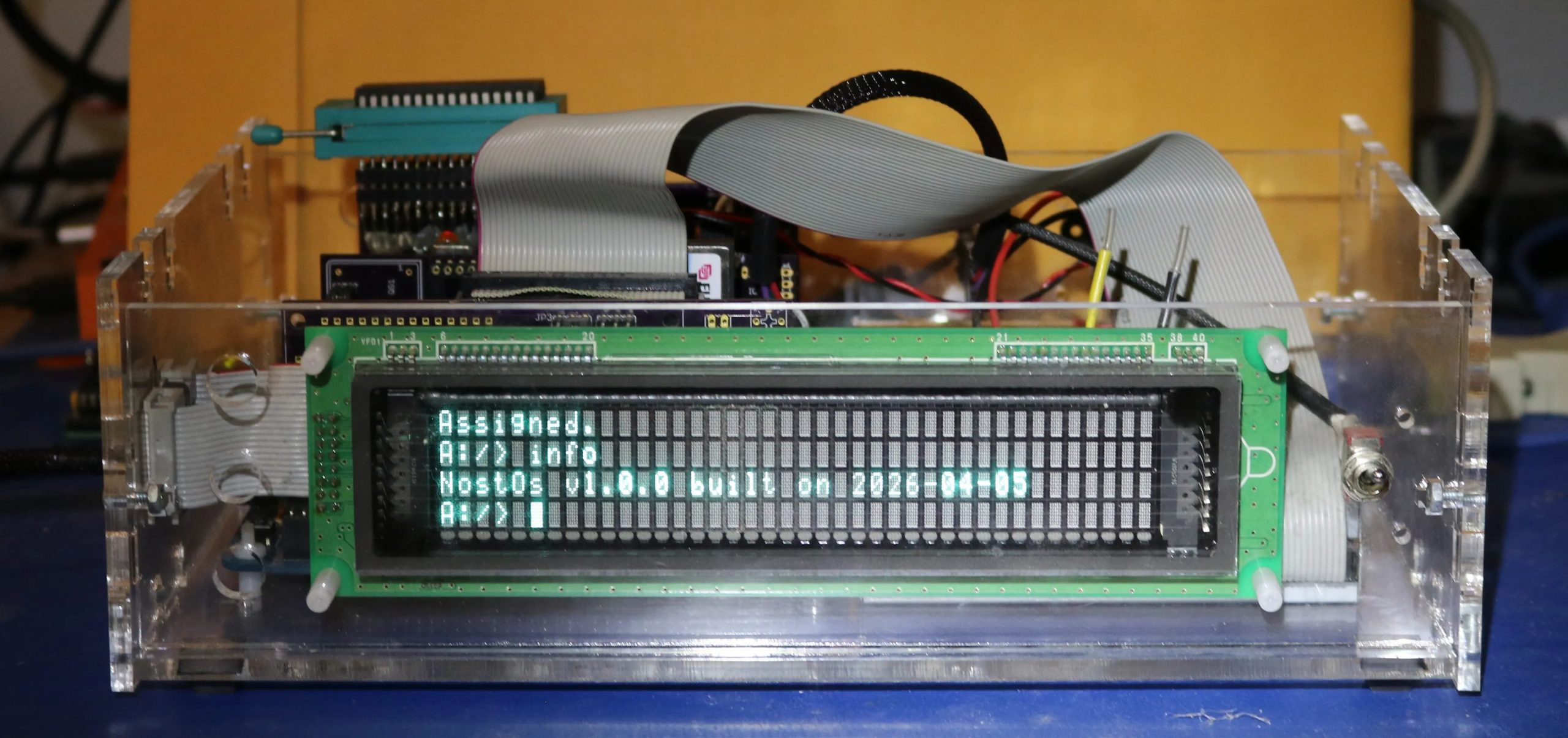
Some might say the venerable Z80 doesn’t need another operating system, but [Scott Baker] obviously disagrees. He has come up with a brand new, from scratch OS called NostOS for the Z80-based RC2014 homebrew retrocomputer. [Scott] describes it as CP/M-like, but it’s not CP/M– in fact, it’s totally incompatible with CP/M–and has a few tricks of its own up its sleeve.

As you might expect of an operating system for this vintage of hardware, it is “rommable” — that is, designed to run from read-only-memory, and fit inside 64kB. It of course supports banking memory to go higher than that 16 bit limit, and natively supports common serial devices, along with the good old WD37C65 floppy controller to get some spinning rust into the game. Of course if you don’t have floppies you can plug in a compact flash card– try that with CP/M– or, interestingly Intel Bubble Memory. [Scott] has a soft-spot for bubble memory, which at one point seemed poised to replace both hard drives and RAM at the same time. We also appreciate that he included drivers for vacuum fluorescent displays, another forgotten but very cool technology. Back in the day, this operating system would have enabled a very cool little computer, especially when you take his implementation of text-to-speech with the SP0256A-AL2 chip. Fancy a game of talking Zork? Yes, he ported Zork, and yes, it talks.

The whole thing is, of course, open-source, and available on [Scott]’s GitHub. Unlike too many open-source projects, the documentation is top-notch, to the point that we could picture getting it in a three-ring binder with a 5 1/4 floppy on the inside cover. If you like video, we’ve embedded [Scott]’s walkthrough but his blog and the docs on GitHub have everything there and more if you’re not into rapidly-flickering-pixels as an information exchange medium.

[Scott] isn’t wedded to Zilog, for the record; this OS should run on an Intel 8080, perhaps like the one in the Prompt 80 he restored last year. 

Advertisement

Thanks to [Scott Baker] for the tip!

Source link

Advertisement
Continue Reading

Tech

Trump officials may be encouraging banks to test Anthropic’s Mythos model

Published

on

Treasury Secretary Scott Bessent and Federal Reserve Chair Jerome Powell summoned bank executives for a meeting this week where they encouraged the executives to use Anthropic’s new Mythos model to detect vulnerabilities, according to Bloomberg

Indeed, while JPMorgan Chase was the only bank listed as one of the initial partner organizations with access to the model, Goldman Sachs, Citigroup, Bank of America, and Morgan Stanley are reportedly testing Mythos as well.

Anthropic announced the model this week but said it would be limiting access for now, in part because Mythos — despite not being trained specifically for cybersecurity — is too good at finding security vulnerabilities. (Others suggested this was hype or simply a smart enterprise sales strategy.)

The report is particularly surprising since Anthropic is currently battling the Trump administration in court over the Department of Defense’s designation of Anthropic as a supply-chain risk; that designation came after negotiations fell apart over the company’s efforts to limit how its AI models can be used by the government.

Advertisement

Meanwhile, the Financial Times reports that U.K. financial regulators are also discussing the risk posed by Mythos.

Source link

Continue Reading

Tech

OpenAI’s new $100 ChatGPT Pro plan targets Claude Max with five times the Codex access

Published

on

In short: OpenAI launched a new $100 per month Pro plan for ChatGPT on 9 April 2026, inserting a new tier between the existing $20 Plus plan and the $200 Pro plan and directly targeting Anthropic’s Claude Max, which is also priced at $100 per month. The new plan offers five times more Codex usage than Plus, access to the same model suite as the $200 tier, and a launch promotion that temporarily doubles that advantage: through 31 May 2026, subscribers get ten times the Codex usage of Plus. The move follows Codex crossing three million weekly users on 8 April, a growth rate the company describes as a 5x increase in three months.

What the $100 plan includes, and where it sits in ChatGPT’s pricing structure

The new plan is the sixth pricing tier in ChatGPT’s current structure, which now runs from a free account with advertising, through a $8 per month Go plan, the $20 per month Plus plan, to two versions of Pro at $100 and $200 per month, a $25 per user per month Business plan, and custom-priced Enterprise contracts. The $100 Pro plan sits directly between Plus and the existing $200 Pro tier, offering five times the Codex usage of Plus and targeting what OpenAI describes as “longer, high-effort Codex sessions” that Plus subscribers hit the ceiling on. The $200 Pro plan, by comparison, provides 20 times the Codex usage of Plus, making it four times more Codex-intensive than the new $100 tier.

Despite the difference in usage limits, both Pro tiers give access to the same model suite: the exclusive GPT-5.4 Pro model, unlimited use of GPT-5.4 Instant and GPT-5.4 Thinking, and all other features available on the $200 plan. The differentiation between the two tiers is usage volume, not capability. As a launch promotion, subscribers to the new $100 plan will receive ten times the Codex usage of Plus through 31 May 2026; after that date, the standard five times limit applies. OpenAI also announced a rebalancing of the Plus plan’s Codex allocation alongside the new tier, shifting Plus towards steadier day-to-day usage rather than allowing the longer burst sessions that the $100 plan is intended to serve.

Codex demand: the numbers that prompted the new tier

On 8 April 2026, the day before the $100 plan was announced, Sam Altman posted on X that OpenAI was resetting Codex’s usage limits across all plans “to celebrate 3M weekly codex users,” and committed to repeating the reset for every additional million users until Codex reaches ten million weekly users. Thibault Sottiaux, who leads the Codex product, stated: “Three million people are now using Codex weekly, up from two million a little under a month ago.” OpenAI described the growth trajectory as a 5x increase in the preceding three months, with 70% month-over-month user growth.

Advertisement

The 💜 of EU tech

The latest rumblings from the EU tech scene, a story from our wise ol’ founder Boris, and some questionable AI art. It’s free, every week, in your inbox. Sign up now!

The scale of that growth reflects a shift in how developers are using AI coding tools. OpenAI rolled out a dedicated Codex app for macOS in February 2026, designed to move beyond line-by-line code generation into what the company called agentic, multi-task coding workflows: orchestrating multiple agents in parallel, running background jobs, and handling instructions that span hours rather than seconds. That architecture, with its longer-running sessions and heavier compute demands, is precisely the usage pattern that the $100 plan is priced to capture. A Plus subscriber who uses Codex for extended autonomous engineering tasks hits usage limits well before their billing cycle ends; the $100 plan is designed to be the next logical tier rather than a jump to $200.

The Claude Max comparison

OpenAI made no attempt to obscure the competitive framing. The new plan is priced identically to Anthropic’s Claude Max 5x tier, which also costs $100 per month and includes elevated limits for Claude Code, Anthropic’s terminal-based agentic coding product. Claude Code has become the fastest-growing part of Anthropic’s commercial portfolio, with an estimated $2.5 billion in annualised revenue by early 2026, and Anthropic has been constructing a developer ecosystem around it: Anthropic launched a marketplace for Claude-powered enterprise software in March 2026, with launch partners including Snowflake, Harvey, and Replit, connecting enterprise buyers with third-party applications built on Claude.

Advertisement

The competitive dynamic sharpened further in the week before OpenAI’s announcement. On 4 April 2026, Anthropic banned third-party agents from Claude Pro and Max subscriptions, preventing subscribers from routing their plan’s usage limits through external frameworks such as OpenClaw; users wanting to continue using those tools must now pay separately under a new per-session “extra usage” system. OpenAI’s announcement went in the opposite direction, increasing Codex availability at the $100 price point and doubling it temporarily to mark the launch. The contrast, at the identical price, was visible enough that most coverage described the new plan as a direct response to Anthropic’s developer subscriber base.

What OpenAI’s pricing move signals

The new tier arrives during a period of accelerating commercial momentum for OpenAI. OpenAI’s $122 billion raise at an $852 billion valuation, completed in March 2026, was led by SoftBank, NVIDIA, and Amazon, and included $3 billion from individual retail investors, a structure that many analysts read as groundwork for an IPO expected as early as the fourth quarter of 2026. The company is generating $2 billion in revenue per month and has more than 50 million paid subscribers across its plans. The $100 plan is part of a deliberate effort to fill the pricing gap between $20 and $200 that had, until now, left a large segment of heavy but not enterprise-grade users without a compelling upgrade path.

The model powering the Pro tiers, GPT-5.4, which launched in March 2026 and introduced native computer use directly into Codex and the API, is the clearest statement of where OpenAI sees the next phase of developer adoption going: not prompting, but autonomous agents operating software, navigating file systems, and running multi-step workflows across applications for hours at a time. The $100 plan is the pricing expression of that bet. Whether it moves enough developers at the $100 Claude Max price point to make a measurable difference in Anthropic’s subscriber base will be visible in both companies’ next quarterly metrics.

Advertisement

Source link

Continue Reading

Tech

‘Marshals’ Release Schedule: When Episode 7 Hits Paramount Plus

Published

on

Marshals, a new Yellowstone spinoff starring Luke Grimes as Kayce Dutton, is airing on CBS right now. You can also tune in with Paramount Plus. The Yellowstone sequel series sees Grimes’ former Navy SEAL join an elite unit of US Marshals to bring range justice to Montana, according to a synopsis from CBS.

The show includes Yellowstone actors Gil Birmingham as Thomas Rainwater, Mo Brings Plenty as Mo and Brecken Merrill as Tate. Spencer Hudnut is the showrunner of Marshals — formerly known as Y: Marshals — and Taylor Sheridan is an executive producer.

Advertisement

When to watch new Marshals episodes on Paramount Plus

Episode 7 of Marshals airs on CBS on Sunday, April 12. Viewing options for Paramount Plus customers vary by subscription tier. You can watch the episode live if you have Paramount Plus Premium, which includes your local CBS station. If you subscribe to Paramount Plus Essential, you can watch the installment on demand the following Monday, but not live on Sunday.

Here’s a release schedule for the next two episodes of Marshals.

  • Episode 7, Family Business: Premieres on CBS/Paramount Plus Premium on April 12 at 8 p.m. ET/8 p.m. PT/7 p.m. CT. Streams on Paramount Plus Essential on April 13.
  • Episode 8, Blowback: Premieres on CBS/Paramount Plus Premium on April 19 at 8 p.m. ET/8 p.m. PT/7 p.m. CT. Streams on Paramount Plus Essential on April 20.

You can also watch CBS and the seventh episode of Marshals without cable with a live TV streaming service such as YouTube TV, Hulu Plus Live TV or the DirecTV MyNews skinny bundle. In addition to offering a lower-cost option, Paramount Plus lets you watch the other two Yellowstone spinoffs: the prequels 1883 and 1923.

Advertisement

James Martin/CNET

After a price increase in early 2026, the ad-supported Essential version runs $9 per month or $90 per year. The ad-free Premium version runs $14 per month or $140 per year. Paying more for Premium gives you downloads, the ability to watch more Showtime programming than Essential and access to your live, local CBS station.

Source link

Advertisement
Continue Reading

Tech

Sunday Reboot: MacBook Neo upgrades, masses of Mac minis, and iPhone re-entry

Published

on

In this week’s “Sunday Reboot,” a storage upgrade for the MacBook Neo, an excuse to buy many Mac minis, and the iPhones come back to Earth with a late congratulatory message.

Silhouetted person in shadow peers through a narrow opening toward a brightly lit wall of stacked silver computer mini desktops with ports and indicator lights
Image credits: NASA/Overcast

Sunday Reboot is a weekly column covering some of the lighter stories within the Apple reality distortion field from the past seven days. All to get the next week underway with a good first step.
This week, researchers managed to get around Apple Intelligence security measures using prompt injection techniques, a repairability report panned Apple’s hardware again, and Apple’s lawsuit with Epic Games over the App Store continued to roll on. There was also a bug found to break Mac networking every 49 days, 17 hours, two minutes, and 47 seconds.
Continue Reading on AppleInsider | Discuss on our Forums

Source link

Continue Reading

Tech

Tesla Achieves European Breakthrough as Full Self-Driving Supervised Reaches Dutch Roads

Published

on

Tesla FSD Europe Netherlands Launch Test Drive
Tesla finally received approval on April 10 from the Dutch vehicle regulator, the RDW, for its Full Self-Driving Supervised system to be used on European roads. They were the first to receive approval for this advanced technology across Europe, marking a significant milestone for the company. This means that the program has been cleared to run on public roads in the Netherlands, and the distribution began the next day, April 11, for a limited number of early testers who had been patiently waiting.


Drivers with Hardware 4 (HW4) computers in their vehicles received an upgrade to version 2026.3.6, which included the European-tuned build of FSD 14.2.2.5. Before turning on the system, drivers must complete a fast tutorial followed by a mini test within the car interface. Once that’s done, they can take their hands off the wheel under appropriate situations, and cameras will watch their eyes to see if they’re paying attention. If they become distracted, the system will begin to display visual alarms, followed by sounds and vibrations if they do not return to it, and if all else fails, the car will slow down and come to a safe stop on its own.


LEGO Icons Ford Model T Building Set for Adults – Collectible Kit with Detailed Features for Bedroom…
  • COLLECTIBLE MODEL CAR KIT – Embark on a nostalgic journey with the LEGO Icons Ford Model T (11376) building set for adults ages 18 and up
  • VINTAGE CAR DISPLAY PIECE – Recreate the iconic 1910s automobile with gleaming black bodywork, golden accents, a foldback fabric roof and tall…
  • AUTHENTIC MODEL T FUNCTIONS – Fold back the model car’s roof, fold down the split windshield, lift the hood from both sides to see the engine, turn…

Overall, this was the product of 18 months of testing, which included more than 1.5 million kilometers of driving on European highways, as well as numerous controlled scenarios on closed tracks. Before approving the system, regulators reviewed almost 400 compliance points. The RDW pronounced it a beneficial addition to road safety, but stressed that drivers must remain in the driver’s seat and ready to take over at any time.


The European version of the software is substantially different from the one accessible in the United States. This is primarily due to the way regulators work here, which requires them to do pre-market checks, as opposed to their US counterparts’ self-certification strategy. As a result, the Dutch construction is more cautious and limits some of the more aggressive driving characteristics available elsewhere. Automatic turns at junctions and navigation-based lane changes are still accessible, but several parking-lot summoning capabilities found in the United States are not available in the Netherlands.

Advertisement


Subscribers will pay 99 euros per month to receive the system, or 49 euros per month if they already have Enhanced Autopilot. Alternatively, they can purchase it outright for 7,500 euros. Tesla claims that the system leverages billions of kilometers of real-world data collected worldwide, and Elon Musk has just stated that the RDW review process was particularly rigorous.

Tesla FSD Europe Netherlands Launch Test Drive
The Dutch approval is now a one-time occurrence, although it has a provisional validity period of at least 36 months. It means that other European states can adopt it on their own, and authorities in Germany, France, and Italy are expected to do so within the next 4 to 8 weeks. Tesla’s goal is to have the system more widely accepted across the EU by the summer, allowing millions of drivers to use it without having to repeat the testing procedure in each nation.
[Source]

Source link

Advertisement
Continue Reading

Tech

Apple reportedly testing out four different styles for its smart glasses that will rival Meta Ray-Bans

Published

on

Apple may be late to the smart glasses market, but it could be covering all its bases with up to four potential styles for its upcoming product. According to Bloomberg‘s Mark Gurman, Apple could launch some or all of the four styles it’s currently testing for its smart glasses.

Gurman reported Apple is testing out a large rectangular frame that’s comparable to Ray-Ban Wayfarers, a slimmer rectangular design like the glasses that Apple CEO Tim Cook wears, a larger oval or circular frame and a smaller oval or circle option. Apple is also working on a range of colors, including black, ocean blue and light brown, according to Bloomberg.

Internally code-named N50 for now, Apple’s upcoming smart glasses will compete directly with the second-gen Ray-Ban Meta model. While similar, Apple might be differentiating its design with “vertically oriented oval lenses with surrounding lights,” according to the report. Like Meta’s smart glasses, Apple’s upcoming product will capture photos and videos, but is meant to better sync with an iPhone, allowing users to take advantage of Apple’s ecosystem for editing, sharing, phone calls, notifications, music and even its voice assistant, according to Gurman. The release of Apple’s smart glasses could even coincide with the upcoming improved Siri that should arrive with iOS 27.

Gurman reported that Apple could reveal its smart glasses as soon as the end of 2026 or early 2027, followed by an official release sometime in 2027. As for the competition, Meta released its latest model that’s better suited for prescription lenses and offers a more customizable fit.

Advertisement

Source link

Continue Reading

Tech

The MacBook Neo is moonlighting as a Windows gaming machine, and it’s doing it well

Published

on

Apple didn’t position its most affordable MacBook as a gaming machine. The MacBook Neo, a budget-leaning laptop that runs on Apple’s A18 Pro chip, the same chip that powers the iPhone 16 Pro models, has been put through a Windows 11 gaming test for YouTuber ETA Prime. 

Turns out, the results are genuinely surprising. Using Parallels Desktop, a virtualization app (paid) with 3D hardware acceleration, the channel ran Windows 11 ARM directly on the Neo’s 8GB RAM (allocating 5GB to the virtual environment), and it did better than most people would think it would. 

What games actually ran well?

Dirt 3 held 75 fps at 1200p on high settings, while Portal 2 cleared 100 fps on medium settings. Skyrim, on the other hand, maintained roughly 60 fps at 1200p resolution on medium graphics settings, while Marvel Cosmic Invasion averaged around 60 fps at the maximum resolution.

Advertisement

What helped performance was games running as native Windows-on-ARM applications. However, GTA V was among the notable stumbles, as the frame rates through the Parelles weren’t playable at all. However, according to Notebookcheck, the game runs acceptably via Crossover. 

Why does this matter for everyday MacBook Neo users?

For users who work on their Mac but occasionally enjoy playing Windows-only games, MacBook Neo’s ability to run native titles via the Parallels app comes as good news. The cost? Parallels Desktop’s Standard tier costs $99.99 per year, which could add to your weekend leisure sessions. 

Anyways, the bigger takeaway is that the MacBook Neo, even with 8GB of RAM (highlighted as a constraint in the video), can run low-to-mid-range Windows games. It also changes the notion around budget Apple hardware being primarily for productivity-based tasks. 

As virtualization tech continues to improve and Apple provides more RAM in future generations of the MacBook Neo, it could redefine what “budget” actually means for Apple buyers, bridging the gap between MacBook and Windows laptops even further. 

Advertisement

Source link

Continue Reading

Tech

How the Budget-Friendly BougeRV 23-Quart 12V Fridge Keeps Food Fresh Through Every Drive

Published

on

BougeRV 23 Quart 12V Portable Fridge Car
Summer heat makes any travel difficult, especially if you’re transporting groceries and / or cold drinks. Drivers are frequently forced to rely on old, simple coolers with ice that melts faster than a popsicle on a hot day, leaving everything wet by the time they reach. That’s where the BougeRV 23-quart unit, priced at $159.97 (was $189.99), comes in, a more practical solution that plugs directly into your car’s normal 12V socket and keeps items perfectly chilled without any of the fuss.


The unit is 22 inches long and weighs just more than 21 pounds, so it can fit into even the smallest trunks or backseats. It also has a built-in handle, making it simple to pull out at a rest break or transport home after a long shopping excursion. Inside, there’s enough space for a couple days’ worth of food or a full load of drinks and snacks for a family road trip.

Sale


BougeRV 12 Volt Refrigerator 12V Car Fridge 23 Quart Portable Freezer Compressor Cooler 12/24V DC…
  • What You Get: The CR22 12V refrigerator comes with a 2-year Tech Support. If you have any questions about the product, please REACH OUT TO BougeRV, as…
  • Fast Cooling Down to 32℉: With Compressor refrigeration technology, this 12v car refrigerator could achieve 15 min fast cooling from 77℉ to…
  • 45W Low Power Consumption: With ECO energy saving mode, this 23 Qt portable refrigerator’s operating power is less than 36W. Even running on MAX…


It’s powered by a 12-volt socket, which is found in practically every modern automobile, and there are alternatives for residential outlets or even solar power if you are parked for an extended period of time. The compressor system kicks in quickly, about 15 minutes, and maintains a consistent temperature between 8 degrees below zero and 50 degrees Fahrenheit, allowing you to choose between fridge and freezer mode as needed.

Advertisement

BougeRV 23 Quart 12V Portable Fridge Car
The portable fridge uses very little energy (around 36 watts in environment mode), and the smart cycling keeps your daily power consumption under one kilowatt-hour even on the warmest days. To be on the safe side, there’s a built-in battery monitor that will turn it off before it consumes your vehicle’s battery, so you don’t have to worry about that.

BougeRV 23 Quart 12V Portable Fridge Car
People who have used it on road trips note that it works effectively, keeping perishables from spoiling without having to constantly add ice, and it absorbs bumps in the road well, even while traveling at a 30-degree angle. If you’re only running to the store for a quick shopping trip, the fridge will keep running until you return home, even if you get stopped in traffic.

Source link

Continue Reading

Tech

New FCC router rules could trap millions using outdated ISP hardware as supply chain limits stall upgrades and complicate security fixes

Published

on


  • FCC rules block new foreign routers while old, vulnerable ones stay in homes longer
  • ISP customers cannot upgrade routers even when security risks become widely known
  • Router approvals now depend on waivers that may slow down nationwide replacements

The Federal Communications Commission (FCC) has issued new rules intended to address security risks posed by routers produced outside the United States.

A number of recent incidents have shown foreign routers are vulnerable to cyberattacks, with campaigns like Flax, Volt, and Salt Typhoon making headlines across the world.

Source link

Continue Reading

Trending

Copyright © 2025