
TL;DR
TikTok is evolving into a super app with shopping, hotel booking, fintech, sports hubs, and microdramas beyond its video roots.



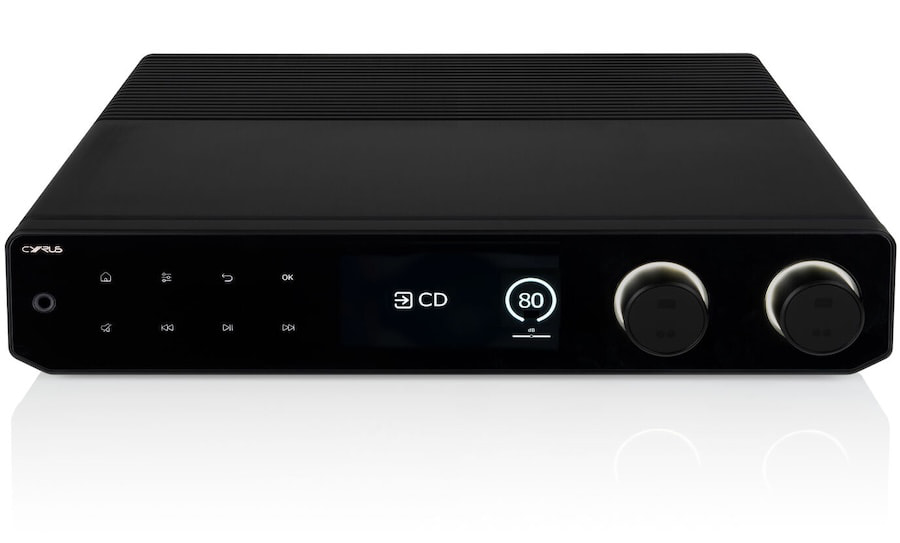
Cyrus Audio will give visitors their first public opportunity to hear its forthcoming 80 PRE streaming preamplifier and 80 PWR power amplifier together at the North West Audio Show 2026. The pair will be demonstrated ahead of its official launch in the Doug Brady HiFi room at De Vere Cranage Estate in Cheshire on June 27 and 28.
Cyrus has spent more than four decades building its reputation around compact half width components, so the 80 Series is not a subtle change of direction. It is the company’s first full width range, aimed at listeners who want the convenience of BluOS streaming, HDMI eARC, vinyl playback, balanced connections, and real Class A/B power without assembling a rack full of unrelated boxes. Cyrus first unveiled the 80 Series during High End Munich 2025, showing the new full-width components at Motorworld Munich.
Cyrus has never quite received the attention it deserves from North American listeners. That is not because the Cambridgeshire manufacturer lacks engineering chops or musical credibility. eCoustics has spent the past several years covering and reviewing Cyrus components, including the One HD, i7-XR, CDi-XR, 40 Series, and now the 80 Series, and the pattern has been rather consistent: thoughtfully engineered products with real sonic authority, strong phono stages, and a design language that has always been more distinctive than universally embraced.
In a market where Naim, Rega, Cambridge Audio, and Linn command far more dealer-floor oxygen, Cyrus has remained something of a cult favorite. The 80 PRE and 80 PWR may finally give the brand a more obvious path into larger North American systems and conversations.
Related Reviews:
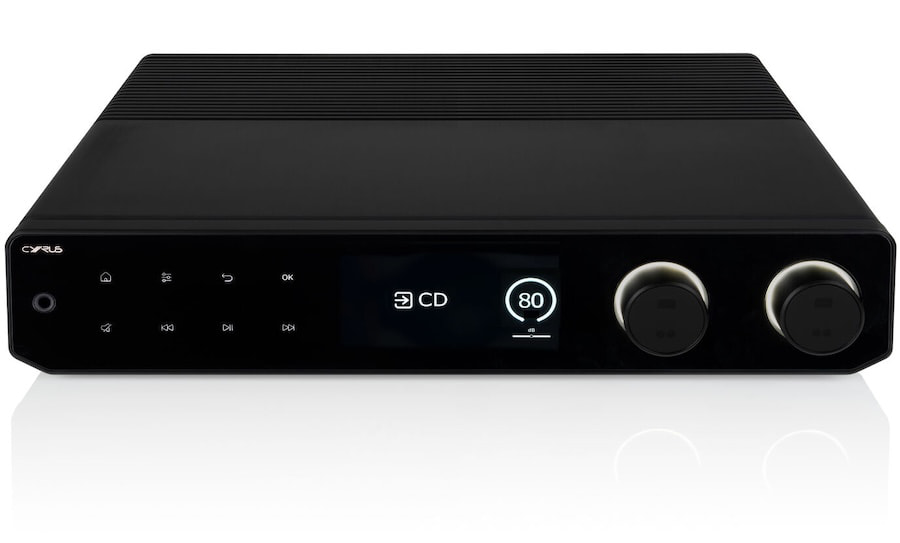
The 80 PRE is far more than a conventional line stage. Cyrus has built BluOS streaming directly into the preamplifier, along with an ESS Sabre ES9039Q2M DAC and support for lossless playback up to 24 bit/192 kHz. It is also Roon Ready, supports AirPlay 2 and MQA decoding, and uses a five inch color TFT display rather than the tiny windows and ancient button arrays that still plague more than a few upscale components.
Connectivity is properly comprehensive. The 80 PRE includes four analog inputs, MM and MC phono inputs, two optical and two coaxial digital inputs, asynchronous USB B, HDMI eARC, balanced XLR input and output, plus both standard and balanced headphone outputs. That makes it a legitimate control center for a mixed system with a turntable, television, computer, streamer, and power amplifier all under one roof.
For Cyrus, the larger chassis is the story. The company has finally given its engineers more physical space to work with, while still allowing the 80 Series to pair with its smaller 40 Series components. That means owners could use the 80 PRE with the 40 CD, 40 PPA phono stage, or TTP turntable rather than being forced into a single all or nothing ecosystem.
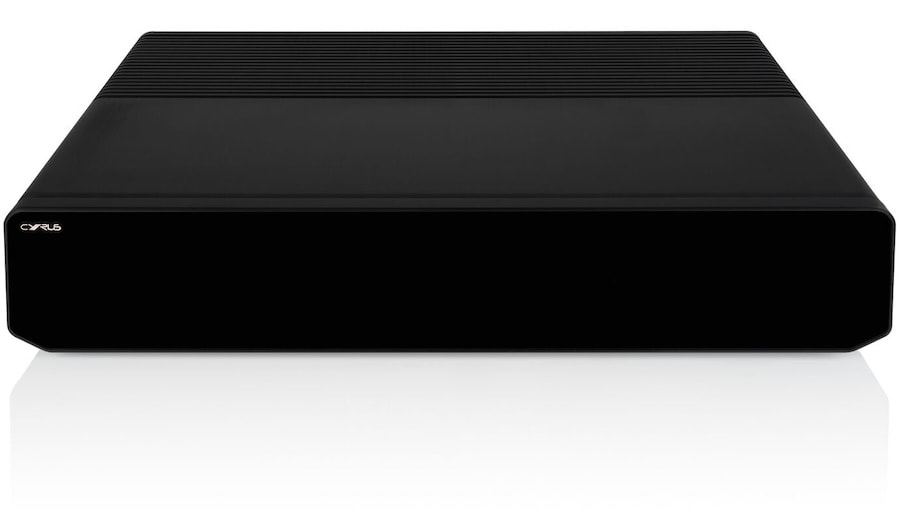
The matching 80 PWR is a Class A/B power amplifier rated at 200 watts in stereo mode and 300 watts when bridged for mono operation. It uses balanced XLR inputs and can be run as a stereo amplifier initially, with a second unit added later for a monoblock system. That is a sensible upgrade path for listeners with difficult loudspeakers or rooms that require more headroom than an integrated amplifier can comfortably provide.
Cyrus has not yet published the usual deeper measurements that serious buyers will want to see, including the impedance at which those power ratings are measured, damping factor, distortion, and dynamic output into lower loads. The published specifications confirm the basic architecture and headline power, but not the full engineering autopsy.
The 80 PRE and 80 PWR are significant because they represent Cyrus’s first serious full width separates platform, combining BluOS streaming, HDMI eARC, MM/MC phono, balanced connectivity, and Class A/B power in a system designed to grow with the owner.
What we still do not know is just as important: final pricing, release timing, 4 ohm output, distortion and damping figures, power supply details, and whether the new larger format delivers the authority Cyrus is promising. Cranage will reveal whether this is a proper Yorkshire pudding or merely a well dressed soufflé that collapses the moment the DALI speakers get demanding.
Doug Brady HiFi will demonstrate the 80 PRE and 80 PWR with the Cyrus TTP turntable, Cyrus 40 Series phono preamplifier, and DALI Epikore 3 standmount loudspeakers in the Stephenson 2 room. The setup is clearly intended to show that Cyrus sees the 40 and 80 Series as complementary rather than competing ranges.
Cyrus’s product pages currently list no pricing or formal retail date. UK retailer listings, however, show the 80 PRE at $5,995 (£4,499) and the 80 PWR at $5,295 (£3,999), with availability expected in August 2026. Those figures should be treated as dealer information until Cyrus confirms final pricing and availability market by market.
For more information: cyrusaudio.com
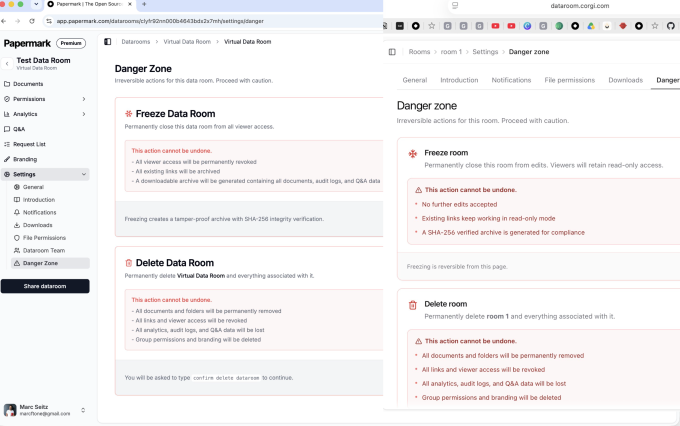
Y Combinator-backed insurance tech startup Corgi became embroiled in yet another controversy earlier this week when Papermark, maker of open source data room software, accused Corgi of stealing its software and passing it off as its own.
Corgi denies this. “No code was used from Papermark,” the company tells TechCrunch.
But there were reasons why people believed the initial allegation, which was made by Papermark co-founder Marc Seitzon X and concerned Corgi’s newly released product called Dataroom. Deal room software is essentially secure document sharing. It is famously used by startups to pitch VCs and send them supporting materials for due diligence.
Seitz’s post blew up because he shared screenshots showing Corgi’s product using the same language for the same features as Papermark’s, word for word. He went as far as to call Corgi’s new product copyright- and license-infringing, and “fraud.”

Corgi’s co-founder and CEO Nico Laqua saw the tweet and promised to investigate. Soon after, he responded on X with a full denial, showing that the code was different between the two products.
While he strenuously pushed back on the allegations of a license violation — arguing that “copying my style” is a different claim than “stealing enterprise code” — he did admit that relying on a vibe-coding design led to the replica features.
“Looking back, we should’ve leaned more into our own language and visual choices instead of taking cues from existing products in the space, and that’s on us,” he posted.
A Corgi spokesperson confirmed to TechCrunch that the offending features were vibe-coded and said they have already been changed, downplaying the situation.
“The issues were isolated to visual elements on two peripheral settings pages,” the spokesperson told us, adding that these elements were “immediately updated” and that “our team confirmed that no code was used from Papermark.”
Laqua and the spokesperson also accused Papermark of making these accusations because Corgi is offering a less expensive product. “I get that this stings since we’re putting out something mostly free that competes with his SaaS. I’d be mad too,” Laqua wrote of Seitz. Seitz did not respond to a request for comment.
The copying of visual elements and identical feature language, however, went beyond sour grapes as a credible complaint. It raises a new and thornier question: If vibe coding makes it so easy to copy the look, feel, and every function of another’s work, while not copying every line of the code itself, how much does it matter if the source isn’t identical?
Obviously, legally speaking, it’s the only thing that matters. So this is not the same as the controversy over Y Combinator alum PearAI, a 2024 startup that admitted to cloning another open source project and releasing it under its own license.
Morally speaking, this is ambiguous and will become increasingly common.
As fellow YC alum and founder of the agent operating system OpenProse Dan Barrett explained on X: “In a world where a bot can trivially copy 1:1 the structure of something even if the character-level code diverges … what makes one unacceptable and the other not? existing IP law, incidental to the old world? is there not some greater principle at work here?”
Corgi is now vigorously trying to clean up any reputational damage. It has issued a cease-and-desist letter to Seitz demanding that he take down the tweet, the company confirmed to TechCrunch. The founder of Hello World Cafe, which competes in part with Corgi’s coffee shop business, says he also received a cease-and-desist from Corgi’s lawyers over a tweet joking about the Dataroom controversy. Though X still remembers. There have been hundreds of comments and countless subtweets.
This is not the first time Corgi has been accused of heavy-handed legal tactics. In May, competitor Matcha accused the company of bullying behavior, a dispute that unfolded alongside a separate lawsuit. The two-year-old startup has also sued various former employees and developed a growing reputation for being litigious.
(Corgi also offers a 24-hour coffee shop, with plans to open more, Laqua recently said on VC Harry Stebbings’ podcast.)
This latest hullabaloo adds to a growing list of chatter around Corgi. The two-year-old startup, for instance, has a growing reputation for being litigious. It’s already sued various former employees.
Laqua also recently went viral for his comments on Stebbings’ podcast about how he expects employees to work seven days a week. “Whatever you can get done in five days, I promise you, you’ll get more done in six and seven,” he said.
That is, of course, the fallacy of startup hustle culture. Decades of research repeatedly conclude that human productivity is not a quadratic equation. While sprints can be effective and build camaraderie for short-term problems like the site going down, the research shows that, as a matter of routine, more hours of work reduces productivity, not the other way around.
The startup also got tongues wagging for how fast it has raised money with increasing valuations, even by AI-startup standards. Last month, Corgi raised a $106 million Series B1, valuing the company at $2.6 billion, just three weeks after announcing a $160 million Series B at a $1.3 billion valuation and four months after its $108 million Series A.
Corgi also operates a 24-hour coffee shop, with plans to open more, Laqua said on the Stebbings podcast.
When you purchase through links in our articles, we may earn a small commission. This doesn’t affect our editorial independence.


TikTok is evolving into a super app with shopping, hotel booking, fintech, sports hubs, and microdramas beyond its video roots.
TikTok is no longer just a video app. The platform has spent the past year adding hotel bookings, in-app commerce, sports hubs, casual games, microdramas, and a fintech licence application, building out the infrastructure of what the industry calls a “super app,” a single destination that handles tasks users currently spread across a dozen different services.
The super app model originated in China, where WeChat combines messaging, payments, ride-hailing, government services, and e-commerce into one platform with more than a billion monthly users. TikTok’s parent company ByteDance already operates Douyin, the Chinese version of TikTok, which integrates AI shopping agents, ticket bookings, and payments in ways that Western platforms have not matched. The question is whether that model can cross the Pacific, and TikTok, now under primarily US ownership after a January transition to an Oracle and Silver Lake-led joint venture, is the vehicle ByteDance is using to find out.
The most commercially significant expansion has been TikTok Shop. According to eMarketer, TikTok Shop grew US sales by 407 percent in 2024 and another 108 percent in 2025 to reach nearly sixteen billion dollars, capturing more than 18 percent of total US social commerce. That share is expected to reach roughly 24 percent by 2027, putting TikTok in direct competition with Amazon, Shein, and traditional online marketplaces.
In May, TikTok launched TikTok GO, a feature that lets US users discover and book hotels, attractions, and experiences without leaving the app. The service partners with Booking, Expedia, Viator, GetYourGuide, and Trip, turning travel content that already drives millions of views into a direct booking funnel. It puts TikTok in competition not just with Google Search and Google Maps, but with the entire online travel agency industry.
The company is also pushing into financial services. In March, Reuters reported that TikTok applied to Brazil’s central bank for two fintech licences, one to offer prepaid accounts where users can store funds and make payments, and another to operate as a direct credit provider. Brazil, where TikTok reaches roughly 131 million users aged 18 and above, would be the first market where the platform handles money directly.
TikTok has also built a dedicated hub for the 2026 FIFA World Cup with live scores, match schedules, standings, and curated video highlights, keeping sports fans inside the app instead of switching to ESPN or Google. ByteDance, meanwhile, continues investing in content tools, recently unveiling its Seedance AI video model that produces 30-second clips at native 4K resolution. The parent company’s broader ambitions in AI, commerce, and entertainment all feed into TikTok’s platform expansion.
The entertainment push extends to scripted content and gaming. TikTok launched PineDrama in January, a standalone microdrama app offering bite-sized TV shows in one-minute episodes, and has added casual games to its DMs. The company previously attempted a music streaming service in 2023 but shut it down in November 2024, pivoting to partnerships with Apple Music and Spotify instead of competing directly.
Whether any of this amounts to a true super app outside China remains an open question. Western users have historically resisted consolidating their digital lives into a single platform, and regulators in the US and EU are more likely to scrutinize a company that handles shopping, payments, travel, entertainment, and social networking under one roof. TikTok is betting that the habit of opening one app for everything can be built incrementally, one feature at a time, rather than arriving fully formed.


NASA has selected proposals from 37 companies, including several with Seattle-area connections, to further its plans to establish a long-term presence on the moon and enable human exploration of Mars.
The companies applied to partner with NASA under the terms of an Announcement of Collaboration Opportunity, or ACO. The selected proposals aim to develop technologies for space transportation, planetary surface operations and lunar surface infrastructure.
“We are empowering American industry to become active partners in NASA’s missions to the moon, Mars and beyond,” Greg Stover, director of the Advanced Research and Technology Division in NASA’s Research and Technology Mission Directorate, said today in a news release. “By tapping into commercial industry, NASA can rapidly develop key capabilities to support its most ambitious missions while fostering the nation’s robust space economy.”
While the ACO agreements do not involve an exchange of funds, the selected companies can leverage NASA’s specialized facilities, software, hardware and subject-matter experts to mature their technologies for commercial and government use. The performance periods will be negotiated individually, with an expected duration of 12 to 24 months.
Five Seattle-area companies made NASA’s list:
The other 32 companies are Advanced Cooling Technologies, Advanced Space, Apech Labs, Astrobotic Technology, Axiom Space, Busek, Canopy Aerospace, Chase Supply, Dcubed USA, Elementum 3D, Enduralock, General Galactic Technologies, Hebi Robotics, Hyperion Transport Systems, Kall Morris, Lockheed Martin, Lunar Outpost, Made in Space, Max Space, Mission Space U.S., Moonprint Solutions, Motiv Space Systems, Opterus Research and Development, Orbital Composites, Psionic, Quadrus Corp., Rogue Space Systems, Starpath Robotics, Teledyne Energy Systems, Ten One Aerospace, Varda Space Industries and Venturi Astrolab.

Craft Recordings and Bluesville are adding two more essential titles to one of the stronger all-analog blues reissue programs currently on vinyl: Jimmy Reed’s Jimmy Reed at Carnegie Hall and Skip James’ Devil Got My Woman. Both LPs have been cut from the original analog master tapes by Grammy-nominated engineer Matthew Lutthans at The Mastering Lab, using an AAA mastering chain, and pressed on 180-gram vinyl in partnership with Acoustic Sounds.
The packaging is not an afterthought, either. Each release comes in a tip-on jacket with an obi strip and new album reflections by Grammy-winning producer, songwriter, and bluesman Scott Billington—details that help distinguish Bluesville from the usual bare-bones catalog recycling. High-resolution and standard digital remasters will also be released alongside the vinyl editions.
Reed’s 1961 Jimmy Reed at Carnegie Hall is a studio recording despite the misleading title, and includes “Bright Lights Big City.” Skip James’ Devil Got My Woman, released in 1968, is a far starker and more intimate affair, built around the Delta blues legend’s singular guitar work, fractured vocals, and the title track that became his signature song.
The new releases follow Bluesville’s recent AAA editions of Albert King’s I’ll Play the Blues for You and Eddie Kirkland’s It’s the Blues Man!, both of which we just reviewed. Those records demonstrated that Craft is taking the series seriously: strong tape work, clean pressings, properly made jackets, and prices that have not yet wandered into the usual audiophile nonsense.
Related Reviews:
Jimmy Reed’s Jimmy Reed at Carnegie Hall is not a live album, despite the title’s rather shameless attempt to borrow some Manhattan prestige. Originally released by Vee-Jay in 1961 as a double LP, the record was assembled from studio material rather than Reed’s actual Carnegie Hall appearance the previous year. Bluesville’s new edition focuses on the first disc, collecting sides A and B on a single 180-gram LP.

That distinction matters less once “Bright Lights Big City” begins rolling out of the speakers. Reed’s best work was built from deceptively modest ingredients: a loose, infectious shuffle, clipped electric guitar, harmonica, and a vocal delivery so relaxed it could sound almost casual. Yet the groove was nearly impossible to resist. “Bright Lights Big City” reached No. 3 on the R&B chart in 1961, crossed onto the Billboard Hot 100, and later became a No. 1 country hit for Sonny James. The song’s influence on British rock, country, and American blues is difficult to overstate.
Born Mathis James Reed in Dunleith, Mississippi, Reed became one of the defining figures of postwar electric blues after signing with Vee-Jay in 1953. Working closely with guitarist Eddie Taylor and drummer Earl Phillips, he built an extraordinarily successful run of singles that included “You Don’t Have to Go,” “Honest I Do,” “Baby What You Want Me to Do,” and “Big Boss Man.” His appeal was never about virtuoso fireworks. Reed made the blues feel conversational, danceable, and accessible enough that everyone from Elvis Presley and the Rolling Stones to Van Morrison and the Grateful Dead eventually came knocking.
The new Bluesville pressing includes “Bright Lights Big City,” “Tell Me You Love Me,” “Hold Me Close,” and “Blue, Blue Water,” the latter featuring Eddie Taylor and Phil Upchurch. It also benefits from the same careful production approach as the recently reviewed Bluesville editions of Albert King’s I’ll Play the Blues for You and Eddie Kirkland’s It’s the Blues Man!.
For listeners who know Reed only through compilations, or through somebody else covering “Big Boss Man” — this is a strong place to start. It is not the full double album, but it contains enough of Reed’s particular magic to explain why so many musicians spent the next several decades trying to find that same pocket.
Where to buy: $32.99 at Amazon (available August 21, 2026)
There are plenty of Delta blues records that sound old. Devil Got My Woman sounds as though it was transmitted from a place slightly outside time, where conventional tuning, meter, and emotional restraint were politely asked to leave the building.

Born Nehemiah Curtis “Skip” James in Bentonia, Mississippi, James was never a conventional bluesman. His singing could rise into a high, ghostly falsetto, while his guitar work moved through unusual minor-key voicings and open D-minor tuning with a fluidity that still feels unnerving almost a century later. He was also a formidable pianist, and the music rarely follows the tidy twelve-bar rules that made other Delta blues artists easier for later generations to imitate.
James recorded for Paramount in 1931, but the records did not turn him into a star. The Depression did not help, nor did the fact that his music was too strange, too personal, and too far removed from the more accessible blues styles of the day. He largely disappeared from public view for more than three decades before John Fahey, Bill Barth, and Henry Vestine found him in a Tunica hospital in 1964.
That rediscovery brought James to the Newport Folk Festival and back into the studio, where he recorded a run of material for Melodeon, Takoma-related sessions later issued as She Lyin’, and Vanguard. Today! arrived in 1966, followed by Devil Got My Woman in 1968, his final album released during his lifetime.
The Vanguard set is a solo performance in the truest sense. James handles the vocals, guitar, and piano himself, moving between instruments rather than relying on a backing band to soften the edges. The title track, a revisiting of one of his 1931 Paramount sides, remains the centerpiece, but the album is deeper than a single famous song. “Little Cow, Little Calf Blues,” “22-20 Blues,” “Sickbed Blues,” and “Illinois Blues” reveal a musician still capable of making familiar blues language feel unsettling, intimate, and completely his own.
James died in 1969, only a year after Devil Got My Woman was released, but the music kept finding new listeners. The title track later reached a wider audience through Ghost World and was inducted into the Grammy Hall of Fame in 2020. That is deserved recognition, although the better reason to own this album is simpler: nobody else in blues sounded remotely like Skip James, and nobody has managed to replace him since.
Where to buy: $32.99 at Amazon or get both for $57 at Craft Recordings (available August 21, 2026)

Why you can trust TechRadar
We spend hours testing every product or service we review, so you can be sure you’re buying the best. Find out more about how we test.
Almost every one of the best open earbuds I’ve tested, has been designed for sports users. They let you hear your surroundings at the gym, remain aware when running in a busy area, and keep alert when cycling on a road. I don’t think Cleer missed this memo – the brand’s intentionally going for something completely different.
The Cleer Arc 5 are open earbuds designed not for sports, but for the rest of us. I was skeptical when I first saw them, but they’ve surprised me — in both good and bad ways.
The presence of Dolby Atmos and THX Spatial Audio means these are suited for watching a TV show or movie on your commute, and their support for a range of better Bluetooth codecs, including LDAC and aptX Adaptive, shows Cleer is aiming for audiophile-quality earbuds here. Those are some exceptional features for a form factor that naturally competes with loads of extraneous background sounds.
Cleer’s app hides loads of other features too, including a posture test which uses the buds’ positional tools, and the ability to set sedentary reminders if you’re too often stuck in one spot.
The design department makes it clear that these aren’t sports buds. Though surprisingly sturdy during a run, the buds are much bulkier than your average svelte runners’ wear. And the presence of an on-case display, full of controls and settings, clearly signposts this as not for active users. When I go to the gym or for a run, the case is always left at home.
Unfortunately, despite the impressive specs and clear focus on listening quality, the Achilles’ Heel of these earbuds is the sound quality. There’s a real lack of expansie through the soundstage, and both treble and bass feel poorly defined. The open-ear form factor doesn’t help here, especially with a max volume that’s simple not loud enough, but many similar earbuds I’ve tested sound a lot better.
It’s a shame that these don’t sound fantastic, and is surprising too when you see the price tag. For some users, I see the feature set trumping the sound quality. The fantastic battery life, health features and spatial audio might trump below-average sound. But it begs the question who these are designed for, if not audiophiles or fitness fans.

The Cleer Arc 5 were announced on March 16, 2026, only four months after their predecessors. That was a quick turnaround!
You can buy the Arc 5 for $219.99 (about £170, AU$340 — no word on a release outside the US, as with the Arc 4). So these are some of the most expensive open earbuds out there.
To my mind only the Bose Ultra Open Earbuds and Shokz OpenFit Pro cost more, but they’re both explicitly designed for sports, while the Cleer is aimed at an audiophile market.
|
Drivers |
16.2mm |
|
Active noise cancellation |
No |
|
Battery life |
12 hours (bud), 60 hours (case) |
|
Weight |
11.5g (bud), 145g (case) |
|
Connectivity |
Bluetooth 6.0 |
|
Frequency response |
65Hz to 40kHz |
|
Waterproofing |
IPX7 |

If there’s an area where the Cleer Arc 5 stand out, it’s in the feature set — it seems that this is what the buds were designed to do.
It starts with the basics: the battery life here is great for open earbuds. You’re getting 12 hours of listening per charge, with 60 hours once you factor in the charging case itself. Beyond a few endurance-focused earbuds, those figures are at the top of their class.
Boot up the Cleer+ app on your phone, and you’re getting a smorgasbord of tools — admittedly in a pretty confusing lay-out. You can use the app to toggle spatial audio, change between EQ modes and create custom ones, change what the touch and gesture controls do, change the case wallpaper, edit what tools are available via the case, and more.
The equalizer is an 8-band one, giving you some control over your sound, though in this day and age I’d say that 10-bands were more common. I preferred using this over the presets, which didn’t have a noticeable impact on a song’s sound.

The “and more” features I alluded to earlier are pretty out-there, hence needing a whole extra paragraph. They’re health ones: you can set up sedentary reminders to get you to move about, add volume limits to protect your hearing, and do a posture test which uses the gesture controls of the buds to evaluate whether you’re sitting straight.
For office workers, this latter is a genuinely useful feature, and I used it to ensure my seat and chair were level when working at my desk. However, for it to work properly, your phone needs to be at eye level too — I messed it up by leaving my mobile o,n my desk, and when I bent over to look at it, the test was ruined.
One feature you’re not getting in the Arc 5 is any kind of noise cancellation. It’s admittedly very rare in the open-ear space, but not unheard of (if you’ll pardon the pun).

Let’s start with the Cleer Arc 5’s big new feature: its charging case. Big literally: it weighs 97g all on its own, and measures 8.3 x 6 x 2cm, making it one of the biggest earbud cases I’ve seen in years.
This size isn’t just to house some pretty big earbuds, but it does that with a few extra twists. It has built-in UV charging for the buds, and a mirror inside the case for some reason. For some reason, the left earbud is housed on the right, and vice versa, which was confusing for a while until I learnt to switch.
But no, the big selling point here is a screen build into the charging case. You can use it to flick between a few menus: battery, music controls, spatial audio settings, general settings, equalizer and remote camera shutter. The interface feels akin to a smartwatches’: very basic.
For changing quick settings like EQ or skipping songs, the case was quite handy: I didn’t need to dig my phone out of my pocket and get distracted by the 120 notifications from that group chat I forgot to mute. But you can’t use the case to change playlists, create an EQ or dig deep into settings, so it won’t replace your phone completely.

The earbuds also have touch controls too, which were quite easy to trigger with a tap anywhere on their body, yet never accidentally picked up an unintentional touch.
I suppose that brings us onto the earbuds. These are pretty huge, and heavy too, weighing roughly 24g each. I haven’t seen an open earbud quite this big, and was expecting them to fit pretty awfully; thankfully, I was totally wrong. I went on many runs with the Arc 5, and not once did they threaten to dislodge, or wobble more than the average open-ear does.
I’d put this down to some smart balancing of the bud and counterweight. They were always comfortable to wear, even if the weight didn’t exactly make them easy to forget.
The Cleer Arc 5 comes in black or white, and I tested the latter. They have an IPX7 rating, which makes them sweatproof but not suited to swimming. I would avoid taking them out in heavier rainfall too, just to be safe.

I was expecting the Cleer Arc 5’s sound to be its outstanding feature. Between its 16.2mm drivers, support for LDAC, aptX Adaptive and aptX Lossless, and high price, it seems like these could be some of the best open earbuds yet.
I’m quite surprised to report that I was wrong, and I didn’t really love listening to tunes on the Arc. The quality isn’t terrible, but it’s not on par with the expectations you’d have from those aforementioned specs.
Music sounds compressed, with neither the high-end nor low-end differentiated in a way that gives any sense of sound stage or distinction. Snare drums lack bite, distorted-guitar walls turn into crunchy puddles, bass wobbles over plenty of other low- or mid- instruments. The buds would perhaps sound better if they were in-ears, but hovering a few mm over your ears, it doesn’t fly.

Low-end is poorly defined yet too prominent in the mix: The Human Race by BYRNE starts with a harmony that sounded more like a glitching speaker than a bass singer. This line’s meant to repeat in the chorus with a bass guitar, and it completely overrides the harmony. In 311’s Good Feeling, the bass trips over all the other instruments, replacing the usually-energetic, fun chorus with the sonic equivalent of a stubbed toe.
Also affected is the treble, as vocals and higher lines lose prominence and energy. Take, for example, Morningsider’s Thinking it Over: a string motif is dropped in the mix in the introduction, and completely lost in the pre-chorus.
I’ll concede that if you listen to acoustic or folky music, you may not notice this issue as much. In songs like Caamp’s 26, the reduced instrumentation meant I could still basically hear everything.
Well, I could hear it until I stepped outside. The Arc 5 falls into a common trap with open earbuds: their maximum volume isn’t high enough to compete with noisy surroundings. When I was running near a main road, I could barely hear my songs.

The Cleer has quite a few neat features. I really like what the case display achieves, and the fit is solid. Plus, the movie listening features offer tools that many other earbuds don’t.
However that’s a really high price for any earbuds, let alone open-style ones — and especially not for ones that, frankly, don’t sound amazing.
There’s no way that these buds offer you value for money; you can get better audio quality for a lot less, especially if you’re happy to buy non-open-style buds.
|
Attributes |
Notes |
Rating |
|---|---|---|
|
Features |
There are loads of features available here, and most of them work flawlessly. |
4.5/5 |
|
Design |
They’re bulky, as is the case, but it all somehow manages to work together well. |
4/5 |
|
Sound quality |
These don’t have the quality, sound stage or vibrancy you’d expect for the price. |
3/5 |
|
Value |
Elsewhere, you can easily get more for your money. |
3/5 |
| Header Cell – Column 0 |
Cleer Arc 5 |
Huawei FreeArc |
Shokz OpenDots |
|---|---|---|---|
|
Drivers |
16.2mm |
17mm x 12mm |
2×11.8mm |
|
Active noise cancellation |
No |
No |
No |
|
Battery life (ANC on) |
12 hours (earbuds), 60 hours (total) |
7 hours (earbuds), 23 hours (total) |
10 hours (earbuds), 40 hours (total) |
|
Weight |
11.5g (each bud), 145g (case) |
8.9g (each bud), 67g (case) |
5.6g (each bud), 52g (case) |
|
Connectivity |
Bluetooth 6.0 |
Bluetooth 5.2 |
Bluetooth 5.4 |
|
Waterproofing |
IPX7 |
IP57 |
IP54 |
I used the Cleer Arc 5 for roughly a month before writing this review of them. In that time, they were paired to a succession of Android smartphones, mostly the Samsung Galaxy S26 Ultra and Moto Edge 70 Fusion.
I listened to the Arc 5 on runs, walks around my neighborhood, office sessions, long trips on public transport and at home. I mostly streamed music via Spotify Lossless, and Apple Music, but also watched movies on a variety of streaming services, played games, and tested a few other music streamers.
I’ve been reviewing gadgets for TechRadar for over seven years now, including testing audio kit for nearly as long. In that time I’ve handled other Cleer gadgets as well as many, many other open-ear buds.


We may receive a commission on purchases made from links.
Maintaining a yard the neighbors will envy, starts with a high-quality mower. However, even if you’re running the best riding lawn mower brand available from Home Depot, it won’t solve all your turf problems. Take for instance, situations where you might have visibly uneven sections that include bumps or dips. Not only can this diminish your properties appearance, but it also creates trip hazards and areas where water can pool, negatively impacting grass health.
There are a variety of methods to tackle this issue, such as pull-behind heavy rollers and drag mats. Unfortunately, these options have downsides. First, they can cost quite a bit, depending on the size and brand. You’ll also need a vehicle like a riding mower, or ATV to pull them. However, there is a less expensive choice that still performs admirably — a lawn leveling rake.
Unlike a standard rake, with tines that spread out and curl down on the ends for grabbing leaves, a leveling rake has horizontally mounted, flat tines that slide over the ground. You can find many budget options, such as the Vivosun Stainless Steel Lawn Leveling Rake for $56.99 at HomeDepot.com. The low price makes it an easy investment for those looking to improve their lawns without significant disruption to existing vegetation.

The first step in the process is to mow your grass short but try not to scalp it. Lowering the cutting height too much goes against the 1/3 rule for mowing, as it can invite pests and disease, turning your green space brown. Next, you’ll need to dethatch the grass with something like the Walensee Thatch Rake on Amazon.com for $34.99. This tool essentially scoops up the loose grass clippings and other organic matter that’s built up in the grass which prevents water from seeping into the soil.
Next, you’ll need something to fill in those dips in your yard. Referred to as “top dressing,” the main ingredient is topsoil; however it’s recommended to add in some compost, which helps your soil hold more moisture. While it’ll be a bit a work, spreading out the top dressing is as simple as using a shovel and focusing on the bumpiest spots of your turf.
It’s at this point where the leveling rake finally makes an entrance. While holding the leveling rake handle, you can drag or simply push it a back-and-forth, guiding the tines over the loose top dressing. The taller sections of soil will be caught in the tool and distributed elsewhere. Meanwhile, the tines won’t disturb lower sections or dips, instead focusing on areas that rise above the rest. Eventually the levelling rake will redistribute the top dressing to the lower areas and make the whole area level — it’s in the name.


OpenAI released Sol, its most powerful model, to about 20 government-approved partners under Trump’s AI order.
OpenAI has released GPT-5.6 Sol, its most powerful model, to roughly 20 partners whose names were individually approved by the US government. The release is the first time an American AI company has launched a frontier model under a government-managed access list, a step beyond the voluntary pre-release review framework Trump’s AI executive order established on June 2.
Sol is the most capable model in a new three-tier series that also includes Terra, a mid-range option, and Luna, which is optimized for speed and cost. OpenAI described Sol as excelling at coding, biology, and cybersecurity, and introduced a new “max reasoning effort” mode that gives the model extended time to work through complex problems. The company plans to add an “ultra” mode that splits tasks among multiple sub-agents.
The limited preview follows a direct request from the Trump administration to stagger the release, with the government approving access customer by customer during the preview period, according to Bloomberg. OpenAI said in a blog post that it does not believe “this kind of government access process should become the long-term default,” but agreed to participate.
The arrangement is the first practical test of the executive order Trump signed earlier this month, which asks AI companies to voluntarily give the government up to 30 days of pre-release access to models deemed to have advanced cyber capabilities. The order explicitly rejects mandatory licensing, but the Anthropic precedent gave it teeth. Two weeks ago, Washington ordered Anthropic to shut down Fable 5 and Mythos 5 after a reported jailbreak, the first time the government forced a commercial AI model offline.
OpenAI’s decision to cooperate contrasts with Anthropic’s experience. Anthropic complied with the shutdown order but publicly called the action disproportionate, warning it would halt all frontier model deployments if applied across the industry. OpenAI appears to be taking the opposite approach, framing voluntary compliance as a way to avoid a more coercive outcome while preserving its ability to push back on the principle.
Sol is also available through Amazon Bedrock, making it the first model in the new series accessible on a competing cloud platform. OpenAI said it plans to make all three tiers generally available in the coming weeks, though it has not set a public date.
The broader question is whether government-gated releases become the template for every frontier model that follows. OpenAI clearly wants to prevent that, and said so publicly. But with Anthropic’s models still offline and the executive order’s voluntary framework already producing mandatory-looking outcomes, the line between cooperation and compliance is getting harder to draw.

Elon Musk is eyeing an acquisition of Mesh Optical Technologies, a startup founded by three former SpaceX engineers last year developing hardware for fast data center communications.
The potential acquisition, which was revealed in a Federal Trade Commission filing and first reported by Bloomberg, confirmed the agency expedited its antitrust review.
Mesh Optical came out of stealth in February when it announced that it raised a $50 million Series A led by Thrive Capital.
Before founding Mesh Optical, the startup’s co-founders, Travis Brashears, Cameron Ramos, and Serena Grown-Haeberli, developed the optical communication links that keep thousands of SpaceX’s Starlink satellites interconnected.
The Mesh co-founders saw an opportunity to develop optical transceivers for terrestrial data centers, as light-based hardware is faster and more energy-efficient than traditional electrical-based systems.
SpaceX has recently entered into agreements with Anthropic, Google, and the open-source AI developer Reflection AI to provide them with compute capacity at its data centers, generating a substantial new revenue stream for the newly public company. Acquiring Mesh could eventually allow SpaceX to improve the efficiency of its data centers, whether they are located on Earth or, in the future, in space.

Amazon Prime Day hits different in 2026, even if it is the last day of the week-long event. Prime Day is often a moment to pick up a big-ticket item—and there are great Amazon Prime Day TV Deals, Prime Day Apple Deals, and Prime Day Tech Deals aplenty for those in need of a serious life upgrade.
But honestly, this year has been a bear for most people I know. I’m shopping on a budget. That’s why I’ve assembled these great Amazon Prime Day Deals under $100. Each is a chance to pick up a necessity, a level-up, or a little treat without having to explain anything to yourself later—whether a low-cost Kindle or a great budget Fitbit. With only hours left in Prime Day, it’s your last chance to snag all of these with such a good price.
For the best of the best of the best deals this Prime Day, check out WIRED’s Absolute Best Prime Day Deals. For lightning deals of the moment, see our Amazon Prime Day live blog for updates in real-time.
Updated 9PM ET on Friday, June 26: We’ve updated this story with a final refresh on deals you can still buy in the last hours of Prime Day.
WIRED Featured Deals

Even after three years, this Charge 6 is still the Fitbit WIRED recommends for most people. The AMOLED touchscreen is bright and easy to read, and it does all the basic stuff that you want a fitness watch to do. It will monitor your blood oxygen, your heart rate, and your skin temp—plus monitor sleep and flag signs of stress or irregular heart rhythms. It’s not as ultra-accurate as some, but it’s good enough for most enthusiasts, and the price is very, very right at the moment.
A good power bank is actually life-changing. It means never having to race to a cafe, hunting desperately for a table near an outlet. This compact little puppy is our top power bank for good reason: Ample 25,000-mAh capacity. Fast-charging capability for phones or laptops. Ability to fast-charge two devices at the same time, with a retractable flat 2-foot USB-C cable, and another 1-foot USB-C that doubles as a carry loop.


Most of us weren’t born tech enthusiasts. Somewhere along the way, a game, a gadget, a PC upgrade, or a new technology grabbed our attention and we never really let go.
Read Entire Article
Source link




Renter of Home in Anne Heche Crash Denies Settlement With Son

Two goals and an assist by sheer aura: Cristiano Ronaldo just entered the World Cup chat


Microsoft accidentally kills epic Outlook email threads


Weekend Open Thread: Staud – Corporette.com


Soccer-U.S. defends Iran World Cup travel restrictions, says discussions ongoing


The House | Manchesterism won’t survive the painful trade-offs unless it gets citizens on board


Andy Burnham and the meaning of Makerfield


Potential 2028er World Cup attendee leaderboard


Asia stock markets slide as tech shares slump


A Look At A Gaggle Of Transputer Boards
Bitcoin (BTC) Dips Below $62K, Ethereum (ETH) Plunges 6% Daily: Market Watch


Securitize Wraps Roubini's SEC-Registered ETF as Dubai VARA Digital Security

Dell (DELL) Shares Tumble Over 5% Following Analyst Downgrade to Hold
Entergy settles forward sale agreements, raises $672 million in cash proceeds

Can Charles Hoskinson Really Rescue Cardano?


FIH Pro League: India defeat Pakistan 7-1, register biggest win of campaign | Other Sports News


RTX holders must register wallets before token distribution begins

Hyperliquid Named on Singapore MAS Investor Alert Register


Jake Chervinsky accuses CME of protecting derivatives monopoly


India vs Bangladesh LIVE Score, Women’s T20 World Cup: Bangladesh Opt To Bat; India Enter ‘Do-Or-Die’ Stage As Semi-Final Race Heats Up

-Reviewer-Photo-SOURCE-Simon-Hill.jpg)


You must be logged in to post a comment Login