
Security teams log 54% of successful attacks and alert on just 14%. The rest move through your environment unseen.
The Picus whitepaper shows how breach and attack simulation tests your SIEM and EDR rules so threats stop slipping by detection.


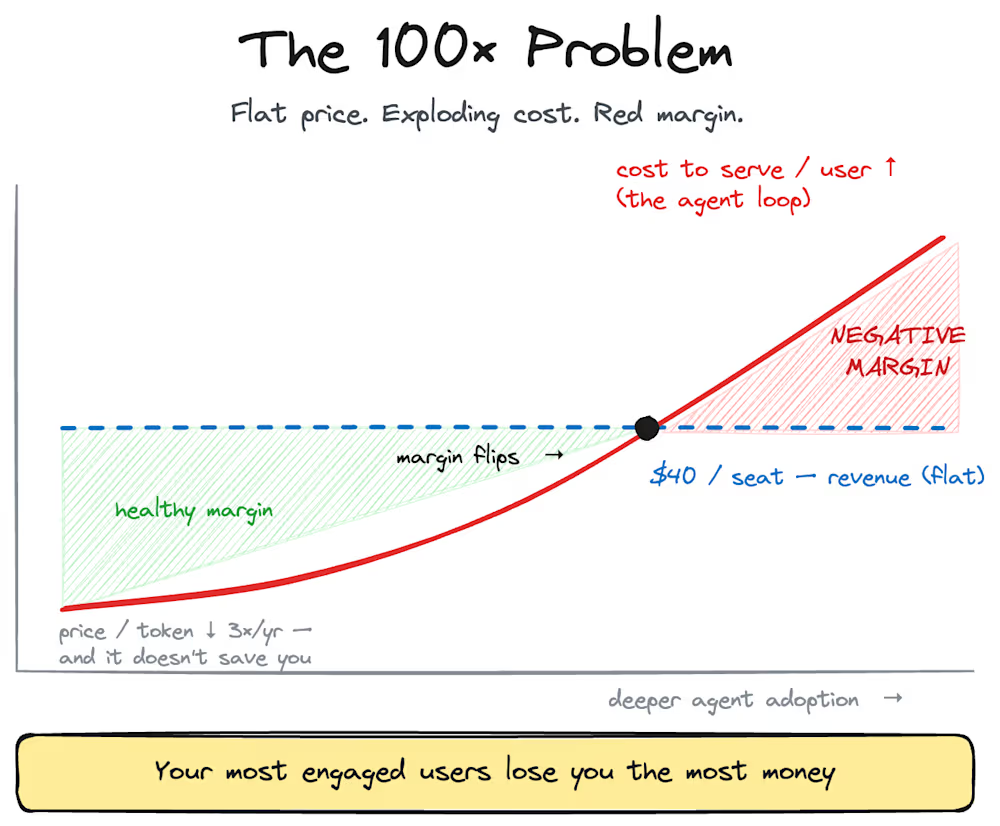

DeepSeek’s recent decision to drastically cut pricing on its V4-Pro model by 75% should have been unequivocally good news for enterprise AI vendors and developers. Instead, many are discovering that cheaper models don’t automatically translate into healthier margins.
The reason is simple: While inference costs plummet, agent systems are voraciously consuming tokens faster than prices are declining. For the last 2 decades, software economics was dictated by the same rule. Infra became cheaper every year whereas applications became more capable. AI was initially hypothesized to follow the same pattern. As frontier models improved and token prices dropped, many assumed inference would become a negligible operating expense.That assumption has begun crumbling exponentially.
A chatbot usually turns one user question into one model call. An agent turns it into a chain of planning, retrieval, tool use, verification, summarization, and follow-up decisions. The user sees one answer. The vendor pays for the loop. That is the 100x problem: The same user-visible request can cost a lot more to serve as an agentic workflow than as a chatbot or retrieval-augmented generation (RAG) response. In longer-running workflows, the multiplier is higher. Falling model prices help, but they do not fix a product architecture that turns one prompt into dozens of billable operations.
The scale of what is now at stake is clear in how model providers themselves are pricing developer relationships. OpenAI’s proposed program to give every Y Combinator startup $2 million in API credits — a number that would have funded an entire seed round in any prior tech cycle, and when the same cohort got by on a few thousand dollars of AWS credits — is less a recruiting perk than an admission of what it now costs to run an AI-native company through its first year of product. For established enterprises retrofitting agents into existing product lines, the absolute numbers are larger still.
In a single-turn chatbot, one user message produces roughly one model call. Input-to-billed ratio is about 1:5.
In a multi-step agent rolled out across customer support, sales operations, finance, legal review, and engineering, that ratio routinely lands at 1:700 or higher. Every loop iteration carries forward the cumulative conversation, tool outputs, and reasoning traces. Each step appends; nothing is dropped.
A “simple” agent query like “What did our top customer ask about last week?” typically touches seven priced operations before returning an answer:
User prompt (~50 tokens)
System prompt and tool definitions (~3,000 tokens, repeated on every call)
Retrieval (~5,000 tokens of context)
Model call #1 — tool selection (8,000 in / 200 out)
Tool execution (~4,000 tokens returned)
Model call #2 — summarization (12,000 in / 400 out)
Model call #3 — follow-up decision (12,400 in / 100 out)
One sentence in, roughly 35,000 input tokens billed. Somewhere between $0.10 and $0.40 per query on a frontier model. Multiply that by a million queries a month — the table-stakes volume for any enterprise B2B feature — and the line item is six figures.

The dominant pricing story for enterprise AI has been seat-based SaaS: Pay per-user per-month, deliver agent capability, capture margin. That model assumes a reasonably bounded cost-per-user.
Token amplification breaks the assumption. A power user running 50 agent invocations a day on a $40/seat plan can cost more in inference than the plan charges. Token amplification shatters the traditional SaaS pricing model. When a power user’s daily agent activity costs more in inference than their monthly subscription fee, vendor gross margins turn negative, a paradox that compounds as customers deepen their agent adoption, the very usage curve vendors are selling to their boards. Several vendors are now privately reporting negative gross margins on heavy users, mirroring recent cloud expenditure reports from the Bessemer ‘Supernova’ cohort, where the correlation between AI-agent adoption and gross margin contraction has moved from a theoretical risk to a primary P&L headwind.
The visible symptoms have started leaking into public coverage. Bloomberg this week documented a widening gap between Salesforce’s Agentforce marketing demos and the capabilities actually shipping to customers. This is the kind of gap that opens predictably when promised functionality is technically possible but uneconomical to serve at the price the seat plan implies. Salesforce is the most-watched case, not a unique one.
“For my team, the cost of compute is far beyond the costs of the employees.” — Bryan Catanzaro, VP of Applied Deep Learning, Nvidia
The strategic implication is not “AI is expensive.” It is that the dominant business model assumed by most AI-native company plans does not survive contact with agentic workloads.
Consider an enterprise software vendor charging $40 per-user per-month for an AI-enabled support assistant. A traditional chatbot might cost only a few cents per user per day in inference, leaving healthy gross margins.
Now replace that chatbot with a fully agentic workflow capable of investigating tickets, querying internal systems, drafting responses, validating outputs, and escalating exceptions. If a heavy user executes 50 to 100 agent requests per day, inference consumption can increase by an order of magnitude. What was once a negligible infrastructure cost becomes a material operating expense.
This creates an unusual dynamic: The customers receiving the most value from the product are often the customers generating the highest inference costs. In extreme cases, vendors can find themselves with their most engaged users contributing the least profit. The result is a growing realization across enterprise software that agent adoption and margin expansion are no longer automatically aligned.
The technical responses are known and converging. They are not novel, but they are critical for survival
Cost-aware routing: This technique involves a small classifier model that decides which tier (Haiku, Sonnet, Opus equivalents) handles each query. Well-tuned routers cut inference bills by around 60% without any degradation in quality
Prompt caching: Anthropic, OpenAI, and Google now offer 75 to 90% discounts on cached prefixes.
Context discipline: You can truncate tool outputs, prune reasoning traces, and cap tool depth to prevent your agent from going down a rabbit hole
Speculative decoding: for self-hosted deployments, this technique guarantees 2 to 3X effective throughput on the same GPUs.
“Organizations using orchestration-led governance report stronger productivity gains — a holistic orchestration layer is associated with six times greater productivity impact than compliance‑only approaches” — IBM
The companies building this layer well are starting to look less like microservice operators and more like financial trading systems: Every routing decision priced, every path with its own P&L, every tenant on a metered budget.

Four moves separate the companies that will still have margin in 24 months from the ones that won’t:
Make inference cost a first-class metric. Track it per-feature, per-tenant, per-query class the same way cloud cost was tracked starting in the mid-2010s.
Budget like a media buyer. Set cost-per-thousand-queries ceilings per feature. Cap them. Alert on overruns. Engineering will not enforce this on its own.
Treat the router as core infrastructure, not an optimization. It is the new load balancer.
Audit prompts quarterly. A 4,000-token system prompt that grew organically over six months is a six-figure bill in slow motion. Most teams have never read their own production prompts end to end.
Negotiate volume commits early. Frontier-model vendors now offer reserved-instance-style prepaid commits at substantial discounts. List price is the worst price any enterprise will ever pay.
The structural shift underneath agentic AI is not that it is expensive. As DeepSeek’s price cut today underscores, frontier inference unit costs are dropping roughly 3X per year, and the curve is not slowing.
The shift is that amplification is outrunning the price cuts. Cutting per-token costs 75% does not help a company whose agents are doing 700X more tokens per user query than its pricing model assumed. For the first time since the cloud era began, architecture decisions are again financial decisions in real time. A prompt redesign is a margin event. A poorly bound agent loop is an outage with a credit card attached.
The companies that survive the next 24 months of AI infrastructure pricing will not be the ones running the cheapest model. They will be the ones whose agents are smart and know what they cost to think.
That is the 100X problem. And it is arriving faster than the price cuts can hide it.
Maitreyi Chatterjee is a senior software engineer at a big tech company.
Devansh Agarwal works as an ML engineer at a leading tech company.
Welcome to the VentureBeat community!
Our guest posting program is where technical experts share insights and provide neutral, non-vested deep dives on AI, data infrastructure, cybersecurity and other cutting-edge technologies shaping the future of enterprise.
Read more from our guest post program — and check out our guidelines if you’re interested in contributing an article of your own!

Add flair to your conversations and clean up those reactions everyone’s getting tired of seeing

Emojis and GIFs are great for reactions and conveying emotion, but new emoji offerings arrive slowly and there are only so many of them. GIFs offer lots more options, but you can’t always find the right one to capture exactly how you’re feeling. If you’re looking for something that’s much more personalized to yourself and your friend groups, you need to check out stickers on your iPhone.
Stickers are a much more personal option that are a lot of fun to use in the Messages app (and elsewhere) on your iPhone. If you haven’t tried these custom “stickable” images yet, you’re missing out. Any photo or video from you or your friends can become a hilarious reaction image. And they’re easy to set up, with no photo editing skills required.
You can easily create stickers using your own photos, including animated stickers from Live Photos. A perfectly timed sticker can be funny in a group chat, great for inside jokes or inventing new memes between friends. After you make a sticker, it stays saved to your library for quick reuse later. And managing your stickers is simple too; you’re free to remove any you aren’t happy with or no longer use. Chances are that when you start using stickers, your friends will too, which means more amusing chats for everyone.

There are two possible routes when you want to create a new sticker: through the Photos app or in the Messages app. For the former, open Photos and find a picture that you want to build a sticker from. The best sticker candidates are images that have a clear subject in the foreground, like a person, animal, hand, or object.
After tapping to view the picture you want to build from, press and hold on the element you want to turn into a sticker. You’ll see it shine for a moment, then a tooltip menu will appear next to it. If this doesn’t happen, try a different element that’s more pronounced against the background (or another photo). Choose Add Sticker to save the sticker to your library. Repeat this to craft as many stickers as you like. You can sometimes even make multiple stickers from the same image. And if you select a Live Photo, your sticker will be animated (toggle off the Live option at the top-left to disable this if you’d rather it stay static).
If you prefer, it’s also possible to create stickers from the same menu you access them from. Open a conversation in the Messages app, select the + (Plus) icon to the left of the area where you type, and choose Stickers. There, hit the + (Plus) icon in your list of stickers. This opens your photo collection with a key difference from earlier: elements that can be converted into stickers appear highlighted without you having to press on them. Tap one, followed by + (Plus) at the bottom, to add it to your library.

The Messages app is the best place to use stickers. Open the same + (Plus) menu mentioned above to see all the ones you’ve made so far. To manage them, press and hold one, then select Rearrange from the tooltip. This puts the stickers into a “jiggle mode” similar to when customizing the iPhone’s Home screen, allowing you to drag them around or tap the – (Minus) button to delete them in bulk. On the same tooltip menu, select Add Effect to jazz your stickers up a bit. You can pick from a few options like Outline and Shiny; some of these even react as you turn your iPhone, looking like a holographic trading card.
To send a sticker, tap it from your library. This adds it to your message draft just like when you attach a photo. For more fun, press and hold a sticker from your library to “peel” it, then drag it onto the conversation to “stick” it there. Try this to mess with texts and images in funny ways: have your pet photobomb your beautiful landscape shots, use your friend’s goofy face as a reaction, and whatever else you can think of.
Keep in mind that stickers are designed to work in iMessage conversations (those with blue bubbles). They should send in RCS chats with Android users but likely won’t show the “peel and stick” option properly. SMS conversations have strict size limitations, meaning stickers might appear blurry.

Messages isn’t the only app compatible with your stickers. They’re usable in other messaging apps like WhatsApp; just tap the Emoji button at the bottom-left of your keyboard and choose the Stickers tab. You can’t “stick” them on messages like in iMessage, though. Stickers are also available in any iPhone app that features Markup mode. For example, try opening an image in the Photos app, tapping the Edit (sliders) icon at the bottom, then selecting the Markup (marker) icon at the top.
Once you’re in Markup mode, tap + (Plus) on the bottom toolbar and choose Add Sticker. You can move stickers around, change their size, and make copies. Be sure to save the edited image once you’re done. Other apps where Markup is available include Mail and Notes. If you’re feeling uninspired, tons of iPhone apps offer their own sticker packs. Inside the Stickers menu, you’ll see icons for emoji (any emoji can double as a sticker), custom Genmoji, Memoji, and compatible installed apps. On my phone, for instance, the American Airlines, Wikipedia, and Taco Bell apps offer their own stickers. Choose Edit at the far right to rearrange your sticker packs, following Get Sticker Apps on the App Store at the bottom if you’re interested in more.
Your created stickers sync to all devices using your Apple account, so try them out on your iPad and Mac too! They’re a great way to make your reactions more personal. There’s no wrong way to use them, so create a bunch and give them a try.
The U.S. Cybersecurity and Infrastructure Security Agency (CISA) is warning of a significant increase in attacks targeting internet-exposed programmable logic controllers (PLCs) in the water and wastewater systems sector.
The agency’s urgent alert comes after hackers disrupted more than 30 community water systems in Minnesota in attacks that started last Sunday and continued through Monday.
CISA’s alert refers to threat activity involved hackers targeting exposed programmable logic controllers (PLC) and changing passwords to lock operators out, modifying IP addresses to disconnect devices from the internet, and other actions that disrupted operations.

“CISA urges critical infrastructure owners, operators, and integrators to remove publicly exposed PLCs and other operational technology (OT) from the internet as soon as possible.”
Organizations of all sizes running water and wastewater systems are being targeted, including some with mature cybersecurity programs.
The bulletin notes that exposed operational technology (OT) may include undocumented cellular modems installed by operators, vendors, or system integrators.
Internet-facing assets are exposed to defacement attacks, configuration changes, operational disruptions, and even physical damage, the agency said.
CISA recommends immediately removing these assets from direct internet exposure. If this is not possible, organizations should use a VPN connection or gateway devices for secure access.
Additionally, default passwords should be changed, and access should be limited to an IP address allow-list.
The agency also pointed owners of Rockwell Automation MicroLogix 1400 PLCs to vendor guidance for recovering access if passwords have been changed.
Cybersecurity search company Censys published a blog post where it quantifies internet exposure, estimating that currently there are more than 4,100 internet-exposed Rockwell Automation/Allen-Bradley hosts, 4,100 Siemens hosts, and over 2,000 Schneider Electric hosts.

However, it should be clarified that the map above shows devices reachable over the public internet, not systems that are necessarily being targeted or compromised.
Regarding the MicroLogix 1400 controllers mentioned in CISA’s bulletin, Censys notes that many appear to be running EoS (end-of-sale) firmware versions.
The cybersecurity company also highlighted the problem of undocumented cellular modems as a common blind spot, reporting that nearly half of the exposed Rockwell devices are reachable via Verizon Business, AT&T, T-Mobile, Comcast, Charter, and Starlink networks.
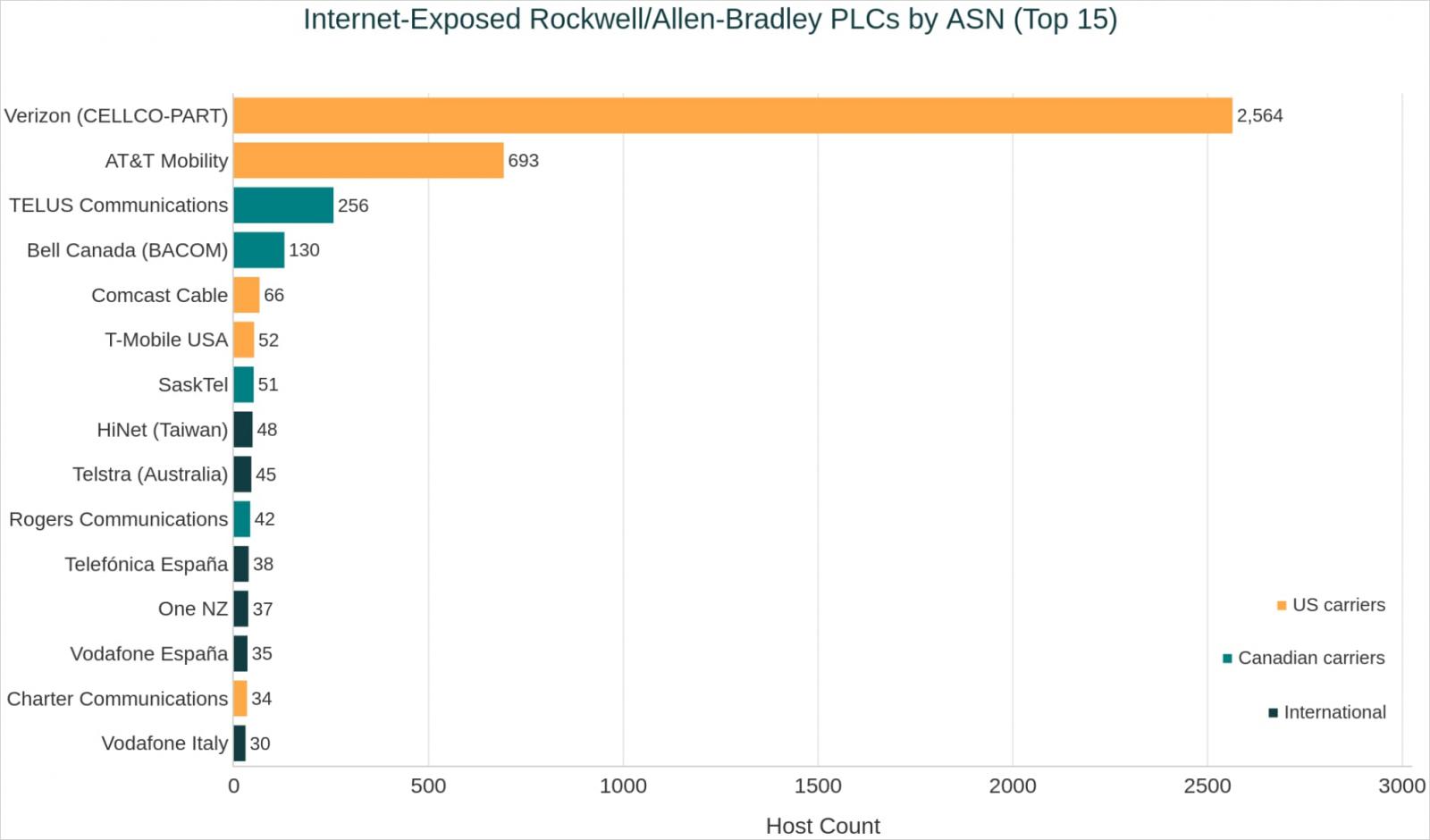
Censys also provided an expanded set of indicators of compromise (IoCs) in its report, along with threat-hunting guidance.
Earlier this week, the Minnesota IT Services (MNIT) agency activated the state’s cybersecurity incident response plan after identifying what it described as “a coordinated cyberattack targeting operational technology at more than 30 Minnesota community water systems.”
Multiple municipalities reported disruptions caused by the cyberattack, with equipment malfunctions forcing some utilities to temporarily switch to manual operations.
MNIT has shared threat intelligence collected from the affected systems and provided guidance and best practices to help impacted utilities restore normal operations.

Security teams log 54% of successful attacks and alert on just 14%. The rest move through your environment unseen.
The Picus whitepaper shows how breach and attack simulation tests your SIEM and EDR rules so threats stop slipping by detection.


Many drivers turn on the air conditioning in their cars without ever giving much thought to how the system works. That is, unless your A/C starts to smell bad or worse yet stops working properly. Until then, it’s easy to assume that a car’s air conditioning unit is one of those systems that engineers have mostly perfected over the decades. However, behind the scenes, it’s a very different story. Scientists have been working for years to try and cut down the amount of emissions that A/C systems generate, and it turns out that the industry’s previous efforts might not quite have been as successful as it was initially hoped.
The culprit is the refrigerant that’s used in many modern systems. It was supposed to be a more environmentally-friendly alternative to the previously used chemicals, but new studies have cast doubt on that idea. This isn’t the first time that this has happened either; manufacturers have already changed the refrigerant that they used twice before, and now it looks like they’ll have to do it again.
Early automotive A/C systems mostly used a refrigerant called R-12. It was synthesized by researchers who were trying to create a stable, non-toxic substance to replace the litany of potentially hazardous chemicals that the first commercial refrigerators had used. The new chemical proved to be very effective and just as stable as hoped, but scientists later found that it was contributing to the loss of the Earth’s ozone layer. In response, automakers switched to a new refrigerant, R-134a, in the 1990s.

This initial change was seen as an improvement; R-134a, which is also called HFC-134a, didn’t contribute to ozone depletion. However, it was part of the chemical group known as per- and polyfluoroalkyl substances, or PFAS. They’re sometimes referred to as “forever chemicals,” because they can cause long-lasting contamination when they’re released into the environment. Research about the full effects of these chemicals is ongoing, but studies have shown that areas with high levels of PFAS contamination in drinking water have seen higher instances of some types of cancer, as well as other diseases.
R-134a is also a greenhouse gas with a high global warming potential (GWP). As the use of R-134a-based A/C systems increased, so did the concentration of R-134a in the atmosphere. This finding prompted European authorities to ban the use of R-134a refrigerant in new car’s A/C systems in 2017, with manufacturers instead replacing it with R-1234yf (also called HFO-1234yf). This new refrigerant has a much lower GWP, but now new research has suggested that it pollutes the environment in a different way.
A 2026 study published in the journal Environmental Science and Technology Letters found that R-1234yf can break down into trifluoroacetic acid (TFA) in the atmosphere at a significantly higher rate than R-134a. According to the findings, R-1234yf produces between 3.6 and 10.3 times as much TFA as R-134a. TFA is a type of PFAS that scientists are particularly worried about, since it’s been linked to liver disease and developmental issues with unborn children. It’s also extremely long-lasting, with scientists warning that its accumulation in the environment is effectively irreversible.
With R-1234yf being a lot less eco-friendly than scientists initially thought, the clock is ticking for manufacturers to find alternatives yet again. Some are already beginning to phase out R-1234yf, with several Volkswagen Group brands switching certain models to R-744 instead. This latest refrigerant is more commonly known as carbon dioxide (CO2).
This is far from a new idea — carbon dioxide’s suitability as a refrigerant has been known for decades, and it drew a lot of attention in the late 1990s when researchers were trying to find alternatives to R-134a. At the time, carmakers like GM opted not to use R-744, in part due to the fact that it needs to operate at significantly higher pressure than R-134a.
Volkswagen came across the same problem, but chose to use it anyway because R-744 brings a couple of key benefits when it’s used in EVs. Battery packs can deliver less range when they’re cold, and R-744 is particularly good at transferring heat in colder operating temperatures. In turn, that helps boost the car’s range, which is a big enough benefit to offset the inconvenience of the high-pressure system.
Another refrigerant that’s attracting interest is R-290, which is propane. It has a low GWP and it’s efficient, but the compromise is that it’s flammable. Still, it’s considered less polluting than today’s main refrigerants, and a report by IDTechEx suggests that demand for both of these alternatives is set to increase significantly over the coming years as manufacturers start to make this latest switch.

CNN tells the unfortunate tale of hedge fund Situational Awareness, “founded in 2024 by German-born Leopold Aschenbrenner when he was in his early 20s.”
Aschenbrenner, a former OpenAI employee, founded the hedge fund on the premise that “AI will be the dominant driver of global market returns over the next decade,” according to the firm’s site… Aschenbrenner managed to turn hundreds of millions of dollars into tens of billions of dollars over the course of roughly two years… That streak ended on Thursday, though, when the fund was forced to sell the bulk of its public holdings to a bigger rival after many of its investments went south.
But that’s only part of the story. The fund employed a risky strategy of borrowing money to purchase stocks. When the investments appreciate, the payoff can be massive. But when the investments sour, the losses can be catastrophic. The downturn in AI stocks over the course of this month, like chip makers and cloud computing providers, hit the hedge fund extra hard. It was forced to sell off many investments at a steep discount to rival hedge fund Citadel in what Aschenbrenner reportedly compared to a “bank run” in a letter to investors.
“Critics pointed out that Aschenbrenner had no experience running money prior to launching his fund in July 2024, calling him more lucky than smart,” writes CNBC:
Some noted that his early work experience was at the doomed crypto firm FTX, where he helped now-disgraced founder Sam Bankman-Fried run a charity out of a Bahamas penthouse. Others on Wall Street, including former traders at global investment banks, noted that in light of reports Situational Awareness used as much as 400% leverage, the collapse wasn’t shocking.
The Wall Street Journal reports that Situational Awareness “also used options to amplify its returns. That meant that even small declines in individual names could have big impacts on Situational’s portfolio.”
And so, as the New York Post put it, “The celebrated crystal ball of the ‘Nostradamus of AI‘ hasn’t merely gone cloudy — it has rolled off the table and shattered on the parlor floor.”
Wall Street breathed a huge sigh of relief last week as an AI-focused hedge fund called Situational Awareness reportedly sold most of its portfolio — reportedly down 67% last month on the backfiring of debt-fueled bets on chipmakers and assorted artificial-intelligence firms — to billionaire Ken Griffin’s Citadel…
The prevailing sentiment was best summed up by a veteran Wall Street sage who has seen a lot of flameouts in his day. Let’s just say he wasn’t impressed by Leopold Aschenbrenner, the 25-year-old German-born “Nostradamus” figure who is the founder of Situational Awareness… “Just your typical leveraged Âidiot who was right until he was wrong,” the source said, adding that the implosion is a “one-off…”
[Another trusted source] felt there was room for conversation: “A significant issue. Not viewed as systemic right now. I wonder if that changes as more problems arise.” Indeed, the fact is that most of Wall Street is closely monitoring the Situational Awareness situation because they were holding many of the same positions as ÂAschenbrenner. Another top hedge fund manager I won’t name tells me he has been getting crushed on similar investments in chipmakers essential to the AI supply chain, as well as other companies feeding off this technology.
Thanks to Slashdot reader joshuark for sharing the news.


software
The first job was lucrative and went well, but a pension was preferable to rolling projects
ON CALL Happy System Administrator Appreciation Day, dear reader! And happy Friday, too, as it heralds both the end of the working week and the day on which The Reg delivers another edition of On Call, the reader-contributed column in which we share your stories of support jobs that twisted, tanked, or turned out terrifically.
This week, meet a reader we’ll Regomize as “Roger” who told us he spent decades providing application support for a UK-based software biz.
In 2015, Roger’s company ended support for legacy products and assumed users would decommission their systems. The company advised them to preserve their old documents and invoices on paper or in durable file formats, just to be safe.
Roger retired in 2021, and a year later heard that a large US-based corporation had acquired his former employer. “They immediately modernized the business by making the entire European support team redundant,” Roger told On Call.
He therefore put his old job out of his mind and settled into life as a pensioner.
And then, a few months ago, the American company contacted Roger.
“They had a customer in Germany who had used our software in the past, lost their paper archive, but still had their digital archives,” he told On Call.
“Every single backup disk was still there and contained every byte of raw data with military precision. What they did not contain were the few insignificant items required to turn those bytes back into documents.”
Which was awkward because the customer was undergoing a tax audit and needed every last document to prove its affairs were in order.
The American company asked if Roger could restore the documents – for a daily fee roughly equal to one month’s pension.
Those sums meant Roger was sure he could help – and proved it by remembering that backups of the application in question produced raw ASCII data that could be converted into human-readable documents with a print server running on bespoke software.
Roger found all the relevant code, got it running, and converted the ASCII files into PDFs.
“Twenty years after last using the software, I still remembered the installation procedure,” he told On Call. “Apparently retirement affects one’s recollection of obscure print server parameters less than where one left one’s reading glasses.”
Once he converted all the files, Roger assumed the job was done.
Then came news that the auditors had refused to accept the data for 2013.
“Apparently a large number of invoices for that year existed in the documents I had provided, but were missing in the accounts data. The expression ‘large-scale tax fraud’ began appearing with uncomfortable frequency.”
Roger rescued the situation by realizing that someone had imported one year’s archives twice, doubling the number of invoices and confusing the taxman.
“I had to charge them another day to discover their error,” Roger told On Call.
One of the younger people on the project casually mentioned several other archives were preserved using the same techniques, suggesting there was plenty more work for Roger to do.
“At that point I decided that retirement was still preferable to returning to full-time employment,” he told On Call.
This story has a bittersweet ending, because Roger told us that as he worked on the project, he realized the income would complicate his own tax affairs. He therefore donated his fees to the care home where he lives.
“That was very positively received by the home’s management,” he told On Call.
Have you been hauled out of retirement to support ancient tech? If so, make one more mouse click here to send On Call and email and share your story. ®

Why it matters: The video game industry has seen a historic wave of layoffs in recent years, with thousands of workers impacted in the last few weeks alone. To support some of the developers affected, indie game storefront itch.io is collaborating with an industry union to sell a collection of over 100 heavily discounted games.
The Game Industry Hardship Fund bundle is live on itch.io through August 13. The collection currently includes more than 100 indie titles, along with a few soundtracks, assets, and other materials, all for just $10.
All proceeds go toward the Game Industry Hardship Fund, which the United Videogame Workers union has promoted amid repeated massive rounds of layoffs throughout the industry. US and Canada-based developers can add more games to the bundle, so it will likely keep growing over the next couple of weeks. Customers can download any games added after their purchase at no additional cost.
The bundle mostly consists of small indie titles, but it also includes a few gems with positive Steam ratings. Examples include A Short Hike (MSRP: $8), Dungeon Bodega Simulator ($10), Eldritch ($15), Neon Struct ($18), Holedown ($10), and more.

Although games purchased through the bundle do not activate on Steam, downloads via the itch app or website are DRM-free. Many of the included titles also natively support macOS and Linux, and items from bundles appear in a separate tab on itch.io’s library section.
The Game Industry Hardship Fund aims to support the thousands of employees laid off over the past several years amid the industry’s pandemic-era overinvestment. The bundle page cites reports claiming that 33% of the industry’s workers have experienced job losses in the past two years.
Publishers have announced layoffs impacting thousands this summer alone. France’s video game union, the Syndicat des travailleurs et travailleuses du jeu vidéo, announced a strike after more than 1,000 workers lost their jobs. Bungie also recently eliminated roughly 400 positions after pivoting away from Destiny 2.
Ubisoft laid off 51 workers at its Barcelona studio shortly after the massively successful launch of Assassin’s Creed Black Flag Resynced, a game the office helped develop, and MindsEye developer Build A Rocket Boy recently faced protests from laid-off workers in the UK while flying in fans for playtesting.
Most notably, Microsoft recently eliminated 1,600 positions, with another 1,600 employees set to be laid off over the course of this year. In a bid to “reset” Xbox, the company let go of five studios and began reorganizing its gaming business. That move has already prompted further layoffs at the now-independent Double Fine.

The writing is on the wall, so CodeWeavers is removing its reliance on Rosetta 2. A very early test version of Apple Silicon-native Crossover is now available for testing.
Cross-platform app compatibility tool CrossOver was designed to work on Intel Macs and could only work on newer M-series models thanks to Apple’s Rosetta 2 translation layer. Apple put developers on notice in June 2025, warning them that they would need to build apps designed without needing Rosetta 2 before 2027’s big macOS software update.
Since then, the developers of CrossOver have been working to get ready for the big transition. It announced in June 2026 that CrossOver 27 would ditch support for Intel Macs and transition fully to Apple Silicon.
Now, CodeWeavers has announced the availability of a preview version of CrossOver 27, complete with Apple Silicon support.
Simplifying a complex issue, Apple Silicon uses ARM64 architecture. CodeWeavers has been working on an ARM64-native version of CrossOver for some time.
Wine, the compatibility layer that allows Windows apps to run on Macs, is core to CrossOver and began work to transition to ARM64 in January 2023.
There have been various milestones since that date, culminating in the release of this preview version of CrossOver.
However, while the preview can be downloaded and used on Apple Silicon Macs today, there are some caveats to keep in mind. CodeWeavers warns that the current very early preview has three big, known limitations.
Thankfully, all three limitations are expected to be resolved before CrossOver 27 launches. It’s currently penciled in for a release in early 2027.
If you’re still using an Intel Mac, the good news is that CrossOver 26 will continue to work even after CrossOver 27 is released. But Apple’s upcoming macOS Golden Gate update will not support Intel Macs, giving Intel owners yet another reason to upgrade to a new model.
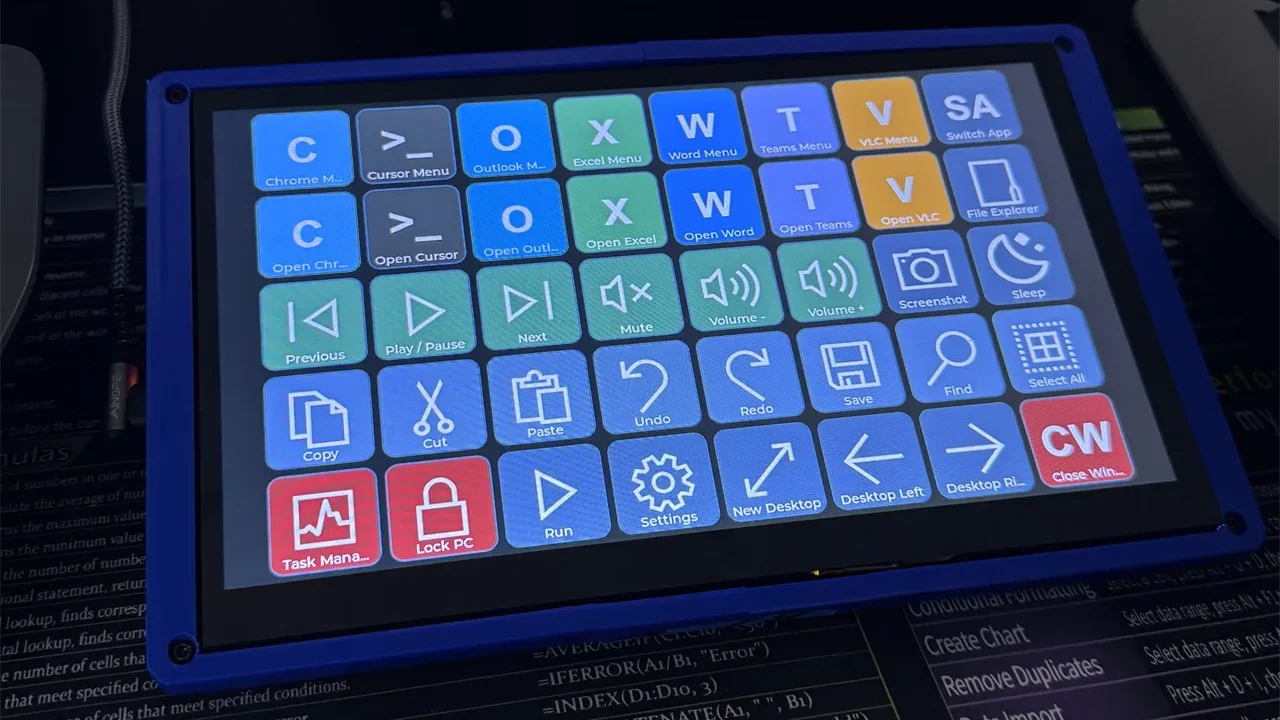
Stream decks are very useful when you’re live on camera and you need to hit some complicated macro at a glance. However, there is sometimes a perception that commercial options are a touch expensive for what they are, an attitude which has spawned many DIY builds. [Fady Faheem] has developed just such a device of his own.
Named Stream32, the build is intended to be simple to understand and adapt to one’s own individual workflow. Putting one together is as easy as buying a display, hooking it up to an ESP32, flashing the firmware, and then adding pages of shortcuts as desired. [Fady] has designed the firmware to be flexible with regards to screen choice — currently, it can be set up for a 4″ Waveshare LCD or a nice roomy 10.1″ display from Elecrow. Since it’s open source, adapting to a wider range of displays is a potential exercise for the builder.
The great thing about custom stream decks is you have all the freedom in the world to customize them to your own specific setup. Play with the code, the functionality, the visual layout—all to suit your own needs. If you’re working on your own custom hardware, be sure to tell us on the tipsline.

While we’ve largely settled on analog sticks and digital buttons for controlling video games, there’s all sorts of projects to create truly esoteric controllers that allow playing games in unique ways. This one from [sukolupo] lets you use data from standard bike trainers to get your virtual character moving.
Called Deck de France, it maps the data coming from one of the supported bike trainers to a virtual controller which can then be “plugged in” to a gaming console of choice, in this case a Steam Deck mounted to the trainer’s handlebars. Although a bike trainer doesn’t have the same number of inputs as a modern gaming controller, it does have enough to play games like Rocket League. As you might expect, it’s also perfect for biking titles such as the Tour de France series.
As far as unique controllers for video games go, this one is surely up in the rankings with a real trombone or a controller purpose-built for riding virtual horses. It’s also a great way for those who are getting a bit bored of riding their trainers to breathe some new life into their exercise routine. We’ve also seen some open-source alternatives for modern bike trainer software as well, which is another great way to get excited about exercise equipment too.

Majestic Labs, a startup founded in 2023 by former Google and Meta engineers, has unveiled a server built to rival Nvidia‘s GPU and HBM combination.
The Tel Aviv-based company argues that pairing costly graphics processors with high-bandwidth memory has become a fundamentally memory-bound and dead-end approach for AI inference.
Its answer is the Prometheus server, which swaps GPUs for Ignite AI Processing Units combining Arm cores with RISC-V vector and tensor engines.
Latest Videos FromTechRadar
Each Prometheus server can house up to 12 AIUs, sharing between 8 TB and 128 TB of LPDDR6 memory across one contiguous, coherent pool.
That memory pool is accessed through custom memory aggregation chiplets linked by copper cables up to one metre long instead of memory attached directly to GPU packages.
A standard 40U rack can hold four such servers, drawing 120 kW total and cooled through cold-plate liquid systems rather than air.
By comparison, an Nvidia DGX B300 system with eight Blackwell GPUs offers 2.3 TB of HBM3e plus up to 4 TB of DDR5 system memory.
Majestic claims its architecture therefore delivers over 50 times more fast memory than that rival configuration, alongside 1.7 times its interconnect bandwidth.
“One Majestic rack holds the fast memory capacity of 25 Nvidia NVL72 Vera Rubin racks at a fraction of the power,” Majestic Lab said.
“Organizations that could never justify hyperscaler infrastructure can now run any workload. In fact, there can be up to “1000× more memory per processor.”
Majestic Labs says the Prometheus server could cost between 10 and 50 times less than a GPU system of equivalent performance once it ships next year, while consuming less electricity per rack.
The server is designed to be OCP-compliant and will support PyTorch, vLLM and OpenAI’s Triton frameworks, letting existing AI models run without modification.
Founded by CEO Ofer Shacham, President Sha Rabii and COO Masumi Reynders, the company employs around 40 people across Tel Aviv and Los Angeles and raised $100 million in an A-round late in 2025.
It claims to have already received significant orders from large enterprises, neoclouds and hyperscalers.
Yet several details remain unclear, including how many memory aggregation chiplets a single server actually requires.
If a 128 TB configuration relies on widely available 2 GB LPDDR6 dies, it would need roughly 64,000 of them, implying well over a hundred aggregation chiplets per server.
The numbers Majestic Labs presents are striking, but they remain the startup’s own projections ahead of any independent benchmarking or shipped hardware.
Enterprise buyers considering a shift away from established GPU vendors may have to wait for independent validation to verify Majestic’s claims.
Via Blocks and Files

Follow TechRadar on Google News and add us as a preferred source to get our expert news, reviews, and opinion in your feeds.




Commonwealth Games boxing: Jadumani Singh seals dominant 5-0 win over Pakistan’s Sumama Rehman to enter quarter-finals | Commonwealth Games News


Why Trees Belong on the Risk Register


Weekend Open Thread: Wit & Wisdom


Intel is reversing course and bringing hyper-threading back to its server chips


Meta enters AI-training agreement with far-right ‘propaganda rag’ Newsmax


Luke Littler dismantles Gerwyn Price to retain title in Blackpool


MicroStrategy Post-Earnings CLARITY Act Push Could Add New Catalyst for Its Stock


The Part of the Electric Transition Nobody Wants to Discuss

‘Stargate’ Creator’s New Sci-Fi Series Returns for Season 3 Tomorrow


BITCOIN JUST ENTERED THIS CRITICAL ZONE…


Major shareholder moves on Canyon


XRP Ledger adds $2.6B as RWA inflows rank second


Spain sweeps the board at 2026 World Cup with individual awards


Bitcoin Enters the 3rd Stage of the Bear Market
XRP Ledger v3.3.0 brings five institutional features


Kraken Enables Retail Access to Jersey Mike’s IPO via Tokenized Shares


New macOS Sequoia & Sonoma security updates for older Macs


Claude: Build Financial Dashboards in Minutes (2026)


Luke Littler’s dominance sparks GOAT debate


Seema Kaliramna Wins Discus Throw Bronze, Takes India’s CWG Medals Tally To 17


You must be logged in to post a comment Login