Tony Siu, founder of Coffee & Code Philadelphia and an AI engineer and community builder, aims to advance a model of ecosystem development that blends human connection with the thoughtful use of AI. His approach reflects a community-first, servitude-leadership philosophy where participation, shared learning, and developer advocacy evolve alongside scalable systems, offering insight into how modern tech ecosystems can grow with intention.
Coffee & Code Philadelphia reflects how these dynamics take shape locally. From informal coding sessions, it has grown into a collaborative network where developers, designers, and founders gather to build, learn, and exchange ideas. Weekly meetups, technical workshops, and community-driven events create an environment where knowledge flows organically. Siu says, “I’ve noticed that spending time building alongside others often leads to conversations that happen naturally, and those moments can open the door to ideas that don’t always come up when working alone.”
This growth aligns with a bottom-up approach to leadership. Instead of directing outcomes, Siu focuses on enabling others to contribute based on their strengths. Participation becomes self-directed, and collaboration develops through shared interest. Such an approach reframes developer relations as a form of leadership.
Advertisement
“I see developer advocates as connectors who help bridge technical teams and the broader community,” Siu remarks. “By being present and engaged, we help create space for mentorship, experimentation, and shared learning, which can support both individual growth and the adoption of new technologies.”
The 💜 of EU tech
The latest rumblings from the EU tech scene, a story from our wise ol’ founder Boris, and some questionable AI art. It’s free, every week, in your inbox. Sign up now!
AI plays a supporting role in enabling this scale. Within the community, AI systems assist with operational processes such as event coordination, sponsorship management, and reporting. These tools allow a small organizing group to sustain a growing ecosystem while maintaining consistency. Siu says, “AI can extend how much a team is able to manage, especially in coordination. The interactions between people, though, are where most of the value continues to develop.”
Advertisement
As communities expand, maintaining authenticity becomes an ongoing consideration. Growth introduces new dynamics, from varied communication styles to broader participation. In-person interaction continues to play a key role in sustaining connection, as collaborative problem-solving and shared experiences deepen engagement. Siu says, “Scaling introduces complexity, and part of the process involves finding ways to keep interactions meaningful as more people become involved.”
Coffee & Code’s recent initiative showed how this balance can extend to larger settings. According to Siu, the Philly Startup Expo at Pennovation Works brought together a wide mix of founders, builders, and community members, with participants from other major tech hubs, as well as traveling in from abroad. “What struck me most innovative is definitely not the pitches, the startups, or even the heavyweight panel. It’s the creativity and resourcefulness of the tech startups resembling the grit, innovation and entrepreneurship of the founding fathers”, he says. Partnering with OneSixOne Ventures, Coffee & Code hosted and held a panel featuring UE Ventures, alongside others, the event featured hands-on demos across AI, spatial computing, and emerging software, and the involvement of startup teams added depth to the conversations. Throughout the expo, Siu notes that there was a clear sense of Philadelphia’s growing momentum as a technology hub.
For Siu, Philadelphia represents both opportunity and personal connection. His experiences across different learning environments shaped his appreciation for accessible, community-driven spaces. This philosophy also informs his guidance for emerging developers. He encourages building in public: sharing work and ideas early as they evolve. “When you share your work, even in its early stages, you create more opportunities to learn through interaction,” Siu explains. Participation in this way can open pathways for feedback, collaboration, and connection within the broader ecosystem.
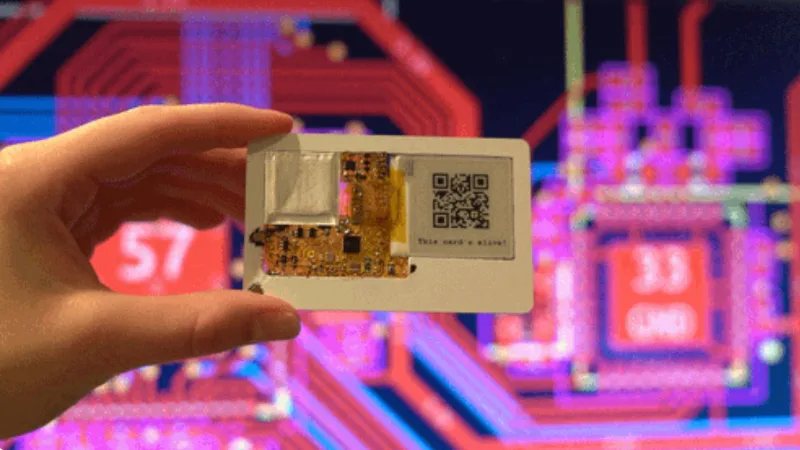
A computer the size of a credit card is nothing new. There have been many single-board computers following the familiar dimensions. [Krauseler]’s credit card computer is different, though. It packs an ESP32-C3, e-paper display, NFC reader, and, incredibly, a Li-Po battery into a credit card form factor in three dimensions rather than two. That’s right, this computer is only 1mm thick.
To ensure perfect compliance with the form factor, the enclosure, if that’s what it can be called, is a real NFC card with the middle cut out to take the electronics. The PCB is flexible, and the battery is the thinnest available. The e-paper display is an ultra-thin, flexible variant. A display connector would have been too thick, so a very fine wire-and-solder job was required.
On its own, an ESP32-C3-based computer with an NFC reader and an e-paper display would be a pretty cool project, depending on what software was on it. This one, however, redefines the term “credit card-sized.”
Researchers at MIT reached back to 1985 and pulled an old design out of storage. What they built with 3D printers now turns three floppy plastic strips into a solid beam in seconds. The device carries a simple name: the Y-zipper. Its triangular profile locks parts together so tightly that soft tentacles become load-bearing supports. Engineers can print the whole assembly in ordinary plastic and watch it switch states on command.
Bill Freeman came up with his initial fastener design while working as an electrical engineer at Polaroid. His goal was to develop a fastening mechanism that would allow chairs, tents, or bags to effortlessly transition between loose and taut forms without the need for additional hardware. Back then, however, companies lacked the ability to produce the three matching strips or the slider that looped around all three corners. Freeman submitted the patent but kept the drawings in a drawer. It wasn’t until 40 years later that the CSAIL team decided it was time to put it into production.
High-Speed Precision: Experience unparalleled speed and precision with the Bambu Lab A1 3D Printer. With an impressive acceleration of 10,000 mm/s…
Multi-Color Printing with AMS lite: Unlock your creativity with vibrant and multi-colored 3D prints. The Bambu Lab A1 3D printers make multi-color…
Full-Auto Calibration: Say goodbye to manual calibration hassles. The A1 3D printer takes care of all the calibration processes automatically…
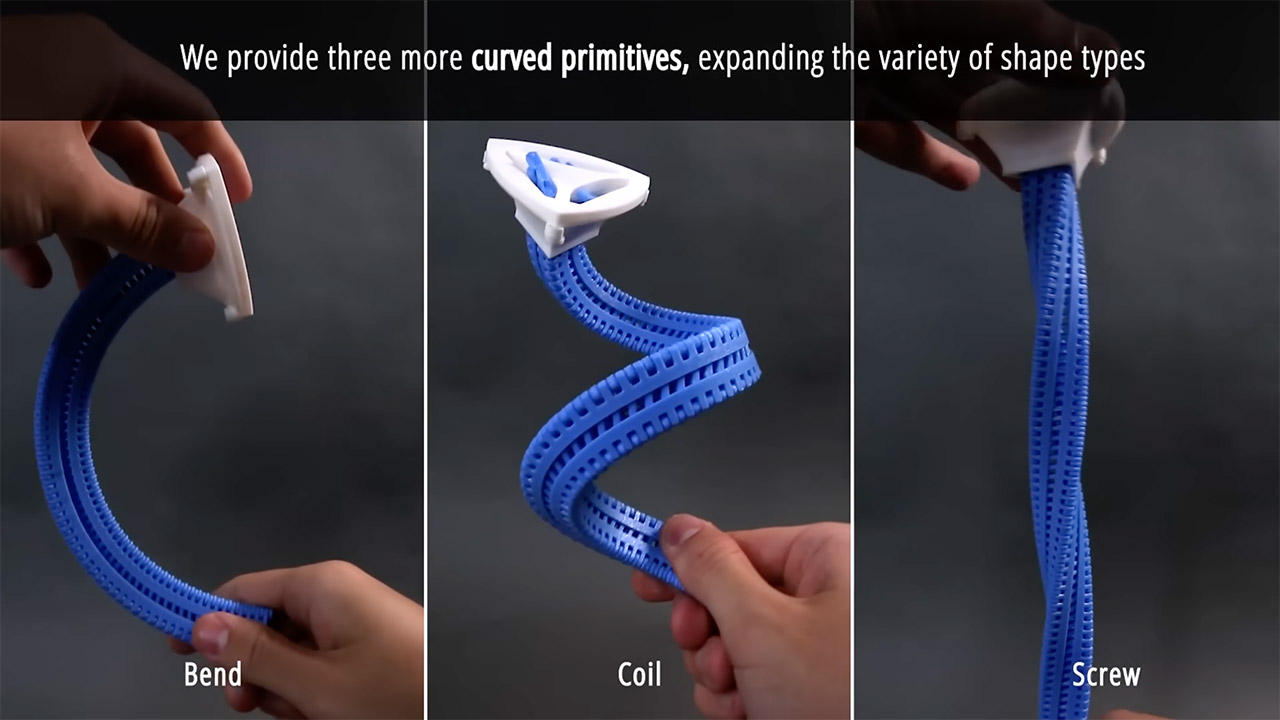
At its core, the system is made up of three separate bands, each with a row of interlocking teeth along two of its long edges. And on top of those bands is a single slider that pulls them all firmly into a triangle shape as it moves. Once the slider is tight, the shape will not bend or twist because triangles distribute stresses evenly. Slide the slider back, and the bands simply pull apart, leaving behind three wonderfully flexible (and independent) ribbons that can bend in almost any way you desire. No tools are required, and the whole operation reverses in no time.
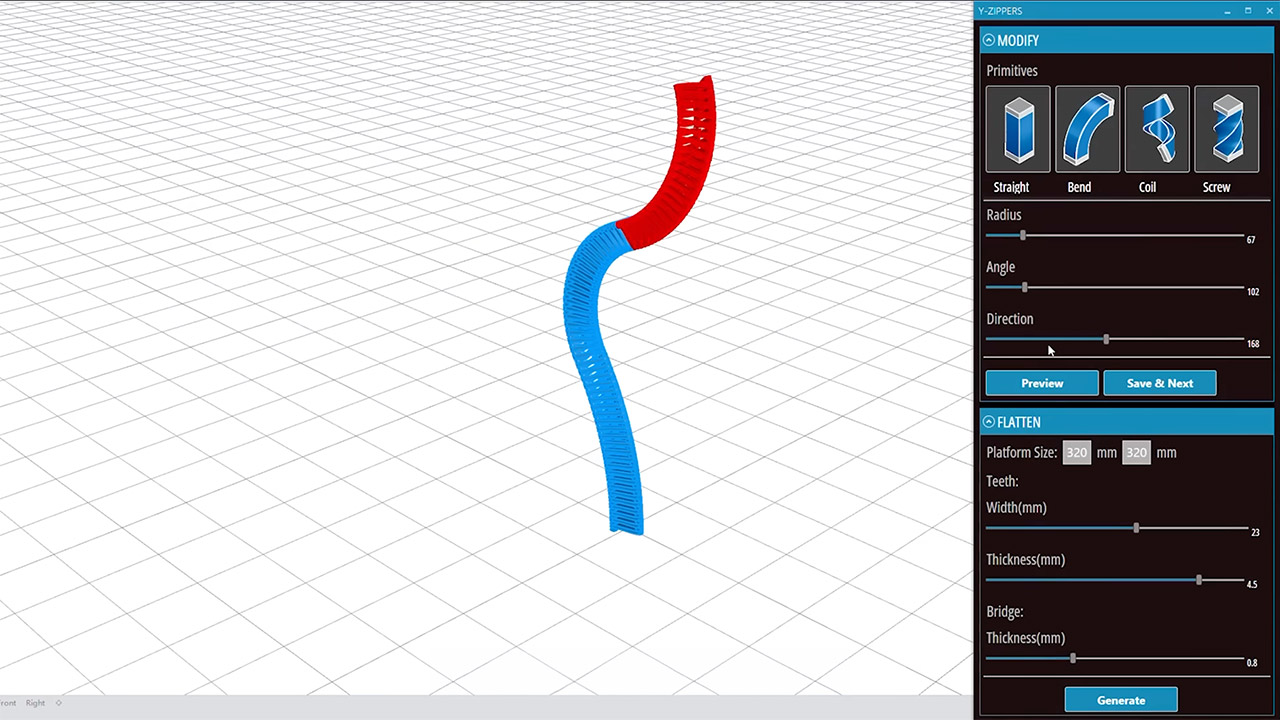
To make it all work, you simply need some software. You give the computer the size of each band, the direction it should curve, and the overall shape you desire (straight line, mild curve, tight spiral, or smooth twist). The software then generates a printable file, and the printer prints the bands made of either stiff (polylactic acid for heavy loads) or flexible (thermoplastic polyurethane for a bit of give). The layers glue together so well that those teeth fit together properly on the first try, with no handfitting required.
Tests have demonstrated how sturdy this assembly is. One system they tested went through 18,000 full open-and-close cycles without displaying even the least indication of wear on a single tooth, and the material flexes just enough to spread out any pressure and prevent snapping. They’ve also conducted load simulations and discovered that the zipped up triangle shape can support far more weight than a flat strip ever could.
Advertisement
Robots are already showing how advantageous this fastening system can be. They are employing a four-legged prototype with a zipper inside each limb. The motors then simply slide the fasteners up and down as needed. When the zippers are tightened, the legs become higher and stiffer, allowing the robot to stroll over rough terrain with ease. When the zippers loosen, the identical limbs drop down low and become much softer, allowing the robot to glide through tiny gaps, and the entire process happens in less than a blink.
Tents are pitched with the same simple hardware that has always been used. Three printed arms emerge and hook onto the cloth panels, and a short burst of power closes the zippers and the entire thing leaps into place in less than a minute and twenty seconds. No more wrestling poles for hours on end; setup is now a breeze. The tent still packs up neatly because when the zippers are closed, the printed arms fold flat.
Medical casts have also become much more comfortable, with one version that wraps over your wrist like a luxury wristband and can be left open during the day to allow your patient to walk about freely. However, as night falls, the slider clicks shut and the support begins to firm up to protect the healing bones. The patient gets to choose when to make the change by flipping a small switch. Artists have even come up with inventive uses for this technology, such as a mechanical flower sitting on a table. [Source]
The new roles will be in areas such as quality, regulatory, supply chain, finance and support functions, according to Evumed.
Cork Airport Business Park has announced plans to host the European headquarters of Evumed, a biopharmaceutical company that has committed to a multimillion-euro investment.
The move will see the creation of the 30 new jobs at Evumed throughout 2026, in areas such as quality, regulatory, supply chain, finance and support functions. Evumed aims to advance healthcare by ensuring continuity of supply and enabling patients across Europe to access high-quality, affordable medications.
At Cork Airport Business Park, Evumed’s headquarters are located alongside globally recognised names such as Amazon, IBM, McKesson, Emerson, Aviva, GSK, Statkraft and Red Hat and letting agents are currently in talks with an additional three global organisations regarding potential tenancies at the site.
Advertisement
Colm Moynihan, the president of Evumed, said: “Cork Airport Business Park’s exceptional global connectivity and modern infrastructure, coupled with Cork’s position as a global hub for pharmaceutical manufacturing and innovation offers Evumed the ideal location to grow as we aim to develop and deliver generic, branded and biologic medicines and bring innovation and accessibility together to improve lives.”
There are a range of career opportunities open to Cork-based professionals currently. In April, US software development company MongoDB, which has locations in Dublin and Cork, announced plans to invest €74m into its Irish operations – a move that will generate 200 new jobs.
In March, data management and cloud data platform provider Qumulo officially launched its new European software R&D hub in Cork, amid a plan for expansion that will create 50 new jobs in the area over the next three years. New roles will include opportunities in engineering, R&D and customer service.
Don’t miss out on the knowledge you need to succeed. Sign up for the Daily Brief, Silicon Republic’s digest of need-to-know sci-tech news.
The 2026 American Innovation $1 Coin project will honor former Apple CEO Steve Jobs with a one-dollar coin bearing his image that costs, at best, $1.55 each.
In 2018, the United States Mint (Mint) announced that it would honor American innovation and pioneering efforts of individuals or groups with $1 coins. Coins will be issued for each of the 50 states, the District of Columbia, and the five U.S. territories.
This year, the Mint will be issuing California’s coin, which will feature “a young Steve Jobs sitting in front of a quintessentially northern California landscape of oak-covered rolling hills.” The Mint works directly with the office of the Governor or other Chief Executive for each state, territory, or city to determine both the subject and design.
“The innovative and entrepreneurial spirit of Steve Jobs embodied the best of California, creating the future we all know today,” Governor Newsom said in a press release on Monday. “His tenacity and fearless pursuit of the California Dream made so many American dreams possible. May we all attempt to fill his shoes as we seek our own California Dreams.”
Advertisement
According to the Mint, the Secretary of the Treasury selects the final design for each coin.
“I’m pleased to celebrate the release of the California American Innovation $1 Coin,” said Mint Director Paul Hollis.
“Steve Jobs was a remarkable innovator and transformed how the world connects and communicates,” Hollis said. “Through this coin, the Mint honors his incredible work and recognizes his importance to both California and the United States.”
The design includes the inscriptions “Steve Jobs” and “Make Something Wonderful.” The latter is a nod to a larger phrase that Jobs said from an internal Apple employee-communications meeting held on October 23, 2007, as noted by The Steve Jobs Archive.
Advertisement
The whole quote, for those interested, is:
There’s lots of ways to be as a person, and some people express their deep appreciation in different ways, but one of the ways that I believe people express their appreciation to the rest of humanity is to make something wonderful and put it out there.
Those interested in purchasing the coins can do so via the United States Mint website. Prospective buyers can select between a roll of 25 coins or a bag of 100 coins, and can pick whether the coins are minted in Denver or Philadelphia.
A roll of coins, regardless of mint location, will cost a buyer $61, or $2.44 each. A bag of coins will cost $154.50, or roughly $1.55 each.
Orders for the 100-coin bags are limited to 10 per household. Orders for the rolls are also limited to 10 per household.
Advertisement
Coins go on sale via the United States Mint website starting on May 12, 2026. There will be a total 25,950 Steve Jobs dollar coins manufactured.
Previous states and their innovations include Pennsylvania and the Polio vaccine, New Jersey and the lightbulb, Ohio and the Underground Railroad, and Texas and the International Space Station. To date, 33 states have had coin designs released or revealed.
This win underscores the global standard of Malaysia’s technology sandboxing framework, where we competed with over 1,000 nominations from 29 Asia-Pacific markets to secure gold.
For context, the Stevie Awards is a global premier business award competition that evaluates thousands of the world’s most respected executives, entrepreneurs, innovators, and business educators.
Advertisement
Securing its spot on the list distinguishes the NTIS programme as a prominent regional industrial and technological player. The panel of judges even praised the programme as one that sets a new benchmark for strategic technology planning.
“This award belongs to the entire Malaysian innovation ecosystem. By working alongside regulators, industry partners, and government agencies, NTIS has proven that a collaborative ‘living lab’ approach can yield extraordinary economic results,” he added.
A cornerstone of Malaysia’s innovation ecosystem
Image Credit: MRANTI
A national government initiative spearheaded by MOSTI with Malaysian Research Accelerator for Technology and Innovation (MRANTI) as its lead secretariat, NTIS provides a structured platform for researchers and startups to efficiently validate high-growth technologies like autonomous systems and advanced robotics.
It’s a dynamic and open innovation ecosystem that allows researchers and entrepreneurs to test their products and services in a live environment. Participants are then able to qualify for grants to bring their products and services to market, thereby bridging the gap between innovative concepts and being commercially viable.
Advertisement
Since its inception in 2020, the programme has matured from a strategic pilot into a cornerstone of Malaysia’s innovation ecosystem.
It has delivered substantial results under the 12th Malaysian Plan (RMKe-12), including but not limited to:
facilitating over RM17.8 million in total commercialisation value,
distributing RM142.2 million in funding to support 229 high-impact projects,
catalysed the creation of 333 high-income jobs, strengthening the nation’s technical workforce,
generating RM122.8 million in export value through 14 focused international projects, and
managing a robust portfolio of 66 Intellectual Properties (IPs), with 36 new IPs filed to safeguard local innovation.
Each of these government agencies play crucial roles in coordinating the nation’s innovation ecosystem and advancing the growth of local innovators.
En route to becoming a high-tech nation
Image Credit: MRANTI
Bagging this award signals a major shift in Malaysia’s approach towards economic development, where we’re moving beyond just focusing on technological progress. Instead, we’re now focusing on getting our homegrown innovations adopted, commercialised, and ready to deliver real impact to the nation.
Ashran Dato’ Ghazi, the CEO of MRANTI and the lead secretariat of NTIS programme expressed, “Winning the Gold Stevie Award is a testament to Malaysia’s unwavering commitment to becoming a high-tech, high-income nation.”
Advertisement
In alignment with this, YB Datuk Chang Lih Kang shared that moving forward, the NTIS programme will be scaling its efforts in accelerating market adoption and expanding the global presence of Malaysian technologies under the 13th Malaysian Plan (RMKe-13).
As NTIS enters its next chapter, it’ll be shifting the focus towards “Deepening Impact” through its Global Testbed & Sandbox Alliance (GTSA), facilitating cross-border collaboration and regulatory harmonisation.
HIDDEN is an outdoor escape room game that allows players to explore Singapore’s neighbourhoods & history
Singapore is not short of escape rooms, ones that are usually built indoors and feature puzzles for participants to solve for them to beat the game and “escape” the room.
However, there is one business that is taking the concept of escape room outdoors, and that is HIDDEN.
We spoke with HIDDEN co-founders, Lim Yee Hung, 40 and Loh Jun Wei, 40, to find out how they captivate “thousands of people” weekly with their game that blends the physical world with the virtual.
Returning home inspired HIDDEN
(L to R): Lim Yee Hung and Loh Jun Wei, the two co-founders of HIDDEN./ Image Credit: HIDDEN
Having been in the United Kingdom for 14 years, Yee Hung had spent his time there as a terrain analyst in London for Deloitte and a property developer, particularly specialising in theme park projects.
One of his projects was Castle Black from Game of Thrones, for which he signed a license with HBO to turn it into a theme park.
Advertisement
When COVID-19 hit, Yee Hung sold off his projects in Britain and returned to Singapore, where he taught himself to code and built HIDDEN with his co-founder and ex-JC classmate, Jun Wei. The duo launched in May 2022, a time Yee Hung called “perfect” during the circuit breaker period.
“People loved that it got them out of the house, having fun learning about their own backyards, while still being compliant with social distancing rules,” he said.
Despite spending close to two decades away from Singapore, Yee Hung said he never really lost touch with home. Instead, returning made him realise just how much the country had changed while he was away.
“When I left Singapore in 2007, Marina Bay Sands, Gardens by the Bay, and Jewel didn’t exist. The population was under five million. Coming back, it was a very different Singapore: over six million people, a new skyline, and a new energy to the city,” Yee Hung recalled.
Advertisement
At the same time, many of the places from his childhood had disappeared too, from the neighbourhood shops he used to frequent, to the flat he grew up in and the fields where he played football.
That sense of loss eventually became the inspiration behind HIDDEN Singapore. To Yee Hung, the game was a way of preserving both the Singapore that no longer exists and the present-day Singapore that could one day disappear too.
It was my way of preserving the Singapore that’s gone and the Singapore now that we will no doubt miss 10 years from today, because Singapore changes so, so fast.
Digging through Singapore’s archives to build HIDDEN
Players during a HIDDEN game./ Image Credit: Lim Yee Hung
Drawing from his experience working with global brands like HBO, Yee Hung wanted HIDDEN to go beyond surface-level storytelling and create experiences that genuinely immerse people in Singapore’s history and culture.
“When you’re working at that level, it’s not enough to just capture the vibe. You’re expected to do the research, really understand the source material, the characters, the story, and the world. And more importantly, your work has to add to it, not just reference it,” he shared.
While working on the Castle Black theme park project, Yee Hung became deeply familiar with the Game of Thrones universe, even down to the exact spots where key scenes involving Jon Snow took place. That experience taught him the importance of treating source material with depth, care, and respect.
Advertisement
It was a philosophy he carried over when building HIDDEN.
In the foreground are the Singapore Improvement Trust flats in Redhill Close. Yee Hung’s archival research, including oral history interviews, uncovered unexpected insights into Redhill’s past, revealing accounts of gang activity and secret societies that once operated in the area./ Image Credit: National Archives of Singapore
Instead of creating generic sightseeing trails, Yee Hung and Jun Wei spent around six months developing and coding the game. This included researching Singapore’s archives, piecing together historical materials and identifying the core narrative behind each neighbourhood.
Rather than developing a standalone app, they intentionally chose to have a chatbot integrated into WhatsApp as the platform to make the experience more accessible, especially for older users, while also making interactions feel more immersive by allowing players to “chat” directly with in-game characters.
How the game works
All this being said, you might be curious how the game actually works. HIDDEN turns Singapore’s architecture and neighbourhoods into a real-life immersive game.
Led by Void Deck Cat, the game’s in-house mascot and WhatsApp chatbot, players receive clues that guide them on quests across Singapore. By analysing architecture and their environment, they solve puzzles while unlocking historical photographs and stories.
Advertisement
Players interact with HIDDEN’s Void Deck Cat throughout the game./ Image Credit: HIDDEN
As players explore different locations, they can text their answers to the chatbot or ask for hints if they get stuck.
Players start at a designated location, where they scan a QR code to begin. Each adventure has its own theme and starting point. For example, the MONOPOLY: Katong-Joo Chiat experience begins at the Singapore Visitor Centre.
Black Earth Auction House is one of the places explored in HIDDEN’s MONOPOLY-themed adventure./ Image Credit: HIDDEN
All public adventures are self-guided and take around 60 minutes to two hours to complete. Each experience is priced from S$29.90 and comes with merchandise as well as freebies from local merchants exclusive to that adventure.
While the game can be played solo, Yee Hung recommends playing in groups of two to five so everyone can actively take part in solving clues. There are currently seven public adventures and seven corporate adventures available across Singapore.
As players move through neighbourhoods, they interact with Void Deck Cat via WhatsApp, receiving clues that prompt them to observe their surroundings.
Along the way, players can also unlock perks that direct them to local independent businesses such as pineapple bakery Kele for breaks and surprise rewards. In MONOPOLY-themed games, players even receive MONOPOLY money to spend at participating merchants.
Advertisement
At the end of the game, players submit their final answers and receive a summary page showing their completion time, missed clues, and the photos taken during their journey.
Strong reception locally and abroad
Building on its strong early traction since launch, HIDDEN has gone on to win the TripAdvisor Travellers’ Choice Award in its first year and has continued to receive it annually.
Yee Hung also shared that the experience has attracted more than 100,000 players to date, including both locals and tourists, with many returning to try different adventures.
Players during a HIDDEN game./ Image Credit: Lim Yee Hung
In addition, HIDDEN has secured major partnerships with brands such as Hasbro and the National Gallery Singapore, for its MONOPOLY and FRAMED tours respectively.
However, Yee Hung noted that the early days came with significant business challenges. These included convincing people to try a completely new concept, designing experiences that would genuinely delight players, and persuading local businesses and venues to participate in an untested format with no established track record.
Advertisement
With limited marketing budgets at the start, the team relied heavily on organic growth. “Word of mouth is free and so much more powerful,” he said.
On the operational side, Yee Hung also highlighted the technical demands of running HIDDEN at scale. The team had to ensure their systems could handle thousands of simultaneous chatbot interactions without crashing, which led them to build proprietary technology capable of managing the “heavy lifting” seamlessly.
They also had to carefully pace game sessions to avoid overwhelming their independent F&B partners with sudden surges of players.
(L to R): Hidden Aotearoa CEO Andrew Te Whaiti, Hidden Group CEO Lim Yee Hung, Singapore High Commissioner to New Zealand William Tan, Ngati Kahungunu ki Tamaki-nui-a-Rua chair Hayden Hape, Te Papa Foundation chairman Aaron Hape and Hidden Group COO Loh Jun Wei at the launch event of Hidden Aotearoa./ Image Credit: HIDDEN
In November 2024, HIDDEN expanded beyond Singapore into its first overseas market.
Yee Hung shared that the company became the first Singaporean business to sign a partnership agreement with a Māori tribe, Ngāti Kahungunu ki Tāmaki-nui-a-Rua in New Zealand, to develop outdoor adventure games rooted in Māori cultural stories. One of these projects is Hidden Aotearoa.
Advertisement
He noted that while the technology framework remains the same, the approach to storytelling changes completely depending on context. “The backend tech stays the same, but the cultural lens shifts entirely,” he said.
Reflecting on building Hidden Aotearoa for a New Zealand context, he added: “We learnt from our Māori partners that we mustn’t try to tell other people’s stories for them.”
In the future, Yee Hung sees continued global expansion on the cards. “I want HIDDEN to join the likes of Lego and IKEA, to become a global brand, bringing joy to people in cities all over the world,” he said.
Looking to upgrade your current desktop setup but aren’t sure where to start? Well, if your current keyboard is showing its age and just isn’t as responsive as it used to be, then getting a new keyboard is a solid way to kick things off. For the gamers and fast typers out there, you may be better suited with one of the best mechanical keyboards.
For those not in the know, mechanical keyboards use individual switches for every single key, instead of a membrane system that’s typically found on laptops and older keyboards. Although there’s no denying that mechanical keyboards are louder to type on, and probably aren’t the best option for use in a shared space, they do come with a ton of benefits.
For starters, because of the more refined and less squishy nature of the keys themselves, you can type at a much faster speed which is great for anyone who uses Microsoft Word or Google Docs for their day-to-day work. While this is a great boon for productivity, the real benefit of the tactile sensation that only mechanical keys provide can be found in gaming.
Mechanical keyboards do a far better job at keeping you locked in with the action, and when you’re playing fast-paced titles like Counter-Strike 2 or Rainbow Six Siege, which require lightning-fast reaction times, playing with anything other than a mechanical keyboard can be a disastrous idea.
Advertisement
Although there are some gaming laptops that come with mechanical keys built in, your best bet is to buy one separately, especially if you’re gaming at a desk. Our team of experts have put together this very guide to pair you with the right mechanical keyboard for your needs. For more buying advice, check out our breakdowns of the best gaming monitors and the best gaming mice.
Best mechanical keyboards at a glance
Advertisement
SQUIRREL_ANCHOR_LIST
Learn more about how we test keyboards
We use every keyboard we test for at least a week. During that time, we’ll check it for ease of use and put it through its paces by playing a variety of different genres, including FPS, strategy and MOBAs.
Advertisement
We also check each keyboard’s software to see how easy it is to customise and set up.
Pros
Wonderfully sturdy
Immensely powerful hall-effect switches
Lightweight and powerful software
Cons
Some may prefer a smaller layout
Pros
Gorgeous aluminium chassis
Fast HE switches
Capable software
Cons
Expensive
Software’s UI could do with a little more polish
Pros
Fast and responsive switches
Durable aluminium chassis
Quality touches including PBT keycaps
Pros
Space-age design is rather cool
Responsive switches
Solid software customisation
Cons
Expensive
Some may want a wireless choice
Pros
Clever and unique layout
Responsive feel
Versatile connectivity and software
Cons
Quite a niche option
Quite expensive
Pros
Sleek looks
Powerful hall effect switches
Competent software
Pros
Impeccable build quality
Powerful switches with rapid trigger
Fantastic software
Cons
Expensive
Some may prefer a wireless keyboard
Pros
Wonderfully clever modularity
Excellent soft-tactile typing feel
Convenient software control
Cons
Can be quite expensive
PBT keycaps would have been a worthwhile addition
Pros
Excellent build quality
Powerful switches with rapid trigger
Convenient software programming
Cons
Some rivals have more advanced switch features
Some may prefer a wireless connection
Pros
Especially potent hall effect switches
Solid build quality
Powerful software
Cons
Quite expensive
Battery life not as strong as other Keychron models
Wonderfully sturdy
Immensely powerful hall-effect switches
Lightweight and powerful software
Some may prefer a smaller layout
Advertisement
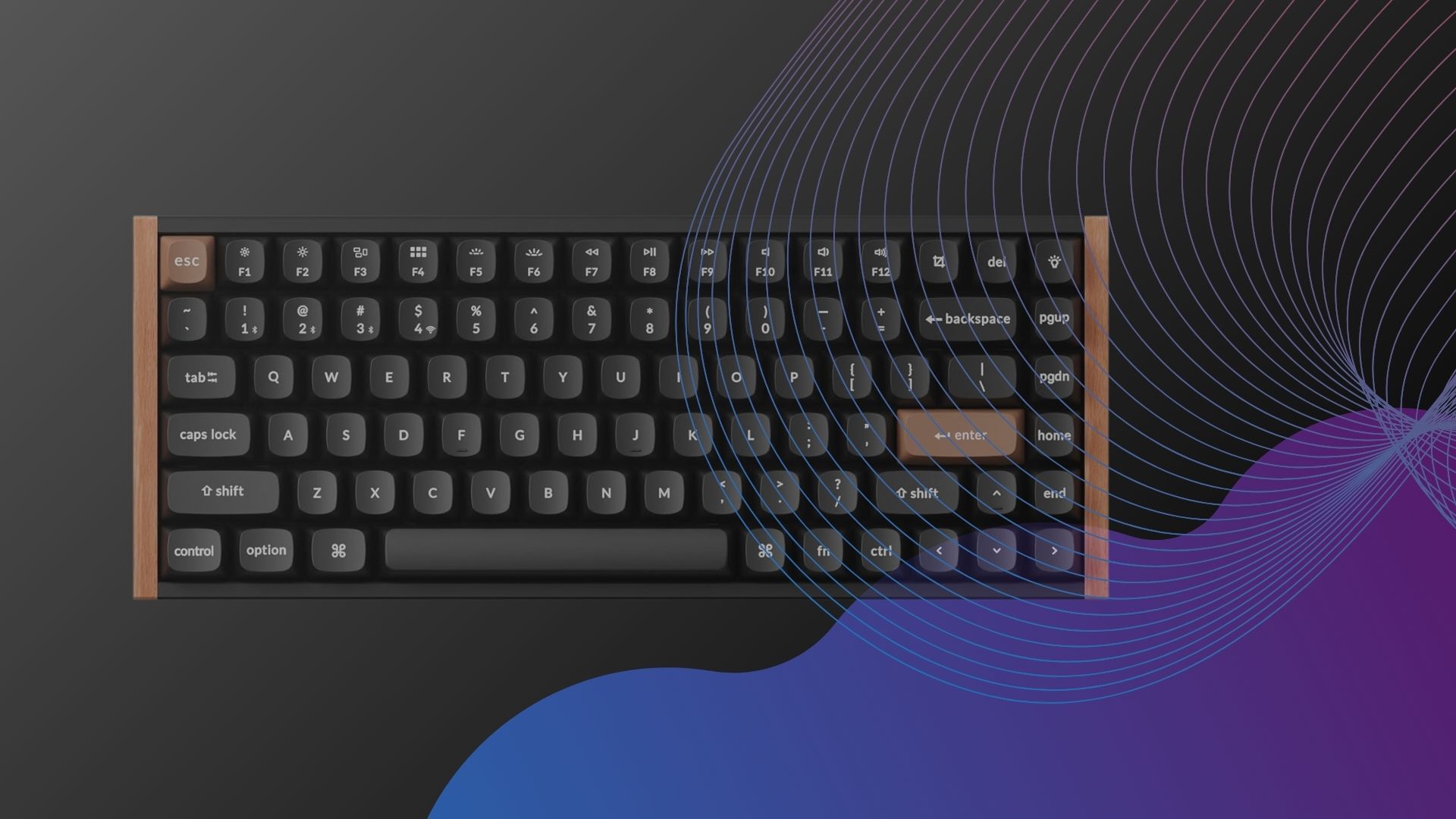
There’s been a definite trend as of late to make mechanical keyboards smaller and more compact so that they can be easily transported from one location to another, and whilst that’s been great for people who are always on the move, it does leave something to be desired for the full-sized keyboards of old. Thankfully, the Keychron K4 HE does away with this trend completely.
Not only is there a full row of function keys on the K4 HE, there’s also a number pad which makes it great for both spreadsheets and games that require plenty of input options. Don’t think that the larger frame comes at the expense of the aesthetic – there are rosewood accents on either side of the keyboard that really help it to stand out, and the light brown colouring of the Esc and Enter keys just pops whenever you look at them.
Beyond the design, there is a ton of functionality here, with wonderfully clicky hall effect switches. Thanks to the benefits that rapid trigger brings to the table, the keys reset almost instantly once they’ve been pressed, so super fast touch typers out there will get on brilliantly here when it comes to typing up documents and emails.
If you have a home office set-up that includes more than one device then you’ll be glad to know that the K4 HE can connect to up to four devices at one. This is perfect for jumping between a tablet and a laptop, or even your smartphone. You’ve got Bluetooth connectivity as well as 2.4GHz functionality via a receiver, so you have plenty of flexibility in this area.
Advertisement
What tops the whole thing off brilliantly is the fact that this is a keyboard you won’t have to charge all that often, even after long stints away from a power outlet. You can anticipate 110 hours of use from a single charge, which is great news for when you’re heading off on a work trip. As a final note, there’s also RGB lighting which can be customised via Keychron’s launcher, providing a bit of personal flair to the proceedings.
Gorgeous aluminium chassis
Fast HE switches
Capable software
Advertisement
Expensive
Software’s UI could do with a little more polish
Although it certainly won’t be for everyone, Gravastar is known for its dedication to a sci-fi like aesthetic across its major products, and that remains true for the Gravastar Mercury V60 Pro. Sure, it might look a little out of place on a desk that also gets used for work during the day, but there’s no denying that if you want a mechanical keyboard with a little extra sauce from a visual standpoint, then this is a great option to go for.
The unique aluminium frame, which showcases a handful of lights on the side of the keyboard, is unlike anything we’ve seen (outside of other products from Gravastar itself) and it’s not just for show either. The V60 Pro also has quite a durable feel about it, giving you plenty of confidence that you can type away at speed and never really have to worry about the impact.
Despite its more bombastic design, the V60 Pro doesn’t take up unnecessary space on your desk thanks to a compact 65% layout, so if you only have a small surface area to work with then you won’t have any issues here. The keys themselves use Hall effect switches so they’re also designed to last a long time, which is always great news for consumer value.
Advertisement
Depending on how you like to play, the V60 Pro packs adjustable actuation points so that you can tweak things to your liking. If you prefer having as little travel as possible in order to instigate quick movements or minimise reload time as much as possible, then you can do just that.
Pro gamers won’t have any issues with staying locked into the action thanks to a blazingly fast 8000Hz polling rate, creating no discernible delay when in use. The only area where the V60 Pro could have had some improvement is in the UI of the accompanying Gravastar software which, despite being feature-packed, is more convoluted than it needs to be.
Advertisement
Fast and responsive switches
Durable aluminium chassis
Quality touches including PBT keycaps
You wouldn’t normally associate Sony with PC gaming, aside from the fact that a few PS5 exclusives like Returnal and The Last of Us Part I have come out of their walled garden and are now available to play on PC, but the brand does have a solid presence in this arena. There are quite a few headsets and monitors that are worth talking about, but in the keyboard space, it’s the Sony Inzone KBD-H75 that steps up as a great option.
Right off the bat, this is a wired keyboard, so you won’t be able to indulge in the wireless lifestyle that Sony is typically known for with its DualSense controllers, but the benefit of a wired connection is the super-fast 8000Hz polling rate which allows the Inzone KBD-H75 to be a shoo-in for pro gamers.
On top of the responsiveness, the Inzone KBD-H75 is very durable thanks to two separate factors: the aluminium chassis and the PBT keycaps. On the former, the Inzone KBD-H75 could take a knock or two when in transit and you wouldn’t have to worry about it having a major impact on performance. PBT keycaps on the other hand are, by design, more capable of withstanding everyday use than regular keycaps, so they’ll hold up well over time.
Advertisement
This is a 75% layout keyboard so the keys have a bit more space to spread out, although you might prefer having something a tad more compact if you’re picky about having larger tech items on your desk. Still, with a bit more space to play around with, the Inzone KBD-H75 boasts a very helpful volume dial which we found to be very tactile.
Because the Inzone KBD-H75 comes from such a widely recognised brand, there is a price to pay for that reassurance as the £250/€300 tag is a lot higher than what you’d typically expect to pay for a mechanical keyboard. Still, because it works so flawlessly and packs a high-end build to boot, you are getting an amazing keyboard in return for the asking price.
Advertisement
Space-age design is rather cool
Responsive switches
Solid software customisation
Expensive
Some may want a wireless choice
Even by Gravastar’s standards, which lean heavily into head-turning, almost sci-fi-esque designs, the Gravastar Mercury V75 Pro feels like a whole new thing entirely. Sure, it’s got the space-age look of a Gravastar keyboard with RGB lighting on the sides and at the front, but the top of the keyboard looks almost like an abstract painting that’s splattered with ink of all colours.
Of course, there’s no denying that this type of look won’t be to everyone’s tastes but when you’ve tested so many mundane and unexciting products as we have, when something comes along with a more distinctive look, it just helps to raise the bar and remind companies that tech doesn’t have to just follow the crowd where looks are concerned.
Advertisement
When it comes to the performance side of things, the V75 Pro actually isn’t too different to Gravastar’s V60 Pro. Both of these keyboards have a high 8000Hz polling rate, so if you’re a pro gamer in need of a more responsive-feeling set of inputs then either of these options is a great choice.
The two keyboards also use Hall effect switches which can minimise the time it takes for your input to be registered, and it’s a more durable system that’s better designed to last over time. Still, if you want to minimise the time even further, you can change the actuation points, giving you the edge during fast-paced titles.
Where they differ is that the V75 Pro uses a larger 75% layout, which includes a volume rocker for quick access to audio controls, and the keyboard itself is wired while the V60 Pro is wireless. The V75 Pro is a tad more expensive too with a price tag of £229.95/$239.95, but for the design alone, we think it’s a worthy purchase.
Advertisement
Clever and unique layout
Responsive feel
Versatile connectivity and software
Quite a niche option
Quite expensive
Even though it looks like something that’s come straight out of the 90s, the Keychron Q60 Max is very much a premium keyboard in every sense of the word. With a £202.99/$199.99 asking price, the Q60 Max is bound to be too expensive for anyone wanting to stick to a reasonable budget, but if you are able to hold off and save a bit more, this is one keyboard that’s worth every penny.
Advertisement
As you may have spotted, this is far more of a compact option than a lot of other mechanical keyboards as it uses a much smaller 60% layout. This is a byproduct of its unique KKHB layout which makes a few key changes to key placement to allow for a fast typing experience. This includes having the Ctrl button moved to where the Caps Lock would usually sit.
The HHKB system does take some getting used to at first, but once it all makes sense, you’ll wonder how you ever tried to get work done without it. Because it’s more of a productivity-focused device, the Q60 Max is designed less with gaming in mind, and you’ll see that there are no dedicated arrow keys whatsoever. This isn’t to say that the keyboard can’t be used for gaming though, far from it.
If you do like to indulge in a bit of gaming after the working day is done then you’ll appreciate the gasket-mounted build of the Q60 Max, something that paves the way for a slightly bouncier feel that’s very enjoyable to type on. The keys themselves are hot swappable too, so you can tweak things to match your preferred aesthetic.
Where the Q60 Max really comes into its own however is with connectivity. Not only can you use the keyboard wirelessly via a 2.4GHz receiver, but there’s Bluetooth functionality so you can connect with up to four devices at one time. To minimise any sense of input lag, you can use the Q60 Max over a wired USB-C cable too.
Advertisement
Sleek looks
Powerful hall effect switches
Competent software
When it comes to PC gaming, very few companies carry quite the same gravitas as Asus, which is why it’s such a reliable brand when it comes to buying products that you know will adhere to a certain degree of quality. Thankfully, the Asus ROG Falchion Ace HFX keeps that reputation running by offering a very slick gaming keyboard that doesn’t leave you wanting for features.
Advertisement
Easily the best thing going for the Ace HFX is its overall design. If you’re not a big fan of the more bombastic gaming keyboards (like the ones from Gravistar) that would simply look too out of place during an average work day, then the Ace HFX fits the bill nicely. It’s compact with a 65% layout, but if you switch off the RGB lighting then you might not think that this particular keyboard has anything to do with gaming.
When you do dive into a gaming session however, this is where the Ace HFX really comes to life. Because the keyboard uses Hall effect keys (alongside PBT keycaps for better durability over time), you’re able to customise the actuation points to suit your playstyle.
If you want to limit the amount of time it takes for a key to register, so you can go through crucial inputs like reloading and crouching quickly, then you can do just that here. In fact, that sense of customisation only continues through Asus’ Armory Crate software, wherein you can change the RGB lighting to how you prefer it.
Advertisement
Across the top of the keyboard is a touch bar which can be used to quickly control the brightness and volume, and the keyboard itself boasts an 8000Hz polling rate for super-fast response times. The only real negative we can level at the Ace HFX is that at £239.99/$199.99, it costs quite a bit more than the competition, but the asking price is certainly worth it as far as we’re concerned.
Impeccable build quality
Powerful switches with rapid trigger
Fantastic software
Advertisement
Expensive
Some may prefer a wireless keyboard
Just like Asus, SteelSeries is another brand that instils a high level of confidence when it comes to PC gaming accessories. After all, the company makes some of our favourite gaming headsets right now, and thankfully a lot of that understanding over what PC gamers want has carried over into the SteelSeries Apex Pro Mini Gen 3.
Living up to the ‘Mini’ in its name, this particular SteelSeries keyboard is ideal for gamers who only have small desks to work with, or if you want to travel with a mechanical keyboard that won’t take up too much space in your bag. With a 60% layout, the Apex Pro Mini Gen 3 has taken away all but the bare essentials so you can lock in with each gaming session (who needs a number pad for FPS titles anyway?).
The keyboard also features SteelSeries’ new and improved OmniPoint 3.0 switches, which are the company’s take on Hall effect switches and are just as brilliant to use. Typing feels snappy and immensely satisfying, so even if you are just working on documents and reports throughout the day, the Apex Pro Mini Gen 3 is a great keyboard to have on hand.
Advertisement
Of course, it’s the ability to change the actuation points of those OmniPoint 3.0 switches that makes it such a great buy for gamers, as it’s ideal for pro gamers who have a very specific setup when they play. This might include a super-fast means of crouching to avoid fire at the last second, or to save time on reloading in between fights.
What really takes this keyboard to another level is the ability to tap into SteelSeries’ GG software, which offers up a ton of customisation. You can select from various presets, and even have the RGB settings change from one game to the next, something that adds a nice bit of visual flare if you like to stream your playthroughs.
Advertisement
Wonderfully clever modularity
Excellent soft-tactile typing feel
Convenient software control
Can be quite expensive
PBT keycaps would have been a worthwhile addition
If you’re a streamer on Twitch then there’s a good chance that you’ve already been eyeing up some of the gaming picks on this list, but for all that streaming entails, you’re better off getting a keyboard that provides more functionality than your average device. To that end, the Mountain Everest Max is just the thing thanks to its modular design.
With proprietary ports around the keyboard, you can add a handful of extras to the Everest Max including a number pad, which can go on either the left or the right, and backs a handful of quick access buttons along the top for your favourite apps/websites. It’s not too different from what you might find on the Elgato Stream Deck, but at least you don’t have to buy an entirely separate device here.
Advertisement
There’s also a media dock attachment that can go along the top of the Everest Max, making it very easy to change the volume and playback in a pinch. There’s even a small display on the dock that can show key bits of information like the current performance of the CPU, and which gaming profile the keyboard is currently set to (you can have multiple for different genres).
When it comes to the core typing experience, the Everest Max uses the phenomenal Cherry MX switches which are by far some of the best switches that money can buy. In our testing, we were impressed by how light a touch they require, and there’s almost a rhythmical quality to their sound. Most importantly however, they are responsive and can keep you locked into the action without any feeling of delay.
Another boon for the streamers out there is the fact that Mountain’s Base Camp software can be integrated with OBS Studio, so you can seamlessly enable recording and transitions whenever you need to. It would have been nice if the Everest Max included PBT keycaps for better durability in the long run, especially as the £249.99/$249.99 asking price certainly isn’t cheap, but there’s still a lot to like here regardless.
Advertisement
Excellent build quality
Powerful switches with rapid trigger
Convenient software programming
Some rivals have more advanced switch features
Some may prefer a wireless connection
For anyone in the market after a great gaming keyboard that feels great to type on, offers all of the main features you could possibly want and at a price that’s reasonable, look no further than the Logitech G Pro X TKL Rapid. Sure, it might have a name that doesn’t easily roll off the tongue, but there’s no friction to be had when using this exemplary keyboard.
Advertisement
The TKL Rapid’s analog switches utilise the brilliance of Hall effect design to offer up customisable actuation points. This is achieved thanks to the use of magnetics at the switch, so the actuation point can be reduced, giving you the chance to engage with core game mechanics at a faster pace. It can be as simple as crouching more quickly to avoid enemy fire, or opening up the team chat at a faster rate so you’re not vulnerable for too long.
Like a lot of our favourite mechanical keyboards, the TKL Rapid uses a tenkeyless design so you won’t see a number pad here. By ditching the num pad, the keyboard itself is far more compact and from a visual perspective, it allows your mind to focus on the keys that are actually going to be important in the middle of a game.
You can find even smaller options on this list, but by having a slightly larger build than a 60/65% layout keyboard, Logitech has been able to add a dedicated row of media controls at the top. If you’re the type of person who likes to listen to music as they work or game, then being able to change the volume or skip a track quickly is a huge boon.
The one thing to note is that this keyboard runs on a wired connection only, so you don’t have the same freedom of movement that wireless keyboards can provide. Still, given the aforementioned price tag of the TKL Rapid, this feels like a fair trade-off, and you’re still getting high-end PBT keycaps that are designed to last well into the future.
Advertisement
Especially potent hall effect switches
Solid build quality
Powerful software
Quite expensive
Battery life not as strong as other Keychron models
Advertisement
For any professionals who love to wind down after work with a spot of gaming, and as such require a keyboard that can be used all day without issue, the Keychron Q1 HE is a great pick. Not only does it pack all of the crucial features you would want from a mechanical keyboard, but its design also stands out from the crowd in just the right way.
The playful jump between white, black and a few keycaps in red provides the Q1 HE with an eye-catching look, but not one that’s overly distracting (something which could be said about Gravistar keyboards, even though they are great for gaming). This is very much the type of keyboard that could be sat in an office and wouldn’t feel too out of place.
There’s a good size to the Q1 HE as its 75% layout ensures that you have dedicated arrow keys, a proper function key row and page up/down keys, all of which can be very helpful when scrolling through documents or spreadsheets. What’s great is that the Q1 HE is also ready to meet you with the particular devices you use.
Advertisement
For example, you can use a 2.4GHz connection via the included dongle to get things started on your PC or laptop, but if you want to get to typing on your tablet or even a smartphone then you can do just that over a Bluetooth connection. Of course, if you’re gaming and you want to do away with any sense of delay with your inputs then you can use the keyboard over a wired connection too.
Speaking of gaming, you have the ability to change the actuation points on this keyboard via the accompanying software, which is perfect for a title like Counter-Strike 2 where every second counts and any chance to minimise input delay can end up tipping the scales in your favour. Although the battery life is a solid 100 hours, this is actually lower than a lot of Keychron’s other mechanical keyboards, so it might be worth checking out the company’s wares if you value battery life above all.
Advertisement
FAQs
Do mechanical keyboards make you type better?
Mechanical keyboards are traditionally said to help improve typing, given their more accurate and precise keypresses, and (depending on the switch you have) the feedback you receive with each input.
Is Asus better than Razer?
Advertisement
This is a subjective question, but for what it’s worth, there are a pair of brilliant Asus keyboards featured in the list above.
By which we mean it bought someone else’s with other people’s money
OpenAI can’t have inexperienced consultants derailing the AI hype train, so it’s launching a consultancy of its own to help enterprises find the value in its models necessary to justify the spending, revenue that Sam Altman’s company desperately needs to cover its infrastructure costs.
To support the endeavor, OpenAI has agreed to acquire UK-based AI consulting firm Tomoro. The terms of the acquisition weren’t disclosed.
Advertisement
Tomoro will form the backbone of the OpenAI Deployment Company, which will operate as a standalone business unit tasked with helping enterprises find the value that they’ve been missing from the AI flag bearer’s models.
But don’t worry, McKinsey. OpenAI’s new Forward Deployed Engineers (FDEs) are only there to make sure you don’t sour enterprises on AI by dragging them down an expensive rabbit hole that fails to deliver value.
The new company is backed by the usual assortment of AI-crazed venture capitalists and private equity firms, but several consultancies, including Capgemini, Bain, and yep, McKinsey, have agreed to plow billions into the venture.
OpenAI says that its AI consultancy will launch with more than $4 billion of investments.
Advertisement
Presumably, these consultancies will call in OpenAI’s FDEs when they need help proving AI can boost productivity and/or cut payroll.
According to OpenAI, a typical enterprise engagement will look a bit like this: OpenAI’s FDEs will launch a diagnostic to determine where AI can create the most value, then carry out a select set of PoCs.
If successful, the FDEs will then design, build, and deploy production systems that tie into enterprises’ existing customer data and tools.
The experience gained from these integrations will no doubt be used to improve OpenAI’s models and services.
Advertisement
The acquisition of Tomoro would bring approximately 150 FDEs and deployment specialists into OpenAI’s new consultancy unit. The deal is expected to close in the coming months, subject to regulatory approvals.
Whether enterprises should hitch their saddle to OpenAI’s success at a time when inference providers and model devs are already jacking prices in an effort to get their infrastructure costs under control is another matter entirely.
As we reported last week, with the launch of GPT-5.5, OpenAI once again increased its API pricing. For one million tokens, GPT-5.5 is priced at $5 (input), $0.50 (cached input), and $30 (output), double that of its predecessor. But don’t worry, OpenAI says the model might be more frugal about how it uses those tokens. ®
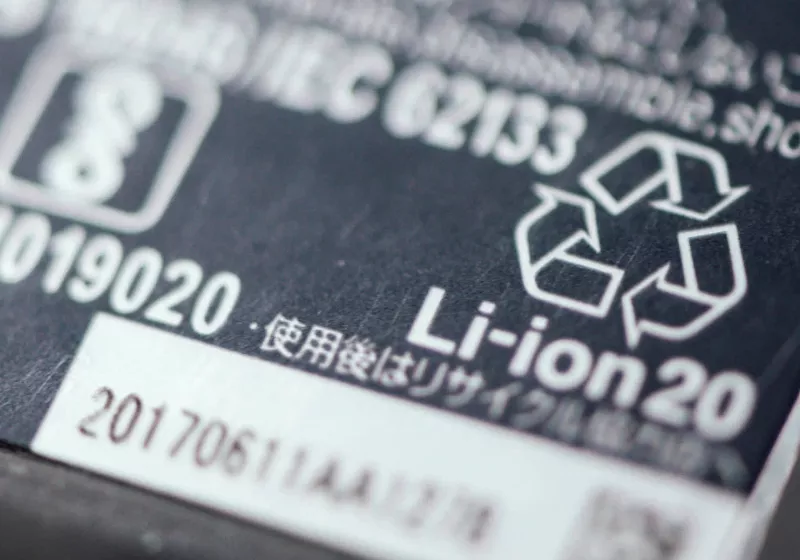
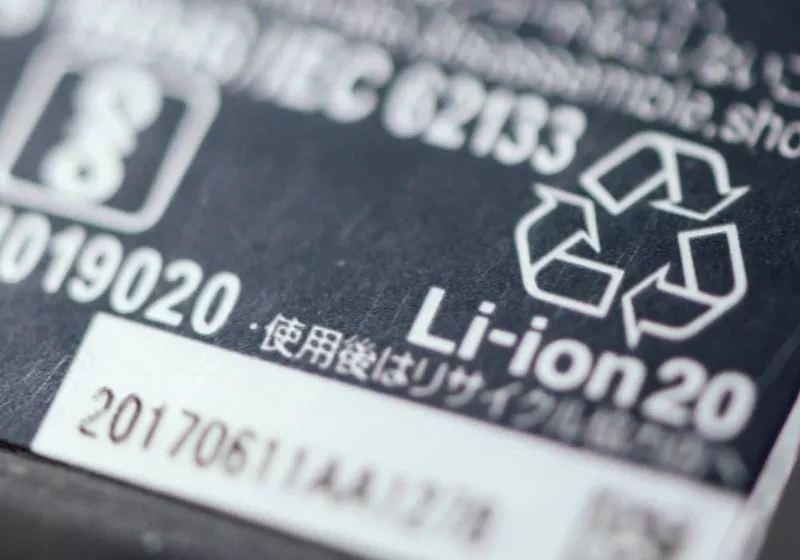
Electric bikes were responsible for nearly a third of all calls – 520, to be exact – in the UK last year. Unsurprisingly, retrofitted models were involved in more incidents compared to those that shipped with batteries from the factory. For comparison, there were only 149 calls for ebike fires in 2022. Read Entire Article Source link
The complaint, filed on behalf of California residents, alleges Meta earns up to $7bn a year from “high-risk” scam ads and tolerated the practice. The county wants restitution, civil damages, and an injunction.
Santa Clara County has sued Meta Platforms in California state court, alleging the company profits from scam advertising on Facebook and Instagram in violation of California’s false-advertising and unfair-business-practices laws.
The lawsuit, filed on Monday in Santa Clara County Superior Court on behalf of all California residents, alleges that Meta earns as much as $7bn in annual revenue from advertisements that bear clear signs of fraud.
The complaint says Meta “largely tolerated” the misconduct and established internal guardrails to block scam-reduction efforts that cost the company too much money.
The county also alleges that Meta allowed middlemen to sell ad accounts that were protected against enforcement and that the company targeted scam ads at users who had clicked on similar fraudulent listings before.
Advertisement
The complaint draws on internal documents first reported by Reuters in November 2025, which indicated that Meta’s own projections expected more than 10% of its 2024 annual revenue, roughly $16bn, to come from advertising scams and banned goods.
Earlier private litigation from the Consumer Federation of America cited the same set of documents.
The lawsuit seeks restitution for affected California residents, civil damages and an order prohibiting Meta from continuing the alleged practices.
Meta did not immediately respond to a request for comment. The company has previously said it removes scam content and has dedicated teams working to enforce its policies.
Advertisement
In April it filed its own lawsuits against advertisers involved in celebrity-impersonation scams.
Santa Clara County’s complaint is the latest in a multi-front legal challenge over Meta’s advertising platform.
A class-action filed in Washington, DC, by the Consumer Federation of America covers similar ground. Japanese regulators, the UK’s Online Safety Act enforcement team and the Australian Competition and Consumer Commission have all opened parallel inquiries into scam-advertising practices across the company’s platforms in the past twelve months.
The Santa Clara case is being handled by the county counsel’s office, and a scheduling order is expected within thirty days.

























































You must be logged in to post a comment Login