

Everyone is wrong about Hank Green.
Tech
Donald Trump Just Became The World’s Most Famous Anti-Vaxxer Nonsense Peddler


from the tiny-little-coffins dept
When it comes to the bullshit, batshit-crazy anti-vaxxer movement that currently has the United States in its un-scientific grip, I’ve focused most of my attention on RFK Jr. And, frankly, for good reason. For arguably decades, but definitely for the last five to ten years, RFK Jr. was the most infamous anti-vaxxer in the world. Kennedy would deny this, of course. In fact, it is old habit for him to talk out of both sides of his mouth when it comes to vaccines, but his anti-vaxxer side speaks much more loudly. And, because of course, one of his chief claims has been that there is a link between childhood vaccinations and autism.
When Donald Trump tasked Kennedy with finding the “cause” of autism, it came off looking like Trump fulfilling his promise to let Kennedy promote his pet conspiracy theories in exchange for gobbling up the MAHA vote when he ran for president. Then Trump himself started parroting some of the same claims you would normally hear from Kennedy. Still, it all looked like performative promise-keeping.
All of that has changed. Donald Trump just made himself the most famous anti-vaxxer on the planet. On Monday, Trump signed an Executive Order making enormous changes to vaccine schedule recommendations for children, both limiting the number of vaccines recommended and advising that vaccines be split up and not offered in combo-shots.
The vaccine changes are not backed by evidence or spurred by new findings. Rather, they are based on false anti-vaccine fearmongering about harms, including the debunked claim that they cause autism, and misinformation that multiple vaccinations can “overwhelm” children’s immune systems. This false claim has also been repeatedly debunked and explained.
During a signing event at the White House on Monday afternoon, Trump falsely claimed that pediatricians “have a vaccination that looks like the size of a bottle of soda,” that is “poured into a little child’s body, and bad things happen in too many cases. This is an explosion; this is an epidemic,” Trump said.
He also tied the new vaccine recommendations to his goal of finding out “what’s going on with autism.” Dozens of high-quality studies encompassing data on millions of children have found no evidence linking the neurodevelopmental condition to immunizations. Nevertheless, Trump suggested that the changes outlined in the order would reduce autism rates in the US.
This is madness. Trump has no understanding of the science or medicine behind vaccines. The fact that he’s layering lies into his signing ceremony for this unscientific proclamation should tell you everything you need to know. It was not that long ago that my own children received their childhood vaccines. I can promise you that no doctor approached them with a syringe the size of a soda can to pour into them. These are lies. Bald-faced lies.
And, while this has been pitched as putting America in line with the vaccine schedules of other developed nations, that is also a lie.
Under the new recommendations, Trump said children should get fewer vaccines, suggesting that the US recommends an excessive number of vaccines compared with other high-income countries. In reality, by dropping down to only 11 recommended vaccinations, the US becomes an outlier in recommending so few, according to fact-checking by Stat News in January. The only other country that recommends so few vaccines is Denmark, a small, relatively homogenous country with universal healthcare.
As for breaking up the MMR vaccine into individual shots, that specific part of the EO also came with lies from Trump. In the signing ceremony, he claimed that the combo MMR shot was “quite lethal.” There is has never been a death linked between the MMR shot and a person with a normally functioning immune systems. Those who are immuno-compromised are already warned against getting the combo shot. In fact, that warning and inability to get what are otherwise normal vaccinations is why it’s so damned important that everyone else immunize based on the previous recommendations, which were made under good science. It’s herd immunity that protects the immuno-compromised. This EO, to whatever extent it is implemented, will be “quite lethal” or otherwise produce negative health outcomes for a non-zero number of people, mostly young children.
This EO will almost certainly result in the deaths of at least some children.
And why? Ego, it appears.
The order is in line with reports that Trump personally promotes the debunked claim that vaccines cause autism and that he wants part of his legacy tied to curing autism. Trump had reportedly put pressure on anti-vaccine Health Secretary Robert F. Kennedy Jr. to do more to link vaccines and autism. In the signing event, Trump praised Kennedy, saying, “He’s doing a fantastic job,” and telling the anti-vaccine advocate “I’m proud of you.”
That Trump would prioritize his own legacy over the health of American children is about as surprising dilated pupils at a Grateful Dead concert. But Trump now directly owns the consequences of promoting anti-vaxxer conspiracy theories to his dedicated flock, as well as the health outcomes for their children. I expect lawsuits to come fast and furious from medical associations and institutions. And I hope they work, but they won’t be enough.
Some percentage of the country will listen to Dear Leader, because that is how cults work. And their innocent children, vulnerable to the misinformed demands of their parents, will be hurt. Perhaps time, money, and effort will be wasted doing trials on individual vaccinations for measles, mumps, and rubella. What comes next is not certain.
But what is certain is that this EO is crafted from a place of selfish ignorance. It does no good and can only cause harm. And our own president is the one harming us.
Filed Under: anti-vaxxers, donald trump, maha, mmr vaccine, rfk jr., vaccines
Continue Reading

Sony and Marvel are once again partnering up for a limited-edition PlayStation 5, DualSense Wireless Controller and console covers to build hype for the PS5-exclusive superhero game Wolverine, as the two companies did with the release of Spider-Man 2. This time, however, it’s going to be a bit more expensive to get these items than it was three years ago.
The Limited Edition Marvel’s Wolverine bundle and accessories showed up on the PlayStation Blog on Tuesday and will be available on Sept. 15, the same day as the release of the Wolverine game. The PS5 console, controller and console covers will all cost more than the current elevated price tag for PlayStation 5 hardware and accessories, but they’ll likely still sell out quickly.
The PS5 Digital Edition – Marvel’s Wolverine Battle Yellow Limited Edition Bundle comes in a distinctly Wolverine yellow. On the console itself is the face of the comic book hero and his iconic claw marks. The DualSense controller has the same color scheme and slashes, just inverted.
For those who want just a limited-edition controller, there will be one in battle yellow as well as the adamantium color, which is similar to silver.
PS5 console owners who don’t have the urge, or the funds, to drop almost $700 on a new console can buy the limited-edition console covers. Console covers are easy to install on a PS5 – they snap on and off the system. PS5 Slim owners will be limited to the battle yellow color, while PS5 Pro console owners have their pick between battle yellow and adamantium.
 Sony
Sony
The prices for the console and accessories are:
- PlayStation 5 Digital Edition – Marvel’s Wolverine Battle Yellow Limited Edition Bundle: $650
- DualSense Wireless Controller – Marvel’s Wolverine Battle Yellow Limited Edition: $85
- DualSense Wireless Controller – Marvel’s Wolverine Adamantium Limited Edition: $85
- PlayStation 5 Console Covers – Battle Yellow Limited Edition: $75
- PlayStation 5 Pro Console Covers – Marvel’s Wolverine Battle Yellow Limited Edition: $75
- PlayStation 5 Pro Console Covers – Marvel’s Wolverine Adamantium Limited Edition: $75
Preorders for the limited-edition PS5, controllers and console covers will start on Aug. 19 at 10 a.m. local time, according to Sony. The limited-edition PS5 and battle yellow DualSense controller will be available at the Sony Direct Store and select retailers, which Sony has not yet detailed. The adamantium DualSense controller and console covers will only be available at the Sony Direct Store. These will likely sell out, and as with the Spider-Man 2 limited-edition items, there will be minimal restocks, if any.
Marvel’s Wolverine, developed by Insomniac Games, is a PS5 exclusive coming on Sept. 15 for $70.


In case you missed the controversy: The veteran YouTube star, writer, and science comms entrepreneur was recently “canceled” after he acknowledged using AI for research.
“I have been relying too heavily on AI as a research aid,” he wrote in a statement on Reddit. “It can be very useful for this task, giving me access to a lot of papers I didn’t know existed really fast, but I think that has been to the detriment of my work because it has not given me the freedom to find all of my own ways into and around a topic.” Although Green wrote that the words in his videos are his own, his reliance on AI as a research aid still gave the finished work an ineffable “AI feel.” And his relationship with AI, he wrote, had become “not healthy for me or good for the world.”
Some of Green’s followers, known by the cheerfully dorky moniker “Nerdfighters,” turned on him for daring to use AI in any capacity. Just as quickly, that backlash produced its own backlash, aghast not at Green’s use of AI but at his prostration before an anti-AI mob — “self-canceling,” as some put it, over a legitimate use of the technology.
I think both of these camps are misguided and have flattened a complex issue into a set of binary extremes. And it surprised me that, despite robust societal debate on AI’s impacts on our ability to think, write, and produce original ideas, the debacle hasn’t prompted more thoughtful conversation about the limits of AI in creative work.
I felt this because I recognized myself in Green’s statement: the feeling that even using AI for research can start to take over your creative process, that it can become hard to know where your own brain ends and where AI begins, and that the technology can simply push you to work too fast. I don’t use AI to generate writing and would not do so — but its use need not rise to that level to raise profound questions about how much of our work to automate, and what happens to our ability to think for ourselves when we do.
In a follow-up video published late last week, Green laid out a new AI policy for his work. He wrote:
1. No portion of any script will be written, edited, or outlined by an LLM.
2. The thesis of a video will always originate with a human.
3. No image or music in a video will be generated by AI. If something is accidentally included, best efforts will be made to remove it.
4. LLM outputs are not trusted as a source.
These are all good ideas for any creator trying to avoid AI creep in their craft. But still, they raise a bigger, harder-to-answer question: The very structure of generative AI makes it hard to use without offloading human thought and judgment, which can lead to a widely discussed phenomenon known as “cognitive surrender.” And it pushes us toward uses — like synthesizing research, brainstorming, generating ideas and angles — that short-circuit the original thinking and discovery that we ought to be doing ourselves. What, then, can we even responsibly use AI for? How can we set guardrails that allow us to avail ourselves of its usefulness, without melting our brains in the process?
The most tempting uses of AI are precisely those best avoided
Remember late 2022, when ChatGPT first came out and everyone mocked its crappy research skills and propensity to hallucinate in every other sentence? I am so wistful for those days.
Many people who abstain from AI may not know it, but in the time since, and especially in recent months, large language models have gotten way smarter (especially the paid premium versions). It’s become unnervingly good at summarizing niche, complex research areas and debates, and producing ideas, often without being asked, for further research or writing on the same subject.
Whenever I have a research question these days (which is pretty much any time I’m working on a story), I’m more likely to fire up an LLM than a traditional search engine. If I ask, “Why are old-growth trees still being logged in North America?” it produces a synthesis of research, news, opinion, and whatever else its training absorbed on the subject: “We’re using an essentially nonrenewable ecological asset to smooth a temporary transition to a renewable timber resource,” it says. Probe it further, and it’ll suggest arguments for you: “Instead of conservationists having to prove that every old forest deserves protection, logging companies should have to demonstrate that cutting a centuries-old stand serves a need that cannot reasonably be met with second-growth or engineered wood.”
LLMs are designed to make cognitive work effortless, but that feels so icky because for it to be worthwhile at all, it has to be effortful.
These aren’t particularly smart or creative ideas — they’re perfectly replacement-level, which makes them plausible substitutes for the thoughts of most people. The AI can supply pat answers to every conceivable question and follow-up you might have while working on a project, relieving you of the need to mentally engage with the shape of a problem. Contrast that with Googling in the pre-AI overview days, which, while certainly not without its problems, at least used to send you to a list of sources that you then had to read and make sense of on your own.
Most of us who’ve engaged with LLMs know what this feels like. They make it easy for users to skate on the surface of a subject and feign understanding or insight, and in the process they can become involved in interpretive decisions that should be our own. In my experience, even more narrowly designed generative AI models don’t escape these problems. Google’s Gemini Notebook (formerly NotebookLM), for example, allows you to upload all of your sources for a project — books, reports, papers, audio and video recordings — and ask it questions based on what they contain, rather than searching the entire internet. It’s less prone to generating outright slop than general-purpose AIs. I use it for most stories I write — it’s an incredibly useful, time-saving tool. But it also enables me to engage with sources in a perfunctory, contextless manner: The AI can surface precisely the bit I need rather than forcing me to form the deeper connections that come from reading a text as a whole.
The best creative work (including not just art and writing, but also technological and medical breakthroughs) probably comes from having a wide range of background associations, and being able to combine them in unexpected ways. The French mathematician Henri Poincaré put this beautifully in his essay “Mathematical Creation,” where he wrote that it’s the tedious, sustained conscious effort that ultimately leads to flashes of insight.
I think this is what Green meant when he wrote that AI can prevent him from finding his “own ways into and around a topic.” LLMs are designed to make cognitive work effortless, but that feels so icky because for it to be worthwhile at all, it has to be effortful. This argument has already been made about AI-generated writing: Letting an LLM write for you defeats the point, because writing is thinking. But it can also be true, as Green’s example has shown, of using AI for the research that feeds the creative process.
If you use AI, consider creating a personal AI policy
Perhaps all these concerns are overblown — humans are hardly less prone to lazy and logically unsound thinking than AI. That’s absolutely true, but the point of doing our own thinking isn’t that we’re inherently good at it. To the contrary, it’s that we can only get better at reasoning by practicing it.
I don’t want to suggest that using AI for research is illegitimate. It’s too useful a tool to take off the table entirely, and we can’t put that genie back in the bottle. It can be extremely helpful with identifying the best sources that you wouldn’t find otherwise, but those very abilities can make it double-edged, foreclosing a slower, more open-ended exploration process. But AI’s greatest strength — its endless variety and flexibility — can be used to steer it away from the most tempting uses, especially those that ultimately harm us.
How to practice good AI hygiene
- Don’t use AI to form your thesis or core arguments.
- Use AI to find, not replace, sources, and avoid depending on AI-generated syntheses of sources. Read through source material yourself.
- Keep creative borrowing of AI-generated language microscopic, not much different from how you’d use a thesaurus.
- Watch out for compulsive chatbot use.
There are very obvious things that any LLM user should do to that end, like never assuming that a claim from an AI is accurate and always reading original sources. Beyond that, the necessary guardrails depend on your own use patterns, but above all, I think it’s helpful to avoid training ourselves to expect immediate answers to difficult questions.
One of my colleagues refrains from using it to brainstorm ideas entirely, instead using it to provide sources for narrow factual questions and to aid in the fact-checking process (emphasis on “aid”) after a story is written. To generalize from this, I think it’s a good idea to resist having AI do much synthetic work on a subject before you have drafted your project yourself. The less you do that, the less you will, to paraphrase Green’s recent video, see every problem as an “LLM-shaped problem,” and the less you’ll feel like you’re in the singularity where your brain is merging with AI.
One way that I like to use AI is as an enhanced thesaurus, to find the precise word or short phrase to express what I want to say in a sentence. When done right, I don’t find this harmful any more than using a traditional thesaurus; I find that it can enrich my working lexicon. But it must be used carefully and surgically, by setting a clear limit on the length of a phrase used from AI — like two or three words max — and avoiding sharing much of your writing with the tool at all, lest it start recommending extensive rewrites.
When interrogating the contents of specific sources or a body of work, or stress testing your own arguments, AI would be better for our intellectual development if it took a Socratic approach — pushing you to discover an answer rather than simply giving you one. It might say, for example, “there might be some relevant caveats to your idea on pp. 42-43 of the source.” LLMs can be directed to behave this way in their custom instructions. It also helps to simply touch grass — find the sources you need, and rather than interviewing the AI about what they say, just close the chatbot and read them from start to finish.
Configuring AI in a way that’s healthier for our brains would also make it less addictive — when you find yourself getting sucked into a long back-and-forth with an AI, that’s often a sign that something has gone amiss. Green evidently struggled to set that boundary, referencing the unhealthy “level of dopamine I’ve been getting from interacting with LLMs.” AI labs have very strong commercial incentives to want us to be addicted to their products, and unless they build different constraints into models themselves, it’s hard to expect the average person, who has far less autonomy over the terms of her work than Green does, to change these conditions on her own.
Although researchers at some AI labs are thinking about the societal risks of cognitive atrophy, it’s another matter to expect these companies, which compete on ease of use, to introduce friction into their models. We shouldn’t count on that happening soon — but we’re far from powerless against AI’s impacts. We can set our own personal AI use policies, and we can enforce social norms against AI-induced brain rot. Like, at bare minimum: Don’t send me your AI-generated writing. It’s rude!


Sonos chief executive Tom Conrad says model quality will converge and the advantage will sit with hardware that already knows a home. An FCC filing names the first product of that push, the Ace Ultra headphones, expected at a September launch event.
Sonos is betting that the value of AI in the home sits in the hardware rather than the model. “Much of the industry conversation about AI in the home is about who has the best model,” chief executive Tom Conrad told analysts. “We think that’s the wrong question.”
Access to strong models “is going to be everywhere, and the differences between them will narrow,” he said. What lasts instead, in his telling, is “the hardware that can converse with quality across every room, the system that already knows the shape of a home and the way a family lives in it.”
The company has some ground to make that argument from. Sonos counts 53 million connected devices across 17 million homes, and posted third-quarter revenue of $375mn, up 9%. Conrad said it has been “competing with the biggest of big tech for customers in the home for nearly a decade.”
The first hardware of that push arrives next month. A Federal Communications Commission filing published Monday, first reported by Lowpass, names the Sonos Ace Ultra, a sequel to the 2024 headphones, in as many as five colours against the original’s two. Technical details in the filing suggest it supports voice commands, which the first Ace did not.
That original landed badly. It shipped alongside a 2024 app rewrite that broke the platform, cut sales and forced Sonos to pause new hardware releases. The headphones were part of why the app went out early, having been built for the new software and left incompatible with the old.
Reviewers liked the industrial design but found little connection to the rest of the system beyond private TV listening through a soundbar. Buyers who expected to hand music from their speakers to their headphones on the way out did not get it. Conrad has since said shipping without that integration was a mistake.
The do-over falls to a thinner team. Sonos cut senior design and product staff in July, around 3% of the company, in a move Conrad framed as buying speed rather than saving money.
He has also pitched Sonos as a home for third-party AI models, though that has been slow going. Amazon’s Alexa+ is still absent from Sonos hardware nearly a year after the company appeared on a partner slide, while Amazon has moved on to putting Alexa in the search bar.
A marketing campaign under Colleen DeCourcy, who joined as chief marketing officer in January, lands this autumn. Conrad has called it “the clearest expression in a decade of what makes Sonos singular in the world.“
Tech
Nvidia’s Switchyard router reshuffles AI models mid-task, cutting task costs to a third in its own tests
Enterprises running always-on AI agents keep hitting the same tradeoff. Send every task to a frontier model and the bill climbs fast. Build custom routing logic to send easy tasks to cheaper models and that becomes its own engineering project, one that has to be maintained every time a workflow changes.
Nvidia is proposing a fix that touches both ends of that problem at once. The company is out on Tuesday with Nemotron 3.5 Lightning, a 30-billion-parameter open mixture-of-experts model built for high-volume, specialized agent tasks, alongside NeMo Switchyard, an open-source library that routes each step of an agent workflow to whichever model fits it best.
The headline numbers: According to Nvidia, Lightning delivers up to 4x faster output than comparable models in its class, completing agentic tasks roughly 30% faster than Qwen3.6-35B at matching accuracy. Paired through Switchyard, Nvidia says the combination holds frontier-level task completion while cutting benchmark costs to roughly a third of running Opus 4.8 alone.
The timing puts Nvidia in the middle of the busiest open-weight stretch the industry has seen in months. Alibaba, Moonshot, Zhipu and DeepSeek have all shipped competitive open models out of China since the spring, several landing at or near frontier performance while undercutting US labs on size or price. Meta added to that pressure by releasing its own 30-billion-parameter open agentic model, Muse Glimmer. Open weights have gone from a differentiator to table stakes in a matter of months, and Nvidia’s release lands squarely inside that shift rather than ahead of it.
The pairing is the point. A model alone doesn’t solve the cost problem, and a router alone has nothing efficient to route to. Nvidia is betting that open source, applied at both the model layer and the routing layer, is what actually moves the cost needle on agentic AI, not a single cheaper model and not a smarter router bolted onto someone else’s stack.
Switchyard’s real rivals aren’t other open models — they’re Not Diamond, which already powers OpenRouter’s Auto mode, and RouteLLM, the open-source framework from UC Berkeley and LMSYS. Neither ships its own model. Nvidia’s bet is that owning both sides of the decision, under one open license, is what a router-only or model-only competitor can’t match.
“That is the power of a system of models, matching the right model to each step of the workflow,” Kari Briski, vice president of generative AI at Nvidia, said in a briefing.
How the router actually changes the workflow
Model routing isn’t a new category. OpenRouter, LiteLLM and a handful of standalone routing startups already let developers point traffic across multiple providers. Switchyard plugs into several of them rather than replacing them outright.
The core problem Switchyard solves is that the right model changes as an agent moves through a task. An agent’s state shifts as tools return results, errors show up, or a step turns out to be routine rather than complex, and a fixed model choice can’t adapt to any of that.
Briski described routing strategies that respond to that shifting state rather than a static task category.
“It has many types of routing strategies,” Briski said. “You can have a random router, which is not that great, or you can have an agent state route or a classifier route. Depending on your routing strategy, it wants to choose the best model. In some cases you want to go with a model like Lightning for really efficient tasks, and the router will actually choose Lightning if it’s set up in your pool of models.”
Cost enters the routing decision directly, not as an afterthought. In response to a question from VentureBeat, Briski said Switchyard can evaluate model verbosity, meaning how many tokens a given model tends to produce for a task, and use that prediction to steer work toward the cheaper option before the call is made.
The part that keeps this from becoming its own integration project is where Switchyard sits. Nvidia split its partners into two groups: agent frameworks that call Switchyard directly, including Cognition, LangChain and Nous Research, and LLM gateways that have built Switchyard support into their own products, including Kong, LiteLLM and OpenRouter. Kong ships Switchyard natively inside Kong AI Gateway. Briski pointed to that same list of gateway partners when describing how the library fits into the existing routing ecosystem.
“We are an ecosystem lover, and we want to make sure that we are integrated,” Briski said. “We’ve partnered with OpenRouter, LiteLLM and Kong, and they’ve already integrated our routing algorithm, so you can pick it up right where you’re already using the best tools.”
Nvidia shared results from nine companies testing Switchyard, several with specific figures attached. LangChain reported a 74% cost reduction across 145 multi-turn Deep Agents tasks by routing just 7% of calls to a frontier model, at a 6% accuracy tradeoff. Ramp said it matched a frontier model’s performance on Ramp SWE-Bench while cutting costs 58% and runtime 33%. Cognition integrated Switchyard’s staged router into Devin Desktop for internal use and reported near-frontier performance on FrontierCode Main while cutting mean cost 28% relative to routing everything to a single frontier model.
Lightning’s architecture and performance gains
Nemotron 3.5 Lightning is a standalone open model in its own right, built for high-volume, specialized agent tasks rather than general-purpose use.
It extends the hybrid Mamba-Transformer, latent mixture-of-experts architecture Nvidia introduced with the Nemotron 3 family in December 2025, the same line behind Nemotron 3 Super, which Nvidia uses as Lightning’s own baseline in its post-training comparisons. Positioned within a routing setup like Switchyard, it’s built to sit at the fast, cheap end of the decision rather than the frontier end, but it runs and ships independent of any router.
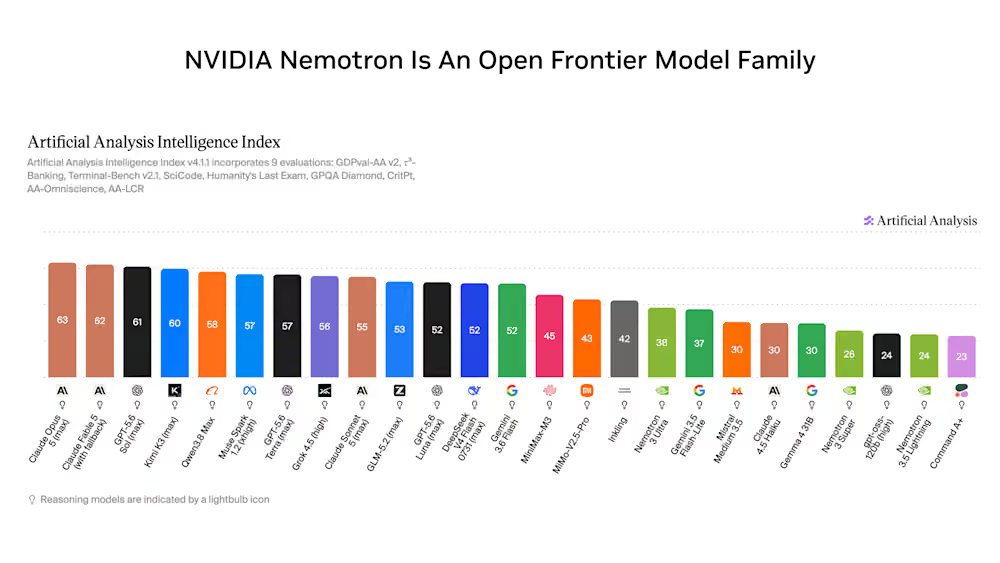
According to the Artificial Analysis Intelligence Index, a general capability benchmark spanning nine evaluations, Lightning scores 24, tied with gpt-oss-120b and behind Nemotron 3 Super, Gemma 4 31B, Claude 4.5 Haiku and Mistral Medium 3.5, all at 30. Lightning isn’t a general-intelligence leader in its size class, and Nvidia isn’t claiming it is.
The actual claim is narrower: according to PinchBench data supplied by Nvidia, Lightning matches Qwen3.6-35B’s accuracy roughly 30% faster and beats Gemma 4 26B’s accuracy at a similar completion time on PinchBench, a real-world agent task benchmark spanning coding, research and file management. That’s a speed-to-accuracy tradeoff, not a capability win.

Post-training is where Nvidia says the bigger gains show up. The company shared before-and-after figures from four early-access partners: CrowdStrike’s malicious-content recall against a Nemotron 3 Super baseline, CodeRabbit’s coding router against a GPT 5.4 Nano baseline, Harvey and Trajectory’s legal task completion against an Opus 4.6 baseline, and Lila Sciences’ energy simulation work against an Opus 4.8 baseline. CodeRabbit’s case is the most specific: Nvidia says the standard NeMo Auto model recipe, trained for one epoch, built into a working router agent for $85 in about two hours.

What this means for enterprises
There is no shortage of competitive offerings in the growing market for open models. The new Nemotron Lightning release will be yet another option for organizations to consider.
On the model side, Lightning’s own benchmark chart picks Qwen3.6-35B as its direct comparison point. Asked by VentureBeat directly how Lightning compares to Chinese models more broadly, Briski didn’t offer a head-to-head benchmark, pointing instead to openness and customizability as the differentiator.
“Our value proposition is not just open and it’s very customizable,” Briski said.
For enterprises building agentic infrastructure, three trends stand out:
The routing decision is becoming dynamic instead of static. Enterprises that built agent pipelines around a single default model are being pushed toward per-step routing based on live signals like agent state and token cost, not a fixed assignment set at design time.
Open source is now a cost lever at two layers, not one. Pairing an open model with an open router a vendor controls end to end is a newer argument than cheaper weights alone, and worth watching for whether other labs follow the same pattern.
The competitive question shifts from best model to best system. As routing libraries mature, the differentiator moves from which model an enterprise defaults to, toward how well its routing layer matches models to tasks in production, a harder thing to benchmark and a harder thing to market.


Presented by Salesforce
Interested buyers don’t generate revenue. Live customers do. That’s the lesson I keep drawing from watching hundreds of ISV partnerships navigate the agent economy over the last 18 months.
The companies pulling ahead aren’t winning on features. They’re winning because customers can move from discovery to live deployment in hours, while competitors are still negotiating contracts, clearing tax reviews, and waiting on provisioning.
That gap between a buyer who says “yes” and a customer who is actually using the product is where too many deals lose momentum. Urgency fades. Champions move on. Competitors get another opening.
Gutenburg saw that gap firsthand. Healthcare organizations valued its product, but sales cycles stretched 30 to 45 days. With custom pricing via AgentExchange, the company closed an urgent healthcare deal in just 48 hours.
Not 48 days. 48 hours.
The final contract phase alone dropped from 4 hours to 4 minutes. A 60x improvement.
I see this pattern across the ISV ecosystem. Building agents is getting faster. Getting buyers live before urgency fades is becoming the constraint. In a market moving this quickly, that can matter as much as the agent itself.
It’s like building a bullet train and selling tickets by fax. The product is built for speed. The transaction is not.
Distribution beats product in crowded markets
Nearly every software company is pouring resources into agent development. Far fewer are rethinking the path from discovery to deployment. Manual contracts, custom invoicing, tax reviews, provisioning delays, these are the handoffs that turn a 48-hour deal into a 45-day cycle.
That friction is now a competitive disadvantage, because the buying process is changing faster than most back offices are. Gartner predicts that by 2028, 90% of B2B purchases will be guided by AI agents.
That does not mean humans disappear from enterprise buying. It means the discovery and evaluation process changes. Buyers will increasingly use AI to identify, compare, and narrow solutions.
If your agent is not discoverable where that evaluation is happening, you may never make the shortlist.
A better agent can still lose to one that’s easier to buy.
Domain expertise matters. Workflow depth matters. Proprietary data matters. Customer context matters.
But enterprise categories are getting crowded fast. In crowded markets, the best product does not always win. The product that is easiest to discover, buy, deploy, and scale often has the advantage.
As agent-guided buying takes hold, the first evaluation may happen before a demo is scheduled or a sales rep is in the room.
AI agents will increasingly scan marketplaces, compare solutions, and help narrow purchase decisions in the time it used to take to schedule a discovery meeting.
Companies that figure out marketplace distribution now will own their categories.
That is the problem AgentExchange was built to address. It’s a single destination for apps, agents, and integrations that extend and connect to Salesforce and Slack, helping customers get more from their platform investments.
But discovery is only the first step. The bigger question is what happens after the buyer says “yes”.
“Yes” doesn’t mean live
Enterprise software teams spend enormous energy getting to “yes.” But in many deals, that is where the operational work begins.
Between “yes” and “live,” the back office can generate a chain of handoffs: contracting, invoicing, tax calculation, licensing, provisioning, fulfillment, payment, and finance reconciliation. Every handoff delays activation for the customer and delays recognized revenue for you.
For AI agents, that back-office drag is becoming a front-office problem.
AgentExchange brings discovery, commerce, and activation together, helping partners manage custom pricing, billing, licensing, provisioning, and fulfillment through one connected experience.
“AgentExchange removes the traditional procurement friction that slows deals. Customers can now discover, purchase, and deploy PandaDoc directly through their existing Salesforce contract, turning what used to be a multi-week process into a same-day activation.” Keith Rabkin, CEO at PandaDoc
What closing in 48 hours actually looks like
Gutenburg’s 30-45 day cycles were eaten up by contract logistics. Sales moved faster than their back office.
Using custom pricing and automated transaction capabilities through AgentExchange, they streamlined contracting, tax calculation, provisioning, and other steps between buyer interest and activation.
When a healthcare organization needed a tool to help them create documents aligned to the Americans with Disabilities Act and accessibility requirements, Gutenburg closed in 48 hours from first contact.
The 48-hour close is the differentiator. It is what efficient growth actually looks like in practice. Revenue scales without scaling headcount. Pipeline coverage improves because you are discoverable everywhere. Net recurring revenue increases because customers expand through the same frictionless channel.
“AgentExchange condenses contracting and tax calculations into a 10-minute process with improved accuracy,” said Zamial Jones, VP of Customer Success at Gutenburg. “For partners spending hours on these tasks for every deal, that’s transformational.”
The window is closing faster than you think
The app economy took a decade to mature.
The agent economy won’t.
The ISV partners I’ve watched pull ahead aren’t the ones with the most sophisticated agents. They’re the ones who treated distribution as a product problem — resourced, measured, and iterated — before the category consolidated around them. The ones still treating go-to-market as a post-launch consideration are consistently 6 to 12 months behind.
You can spend the next two quarters perfecting your agent’s reasoning capabilities. Or you can spend them making sure customers can actually buy it.
Salesforce is investing in the next generation of companies creating agents with $50 million through the AgentExchange Builders Initiative—capital, engineering support, co-marketing, and co-sell programs. Companies that move now will define what enterprise AI distribution looks like for the next decade. Learn more here.
Lisa Eisenberg is SVP of ISV Partnerships at Salesforce.
Sponsored articles are content produced by a company that is either paying for the post or has a business relationship with VentureBeat, and they’re always clearly marked. For more information, contact sales@venturebeat.com.

Apple is reportedly in talks with the owners of golf’s Open Championship to take over when NBC’s license runs out in 2028, but other bids are in play.
Sports rights have become a battleground as streamers seek to take over from legacy media. Apple has had small successes in getting rights for MLS, MLB, and F1, but its ambitions go much further.
According to a report from The Guardian, Apple TV is in early discussions with the R&A about streaming rights for golf’s Open Championship. NBC has the rights through 2028, but there is no guarantee they’ll stay with NBC with a renewal.
Netflix and Amazon are also expected to make bids. Apple has lost out to other streamers on such bids after backing down when negotiators wouldn’t meet their expectations.
Golf is a very popular sport in the United States and getting rights to the Open Championship would be yet another way to attract customers to its platforms. It isn’t clear if Apple would charge for access, include it with Apple TV, or stream it for free.
Apple Services SVP Eddy Cue has said he’s unhappy with how spread out sports streaming rights have become. It seems Apple is prioritizing rights to sporting events and series that can be wholly owned by the company, rather than partial rights.
It will be some time before the rights for golf are on the table, so expect to hear more about the potential bids in the meantime. NBC may end up keeping the rights past 2028 if a deal is made before then.


The company wants to grow its headcount by 1,000 in the next five years.
H&MV Engineering has tapped around €750m in extended investments led by European private equity company Exponent and plans to recruit across its international operations. The fresh funding values the Limerick-headquartered business at €1.4bn.
The critical power infrastructure services provider said the funding will help its next phase of growth, with a focus towards US expansion. The continuation vehicle also brings in new investors Apollo S3, Pantheon and SQ Capital. Exponent has backed H&MV since 2022.
Power infrastructure providers play a key role in enabling the expansion of newer technologies including AI and data centres (whose power consumption has grown at a 12pc rate every year since 2020), and battery storage systems.
H&MV is at the “centre of some of the world’s fastest-growing infrastructure markets, where demand for specialist engineering expertise and reliable power infrastructure continues to increase”, said John Moore, operating partner at Exponent and board chair at H&MV Engineering.
The company currently has more than 24GW of projects in design and construction, and operates from 20 international offices across Ireland, the UK, Europe, the US and Asia.
“This transaction gives H&MV the long-term backing to scale at the pace of the markets we serve and to deliver on our five-year growth ambition,” said PJ Flanagan, the company’s CEO.
“As we enter our next phase of growth, we’ll continue investing in the team, our engineering capability and the culture that has enabled us to grow while delivering for clients around the world.”
Earlier this year, the company agreed to provide BnM with electrical and infrastructure support as it builds the Oweninny Wind Farm in Co Mayo.
Since 2020, H&MV has increased revenue from €61m to roughly €1bn this year and grown its workforce from around 300 to nearly 2,000, it said. It wants to triple its revenues to €3bn in the next five years and grow its headcount by another thousand.
Recruitment will be focused on the US, alongside continued hiring in Ireland, the UK and Europe, H&MV told SiliconRepublic.com.
H&MV purchased Texas-based Cooke Power Services this year in preparation for its expansion plans. It now plans to open its North American headquarters in Dallas later this year.
Don’t miss out on the knowledge you need to succeed. Sign up for the Daily Brief, Silicon Republic’s digest of need-to-know sci-tech news.

When people say the key to a happy, long-lasting marriage is communication, they generally mean the verbal kind: talking things out with your spouse, sharing your feelings, and all that lot. [Rich] AKA [Thumblegudget] took it another way, and built a engine-room telegraph for intramarital communication.
Now, this is less crazy than it sounds. Like the ship’s telegraph, which matched the position of an indicator on the bridge and in the engine room, [Rich]’ telegraph pairs an indicator in his office with one in the living areas of the house. He sets himself to “busy” and the arrow on the matching unit in the basement moves to that position. This naturally goes both ways, which allows his wife to point the needle to remind [Rich] that it may be time for hugs, dinner, or — most essentially for a brit — tea.
In operation each unit has a gimbal motor paired to a rotation sensor and an ESP32-S3 driving it. Thanks to that rotation sensor, the gimbal motor is programmed to lock itself into the positions on the wheel when you poke it, and the ESP32 wirelessly synchronizes the two units. A moving arrow might not be enough to get [Rich] to come down to dinner, so just like the ship’s telegraph you may remember from Titanic, [Rich]’s comes equipped with a bell to draw attention to itself.
Given [Rich]’s wife participated in the video and isn’t filing for divorce, it seems he may be onto something. Perhaps good communication doesn’t need to involve cumbersome human speech at all; maybe all a marriage needs is a telegraph like this and some paddles to send more complicated messages via Morse code.

Need some help with today’s Mini Crossword? This one wasn’t too difficult, I thought. Read on for all the answers.

Mini across clues and answers
1A clue: Caitlin Clark’s league, for short
Answer: WNBA
5A clue: Odysseus’s hiding place when entering the city of Troy
Answer: HORSE
7A clue: Hawaiian “hi”
Answer: ALOHA
8A clue: Personal opinions, in modern parlance
Answer: TAKES
9A clue: Where a nuthatch hatches
Answer: NEST
Mini down clues and answers
1D clue: “Come again?”
Answer: WHAT
2D clue: Hall-of-Fame pitcher ___ Ryan
Answer: NOLAN
3D clue: Unloaded?
Answer: BROKE
4D clue: What a phoenix rises from
Answer: ASHES
6D clue: The “E” of NE
Answer: EAST

Get CNET’s top-rated VPN for privacy and usability



Company86’s Cheryl Martin discusses the cyber landscape and why the skills shortage is more than a recruitment problem.
Having first started out in banking, Company86’s CISO Cheryl Martin moved through a series of customer-facing roles before becoming curious about the technical side of STEM. This interest generated a range of opportunities, such as building telecoms technology infrastructure supporting sub-sea cables and developing the UK’s internet backbone.
She told SiliconRepublic.com, “That, in turn, led to a role undertaking major expansion into data centres. From there I pivoted into information security and have never looked back, embracing the various technology trends along the way.
“I love solving puzzles and this industry is full of them. Technology, threats, capabilities and risks all have one thing in common, they constantly change and manifest themselves into something different, much like a chameleon. The challenge to get ahead and stay ahead keeps me energised and keen to learn more.”
Be the momentum
Martin’s career has spanned what she refers to as “a number of technology changes and ways of working”. As a result she finds she has faced the types of challenges common to “first movers”, several times over. While exciting and sometimes even risky, it has also opened her eyes to what can be achieved when you have a vision.
She said, “Sometimes a process or way of working hasn’t been defined, and it’s down to you to work through the myriad of possibilities. In all instances you need to be able to fail fast, express yourself in simple, easy-to-understand language and trust the team around you.
“One highlight that stays with me is the early work building the infrastructure behind sub-sea cables and the UK internet backbone and being part of laying the foundations for things people now take for granted every day. At the time much of it was uncharted, and there was real satisfaction in solving problems no one had a template for.”
She further explained, the secret to keeping her more than 20 year career in the cybersecurity sector fresh and interesting is in understanding that “you never really reach a point where you can say you’ve mastered it.” The technology will change, attackers will adapt their tactics and “suddenly the assumptions you were working with six months ago need to be challenged again.”
She said, “AI is a fascinating example of that. We’re seeing it change both sides of the equation. Attackers can experiment and personalise at much greater speed, while defenders have new ways to identify patterns, automate repetitive work and make sense of huge amounts of information.
“That constant movement suits curious people. Some of the best people I’ve worked with in cyber are the ones who keep asking questions, particularly when everyone else thinks something has been solved. I think that’s a big part of why I’m still excited by it.”
Trending threats
Martin noted one of the predominant trends of 2026 so far is undoubtedly AI, which is a far more relevant topic when viewed through the lens of its impact on the speed of cybersecurity and the pressure being placed on organisations to adapt at a similar pace.
She said, “That’s why I think we need to start talking about “Mean Time to Adapt”. For years we’ve measured things like ‘Mean Time to Detect’ and ‘Mean Time to Respond’, which are still important. But increasingly, I want to know how quickly an organisation can learn from what it is seeing and actually change.
“Can you reassess a risk, update a control, retrain people or change a governance decision quickly enough to respond to a threat that is continually evolving?”
She predicts this will be a key trend throughout the rest of 2026, where adaptability will become one of the clearest dividing lines between organisations. She said, “You can’t predict every attack or technology shift. What you can build is an organisation that learns quickly, changes quickly and is ready when the next one arrives.”
A core element of addressing challenges is in overcoming threats via an established team of skilled and nichely qualified professionals, however, for Martin, the cyber skills deficit being seen on a global scale is not solely a recruitment issue.
She explained, “Recruitment only tackles one part of the problem. If we’re all competing for the same pool of experienced cyber professionals, we’re moving talent around rather than creating more of it. We need to think much earlier about how people find their way into cybersecurity in the first place.
“That means engaging with schools and universities, mentoring people at the start of their careers, creating more visible role models and showing that there isn’t one fixed route into the industry. Cyber needs technical specialists, but it also needs people who can communicate, solve problems, understand risk and bring different perspectives to the table.
“The challenges we’re dealing with are becoming more complex and different experiences and ways of thinking help teams spot things others might miss and challenge established assumptions. If we want a strong pipeline of people with those skills and perspectives, we have to invest in developing them long before there’s a role to fill.”
Don’t miss out on the knowledge you need to succeed. Sign up for the Daily Brief, Silicon Republic’s digest of need-to-know sci-tech news.

Sports1 minute ago
I managed Man United against Arsenal, Liverpool and Man City but one fixture was more fierce

Tech2 minutes ago
PlayStation 5 Is Getting a Wolverine Yellow Makeover, and It’ll Cost You $650

Entertainment3 minutes ago
Friend of Malcolm-Jamal Warner’s Widow Launches GoFundMe


![Bitcoin is in Serious Trouble Again! [Warning]](https://wordupnews.com/wp-content/uploads/2026/08/1786521469_maxresdefault-80x80.jpg)
-

 Fashion5 days ago
Weekend Open Thread: Mattifying Sunscreen
-

 Fashion5 days ago
Frugal Friday’s Workwear Report: Cap-Sleeve Pointelle Crewneck Sweater
-

 News Videos4 days ago
Can Astrology Help Find Gold and Silver Trends? A Financial Astrology Guide
-

 Sports6 days ago
Jordan Coyle & Cordiamo take Laya Arena Stakes at RDS
-
 Business6 days ago
US stocks: Dow closes at record on Mideast optimism; SpaceX, AMD drag Nasdaq
-

 Politics6 days ago
Reform UK And Greens Sink To Lowest Favourability Ratings To Date
-

 Business6 days ago
Supply chain issues impact Ingredion
-

 Tech4 days ago
Rinn Pharma & Biopharma to join NordicPharmaTrain network
-

 Business3 days ago
How to Start a Cleaning Business: A Step-by-Step Guide
-

 Business3 days ago
Datadog: Best Of Breed For Multiple Reasons
-

 Business3 days ago
BDC Weekly Review: Private BDC Q2 Numbers Are Strong
-
 NewsBeat9 hours ago
Communication cards help banking customers access services or report scams
-
Sports6 days ago
Spider-Man: Brand New Day ending explained: Is Peter Parker alive?
-

 Fashion7 days ago
Suit of the Week: Me + Em
-

 Tech5 days ago
Price Hikes May Be Coming for PC Motherboards Next
-
 Fashion7 days ago
Birthstone pendant necklaces for women by ottomanhands – 18ct gold plated
-
 Crypto World6 days ago
Galaxy Digital Stock Slides 14% as Crypto Prices Hit Earnings
-

 Business5 days ago
Brightwater secures funding for WA-first dementia projects
-

 Politics7 days ago
Comedian Jimmy Cricket Has Died, Aged 80
-

 Politics6 days ago
The Not-So Talented Mr Arday
You must be logged in to post a comment Login