Connect with us
DAPA Banner
DAPA Coin
DAPA
COIN PAYMENT ASSET
PRIVACY · BLOCKDAG · HOMOMORPHIC ENCRYPTION · RUST
ElGamal Encrypted MINE DAPA
🚫 GENESIS SOLD OUT
DAPAPAY COMING

Tech

Edifier M90 review: good jack-of-all-trade bookshelf speakers

Published

on

Why you can trust TechRadar


We spend hours testing every product or service we review, so you can be sure you’re buying the best. Find out more about how we test.

Edifier M90: One-minute review

When you get into audio, it quickly becomes clear that the best stereo speakers won’t be enough. Sure, they’ll cover your living room, but what about your desktop? Your TV set-up? It’s time to buy more speakers!

…or you could accept the the Edifier M90 speakers’ pitch, which is to just buy one pair of speakers that have absolutely loads of connection options. Not only do they have the basics — Bluetooth 6.0 and aux-in — they have support for optical, USB-C in and HDMI eARC.

Advertisement

Source link

Advertisement
Continue Reading
Click to comment

You must be logged in to post a comment Login

Leave a Reply

Tech

Unemployment Ticked Up in America’s IT Sector

Published

on

IT sector unemployment “increased to 3.8% in April from 3.6% in March,” reports the Wall Street Journal.

But they add that the increase reflects “an ongoing uncertainty in tech as AI continues to play havoc with hiring. That’s according to analysis from consulting firm Janco Associates, which bases its findings on data from the U.S. Labor Department.”
On Friday, the department said the economy added 115,000 jobs, buoyed by gains in industries including retail, transportation and warehousing and healthcare. The unemployment rate was unchanged at 4.3%. But the information sector lost 13,000 jobs in April.

While it’s still too early to say exactly how AI is affecting employment overall, some businesses, especially in the tech industry, have said it’s part of the reason they’re cutting staff. In April, Meta Platforms said it would lay off 10% of its staff, or roughly 8,000 people, as it seeks to streamline operations and pay for its own massive investments in AI. Nike will reduce its workforce by roughly 1,400 workers, or about 2%, mostly in its tech department, as it simplifies global operations. And Snap is planning to eliminate 16% of its workforce, or about 1,000 positions, as it aims to boost efficiency. In other areas of IT, which includes telecommunications and data-processing, employment is now down 11%, or 342,000 jobs, from its most recent peak in November 2022.

But there’s not just AI to blame. Inflation and economic uncertainty linked to the Iran conflict is giving some chief executives and tech leaders reason to pull back or pause their IT hiring, said Janco Chief Executive Victor Janulaitis.
The article even notes that postings for software developer jobs “are up 15% year-over-year on job-search platform Indeed, according to Hannah Calhoon, its vice president of AI”. But employers do seem to be looking for experienced developers, which could pose a problem for recent college graduates.

Advertisement

Source link

Continue Reading

Tech

Open Source Project Shuts Down Over Legal Threats from 3D Printer Company Bambu Lab

Published

on

The free/open source project OrcaSlicer is a popular fork of 3D printer slicing software from Bambu Lab. But Tuesday independent developer Pawel Jarczak shuttered the project “following legal threats from Bambu Lab,” reports Tom’s Hardware:

Jarczak’s fork of OrcaSlicer would have allowed users to bypass Bambu Connect, a middleware application that severely limits OrcaSlicer’s access to remote printer functions in the name of security. Jarczak said in a note on GitHub that Bambu Lab threatened him with a cease and desist letter and accused him of reverse engineering its software in order to impersonate Bambu Studio.

From Bambu Lab’s blog post:


Bambu Studio is an open-source project under the AGPL-3.0 license. Anyone can take its code, modify it, and distribute it… That’s what OrcaSlicer does, and 734 other forks do as well. We have no issue with that and never have. At the same time, a license for code is not a pass to our cloud infrastructure… Our cloud is a private service. Access to it is governed by a user agreement, not the AGPL license… [T]he modification in question worked by injecting falsified identity metadata into network communication. In simple terms: it pretended to be the official Bambu Studio client when communicating with our servers… If this method were widely adopted or incorrectly configured, thousands of clients could simultaneously hit our servers while impersonating the official client.

Advertisement

“User-Agent is not authentication,” counters OrcaSlicer’s developer. “It is only self-declared client metadata. Any program can set any User-Agent.” And “the User-Agent construction comes directly from Bambu Lab’s own public AGPL Bambu Studio code…. So on what basis can anyone claim that I am not allowed to use this specific part of AGPL-licensed code under the AGPL license…? My work was based on publicly available Bambu Studio source code together with my own integration layer.”

But the bottom line is that Bambu Lab “contacted me directly and demanded removal of the solution.”

I asked whether I could publish the private correspondence in full for transparency. That request was refused… They also referred to legal materials and stated that a cease and desist letter had been prepared…

I removed the repository voluntarily. That removal should not be interpreted as an admission that all legal or technical allegations made against the project were correct. I removed it because I have no interest in maintaining a prolonged dispute around this particular implementation, and no interest in continuing to distribute it.
YouTuber and right-to-repair advocate Louis Rossmann reviewed the correspondence from Bambu Lab — then pledged $10,000 for legal expenses if the developer returned his code online. (“I think that their legal claim is bullshit,” Rossman said Saturday in a YouTube video for his 2.5 million subscribers. “I’m not a lawyer, but I’m willing to put my money where my mouth is.”)

The video now has over 129,000 views so far. “Rossman has not started a crowdfunding site yet,” Tom’s Hardware notes, “stating in the comments that he wants to prove to Jarczak that he has supporters willing to put their money where their mouth is. The video had over 129,000 views so far, with commenters vowing to back the case as requested.”

Advertisement

Source link

Continue Reading

Tech

Samsung’s Bespoke Update Is Big Step Towards A Useful AI For Your Fridge

Published

on


The idea of installing a software update on your fridge already feels kind of weird, let alone one centered around improving its AI capabilities. But that’s exactly what’s happening to Samsung’s line of Bespoke refrigerators this week, and to my surprise this patch is making major strides at providing truly useful machine learning in a modern day icebox.

As a quick recap, Samsung has offered AI-powered features like automatic food recognition and meal planning on its Bespoke refrigerators for a couple years already. However, as I found out after reviewing its flagship model late last year, the company’s AI capabilities are still very much a work in progress. Previously, the fridge could recognize around 60 different kinds of fresh foods (like fruits and veggies) alongside another 50 or so packaged goods like yogurt or popcorn. That felt like a decent start, but considering the sheer number of different items you can find at a typical grocery store, it was far from complete. Furthermore, you often had to input additional data like the number of items or when something was first added, which made the idea of AI-assisted grocery tracking more tedious than I’d like. I don’t know about you, but I generally don’t want to have to type on my fridge and I’m pretty sure the engineers at Samsung agree, which is probably what brought about this major update to its Bespoke refrigerator software.

Advertisement

So what’s new?

The big change is that Samsung is adding support for Google Gemini, which has several important implications. By combining Samsung’s existing on-device object recognition with Google’s cloud-based models, the total number of identifiable foods is increasing from just over 100 items to more than 2,000. Now this does mean you will need to connect the fridge to Wi-Fi, but considering the number of other smart features it supports like calendar integration and video playback, that’s not a big ask.

Another update is that Samsung is using Gemini to expand voice controls, allowing users to ask the fridge to change things like device settings, check details like when the water filter was last replaced or to even help troubleshoot issues. And depending on the situation, the fridge can even play back a tutorial about how to solve the issue.

Alternatively, for more complicated or harder-to-solve problems, Samsung is introducing what it calls Reliability AI, which is designed to monitor the fridge’s components or help identify faults before they get too serious. Or in cases where the device needs to be serviced, the AI can provide more detailed info to agents while potentially allowing them to fix certain things remotely.

Advertisement

For example, a Samsung representative told me that if a customer calls and says that cubes from the icemaker are coming out in clumps and stuck together, Reliability AI could allow agents to reduce the amount of water that is being added to the ice tray — all without ever needing to physically come to your home. Critically, Samsung says that while the fridge will monitor and track device health metrics, owners will need to provide express consent in order for repair personnel to access that data. Meanwhile, if an issue does require in-person servicing, Samsung says that by sharing this data with repair technicians, it allows people to identify and solve problems faster instead of having to arrive with no context and diagnose issues from scratch.

Advertisement

How this works in the real world

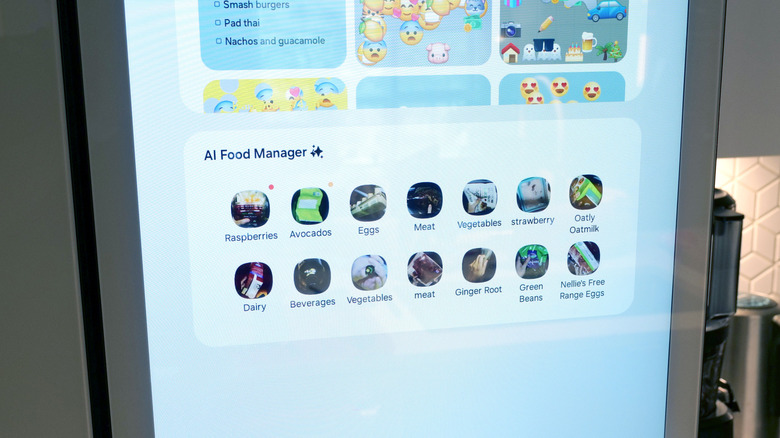
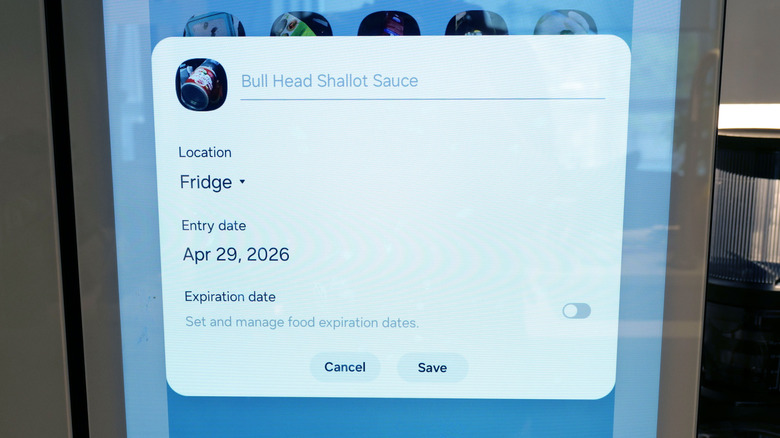
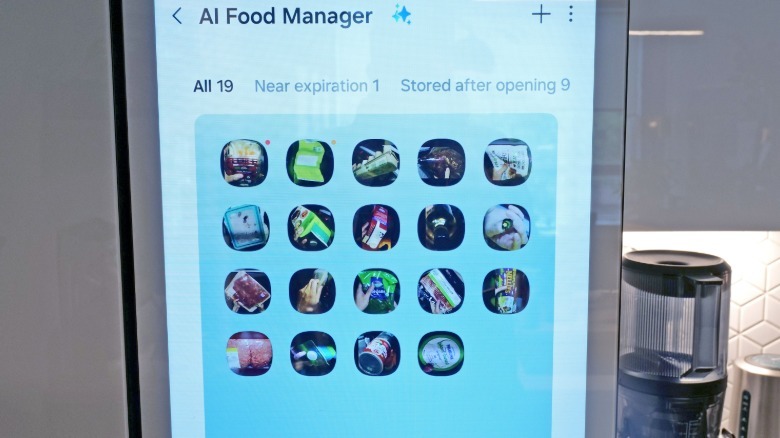
My test unit hasn’t run into any mechanical issues in the eight months I’ve been using it, so I haven’t been able to evaluate Samsung’s Repairability AI. That said, after checking it out first at Samsung’s headquarters, I’ve had the chance to use an early version of the Bespoke line’s new software over the last two weeks — including its upgraded support for cloud-based object recognition — and the improvement is profound. Even after using it for a while, I’m still surprised by how many different foods it recognizes. Deep in the back of my fridge, I have a can of Bull Head Shallot Sauce, which is a rather niche ingredient from Taiwan used almost exclusively in Asian dishes. However, the AI had no trouble recognizing it, automatically tagging it and including when it was first added to the fridge’s AI Food Manager.

On top of that, the system is now much better at recognizing brands and counting the number of specific ingredients in order to create more detailed listings. It can distinguish between a Diet Coke and Coke Zero while also accurately noting that there were multiples of each item. And even though the fridge often has to ping a cloud-based server somewhere to help recognize various items, results appeared rather quickly, often in less than a few seconds. And for certain foods like avocados, I was delighted that the fridge tracks how long you’ve had it and will surface a notification that it might be getting close to expiration. Granted, it’s not always right, but all I really need is a reminder to check on things and it does just that.

I also noticed that the fridge now remembers when you frequently take a specific food out and then asks if you want to add that item to your shopping list. It’s a nice reminder to replenish staples you use regularly and happens in a low-friction way, so it doesn’t become annoying. From there, you can simply check your phone when you’re at the store instead of needing to manually curate a list every week. Also, because the fridge does a much better job of recognizing and tracking what’s inside, it can provide better suggestions about recipes you can cook using ingredients you already have.

That said, like a lot of current models, the AI doesn’t always nail every detail. For example, I was initially impressed when it automatically labeled a tub of fake cream cheese as “Philadelphia Plant-based,” until I realized that the label was incomplete and the AI was merely reading what was written on the lid and didn’t have the smarts to accurately finish the description. Don’t get me wrong, it provides more than enough info to help me figure out what’s in the fridge when I’m glancing at the Food Manager. It’s just not quite spot on.

Advertisement

Outlook and things that still need work

The one issue with this update is that like a lot of AI services today, Samsung’s new software can be a bit overconfident or prone to hallucinations. One time, as my wife was putting something back in the fridge, the algorithm took a picture of a brightly colored bandage on her finger and labeled that as a veggie, which it very much is not. Other times it seemingly just guesses. But I’d argue going from around 100 identifiable items to over 2,000 is a very welcome improvement even with the limitations.

The other weird thing is that even though Samsung is leveraging Google’s AI models for a lot of the fridge’s new features, you won’t see any obvious callouts to Gemini inside the device itself. That’s kind of a bummer because Bixby is still the only digital assistant you can use and talk to directly.

I’ve said before that Samsung’s AI food recognition is a work in progress and I think that still holds true. With this latest update, the company has gotten a lot closer to delivering on the promise of a fridge with truly useful AI-powered features. What once felt more like a promising tech demo has quickly become a handy tool to keep track of your groceries, even with some hiccups here and there.

Advertisement


Source link

Advertisement
Continue Reading

Tech

If your router or drone maker is banned in the US, it will get an update lifeline until 2029

Published

on

The Federal Communications Commission has extended a key waiver allowing certain foreign-made routers, drones, and drone components to continue receiving software and firmware updates in the United States until at least January 1, 2029.

The move comes after growing concerns that millions of already-deployed devices could become cybersecurity risks if manufacturers were suddenly blocked from issuing security patches and compatibility updates. The decision was announced through the FCC’s Office of Engineering and Technology (OET), which also expanded the scope of the waiver to cover additional software-related changes needed to maintain device functionality.

Security concerns forced a regulatory rethink

The extension follows a broader FCC crackdown that added certain foreign-produced routers and unmanned aerial systems to the agency’s “Covered List” in late 2025 and early 2026 over national security concerns. Those restrictions effectively blocked new approvals and limited post-certification modifications for affected devices.

Initially, existing waivers would have allowed updates only until 2027. However, regulators later acknowledged that cutting off software support entirely could create a bigger problem by leaving devices exposed to vulnerabilities, cyberattacks, and compatibility failures.

Advertisement

The updated waiver now permits critical firmware and software updates for previously authorized devices, even though the products themselves remain subject to broader restrictions. The FCC emphasized that the policy does not reverse the bans or remove affected products from the Covered List.

Why consumers should pay attention

For everyday users, the decision matters because routers and drones depend heavily on ongoing software support to remain secure and functional. Routers in particular act as gateways for home networks, connecting phones, laptops, smart TVs, cameras, and other internet-enabled devices. Without security patches, known vulnerabilities can become easier targets for hackers.

The FCC’s extension effectively gives consumers more time before worrying about their devices becoming unsupported or obsolete. It also reduces the risk of millions of products suddenly losing compatibility with future operating systems, networks, or connected services.

What happens next

While the waiver offers temporary relief, it also highlights the growing tension between national security policy and practical cybersecurity needs. Regulators are now expected to spend the next few years developing a more permanent framework governing foreign-made networking equipment and drones.

For manufacturers, the message remains mixed: existing products can continue receiving critical updates, but future approvals for foreign-made devices will likely face tighter scrutiny and more restrictive oversight in the years ahead.

Advertisement

Source link

Continue Reading

Tech

Hackaday Links: May 10, 2026

Published

on

While Artemis II was primarily a demonstration flight of the architecture NASA plans to use for future lunar missions, it was also an excellent excuse for the crew to snap some photos of the Moon and Earth with the benefit of modern camera technology. If you’ve been looking forward to seeing more of the crew’s images, you’re in luck, as thousands of new images have recently been released.

Now we don’t mean to beat up on the folks at NASA, but browsing through these images, we couldn’t help but be reminded of an article we saw on PetaPixel that discussed the space agency’s haphazard approach to sharing images online.

It’s really more like an unsorted file dump than anything, made worse by the fact that you have to access it through a government website that looks and performs like it was designed in the early 2000s. There’s even a prominent button that attempts to load a gallery feature that relies on the long-deprecated Adobe Flash. It would be nice to see the situation improved by the time astronauts actually touch down on the lunar surface, but we wouldn’t count on it.

Speaking of old tech, we’ve been following the resurgence of keyboard-equipped smartphones with great interest, as we imagine many of you have been. A recent CNBC article addresses the trend, although it didn’t quite take the nerd contingent into account. We want physical keys so we can work in the terminal and write code without fighting an on-screen keyboard, but of course, that’s not exactly what your average consumer is looking for.

It’s quite the opposite, in fact. A 20-something user referenced in the article explained how the younger generations see the physical keyboard as a way to be less connected to their phones, describing it as “an extra barrier of inconvenience that adds more steps into the thinking process.” If you need us, we’ll be collecting dust in the corner.

Advertisement

As regular readers may know, we’ve also taken an interest in plug-in solar panels recently. So-called “solar balconies” have become quite popular in Europe, but regulatory friction in the United States has prevented them from achieving similar success here. An article in the MIT Technology Review talks about the process of bringing solar balconies to the US, and we’re not overly thrilled with some of the developments it highlights.

As the key hurdle appears to be safety, UL Solutions recommends that balcony solar panels be plugged into a specialized outlet. If putting a regular AC plug on the end of a solar panel can lead to potentially dangerous situations, they believe the solution is to require a different plug that no one could mistake for anything else, with built-in safety features to reduce the risk of electric shock.

That might not seem unreasonable at first, but it actually represents a pretty serious hurdle for many users. Consider that the whole advantage of these panels is the convenience: you can simply open the box, plug them in, and start collecting energy. But if you need to install a special outlet, potentially requiring an electrician, the whole concept falls apart. Expect to hear more from us on this particular subject as it develops.

Finally, Spirit Airline customers weren’t the only ones running into issues this week — a Southwest flight in California was delayed due to complications with a robotic passenger. The bot actually had a ticket, but the flight crew said it still violated the airline’s rules for large carry-on luggage and had to be moved to a different seat. Then somebody realized the robot’s relatively large lithium-ion battery was also in violation of carry-on limits, and it had to be removed and confiscated by authorities. Important details to keep in mind if you happen to be a robot planning your summer vacation.


See something interesting that you think would be a good fit for our weekly Links column? Drop us a line, we’d love to hear about it.

Advertisement

Source link

Continue Reading

Tech

AMD's next Epyc server chip debuts this year with 256 cores and 70% better performance

Published

on


During an investor call following the release of AMD’s first-quarter 2026 earnings, CEO Lisa Su confirmed that the Epyc Venice processors remain on schedule for launch later this year. The server CPUs will mark the debut of the Zen 6 architecture and AMD’s first move to TSMC’s 2nm process technology.
Read Entire Article
Source link

Continue Reading

Tech

Logitech Promo Codes and Deals: Up to $100 Off

Published

on

A leader in almost everything tech and home-office related for over 40 years, Swiss-founded Logitech offers a vast array of products, including keyboards, consoles, webcams, and tech gear made especially for education, business, and gaming. We at WIRED know the company’s wares well (obviously), so we’ve found the latest Logitech promo codes and deals to save on any type of tech purchase.

Logitech makes seriously great Bluetooth keyboards, keyboard cases, and smart pencils that made our Best iPad Accessories list. We also named the Logitech Pro X 2 the best gaming headset in our wireless headphones guide. If you want to keep the spirit of playfulness alive, fellow F1 enthusiast (and senior editor of product reviews) Parker Hall raved about Logitech’s high-tech wheel, pedals, and seat racing simulation set to help you become the Lewis Hamilton of your gaming fantasies. Check out these Logitech discounts we’ve found to help you ball (technologically) on a budget.

Get a Free Gift With Select Purchases at Logitech

Right now, Logitech wants to reward you for choosing them, with tons of free gifts with select purchases at Logitech. These Logitech deals include major savings, like a free Logitech Desk Mat when you buy any two Ergo Products, ($23 value), or a free Logitech Accessory Case when you purchase a Crayon & Combo Touch Case ($30 value). There are tons of savings on accessories, like a free Wooden Headset Stand when you buy a qualifying Logitech Zone Headset, ($40 value), or a free MX Keyboard Sleeve when you purchase a qualifying MX Mini Keyboard ($30 value). Plus, you can claim a free 6-month Perplexity Pro membership, worth $120, when you buy an eligible MX Series, Ergo Series, or iPad Keyboard case over $119.

Save up to $100 On Refurbished Premium Gear

The Logitech outlet is one of the best ways to save big on your important tech purchases on premium gear with exclusive gear. With the outlet, you’ll find like-new refurbished devices and limited-time favorites to shop before they’re gone forever (so be sure to check often and act soon!). Some of the best deals we’ve seen so far include: $50 off a refurbished X56 HOTAS VR flight simulator controller, $60 off a refurbished G715 wireless gaming keyboard, and $20 off a refurbished Folio Touch for iPad Air and Pro models.

Advertisement

Tips and Tricks for More Logitech Discounts

Even if you don’t have a promo code on hand, Logitech has plenty of ways to save, with free shipping on orders of $29 or more (a super-easy mark to hit). Many products also qualify for a gift with purchase, so take advantage of a free MX travel case, keyboard sleeve, or 1 month of Adobe Creative Cloud. And for a limited time, when you buy one product, you can get a second for 25% off.

With an array of helpful products for students, Logitech is making it easier to get all this game-changing tech. Students can get a 25% discount on products after registering and verifying their student status with UNiDAYS.

{​Logitech 20% Off: Students & Heroes

Logitech wants to benefit as many people as it can, with a 20% discount for some of our most valuable community members who can benefit from this important, but sometimes pricey tech. That’s why Logitech is offering a 20% Logitech promo code discount of 20% off for heroes and students—this includes students, teachers, medical professionals, military, and first responders. Just verify your status to get the Logitech discount code.

25% Off Logitech Gaming Gear

Logitech G Play Days sales event is a celebration of all things gaming. During the Logitech G Play Days sales event, you’ll save with exclusive promotions and score 25% off select gear for a limited time. So whether you (or a friend) is in need of a new gaming headset or wants to upgrade your keyboard, there’s gear (and discounts) for every type of gamer.

Advertisement

Shop Trending Logitech Products

As mentioned, Logitech has nearly every type of tech product needed for productivity in your office or school, but also has some really innovative tech products for home and gaming. Looking to get serious about your WFH (or gaming) setup? Logitech’s MX Keys S Advanced Wireless Illuminated Keyboard is a bestseller because of its portability, ergonomic design, and cheap price point. The bestselling MX Vertical Advanced Ergonomic Mouse is occasionally discounted, so save your hand the cramps and carpal tunnel (while saving some coin, too).

Source link

Continue Reading

Tech

Most Polymarket Users Lose Money, While Top 1% Claim 76.5% of Gains, Study Finds

Published

on

In Polymarket’s prediction market, “most people end up losing money,” reports the Washington Post — typically a few bucks.

“Since Polymarket launched in 2022, a few thousand people have lost the bulk of the money… and an even smaller group — .05 percent of users — has gone home with most of the overall profits, according to a new analysis from finance researcher Pat Akey and colleagues.”


A lot of users aren’t that good at predicting the future. They’re losing money at roughly the same rate as online gamblers betting on sports and other real-life events at traditional sportsbooks, according to the U.K. gambling regulator’s analysis of 2024 data. On Polymarket, the odds of making a profit are slightly higher on weather and tech markets — and a little lower on sports…

On Polymarket, just 1,200 people took more than half the profits — $591 million, or more than $100,000 each. [“The top 1% of users capture 76.5% of all trading gains,” the researchers write.] When you dabble in prediction markets, you’re competing against these sophisticated players who consistently win. Most of those 1,200 big winners didn’t place just a few smart bets. They appear to be pros making thousands of trades, mostly in the past year and a half, that were probably automated. One user made $3 million since January on more than a million trades about the Oscars, according to TRM Labs…

Advertisement

The most profitable participants are also just good at picking what to bet on, Akey found, winning so often it was statistically unlikely to be dumb luck. They had some sort of edge — expertise, deep research or, perhaps, inside knowledge.
“Our results suggest that the informational benefits of prediction markets come at a cost to unsophisticated participants,” the researchers conclude.

Source link

Continue Reading

Tech

NYT Connections hints and answers for Monday, May 11 (game #1065)

Published

on

Looking for a different day?

A new NYT Connections puzzle appears at midnight each day for your time zone – which means that some people are always playing ‘today’s game’ while others are playing ‘yesterday’s’. If you’re looking for Sunday’s puzzle instead then click here: NYT Connections hints and answers for Sunday, May 10 (game #1064).

Good morning! Let’s play Connections, the NYT’s clever word game that challenges you to group answers in various categories. It can be tough, so read on if you need Connections hints.

Advertisement

Source link

Advertisement
Continue Reading

Tech

NYT Strands hints and answers for Monday, May 11 (game #799)

Published

on

Looking for a different day?

A new NYT Strands puzzle appears at midnight each day for your time zone – which means that some people are always playing ‘today’s game’ while others are playing ‘yesterday’s’. If you’re looking for Sunday’s puzzle instead then click here: NYT Strands hints and answers for Sunday, May 10 (game #798).

Strands is the NYT’s latest word game after the likes of Wordle, Spelling Bee and Connections – and it’s great fun. It can be difficult, though, so read on for my Strands hints.

Advertisement

Source link

Continue Reading

Trending

Copyright © 2025