Abbott’s Jasmine Swift discusses how a career in engineering is far more than just another nine to five.
“Growing up in an engineering household shaped my curiosity from an early age,” explains Jasmine Swift, a senior process project engineer at healthcare company Abbott.
“My father was an engineer and I was constantly surrounded by conversations about problem-solving, design and innovation.
“That exposure gave me a general understanding of engineering principles long before college, and it sparked a fascination with how things work.”
Advertisement
She “didn’t just see engineering as a job”, but instead regards it as a vehicle through which professionals can “create solutions that make life better”.
“That foundation, strengthened through my education and career experiences, made choosing this path feel natural. It’s a career where curiosity meets impact and that’s what drew me in.”
What’s the best thing about working in this field?
The best part is the sense of purpose and impact. Every project I work on contributes to improving health and nutrition for people around the world. That’s a powerful motivator. It’s not just engineering for the sake of engineering; it’s engineering that changes lives.
I also love the variety and challenge. STEM is never static. There’s always a new technology, a new problem to solve, or a new way to make processes more efficient and sustainable. It keeps me learning and growing every single day, and that’s something I value.
Advertisement
What’s the most exciting development you’ve witnessed in your sector since you started working in it?
The evolution of automation and data analytics has been incredible to witness. When I first started, many processes were still heavily manual, relying on operator experience and traditional controls. Today, we’re leveraging smart sensors, predictive modelling and real-time data to optimise performance and reduce variability.
What excites me most is how these technologies don’t just make processes faster, they make them smarter and more sustainable. For example, predictive maintenance can prevent downtime before it happens, and advanced analytics help us minimise waste and energy use.
It’s a shift from reactive to proactive, and it’s transforming how we think about manufacturing. Seeing this digital transformation unfold reminds me why I chose engineering – it’s about continuous improvement and shaping the future.
What aspect of your job did you struggle to get to grips with?
Early in my career, I struggled with stakeholder alignment. Engineering solutions aren’t just technical, they involve people, priorities, and timelines. I had to learn that success depends as much on communication and collaboration as it does on technical expertise.
Advertisement
It was a shift in mindset: moving from ‘I need to solve this problem’ to ‘I need to bring everyone along on the journey’. Over time, I developed skills in active listening, empathy and clear communication, which have made me a stronger leader and a better engineer.
How were challenges overcome?
One of the toughest challenges has been working on a project that started as a small initiative and then transformed into a significant and strategic project for our site – a project I’m still leading today.
The scale-up was enormous, and with it came increased visibility, tight timelines and high expectations. Managing this transition required me to shift from a technical mindset to a strategic leadership role. Suddenly, it wasn’t just about engineering solutions but about aligning stakeholders, managing risk, and keeping a diverse team motivated under pressure.
To navigate this, I focused on breaking the work into clear phases, building strong team dynamics and maintaining transparent communication. I also leaned heavily on mentorship and coaching to strengthen my leadership skills. This experience continues to teach me resilience, adaptability and the importance of collaboration. It’s a defining chapter in my career that proves growth often comes from stepping into discomfort.
Advertisement
If you had the power to change anything within the STEM sector, what would that be?
I would focus on making STEM careers more accessible and inclusive. When different perspectives come together, we create better solutions and stronger teams. But change needs to start early.
Too often, children grow up with a narrow view of what engineering looks like, typically imagining someone in a hard hat on a construction site. I’d love to see schools actively educate students about the wide range of engineering roles, from process design to data analytics to sustainability.
Showing young people the breadth of opportunities could inspire the next generation of innovators and break down stereotypes that limit potential.
Which of your personality traits makes you best suited to your job and this sector?
Curiosity and adaptability are at the heart of everything I do. Curiosity drives me to ask ‘why’ and ‘how’ every single day, whether it’s understanding a process, troubleshooting a problem or exploring new technologies. It keeps me learning and growing, even when the answers aren’t obvious.
Advertisement
Adaptability is equally important because STEM is constantly evolving. Projects change, priorities shift, and unexpected challenges arise. Being able to pivot quickly, stay calm under pressure and find creative solutions have been critical to my success.
I’d also add resilience and empathy. Resilience helps me push through setbacks without losing sight of the bigger picture, and empathy allows me to connect with people. Engineering isn’t just about machines and data; it’s about collaboration and understanding the human side of every decision.
Is there something in your personal life that helps you or has helped you in your job?
Definitely. Growing up with my father as an engineer gave me an early appreciation for problem-solving and innovation. That exposure gave me a foundation that I’ve built on through college and my career. Having that understanding early in life made technical concepts feel less intimidating and gave me confidence to tackle challenges head-on.
Over time, I’ve strengthened that base with formal education and hands-on experience, but the curiosity and logical thinking I learned at home still guide me every day. It’s a reminder that our roots often shape the way we lead and create.
Advertisement
How do you make connections with others in the STEM community?
For me, building connections is about being intentional and authentic. I actively seek out opportunities to engage through professional networks, industry conferences or internal groups like Women Leaders of Abbott. These spaces allow me to share ideas and learn from others. The STEM community thrives on collaboration, and every connection is a chance to learn something new or spark innovation.
What advice would you give to someone thinking about a career in your field?
Be curious and fearless. Engineering is about solving problems, and the best solutions often come from bold ideas and diverse perspectives. Don’t be afraid to ask questions, even the ‘simple’ ones, and seek opportunities that stretch you beyond your comfort zone.
One of my favourite insights from Brené Brown’s book Dare to Lead is that ‘clear is kind’. In STEM, clarity matters – whether you’re explaining a design, managing a project or leading a team. Communicate openly, set clear expectations and don’t shy away from tough conversations. It builds trust and makes collaboration stronger.
Also, remember that STEM isn’t just about technical skills; it’s about courage, creativity and connection. Build your network, find mentors and never stop learning. Every challenge is an opportunity to grow and every failure is a stepping stone towards success.
Advertisement
Don’t miss out on the knowledge you need to succeed. Sign up for the Daily Brief, Silicon Republic’s digest of need-to-know sci-tech news.
Vacuuming is a chore, even if you use one of the best vacuums in Australia. If you want to make it as effortless as possible, investing in one of the best robot vacuums is the way to go.
The best robovacs available today are autonomous cleaners requiring minimal human intervention. They’re perfect for regular vacuuming and mopping, plus they can be scheduled for when you and the family will be away to minimise disrupting household activities.
Advertisement
There’s a wide variety of robot vacuums available today, from affordable options that cost a few hundred dollars to premium models that will set you back by up to AU$3,000. And while it’s tempting to opt for an affordable one, robovacs epitomise the old adage of you get what you pay for.
I’ve reviewed several robovacs in the last nine years from different brands, so I’m using my experience and knowledge to pick the top models for several use cases. Based on hours of testing and comparisons, I think the Ecovacs Deebot X8 Pro Omni is an excellent overall choice. I’ve used it myself in my own home and while I was annoyed with its voice prompts, I couldn’t fault its cleaning prowess. Importantly, it’s regularly discounted these days, making it a good-value option for a premium robovac.
There are other options, of course, each with their own pros and cons, useful for specific functions. I’ve even included an affordable option, although you won’t get all the bells and whistles from more premium models.
Advertisement
One thing to note is that you may need to supplement your robovac with a manual model if you have stairs or need deep cleaning – take a look at my guide of the best cordless stick vacuums in Australia for the top options.
Curated by
Curated by
Sharmishta Sarkar
Sharm is TechRadar’s APAC Managing Editor, with nine years of experience testing and reviewing vacuums of all shapes and sizes. She’s fascinated by how quickly robovac technology has evolved and is always keen to try the next new thing in floor care.
While the three robot vacuums listed above are my top picks across different price points, there are plenty of other models to consider. If you are a pet owner, I’d recommend a different Dreame model to the Aqua10 Ultra, but it too will do just as nicely for pet owners, even those who have carpets at home.
Advertisement
Alternatively, if you have cash to spare, the newly released Roborock Saros 20 is a pet-hair specialist, plus it’s got nifty features that allow it to scale steps and look after high-pile carpets. It’s the most expensive model on this page, but it can be argued it justifies it as the most powerful and full-featured model available today.
If none of my top 5 picks catch your fancy, I’ve listed 3 more alternatives further down the page to offer a few more choices – rest assured they’ve all been tested my either me or one of my colleagues.
The best robot vacuum for most people
Image 1 of 5
Advertisement
(Image credit: Sharmishta Sarkar / TechRadar)
(Image credit: Sharmishta Sarkar / TechRadar)
(Image credit: Sharmishta Sarkar / TechRadar)
(Image credit: Sharmishta Sarkar / TechRadar)
(Image credit: Sharmishta Sarkar / TechRadar)
The best robot vacuum for most people
Specifications
Max suction: 18,000Pa
Robot height: 9.8cm
Mop type: Extendable roller
Self-empty: Yes
Advertisement
Dock bin size: 3L dust bag
Max threshold clearance: 2cm
Reasons to buy
+
Excellent suction and mopping
Advertisement
+
Top-notch edge cleaning
+
Good obstacle avoidance
Advertisement
+
Easy to set up and use
Reasons to avoid
–
Noisy base station suction
Advertisement
–
Expensive at full price
–
Some superfluous features
Advertisement
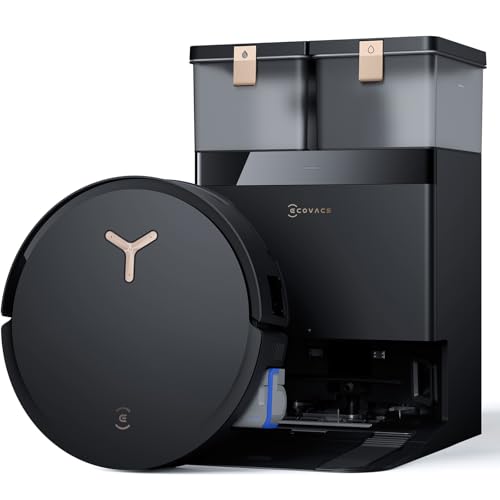
These days there’s not a lot that differentiates robot vacuums – they all do the same things, including vacuuming, mopping and self-cleaning. The Ecovacs Deebot X8 Pro Omni stands out for one reason only: value for money.
That said, I wouldn’t recommend this at full price, but it’s so often discounted these days that it’s really hard for me to pass up as a top recommendation. I’ve tested it myself and I can vouch for its excellent performance, both when cleaning floors and cleaning itself. So if you’re after an all-in-one robovac and you see this going for under AU$1,400, I’d say pick it up.
Cleaning performance
For a robot vacuum that costs four figures, the expectation is that it will clean really well and this Deebot absolutely does. Not only did I conduct TechRadar’s standard tests of sprinkling tea and oats on different floor types, I also tested this bot’s ability to suck up hair without tangling and how it handles very fine dust. It passed all my tests with flying colours.
What impressed me the most was its ability to clean room edges really well. It was the first robot vacuum I’d personally tested that would move right along a wall or furniture, ensuring not even the smallest amount of floor space was left out, whether vacuuming or mopping.
Advertisement
It’s suction is good enough for mid-pile carpets with some hair (or fur), but if your carpets are exceptionally dirty, it will struggle – as I suspect most robovacs will. Mopping, however, is really where it shines and its roller leaves no streaks on the floor. It’s able to clean most caked-in stains, but if it’s a heavy spill that’s dried out, it will struggle. For a robot vacuum, though, I found hardly anything to complain about when it came to cleaning performance.
Coupled with reliable navigation and intelligent features like dirt and stain detection, this robot vacuum will clean a spot repeatedly if necessary, without you needing to send it back for another pass. It’s really very good.
Base station performance
Most premium robovacs require minimal human intervention and the Deebot X8 Pro Omni is no exception. Its base station suction is excellent and you’ll find only the barest of fine dust coating the inside of the onboard dustbin after a clean.
The base station can also take a 3L dust bag, so you may not need to empty it too often if you don’t have pets or if you’re running the machine once a week, but keep in mind that even the tiniest amount of moisture trapped inside the bag will generate nasty odours, so you may want to have spares ready.
Advertisement
Arguably, its best bast-station ability is its mop cleaning, which leaves the roller looking like new after every session. And that alone I think warrants its high asking price. Hot-air drying is better than what I’ve seen on even more expensive models, so Ecovacs is to be commended on its dock performance, something I’ve seen is quite steady across several Deebot models.
From a design perspective, this is one of the few robot vacuums on the market that doesn’t have a top navigation turret (or puck) on the bot – instead, all the sensors it needs is on the front and sides. That said, it is taller than some other robots on this page, and it may not necessarily squeeze under low-lying furniture. Both the side brush and the roller mop extend outward when an edge is detected and its obstacle avoidance is excellent.
There’s a plethora of features here, some which I think is superfluous, like Matter support, but there is a voice assistant (called Yiko) that you can interact with and give some basic commands to. It’s good at following several commands, but it has its limitations and I found I hardly ever used it, relying mostly on the app for all cleaning sessions.
There’s really nothing that stands out about the base station, although the brass-coloured clips on the water tanks add a touch of class. Inside the base station is also a detergent dispenser and that’s optional to use, as with nearly every robovac available today, and it fits a 3L dust bag. Keep in mind that even the tiniest amount of moisture trapped inside the onboard dustbin will enter the bag and odours can begin to build, so you may need to change the dust bag out more often than expected.
Ecovacs says the X8 Pro Omni’s 6.400mAh battery should last up to 228 minutes but, in real-world use, that’s not possible unless you’re running it at its lowest suction and waterflow levels. Still, battery use is quite good here and my tests showed that a Standard suction and medium water rater will clean about 60sqm to 70sqm (on a vacuum-and-mop setting), but that will vary depending on how much dirt it detects and if it’s mopped repeatedly at any one spot.
On Max suction, I got a no more than 78 minutes on a single charge on the Deep Clean (or best navigation) mode. That’s quite impressive to be honest, as other models I’ve tested have given me about 60-65 minutes on a similar setup.
Whether vacuuming or mopping floors, or even cleaning itself, the Dreame Aqua10 Ultra is absolutely fantastic and comes in as a runner up (rather than my #1 pick) only because of its price – even when discounted it’s expensive. But if money is no object and you want a reliable floor cleaner, this truly is excellent.
I use the Aqua10 Ultra at home and find I don’t reach for my cordless vacuum unless I need to a handheld cleaner. It’s even more feature-packed than the Deebot listed above, which does go some way in justifying its higher price tag, and it’s performance is extremely reliable.
Cleaning performance
Perhaps the standout spec for the Aqua10 Ultra is its listed suction power of 30,000Pa. Now, as impressive as that sounds, it doesn’t always translate in real-world use but this robot vacuum comes close.
Advertisement
The biggest test I could perform to test its vacuuming capabilities was seeing how well it sucked up entangled hair from within fibres of a mid-pile carpet and the Aqua10 Ultra handles that quite well. I will admit that if you have a pet that sheds a lot, the robot will struggle to clean up everything, but its pickup rate of 98% to 99% is better than anything I’ve experienced with other robovacs on its maximum suction setting. And if you only have hard floors, even lower suction is usually enough.
What I also like about this machine while its vacuuming is it automatically raises its small side brush when it detects certain kinds of debris, like rice or oats, to avoid scattering particles.
It even takes mopping to new heights, with the roller featuring its own slim cover that automatically triggers when the bot senses a carpet, so not even the tiniest amount of moisture transfers. And when it comes to cleaning up stains, the roller does use some pressure to mop and, like the Deebot above, it cleans a spot repeatedly if it senses more dirt. This may look like its navigation is unreliable, but that’s not the case at all – it’s highly reliable.
Base station performance
You’ll need to clean out the dirt water regularly and refill the clean, but like all other premium robovacs, the Aqua10 Ultra’s base station requires minimal intervention. Its standout feature is the hot-air drying of the dust bag as well, which means this is a rare robovac that can vacuum over a little moisture on the floor – I still wouldn’t send it (or any robot vacuum) to clean a wet spill in the vacuum-and-mop mode.
Advertisement
The detergent dispenser here has two compartments – one for detergent and one for pet odour neutraliser. In fact, a bottle of each is shipped in the box and you can buy more later, although use of either is optional.
I also appreciate that Dreame ships a long-handled brush in the box with this machine that is used to clean the wash tray once every month or so. In fact, I’ve even used it to clean out the scum from the dirty-water tank as well.
The one thing this Dreame doesn’t do as well as the Deebot X8 Pro Omni listed above is dry out the roller mop as well. I’ve occasionally found it still a little damp after hours of air drying, but I’ve never noticed any bad odours or mould growing on the mop. If you do find this is happening regularly, there are multiple drying options and you can set one that best suits your cleaning needs.
I am personally a big fan of the overall design aesthetic of the Dreame Aqua10 Ultra – there’s something Mid-Century about it and resembles Marshall speakers in some ways. In Australia, the only colour of this model is black, but its gold accents lend it some class. Clean lines and sharp corners mean it fits into any home’s decor too.
The robot has a moving LDS puck that descends when it detects low-lying furniture or when charging. A light ring around the circumference of the puck lights up when charging too. It’s a very neat design, robot and dock both.
Advertisement
It doesn’t skimp on features either, and I’ve already mentioned a few – high suction, air-drying for the dust bag, and cover for the mop, with the last two being unique to it. There’s also a voice assistant that you’ll hear often enough and responds well to some basic commands for cleaning functions.
The app is one of the better-looking ones where robot vacuums are concerned, but it sure can get a little complicated with some setting options hidden away. The app gives you access to all the features you need, but it requires a learning curve to master – I think the app could be better streamlined, but that’s a personal niggle.
The battery life here is quite standard for premium robovacs, promising over 200 minutes on a single charge but, again, this will vary depending on what suction and mop settings you use for cleaning.
However, the way the Dreame uses its battery isn’t the most efficient. As soon as you begin a clean, the vacuum suction kicks in as soon as it exits the base station. So by the time the bot gets to its starting point, it could have easily dropped 1% to 2%. This won’t affect use in smaller one- or two-bedroom homes, but this loss will affect larger spaces.
Topping up takes a few hours, but it’s intelligent enough to know just how much it needs to finish an incomplete job and will pick up where it left off efficiently enough.
Xiaomi may not be the most popular brand of robot vacuum in Australia, but this particular model did well in our review and is often discounted to below the AU$600 mark. Considering it’s a do-it-all bot, that’s good value.
Advertisement
Another reason it’s slightly cheaper now is because it’s a couple of years old now, and it’s not the most powerful cleaner on the market, but if you have hard floors, it proves you don’t need to spend top dollar to have a clean home.
Cleaning performance
Like many robovacs, the Xiaomi X20+ has four suction settings, but don’t expect it match the likes of the Dreame Aqua10 Ultra listed above. Still, its 6,000mAh of suction does very well on hard floors. Our reviewer conducted some of our standard tests and found its ‘Strong’ setting vacuumed wood floors very well.
On carpets, however, the X20+ needed a couple of passes to get it clean on the strongest setting. It will struggle if you are a pet owner with carpets and rugs, but it should still be able to clean fur and hair from hard floors easily. Keep in mind that for slightly larger debris, you will notice some scattering.
There are three waterflow levels when mopping and the traditional dual rotating mops do quite well. However, our reviewer found that the X20+ can’t always distinguish between hard floor and thin rug, so you may want to remove those from its path when it’s mopping as the pads won’t necessarily rise up.
Advertisement
While its navigation is fine, its obstacle avoidance isn’t as good as newer and more expensive models.
Base station performance
While our reviewer wasn’t enthused by the design of the base station, its performance was another matter – it was impressive. It’s a comparatively basic model, and yet it houses a 2.5L dust bag to automatically empty the onboard bin. It can also wash the mop after every session and dry the pads with warm air.
What’s not basic about the Xiaomi’s dock is the water-tank capacity – it’s 4L for both dirty and clean, which is one on the larger side for a budget model. There’s also a self-cleaning cycle to clean the base of the dock, but you will need to give it a little scrubbing with a brush to remove any gunk from the mop pads. The dirty water from this self-clean cycle gets automatically pumped into the dirty-water tank, a feature that’s usually found in higher-end models like the Dreame Aqua10 Ultra.
As I’ve already mentioned, the Xiaomi X20+ is a very basic robovac, so don’t expect a lot of bells and whistles here. In fact, other that its ability to vacuum, mop and clean itself, there’s not much else here in terms of features, but you can still schedule cleans and choose suction and waterflow rates.
Even from a design perspective, there’s not a whole lot to talk about, but our reviewer wasn’t a fan of the base station’s bulk. That comes from the 4L water tanks for the most part, but there aren’t any design elements to make it stand out in a crowded market.
Advertisement
So while there’s not a lot to talk about here, it has everything it needs to its job with minimal human intervention.
The X20+ houses a 5,200mAh battery that’s rated for a maximum 140 minutes runtime. That’s not bad for the price point, but again, I should iterate that, in real-world use, you’ll get a lot less than that.
I would recommend this machine for a smaller home because the battery also takes a very long time to top up – up to 6.5 hours.
A premium all-rounder, especially for pet households
Specifications
Max suction: 35,000Pa
Robot height: 7.98cm
Mop type: Dual rotating pads
Advertisement
Self-empty: Yes
Dock bin size: 2.5L
Max threshold clearance: Double layer thresholds up to 4.5 + 4cm
Reasons to buy
+
Advertisement
Scales some steps
+
Strong vacuuming, especially on pet hair
+
Advertisement
Reliable navigation
+
Slim robot with no LiDAR puck
Reasons to avoid
–
Advertisement
Occasional erratic behaviour
–
Overkill for some needs
–
Advertisement
Very premium pricing
–
Dust bag drying slightly noisy
If you have the cash to splash, and you’re a pet-friendly household, there’s nothing better than the Roborock Saros 20 right now. It’s arguably the most powerful robot vacuum on the market at present and adds features that can be handy.
Advertisement
Being best in class comes at a price and, being newly released as of April 2026, it’s likely not going get discounted for a while. If you can wait for a drop in price, this could be the only robovac you need.
Cleaning performance
If there’s one thing robot vacuums aren’t is consistent — there’ll be days when it does well and at other days you might find it’s missing spots. Not so with the Roborock Saros 20. Our reviewer found it to be very consistent day after day on both carpet and hard flooring. And even though it was cleaning copious amounts of pet hair, there was no clogging during self-empty.
While it needs a slightly higher suction setting to tackle finer particles, it handles larger debris easily with minimal scattering. And, if you don’t need it mop and opt for a vacuum-only run, it will drop its mop pads in the dock.
When you do need it to mop, it does a decent job, although I should note that dual spinning mops aren’t as effective at cleaning viscous, sticky messes compared to roller mops. Despite that, our reviewer says it “did a stellar job”, leaving tiles free of marks and streaks. The Saros 20 also reliably avoided mopping thin rugs, while reaching out to mop along room edges consistently.
Advertisement
Base station performance
Like many premium robovacs, the Saros 20’s dock is impressive, effectively washing the mop pads even after they’ve cleaned sticky messes, with our reviewer saying “they looked (and smelled) good as new”.
There’s a soap dispenser in the dock and you can set to automatically add detergent to the mop water and, like the Dreame Aqua10 Ultra listed above, it uses hot air to dry out the dust bag as well to prevent bacterial and fungal growth. This process, however, will emit a low hum that you will need to get used to.
I was a big fan of the Roborock Saros 10 series design and I’m glad the brand hasn’t changed things too much in the Saros 20. It’s still a smart-looking machine with a slim robot that doesn’t have the LiDAR puck, so it can roll under some furniture for cleaning. That’s because Roborock uses a proprietary navigation technology called StarSight rather than LiDAR.
The headline act here is the AdaptiLift Chassis that raises the bot up to traverse high thresholds. This also allows it to get the bot to lift itself out when it gets stuck, and helps it roll smoothly over thick carpets.
The robot can also assess the depth of the carpet or rug in front of it, and elevate itself to one of a selection of preset heights, where it will hover as it cleans. This theoretically means an efficient clean without the risk of getting bogged down in the fibres. It’s suitable for pile up to 3cm.
Advertisement
Object recognition has been improved for the Saros 20, with Roborock promising recognition of over 200 common object types, as small as 2cm in height or width.
A 6,400mAh battery is quite standard in premium models, and that’s what you’ll find here as well. While our reviewer neglected to mention how long the Saros 20 can run on a single charge, I can make some educated estimates based on the Saros 10 series and other bots using the same battery capacity.
Roborock says this should give you up to 180 minutes of use in Quiet mode but, in real-world use, that will around the 160-minute mark in the same mode, but it depends on how much clutter the bot will need to go around. On higher suction settings, you’re likely to get between 50 to 70 minutes, again depending on how much cleaning and navigation the robot has to perform.
The standout here is that Roborock says the machine has fast charging abilities, so you could see a fully drained battery top up in about 2.5 hours.
While most robot vacuum cleaners today are designed for homes with mostly hard floors as mopping is their headline act, an older model like the Roborock S8 MaxV Ultra would suit homes with mostly carpets, but you also get the advantage of a mop.
Admittedly the S8 MaxV Ultra doesn’t have the kind of suction power that most of the models on this page can boast, it puts its limited 10,000Pa to good use and can handle carpets quite well. However, I would note that it might struggle compared to more expensive models if you also have pets, but for smaller, non-pet households with wall-to-wall carpets, this is a good option.
Cleaning performance
There’s a very specific cleaning option in the app for this machine — called Deep Clean — which will vacuum your carpets twice. Moreover, like all other bots these days, the S8 MaxV Ultra automatically increases suction on carpets, so you know your home will get a good cleaning. I should note that you’ll get the best clean from this machine on low- to mid-pile carpets — excessive pet hair on high-pile carpets will be a challenge. And that should be fine as most Aussie homes have low- or mid-pile carpets — high-pile, plush carpets are rare in fully carpeted rooms.
Opting for a machine like the S8 MaxV Ultra means you’ll be able to mop any hard floors you might have as well. Our reviewer found that it’s not the best mopper but it will handle regularly cleaning jobs easily enough.
Advertisement
Base station performance
Considering it’s an older model, the S8 MaxV Ultra’s dock uses 60ºC water temperature to wash the mop, which is enough to remove grease and clean it effectively for the next task, but you should be aware that newer models use higher water temperatures that sterilise mops well. There is a spinning brush roller inside the dock to help scrub the mop pad though.
It’s also worth keeping in mind that unlike other models, there’s a version of the S8 MaxV Ultra available that can be plumbed into a water supply, so you don’t need to keep refilling the 4L clean-water tank, but the model we’ve tested is the manual option and works identically to all other models on this list.
There’s not a lot that’s standout here that other robovacs don’t offer, but what the S8 MaxV Ultra offers is enough to clean a smaller home regularly. While our reviewer found that its obstacle avoidance wasn’t the best, its mapping was quick and accurate.
The app is also quite intuitive and provides a few cleaning options to suit different needs. It gives you plenty of control, allowing you to choose auto cleaning or set up a manual routine if you wish.
The S8 MaxV Ultra uses a 5,200mAh battery capacity that is more than enough for smaller homes — it might clean a one- or two-bedroom home, but will need to pause its cleaning to recharge for any space that’s larger.
This does diminish its value a little as it still costs more than four of the robovacs on this page, but it could well be worthwhile if you appreciate a good clean.
If none of the robot vacuums above take your fancy, here are some other models worth considering. These robovacs all scored highly on test, but just didn’t quite make our main guide.
Advertisement
On test, we were wowed by this robovac’s mopping abilities. The mop pads assert downwards pressure as they rotate, leaving our tester’s floors shining and spotless. In contrast, the vacuuming was good but not outstanding.
The transparent dock aside, this robovac makes good use of DJI’s drone tech to avoid obstacles. It’s also features excellent navigation, strong suction, decent mopping and very good edge-cleaning.
Offering three different mop pad pairs in the dock to clean different areas — the change takes place automatically — you also get threshold clearance of up to 4cm, impressive obstacle recognition and excellent cleaning to boot.
For certain people and households, very much so. I only used manual vacuums before I started testing robot vacuums for TechRadar, and now I wouldn’t be without a robovac. They have revolutionized my cleaning – I live alone, so I’m not dealing with loads of dirt and dust buildup, but I send the robot out once or twice a week and it just takes care of the vacuuming for me. It’s realistically far more often than I would drag a manual vac out of the cupboard, so my apartment is cleaner than usual.
Advertisement
I have also kitted my partner’s larger house out with a hybrid robot vacuum and it has proved a massive win there too. The bot gets sent out almost nightly to clear dog hair from carpets and remove paw-prints from the kitchen floor. It’s not up to a deep clean, but it stops the hair from building up and keeps things looking neat between manual vacuum sessions.
A 2024 study from Roskilde University in Denmark explored how householders’ experiences with robot vacuum cleaners compared to their experience with manual vacuum, and found that “robotic vacuum cleaners are inferior in use, yet transform vacuuming”. That’s exactly in line with my personal experience – while I can see that my robot vacuum’s cleaning power is not as strong as a manual vac, the fact that it allows for regular, basically effort-free vacuuming means it has still had a massive positive impact on my cleaning routine.
Robot vacuums can be expensive, but you don’t have to shell out for a top-of-the-range model – for many people, even a basic, affordable option will make a big difference.
There are caveats, though. Robovacs can’t deal with stairs (although watch this space, that might be changing), so their usefulness in multi-floor homes is far more limited. They’re also not capable of proper deep cleans, so will typically supplement rather than replacing a manual vacuum.
Advertisement
Do robot vacuums work on pet hair?
Yes, but with caveats. Robot vacuums can’t match manual models for outright suction power, so they won’t clean built-up pet hair and dander as thoroughly as, say, a corded upright. That’s especially true if you’re dealing with carpet. Robot vacs are best suited to convenient, little-and-often cleans, so if you send yours out daily, it’ll help you stay on top of your pet’s hair and stop it from building up in the first place. You’ll likely still want to supplement this with the occasional deep clean with a manual vacuum, though.
If you have shedding pets and carpet, look for models with higher suction power (8,000Pa or ideally more), and a boost/extra suction mode option. Models with rubbery brushrolls are also typically good at gripping hair.
Can a robot vacuum replace a normal vacuum?
Realistically, probably not. For one, you can’t use them anywhere but on the floor, so you’ll need something to clean your stairs, furniture, mattress and so on. They also can’t really match manual vacuums for suction power, so while they can help you stay on top of dust build-up, most people will want to supplement their work with the occasional deep clean with a manual vacuum.
In the most basic terms, robot vacuums are compact machines that make their way around your home and vacuum up dust and dirt. Most modern robot vacuums can also mop floors for you. They’re paired with a dock where they return to charge. These docks can sometimes also take care of maintenance tasks for you, including emptying the small onboard dust bin. Navigation typically relies on lasers (LiDAR) supplemented by cameras.
The features included in today’s best robot vacuums are wide and varied. On the vacuuming front, it’s common to see a side sweeper that rotates to flick dust and dirt from the edges of rooms to the bot’s suction path. On more advanced robot vacuums, you might have two, and they might be able to extend out when the bot senses it’s near the edge of a room. Many modern bots also have anti-tangle features built into their rollers, to prevent hair wrap.
Mop types also vary. Common setups include a D-shaped pad (which sometimes vibrates or presses down) or two spinning discs, but roller mops are also starting to become popular. They’re dragged across the floor to wipe it down and – to some extent – scrub away dirt. Pricier bots will be able to lift their damp mop pads when they sense they’re moving onto carpet, and if you opt for an advanced dock it might be able to refill your onboard water tank, clean and dry the mop pads, and dispense floor cleaners too.
Advertisement
How to choose the best robot vacuum for you
New robot vacuums are being released at an alarming rate, and it can be difficult to tell one from another. Below is my quick guide to how to choose the right model for you – if you want more information, you’ll find it in our in-depth robot vacuum buying advice article.
Suction power
Why you can trust TechRadar
We spend hours testing every product or service we review, so you can be sure you’re buying the best. Find out more about how we test.
Up to the start of 2025, the highest suction level you’d see on a robot vacuum would be around 10,000Pa (which will be ample for most people’s need). However, today’s top-specced bots can generate upwards of 18,000Pa. In the mid-range price bracket today, expect 6,000-9,000Pa of suction. Lower than 6,000Pa is what I’d expect in a budget-friendly model.
Advertisement
Respected robovac brand Eufy says on its blog that 2,000-6,000Pa is “adequate for routine maintenance cleaning”. That figure is a little outdated, and you can expect more suction for your money nowadays. If you’re dealing with things like pet hair and/or carpets, I’d definitely be looking at a bot that has 6,000Pa plus.
Remember that in general robot vacuums are designed for regular, light cleaning rather than deep cleans.
Vac or mop-vac?
Many of today’s best robot vacuums are also able to mop floors. This can be useful if you have a mix of hard floors and carpet, but be aware that robovac mopping tends not to clean as well as good old manual mopping. Dual, rotating circular disc mop pads tend to deliver a more effective clean than semicircular mop pads, in my experience, and the new breed of roller mop is a step up again.
Advertisement
Dock type
The cheapest robovacs will only have a dock for charging. Pricier models incorporate self-emptying of the onboard dustbin, and draining/refilling of the onboard water tanks. The very fanciest models offer automatic mop pad cleaning, and detergent dispensing for the mopping fluid. Onboard dustbins tend to be small, so if you’re dealing with lots of dust or hair then I’d recommend prioritizing a self-empty dock. However, be aware that the more functions you add, the bigger the dock will be – the ones with water tanks can be pretty massive.
Cleaning features
Beyond suction power, there are lots of design aspects that will affect how well your robovac cleans, including edge cleaning features, pet-friendly features, and features geared towards tackling hair.
Advertisement
Historically, robovacs aren’t great at cleaning up to the edges of rooms, but today’s best robot vacuums add spinning side brushes designed to flick debris into the robot’s suction path. Combo models might also have mops that can kick out from the side of the vacuum to get closer to the sides of rooms.
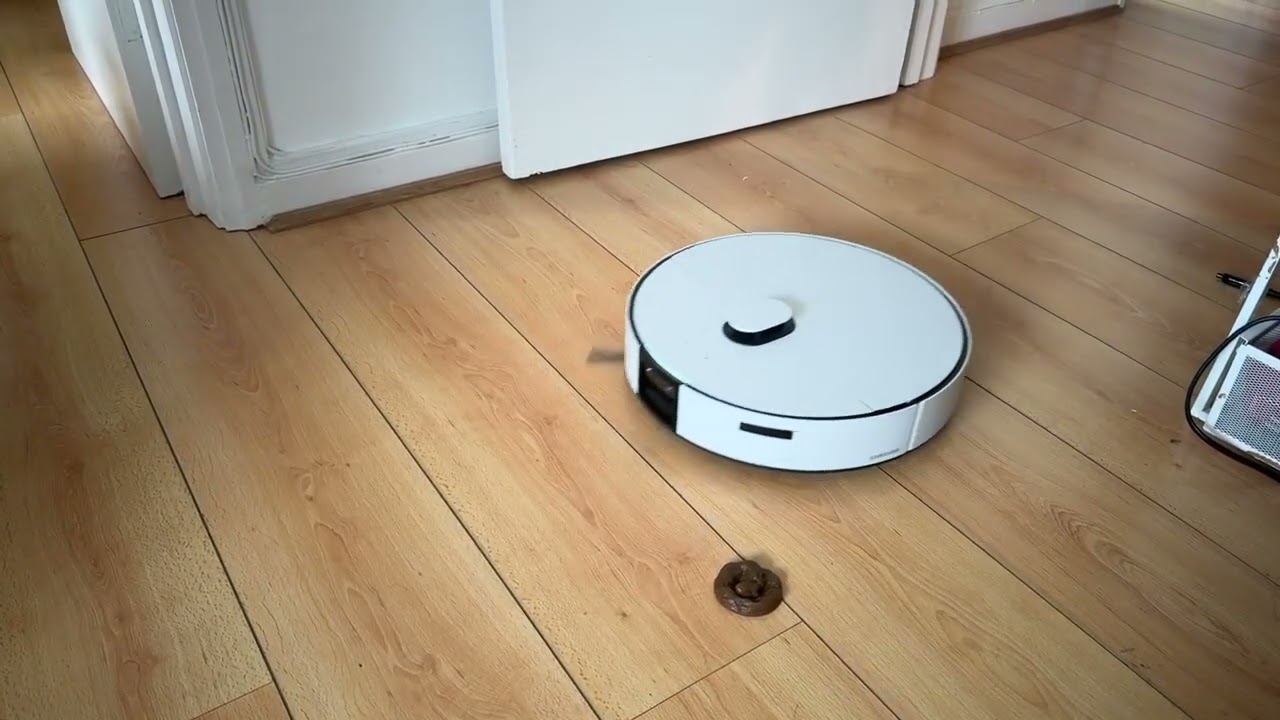
Pet owners might want to look for a model that is able to recognize their pet and either avoid it (if it’s spooked by the addition of a sentient appliance to the household) or seek it out to check up on it while you’re out of the house. If your pet isn’t reliably house trained, beware: even bots with advanced object recognition can struggle with objects under, say, 2 inches in height. I’d never trust any robovac to avoid pet poop, even those with promises that specifically focus on pet mess.
If you have long hair, or live with someone who does, you might want to consider a robot vacuum with features geared towards ensuring it doesn’t end up tangled all around the brushrolls. Some brands will address this by tapering their brushrolls or breaking them in the middle, with the aim of quickly directing hair towards the bin inlet. Dreame even has an alternative brushroll attachment that has little blades to chop up hair so it can be more easily managed.
A new robot vacuum can be a significant investment, so to ensure you end up with the right one for you, each model here has been tested either by myself or one of my regular, experienced freelance reviewers.
Advertisement
We test out models from a wide range of brands, including the likes of iRobot Roomba, Dreame, Shark and Roborock, as well as Eufy, Ecovacs, Narwal and Proscenic. We cover options for different budgets, rather than only testing the latest-and-greatest models (which, after all, will be overkill for many shoppers).
Our reviews are underpinned by specific, standardized tests. Here’s a rundown of our review process.
Suction tests We test fine dirt pickup by sprinkling a mix of flour and cookie crumbs on the floor, and large debris pickup using oats. We look at whether there’s any remnants left after a single pass from the robot vacuum, and if it catches them on a second run. We repeat these tests for both hard floor and carpet.
We test pickup of large and fine debris on carpet, as well as hard floor (Image credit: Future)
Mopping tests If the robot vacuum has a mop function, we see how it copes with fresh liquid spillages as well as dried-on, sticky messes. To test this, we smear a tiny bit of ketchup on the floor and leave it to dry, and also spill a bit of soy sauce, then task the robot with a spot clean. We’ll also look at how the robot tackles the issue of switching between vacuuming and mopping – will it reliably detect floor type, and pick up its mop pad when moving from hard floor onto carpet, for example?
Advertisement
Mapping tests When we first get the robot set up, we’ll see how long it takes to create a map of the home, and how accurate that map is. For subsequent runs, we’ll keep an eye on how the robot navigates the space; if takes a logical route through the house, if it repeats already-clean areas, and so on.
Navigation tests To assess object avoidance, we lay out a charge cable, a sock that’s a similar color to the floor, and some fake pet poop, to see if it can reliably spot and avoid them. On the navigation front, we’ll also test the robot vacuum’s edge cleaning abilities – does it get right up to the edges of rooms, or leave a margin that needs manual cleaning.
General use tests As well as these standardised tests, my reviewers integrate these robovacs into their daily cleaning setup, to get a feel for how effective and user-friendly they are in general. This includes assessing noise levels (when cleaning and also when self-emptying), how long they last on a single charge, and how regularly they have to return to the dock to self-empty or charge.
We’ll dig into the app and gauge how well-designed, usable and intuitive it is, and how much control it offers. We’ll also test any specific performance claims made by the manufacturer, as well as checking out any special features like built-in voice assistants and camera surveillance.
After at least two weeks of testing, we consolidate our findings and use them to judge who (if anyone) we’d recommend the robot vacuum to. We also compare the features and build quality to the price, to assess if the robot vacuum is good value for money.
After 49 years of space travel, Voyager 1 “is running out of power,” reports NPR:
The spacecraft runs on a radioisotope thermoelectric generator — a device that converts heat from decaying plutonium into electricity. It carries no solar panels, no rechargeable batteries. Just the slow, steady release of nuclear warmth, which diminishes by about 4 watts each year. After nearly five decades, that decline has become critical.
During a routine maneuver in late February, Voyager 1’s power levels fell unexpectedly, bringing the probe dangerously close to triggering an automatic fault-protection shutdown — a self-preservation response that would have forced engineers into a lengthy and risky recovery process. The team needed to act first. On April 17, mission engineers sent a sequence of commands to deactivate the Low-energy Charged Particles experiment, known as the LECP, which is one of Voyager 1’s remaining science instruments. The LECP has measured ions, electrons, and cosmic rays originating from both our solar system and the galaxy beyond it, helping scientists map the structure of interstellar space in a way no other instrument could…
Voyager 1 now carries two operational science instruments: one that listens for plasma waves, and one that measures magnetic fields. Engineers believe the latest shutdown could buy the mission roughly another year of breathing room. The team is also developing a more sweeping power conservation plan they informally call “the Big Bang” — a coordinated swap of several powered components all at once, trading older systems for lower-power alternatives. If testing on Voyager 2, planned for May and June 2026, goes well, the same procedure will be attempted on Voyager 1 no sooner than July. If it works, there is even a slim chance the LECP could once more continue to work.
Advertisement
The engineers say they hope to keep at least one instrument operating on each spacecraft into the 2030s. It would leave both still reporting from places no machine has ever gone before.111 Voyager 1 is now 15 billion miles from Earth, the article points out. (Radio signals take 23 hours to arrive…)
Thanks to long-time Slashdot reader fahrbot-bot for sharing the article.
Dutch regional broadcaster Omroep Gelderland reported that one of its journalists tracked HNLMS Evertsen, a Dutch air-defense frigate, during an active deployment in the eastern Mediterranean. The ship was operating to help protect France’s aircraft carrier Charles de Gaulle against missile threats when the tracking occurred. Read Entire Article Source link
At AXPONA 2026, the EarGear section was filled with the usual heavyweight brands, but a smaller name managed to stand out. Audma may be a new company on paper, founded in 2024, but its story reaches back to 1978 when Cesare Mattoli began chasing a stubborn idea: getting headphones to sound more like speakers in a room.
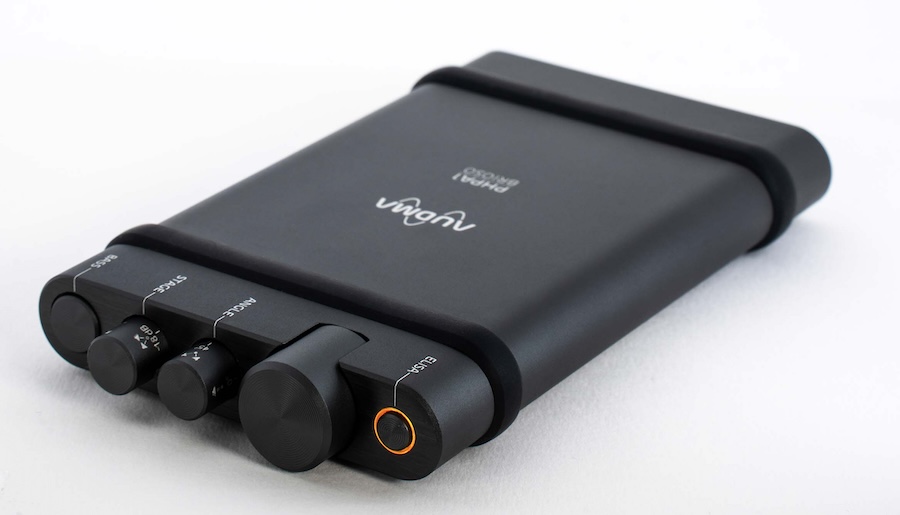
For decades, that goal remained out of reach. Mattoli built and rebuilt designs that never quite delivered, held back more by the limits of available technology than a lack of vision. That changed in 2022 with the arrival of ELISA, the Electronic Loudspeaker Imaging Simulating Amplifier, which finally brought his concept into focus. The company later rebranded as Audma in 2024, keeping ELISA as the core technology behind its products. Since then, Audma has introduced two amplifiers, the Maestro HPA1 desktop model and the Brioso PHPA1 portable, both demonstrated at AXPONA as a different way to tackle soundstage without changing your headphones, just the signal path.
Audma Maestro HPA1
While most headphone manufacturers try to squeeze more space out of their designs by tweaking cup geometry, airflow, and damping materials, Audma takes a different route. Its approach centers on delay line processing at the amplification stage, shaping how the signal reaches each ear rather than altering the headphone itself. The idea is straightforward: keep your existing headphones and source, insert one of Audma’s amplifiers into the chain, and let the processing do the heavy lifting in creating a more speaker like presentation.
Audma Brioso PHPA1
How Audma ELISA Reworks Spatial Cues Inside Your Headphones
The ELISA circuitry uses delay line processing to create an image that more closely approximates what a listener hears with speakers or live music. One of the core issues it addresses is that headphones separate channels too well. In real world listening, the brain determines direction and distance based on the time delay between when a sound reaches each ear and the reduction in level at the farther ear.
Advertisement
With headphones, that mechanism is largely lost because each channel is delivered almost entirely to one ear. Some amplifiers and digital audio players attempt to compensate with crossfeed. Crossfeed mixes a portion of each channel into the other with reduced level and a slight delay so that both ears receive both signals, more like real listening conditions. Different implementations vary the amount of delay and level, which is why reactions to crossfeed tend to be mixed.
Audma builds on that same principle but with a more advanced approach. ELISA allows adjustment of both delay and perceived direction rather than just blending the channels. On both the desktop and portable amplifiers, listeners can control the apparent distance and angle of the sound, effectively expanding or narrowing the stage and shifting their position relative to it. In practice, that means you can move closer to the performance or further back by making a few adjustments, rather than changing headphones.
ELISA Enabled Products
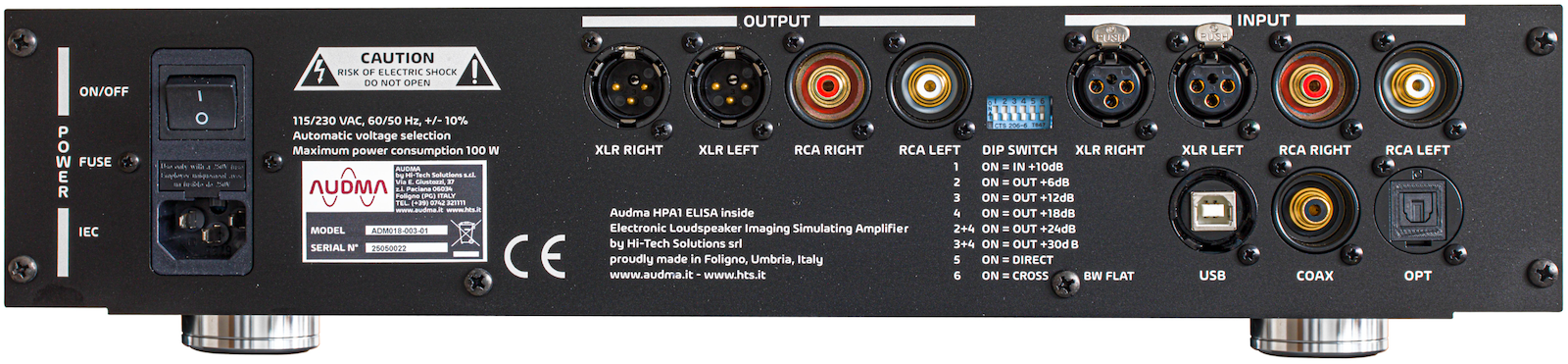
Audma Maestro HPA1 rear
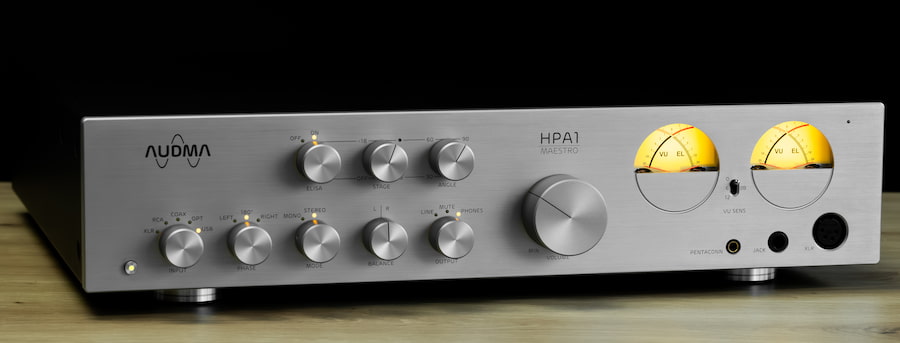
The Maestro was Audma’s original release and is designed to function as both a headphone amplifier and a preamp. Connectivity is extensive, with XLR, RCA, coaxial, optical, and USB inputs, along with both RCA and XLR outputs. The chassis follows a fairly standard full size footprint at 16 x 4.5 x 16 inches (W x H x D) and is available in either brushed metal or black, with weight ranging from roughly 20 to 25 pounds depending on configuration.
On the digital side, the Maestro incorporates an AKM 4499REQ DAC capable of up to 768 kHz/32-bit PCM and DSD256, making it a serious standalone DAC as well. As a headphone amplifier, it offers an output impedance of 6 ohms and six selectable gain levels at 0, +6, +12, +18, +24, and +30 dB, allowing it to accommodate a wide range of headphones. Output power is rated at 4 watts into 32 ohms and 8 watts into 300 ohms, and it had no issue driving 600 ohm headphones during the demo, including a borrowed Beyerdynamic headphones.
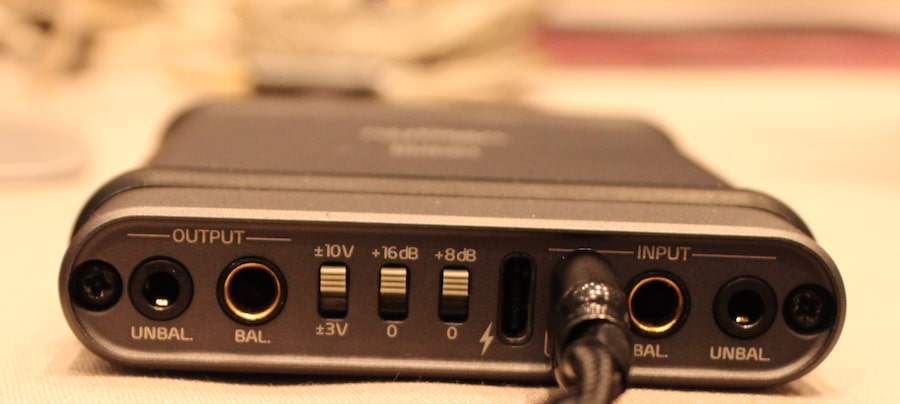
Audma Brioso PHPA1 (rear)
Along with the standard controls and ELISA stage and angle adjustments, the Maestro also includes phase control, giving the listener another layer of tuning to better match personal preference and system synergy.
Advertisement
The portable Brioso PHPA1 offers both headphone amplifier and DAC functionality but drops the preamp role in favor of battery operation. Its size and shape are roughly comparable to a Samsung Galaxy S25+, measuring about 3 inches wide, three quarters of an inch thick, and just under 6 inches tall. Weight comes in at around half a pound, making it easy enough to carry on a daily basis.
Internally, it uses the AKM 4499EXEQ DAC paired with the 4191EQ modulator, supporting up to 768 kHz PCM and DSD256. For those who prefer an external DAC, both 3.5 mm and 4.4 mm analog inputs are included. The amplifier section provides four gain settings at 0, +8, +16, and +24 dB, with output power rated at 4 watts into 32 ohms and 5.4 watts into 150 ohms, which is more than enough for the vast majority of headphones.
Advertisement. Scroll to continue reading.
Battery life is rated at up to 5 hours per charge, depending on listening levels, DAC usage, and headphone load.
Advertisement
Both Audma amplifiers are priced at approximately $5000 USD and are available directly from Audma or through select distribution partners.
The Bottom Line
Audma is chasing something most headphone brands only nibble at from the edges. By moving spatial processing into the amplification stage, ELISA offers a level of control over stage width, depth, and positioning that goes well beyond typical crossfeed. It’s clever, and in the right setup, it works.
The problem is the price of entry. At around $5000, you’re being asked to rethink your entire signal chain for an effect that some headphones, like the Grell OAE2, already attempt to deliver for well under $500. No, they don’t offer the same level of adjustability or precision, but the gap in cost is hard to ignore.
If ELISA delivers on its promise in a controlled environment, Audma might be onto something genuinely different. But at this level, different isn’t enough. It has to be indispensable.
We’ll start things off this week with a story that’s developing more than 25 billion kilometers from Earth — on Friday, NASA announced that the command had been sent to shut down Voyager 1’s Low-energy Charged Particles (LECP) instrument. As the power produced by the spacecraft’s aging radioisotope thermoelectric generator (RTG) continues to dwindle, engineers at the Jet Propulsion Laboratory have been systematically turning off various systems to extend the mission for as long as possible. It’s believed that deactivating LECP should buy them another year, during which engineers hope to implement a more ambitious power-saving routine. If this sounds a bit familiar, you’re probably thinking of Voyager 2. The plug was pulled on its LECP instrument back in March of 2025.
The JPL engineers hope that their new plan may allow them to reactivate previously disabled systems on the twin space probes, but even if everything goes according to plan, there’s no fighting the inevitable. At some point, there simply won’t be enough juice in the RTGs to keep the lights on. Although it’s going to be a sad day when we have to bring you that news, surviving a half-century in space is one hell of a run.
Speaking of ending a run, just a week after Amazon announced that pre-2012 Kindles would no longer be supported, the company is letting users know that the Kindle software for PCs will be discontinued in June. In its current form, at least. As Good e-Reader reports, Amazon is developing a new client for users who want to access the Kindle ecosystem from their computers, but it will only run on Windows 11. Since older software could be used to strip DRM from purchased ebooks, it seems likely this is another attempt to lock the platform down.
Because, of course, people post car crashes on Facebook.
We’re not fans of arbitrary limits being placed on ebooks and the devices that read them, but on the other hand, there are definitely systems out there that could stand to be tightened up a bit. For example, research out of Quarkslab has shown that the electronic control unit (ECU) from a wrecked vehicle can reveal a surprising amount of information.
After picking up a used ECU, they were able to dump its NAND flash chip and decode the log files it contained. It turns out the car had GPS logs going back to the day it rolled off the assembly line, and the researchers were able to reconstruct every trip it ever made.
Advertisement
By cross-referencing the last recorded coordinates with social media posts, they were even able to find pictures of the crash that took the vehicle out of commission. It’s bad enough that personal information can be scraped off of secondhand hard drives; now we’ve got to worry about what happens to our cars after they get hauled off to the junkyard.
If these are the sort of stories that keep you on two wheels rather than four, you may be interested in the latest innovation from Škoda Auto. In an effort to reduce collisions with pedestrians, they’ve developed a bike bell that penetrates active noise cancellation (ANC) systems. The logic goes like this: if someone is walking around with headphones that feature ANC, they might not hear the bell of an approaching bike. So they teamed up with researchers from the University of Salford to essentially find the weaknesses in existing ANC systems.
As you might have guessed, irregular noises are harder to block out than constant tones. Researchers uncovered a gap between 750 and 780 Hz where sounds could sneak through. The mechanical bell uses both principles to defeat ANC, and in testing, it was shown to provide headphone-wearing pedestrians more time to react to an approaching bicycle.
Finally, we’ll bring this week’s post full circle by starting and ending on a space story: earlier this week, PBS released the hour-long documentary Artemis II: Return to the Moon on YouTube. Watching PBS programming on YouTube might seem a bit odd, but that’s the world we live in these days. At any rate, the video is a fascinating look into what went into the recently concluded Moon mission and has us even more excited for Artemis III and beyond.
Advertisement
See something interesting that you think would be a good fit for our weekly Links column? Drop us a line, we’d love to hear about it.
Looking for the most recent Connections answers? Click here for today’s Connections hints, as well as our daily answers and hints for The New York Times Mini Crossword, Wordle, Connections: Sports Edition and Strands puzzles.
Today’s NYT Connections puzzle is pretty tricky. It was a little unnerving to see “cannibalism” as one of the clues. Read on for clues and today’s Connections answers.
The Times has a Connections Bot, like the one for Wordle. Go there after you play to receive a numeric score and to have the program analyze your answers. Players who are registered with the Times Games section can now nerd out by following their progress, including the number of puzzles completed, win rate, number of times they nabbed a perfect score and their win streak.
Here are four hints for the groupings in today’s Connections puzzle, ranked from the easiest yellow group to the tough (and sometimes bizarre) purple group.
Anyone looking to upgrade to the next Mac Studio or MacBook Pro might have to wait a little longer, thanks to the ongoing global memory shortage. As reported by Bloomberg‘s Mark Gurman, “at least two of the company’s upcoming machines … could debut a little later than the company initially planned,” referencing the refreshes to Apple’s desktop and its laptop that’s expected to get a touchscreen.
Bloomberg reported that the upcoming Mac Studio, which follows up the current lineup in the M4 Max and M3 Ultra configurations, was first expected to release in the middle of the year. However, Apple is already dealing with shortages of its existing Mac Studio stock, likely due to the device being a popular choice for anyone running local AI models. With no stop to the shortage in sight, Gurman predicted that the refreshed Mac Studio’s release could be postponed to around October instead.
It’s not just Apple’s desktop offerings being affected. Gurman also reported that the release of the next MacBook Pro could be delayed. While Gurman said the release timeline of the touchscreen MacBook Pro could be between the end of 2026 to early 2027, he’s now predicting that it would arrive toward the later end of that timeline. Of course, Apple isn’t the only consumer tech company heavily affected by the RAM shortage. However, Apple can at least take advantage of its successful MacBook Neo release amidst the memory shortage crisis affecting all laptop makers.
Live Science spoke with physicist David Gross, who today received the $3 million “Special Breakthrough Prize in Fundamental Physics”. He was part of a trio that won the 2004 physics Nobel prize for research that helped complete the Standard Model of particle physics. But when asked if physics will reach a unified theory of the fundamental forces of nature within 50 years, Gross has a surprising answer. “Currently, I spend part of my time trying to tell people… that the chances of you living 50 [more] years are very small.”
Cold War estimates for a 1% chance of nuclear war each year seem low, Gross says. “The chances are more likely 2%. So that’s a 1-in-50 chance every year.”
David Gross: The expected lifetime, in the case of 2% [per year], is about 35 years. [The expected lifetime is the average time it would take to have had a nuclear war by then. It is calculated using similar equations as those used to determine the “half-life” of a radioactive material.]
Live Science: So what do you suggest as remedies to lower that risk?
Advertisement
Gross: We had something called the Nobel Laureate Assembly for reducing the risk of nuclear war in Chicago last year. There are steps, which are easy to take — for nations, I mean. For example, talk to each other. In the last 10 years, there are no treaties anymore. We’re entering an incredible arms race.
We have three super nuclear powers. People are talking about using nuclear weapons; there’s a major war going on in the middle of Europe; we’re bombing Iran; India and Pakistan almost went to war. OK, so that’s increased the chance [of nuclear war]. I would really like to have a solid estimate — it might be more, and I think I’m being conservative — but a 2% estimate [of nuclear war] in today’s crazy world.
Live Science: Do you think we’ll ever get to a place where we get rid of nuclear weapons?
Gross: We’re not recommending that. That’s idealistic, but yes, I hope so. Because if you don’t, there’s always some risk an AI 100 years from now [could launch nuclear weapons], but chances of [humanity] living, with this estimate, 100 years, is very small, and living 200 years is infinitesimal. So [the answer to] Fermi’s question of “Where are the civilizations, all the intelligent organisms around the galaxy, and why don’t they talk to us?” is that they’ve killed themselves…
Advertisement
There are now nine nuclear powers. Even three is infinitely more complicated than two. The agreements, the norms between countries, are all falling apart. Weapons are getting crazier. Automation, and perhaps even AI, will be in control of those instruments pretty soon… It’s going to be very hard to resist making AI make decisions because it acts so fast. He points out that with the threat of climate change, “people have done something,” even though “It’s a much harder argument to make than about nuclear weapons.
“We made them; we can stop them.”
Thanks to hwstar (Slashdot reader #35,834) for sharing the article.
There’s something to be said about brand recognition — being able to tell what one car is from another at a glance. Companies have their trademark “looks” befitting certain models, sure — Jeep Wranglers are always boxy 4x4s with the seven-slotted grille and Ford Mustangs have the triple-taillight and a fastback coupe body shape. And these trends generally carry on from one generation to the next — a modern Wrangler still bears a superficial resemblance to the old TJ Wrangler from the 1990s, for instance. But every now and then, you get manufacturers trying something new. Whether it’s reusing a name on a brand-new platform or just a total ground-up redesign, sometimes you’re simply baffled to see the same logo on two seemingly completely different cars.
This is actually way more common than one might think. Take the Dodge Challenger, for instance, which went from a pony car in the early 1970s to a rebadged Mitsubishi Galant of all things. There are a few instances of this practice rearing its head, generally when automakers are chasing trends or undergoing large platform changes. An example of the latter is the Dodge Ram, which went from a Spartan, functional pickup in the 1980s to arguably the first modern production pickup truck in 1994.
Advertisement
We don’t see it as often today, with designs focusing more on minimalism and safety. But there are a few newer cars out there that will make you go, “Wait, it looked like that just one generation ago?” Let’s dive in and have a look.
Advertisement
Chrysler 300
What’s the first thought that comes to your mind when you think of the name “Chrysler 300?” Because the answer is generally all over the place; these cars (sadly now discontinued) once began life as midsize 1950s luxury sedans. Then they evolved into 1960s luxury sedans, then 1970s luxury sedans, and so on — the trend ran right up to their ultimate demise. But while these cars never changed their intended purpose, they most certainly changed their looks. Because the modern 2005-2023 Chrysler 300’s father is actually just a fancier Sebring — identical body shape and all, to the point where you’d be forgiven for mistaking the two without the presence of the badge.
Okay, granted, that badge reads “300M,” but it’s a Chrysler 300 — a car which, like its predecessors, prides itself on being refined and luxurious. Although you won’t find a Hemi anywhere near this car (unless you’re a lunatic who swapped in a remarkably inexpensive Hemi crate engine). Instead, you’ll find that classic Pentastar V6 in 3.5L form married to a front-wheel drive setup, all housed underneath a remarkably well-rounded body shell. It was Chrysler’s thing at the time; we all know that look from the Town and Country minivans.
The mid-2000s marked a pivotal period for Chrysler (and Mopar as a whole), with the entire range undergoing massive redesigns. These included the debuts of the new Jeep Wrangler JK in 2007, the Dodge Magnum in 2005, and many others. For the 300, it meant going from FWD budget luxury to intimidating, Hemi-powered RWD aspiration piece, a move that became so iconic that the car remained nearly unchanged right up until it was discontinued.
Advertisement
Chevrolet Corvette
Jonathan Weiss/Shutterstock
This one is also fairly obvious when you look at it, especially considering this was the first time we’ve ever seen a mid-engine Corvette in dealerships. It’s a car that has arguably marred a silhouette that was well over 50 years old, with the classic front-engine, rear-drive grand tourer coupe layout solidifying in 1963 with the Stingray fastback. Those classic lines of the long hood and sweeping rear end met their demise with Chevrolet’s modern rendition, for better or worse, marking a shift in design philosophy never before seen in the lineup — going from a grand touring sports car to supercar.
Typically the Corvette filled the niche of the former: a sports car. It was less money, less hassle, more practical, and generally more common than a lot of other high-performance vehicles of its era. Even today, you’re more likely to see a Corvette cruising down the highway than, for instance, a Lamborghini that’s more than double the cost (depending on where you live). But modern “fast cars” have a new image attached to them; think of modern Ferraris, the Audi R8, and so on. These are cars which typically command six-figure sums and hit 60 in three seconds or less. But not the Corvette (at least the base model).
The original design was revolutionary for the time, being marketed as “America’s First Sports Car.” And it’s a classic template, one which could easily continue into the future. But GM chose to depart from the “sports car” label, leaving us with what is ostensibly America’s budget supercar. Recognizable in name and performance, but hardly a trace when it comes to aesthetic presentation.
Advertisement
Dodge Charger
This was probably one of the most startling and controversial redesigns of the past couple years, with the Charger going from a pure-bred modern muscle car to a two-door EV (with the Hurricane turbocharged straight six available in model year 2026 onwards). Some might call it blasphemous to release a muscle car with no V8 option available for the masses, but whatever you think about the powertrain, it still wears the Charger badge — and looks almost nothing like its predecessor, with only a passing resemblance in four-door form.
Advertisement
Granted, the Charger was never exactly a svelte sports car in terms of its looks (as you can see in each generation). It was more of a brick on wheels than anything. The original Charger was a full-size sleeper coupe, looking more like a salesman’s car from the outside but potentially hiding a massive engine under the hood. The second-gen is what we generally think of when we hear of a classic Charger, but they both share certain key traits like that iconic, stone-faced grille and fastback roof. The modern Charger takes these elements and reimagines them in a 2020s context, returning the two-door configuration, flat nose, and vintage roof line. It’s a retro-flavored design, for sure, arguably returning the Charger name to a more traditional aesthetic.
Redesigns rarely hit without backlash, as we see fairly often in website facelifts for instance. And the new Charger was met with tons of it, though that generally revolved around its powertrain, not its aesthetics. The actual look of the car is, in fact, far more in-line with vintage Charger design philosophy, which may not be to everyone’s taste. But it’s certainly more faithful than the 2000s-era four-door sedan look, which is arguably its own unique thing.
Advertisement
Toyota Supra
We have yet another sports car entering the chat, this time a Japanese-German chimera born from a BMW — and yes, the Supra has a BMW engine. The B58, to be specific, the same engine as the BMW Z4. Of course, the body is quite different from the Z4, though that doesn’t stop people from calling the MK5 Toyota Supra a BMW. It’s yet another controversial car in this regard, but aside from the question of whether or not it’s a “real” Toyota, one fact still remains consistent: This thing looks nothing like the MK4 A80 Supra, from just about any angle.
One might suggest that such a design departure is obvious enough. After all, the A80 itself looks almost nothing like its predecessor either, trading the boxy pop-up headlights look for that timeless rounded shape. Regardless of what you think about the car (it’s arguably seriously overrated for what it provides), that body shape is instantly recognizable and looks correct even in modern traffic. By contrast, the MK5 is certainly not a bad-looking car in its own right, with exceptionally sporty design language. That said, good luck finding commonality, aside from the 2-door fastback styling.
By contrast, the MK5 Supra is a car with a contemporary aggressive fascia, plenty of vents, a svelte body with bold accents, and a long nose hiding that straight six. The FT-1 concept it was based on was well-received for its looks, with the production Supra basically being a watered-down version. Is it bad? Absolutely not — neither it nor its ancestor were. But you really have to stretch the definition of “similar” to marry this car’s aesthetic language to the MK4’s.
Advertisement
Chevrolet Blazer
Typically when a car totally jumps from one segment to another, you get some sort of differentiation in the name — Ford Mustang Mach-E or Mitsubishi Eclipse Cross, for example. Other times it’s a revival of a far older nameplate banking on recognition, such as the Ford Capri or Maverick. And then there’s this thing. The Chevrolet Blazer at a glance looks like it fills a similar role to the previous S-10 Blazer. That car was produced until the mid-2000s in North America, supplanted by the TrailBlazer in the midsize segment. Neither model bear even a passing resemblance to the modern crossover, however, either in form or function.
Advertisement
The S-10 and TrailBlazer alike were both unquestionably SUVs, with the S-10 in particular being more off-road oriented with its traditional high ground clearance, optional full-time 4WD, and features on-par with competitors like the Jeep Grand Cherokee. Additionally, Chevrolet even offered it in performance truck trim, with street-oriented option packages like the Blazer Xtreme. Its versatile SUV platform suited many roles well for its day, but its design is certainly dated on modern roads.
Chevrolet’s answer wasn’t to remake it as an SUV but rather as a crossover, debuting in 2019 to mixed reception (putting it mildly). The design proved controversial with the Blazer crowd, expecting a plucky, utilitarian 4×4 to rival the Bronco and getting a decidedly road-oriented unibody instead. It is almost nothing like the Blazers of old, only sharing the rough physical footprint they take up on the road. The Blazer is essentially the reverse of the Chrysler 300, going from a RWD or 4×4 truck to a FWD or AWD midsize that blazes rental fleets nationwide.
To make up for an incredibly laughable inaugural event, Beijing is running back its humanoid robot half-marathon. Fortunately, the event that pits humanoid robots made by Chinese companies against each other across 13 miles went a lot smoother this year.
This year’s half-marathon hosted more than 100 competitors, with first place going to Honor, better known for its smartphones, and its red-clad robot named Lightning. Living up to the name, the gold medalist finished the race in 50 minutes and 26 seconds. That’s several minutes faster than the human record that was recently set by Uganda’s Jacob Kiplimo last month.
Honor swept the other podium spots, with the important caveat that they all navigated the course autonomously, according to the state-sponsored television news agency CCTV. That’s a massive improvement over last year, where the fastest time among 21 robots was achieved by Tiangong Ultra with a record of two hours and 40 minutes. Last year’s event saw many of the bipedal robots receiving assistance from human operators who ran alongside them, as well as some comical mishaps, like falling at the starting line.
However, the BBC reported that around 40 percent of the robots competed autonomously this year, while the rest were remote-controlled. Despite the rapid improvements, this year’s event still had its fair share of crashes, even from Honor’s robots.





















































You must be logged in to post a comment Login