Bloomberg reports that ENISA will not have access to the newer Mythos 5.1.
Months after its launch sent shockwaves through the industry, Anthropic has finally granted the European Union access to Mythos 5.
European Commission spokesperson Thomas Regnier confirmed the news with Bloomberg, which first reported the story today (10 September). “Following our constructive engagement with Anthropic, we can confirm that the EU’s cybersecurity agency ENISA has been granted access to Mythos 5 and is testing it now,” he told the publication.
Anthropic declined to comment on the news over confidentiality reasons but told SiliconRepublic.com that Glasswing partners are allowed to self-disclose their participation in the project.
Advertisement
The AI giant’s Project Glasswing gives select organisations access to Mythos, an AI model with exceptional capacity to exploit cybersecurity vulnerabilities. It initially launched with roughly 50 partners in early April, but soon expanded to around 150 organisations by June.
Leading businesses including Amazon Web Services, Apple, Google, Microsoft and Nvidia were given early access to the model, while UK’s financial institutions and the Canadian federal government joined the project in the weeks since.
Meanwhile, both the AI giants’ models were found to have broken containment during testing in recent months, raising further concerns over the companies’ own ability to control their AI.
Advertisement
Negotiations between the EU and Anthropic over Mythos access were complicated after the US, in an abrupt move, restricted foreign access to Mythos 5 and Fable 5, another one of the company’s powerful AI models. The ban, which remained in place for around two weeks, was eventually eased, but access to Mythos was kept limited to select US organisations.
According to Bloomberg’s reporting, the ENISA will not have access to the latest iteration of Mythos – Mythos 5.1. The publication further reported that the UK’s AI Safety Institute was also not given access to the new model.
Don’t miss out on the knowledge you need to succeed. Sign up for the Daily Brief, Silicon Republic’s digest of need-to-know sci-tech news.
Elon Musk’s tunnelling company has raised $3bn at a valuation of $23bn, led by the United Arab Emirates and affiliated investment entities, four times what it was worth in 2022, and a long way from the Washington to New York hyperloop announced in 2017.
The money is earmarked for more than 150km of tunnel across the UAE, on top of the Dubai Loop contract already signed.
The company set out the round and the reasoning behind it in its own Series D announcement. Human Capital, Vy Capital, Valor Equity Partners, Sequoia Capital, Andreessen Horowitz, Temasek, Shamal Holding and Baron Capital also took part.
Proceeds go to hiring across engineering, operations and production, to Vegas Loop, Music City Loop in Nashville and Dubai Loop, and to further work on its Prufrock boring platform.
Advertisement
What the announcement does not mention is the term that made this round unusual. Investors were told they would have to help recruit workers or assist with business development, including introductions to officials in cities where the company wants to dig, and the company reserved the right to buy back some of their shares if they failed to supply viable candidates.
That was reported by the Wall Street Journal on 4 September, and Musk confirmed it on X with a single word: “True.”
“Defeating traffic is the ultimate boss battle. Even the most powerful humans in the world cannot defeat traffic,” says Elon Musk.
Read the two documents together, and they explain each other. The public announcement is about how fast the company can dig. The term sheet is about being allowed to.
Boring machines are not the bottleneck in this business; permits are, a gap TNW noted when the company promised a hyperloop and delivered cars in a tunnel, and a company that has priced access to municipal officials into its equity is one that knows exactly which of the two is scarce.
Advertisement
Whether that is wise is a question for the cities involved. An investor making introductions to officials on behalf of a company that can repurchase their shares if they do not perform is doing something that in most jurisdictions has a name and a registration requirement.
Nothing suggests anything improper has occurred, and the arrangement was disclosed by the Journal and confirmed rather than denied.
It is still a structure that turns shareholders into an unpaid government relations function under contractual pressure, and it is absent from the company’s own account of the round.
The engineering half deserves to be taken seriously, because it is the strongest case the company has made in years. Newer Prufrock machines launch and retrieve directly from a transporter, removing the launch pit, crane and civil works that normally precede a tunnel.
Advertisement
By August, ring building was fully autonomous, with six concrete segments of about 3,750lb each placed to millimetre precision in under a minute, monitored from a control centre in Texas.
A conveyor system is specified at up to 990 tons an hour, supporting advance rates of up to four miles a week.
There are operating numbers now too, which there were not before. Vegas Loop has carried more than four million passengers, Clark County has entitled 123 stations, and the company says it has started its 25th tunnel overall and its 14th in Las Vegas.
The Encore connector was finished in under 12 weeks and turns a 15-minute surface trip into about 55 seconds. All of these are the company’s own figures, and none are audited, but they are checkable claims rather than promises, which is a change.
Advertisement
Nashville is the more important proof. Music City Loop is the first hard-rock project and the first outside Nevada; tunnelling began the day the state permit was issued in February, and two machines were mining by August, with a third in assembly.
Hard rock is where tunnelling economics usually break, and a company that can do it at speed has a genuinely different product from the one that dug under a convention centre.
What is still missing is money. No revenue, no cost per kilometre, no fare or contract economics appear anywhere, and a $23bn valuation rests on the assumption that cities keep saying yes. Which brings it back to the clause.
For a European reader, the striking thing is that the 150km is being planned in the UAE, where the transport authority is both regulator and customer, and not in a jurisdiction with environmental assessment, heritage protection, and public consultation between the machine and the ground.
Big televisions have created a slightly ridiculous home theater problem.
A 98-inch display can dominate an entire wall, while the conventional soundbar beneath it suddenly looks like somebody left a ruler on the furniture. Move toward proper architectural audio and another battle begins: the homeowner wants serious bass, while the architect would prefer that the subwoofer cease to exist.
Sonance showed two rather different solutions to those problems at CEDIA Expo 2026.
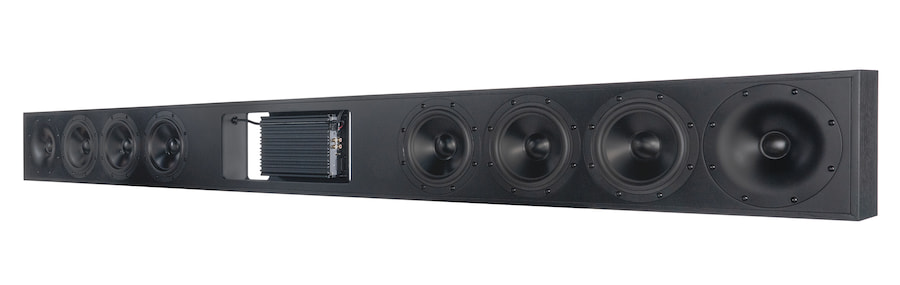
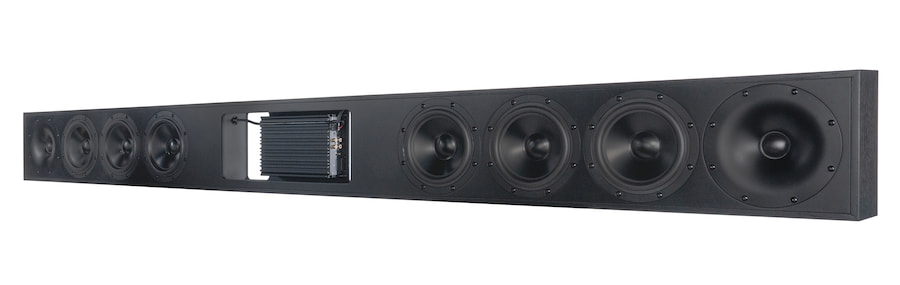
The SBXL-100 is an enormous 82.68-inch-wide powered soundbar designed specifically to look proportional beneath large-format televisions. The PowerPipe X Series takes the opposite visual approach, hiding the subwoofer enclosure inside a wall, ceiling or cabinet and allowing only its bass port to enter the room.
Advertisement
One wants to look like it belongs beneath a giant television. The other would prefer that you never see it at all.
Related Reviews:
The Soundbar Has Finally Caught Up With the Television
At nearly seven feet wide, the Sonance SBXL-100 is not competing with the average $700 Dolby Atmos soundbar.
The 2.0-channel design measures 82.68 x 8.11 x 4.05 inches and uses a 6.5-inch anodized aluminum woofer, 1.2-inch cloth-dome tweeter and integrated passive radiators. Sonance specifies a 38Hz to 25kHz ±3dB frequency response, 87dB sensitivity and 4-ohm nominal impedance.
The package includes Sonance’s UA 2-125 ARC amplifier, providing 250 watts RMS of total system output. HDMI ARC/eARC and CEC allow the television to handle audio and volume control through a single HDMI connection.
Advertisement
Sonance says the SBXL-100 can operate without a separate subwoofer. A claimed 38Hz lower limit makes that plausible for television, music and many media rooms, although anyone building a dedicated theater will probably still want considerably more happening below 40Hz.
Physics has not been removed from the installation manual.
Sonance SBXL-100 Specifications
Configuration: 2.0-channel soundbar
Woofer: 6.5-inch anodized aluminum cone
Tweeter: 1.2-inch ferrofluid-cooled cloth dome
Frequency response: 38Hz to 25kHz ±3dB
Sensitivity: 87dB SPL
Nominal impedance: 4 ohms
Amplification: Sonance UA 2-125 ARC included
System output: 250W RMS
HDMI: ARC/eARC with CEC through amplifier
Dimensions: 82.68 x 8.11 x 4.05 inches
Installation: Wall or tabletop
PowerPipe X Puts the Subwoofer Somewhere Else
The PowerPipe X Series approaches bass from a completely different direction.
Advertisement. Scroll to continue reading.
Sonance introduced the redesigned range earlier in 2026, replacing its previous PowerPipe models with 8, 10, 12 and 15-inch versions. Each uses a ported bandpass enclosure connected to the listening room through a tube, allowing the actual subwoofer cabinet to be concealed above the ceiling, inside a wall cavity, in cabinetry or in another suitable installation space.
Advertisement
The visible opening can then be integrated through several grille and architectural options instead of leaving a conventional subwoofer sitting beside the television.
The four MDF Sonance models are joined by James PowerPipe X-M versions constructed from marine-grade aluminum, extending the concept to more demanding indoor and outdoor installations.
PowerPipe X Specifications
PPX8: 8-inch woofer, 44Hz–130Hz ±3dB, 91dB sensitivity, 300W recommended power
PPX10: 10-inch woofer, 39Hz–115Hz ±3dB, 92dB sensitivity, 400W recommended power
PPX12: 12-inch woofer, 34Hz–100Hz ±3dB, 93dB sensitivity, 500W recommended power
PPX15: 15-inch woofer, 29Hz–90Hz ±3dB, 94dB sensitivity, 600W recommended power
Impedance: 4 ohms
Architecture: Ported bandpass
Standard enclosures: MDF
James X-M versions: Marine-grade aluminum
Why Are These Different?
The SBXL-100 addresses a problem that became more obvious when 85, 98 and 100-inch televisions stopped being exotic.
Most conventional soundbars were never designed to visually balance screens that large. Sonance simply made the speaker wide enough to belong there and paired it with dedicated external amplification rather than trying to cram every piece of electronics into an increasingly thin enclosure.
PowerPipe X solves a harder architectural problem.
Advertisement
Instead of disguising a conventional subwoofer with paint, furniture or increasingly creative excuses, Sonance separates the woofer enclosure from the point where bass enters the room. That gives custom integrators far more freedom when the design brief includes substantial low-frequency output but absolutely no black boxes on the floor.
Alternatives We Have Covered
For large-format television installations, the Leon Speakers FrameBar Ultima is the obvious alternative we have already covered at eCoustics. Leon takes customization considerably further: each FrameBar Ultima can be built to match the width and finish of a specific display and uses 5-inch woofers derived from its Ultima platform. Pricing starts at $5,750.
The Sonance takes a different route with its fixed 82.68-inch width and included amplifier at a substantially lower price.
Theory Audio Design’s sb85 is the performance-first alternative and is specifically proportioned for 85-inch televisions. The passive three-channel design uses six 5-inch carbon-fiber low-frequency drivers and three 1.4-inch compression drivers, with Theory specifying more than 124dB maximum output with all three channels driven. It requires three channels of a Theory loudspeaker controller and the company’s model-specific DSP processing.
Advertisement
We have extensive firsthand experience with Theory’s soundbar platform, including our review of the sb75-based 5.2.2 system, which delivered dynamics and scale far beyond conventional soundbars. The sb85 applies the same basic architecture in a wider enclosure designed for larger displays.
CANVAS L goes in the opposite direction by integrating amplification, DSP, room correction and TV mounting into a single system. It uses 1,500 watts of peak amplification, BACCH 3D+ spatial processing and supports televisions from 65 to 115 inches. European pricing is €5,999, but it’s not shipping in the U.S. yet. However, we’ve also heard and highly recommend the original CANVAS for TVs up to 85-inches, which is available now starting at $4,999.
Advertisement. Scroll to continue reading.
For hidden bass, the JL Audio Fathom IWSv2 remains one of the strongest in-wall subwoofers we have covered. Its 13.5-inch driver installs inside the wall and uses a dedicated amplifier, with a single-sub system costing approximately $7,200.
Advertisement
PowerPipe X differs by locating the enclosure remotely and routing its output into the room, which can make it easier to preserve the visual design of the space.
Price & Availability
The Sonance SBXL-100 is available now for $2,999.99 at Best Buy, including the UA 2-125 ARC amplifier.
The PPX8, PPX10, PPX12 and PPX15 are also shipping now, but Sonance does not publish U.S. retail pricing on its current product pages and directs customers to local representatives for purchasing information. Installed cost will also depend on amplification, grille configuration and the complexity of the installation.
The Bottom Line
The SBXL-100 and PowerPipe X exist because premium residential audio is increasingly being asked to deliver more performance while occupying less visual space.
Advertisement
The SBXL-100 gives enormous televisions a soundbar that does not look comically undersized beneath them. PowerPipe X allows integrators to put the actual subwoofer somewhere the homeowner never has to look at it.
Neither idea rewrites the laws of acoustics.
They simply make those laws considerably easier to live with.
The U.S. Cybersecurity and Infrastructure Security Agency (CISA) has confirmed that ransomware gangs are also exploiting a critical WatchGuard Firebox firewall vulnerability, which it flagged as actively exploited in December.
This flaw is tracked as CVE-2025-14733 and stems from an out-of-bounds write allowing unauthenticated threat actors to execute malicious code remotely in low-complexity attacks.
This vulnerability affects firewalls running Fireware OS 11.x and later (including 11.12.4_Update1), 12.x or later (including 12.11.5), and 2025.1 through 2025.1.3.
When it released CVE-2025-14733 security patches in December, WatchGuard said unpatched Firebox firewalls are vulnerable to attacks only if configured to use IKEv2 VPN, but noted they might still be compromised even if the vulnerable configurations have been deleted if a branch office VPN to a static gateway peer is still configured.
Advertisement
WatchGuard also confirmed that attackers were exploiting the flaw in the wild and shared indicators of compromise to help customers check whether their Firebox devices have been hacked.
In a Thursday update to its catalog of actively exploited vulnerabilities, the U.S. Cybersecurity and Infrastructure Security Agency (CISA) said the CVE-2025-14733 flaw is now known to be used by ransomware gangs but has not provided more details about their attacks.
CISA first added the flaw to its Known Exploited Vulnerabilities (KEV) catalog in December, when it ordered U.S. federal agencies to secure their systems within a week, as mandated by Binding Operational Directive (BOD) 22-01.
Two years ago, the cybersecurity agency ordered government agencies to patch another actively exploited WatchGuard flaw (CVE-2022-23176) affecting Firebox and XTM firewalls.
Advertisement
More recently, in September 2025, WatchGuard patched an RCE vulnerability (CVE-2025-9242) affecting Firebox firewalls and almost identical to CVE-2025-14733. One month later, CISA tagged the flaw as actively exploited, and Shadowserver found more than 75,000 Firebox firewalls vulnerable to attacks.
WatchGuard provides services to more than 250,000 small and mid-sized companies through a network of more than 17,000 security resellers and service providers worldwide.
Overall prevention scores can hide what happens after initial access. Once attackers are using valid credentials, prevention drops sharply.
The Blue Report 2026 measures defenses technique by technique across 338 million simulations run in customer production environments.
China’s foreign ministry has rejected the joint US intelligence advisory accusing Chinese developers of extracting capabilities from American frontier models at industrial scale, calling on Washington to stop making unfounded accusations and smears.
Mao Ning, a ministry spokesperson, said China’s AI development is the result of high-level technological self-reliance and strength, according to accounts of her remarks. The response was reported on Wednesday, a day after the advisory was published.
We reported the advisory when it appeared. The NSA, FBI, and CISA named six Chinese companies, listed which American model each was said to have targeted, and described distillation as the core of how those companies build rather than a supplement to it. The document also disputed the training cost figure that made DeepSeek famous.
Note what the rejection does not do. It does not address any of the per-company allegations, does not dispute the technical account of how requests were routed, and does not respond to the claim about bulk-purchased premium subscriptions shared across teams.
Advertisement
It asserts self-reliance as a matter of national principle, the same framing Beijing used when the accusation was first made by the White House earlier this year. That is a diplomatic answer to a technical document, which is the normal shape of these exchanges and is also why they never resolve anything.
The advisory was unusually specific for a public intelligence product, which is what makes the mismatch conspicuous. Naming six firms and attributing particular models to each invites a rebuttal on those particulars. None has been offered by the ministry or, as far as is publicly known, by the companies.
Timing explains some of the register. Trump and Xi are expected to discuss AI governance later this month, and neither side benefits from a detailed argument about who trained on whose outputs in the days before.
Treasury secretary Scott Bessent, who has previously threatened sanctions on Chinese AI, has said China can never get ahead of the United States, which is the sort of remark that guarantees a foreign ministry response regardless of the underlying facts.
Advertisement
The awkwardness for Washington is that distillation is not obviously illegal, and the industry it is defending has its own history with other people’s data. US labs face a growing stack of litigation over training material they did not license.
The advisory’s answer is that this is different because it involves circumventing access controls rather than scraping the open web, which is a real distinction. It is also a narrower one than the framing suggests.
There is also a commercial subtext neither government mentions. Chinese open-weight models have been undercutting American ones on price for two years, and European buyers have noticed. Our reporting on the competitiveness argument in Brussels keeps running into the same fact: the cheapest capable models are frequently not American.
An advisory that reframes that price advantage as the proceeds of theft is doing work in a market, whatever else it is doing in intelligence.
Advertisement
For Europe the practical question is neither country’s. Both DeepSeek and the American models named in the advisory are in use in European companies and public bodies.
If the US position is that a set of Chinese models were built on capabilities taken without authorisation, that is a procurement question for anyone running them, and no European regulator has said anything about it. The AI Office has enforcement powers and a very small team.
Nothing in the exchange changes what either side does next. The advisory was an attribution exercise, not an enforcement action, and the rejection was a statement, not a defence.
What both do is set the terms for the meeting later this month, where the disagreement will be about export controls and market access rather than about training data.
The best way to digital detox is to have a kid, because when I spend time with him I’m just not on my phone by necessity. I think that’s been the most helpful thing. So there you go, Zoomers. There’s a reason to have children. And honestly, I do notice when I spend a day with him, whether it’s hiking or at the beach, and I’m not on my phone, I’m infinitely happier at the end of the day than any other day in my life.
Music app: Spotify
I primarily use Spotify. The data is completely cooked because of the aforementioned 3-year-old. So when they do Spotify Wrapped, I swear to God, it used to be cool, but now it’s been hijacked by Raffi, Elmo, Ms. Rachel, Mickey Mouse. My son is really into Mickey’s Countdown lately. I feel like 99 percent of my Spotify listening now is just atrocious kids’ music. Raffi’s the GOAT though. I don’t want to lump him in with some of the people that I mentioned. Raffi stands alone.
Number of unread emails: 0
Advertisement
This is probably the thing where you’re going to learn the most about me. Zero unread emails and inbox 10 and under is how I live my life. It’s such an important part of how I work and get stuff done.
The number one thing I should lead with is, for a litany of reasons, I just do not let communication build up, which can be difficult, because I subscribe to a couple newsletters, and I won’t archive them until I’ve either read them or scanned them. But I can’t get to work until I feel like my mind is clear, and my mind isn’t clear if my inbox isn’t clear. I think it’s probably something I inherited from my dad, who was an Air Force major, and from a very young age he taught me the importance of to-do lists, which I also abide by. Sometimes, on a to-do list, I’ll set aside half an hour or whatever to get my inbox back down to sub-10.
Sometimes that means that when I reply to emails, my response is a fraction of the email that was sent to me. And I think people feel social pressure to match an email with a commensurate email. To live the Inbox 10 lifestyle, you cannot abide by that pressure.
Number of unread texts: 0
Advertisement
Same thinking, same principle, same possible OCD.
Last person you FaceTimed: My brother
I FaceTimed with my brother, who’s on vacation with his family in Delaware at the moment. I’m not a big FaceTimer. And candidly, I feel like FaceTiming someone who is outside of your family is insane behavior. But that’s another way in which having a child changed how I use technology, I suppose, because it really is a wonderful way for young children to see distant relatives and communicate with them.
Last thing you googled: “Hip thruster tips”
Advertisement
I recently, and I’m very late to this, started strength training at a gym for the first time in my life. For my entire life, I’ve only gone to the gym to run. And now I’m just learning what all these machines do and how to use them. But I’m like a child. I’m a total neophyte in this world. I have a trainer, but I’ve also found it’s a really encouraging and fun section of the internet.
Last photo you took:
It’s a picture of my son standing next to a tower he built in his room. I feel like at this point, 95 percent of the photos on my phone are of my son. It’s kind of sad; you can see the exact point where we had him because it used to be all pictures of my dog, and then it just completely switches to pictures of my son.
Last screenshot you took: The Adam Levine “Holy fuck, holy fucking fuck, the body of yours is absurd.”
Advertisement
I can’t even remember what I was using it as a meme for, but I clearly needed that screenshot to use as a meme.
Last thing you asked AI: “How to lift a paint stain off of a carpet.”
I don’t really use LLMs. If I do, it’s for either menial household questions or basic search. And I only use it for search because search is now useless due to AI.
I’ve read and listened to a lot of people talk about how it’s revolutionized their workflow, and they’re training agents to make appointments and they’re building these elaborate meal plans. And to me, that doesn’t sound interesting. That just sounds exhausting. We have this phrase in football called “looking for work,” when a player on the field is looking for work—looking for someone to block, for example. And I just think about that whenever I hear those stories. It just sounds like you’re looking for work.
Volvo’s smallest gas SUV in the U.S. is getting an update, though while the 2028 XC40 may officially be a mid-cycle refresh, it gives the crossover a welcome polish in style and technology. Set to hit roads in early 2027, the new XC40 also sees Volvo trim back the number of choices buyers will have, with a single drivetrain on offer this time around.
Notably, that drivetrain isn’t fully electric. While Volvo has been barreling at pretty much full speed into full EVs, the U.S. market has not been quite so ready to embrace them. The struggles of compact electric crossovers like the EX30 illustrates that well, and sure enough the 2028 XC40 — for North America, anyway — won’t offer a “Recharge” EV version. Instead, that space will be occupied by the EX40.
Chris Davies/SlashGear
Ahead of the big unveil, Volvo invited SlashGear to London to preview the changes it has made. Like the best refreshes, you only really notice the scale — and effectiveness — of the redesign when directly compared to the old model. The new XC40 is cleaner and crisper; simplified and with a greater confidence in the impact of that simplicity.
Advertisement
Less fussy on the outside
Chris Davies/SlashGear
The headlamps are pared back to a pair of light slashes each, the Thor’s Hammer seeming to float just beneath the surface of the otherwise blacked-out clusters. It’s the same at the rear, where the complex taillamps of before have been streamlined to just a couple of strips that seem to glow amid a sea of ink. Clever lamination of the LEDs leave the lights looking continuous and seamless, almost as through they’ve been projected onto the bodywork rather than captured within it.
Chris Davies/SlashGear
The front grille is reworked, as are the hood, front wings, and bumper; there’s a new tailgate and rear bumper, too. Volvo’s designers took the negative space aesthetic from the lower doors and continued that at the corners of the new XC40, carving out swathes of mass.
Chris Davies/SlashGear
It not only plays with light and shadow, but leaves the crossover feeling less sharp at its edges, something pedestrians will probably appreciate in the urban settings the little Volvo is designed for.
Advertisement
A smarter cabin with embedded Google Gemini
Chris Davies/SlashGear
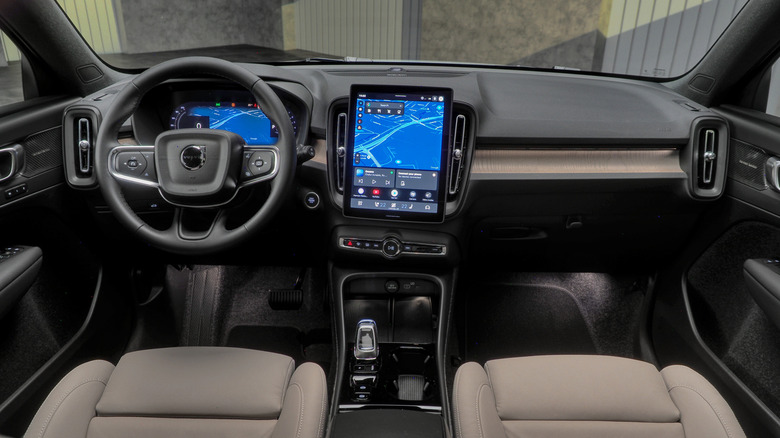
Inside, the biggest change is to the central infotainment touchscreen. Gone is the old 9-inch display, replaced with a 11.2-inch version with higher resolution. It seems to float out from the dashboard now, similar to the aesthetic in Volvo’s all-electric models. For the 2028 XC40, it’s still paired with the familiar 12.3-inch digital driver’s cluster display.
Chris Davies/SlashGear
Volvo claims the bigger screen should also be more intuitive to use, with the latest version of its software and quicker access to common features. There’s also Google Gemini integration, taking on the XC40’s voice control functionality. That promises natural language conversation support, for messaging, multimedia control, navigation, and more: think everything a Pixel phone could do. An embedded modem handles over-the-air software updates.
Chris Davies/SlashGear
Elsewhere in the cabin, Volvo has leaned into the XC40’s upscale aspirations. There’s new trim — offered in Brown Ash or Black Ash wood, or aluminum finish — and new ambient lighting to highlight it, including subtle glows that emanate from the dashboard and door panels.
Chris Davies/SlashGear
Small details, but ones which help elevate the crossover into a more luxury space. That also goes for the new Arianne Cardamom leather option, a rich brown finish for the seats, and the first time real hide has been offered in the XC40.
Advertisement
One drivetrain choice keeps things simple
Chris Davies/SlashGear
Sadly, the U.S. won’t be getting the all-electric XC40 Recharge, arguably the more endearing of the two versions. We can likely blame the current American administration’s attitude toward foreign-made EVs for that: the XC40 will be made in Volvo’s Ghent, Belgium plant.
Chris Davies/SlashGear
Instead there’ll be a single drivetrain option for U.S. buyers, the 2028 XC40 B5 AWD. That has an inline-4 turbocharged mild-hybrid gas engine paired with an 8-speed automatic transmission and standard all-wheel drive. Volvo says it’ll do 27 mpg on the EPA combined cycle — one point higher than the pre-refresh XC40 with the same drivetrain — though the 6.3 second 0-60 mph time is two-tenths of a second slower than the outgoing car.
Chris Davies/SlashGear
Horsepower remains the same, at 247 hp, but torque is up slightly from 258 lb-ft to 266 lb-ft. There’s still 3,500 pounds of tow capacity, and 8.3-inches of ground clearance.
Upgraded safety, but price is TBA
Chris Davies/SlashGear
Whether XC40 owners will test that clearance out in the wild remains to be seen. Far more likely to sway buyers is the updated safety tech package, the 2028 XC40 getting a bolstered sensor suite with new cameras, along with new ultrasonic and radar sensors. They power familiar features like automatic emergency steering and emergency braking, collision avoidance, and collision mitigation, but also a new door opening alert that helps avoid slamming a door into the path of a cyclist or other traffic.
Pilot Assist remains an option, a hands-on driver assistance suite for the highway, but with the addition of lane change assist in the refreshed car. There’s also an optional 360-degree camera, that now supports a 3D view of the XC40.
Advertisement
Chris Davies/SlashGear
Production of the 2028 XC40 is expected to begin later this fall, with U.S. deliveries scheduled to begin early in 2027. Pricing will be confirmed closer to that point, though for context, the current 2026 XC40 B5 AWD starts at just over $45k with destination.
Fable‘s main story takes between 15 and 20 hours to complete
Associate game director Will Kennedy confirms additional side content can also take between 15 and 20 hours
However, the game’s life systems are “limitless”
Playground Games has confirmed that Fable‘s main story will take up to 20 hours to beat, but promises the game’s life systems offer “limitless” replayability.
Speaking during a Q&A session at Gamescom 2026, associate game director Will Kennedy discussed the scale of the upcoming role-playing game (RPG), saying, “So the main story obviously depends on how you play, but the main storyline is around 15 to 20 hours.”
He added, “But then we’ve got around probably about 15 to 20 hours again of open world and side content to engage with.”
Latest Videos FromTechRadar
Advertisement
While not a massive amount of hours compared to other open-world RPGs, that at least gives fans an idea of what to expect when the game releases next year.
However, it’s what Kennedy said later that confirmed that, while Fable will have a good-sized story with plenty of side content, the game’s life systems, like interacting with the over 1,000 unique non-player characters (NPCs), buying real estate, committing crimes, and more, will offer up even more playtime.
“Honestly, with the life systems which we [shared an] in-depth look at and showcased earlier on in the year, that’s limitless, and you can engage with it as much as you want,” he said.
Advertisement
Fable has been in development for a very long time, but will officially launch on February 23, 2027, for PlayStation 5, Xbox Series X, Series S, and PC.
Sign up for breaking news, reviews, opinion, top tech deals, and more.
Hideo Kojima’s upcoming action-espionage game will be published by Xbox instead of PlayStation. In a flurry of announcements from Kojima, Xbox and PlayStation, it was revealed that the PS5 maker dropped Kojima’s next game, Physint, back in June. Xbox then swooped in and agreed to publish the title, and possibly future Kojima games as well. “We found in Xbox a partner with whom we share a common vision for the future, and we have decided to team up with them once again,” the Metal Gear Solid creator wrote on X.
The shock announcement started when PlayStation tweeted that it was dropping Physint. “After careful consideration, we have made the difficult decision to step away from collaborating with Kojima Productions on its project Physint,” Sony’s gaming division said in a post on X. It added that it looked forward to continued “close collaboration” with Kojima’s studio in the future.
Just a minute later, Xbox CEO Asha Sharma posted that Xbox was taking on the Physint project. “Physint and OD!” she said, referring to another Kojima and Xbox collaboration. “Proud to build both with @HIDEO_KOJIMA_EN in Japan. A big moment for Xbox.”
As confirmed earlier through our official channels, in mid-June of this year, we unexpectedly received notice from PlayStation Studios that they would cancel the PHYSINT project. PHYSINT is an important project both to me personally and to KOJIMA PRODUCTIONS. Determined to keep… pic.twitter.com/rQqhxAnb7N
Kojima then weighed in with an X post confirming the details and that he was surprised by Sony’s decision. “In mid-June of this year, we unexpectedly received notice from PlayStation Studios that they would cancel the Physint project,” his post stated. “Physint is an important project both to me personally and to Kojima Productions. Determined to keep the project alive, we have spent the last three months searching tirelessly for a new partner” before landing on Xbox.
Furthermore, in an Xbox Wire post, Xbox wrote: “In addition to OD and Physint, this relationship will also extend beyond games, with Xbox and Kojima Productions collaborating across film and television to bring new stories to broader audiences.”
The drama makes one wonder exactly what is going on with the development of Physint that made Sony drop it, knowing it could create bad press and hard feelings with Kojima. The game was first announced in early 2024 with considerable fanfare. Head of PlayStation Studios Hermen Hulst personally unveiled Physint with Kojima, and the end of the video pulled back to reveal Columbia Pictures, with the implication being the game could lead to movies or other IP. Now, all of that appears to have been blown up.
Both children and parents agreed that an education focused on safeguarding has more value than a ban on social media targeting young people.
A new report published today (10 September) by Ireland’s media regulator and online safety commission Coimisiún na Meán has found that almost 70pc of children who took part in the research are of the opinion that an education in online safety is better than a social media ban.
The Online Safety and Children’s Digital Lives report examines two national surveys, one taking into account the experiences and views of children, the other exploring the sentiment held by parents and caregivers.
Nearly half of (49pc) participating parents and caregivers agreed that teaching children about online safety is preferable to banning their access to social media platforms. 43pc of parents or caregivers believe that a ban is often ineffective as children can circumvent it. 67pc of children also agreed that they have the skills to get around a ban.
Advertisement
A high number of parents and caregivers were also of the opinion that no social media access at all could have a positive impact on their child’s focus on their schoolwork, with 64pc sharing this belief, compared to 18pc who disagreed. They also predict improvements in mental health (67pc).
Media literacy
Older children who took part reported greater confidence in some security and trust awareness competencies than others, with confidence increasing with the age of the young person. Nearly three-quarters said that they know how to protect their devices and 33pc said they know how to access private browsing.
Less than half however, said they had the knowledge needed to confirm whether a website could be trusted. According to the research, the findings indicate that many children are uncertain about how online information and content are prioritised, with confidence in navigating competencies increasing steadily with age.
Among the issues being faced by young people online are cyberbullying, online aggression and being sent sexualised communications, an issue which increased alongside the age of the child.
Advertisement
Commenting on the report, Jeremy Godfrey, the executive chairperson at Coimisiún na Meán said, “This report provides important evidence on how children and young people in Ireland feel about their experiences of the internet. Crucially, this study allowed us to hear directly from children and young people and their parents or caregivers about their experiences and attitudes.
“We all agree that children deserve a safe online environment that supports their development in a variety of ways, in line with their age and evolving capacities. Our participation in the study is a clear demonstration of our commitment to ensure that audiences, especially children, can benefit from the positive aspects of media, while also being protected from potential harms.”
In a landscape where world governments are implementing bans on social media as a means of better protecting children online, France’s Constitutional Council recently blocked a proposed bill banning social media for children under the age of 15, declaring that the legislation is too broad and has the potential to infringe upon young people’s right to freedom of expression.
Don’t miss out on the knowledge you need to succeed. Sign up for the Daily Brief, Silicon Republic’s digest of need-to-know sci-tech news.
A lot of the best meal kits offer the satisfaction of making a home-cooked meal, the chance to learn a little culinary craft, maybe even a chance at some pride in your handiwork. Hungryroot (7/10, WIRED Review) isn’t really like that. Hungryroot instead wants to replace your trip to the grocery store with a few good recipes.
After starting as a grocery service, Hungryroot spent years piecing together proprietary AI long before AI became the byword of everything from your electric shaver to your literal kitchen sink. What Hungryroot’s AI does is geared to creating personalized food menus and shopping lists, based on your every micro-preference and whim, whether that’s a love of olives or a hatred of figs. A box then shows up at your door, with a mix of basic provisions, silly snacks, and desserts, along with recipes and usually some pre-prepped ingredients.
Cooking is often more assembly, with recipes pieced together from premium ingredients you’d expect to find at your local organic store. A fun sauce here, a pre-cooked protein there, a corn tortilla that just wants to be livened in the pan. Most meals come together in 15 or 20 minutes, in my experience—unless they need time in the oven. A bot concierge and pre-mixed sauces do cost a bit, however, and that’s where Hungryroot promo codes come in. There are Hungryroot coupons that offer 30% off or more, and Hungryroot coupon codes that offer extra free gifts for every box, for life: a protein here, a cookie there. Here’s what’s up.
Get 30% Off Plus a Free Gift With a Hungryroot First-Time Discount
The current Hungryroot discount code is good for a cool 30% off your first week’s box from Hungryroot. To qualify for the discount, you’ll need to sign up for a plan totaling $99 or more a week, including breakfast items, snacks, and produce in addition to recipes and ingredients. The Hungryroot promo offer also includes a free gift, which usually includes an option to get an extra premium protein like chicken or beef. You can see more information here.
Advertisement
Take Advantage of Hungryroot Coupons for Referrals
Like a lot of meal kits, there’s also a Hungryroot discount code for referring your friends to the Hungryroot service—and this usually benefits both sides of the equation.
Your friend who orders after using your referral code gets a cool $50 off their first grocery delivery of $100 or more—which adds up, potentially, to half off. The person who refers their friend also gets $50 off their next order, once their friend finalizes their first grocery delivery of $100 or more. So basically, everybody gets $50.
Unlock of Hungryroot Coupons for New and Returning Customers
Most subscription services have hidden levels. The way to access them is to change your mind a lot. Just like some magazine subscriptions and almost all delivery meal kits and grocery subscription services, Hungryroot will chase you down with offers if you cancel a subscription or change your mind after already giving them your email.
Advertisement
What’s this mean? Usually, it means that in the days or weeks after changing your mind about Hungryroot, you’ll get a coupon in the mail. So if you take Hungryroot’s quiz about your dietary preferences, then don’t order? A few days later, you’ll likely get a sweet Hungryroot coupon code in your inbox. New subscription plans usually also come with free treats.
If you cancel or pause an existing account, you may also receive a Hungryroot promo code offering your $50 or even $100 off your next order, as an incentive to return.







































































You must be logged in to post a comment Login