The European Union’s push for technological sovereignty faces an uncomfortable contradiction.
As the EU rolls out AI factories, gigafactories, and new data centers, it is creating a surge in demand for the advanced semiconductors that underpin artificial intelligence. Yet Europe produces fewer than 10 percent of the world’s chips and remains heavily dependent on U.S. designers and Asian manufacturers for the most advanced processors.
That tension sits at the heart of Chips Act 2.0, the European Commission’s planned overhaul of its flagship semiconductor strategy.
Advertisement
The original Chips Act, adopted in 2023, sought to raise Europe’s share of global semiconductor production to 20 percent by 2030. But the European Court of Auditors has warned that target is unlikely to be met, while the Commission’s own projections put Europe’s market share at about 11.7 percent.
The Commission now wants to correct what officials see as a major weakness in the first law: It focused on expanding supply without doing enough to stimulate demand. To address that gap, Chips Act 2.0 is expected to introduce demand-side measures, including public procurement tools, demand accelerators, and closer coordination between semiconductor producers and industrial users. The Commission’s calculation is straightforward: Stronger domestic demand will encourage companies to invest in designing and manufacturing chips in Europe.
But the strategy carries a paradox. The AI infrastructure that the Commission hopes will anchor a European semiconductor ecosystem will initially rely almost entirely on advanced processors designed by U.S. companies and manufactured in Asia.
“Key positions are held by a small number of firms, mostly outside Europe,” Claire Godfrey, executive director of the Balanced Economy Project, told Tech Policy Press.
Advertisement
AI factories create a demand trap
The European Commission’s AI Continent action plan includes 19 AI factories, computing facilities that integrate energy sources, specialized chips, and other infrastructure for running AI models and applications, plans for up to five AI gigafactories (since upgraded to seven), and a proposal to at least triple the bloc’s data center capacity within five to seven years under the Cloud and AI Development Act. That expansion will require a large supply of advanced AI processors.
The Center for European Policy Studies (CEPS) estimates that each planned AI factory site requires up to 25,000 advanced chips, while a gigafactory requires at least 100,000.
Almost all of those processors are expected to come from Nvidia. The company supplies most of the graphics processing units deployed in Europe, while its proprietary CUDA software underpins much of the AI software ecosystem. CEPS warns this could create an “Nvidia dependency trap,” where computing infrastructure is physically located in Europe but remains technologically dependent on a single U.S. supplier.
Recent AI infrastructure projects in Europe illustrate the problem. Mistral has lined up 13,800 Nvidia GPUs for a data center near Paris. Deutsche Telekom’s Munich Industrial AI Cloud is being built with nearly 10,000 Nvidia Blackwell GPUs. And Nscale says its Sines deployment for Microsoft will start with more than 12,600 Nvidia Blackwell Ultra GPUs before expanding to more than 66,000 in 2027.
Advertisement
Europe still doesn’t control the chip supply chain
The challenge extends well beyond Nvidia. Even if Europe succeeds in expanding semiconductor manufacturing, the global supply chain limits how much autonomy any single region can achieve.
“Europe depends on both the United States and Asia, but at different stages of the value chain,” Toni Roldán-Monés, economist and assistant professor of public policy at IE University, told Tech Policy Press.
“The United States maintains a dominant position in areas such as chip design, intellectual property, and certain frontier equipment. Meanwhile, the manufacturing of the most advanced semiconductors is highly concentrated in Asia, especially in Taiwan and South Korea, while China plays a fundamental role in various materials, industrial processes, and critical minerals,” said Roldán.
Europe’s reliance on third countries is more evident in some parts of the chip value chain. In fabrication, Taiwan produces around 90 percent of the world’s most advanced chips. In packaging, assembly, and testing, the EU holds just 4 percent of the market and remains highly dependent on Asia, according to Laith Altimime, President of SEMI Europe.
Advertisement
“The objective is… to avoid excessive dependence on a single country, company, or technology.” Toni Roldán-Monés
“No top 20 assembly, test, and packaging company is headquartered in the EU,” Godfrey said. “There is also the materials issue. China dominates several inputs used in key parts of the semiconductor and advanced electronics supply chain.”
Europe nevertheless retains important advantages.
The region is home to ASML, the Dutch company that dominates the market for extreme ultraviolet lithography systems, and to Belgium’s Imec, one of the world’s leading semiconductor research centers. Europe also remains a key supplier of specialist materials and power electronics.
Advertisement
Those strengths, however, “do not translate into autonomy across the semiconductor value chain,” Roldán said.
Sovereignty means resilience, not self-sufficiency
Few experts believe complete semiconductor self-sufficiency is achievable.
Instead, the goal should be to reduce strategic vulnerabilities rather than eliminate international interdependence. “It is not conceivable that one country can rebuild the supply chain. Global collaboration is key,” SEMI Europe’s Altimime told Tech Policy Press. SEMI forecasts that by 2028 the Europe, Middle East, and Africa region will only manufacture about 68 percent by volume of the non-memory semiconductor chips it demands.
“The challenge is to reduce dependencies that could become geopolitical vulnerabilities,” argues Roldán. “The sensible approach is to strengthen critical parts of the value chain, diversify suppliers, protect sensitive data, and develop domestic capabilities in strategic sectors. That can coexist perfectly well with foreign suppliers: The objective is not to expel them, but to avoid excessive dependence on a single country, company, or technology.”
Advertisement
That distinction is especially relevant for Europe’s sovereignty ambitions. As Godfrey notes, “European firms are building around Nvidia hardware, CUDA, cloud infrastructure, and the software choices that come with them. That leaves Europe with two problems. It relies on Asian manufacturing and materials chokepoints. It is also at risk of trying to address that exposure by tying itself more closely to U.S.-controlled AI and cloud infrastructure. The Chips Act 2.0 needs to deal with both, or it will miss a large part of the problem.”
Roldán said Europe’s greatest vulnerability is dependence on partners willing to use global supply chains for geopolitical leverage. Whether Chips Act 2.0 reduces that risk, experts say, will depend on whether it diversifies suppliers rather than just shifting dependence from Asian manufacturers to U.S. technology companies.
I wrote this article at roughly 3 am, sitting in a clinic lobby while my friend talks to an oncologist in the cabin behind me. The air is saturated with the smell of medicines, of course, and the atmosphere has an unmistakable whiff of gloom that compels me to exit the compound as soon as possible. The overwhelming sensation, however, is that of rage and fury.
Merely an hour ago, I had received a call from my 24-year-old friend, complaining about a severe headache and pain in her stomach. She is currently undergoing treatment for breast cancer, and after seeing her go through the ordeal over the past two years, I rushed to her place, hoping it was not serious. Without asking too many questions, I looked up the nearest hospital and rushed her for a checkup.
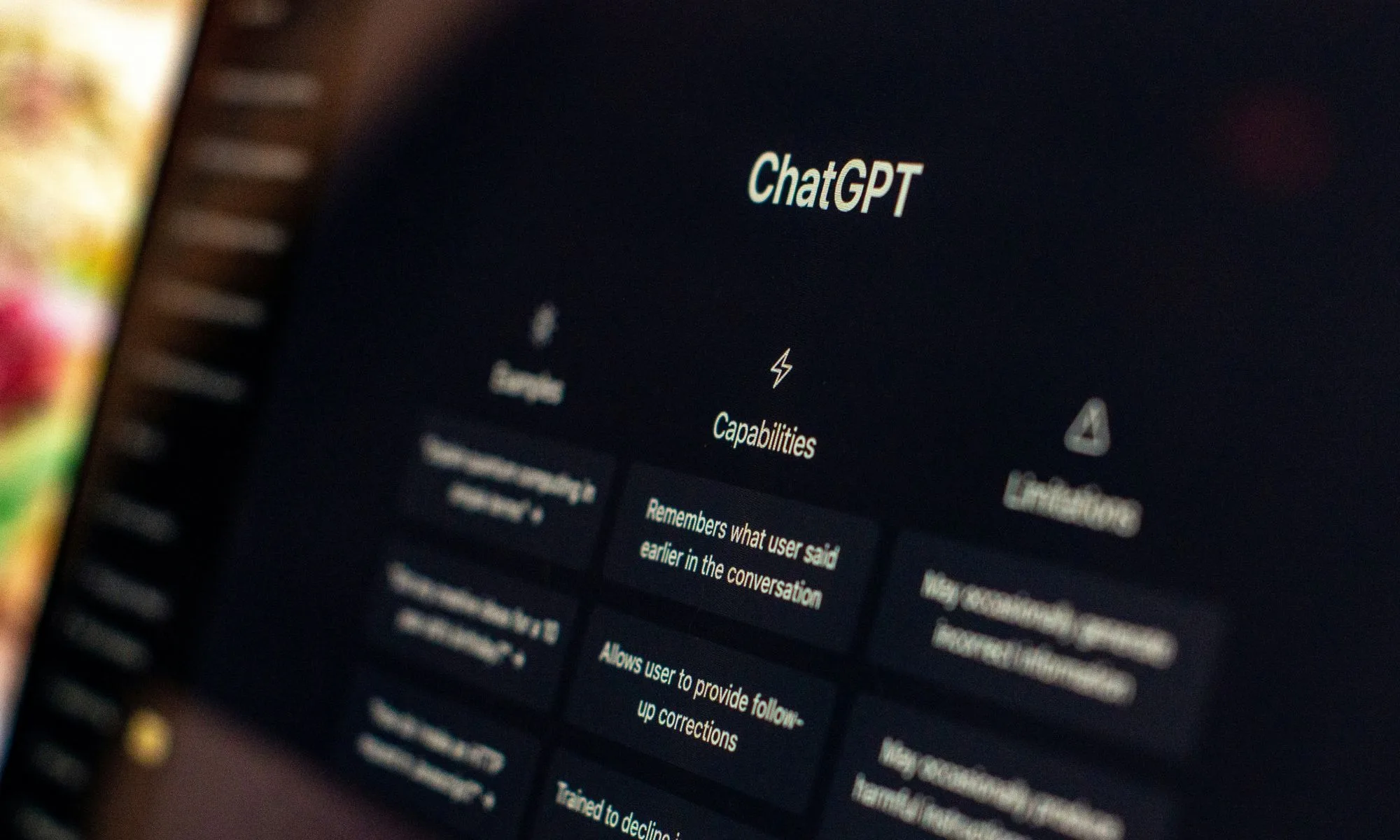
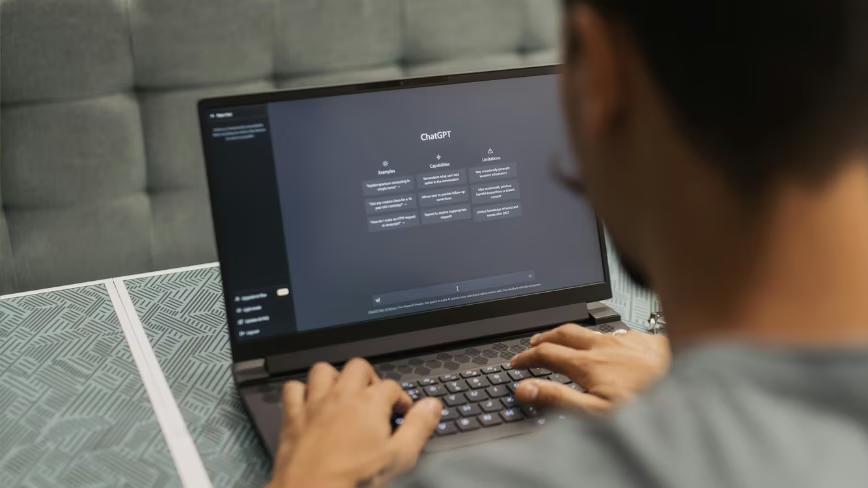
On the way to the hospital, I asked her when the pain started and if she had experienced any other worrisome symptoms. Her answer shocked me, and to such an extent that I wanted to snatch her phone and crush it to pieces. “After I returned from work, I felt some dizziness and also felt that something was not right in my gut. So, I asked ChatGPT if I could take painkillers, and a few hours after I took them, the gut pain worsened with a burning sensation. I also vomited a few times.”
Who must act responsibly?
Unsplash
The admission shook me, and the casual tone in which she described her ChatGPT interactions was even more frightening. But there are so many layers to this mishap that I’ve decided to ban AI for my loved ones, especially when it comes to health and wellness-related conversations. As someone who is extremely sensitive to medications and who is going through cancer treatment, asking an AI about taking medicines was the last thing you would expect any sane person to do.
I don’t know exactly who is to blame for this potentially life-threatening misadventure. She simply took a picture of a painkiller, fed it to ChatGPT, and asked if she could take two pills at the same time. Her doctor has only recommended her one pill at a time, and that too, when the pain is too severe to tolerate. ChatGPT told her she should take one painkiller, and two of them, only with a doctor’s recommendation.
Advertisement
When I asked why she turned to the AI bot, she later told me ChatGPT “is easier to get answers from. I don’t even know what’s real on the internet.” For a person who had to drop studies after high school and support their family with odd jobs, I understood her predicament. I couldn’t lecture her on the concepts of digital literacy and fact-checking. There was so much wrong with that chat, and both parties are to blame here.
This is where the problem begins. She is not a native speaker of the Hindi language, and when she translated her query into Hindi, it was a grammatical disaster owing to just one word. She wanted to ask if she could take two pills of the medicine appearing in the picture. But her broken translation made it seem as if she was asking ChatGPT if she could take “both medicines.”
This is where ChatGPT also tripped. The picture shows a pill with only its chemical composition visible — Diclofenac and Serraptiopeptidase. The name of the medicine was only half visible. Despite that, the AI bot accurately identified the painkiller medicine as “something like Cipzen-D.” But before that, it also mentioned another medicine, Fenak Plus, whose chemical composition is Diclofenac and Paracetamol, and which she had previously discussed in another conversation.
ChatGPTUnsplash
It’s an entirely different composition, even though both are easily available as over-the-counter painkiller medicines that you can even buy (worryingly) without a proper prescription at local dispensaries. So, broadly, we have one human mistake (with translation) and two mistakes by ChatGPT because it was also pulling knowledge from its memory. The advice, however, was accurate.
OpenAI’s AI bot clearly warned that taking both medicines is not a good move, adding that it could lead to an overdose of Diclofenac. The AI bot also described the after-effects, which included a burning sensation in the stomach, ulcer-related problems, bleeding, and long-term ill-effects on the kidneys.
Advertisement
Do keep in mind that the picture fed to ChatGPT only depicted one painkiller. It further recommended that only one of those painkillers must be taken at a time, and not both. My friend, recalling that both medicines had been prescribed by doctors at one point (though not together), took them both for quick pain relief and soon felt the wrath.
The doctor was also furious and, rightfully so, when my friend told them why she took two pills at the same time, chiding her for not consulting a healthcare professional. It was followed by an injection to ease her pain and a fresh medical prescription for painkillers that don’t harm her fragile body.
As a technology reporter who has written about the risks of AI interactions on sensitive topics, especially health and wellness, I felt like a failure. I felt that I never actually had a chat about the risks of AI bots with my friend. And it was only after the scary incident that I warned her about the risks.
When she confessed to using ChatGPT for medical advice on multiple other occasions in the past, I took her phone and deleted the app. More importantly, I asked her to never touch another AI chatbot — such as Gemini or Claude — for medical advice, or the whole internet, for that matter. The only way forward is talking to a doctor, or visiting a clinic.
Advertisement
The perception problem
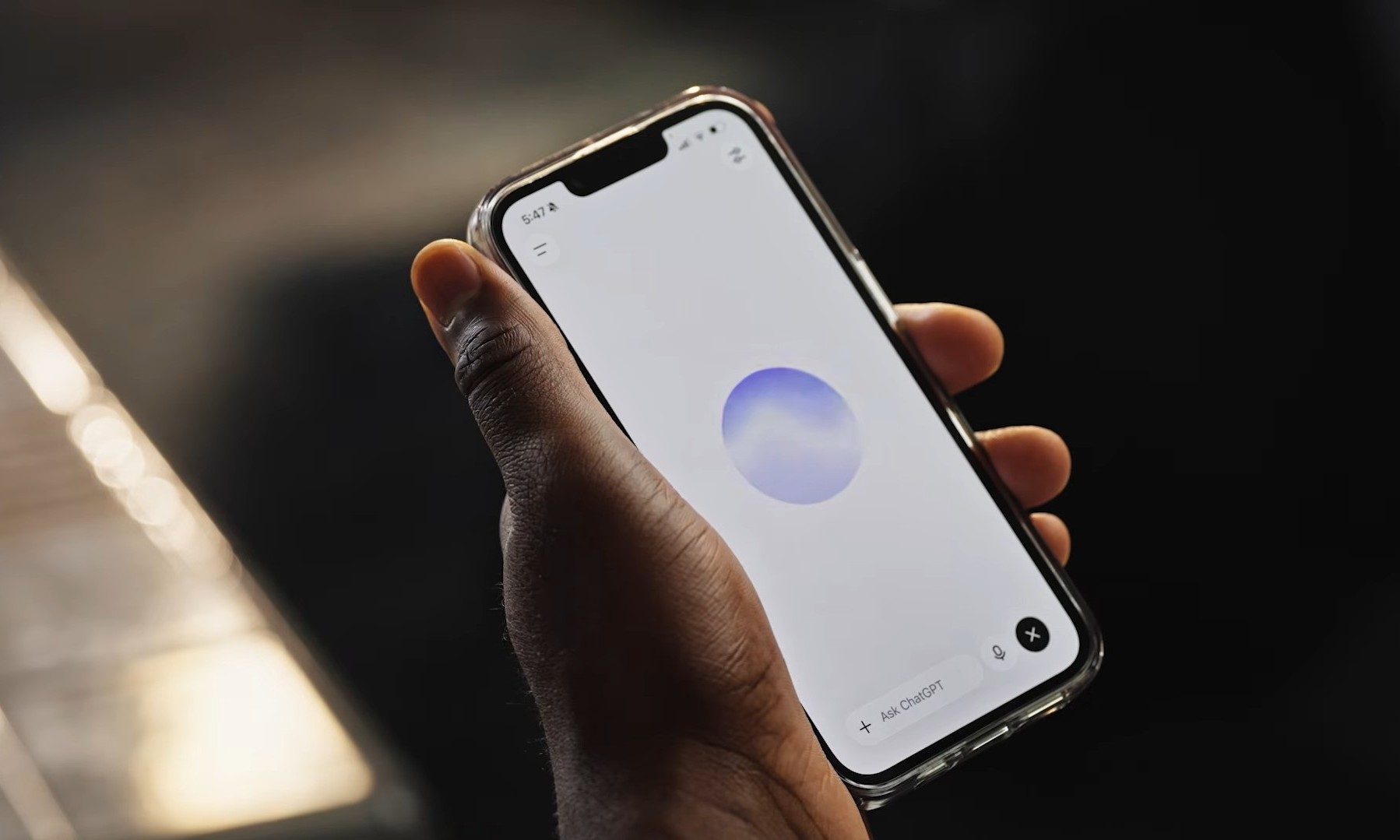
ChatGPT Live mode.OpenAI
I don’t blame her entirely for the episode. Given the fashion in which ChatGPT has rooted itself in the daily digital habits of the masses as an all-knowing genie, it’s hard to blame her. People see it as a more convenient (and truthful) answering engine compared to the friction of looking up answers on Google Search, clicking on blue links, and skimming through the answers on a webpage(s).
They’re not wrong, to be fair. Getting straightforward answers from an AI bot like ChatGPT, and that, too, in natural language within a matter of seconds, is far more convenient than entering the maze of Google Search links. Google is also aware of the changing user behavior, which also explains the push being given to the conversational AI mode in Search.
As of today, the conversational answers supplied by Gemini sit atop the regular search results. The idea is identical: giving users summarized answers extracted from the blue link sources on Google Search before they go on a deeper hunt for knowledge by reading multiple sources spaced across half a dozen tabs
To their credit, ChatGPT (or most frontier AI models, for that matter) plays it especially safe when someone seeks health and wellness advice. In an overwhelming majority of such answers, the AI bots ask the user to consult a certified healthcare professional or access the appropriate helpline. But once again, the way these AI chatbots have entered the public discourse as a quick and trusty source of knowledge is what makes them equally scary.
A few days ago, I was watching a heated debate on a prime-time news channel. During the fiery exchange, one of the panelists asked their opponent to go ahead and check the facts by asking ChatGPT. In that moment, I saw ChatGPT being talked about as the modern-age equivalent of finding answers in an encyclopedia, and that too, from a stage that influences millions of people in the world’s second-largest market for AI chatbots.
Advertisement
Lost in translation
The US sits at the top of AI adoption, but the country also has arguably the highest awareness about the risks of using AI chatbots. In India, digital literacy (and AI awareness) is dramatically lower, and hence, the risk potential is much higher. The danger is further exacerbated by the fact that hundreds of thousands of people are using ChatGPT and other AI agents in a native Indian language. And this is one of the key drivers behind the recent episode with my friend: ChatGPT’s language problem.
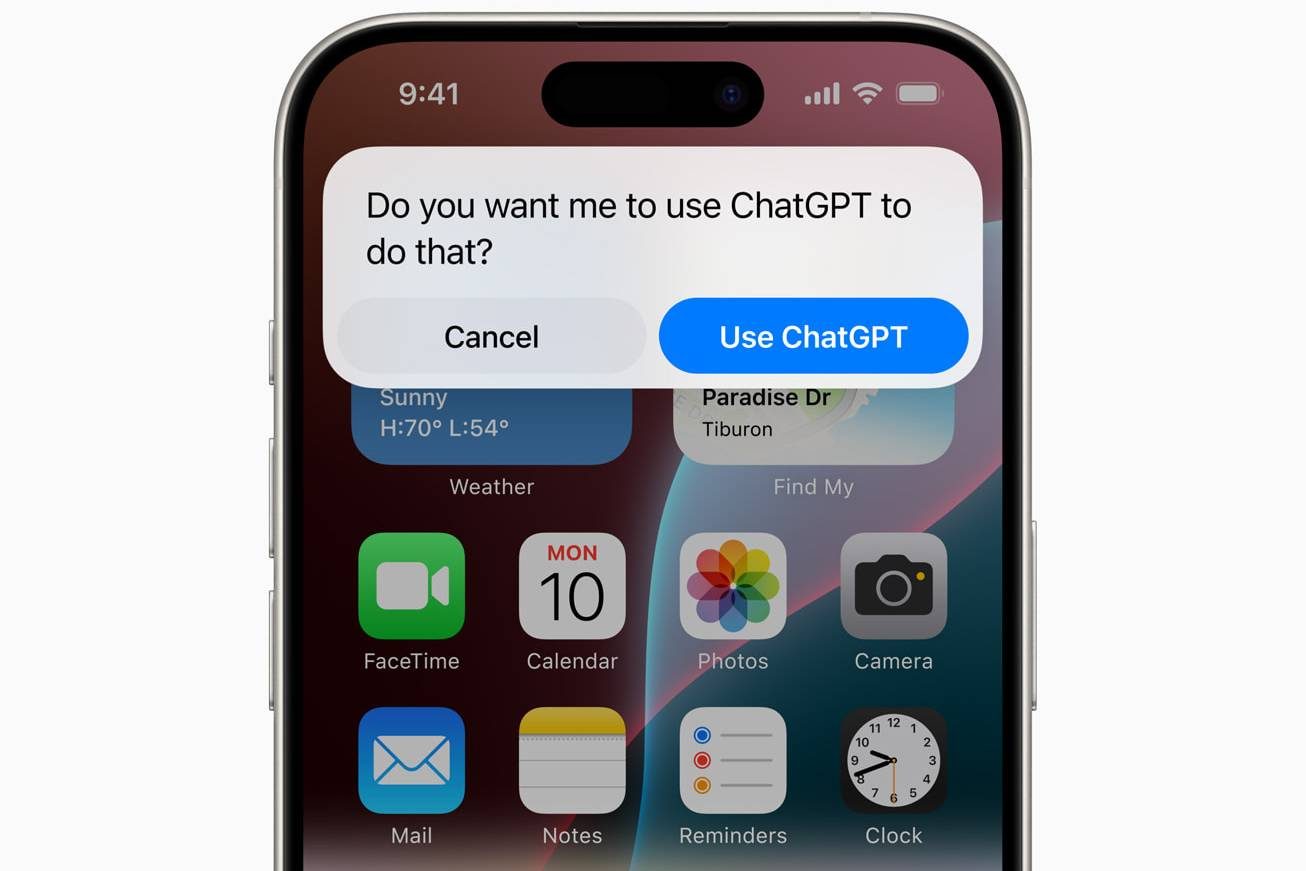
Apple
In a research study published earlier this year, the MIT Center for Constructive Communication mentions that the accuracy of answers provided by AI chatbots is lower if users are interacting in a non-English language. The SAHARA benchmark, released in December last year, also highlighted a similar discrepancy in AI chatbot behavior when users are talking in a non-English language. The Economist also highlighted numerous papers in which the language issue of LLMs was laid bare.
The language barrier further raises the risk quotient.
Translation is not the only problem, though. Healthwatch England, an independent consumer advocacy group for patients in the UK public health system, has also warned about the risks of using AI transcription tools by doctors and healthcare experts. Here’s a worrying snapshot from our report:
“In one alarming instance, an AI tool reviewed an MRI summary and documented that a patient had demyelination, a serious nerve condition linked to multiple sclerosis. The scan actually revealed “null demyelination”, meaning the issue was not present.”
It’s an obvious flaw that large language models have to fix, but there’s an even bigger issue at play here. AI chatbots need to do better when dealing with sensitive topics. The likes of ChatGPT have implemented parental controls and often tell users to seek help, while also offering helpline numbers and reliable resources. You will also see a warning that ChatGPT is not a doctor, or some form of it.
Advertisement
But these warnings should appear right at the top for all such conversations, and not buried below the first few sentences, which is where most users get their answer and never bother to read further. I would much rather prefer to see a wide banner right at the top, and this protocol should be drilled into the very heart of the AI model’s behavior.
Next, we need awareness. A lot of it. AI companies are busy parading how their LLMs are solving complex mathematical problems, beating humans at olympiads, and helping with medical breakthroughs. But all that happens under the supervision of experts. For an average person, for whom ChatGPT is a source of quick and conversational knowledge, the warnings and disclaimers should take priority.
OpenAI may play it safe, but the public perception of ChatGPT is evolving dangerously fast.
A lot of users see it as a new kind of knowledge engine, one that talks like any other human. There are numerous cases of AI bots giving dangerously bad health advice, and as of 2026, research continues to highlight their risky behavior on sensitive topics. I just hope OpenAI, and every other AI player out there, thinks this through and takes appropriate action.
I can’t assume the Trump administration hoped this would happen. But I can’t believe no one in the administration (Trump, Stephen Miller, Tom Homan) isn’t secretly thrilled that this has happened.
The administration managed to revoke temporary protected status for Haitian refugees in America, a decision that affects nearly 350,000 people. The revocation of this status (which involved a protracted court battle) comes with the implication that these refugees are no longer in danger and can safely return to the country they fled.
“Why is the Trump administration knowingly sending Haitians, including many who’ve lived in the U.S. legally under Temporary Protected Status, into the danger that they describe?” [CNN’s Dana] Bash asked Homan.
“We’re returning deportees to their home country,” Homan replied. “I’m not in the loop on this specific incident … but when people are deported, they can’t stay here, they’re gonna go home.”
Advertisement
At best, this is what is known as a conclusory statement. It’s the equivalent of using the word you’re defining in the definition. Of course people being deported can’t stay in the US. That’s how deportation works. But that doesn’t answer the question that was asked: how can this administration justify the deportation of Haitians to a country the State Department says is so dangerous it has issued a “No Travel Advisory?”
This doesn’t either, although it does make it clear every Trump administration official will simply feign ignorance when confronted with their own awfulness:
“Look, the bottom line is they’ve been ordered removed,” Homan replied. “I don’t know the conditions in Haiti. I’ve never been to Haiti. I don’t know if you have. But look, the judge made a decision … and they need to go home.”
Yep, there’s literally no way to tell how things are in Haiti without actually going there yourself. But you won’t because the State Department is pretty fucking clear that Haiti is a bad place where bad things happen.
Here’s the exact wording used by the State Department, which, I must remind you, is headed by Trump stan Marco Rubio (emphasis in the original):
Advertisement
Do not travel to Haiti due to the risk of crime, kidnapping, terrorism, unrest, and limited health care.
This has been true of Haiti for decades. Multiple rounds of plundering by foreign nations (including our own) destabilized the nation to the point where it’s just been a succession of coups and dictatorships for most of the past 150 years. It hasn’t been a safe place to live for more than a century. And now, because a bunch of bigots are running our country, it’s only safe enough for deported Haitians, even if it definitely isn’t safe enough for US citizens.
That’s because this administration — or at least a handful of the people involved in running it — don’t consider Haitians to be people. At best, they’re maybe two-thirds of a white American, which is why the State Department tells US citizens not to go there, even as this same government is escalating deportations of Haitian refugees.
The Department of Homeland Security sent a second deportation flight in a week to Haiti on Thursday, returning 57 Haitians to the unstable Caribbean country, including several children born in the U.S. and Brazil.
You do know what people born in the US are, right? They’re US citizens. Trump may be trying to undo birthright citizenship, but the law of the land (and a recent rejection of Trump’s racist overtures by the Supreme Court) still makes these kids US citizens. And who knows why we’re flying Brazilian kids to Haiti other than just because we can.
Advertisement
Of course, this all traces back to Trump himself. During his 2024 presidential campaign, he amplified and repeated racist claims that Haitian refugees were stealing neighbors’ pets and eating them. Prior to that — during his first term in office — he referred to Haiti (along with the entire continent of Africa) as a “shithole country.”
And that’s why what has just happened in Haiti — a country that has already seen 3,000 killings in the first six months of this year — is more likely to make Trump (and a bunch of his enablers) pleased, rather than horrified:
At least 47 people were killed and more than 50 others kidnapped when armed men attacked a once-peaceful community near Haiti’s capital earlier this week, the United Nations said Tuesday.
It is believed to be one of the largest mass kidnappings in Haiti in recent years, and one gang leader is threatening to kill the hostages if authorities kill any gang members as they try to secure the community nestled in the hills above Port-au-Prince.
If you don’t think the hostages are going to be killed in the near future, you’re hopelessly optimistic. The gang has made it clear that any attempt to free hostages will result in their death. And the gang really doesn’t need the hostages because there are still plenty of other people to kill and/or kidnap in the area they’re trying to control. Government officials aren’t exactly sounding confident that they’ll be able to do anything to limit the final murder total, which clearly demonstrates Haiti is not a safe place to exist, much less seek to eke out a living.
Advertisement
And there are more victims of violent crime arriving every day, thanks to the Trump administration. Some of those potential crime victims were born in the US. The youngest deportee born in the US on the most recent flight is only three years old.
But this is all fine with Trump and his MAGA faithful. People who aren’t white get what they get, especially if they’re from third-world countries where residents are just expected to eat shit and die, rather than grab their piece of the American Dream these faux patriots continue to claim makes us the best country in the world.
The platforms have four months to comply with the rules or face penalties of up to 6pc of global revenue.
ChatGPT, Roblox and Reddit will be governed under the EU Digital Services Act’s (DSA) most stringent rules that aim to mitigate risks that large platforms might pose to the safety of the bloc’s users.
The EU brands online services with more than 45m EU-based users as very large online platforms (VLOPs) or very large online search engines (VLOSEs). Once labelled as such, these platforms are required to follow specific rules that mitigate harm to their EU users, including around illegal content, ad transparency, health and safety.
These rules include creating user-friendly terms and conditions, establishing a point of contact for authorities and users, and the reporting of criminal offences. VLOPs and VLOSEs are also required to identify and assess systemic risks that could be linked to their services.
Advertisement
Designated platforms that don’t comply with these rules can face penalties of up to 6pc of their global annual turnover.
OpenAI’s ChatGPT, Roblox – the popular video game for children – and the online forum Reddit now have four months to comply with their additional obligations in the bloc.
The three new additions take the total platforms designated as VLOPs or VLOSEs to 28, including offerings from X, Amazon, Apple, Microsoft, LinkedIn and TikTok. The designations also give the EU additional investigative powers to assess how the platforms function in the bloc. Ireland’s Coimisiún na Meán will also hold special responsibility to oversee ChatGPT and Reddit.
Since the DSA’s enforcement in 2024, the European Commission has launched numerous probes, resulting in penalties to date on X, Temu, and AliExpress – collectively amounting to nearly €900m.
Advertisement
“These new designations mean that ChatGPT, Reddit and Roblox will now be held to a higher standard of scrutiny and accountability in the European Union, in line with their large impact on our citizens and society,” said EU executive vice-president for tech sovereignty, security and democracy Henna Virkkunen.
“We continue to watch the digital landscape closely and will not hesitate to designate any platform that meets the threshold for enhanced supervision under the Digital Services Act.”
Don’t miss out on the knowledge you need to succeed. Sign up for the Daily Brief, Silicon Republic’s digest of need-to-know sci-tech news.
OpenAI says ChatGPT Ads has reached $1B in annualised revenue run rate in under 200 days and has opened self-service buying across Europe, India, the Middle East and North Africa. On the same day the European Commission designated ChatGPT a Very Large Online Search Engine under the Digital Services Act, on 159.1 million declared monthly users in the EU.
ChatGPT’s advertising business has reached $1B in annualised revenue in under 200 days. Self-service buying opens across Europe, India, the Middle East and North Africa, OpenAI said.
The purpose it gives for this is a free tier. Advertising sits alongside subscriptions, enterprise deals and paid API access, funding a free ChatGPT for more than a billion weekly users.
The same day brought something OpenAI did not mention. The European Commission designated ChatGPT a Very Large Online Search Engine under the Digital Services Act, Euronews reported.
Advertisement
The number that triggered it is 159.1 million. That is ChatGPT’s declared average of monthly active users in the EU, against a designation threshold of 45 million.
Europe was already being sold to. TNW reported this month that ChatGPT ads were reaching 31 European countries through OpenAI’s own sales team and its partners.
What changed today is who can buy. Ads Manager lets any business purchase directly, which is how small and medium companies enter a market previously run through agencies.
One obligation lands squarely on that. Designated platforms and search engines must keep a public advertisement repository, the Commission’s guidance says.
Advertisement
It has to hold a year of history after an ad last runs. Content, who paid, the period it ran, the targeting parameters used and how many people it reached.
The buying is already specific enough to make that interesting. Cost per click and outcome-optimised bidding now account for most campaigns, after TNW covered the move to CPC.
The stricter advertising rule may not reach it. The ban on ads profiled using sensitive data is written for providers of online platforms, and ChatGPT has been designated a search engine.
Personalisation is where the announcement hedges. OpenAI says the system may draw on a user’s broader ChatGPT experience depending on the country and their settings, in a product it is building towards conversational ads.
Advertisement
Nobody has resolved the scope question publicly. Ireland’s digital services coordinator supervises ChatGPT, and OpenAI has four months to comply with what the designation does bring.
Which is what makes the timing worth noting. People tell a chatbot things they would never type into a search box, and the rule written for that data is pointed at a category ChatGPT was not put in.
Mattress deals come around pretty frequently, which means you can almost always save at least some money. But the very best deals come around Memorial Day, Labor Day, Black Friday, and Cyber Monday. If you’re in the market for a new bed, or you need some sleep accessories like bedding, pillows, or blankets, we’ve found deals on tried-and-tested favorites. We’ll update this story again as more Labor Day mattress deals go live.
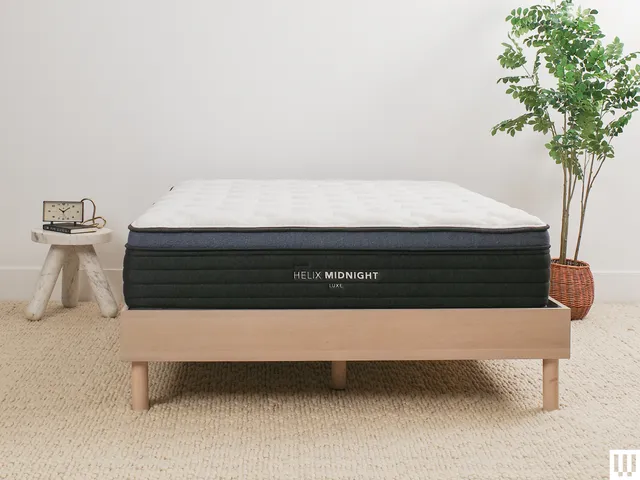
Use code LUXE25 at checkout to save on the best mattress we’ve ever tried. Out of the hundreds of options we tested, this strikes the best balance between features and price for most sleepers. Individually wrapped springs provide support and pressure relief, and six layers of cushioning mean it’s cozy but not overly plush. Make sure you get deep-pocketed sheets to accommodate the 13-inch height.
The Love Island USA season 8 reunion premieres exclusively on Peacock on Monday, August 31 at 9pm ET and if it’s anything like the spicy trailer, reality TV fans are in for a treat. All eyes on Melanie… that’s all we’re saying.
You can watch the Love Island USA season 8 reuniononlinefrom anywhere with a VPN and potentially for free.
The fiery sneak peek, co-hosted by Bravo’s Andy Cohen and Ariana Madix, sees the islanders going in hard: “If you don’t like me, go f–k yourself” rages paralympian Beatriz Hatz. Fans can also expect season 8 winner Trinity Tatum – still going strong with Bryce btw – to address the wild rumors on social media.
Advertisement
Peacock has officially confirmed season 8 racked up over 19 billion minutes streamed, so let’s find out all the ways to watch the Love Island USA season 8 reunion from anywhere.
Can I watch the Love Island USA S8 reunion for free?
All 35 episodes of Love Island USA S8 are free to watch on ITVX but Brits will have to wait a while for the reunion show.
You’ll need a subscription to either Peacock in the US, Crave in Canada, or Stan in Australia to watch reunion on August 31.
Outside the US? Use a strong VPN to watch – see our exclusive deal below.
Advertisement
Watch the Love Island USA S8 reunion from anywhere
If you’re keen to watch the Love Island USA reunionbut you’re away from home and access to the show is geo-blocked, you can always use a VPN to access it (assuming you’re not breaching any broadcaster T&Cs, of course). You may be surprised by how simple it is to do.
Use one of the best VPNs to watch Love Island reunion from anywhere:
Advertisement
Watch the Love Island USA S8 reunion in USA
The Love Island USA S8 reunion premieres at 9pm ET / 6pm PT on Mon, Aug 31 in the US, streaming exclusively on Peacock.
You’ll need the $11.99/month plan to tune in.
Alternatively, you can access Peacock for just $1 with the Walmart Plus trial. Peacock Premium is thrown in for free.
Traveling outside the US?Try using a VPN – check the details above for more.
Advertisement
How to watch the Love Island USA S8 reunion in Canada
The Love Island USA season 8 reunion show premieres an hour after the US show airs – 10pm ET/PT on Mon, Aug 31 on Crave in Canada.
Outside Canada right now?Use a VPN to gain access to all the content you’d normally stream at home.
Advertisement
Can I watch the Love Island USA S8 reunion in the UK?
(Image credit: Other)
Free-to-air ITVX is home to Love Island USA in the UK, but the season 8 reunion show isn’t likely to drop for a while. For now, you can watch all 35 episodes of season 8 for free…
Remember a VPN will help you tune in if you’re an American or a Canadian traveling across the pond. NordVPN is our recommended provider, and you can find out why with our in-depth NordVPN review (basically, it unblocks Peacock and many other VPNs don’t).
How to watch the Love Island USA S8 reunion in Australia
(Image credit: free)
The Love Island USA season 8 reunion show with Bravo’s Andy Cohen premieres on Stan in Australia on Tuesday, September 1.
Advertisement
A subscription starts at AU$12 a month.
Traveling outside Australia? As detailed above, if you’re overseas you’ll struggle to connect to any of the streaming services you usually use. The solution? Try using a VPN.
What to expect: Love Island USA S8 reunion
Andy Cohen is co-hosting – For the first time in Love Island history, host Ariana Madix is joined by Bravo big cheese Andy Cohen to co-host Monday’s reunion special, meaning the Islanders can expect a proper Real Housewives-style grilling.
Advertisement
Live studio audience – The 2026 reunion show was filmed on location at Universal Studios Hollywood in front of a live studio audience, departing from standard closed-set reunion formats. How will the crowd react?
More blockbuster ratings – According to Peacock, Love Island USA season 8 racked up over 19 billion minutes streamed, ranking as the No. 1 reality streaming title of the 2026 summer season for six consecutive weeks (per MediaPlayNews).
Breakups on stage – Season 8 winners Trinity and Bryce are still together, but let’s be honest, many couples who look solid after leaving Fiji hit the buffers when the cameras stop rolling. The reunion will catch viewers up on the breakups – and we might even see some on-stage breakups.
Season 9 preview – Alongside the reunion announcement, Peacock has officially renewed Love Island USA for season 9 with host Ariana Madix returning in 2027. The streamer also greenlit third seasons of both spinoffs – Love Island Games and Love Island: Beyond the Villa. Monday’s reunion show could contain some kind of teaser…
Advertisement
Love Island USA S8 reunion date and & time
Peacock officially confirmed that the Love Island USA Season 8 Reunion drops on Monday, August 31, 2026, at 9pm ET / 6pm PT.
Love Island USA S8 reunion cast?
The Finalists:
Advertisement
Trinity Tatum & Bryce Dettloff (Winners)
Aniya Harvey & Carl Schmidt (Runners-Up)
Melanie Moreno & Sincere Rhea (3rd Place)
Kayda Bosse & Zach Georgiou (4th Place)
Advertisement
Notable Returnees & Bombshells:
KC Chandler & Tierra “Titi” Davis
Kenzie Annis
Jen Terry
Advertisement
Beatriz Hatz
Caleb & Jaiden (returning to discuss their post-villa split)
No Shows / Minimal screentime
Unlike previous seasons there no major boycotts (so far) but don’t expect to see much of early dropouts, early bombshells or Casa Amor cuts such as Tino Ellis or Trae Taylor (looks like they were either not invited to stage seats or only featured in the audience).
Advertisement
We test and review VPN services in the context of legal recreational uses. For example: 1. Accessing a service from another country (subject to the terms and conditions of that service). 2. Protecting your online security and strengthening your online privacy when abroad. We do not support or condone the illegal or malicious use of VPN services. Consuming pirated content that is paid-for is neither endorsed nor approved by Future Publishing.
Every F-35 pilot in the US Air Force gets their own custom-fitted $400,000 helmet, which lets them peer through the cockpit mid-flight to see what’s going on in the surrounding airspace and the ground below.
This is possible through six infrared cameras embedded on to the flight’s exterior, broadcasting a 360-degree video stream straight into the pilot’s visor. Pilots say it’s like being able to see through the hull of the aircraft, as if it were made of glass.
No expense spared
Advertisement
Lockheed Martin’s F-35 Lightning II is one of the world’s most expensive fighter jets, priced anywhere between $80-110 million USD. These are single-seat, supersonic, stealth fighter jets designed for air strikes and electronic warfare.
Latest Videos FromTechRadar
Each fighter jet also comes equipped with a Gen III Helmet Mounted Display System (HMDS). A single F-35 Gen III helmet costs four times more than what the older F-16 jets came equipped with. To be more specific, an investigation by Air Force Times in 2015 put their per-unit pricing at roughly $400,000.
Given that the United States Air Force has a contract with the helmet manufacturer, Collins Elbit Vision Systems, to build thousands of these helmets — that makes the combined project cost for the headgear alone in the billions of dollars.
Advertisement
What do Air Force pilots get for the exorbitant price tag? When looking down through the visor, they get a real-time view of the airspace and ground below, the closest that the US military has come to X-ray vision.
Mark Welsh III, a retired four-star general who served as the Air Force’s 25th Chief of Staff, remarked that “the helmet is a workspace,” adding “It’s an interpretation of the battle space. It’s situational awareness. Calling this thing a helmet … we’ve got to come up with a new word.”
Sign up to the TechRadar Pro newsletter to get all the top news, opinion, features and guidance your business needs to succeed!
Advertisement
(Image credit: United States Air Force)
What makes the helmet special
The new F-35 Gen III helmets were designed by Collins Elbit Vision Systems, a joint venture between Collins Aerospace and Elbit Systems of America. Through their contract with the F-35 Joint Program, Collins Elbit has so far shipped more than 3,000 units of these helmets to the United States Air Force.
Each helmet is custom-built to match an individual pilot’s skull and facial structure, assigned right away during training, and retained by the pilot for all future flight runs.
The flagship feature of the Gen III helmets is that they let Air Force pilots see through the floor of their aircraft, using a Distributed Aperture System (DAS) designed by Northrop Grumman. This system consists of a set of cameras and built-in sensors, all connected using a software module that lets pilots track nearby aircrafts or missiles. Pilots can even lock on to targets as far as 800 miles away simply by looking at them.
Advertisement
Apart from the mounted display system and cameras, F-35 helmets are also equipped with digital night vision and thermal imaging. The visor uses high-resolution LCD lenses for improved picture clarity, plus the helmet itself is equipped with head and eye tracking systems to adjust to the pilot’s motions.
A vast improvement over previous models
Earlier versions of the F-35 helmet suffered from jittery visuals and ejection issues, so much so that the Pentagon funded a backup program with BAE Systems in case Lockheed Martin wasn’t able to deliver.
Advertisement
It took years for the joint venture to get the helmet designs right. There were multiple design iterations and several rounds of reviews before the Pentagon finally cleared the helmets for Air Force use, with the current version improved in mobility and vision.
Bob Hess, a senior director at Elbit America, went on record claiming that the Gen III HMDS was “the most advanced helmet-mounted display system in the world” in a 2024 press release. “The system’s next-generation user interface serves as a pilot’s primary display system, providing them with vital flight, tactical and sensor information day or night,” he said.
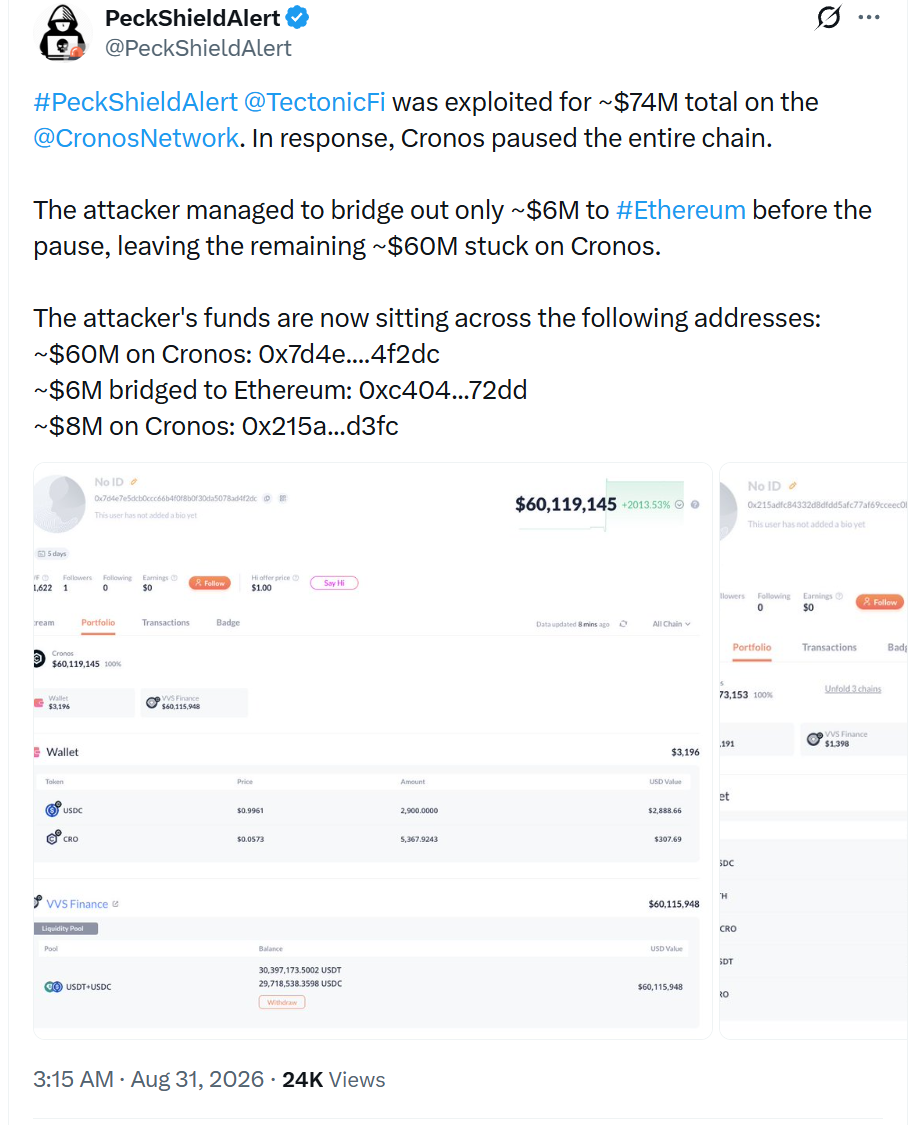
The Cronos blockchain network has resumed trading activity after a price-manipulation attack on the Tectonic cryptocurrency lending platform allowed an attacker to borrow $74 million.
According to current information, the threat actor artificially inflated the price of Tectonic’s TONIC token by 100 times, then used it as collateral to borrow real assets. The price manipulation happened in 20 minutes.
Despite the massive amount the exploit generated, the attacker only managed to steal roughly $6 million worth of Ethereum, the rest of the funds being “stuck” on Cronos, says blockchain security and data analytics company PeckShield.
Cronos is an Ethereum-like blockchain network associated with Crypto.com, while Tectonic is a decentralized finance (DeFi) lending app running on Cronos.
Advertisement
Tectonic, which was Cronos’ largest lending protocol before the incident, holding $122 million, allows users to deposit cryptocurrency and borrow against assets they provide as collateral.
After the incident, the total value locked according to DeFiLlama is just under $3 million.
Yesterday, Tectonic announced that it was investigating an incident and advised users not to interact with the protocol until the platform publicly confirmed that it was safe to do so.
Cronos responded quickly to the detected exploit and halted the blockchain’s operation, freezing all transactions in progress at the time.
Advertisement
Earlier today, Cronos restarted the network again and notified users that it “is producing blocks again and is fully back online.”
“This was a validator-consensus emergency action to protect users from an exploit on the Tectonic protocol,” Cronos states.
“The chain state was restored to before the Tectonic exploit from this morning. Cronos is producing blocks again as of 2026-08-30 23:49:01 UTC, starting from block 90,896,189.”
The blockchain is currently being closely monitored for stability, protocol compatibility, and other issues.
Advertisement
The platform also said it would provide further details about the exploit in a post-mortem report to be published soon.
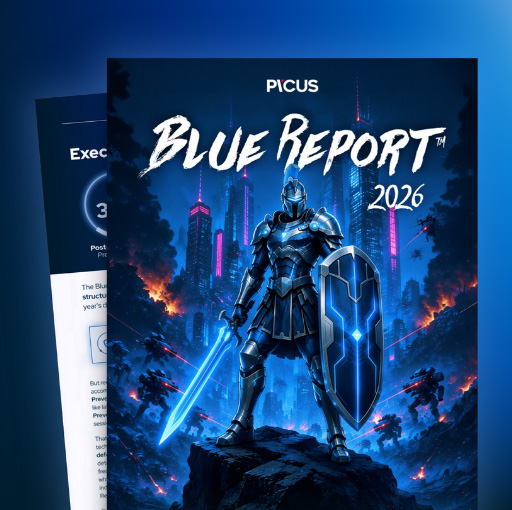
Overall prevention scores can hide what happens after initial access. Once attackers are using valid credentials, prevention drops sharply.
The Blue Report 2026 measures defenses technique by technique across 338 million simulations run in customer production environments.
We spend hours testing every product or service we review, so you can be sure you’re buying the best. Find out more about how we test.
The MSI PRO MP243 is a slim-bezel monitor that delivers nearly everything you would want from a low-cost display. At the same time, it’s exactly what you would expect when you hear the words “budget monitor.”
It’s not going to impress you with flashy features, and it’s not going to win any performance awards. It’s not the very best business monitor we’ve ever tested. But what it does offer, however, is a sleek design, an easy setup, and enough of what most people need to make it a practical choice for everyday work in the office or home.
Advertisement
Maybe you need a larger screen for your home office, or perhaps you just bought a mini PC or Mac mini and need an affordable display to go along with it. It could also work well as a second monitor in a dual-screen setup. In those cases, the MP243 does the job.
MSI PRO MP243: Price and availability
(Image credit: Collin Probst // Future)
The price is where the MP243 really starts to make sense.
At around $120, you are getting a 23.8-inch IPS panel, a 144Hz refresh rate, Adaptive-Sync, HDMI, DisplayPort, built-in speakers, VESA support, and a clean white design.
Advertisement
That is a good group of features for a monitor in this price range.
One of the closest alternatives is the Dell SE2426HS. It has a similar 23.8-inch Full HD IPS panel, 144Hz refresh rate, Adaptive-Sync, and VESA support. The Dell also has a height-adjustable stand, which is a real advantage over the tilt-only stand on the MSI.
Sign up to the TechRadar Pro newsletter to get all the top news, opinion, features and guidance your business needs to succeed!
The MSI does have a few advantages of its own. It includes built-in speakers and DisplayPort, and the white finish gives it a cleaner look than most budget monitors.
Advertisement
At a lower sale price, the MSI is an easy monitor to recommend. At around $120, it is still a good option, but there are more competitors worth considering.
It really comes down to what matters more to you. If you want the white design, built-in speakers, and DisplayPort, the MSI is a good pick. If you care more about stand adjustment (and a higher resolution), there are better options.
(Image credit: Collin Probst // Future)
MSI PRO MP243: Unboxing and First Impressions
Most of the monitor and stand are plastic, but they don’t really feel cheap. It’s lightweight enough that I’d still be careful when putting it together and taking it apart.
Advertisement
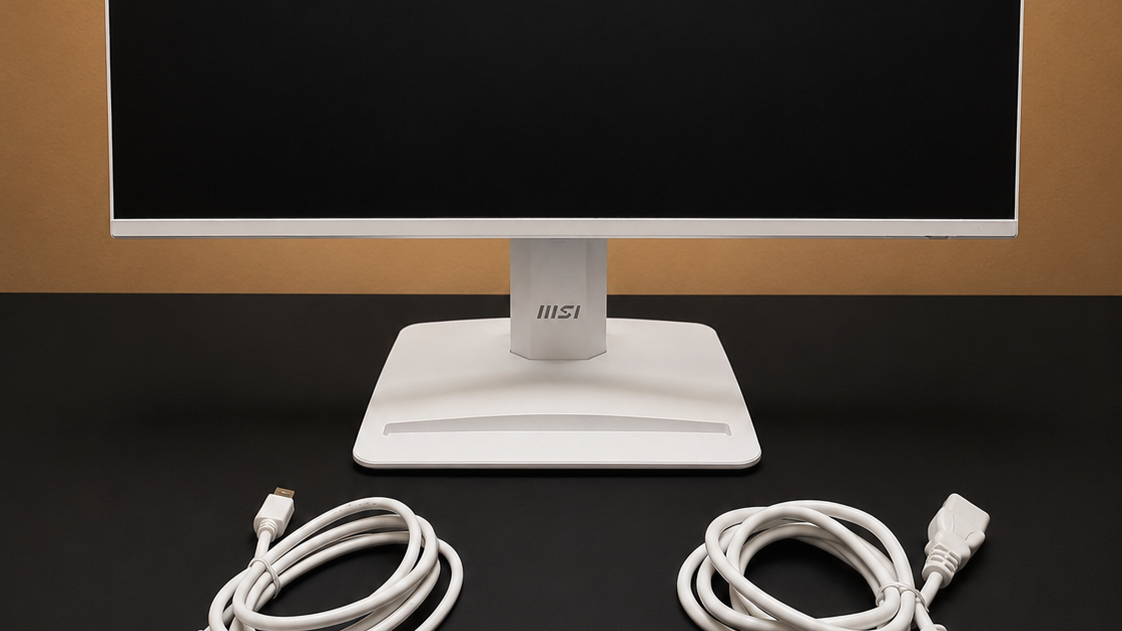
Everything included in the box is white, even down to the cables, which gives the setup a uniform look. If you’re someone who likes a certain aesthetic, I think you’ll appreciate that everything matches.
The monitor is really simple to put together. Everything just clicks in, and then you’re good to go. The back of the stem includes a cable-management clip for routing your power and display cables. It is a small feature, but it helps keep the back of your desk a little cleaner.
The top of the base includes a simple organizer slot. It’s big enough that you can put a USB adapter, thumb drive, or anything else in there that would otherwise just be sitting on top of your desk. It’s an unexpected little feature that actually turned out to be useful.
MSI advertises it as a spot to hold your phone. You can place your phone in landscape and, depending on your workflow, use it as a secondary screen or simply keep it visible for notifications, your calendar, or something similar. It’s not a huge feature by any means, but it’s another small touch I appreciated that adds to the overall practicality of the monitor.
Advertisement
MSI PRO MP243: Design & Build Quality
The monitor’s control button is on the back right side. It doubles as both the power button and the joystick for navigating the menu.
The monitor keeps things simple when it comes to connectivity. It has one HDMI port, one DisplayPort, and one 3.5mm headphone jack. Both display inputs support 1080p at refresh rates up to 144Hz.
Honestly, support for up to 144Hz is a nice bonus for this price range, even if it’s clearly built for office work first. It’s not necessary, but it’s handy and opens up the customers for this monitor a little bit as well.
Advertisement
The MP243 has the standard settings you would expect, including brightness, contrast, sharpness, volume, and color controls. It also includes a few MSI-specific features that are worth mentioning.
MSI’s EyesErgo features include Less Blue Light, Anti-Flicker, and an anti-glare coating. These are all meant to make the monitor easier on your eyes during longer work sessions. If you spend most of your day reading emails, writing, or working through spreadsheets, they are nice features to have.
There is also an Eye-Q Check feature that gives you basic reminders for posture, eye fatigue, and taking breaks. It is not a feature I would buy the monitor for, but it makes sense on something that is primarily designed for office use.
The monitor supports Adaptive-Sync, HDR Ready, and refresh rates up to 144Hz. Adaptive-Sync can help reduce screen tearing, while 144Hz makes scrolling through webpages and moving things around the screen feel smoother than it would on a basic 60Hz monitor.
Advertisement
One of the more useful features of this monitor is its support for VESA mounting. The obvious benefit is that the monitor can be attached to a compatible wall mount or monitor arm. However, I think the more interesting use case is mounting a compatible mini PC directly to the back of the monitor.
Pairing this monitor with any of the best mini PCs is a more affordable alternative to a prebuilt all-in-one desktop. The computer stays out of sight, you can use shorter cables, and the whole setup takes up less space and looks cleaner.
I’m a stickler for cable management and keeping electronics as organized as possible. Being able to mount a mini PC behind the monitor, hide most of the hardware, and cut down on visible cables really adds to the value of this monitor.
The MP243 uses a 24-inch IPS panel with a claimed viewing angle of 178 degrees.
Advertisement
The bezels are thin along the left, right, and top edges, while the bottom bezel is slightly thicker. Combined with the white finish, the slim borders give the monitor a more high-end appearance than its price might suggest.
That is where this monitor arguably shines the most. It looks sleek, occupies relatively little space, and can blend naturally into a clean home-office environment.
The actual display is more conventional. Its 1080p resolution and standard image-quality features are appropriate for email, web browsing, documents, spreadsheets, and other everyday office tasks.
You can do just about anything with it, of course, but if you’re trying to edit photos or creative content on this, you may miss some things you would catch on a higher end monitor, it also just won’t look as clear.
Advertisement
MSI PRO MP243: In use
(Image credit: Collin Probst // Future)
One thing I actually didn’t mind was virtual meetings on this monitor. While I didn’t have the clearest images of everyone, I didn’t feel the virtual meeting was degraded or compromised in any way when using this screen.
The monitor includes two built-in 2W stereo speakers. The best comparison I can make is that they sound like basic laptop speakers without Dolby features or any other processing trying to make them sound better than they are.
It was good enough to hear clear audio, but I won’t be listening to music through this anytime soon. If you do not already own desktop speakers, they are enough to get started. You can always add better speakers or headphones later.
Advertisement
I also connected an Xbox Series X and tested the monitor with Overwatch. It worked and the game was “playable.” However, the deficiencies were pretty noticeable when compared to my dedicated gaming monitor, which was already around five years old.
The 144Hz refresh rate may make it seem gaming-friendly on paper, but refresh rate alone doesn’t define the overall experience. For casual gaming, especially with a system limited to Full HD, it gets the job done.
I would not buy it specifically for gaming, though. Anyone shopping primarily for gaming should look elsewhere, which makes sense as this is more of a budget business monitor, despite the 144Hz tag that will get gamers excited.
Advertisement
MSI PRO MP243: Final verdict
(Image credit: Collin Probst // Future)
The MSI PRO MP243 is best suited to someone who wants to upgrade or expand a home-office setup without spending much money.
Its strongest qualities are its clean design, compact footprint, useful stand, cable-management features, built-in speakers, and support for VESA mounting systems. It provides the basic features most people need for regular office work while looking better than many inexpensive monitors.
Its limitations are just as clear, though. It’s only 1080p, the build is lightweight, and while it supports 144Hz, I wouldn’t recommend buying it specifically for gaming. That doesn’t make it a bad product. It just means it should be purchased for the right reasons.
This is a practical choice for emails, documents, web browsing, secondary-screen use, casual media consumption, and compact desktop setups. If you’re not concerned about having 4K, it offers a straightforward and affordable way to add more screen space to your desk.
When it comes to building real-world flying vehicles, testing can be arduous and expensive. You have to find somewhere to fly, then you have to contend with environmental conditions and the possibility of damaging your craft if things go wrong. Simulation is a great solution to this, allowing testing without so much risk. To that end, [AlexanderRex] whipped up a platform for testing UAVs from the comfort of your computer desk.
PteroSim is intended as a comprehensive test bench for simulating autonomous aerial vehicles. It can run PX4, ArduPilot, and Betaflight binaries right in the simulator. The autopilot code is given simulated sensor data, and in turn responds with actuator commands, just as it would in a real craft. The simulator runs the flight dynamics using JSBSim, and the resulting scene is rendered in Unreal Engine 5.
If you’ve ever wanted to quickly road test different autopilot settings without heading out to the field or risking hardware, this is a great way to do so. It’s hard to beat the speed of iteration that is possible when testing on the computer on your desk. We’ve featured similar work before, too.










-Partner-Photo-SOURCE-Wired-(edited-R0000095).jpg)

























































You must be logged in to post a comment Login